WALLENSTEIN, DUKE OF FRIEDLAND. By FRIEDRICH VON SCHILLER.
Reading edition
[Albrecht Wenzel Eusebius von Wallenstein, a distinguished Austrian general, the most noted opponent of Gustavus Adolphus in the Thirty Years’ War, born 1583, assassinated 1634. Wallenstein had already achieved the most brilliant rank among the Imperialist generals, except Tilly, when the defeat of the latter made the ambitious soldier, whose great wealth and unscrupulous daring had excited the jealousy of the Emperor Ferdinand, again a necessity to the Catholic cause. Wallenstein, who had raised and subsisted an immense army at his own expense at a time of pressing imperial need, had afterward been retired from command. When called again to the help of the imperial cause, Wallenstein dictated his own terms, which practically left Ferdinand a mere puppet in his hands. Though Gustavus Adolphus was victor at the battle of Lützen, it was at the cost of his own life, a result welcomed by the Catholic league as a great victory. Wallenstein reorganized his army, and was again ordered by the emperor to lay down his baton on the just suspicion that he was negotiating with the Swedes disloyally. His official removal was made known to his principal generals, and Wallenstein, deserted by a large portion of his troops, was assassinated by a conspiracy of his minor officers, who had become satisfied that it would be impracticable to secure his person alive, or to prevent his immediate junction with the advancing Swedes.]
Count Wallenstein, afterward Duke of Friedland, was an experienced officer, and the richest nobleman in Bohemia. From his earliest youth he had been in the service of the house of Austria, and several campaigns against the Turks, Venetians, Bohemians, Hungarians, and Transylvanians had established his reputation. He was present as colonel at the battle of Prague, and afterward, as major-general, had defeated a Hungarian force in Moravia. The emperor’s gratitude was equal to his services, and a large share of the confiscated estates of the Bohemian insurgents was their reward. Possessed of immense property, excited by ambitious views, confident of his own good fortune, and still more encouraged by the existing state of circumstances, he offered, at his own expense and that of his friends, to raise and clothe an army for the emperor, and even undertook the cost of maintaining it if he were allowed to augment it to fifty thousand men.
The project was universally ridiculed as the chimerical offering of a visionary brain; but the offer was highly valuable, if its promises should be but partly fulfilled. Certain circles in Bohemia were assigned to him as depots, with authority to appoint his own officers. In a few months he had twenty thousand men under arms, with which, quitting the Austrian territories, he soon afterward appeared on the frontiers of Lower Saxony with thirty thousand. The emperor had lent this armament nothing but his name. The reputation of the general, the prospect of rapid promotion, and the hope of plunder, attracted to his standard adventurers from all quarters of Germany, and even sovereign princes, stimulated by the desire of glory or of gain, offered to raise regiments for the service of Austria.
The secret how Wallenstein had purposed to fulfill his extravagant designs was now manifest. He had learned the lesson from Count Mansfeld,[25] but the scholar surpassed his master. On the principle that war must support war, Mansfeld and the Duke of Brunswick had subsisted their troops by contributions levied indiscriminately on friend and enemy; but this predatory life was attended with all the inconvenience and insecurity which accompany robbery. Like fugitive banditti, they were obliged to steal through exasperated and vigilant enemies; to roam from one end of Germany to another; to watch their opportunity with anxiety, and to abandon the most fertile territories whenever they were defended by a superior army. If Mansfeld and Duke Christian had done such great things in the face of these difficulties, what might not be expected if the obstacles were removed; when the army raised was numerous enough to overawe in itself the most powerful states of the empire; when the name of the emperor insured impunity to every outrage; and when, under the highest authority, and at the head of an overwhelming force, the same system of warfare was pursued which these two adventurers had hitherto adopted at their own risk, and with only an untrained multitude?
Wallenstein was at the head of an army of nearly a hundred thousand men, who adored him, when the sentence of his dismissal arrived. Most of the officers were his creatures—with the common soldiers his hint was law. His ambition was boundless, his pride indomitable, his imperious spirit could not brook an injury unavenged. One moment would now precipitate him from the height of grandeur into the obscurity of a private station. To execute such a sentence upon such a delinquent seemed to require more address than it cost to obtain it from the judge. Accordingly, two of Wallenstein’s most intimate friends were selected as heralds of these evil tidings, and instructed to soften them as much as possible by flattering assurances of the continuance of the emperor’s favor.
Wallenstein had ascertained the purport of their message before the imperial ambassadors arrived. He had time to collect himself, and his countenance exhibited an external calmness while grief and rage were storming in his bosom. He had made up his mind to obey. The emperor’s decision had taken him by surprise before circumstances were ripe or his preparations complete for the bold measures he had contemplated. His extensive estates were scattered over Bohemia and Moravia, and by their confiscation the emperor might at once destroy the sinews of his power. He looked, therefore, to the future for revenge, and in this hope he was encouraged by the predictions of an Italian astrologer, who led his imperious spirit like a child in leading-strings. Seni had read in the stars that his master’s brilliant career was not yet ended, and that bright and glorious prospects still awaited him. It was, indeed, unnecessary to consult the stars to foretell that an enemy, Gustavus Adolphus, would ere long render indispensable the services of such a general as Wallenstein.
“The Emperor is betrayed,” said Wallenstein to the messengers; “I pity but forgive him. It is plain that the grasping spirit of the Bavarian dictates to him. I grieve that, with so much weakness, he has sacrificed me; but I will obey.” He dismissed the emissaries with princely presents, and, in a humble letter, besought the continuance of the emperor’s favor and of the dignities he had bestowed upon him.
The murmurs of the army were universal on hearing of the dismissal of their general, and the greater part of his officers immediately quitted the imperial service. Many followed him to his estates in Bohemia and Moravia; others he attached to his interests by pensions, in order to command their services when the opportunity should offer.
But repose was the last thing that Wallenstein contemplated when he returned to private life. In his retreat he surrounded himself with a regal pomp which seemed to mock the sentence of degradation. Six gates led to the palace he inhabited in Prague, and a hundred houses were pulled down to make way for his courtyard. Similar palaces were built on his other numerous estates. Gentlemen of the noblest houses contended for the honor of serving him, and even imperial chamberlains resigned the golden key to the emperor to fill a similar office under Wallenstein. He maintained sixty pages, who were instructed by the ablest masters. His antechamber was protected by fifty life-guards. His table never consisted of less than one hundred covers, and his seneschal was a person of distinction. When he traveled his baggage and suite accompanied him in a hundred wagons drawn by six or four horses; his court followed in sixty carriages attended by fifty led horses. The pomp of his liveries, the splendor of his equipages, and the decorations of his apartments were in keeping with all the rest. Six barons and as many knights were in constant attendance about his person, and ready to execute his slightest order. Twelve patrols went their rounds about his palace to prevent any disturbance. His busy genius required silence. The noise of coaches was to be kept away from his residence, and the streets leading to it were frequently blocked up with chains. His own circle was as silent as the approaches to his palace. Dark, reserved, and impenetrable, he was more sparing of his words than of his gifts, while the little that he spoke was harsh and imperious. He never smiled, and the coldness of his temperament was proof against sensual seductions.
Ever occupied with grand schemes, he despised all those idle amusements in which so many waste their lives. The correspondence he kept up with the whole of Europe was chiefly managed by himself, and, that as little as possible might be trusted to the silence of others, most of the letters were written by his own hand. He was a man of large stature, thin, of a sallow complexion, with short, red hair, and small, sparkling eyes. A gloomy and forbidding seriousness sat upon his brow, and his magnificent presents alone retained the trembling crowd of his dependents.
In this stately obscurity did Wallenstein silently but not inactively await the hour of revenge. The victorious career of Gustavus Adolphus soon gave him a presentiment of its approach. Not one of his lofty schemes had been abandoned, and the emperor’s ingratitude had loosened the curb of his ambition. The dazzling splendor of his private life bespoke high soaring projects, and, lavish as a king, he seemed already to reckon among his certain possessions those which he contemplated with hope.
Wallenstein, at the age of fifty, terminated his active and extraordinary life. To ambition he owed both his greatness and his ruin. With all his failings he possessed great and admirable qualities; and, had he kept himself within due bounds, he would have lived and died without an equal. The virtues of the ruler and of the hero—prudence, justice, firmness, and courage—are strikingly prominent features in his character; but he wanted the gentler virtues of the man, which adorn the hero and make the ruler beloved. Terror was the talisman with which he worked; extreme in his punishments as in his rewards, he knew how to keep alive the zeal of his followers, while no general of ancient or modern times could boast of being obeyed with equal alacrity. Submission to his will was more prized by him than bravery; for, if the soldiers work by the latter, it is on the former that the general depends. He continually kept up the obedience of his troops by capricious orders, and profusely rewarded the readiness to obey even trifles, because he looked rather to the act itself than its object. He once issued a decree, with the penalty of death on disobedience, that none but red sashes should be worn in the army. A captain of horse no sooner heard the order, than, pulling off his gold-embroidered sash, he trampled it under foot. Wallenstein, on being informed of the circumstance, promoted him on the spot to the rank of colonel.
His comprehensive glance was always directed to the whole, and in all his apparent caprice, he steadily kept in view some general scope or bearing. The robberies committed by the soldiers in a friendly country had led to the severest orders against marauders; and all who should be caught thieving were threatened with the halter. Wallenstein himself having met a straggler in the open country upon the field, commanded him to be seized without trial, as a transgressor of the law, and, in his usual voice of thunder, exclaimed, “Hang the fellow,” against which no opposition ever availed. The soldier pleaded and proved his innocence, but the irrevocable sentence had gone forth. “Hang, then, innocent,” cried the inexorable Wallenstein, “the guilty will have then more reason to tremble.” Preparations were already making to execute the sentence, when the soldier, who gave himself up for lost, formed the desperate resolution of not dying without revenge. He fell furiously upon his judge, but was overpowered by numbers and disarmed before he could fulfil his design. “Now let him go,” said the duke, “it will excite sufficient terror.”
His munificence was supported by an immense income, which was estimated at three millions of florins yearly, without reckoning the enormous sums which he raised under the name of contributions. His liberality and clearness of understanding raised him above the religious prejudices of his age; and the Jesuits never forgave him for having seen through their system, and for regarding the pope as nothing more than a bishop of Rome.
But as no one ever yet came to a fortunate end who quarrelled with the Church, Wallenstein, also, must augment the number of its victims. Through the intrigues of monks, he lost at Ratisbon the command of the army, and at Egra his life; by the same arts, perhaps, he lost what was of more consequence, his honorable name and good repute with posterity.
For, in justice, it must be admitted that the pens which have traced the history of this extraordinary man are not untinged with partiality, and that the treachery of the duke, and his designs upon the throne of Bohemia, rest not so much upon proved facts, as upon probable conjecture. No documents have yet been brought to light which disclose with historical certainty the secret motives of his conduct; and among all his public and well-attested actions, there is, perhaps, not one which could have had an innocent end. Many of his most obnoxious measures proved nothing but the earnest wish he entertained for peace; most of the others are explained and justified by the well-founded distrust he entertained of the emperor, and the excusable wish of maintaining his own importance. It is true, that his conduct toward the Elector of Bavaria looks too like an unworthy revenge, and the dictates of an implacable spirit; but still, none of his actions perhaps warrant us in holding his treason to be proved. If necessity and despair at last forced him to deserve the sentence which had been pronounced against him while innocent, still this will not justify that sentence. Thus Wallenstein fell, not because he was a rebel, but he became a rebel because he fell. Unfortunate in life that he made a victorious party his enemy, but still more unfortunate in death, that the same party survived him and wrote his history.
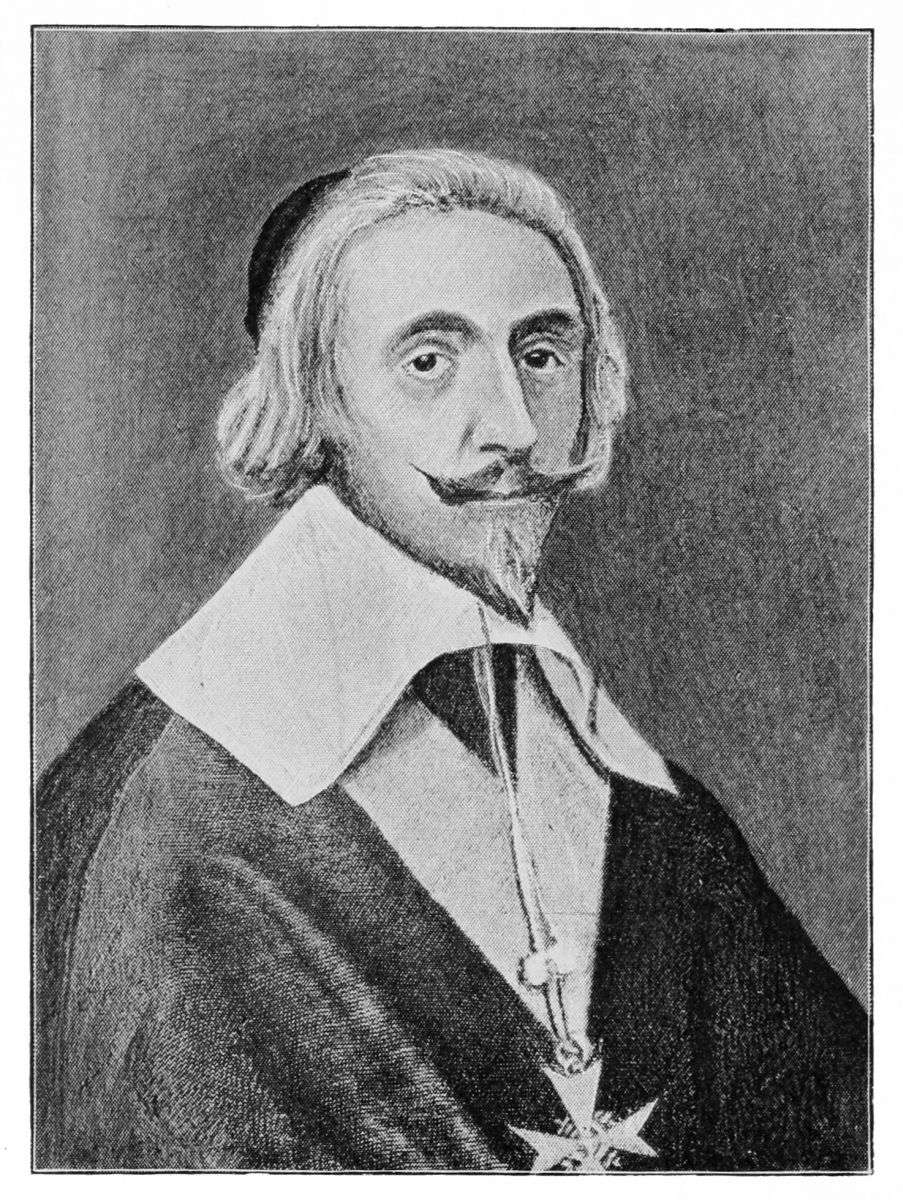
CARDINAL RICHELIEU.