HANNIBAL. By THEODOR MOMMSEN.
Reading edition
[A Carthaginian statesman and soldier, one of the foremost generals of antiquity, born 247 B.C., died 183. The series of Italian campaigns in which he imperiled the very existence of Rome are commented on by modern military critics as models of brilliancy and daring, combined with far-sighted prudence. Finally compelled to evacuate Italy, he was defeated and his army destroyed by Publius Cornelius Scipio, afterward surnamed Africanus, at the battle of Zama in Africa in 202. Exiled from Carthage, he spent the latter years of his life in fomenting war against Rome among the Eastern nations, and finally committed suicide to prevent being delivered over to the hands of Rome. References: Mommsen’s “History of Rome,” Plutarch’s “Lives.”]
When Hamilcar departed to take command in Spain, he enjoined his son Hannibal, nine years of age, to swear at the altar of the Supreme God eternal hatred to the Roman name, and reared him and his younger sons, Hasdrubal and Mago—the “lion’s brood,” as he called them—in the camp, as the inheritors of his projects, of his genius, and of his hatred.
The man whose head and heart had in a desperate emergency and amid a despairing people paved the way for their deliverance, was no more when it became possible to carry out his design. Whether his successor Hasdrubal forbore to make the attack because the proper moment seemed to him not yet to have arrived, or whether, a statesman rather than a general, he believed himself unequal to the conduct of the enterprise, we are unable to determine. When, at the beginning of 219 B.C., he fell by the hand of an assassin, the Carthaginian officers of the Spanish army summoned to fill his place Hannibal, the eldest son of Hamilcar.
He was still a young man, born in 247 B.C., and now, therefore, in his twenty-ninth year; but his life had already been fraught with varied experience. His first recollections picture to him his father fighting in a distant land and conquering on Ercte; he shared that unconquered father’s fortunes and sympathized with his feelings on the peace of Catulus, on the bitter return home, and throughout the horrors of the Libyan war. While still a boy he had followed his father to the camp, and he soon distinguished himself.
His light and firmly built frame made him an excellent runner and boxer and a fearless rider; the privation of sleep did not affect him, and he knew like a soldier how to enjoy or to want his food. Although his youth had been spent in
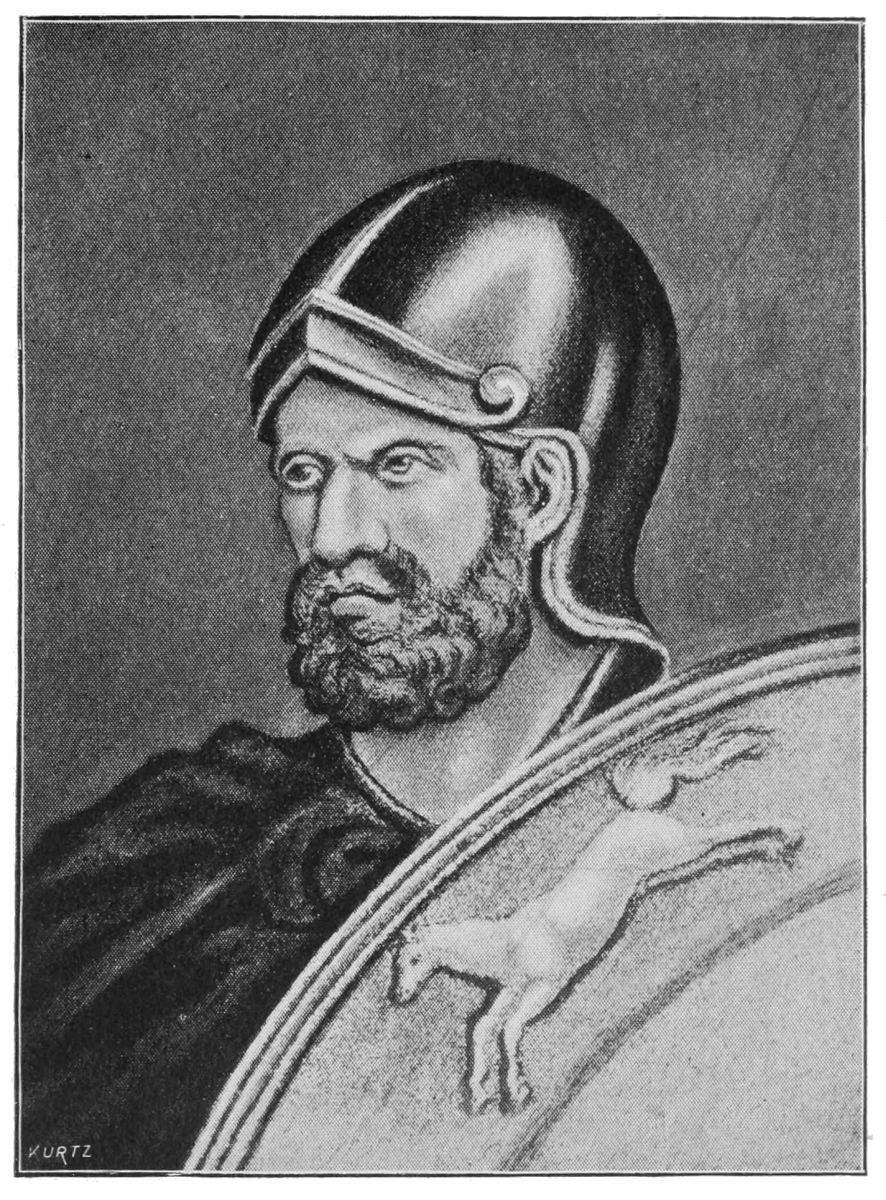
HANNIBAL.
the camp, he possessed such culture as was bestowed on the noble Phœnicians of the time; in Greek, apparently after he had become a general, he made such progress under the guidance of his intimate friend Sasilus of Sparta as to be able to compose state papers in that language.
As he grew up, he entered the army of his father to perform his first feats of arms under the paternal eye, and to see him fall in battle by his side. Thereafter he had commanded the cavalry under his sister’s husband Hasdrubal and distinguished himself by brilliant personal bravery as well as by his talents as a leader. The voice of his comrades now summoned him—their tried and youthful leader—to the chief command, and he could now execute the designs for which his father and his brother-in-law had died.
He took possession of the inheritance, and was worthy of it. His contemporaries tried to cast stains of all sorts on his character; the Romans charged him with cruelty, the Carthaginians with covetousness; and it is true that he hated as only Oriental natures know how to hate, and that a general who never fell short of money and stores can hardly have been other than covetous. Nevertheless, though anger and envy and meanness have written his history, they have not been able to mar the pure and noble image which it presents.
Laying aside wretched inventions which furnished their own refutation, and some things which his lieutenants Hannibal Monomachus, and Mago the Samnite, were guilty of doing in his name, nothing occurs in the accounts regarding him which may not be justified in the circumstances and by the international law of the times; and all agree in this—that he combined in rare perfection discretion and enthusiasm, caution and energy.
He was peculiarly marked by that inventive craftiness which forms one of the leading traits of the Phœnician character—he was fond of taking singular and unexpected routes; ambushes and strategems of all sorts were familiar to him; and he studied the character of his antagonists with unprecedented care. By an unrivaled system of espionage—he had regular spies even in Rome—he kept himself informed of the projects of the enemy; he himself was frequently seen wearing disguises and false hair in order to procure information on some point or another.
Every page of history attests his genius as a general; and his gifts as a statesman were, after the peace with Rome, no less conspicuously displayed in his reform of the Carthaginian constitution and in the unparalleled influence which as an exiled strength he exercised in the cabinets of the Eastern powers. The power which he wielded over men is shown by his incomparable control over an army of various nations and many tongues—an army which never in the worst times mutinied against him. He was a great man; wherever he went he riveted the eyes of all.
Hannibal’s cautious and masterly execution of his plan of crossing the Alps into Italy, instead of transporting his army by sea, in its details, at all events, deserves our admiration, and, to whatever causes the result may have been due—whether it was due mainly to the favor of fortune or mainly to the skill of the general—the grand idea of Hamilcar, that of taking up the conflict with Rome in Italy, was now realized. It was his genius that projected the expedition; and the unerring tact of historical tradition has always dwelt on the last link in the great chain of preparatory steps, the passage of the Alps, with a greater admiration than on the battles of the Trasimene Lake and of the plain of Cannæ.
Hannibal knew Rome better, perhaps, than the Romans knew it themselves. It was clearly apparent that the Italian federation was in political solidity and in military resources far superior to an adversary who received only precarious and irregular support from home; and that the Phœnician foot-soldier was, notwithstanding all the pains taken by Hannibal, far inferior in point of tactics to the legionary, had been completely proved by the defensive movements of Scipio. From these convictions flowed two fundamental principles which determined Hannibal’s whole method of operations in Italy, viz., that the war should be carried on somewhat adventurously, with constant changes in the plan and in the theatre of operations; and that its favorable issue could only be looked for as the result of political and not of military successes—of the gradual loosening and breaking up of the Italian federation.
This aim was the aim dictated to him by right policy, because mighty conqueror though he was in battle, he saw very clearly that on each occasion he vanquished the generals but not the city, and that after each new battle, the Romans remained as superior to the Carthaginians as he was personally superior to the Roman commanders. That Hannibal, even at the height of his fortune, never deceived himself on this point is a fact more wonderful than his wonderful battles.