Chapter VI · (continued 2)
Reading edition
The purely chemical deposits of limestone are probably all of shallow-water origin. Once made, they are subject to solution, redeposition, and other mutations like other deposits. As a result, they often lose many of their original characteristics, but enough usually remain to tell the story of their origin.
Deep-sea Deposits.
Contrasted with shallow-water deposits.—The deep-sea deposits cover the ocean-bottom below the 100-fathom line. Their area is considerably more than half the earth’s surface. The characteristic deposits are muds, organic oozes, and clays, which in their physical characteristics are remarkably uniform. In regions of floating ice, greater diversity is introduced from the varied nature of the materials which the ice transports, but gravels and sands, comparable to those of shallow water, are rarely found. “Tides, currents, and waves produce some mechanical effects at the upper limits of the deep-sea region, but on the whole there is an absence of the phenomena of erosion, and mechanical action would appear to be absent except in the case of submarine eruptions. The depth is too great for sunlight to penetrate, and vegetable life is limited to the upper zone. Animal life is present in the same zone and on the bottom, but absent or nearly so in the middle depths. The temperature (at the bottom) is below 40° Fahr. throughout the larger part of the area, and if subject to variation with latitude or change of season, these changes affect only the depths immediately beyond the 100-fathom line. Throughout the whole region there is a very uniform set of conditions. In the shallow-water and littoral zones, owing to the rapid accumulation and the mechanical effects of transportation and erosion, the effects of chemical modification are not very apparent in the deposits; but in deep-sea deposits, in consequence of the less rapid rate of accumulation, absence of transport, the nature and small size of the particles, many evident chemical reactions have taken place, resulting in the formation in situ of glauconite, phosphatic and manganese nodules, zeolites, and other secondary products.”[176] With increasing depth and distance from the shore, the character of the deposits undergoes a change. There is less and less material derived directly from the land, and more “amorphous matter arising from the ultimate decomposition of minerals and rocks, and accompanied, in all moderate depths, by an increase [relative] of the remains of pelagic organisms. We thus pass insensibly from those deep-sea deposits of a terrestrial origin, which we call ‘terrigenous,’ to those deep-sea deposits denominated ‘pelagic,’ in which the remains of calcareous and siliceous organisms, clays and other substances of secondary origin play the principal rôle.”[176]
The following table[177] shows the relations of the various groups of marine deposits.
1. Deep-sea deposits beyond 100 fathoms Red clay I. Pelagic deposits formed in deep water removed from land.


Radiolarian ooze
Diatom ooze
Globigerina ooze
Pteropod ooze
Blue mud II. Terrigenous deposits formed in deep and shallow water, mostly close to land.
Red mud
Green mud
Volcanic mud
Coral mud
2. Shallow-water deposits between low-water mark and 100 fathoms Sands, gravels, muds, etc.
3. Littoral deposits between high- and low-water marks Sands, gravels, muds, etc.
Sources.—The pelagic deposits are made up in part of materials of organic origin, and in part of materials of inorganic origin. The inorganic materials may be of mechanical or chemical origin. Mechanical pelagic deposits originate in various ways. They may come (1) from the land by the ordinary processes of gradation, (2) from volcanic vents, or (3) from extra-terrestrial sources. Chemical deposits may be formed (1) in situ by the chemical interaction of substances in the sea-water on materials of organic and inorganic origin, and (2) by direct precipitation from the sea-water.
Mechanical inorganic deposits.—The terrigenous materials which reach the deep sea are, as a rule, only the finest products of land decay, and are carried out by movements of water or by the winds. They are not commonly recognized in the dredgings more than 200 miles from the shore, but opposite the mouths of great rivers they extend much farther,—1000 miles in the case of the Amazon. They are especially abundant on the slopes of the continental shelves. Here occur the blue, green, and red muds, with which are associated volcanic and coral muds. The color of these various muds is dependent in part on the changes which they have undergone since their deposition. The green muds usually contain enough glauconite to give them their color, and are most commonly found off bold coasts where sedimentation is not rapid. The blue muds indicate lack of oxidation, or perhaps deoxidation. Red muds are not common, though they have been found in some situations. In general, these deposits are analogous to certain shales, marls, etc., found within the continents.
Though coarse materials derived from the land are occasionally found in the deep-sea deposits, their presence must be looked upon as in some sense accidental. Occasional pebbles, or even bowlders, are carried out into the ocean entangled in the roots of floating trees. Within limits, too, icebergs have carried out land débris, though it is probable that transportation by this means has been exaggerated. The amount which icebergs might carry, if fully loaded, is far greater than the amount which they do carry.
Of the identifiable inorganic materials in the deep sea, the most abundant are of volcanic origin, and among these the most common is pumice, which is frequently so light that it floats readily until it becomes water-logged. Pieces of pumice brought up by the Challenger and thoroughly dried were found to float for months in sea-water before settling even through the depth of water contained in the vessel in which the experiment was performed.[178] The next most abundant substance of volcanic origin in pelagic deposits is volcanic glass. This ranges from pieces of the size of a walnut down to the smallest fragments, which often serve as centers for concretions. Lapilli (cinders) and volcanic ash also are abundant in parts of the deep sea. The distribution of these volcanic products is essentially universal, though by no means uniform. Some of them are probably from submarine volcanoes.
The study of the deep sea deposits has revealed the presence of many nodules and grains which are believed to be of extra-terrestrial origin. Many of them are magnetic.[179] The dust of countless meteors which enter the atmosphere daily settles on land and sea alike, and enters into the sediment of the bottom of the latter. It is probably no more abundant in deep water than in shallow, but it is relatively more important, since other sedimentation is more meager. The number of meteorites which enter the atmosphere daily has been estimated at from 15,000,000 to 20,000,000.[180] If on the average the meteorites weigh ten grains each, probably a rather high estimate, the total amount of extra-terrestrial matter reaching the earth yearly would be 5,000 to 7,000 tons, and something like three-fourths of this must, on the average, fall into the sea. But even at this rate it would take some fifty billion years to cover the sea-bottom with a layer one foot in thickness.
Organic constituents of pelagic deposits.—With increasing distance from shores, and especially with increasing depth of water, terrigenous deposits become less and less abundant, and sediments derived from pelagic life increase in relative importance. Beyond the upper part of the outer slopes of the continental shelves, the pelagic deposits are largely made up of shells and skeletons of marine organisms which live in the surface-waters. Pelagic molluscs, foraminifera, and algæ secrete shells of lime carbonate, while diatoms and radiolarians secrete shells of silica. When the organisms die, they sink to the bottom with their shells, and these mineral matters of organic origin are mingled with the volcanic products which are universal over the sea-floor. Pelagic deposits of organic origin are named according to their characteristic constituents. Thus there are pteropod oozes, globigerina oozes, diatom oozes, radiolarian oozes, etc.[181] It is not to be understood that these oozes are made up exclusively of the shells which give them their names. Diatom ooze is an ooze in which diatom shells are abundant, not an ooze made up wholly of diatom shells; and globigerina ooze is an ooze in which globigerina shells are abundant, though in many cases they do not make up even the bulk of the matter. While samples of these various oozes might be selected which are thoroughly distinct from one another, there are all gradations between them, since pelagic life does not recognize boundary-lines.
It is a significant fact that with increasing depth the proportion of lime carbonate in the ooze decreases. Thus in tropical regions remote from land where the depths are less than 600 fathoms, the carbonate of lime of the shells of pelagic organisms may constitute 80% or 90% of the deposit. With the same surface conditions, but with increasing depth, the percentage of lime carbonate decreases, until at 2000 fathoms it is less than 60%; at 2400 fathoms, 30%, and at 2600 fathoms, 10%. Beyond this depth there are usually no more than traces of carbonate of lime. The data at hand show that the percentage of lime carbonate falls off below 2200 fathoms more rapidly than at lesser depths.
When the percentage of lime carbonate becomes very low, the calcareous oozes grade off into the red clay with which the sea-floor below 2400 to 2600 fathoms is covered.
Chemical deposits.—The chemical deposits of the deep sea are chiefly the alteration products of sediments which reach the sea-bottom by mechanical means. All sediment deposited in the sea undergoes more or less chemical change, but it is only when the change is very considerable that the product is referred to this class. Where sedimentation is rapid and the sediment coarse, the chemical change is relatively slight; but where the sedimentation is slow and the sediment fine, the chemical change is relatively great; for the longer exposure to the sea-water and the greater proportion of surface exposed to attack, both favor change. Both the area and the mass of sea-bottom sediment radically changed in this way are large, but most of the deposit does not correspond to any formation known on the land.
The red clay already referred to belongs to this class of deposits. Its origin has been the subject of much discussion. It contains much volcanic débris, various concretions, bones of mammals, zeolitic crystals, and extra-terrestrial spherules, and doubtless the insoluble products of the shells of pelagic life; but it is still a mooted question how far the clay itself is the product of decomposed shells, and how far the altered product of pulverized pumice, volcanic ash, dust, etc. Pelagic life does not seem to be less abundant at the surface where the water is deep than where it is shallow, and it would appear that the shells must sink in such situations as elsewhere. If the lime carbonate of globigerina ooze be removed by dilute acid, the inorganic residue is similar to the red clay in the ocean-bottom. This suggests that owing to the more complete solution in the very deep water, the lime carbonate of the shells has been dissolved, leaving the red clay as a residuum. The more complete solution at the bottom might be the result either of the greater pressure, or of a greater percentage of CO2 in the water due to emanations from the sea-floor, or to both; but the suddenness of the transition from oozes to red clay, with increasing depth, does not seem to be fully explained by these assumptions. The study of the dredgings has inclined the students of these materials to the conclusion that volcanic materials, rather than shells, are the principal source of the red clay.[182] The volcanic materials are thought to have accumulated slowly and to have been long exposed to the action of sea-water. The various nodules and crystals in the clay are believed to be secondary products, the materials for which were derived from the decomposition of the same materials. Eolian dust may be a notable constituent of the red clay.
Various specific products of chemical change may be briefly referred to. The decomposition of certain mineral particles, such as feldspar, gives rise to kaolin, and kaolin is a very considerable constituent of most of the clayey deposits of the ocean-bottom. The kaolinization of feldspar may take place both on land and in the sea. Manganiferous deposits are widespread in the ocean-bottom, occurring both as coatings on grains of mechanical sediments, shells, etc., and as concretions ranging in sizes from minute particles to nodules an inch or more in diameter. The concretions are sometimes approximately spheroidal, but often botryoidal. These manganiferous nodules are believed to have arisen from the decay of fragments of volcanic rocks. In their decay, the manganese and iron are believed to have been first changed to carbonates, and subsequently to oxides. After manganese oxide, iron oxide and silica are by far the most abundant constituents, but many other substances enter into their composition in minor quantities.
Another substance somewhat widely distributed in the sea-bed, though by no means universal, is glauconite, a complex silicate of alumina, iron, potassium, etc. Glauconite is, on the whole, most abundant along the edges of the continental shelves, though it is by no means universal in this position. It is not commonly found in deep water, nor very near the shore, but approximately at the “mud-line.” The glauconite grains begin to form, as a rule, in tiny shells, chiefly the shells of foraminifera. After filling the shell, the shell itself may disappear, while the glauconite goes on accumulating around the core already formed, until the grain attains considerable size. Glauconite is believed to be an alteration product of certain sorts of mechanical sediment, the change being effected under the influence of the decaying organic matter in the shells.[183] It does not occur where sedimentation is rapid, and its formation appears to be favored by considerable changes of temperature. Glauconite deposits occur on the land and are commonly known as green sand marl. Glauconite also occurs sparingly in many other sedimentary rocks.
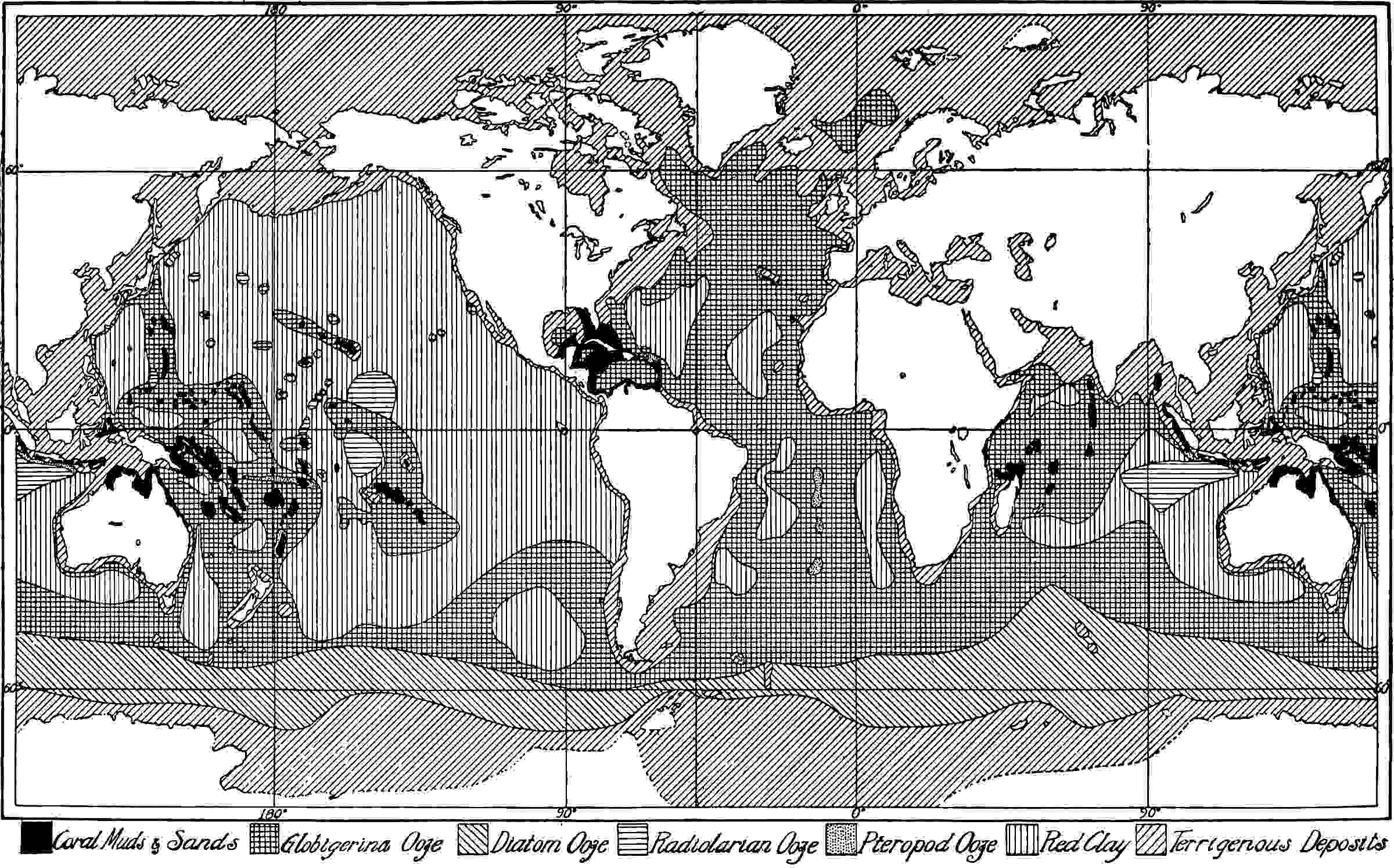
Fig.
330.—Distribution of various sorts of deep-sea deposits. (Murray. Challenger Reports.)
Another substance which is somewhat widespread in the ocean-bottom is phosphate of lime, which occurs in various sorts of oozes, in the manganiferous nodules, in glauconite, and in independent nodules. Like the grains of glauconite, the grains of phosphate of lime appear to have started as concretions in shells, and to be the result of the reaction of organic matter on the contents of sea-water. The immediate source of the lime phosphate in the water appears to have been the shells or bones of the numerous animals living in the sea.
Secondary minerals made from the constituents of volcanic matter which has been decomposed occur not uncommonly in the bottom of the sea. These minerals belong to the general class of zeolites, phillipsite being the most abundant. Their distribution is somewhat wide, but their quantity is slight.
Unfortunately, knowledge of the deep-sea deposits is limited to their superficial layers. Soundings do not usually penetrate more than a few inches, or at most a foot or two.
Unlike shallow-water deposits, those of the really deep sea seem to find no correlatives in the known rock formations of the land.
LAKES.
Most of the phenomena of the ocean are repeated on a smaller scale in lakes. The waves of lakes and their attendant undertows and littoral currents are governed by the same laws and do the same sort of work as the corresponding movements of the ocean. Tides are absent, or insignificant, but slight changes of level, known as seiches,[184] have been observed in many lakes. They are probably caused by sudden changes in atmospheric pressure. While they are generally very slight, they frequently amount to as much as a foot, and occasionally to several feet. The seiches are oscillatory movements, and their period is influenced by the length and depth of the lake. They have been studied most carefully in Switzerland. Currents corresponding to those of the ocean are slight or wanting in lakes, but since most lakes have inlets and outlets, their waters are in constant movement toward the latter. In most cases this movement is too slow to be readily noted, or to do effective work either in corrasion or transportation. The work of the ice, on the other hand, is relatively more important in lakes than in the sea.
Changes taking place in lakes.—The processes in operation in lakes are easily observed and readily understood. (1) The waves wear the shores, and the material thus derived is transported, assorted, and deposited as in the sea, and all the topographic forms resulting from erosion or deposition along the seacoast are reproduced on their appropriate scale in lakes. (2) Streams bear their burden of gravel, sand, and mud into lakes and leave it there. (3) The winds blow dust and sand into the lakes, and in some places pile the sand up into dunes along the shores. (4) Animals of various sorts live in the lakes, and their shells and bones give rise to deposits comparable to the animal deposits in the sea. (5) Abundant plants grow in the shallow water about the borders of many ponds and lakes, and as they die, their substance accumulates on the bottom. (6) At the outlet the water is constantly lowering its channel. The lowering of the outlet is often slow, especially if the rock be coherent, for the outflowing water is usually clear, and therefore inefficient in corrasive work. These six processes are essentially universal, and all conspire against the perpetuity of the lakes. (7) In lakes where the temperature is low enough for ice to be formed, it crowds on the shores and develops phenomena peculiar to itself. The ice of the sea may work in similar ways, but its work is restricted to high latitudes. (8) In lakes in arid regions, deposits are often made by precipitation from solution. The first five and the last of these processes are filling the basins of the lakes. As the sediment is deposited, a corresponding volume of water is displaced, and, if there be outlets, forced out of the basins; the sixth process is equally antagonistic to the lakes, while the seventh has little influence on their permanence. Given time enough, these processes must bring the history of any lake to an end. The lowering of the outlet will alone accomplish this result if the bottom of the basin is above base-level. Many lakes have already become extinct, either through the filling or draining of their basins, or through both combined. The antagonism of rivers and lakes long ago led to the epigram “Rivers are the mortal enemies of lakes.” True as this statement is, it does not follow that lakes will ever cease to exist, for the causes which produce new lakes may be in operation contemporaneously with those which bring lakes now in existence to an end.
Lacustrine deposits.—The beds of sediment deposited in lakes are similar in kind, in structure, and in disposition to beds of sediment laid down in the sea, but river-borne sediment is more commonly concentrated into deltas, since waves and shore-currents are less effective. Even the limestone of the sea has its correlative in some lakes. Some of it was made of the shells of fresh-water animals which throve where the inwash of terrigenous sediment was slight, some of it from the calcareous secretions of plants,[185] and some of it was precipitated from solution.[186] Salt and iron-ore[187] deposits are also sometimes made in lakes.
Extinct lakes.—The former existence of lakes where none now exist may be known in various ways. If the lake basin was filled, its former area is a flat, the beds of which bear evidence, in their composition, their structure, and often in their fossil contents, of their origin in standing water. Such a flat is commonly so situated topographically that the basin would be reproduced if the lacustrine deposits were removed. To this general rule there might be exceptions, as where a glacier formed one side of the basin when it was filled. If the lake was destroyed by the reduction of its outlet, or by the removal of some other barrier, such as glacier ice, or by desiccation, shore phenomena, such as beaches, spits, etc., may be found. In time such evidences are destroyed by subaërial erosion, so that they are most distinct soon after the lake becomes extinct.
Many lakes, some of them large[188] and many of them small, are known to have become extinct, while many others are now in their last stages, namely, marshes. Many others have been greatly reduced in size. Such reductions are often obvious where deltas are built into lakes. Thus the delta built by the Rhone into Lake Geneva is several miles in length, and has been lengthened nearly two miles since the time of the Roman occupation. The end of Seneca (N. Y.) lake has been crowded northward some two miles by deposition at its head. Similar changes have taken place and are now in progress in many other lakes.
Lake ice.[189]—Since fresh water is densest at 39° Fahr., ice does not commonly form on the surface until the temperature from top to bottom is reduced to this point. Cooled below this temperature, the surface-water fails to sink, and with sufficient reduction freezes. If the lake be small, and especially if it be shallow, it is likely to freeze over completely in any region where the temperature is notably below the freezing-point for fresh water for any considerable period of time. It is under these circumstances that the ice becomes most effective.
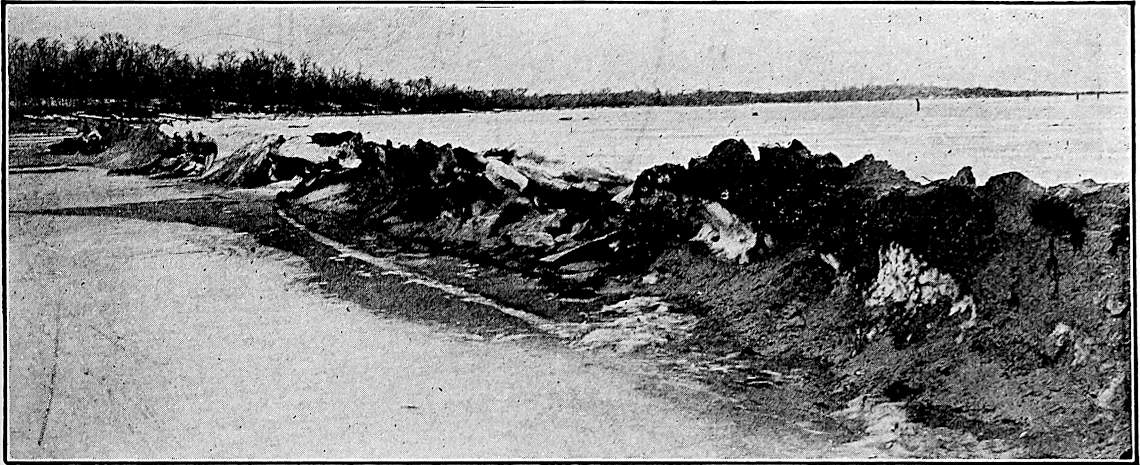
Fig.
331.—Ice crowding upon low shore. Clear Lake, Ia. (Calvin.)
Suppose a lake in temperate latitudes, where the range of temperature is considerable, to be frozen over when the temperature is 20° Fahr. If now the temperature be suddenly lowered to −10°, and such change of temperature is not uncommon in the northern part of the United States, the ice contracts notably. In contracting, it either pulls away from the shores or cracks. If the former, the water from which the ice is withdrawn quickly freezes; if the latter, water rises in the cracks and freezes there. In either case, the ice-cover of the lake is again complete. If the temperature now rises to 20° the ice expands. The cover is now too large for the lake, and it must either crowd up on the shores (Fig. 331) or arch up (wrinkle) elsewhere. It follows the one course or the other, or both, according to the resistance offered by the shore.
If the water near the shore is very shallow, the ice freezes to the sand, gravel, and bowlders at the bottom. If the adjacent land is low, the ice in expanding may shove up over it, carrying the débris frozen in its bottom. It may even push up loose gravel and sand in front of its edge if they be present on the shore. Where bowlders are frozen to the bottom of the ice, the shoreward thrust in expanding has the effect of shifting them in the same direction, and even of lifting them a little above the normal water-level. This constant process of concentrating bowlders at the shore-line gives rise to the “walled” lakes, which are not uncommon in the northern part of the United States. The “wall” does not commonly extend entirely around a lake, though it exists at various points on the shores of many lakes. In making the walls, the ice shoved up by winds, especially in the spring when the ice is breaking up, coöperates.
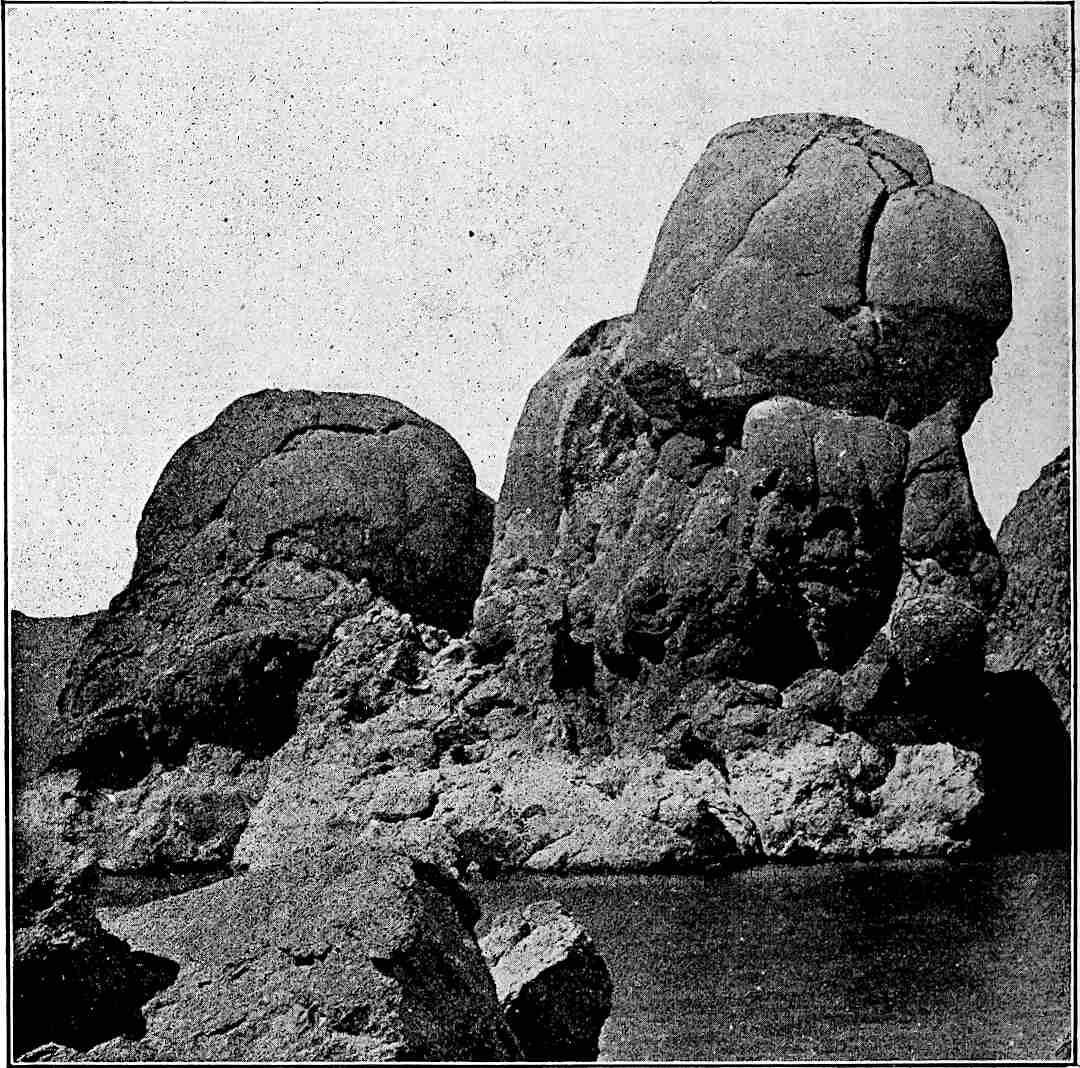
Fig.
333.—Calcareous tufa domes. Pyramid Lake,
Nev.
(Russell.)
If the lake be bordered by a low marsh, the ice and frozen earth of the latter are really continuous with the ice of the lake, and the push of the latter sometimes arches up the former into distinct anticlines, the frozen part only being involved in the deformation. A succession of colder and less cold periods may give rise to a succession of such anticlines.[190] If the shore be steep and of non-resistant material, the crowding of the ice produces different but not less striking results. Where the thrust of the ice is against a low cliff of yielding material, such as clay, it disturbs all above the shore-line. Where the cliff is sufficiently resistant, it withstands the push of the ice, and the ice itself is warped and broken.
Saline lakes.—A few lakes, especially in arid or semi-arid regions, are salt, and others are “bitter.” Beside sodium chloride, salt lakes usually contain magnesium chloride, and magnesium and calcium sulphates. “Bitter” lakes usually contain much sodium carbonate, as well as some sodium chloride and sulphate, and sometimes borax. The degrees of saltness and bitterness vary from freshness on the one hand to saturation on the other. The water of the Caspian Sea (lake) contains, on the average, less salt than that of the sea; that of Great Salt Lake contains about 18%; that of the Dead Sea, about 24%; and that of Lake Van (eastern Turkestan), the densest body of water known, about 33%. See accompanying table.
Many salt lakes, such as the Dead Sea and Great Salt Lake, are descended from fresh-water ancestors, while others, like the Caspian and Aral Seas, are probably isolated portions of the ocean. Lakes of the former class have usually become salt through a decrease in the humidity of the region where they occur. The water begins to be salt when the aridity is such that evaporation from the lake exceeds its inflow. In this case the inflowing waters bring in small amounts of saline and alkaline matter, which is concentrated as evaporation takes place. The concentration may go on until the point of saturation is reached, or until chemical reactions cause precipitation. In general the least soluble minerals are precipitated first. Thus gypsum begins to be deposited from sea-water when 37% of it has been evaporated; but the saturation-point for salt is not reached until 93% of the water has been evaporated (see p. 375). The relations in lakes are similar, and gypsum deposits often underlie those of salt. Deposits of salt and other mineral matters once in solution are making in some salt lakes at the present time, and considerable formations of the same sort have been so made in the past. Buried beneath sediments of other sorts, beds of common salt or of other precipitates are preserved for ages. Lime carbonate has been precipitated in quantity from some extinct lakes (Fig. 333).
The lakes which originate by the isolation of portions of the sea are salt at the outset. If inflow exceeds evaporation, they become fresher and may ultimately become fresh; otherwise they remain salt. If evaporation exceeds inflow they diminish in size and their waters become more and more salt or bitter.
Indirect effects of lakes.—Lakes tend to modify the climate of the region where they occur, both by increasing its humidity and by decreasing its range of temperature. They act as reservoirs for surface-waters, and so tend to restrain floods and to promote regularity of stream flow. They purify the waters which enter them by allowing their sediments to settle, and so influence the work and the life of the waters below.
Composition of lake-waters.—The accompanying table[191] shows the composition of various inclosed lake-waters, and gives some idea of the wide range, both in kind and quantity, of the mineral matter held in solution by them. It is to be noted that the table shows the composition of the waters of exceptional, rather than common, lakes. The waters of fresh lakes do not depart widely from those of rivers (p. 107).
TABLE—ANALYSES OF THE WATERS OF INCLOSED LAKES.
[Reduced to Parts per 1000 by Dr. H. J. Van Housen.]
Locality Abert Lake, Oregon Bogdo Lake Caspian Sea. 2° W. S. W. of Pischina, at 15 feet depth, wind, W. S. W. Caspian Sea, near mouth of the Volga Dead Sea, Ras Dale, surface
Specific gravity 1023.17 ...... ...... ...... 1.0216
Date May 3, 1883 ...... ...... ...... Mar. 20, 1864
Analyst Terreil F. W. Taylor Gobel Gobel H. Rose
Reference Lartet Geological Exploration of Dead Sea, p. 278 Fourth Ann. Rep. U. S. Geol. Survey, p. 454 Lariet Geological Exploration of Dead Sea, p. 284 Bischof’s Chemical Geology, Vol. I, p. 89 Bischof’s Chemical Geology, Vol. I, p. 89
Sodium, Na 2.838 74.700 1.4440 .3081 .885
Potassium, K 10.880 1.041 .0398 .474
Rubidium, Rb ...... ...... ...... ......
Calcium, Ca ...... 3.647 .1854 .1238 2.150
Magnesium, Mg .002 13.777 .4095 .0728 4.197
Lithium, Li ......
Iron, Fe ...... ...... ...... ...... Trace
Chlorine, Cl 8.410 163.344 2.7376 .4576 17.628
Bromine, br2 ...... .043 Trace ...... .167
Carbonic acid gas, CO2 4.653 ...... .1382 .3746 Trace
Sulphuric acid, H2SO4 .509 .198 1.3372 .3109 .202
Phosphoric acid, HPO4
Nitric acid, NO3
Boracic acid, H3BO3 ...... ......
Silica, SiO2 .064 .006
Alumina, Al2O3 ...... ...... ...... Trace
Hydrogen in bicarbonates, H .0023 .0062 ......
Ammonium, NH4 ...... Trace
Organic matter ...... ...... ...... ...... Trace
27.357 256.750 6.2940 1.6540 25.709
Locality Dead Sea, near the Island, surface Dead Sea, at 393 ft., between Ras Feschkak and Ras Zerka Dead Sea, at 656 ft., between Ras Feschkak and Ras Zerka Elton Lake Elton Lake
Specific gravity 1.1647 1.2225 1.2300 ...... ......
Date Apr. 7, 1864 Mar. 15, 1804 Mar. 15, 1864 April August
Analyst Terreil Terreil Terreil Gobel Erdman
Reference Lartet Geological Exploration of Dead Sea, p. 278 Lartet Geological Exploration of Dead Sea, p. 278 Lartet Geological Exploration of Dead Sea, p. 278 Bischof’s Chemical Geology, Vol. I, p. 403–405 Bischof’s Chemical Geology, Vol. I, p. 403–405
Sodium, Na 22.400 25.071 25.107 51.590 29.300
Potassium, K 3.547 3.990 4.503 1.162
Rubidium, Rb ...... ...... ...... ......
Calcium, Ca 9.094 3.704 4.218 ...... .106
Magnesium, Mg 25.529 41.306 42.006 29.971 45.598
Lithium, Li ...... ...... ......
Iron, Fe Trace Trace Trace ...... ......
Chlorine, Cl 126.521 166.340 170.425 159.498 166.890
Bromine, br2 4.568 4.870 4.385 .059 ......
Carbonic acid gas, CO2 Trace Trace Trace ...... .272
Sulphuric acid, H2SO4 .494 .451 .459 13.320 17.734
Phosphoric acid, HPO4
Nitric acid, NO3
Boracic acid, H3BO3 ...... ...... ......
Silica, SiO2 Trace Trace Trace
Alumina, Al2O3 Trace Trace Trace
Hydrogen in bicarbonates, H ...... ...... ......
Ammonium, NH4 Trace Trace Trace ...... ......
Organic matter Trace Trace Trace Trace 5.080
192.153 245.732 251.103 255.600 264.980
Locality Elton Lake Great Salt Lake Great Salt Lake Great Salt Lake Humboldt[192] Lake Indevak Lake
Specific gravity 1.27288 1.170 2.4 1.102 1.007 ......
Date October 1850 1869 Aug., 1873 ...... ......
Analyst H. Rose L. D. Gale O. D. Allen H. Bassett O. D. Allen Gobel
Reference Bischof’s Chemical Geology. Vol. I, p. 403–405 Stambury’s Expedition to Great Salt Lake, p. 410 U. S. Geological Expl. 40th par. 1877, Vol. II, p. 435 Amer. Chemist, 1874, p. 395 U. S. Expl. 40th par. 1877, Vol. I, p. 528 Lartet Expl. of Dead Sea, p. 284
Sodium, Na 15.060 85.330 49.690 38.3 .27842 94.050
Potassium, K 1.204 2.407 9.9 .06083 .529
Rubidium, Rb ...... ...... ...... ...... ......
Calcium, Ca ...... Trace[196] .255 .6 .01257 .123
Magnesium, Mg 60.540 .636 3.780 3.0 .01648 5.076
Lithium, Li Trace Trace
Iron, Fe ...... ...... ...... ...... ...... ......
Chlorine, Cl 171.936 124.454 83.946 73.6 .29545 158.687
Bromine, br2 Trace ......
Carbonic acid gas, CO2 ...... ...... ...... ...... .20126 ......
Sulphuric acid, H2SO4 42.560 12.400 9.858 8.8 .03040 3.065
Phosphoric acid, HPO4 .00069
Nitric acid, NO3 ...... .03250
Boracic acid, H3BO3 Trace Trace
Silica, SiO2 ...... .03250
Alumina, Al2O3
Hydrogen in bicarbonates, H
Ammonium, NH4 ......
Organic matter Trace ...... ...... ...... ...... .....
291.300 222.820 149.936 134.2 .92800 261.530
Locality Soda Lake, near Ragtown, Nev., at 1 foot below surface Soda Lake, near Ragtown, Nev., at 100 feet below surface Mono Lake, Cal., at 1 foot below surface Urmiah Lake Owen’s Lake, Cal.
Specific gravity 1.101 1.101 1.048 1.155 1.051
Date ...... ...... July 16, 1883 ...... ......
Analyst T. M. Chatard T. M. Chatard T. M. Chatard Hitchcock O. Loew
Reference Ante, p. 70 Ante, p. 70 Bulletin No. 9. U. S. Survey, p. 26 Lartet Geological Exploration of Dead Sea, p. 284 Appendix JJ Ann. Rep. Chief Engineers, 1876 p. 190
Sodium, Na 41.632 40.206 18.100 74.890 21.650
Potassium, K 2.290 2.425 1.111 2.751
Rubidium, Rb ...... ...... ......
Calcium, Ca ...... ...... .278 .529 Trace
Magnesium, Mg .245 .245 .125 2.914 Trace
Lithium, Li ...... Trace
Iron, Fe ...... ...... ...... ...... ......
Chlorine, Cl 41.496 40.206 11.610 119.496 13.440
Bromine, br2 ...... ...... ...... ......
Carbonic acid gas, CO2 15.650[7] 18.058[7] 14.465[7] ...... 13.140
Sulphuric acid, H2SO4 11.771 11.943 6.520 7.671 9.362
Phosphoric acid, HPO4 ...... ......
Nitric acid, NO3 ...... ...... ...... Trace
Boracic acid, H3BO3 .285 .287 .153 Trace
Silica, SiO2 .275 .281 .268 .164
Alumina, Al2O3 ...... Trace
Hydrogen in bicarbonates, H ......
Ammonium, NH4 ......
Organic matter ...... ...... ...... ...... Trace
113.644 113.651 49.630 205.500 60.507
Locality Pyramid Lake,[193] Nev. Sevier Lake, Utah Walker Lake,[194] Nev. Winnemucca Lake, Nev. Van Lake Aral Sea
Specific gravity ...... ...... 1.003 1.001 ...... ......
Date Aug. 1882 1872 Sept., 1882 Aug., 1882 ...... ......
Analyst F. W. Clarke O. Loew F. W. Clarke F. W. Clarke Chancourtois ......
Reference Ante, pp. 57 and 58 U. S. Survey, W. 100 M., Vol. III, p. 144 Ante, p. 70 Ante, p. 63 Bischof’s Chemical Geology, Vol. I, p. 94 Roth Chemical Geology, p. 465
Sodium, Na 1.1796 28.840 .85535 1.2970 8.502[4] 2.4512
Potassium, K .0733 Trace .0686 .246 .0584
Rubidium, Rb ...... ...... ...... ...... .0022
Calcium, Ca .0089 .118 .02215 .0196 ...... .4581
Magnesium, Mg .0797 2.000 .03830 .0173 .157[197] .5965
Lithium, Li ...... .....
Iron, Fe ...... ...... ...... ..... Trace[197] .0008
Chlorine, Cl 1.4300 45.500 .58375 1.6934 5.693 3.8386
Bromine, br2 ...... ...... ...... ...... .0029
Sulphuric acid, H2SO4 .1822 9.345 .52000 .1333 2.555 3.3368
Phosphoric acid, HPO4 ...... .0011
Nitric acid, NO3 Trace
Boracic acid, H3BO3 ...... ...... ...... ......
Silica, SiO2 .0334 .00750 .0275 .180 .0032
Alumina, Al2O3 ...... ...... ......
Hydrogen in bicarbonates, H ......
Ammonium, NH4 Trace
Organic matter ...... ...... ...... ...... ...... Trace
3.4861 86.403 2.50150 3.6025 22.600 10.8416