Chapter V · (continued 2)
Reading edition
Whether these processes furnish an adequate explanation of the changes or not, the observed fact is that there are all gradations from snowflakes and pellets into granular névé, and thence into glacier granules (Gletscherkörner), varying in size up to that of filberts and walnuts, and even beyond. In coherence, these aggregations may vary from the early slightly coherent granular stage, where the grains are small and spheroidal, to the ice stage, where the cohesion has become strong through the interlocking growths of the large granules. Even when the mass has become seemingly solid ice, sufficient space is usually left between the granules to give the dispersive reflection to light which imparts to glacier ice its distinctive whitish color.
The arrangement of the crystal axes.—The most radical difference between glacier ice and ice formed directly from water is in the arrangement (orientation) of the crystals. In the ice formed on undisturbed water, the bases of the crystals are at the surface and their principal axes are vertical, as shown by Mügge.[134] As they grow, the crystal prisms extend downwards. This gives a columnar or prismatic structure to the ice, well seen when it is “honeycombed” by partial melting. In the glacier, on the other hand, the crystals, starting from snowflakes, have their axes turned in various directions according to the accidents of their fall; and as the snow develops into ice, the principal axes of the crystals continue to lie in all directions. Hence glacier ice, unlike pond ice, cannot usually be split along definite planes, except where cleavage planes are subsequently developed by extraneous agencies.
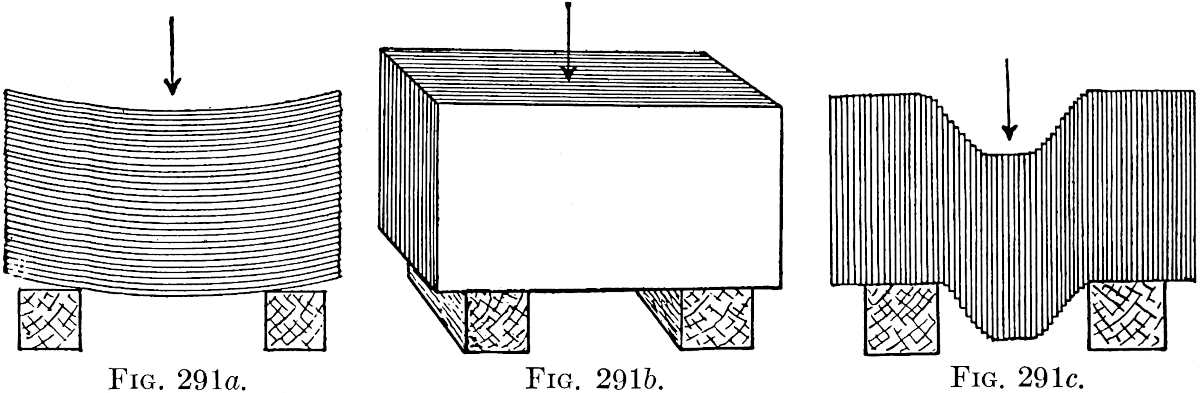
Figures to illustrate the method of deformation of ice crystals.
While the crystals of a glacier usually have their principal axes in various directions, there appears to be a tendency for them to approach parallelism in certain positions, especially in the basal parts of a glacier near its terminus. Observations on this point are not so full and critical as could be desired, but it is probable that the parallel orientation is partly general, and due to the vertical pressure of the ice, and partly special and local, and connected with the shearing planes and foliation.
The bearing of this partial parallelism of the crystals on shearing and foliation is supposed to reside in the fact that a crystal of ice is made up of a series of plates arranged at right angles to the principal axis of the crystal. These plates may be likened to a pile of cards, the principal axis being represented by a line vertical to them. If a cube be cut from a large crystal of ice, it will behave much like a cube cut from the pile of cards. If the cube be so placed that its plates are horizontal (Fig. 291a), and if it be rested on supports at two edges and heavily weighted in the middle, it will sag, the plates sliding slightly over one another so as to give oblique ends, but in this case the cube offers considerable resistance to deformation. If the cube be so placed that the plates stand on edge, each reaching from support to support (Fig. 291b), it will offer very great resistance to deformation; but if the plates be vertical and transverse to the line joining the supports, as in Fig. 291c, the middle portion will sag under very moderate weighting by the sliding of the plates on one another, and in a comparatively short time the middle portion may be pushed entirely out, dividing the cube. These properties have been demonstrated by McConnel[135] and Mügge, and they appear to throw light on certain phases of the action of glaciers that are most pronounced in their basal parts, and are best illustrated in arctic glaciers.
The Probable Fundamental Element in Glacial Motion.
Melting and freezing.—It has already been shown (p. 279) that the initial or fundamental cause of glacial motion must be operative at the heads of glaciers where the temperature is lowest and the material most loosely granular. In this condition, there is reason to believe that motion takes place between the grains, rather than by their distortion through the displacement of their laminæ. The fact that the granular structure is not destroyed, as it would be by the indefinite sliding of the crystal plates over each other, sustains this view. The inference is that the gliding planes play a notable rôle in glacial movement only in the basal parts of the lower ends of glaciers, where the greatest thrusts are developed, and where the granules have become largest and most completely interlocked. At the heads of glaciers, where motion is initiated, there may be great downward pressure, but not vigorous thrusts from behind, and probably only moderate thrusts developed within the body itself. There seems therefore no escape from the conclusion that the primal cause of glacial motion is one which may operate even under the relatively low temperatures, the relatively dry conditions, and the relatively granular textures which affect the heads of glaciers. These considerations lead to the view that movement takes place by the minute individual movements of the grains upon one another. While they are in the spheroidal form, as in the névé, this would not seem to be at all difficult. They may rotate and slide over each other as the weight of the snow increases; but as they become interlocked by growth, both rotation and sliding must apparently encounter more resistance. The amount of rotary motion required of an individual granule is, however, surprisingly small, and the meltings and refreezings incident to shifting pressures and tensions, and to the growth of the granules, seem adequate to meet the requirements. In order to account for a movement of three feet per day in a glacier six miles long, the mean motion of the average granule relative to its neighbor would be, roundly, ¹⁄₁₀₀₀₀ of its own diameter per day, or one diameter in 10,000 days; in other words, it would change its relations to its neighbors to the extent of its diameter in about thirty years. A change of so great slowness under the conditions of granular alteration can scarcely be thought incredible, or even improbable, in spite of the interlocking which the granules may develop. The movement is supposed to be permitted chiefly by the temporary passage of minute portions of the granules into the fluid form at the points of greatest compression, the transfer of the moisture to adjoining points, and its resolidification. The points of greatest compression are obviously just those whose yielding most promotes motion, and a successive yielding of the points that come in succession to oppose motion most (and thus to receive the greatest stresses) permits continuous motion. It is merely necessary to assume that the gravity of the accumulated mass is sufficient to produce the minute temporary liquefaction at the points of greatest stress, the result being accomplished not so much by the lowering of the melting-point as by the development of heat by pressure.
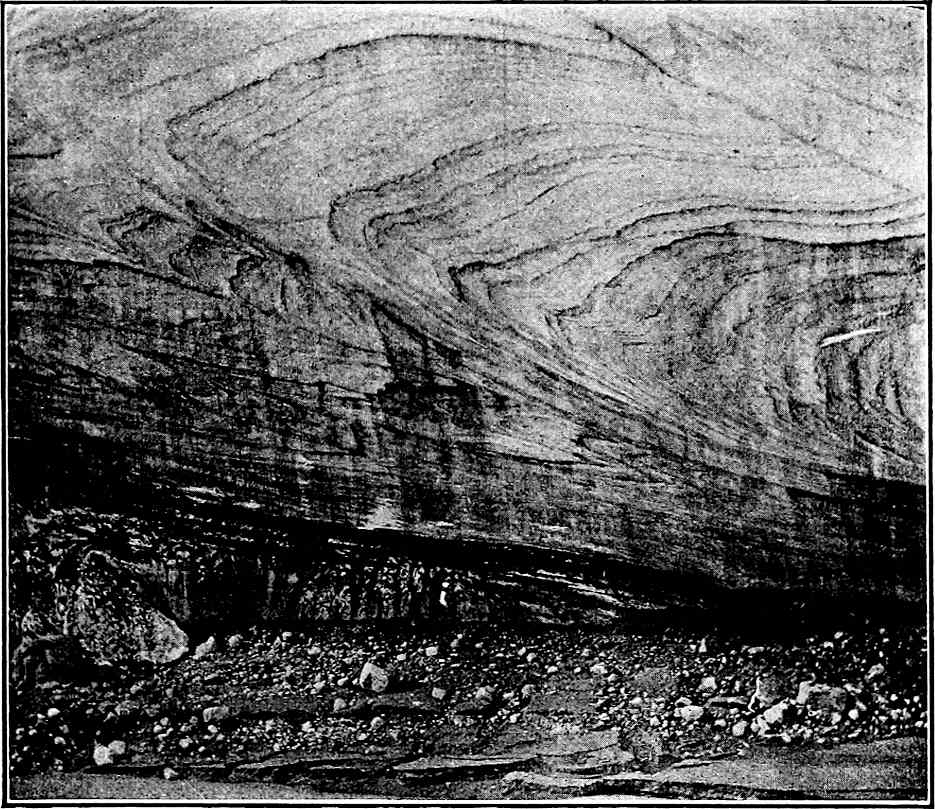
Fig.
292.—Portion of the east face of Bowdoin glacier, North Greenland, showing oblique upward thrust, with shear.
This conception of glacial “flowage” involves only the momentary liquefaction of minute portions of the mass, while the ice as a whole remains rigid, as its crystalline nature requires. Instead of assigning a slow viscous fluidity like that of asphalt to the whole mass, which seems inconsistent with its crystalline character, it assigns a free fluidity to a succession of particles that form only a minute fraction of the whole at any instant.
This conception is consistent with the retention of the granular condition of the ice, with the heterogeneous (in the main) orientation of the crystals, with the rigidity and brittleness of the ice, and with its strictly crystalline character, a character which a viscous liquid does not possess however much its high viscosity may make it resemble a rigid body.
Accumulated motion in the terminal part of a glacier.—However slight the relative motion of one granule on its neighbor, the granules in any part of a glacier partake in the accumulated motion of all parts nearer the source, and hence all are thrust forward. Herein appears to lie the distinctive nature of glacial movement. Each part of a stream of water feels the hydrostatic pressure of neighboring parts (theoretically equal in all directions) and the momentum of motion, but not the rigid thrust of the mass behind. Lava streams are good types of viscous fluids flowing in masses comparable to those of glaciers and on similar slopes, and, in their last stages, at similar rates, but their special modes of flow and their effects on the sides and bottoms of their paths are radically different from those of glaciers. Forceful abrasion, and particularly the rigid holding of imbedded stones while they score and groove the rock beneath, is unknown in lava streams and is scarcely conceivable. There is, so far as we know, no experimental or natural evidence that any typical viscous body in flowing over a rugose bottom detaches and picks up fragments and holds them as graving tools in its base so fixedly as to cut deep, long, straight grooves in the hard bottom over which it flows. It would seem that competency to do this peculiar class of work, which is distinctive of glaciers, should be demonstrated before the viscous theory of glacial movement is accepted as even a good working hypothesis. Somewhat in contrast with viscous movement, it is conceived that a glacier is thrust forward rigidly by internal elongation, shears forcibly over its sides and bottoms, and leaves its distinctive marks upon them.
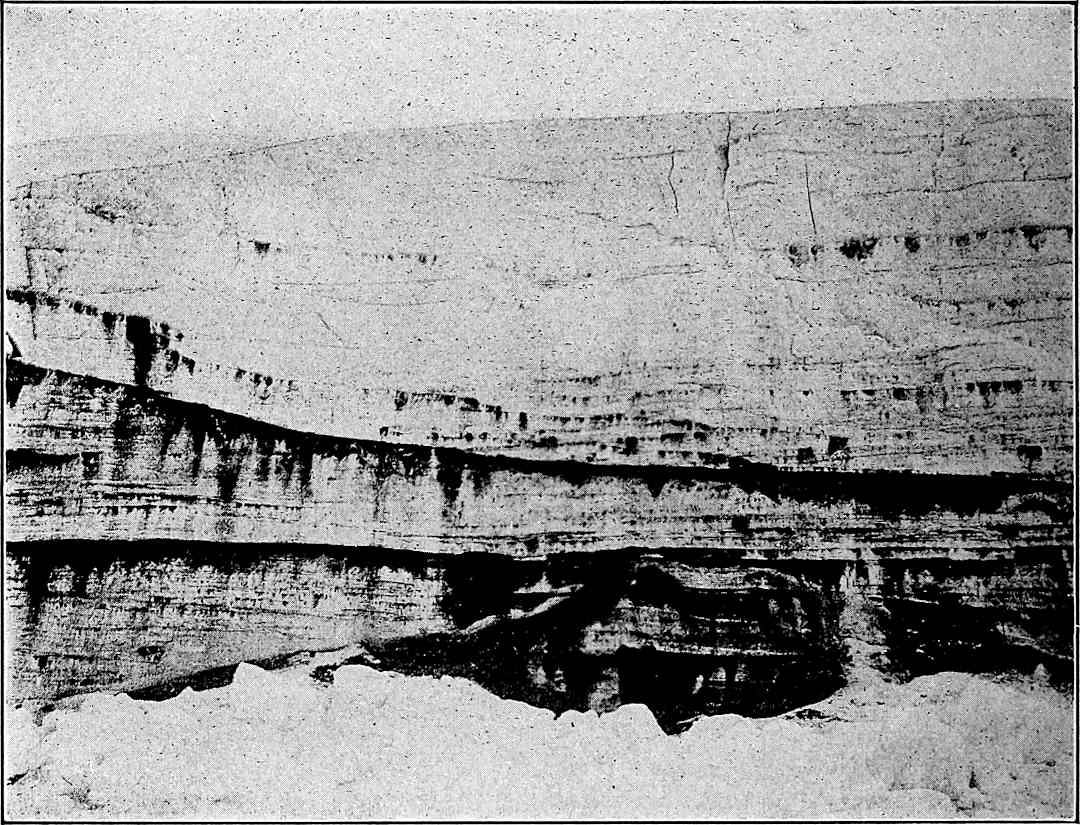
Fig.
293.—Shearing plane well defined. A Spitsbergen glacier. (Hamberg.)
Auxiliary Elements.
Shearing.—In the lower portion of a glacier where normally the thrusts are greatest, the granules fewest, and their interlocking most intimate, shearing takes place within the ice itself. This is illustrated by the accompanying Figs., 292–295. The shearing results in the foliation of the ice and in the forcing of débris between the sheared layers. Thus the ice becomes loaded in a special englacial or baso-englacial fashion, as previously mentioned and illustrated in Fig. 268.
Within the zone of shearing, it is probable that the gliding planes of the crystals come into effective function. It is thought that the combined effect of the vertical pressure, the forward thrust, and the basal drag of the ice, may be to increase the number of granules whose gliding planes are parallel to the glacier’s bottom. At any rate, Drygalski reports[136] that there is a tendency to such an arrangement in the basal portion of the Greenland glaciers at their borders. It is conceived that where strong thrusts are brought to bear upon such a mass of granules, those whose gliding planes are parallel to the direction of thrust are strained with sufficient intensity to cause the plates to slide over each other, while those which are not parallel to the direction of thrust are either rotated into parallelism—when they also yield—or are pressed aside out of the plane of shear. As previously noted, shearing is observed to occur chiefly where the ice below the plane of shearing is protected more or less from the force of the thrust. It perhaps also occurs where the basal ice becomes so overloaded with débris that it is incapable of ready movement.
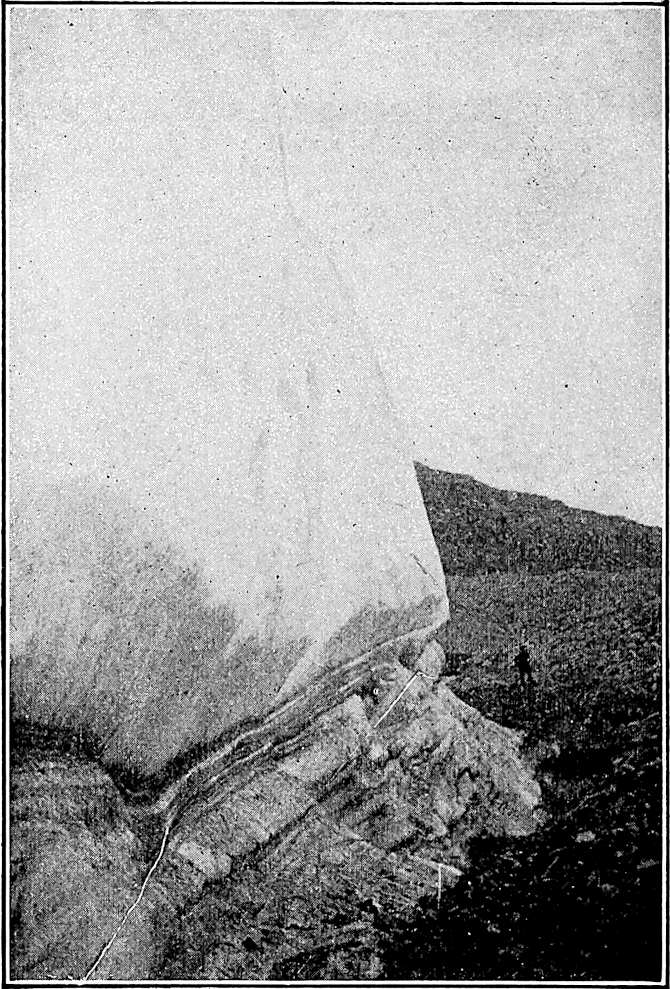
Fig.
294.—Portion of the lateral margin of a North Greenland glacier. Shows upturning of the layers at the base, the cleanness of the ice above the bottom, and, possibly, shearing.
It is also probable that sharp differential strain and shearing are developed at the level where the surface-water of the warm season, descending into the ice, reaches the zone of freezing. The expanding of the freezing water at the upper limit of the cold zone may cause the layer expanded by it to shear over that below. As the level of freezing is lowered with the advance of the warm season, the zone of shearing also sinks. This may be regarded as an auxiliary agency of shearing, of application to a special horizon.
High temperature and water.—In the zone of waste, a higher temperature and more water lend their aid to the fundamental agencies of movement, and there is need for these aids to promote a proportionate movement, for here the granules are more intimately interlocked and the ice more compact and inherently more solid and rigid. The average temperature is, however, near the melting-point (p. 276), and during the warm season the ice is bathed in water so that the necessary changes in the crystals are facilitated, and movement apparently takes place even more readily than in the more open granular portion of lower temperature and dryer state. The extraordinary movements of certain tongues of ice in some of the great fiords of Greenland are probably due to the convergence of very thick slow-moving ice from the interior into basins leading down to the fiords. Into the same basins a large amount of surface-water is concentrated at the same time, with the result that the thick ice, bathed with water and having a high gradient, develops unusual velocity during the warm season.
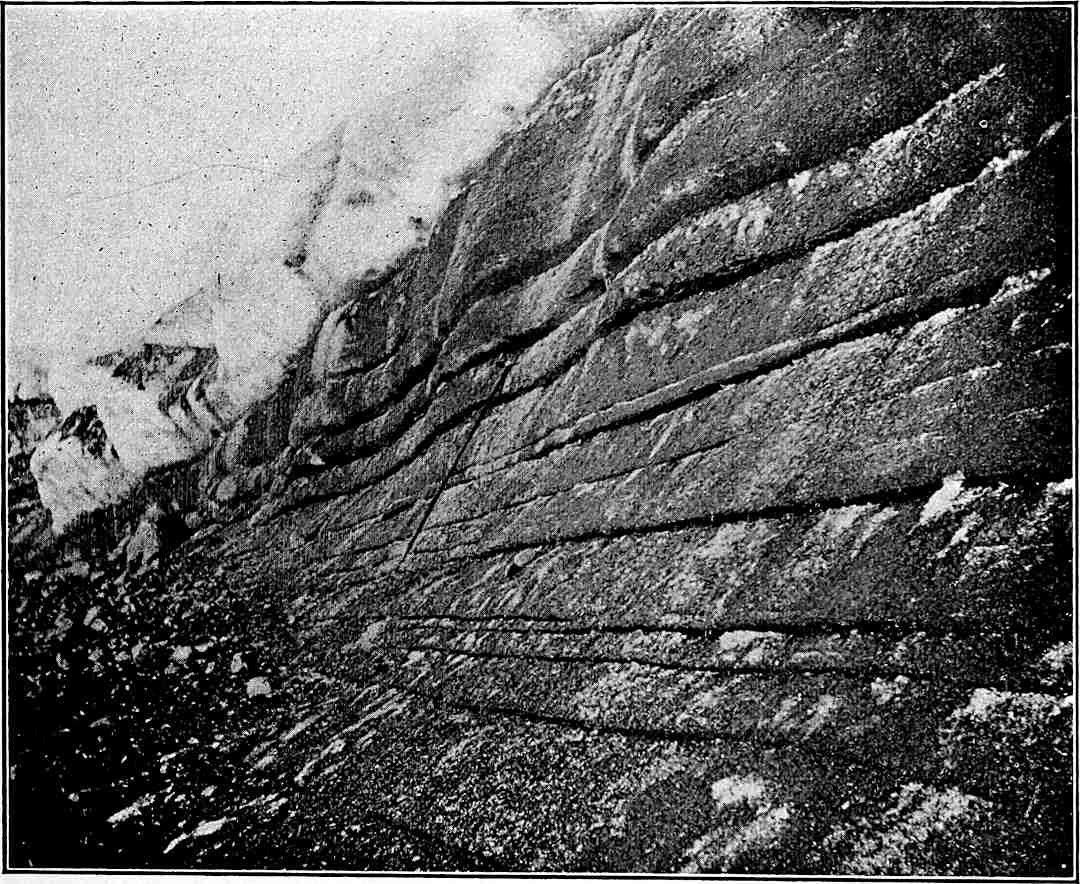
Fig.
295.—Lateral margin of a North Greenland glacier, Inglefield Gulf region. The overhanging edges of the successive layers are not altogether the result of shear. They are due in part at least to differential melting along the lines where débris comes to the surface. The débris planes may be shear planes.
Applications.—By a studious consideration of the coöperation of the auxiliary agencies with the fundamental ones, the peculiarities of glacial movement may apparently be explained. In regions of intense cold, where a dry state and low temperature prevail, as in the heart of Greenland, the snow-ice mass may accumulate to extraordinary thicknesses, for the burden of movement seems to be thrown almost wholly upon compression, with the slight aid of molecular changes due to internal evaporation and allied inefficient processes. Since the temperature in the upper part of the ice is very adverse (see p. 277), the compression must be great before it becomes effective in melting the ice, and hence the great thickness of the mass antecedent to much motion. Similar conditions more or less affect the heads of alpine glaciers, though here the high gradients favor motion with lesser thicknesses of ice; but in the lower reaches of alpine glaciers, where the temperatures are near the melting-point, and the ice is bathed in water, movement may take place in ice which is thin and compact.
If the views here presented are correct, there is also, near the end or edge of a glacier, the coöperation of rigid thrust from behind with the tendency of the mass to move on its own account. The latter is controlled by gravity, and conforms in its results to laws of liquid flow. The former is a derived factor, and is a mechanical thrust. This thrust is different from the pressure of the upper part of a liquid stream on the lower part, because it is transmitted through a body whose rigidity is effective, while the latter is transmitted on the hydrostatic principle of equal pressure in all directions.
Corroborative Phenomena.
The conception of the glacier and its movement here presented explains some of the anomalies that otherwise seem paradoxical. While a glacier in a sense flows over a surface, it often cuts long, deep furrows in firm rock. It is difficult to explain this if the ice be so yielding as to flow under its own weight on a surface which is almost flat. If the mass is really viscous, its hold on its imbedded débris should also be viscous, and a bowlder in the bottom should be rotated in the yielding mass when its lower point catches on the rock beneath, instead of being firmly held while a deep groove is cut. This is more to the point since viscous fluids flow by a partially rotary movement. If, on the other hand, the ice is always a rigid body which yields only as its interlocking granules change their form by loss and gain, a rigid hold on the imbedded rock at some times, and a yielding hold at others, is intelligible, for on this view the nature of its hold is dependent on the temperature and dryness of the ice. Stones in the base of a glacier may be held with very great rigidity when the ice is dry, scoring the bottom with much force, while they may be rotated with relative ease when the ice is wet. In short, the relation of the ice to the bowlders in its bottom varies radically according to its dryness and temperature. A dry glacier is a rigid glacier. A dry glacier is necessarily cold, and a cold glacier is necessarily dry.
On the view here presented, a glacier should be more rigid in winter than in summer, and the whole thickness of the glacier should experience this rigidity chiefly at the ends and edges, where the relative thinness of the ice permits the low temperature to reach its bottom. The motion in these parts during the winter is, therefore, very small.
In this view may also be found an explanation of the movement of glaciers for considerable distances on upward slopes, even when the surface as well as the base is inclined backwards. So far does this go that superglacial streams sometimes run for some distance backwards, i.e. toward the heads of the glaciers, while in other places surface-waters are collected into ponds and lakelets. Such a slope of the surface of ice is not difficult to understand if the movement be due to thrust from behind, or if it be occasioned by internal crystalline changes acting upon a rigid body; but it must be regarded as very remarkable if the movement be that of a fluid body, no matter how viscous, for the length of the acclivity is sometimes several times the thickness of the ice. Crevassing and other evidences of brittleness and rigidity find a ready elucidation under the view that the ice is a really solid body at all times, and that its apparent fluency is due to the momentary fluidity of small portions of the mass assumed in succession as compression demands.
In addition to the considerations already adduced, it may be urged that a glacier does not flow as a stiff liquid because its granules are not habitually drawn out into elongated forms, as are cavities in lavas and plastic lumps in viscous bodies. Flowage lines comparable to those in lavas are unknown in glaciers.
All this is strictly consistent with our primary thesis, that a glacier is a crystalline rock of the purest and simplest type, and that it never has other than the crystalline state. This strictly crystalline character is incompatible with viscous liquidity.
Other Views of Glacier Motion.[137]
While these views of glacial motion seem to us to best accord with the known facts, they are not to be regarded as established in scientific opinion, or as the views most commonly held. The mode of glacial motion has long been a mooted question, and is still so regarded. The main alternative interpretations that have been entertained are the following:
(1) In the early days of glacial studies De Saussure thought that glaciers slid bodily on their beds;
(2) Charpentier and Agassiz referred the movement to the expansion of descending water freezing within the glacier;
(3) Rendu and Forbes, followed by many, perhaps most, modern writers, believed ice to be viscous, and that in sufficiently large masses it flows under the influence of its own weight, like pitch or asphalt;
(4) Others, realizing the fundamental difference between crystalline ice and a true viscous body, have fallen back on a vague notion of plasticity which scarcely amounts to a definite hypothesis at all;
(5) Tyndall urged that the movement was accomplished by minute repeated fracturing and regelation, appealing to the fact that broken pieces of ice slightly pressed together at melting temperatures freeze together, but neglecting the fact that this would destroy the integrity of the crystals;
(6) Moseley assigned the movement to a bodily expansion and contraction of the glacier, analogous to the creeping of a mass of lead on a roof;
(7) James Thompson demonstrated that pressure lowers the melting-point, and while this effect is so small as probably to be ineffectual, it is correlated with the very important fact that compression may cause melting, which is not the case in most other rocks. He recognized that under pressure partial liquefaction took place, that the water so liberated might be refrozen as it escaped from pressure, and appears to have regarded this as a vital factor;
(8) Croll held that the movement was due to a consecutive series of molecular changes somewhat like the chain of chemical combinations in electrolysis;
(9) Hugi, Eli de Beaumont, Bertin, Forel, and others thought that the growth of the granules was the leading factor in the ice movement;
(10) McConnel and Mügge have made the gliding planes of the ice crystals serve an important function in glacial movement.
It will be seen that the principle of partial liquefaction for which Thompson laid the basis, the crystallization of descending water, urged by Charpentier and Agassiz, and the granular growth on which Hugi, Beaumont, Forel, and others founded their hypotheses, are incorporated in the view already presented. Probably the agencies on which some of the other views are based may also be participants in producing glacial motion, sometimes as incidental factors, and sometimes perhaps as important ones, for under different conditions, different agencies may play rôles of varying importance. For example, in going over the brinks of precipices of sufficient height, glaciers break into fragments which are re-cemented below, and the “reconstructed” glacier moves on as before. Here fracture and regelation are evident. The movement of the gliding planes of the ice crystals over each other, which has been looked upon as a special kind of viscoid movement, probably plays a large part in the shearing movements in certain cases. But neither of these is probably a large factor in ordinary glacial movement, and it seems highly improbable that any of them are essential factors in the primary movements in the snow-fields where glacial action begins.