Vincent van Gogh (1853-1890) La Mousmé Chester Dale Collection
Reading edition
Loving the delicacy of Japanese art and having read about Japan, van Gogh named this young girl a “mousmé.” The word was taken from a romantic novel by Pierre Loti, who used it in describing the charm of the young Japanese tea-house attendants. Actually this subject was a peasant of Provence, in southern France. Van Gogh went there in 1888 hoping to capture in its bright sunshine some of the beauty he imagined in Japan.
With a very personal interpretation of Japanese style, he has shown this figure in a bold pattern of startling, bright colors. Earlier in Paris he had learned the color theories which Neo-Impressionists were applying to painting, and here his green, orange red, and intense blue are used with the purity that characterizes them in the spectrum. The Neo-Impressionists juxtaposed very small touches of such pure colors in order to suggest light even brighter than the Impressionists had achieved. But van Gogh was disinterested in effects of natural lighting. In this picture the girl is like a figure in an icon. Set against the plain, intense green background, she seems to be isolated from commonplace experience, and we are reminded of van Gogh’s stated aim, “I wish to paint men and women with that quality of the eternal which used to be suggested by the halo and which we attempt to give by the pure radiance and vibration of the colors.”
37
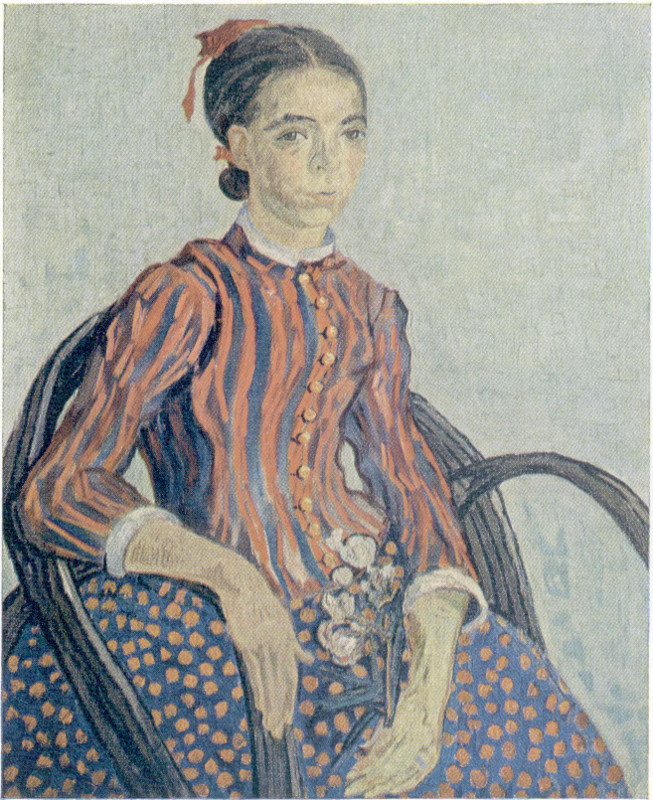
Canvas. 28⅞ × 23¾ inches Painted 1888
38