Paul Cézanne (1839-1906) Still Life Chester Dale Collection
Reading edition
Against rigid horizontal and vertical lines in the background, Cézanne has juxtaposed the curves of apples, bottles, and folds of drapery in turbulent, sweeping lines. He delighted in painting still-life subjects, for here were things that, unlike people, did not want to move but remained uncomplainingly motionless during the long hours, even days, that Cézanne needed for his intensive, exacting studies.
Realizing that Impressionists sacrificed the pictorial structure he admired in the Old Masters’ works, Cézanne took the formless touches of the Impressionists’ broken color and made each brush stroke a distinct “little plane.” In an apple, for example, he realized its form and color by integrating these small modulating planes of color so that the apple appears solid, round, and glowing with light. Yet Cézanne was aiming beyond simply reproducing the appearance of an apple. He strove for a total form in which every brush stroke in his composition is integrated. Every touch of paint, like a link in a chain, must contribute to the consistent unity of the picture. He believed a picture should give a unified sensation in which “every color-touch must contain air, light, the object, the plane, the character, the drawing, the style.” By abstracting nature into the painter’s colored planes, Cézanne paved the way for the abstract styles of the present century.
41
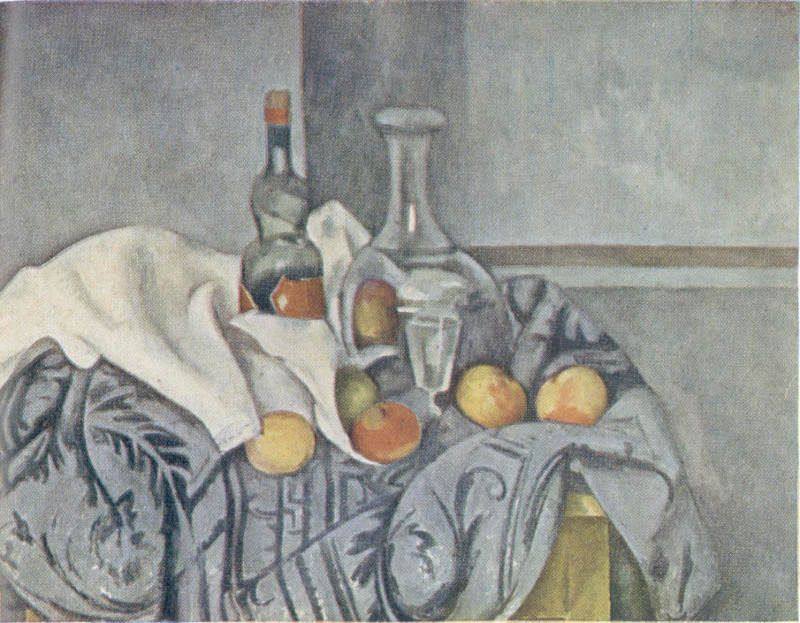
Canvas. 26 × 32⅜ inches Painted c. 1890
42