Henri de Toulouse-Lautrec (1864-1901) Quadrille at the Moulin Rouge Chester Dale Collection
Reading edition
In tones of green and copper Toulouse-Lautrec has captured the tawdry gaiety of Montmartre’s most colorful night spot in the gay ’nineties. The Moulin Rouge, despite its name, was never a windmill; it is a dance hall which uses the sails of a mill for advertising. Lautrec frequented it because he enjoyed watching the nightly performances of its spirited dancers. Their specialty, the quadrille, grew out of the high-kicking cancan; almost as vigorous, it was even more complicated. Dominating the scene here, Gabrielle, a popular professional dancer, has hoisted her skirts as she lines up with the others to begin the dance. With telling outline, Lautrec characterizes her robust physique and hoydenish air. She is in sharp contrast to the woman facing her, in the foreground, whom Lautrec has shown as delicately refined.
Admiring Manet, Morisot, and especially Degas, Lautrec produced handsome compositions similar to theirs. Again, under the influence of Japanese prints, light and shadow have disappeared, replaced by bold color patterns and strong lines. But Lautrec was far more concerned with characterization than were the other painters of his time and, like Daumier in an earlier generation, he gives a wonderfully vivid picture of his age.
35
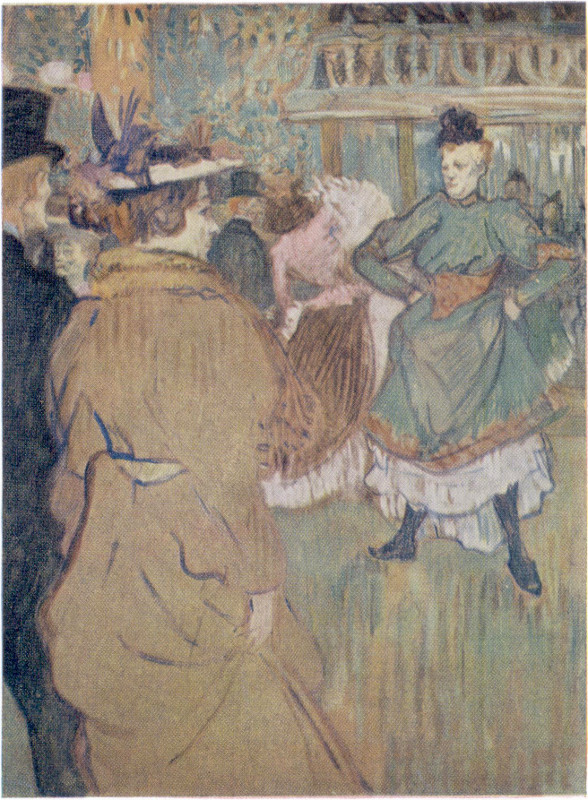
Gouache on cardboard. 31½ × 23¾ inches Painted 1892
36