Paul Gauguin (1848-1903) Fatata te Miti Chester Dale Collection
Reading edition
Fatata te Miti means simply “by the sea,” but what a curious vision Gauguin’s imagination has created from this scene of two Tahitian girls on the beach! The artist has found himself in a disquieting, primeval world where rich tropical colors and exotic forms of life, both human and vegetable, engender a haunting air of mystery. Gauguin painted this in 1892, during his second year in Tahiti. He had fled from Western civilization for he believed its materialistic culture rejected the artist as a useful citizen. He turned to the Pacific islands because he felt the need to become a primitive in both life and art. Only by returning to the primitive’s simple standards might man rediscover significant meaning in his life and work.
The almost forgotten religion of the Maori cult stirred Gauguin’s mind to prodigious creative activity. Lingering superstitions delighted him; phosphorescent fungi on the trees glowing in the twilight, as he painted them here, were thought to represent the spirits of long dead ancestors. In his art he evolved an expressive symbolism. He spoke of “the music of the picture,” a “magic accord” of the colors and arabesque patterns, which “addresses itself to the most intimate part of the soul.”
39
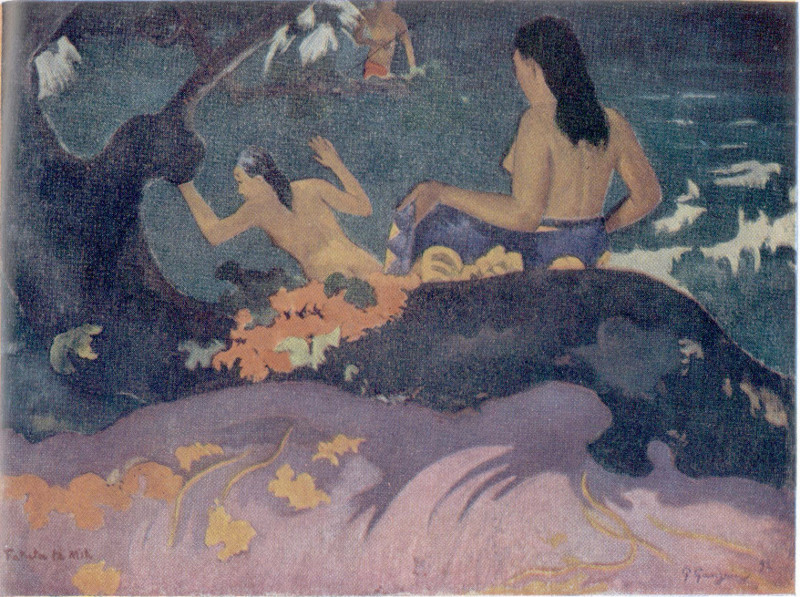
Canvas. 26¾ × 36 inches Dated 1892
40