Edgar Degas (1834-1917) Four Dancers Chester Dale Collection
Reading edition
Before a colorful stage set, four ballerinas are awaiting their cue to perform. Dancers were among Degas’ most frequent subjects. Because the forms of their flaring skirts and bodices were simple, he could arrange them easily into handsome patterns and make them colorful by the artificial richness of stage lighting. He sketched the ballet dancers frequently during their exhausting hours of rehearsal and again in their spritely performances at the Paris Opera.
Though Degas shared interests with both Realists and Impressionists, he cannot be classified simply as either. His art synthesized several trends; he merged the academic and the progressive styles. Firmly grounded in the academic manner, he used precise outlines, which were foreign to the Realist or Impressionist. In this picture, his lines describe the ballerinas’ heads, arms and costumes and also establish an intricate design of diagonals moving back into depth. While the extreme off-center balance of the composition gives a realistic “snap-shot” view, it also heightens our awareness of the design so that the eye enjoys the variety of shapes and colors. Though the colors are applied with Impressionistic freedom, they combine into a vibrant harmony typical of Degas’ late style. Very fond of this picture, Degas kept it in his studio until his death.
33
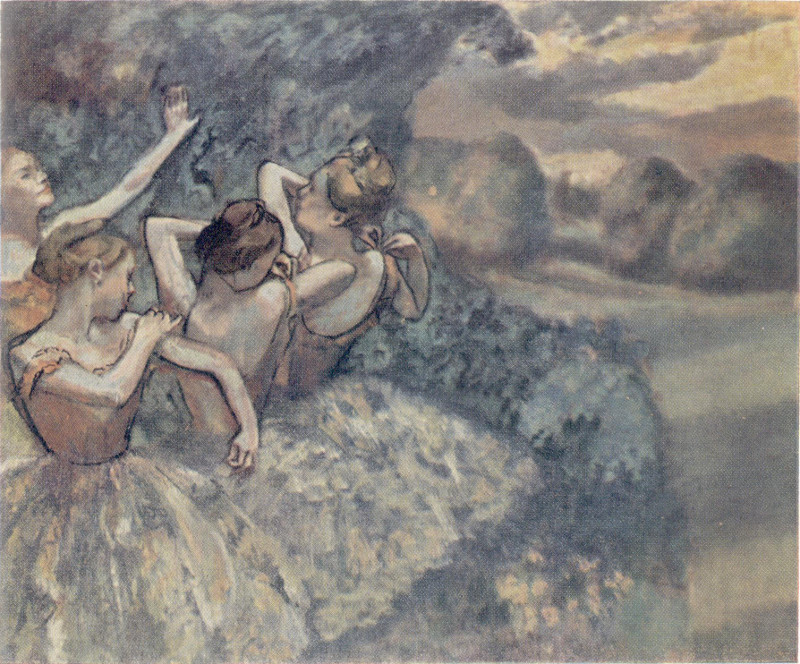
Canvas. 59½ × 71 inches Painted c. 1899
34