Eugène Delacroix (1798-1863) Columbus and His Son at La Rábida Chester Dale Collection
Reading edition
In 1491 Columbus, despairing of Spanish support for his voyage of exploration, was on his way to seek aid in France when he and his son Diego stopped at the monastery of La Rábida, near Huelva, in southern Spain. Delacroix shows them resting here after their exhausting journey. Columbus gazes thoughtfully at a map, while the prior, Juan Perez, behind him, is about to welcome him. Perez, who had been Queen Isabella’s confessor, was able to arrange a royal interview for Columbus so that ships and men were secured for the adventure.
Delacroix painted this in 1838, after a trip through Spain. Evidently the air of quiet mystery in a Spanish monastery caught his fancy, and he recreates it here. Unlike the Neo-Classicists, the Romantic Delacroix does not attempt to define his subjects exactly. In his painting, vague, suggestive forms are used to stimulate the imagination. His composition is not a linear design; it is spatial; and our interest is drawn into the space of this room to discover the whispered confidences of the monks, the mystery of dark corridors, and the kind reception of the weary travelers. Delacroix sought a “silent power which speaks alone to the eyes and gains and conquers all the faculties of the spirit.”
17
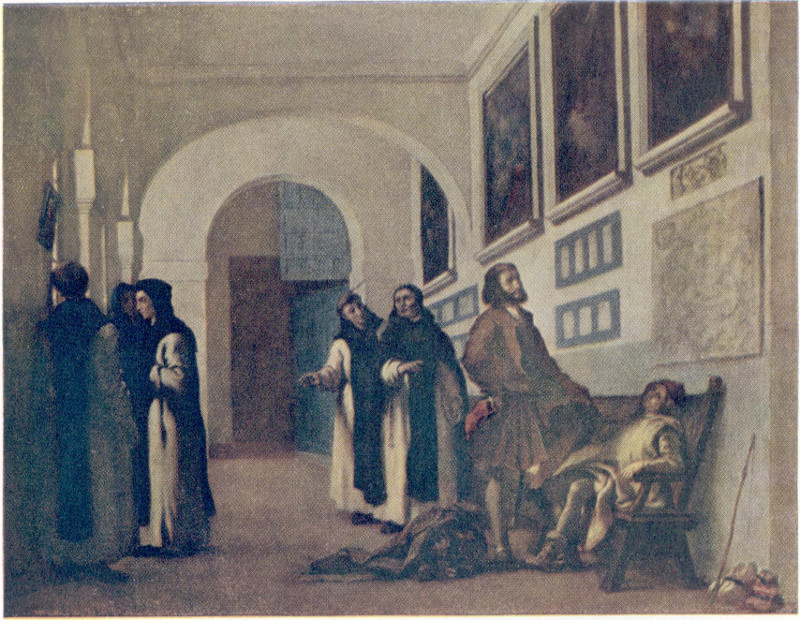
Canvas. 35⅝ × 46⅝ inches Dated 1838
18