THE WHIST FAMILY. (continued 5)
Reading edition
As already observed, Vivant loses or gains double the value of the points in each hand. In the three-handed game this must be so; but in my opinion it would be a great improvement in the four-handed game to allow the player sitting out to share the fortunes of the Vivant, as in Bridge, and in many German games of cards, notably Skat.
SLAMS. The two great differences between French and English Dummy are that honours are not counted in Mort, and that a special value is attached to slams. A slam is made when one side takes the thirteen tricks. These must be actually won, and cannot be partly made up of tricks taken in penalty for revokes. Players cannot score a slam in a hand in which they have revoked.
A slam counts 20 points to the side making it; but these 20 points have nothing to do with the game score. For instance: The score is 4 all. Vivant and Mort make a slam. This does not win the game; but the 20 points are debited and credited on the score-sheet; the deal passes to the left, and the game proceeds with the score still 4 all, as if nothing had happened.
SCORING. The number of points won on each game are put down on the score-sheet, each side being credited with the number of points appearing on their markers when the game is finished. To the winners’ score is added: 3 points, for a triple game, if their opponents have not scored; 2 points, for a double game, if their opponents are not half way, or 1 point, for a simple game, if their opponents are 3 or 4. In addition to this, the winners add 4 points, for bonus or consolation, in every instance. From the total thus found must be deducted whatever points have been scored by the losers, whether game points, slams, or both. For instance: Vivant and Mort win a game with the score 8 to 2 in their favor, which is a double. This is put down on the score sheets thus:—
8 + 2 for the double, + 4 consolation, = 14, minus 2 scored by the opponents; making 12 the net value of the game. Vivant therefore wins 24 points, and each of the adversaries, R and L, lose 12. Again:—
R and L win a simple with a score of 5 to 4, V and M having made a slam. 5 + 1 for the simple, + 4 for consolation, = 10, minus 4 points scored, and 20 for the slam = 24; showing that R and L lose 14 points each, although they won the game. Again:—
V and M win a triple, with a score of 8 to 0; R and L having revoked. 8, + 3, + 4, + 3 for the revoke = 18, from which there is nothing to deduct.
The greatest number of points that can be made on a game, exclusive of slams and revokes, is 17; and the least number is 6.
MARKING. The methods of using the counters in scoring the game points have already been described in connection with whist.
CUTTING OUT. If there are more than four candidates for play at the conclusion of a tournée, the selection of the new table must be made as if no tournée had been played; all having equal rights to cut in.
CHEATING. Mort offers even less opportunity to the greek than whist, as the deal is a disadvantage, and nothing is gained by turning up an honour, beyond its possession.
CAYENNE, OR CAYENNE WHIST.
CARDS. Cayenne is played with two full packs of fifty-two cards, which rank as at Whist, both for cutting and playing.
MARKERS are necessary, and must be suitable for counting to ten points. A sheet of paper is used for scoring the results of the games.
PLAYERS. Cayenne is played by four persons. When there are more than four candidates for play the selection of the table must be made as at Whist. Partners and deal are then cut for.
CUTTING. One of the packs having been spread on the table, face down, each of the four players draws a card; the two lowest pairing against the two highest. The lowest of the four is the dealer, and has the choice of seats and cards. Ties are decided in the same manner as at Whist.
POSITION OF THE PLAYERS. The partners sit opposite each other, and the players are distinguished, as at Whist, by the letters A-B and Y-Z. Z is the dealer, and A has the original lead.
DEALING. One pack of cards is shuffled and cut as at Whist. The dealer then gives four cards to each player, beginning on his left; then four more, and finally five, no trump being turned. In many places six cards are first dealt to each player, and then seven; but the 4-4-5 system is better, and is the rule in the very similar game of Boston.
The general rules with regard to irregularities in the deal are the same as at Whist; except that a misdeal does not lose the deal. The misdealer must deal again, and with the same pack.
CAYENNE. After the cards are all dealt, the player to the left of the dealer cuts the still pack, which is shuffled and presented to him by the dealer’s partner, and the top card of the portion left on the table is turned up for Cayenne. This card is not a trump, but is simply to determine the rank of the suits.
STAKES. In Cayenne the stake is a unit, so much a point. The largest number of points possible to win on a rubber is 24, and the smallest, 1. The result of the rubber may be a tie, which we consider a defect in any game. In settling at the end of the rubber it is usual for the losers to pay their right-hand adversaries.
MAKING THE TRUMP. The trump suit must be named by the dealer or his partner, after they have examined their cards. The dealer has the first say, and he may either select cayenne or any of the other suits; or he may announce grand, playing for the tricks without any trump suit; or he may call nullo, playing to take as few tricks as possible, without a trump suit. If the dealer makes the choice, his partner must abide by it; but if he has not a hand to justify him in deciding, he should leave the selection to his partner, who must decide one way or the other.
The considerations which should guide players in their choice are the scoring possibilities of their hands, in tricks and in honours. As in Whist, the first six tricks taken by one side do not count; but each trick above that number counts one, two, etc., by cards. There are five honours in the trump suit in Cayenne; A K Q J 10; and the partners holding the majority of them count 1 for each honour that they hold in excess of their opponents, and 1 in addition, for honours. For instance: If A-B have three honours dealt them, they must have one more than their adversaries, and 1 for honours; entitling them to score 2. If they have four, they have 3 in excess, and 1 for honours, a total of 4. If they have five, they count 6 by honours.
At the end of the hand the points made by cards and by honours are multiplied by the value of the trump suit. This value varies according to the suit which is cayenne, which is always first preference. If cayenne is also the trump suit the points made by cards and honours are multiplied by 4. If the trump suit is the same colour as cayenne, the multiplier is 3. If it is a different colour the multiplier is 2 or 1, according to the suit. The rank of the suits as multipliers will be readily understood from the following table:—
If Cayenne is ♡ ♢ ♣ ♠ If trumps, multiply by 4.
Second color is ♢ ♡ ♠ ♣ If trumps, multiply by 3.
Third color is ♣ ♣ ♡ ♡ If trumps, multiply by 2.
Fourth color is ♠ ♠ ♢ ♢ If trumps, multiply by 1.
Better to understand the importance of considering this variation in value when making the trump, it should be noticed that although the game is 10 points, several games may be won in a single hand, as everything made is counted, and any points over 10 go to the credit of the second game. If more than 20 points are made, the excess goes on the third game, and so on. Another important point is the great value attached to honours, and the maker of the trump should never forget that he can better afford to risk his adversaries winning 2 by cards with a trump in which he has three honours, than he can to risk a trump in which they may have three honours, and he can probably win only the odd trick.
A further element may enter into his calculations, the state of the score. Tricks count before honours, and if he feels certain of making, by cards, the few points necessary to win the rubber, he may entirely disregard the honours.
With such a hand it would be better to play without a trump, and to announce a grand, in which there are neither trumps nor honours, and every trick over the book is multiplied by 8. Two by cards at grand is worth more than two by cards and two by honours with any trump but cayenne.
There is still another resource, to announce nullo, in which there is no trump, and the object of the players is to take as few tricks as possible. In nullo, every trick over the book counts for the adversaries, and is multiplied by 8. A peculiarity of nullo is that the Ace of each suit ranks below the deuce, unless the player holding it wishes to declare it higher than the King. In the latter case he must announce it when he plays it, and before his left-hand adversary plays to the trick.
If the dealer transfers the right of making the trump to his partner, he must use the phrase, “You make it, partner.” If a player makes the trump out of turn, his adversaries may consult as to the propriety of demanding a new deal.
METHOD OF PLAYING. The trump suit, grand, or nullo having been announced, the player on the dealer’s left begins by leading any card he pleases, and the others must all follow suit if they can. The penalty for a revoke is the loss of three tricks; or the value of three tricks in points; or the addition of a like amount to the adversaries’ score. The side making a revoke cannot win the game that hand, no matter what they score; but they may play the hand out, and count all they make to within one point of game, or 9. Revoking players cannot count points for slams.
The rules for cards played in error, leading out of turn, and all such irregularities, are the same as in Whist. The last trick turned and quitted may be seen.
The methods of gathering and stacking the tricks is the same as at Whist.
OBJECTS OF THE GAME. The chief object in Cayenne, either with a trump or in a grand, is to take tricks; in a nullo it is not to take them. In any case the highest card played of the suit led wins the trick, and trumps, if any, win against all other suits. At the end of each hand the side that wins any tricks in excess of the book scores them, after multiplying their number by the unit of value settled upon by the announcement. If a nullo is played the adversaries score them. Honours are then claimed; but the game cannot be won by honours alone, as at Whist; those holding honours must stop at the score of 9, unless they also win the odd trick. As soon as either side reaches or passes 10 points, they win a game; but the hand must be played out, and all tricks taken must be counted. If one side goes out by cards, the other cannot score honours. Thirteen tricks taken by one side is called a slam, and it counts 6 points. Twelve tricks is a little slam, and it counts 4. Either of these must be made exclusive of revoke penalties.
RUBBERS. The rubber is won by the side that first wins four games of ten points each; and the winning side adds 8 points to its score.
SCORING. The game score should be kept on a whist marker, using the four large keys on one side for single points, and the single large key on the opposite side for five points. The three small keys are used to show how many games of the rubber have been won by that side.
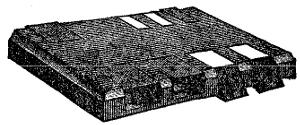
Two Games Won, and 2 Points Scored on the Third.
The method of using counters for scoring 10-point games has already been described in connection with Whist.
In addition to either markers or counters, there must be a sheet of paper to keep the final results of the games.
In scoring, the revoke penalty counts first, tricks next, and honours last.
The side first reaching 10 points wins a quadruple, or game of 4, if their adversaries have not scored; a triple, or game of 3, if their adversaries have not reached 4; a double, or game of 2, if the adversaries have not reached 7; and a single, or game of 1, if their adversaries are 8 or 9 up. These game points are put down on the score-sheet, and all the points on the adversaries’ marker are then turned down. If the winners make any points in excess of 10, such points are left to their credit on the marker, and count toward the next game. For instance: The score is A-B, 6; and Y-Z, 8; shown on the markers thus:—
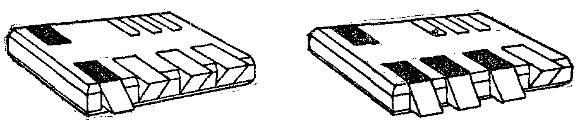
A-B 6 Points. Y-Z 8 Points.
Let us suppose that Z announces cayenne, and makes 2 by cards; A-B claiming two by honours. Y-Z multiply by 4, making them 8, and bringing their total score on the marker to 16; that is, a game, and 6 points to their credit on the second game. This must now be put down on the score-sheet. A-B’s honours not counting, as Y-Z went out by cards, the game is a double; A-B not having reached 7 points. The score and markers now stand:—
A-B 0
Score:
Y-Z 2
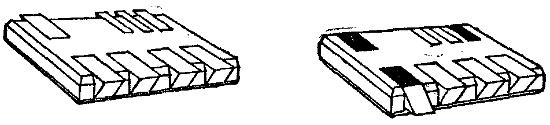
A-B’s, Nothing. Y-Z’s, 1 Game, 6 Points.
Let us suppose A-B to announce grand on their deal, and to make four by cards, which, multiplied by 8, gives them 32 points; that is, three games, and 2 points to their credit on the marker. The first of these games is a double, Y-Z having 6 points up. The two others are quadruples, put down on the score-sheet thus:—
A-B 0 2 4 4
Score:
Y-Z 2 0 0 0
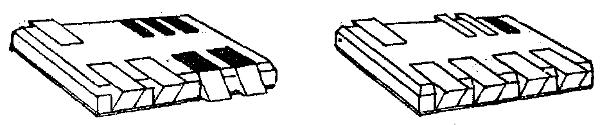
A-B’s, 3 Games, 2 Points. Y-Z’s, 1 Game, 0 Points.
In the next hand let us suppose clubs to be cayenne. Y deals, and plays in colour, spades. Y-Z win 6 by cards, and 4 by honours; 10 points multiplied by 3, = 30. For this they score three games, the first being a triple, and the others quadruples. These three games win the rubber, for which they add 8 points, and 4 points for the little slam. This is all put down on the score-sheet:—
A-B 0 2 4 4 0 0 0 = 10
Score:
Y-Z 2 0 0 0 3 4 4 8 4 = 25
Both scores being added up, the value of the rubber won by Y-Z is found to be 15, after deducting the 10 points made by A-B.
CUTTING IN. If there are more than four persons belonging to the table, those waiting cut in, as at Whist.
METHODS OF CHEATING. In all games in which the cards are dealt in bulk, four or six at a time, there is more or less temptation for the greek to gather desirable cards in the pack, leaving them undisturbed in the shuffle. If he can pick up two tricks of the previous deal with eight good cards of the same suit in them, by placing any two tricks of other cards between them, and dealing six at a time, he can tell exactly how many of the eight located cards are in his partner’s hand. For this reason a player who does not thoroughly shuffle the cards should be carefully watched; and an immediate protest should be made against any disarrangement of the tricks as they are taken in during the play, such as placing the last trick taken under the first. If the player doing this is to be the next dealer, any one observing the movement should insist upon his right to shuffle the cards thoroughly; if not to leave the game.
We are strongly opposed to dealing the cards in bulk at Cayenne, and see no reason why the methods that prevail in the very similar game of Bridge should not be adopted.
SUGGESTIONS FOR GOOD PLAY. There is little to add to the rules already given for Whist. The principles that should guide in the making of the trump have been given in connection with the more important game of Bridge; and the suggestions for playing nullo will be fully discussed in the games in which it is a prominent characteristic: Solo Whist, and Boston. Grand is practically Whist after the trumps are exhausted.
For the Laws of Cayenne see Whist Family Laws.
SOLO WHIST, OR WHIST DE GAND.
CARDS. Solo Whist is played with a full pack of fifty-two cards, which rank as at Whist, both for cutting and playing. Two packs are generally used, the one being shuffled while the other is dealt.
MARKERS are not used in Solo Whist, every hand being a complete game in itself, which is immediately settled for in counters representing money. At the beginning of the game each player should be provided with an equal number of these counters. They are usually white and red, the red being worth five times as much as the white. Twenty white and sixteen red is the usual allotment to each player when the game begins. Some one player should be the banker, to sell and redeem all counters.
PLAYERS. Solo Whist is played by four persons. If there are five candidates for play, they all sit at the same table, each taking his turn to sit out for one hand while the four others play. The dealer is usually selected to sit out. If there are only three players, one suit must be deleted from the pack, or the 2, 3, and 4 of each suit must be thrown out.
CUTTING. The table being formed, the players draw from an outspread for the deal, and choice of seats and cards. The player drawing the lowest card deals the first hand, and it is usual for him to dictate to the other players what seats they shall occupy with relation to himself. Ties are decided in the same manner as at Whist.
POSITION OF THE PLAYERS. The four players at Solo Whist are usually distinguished by the letters A B Y Z.
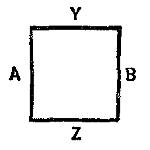
Z is the dealer, and A is known as the eldest hand. The position of the players does not imply any partnership; for, as we shall see presently, any player may have any one of the others for a partner, without any change taking place in their positions at the table.
The players having once taken their seats are not allowed to change them without the consent of all the others at the table.
DEALING. The cards having been properly shuffled, are presented to the pone to be cut. Beginning on his left, the dealer distributes the cards three at a time, until only four remain. These he deals one at a time, turning up the last for the trump. When two packs are used, the player sitting opposite the dealer shuffles the still pack while the other is dealt. The deal passes in regular rotation to the left.
When three play with a pack of forty cards, the last card is turned up for trumps, but it does not belong to the dealer, and is not used in play.
The general rules with regard to irregularities in the deal are the same as at Whist; except that a misdeal does not pass the deal. The misdealer must deal again, and with the same pack.
The cards dealt, each player sorts and counts his hand to see that he has the correct number of cards, thirteen. If not, he should immediately claim a misdeal; for a player having more or less than his right proportion of cards cannot win anything on that hand, but will have to stand his proportion of all losses incurred by him or his side.
OBJECTS OF THE GAME. There are seven distinct objects in the Solo Whist, and before play begins each player has an opportunity of declaring to which of these objects he proposes to attain. They are:—
1st. To win 8 of the 13 tricks, with the assistance of a partner. This is called a Proposal; the partner’s share is an Acceptance.
2nd. To win 5 of the 13 tricks, against the three other players combined. This is called a Solo.
3rd. To take no tricks, there being no trump suit, and the three other players being opposed. This is called Misère, or Nullo.
4th. To win 9 of the 13 tricks against the three other players combined; the single player to name the trump suit. This is called Abundance.
5th. To win 9 of the 13 tricks against the three other players combined, with the trump suit that is turned up. This is called Abundance in Trumps.
6th. To take no tricks, there being no trump suit, and the three other players being opposed; the single player’s cards being exposed face up on the table after the first trick is complete. This is called Misère sur table, or A Spread.
7th. To win all 13 tricks against the three other players combined; the single player to name the trump suit, and to have the original lead whether eldest hand or not. This is called Abundance Déclarée, or A Slam.
While the object of the proposing player is to win or lose the declared number of tricks, that of his adversaries is to prevent him from doing so, if possible. There are no honours, and the only factor in the count is the number of tricks actually taken. The highest card played of the suit led wins the trick, and trumps, if any, win against all other suits.
METHOD OF DECLARING. The eldest hand has the first say, and after examining his cards he may make any of the several propositions just enumerated. The smallest proposal he can make is to take 8 tricks with the assistance of a partner. To do this he should have four reasonably sure tricks in his own hand. Some players say he should be strong in trumps; while others claim that the eldest hand should propose only on general strength. The former is the better plan. No other player should propose on trumps alone. This announcement is made by saying “I propose.” If a player thinks he can take five tricks against the combined efforts of the three other players, he announces: “Solo.” If he feels equal to a misère, he calls: “Misère;” and so on, according to the strength of his hand. If he does not feel justified in making a call, he says “I pass;” and the next player on his left has the opportunity; and so on, until some player has proposed to do something, or all have passed.
If any player has proposed for a partner, any of the others, in their proper turn, may accept him by simply saying “I accept.” By so doing, a player intimates that he has four probable tricks also, but in the plain suits, and that he is willing to try for eight tricks with the proposer for a partner. All the other calls are made by a single player with the intention of playing against the three others. Any player except the eldest hand having once said, “I pass,” cannot afterwards make or accept any proposal. The eldest hand, after passing once, can accept a proposal, but he cannot make one.
It is the custom in some places, when no one will make a proposal of any sort, to turn down the trump, and play the hands without any trump suit, each man for himself, the winner of the last trick losing to each of the others the value of a solo. This is called a Grand.
RANK OF THE PROPOSALS. The various calls outrank one another in the order in which we have given them. If one player says, “I propose,” and another calls “Solo,” the solo call shuts out the proposal, even though it has been accepted by a second player. The call of a misère would in turn shut out a solo; abundance would take precedence of misère; and abundance in trumps would be a better call than simple abundance. The slam of course outranks all other bids. This making of a better proposition than one already made is known as “Over-calling.”
A player who has made a call of any kind, or has accepted a proposal, may amend his proposition to a better one, only in case he is over-called; or a player who can not get a partner to accept him may amend his call to solo. For instance: A player may have a hand which he feels sure is good for 8 tricks, perhaps 9. To be safe, he calls solo, and hopes to make three or four over-tricks. If he is outbid by some player over-calling him with a misère, he may be tempted to amend his call to abundance.
No call is good until every player who has not already passed does so, by saying distinctly, “I pass.”
STAKES. The losses and gains of the players are in proportion to the difficulties of the tasks they set themselves.
The most popular method of settling is to pay or take red counters for the various calls, and white counters for the tricks under or over the exact number proposed. If the callers succeed in their undertakings, their adversaries pay them; if they fail, they pay their adversaries. A red counter is worth five white ones.
Proposal and Acceptance wins or loses 1 red counter.
Solo wins or loses 2 red counters.
Misère, or Nullo, wins or loses 3 red counters.
Abundance, of any kind, wins or loses 4 red counters.
Open Misère, or Spread, wins or loses 6 red counters.
Declared Abundance, or Slam, wins or loses 8 red counters.
Each Over or Under-trick wins or loses 1 white counter.
In Proposal and Acceptance, each of the partners pays one of his adversaries. In all cases in which a single player is opposed to the three others, he wins or loses the amount shown in the foregoing table with each of them individually; so that a single player calling a solo would win or lose 6 red counters. If he lost it, making only four tricks, he would also have to pay to each of his three adversaries a white counter. If he won it, making seven tricks, each of them would have to pay him two red and two white counters.
Misères, Spreads, and Slams pay no odd tricks. The moment a Misère player takes a trick, or a Slam player loses one, the hands are abandoned, and the stakes paid.
The usual value attached to the counters in America is 25 cents for the red, and 5 cents for the white. In England the proportion is sixpence and a penny.
POOL SOLO. When players wish to enhance the gambling attractions of the game, a pool is introduced. For this purpose a receptacle is placed upon the table, in which each player puts a red counter at the beginning of the game. Any person playing alone against the three others, wins this pool if he is successful; if he fails, he must double the amount it contains, besides paying each of his adversaries in the regular way. In some places it is the custom for each player to contribute a red counter when he deals. The proposals and acceptances do not touch the pool.
METHOD OF PLAYING. If a proposal is accepted, and no one over-calls it, the proposer and acceptor are partners; but make no change in their positions at the table. The eldest hand, sitting to the left of the dealer, begins by leading any card he pleases, and the play proceeds exactly as at Whist, the tricks being so stacked that they may be readily counted at any time.
If a single player has called solo, misère, or abundance, the eldest hand still has the original lead, and there is no change in the positions of the players. The position of the lead is often a serious consideration with a player calling a solo or a misère.
In all calls except misères and slams, the hands must be played out, in order to give each side an opportunity to make all the over-tricks they can. The moment a misère player takes a trick, or a slam player loses one, the hands are thrown up, and the stakes paid.
When a spread is called, the trump is taken up, and the eldest hand leads. As soon as all have played to the first trick, the caller spreads his remaining twelve cards face upward on the table, so that each of his adversaries may see them; but they have no control of the order in which they shall be played. The adversaries play their hands in the usual manner, with no further guidance than that possible by inference from the play and the exposed hand. The caller plays according to his best judgment.
When a slam is called, the player proposing it has the original lead; but that does not alter the position of the deal for the next hand.
REVOKES. A revoke is a serious matter in Solo Whist. The penalty for it is the loss of three tricks, and the revoking players must pay the red counters involved in the call whether they win or lose; but they may play the hand out to save over-tricks. For instance: A proposer and acceptor make 11 tricks; their adversaries having claimed a revoke. After deducting the revoke penalty, 3 tricks, the callers still have 8 tricks left, enough to make good the call. They each lose a red counter; but no white ones, having saved their over-tricks. Had they taken only 8 tricks altogether, the penalty for the revoke would have left them only 5, and they would each have had to pay one red and three whites. If either adversary of the callers revokes, the individual player in fault must pay for all the consequences of the error. If the player in fault can show that the callers would have won in spite of the revoke, his partners must pay their share; but the revoking player must settle for the three tricks lost by the revoke. For instance: Z calls solo; A revokes; Z makes 6 tricks, which it can be shown he must have done in spite of the revoke. A, Y, and B each pay Z 1 red and 1 white counter, and then A pays Z 9 white counters in addition for the tricks taken as revoke penalty.
If the single player revokes, either on solo or abundance, he loses the red counters involved, and must pay whatever white counters are due after three of his tricks have been added to those of the adversaries as penalty for the revoke. For instance: A calls solo, and revokes, but wins 6 tricks in all. He pays two red counters to each adversary. They then take three of his tricks, leaving him three only, and demand two white counters each, for the two under-tricks. If a player revokes who has called a misère or a slam, he immediately loses the stakes. If a revoke is made by any adversary of a player who has called misère or slam, the player in fault must individually pay all the stakes.
CARDS PLAYED IN ERROR. In the simple proposal and acceptance, the rules with regard to cards played in error, or led out of turn, are the same as at Whist. In the case of a single player against three adversaries, the caller is not liable to any penalty for cards played in error, or led out of turn; but his adversaries are subject to the usual whist penalties for all such irregularities, such as having the cards laid on the table as exposed, or a suit called, or the highest or lowest of a suit led demanded from an adversary who has followed suit out of turn.
For the better protection of the single player, who is much more liable to be injured by irregularities than partners would be, he is allowed to prevent the use of an exposed trump for ruffing, and to demand or to prevent the play of any exposed card in plain suits. If a suit is led of which an adversary has an exposed card on the table the single player may call upon him to play his highest or lowest of that suit.
If any adversary of a misère player leads out of turn, or exposes a card, or plays before his proper turn in any trick, the caller may immediately claim the stakes, and the individual player in fault must pay for himself, and for his partners.
METHODS OF CHEATING. While the practice of dealing three cards at a time gives a little more opportunity to the greek than would occur if they were dealt as at Whist, there is little to be feared if two packs are used, unless two greeks are in partnership. When such partners sit next each other, there is more or less danger, if only one pack is used, that one may shuffle so that the other may cut understandingly; or that a good shuffler may run up six cards for a dealer that is not embarrassed by the cards being cut. A shrewd greek can often help a silent partner who is playing under the disguise of a single caller, especially in misère. Persons who play in the many public cafés of Europe should be especially careful to avoid this style of partnership, where it is very common.
SUGGESTIONS FOR GOOD PLAY. Apart from the general principles common to all forms of Whist, such as the play of high or low cards, trumps or plain suits, etc., there are several points peculiar to Solo Whist which require attention.
Proposing. It is better to propose on two or three sure tricks, with strong probabilities of several more, than on a certainty of four only. For instance: The two highest trumps and two suits containing Aces, with no other trick probable, is not such a good hand for a proposal as one containing four average trumps, with one plain suit of K Q J x x, and another of K Q x x. It is not improbable that the latter may be good for seven or eight tricks. Nothing but experience will teach a player what combinations of cards are “probably” good for tricks; but K x x, or Q J 10 x or K Q, may be counted on.
There should be some intelligible system of proposing, so that the players may understand each other. The eldest hand should not propose except on strong trumps, and this should be a warning to other players not to accept him on trump strength alone.
Four trumps with two or three honours may be called strong; or five trumps, even without an honour. Five trumps with two or more honours is great strength.
Any player other than the eldest hand should propose on general strength and the player accepting him should do so on trump strength. Some such distinction should be clearly understood, in order that there may be no such contretemps as two players proposing and accepting on trumps alone and finding themselves without a trick in the plain suits after the trumps are drawn.
If the eldest hand is strong in trumps, but has not four sure tricks, he should pass, which will give him an excellent opportunity to accept a player proposing on general strength in the plain suits. If the proposal should be accepted before it comes to his turn, the eldest hand should be in a good position to defeat it.
If any player, other than the eldest hand, has sufficient trump strength to justify a proposal, he will usually find that he can risk a solo; or by passing, defeat any proposal and acceptance that may be made.
Accepting. A proposal by the eldest hand should not be accepted by a player with only one strong suit. The probability of tricks in several suits is better than a certainty in one suit; but if one strong suit is accompanied by a card of re-entry, or by four trumps, it should prove very strong, particularly in partnership with the eldest hand.
When the partners will sit next each other, proposals may be accepted on slightly weaker hands than would be considered safe otherwise.
Playing Proposals and Acceptances. If the eldest hand has proposed, and his partner sits next him on the left, the commanding trumps should be first led, in order to secure as many rounds as possible. If the eldest hand has no high-card combination in trumps, it is sometimes better to lead a small card from a weak suit, hoping to put the partner in. If successful, the partner will first show his suit, and then lead trumps through the adversaries. If the acceptor sits on the right of the proposing eldest hand, trumps should be led immediately, and the highest of them first, no matter what they are. The Q or J at the head of five trumps may be of great use to a partner with an honour. When the eldest hand has proposed, and his partner sits opposite him, trumps should be led at once, and all combinations played as at Whist.
The foregoing principles equally apply when the eldest hand has accepted a proposal, if the player can be depended on to have proposed on general strength.
When partners sit opposite each other, the general principles of leading, establishing, defending, and bringing in suits, are the same as at Whist, and the usual trump signals and echoes are made use of. The game is practically Whist, with the additional knowledge that both proposer and acceptor have strong hands.
When partners sit next each other, there are many opportunities for leading strengthening cards through the adversaries, especially in the partner’s known or inferred strong suit.
Finesse. If neither proposer nor acceptor is the eldest hand, they should make no finesses; but get into the lead as soon as possible, and exhaust the trumps. The greatest danger of defeat for a proposal and acceptance is that the adversaries, with the original lead, may establish a cross-ruff, or get six tricks with their winning cards before the calling players get a lead.
It is a common artifice for the proposer and acceptor, after they have exhausted the adversaries’ trumps, each to show a strong suit by leading it once, and then to lead the highest card of a weaker suit; thus offering each other chances for successful finesse.
If a partner sitting on the right leads a suit, there should be no finesse; and in general, finessing should be avoided until the declaration is assured. It may then be used to secure probable over-tricks.
Adversaries’ Play. The players opposed to the call are always designated as the adversaries.
Players opposed to a proposer and acceptor should make no finesses that they are not certain will win more tricks if successful than they will lose if they fail. If the adversaries sit together, and are the last to play on any trick, the third hand should not trust anything to his partner that he can attend to himself, unless he is very anxious to be the last player on the next trick.
When the adversaries sit opposite each other, their play will differ very little from that in Whist, except that they will make no efforts to establish long suits, and will not lead small cards from combinations containing an Ace. Every trick possible should be made sure of at once, before the calling players get any chance to discard. Weak suits should be protected, as they are in Whist when opposed to strong hands.
If an adversary has the first lead, it is usually best for him to make what winning cards he has at once, unless he is pretty sure that the proposal will be defeated.
It is very seldom right for the adversaries to lead trumps. Some exceptions will naturally present themselves, such as an eldest hand leading to his partner’s turned-up King. In the middle or end game, it may be advantageous to bring down the caller’s trumps together, or to draw two for one.
If an adversary finds himself with a pretty strong hand, he should utterly disregard his partner, and play as false as he can; for if the callers have eight probable tricks between them, it is impossible for the fourth player to have anything, unless there has been some mistake in the call.
In General. There are one or two exceptions to the methods of playing sequences at Whist, dependent on the position of the players holding them. For instance: If first or second hand holds any sequence of high cards, he should play the highest if his partner sits next him on the left, and the adversaries are to play after him; otherwise the partner might think the higher cards of the sequence were against the leader. If a caller should hold K Q x second hand, and play the Q as at Whist, his partner following him, and holding Ace, would have to play it, thinking the King might be beyond.
SOLO. In speaking of the players in a solo, misère, or abundance, it is usual to distinguish those opposed to the single player by calling them respectively, Left, Right, and Opposite.
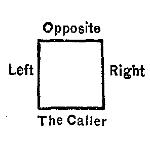
This arrangement does not affect the use of the letters A Y B Z, and the terms first, second, third, and fourth hand; indicating the position of the deal, and of the lead.
Calling. Those solos are easiest which are declared by the eldest hand, or by the dealer; the hardest being those called by second hand. The safest solos are those called on trump strength; but average trumps and winning cards in the plain suits are more advantageous if the caller is not eldest hand. To call a solo on plain suits alone, with only one or two trumps, is extremely dangerous; and a solo called on a single suit must have at least five or six good trumps in order to succeed.
PLAYING. When a call has been made entirely upon trump strength, it is much better to make tricks by ruffing, than by leading trumps. There is little use for a solo player to hold a tenace in trumps, hoping it will be led to him. If he has good suits, he should make sure of two rounds of trumps by leading the Ace.
When the solo player is depending on the plain suits for tricks, and has one long suit, he should make what winning cards he has in the other plain suits in preference to leading trumps, for his only danger is that his long suit will be led often enough to give his adversaries discards in the other suits.
If a proposal was made before the solo was called, it is better for the solo player to sit on the left of the player that proposed.
The caller should never play single honours second hand, unless he has only one small card of the suit, or the honour is the Ace.
With A Q x, second or third hand, the Q must be finessed if the caller has counted on both A and Q for tricks. If he can probably win without the finesse, he should play Ace. If he has tricks enough to win without either A or Q, he should play neither of them.
A solo player should be very sure of his call before finessing for over-tricks.
Adversaries’ Play. The player to the left of the caller should not lead trumps; but if the solo player has had a lead, and has not led trumps himself, the player on his right should take the first opportunity to lead them through him.
The player to the left of the caller should not lead from suits headed only by the King; nor from those containing major or minor tenaces. The best leads are from suits headed by Q J or 10, even if short.
With such high-card combinations as can be used to force the command in one round, such as K Q, or K Q J, the regular whist leads should be used. With suits headed by winning sequences, held by the player on the left, it is often right to lead them once, in order to show them, and then to lead a weaker suit to get rid of the lead. It is sometimes better to play winning sequences as long as it seems probable that the caller can follow suit.
Many persons use the Albany lead to indicate a wish for trumps to be led through the caller. In response to such a signal the best trump should be led, whatever it is.
When the adversary who leads in any trick is not on the left of the solo player, the caller will, of course, not be the last player, as at least one adversary must play after him. In such cases it is best to lead the longest suits.
MISÈRE. The great difficulty in Misère is not in playing it; but in judging what hands justify such an undertaking.
Calling. As a general proposition it may be stated that misère should not be called with a long suit not containing the deuce. But the longer the suit the less the danger there is for a player who is determined to risk it; because the deuce is more likely to be found alone in some adversary’s hand. Short suits may be risked, even with no card smaller than a 5 or 6, and it is of course a great advantage to have a suit altogether missing.
Leading. The lead is a disadvantage to the caller, because he must begin with a small card, and the adversaries can play their highest. The only satisfaction to the caller is that he can usually locate the high cards of the suit under such circumstances. For instance: Suppose he originally leads a 4; second hand playing the 9; third hand the Ace; and fourth hand the 10. The third hand is marked with whatever cards of the sequence K Q J are not in the caller’s hand.
Many players fall into the error of leading the highest card of a losing sequence, such as a 6 from 6 5 4 3. This accomplishes nothing, and only discloses to the adversaries the fact that the caller is safe in that suit. The three is the better lead.
Following Suit. The caller should usually play a card as little inferior as he can to the highest already on the trick. When he has cards of equal value, such as the 5 and 2, the 3 and 4 being already on the table, he should play the lower card of the fourchette; for although it may be said that the fourth player must take the trick, there is no certainty that he will follow suit.
When second hand, if there is a choice between two cards, such as the 6 and 2, an intermediate card having been led, it is often a nice point to decide whether or not to risk covering and keeping the deuce. If the deuce is played, it must be remembered that the adversaries will follow with their highest cards, leaving two cards out against the caller, both smaller than the 6.
Discarding. The misère player should never discard from his long suits. The high cards of short suits, and single intermediate cards, such as 5’s and 6’s, should be got rid of at every opportunity.
Adversaries of the Misère. In playing against a misère the chief difficulty is to prevent the caller from discarding, and to place the lead with the player who can probably do him the most harm.
It is an axiom with solo-whist players that every misère can be defeated, if the weak spot in it can be found; because if the misère was absolutely safe, it would be played as a spread, which would pay the caller twice as much. This is not true, however, for it often happens that the cards are so distributed in the other hands that the call cannot be defeated, however risky it may have been.
The weak point in a misère is usually a short suit with one high card in it; or a suit of intermediate length, without the deuce.
As it is probable that the caller is short in suits in which the adversaries are long, and long in those in which they are short, he is less likely to get a discard if they lead their shortest suits first. If the misère player has over-called a proposal or a solo, he is likely to be short in the trump suit, or at least safe in it. It is not good play to lead a single Ace; but a King may be very effective; for if no one plays the Ace on it, that card may be absolutely marked in the caller’s hand. In such a case the adversary with the greatest number of that suit should keep it for the attack. If this player can get into the lead, he is not only sure of preventing the caller from discarding, but of allowing the other adversaries to discard to advantage.
With an honour and one small card, a player on the left should lead the small card first; if on the right, the honour should be led first. A long suit containing the deuce should be avoided as long as possible.
The caller’s cards may sometimes be inferred if there has been a previous call on the hand. For instance: A misère may be a forced call; that is, the player first called a proposal, and not being accepted, was forced to amend his call, choosing misère in preference to solo. This would indicate a long weak suit of trumps. If the dealer calls misère, the turn-up trump should be carefully noted.
It is useless to persevere in suits in which the caller is evidently safe. If he plays a very low card to a trick in which there is already a high card, that suit should be stopped.
Discarding. An adversary should get rid of some one suit, if possible; for when that suit is afterwards led he will have free choice of his discards in the other suits. Short suits should be discarded in preference to high cards in long suits, unless the cards in the short suit are very low. Discards give great information to the adversaries if the rule is followed to discard the highest of a suit; because all cards higher than those discarded must be between the two other adversaries and the caller, and each adversary is thus furnished with a guide. It is useless to discard a suit of which the caller is void; and it is best to keep discarding from one suit until it is exhausted, or only the deuce remains. The trump signal is frequently used in discarding to indicate that the signaller wishes to get into the lead.
Returning Suits. Whether or not to return a partner’s lead may often be decided by inferences from the fall of the cards. It is frequently an easy matter to locate the cards in the various suits, if it is borne in mind that adversaries who play after the caller get rid of their highest cards. For instance: Right leads the 9; caller plays the 5; left the 10; and the last player finds he holds K Q J 6 of the suit. He should know that the caller has nothing between the 5 and the 9, and must have the Ace; so his cards were probably A 5 4 3 2. While it is manifestly impossible to catch him on that suit, it may still be led three times, in order to give the partners discards, as both of them must be short. If this estimate of the caller’s cards is wrong in anything, it is not with regard to the Ace, so there is not the slightest danger in continuing the suit.
As a general rule, the suit first led by an adversary should be returned, unless the player winning the trick has a singleton in another suit, when he should lead that.
The suit led by the caller, if he was eldest hand, should not be returned.
Some judgment of character must be used in playing on a caller’s own lead. An adventurous player will sometimes call a misère on a hand which contains a singleton 5 or 6, and will lead it at once; trusting that second hand will imagine it to be safe, and cover it. Players should be aware of this trap, and never cover a misère player’s own lead if they can help it, unless the card led is below a 4.
ABUNDANCE. Very few persons will risk calling an abundance which they are not pretty certain of; but a player may be forced to the call on a doubtful hand, especially if he is over-called on his original proposal to play a solo. The lead is a great advantage, because trumps can be exhausted immediately, and the suits protected. If the caller has not the lead he must calculate in advance for trumping in, and if his plain suits are not quite established, he will require more trumps than would otherwise be necessary. The greatest danger to an abundance player who has not the original lead, is that his best suit will be led through him, and trumped, either on the first or second round. The caller is often trapped into unnecessarily high trumping when suits are led through him a second or third time.
The Adversaries have little chance to defeat an abundance unless they can over-trump the caller, or ruff his good cards before he can exhaust the trumps. It is best for the Right to lead his longest suit, and for the Left to lead his shortest. A guarded King suit should not be led under any circumstances; nor a short suit Ace high. If an adversary has a single trump of medium size, such as a J or 10, it is often good play to trump a partner’s winning cards, so as to be sure of preventing the caller from making a small trump. If an adversary has trumped or over-trumped, it is very important to lead that suit to him again as soon as possible.
The rules for discarding that are given in connection with Whist should be carefully observed; especially in the matter of showing command of suits.
SPREADS. These should not be called except with hands in which every suit contains the deuce, and all the cards are low enough to insure the player that nothing short of extraordinary circumstances will defeat him. Open sequences, or Dutch straights, as they are sometimes called, in which the cards are all odd or all even, such as 2 4 6 8 10, are quite as safe as ordinary sequences, provided the deuce is among the cards.
The player calling a spread must remember that it will be impossible for him to get any discards after the first trick without the consent of the adversaries; for they will not lead a suit of which they see he is void. In order to reduce the caller’s chances of a discard on the opening lead, before his cards are exposed, the adversaries should select their shortest suits, unless they have a bottom sequence to the deuce.
THE SLAM. This feature of Solo Whist is even rarer than the grand coup at Whist. It is not very marvellous for an abundance player to make twelve or thirteen tricks; but to announce thirteen tricks before a card is played is something phenomenal. All the adversaries can do against such a call is to show each other, by their discards, in which of the suits they have a possible trick. It is very annoying to have a player succeed in making a slam just because two of his adversaries keep the same suit.
SOLO WHIST FOR THREE PLAYERS.
The best arrangement is to play with a pack of forty cards, deleting the 2, 3, and 4 of each suit. The last card is turned up to determine the trump, but it is not used in play.
There is no proposal and acceptance, solo being the lowest call. If all three players pass, the trump card is turned down, and each player in turn has the option of calling a six-trick abundance, naming his own trump suit. In some places it is the custom to allow the players to over-call each other, after the trump is turned down, each increasing the number of tricks he proposes to take. A misère over-calls eight tricks.
Kimberly Solo is for four players, without any proposal and acceptance, solo being the lowest call. If all pass, a six-trick solo with a different trump is allowed.
TEXT BOOKS.
Solo Whist, by R.F. Green.
How to Play Solo Whist, by Wilks & Pardon.
For the Laws of Solo Whist, see Whist Family Laws.
ILLUSTRATIVE SOLO WHIST HANDS.
The dealer, Z, turns up the heart 3 in both hands, and A leads. The underlined card wins the trick, and the card under it is the next one led.
A Solo. Trick A Misère.
A Y B Z A Y B Z
10♢ 8♢ Q♢ K♢ 1 K♠ 7♠ J♠ 10♠
3♢ 9♢ A♢ 2♢ 2 Q♠ 5♠ 9♠ 8♠
♡6 ♡2 ♡A ♡3 3 Q♢ 5♢ A♢ J♢
♣8 ♡4 ♡Q ♡K 4 9♢ 4♢ K♢ 10♢
♣9 ♣A ♣4 ♣7 5 ♡6 3♠ 6♠ 8♢
A♠ 9♠ K♠ 4♠ 6 ♡7 2♠ 4♠ ♣A
♣K ♣2 ♣6 ♣5 7 ♣10 ♣8 ♣7 ♣K
7♠ 2♠ Q♠ 6♠ 8 ♣9 ♣6 7♢ ♣Q
5♢ ♣3 ♣Q ♡8 9 ♣5 ♣4 6♢ ♣J
6♢ 3♠ ♡5 J♢ 10 ♡8 ♣2 ♡K ♣3
7♢ ♡10 ♡9 ♡J 11 ♡A ♡2 ♡Q ♡3
8♠ 5♠ ♡7 4♢ 12 2♢ 3♢ ♡9 ♡4
J♠ ♣J ♣10 10♠ 13 ♡J A♠ ♡10 ♡5
Solo player wins. Misère player loses.
In the first example, A and Y pass, and B calls Solo. A follows the modern practice of leading the top of his long weak suit, as a card of warning and support for his partners. Z knows Y must have 9 or Ace of diamonds, or no more, and he avoids the error of opening another suit, especially a weak one. B continues with the trump Queen, hoping to drop King and Jack together. At trick 5, Z cannot give up the command of trumps, and as A’s lead and discard indicate that he wants spades led up to him, Z’s best chance is that Y has some clubs. Y leads to A. At trick 9, Z knows B cannot have 10 and 9 of trumps, or he would have led one of them to prevent the J and 8 both making, so Y must have one of those trumps. At trick 11, if B leads the club, he loses his call. He must again take the chance of bringing the trumps down together.
In the second example A proposes, or calls Solo, and Y over-calls him with Misère. The great point in playing against Misère is to continue leading suits in which he is known to be long, so as to give your partners discards. This B does with the two long spades, the caller being marked with the ace and others on the second trick. Then Z allows B to discard his high diamonds on the clubs.
SCOTCH WHIST, OR CATCH THE TEN.
CARDS. Scotch Whist is played with a pack of 36 cards, which rank in plain suits, A K Q J 10 9 8 7 6; the Ace being highest both in play and in cutting. In the trump suit the Jack is the best card, the order being, J A K Q 10 9 8 7 6.
MARKERS. There are no suitable counters for Scotch Whist, and the score is usually kept on a sheet of paper.
PLAYERS. Any number from two to eight may play. When there are five or seven players, the spade 6 must be removed from the pack. In some places this is not done; the thirty-fifth card being turned up for the trump, the thirty-sixth shown to the table, and then laid aside.
CUTTING. Whatever the number of persons offering for play, the table is formed by cutting from the outspread pack for partners, seats, and deal.
When two play, the one cutting the lowest card has the choice of seats and cards, (if there are two packs).
When three play, the lowest deals, and chooses his seat and cards. The next lowest has the next choice of seats.
When four play, partners are cut for; the two lowest pairing against the two highest; the lowest of the four is the dealer, and has the choice of seats and cards.
When five play, each for himself, the lowest cut deals, and has the first choice of seats and cards. The next lowest has the next choice of seats, and so on.
When six play, they cut for partners, the two lowest pairing together; the two highest together; and the two intermediates together. The player cutting the lowest card of the six has the choice of seats and cards, and deals the first hand. If the six play, three on a side, the three lowest play against the three highest; the lowest cut of the six taking the deal, and choice of seats and cards.
When seven play, each for himself, the lowest deals, and has the choice of seats and cards; the others choosing their seats in the order of their cuts.
When eight play, they may form two sets of four each, or four sets of two each. In either case the partnerships are decided by cutting, and the lowest cut of the eight has the deal, with choice of seats and cards.
TIES are decided in the manner already described in connection with Whist.
POSITION OF THE PLAYERS. Two players sit opposite each other. Three, five or seven sit according to their choice. Four sit as at Whist, the partners facing each other. Six, playing in two partnerships, sit alternately, so that no two partners shall be next each other. Six, playing in three partnerships of two each, sit so that two adversaries shall be between each pair of partners. Eight, playing in two sets of four each, or as four pairs of partners, arrange themselves alternately. If we distinguish the partners by the letters A, B, C, D, the diagram will show the arrangement of the tables.
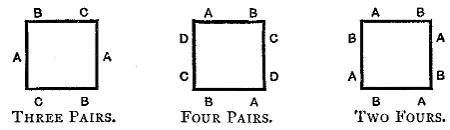
The player to the left of the dealer is the original leader.
DEALING. The method of dealing varies with the number of players engaged. When only one pack is used, any player may shuffle, the dealer last. The pack must be presented to the pone to be cut, and the entire pack is then dealt out, one card at a time.
When two play, the dealer gives each six cards, one at a time. These two hands are kept separate, and two more are dealt in the same manner, and then a third two, the last card being turned up for the trump. When the deal is complete, there will be six hands on the table, three belonging to each player.
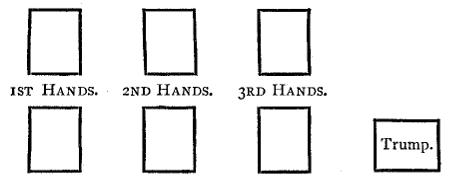
When three play, the cards are dealt in much the same manner; two separate hands of six cards being given to each player.
When four, five, six, seven, or eight play, the cards are dealt in rotation from left to right until the pack is exhausted, the last card being turned up for the trump. When five or seven play, either the spade 6 must be thrown out of the pack, or the thirty-sixth card must be shown, after the dealer has turned the thirty-fifth for the trump. When eight play, all four sixes are deleted.
The deal passes to the left, each player dealing in turn until the game is finished.
The general rules with regard to irregularities in the deal are the same as at Whist.
STAKES. When stakes are played for, they are for so much a game. Rubbers are not played. It is usual to form a pool, each player depositing the stake agreed upon, and the winner taking all. In partnership games, each losing player pays the successful adversary who sits to his right. If three pairs were engaged, and A-A won, C and B would each pay the A sitting next him. Before play begins, it should be understood who pays for revokes; the side or the player.
METHOD OF PLAYING. The player on the dealer’s left begins by leading any card he chooses, and the others must all follow suit if they can. Failure to follow suit when able is a revoke, the penalty for which, if detected and claimed by the adversaries, is the immediate loss of the game. When there are more than two players or two sets of partners, the revoking player or side must pay the two or more adversaries as if each had won the game. In some places the individual is made to pay, not the side. This should be understood before play begins. If seven are playing, and one is detected in a revoke, his loss is equal to six games. Any player having none of the suit led may either trump or discard. The dealer should take up the trump card when it is his turn to play to his first trick; after which it must not be named, although a player may be informed what the trump suit is. If all follow suit, the highest card played of the suit led wins the trick, trumps win all other suits. The winner of the trick may lead any card he chooses for the next; and so on, until all the cards have been played.
It is not necessary to keep the tricks separate, as at Whist; but one player should gather for his side.
When two or three play, the hands must be played in the order in which they were dealt. For instance: If these are the hands:—
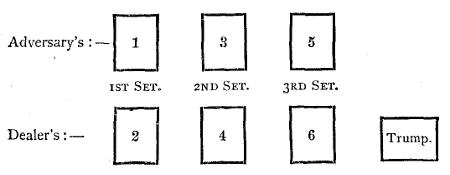
The players first take up hands Nos. 1 and 2; a card is led from No. 1, the dealer follows suit from No. 2, or trumps, or discards, and the play continues until these two hands are exhausted. The second set are then taken up and played in the same manner; the player who won the last trick in one set having the first lead in the next. Finally, the third set are played in the same manner; all the cards taken by each side being gathered into one pile by the player who has won them. The trump card must remain on the table until the dealer takes up the last hand. When three play, the set of hands first dealt must be first played, and then the second set taken up.
The rules for cards played in error, leading out of turn, etc., are the same as at Whist.
OBJECTS OF THE GAME. The side first scoring 41 points wins the game; and the chief object is to secure tricks containing cards to which a certain value is attached. These all belong to the trump suit, and are the following:—
The Jack of trumps counts 11
The Ace of trumps counts 4
The King of trumps counts 3
The Queen of trumps counts 2
The Ten of trumps counts 10
The other trumps, and the plain suit-cards, have no counting value.
The Jack of trumps, being the best, must be taken in by the player to whom it is dealt; but any court card in trumps will win the Ten, so that one of the principal objects in Scotch Whist is to catch the ten.
At the end of each hand the players count the number of cards they have taken in tricks, and they are entitled to score one point for each above the number originally dealt to them. For instance: If four play, nine cards were originally dealt to each, so each pair of partners held eighteen. If at the end of the hand they have taken in eight tricks, or thirty-two cards, they score 14 points toward game, in addition to any score they may have made by winning honours in trumps, or catching the Ten. If five play, beginning with seven cards each, and at the end of the hand one player has taken in fifteen, and another ten; they score 8 and 3 respectively, for cards.
SCORING. At the end of each hand, each player or side should claim all honours won, and cards taken in. One player should keep the score, and announce it distinctly, in order that it may be known how many points each player or side requires to win the game.
In the case of ties, the Ten counts out first; then cards; then A K Q of trumps in their order, and the Jack last. A revoke, if detected and claimed before the cards are cut for the next deal, immediately ends the game.
METHODS OF CHEATING. When only one pack is used, the greek can often succeed in dealing himself the Jack of trumps, and usually loses no time in marking the Ten, so that he can at least distinguish the player to whom it is dealt. A player should be carefully watched who keeps his eyes on the pack while shuffling, or who rivets his attention on the backs of the cards as he deals. Two packs should be used in all round games of cards.
SUGGESTIONS FOR GOOD PLAY. The chief counting elements that are affected by the play being the trump Ten and the cards, it is usual to devote particular attention to winning them. With J A of trumps, or A K, it is best to lead two rounds immediately; but with a tenace, such as J K, or A Q it is better to place the lead on your left if possible. The high cards in the plain suits are capable of being very skilfully managed in this matter of placing the lead. It sometimes happens that a player with the Ten may be fourth hand on a suit of which he has none; or he may catch the Ten with a small honour if it is used in trumping in. The partnership games offer many fine opportunities for playing the Ten into the partner’s hand, especially when it is probable that he has the best trump, or a better trump than the player on the left.
In calculating the probabilities of saving the Ten by trumping in, it must be remembered that the greater the number of players, the less chance there is that a suit will go round more than once, because there are only nine cards of each suit in play.
Many players, in their anxiety to catch the Ten, overlook the possibilities of their hands in making cards, the count for which often runs into high figures.
Close attention should be paid to the score. For instance: A wants 4 points to win; B wants 10; and C wants 16. If A can see his way to win the game by cards or small honours, he should take the first opportunity of giving C the Ten; or allowing him to make it in preference to B. As the Ten counts first, cards and honours next, B may be shut out, even if he has the Jack.
LAWS. There are no special laws for Scotch Whist. The whist laws are usually enforced for all such irregularities as exposed cards, leading out of turn, etc. The most important matter is the revoke, and it should be clearly understood before play begins whether the revoke penalty is to be paid by the individual in fault, or by the side to which he belongs. Some players think there should be some regulation for penalties in such cases as that of a player taking up the wrong hand, when two or more are dealt to each player; but as no advantage can be gained by the exchange, it is hard to see what right the adversary would have to impose a penalty.
ILLUSTRATIVE SCOTCH WHIST HAND.
We give a simple example hand, as an illustration of the manner of playing with four persons; two being partners against the other two.
Z deals and turns heart 8
A Y B Z
1 Q♢ K♢ 8♢ 9♢
2 ♣A ♣K ♣J ♣8
3 ♣7 ♣9 ♣6 6♠
4 8♠ J♠ K♠ A♠
5 J♢ 9♠ A♢ Q♠
6 7♢ 10♠ ♣Q 7♠
7 ♡A 10♢ 6♢ ♡Q
8 ♡9 ♡6 ♡K ♡7
9 ♣10 ♡10 ♡J ♡8
A-B win 30 by honours.
Y-Z win 2 by cards.
Trick 1. Y plays King second hand, hoping it will be taken by the Ace, so that he may become third or fourth player, and perhaps save his Ten. B, with the minor tenace in trumps, plays to avoid the lead as long as possible.
Trick 2. Y gets rid of another winning card; B keeping a small card to avoid the lead.
Trick 3. A returns the Club, reading B for the Q or no more. B still avoids the lead, and Z is marked as not having the trump Ten, or he would have saved it.
Trick 4. Z plays to win what cards he can.
Trick 5. B throws ♢A to avoid the lead, knowing Y has the trump Ten; for A would have made it on the second round of Spades. A also marks it with Y, as B does not save it.
Trick 6. B is not sure whether Y has a Diamond or a Club left, and discards the winning card.
Trick 7. Z plays Queen to shut out the Ten, if with A. A knows each player has two trumps left, and that as the turn-up is still with Z, B must have J or K; for if he held only 7 and 6 he would have trumped in to make cards.
Trick 8. A leads trumps. If Y does not play the Ten, and B has not the Jack, B must make four cards and the King by passing. If B has the Jack, he must catch the Ten, no matter how Y and Z play.
FRENCH WHIST is the name given to a variety of Scotch Whist in which the Ten of Diamonds counts ten to those winning it, whether it is a trump or not.
BOSTON.
CARDS. Boston is played with two packs of fifty-two cards each, which rank as at Whist, both for cutting and playing.
MARKERS are not used in Boston, every hand being immediately settled for in counters. These are usually of three colours; white, red, and blue; representing cents, dimes, and dollars respectively. At the beginning of the game each player should be provided with an equal number, the general proportion being 20 white, 18 red, and 8 blue for each. Some one player should be selected to act as the banker, selling and redeeming all counters.
STAKES. The stakes in Boston depend upon the value of the counters. One cent for a white counter is considered a pretty stiff game; because it is quite possible for a single player to win or lose a thousand white counters on one hand, and the payments very seldom fall short of fifty.
THE POOL. In addition to the counters won and lost on each hand, it is usual for the players to make up a pool at the beginning of the game by each of them depositing one red counter in a small tray provided for the purpose. This pool may be increased from time to time by penalties; such as one red counter for a misdeal; four for a revoke, or for not having the proper number of cards, etc. The whole amount in the pool may be won or lost by the players, according to their success or failure in certain undertakings, which will presently be described. When empty, the pool is replenished by contributions from each player, as at first.
The pool proper is usually limited to 25 red counters. When it exceeds that amount, the 25 are set aside, and the surplus used to start a fresh pool. Any player winning a pool is entitled to 25 red counters at the most. It will often happen that several such pools will accumulate, and each must be played for in its turn. At the end of the game any counters remaining in the pool or pools must be divided among the players.
PLAYERS. Boston is played by four persons. If more than four candidates offer for play, five or six may form a table; if there are more than six, the selection of the table must be made by cutting, as at Whist.
CUTTING. The four persons who shall play the first game are determined by cutting, and they again cut for the deal, with the choice of seats and cards. The player drawing the lowest card deals, and chooses his seat; the next lower card sits on his left, and so on, until all are seated. Twelve deals is a game, at the end of which the players cut to decide which shall go out, as at Whist.
It is usual to count the deals by opening the blade of a pocket-knife, which is placed on the table by the player on the dealer’s right. When it comes to his turn to deal, he partly opens one blade. When he deals again he opens it entirely, and the third time he closes it; that being the third round, and the last deal of the game.
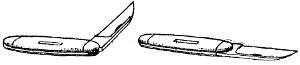
Fourth Deal. Eighth Deal.
POSITION OF THE PLAYERS. The four players at Boston are distinguished by the letters A Y B Z.
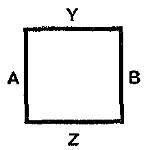
Z is the dealer, and A is known as the eldest hand. There are no partnerships in Boston, except that of three players combined against the fourth, who is always spoken of as the caller. The players having once taken their seats are not allowed to change them without the consent of all the others at the table.
DEALING. At the beginning of the game the two packs are thoroughly shuffled; after which they must not again be shuffled during the progress of the game. If a hand is dealt and not played, each player must sort his cards into suits and sequences before they are gathered and dealt again.
At the beginning of each deal, one pack is presented to the players to be cut; each having the privilege of cutting once, the dealer last. Beginning on his left, the dealer gives four cards to each player, then four more, and finally five; no trump being turned.
The general rules with regard to irregularities in the deal are the same as at Whist, except that a misdeal does not lose the deal. The misdealer must deal again with the same pack, after the players have sorted their cards into suits. It is a misdeal if the dealer fails to present the pack to the other players to cut, or neglects to cut it himself. Should the dealer expose any of his own cards in dealing, that does not invalidate the deal. The deal passes in regular rotation to the left, each pack being used alternately.
MAKING THE TRUMP. The deal being complete, the player opposite the dealer cuts the still pack, and the player on his right turns up the top card for the trump. The suit to which this card belongs is called First Preference, and the suit of the same colour is called Second Preference, or Colour. The two remaining suits are known as Plain Suits for that deal.
The cards having been dealt, and the trump turned, each player carefully sorts and counts his cards, to see that he has the correct number, thirteen. A player having more or less than his right proportion should at once claim a misdeal; for if he plays with a defective hand he cannot win anything that deal, but must stand his proportion of all losses incurred, besides paying a forfeit of four red counters to the pool.
OBJECTS OF THE GAME. In Boston, each player has an opportunity to announce that he is willing to undertake to win a certain number of tricks, if allowed the privilege of naming the trump suit; or to lose a certain number, there being no trumps. In either case, he proposes to play single-handed against the three other players. The player proposing the undertaking which is most difficult of accomplishment is said to over-call the others, and must be allowed to try. If he is successful, he wins the pool, and is paid a certain number of counters by each of his adversaries. If he fails, he must double the amount in the pool, and pay to each of the other players a certain number of counters.
ANNOUNCEMENTS. The bids rank in the following order, beginning with the lowest. The full-faced type shows the words used by the players in calling their bids:—
To win five tricks; Boston.
To win Six Tricks.
To win Seven Tricks.
To lose twelve tricks, after having discarded a card which is not to be shown; Little Misère.
To win Eight Tricks.
To win Nine Tricks.
To lose every trick; Grand Misère.
To win Ten Tricks.
To win Eleven Tricks.
To lose twelve tricks, after having discarded a card which is not to be shown; the single player’s remaining twelve cards being exposed face up on the table, but not liable to be called; Little Spread.
To win Twelve Tricks.
To lose every trick; the single player’s cards exposed on the table, but not liable to be called; Grand Spread.
To win Thirteen Tricks; Grand Slam.
The object of the proposing player, if successful in his bid, is to win or lose the proposed number of tricks; while that of his three adversaries is to combine to prevent him from so doing. There are no honours, and the only factor in the count is the number of tricks taken. The highest card played of the suit led wins the trick; and trumps, if any, win against all other suits.
METHOD OF BIDDING. The eldest hand has the first say, and after examining his cards, and estimating the number of tricks he can probably take, making the trump to suit his hand, he bids accordingly. It is not necessary for him to state which suit he wishes to make the trump; but only the number of tricks he proposes to win. If he has no proposal to make, he says distinctly; “I pass,” and the other players in turn have an opportunity to bid. If any player makes a bid, such as six tricks, and any other player thinks he can make the same number of tricks with a trump of the same colour as the turn-up, that is, Second Preference, he over-calls the first bidder by saying “I keep;” or he may repeat the number bid, saying “Six here.” This is simply bidding to win the number of tricks in colour. The original caller may hold his bid, or a third player may overbid both, by saying; “I keep over you,” or “Six here.” This means that he will undertake to win the number of tricks already bid, with the turn-up suit for trumps. In order to over-call such a bid as this, any other player would have to announce a greater number of tricks. For instance; Z deals, and turns a heart. A calls six tricks, intending to name hearts trumps; but not saying so. B passes; Y says “I Keep.” This announces to the table that Y will play with a red trump, and A knows he is bidding on diamonds. Z passes, and A says; “I keep over you.” B then bids seven tricks, and if A will not risk seven tricks in hearts, B will be the successful bidder. If A should bid seven tricks by keeping over B, the latter must know that it is useless for him to bid again unless he can make more tricks in diamonds than A can in hearts; for A’s bid, being in first preference, will always outrank B’s for the same number of tricks.
A player once having passed cannot come into the bidding again, except to call one of the misères. In the example just given, either Y or Z, after having twice passed, might have outbid the seven tricks by calling a little misère. Such a bid can, of course, be entertained only when it outranks any bid already made.
A player is not compelled to bid the full value of his hand; but it is to his interest to go as near to it as he can with safety; because, as we shall see presently, the more he bids the more he is paid. For instance: If he can make ten tricks, but bids seven only, he will be paid for the three over-tricks, if he makes them; but the payment for seven bid and ten taken, is only 22 counters; while the payment for ten bid and ten taken is 42. As he receives from each adversary, a player who underbid his hand in this manner would lose 60 counters by his timidity.
It sometimes happens that no one will make a proposal of any sort. It is very unusual to pass the deal. The trump is generally turned down, and a Grand is played, without any trump suit. This is sometimes called a Misère Partout, or “all-round poverty”; and the object of each player is to take as few tricks as possible.
METHOD OF PLAYING. No matter who is the successful bidder, the eldest hand always leads for the first trick, and the others must follow suit if they can, the play proceeding exactly as at Whist. The tricks should be carefully stacked, so that they can be readily counted by any player without calling attention to them. The laws provide a severe penalty for drawing attention to the score in this manner. Suppose a player has called eight tricks. An adversary hesitates in his play, and another reaches over and counts the tricks in front of the caller, finding he has seven. This is tantamount to saying to the player who hesitates: “If you don’t win that trick, the call succeed.” In such a case, the single player may at once demand the play of the highest or lowest of the suit; or that the adversaries trump or refrain from trumping the trick.
In all calls except misères and slams, the hands should be played out, in order to allow the players to make what over-tricks they can; but the moment a misère player takes a trick, or a slam player loses one, the hands are thrown up, and the stakes paid. It is usual to show the cards to the board, in order to satisfy each player that no revoke has occurred.
When Little Misère is called, each player discards one card, which must not be shown, and the hand is then played out with the remaining twelve cards.
When Spreads are called, the caller’s cards must be placed face upwards on the table before a card is played. If it is a Little Spread, the discard of each player must remain unknown. The adversaries have no control of the manner of playing the exposed cards, which cannot be called, and may be played in any manner suited to the judgment of the single player, provided he follows suit when able.
REVOKES. If a player opposed to the caller revokes, but discovers his mistake in time to save himself, he may be called upon by the single player for his highest or lowest of the suit led; or the card played in error may be claimed as an exposed card. If the highest or lowest of the suit is called, the card played in error is taken up.
If the caller revokes, and discovers his mistake in time, he is not liable to any penalty, unless an adversary has played to the next trick. In that case the revoking card must be left on the table, and is liable to be called. When the single player revokes, he loses the call in any case, and at least one trick besides. He must also double the pool, and add to it a revoke forfeit of four red counters. For instance: A bids eight tricks, and his adversaries detect and claim a revoke. As he is supposed to have lost his bid, and one trick more, he may be said to have bid eight, and taken only seven; losing 23 white counters to each of his adversaries, doubling the pool, and then paying a forfeit of four red counters. In some places the forfeit is omitted, and in others it takes the place of doubling the pool. It is not usual to play the hand out after a revoke is claimed and proved.
If an adversary of the single player revokes, he and his partners must each pay the caller just as if he had been successful, and must also pay him for three over-tricks as forfeit, provided his bid was not more than nine tricks; for the bid and the over-tricks together must not exceed thirteen tricks. In addition to this, the individual player in fault must pay four red counters as forfeit to the pool. In some places he is made to double the pool; but this is manifestly unfair, as he could not win the amount in the pool in any case, and therefore should not lose it.
In a Misère Partout, the revoking player pays five red counters to each adversary, and deposits a forfeit of four red counters in the pool. The hands are immediately thrown up if the revoke is claimed and proved.
CARDS PLAYED IN ERROR. The single player is not liable to any penalty for cards played in error, or led out of turn, except those taken back to save a revoke; but his adversaries are liable to the usual whist penalties for all such irregularities. The single player can forbid the use of an exposed trump for ruffing, and can demand or prevent the play of an exposed card in plain suits, provided he does not ask the adversary to revoke. If a suit is led of which an adversary has an exposed card on the table, the single player may call upon him to play his highest or lowest of that suit.
If a player has announced Little Misère, and one of the adversaries leads before the others have discarded, the caller may immediately claim the pool and stakes. If any adversary of a misère player leads out of turn, or exposes a card, or plays before his proper turn in any trick, the bidder may at once claim the pool and stakes. In all such cases it is usual for the individual in fault to pay a forfeit of four red counters toward the next pool.
In Misère Partout, there is no penalty for cards played in error, or led out of turn.
PAYMENTS. If the caller succeeds in winning the proposed number of tricks, he is paid by each of his adversaries according to the value of his bid, and the number of over-tricks he wins, if any. The various payments are shown in this table:—
Number of tricks bid by player. Number actually taken by him.
5 6 7 8 9 10 11 12 13
Five 12 12 13 13 14 14 14 15 15
Six 15 16 16 17 18 19 20 20
Seven 18 20 21 22 23 24 26
Eight 23 24 26 28 29 31
Nine 32 34 36 39 41
Ten 42 45 48 52
Eleven 63 68 72
Twelve 106 114
Thirteen 166
The American system is not to pay the successful bidder for any over-tricks. This is to make him bid up his hand, and to save time; as hands need not be played out when the bidder has made or can show the number of tricks bid.
Tricks bid 5 6 7 8 9 10 11 12 13
Amount. 10 15 20 25 35 45 65 105 170
If the caller fails in his undertaking, he must pay each adversary according to the number of tricks by which he failed to reach his bid. For instance: A player bidding eight, and taking only seven, is said to be “put in for” one trick, and he would have to pay each adversary 23 white counters. These payments are shown in this table:—
Tricks bid by the player. Number of tricks by which the player falls short of his declaration.
1 2 3 4 5 6 7 8 9 10 11 12 13
Five 11 21 31 41 50
Six 15 24 35 45 55 66
Seven 19 29 40 50 60 72 82
Eight 23 34 46 56 67 78 89 110
Nine 33 44 57 68 82 92 103 115 127
Ten 44 56 70 82 94 107 119 132 145 157
Eleven 67 80 95 109 123 138 151 165 180 194 208
Twelve 113 130 148 165 182 200 217 234 252 270 286 304
Thirteen 177 198 222 241 262 284 305 326 348 369 390 412 433