THE WHIST FAMILY. (continued 4)
Reading edition
we should lead the seven of diamonds.
From hands containing four trumps and three three-card suits, we use our own judgment, sometimes leading the trump, and sometimes a plain suit. We prefer the plain suit if it is a desirable one to open, such as hearts trumps:—
♡ K 8 3 2 ♣ J 10 4 ♢ A 10 3 ♠ 8 4 3
From this we would open the Jack of clubs; but from
♡ K 8 3 2 ♣ J 3 2 ♢ A 10 3 ♠ Q 6 3
we should lead the deuce of trumps. If in this hand the club suit were Q J 3, the Queen of clubs would be the best opening.
It may seem paradoxical that a weaker hand should call for a trump lead; but the opening is not an attack. It is a move to await developments.
Three-trump Hands. From hands containing three trumps or less, our opening leads vary from the ordinary player’s game more than in any other particular. We always open a long suit from three-trump hands if the suit is a good one, such as A K and others, K Q and others, or even Q J and others. But without such strength in the long suit, we let it severely alone, and develop the hand with a short-suit or “gambit” opening.
With three trumps and a five-card suit containing two honors not in sequence, we still open the long suit if we have a sure re-entry in another suit. This, for example, hearts trumps:—
♡ K 6 2 ♣ 8 6 2 ♢ A Q 6 4 3 ♠ A 10
The trey of diamonds is the best opening. If there were no re-entry, such as only 10 2 of spades instead of A 10, we should open the 10 of spades.
Although we open a great many short suits, we avoid weak three-card suits except in rare instances.
While our system, like all others, entails losses at times, it seems to avoid many of the pitfalls that confront the player who always opens his long suit, regardless of the possibilities of ever bringing it in. In many instances we find he places himself in the worst possible position for any chance to make even one trick in the suit he opens.
We admit that if a team adopts straight American leads, it is much easier for them to count the partner’s hand accurately; but it seems to me that this advantage is more than overcome by the fact that in our openings we have a clear idea as to the general character of the partner’s hand while there is still time to take advantage of the knowledge. In the long-suit game this element is entirely wanting.
IN CONCLUSION. The first-class whist-player is usually developed gradually. If he possess the faculty of paying close attention to the game while he is playing, nothing should prevent his rapid progress. At first he may care little or nothing for “book” whist, but after some experience with book players, he is rather in danger of running to the other extreme, and putting more book into his game than it will carry. Having passed that stage, his next step is usually to invent some system of his own, and to experiment with every hand he plays. By degrees he finds that all special systems of play have some serious defects which over-balance their advantages, and this discovery gradually brings him back to first principles. If he gets so far safely, his game for all future time will probably be sound, common-sense whist, without any American leads, plain-suit echoes, or four-signals, and free from any attempts to take fourteen tricks with thirteen cards.
When a whist-player reaches that point, he is probably as near the first class as the natural limitations of his mental abilities will ever permit him to go.
THE LAWS will be found at the end of the Whist Family of Games.
ILLUSTRATIVE WHIST HANDS.
A and B are partners against Y and Z. A is always the original leader, and Z is the dealer. The underlined card wins the trick, and the card under it is the next one led.
No. 1. Long Suits; ♡5 turned. TRICK No. 3. Short Suits; ♡Q turned.
A Y B Z A Y B Z
♣K ♣5 ♣7 ♣3 1 Q♢ K♢ A♢ 2♢
♡10 ♡J ♡Q ♡5 2 2♠ A♠ J♠ 5♠
♣Q ♣J ♣2 ♣10 3 4♢ 10♢ 3♢ J♢
♡7 ♡3 ♡9 ♡8 4 ♡2 ♡5 ♡3 ♡ Q
J♠ 9♠ 2♠ 5♠ 5 ♡6 ♡A ♡4 ♡ J
♣A ♡4 ♡6 5♢ 6 ♣8 ♣2 ♣3 ♣ K
4♠ ♡K A♠ 6♠ 7 ♡7 8♢ 5♢ 7♢
J♢ 7♢ 2♢ K♢ 8 ♡K 4♠ 6♢ ♡ 9
♡2 3♢ 4♢ A♢ 9 K♠ 7♠ 6♠ 8♠
♣9 6♢ 3♠ 8♢ 10 Q♠ ♣4 ♣5 10♠
♣8 9♢ 7♠ 8♠ 11 9♠ ♣Q ♣6 ♡10
♣6 10♢ K♠ 10♠ 12 ♡8 9♢ ♣7 ♣ J
♣4 Q♢ ♡A Q♠ 13 3♠ ♣A ♣10 ♣ 9
No. 2. American Game; ♡8 turned. TRICK No. 3. Play to score; ♡J turned.
A Y B Z A Y B Z
6♢ J♢ A♢ 9♢ 1 K♠ 4♠ 3♠ A♠
♡3 3♢ 2♢ 10♢ 2 ♡3 ♡9 ♡Q ♡2
♣9 ♣K ♣A ♣3 3 2♠ 7♠ 5♠ ♡4
♡6 4♢ 5♢ ♣4 4 ♣2 ♣K ♣6 ♣3
♣Q ♣8 ♣2 ♣7 5 ♡5 ♡7 ♡8 ♡J
♣6 ♡4 ♡9 ♣10 6 ♡10 ♣5 ♡K ♡A
♡10 7♢ 8♢ ♣J 7 ♣8 ♣J 3♢ ♣4
♣5 ♡K ♡A 7♠ 8 5♢ J♢ A♢ 2♢
4♠ Q♢ ♡Q ♡5 9 10♠ 9♠ 8♠ ♡6
2♠ 5♠ ♡J ♡7 10 ♣Q ♣7 4♢ ♣A
A♠ 6♠ Q♠ K♠ 11 Q♠ J♠ 6♠ ♣10
J♠ 9♠ 3♠ 10♠ 12 10♢ 7♢ 6♢ ♣9
8♠ K♢ ♡2 ♡8 13 Q♢ 8♢ 9♢ K♢
No. 1. This is a fine example of the Long-suit Game. The leader begins with one of the high cards of his long suit. Missing the 2, he knows some one is signalling for trumps, and as it is very unlikely that the adversaries would signal while he was in the lead, he assumes it is his partner, and leads his best trump. His partner does not return the trump, because he holds major tenace over the king, which must be in Y’s hand. At trick 5 B still holds major tenace in trumps, and leads a small card of his long suit to try to get A into the lead again. If A leads trumps again, his only possible card of re-entry for his club suit is gone. At trick 7, if B draws Y’s king, he kills A’s card of re-entry at the same time.
No. 2. This is an excellent example of the American Game. A has a three-trump hand, but his long suit is not headed by two honors in sequence, and the Queen of clubs cannot be considered as a re-entry, so A makes the gambit opening of the singleton diamond. His partner, having nothing in plain suits, immediately returns the diamond. A now leads an intermediate club, and B forces him again. At trick 6, A avoids changing suits. If the long spade suit is opened, and Z returns the diamond 10, A-B will make four tricks less on this hand.
No. 3. This example of the Short-suit Game is from Val Starnes’ Short-Suit Whist. This is sometimes called the Gambit opening. The leader, having no reason to lead trumps, even with five, and not having three honours in his long suit, prefers the gambit opening of the singly guarded queen. Y holds what is called a potential or imperfect fourchette, and covers, in order to make A-B play two honours to get one trick. B also makes a gambit opening by returning a supporting spade. Three tricks are gained by the two leads of the supporting cards, and five would have been made but for Y’s covering on the first trick.
No. 4. This is an example of Playing to the Score. The game is English Whist, 5 points, counting honours. The first lead of trumps shows Z that honours are divided, and that he must make 11 tricks to win the game. At trick 3, he must trump; to discard clubs would be inconsistent with refusing to trump in order to bring them in. At trick 4, if Y cannot win a trick in clubs and give Z a finesse in trumps, Z cannot win the game. At trick 7, both black queens are against Z, and he must take the best chance to win if the diamond ace is also against him. The adversaries cannot place the club ace, and so Z underplays in clubs as his only chance for the game.
PRUSSIAN WHIST. This is the ordinary 5, 7 or 10 point whist, with or without honours, except that instead of turning up the last card for trump, the player to the left of the dealer cuts a trump from the still pack, which is shuffled and presented to him by the dealer’s partner.
FAVOURITE WHIST. This is the regular 5, 7 or 10 point whist, with or without honours, except that whichever suit is cut for the trump on the first deal of the rubber is called the favourite. Whenever the suit turns up for trump, after the first deal, tricks and honours count double towards game. There must be a new favourite at the beginning of each rubber, unless the same suit happens to be cut again.
A variation is to attach a progressive value to the four suits; tricks being worth 1 point when Spades are trumps; when Clubs 2; when Diamonds 3; and when Hearts 4. Honours do not count, and the game is 10 points, made by tricks alone. The hands are played out; the winners score all tricks taken, and the winners of the rubber add 10 points for bonus. The value of the rubber is the difference between the scores of the winners and that of the losers. For instance: If the rubber is in A-B’s favour with the score shown in the margin A-B win a rubber of 8 points.
1st game; 10 to 6
2nd game; 4 to 16
3rd game; 14 to 8
Rubber; 10
Totals 38 to 30
This is a good game for superstitious people, who believe that certain trump suits are favourable to them.
TEXT-BOOKS.
The following list of works on whist, alphabetically arranged, contains the principal standard text-books on the game. Those marked * are especially for the beginner. Those marked x are chiefly devoted to the Short-suit game.
Art of Practical Whist, by Major Gen. Drayson.
* Foster’s Whist Manual, by R.F. Foster.
* Foster’s Whist Tactics, by R.F. Foster.
x Foster’s Common Sense in Whist, by R.F. Foster.
* Foster’s Self-Playing Cards, by R.F. Foster.
x Foster’s Duplicate Whist, by R.F. Foster.
Foster’s American Leads, by R.F. Foster.
* Foster’s Whist at a Glance, by R.F. Foster.
* Gist of Whist, by C.E. Coffin.
x Howell’s Whist Openings, by E.C. Howell.
Laws and Principles of Whist, by “Cavendish.”
Modern Scientific Whist, by C.D.P. Hamilton.
Philosophy of Whist, by Dr. W. Pole.
* Practical Guide to Whist, by Fisher Ames.
x Short-Suit Whist, by Val. W. Starnes.
* Short Whist, by James Clay.
* Theory of Whist, by Dr. W. Pole.
* Whist, or Bumblepuppy, by “Pembridge.”
Whist Developments, by “Cavendish.”
* Whist of To-day, by Milton C. Work.
* Whist à Trois, by Ch. Lahure. [Dummy.]
x Whist, and its Masters, by R.F. Foster.
* Whist, A monthly journal; pub. Milwaukee, Wis., U.S.A.
DUPLICATE WHIST.
Duplicate whist is not a distinct game, but is simply the name given to that manner of playing whist in which a number of hands are played over again with the same cards, but by different persons.
CARDS. The cards have the same rank as at whist; they are dealt in the same manner, and the same rules apply to all irregularities in the deal, except that a misdealer must deal again. The objects of the game are the same, and so are all the suggestions for good play. The only differences that require attention are the positions of the players, the manner of counting the tricks, and the methods of keeping and comparing the scores.
THEORY. It may briefly be stated that duplicate proceeds upon the principle that if two partners have made a certain number of tricks with certain cards, under certain conditions with respect to the lead, distribution of the other cards in the adversaries’ hands, etc., the only way to decide whether or not two other players could have done better, or cannot do so well, is to let them try it, by giving them the same cards, under exactly similar conditions.
This comparison may be carried out in various ways; but in every instance it depends entirely upon the number and arrangement of the players engaged. The most common forms are: club against club; team against team; pair against pair; or man against man. The reason for the arrangement of the players will be better understood if we first describe the method.
METHOD OF PLAYING. There is no cutting for partners, and choice of seats and cards as at whist, because the players take their places and deal according to a pre-arranged schedule.
The player to the left of the dealer begins by placing the card he leads face up on the table, and in front of him. The second player follows by placing his card in front of him in the same manner; and so the third, and so the fourth. The four cards are then turned face down, and the dealer takes up the trump. The partners winning the trick place their cards lengthwise, pointing towards each other; the adversaries place theirs across. At the end of the hand, the number of tricks taken by each side can be seen by glancing at any player’s cards. If there is any discrepancy, a comparison of the turned cards will show in which trick it occurs, and the cards can be readily faced and examined.
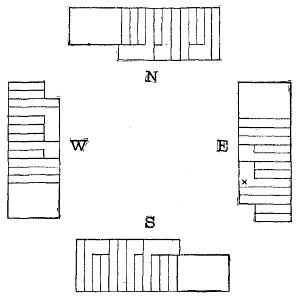
N & S 6; E & W 7. East has made a mistake in turning the fifth trick.
COUNTERS. In some places 13 counters are placed on the table, the winner of each trick taking down one. This system often leads to disputes, as there can be no check upon it, and there is nothing to show in which trick the error occurred.
COUNTING TRICKS. At the end of each hand, the players sitting North and South score the total number of tricks they have taken; instead of the number in excess of a book. Their adversaries, sitting East and West, do the same. Each player then slightly shuffles his 13 cards; so as to conceal the order in which they were played, and the four separate hands of 13 cards each are then left on the table, face down; the trump being turned at the dealer’s place.
TRAYS. When any apparatus is used for holding the cards, such as trays, boxes, or envelopes, each player puts his 13 cards in the compartment provided for them. Each tray has a mark upon it, usually an arrow, showing which end of the tray should point toward a given direction, usually the North. The pocket into which the dealer’s cards go is marked “dealer,” and it is usual to provide a trump slip for each tray. When the hand is first dealt, the trump is recorded on this slip, which travels round the room with the tray. After the dealer has turned up the designated trump, he places the trump slip in the tray, face down. When the play of the hand is finished and the cards replaced in the tray, the dealer puts his trump slip on the top of his cards. The four hands can then be conveniently carried or handed to any other table to be overplayed.
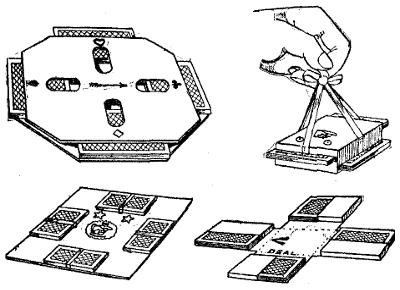
Various Apparatus for Duplicate.
SCORING. There should be two score-cards at each table. The various methods of putting down and comparing the scores can best be described in connection with the variety of competition to which they belong. It is a common practice to note the trump card on the score sheets.
POSITION OF THE PLAYERS. The four players at each table are distinguished by the letters N S E W; North and South being partners against East and West. West should always be the dealer in the first hand, North having the original lead. In all published illustrative hands, North is the leader, unless otherwise specified.
The deal passes in rotation to the left, and the number of hands played should always be some multiple of four, so that each player may have the original lead an equal number of times. 24 hands at each table is the usual number, and is the rule at all League tournaments. The partners and adversaries should be changed after each eight hands. Three changes in 24 hands will bring each member of a set of four into partnership with every other member for an equal number of hands.
If two teams of four on a side, A B C D, and W X Y Z, play against each other, the arrangement in a League tournament would be as follows:—that A B C D should represent the players of the visiting club, or challengers, and W X Y Z the home club, or holders; and that the positions of the players should be changed after every four hands. It is usual to play 24 hands in the afternoon, and 24 more at night.
A A A A A A
W X Y Z W Y X Z X Y W Z
B B C C D D
1st. 2nd. 3rd. 4th. 5th. 6th.
Y W X W W X
C D C D B D B D B C B C
Z X Z Y Z Y
If more than four players are engaged on each side, this arrangement must be repeated with every additional four; the tables being always in sets of two each, but in such cases, and in fact in anything but League matches, it is usual to play only the 1st, 3rd and 5th sets.
CLUB AGAINST CLUB. The smaller club should put into the field as many multiples of four as it can; the larger club presenting an equal number to play against them. The opposing sides are then so arranged that half the members of each club sit North and South, the other half East and West. If we distinguish the clubs by the marks O and X, and suppose 16 to be engaged on each side, they would be arranged at 8 tables, thus:—
O O O O
X 1 X X 3 X X 5 X X 7 X
O O O O
1st set 2nd set 3rd set 4th set
X X X X
O 2 O O 4 O O 6 O O 8 O
X X X X
If apparatus is used, the players may sit still for four hands, putting the trays aside, and then exchanging them for the four trays played at the other table in their set. If not, the cards are left on the table, as already described, and the fours change places; those at table No. 1 going to table No. 2, while those at No. 2 go to No. 1, the other sets changing in the same manner. This brings them into this position:—
X X X X
O 1 O O 3 O O 5 O O 7 O
X X X X
O O O O
X 2 X X 4 X X 6 X X 8 X
O O O O
The two O’s that have just played the N & S hands at table No. 1, proceed to play at table No. 2, the N & S hands which have just been played by two X’s; while the two O’s that played the E & W hands at table No. 2, overplay at table No. 1, the E & W hands just held by the two X’s.
It is now evident that the four O’s have held between them all the 52 cards dealt at each table; for the first pair have held all the N & S hands dealt at both tables, and the second pair have held all the E & W hands. The same is true of the four X players; and if there is any difference in the number of tricks taken by the opposing fours, it is supposed to be due to a difference in skill, other matters having been equalised as far as the limitations of the game will permit.
The overplay finished, the cards are gathered, shuffled, cut, and dealt afresh, East now having the original lead. It must be remembered that the deal can never be lost, and that no matter what happens, the player whose proper turn it is to deal must do so.
NUMBERING HANDS. The hands simultaneously played are scored under the same number, but distinguished by the number of the table at which they are first dealt. Each pair of partners in a team play two No. 1 hands, in one of which they are N & S; in the other E & W.
SCORING. The result of the hand is entered upon the score sheets, which the opposing players at each table should then compare, and turn them face down, leaving them on the table when they change places.
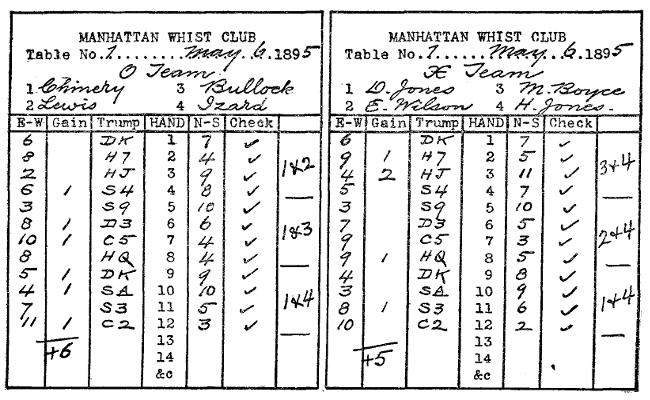
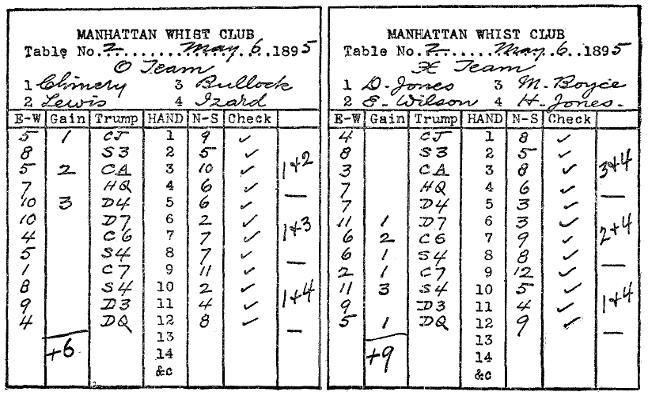
Let us suppose the N & S partners of the O team to make 7 tricks at table No. 1; the E & W partners of the X team making 6. Each pair enters on its own score-card the number it makes. The E & W partners of the O team now come to table No. 1, and play the 26 cards which the other members of their team did not hold. They are not permitted to look at the score-card until the hand has been overplayed. Then they enter the result, which should be 6 tricks. If the total of the tricks taken by the same team on the N & S and the E & W hands is not 13, it must be a loss or a gain. At the end of the 24 hands, the result of the match can be immediately ascertained by laying side by side the score cards of the East and West hands played at the same table. The North and South scores are not compared, because the laws say they may be incorrect, but the East and West must be, officially, right.
We give on the two preceding pages an illustration of the full score of a match. The check marks in the 6th column show that the N & S players compared the score with the E & W before turning down their cards. The figures in the 2nd column are the gains on the various hands. The figures in the 7th column show which of the four players whose names appear at the top of the score-card were partners for that series of hands. The result shows that the O team had a majority of one trick at table No. 1, while the X team had a majority of three tricks at table No. 2, leaving them the winners of the match by two tricks.
If sixteen players were engaged, it would be necessary to institute a similar comparison between each set of tables, and there would be sixteen score-cards to compare, two at a time, instead of four.
TEAM AGAINST TEAM. The methods just described for a match of club against club are identical with those which are used in a contest between two teams of four; the only difference being that of proportion. In the latter case there will be only one set, of two tables, and only four score-cards to compare.
The change of partners should be exhaustive in team matches; which will require six sets.
TEAMS AGAINST TEAMS. When several quartette teams compete with one another, Howell’s system of arrangement will be found the best. There are two methods; for odd and for even numbers of teams.
Odd Numbers of Teams. This is the simplest form of contest. Let us suppose five teams to offer for play, which we shall distinguish by the letters, a, b, c, d, e, arranging each at its own table thus:—
N a b c d e
W + E a 1 a b 2 b c 3 c d 4 d e 5 e
S a b c d e
The names of the N & S and the E & W members of each team should first be entered on the score-cards; then all the N & S players move to the next table East; those at table 5 going to table 1; and each table dealing and playing four hands, afterwards putting them away in trays.
e a b c d
a 1 a b 2 b c 3 c d 4 d e 5 e
e a b c d
Hands:— 1 to 4 5 to 8 9 to 12 13 to 16 17 to 20
The peculiarity of this system is in the movement of the trays; those at the middle table always going to the extreme West of the line, the others moving up as many tables at a time as may be necessary to follow them. In this instance the trays at table 3 go to 1, all others moving up two tables. At the same time the N & S players all move one table further East, bringing about this position:—
2nd set. d e a b c
a 1 a b 2 b c 3 c d 4 d e 5 e
d e a b c
Hands:— 9 to 12 13 to 16 17 to 20 1 to 4 5 to 8
This movement of the trays and players is continued for two more sets, which completes the round:—
3rd set. c d e a b
a 1 a b 2 b c 3 c d 4 d e 5 e
c d e a b
Hands:— 17 to 20 1 to 4 5 to 8 9 to 12 13 to 16
4th set. b c d e a
a 1 a b 2 b c 3 c d 4 d e 5 e
b c d e a
Hands:— 5 to 8 9 to 12 13 to 16 17 to 20 1 to 4
If we now take any two of the teams engaged, a and d for instance, we shall find that the E & W a and the N & S d pairs of those teams have played hands 9 to 12 at table 1, in the 2nd set; and that N & S a and E & W d pairs have overplayed the same hands at table 4, in the 3rd set; so that we have really been carrying out a number of matches simultaneously, between five teams of four players each.
If there are 5, 7, 9 or 11 tables in play, the movement of the trays must be 2, 3, 4 or 5 tables at a time; but the movement of the players remains the same; one table at a time, in the direction opposite to the trays.
Gilman’s System. Another method, recommended by Charles F. Gilman, of Boston, which prevents any possibility of players giving hints to their friends as they pass the trays, is to have each team play at its own table first, so as to get an individual score. The E & W players then move to the next table but one, in either direction, going from 11 to 9; from 9 to 7, etc., the N & S players sitting still. This movement is continued until the E & W players have gone twice round. The trays move in the same direction as the players, but only one table at a time; going from 11 to 10, 9 to 8, etc. This brings about the same result as the Howell’s system.
Even Numbers of Teams. The present method of arranging even numbers of teams is also Gilman’s; but it requires considerable care in the movement of the trays, because half of them lie idle during each round, which is the same as skipping a table in other methods.
Suppose we have ten tables, arranged in two rows thus, with a team of four players at each:
1 2 3 4 5
6 7 8 9 10
Taking 30 deals as the number to be played, we place trays No. 1, 2, 3, to be played and overplayed by tables 1 and 6, which are opposite each other in the rows. Trays 4, 5, 6, we lay aside. Trays 7, 8, 9, are to be played and overplayed by tables 2 and 7; while 10, 11, 12, are laid aside, and so on until we get to tables 5 and 10, which play and overplay trays 25, 26, 27. The easiest way to manage this is to give tray No. 2 to table 6, while tray 1 is at table 1, and then to let table 1 take tray 2, while table 6 plays tray 3. Then table 1 will get tray 3, while table 6 overplays tray 1. This will make all the trays come in numerical order to table 1, and will act as a check.
The play of the first round, three deals, finished, the E & W players all move one table, 2 going to 1, 3 to 2, etc. The umpire now brings into play the trays that were idle, giving trays 4, 5, 6, to tables 1 and 6; trays 10, 11, 12, to tables 2 and 7, and so on down the line, all the trays that were used in the first round lying idle.
Again the players move, and now table 1 gets the 7, 8, 9, set of trays to overplay with table 6, and so on; so that all the sets move up a table after each intervening round, and table 1 will get all the trays from 1 to 30 in order.
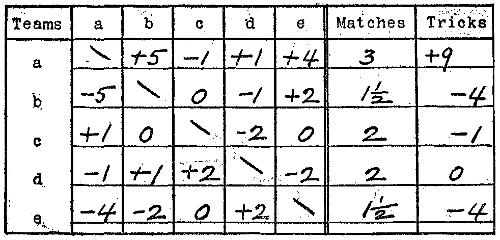
SCORING. In both the foregoing systems, each pair should have its own score-card, and should mark the name of the team it plays against for each series of four hands. These score-cards are more for private reference than anything else in tournaments; because there is always a professional scorer, for whose use small slips are filled out and collected from the tables at the end of each round. The winner is the team that wins the most matches; not the one that gains the most tricks. In case of ties, the number of tricks won must decide. If the number of tricks taken by each side is a tie in any match, the score is marked zero, and each team counts half a match won. We give an illustration of the final score in a match between five teams. The c and d teams are tied for a second place in the number of matches; but the c team takes third place, because it has lost one more trick than the d team. The b and c teams score a half match; so do the c and e teams.
PAIR AGAINST PAIR. This is the most interesting form of competition, especially for domestic parties, as the arrangement of the players will allow of great latitude in the number engaged, table after table being added as long as players offer to fill them.
Two Pairs. When only four players are engaged at a single table, the game is called Memory Duplicate; which is forbidden in all first-class clubs. The players retain their seats until they have played an agreed number of hands, which are laid aside one by one in trays. No trump is turned in Memory Duplicate; one suit being declared trumps for the entire sitting.
Instead of the players changing positions for the overplay, the trays are reversed. If the indicators pointed N & S on the original deals, they must lie E & W for the overplay.
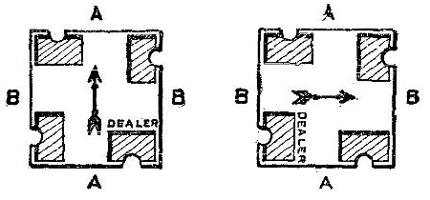
Original Position of Trays. Position for Overplay.
Scoring. The E & W hands only are scored, the card being laid aside after the original play is completed, and a new card used for the overplay. The difference in the totals of these two sets of score-cards will show which pair gained the most tricks.
Four Pairs. These should be arranged at two tables, changing adversaries after every 8 hands. The third set will exhaust the combinations, and it will then be found that each pair has played and overplayed an equal number of hands against every other pair.
1st set 2nd set 3rd set
b c d
a a a a a a
b c d
Hands:— 1 to 8 9 to 16 17 to 24
d b c
c c d d b b
d b c
Four hands are dealt at each table in each set, and then exchanged. The trump card is turned for every original deal.
Scoring. Each pair carries its own score-card with it from table to table, until the 24 hands have been played. The 7th column is used to designate the pair played against. The pairs at the second table should begin scoring with hands Nos. 5, 13 and 21 respectively; as they will presently receive from the first table the series beginning 1, 9 and 17 respectively. Eight hands complete a match, and the result must be tabulated in the same manner as for teams of four, ties being decided by the majority of tricks won. We give an example.
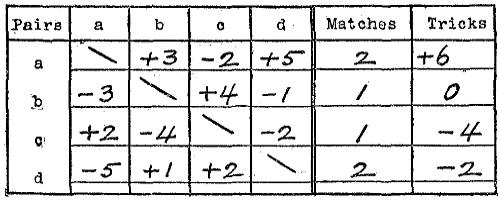
The a pair wins the tie with d, being 6 tricks plus.
Six Pairs. This is a very awkward number to handle, and should be avoided if possible. The whole could be played at three tables simultaneously; but such a course would necessitate their changing places ten times, following a very complicated schedule in so doing. The simplest way to handle six pairs is to arrange them at three tables, two of which are constantly in play, the third only half the time. This is the first position:—
b d f
a 1 a c 2 c e 3 e
b d f
Tables 1 and 2 deal and play two hands each, and then exchange trays with each other. At table 3, two hands are dealt and played, both being left in the trays.
The players at tables 1 and 2 then change adversaries; dealing, playing and exchanging two fresh hands. The players at the third table remain idle, or look on.
c d f
a 1 a b 2 b e 3 e
c d f
Hands 5 and 6 played and exchanged. None.
The b and c pairs now give way to e and f:—
e d b
a 1 a f 2 f c 3 c
e d b
Hands 7 and 8 played and exchanged. 3 and 4.
While tables 1 and 2 are playing two fresh hands, the trays containing hands Nos. 3 and 4 which were left at table 3 are overplayed by the b and c pairs, which makes a match between them and the e and f pairs.
Again the pairs at the first two tables change adversaries; dealing, playing and exchanging two more hands; the third table remaining idle.
f d b
a 1 a e 2 e c 3 c
f d b
Hands 9 and 10 played and exchanged. None.
The pairs a and d now give way to b and c, and the b c e f pairs play two hands and exchange them; then change adversaries for two more hands; a and d remaining idle all the time. All the pairs have now been matched but a and d, and they take seats E & W at two tables, the N & S positions being filled up by any of the other players in the match.
any any
a 1 a d 2 d
any any
No notice is taken of the scores made by the N & S hands in the last set; as it is simply a match between the a and d pairs.
Scoring. Each pair against each is considered a match, and the winner of the most matches wins, tricks deciding ties.
Compass Whist. When we come to handle large numbers, the changes of position become too complicated, and the simplest plan is to arrange them at as many tables as they will fill, and to place on each table an equal number of trays. At the Knickerbocker Whist Club, New York, which is still famous for its compass games, they play a minimum of 24 trays, or get as near that number as possible. If there are 14 tables, they play two deals at each. If there are only 10 tables, they play 30 trays.
All the N & S players sit still, and at the end of each round, two or three deals as the case may be, all the E & W players move up one table, 2 going to 1, 3 to 2, etc. Each pair keeps its own score card, on which is put down the number of the tray, the number of the pair played against, which is always the number of the table at which they started; one of the pairs remaining there being No. 3 N & S, the other moving away, being No. 3 E & W.
Each pair adds up its score card at the end, and puts down the total number of tricks they have won. The names of the players having been previously written on the blackboard, their scores are put down opposite their names, each side, N & S and E & W, is then added up in order to find the average, and all scores above average are plus, while all below average are minus.
The following is an example of the averaging of a game in which five tables took part, playing 30 deals:—
N & S E & W
a 201 -6 f 189 +6
b 204 -3 g 186 +3
c 211 +4 h 179 -4
d 207 = j 183 =
e 212 +5 k 178 -5
5 1035 5 915
Aver. 207, N & S. Aver. 183, E & W.
The e and f pairs make the best scores N & S and E & W respectively; the f pair, having won the greatest number of tricks above the average of the hands, would be the winners.
Howell Pair System. A very popular system of managing pairs in club games, and also in the national tournaments for the Minneapolis trophy, is called the Howell Pairs. Indicator cards are placed on the tables, which show each player the number of the table and the position at that table to which he should move next. Sometimes he will sit N, sometimes S, and sometimes E or W, but he always finds his partner opposite him, and at the end of the game he will have had every other pair in the game for an adversary once, and will have played all the hands dealt.
A different set of indicator cards is required for every different number of tables in the game. They are the invention of the late E.C. Howell of Washington, D.C., and have been arranged for any number of pairs from four to thirty-four.
INDIVIDUALS. When four play memory duplicate, one of the four, usually S, retains his seat and keeps the score, the others changing places right and left alternately, each playing with S as a partner for 8 hands. These changes successively bring about the three following positions:—
c b a
a b a c c b
S S S
Hands:— 1 to 4 5 to 8 9 to 12
For the overplay, the trays are reversed, the hands originally dealt N & S being placed E & W; but the players continue to change right and left alternately. This brings the same partners together, but on different sides of the table.
c b a
b a c a c b
S S S
Hands:— 1 to 4 5 to 8 9 to 12
Scoring. The names of the four players should be written at the head of each score-card, and as there is no trump turned in memory duplicate, the third and seventh columns can both be used for the numbers of the players that are partners, and the sixth column for the N & S gains.
When the match is finished, a tabulation of the tricks lost or won by each player will readily show which is the winner. In the illustration which we give, No. 3 finishes plus 6; No. 4 plus 2; No. 1 minus 4; and No. 2 minus 4.
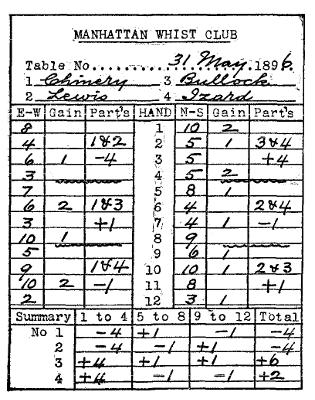
It must be remembered that the hands which are here scored N & S, in the 5th column, were E & W when originally dealt; so that the 1st and 5th columns are really the same hands. The score-card should be folded down the middle during the overplay, so that the original scores cannot be seen. It is even better to use a new card.
Foster’s System of playing two pairs at one table, which was used at all the matches for the Utica Trophy, in which one pair from a club challenged the pair that held the trophy for another club, consisted in having an umpire to transpose the suits between the original and the overplay of the deals. The trays containing the hands were sent in to the umpire’s room, and he had an extra pack of cards, from which he duplicated each hand of thirteen cards as he took it out of the pocket to which it belonged, but changed the suits, making clubs trumps instead of hearts, etc. This system was found to do away with the memory part of the game, it being very difficult to recognize a hand unless it had some startling feature.
Coupled with the present practice of throwing out all hands in which there is found to be a suit of more than six cards, and dealing it over again, Foster’s system for two pairs is the best so far suggested.
Eight Individuals. This form of contest is seldom used, because players dislike the continual changing of position, and the delay in arriving at the results of the score. It would require seven sets to exhaust the combinations; and at each table two hands should be dealt, played, and exchanged with the other table in the set, before the players change positions. This would require 28 hands to complete the match.
Safford’s System for arranging the players is to have indicator cards on the tables:—
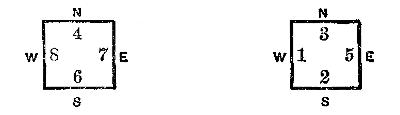
The players take their seats in any order for the first set; after which they go to the next higher number; 8 keeping his seat, and 7 going to 1.
Scoring. Each individual must keep his own score, adding up the total tricks taken in each set of four hands. These totals must then be compared with those of the player occupying the same position, N, S, E, or W, at the other table in the set; and it will save time in the end if these are tabulated at once, on a sheet prepared for the purpose. For instance: Let this be the arrangement of eight players in the first set:—
b Hands 1 to 4. f
a 1 c e 2 g
d h
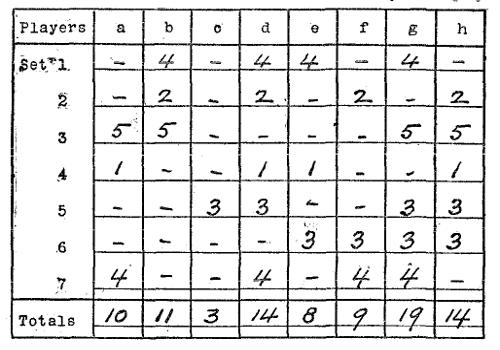
If a and c take 34 tricks E & W; e and g taking only 30 with the same cards, either a and c must have gained them, or e and g must have lost them. It is a waste of time to put down both losses and gains, and all that is necessary is to call the top score zero, and charge all players with the loss of as many tricks as their total is short of the top score. In this case we charge e and g with a loss of 4 each. It must be obvious that f and h have also made 4 more tricks than b and d; and that the latter must be charged with a loss of 4 on the same hands that e and g lose on.
We give as an illustration a sheet balanced in this way, showing the losses of the various players. The totals at the end of the match show that c is the winner, losing less tricks than any other player.
Large Numbers of Individuals. Several ingenious methods have been devised for handling large numbers of players, especially in domestic parties; Safford and Mitchell having both distinguished themselves in this line. The simplest form has been suggested by Mitchell, and is especially adapted for social gatherings of ladies and gentlemen.
As many tables as possible are filled; all the ladies sitting N & E; the gentlemen S and W.
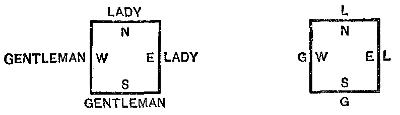
The number of hands dealt at each table must be adjusted to the number of tables filled, and the time to be devoted to play. The trays containing the hands are passed to the West, and all the gentlemen move one table to the East, the ladies sitting still. In all the changes each gentleman keeps to his original point of the compass, South or West. When he arrives at the table he started from, the round is finished. If an odd number of tables are engaged in play, the changes may take place in regular order to the end. If even, a dummy must be put in; but as that is objectionable in a social gathering, it is better to adopt one of the two systems following, unless half the number of tables is an odd number, when the method already described may be used.
1st Method. Some table in the series, which must not be either the first or the last, deals no original hands, but overplays all the hands coming from the other tables to the East of it. The four players sit still, taking no part in the progression; thus obliging those whose turn it would be to play at their table to pass on to the next.
2nd Method. Each gentleman should carefully note the number of the hand originally dealt at the table from which he starts. He progresses until he meets this hand again. The first to observe this should give notice to the company by a bell tap, as all the gentlemen must meet their original hands at the same time. Instead of stopping at the table at which this tray is encountered, all the gentlemen move on to the next, leaving the trays as they are. This skip enables each to finish the round without playing any of the hands twice.
Scoring. There must be four winners; the ladies with the best scores for the N & E hands respectively, and the gentlemen with the best S & W scores. If a choice is necessary, the lady and the gentleman taking the greatest number of tricks above the average should be selected as the winners.
MARRIED COUPLES. Safford has an ingenious schedule for eight married couples, so arranged in two sets that no husband and wife are ever in the same set at the same time. When seven sets have been played, every lady will have overplayed four hands against every other lady and gentleman, including four held by her husband. The same will be true of every man. Indicators are placed on the tables to show players their successive positions. The numbers represent the husbands, and the letters the wives, the couples being a-1, b-2, etc. The couple a-1 always sit still; the ladies go to the next higher letter of the alphabet, and the men to the next higher number; h going to b, as a sits still; and 8 to 2.
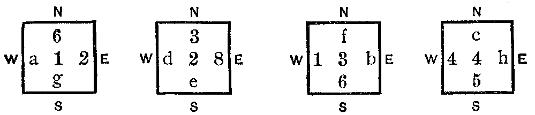
One hand is dealt at each table, and overplayed at each of the others. A different point of the compass should deal at each table, in order to equalise the lead.
Scoring. The score of each four hands should be added up by each individual player, and the results tabulated at the end of every four hands, in the manner described for eight individuals. The winner is the player who loses the fewest tricks. This is the only known system for deciding whether or not a man can play whist better than his wife.
PROGRESSIVE DUPLICATE WHIST is the generic name by which those systems of duplicate are known in which the purpose is to have as many as possible of the players meet one another during the progress of the match. Most of the systems we have been describing belong to this class.
There are at present only two works on Duplicate Whist; but a number of articles on the subject may be found in “Whist.”
Duplicate Whist; by John T. Mitchell, 1896.
Foster’s Duplicate Whist; 1894.
Whist; Jan., 1892; Jan., 1894; Aug., 1894; Oct., 1894; Jan., 1895: Mar., 1895; May, 1895; July, 1895; Oct., 1895.
THE LAWS OF DUPLICATE WHIST.
The Laws of Duplicate Whist as Amended and Adopted at the Whist Congress, Niagara Falls, New York, July, 1900; as amended at the Twelfth Congress, June, 1902; as amended at the Thirteenth Congress, July, 1903; Fourteenth A.W.L. Congress, July, 1904; Fifteenth Congress, July, 1905; Sixteenth Congress, July, 1906; Twentieth Congress, July 1910.
DEFINITIONS.
The words and phrases used in these laws shall be construed in accordance with the following definitions unless such construction is inconsistent with the context:
(a) The thirteen cards received by any one player are termed a “hand.”
(b) The four hands into which a pack is distributed for play are termed a “deal;” the same term is also used to designate the act of distributing the cards to the players.
(c) A “tray” is a device for retaining the hands of a deal and indicating the order of playing them.
(d) The player who is entitled to the trump card is termed the “dealer,” whether the cards have or have not been dealt by him.
(e) The first play of a deal is termed “the original play;” the second or any subsequent play of such deal, the “overplay.”
(f) “Duplicate Whist” is that form of the game of whist in which each deal is played only once by each player, and in which each deal is so overplayed as to bring the play of teams, pairs of individuals into comparison.
(g) A player “renounces” when he does not follow suit to the card led; he “renounces in error” when, although holding one or more cards of the suit led, he plays a card of a different suit; if such renounce in error is not lawfully corrected it constitutes a “revoke.”
(h) A card is “played” whenever, in the course of play, it is placed or dropped face upwards on the table.
(i) A trick is “turned and quitted” when all four players have turned and quitted their respective cards.
LAW I.—Shuffling.
Sec. 1. Before the cards are dealt they must be shuffled in the presence of an adversary or the umpire.
Sec. 2. The pack must not be so shuffled as to expose the face of any card; if a card is so exposed the pack must be reshuffled.
LAW II.—Cutting for the Trump.
Sec. 1. The dealer must present the cards to his right hand adversary to be cut; such adversary must take from the top of the pack at least four cards and place them toward the dealer, leaving at least four cards in the remaining packet; the dealer must reunite the packets by placing the one not removed in cutting upon the other. If, in cutting or in reuniting the separate packets, a card is exposed, the pack must be reshuffled and cut again; if there is any confusion of the cards or doubt as to the place where the pack was separated, there must be a new cut.
LAW III.—Dealing.
Sec. 1. When the pack has been properly cut and reunited, the cards must be dealt, one at a time, face down, from the top of the pack, the first to the player at the left of the dealer, and each successive card to the player at the left of the one to whom the last preceding card has been dealt. The last, which is the trump card, must be turned and placed face up on the tray, if one is used; otherwise, at the right of the dealer.
Sec. 2. There must be a new deal—
(a) If any card except the last is faced or exposed in any way in dealing;
(b) If the pack is proved incorrect or imperfect;
(c) If either more or less than thirteen cards are dealt to any player;
(d) If, after the first trick has been turned and quitted on the original play of a deal, one or more cards are found to have been left in the tray.
LAW IV.—The Trump Card.
Sec. 1. The trump card and the number of the deal must be recorded, before the play begins, on a slip provided for that purpose, and must not be elsewhere recorded. Such slip must be shown to an adversary, then turned face down and placed in the tray, if one is used.
Sec. 2. The dealer must leave the trump card face up until it is his turn to play to the first trick; he must take the trump card into his hand and turn down the trump slip before the second trick is turned and quitted.
Sec. 3. When a deal is taken up for overplay, the dealer must show the trump slip to an adversary, and thereafter the trump slip and trump card shall be treated as in the case of an original deal.
Sec. 4. After the trump card has been lawfully taken into the hand and the trump slip turned face down, the trump card must not be named nor the trump slip examined during the play of the deal; a player may, however, ask what the trump suit is.
Sec. 5. If a player unlawfully looks at the trump slip, his highest or lowest trump may be called; if a player unlawfully names the trump card, or unlawfully shows the trump slip to his partner, his partner’s highest or lowest trump may be called.
Sec. 6. These penalties can be inflicted by either adversary at any time during the play of the deal in which they are incurred before the player from whom the call can be made has played to the current trick; the call may be repeated at each or any trick until the card is played, but cannot be changed.
Sec. 7. When a deal has been played the cards of the respective players, including the trump card, must be placed in the tray face down and the trump slip placed face up on top of the dealer’s cards.
Sec. 8. If on the overplay of a deal, the dealer turns a trump card other than the one recorded on the trump slip, and such error is discovered and corrected before the play of the deal is commenced, the card turned in error is liable to be called.
Sec. 9. If such error is not corrected until after the overplay has begun and more than two tables are engaged in play, the players at that table shall take the average score for the deal; if less than three tables are in play there must be a new deal.
Sec. 10. Should a player record on the trump slip a different trump from one turned in dealing and the error be discovered at the next table, there must be a new deal. If the deal has been played at one or more tables with the wrong trump, the recorded trump must be taken as correct and the players at the original table take the average score for the deal; if less than three tables are in play, there must be a new deal.
Sec. 11. By the unanimous consent of the players in any match, a trump suit may be declared and no trump turned.
LAW V.—Irregularities in the Hand.
Sec. 1. If, on the overplay, a player is found to have more than his correct number of cards or the trump card is not in the dealer’s hand, or any card except the trump card is so faced as to expose any of the printing on its face, and less than three tables are engaged, there must be a new deal. If more than two tables are in play, the hands must be rectified and then passed to the next table; the table at which the error was discovered must not overplay the deal but shall take the average score.
Sec. 2. If after the first trick has been turned and quitted on the overplay of a deal, a player is found to have less than his correct number of cards, and the others have their correct number, such player shall be answerable for the missing card or cards and for any revoke or revokes which he has made by reason of its or their absence.
LAW VI.—Playing, Turning and Quitting the Cards.
Sec. 1. Each player when it is his turn to play, must place his card face up before him and towards the center of the table and allow it to remain in this position until all have played to the trick, when he must turn it over and place its face down and nearer to himself, placing each successive card as he turns it, so that it overlaps the last card played by him and with the ends towards the winners of the trick. After he has played his card and also after he has turned it, he must quit it by removing his hand.
Sec. 2. The cards must be left in the order in which they were played and quitted until the scores for the deal are recorded.
Sec. 3. During the play of a deal a player must not pick up or turn another player’s card.
Sec. 4. Before a trick is turned and quitted any player may require any of the other players to show the face of the card played to that trick.
Sec. 5. If a player names a card of a trick which has been turned and quitted or turns or raises any such card so that any portion of its face can be seen by himself or his partner he is liable to the same penalty as if he had led out of turn.
LAW VII.—Cards Liable to be Called.
Sec. 1. The following cards are liable to be called:
(a) Every card so placed upon the table as to expose any of the printing on its face, except such cards as these laws specifically provide, shall not be so liable.
(b) Every card so held by a player as to expose any of the printing on its face to his partner or to both of his adversaries at the same time.
(c) Every card, except the trump card, named by the player holding it.
Sec. 2. If a player says. “I can win the rest,” “The rest are ours,” “It makes no difference how you play,” or words to that effect, or if he plays or exposes his remaining cards before his partner has played to the current trick, his partner’s cards must be laid face up on the table and are liable to be called.
Sec. 3. All cards liable to be called must be placed face up on the table and so left until played. A player must lead or play them when lawfully called, provided he can do so without revoking; the call may be repeated at each or any trick until the card is played. A player cannot, however, be prevented from leading or playing a card liable to be called; if he can get rid of it in the course of a play no penalty remains.
Sec. 4. The holder of a card liable to be called can be required to play it only by the adversary on his right. If such adversary plays without calling it, the holder may play to that trick as he pleases. If it is the holder’s turn to lead, the card must be called before the preceding trick has been turned and quitted, or before the holder has led a different card; otherwise he may lead as he pleases.
LAW VIII.—Leading out of Turn.
Sec. 1. If a player leads when it is the turn of an adversary to lead, and the error is discovered before all have played to such lead, a suit may be called from him or from his partner, as the case may be, the first time thereafter it is the right of either of them to lead. The penalty can be enforced only by the adversary on the right of the one from whom a lead can lawfully be called, and the right thereto is lost unless such adversary calls the suit he desires led before the first trick won by the offender or his partner subsequent to the offence is turned and quitted.
Sec. 2. If a player leads when it is his partner’s turn and the error is discovered before all have played to such lead, a suit may at once be called from the proper leader by his right-hand adversary. Until the penalty has been exacted, waived or forfeited, the proper leader must not lead; should he so lead, the card led by him is liable to be called.
Sec. 3. If a player when called on to lead a suit has none of it, he may lead as he pleases.
Sec. 4. If all have not played to a lead out of turn when the error is discovered, the card erroneously led and all cards played to such lead are not liable to be called, and must be taken into the hand.
LAW IX.—Playing out of Turn.
Sec. 1. If the third hand plays before the second, the fourth hand may also play before the second.
Sec. 2. If the third hand has not played and the fourth hand plays before the second, the latter may be called upon by the third hand to play his highest or lowest card of the suit led, and, if he has none of that suit, to trump or not trump the trick; the penalty cannot be inflicted after the third hand has played to the trick. If the player liable to this penalty plays before it has been inflicted, waived or lost, the card so played is liable to be called.
LAW X.—The Revoke.
Sec. 1. A renounce in error may be corrected by the player making it, except in the following cases, in which a revoke is established and the penalty therefore incurred:
(a) When the trick in which it occurs has been turned and quitted.
(b) When the renouncing player or his partner, whether in his right turn or otherwise, has led or played to the following trick.
Sec. 2. At any time before the trick is turned and quitted a player may ask an adversary if he has any of a suit, to which such adversary has renounced in that trick, and can require the error to be corrected in case such adversary is found to have any of such suit.
Sec. 3. If a player, who has renounced in error, lawfully corrects his mistake, the card improperly played by him is liable to be called, and, if he be the second or third hand player and his left hand adversary has played to the trick before attention has been called to the renounce, he may be required by such adversary to play his highest or his lowest card to the trick in which he has renounced, and shall not play to that trick until such adversary has inflicted or waived the penalty. Any player who has played to the trick after the renouncing player, may withdraw his card and substitute another; a card so withdrawn is not liable to be called.
Sec. 4. The penalty for a revoke is the transfer of two tricks from the revoking side to their adversaries. If more than one revoke during the play of a deal is made by one side, the penalty for each revoke, after the first, is the transfer of one trick only. The revoking players cannot score more, nor their adversaries less than the average on the deal in which the revoke occurs; except that in no case shall the infliction of the revoke penalty deprive the revoking players of any tricks won by them before their first revoke occurs.
In Pair Matches the score shall be recorded as made, independently of the revoke penalty, which shall be separately indicated as plus or minus revoke (“-R” for the revoking side, and “+R” for their adversaries). In such matches, the penalty for a revoke shall not increase the score of the opponents of the revoking players above the maximum, as made at the other tables, on the deal in which the revoke occurs; provided, however, that if the opponents win more tricks than such maximum, independently of the revoke penalty, their score shall stand as made. Nor shall the score of the revoking players be reduced, by the infliction of the revoke penalty, below the minimum so made at the other tables until the averages for the match and the relative scores of the other players have been determined; the score of the revoking players shall then, if necessary, be further reduced, so that in all cases they shall suffer the full penalty as provided in the first paragraph of this section.
Sec. 5. A revoke cannot be claimed if the claimant or his partner has played to the following deal, or if both have left the table at which the revoke occurred. If the revoke is discovered in season, the penalty must be enforced and cannot be waived.
Sec. 6. At the end of the play of a deal the claimants of a revoke can examine all of the cards; if any hand has been shuffled the claim may be urged and proved if possible; but no proof is necessary and the revoke is established if, after it has been claimed, the accused player or his partner disturbs the order of the cards before they have been examined to the satisfaction of the adversaries.
LAW XI.—Miscellaneous.
Sec. 1. If any one calls attention in any manner to the trick before his partner has played thereto, the adversary last to play to the trick may require the offender’s partner to play his highest or lowest of the suit led, and, if he has none of that suit, to trump or not to trump the trick.
Sec 2. A player has the right to remind his partner that it is his privilege to enforce a penalty and also to inform him of the penalty he can enforce.
Sec. 3. A player has the right to prevent his partner from committing any irregularity, and for that purpose, may ask his partner whether or not he has a card of a suit to which he has renounced on a trick which has not been turned and quitted.
Sec. 4. If either of the adversaries, whether with or without his partner’s consent, demands a penalty to which they are entitled, such decision is final; if the wrong adversary demands a penalty or a wrong penalty is demanded, or either adversary waives a penalty, none can be enforced except in case of a revoke.
Sec. 5. If a player is lawfully called upon to play the highest or lowest of a suit, to trump or not to trump a trick, to lead a suit or to win a trick, and unnecessarily fails to comply, he is liable to the same penalty as if he had revoked.
Sec. 6. If any one leads or plays a card, and then, before his partner has played to the trick, leads one or more other cards, or plays two or more cards together, all of which are better than any of his adversaries hold of the suit, his partner may be called upon by either adversary to win the first or any subsequent trick to which any of said cards are played, and the remaining cards so played are liable to be called.
For the Rules of Etiquette of Duplicate Whist, see page 85.
SINGLE TABLE, OR MNEMONIC DUPLICATE.
The laws of Duplicate Whist govern where applicable, except as follows:
Each player plays each deal twice, the second time playing a hand previously played by an adversary. Instead of turning the trump, a single suit may be declared trumps for the game. On the overplay, the cards may be gathered into tricks instead of playing them as required by law (Law VIII, Sec. 1). In case of the discovery of an irregularity in the hands, there must always be a new deal.
MNEMONIC DUPLICATE FOR MORE THAN ONE TABLE.
Except a contest played in comparison with a progressive match, the replaying of the cards by the same players—“up and back,” as it is sometimes called—is the only possible method of approximating to Duplicate Whist for one table; but where eight or more players participate, this form of the game is extremely undesirable, from the element of memory entering into the replay and destroying the integrity of the game and its value as a test of Whist skill. It has been well described as “a mongrel game—partly Whist and partly Dummy, but lacking in the best features of each.”
In the early days of Duplicate Whist, Mnemonic Duplicate was, to some extent, played even when several tables of players were participating. It still survives in a few circles, chiefly where Duplicate Whist has never been tried. It can be played under any of the Duplicate Whist schedules by playing them through twice—the second time with the North and South hands given to the East and West players, and vice versa. As each deal is played twice by each pair, double the time is required to play the same number of deals, as at Duplicate Whist. Allowance must be made for this in fixing the number of deals to be played.
The Snow System of movement, where practicable, is preferable. Where the Howell pair system of movement is used, the scores do not require “equating”, as they are equalised on the replay. Under other systems, only the North and South scores need be kept, as the comparison can be made quite as readily as by direct comparison of these scores.
DUMMY.
There are three forms of Dummy: The English game, for three players; the French game, for three or four: and the game now generally known as Bridge, or Bridge Whist. Dummy is not recognized in any form by the American Whist League, and there are no American Laws governing it. We shall describe each variety of the game in its turn; beginning with the English.
Cards. ENGLISH DUMMY, is played with a full pack of fifty-two cards, ranking as at whist both for cutting and playing. Two packs are generally used.
Markers are necessary, and are of the same patterns as those used in whist.
Players. According to the English usage, Dummy is played by three persons, and the table is complete with that number.
They cut for partners and for the deal; the player cutting the lowest card takes dummy for the first rubber; the one cutting the next lowest takes dummy for the second rubber; and the one cutting the highest takes it for the last rubber. It is considered obligatory to play three rubbers, in order that each may have whatever advantage or disadvantage may be supposed to attach to the dummy. The three rubbers so played are called a Tournée. It is sometimes agreed that one player shall take dummy continuously, on condition that he concedes to his adversaries one point in each rubber. When this is done, the largest rubber that the dummy’s partner can win is one of seven; and he may win nothing; whereas his adversaries may win a rubber of nine, and must win at least two. This concession of a point is not made, as many imagine, because it is an advantage to have the (dummy) partner’s hand exposed; but because it is an advantage to have the player’s hand concealed. He knows the collective contents of the adversaries’ hands; each of them knows only the contents of dummy’s hand and his own.
Cutting. The player cutting the lowest card has the choice of seats and cards; but he must deal the first hand for his dummy; not for himself. The methods of spreading, cutting, deciding ties, etc., described in connection with whist, are those employed in dummy.
Position of the Players. The players are distinguished, as at whist, by the two first and last letters of the alphabet, and their positions at the table are indicated in the same manner. There is no mark to distinguish the dummy hand; a defect which is remedied in the French system.
Dealing. At the beginning of a rubber, dummy’s partner presents the pack to his left-hand adversary to be cut, and deals from right to left, beginning with the player on his right, and turning up the last card for dummy’s trump. When two packs are used, there is no rule as to which player shall collect and shuffle the still pack. On this point the French rules are very explicit.
The general rules with regard to irregularities in the deal are the same as at whist.
The cards having been dealt, it is usual for dummy’s partner to take up and sort the dummy first. There are several ways of laying out dummy’s hand; the most common being to run the suits down in rows, with the turn-up across and to the right of the other trumps, if any.
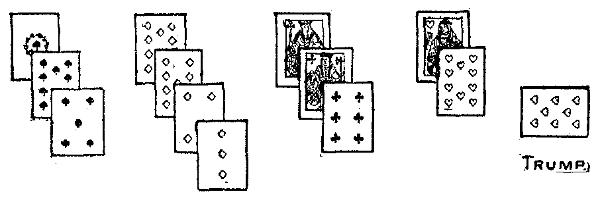
Method of Spreading Dummy’s Cards.
Stakes. The remarks made on this subject in connection with whist apply equally to dummy. Dummy’s partner must pay to, or receive from each adversary the amount agreed.
Method of Playing. The general method of playing is identical with that of whist, with the following exceptions:—
When it is dummy’s turn to play, his partner selects the card.
The Revoke. For this dummy is not liable to any penalty, as his adversaries can see his cards. Even should the revoke be occasioned by dummy’s cards being disarranged, or one of them covered up, the adversaries should be as able to detect the error as the partner. Should dummy’s hand revoke, it cannot be remedied after the trick in which it occurs has been turned and quitted; and the game must proceed as if no revoke had occurred. All the penalties for a revoke may be enforced against dummy’s partner, should he renounce in error, and not correct it in time. There being no American laws for dummy, the English penalty of three tricks or three points may be enforced, and the revoking player cannot win the game that hand.
Cards Played in Error. Dummy’s partner is not liable to any penalty for cards dropped face upwards on the table, or two or more played at once, because it is obvious that Dummy cannot gain any advantage from such exposed cards.
Leading out of Turn. Should either dummy or his partner lead out of turn, the adversaries may call a suit from the one that should have led. It should be noticed that if it was not the turn of either to lead, there is no penalty; for neither can have gained any advantage from knowing what suit the other wished to lead, or from the exposed card. Should all have played to the erroneous lead, the error cannot be corrected, and no penalty remains.
The methods of Taking Tricks; Scoring; Claiming and Counting Honours; Marking Rubber Points, etc., are the same as in whist, and the counters are used in the same manner.
Cutting Out. As already observed, there is no change of partners, or of the rotation of the deal, until the completion of a rubber; but at the beginning of each rubber, dummy must deal the first hand. Should one side win the first two games in any rubber, the third is not played. At the end of the tournée, should any player wish to retire, and another offer to take his place, the cards must be shuffled and cut as at the beginning; a player’s position in one tournée giving him no rights in the next. There is nothing in the English game to recognize that there may be more than three candidates for dummy; as it is supposed that if four were present, they would prefer playing whist.
Suggestions for Good Play. As these are equally proper to any form of dummy, we shall postpone their consideration until we have described the other varieties of the game; French dummy, and Bridge; giving them all at the end of the chapter on “Bridge.”
DOUBLE DUMMY.
CARDS. Double Dummy is played with a full pack of fifty-two cards, ranking as at whist both for cutting and playing. Two packs are generally used.
MARKERS are necessary, and are of the same description as those used in whist.
PLAYERS. According to the English usage, double dummy is played by two persons, and the table is complete with that number.
CUTTING. The players cut for the deal; the player cutting the lowest card deals for his dummy first, and has the choice of sitting to the right or left of his opponent. It is usual to select the seat on the right of the living player, because it is possible that one may forget whether or not certain cards have been played, and under such circumstances it is better to lead up to an exposed hand than to one whose contents you are not sure of.
The methods of spreading, cutting, deciding ties, etc., are the same as those employed at whist.
POSITION OF THE PLAYERS. It is not usually considered necessary to distinguish the players further than to indicate which hand had the original lead. For this purpose the whist notation is used, A being the leader, and Z the dealer.
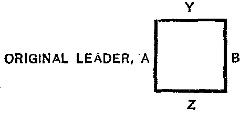
DEALING. When two packs are used, the still pack should be shuffled by the non-dealer, and placed on the left of the player or dummy whose turn it will be to deal next.
The general rules with regard to irregularities in the deal are the same as in whist.
The cards being dealt, it is usual to sort the dummy hands first, running the suits down in rows, with the turn-up trump across, and to the right of the others.
STAKES. The remarks already made on this subject in connection with whist and dummy, apply equally to double dummy, except that there is no double payment; but each player wins from or loses to his living adversary the unit agreed upon.
METHOD OF PLAYING. This so closely resembles dummy as to need no further description. Neither dummy can revoke, and there are no such things as exposed cards, or cards played in error. It is very common for one player to claim that he will win a certain number of tricks, and for his adversary to admit it, and allow him to score them, without playing the hand out.
LEADING OUT OF TURN. Should either of the dummies or the players lead out of turn, the adversary may call a suit from the one that ought to have led; but if it was the turn of neither, there is no penalty. If all four have played to the trick, the error cannot be corrected, and no penalty remains.
The methods of Taking Tricks; Scoring; Claiming and Counting Honours; Marking Rubber Points, etc., are the same as in whist, and the counters are used in the same manner.
RUBBERS. If the first two games are won by the same player and his dummy, the third is not played. Tournées are not played, and the completion of the rubber breaks up the table.
CUTTING IN. The table being complete with two, at the end of a rubber a new table must be formed.
SUGGESTIONS FOR GOOD PLAY. The player should first carefully examine the exposed hands, and by comparing them with his own, suit by suit, should fix in his mind the cards held by his living adversary. This takes time, and in many places it is the custom to expose the four hands upon the table. Players who have better memories than their opponents object to this, for the same reason that they prefer sitting on the right of the living player. It is not at all uncommon for a player to forget that certain cards have been played, to his very serious loss.
The hands once fixed in the mind, some time should be given to a careful consideration of the best course to pursue; after which the play should proceed pretty rapidly until the last few tricks, when another problem may present itself.
There is nothing in the game beyond the skilful use of the tenace position, discarding, and establishing cross-ruffs. Analysis is the mental power chiefly engaged. There are no such things as inferences, false cards, finesse, underplay, speculative trump leads, or judgment of human nature. The practice of the game is totally different from any other form of whist, and much more closely resembles chess.
The laws of Dummy will be found at the end of the English Whist Laws.
HUMBUG WHIST.
This is a variation on double dummy, in which two players sit opposite each other. The deal and seats are cut for in the usual manner; four hands of thirteen cards each are dealt, and the last card is turned for trump.
Each player examines the hand dealt to him, without touching those to his right or left. If he is content with his hand, he announces it, if not, he may exchange it for the one on his right. In case of exchange, the discarded hand is placed on the table face down; and the other taken up and played. If a player retains the hand originally dealt him, he must not look at the others. If the dealer exchanges, he loses the turn-up card, but the trump suit remains the same. Each player deals for himself in turn, there being no deal for the dead hands. Whist laws govern the deal and its errors.
METHOD OF PLAYING. The dealer’s adversary has the first lead; the other must follow suit if he can, and the highest card of the suit led wins the trick. Trumps win all other suits.
SCORING. Each trick above six counts one point towards game. Of the four honours, A K Q J of trumps, if each player holds two, neither can count. But if one player has only one honour, or none, the other counts 2 points for two honours, if he holds them; 3 points for three; and 4 points for four. The honours count towards game as in whist. The penalty for a revoke is three tricks, and it takes precedence of other scores; tricks count next, honours last. Five points is game.
SUGGESTIONS FOR GOOD PLAY. It is considered best for a player not finding four reasonably sure tricks in his hand to exchange; for there is a certain advantage to be gained by knowing thirteen cards which cannot be in the adversary’s hand. Before changing, the player should fix in his memory the exact cards of each suit in the hand which he is about to discard. By combining his knowledge of them with his own cards, he may often be able to direct his play to advantage. Beyond this there is little skill in the game.
A variation is sometimes made by the dealer announcing a trump suit after he has examined his hand, instead of turning up the last card. His adversary then has the right either to play his hand, or to exchange it for the one on his right; but the dealer must play the hand dealt to him.
THIRTEEN AND THE ODD.
This is Humbug Whist without the discard. The dealer gives thirteen cards to his adversary and to himself, one at a time, and turns up the next for the trump. The trump card belongs to neither player. The winner of the odd trick scores a point. Five points is game.
MORT. WHIST À TROIS; OR FRENCH DUMMY.
MORT means simply the dead hand; and is the equivalent of the English word Dummy; the partner being known as Vivant, or the living hand. In these words the English usually sound the t, as they do in such words as piquet, and valet.
CARDS. Mort is played with a full pack of fifty-two cards, ranking as at whist for cutting and playing. Two packs are generally used.
MARKERS are necessary to count the game points only. Four circular counters for each side, preferably of different colours, are employed, or the ordinary whist markers may be used. At the end of each game, the score of the points won or lost by each player must be transferred to a score-sheet, kept for that purpose.
PLAYERS. Mort is played by three persons; but the table is usually composed of four. If there are more than four candidates, the methods described in connection with whist are adopted for deciding which four shall play the first tournée.
The table being formed, the cards are again shuffled and spread to cut for partners and deal.
TIES are decided in the same manner as at whist.
CUTTING. If there are three players, the one cutting the lowest card takes dummy for the first game; he also has the choice of seats and cards, and may deal the first hand for himself or for Mort, as he pleases; but having once made his choice, he must abide by it. The player cutting the intermediate card takes dummy for the second game; and the player cutting the highest card takes it for the third game; each in turn having the choice of seats and cards. These three games finish the rubber or tournée, each having once had the advantage or disadvantage of playing with Mort. It is obligatory to finish the tournée, no player being allowed to withdraw and substitute another without the consent of the other players. In Mort it is very unusual for one person to take dummy continuously.
If there are four players, the one cutting the highest card of the four sits out, and takes no part in the first game. It is customary for him to take Mort’s seat, and to make himself useful in sorting dummy’s cards for him. He plays in the three following games, taking Mort in the fourth, or last. Four games complete the tournée for four players.
POSITION OF THE PLAYERS. The players or hands are distinguished by the letters, M, V, L, and R; which stand respectively for Mort, Vivant, Left, and Right. The Mort is the dead hand, which is turned face up on the table. The Vivant is his partner, who sits opposite him, and plays his cards for him. The Left and Right are the adversaries who sit on the left and right of Mort.
Special attention must be called to the use of the term adversaries in any description of Mort. It is used exclusively to designate the two partners opposed to the Mort and Vivant. In all other cases where opposition is implied, the term opponents must be used.
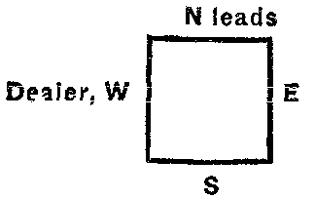
When necessary to distinguish the dealer from the first, second, or third hand, it is usual to add the letters employed for that purpose in whist; placing them inside the diagram of the table, thus:—
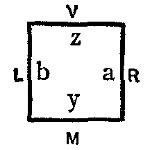
This diagram shows that Vivant dealt, and that the adversary on the Right of Mort had the original lead.
With Three Players. Vivant having selected his seat and cards, the adversaries may select their seats. It is usual for the strongest adversary to sit Right.
With Four Players, we can best describe the arrangement by numbering them 1, 2, 3, and 4, respectively, the lowest number, 1, having cut the lowest card, and the others having the right to play Vivant in their numerical order. The initial arrangement would be as follows:—
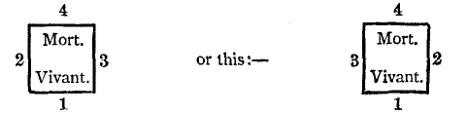
For the three succeeding games the arrangement would be:—
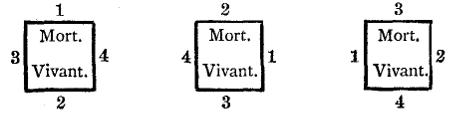
It will be seen that each player, immediately after being Vivant, sits out, or takes Mort’s place, for the next game.
DEALING. It is usual for Vivant to deal the first hand for himself, as the disadvantage of exposing fourteen cards is more than compensated for in compelling the adversary to open the game by leading up to an unknown hand. If Vivant deals the first hand for Mort, he must present the pack to the player on dummy’s right to be cut, and deal the cards from right to left, turning up the trump at Mort’s place. If he deals for himself, he presents the pack to the pone to be cut, and proceeds as in whist.
When two packs are used, the French laws require that if the deal is for Mort, the Right shall gather and shuffle the still pack; and that if Vivant deals for himself, the pone shall gather and shuffle. I have found this to be awkward, because the player who is gathering and shuffling the cards of one pack is called upon to cut the other. For this reason I recommend that whichever adversary is the pone for the deal in hands should allow his partner to gather and shuffle the still pack. When either adversary deals, his partner will, of course, gather and shuffle the still pack.
The general rules with regard to irregularities in the deal are the same as at whist, with the following exceptions:—
A misdeal does not lose the deal unless the opponents so elect; they may prefer a new deal by the same dealer. The reason for this is that the deal is a disadvantage, especially for Mort.
If Vivant or Mort offers the pack to one adversary to cut, and then deals as if the other had cut, it is a misdeal; and it is not admissible to shift the packets in order to remedy matters.
It might be imagined that a card exposed in dealing, if dealt to Mort, would make no difference, as all his cards will presently be exposed. But the laws give the opponents of the dealer the option of either allowing the deal to stand, or having a new deal, or calling it a misdeal.
According to the French laws, if there is any discussion in progress with regard to the previous hand or play, the dealer may lay aside the trump card, face down, until the discussion is finished. If this law prevailed in America, I think the trump would very seldom be turned immediately.
STAKES. In Mort the stake is a unit, so much a point. It may assist players in regulating the value of the stake to remember that six is the smallest number of points that can be won or lost on a single game, and that thirty-seven is probably the highest, although fifty, or even a hundred is not impossible. The average is about twelve. The same customs as at whist prevail with regard to outside betting.
The Vivant must pay or receive double, as he has to settle with each adversary. If four play, the one sitting out has nothing to do with the stakes; but he may make outside wagers on the result of the game.
THE METHOD OF PLAYING is practically the same as at whist, with the following exceptions:—
When it is the turn of Mort to play, Vivant selects the card for him.
The Revoke. The rules governing this are the same as those already given for English Dummy. Mort is not liable to penalty under any circumstances. If any other player revokes, his opponents may take three points from the score of his side; or add three points to their score; or take three of his tricks. The penalty cannot be divided; but if two or more revokes are made by the same side, the penalty for each may be enforced in a different manner. For instance: If the score is 3 to 2 in favor of the adversaries, Vivant may take three points from their score for one revoke, and add three to his own score for the other. It is not permissible to reduce the revoking player’s tricks to nothing. At least one must be left in order to prevent slams being made through revoke penalties.
Cards Played in Error. Vivant is not liable to any penalty for dropping his cards face up on the table; but if he or Mort plays two cards at once to a trick, the adversaries may select which they will allow to be played. The adversaries are subject to the same penalties as in whist for all cards played in error.
Leading Out of Turn. If Vivant or Mort lead out of turn, the adversaries may let the lead stand, or demand it be taken back. If it was the turn of neither, no penalty can be enforced, and if all have played to the trick, the error cannot be corrected.
Taking Tricks. The methods of taking tricks, and placing them so that they can be easily counted, have been fully described in connection with whist.
OBJECT OF THE GAME. As in whist, the object is to take tricks; the highest card played of the suit led wins, and trumps win against all other suits. The first six tricks taken by one side, and forming a book, do not count; but all above that number count toward game. At the end of each hand, the side that has taken any tricks in excess of the book scores them, their opponents counting nothing. As soon as either side reaches five points, they win the game, but the concluding hand must be played out, and the winners are entitled to score all the points over five that they can make on that hand. For instance: The score is 4 to 3 in favor of Vivant and Mort. They win the first seven tricks, which makes them game; but they do not cease playing. If they succeed in gaining eleven tricks out of the thirteen, they win a game of 9 points, instead of 5.