NATIONAL GAMES.
Reading edition
There are certain games of cards which do not seem to belong to any particular family, but stand apart from other games, and have been played since their first invention with only trifling variations, giving rise to no offshoots bearing other names. These are usually the most popular games with the middle and lower classes in the countries in which they are found, and may be considered as distinctly national in character. Games that become popular with the masses always last longer than others, and the rules governing them are much better understood, and more firmly established. In the course of a century the English aristocracy have run the gamut of Quadrille, Ombre, Whist, Écarté, Bézique, Piquet, Rubicon, and Bridge; while the middle classes have stuck steadily to Cribbage for nearly two hundred years.
Six of these popular games are strikingly typical of the national character, both in their construction, and in the manner of playing them. These are: Skat in Germany; Cribbage in England; Piquet in France; Conquian in Mexico; Calabrasella in Italy; and Cassino in America. All these are excellent games, and have deservedly survived much more pretentious rivals.
With the exception of Skat, little is known of the exact origin of any of these games, although most of them may be traced by their resemblance to more ancient forms. Skat is the most modern, and to-day the most popular, many persons thinking it superior to Whist. The game seems to have originated among the farmers of Thuringia, a province of Saxony, and was probably a variation of the Wendish game of Schapskopf. The first mention of Skat that we can find is in an article in the “Osterländer Blättern,” in 1818. Thirty years later Professor Hempel of Altenburg published the rules and principles of the game under the title: “Das Skatspiel, von J.F.L.H.” It is said that he learned the game from a friend, who had been taught it by a Wendish coachman in his employ. The game spread rapidly, and soon became popular all over Germany, but with many minor variations in the details of play. To settle these, a Skat congress was finally held in Altenburg in 1886. This was succeeded by others in Leipzic and Dresden, and the result of these meetings has been to weed out all the minor differences in play, and to settle upon a universal code of laws for the game, which is called Reichs-Skat.
In America, Reichs-Skat is no longer played; the value of some of the games is changed, and all the bidding is by Zahlen-reizen. In all the text-books on Skat which we have examined, this fact has been entirely overlooked.
SKAT.
The etymology of the word Skat, sometimes spelt Scat, is a matter of doubt, but the most plausible explanation is that it is a corruption of one of the terms in the parent game of Taroc; “scart,” from “scarto,” what is left; or “scartare,” to discard or reject. “Matadore” is another word from the game of Taroc, still retained in Skat. Others attribute the word to “Skatt,” the Old-German or Anglo-Saxon for money; the modern German, “Schatz,” a treasure, referring to the forms of the game in which good counting cards are laid aside in the skat for the count at the end of the hand. This derivation would account for both spellings of the word, with a “k” and with a “c.”
The student is advised to make himself familiar with the German terms in the following description, as they are in common use wherever skat is played. Many American players who use the English language in bidding by figures, still adhere to the German names for the suits and positions at the table.
CARDS. Skat is played with a pack of thirty-two cards, all below the Seven being deleted. The rank of the cards differs according to whether the players are attempting to win or to lose tricks. If the object is to win tricks, it is known as a “game;” if the object is to lose, it is called a “nullo.” In nullo the cards rank in their natural order; A K Q J 10 9 8 7, the Ace being the highest. In the various “games,” the four Jacks are always the best trumps, and are known as Wenzels. The other cards follow the usual German rank; A 10 K Q 9 8 7, the Ace being the highest in plain suits.
The German names for the cards are as follows;—Jack: Wenzel, Bauern, Bube, Jungen, or Unter. Ace: As, or Daus. Ten, Zehn. King, König. Queen: Dame, Ober, or Königen. Nine, Neun. Eight, Acht. Seven, Sieben. The most common terms are; Bube, As, Zehn, König, Dame, etc. The words Unter and Ober for the Jack and Queen, refer to the manner of marking the suits on the German cards. In the Queens, the mark of the suit is always above the figure, which has a single head; in the Jacks the suit mark is always under the figure. This distinction is necessary, because in the German cards the Queen is a male figure. The King has two suit marks, one on each side of the head. When the French or American double-head cards are used, with suit-marks in both corners, the words “ober” and “unter” have no meaning; Dame and Bube being used instead.
Rank of the Suits. In addition to the rank of the cards themselves, the suits outrank one another, except in Nullo, clubs being always the best, then spades, hearts and diamonds. The Germans have various names for the suits, that first given in each instance being in common use among modern Germans. Clubs: Kreuz, Trefle, Eicheln, Eckern, or Braün. Spades: Pique, Schüppen, Laub, or Grün. Hearts: Hertzen, Cœur, or Roth. Diamonds: Carreau, Schellen, Eckstein, Ruthen, or Gelb. In the German notation of card games and problems, the suits are indicated by the French terms: clubs, tr for trefle; spades, p for pique; hearts, co for cœur; diamonds, car for carreau. The cards are indicated by the initials; A K D B Z 9 8 7, which stand for As, König, Dame, Bube, Zehn, etc. The winning card in each trick is always printed in full-faced type.
The cards of each suit are divided into two parts, known as counting cards, Zahlkarten, and those having no counting value; Fehlkarteten or Ladons. The counting cards and their values are as follows:—Ace 11, Ten 10, King 4, Queen 3, and Jack 2. These are used in reckoning up the value of the tricks won by each side in counting toward 61 in all the “games,” but not in Nullo. The Seven, Eight and Nine have no counting value.
The rank of the suits has no influence on their trick-taking powers, nor on the value of the Zahlkarten; but it increases or diminishes the value of the “game” played for. When any suit is made the trump, it takes the precedence of the three others only in so far as trumps will win other suits, and the suits which are not trumps are equal in value so far as trick-taking is concerned. As the four Wenzels are always the highest trumps, there will always be eleven cards in the trump suit, and seven in each of the plain suits; so that if clubs were trumps, the rank of the cards would be:—
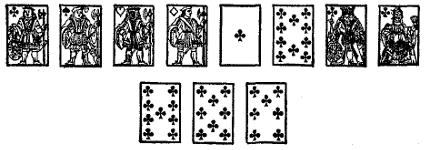
In any of the other suits the rank would be:—

Matadores. The club Jack is always the best trump, and every trump card in unbroken sequence with the club Jack is called a Matadore, provided the sequence is in the hand of the same player. This rule holds whether the sequence was in the hand originally dealt to him or part of it is found in the Skat, should he become possessed of the Skat cards. For instance: Clubs are trumps, and a player holds these cards:—

He has only one Matadore; but as the Skat cards will belong to him if he has made the trump, he may find in them the spade Jack, which would complete his sequence, giving him six Matadores, instead of one. As one side or the other must have the club Jack in every deal, there must always be a certain number of Matadores, from one to eleven. If the player who makes the trump has them, he is said to play with so many; if his adversaries hold them, he is said to play without just as many as they hold. The difficult thing for the beginner at Skat to understand is that whether a player holds the Matadores or not, the number of them has exactly the same influence on the value of his game. If one player held these cards
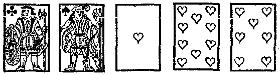
and wished to make hearts trumps, he would be playing “with two.” If another player wished to make the same suit trumps with these cards:—
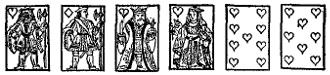
he would be playing “without two,” and the value of each game would be exactly the same, no matter which player actually made the trump. Matadores must be held; they do not count if won from the adversaries in the course of play.
MARKERS. Counters of any kind are not used in Skat, as the score is kept on a writing pad, which should be ruled into vertical columns for the number of players engaged.
PLAYERS. Skat is played by three persons. If there are four at the table the dealer takes no cards, but shares the fortunes of those who are opposed to the single player, winning and losing on each hand whatever they win and lose. If there are five or six at the table, the dealer gives cards to the two on his left, and the one next him on the right. Those holding no cards share the fortunes of the two who are opposed to the single player.
After the table is formed, no one can join the game without the consent of all those already in, and then only after a round; that is, after each player at the table has had an equal number of deals. Should any player cut into a table during the progress of a game, he must take his seat at the right of the player who dealt the first hand. When six persons offer for play, it is much better to form two tables, but some persons object to playing continuously, and like the rest given to the dealer when more than three play.
There are always three active players in Skat. The one who makes the trump is called the player, or Spieler; the two opposed to him are called the adversaries, or Gegners; while those who hold no cards are called im Skat, or Theilnehmer. Of the three active players, the one who leads for the first trick is called Vorhand; the second player is called Mittelhand, and the third Hinterhand. The person sitting on the dealer’s right, to whom the cards are presented to be cut, is called the pone.
No person is allowed to withdraw from the game without giving notice in advance, and he can retire only at the end of a round of deals. It is usual to give notice at the beginning of a round, by saying: “This is my last.”
CUTTING. Positions at the table are drawn for, the cards ranking as in play, Jacks being the best, and the suits outranking one another in order, so that there can be no ties in cutting. The lowest cut has the first choice of seats, and also deals the first hand. It is usual for the player sitting on the right of the first dealer to keep the score, so that one may always know when a round ends.
STAKES. Skat is played for so much a point, and the single player wins from or loses to each of the others at the table. A cent a point is considered a pretty stiff game, half a cent being more common in good clubs. Many play for a fifth, or even a tenth of a cent a point. At half a cent a point, ten dollars will usually cover a run of pretty bad luck in an evening’s play.
DEALING. At the beginning of the game the cards should be counted and thoroughly shuffled, and shuffled at least three times before each deal thereafter. The dealer presents the pack to the pone to be cut, and at least five cards must be left in each packet. The cards are dealt from left to right in rotation, and the deal passes to the left in regular order.
Only three persons at the table receive cards, no matter how many are in the game. If there are four players, the dealer gives himself no cards. If there are five or six players, the first two on the dealer’s left and the pone receive cards. The other persons at the table are said to be “im Skat,” because they are laid aside for that deal.
The cards may be distributed in several ways, but whichever manner the first dealer selects must be continued during the game, both by the original dealer, and by the others at the table. Ten cards are given to each player, and two are dealt face downward in the centre of the table for the Skat. No trump is turned. The cards must be dealt, three cards to each player, then two to the Skat; then four to each player again, and finally three.
Irregularities in the Deal. If the pack is found to be imperfect, the deal in which the error is discovered is void; but any previous scores or cuts made with that pack stand good. If the cards have not been cut, or if a card is found faced in the pack, or if the dealer exposes a card in dealing, any active player who has not looked at his cards may demand a fresh deal by the same dealer. If the dealer gives too many or too few cards to any player, he must shuffle and deal again. If the error is not discovered until the hand is partly played out, the deal is void, and the misdealer deals again. A misdeal does not lose the deal under any circumstances, but it is usual to exact a penalty of ten points for a misdeal.
OBJECTS OF THE GAME. The object of each player is to obtain the privilege of attempting to accomplish a certain task, which is known as his “game,” and which he must be able to carry through successfully against the combined efforts of the two other players. The more difficult the task undertaken, the greater the number of points scored for it, and the player who will undertake the game which is of the greatest value of those offered must be allowed the privilege of trying it. In order to determine which player this is, they may all bid for the privilege by naming a certain number of points, usually well within the actual value of the game they intend to play. If a bidder meets with opposition, he gradually approaches the true value of his game, and the player whose game is worth the most will of course be able to bid the greatest number of points, and must be selected as the player, the two others being his adversaries.
Games. These games are divided into two principal classes, those in which the player undertakes to win, and those in which he tries to lose. When he plays to lose, it is to lose every trick, there being no trump suit, and the cards in each suit ranking A K Q J 10 9 8 7. These games are called Null, or Nullo, and Null Ouvert, the latter being played with the successful bidder’s cards exposed face upward on the table, but not liable to be called. The moment he wins a trick in a Nullo, he loses his game. Nullos are quite foreign to Skat, and appear to have been introduced as a consolation for players who always hold bad cards.
When Ramsch is played, the object is to take less than either of the other players; but the cards rank as in the ordinary game, except that the four Jacks are the only trumps.
In all other games the successful bidder undertakes to win; but his success does not depend on the number of tricks he takes in, but on the total value of the counting cards contained in those tricks. The total value of all the counting cards is 120 points, and to be successful, the single player must win at least 61. If he succeeds in winning 61 or more points, he wins his game, whatever it may be. If he can get 91 points, he wins a double game, which is called schneider. If he can take every trick, he wins a treble game, which is called schwartz. It is not enough to win 120 points, for if the adversaries win a single trick, even if it contains no counting cards, they save the schwartz.
If the single player fails to reach 61, he loses. If he fails to reach 31, he is schneider; and if he fails to take a trick he is schwartz. These various results increase the value of the game, as will presently be seen.
There are four varieties of games in which the successful bidder plays to win, the difference being in the manner of using the skat cards, and making the trump. These games are called Frage, Tourné, Solo, and Grand, and they outrank one another in the order given, Frage being the lowest. The first three: Frage, Tourné and Solo, are each again divided into four parts, according to the suit which is trumps; a Tourné in clubs being better than one in spades; a Solo in hearts being better than one in diamonds, and so on. This is in accordance with the rank of the suits already mentioned in the paragraph devoted to that subject.
In a Frage, or Simple Game, the successful bidder takes both the skat cards into his hand, and then declares which suit shall be the trump; discarding two cards face downward for his schatz, or treasure, before play begins. The two cards thus laid aside count for the single player at the end of the hand, provided he takes a trick, and they cannot be won by the adversaries unless they make the single player schwarz. Frage is no longer played.
In a Tourné, the successful bidder turns one of the skat cards face upward on the table before looking at the second card. He may turn over whichever card he pleases, but the one he turns fixes the trump suit for that hand. If the card turned over is a Jack, he may change to a Grand; but he must do so before he sees the second card in the Skat.
If the player does not like the first card he turns, he need not show it, but may put it in his hand and turn the other. This second one must be the trump; or a Grand may be played if the card is a Jack. In case the game is lost after taking the second card, it costs double. This is called Passt mir Nicht.
In a Solo, the skat cards are not touched, the successful bidder naming the trump to suit the hand of ten cards originally dealt him. The Skat belongs to him, as in Frage and Tourné, but he must not see its contents until the hand is played out, when any points and Matadores it may contain will count for him.
In a Grand there is no trump suit, the four Jacks being the only trumps in play. These four cards preserve their relative suit value, the club Jack being the best, and they are still Matadores. There are four varieties of Grand: A tourné player may make it a Grand if he turns up a Jack. This is called a Grand Tourné. A player may make it a grand without seeing either of the skat cards. This is called a Grand Solo. A player may announce a Grand and lay his cards face up on the table; exposed, but not liable to be called. This is called a Grand Ouvert. A Frage cannot be played as a Grand under any circumstances. A player may announce Gucki Grand, which means that he will take both the skat cards into his hand at once, in order to get the privilege of laying out any two cards he pleases, but that Jacks will be the only trumps. If a Gucki Grand is lost, it costs double.
A player may announce a Gucki Nullo, in which he takes both the skat cards into his hand and lays out any two cards he pleases. This loses double if it is not successful.
Revolution is seldom played. It is a Nullo in which the adversaries put their twenty cards together as one hand to see if they can make the player take a trick.
Uno and Duo are Grands, in which the single player engages to take one trick in Uno, or two in Duo, neither more nor less.
GAME VALUES. Each of the foregoing games has what is called a unit of value, which is afterward multiplied several times according to the number of Matadores, and whether the game was schneider or schwarz.
These unit values are as follows, beginning with the lowest:
Suits Trumps:— Jacks Trumps:— No Trumps:—
Turn Solo Turned Grand 12 Gucki Nullo 15
♢ 5 9 Gucki Grand 16 ” if played open 30
♡ 6 10 Solo Grand 20 Solo Nullo 20
♠ 7 11 Open Grand 24 ” if played open 40
♣ 8 12 Ramsch 20 Revolution 60
When one player takes no trick in a Ramsch, the player with the greater number of points loses 30. If two players take no trick, the loss is 50 points.
All Guckis lose double if they fail, so that if a player announces a Gucki Nullo and loses it, he will lose 30; but if he won it he would get 15 only. If a player has a Gucki Null Ouvert, he must announce that it is to be played open before he touches the skat cards. It is then worth 30 if won; 60 if lost.
Passt-mir-nicht tournées all lose double if they fail, but win the usual number of points if they succeed.
Multipliers. The foregoing are simply the standard counting values of these various games. In calculating the actual value of a player’s game, in order to see how much he may safely offer in the bidding, and how much he would win if successful in his undertaking, these standard values are multiplied as follows:—
Five classes of games are recognized, beginning with the lowest, in which the player gets the necessary 61 points, but does not make his adversaries schneider. This is simply called “game,” and as it must always be either won or lost, it is a constant factor. The value of the game is 1, and each better game is numbered in regular order, the five varieties being as follows:
The Game, 1. Schneider, 2. Schwarz announced or Schwarz, 3. Schwarz after announcing Schneider, 4. Schwarz announced, 5.
These numbers are added to the number of Matadores, and the total thus found is multiplied by the unit value of the game. For instance: A player has obtained the privilege of playing on a bid of thirty. His game is a Solo in hearts, in which he holds the three highest Matadores and announces schneider in advance. His game multiplier is therefore 3 (for the announced schneider), to which he adds 3 more for the Matadores, 6 altogether. The unit value of a heart Solo being 10, he could have gone on bidding to 60 had it been necessary, and he will win 60 from each of his adversaries if he succeeds in reaching 91 points in the counting cards he takes in in his tricks, together with what he finds in the Skat.
If his adversaries got to 30 with their counting cards, he would have lost 60 to each of them, although he bid only 30, because he announced his game as schneider, and did not make it. Had he not announced the schneider, and reached 91 or more in his counting cards, he would have won a game worth 50, losing the extra multiplier by not announcing the schneider in advance; for a schneider made without announcing it is worth only 2.
In reckoning the value of a game it is always safer to bid on playing “with” than “without” Matadores in a Solo or Tourné; because, although you may have a hand “without four,” you may find a Wenzel in the Skat, and if it is the club Jack you lose three multipliers at once.
BIDDING. The players must be familiar with the manner of computing the various games in order to bid with judgment, and without hesitation. Suppose you hold the three highest Matadores with an average hand, not strong enough in any one suit to play a Solo, but good enough for a Tourné. Your smallest possible game will be diamonds with three; which will be worth 5 multiplied by 4; 1 for the game, and 3 for the Matadores, 20 points. If you can get the game on any bid less than 20 you are absolutely safe, provided you can reach 61 in your tricks. But the opposition of another player may irritate you, [reizen,] and provoke you to bid 24, or even 28, in the hope of turning a heart or a spade. If you go beyond 20, and turn a diamond, you must either find the fourth Matadore in the Skat, or make your adversaries schneider, in order to secure another multiplier. If you fail, you lose 24, or 28, according to your bid.
The great difficulty in Skat is to judge the value of a hand, so as neither to under nor overbid it, and also to get all out of it that it is worth. A person who plays a Frage in hearts when he could easily have made it a Solo, reduces the value of his game just eighty per cent. A player with the four Wenzels, A K Q 9 8 of diamonds, and a losing card, would be foolish to play a diamond Solo with five, schneider announced, worth 72; while he had in his hand a sure Grand, with four, schneider announced, worth 140. Of course the schneider is not a certainty. The risk is that the Ten of diamonds will be guarded, and that an Ace and a Ten will make, both of them on your losing card, or one of them on the diamond Ten. A careful player would be satisfied with 100 on such a hand, for if he fails to make the announced schneider, he loses everything.
A player is not obliged to play the game he originally intended to, if he thinks he has anything better; but he must play a game worth as much as he bid, or the next higher, and having once announced his game, he must play it.
Suppose Vorhand has a spade Solo with two, and on being offered 33 says, “Yes,” thinking the bidder will go on to 36, instead of which he passes. It is very probable that the bidder has a spade Solo without two, and will defeat a spade Solo announced by Vorhand. If Vorhand has almost as good a game in hearts, he should change, hoping to make schneider, or to find another Matadore in the Skat. If he loses the game, a heart Solo with two costs 30 points; but as Vorhand refused 33, and the next best game he could have made with a heart Solo is 40, that is the amount he loses, although he refused only 33.
Method of Bidding. The Vorhand always holds the play, and the Mittelhand always makes the first bid, or passes, the Hinterhand saying nothing until the propositions made by the Mittelhand have been finally refused or passed by the Vorhand. The usual formula is for the Vorhand to say, “How many?” or, “I am Vorhand,” thereupon the Mittelhand bids or passes. If Vorhand has as good a game as offered him he says, “Yes,” and Mittelhand must bid higher or pass. If Vorhand has not as good a game he may either pass, or bluff the bidder into going higher by saying, “Yes.” As soon as one passes, the other turns to the Hinterhand, who must either make a higher bid than the last, or pass. The survivor of the first two must either say, “Yes,” to the offers made by Hinterhand, or pass. The final survivor then announces his game. It is usual for the last one to pass to signify that he is done by pushing the skat cards toward the survivor, indicating that they are his, and that he is the player. If a player is offered a game equal to his own he may still say, “Yes;” but if he is offered a better game, and still says, “Yes,” he runs the risk of being compelled to play.
The old German way of bidding, adopted at the Skat Congresses in Altenburg, Leipzig and Dresden, was to bid in suits; a bid of club Solo outranking one of spade Solo, no matter what it was worth. This has long been obsolete, the objection to it being that a player might get the play on a game of much inferior value. A player with a spade Solo, six Matadores, and schneider announced could offer only a spade Solo, without mentioning its value, and although his game was worth 99, he could be outbid by an offer of Nullo, which was then worth only 20. This is contrary to the spirit of the game, which requires that the person offering the game of the greatest value shall be the player. The rank of the bids in the old German game was as follows, beginning with the lowest:—
Frage, in the order of the suits.
Tourné, in the order of the suits.
Grand Tourné.
Solo in diamonds, hearts and spades.
Nullo, worth 20.
Solo in clubs.
Grand Solo, worth 16.
Null ouvert, worth 40.
Grand ouvert.
The multipliers were the same as those used in the modern game, but the player had no means of using them in his bids. It will be observed that the modern value of the various games seeks to preserve the old rank by assuming the lowest possible bid on any given game.
In some parts of Germany it is still the custom to reckon Solos at the tourné values, simply adding one multiplier for “out of hand.” Thus a spade Solo with two would be reckoned; “with two, one for game, one for out of hand; four times seven, or twenty-eight.” Note that seven is tourné value for spades.
THE SKAT CARDS. The successful bidder determined, the skat cards are pushed towards him, and the manner in which he uses them limits the game he is allowed to play. While the player must win or lose a game worth as many as bid, he may attempt to win as many more as he pleases. If he has got the play on a bid of ten, that does not prevent him from playing a club Solo, with schneider announced. But if he has bid or refused eleven, and plays a tourné in diamonds, he must make schneider or play with or without two Matadores in order to bring his multipliers up to three. It both these fail him he loses 15, the next higher game than his bid possible in a diamond tourné.
As Frage is no longer played on account of its small value, if the player takes both the skat cards into his hand at the same time, without showing them, his game must be a Gucki Grand, unless he has previously announced that it is a Gucki Nullo. His game announced, he lays out any two cards he pleases for his skat, so as to play with ten only.
If the player turns over either of the skat cards, his game is limited to a tourné. If he turns a Jack, he may change to Grand, but not to Grand Ouvert. Neither schneider nor schwarz can be announced in any game in which the skat cards are used. A tourné player must lay out two skat cards to reduce his hand to ten cards.
If the player neither turns over nor takes into his hand either of the skat cards, he may play any of the suit Solos, Grand Solo, Grand Ouvert, Nullo, or Null Ouvert. He may announce schneider or schwarz in any Solo.
Any player looking at the skat cards before the beginning of the play is debarred from bidding that deal, and is penalised ten points in the score. In addition to this penalty, either of the other players may demand a fresh deal. If a player looks at the skat cards during the play of a hand the play is immediately stopped, and if he is the single player he can count only the points taken in up to that time, exclusive of the skat. These points are deducted from 120, and his adversaries claim the difference. The game is then settled, according to this count, exactly as if the hand had been played out. If an adversary of the single player looks at either of the skat cards during the play of a hand, the single player may at once stop the game, and his adversaries can count only the points they have taken in in tricks up to that time. If they have no tricks they are schwartz; if they have not 30 points they are schneider.
When four or more play, any person holding no cards may be penalised ten points for looking at the skat cards.
METHOD OF PLAYING. The successful bidder having disposed of the skat cards and announced his game, the Vorhand leads any card he pleases for the first trick. Vorhand should be careful not to lead until the player has laid out or discarded for the Skat in a Gucki or a Tourné. Players must follow suit if they can, but are not obliged to win the trick. Having none of the suit led, they may trump or discard at pleasure. The highest card played, if of the suit led, wins the trick, and trumps win all other suits. The winner of the first trick leads for the next, and so on, until all the cards have been played, or the game is acknowledged as won or lost, and abandoned. In a Grand, if a Jack is led, players must follow suit with the other Jacks, they being trumps.
Abandoned Hands. If the single player finds he has overbid himself, or sees that he cannot make as good a game as bid, he may abandon his hand to save himself from being made schneider or schwarz, provided he does so before he plays to the second trick. A Solo cannot be abandoned in this manner, as the rule is made only to allow a player to get off cheaply who has been unlucky in finding nothing in the Skat to suit his hand. For instance: A player has risked a Tourné with a missing suit, and turns up that suit. He can abandon his hand at once, losing his bid or the next higher game, but escaping schneider.
Irregularities in the Hands. If, during the play of a hand, any person is found to have too many or too few cards, the others having their right number, it is evident that there has been no misdeal if the pack is perfect and there are two cards in the Skat. If the player in error has too few cards, probably from having dropped one on the floor, or having played two cards to the same trick, he loses in any case, but the adversary may demand to have the hand played out in order to try for schneider or schwarz, and the last trick, with the missing card, must be considered as having been won by the side not in fault. If the player in fault is opposed to the single player, his partner suffers with him. If the player discovers his loss, he is not allowed to pick the card from the floor and replace it in his hand if he has in the meantime played to a trick with a wrong number of cards.
Playing Out of Turn. The usual penalty in America for leading or playing out of turn is the loss of the game if the error is made by the adversaries of the single player. If by the player himself, the card played in error must be taken back, and if only one adversary has played to the false lead, he may also take back his card. If both have played, the trick stands good. The single player suffers no penalty, as it is only to his own disadvantage to expose his hand.
The Revoke. If a player revokes, and he is one of the adversaries of the single player, the game is lost for the player in error; but he may count the points in his tricks up to the time the revoke occurred, in order to save schneider or schwarz. In Nullos, the game is lost the moment the revoke is discovered.
Seeing Tricks. The tricks must be kept separate as they are taken in, and any player is allowed to look at the last trick turned and quitted. Any player looking at any other trick but the last may be penalized ten points.
Playing Ouverts. The rules of the game require Ouverts to be exposed face upward on the table before a card is played.
SCORING. The score should always be kept by the player sitting on the right of the first dealer. This will mark the rounds. The score sheet should be ruled in vertical columns, one for each player at the table.
Each player is charged individually with his losses and gains, the amounts being added to or deducted from his score, and a plus or a minus mark placed in front of the last figure, so that the exact state of each player’s score will be apparent at a glance.
The score of the single player is the only one put down, and it is charged to him as a loss or a gain at the end of each deal.
If there are four players, a line is drawn under every fourth amount entered in each person’s account. If three play, the line is drawn under every third amount. This system of scoring will show at once whose turn it is to deal, if the total number of amounts under which no line is drawn are counted up. For instance: Three persons play; A dealt the first hand. In the first three columns are shown the amounts won and lost in the three rounds, while the last three columns show the manner in which these losses and gains were entered on the score sheet:—
Points won and lost. Score Card.
1st Round. 2nd Round. 3rd Round. A B C
A won 33 A lost 16 C lost 36 +33 +40 +55
C won 55 B won 40 B won 48 +17 +88 +67
C won 12 A lost 24 C lost 12 -7 +31
+19
At the end of the second round a line was drawn under A’s account, which then contained three items; and after the first game in the third round a line was drawn under C’s account.
If we suppose the game to be stopped at this point, the scores would be balanced as follows:
We take the three scores and bring them down on one line. We draw a line under them, and proceed as follows: First we take A, who has lost 7 to B, and from whom B has also won 88. This gives us 95 minus for A and 95 plus for B. We then compare A and C, and find that A owes C 26; put down as minus for A, plus for C. We now compare B and C, and find that B wins the difference, which is 69 points; put down plus for B, minus for C. Then we add up to see that the scores balance.
A B C
-7 +88 +19
-95 +95 +26
-26 +69 -69
-121 +164 -43
The same method may be used when four play; but some prefer to call the lowest score zero, and so make all the others plus. Suppose the final scores were as follows:
A B C D
+186 +42 +344 +116
+144 0 +302 +74 = 520
+4 4 4 4
+576 0 +1208 +296
-520 -520 -520 -520
+56 -520 +688 -224
If B is zero, his points are to be taken from those of each of the others, as B is plus. If the low score is a minus, the points must be added to each of the others. The three totals are added, and found, in this case, to be 520, which is the total of B’s loss. We now multiply the scores by the number of players engaged, in this case four, and from the product we deduct the 520 already found. Then the scores balance.
When Skat is played for the League stake, which is one-fourth of a cent a point, the results may be found in a still shorter way by adding up all the scores and taking an average, this average being the sum divided by the number of players. Take the results just given for example:—
A B C D
186 42 344 116 = 688 ÷ 4 = 172
172 172 172 172
+14 -130 +172 -56
The average is simply deducted from each score, and the remainder is the amount won or lost, in cents.
CHEATING. As in all games in which the cards are dealt in groups, the greek will find many opportunities in Skat. The clumsiest shuffler can usually locate some of the Wenzels at the top or the bottom of the pack, before presenting it to be cut, and if the players do not insist on the cards being dealt always in the same manner, the sharper can secure to himself two or more Wenzels, either in his hand or in the Skat. Any person who deals the cards sometimes three at a time, and again five at a time, should be stopped immediately, and no such excuses as changing his luck should be listened to for a moment. Any person who habitually picks up the cards with their faces towards him, and straightens them by lifting them from their positions in the pack, should be stopped at once, and requested to straighten the cards face down.
Dealing seconds is very difficult when the cards have to be “pinched” in threes and fours. A second dealer holding back a Wenzel on the top may give his adversary two underneath without knowing it. Marked cards are of advantage only when the dealer plays, and are of little use beyond telling him what he can turn up for a trump, or what he will find in the Skat. The rule for having four in the game, if possible, is one of the greatest safeguards, unless the dealer is in secret partnership with one of the players.
SUGGESTIONS FOR GOOD PLAY. The chief things to master in Skat are the values of the hands, the principles of bidding on them, the best methods of playing them, and the proper methods of combining forces with your partner for the time being, in order to defeat the single player.
Bidding. Some persons attach a great deal of importance to the odds for and against certain cards being in the Skat. If a player without three is forced to risk finding a Matadore in the Skat, it is usually enough for him to know that the odds are about 3 to 1 against it. It is much more important for him to consider what cards may make against him, and what they would count. It is often necessary to estimate very closely the number of points that must fall on a certain number of leads. For instance: You are Vorhand, and hold these cards:—

Even if you find the Ace and Ten with the best Wenzel in one hand against you, you have an almost certain club Solo, for if you lead a Wenzel, your adversary must either take it, or give you the Ace or Ten. If he wins it, and his partner gives him a Ten of another suit, and they then proceed to make both the Aces and Tens of your weak suits, that will give them only 56 points, and you will make every other trick. The only thing that could defeat you is for one player on the fourth trick to lead a suit of which his partner had none. This would require one player to have all the spades and the other all the hearts, which is almost impossible.
Another familiar example is the following: You are Vorhand with these cards:—

Although you cannot possibly win more than six tricks, and must lose every trick in the red suits, you have an invincible Grand; because the adversaries have not a sufficient number of Fehlkarten to give you to avoid adding 16 points to the 46 you already have in your hand, which must make you 62 before they get a trick.
It is better to bid on a doubtful Solo than on a risky Tourné, and if you have a choice of two numerically equal suits, it is better to bid on a suit containing small cards in preference to one containing A 10. In bidding Tournés, you must remember that the more cards you hold of a suit, the less your chance to turn up one.
It is not good play to bid a Solo on four or five trumps unless you have some aces in the other suits. A Grand may be bid even without a trump, if you have the lead, and hold four aces, or three aces and four Tens. A Grand with any two Wenzels is safe if you have two good suits. A Nullo should never be bid unless the player has the Seven of his long suit.
A certain amount of risk must be taken in all bids, and a player who never offers a game that is not perfectly safe is called a Maurer; one who builds on a solid foundation. The player who offers the most games will usually win the most unless he is a very poor player.
Leading. The single player should almost always begin with the trumps, in order to get them out of his way. With a sequence of Wenzels, it is a common artifice to begin with the lowest, hoping the second player may fatten the trick by discarding a Ten or Ace, under the impression that the Hinterhand can win it. This style of underplay is called Wimmelfinte, and the Mittelhand should beware of it. With only one Wenzel and the Ace and Ten, it is better to begin with a small trump. If you find all the trumps in one hand against you, or tenace over you, stop leading trumps, and play forcing cards.
If you have no Wenzels it is usually best to lead your smallest trumps. If you have only Ace Ten and small trumps, and know the adversaries have one Wenzel and one trump better than your small one, lead your Ten, so that they cannot make both trumps. In playing for a schneider, it is often advisable to continue the trumps, even after the adversaries are exhausted, so that they shall not know which suit to keep for the last trick.
Laying out the Skat. In a Frage or a Tourné, some judgment is required in discarding for the Skat. It is often necessary to lay aside the Ace and Ten of trumps if there is any danger that the adversaries may catch them. Unguarded Tens should always be laid out, and it is a good general principle to get rid of one suit entirely, so that you can trump it. It is a common practice to put in the Skat the Ace and Ten of a suit of which you hold also the King. When you lead the King, if Mittelhand has none of the suit he is sure to fatten the trick for his partner, thinking he must have Ace or Ten. With the Ten, King, and small cards of a plain suit, lay the Ten and King in the Skat.
The Adversaries should combine against the single player by getting him between them if possible. If you sit on the left of the player, lead your short suits up to him; but if you sit on his right, lead your longest suit through him. Try to force out his trumps on your plain-suit cards if you can, and avoid giving him discards of his weak suits. With a long trump suit, it is often advantageous to lead it through the player, but seldom right to lead it up to him.
In Solos, the adversaries should lead Aces and winning cards, and change suits frequently. If you are playing against a Grand, and have two trumps, one of them the best, lead it, and then play your long suit; but if you have the two smallest trumps, lead the long suit first, and force with it every time you get in.
The partners should always scheme to protect each other’s Tens by keeping the Aces of plain suits. For this reason it is very bad play to fatten with the Ace of a suit of which you have not the Ten, or to play an Ace third hand when there are only small cards in the trick, and the Ten of the suit has not been played and you do not hold it.
If the player is void of a suit, continue leading it, no matter what you hold in it. This will either weaken his trumps, or, if he is between you, will give your partner discards.
If the player leads a Wenzel, it is usually best to cover it if you can; but do not play the club Jack on the diamond Jack unless you want the lead very badly.
When the single player does not lead trumps, but plays his Aces and Tens, the Germans call it “auf die Dörfer gehen;” that is, getting to the villages, or getting home; equivalent to our expression, “getting out of the woods,” or “getting in out of the rain.” When the single player runs for home in this way, it is usually best to lead trumps through him at the first opportunity.
In playing against a Nullo, the great point is to give your partner discards. If you find that the player’s long suit is yours also, continue it until your partner has discarded an entire suit if possible. If you then have the small card of the discarded suit, you may defeat the Nullo at once.
Fattening. The Germans call this Wimmeln, or “swarming” the points together in one trick. It is always advisable to get rid of Tens in this way, or Aces of suits in which you hold both Ace and Ten; but it is bad play to fatten with the Ace of a suit of which you have not the Ten, unless the trick wins the game from the player, or saves a very probable schneider.
The following Illustrative Hands will give the student a very good idea of the manner in which the various forms of the game are played, showing the difference in the play of a Tourné, Solo, and Grand.
A TOURNÉ. A, Vorhand, has refused ten with the following cards, Hinterhand having passed without a bid:—

A concludes to play a Tourné, and turns the heart ♡ Q, finding the ♢ King in the Skat. He lays out the ♠ 10 and ♠ 9 in the Skat, and expects to make 12 points; a heart Tourné, with one Matadore. The play is given in the margin. A is the player, and is also Vorhand, with the lead for the first trick. Hearts are trumps.
A TOURNÉ
A B C A wins.
1 ♣J ♡7 J♢ 4
2 ♡Q ♡A ♡8 -
3 K♢ 9♢ Q♢ 7
4 ♡J J♠ A♠ -
5 ♡10 ♡9 7♠ 10
6 A♢ ♣7 8♢ 11
7 7♢ K♠ 10♢ -
8 ♣K ♣10 ♣9 -
9 ♡K Q♠ 8♠ 7
10 ♣A ♣Q ♣8 14
♠10 and ♠9 in the Scat. 10
A wins 63
The manner in which A exhausts the trumps, and makes both his Ace and King of diamonds, should be carefully studied. At trick 8, if he put on the ace of clubs, B might have the 8, and he would lose both his King and the Queen on the Ten, giving him only 60 points. It must be remembered that A knows every card out against him, because he has seen the skat cards. A wins his 12 points; a heart Tourné with one.
A SOLO. Vorhand has refused a bid of 18, and announces spade Solo with the following cards:—

A SOLO.
A B C A wins.
1 8♠ K♠ ♡J -
2 ♣ A ♣K ♣7 15
3 9♠ Q♠ 10♢ -
4 7♢ A♢ Q♢ -
5 8♢ K♢ ♣Q -
6 ♡ A ♡K ♡8 15
7 ♡10 ♡7 ♡9 10
8 10♠ 7♠ ♣8 10
9 J♠ ♣J ♡Q -
10 A♠ J♢ ♣9 -
♢9 and ♣10 in the Scat. 10
A wins 60
He has the lead for the first trick, and of course begins with the trumps. The play is given in the margin.
C wins the first trick, and leads his long suit through the player. In the last three tricks A coaxes B to win the Ten of trumps; but if B does so he gives up the advantage of his tenace over the player, which is now the only chance to defeat him. B knows that if he wins the Ten of trumps, B and C can make only 59 points, because A will save his trump Ace.
A, having failed to reach 61, loses a spade Solo without one; twice 11, or 22 points, which was the game he must have won to be as good as the offer of 18 which he refused.
A GRAND. B bids; both Vorhand and Hinterhand pass, and B announces a Grand, with the following cards:—

The play is given in the margin. In a Grand the four Jacks are the only trumps.
A has the first play, and as he leads through the player, he begins with his long suit, of which he knows that the Ace alone is out, and it may be in the skat. If the player has the Ace, C will probably trump it. If the player has not the Ace, it is just possible that he will not trump the Ten.
C, leading up to the player, opens his short weak suit. At trick 3, C knows that A must have the Ten of hearts, or he would not fatten with the Ace. As this shows that A can stop the heart suit, C guards the spades and lets all his hearts go.
B loses a very strong Grand, which must have been successful if C had had one club, or if A had led anything but the club Ten. A Grand with three Matadores is worth 4 times 20 or 80 points, which is what B loses, although he may have bid only 10 or 12 to get the play.
A GRAND.
A B C B wins.
1 ♣10 ♣A J♢ -
2 8♠ A♢ 7♢ 11
3 ♡A 9♠ 10♠ -
4 ♣7 10♢ 9♢ 10
5 ♣8 ♡J Q♢ 5
6 ♣9 J♠ ♡9 2
7 ♡7 K♢ ♡Q 7
8 ♣Q ♣J ♡K 9
9 ♣K A♠ 7♠ 15
10 ♡10 Q♠ K♠ -
♢8 and ♡8 in the Scat. -
B wins 59
Text Books. Foster’s Skat Manual, 1906. Eichhorn’s American Skat, 1898. Lehrbuch des Skatspiels, by K. Buhle. 1891. Deutsche Skatordnung, by K. Buhle. 1888. Scatspiel. (Anon.) Von Posert, Quedlinburg. 1879. Encyclopædia der Spiele, by Fr. Anton. 1889. Skat, by F. Tschientschy. 1888. Skat, by L.V. Diehl. 1891. Skat, by E.E. Lemcke. 1887.
All but the first two on the list treat of the old game, bidding by suits, and making no mention of Guckis; but some of them, especially Buhle’s, contain some very fine examples of good play. The first two on the list and the last two are in English. All the others are in German.
AMERICAN SKAT.
In this variation, now so largely played, the highest bidder always sees the skat before announcing his game. Although a gucki, it need not be a grand, but may be solo or nullo if he likes. If he wins the game he announces the scores as usual; but if he loses he always loses double. He may announce schneider or schwarz after discarding for the skat. If he makes an announced schneider, it doubles the value of his game, instead of simply adding a multiplier. An announced schwarz trebles it.
For example: Spade solo with 1, schneider announced. His game is 1 for game, 1 for schneider, without 1, 3 × 11 = 33, doubled for announcing schneider, 66. If lost, it costs 132. If he makes schwarz after announcing schneider, it adds one multiplier, 77. The smallest possible game is a diamond with or without 1, worth 18; 36 if lost. The largest game possible to lose is a grand with four, schwarz announced, costing 1,008.
THE LAWS OF SKAT.
THE GAMES.
1. The following are the unit values of the various games:—
Frage shall not be allowed. Tournée in diamonds 5, in hearts 6, in spades 7 and in clubs 8. Solo in diamonds 9, in hearts 10, in spades 11 and in clubs 12, Turned grand 12, gucki grand 16, solo grand 20 and open grand 24. Gucki nullo 15, open gucki nullo 30, solo nullo 20, open solo nullo 40, and revolution, if played, 60. Uno and duo, if played, shall be worth 20, or if played open 40.
2. When there are trumps, the unit value of the game shall be multiplied as follows: 1 for game; 2 for schneider; 3 for announcing schneider, or for making schwarz without having made any announcement; 4 for schwarz after having announced schneider; and 5 for announcing schwarz. To each of these multipliers shall be added one for each matadore, “with” or “without.”
3. In tournées, if the player says “passt-mir-nicht” to the first card and takes the second, he loses double if he loses his game. In guckis, whether grand or nullo, the player loses double if he loses his game.
4. The value of Ramsch shall be 20 points, to be charged to the player losing the game. If one player takes no trick, the loser shall be charged 30 points. If two players take no trick, the loser shall be charged 50 points. The winner of the last trick takes the skat cards. If there is a tie between two for high score, the winner of the last trick shall be the loser. If the last trick is taken by the low score, and the others are tied, the two high scores lose 20 points each. If all three are tied at 40 points each, there is no score.
5. In all games which are played “open,” the hand of the single player must be laid face up on the table before either adversary plays a card; but the adversaries shall not be allowed to consult, neither can they dictate to the player what cards he shall play.
FORMATION OF TABLE.
6. Any number from three to six may form a table, but there shall be only three active players in each deal, and they shall be known respectively as Vorhand, Mittelhand, and Hinterhand. Those who hold no cards shall share the fortunes of those opposed to the single player whose score is put down.
7. There shall be as many deals in each round as there are players at the table, and no person shall be allowed to withdraw from the game during a round unless the others consent to a substitute and such substitute be found.
8. Newcomers can enter the table only after the conclusion of a round and with the consent of the other players. The new candidate for play must take his seat so that he shall have the deal.
9. If seats are drawn for, the lowest skat card shall have the first choice. The next lowest shall sit on his left, and so on. In cutting, the cards and suits rank as in play. The one drawing the lowest card shall deal the first hand, and the score shall be kept by the player on his right.
10. The game shall come to an end only at the conclusion of a round, and any player wishing to stop must give notice before the beginning of a round.
CARDS.
11. There are thirty-two cards in the pack, the rank and value of which are as follows: Jack 2; ace 11; ten 10; king 4; queen 3; the nine, eight and seven having no counting value.
12. The suits shall always outrank one another in the same order; clubs, spades, hearts and diamonds. The four jacks, or Wenzels, which are always the four best trumps, shall outrank one another in the same order.
13. In Nullo, the cards rank: A K Q J 10 9 8 7, and the suits and jacks are all of equal rank.
DEALING.
14. When four or more play at the same table, the dealer takes no cards, but gives cards to the two sitting immediately on his left and to the one next him on his right.
15. When only three play, Hinterhand shall deal the cards.
16. The deal passes in regular order to the left.
17. After being thoroughly shuffled, the pack must be presented to the pone (the player sitting on the dealer’s right) to be cut, and at least three cards must be left in each packet. Any player may demand a right to shuffle the cards before they are dealt, but the dealer shall have the last shuffle before presenting the cards to be cut. If any card is exposed in cutting, there must be a new cut.
18. The dealer shall give each active player cards, three at a time for the first round, face down, beginning on his left. He shall then lay aside, face down, two cards for the skat. Each player shall then receive four cards at a time for the second round, and finally three cards at a time for the last round.
19. If any card is found faced in the pack, or if the pack be proved incorrect or imperfect, there must be a new deal. An imperfect pack is one in which there are duplicate or missing cards, or cards so torn or marked that they can be identified by the backs.
20. Should a player deal out of his turn, the deal must stand if it is complete; otherwise there must be a new deal by the right dealer. When the deal stands, the next deal must be by the player who should have dealt, and subsequent deals must be so arranged that there shall be the right number to each round. A player dealing out of turn may be penalized 10 points.
ERRORS IN DEALING.
21. There are no misdeals. No matter what happens, the same dealer must deal again if it was his proper turn to deal.
22. If a card is exposed by the dealer during the deal, there must be a new deal; or if the cards of the players become confused, so that the dealer cannot separate them.
23. If the dealer gives too many or too few cards to any player, or neglects to lay out the skat cards in their proper turn, or does not give the right number of cards in each round, or gives three to one player and four to another, or fails to present the pack to be cut, there must be a new deal, and the dealer is charged 10 points for the error.
THE SKAT CARDS.
24. Any active player taking up or seeing either or both the skat cards when he is not entitled to do so shall be debarred from bidding that deal. If any but an active player look at either of the skat cards, 10 points shall be deducted from his score.
25. If any Kiebitz (an onlooker not belonging to the table) looks at either of the skat cards, he may be called upon to pay the value of the game.
26. If an active player look at the skat cards during the play, he not having laid out those cards from his own hand, his game is lost if he is the single player. If he is opposed to the player, the player’s game is won, but it may be played out to see if he can make schneider or schwarz.
27. Should an active player take one or both the skat cards into his hand by mistake, before the bidding begins, the dealer shall draw from his hand, face down, enough cards to reduce his hand to ten, and the player in fault shall be charged 25 points penalty, and be debarred from bidding for that deal. If, in three-hand, the player in fault is the dealer, Vorhand shall draw.
28. Should the successful bidder take both the skat cards into his hand together, or pick them up together, he shall be obliged to play a Gucki Grand, unless he has announced to play Nullo. Should he put the first card into his hand without showing it, he shall be obliged to turn up the second card and play Passt-mir-nicht.
29. The player may turn up either of the skat cards; but should he expose both he must play the suit of higher value.
30. Should he turn a jack, he may either play in suit or announce a turned Grand.
31. A player turning up a seven cannot announce a Nullo unless it has been previously agreed to play turned Nullos, which are worth 10 points.
32. The player who takes the skat cards must lay out two cards in their place before a card is led. Should he neglect to lay out for the skat before he plays to the first trick; or should he lay out more or less than two cards, and not discover the error until the first trick has been turned and quitted, he shall lose his game.
BIDDING.
33. All bidding shall be by numbers representing the value of some possible game, and the lowest bid allowed shall be 10.
34. Mittelhand must bid to Vorhand, and Vorhand must either undertake as good a game as that offered him, or pass. If Vorhand passes, Hinterhand bids to Mittelhand, and Mittelhand must either undertake as good a game as that offered, or pass. If Mittelhand passes, when bidding to Vorhand, Hinterhand must bid to Vorhand: but Hinterhand is not allowed to say anything until either Mittelhand or Vorhand has passed.
35. Any figure once named cannot be recalled. A player having once passed, cannot come into the bidding again.
36. The survivor of the bidding shall be known as the Player, and shall have the privilege of naming the game to be played; the two other active players being his adversaries.
37. If no bid is made, and Vorhand will not undertake to play any game against the two others, they must play Ramsch.
ANNOUNCEMENTS.
38. The player, if he does not use the skat cards, may announce any suit for the trump, or he may play a Grand or Nullo.
39. If he wishes to announce schneider or schwarz, he must do so when he names the game to be played, and before a card is led. All Open Grands are compulsory “schwarz announced.”
40. The manner of taking up the skat cards, when the player uses them, is sufficient announcement for a Tournée, Passt-mir-nicht, or Guckser; but a Gucki Nullo must be announced before the skat cards are touched, and open Gucki Nullo must be announced before the skat cards are seen.
41. The player is not allowed to announce either schneider or schwarz in any game in which he uses the skat cards.
42. The adversaries cannot announce schneider or schwarz under any circumstances.
43. No player but Vorhand can announce Ramsch, and then only when no bid has been made.
PLAYING.
44. In Tournée, but not in Solo, Grand, or Nullo, the player may, in order to avoid the possibility of being made schneider, abandon his game as lost before playing to the second trick. The adversaries are then bound to score it as a “game” lost, even if they could have made the player schneider.
45. No matter who is the single player, Vorhand shall always lead for the first trick. The winner of one trick leads for the next, and so on, and each player in turn must follow suit if he can.
46. If, during the play of the hand, any player is found to have a wrong number of cards, the others having their right number, only those who have their right number can win the game. If it is the player who has a wrong number, his game is lost. If it is one of his adversaries, the player’s game is won.
47. If the single player leads out of turn, the cards must be taken back if the trick is not complete and the adversary who has not played demands it. If both adversaries have played to the false lead, the trick stands. If an adversary has played to his false lead, the player cannot take it back unless the other adversary permit it.
48. If an adversary of the player leads out of turn, and the player calls attention to it, the player may immediately claim his game as won and abandon the hand; or he may insist that the play proceed with a view to making the adversaries schneider or schwarz. Whether he proceeds or not his game is won, and he may either let the false lead stand, or insist on a lead from the proper hand.
49. If, during the progress of the hand, the player lays his cards on the table, face up, and announces that he has won his game by reaching 61 or 91, whichever may be necessary to make good his bid, and it is proved that he is mistaken, he loses his game, even if he could have taken up his cards again and won it.
50. If an adversary lays his cards on the table, face up, and claims to have already defeated the player’s game, all that adversary’s cards shall be taken by the player and counted with the tricks already taken in by the player. If the adversary be found to be in error, the player shall score his game as won, even if he would have lost it had it been continued.
51. If the single player gives up his game as lost, and lays his cards on the table, the adversaries shall take all such cards and add them to their own, and count their cards to see if they have also made the player schneider.
THE REVOKE.
52. Should the single player revoke, and not discover the error before the trick is turned and quitted, he loses his game. If he discovers the error and corrects it in time, there is no penalty; but any adversary who plays after him may amend his play.
53. If either adversary of the player revokes, the player may claim his game as won; but he may insist on playing the hand out to see if he can make schneider or schwarz. Even if the single player has overbid his hand, he wins his game if either adversary revokes.
LOOKING BACK.
54. Any active player may see the last trick turned and quitted, provided no card has been led for the next trick. Should a player look back at any other trick, or count his cards, he loses the game; but either of the others may insist on playing on to see if they can make schneider.
55. If an adversary of the player tell his partner how many points they have taken in, or ask him to fatten a trick which is his, or call attention in any way to the fact that the partner’s play should be thus or so, the single player may at once claim his game as won, and abandon his hand.
SCORING.
56. The single player wins his game if he reaches 61 points. He wins schneider if he makes 91. He wins schwarz if he gets every trick.
57. If the adversaries reach 30, they are out of schneider. If they reach 60, they defeat the player. If they get to 90, they make him schneider; and if they win every trick they make him schwarz.
58. The value of the game having been calculated according to Law No. 2, the amount won or lost shall be entered on the score pad under the name of the individual player, and each following item shall be added to or deducted from the previous total, so that the last entry shall at all times show the exact state of the player’s score.
59. At the end of the sitting each player wins from or loses to each of the others at the table the full amount of his score.
60. In every case in which a player loses his game, he loses what he would have won if he had been successful, regardless of the amount he may have bid; but,
61. If the player fails to win a game equal to the amount he has bid, he loses the value of the next higher game which would have made his bid good; because in no case can a player lose less than he bid, and in every case must he lose some multiple of the game which he declared to play.
FROG.
This is a very popular game in Mexico, and seems to be an elementary form of Skat, which it resembles in many ways. Even the name may be a corruption of the simple game in Skat, which is called “frage.” The chief differences are that there are four cards added to the pack for frog, and that the players win or lose according to the number of points they get above or below 61, instead of computing the value of the game by matadores.
Players. Three, four, or five can play; but only three are active in each deal. If four play, the dealer takes no cards. If five play, he gives cards to the two on his left and one on his right.
Cards. There are thirty-six cards in the pack, which rank: A 10 K Q J 9 8 7 6. Each Ace is worth 11, Tens are worth 10, Kings 4, Queens 3, and Jacks 2. This gives us 120 points in the pack, and the object is to get 61 or more.
Dealing. Any one can deal the first hand, after which the deal passes to the left. Three cards are given to each player the first round, then three for the widow, and then two rounds of four cards each to the players, so that there are three hands of eleven cards each, and three in the widow.
THE GAMES. Each player in turn, beginning on the dealer’s left, can offer to play one of three games, and the highest offer must be accepted. A player cannot increase his own bid unless he is overbid. The highest bidder becomes the single player, opposed to the two others.
Frog. In this, hearts must be trumps. The single player turns the widow face up to show what it contained, and then takes the three cards into his hand. He must then discard to reduce his playing hand to eleven cards again. Any points in the cards he lays away will count for him at the end of the play.
The player on the dealer’s left always leads for the first trick, any card he pleases. The others must follow suit if they can, but they are not obliged to head the trick. If a player cannot follow suit, he must trump, and if the third player cannot follow suit either, he must play a trump, but he is not obliged to over-trump unless he likes.
The eleven tricks played, each side turns over the cards taken in and counts the points. For every point the single player gets over 60 he must be paid a counter by each of the others who held cards. But if he does not get 60, he must pay each of the others at the table, including those who held no cards, if any, a counter for every point his adversaries get over 60.
Chico outbids Frog. The player offering this game can name any suit for the trump except hearts, but he must not touch the widow, although the points in it will count for him at the end. Each point under or over 60 is worth two counters in Chico.
Grand outbids Chico, and is the highest bid possible. Hearts must be trumps, and the player offering this game must not touch the widow until the play is finished. Every point under or over 60 in a Grand is worth four counters.
The bidder must play the game he names. He cannot bid Frog and play Chico, or bid Chico and play Grand. The settling up of the scores at the end, if the payments are not made at once in counters, is the same as in Skat.
CRIBBAGE.
Cribbage is not only one of the oldest of the games upon the cards, but enjoys the distinction of being quite unlike any other game, both in the manner of playing it, and in the system of reckoning the points. It is also peculiar from the fact that it is one of the very few really good games which require no effort of the memory; judgment and finesse being the qualities chiefly requisite for success.
There are two principal varieties of the game; Five and Six-card Cribbage; and these again are divided according to the number of players. The old writers agree in speaking of the five-card game as the more scientific; but the modern verdict is in favour of the six-card game, which is certainly the more common and popular. The skill in Five-card Cribbage is limited to laying out for the crib and securing the “go”; but in Six-card Cribbage, while the scientific principles applicable to the crib remain the same as in the five-card game, there is abundant room for the display of skill all through, the hand being as important as the crib, and the play sometimes more important than either. The six-card game will be first described.
CARDS. Cribbage is played with a full pack of fifty-two cards, which have no rank except the order of their sequence; K Q J 10 9 8 7 6 5 4 3 2 A, the Ace being always the lowest, either in cutting or in play. The cards have also a counting or pip value, the three court cards, K Q J, and the 10 being worth ten points each. All other cards, including the Ace, retain their face value. There are no trumps, and the four suits are therefore equal in value at all times.
MARKERS. The game is 61 points, and is scored or “pegged” on a cribbage board, which has a double row of 30 holes on each side, and a game-hole at each end. The players are each provided with two pegs, and they score the points as they accrue by advancing their pegs from left to right according to the number of points they make. For instance: One player makes 6 for his first count. He places one of his pegs in the sixth hole from the left-hand end of the board. Then he makes 4, and places the second peg four holes in advance of the first, which will show that his total score is ten points. The third time he makes 2, which he scores by lifting out the back peg and putting it two holes in advance of the first one. This system of pegging not only shows the total number of points made by either player, but enables the adversary to check the count, as a glance at the distance between the two pegs will show the number of points pegged last time.
When a player reaches the extreme right of the board, 30 points, he crosses over to the inner row of holes, and goes down from right to left. On reaching the end of the second row he has still one more to go to get into the game-hole, which is in the middle of the board.
When one player reaches his game-hole before the other turns the corner, it is called a lurch, and counts two games.
The pegs are so often lose or mislaid that it is much more convenient to use a pull-up cribbage board, in which every hole is provided with its own peg, which may be raised to indicate the count. The back pegs can be either left standing or pushed down again.
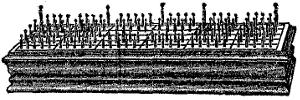
The board is always placed midway between the players.
If three persons play, a triangular board is necessary. This is provided with three sets of holes and three game holes.
When a cribbage board is not at hand, the game may be kept by ruling a sheet of paper into ten divisions, and marking them with the figures 1 to 0 on each side:
0 9 8 7 6 5 4 3 2 1
1 2 3 4 5 6 7 8 9 0
Each player being provided with two coins, one silver and one copper, (or different sizes,) the copper coin can be advanced from point to point to count units, and the silver coin will mark the tens.
PLAYERS. Cribbage is distinctly a game for two players, although three may play, each for himself, or four, two being partners against the other two. When two play, one is known as the dealer, and the other as the non-dealer, or the pone.
CUTTING. The players cut for the choice of seats, and for the first deal. The lowest cut has the choice, and deals the first hand. The Ace is low. If a player exposes more than one card he must cut again. Ties are also decided by cutting again.
STAKES. Cribbage is played for so much a game, lurches counting double. Players may either settle at the end of each game, or score on a sheet of paper. In the pull-up cribbage boards there are nine extra pegs for counting games won. These are placed in a line with the player’s game hole at each end.
DEALING. The cards are shuffled and presented to the pone to be cut, and he must leave at least six cards in each packet. Six cards are dealt to each player, one at a time in rotation, beginning with the player on the dealer’s left if there are more than two. No trump is turned, and the remainder of the pack is placed face downward at the end of the cribbage board on the dealer’s left.
Irregularities. It is a misdeal if any card is found faced in the pack, or if the pack is found to be imperfect, and there must be a fresh deal by the same dealer. Any previous cuts or scores made with the imperfect pack stand good. A player dealing out of turn may be stopped before the non-dealer lifts his cards from the table. The penalty for dealing out of turn is two points, if the error is detected in time; otherwise the deal stands good.
If the dealer neglects to have the pack cut, exposes a card in dealing, gives too many or too few cards to any player, deals a card incorrectly, and fails to remedy the error before dealing another, or exposes one of his adversary’s cards, the non-dealer scores two points by way of penalty. He also has the option of demanding a fresh deal by the same dealer, or of letting the deal stand. If the error is simply an irregularity in the manner of dealing, or an exposed card, the pone must decide without looking at his cards. If either player has too many or too few cards, the pone may look at the hand dealt him before deciding whether or not to have a fresh deal; but if it is the pone himself that has too many or too few cards, he must discover and announce the error before lifting his cards from the table, or he will not be entitled to the option of letting the deal stand. If the pone has too many cards he may return the surplus to the top of the pack, without showing or naming them. If the dealer has too many, the pone may draw from his hand face downward, returning the surplus to the top of the pack; but the pone may not look at the cards so drawn unless the dealer has seen them. If there are too few cards, and the pone elects to have the deal stand, the deficiency must be supplied from the top of the pack.
THE CRIB. The cards dealt, each player takes up his six cards and examines them with a view to laying out two cards, face downward, for the crib; leaving himself four cards with which to play. The four cards which form the crib, two from each hand, always belong to the dealer, and it is usual for each player, in discarding for the crib, to slip his two cards under the end of the cribbage board opposite to that occupied by the remainder of the pack.
Cards once laid out for the crib, and the hand removed from them, cannot be taken up again. A penalty of two points may be scored by the adversary for each card so taken up again, whether it is returned to the player’s hand or not. If either player confuses his cards in any manner with those of the crib, his adversary scores two points, and may also claim a fresh deal.
If it is not discovered until he comes to lay out for the crib, that a player has too many cards, the same rules apply that are given for misdealing; but if he has too few cards there is no remedy, as he has lifted his hand. He must lay out two cards for the crib and play with what remain, his adversary scoring two points penalty at the same time.
THE STARTER. Both players having discarded for the crib, the non-dealer cuts the remainder of the pack, and the dealer lifts the top card from the portion left on the table, turning it face up. The two portions being again united, the turned card is placed face up on the pack, and is known as the starter, because it forms the starting-point in the count for every hand and crib. At least four cards must be left in each packet in cutting for the starter. If the starter is found face up, there must be a new deal.
If the starter is a Jack, the dealer immediately pegs two points for his heels. If he does not peg these two holes before he plays a card the score is lost. If the Jack of the same suit as the starter is found in the hand or crib of any player, it is called his nobs, and when the hand is reckoned up after the play is over, one point may be scored for it.
If the dealer exposes more than one card after the pack has been properly cut, his adversary may choose which of the exposed cards shall be the starter.
In order to understand the motives which govern the players in discarding, and the influences which the starter has upon the value of the hands and crib, it will be necessary to describe the objects of the game, before giving the method of play.
OBJECTS OF THE GAME. The chief object in Cribbage is to form and to preserve various counting combinations. As these combinations occur in the course of play, or are shown in the hand or crib after the play is over, their value in points is pegged on the cribbage board, and the player who first pegs a sufficient number of these combinations to reach a total of 61 points, wins the game.
There are five principal varieties of these counting combinations: Pairs, Triplets, Fours, Sequences, and Fifteens; besides some minor counts which will be spoken of in their proper place.
The various counting combinations in Cribbage may arise in two ways. They may be formed by combining the cards played by one person with those played by his adversary; or they may be found in the individual hand or crib after the play is over. In the latter case the starter is considered as part of each hand and crib, increasing each of them to five available counting cards.
Pairs. A pair is any two cards of the same denomination, such as two Fives or two Queens, and its counting value is always the same, 2 points. Triplets, usually called Pairs Royal, Proils, or Prials, are any three cards of the same denomination, such as three Nines. Their value is the number of separate pairs that can be formed with the three cards, which is three, and the combination is therefore always worth 6 points. The different pairs that can be formed with three Nines, for instance, would be as follows:—

Fours, sometimes called Double Pairs Royal, or Deproils, are any four cards of the same denomination, such as four Fours, and their counting value is the number of separate pairs that can be formed with the four cards, which is six. The combination is therefore always worth 12 points. The different combinations of four cards, arranged in pairs, is as follows:—
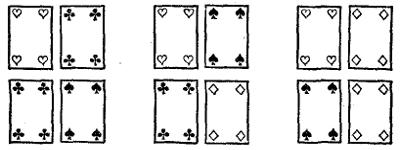
Whether the foregoing combinations are formed during the play of the hand, or found in the hand or crib after the play is over, their counting value is exactly the same.
Sequences. Any three or more cards, following one another in numerical order, will form a sequence. A sequence may also run into the court cards, such as 9 10 J, 10 J Q, or J Q K; but Q K A is not a sequence in Cribbage. The counting value of a sequence is one point for each card in it. Sequences formed in the course of play must always be single, although the cards forming them need not fall in regular order. Those found in the hand or crib may be double, and those formed with the aid of the starter may be treble or quadruple.
The method of computing the value of double and treble sequences should be thoroughly understood, in order that such combinations may be counted at sight. A few examples will show that each combination belongs to a certain class, to which the same counting value is always attached. These classes are distinguished by the number of duplicates of the sequence cards.
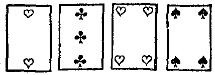
If you hold three cards which form a sequence, and have also a duplicate of any one of them, no matter which, it is evident that by substituting the card of equal value you can form another sequence. Such combinations are therefore always worth 8 points, 6 for the double run, as it is called, and 2 for the pair, no matter what the cards are that form the combination.
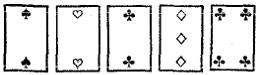
If the five cards in the hand and starter together contain a run of three with two duplicates, it is evident that three separate sequences can be formed by using each of the duplicates alternately. Such combinations are always worth 15 points; 9 for the triple run of three, and 6 for the pair royal.
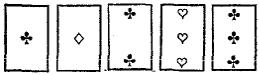
If the duplicates are of two different cards, no matter which, it will be found that four different sequences of three cards each can be formed by changing the Aces and Threes alternately. Such combinations are therefore always worth 16 points: four runs of three, worth 12, and 4 points for the two separate pairs.
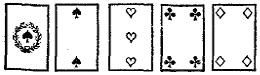
If the five cards contain one sequence of four, and one duplicate, the combination will always be worth 10 points; 8 for the double run of four, and 2 for the pair.
The foregoing should be thoroughly familiar to every player, so that he may know the exact value of the combination the moment he sees the length of the sequence and the number of duplicates.
Two-card Fifteens. Any combination of two or more cards, the total face value of which is exactly 15, is called fifteen-two, because each fifteen so formed is worth two points in the pegging. There are only three combinations of two cards which will form fifteen; a Five with any court card or Ten; a Nine and a Six; an Eight and a Seven. The manner of counting duplicates is the same as that employed for the pairs and sequences, and the player should be equally familiar with each variety of combination. The fifteens formed by two cards only are the simplest, and should be studied first.
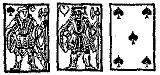
It is obvious that if there is in the hand or the starter a duplicate of either of the cards forming the fifteen, no matter which, another fifteen can be formed, and the combination will therefore always be worth 6 points; 4 for the two fifteens, and 2 for the pair. It must not be forgotten that in the case of tenth cards, as they are called, the duplicates may not form pairs, as for instance with K J 5. The fifteen is duplicated, but there is no pair.