THE EUCHRE FAMILY.
Reading edition
This family embraces four of the best known and most popular games in the world, each of which has been considered the national game in its own country: Écarté in France; Napoleon in England; Spoil Five in Ireland; and Euchre in America.
It has always been the custom to trace the origin of Euchre to a variety of Triomphe, or French Ruff, probably introduced to America by the French of Louisiana; and to claim Écarté as its cousin, and the French survivor of the parent game. In the opinion of the author, both the game and its name go to show that Euchre is of mixed stock, and probably originated in an attempt to play the ancient Irish game of Spoil Five with a piquet pack. “Euchre” is not a French word, but the meaning of it is identical with “Spoil Five”; both names signifying that the object of the game is to prevent the maker of the trump from getting three tricks. In the one game he is “spoiled;” in the other he is “euchred.” In the old game of Triomphe, in Écarté, and in the black suits in Spoil Five, the order of the court cards in plain suits is the same, the ace ranking below the Jack. But in Euchre the Jack ranks above the ace when the suit is trumps, exactly as it does in Spoil Five. In the latter game the five is the best trump; but as there is no five in a piquet pack, that trump was probably disregarded, leaving the Jack the best. Taking up, or “robbing” the turn-up trump, is another trait common to both Spoil Five and Euchre.
Spoil Five and Triomphe are mentioned in the earliest works on card games. Triomphe can be traced to 1520, when it was popular in Spain; and the origin of Maw, the parent of Spoil Five, is lost in the mists of Irish antiquity. It was the fashionable game during the reign of James I.
The old Spanish game of Triomphe, now obsolete, seems to have undergone several changes after its introduction to France. At first it was played either by two persons, or by two pairs of partners. If one side had bad cards, they could offer to abandon the hand, and allow the adversaries to count a point without playing. If the adversaries refused, they were obliged to win all five tricks or lose two points. It was compulsory to win the trick if possible, and to trump, over-trump, or under-trump if the player had none of the suit led. This peculiarity survives in the games of Rams and Loo, which also belong to the euchre family.
After a time we find a variation introduced in which any number from two to six could play, each for himself, and the player first winning two tricks out of the five marked the point. Later still we find the ace ranking above the King, thus becoming the best trump. If the ace was turned up, the dealer had the privilege of robbing it, or the holder of the ace of trumps could rob the turn-up, discarding any card he pleased, just as in Spoil Five. But in Triomphe the dealer turned up another card, and if that was of the trump suit the holder of the ace could rob that also, and so on until he turned a card of a different suit. This did not alter the trump, but merely stopped the robbing process. Whether or not Triomphe borrowed this feature from Spoil Five or Maw, it is now impossible to say.
Whatever its origin, Euchre has always been the most respectable member of the family, and the game of all others that has best served the card-playing interest in social life. Spoil Five probably comes next in point of respectability; but Écarté has often fallen into evil hands, and the very name is in some places regarded as synonymous for gambling. The same is true of Napoleon, but in less degree. Euchre, unlike the other members of the family, is not essentially a gambling game, but belongs rather to the intellectual group of card games; a position which we hope it may long maintain.
EUCHRE.
CARDS. Euchre is played with what is commonly known as the piquet pack, 32 cards, all below the 7 being deleted. In plain suits the cards rank as at Whist; but in the trump suit the Jack is the best, and it is called the Right Bower. The Jack of the same colour as the trump suit, red or black, is the second-best trump, and it is called the Left Bower; so that if clubs were trumps the rank of the nine cards in the trump suit would be as follows:—

The rank of the cards in the other suits would be:—
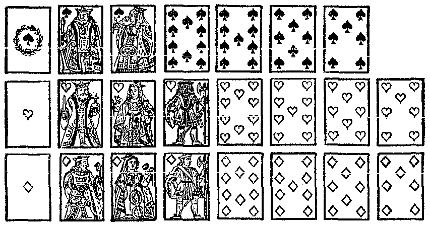
When the Joker, or blank card is used, it is always the best trump, ranking above the right bower. In cutting, the ace is low, the other cards ranking as in plain suits. A player cutting the Joker must cut again.
COUNTERS or whist markers may be used for keeping the score, but it is much more common to use the small cards from the deleted portion of the pack. The game is five points, and the best method of scoring is to use the 4 and 3 of any suit. When the 3 is face up, but covered by the 4 face down, it counts one. When the 4 is face up, covered by the 3 face down, it counts two. When the 4 is face down, covered by the 3 face up, it counts three. When the 3 is face down, covered by the 4 face up, it counts four.
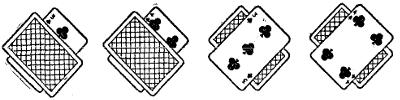
One. Two. Three. Four.
The number of pips exposed on the card which is face up is immaterial; the relative position of the two cards will always determine the score.
Rubber or game scores must be kept on a whist marker, or on a sheet of paper.
PLAYERS. Euchre may be played by any number of persons from two to seven; but in the seven-handed game the full pack of fifty-three cards is used. Whatever the number of players, they cut for positions at the table, for partners, and for the deal.
CUTTING. The cards are usually spread, face down, and each candidate for play draws a card.
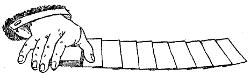
Spreading the Pack.
When two or three play, the lowest cut has the choice of seats, and takes the first deal. When four play, they cut for partners; the two highest pairing against the two lowest. The lowest has the choice of seats, and deals the first hand. When five or seven play, they have the choice of seats in their order, the lowest first, and the lowest cut deals. When six play, the three lowest are partners against the three highest, the lowest cut having the choice of seats, and the first deal.
TIES. Players cutting cards of equal value cut again; but the new cut decides nothing but the tie.
PLAYER’S POSITIONS. The eldest hand, or age, sits on the left of the dealer, and the pone sits on the dealer’s right. There are no distinctive names for the other positions.
When two play, they sit opposite each other. When three play, each for himself, the game is known as Cut Throat, and the position of the players is immaterial. When four play, the partners sit opposite each other. When five or seven play, the maker of the trump in each deal selects his partners, and they play against the others without any change in their positions at the table. When six play, three are partners against the other three, and the opposing players sit alternately round the table.
STAKES. If there is any stake upon the game, its amount must be settled before play begins. When rubbers are played, it is usual to make the stake so much a rubber point. If the winners of the game are five points to their adversaries’ nothing, they win a treble, and count three rubber points. If the losers have scored one or two points only, the winners mark two points for a double. If the losers have reached three or four, the winners mark one for a single. The side winning the rubber adds two points to its score for so doing; so that the largest rubber possible is one of eight points;—two triples to nothing, and two added for the rubber. The smallest possible is one point;—two singles and the rubber, against a triple. If the first two games are won by the same partners, the third is not played.
DEALING. Any player has the right to shuffle the cards, the dealer last. The pack must be presented to the pone to be cut, and he must leave at least four cards in each packet. Beginning on his left, the dealer distributes the cards either two at a time and then three, or three and then two to each player in rotation, until all have five cards. Whichever number, two or three, the dealer begins with, he must continue giving the same number to every player, including himself, for the first round. After the cards are dealt, the next card is turned face up on the remainder of the pack, except in five and seven-handed Euchre, in which no trump is turned. Each player deals in turn to the left, until the conclusion of the game or rubber.
Irregularities in the Deal. If any card is found faced in the pack, the dealer must deal again. Should the dealer expose any card but the trump while dealing, the adversaries may demand a new deal by the same dealer. Should any adversary of the dealer expose a card, the dealer may elect to deal again. A player dealing out of turn may be stopped before the trump card is turned; but after that the deal must stand, afterward passing to the left in regular order. On the completion of the deal, if any player has more or less than five cards, it is a misdeal, and the deal passes to the player on the misdealer’s left.
The dealer loses his deal if he neglects to have the pack cut; if he deals a card incorrectly, and fails to remedy the error before dealing another; if he counts the cards on the table, or those remaining in the pack; or if he deals two cards to one player and three to another in the same round.
If the pack is found to be imperfect, the deal in which the error is discovered is void; but all previous scores stand good.
MAKING THE TRUMP. Although a card is turned up at the end of the deal, the suit to which it belongs is not necessarily the trump for that hand. Each player in turn, beginning on the dealer’s left, whether he be an adversary or a partner of the dealer’s, may insist on the turn-up suit remaining the trump; or he may declare that he is indifferent as to which suit is the trump, the one turned up or some other. But should one player in his proper turn decide in favour of the turn-up, no player after him can alter the decision. When it comes to the dealer’s turn, if no other player has decided to retain the suit turned up, he must either let the trump remain as it is, or insist on its being changed.
As the individual or side that settles which suit shall be the trump is said to make the trump, it will be necessary to describe the method of scoring in order to understand the principles that guide the players in deciding on the trump suit.
SCORING. Euchre is played for tricks. If the side that makes the trump takes three or four tricks out of the five possible, it scores one point. If the side wins all five tricks, it scores two points for a march. If the player that makes the trump fails to win three tricks, he is euchred, and his adversaries score two points for the euchre. When four play, if the player who makes the trump declares to play alone, that is, without any assistance from his partner, who must lay down his cards, the maker of the trump scores four points if he succeeds in winning all five tricks, and one point if he wins three or four tricks. But if he fails to win three tricks, he is euchred, and the adversaries score two points. When three play, a lone hand counts three if the player wins all five tricks. When two play, five tricks is simply a march, and counts two points. When five or seven play, there are special scores for lone hands. When all five tricks are taken by one side, but not by an individual playing a lone hand, it is simply a march, and counts two points, no matter how many are playing. When two or three are playing, a march must of course be a lone hand, as there are no partnerships. As we shall see later, there are some varieties of Euchre in which a lone hand may play against a lone hand, but this is not permitted in the ordinary game.
No one but the individual player who makes the trump can play alone.
Except in five and seven-handed Euchre, the player or side first reaching five points wins the game. If three are playing, and two of them reach five points simultaneously by euchreing the third, they both win a game. If they are playing for stakes, they divide the pool.
TAKING UP THE TRUMP. After the trump is turned up, each player in turn examines his cards, and if he does not care whether the trump suit remains unchanged or not, he says: “I pass.” If all pass, the dealer must decide. The dealer has the advantage of being allowed to take the trump card into his own hand, discarding one of his worthless cards in its place. If he thinks he can make three tricks with the turn-up suit for trumps, and his partner’s probable assistance, or can win five tricks by playing alone, he discards any card he pleases, placing it under the remainder of the pack, face down, and without showing or naming it. If the dealer decides to play alone, it is usual for him to pass his discard across the table to his partner, face down, so that there may be no misunderstanding his intention.
The dealer may take up the trump card at any time during the play of the hand; but it is usual to leave it on the pack until it is played to a trick. No one but the dealer can take the trump into his hand.
TURNING DOWN THE TRUMP. If the dealer fears that he and his partner cannot make three tricks with the turn-up suit for trumps, or would prefer to have the suit changed, he can pass. If he passes, he takes the trump card from the top of the pack, and places it face upward, and partly under the pack, in such a manner that it can be distinctly seen.
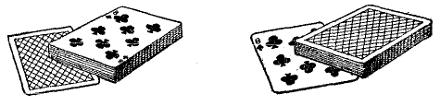
Taken Up. Turned Down.
CHANGING THE TRUMP. It then becomes the turn of the other players, each in succession to the left of the dealer, to name some other suit for the trump, or to pass a second time. If the suit of the same colour as the turn-up is named for the new trump, it is usual to say: “I make it next.” If a suit of a different colour is named, it is called crossing the suit, and some players, if a red suit is turned, will say: “I cross to clubs.”
Any player naming a new suit may announce to play alone at the same time. The side that makes the new trump must make at least three tricks, or it will be euchred, and the adversaries will count two points. If a player names the suit that has just been turned down, he loses his right to make the trump; and if he corrects himself, and names another suit, he debars not only himself but his partner from making the trump. One player having named a new trump suit in his proper turn, his decision is binding on all the others; but should a player name a suit out of his proper turn, both he and his partner are debarred from making that suit the trump. If no one will name a new trump, the deal is void, and passes to the next player on the dealer’s left.
ORDERING UP THE TRUMP. Instead of passing the turn-up trump on the first round, any player who thinks it would be to his advantage to have the turn-up remain the trump, may order the dealer to take it up. In doing so he says: “I order it,” if he is an adversary; or: “I assist,” if he is the dealer’s partner. In either case the player making the trump may announce a lone hand at the same time. His side must make at least three tricks, whether he plays alone or not, or it is a euchre, and the adversaries will count two points. In case an adversary of the dealer plays alone, he must distinctly announce it when he orders up the trump. The usual expression is: “I order it alone.” His partner then lays his cards face downward on the table and takes no further part in the play of that hand. If he exposes any card of the abandoned hand, the adversaries can call upon him to take up the hand and play it, leaving the exposed card on the table as liable to be called. This of course prevents the lone hand.
If the dealer’s partner wishes to play alone, instead of assisting, he says: “I play this alone,” and the dealer lays down his cards, leaving the trump on the pack.
PLAYING ALONE. No player but the one that takes up, orders up, or makes the trump can play a lone hand. If the dealer takes up the trump card of his own accord, he can play alone. If any player orders up or assists, that player can play alone. Any player making a new trump after the first has been turned down, can play alone. If one player orders up the trump, neither his partner nor his adversary can play alone; and if the dealer’s partner assists, that prevents the dealer from playing a lone hand. In many clubs the mistake is made of allowing the dealer to play alone on his partner’s assist; or letting the pone play alone after the dealer has been assisted; or letting the partner of the player who makes the new trump play alone. This is not good Euchre, because it gives an unfair advantage to one side, as we shall see when we come to the suggestions for good play, especially in connection with ordering up at what is called the “bridge;” that is, when the score is 4 to 1, or 4 to 0.
METHOD OF PLAYING. The trump settled, the eldest hand, or the player next him on the left, if the partner of the eldest hand is playing alone, begins by leading any card he pleases, and the others must follow suit if they can. Failure to follow suit when able is a revoke, if the error is not discovered and corrected before the trick in which it occurs is turned and quitted. If the player discovers his mistake in time, the card played in error must be left on the table, and is liable to be called. When a revoke is discovered and claimed by the adversaries, it is usual to abandon the hand, and the adversaries of the revoking player can either deduct two points from his score, or add two to their own score, for every revoke made during the hand. The penalty cannot be divided. If both sides revoke, the deal is void, and the same dealer must deal again.
Any player having none of the suit led may either trump, or throw away a card of another suit. The highest card played, if of the suit led, wins the trick, trumps winning against all other suits, and a higher trump winning a lower. The winner of the trick may lead any card he pleases for the next trick, and so on, until all five tricks have been played. If the dealer takes the trump into his hand, any player naming it is liable to have his highest or lowest trump called; but a player may ask and must be informed what the trump suit is.
Cards Played in Error. All cards led out of turn, played in error, or two or more played to a trick, or dropped face upward on the table, are called exposed cards, and must be left face up on the table. These must be played when called by the adversaries, unless compliance with the demand would make the player revoke; but the fact of their being exposed does not prevent their being got rid of in the course of play if the opportunity offers. Some persons imagine that the adversaries can prevent an exposed card from being played; but such is not the case in Euchre. A person playing a lone hand is not liable to any penalty for exposing his cards, nor for leading out of turn, for he has no partner to derive any benefit from the information conveyed.
Leading Out of Turn. Should any person, not playing alone, lead out of turn, the adversaries may call a suit from the player in error, or from his partner, when it is next the turn of either of them to lead. The demand must be made by the person who will be the last player on the trick in which the suit is called. If all have played to the lead before discovering the error, it cannot be rectified; but if all have not played, those who have followed the false lead must take back their cards, which are not liable to be called.
Any player may ask the others to draw cards in any trick, provided he does so before the cards are touched for the purpose of gathering them. In answer to this demand, each player should indicate which card of those on the table he played. No one is allowed to see any trick that has been turned and quitted.
Taking Tricks. As the tricks are taken they should be neatly laid one upon the other in such a manner that any player at the table can count them. All tricks belonging to one side should be kept together. At the end of each hand the score should be claimed and marked. Revokes must be detected and claimed before the cards are cut for the following deal.
CUTTING OUT. When the play is confined to four players, rubbers are usually played, and the table is complete with six persons, two looking on, and awaiting their turn. At the end of a rubber, if there are more than four players belonging to the table, those who have just played cut to decide which shall give place to those waiting, the players cutting the highest cards going out. If six belong to the table, there will be no further cutting out, as those who are out for one rubber re-enter for the next, taking the places of those who have played two consecutive rubbers. If five belong to the table, the three who remained in for the second rubber must cut to allow the fifth player to re-enter. At the end of the third rubber, the two cut that have not yet been out; and at the end of the fourth rubber the one who has played every rubber goes out without cutting. Partners and deal are cut for at the beginning of each new rubber.
METHODS OF CHEATING. All the Euchre family of games, especially Écarté and Napoleon, offer numerous opportunities to the greek. So well is this known in Europe that it is considered extremely foolish for any person to play Écarté in mixed companies. The small number of cards in the pack, and the custom of dealing two and three at a time, gives the dealer an opportunity to bunch four valuable cards, of which he can give himself three, and turn up the fourth. False shuffles, shifted cuts, and marked cards are formidable weapons. The telegraph between partners, and the variation in tone or words in passing are frequently used by card-sharpers. One of the commonest devices in America is the use of what are known as “jack strippers.” These are two Jacks, usually both of the same colour, which can be withdrawn from any portion of the pack by the fingers of an expert, and placed on the top. When the sharp deals, he places cards enough on these to supply the other players on the first round, so that the strippers will come to him. When only two are playing, he strips them out and leaves them on the top when he cuts the cards, so that they shall be dealt to him. Never play Euchre or Écarté with a man who cuts the pack with both hands.
Any person who is tempted to bet on any game in the Euchre family should remember the advice of the worldly-wise Parisian to his son: “Until you have four eyes in your head, risk not your gold at Écarté.”
SUGGESTIONS FOR GOOD PLAY. The chief points for the beginner to understand are. When to order up; when to assist; when to take up; when to play alone; and what to make the trump if it is turned down. His decision in each case will be governed largely by his position at the table, and by the score. The following suggestions are for four players, two being partners against the other two, and playing without the Joker; that being the most common form of the game. The general principles underlying these suggestions for the four-handed game will be found equally valuable in any form of Euchre.
ORDERING UP. Although probabilities are of little practical value in Euchre, it may be well to remember that there are nine cards in the trump suit; but as only two-thirds of the pack is dealt out, the average number of trumps among four players will be six. Of these, the dealer always has the advantage of being sure of one more than his share, and it is safe to reckon upon the dealer to hold at least two trumps. He may also be counted for a missing suit, for he will discard any losing card of an odd suit when he takes up the trump.
The Eldest Hand should not order up the trump unless he has such cards that he is reasonably certain of three tricks without any assistance from his partner, and cannot be sure of two tricks if the trump is turned down. When he holds one or two bowers, especially if he has cards of the next suit; that is, the suit of the same colour as the turn-up, he should always pass; because if the dealer takes it up he will probably be euchred, and if he turns it down, the eldest hand will have the first say, and can make it next. It is seldom right to order up a bower, because the dealer will rarely turn down such a card.
There are exceptional cases in which the eldest hand may order up with little or nothing. One of the most common is when the adversaries of the dealer are at the bridge; that is, when their score is 4, and the dealer’s side has only 1 or 2 marked. It is obvious that if the dealer or his partner plays alone, he will win the game; but if the trump is ordered up the most he can score is 2 points for a euchre, and the player who orders up will then have a chance to go out on his own deal. For this reason it has come to be regarded as imperative for the eldest hand to order up at the bridge, unless he holds the right bower, or the left bower guarded, or the ace twice guarded, any one of which combinations is certain to win a trick against a lone hand if the eldest hand does not lead trumps himself. Another case is when the score is 4 to 4, and the eldest hand has average trump strength, good side cards, but nothing in the next suit. It is better to order it up, and risk the game on such a hand than to take the chance of the dealer’s turning it down.
The Pone, who is the partner of the eldest hand, orders up at the bridge on exactly opposite principles. The fact that the eldest hand did not order up shows that the dealer cannot make a lone hand. This should indicate to the pone that his partner has a certain trick in trumps, and if the pone holds any good trumps himself, he can often guess what his partner’s trumps are. For instance: The ace is turned, and the pone holds the left bower guarded. The eldest hand must have the right bower, or four trumps to the King. If the eldest hand has passed at the bridge, and the pone has strong trumps himself, especially the ace or left bower and two small trumps, he should order up the trump; not to save the game, but to be sure of winning it by preventing the dealer from turning it down. If the pone does not order up at the bridge, the eldest hand may infer that he is weak in trumps.
When it is not a bridge, the pone should be guided by the same principles as those given for the eldest hand, because he may be sure that his partner will make it next if it is turned down, unless he has a certainty of three tricks by crossing.
If a player calls his partner’s attention to the fact that they are at the bridge, both lose their right to order up.
ASSISTING. The dealer’s partner usually assists on plain-suit cards, such as two aces, rather than on trumps. The score and the turn-up trump will often be a guide as to whether or not to assist. For instance: If the score is 1 all, or to 2 to 1, and a bower is turned, it is rarely right to assist, because it prevents the dealer from playing alone. If the partner has good suit cards, they may be useful to make a march; if he has strong trumps, especially if sure of three tricks, he should play alone, instead of assisting. If the score is 3 in the dealer’s favour, he does not need a lone hand to win the game, and with two reasonably certain tricks in his own hand the dealer’s partner should assist, as they may win the game by a march.
If the dealer’s side is at the bridge, the score being 4 to 1 or 4 to 0 in their favour, and the eldest hand passes, the dealer’s partner must be on the alert to prevent the pone from placing a lone hand. He should assist unless a bower is turned, or he has it himself, or holds such cards that, combined with the turn-up, he is sure of a trick. For instance: The dealer’s partner has the King and two other trumps, and the ace is turned. It is impossible for the pone to make a lone hand, even if he has both bowers, and the ace is bare; for he cannot catch the King, even if his partner leads the trump through it. But if a small trump was turned, the pone might easily make a lone hand with both bowers and the ace.
TAKING UP. The average expectation of the dealer is something over two trumps, including the turn-up. With more than two trumps, or with two strong trumps, and a reasonably certain trick in a plain suit, the dealer should take up the trump. Three trumps of any size and an ace in plain suits is a strong take-up hand. It is better to take up the trump with only one plain suit in the hand, and small trumps, than with two strong trumps and two weak plain suits. The score will often decide the dealer in taking up the trump. For instance: At 4 all, it is useless to turn anything down unless you have a certain euchre in the next suit, and nothing in the turn-up. Even then, the adversaries are almost certain to cross the suit and go out. With the score 3 all, the dealer should be very careful about taking up on a weak hand, because a euchre loses the game. If he is weak, but has a chance in the next suit, or a bower in the cross suits, he should turn it down. It is a common stratagem to turn it down for a euchre when the dealer is better in the next suit, and has only 2 to go.
PLAYING ALONE. The dealer has the best chance to get a lone hand; but the eldest hand is more likely to succeed with one, on account of the advantage of the lead. It is an invariable rule for any player to go alone when he has three certain tricks, unless he is 3 up, and can win the game with a march. A lone hand should be played with both bowers and the ace, no matter how worthless the other cards; or with five trumps to the ace without either bower; or two high trumps and three aces in plain suits; or three good trumps and two aces. The theory of this is that while the march might possibly be made with partner’s assistance, if partner has the cards necessary to make a march, the adversaries have little or nothing, and there is a very good chance to make a lone hand if three tricks of it are certain. Both bowers and the ace, with only the seven and eight of a plain suit have made many a lone hand. If the lone player is not caught on the plain suit at the first trick, the adversaries may discard it to keep higher cards in the other suit; or they may have none of it from the first. There is always a chance, and it should be taken.
The dealer’s partner, and the pone, should be very careful in playing lone hands, and should never risk them except with three certain tricks, no matter what suit is led first.
With three sure tricks, some players make it a rule to play alone, provided the two other cards are both of the same suit.
MAKING THE TRUMP. When the trump is turned down, the general rule is for the eldest hand to make it next. The exceptions are when he has nothing in the next suit, but has at least two certain tricks in the cross suit, and a probable trick in a plain suit. It is safer to make it next with a weak hand than to cross it on moderate strength, for the presumption is that neither the dealer nor his partner had a bower in the turn-down suit, and therefore have none in the next suit. Such being the case, it is very likely that one or both may be strong in the cross suits, and it is not considered good policy to cross the suit unless so strong in it as to be reasonably certain of three tricks. Some players invariably make it next, regardless of their hands, unless they can play alone in the cross suit. Such a habit exposes them to the common artifice of the dealer’s turning it down for a euchre. A dealer holding a bower and three cards of the next suit, will often turn it down, and trust to the eldest hand making it next, which will give the dealer four trumps instead of two. The eldest hand should be on his guard against this when the dealer’s side has 3 scored.
The dealer’s partner, on the other hand, should cross the suit almost as invariably as the eldest hand should make it next; for if his partner cannot take up the trump, and the eldest hand cannot make it next, their hands must be weak, and if it is passed to the pone, he will probably turn out to have a lone hand. The best chance is to cross the suit, unless the player has three certain tricks in his own hand by making it next, such as five trumps to the ace, or four trumps and a plain-suit ace. With such cards he should play alone.
The pone should never make the trump unless he has three certain tricks, and is willing to play a lone hand. If the dealer turns it down, and both the eldest hand and the dealer’s partner pass a second time, there must be a nigger in the woodpile somewhere.
LEADING. The general principle of leading is to make tricks while you can. It is useless to save up tenaces in plain suits, because there are only five tricks to play, two of which are certain to fall to the trumps, and it is very improbable that any player will lead up to you a small card of a plain suit that will go round twice. It is seldom right to lead small cards of a plain suit. There is a better chance to make a trick with the King by leading it than by keeping it guarded. In the trump suit, tenaces are very strong, and should be preserved, especially if the tenace is over the turn-up trump. There is a familiar example of the importance of tenace when only two play, in which one person holds the major tenace in trumps, hearts, and must win three tricks, no matter which player leads. The cards in one hand are:—
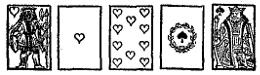
and those in the other hand are;—
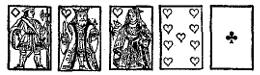
If the player with the major tenace has to lead first, all he has to do is to force his adversary with the plain suit, spades. Whatever the adversary leads, the player with the major tenace simply wins it, and forces again. If the player with the four trumps has the first lead, it does not matter what card he plays; the player with the major tenace wins it, and forces with the plain suit. As long as the major tenace in trumps is not led away from, it must win three tricks in trumps.
Leading Trumps. With strong cards in plain suits, the eldest hand may often lead trumps to advantage if the dealer’s partner has assisted, especially if the turn-up trump is small. It is seldom right to lead trumps if the dealer has taken up the trump of his own accord; but an exception is usually made when the eldest hand holds three trumps, and two aces in plain suits. The best chance for a euchre is to exhaust the trumps, so as to make the aces good for tricks. If the pone has ordered up the trump, the eldest hand should lead trumps to him immediately; but the pone should not lead trumps to his partner if the eldest hand has ordered up at the bridge. If a bower is turned, the dealer’s partner should lead a small trump at the first opportunity.
In playing against a lone hand the best cards in plain suits should always be led, trumps never. In playing alone, it is best to lead winning trumps as long as they last, so as to force discards, which will often leave intermediate cards in plain suits good for tricks.
Second Hand. Play the best card you have second hand, and cover everything led if you can. With King and another or Queen and another, it is usually best to put up the honour second hand, on a small card led.
Trumping. It is seldom right to trump partner’s winning cards, unless he has ordered up the trump, and you think you can lead through the dealer to advantage. In playing against a lone hand, it is sometimes good play to trump your partner’s ace with an unguarded left bower or ace of trumps, as it may prevent the dealer from getting into the lead with a small trump, and may save a King or Queen of trumps in your partner’s hand. If you don’t trump, the dealer will probably get in and swing the right bower, and your trump will be lost.
If your partner has ordered, made, or taken up the trump, and you have only one trump, even a bower, trump with it at the first opportunity. Trump everything second hand, unless it takes the right bower for a doubtful trick, or breaks into the major tenace in trumps.
Discarding. It is best to throw away singletons, unless they are aces. If you have two cards of equal value, but of different colours, one of which must be discarded, it is usual to keep the one of the same colour as the turn-up when playing against the dealer. Discard suits that the adversaries are trumping. If your partner discards a suit in which you have a high card, keep that suit, and discard another. If you have both ace and King of a plain suit, discard the ace, to show partner that you can win a trick in the suit. It is very often important to discard correctly when playing against a lone hand, especially if the lone player leads trumps for the fourth trick. It is a common practice for modern players to signal in the discard if they have a certain trick in a suit. This is done by discarding two cards in another suit, the higher before the lower. For instance: You have two aces, spades and diamonds. The dealer plays alone on hearts, and trumps your spade ace the first time. If you have two clubs, such as King and ten, discard the King first, and then the ten, and your partner will know you can stop the diamond suit. This should advise him to keep his clubs.
CUT-THROAT EUCHRE.
The chief element in the three-handed game is playing to the score. The player with the strong hand must always be kind to the under dog, and partnerships are always formed against the man with the high score. Suppose A, B, and C are playing, and that A has 3 points to his adversaries’ nothing on B’s deal. It is to the interest of A to euchre B; but it is to the interest of C to let B make his point because if B is euchred, A wins the game. B having made his point, C deals, and it is then to the interest of B to let C make his point. Suppose C makes a march, 3 points, which puts him on a level with A. On A’s deal it is C’s game to euchre him, but B must let A make his point; so that instead of being opposed by both B and C, as he was a moment ago, A finds a friend in B, and the two who were helping each other to beat A, are now cutting each other’s throats. On B’s deal, A does not want to euchre him, for although that would win the game for both A and C, A, who now has 4 points up, does not wish to divide the pool with C while he has such a good chance to win it all himself. Suppose B makes his point. A will do all he can to euchre C, but B will oppose the scheme, because his only chance for the game is that A will not be able to take up the trump on his own deal, and that B will make a march.
SET-BACK EUCHRE.
This is simply a reversal of the ordinary method of scoring, the players starting with a certain number of points, usually ten, and deducting what they make on each deal. The peculiarity which gives the game its name is that if a player is euchred he is set back two points, his adversaries counting nothing. The revoke penalty is settled in the same way. The game is usually counted with chips, each player starting with ten, and placing in the centre of the table those that he is entitled to score.
BLIND EUCHRE.
Each player is for himself and a widow of two cards is dealt. The player who takes the widow practically orders up the trump and must play against all the others after discarding two cards. If no one will take the widow, the deal is void.
PENALTY EUCHRE.
Five players are each provided with twelve counters. An extra hand of five cards is dealt face down, for a widow. Each player in turn can exchange the hand dealt him for the widow, or for the hand abandoned by anyone who has taken the widow, the cards being always face down. The turned trump is not taken up by the dealer, but is left on the pack. The eldest hand leads for the first trick and every man is for himself, each holding his own tricks.
At the end of the hand, each player that has not taken a trick receives a counter from each of the others, whether they have taken tricks or not. Then all those that have won tricks put back into the pool a counter for each trick they have taken. The first player to get rid of his twelve counters wins the game.
AUCTION EUCHRE.
This form of the game is sometimes erroneously called French Euchre. The French know nothing about Euchre in any form. Auction Euchre is exactly the same as the ordinary four or six-handed game, except that the trump is not turned up, the players bidding in turn for the privilege of naming the trump suit. The bidder names the number of tricks he proposes to take. There is no second bid, and the player who has made the highest bid names the trump suit. No matter who is the successful bidder, the eldest hand leads for the first trick. The number of points won or lost on the deal are the number of points bid, even if the bidder accomplishes more. If a player has bid 3, and he and his partner take 4 or 5 tricks, they count 3 only. If they are euchred, failing to make the number of tricks bid, the adversaries count the number of points bid. Fifteen points is usually the game.
This is probably the root of the much better games of five and seven-handed Euchre, which will be described further on.
PROGRESSIVE EUCHRE.
This form of Euchre is particularly well suited to social gatherings. Its peculiarity consists in the arrangement and progression of a large number of players originally divided into sets of four, and playing, at separate tables, the ordinary four-handed game.
Apparatus. A sufficient number of tables to accommodate the assembled players are arranged in order, and numbered consecutively; No. 1 being called the head table, and the lowest of the series the booby table. Each player is provided with a blank card, to which the various coloured stars may be attached as they accrue in the course of play. These stars are usually of three colours; red, green, and gold. The head table is provided with a bell, and each table is supplied with one pack of cards only. It is usual to sort out the thirty-two cards used in play, and the four small cards for markers, before the arrival of the guests.
Drawing for Positions. Two packs of differently coloured cards are used, and from the two black suits in each a sequence of cards is sorted out, equal in length to the number of tables in play. For instance: If there are sixteen ladies and sixteen gentlemen, or thirty-two players in all, they will fill eight tables, and all the clubs and spades from the ace to the eight inclusive should be sorted out. These are then thoroughly shuffled and presented, face down, to the players to draw from. The ladies take only the red-back cards, and the gentlemen only the blue. The number of pips on the card drawn indicates the number of the table at which the player is to sit, and those drawing cards of the same suit are partners for the first game.
Playing. All being seated, the deal is cut for at each table, and play begins. There is no cutting for partners, that being settled in the original drawing. Five points is a game, and after that number is reached by either side at the head table, the bell is struck. Lone hands are usually barred at the head table, so as to give the other tables time to make a certain number of points, and so to avoid ties. Upon the tap of the bell all play immediately ceases, even if in the middle of a deal. If the players at any but the head table have reached five points before the bell rings, they play on, counting all points made until the bell taps.
Progressing. The partners winning the game at the head table each receive a gold star, and retain their seats for the next game. The losing players at the head table go down to the booby table. All the winning players at the other tables receive red stars, and go to the table next in order above, those at table No. 2, going to No. 1. Those losing and remaining at the booby table each receive a green star.
Changing Partners. At all but the head table the partners that progress to the next table divide, the lady who has just lost at each table retains her seat, and takes for her partner the gentleman who has just arrived from the table below. At the head table the newly arrived pair remain as partners; but at the booby table the players who have just arrived from the head table divide. All being seated, they cut for the deal, and play is resumed until the next bell tap.
Ties. In case of ties in points at any table when the bell taps, those having won the most tricks on the next hand are declared the winners. If that is also a tie, the ladies cut to decide it, the lowest cut going up. In cutting, the ace is low, and the jack ranks below the Queen.
Prizes. Six prizes are usually provided for large companies. The lady and gentleman having the largest number of gold stars taking the first prizes; the largest number of red stars winning the second prizes; and the largest number of green stars the booby prizes. One player cannot win two prizes. In case of ties for the gold stars, the accompanying red stars decide it; if that is also a tie, the player with the fewest number of green stars wins; and if that is still a tie, the players must cut for it.
The hostess decides the hour at which play shall cease, and is the referee in all disputes.
MILITARY EUCHRE.
The hostess arranges each table as a fort, with a distinguishing flag and a number of small duplicate flags. The partners who sit East and West progress round the room from table to table, and play one game of five points at each, no lone hands allowed. The winners of each game get a little flag from the losers as a trophy. By the time the E and W pairs have made the circuit of all the tables and got home again, the game is ended, the victors being the fort that has captured the greatest number of flags.
RAILROAD EUCHRE.
Railroad Euchre is the name given to any form of the four-handed game in which every expedient is used to make points rapidly.
Cards. A pack of twenty-five cards is used, all below the 9 being deleted, and the Joker added. The Joker is always the best trump.
Players. There are four players, two being partners against the other two. Partners, deal, and seats are cut for as in the ordinary game.
Dealing. The cards are distributed as in the ordinary game; but it is usual to agree beforehand upon a suit which shall be the trump if the Joker is turned up.
Playing Alone. The chief peculiarity in Railroad Euchre is in playing alone. Any player announcing to play alone, whether the dealer or not, has the privilege of passing a card, face down, to his partner. In exchange for this, but without seeing it, the partner gives the best card in his hand to the lone player, passing it to him face down. If he has not a trump to give him, he can pass him an ace, or even a King. Even if this card is no better than the one discarded, the lone player cannot refuse it. If the dealer plays alone, he has two discards; the first in exchange for his partner’s best card, and then another, in exchange for the trump card, after seeing what his partner can give him. In this second discard he may get rid of the card passed to him by his partner. If the dealer’s partner plays alone, the dealer may pass him the turn-up trump, or any better card he may have in his hand.
Any person having announced to play alone, either of his adversaries may play alone against him; discarding and taking partner’s best card in the same manner. Should the lone player who makes the trump be euchred by the lone player opposing him, the euchre counts four points. It is considered imperative for a player holding the Joker, or the right bower guarded, to play alone against the lone hand, taking his partner’s best; for as it is evident that the lone hand cannot succeed, there is a better chance to euchre it with all the strength in one hand than divided.
If any player, in his proper turn, announces to play alone, and asks for his partner’s best, the partner cannot refuse; neither can he propose to play alone instead.
Scoring. With the exception of the four points for euchreing a lone hand, the scoring is exactly the same as in the ordinary four-handed game; but there are one or two variations which are sometimes agreed upon beforehand in order to make points still more rapidly.
Laps. If a player makes more points than are necessary to win the game, the additional points are counted on the next game, so that there is always an inducement to play lone hands, even with 4 points up.
Slams. If one side reaches five points before the other has scored, it is a slam, and counts two games.
When laps and slams are played, it is sometimes agreed that if a person plays alone without taking his partner’s best card, or the dealer plays alone without taking up the trump or asking for his partners best, and such a player succeeds in winning all five tricks with a pat hand, it counts five points. If he fails to win all five tricks, the adversaries count one. If he is euchred, they count three; but they are not permitted to play alone against him.
Jambone. Any person playing a lone hand may announce Jambone, and expose his cards face up on the table. The adversaries then have me right to call any card they please, either for the lead, or in following suit; but they cannot make the player revoke, nor can they consult, or in any way expose their hands. If a lead is required, it must be called by the person on the jambone player’s left. If a card is called on a trick, it must be called by the person on the jambone player’s right. If in spite of these difficulties the jambone player succeeds in winning five tricks, he scores eight points. If he wins three or four only, he counts one point. If he is euchred he loses two. It is not allowable to play alone against a jambone.
Jamboree. This is the combination of the five highest trumps in one hand, and need only be announced and shown to entitle the holder to score sixteen points. If held by the dealer, it may be made with the assistance of the turn-up trump; and any player may make it with the assistance of his partners best; but it does not count unless the holder of it has made the trump. If a player with a pat Jamboree is ordered up, all he can score is a euchre.
As in other forms of Euchre, no one but the maker of the trump can play alone, or announce Jambone or Jamboree. Lone hands are very common in Railroad Euchre, and ordering up to prevent lone hands is commoner still.
SEVEN-HANDED EUCHRE.
Cards. Seven-handed Euchre is played with a full pack of fifty-three cards, including the Joker. The cards in plain suits rank as at Whist; but the Joker is always the best trump, the right and left bowers being the second and third-best respectively.
Counters. One white and four red counters are necessary. The white counter is passed to the left from player to player in turn, to indicate the position of the next deal. The red counters are placed in front of the maker of the trump and his partners, to distinguish them from their opponents. Markers are not used, the score being kept on a sheet of paper. The score is usually kept by a person who is not playing, in order that none of those in the game may know how the various scores stand. Should an outsider not be available for scoring, there are two methods: One is for one player to keep the score for the whole table, who must inform any player of the state of the score if asked to do so. The other is to have a dish of counters on the table, each player being given the number he wins from time to time. These should be placed in some covered receptacle, so that they cannot be counted by their owner, and no other player will know how many he has. As it is very seldom that a successful bid is less than five, and never less than four, counters marked as being worth 4, 5, 6 and 7 each will answer every purpose, and will pay every bid made.
Cutting. The players draw cards from an outspread pack for the choice of seats, those cutting the lowest cards having the first choice. The lowest cut of all deals the first hand, passing the white counter to the player on his left, whose turn it will be to deal next. Ties are decided in the usual way.
Dealing. The cards are dealt from left to right, two being given to each player for the first round, then three, and then two again, until each player has received seven cards. The four remaining in the pack are then placed in the centre of the table, face down, and form the widow. No trump is turned.
The rules governing all irregularities in the deal are the same as in ordinary Euchre.
Making the Trump. The cards dealt, each player in turn, beginning with the eldest hand, bids a certain number of points, at the same time naming the suit which he wishes to make the trump. There is no second bid, and the suit named by the highest bidder must be the trump for that deal. The successful bidder takes the widow, selecting from it what cards he pleases, and discarding others in their stead, so as to restore the number of his cards to seven. He then places a red counter in front of him, and chooses his partners, passing a red counter to each of them. These counters must be placed in front of the players to distinguish them as belonging to the bidder’s side; but the players make no changes in their respective positions at the table. Each player should bid on the possibilities of his hand, however small, so as to guide the others in their selection of partners.
Partners. If the bidder has proposed to take not more than five tricks out of the seven possible, he chooses two partners, and these three play against the remaining four. If he has bid to make six or seven tricks he chooses three partners, and these four play against the remaining three. Partners cannot refuse to play.
Playing Alone. Should a player think he can take all seven tricks without any partners, he may bid ten, which would outrank a bid of seven; but such a bid must be made before seeing the widow. If a player thinks he can win all seven tricks without either widow or partners, he may bid twenty, which is the highest bid possible. When twenty is bid the cards in the widow must remain untouched.
Playing. The successful bidder has the lead for the first trick. The general rules for following suit, etc., are the same as in ordinary Euchre. The bidder takes in all the tricks won by himself and his partners, and one of the adversaries should gather for that side. If a player on either side revokes, the adversaries score the number bid, and the hand is abandoned.
Scoring. If the bidder is successful in his undertaking, he and his partners, if any, are credited by the scorer with the number of points bid, but no more. Should a player bid five, and his side take seven, it would count them only five points. If the player making the trump fails to reach his bid, he is euchred, and the adversaries are credited with the number of points bid.
Prizes. It is usual to give two prizes for each table in play; one for the highest number of points won during the evening, and one for the smallest number; the latter being usually called the “booby” prize.
Suggestions for Good Play. It is very risky to bid seven without the Joker, the odds being 11 to 1 against finding it in the widow. A bid of ten should not be made without both Joker and Right Bower, and all the other cards winners and trumps. To bid twenty, a player should have a practically invincible hand, with at least five winning leads of trumps.
The first bidders are always at a disadvantage, because they know nothing of the contents of the other hands; but after one or two players have made a bid, those following them can judge pretty well how the cards lie. For instance: The seven players are A B C D E F G. A deals, and B bids 2 in hearts. C and D pass. E bids 3 in clubs; and F says 4 in hearts. It is evident that F is bidding on B’s offer in hearts, and intends to choose him for a partner. G finds in his hand four good spades and the Joker, but neither Bower. He may safely bid 5 or 6, taking E for a partner if successful, as E very probably has one or both the black Bowers. If he bids 5 only, the dealer, A, would have an excellent chance to bid 6 in hearts, and to take B and F for two of his partners, and G for the third, trusting to find him with the Joker, or at least protection in one or both black suits.
If the successful bidder has had no previous bids to guide him in his choice of partners, he should take those who have the lowest scores, if the scores are known; because it is to his advantage to avoid advancing those who are perhaps already ahead. When the scores are not known, there is nothing but luck to guide one, unless a person has a very good memory, and knows which players are probably behind.
Leading. If the successful bidder wants 6 or 7 tricks, and holds the Joker, he should lead it at once. If he has not the Joker, he should begin with a low trump, and give his partners a chance to play the Joker on the first round. If the leader cannot exhaust the trumps with one or two rounds, it will sometimes be to his advantage to lead any losing card he may have in the plain suits, in order to let his partners win the trick if they can. In playing alone, it is absolutely necessary to exhaust the trumps before opening a plain suit.
Partners should avail themselves of the methods common to four-handed Euchre to support one another in trumps and plain suits. The discard should invariably be from weakness if the player is the bidder’s partner; and from strength, if opposed to him.
EUCHRE FOR FIVE PLAYERS. This is practically the same as the seven-handed game, but the pack is reduced to 28 cards, all below the Eight in each suit being deleted. The Joker is not used. Five cards are dealt to each player, by two and three at a time, and the three remaining form the widow. The player bidding three tricks takes one partner only. The player bidding four or five tricks, takes two partners. A player who intends to take the widow, but no partners, can bid eight and one who intends to take neither widow nor partners can bid fifteen. In this form of Euchre the scores are generally known, and 100 points is game.
In some clubs it is the practice for the successful bidder to select one of his partners by asking for the holder of a certain card. For instance: B has the lead, and has bid five in hearts, holding the three best trumps, the club ace, and a losing spade. Instead of selecting his partners at random, he asks for the spade ace, and the player holding that card must say, “Here”; upon which the bidder will pass him a counter, marking him as one of his partners.
CALL-ACE EUCHRE.
In this variety of euchre, each player is for himself so far as the final score goes. The one who takes up the trump or orders it up, or who makes it after it is turned down, may call upon the best card of any suit but the trump. The player holding the best card of that suit must be his partner, but he does not declare himself. When the highest card of the suit asked for falls in play, the partner is disclosed.
As the whole pack is not dealt out, it often happens that the ace, or even both ace and king, of the suit called for are in the talon. Should it turn out that the caller has the highest card of the suit himself, he has no partner.
When six play, 32 cards are used, and only one remains unknown. When five play, the sevens are thrown out. When four play, the eights are also discarded.
If the maker of the trump does not want a partner, he may either say “alone” or he may ask for a suit of which he holds the ace himself.
If the maker of the trump and his partner get three tricks, they score 1 point each. If they win all the tricks, they score 3 points each if there are five or six in the game; 2 points if there are not more than four players. If the partnership is euchred, each of the others at the table scores 2 points.
For a lone hand, winning all five tricks, the player scores a point for as many players as there are at the table, including himself. Euchres score 2 for every other player but the lone hand. A lone hand making three or four tricks only, scores 1.
500, OR BID EUCHRE.
In this variety of euchre, the joker is always used. When there is a trump suit, it is the best trump; but when there are no trumps, it is a suit by itself, but still a trump. The player holding it cannot trump with it as long as he can follow suit; but when he has none of the suit led, he can trump with the joker if he likes. When the joker is led in a no-trump hand, the leader must name the suit that he wishes played to it.
Five hundred is supposed to be a game for three players, but sometimes two play against two as partners.
The dealer gives ten cards to each player, three and then two at a time as in the ordinary game of euchre; but after dealing the first three cards to each he lays off three cards face down for a widow. This widow is taken in hand by the successful bidder, who discards three cards in its place.
The players bid for the privilege of naming the trump suit, or of playing without any trump but the joker. The number of tricks bid must not be less than six, and the suit must be named at the same time. The player having the most valuable game, regardless of the number of tricks or the suit, is the successful bidder, because a bid of seven in hearts, for instance, is worth more in points than a bid of eight in clubs, as will be seen from the following table.
If trumps are: 6 tricks. 7 tricks. 8 tricks. 9 tricks. 10 tricks.
Spades 40 80 120 160 200
Clubs 60 120 180 240 300
Diamonds 80 160 240 320 400
Hearts 100 200 300 400 500
No-trumps 120 240 360 480 600
The successful bidder always leads for the first trick, after he has taken the widow and discarded, and after the hand is played, he has the first count. If he has made as many as he bid, he scores it; but he cannot score more than he bid unless he succeeds in winning every trick. In that case he scores 250 if his bid was less than 250; but if his bid was more than 250, he gets nothing extra for winning every trick.
Any player but the bidder winning a trick scores ten points for it, so it is necessary for each player to keep separate the tricks he individually wins.
If the bidder fails, he loses, or is set back, as many points as he bid, and he scores nothing for the tricks he takes, but he may play the hand out to prevent the others from scoring, as his adversaries still get ten points for each trick they win.
Five hundred points is game, and as the bidder has the first count he may go out first, even if an adversary has won tricks enough to reach 500 also.
EUCHRE LAWS.
1. SCORING. A game consists of five points. If the players making the trump win all five tricks, they count two points towards game; if they win three or four tricks, they count one point; if they fail to win three tricks, their adversaries count two points.
2. If the player making the trump plays alone, and makes five tricks, he counts as many points as there are players in the game: Two, if two play; three if three play; four if four play, etc. If he wins three or four tricks only, he counts one; if he fails to win three tricks, his adversaries count two.
3. The Rubber is the best of three games. If the first two are won by the same players, the third game is not played. The winners gain a triple, or three points, if their adversaries have not scored; a double, or two points, if their adversaries are less than three scored; a single, or one point, if their adversaries have scored three or four. The winners of the rubber add two points to the value of their games, and deduct the points made by the losers, if any; the remainder being the value of the rubber.
4. FORMING THE TABLE. A Euchre table is complete with six players. If more than four assemble, they cut for the preference, the four lowest playing the first rubber. Partners and deal are then cut for, the two lowest pairing against the two highest. The lowest deals, and has the choice of seats and cards.
5. Ties. Players cutting cards of equal value cut again, but the new cut decides nothing but the tie.
6. Cutting Out. At the end of a rubber the players cut to decide which shall give way to those awaiting their turn to play. After the second rubber, those who have played the greatest number of consecutive games give way; ties being decided by cutting.
7. Cutting. In cutting, the ace is low, the other cards ranking, K Q J 10 9 8 7, the King being the highest. A player exposing more than one card, or cutting the Joker, must cut again.
8. SHUFFLING. Every player has a right to shuffle the cards, the dealer last.
9. DEALING. The dealer must present the pack to the pone to be cut. At least four cards must be left in each packet. If a card is exposed in cutting, the pack must be reshuffled, and cut again. If the dealer reshuffles the pack after it has been properly cut, he loses his deal.
10. Beginning on his left, the dealer must give to each player in rotation two cards on the first round, and three on the second; or three to each on the first round, and two on the second. Five cards having been given to each player in this manner, the next card is turned up for the trump. The deal passes to the left.
11. There must be a new deal by the same dealer if any card but the trump is found faced in the pack, or if the pack is proved incorrect or imperfect; but any previous scores made with the imperfect pack stand good.
12. The adversaries may demand a new deal if any card but the trump is exposed during the deal, provided they have not touched a card. If an adversary exposes a card, the dealer may elect to deal again. If a new deal is not demanded, cards exposed in dealing cannot be called.
13. The adversaries may stop a player dealing out of turn, or with the wrong pack, provided they do so before the trump card is turned, after which the deal stands good.
14. MISDEALING. A misdeal loses the deal. It is a misdeal: If the cards have not been properly cut; if the dealer gives two cards to one player and three to another in the same round; if he gives too many or too few cards to any player; if he counts the cards on the table, or those remaining in the pack; or if he deals a card incorrectly, and fails to correct the error before dealing another. If the dealer is interrupted in any manner by an adversary, he does not lose his deal.
15. THE TRUMP CARD. After the trump card is turned, each player in turn, beginning with the eldest hand, has the privilege of passing, assisting, or ordering up the trump. Should a player pass, and afterward correct himself by ordering up or assisting, both he and his partner may be prevented by the adversaries from exercising their privilege. If a player calls his partner’s attention to the fact that they are at the bridge, both lose their right to order up the trump.
16. The dealer may leave the trump card on the pack until it is got rid of in the course of play. If the trump card has been taken up or played, any player may ask, and must be informed by the dealer, what the trump suit is; but any player naming the trump card may be called upon by an adversary to play his highest or lowest trump.
17. If the dealer takes up, or is ordered up, he must discard a card from his own hand, placing it under the remainder of the pack. Having quitted such discard, it cannot be taken back. If the dealer has not discarded until he has played to the first trick, he and his partner cannot score any points for that hand.
18. If the eldest hand leads before the dealer has quitted his discard, the dealer may amend his discard, but the eldest hand cannot take back the card led.
19. If the dealer takes up the trump to play alone, he must pass his discard across the table to his partner. If he fails to do so, the adversaries may insist that his partner play with him, preventing the lone hand.
20. MAKING THE TRUMP. If the dealer does not take up the trump, he must place it under the remainder of the pack, face upward, so that it can be distinctly seen. Each player in turn, beginning on the dealer’s left, then has the privilege of naming a new trump suit.
21. If any player names the suit already turned down, he loses his right to name a suit; and if he corrects himself, and names another, neither he nor his partner is allowed to make that suit the trump. If a player names a new trump suit out of his proper turn, both he and his partner are forbidden to make that suit the trump.
22. If no one will name a new trump, the deal is void, and passes to the next player on the dealer’s left.
23. IRREGULARITIES IN THE HANDS. If any player is found not to have his correct number of cards, it is a misdeal; but if he has played to the first trick the deal stands good, and he cannot score anything that hand.
24. EXPOSED CARDS. The following are exposed cards, and must be left face up on the table, and are liable to be called by the adversaries:
I. Every card faced upon the table otherwise than in the regular course of play.
II. Two or more cards played to a trick. The adversaries may elect which shall be played.
III. Any card named by the player holding it.
25. If an adversary of a person playing alone exposes a card, the lone player may abandon the hand, and score the points. Should the partner of the lone player expose a card, the adversaries may prevent the lone hand by compelling the player in error to play with his partner, leaving the exposed card on the table.
26. CALLING EXPOSED CARDS. The adversary on the right of an exposed card must call it before he plays himself. If it will be the turn of the player holding the exposed card to lead for the next trick, the card, if wanted, must be called before the current trick is turned and quitted. Should a player having an exposed card and the lead, play from his hand before the previous trick is turned and quitted, the card so led may also be claimed as exposed.
27. LEADING AND PLAYING OUT OF TURN. If a player leads when it was his partner’s turn, a suit may be called from his partner. The demand must be made by the last player to the trick in which the suit is called. If it was the turn of neither to lead, the card played in error is exposed. If all have played to the false lead, the error cannot be rectified. If all have not followed, the cards erroneously played must be taken back, but are not liable to be called.
28. If an adversary of a lone player leads out of turn, the lone player may abandon the hand, and score the points.
29. If the third hand plays before the second, the fourth hand may play before his partner, either of his own volition, or at the direction of the second hand, who may say: “Play, partner.” If the fourth hand plays before the second, the third hand may call upon the second hand to play his highest or lowest of the suit led, or to trump or not to trump the trick.
30. REVOKING. A revoke is a renounce in error, not corrected in time; or non-compliance with a performable penalty. If a revoke is claimed and proved, the hand in which it occurs is immediately abandoned. The adversaries of the revoking player then have the option of adding two points to their own score, or deducting two points from his score. If both sides revoke, the deal is void. If one person is playing alone, the penalty for a revoke is as many points as would have been scored if the lone hand had succeeded.
31. A revoke may be corrected by the player making it before the trick in which it occurs has been turned and quitted, unless the revoking player or his partner, whether in his right turn or otherwise, has led or played to the following trick.
32. If a player corrects his mistake in time to save a revoke, the card played in error is exposed; but any cards subsequently played by others may be taken back without penalty.
33. PLAYING ALONE. No one but the individual maker of the trump can play alone.
34. The dealer must announce his intention to play alone by passing his discard over to his partner. Any other player intending to play alone must use the expression “alone” in connection with his ordering up or making the trump; as, “I order it, alone;” or “I make it hearts, alone.”
35. The partner of a player who has announced to play alone must lay his cards on the table, face down. Should he expose any of his cards, the adversaries may prevent the lone hand, and compel him to play with his partner, the exposed card being left on the table and liable to be called.
36. The lone player is not liable to any penalty for exposed cards, nor for a lead out of turn.
37. Should either adversary lead or play out of turn, the lone player may abandon the hand, and score the points.
38. MISCELLANEOUS. No player is allowed to see any trick that has once been turned and quitted, under penalty of having a suit called from him or his partner.
39. Any player may ask the others to indicate the cards played by them to the current trick.
40. A player calling attention in any manner to the trick or to the score, may be called upon to play his highest or lowest of the suit led; or to trump or not to trump the trick during the play of which the remark was made.
ÉCARTÉ.
Écarté is usually described as a very simple game, but unfortunately the rules governing it are very complicated, and as no authoritative code of law exists, disputes about trifling irregularities are very common. In the following directions the author has selected what appears to be the best French usage. The code of laws adopted by some of the English clubs is unfortunately very defective, and in many respects quite out of touch with the true spirit of the French game. The English are very fond of penalties; the French try to establish the status quo.
CARDS. Écarté is played with a pack of thirty-two cards, which rank, K Q J A 10 9 8 7. When two packs are used, the adversary shuffles one while the other is dealt.
MARKERS. In France, the game is always marked with the ordinary round chips or counters, never with a marker. As five points is the game, four of these counters are necessary for each player.
PLAYERS. Écarté is played by two persons, who sit opposite each other. One is known as the dealer, and the other as the pone, the adversary, the elder hand, the non-dealer, the leader, or the player.
THE GALLERY. In clubs that make a feature of Écarté, and in which there is a great deal of betting on the outside by the spectators, it is not usual to allow more than one game between the same players, the loser giving place to one of those who have been backing him, and who is called a rentrant. This is known as playing the cul-levé. Any person in the gallery is allowed to draw attention to errors in the score, and may advise the player he is backing, or even play out the game for him, if he resigns. The player need not take the advice given him, which must be offered without discussion, and by pointing only, not naming the suit or cards. If a player will not allow the gallery to back him, taking all bets himself, no one may overlook his hand nor advise him without his permission, and he need not retire if he loses the game.
CUTTING. The player cutting the highest écarté card deals the first hand, and has the choice of seats and cards. If a person exposes more than one card in cutting, the lowest is taken to be his cut. If he does not cut, or will not show his cut, he loses the first deal.
STAKES. Écarté is played for so much a game. If the gallery is betting, all money offered must be placed on the table, and if the bets are not taken by the players, they may be covered by the opposing gallery.
DEALING. It is usual for the dealer to invite his adversary to shuffle the cards, but if two packs are used this is not necessary. The dealer must shuffle the pack and present it to his adversary to be cut. At least two cards must be left in each packet, and the upper part of the pack must be placed nearer the dealer. Five cards are given to each player, and the eleventh is turned up for the trump. The cards are distributed two and three at a time, or three and then two, and in whichever manner the dealer begins he must continue during the game. If he intends to change his manner of dealing in the following game, he must so advise his adversary when presenting the cards to be cut.
MISDEALING. A player dealing out of turn, or with the wrong cards, may be stopped before the trump is turned. But if the trump has been turned, and neither player has discarded or played to the first trick, the pack must be set aside, with the cards as dealt, and the trump turned, to be used for the ensuing deal. The other pack is then taken up and dealt by the player whose proper turn it was to deal. If a discard has been made, or a trick played to, the deal stands good, and the packs, if changed, must so remain.
There must be a new deal if any card but the eleventh is found faced in the pack. If the dealer exposes any of his own cards, the deal stands good. If he exposes any of his adversary’s cards, the non-dealer may claim a fresh deal, provided he has not seen any of his cards.
It is a misdeal if the dealer gives too many or too few cards to his adversary or to himself. If the hands have not been seen, and the pone discovers that he has received more than five cards, he has the choice to discard the superfluous cards at hazard, or to claim a misdeal, which loses the deal. If the pone has received less than the proper number, he may supply the deficiency from the remainder of the pack, without changing the trump card, or he may claim a misdeal. If the dealer has given himself too many or too few cards, the pone may claim a misdeal, or he may draw the superfluous cards from the dealer’s hand, face downward, or allow him to supply the deficiency from the remainder of the pack, without changing the trump.
If the cards have been seen, the pone, having an incorrect number, may supply or discard to correct the error, or he may claim a misdeal. If he discards, he must show the cards to the dealer. If the dealer has an incorrect number, the pone may draw from his hand, face downward, looking at the cards he has drawn, (as the dealer has seen them,) or allow him to supply the deficiency, or claim a misdeal.
When any irregularity is remedied in this manner, the trump card remains unchanged.
If the dealer turns up more than one card for the trump, his adversary has a right to select which card shall be the trump, or he may claim a new deal by the same dealer, provided he has not seen his hand. If he has seen his hand, he must either claim a misdeal, or the eleventh card must be the trump, the other exposed card being set aside.
If the pack is found to be imperfect, all scores previously made with it stand good.
TURNING THE KING. If the King is turned up, the dealer marks one point for it immediately. If a wrong number of cards has been dealt, and a King is turned, it cannot be scored, because it was not the eleventh card.
PROPOSING AND REFUSING. The cards dealt, the pone examines his hand, and if he thinks it strong enough to win three or more tricks, he stands; that is, plays without proposing, and says to the dealer: “I play.” If he thinks he can improve his chances by drawing cards, allowing the dealer the same privilege of course, he says: “I propose;” or simply: “Cards.” In reply the dealer may either accept the proposal by asking: “How many?” or he may refuse, by saying: “Play.” If he gives cards, he may also take cards himself, after having helped his adversary. If he refuses, he must win at least three tricks or lose two points; and if the pone plays without proposing, he must make three tricks, or lose two points. The hands on which a player should stand, and those on which the dealer should refuse are known as jeux de règle, and will be found in the suggestions for good play.
A proposal, acceptance, or refusal once made cannot be changed or taken back, and the number of cards asked for cannot be corrected.
DISCARDING. If the pone proposes, and the dealer asks: “How many?” the elder hand discards any number of cards from one to five, placing them on his right. These discards, once quitted, must not again be looked at. A player looking at his own or his adversary’s discards can be called upon to play with his cards exposed face upward on the table, but not liable to be called. The number of cards discarded must be distinctly announced, and the trump is then laid aside, and the cards given from the top of the pack, without further shuffling. It is considered imperative that the player who has proposed should take at least one card, even if he proposed with five trumps in his hand. The pone helped, the dealer then announces how many cards he takes, placing his discards on his left. The dealer, if asked, must inform his adversary how many cards he took, provided the question is put before he plays a card.
After receiving his cards, the pone may either stand or propose again, and the dealer may either give or refuse; but such subsequent stands or refusals do not carry with them any penalty for failure to make three tricks. Should these repeated discards exhaust the pack, so that there are not enough cards left to supply the number asked for, the players must take back a sufficient number from their discards. If the dealer has accepted a proposal, and finds there are no cards left for himself, that is his own fault; he should have counted the pack before accepting. The trump card cannot be taken into the hand under any circumstances.
MISDEALING AFTER DISCARDING. If the dealer gives the pone more or less cards than he asks for, he loses the point and the right to mark the King, unless it was turned up.
If the dealer gives himself more cards than he wants, he loses the point and the right to mark the King, unless he turned it up. If he gives himself less cards than he wants, he may make the deficiency good without penalty; but if he does not discover the error until he has played a card, all tricks for which he has no card to play must be considered as won by his adversary.
If the pone asks for more cards than he wants, the dealer can play the hand or not, as he pleases. If he plays, he may draw the superfluous card or cards given to the pone, and look at them if the pone has seen them. If the dealer decides not to play, he marks the point. In either case the pone cannot mark the King, even if he holds it.
If the pone asks for less cards than he wants, he must play the hand as it is, and can mark the King if he holds it; but all tricks for which he has no card to play must be considered as won by his adversary.
If a player plays without discarding, or discards for the purpose of exchanging, without advising his adversary of the fact that he has too many or too few cards, he loses two points, and the right of marking the King, even if turned up.
If either player, after discarding and drawing, plays with more than five cards, he loses the point and the privilege of marking the King.
Should the dealer forget himself in dealing for the discard, and turn up another trump, he cannot refuse his adversary another discard, if he demands it, and the exposed card must be put aside with the discards.
If any cards are found faced in the pack when dealing for the discard, the deal stands good if they will fall to the dealer. But if the exposed card will go to the pone, he has the option of taking it, or claiming a fresh deal by the same dealer.
During all the discards the trump card remains the same.