TABLE GAMES.
Reading edition
The common form of folding chess-board provides a field for three of our best known games; Chess, Checkers, and Backgammon, which are generally spoken of as “table games,” although, strictly speaking, Backgammon is the only game of Tables. These three games were probably played long before history noticed them, and they have survived almost all ancient forms of amusement.
Chess is not only the most important of the three, but the most widely known, and possesses the most extensive literature. According to Chatto, it is probable that all games of cards owe their origin to chess, cards themselves having been derived from an old Indian variation of chess, known as the Four Kings. Chess is also the most fascinating of the table games, its charm being probably due to the fact that, like whist, it is a game that no man ever mastered. Whether or not this is in its favour is an open question. The amount of study and practice required to make a person proficient in chess brings a serious drain upon the time, and the fascinations of the game are such that once a person has become thoroughly interested in it, everything else is laid aside, and it is notorious that no man distinguished as a chess-player has ever been good for anything else.
Mr. Blackburne, the English chess champion, regards the game as a dangerous intellectual vice which is spreading to rather an alarming extent. Discussing the matter, after his game with Mr. Bardeleben, he said: “I know a lot of people who hold the view that chess is an excellent means of training the mind in logic and shrewd calculation, provision and caution. But I don’t find these qualities reflected in the lives of chess-players. They are just as fallible and foolish as other folks who don’t know a rook from a pawn. But even if it were a form of mental discipline, which I doubt, I should still object to it on the ground of its fatal fascination. Chess is a kind of mental alcohol. It inebriates the man who plays it constantly. He lives in a chess atmosphere, and his dreams are of gambits and the end of games. I have known many an able man ruined by chess. The game has charmed him, and, as a consequence, he has given up everything to the charmer. No, unless a man has supreme self-control, it is better that he should not learn to play chess. I have never allowed my children to learn it, for I have seen too much of its evil results. Draughts is a better game, if you must have a game.”
Chess is generally believed to have originated in India, and in its primitive form was called Chaturanga. It is mentioned in the Hindoo Puranas, at least 3000 years B. C. The game seems to have spread eastward long before it came West, going through Burmah to Thibet, Siam, China, Malacca, Java, and Borneo. Owing to the better preservation of historical records in China, many persons have been led to credit that country with the invention of chess, but recent investigations have shown that the Chinese got it from India. At some remote period of the world’s history the game was taken from China to Japan, and there are to-day many points in common between the games played in these two countries, especially in the arrangement of the pieces, although the Japanese board has eighty-one squares.
Chess came westward through Constantinople, it having passed through Persia sometime during the sixth century. The Arabs seem to have learned the game, and taken it to Mecca and Medina, afterward passing it along to Syria and the Byzantines, sometime during the seventh century. Disbanded body-guards of the Byzantine emperors carried it to Scandinavia and the North, while it was gradually spreading over Europe by way of the Bosphoros and the Danube.
Draughts, or Checkers, is sometimes claimed to be an older game than Chess: but it is much more probable that both are developments of some still older game, all trace of which is lost. In Egypt and Nubia there are illustrations of persons playing at draughts twenty centuries before the Christian era. During recent explorations in Egypt quite a variety of draughtmen have been found, some of which were used during the reign of Rameses III. The usual form seems to have been circular, about an inch in diameter, and surmounted by a round knob, something like a chess pawn, so that the men could be easily picked up. From the manner in which the men are shown mixed upon the board, it is evident that they could not move or take backwards, as in Polish draughts, but whether they advanced diagonally, as at the present day, there is no evidence to show. The Japanese game of draughts has lately been revived in England and America under the name of Go-Bang, but as it requires a special board of 324 squares, it has never been popular.
Backgammon cannot be traced to its origin. Several authorities have fallen into the error of ascribing the game to a certain country because the name is derived from a certain language, forgetting that in ancient times every country invented its own names for games. Chess is called Choke-choo-hong-ki in China, and Shogi in Japan; but that does not make it either a Chinese or a Japanese game. Either of these names might be used for Backgammon, as they have exactly the same meaning. The Welsh words, bach, and cammen; or the Saxon bac, and gamen, signify “a little battle;” while the Chinese and Japanese names for Chess signify “mimic warfare.”
The Welsh and Saxons undoubtedly got Backgammon from the Romans, who played it under the name of Scripta Duodecimo. They seemed to have got it from the Greeks, who are known to have used a table called Abacus, very much like a backgammon board in form, with lines drawn upon it, and the men were moved from one line to another according to the throws of the dice.
There is no trace of Backgammon among the games of the Egyptians or the Hebrews, although the chief factors in the game, the dice, have been known to all nations, and are probably the oldest gaming instruments in the world.
As to the respective merits of these table games, there is little to be said. Curiously enough they are played by entirely different classes of people. Backgammon has always been highly respectable, and seems likely to retain its position as the fashionable game. Draughts is peculiarly the game of the middle classes, popular at the workman’s dinner hour, in the sitting-rooms of cheap hotels, in country clubs, and in fire engine stations; the latter being a favourite training ground for our checker champions. Chess is probably the most universal game of all, and its general character is understood by almost every educated person in the world.
CHESS.
Chess is played upon a square board, divided into sixty-four smaller squares of equal size. These small squares are usually of different colours, alternately light and dark, and the board must be so placed that each player shall have a light square at his right, on the side nearer him.
Each player is provided with sixteen men, eight of which are called pieces, and eight pawns. The men on one side are red or black, and those on the other side are white or yellow, and they are usually of a standard pattern, which is known as the Staunton model.
The eight pieces are:
The King, ♚
The Queen, ♛
Two Rooks or Castles, ♜
Two Bishops, ♝
and two Knights, ♞
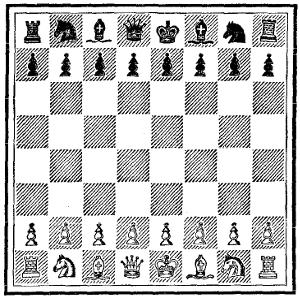
These eight pieces are arranged on the side of the board nearer the player, and immediately in front of them stand the eight Pawns, ♟. Diagram No. 1 will show the proper arrangement of the men at the beginning of a game:—
No. 1.
BLACK.
WHITE.
It will be observed that the two Queens are opposite each other, and that each Queen stands upon a square of the same colour as herself. For irregularities in setting up the men, see the Laws of Chess.
The players are designated by the colour of the men with which they play, Black or White, and White always has the first move. In a series of games each player alternately takes the white men with the first move. It is usual to draw for the first game, one player concealing in each hand a pawn of a different colour, and offering the choice of hands to his adversary. Whichever colour the chosen hand contains is the one the chooser must take for the first game.
The duplicate pieces of each colour are distinguished by their position with regard to the King or Queen; those on the King’s side being called the King’s Bishop, the King’s Knight, and the King’s Rook. Those on the Queen’s side are the Queen’s Bishop, Queen’s Knight, and Queen’s Rook. The pawns are designated by the pieces in front of which they stand; King’s Pawn; Queen’s Knight’s Pawn, etc.
The comparative value of the pieces changes a little in the course of play, the Rooks especially not being so valuable early in the game. Authorities differ a little as to the exact value of the pieces, but if we take the Pawn as a unit, the fighting value of the others will be about as follows:—
A Knight is worth 3½ Pawns.
A Bishop is worth 5¼ Pawns.
A Rook is worth 9½ Pawns.
A Queen is worth 15 Pawns.
A King is worth 4½ Pawns.
THE MOVES. Each piece has a movement peculiar to itself, and, with the exception of the Pawns, any piece can capture and remove from the board any opposing piece which it finds in its line of movement. The captured piece is not jumped over, but the capturing piece simply occupies the square on which the captured piece stood. The movement of each piece should be studied separately.
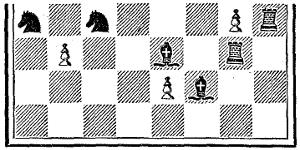
♟ The Pawns move straight forward, one square at a time, except on the first move, when they have the privilege of moving either one or two squares, at the option of the player. In capturing, the Pawn does not take the piece directly in its path, but the one diagonally in front of it on either side. Such a capture of course takes the Pawn from the file it originally occupied, and it must then continue to advance in a straight line on its new file. In Diagram No. 2, the white Pawns could not capture either of the black Bishops or Rooks, but the Pawn on the left could take either of the black Knights:—
No. 2.
WHITE.
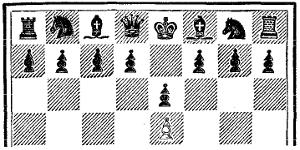
After a Pawn has crossed the middle line of the board into the adversary’s territory, it is called a passed Pawn. If an adverse Pawn attempts to pass this Pawn by availing itself of the privilege of moving two squares the first time, that would not prevent the passed Pawn from capturing it en passant. In the position shown in Diagram No. 3, for instance, if the black Queen’s Pawn were to advance two squares, the white Pawn could capture it en passant, lifting it from the board, and taking the position that the black Pawn would have occupied if it had moved only one square the first time; that is, the first black square in front of the Queen. A Pawn can be taken en passant only by another pawn, never by any other piece.
No. 3.
BLACK.
♜ The Rook can be moved any number of squares at a time, forward or backward, but only in vertical or horizontal lines, never diagonally. The Rook’s movement is of course limited by pieces obstructing its path, for it cannot jump over anything. At the beginning of the game, for instance, the Rook cannot move at all.
♝ The Bishop can be moved any number of squares at a time, forward or backward, but only in diagonal lines, never horizontally or vertically. For this reason the Bishop never leaves the squares of the same colour as that on which it originally stood. A Bishop is often spoken of as a white Bishop or a black Bishop, which does not mean that it is one of White’s Bishops, or one of Black’s; but that it stands upon a white or black square. Like the Rook, the Bishop cannot jump over other pieces, and cannot be moved at all until one or other of the two Pawns diagonally in front of it have opened the way.
♛ The Queen combines the movements of the Rook and Bishop, and can be moved horizontally, vertically, or diagonally, any number of squares at a time, provided that the path is clear. Like the Rook and Bishop, she cannot move at all until some of the adjoining pieces have made a way for her.
♚ The King has the same movement as the Queen, but is limited to one square at a time. The King is not allowed to move to a square which would expose him to capture by adverse pieces, for reasons which will presently be explained.
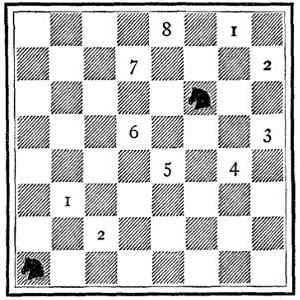
♞ The Knight has a very peculiar movement, which is L shaped, and necessitates his changing the colour of the square he stands on, every time he moves. The simplest way for the beginner to learn the Knight’s move is to observe that he must go two squares, neither more nor less, in a vertical or a horizontal direction, and must then change the colour of the square he stands on by going one square either to the right or left, which will complete the L shaped movement. Diagram No. 4 will show that when the Knight is away from the side of the board, he may go to any one of eight different squares; but when he is in a corner he can go to two only. For that reason Knights are much more powerful when placed near the centre of the board.
No. 4.
The peculiarity of the Knight’s move is that it is not retarded by other pieces, because the Knight can jump over them, a privilege which is not given to any other piece on the board. In Diagram No. 5, for instance, the Knights have been legitimately moved, but no other piece could be moved until the Pawns had made way for it.
No. 5.
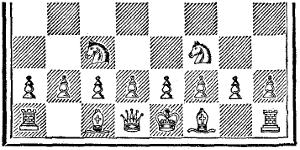
There are one or two peculiar movements which are allowed only under certain conditions. One of these is Castling. If there are no pieces between the King and the Rook, and neither piece has been moved, the King may be moved two squares toward the Rook, and at the same time the Rook may be brought round to the other side of the King. The movement must be made with both hands, each manipulating a piece. In the position shown in Diagram No. 6, for instance, the King could castle on either side, with the King’s Rook, or with the Queen’s Rook:—
No. 6.
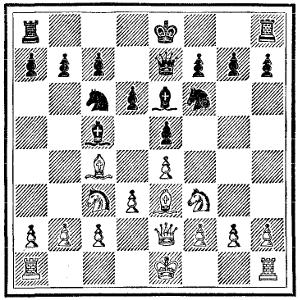
If an adverse piece commands the square that would be passed over by the King in castling, the move is not allowed; because a King must not move into check, nor cross a square that is checked by an adverse piece nor castle out of check.
In Diagram No. 7 the position that would result from castling with the Queen’s Rook is shown by the black men.
No. 7.
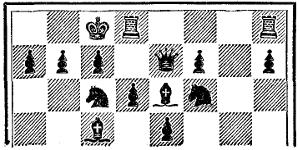
Queening Pawns. If a passed Pawn succeeds in reaching the last or eighth square on any file, the player to whom the Pawn belongs may call it anything he chooses, from a Queen to a Knight. If the piece he chooses has already been captured, it must be replaced on the board, and on the square occupied by the Pawn, which is then removed. If not, some other piece must be put upon the board as a marker; a Rook upside down, or a Pawn with a ring on it, may represent a second Queen.
OBJECT OF THE GAME. If all the pieces could be captured, the object of the game might be to clear the board of the adversary’s men, as in Checkers; but the peculiarity of Chess is that one piece, the King, cannot be captured, and the object is to get the adverse King in such a position that he could not escape capture if he were a capturable piece. When that is accomplished the King is said to be mated, and the player who first succeeds in giving mate to the adversary’s King wins the game, regardless of the number or value of the pieces either side may have on the board at the time the mate is accomplished.
When an adverse piece is moved so that it could capture the King on the next move, due notice must be given to the threatened King by announcing “Check,” and the player must immediately move his King out of check, interpose a piece or a Pawn, or capture the piece that gives the check. If he cannot do one of these three things he is mated, and loses the game. A very simple example of a mate is given in Diagram No. 8.
No. 8.
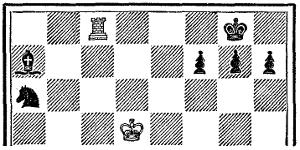
The white Rook has just been moved down to the edge of the board, giving “check.” As the black King can move only one square at a time, he cannot get out of check by moving, because the only squares to which he could go would still leave him in check from the Rook. Neither the Knight nor the Bishop can interpose to shut out the Rook’s attack; neither of those pieces can capture the Rook; and the Pawns cannot move backward; so the black King is mated, and White wins the game.
A mate may take place in the middle of the board, as shown in Diagram No. 9.
No. 9.
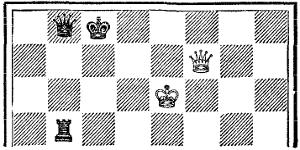
If the black Queen moves diagonally four squares, placing herself in front of the white King, and on the same horizontal file as the black Rook, it will be check-mate, because the white King cannot get out of one check into another by taking the Queen, which is protected by the Rook. For the same reason he cannot move, as the only squares open to him would leave him in check from the Queen, or move him into check from the black King.
Stalemate. If the King is not in check, but cannot move without going into check, and there is no other piece for the player to move, it is called a stale-mate, and the game is drawn. In Diagram No. 10, for instance,
No. 10.
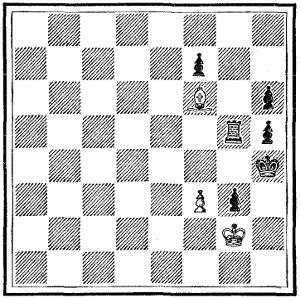
the black King cannot move without going into check from the Pawn or the King; none of the black Pawns can move, and Black cannot move the Rook without putting his own King in check, (from the Bishop,) which is not allowed.
Perpetual Check. If a piece gives check to the adverse King, and the King moves away, the check may be repeated, and the King must move again, or interpose a piece, or capture the checking piece. If the position is such that no matter how often the King moves or is covered he cannot get out of check, and no matter how much the opposing pieces move they cannot check-mate him, the game is drawn by perpetual check. Diagram No. 11 is an illustration of such a position.
No. 11.
BLACK.
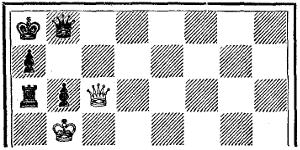
The only way out of the check is to interpose the Queen, whereupon the white Queen will move diagonally to the edge of the board and check again, forcing the black Queen back where she came from, and drawing the game by perpetual check. If the black Queen moves away from the King, she will be captured, and White will give check-mate at the same time.
NOTATION. The various moves which take place in the course of a game are recorded by a system of chess notation, the number of the move being given first, and then the pieces moved and the direction of their movement. The names of the pieces themselves are used to distinguish the various files of squares running vertically from the piece itself to the opposite side of the board, and the seven squares in front of each piece are numbered from 2 to 8. No matter how much the pieces may be moved, the various vertical files still retain the name of the pieces which stood at the bottom of them when the men were first set up. In chess notation, only the initials of the pieces are used, K standing for King, and Kt for Knight. Although the files bear the same names, the numbers count from the side on which the men are placed, so that each square has a double name, depending on the colour of the man placed upon it.
No. 12.
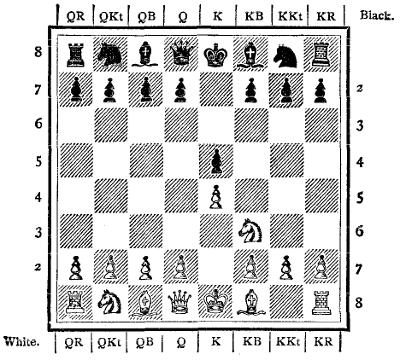
In Diagram No. 12, for instance, both the Pawns that have been moved would be spoken of as on K 4. The Knight that has been moved is on K B 3, because it is a white Knight. If it was a black Knight it would be on K B 6, reckoning from the black side of the board for the black pieces. In order to test your understanding of this system of notation, which is very important in following published games or problems, take the board and men, white side next you, and set up the following position, remembering that when no number is given, the piece stands upon the square originally occupied by the piece which gives its name to the file:—
Black men;—King on Q R’s; Queen on Q Kt’s; Pawns on Q R 2, and Q Kt, 3; Rook on Q R 3.
White men;—King on Q Kt 5; Queen on Q B 6.
Now look at Diagram No 11, and see if you have it right.
In addition to the notation of position, there is that of action. If a dash is placed between the initials of the piece and the definition of the square, it shows first the piece moved, and then the square to which it is moved. In Diagram No 11, for instance, Black’s only move to cover the check would be given: Q-Q Kt 2; and White’s continuation would be given; Q-K 8.
The first of these might be abbreviated by saying, Q-Kt 2, because there is only one Kt 2 to which the Queen could be moved.
The moves of the white pieces are always given first, either in the left hand of two vertical columns, which are headed “White,” and “Black” respectively; or above a line which divides the white move from the black, the latter form being used in text-books, the former in newspapers. The moves in Diagram No. 11 would be as follows, supposing the white Queen to arrive from K8 in the first place:—
White. Black.
1. Q-B 6, ch Q-Kt 2
2. Q-K 8, ch Q-Kt’s
Or this;
1.
Q-B 6, ch
Q-Kt 2
When the abbreviation “ch.” is placed after a move, it means “check.” If it is a mate, or a drawn game, or the player resigns, the word follows the move. When the King castles with the King’s Rook, which is the shorter move for the Rook, it is indicated by the sign O-O. When the King is castled with the Queen’s Rook, which is the longer move for the Rook, the sign O-O-O is used.
A cross, x, placed after the piece moved shows that it captured something, and the letters following the cross do not give the square to which the piece is moved, but show the piece that is captured. K B x Q P, for instance, would mean that the adversary’s Queen’s Pawn was to be taken from the board, and the King’s Bishop was to occupy the square upon which the captured Queen’s Pawn had stood.
Beginners usually have some difficulty in following the moves of the Knights, because it frequently happens that the same square can be reached by either of them. The Bishops cannot be confused in this way, because they never change the colour of the square they stand upon. In some sets of chessmen the Knights are distinguished by putting a small crown on the King’s Knight, but this is never done in the regulation Staunton model. The beginner will find it very convenient, when following out the play of published games, to screw off the bottom of one white and one black Knight, and to exchange the bases. The white King’s Knight will then have a black base, and the black King’s Knight will have a white base, and they can be easily identified at any period of the game.
GERMAN NOTATION. Many of our standard chess books, and some of the best edited chess columns, are in German, and the student should be familiar with the German notation, which is much simpler than the English.
The white men are always considered as the side nearer the player; the vertical columns are designated from left to right by the letters a b c d e f g h; and the horizontal rows by the numbers 1 2 3 4 5 6 7 8, beginning at the bottom, or white side. The pieces are designated by one capital letter only, as follows:—
K for König, or King.
D for Dame, or Queen.
T for Thurm, or Rook.
L for Läufer, or Bishop.
S for Springer, or Knight.
The Pawn is called a Bauer, but when it is moved no initial is given, simply the square it comes from. In Diagram No. 12, for instance, the English notation for the first two moves made by white would be:—P-K 4, and K Kt-B 3, or, Kt-K B 3. The German notation would be:—e 2-e 4; and S g 1-f 3. The move of the Knight, it will be observed, gives the initial of the piece and the square upon which it stands, and then the square to which it is moved. A capture is indicated by the letter “n” taking the place of the dash. If the white Knight took the black King’s Pawn in Diagram No. 12, for instance, the move would be recorded: S f 3 n e 5, that is, the Springer at f 3 “nimmt” whatever it found at e 5. A check is indicated by a plus sign, +, following the move. In Diagram No. 11, for instance, the last move of the white Queen would be: D e 8-c 6 +; and Black’s reply would be: D b 8-b 7.
THE OPENINGS. Time and experience have shown that it is best for each player to adopt certain conventional openings, in order to develop his pieces. White always has the advantage, usually believed to be equal to 55%, counting drawn games as one half. This is because White can usually take more risks in offering a gambit than Black can in accepting it, and the best judges say that they would rather give a Knight and take the white pieces, than give Pawn-and-move and take the black. Gambit is a term used in Italian wrestling, and means that the adversary is given an apparent advantage at the start, in order more successfully to trip him up later on.
There are a great many chess openings, all of which have been analysed as far as the tenth move, including every possible variation on the way. The student who wishes to study them in detail should procure Freeborough’s “Chess Openings,” or Cook’s “Synopsis.” In these works, if either side has an advantage before the tenth move, it is indicated by a plus sign; if the position is equal, it is so marked.
In studying openings, the student should be careful always to play with the winning side next him; that is, never study how to play a losing game. If the variation ends with a plus sign, showing a win for the white, play it over with the white men next you. In selecting openings for general use in play, if it is one for the white men, take those openings that have the greatest number of variations ending in favour of white. The Ruy Lopez is a very good opening for beginners, and the Evans’ Gambit may be studied later. The French Defence and the Petroff are good openings for Black.
The theory of opening is to mobilise your forces for the attack in the fewest possible moves. Lasker thinks six moves should be enough for this purpose, and he recommends that only the King’s and Queen’s Pawns should be moved, after which each piece should be placed at once upon the square from which it can operate to the best advantage. He thinks the Knights should be first brought out, and posted at B 3, and then the K’s B, somewhere along his own diagonal. The great mistake made by beginners is that they rush off to the attack and try to capture some of the adverse pieces before they have properly prepared themselves for re-inforcement or retreat. It should never be forgotten that the game is not won by capturing the adversary’s pieces, but by check-mating his King.
Take the board and pieces, arrange them with the white men next you, and play over the following simple little game. Remember that the figures above the line are for the white men; those below for the black.
1
P-K4
P-K4
2
Kt-KB3
P-Q3
3
Kt-QB3
P-KR3
4
B-B4
B-Kt5
The third move made by Black accomplishes nothing, and is simply a waste of time. He should have continued by bringing his Knights into play. His fourth move is also a mistake; he should develop the Knights before the Bishops.
5
KtxP
BxQ
6
BxKBP ch
K-K2
7
Kt-Q5 mate
On his fifth move, Black jumps at the chance to win White’s Queen, but this is not of the slightest benefit to him, because the object of the game is not to win the Queen, but to mate the King. At the seventh move the beginner will see that the black King cannot move out of check, neither can he move into check by taking the Bishop. He has no piece that can capture the Knight that gives the check, and nothing can be interposed, so he is mated, and White wins.
Here is another simple little game. Take the black pieces this time, but make the white men move first, of course.
1
P-K4
P-K4
2
Kt-KB3
Kt-KB3
3
KtxP
Kt-QB3
You don’t take the King’s Pawn; it is much more important to develop your pieces rapidly.
4
KtxKt
QPxKt
5
P-Q3
B-QB4
6
B-Kt5
KtxP
White’s sixth move is bad, and you immediately take advantage of it. If he takes your Knight with his Pawn, you will take his K B P with your Bishop, and say “Check.” If he takes the Bishop you win his Queen. If he moves his King you check again with your other Bishop, which will force him to take your black Bishop, and lose his Queen.
7
BxQ
BxP ch
8
K-K2
B-Kt5 mate
If the beginner will examine the position, he will find that there is no way of escape for the King, and Black wins.
Openings are usually divided into five principal classes: Those in which the first piece developed is the King’s Knight; those in which the King’s Bishop is the first piece brought into play; those in which a Gambit is offered on the second move, usually a sacrificed Pawn; those which are called Close openings, securing a good defensive game for the black pieces; and those which are Irregular.
In the following outline of fifty of the openings, only the first four moves are given, and usually only one variation is selected, the object being more to give the student an idea of the development than to exhaust the subject. The arrangement is alphabetical, that being more convenient in a book of reference. For the continuations the student is recommended to study “Freeborough,” or the “Handbuch des Schachspiels.”
Allgaier Gambit:—
1
P-K4
P-K4
2
P-KB4
PxP
3
Kt-KB3
P-KKt4
4
P-KR4
P-Kt5
Boden-Kieseritzky Gambit:—
1
P-K4
P-K4
2
B-B4
Kt-KB3
3
Kt-KB3
KtxP
4
Kt-B3
KtxKt
Berlin Defence:—
1
P-K4
P-K4
2
B-B4
Kt-KB3
3
Q-K2
Kt-QB3
4
P-QB3
B-B4
Blackmar Gambit:—
1
P-Q4
P-Q4
2
P-K4
PxP
3
P-KB3
PxP
4
KtxP
B-B4
Calabrese Counter Gambit:—
1
P-K4
P-K4
2
B-B4
P-KB4
3
P-Q3
Kt-KB3
4
P-B4
P-Q4
Centre Gambit:—
1
P-K4
P-K4
2
P-Q4
PxP
3
QxP
Kt-QB3
4
Q-K3
B-Kt5 ch
Centre Counter Gambit:—
1
P-K4
P-Q4
2
PxP
QxP
3
Kt-QB3
Q-Q sq
4
P-Q4
Kt-KB3
Classical Defence, to K. B. opening:—
1
P-K4
P-K4
2
B-B4
B-B4
3
P-QB3
Kt-KB3
4
P-Q4
PxP
Cunningham Gambit:—
1
P-K4
P-K4
2
P-KB4
PxP
3
Kt-KB3
B-K2
4
B-B4
B-R5 ch
Cochrane Gambit:—
1
P-K4
P-K4
2
P-KB4
PxP
3
Kt-KB3
P-KKt4
4
B-B4
P-Kt5
Danish Gambit:—
1
P-K4
P-K4
2
P-Q4
PxP
3
P-QB3
PxP
4
B-QB4
Kt-KB3
English Opening:—
1
P-QB4
P-QB4
2
P-B4
P-B4
3
P-Q3
Kt-KB3
4
Kt-QB3
P-Q3
Evans’ Gambit:—
1
P-K4
P-K4
2
Kt-KB3
Kt-QB3
3
B-B4
B-B4
4
P-QKt4
BxKtP
Evans’ Gambit Declined:—
1
P-K4
P-K4
2
Kt-KB3
Kt-QB3
3
B-B4
B-B4
4
P-QKt4
B-Kt3
Fianchetto Opening:—
1
P-K3
P-K4
2
P-QB4
Kt-KB3
3
Kt-QB3
P-Q4
4
PxP
KtxP
Fianchetto Defence:—
1
P-K4
P-QKt3
2
P-Q4
P-K3
3
B-Q3
B-Kt2
4
Kt-K2
Kt-KB3
Four Knights:—
1
P-K4
P-K4
2
Kt-KB3
Kt-QB3
3
Kt-B3
Kt-B3
4
B-Kt5
B-Kt5
French Defence:—
1
P-K4
P-K3
2
P-Q4
P-Q4
3
Kt-QB3
Kt-KB3
4
B-KKt5
B-K2
From Gambit:—
1
P-KB4
P-K4
2
PxP
P-Q3
3
PxP
BxP
4
Kt-KB3
Kt-KB3
Giuoco Piano:—
1
P-K4
P-K4
2
Kt-KB3
Kt-QB3
3
B-B4
B-B4
4
P-B3
Kt-B3
Greco-Counter Gambit:—
1
P-K4
P-K4
2
Kt-KB3
P-KB4
3
KtxP
Q-B3
4
P-Q4
P-Q3
Hamppe-Allgaier Gambit:—
1
P-K4
P-K4
2
Kt-QB3
Kt-QB3
3
P-B4
PxP
4
Kt-B3
P-KKt4
Hungarian Defence:—
1
P-K4
P-K4
2
Kt-KB3
Kt-QB3
3
B-B4
B-K2
4
P-Q4
P-Q3
Irregular Openings:—
1
P-K4
P-K4
2
P-QB3
P-Q4
3
Kt-B3
PxP
4
KtxP
B-Q3
1
P-K4
P-Q3
2
P-Q4
Kt-KB3
3
B-Q3
Kt-QB3
4
P-QB3
P-K4
1
P-K4
P-QB3
2
P-Q4
P-Q4
3
PxP
PxP
4
B-Q3
Kt-QB3
1
P-K4
Kt-QB3
2
P-Q4
P-K4
3
PxP
KtxP
4
P-KB4
Kt-Kt3
Jerome Gambit:—
1
P-K4
P-K4
2
Kt-KB3
Kt-QB3
3
B-B4
B-B4
4
BxP ch
KxB
Kieseritzky Gambit:—
1
P-K4
P-K4
2
P-KB4
PxP
3
Kt-KB3
P-KKt4
4
P-KR4
P-Kt5
King’s Bishop’s Gambit:—
1
P-K4
P-K4
2
P-KB4
PxP
3
B-B4
Q-R5 ch
4
K-B sq
B-B4
King’s Bishop’s Pawn Game:—
1
P-KB4
P-K3
2
Kt-KB3
Kt-KB3
3
P-K3
B-K2
4
B-K2
P-QKt3
King’s Knight Opening. Irregular Defences:—
1
P-K4
P-K4
2
Kt-KB3
P-KB3
3
KtxP
Q-K2
4
Kt-KB3
P-Q4
1
P-K4
P-K4
2
Kt-KB3
Q-B3
3
Kt-B3
P-B3
4
P-Q4
PxP
1
P-K4
P-K4
2
Kt-KB3
B-Q3
3
B-B4
Kt-KB3
4
P-Q4
Kt-B3
1
P-K4
P-K4
2
Kt-KB3
B-B4
3
KtxP
Q-K2
4
P-Q4
B-Kt3
King’s Gambit:—
1
P-K4
P-K4
2
P-KB4
PxP
3
P-Q4
Q-R5 ch
4
K-K2
P-Q4
1
P-K4
P-K4
2
P-KB4
PxP
3
P-KR4
P-Q4
4
PxP
QxP
1
P-K4
P-K4
2
P-KB4
PxP
3
Kt-KB3
P-KKt4
4
B-B4
B-Kt2
1
P-K4
P-K4
2
P-KB4
PxP
3
P-KR4
B-K2
4
Kt-KB3
Kt-KB3
King’s Gambit Declined:—
1
P-K4
P-K4
2
P-KB4
P-Q4
3
PxQP
QxP
4
Kt-QB3
Q-K3
Max Lange’s Attack:—
1
P-K4
P-K4
2
Kt-KB3
Kt-QB3
3
B-B4
B-B4
4
Castles
Kt-B3
Muzio Gambit:—
1
P-K4
P-K4
2
P-KB4
PxP
3
Kt-KB3
P-KKt4
4
B-B4
P-Kt5
Petroff’s Counter Attack:—
1
P-K4
P-K4
2
Kt-KB3
Kt-KB3
3
KtxP
P-Q3
4
K-KB3
KtxP
Philidor’s Defence:—
1
P-K4
P-K4
2
Kt-KB3
P-Q3
3
P-Q4
PxP
4
KtxP
P-Q4
Pierce Gambit:—
1
P-K4
P-K4
2
Kt-QB3
Kt-QB3
3
P-B4
PxP
4
Kt-B3
P-KKt4
Queen’s Pawn Counter Gambit:—
1
P-K4
P-K4
2
Kt-KB3
P-Q4
3
PxP
B-Q3
4
P-Q4
P-K5
Queen’s Gambit:—
1
P-Q4
P-Q4
2
P-QB4
PxP
3
P-K3
P-K4
4
BxP
PxP
1
P-Q4
P-Q4
2
P-QB4
PxP
3
P-K4
P-K4
4
P-Q5
P-KB4
1
P-Q4
P-Q4
2
P-QB4
PxP
3
Kt-KB3
P-K3
4
P-K3
Kt-KB3
Queen’s Pawn Game:—
1
P-Q4
P-Q4
2
P-K3
P-K3
3
Kt-KB3
Kt-KB3
4
B-K2
B-K2
Ruy Lopez:—
1
P-K4
P-K4
2
Kt-KB3
Kt-QB3
3
B-Kt5
P-QR3
4
B-R4
Kt-B3
Salvio Gambit:—
1
P-K4
P-K4
2
P-KB4
PxP
3
Kt-KB3
P-KKt4
4
B-B4
P-Kt5
Scotch Game:—
1
P-K4
P-K4
2
Kt-KB3
Kt-QB3
3
P-Q4
PxP
4
KtxP
B-B4
Sicilian Defence:—
1
P-K4
P-QB4
2
Kt-QB3
Kt-QB3
3
Kt-B3
P-K3
4
P-Q4
PxP
Staunton’s Opening:—
1
P-K4
P-K4
2
Kt-KB3
Kt-QB3
3
P-B3
P-B4
4
P-Q4
P-Q3
Steinitz Gambit:—
1
P-K4
P-K4
2
Kt-QB3
Kt-QB3
3
P-KB4
PxP
4
P-Q4
Q-R5 ch
Three Knights’ Game:—
1
P-K4
P-K4
2
Kt-KB3
Kt-KB3
3
Kt-B3
P-Q3
4
P-Q4
PxP
Two Knights’ Defence:—
1
P-K4
P-K4
2
Kt-KB3
Kt-QB3
3
B-B4
Kt-B3
4
Kt-Kt5
P-Q4
Vienna Opening:—
1
P-K4
P-K4
2
Kt-QB3
B-B4
3
P-B4
P-Q3
4
Kt-B3
Kt-KB3
Zukertort’s Opening:—
1
Kt-KB3
P-K3
2
P-Q4
Kt-KB3
3
P-K3
P-QKt3
4
B-K2
B-Kt2
GAMES AT ODDS. Between unequal players it is a common practice for the stronger to give the weaker some advantage. Very few are able to give a Queen, or even a Rook, but a Knight is quite common, and one who can concede a Knight to the weakest players in a club is usually spoken of as, “a Knight player.” The most common odds between nearly equal players is Pawn and Move; and with a player not strong enough to give a Knight, Pawn and Two Moves. The Pawn removed in each instance is Black’s K B P, and the Knight is usually the Q Kt. Here are a few examples of the openings in games at odds:—
Pawn and Move:—
1
P-K4
P-K3
2
P-Q4
P-Q4
3
Q-R5 ch
P-KKt3
4
Q-K5
Kt-KB3
1
P-K4
P-Q3
2
P-Q4
Kt-KB3
3
Kt-QB3
Kt-B3
4
P-Q5
Kt-K4
1
P-K4
Kt-QB3
2
P-Q4
P-Q4
3
P-K5
B-B4
4
B-QKt5
Q-Q2
1
P-K4
Kt-QB3
2
P-Q4
P-Q4
3
PxP
KtxP
4
P-KB4
Kt-B2
Pawn and Two Moves:—
1
P-K4
2
P-Q4
P-K3
3
B-Q3
P-B4
4
P-Q5
P-Q3
1
P-K4
2
P-Q4
P-Q3
3
P-QB4
P-B4
4
P-Q5
P-Q3
1
P-K4
2
P-Q4
P-Q3
3
P-KB4
P-K3
4
B-Q3
Kt-K2
1
P-K4
2
P-Q4
Kt-QB3
3
P-Q5
Kt-K4
4
P-KB4
Kt-B2
Odds of Queen’s Knight:—
1
P-K4
P-K4
2
Kt-B3
P-Q4
3
PxP
P-K5
4
Kt-K5
QxP
1
P-K4
P-K4
2
P-KB4
P-Q4
3
PxQP
QxP
4
Kt-B3
P-K5
Odds of King’s Knight:—
1
P-K4
P-K4
2
B-B4
P-QB3
3
Kt-B3
Kt-B3
4
P-Q4
P-Q4
1
P-K4
P-K4
2
B-B2
Kt-KB3
3
P-Q2
B-B4
4
0-0
0-0
In order to give the student an idea of the value and popularity of the various openings, the following table of the results of 1500 games may be useful. It is from the chess columns of the New York Sun:—
OPENINGS FIRST PLAYER. TOTAL PLAYED. PER CENT. WON BY FIRST PLAYER. PER CENT. TOTAL GAMES PLAYED.
WON. LOST. DREW.
Ruy Lopez 145 103 58 306 57 20
Queen’s Pawn(a) 97 63 39 199 48 13
French Defence 84 48 39 171 60 11
Vienna 47 34 15 96 57 6
Sicilian Defence 40 29 10 79 57 5
King’s Gambit 36 32 11 79 52 5
Giuoco Piano 36 32 10 78 52 5
Evans 34 20 12 66 61 4
Irregular 29 31 14 74 49 5
Scotch 22 26 9 57 47 4
Zukertort 23 17 11 51 56 3
Two Knights Defence 16 20 10 46 46 3
Staunton’s 19 15 5 39 55 3
Fianchetto 13 14 2 29 48 2
Petroff Defence 15 9 3 27 61 2
Centre Gambit(b) 11 11 4 26 50 2
Philidor Defence 8 9 3 20 47 1
Miscellaneous 22 29 6 57 44 4
Total 697 542 261 1500
The first player won 55.2 per cent. of games played, counting drawn games as one-half.
THE MIDDLE GAME. After a little experience with openings, the player will usually select one or two which he feels that he can handle better than others, and will make a specialty of them. Having mastered a number of variations, and learned the object of them in forming his pieces for attack or defence, he will naturally be led to the study of the middle game. In this there are a few general principles which should be steadily kept in view. For attack, the player should secure command of a wide range of the board; but for defence he should concentrate his forces as much as possible. He should be careful not to get his pieces in one another’s way, and not to leave pieces where they can be attacked and driven back by inferior pieces, because that entails a loss of valuable time. A player should never exchange a man in active service for one that is doing nothing. If several lines of play are open, the one offering the most numerous good continuations should be selected. When a player is not ready for attack, he should develop his pieces, and remember that the more of them he can get to bear on the enemy’s King, the better. Supporting pieces should be placed where they are not easily attacked, because good players attack the supports first, so as to isolate the advance guard. Beginners are usually in too great a hurry to give check; the best players do not check until they are ready to follow it up with a mate, or a winning position, or can gain time in developing their pieces.
END GAMES. There are certain positions in which apparently equal games are not necessarily drawn, and there are others in which a player with a decided advantage cannot win, within the fifty moves which are allowed him, unless he knows exactly how to proceed. If a player is not well up in endings he may lose many a game which could be won if he only knew how to win it. The following games may be abandoned as drawn:—
King and Bishop against a King.
King and Knight against a King.
King and two Knights against a King.
King and Queen against two Rooks.
King and Queen against King and two Bishops.
King and Rook against King, Rook and Pawn.
King and Rook against King and Bishop.
King and Rook against King and Knight.
King and Rook against King, Rook and Bishop.
The following games can be won:—
King and Queen, or King and Rook, against a King.
King and Queen against King and Rook.
King and Queen against King and Bishop.
King and Queen against King and Knight.
King and Queen against King and Pawn.
King and two Rooks against King and Rook.
King and two Bishops against a King.
King Bishop and Knight against a King.
In order to master all these endings, the student should take up Staunton’s Handbook, or the Lehrbuch des Schachspiels, in which they are given very fully. For the beginner only one or two of the most common and important are necessary.
K and Q, or K and R, against K. All that is necessary is to drive the King to the edge of the board, which may be done by holding him below a certain parallel with the Q or R, and then getting your own King in front of him; a check will then drive him one line further back, and when he arrives at the edge of the board, and can no longer go back, he is mated.
K and Q against K and R. Freeborough has devoted an entire volume to this ending, which may be very much prolonged by a skilful player. The object is to drive the King to the edge of the board, and then to get the Rook in such a position that it must be sacrificed to save the mate, or that the mate can be accomplished with the Rook on the board. The player with the Queen must be on his guard against stale-mate in this ending.
K and Q against K and B, K and Kt, or K and P. This is easy enough for the Queen if the player is careful to avoid stale-mate.
K and two R’s against K and R. This can be won easily by forcing an exchange of Rooks.
K and two B’s against K. In this position the King must be ruled off into a corner by getting the Bishops together, protected by their King. Start with the men in the following position:—
Black K on his own square. White King on K B 6; white Bishops on K B 4 and K B 5. White to move and win. The mate can be accomplished in six moves, as follows:—
1
B-B7
K-B sq
2
B-Q7
K-Kt sq
3
K-Kt6
K-B sq
4
B-Q6 ch
K-Kt sq
5
B-K6 ch
K-R sq
6
B-K5 mate
K, B and Kt against K. This is one of the most difficult endings for a beginner, but is very instructive, and should be carefully studied. Set up the men as follows:—
Black King on K R sq. White King on K B 6, white Bishop on K B 5, and white Knight on K Kt 5; White to move and win. The object is to drive the King into a corner of the board which is commanded by the Bishop, as he cannot otherwise be mated.
1
Kt-B7 ch
K-Kt sq
2
B-K4
K-B sq
3
B-R7
K-K sq
4
Kt-K5
K-B sq
5
Kt-Q7 ch
K-K sq
6
K-K6
K-Q sq
7
K-Q6
K-K sq
8
B-K6 ch
K-Q sq
9
K-B6
K-B sq
10
B-B7
K-Q sq
11
Kt-Kt7 ch
K-B sq
12
K-B6
K-Kt sq
13
K-Kt6
K-B sq
14
B-K6 ch
K-Kt sq
15
Kt-B5
K-R sq
16
B-Q7
K-Kt sq
17
Kt-R6 ch
K-R sq
18
B-B6 mate
If, at the fourth move, the black King does not go back to the Bishop’s square, but goes on to the Queen’s square, hoping to cut across to the other black corner of the board, the continuation will be as follows, beginning at White’s fifth move:—
5
K-K6
K-B2
6
Kt-Q7
K-B3
7
B-Q3
K-B2
8
B-Kt5
K-Q sq
9
Kt-K5
K-B2
10
Kt-B4
K-Q sq
11
K-Q6
K-B sq
12
Kt-R5
K-Q sq
13
Kt-Kt7 ch
K-B sq
14
K-B6
K-Kt sq
15
Kt-Q6
K-R2
16
K-B7
K-R sq
17
B-B4
K-R2
18
Kt-B8 ch
K-R sq
19
B-Q5 mate
PAWN ENDINGS. There are a great number of these, many being complicated by the addition of Pawns to other pieces. The following example, which is a position that often occurs, should be understood by the beginner:—
Put the black King on K B square; the white King on K B 6, and a white Pawn on K 6. If it is Black’s move, White can win easily; but if it is White’s move it is impossible to win, because whether he checks or not the black King gets in front of the Pawn and either wins it or secures a stale-mate.
Put the Pawn behind the King, on K B 5, and White wins, no matter which moves first, for if Black moves he allows the white King to advance to the seventh file, which will queen the Pawn. If White moves first, and the black King keeps opposite him, the Pawn advances. If Black goes in the other direction, the white King goes to the seventh file and wins by queening the Pawn.
If the white King and Pawn are both moved one square further back, the King on K B 5, and the Pawn on K B 4. the win will depend on the move. If it is White’s move he can win by advancing the King; but if it is Black’s move he can draw by keeping his King always opposite the white King. If the Pawn advances, he will get in front of it, and if the King is afterward advanced, he will get in front of it; winning the Pawn or securing a stale-mate.
THE KNIGHT’S TOUR. Owing to the peculiarity of the Knight’s move, many persons have amused themselves in trying to cover the entire chess board with a Knight, touching the same square once only, and returning to the starting-point again. There are several ways of doing this, one of the simplest being the following:—
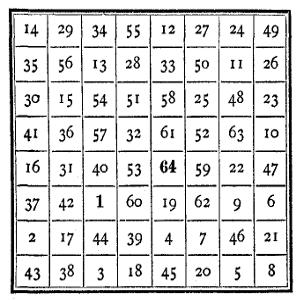
TEXT BOOKS. Among the very large number of works on Chess there is abundant room for choice, but the following works are considered standard authorities on the game:—
Freeborough’s Chess Openings, 1896.
Cook’s Synopsis.
Minor Tactics of Chess, by Young and Howell.
Modern Chess Instructor, by W. Steinitz.
Common Sense in Chess, by E. Lasker.
Walker’s Treatise on Chess, 1841.
Handbuch des Schachspiels.
Lehrbuch des Schachspiels, by J. Dufresne.
Teoria e Practica del Giuoco degli Schacchi.
British Chess Magazine.
Chess Player’s Chronicle.
Chess Monthly.
Westminster Papers, 1868 to 1879.
Of these works, “Minor Tactics” will be found most useful to the beginner, as it simplifies the openings by grouping them, and concentrates the attention on the essential points of chess strategy.
CODE OF CHESS LAWS. ADOPTED BY THE FIFTH AMERICAN CHESS CONGRESS.
Definitions of Terms Used. Whenever the word “Umpire” is used herein, it stands for any Committee having charge of Matches or Tournaments, with power to determine questions of chess-law and rules; or for any duly appointed Referee, or Umpire; for the bystanders, when properly appealed to; or for any person, present or absent, to whom may be referred any disputed questions; or for any other authority whomsoever having power to determine such questions.
When the word “move” is used it is understood to mean a legal move or a move to be legally made according to these laws.
When the word “man” or “men” is used, it is understood that it embraces both Pieces and Pawns.
The Chess-Board and Men. The Chess-board must be placed with a white square at the right-hand corner.
If the Chess-board be wrongly placed, it cannot be changed during the game in progress after a move shall have been made by each player, provided the men were correctly placed upon the board at the beginning, i.e., the Queens upon their own colours.
A deficiency in number, or a misplacement of the men, at the beginning of the game, when discovered, annuls the game.
The field of the Standard Chess-board shall be twenty-two inches square.
The Standard Chess-men shall be of the improved Staunton Club size and pattern.
First Move and Colour. The right of first move must be determined by lot.
The player having the first move must always play with the white men.
The right of move shall alternate, whether the game be won, lost or drawn.
The game is legally begun when each player shall have made his first move.
Whenever a game shall be annulled, the party having the move in that game shall have it in the next game. An annulled game must be considered, in every respect, the same as if it had never been begun.
Concessions. The concession of an indulgence by one player does not give him the right of a similar, or other, indulgence from his opponent.
Errors. If, during the course of the game, it be discovered that any error or illegality has been committed, the moves must be retraced and the necessary correction made, without penalty. If the moves cannot be correctly retraced, the game must be annulled.
If a man be dropped from the board and moves made during its absence, such moves must be retraced and the man restored. If this cannot be done, to the satisfaction of the Umpire, the game must be annulled.
Castling. The King can be Castled only:
When neither the King nor the Castling Rook has been moved, and
When the King is not in check, and
When all the squares between the King and Rook are unoccupied, and
When no hostile man attacks the square on which the King is to be placed, or the square he crosses.
In Castling, the King must be first moved.
The penalty of moving the King prohibits Castling.
En Passant. Taking the Pawn “en passant,” when the only possible move, is compulsory.
Queening the Pawn. A pawn reaching the eighth square must be at once exchanged for any piece (except the King) that the player of the Pawn may elect.
Check. A player falsely announcing “check,” must retract the move upon which the announcement was based and make some other move, or the move made must stand at the option of the opponent.
No penalty can be enforced for any offence committed against these rules in consequence of a false announcement of “check,” nor in consequence of the omission of such announcement, when legal “check” be given.
“J’adoube.” “J’adoube,” “I adjust,” or words to that effect, cannot protect a player from any of the penalties imposed by these laws, unless the man or men touched, obviously need adjustment, and unless such notification be distinctly uttered before the man, or men, be touched, and only the player whose turn it is to move is allowed so to adjust.
The hand having once quitted the man, but for an instant, the move must stand.
Men overturned or displaced accidentally may be replaced by either player, without notice.
A wilful displacement, or overturning of any of the men, forfeits the game.
Penalties. Penalties can be enforced only at the time an offence is committed, and before any move is made thereafter.
A player touching one of his men, when it is his turn to play, must move it. If it cannot be moved he must move his King. If the King cannot move, no penalty can be enforced.
For playing two moves in succession, the adversary may elect which move shall stand.
For touching an adversary’s man, when it cannot be captured, the offender must move his King. If the King cannot move, no other penalty can be enforced. But if the man touched can be legally taken, it must be captured.
For playing a man to a square to which it cannot be legally moved, the adversary, at his option, may require him to move the man legally, or to move the King.
For illegally capturing an adversary’s man, the offender must move his King, or legally capture the man, as his opponent may elect.
For attempting to Castle illegally, the player doing so must move either the King or Rook, as his adversary may dictate.
For touching more than one of the player’s own men, he must move either man that his opponent may name.
For touching more than one of the adversary’s men, the offender must capture the one named by his opponent, or if either cannot be captured, he may be required to move the King or capture the man which can be taken, at the adversary’s option; or, if neither can be captured, then the King must be moved.
A player moving into check may be required, by the opposing player, either to move the King elsewhere, or replace the King and make some other move—but such other move shall not be selected by the player imposing the penalty.
For discovering check on his own King, the player must either legally move the man touched, or move the King at his adversary’s option. In case neither move can be made, there shall be no penalty.
While in check, for touching or moving a man which does not cover the check, the player may be required to cover with another piece, or move the King, as the opposing player may elect.
Touching the Squares. While the hand remains upon a man, it may be moved to any square that it commands, except such squares as may have been touched by it during the deliberation on the move; but if all the squares which it commands have been so touched, then the man must be played to such of the squares as the adversary may elect.
Counting Fifty Moves. If, at any period during a game, either player persist in repeating a particular check, or series of checks, or persist in repeating any particular line of play which does not advance the game; or if “a game-ending” be of doubtful character as to its being a win or a draw, or if a win be possible, but the skill to force the game questionable, then either player may demand judgment of the Umpire as to its being a proper game to be determined as drawn at the end of fifty additional moves, on each side; or the question: “Is, or is not the game a draw?” may be, by mutual consent of the players, submitted to the Umpire at any time. The decision of the Umpire, in either case, to be final.
And whenever fifty moves are demanded and accorded, the party demanding it may, when the fifty moves have been made, claim the right to go on with the game, and thereupon the other party may claim the fifty move rule, at the end of which, unless mate be effected, the game shall be decided a draw.
Stale-Mate. A stale-mate is a drawn game.
Time Limit. The penalty for exceeding the time limit is the forfeiture of the game.
It shall be the duty of each player, as soon as his move be made, to stop his own register of time and start that of his opponent, whether the time be taken by clocks, sand-glasses, or otherwise. No complaint respecting an adversary’s time can be considered, unless this rule be strictly complied with. But nothing herein is intended to affect the penalty for exceeding the time limit as registered.
Abandoning the Game. If either player abandon the game by quitting the table in anger, or in any otherwise offensive manner; or by momentarily resigning the game; or refuses to abide by the decision of the Umpire, the game must be scored against him.
If a player absent himself from the table, or manifestly ceases to consider his game, when it is his turn to move, the time so consumed shall, in every case, be registered against him.
Disturbance. Any player wilfully disturbing his adversary shall be admonished; and if such disturbance be repeated, the game shall be declared lost by the player so offending, provided the player disturbed then appeals to the Umpire.
The Umpire. It is the duty of the Umpire to determine all questions submitted to him according to these laws, when they apply, and according to his best judgment when they do not apply.
No deviation from these laws can be permitted by an Umpire, even by mutual or general consent of the players, after a match or tournament shall have been commenced.
The decision of the Umpire is final, and binds both and all the players.
RULES FOR PLAYING THE GAME AT ODDS.
I. In games where one player gives the odds of a piece, or “the exchange,” or allows his opponent to count drawn games as won, or agrees to check-mate with a particular man, or on a particular square, he has the right to choose the men, and to move first, unless an arrangement to the contrary is agreed to between the combatants.
II. When the odds of Pawn and one move, or Pawn and more than one move are given, the Pawn given must be the King’s Bishop’s Pawn when not otherwise previously agreed on.
III. When a player gives the odds of his King’s or Queen’s Rook, he must not Castle (or more properly speaking leap his King) on the side from which the Rook is removed, unless before commencing the game or match he stipulates to have the privilege of so doing.
IV. When a player undertakes to give check-mate with one of his Pawns, or with a particular Pawn, the said Pawn must not be converted into a piece.
V. When a player accepts the odds of two or more moves, he must not play any man beyond the fourth square, i.e., he must not cross the middle line of the board, before his adversary makes his first move. Such several moves are to be collectively considered as the first move of the player accepting the odds.
VI. In the odds of check-mating on a particular square it must be the square occupied by the King mated, not by the man giving the mate.
VII. The player who undertakes to win in a particular manner, and either draws the game, or wins in some other manner, must be adjudged to be the loser.
In all other respects, the play in games at odds must be governed by the regulations before laid down.
RULES FOR PLAYING CORRESPONDENCE AND CONSULTATION GAMES.
I. In playing a game by correspondence or in consultation, the two parties shall always agree beforehand in writing or otherwise as to the persons who are to take part in the contest, as to the time and mode of transmitting the moves, as to the penalties to be inflicted for any breach of the contract, and as to the umpire or referee.
II. In games of this description each party is bound by the move dispatched; and in this connection the word move refers to what is intelligibly written, or delivered viva voce.
In any game the announcement of a move which does not include the actual transfer of a man from one square to another, shall be considered as a move not intelligibly described within the meaning of this section.
III. Each party must be bound by the move communicated in writing, or by word of mouth, to the adversary whether or not it be made on the adversary’s board. If the move so communicated should prove to be different from that actually made on the party’s own board, the latter must be altered to accord with the former.
IV. If either party be detected in moving the men when it is not their turn to play, or in moving more than one man (except in castling) when it is their turn to play, they shall forfeit the game, unless they can show that the man was moved for the purpose of adjusting or replacing it.
V. If either party has, accidentally or otherwise, removed a man from the board, which has not been captured in the course of the game, and made certain moves under the impression that such man was no longer in play, the moves must stand, but the man may be replaced whenever the error is discovered.
VI. If either party permit a bystander to take part in the contest, that party shall forfeit the game.
The foregoing laws differ very slightly from those of the British Chess Association, and it is to be hoped that an international code will be agreed upon before a second edition of this work is issued.
CHECKERS, OR DRAUGHTS.
The Board. Checkers is played upon a board which is not more than sixteen, nor less than fourteen inches square, and is divided into sixty-four smaller squares of equal size. These squares are of different colours, alternately light and dark, and the board must be so placed that each player shall have a light square at his right on the side nearer him.
The Men. Each player is provided with twelve men, which are circular in form, one inch in diameter, and three eighths thick. The men on one side are red or black; those on the other white or yellow. The men must be placed on the black squares.
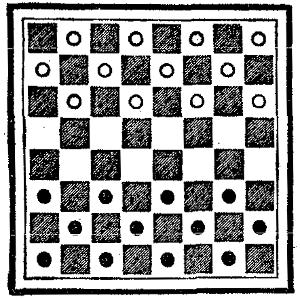
Diagrams. For convenience in illustrating games and problems the men are always shown as placed on the white squares, type made in that manner being more easily read. The following diagram will show the proper arrangement of the men at the beginning of the game, if the white squares are supposed to be black ones:—
Two Move Restriction. It has lately become the custom in important tournaments to write an opening and second move, such as 10-14, 22-17 on a slip of paper; 10-14, 24-19 on another, and so on for all possible openings. These are placed in a hat and when the players face each other, a slip is drawn. If it is 11-15, 22-18, the game must be opened with those moves. When these players start the second game, the one who was second player on the first game begins with 11-15, and his opponent must play 22-18. The same opening is never again used by the same pair, the object being to diversify the play and drive contestants out of their favourite ruts.
The Players are designated by the colour of the men with which they play, White or Black, and Black always has the first move. In a series of games each player in turn takes the black men and the move. It is usual to draw for the first game, one player concealing in each hand a man of different colour, and offering the choice of hands to his adversary. Whichever colour the chosen hand contains the chooser must take for the first game.
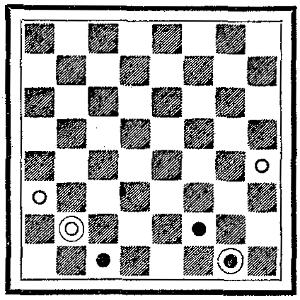
The Moves. The men never leave the colour of the squares on which they are originally set up, so that they always move diagonally. At the beginning of the game the men move only one square at a time, and always forward, and can be placed only on squares which are unoccupied. If an adverse piece stands upon a square to which a man might be moved, and there is a vacant square beyond, the man must jump over the adverse piece to the unoccupied square, at the same time removing from the board the piece so jumped over. In the position shown in Diagram No. 1, for instance, it being White’s turn to move, he must jump over the black man, removing it from the board. Black will then have a choice of two jumps, over one man or over two, and will of course select the jump toward the right of the board first, and then over the second man, removing both from the board. A man may jump over and capture several men at one move, provided there are vacant squares between them, and beyond the last man.
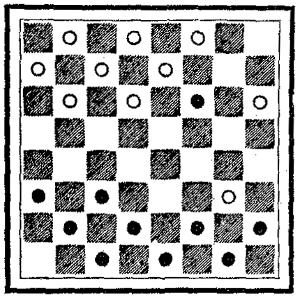
No. 1.
Huffing. If a player who can capture a piece neglects to do so, his adversary has the choice of three things:—To compel the player to take back his move and capture the piece; to huff (remove from the board,) the man that should have captured the piece; or to let the move stand, and go on with his own move. A huff does not constitute a move; the piece is simply removed from the board as a penalty, but the penalty must be enforced before the player exacting it makes his own move.
Kings. When a man arrives at any of the four squares on the edge of the board farthest from the side on which he started, he becomes a King, and is crowned by putting another man of the same colour on the top of him. In diagrams, kings are distinguished by putting a ring round the single man. ⦾ ⦿. Kings can move either backward or forward, but only one square at a time. If a man arrives at the king-row by capturing an adverse piece, that ends the move, and the newly made king cannot move again, even to capture another piece, until his adversary has moved. [See notes to Diagram No. 7.]
The Object of the Game is to confine your adversary’s pieces so that he cannot move any of them; or to capture all of them, so that he has none to move. You may succeed in confining the whole twelve of your adversary’s men, without capturing any of them, as in Diagram No. 2; or such as are left on the board after a certain number have been captured, as in Diagram No. 3.
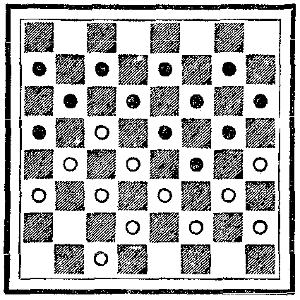
No. 2. White to Move.
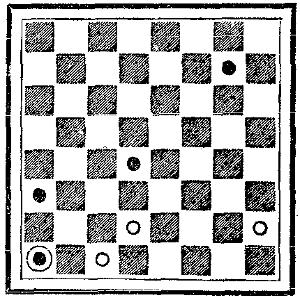
No. 3. White to Move.
Diagram No. 2 is the ending of our Illustrative Game No. 7.
In No. 3, White gives away a man, bottling up the three black men, and then catches the other black man. In both these examples it will then be Black’s move, and as he cannot move, White wins.
Notation. The various moves which take place in the course of a game are recorded by giving each square on the board a number, and putting down the number of the square the man is moved from, and the one it is moved to. Only those squares upon which the men stand are numbered, and the black men are always supposed to be originally placed upon the lower numbers, from 1 to 12; the white men being placed upon the squares numbered from 21 to 32. Diagrams Nos. 4 and 5 show the method of numbering the board, and the men placed in position.
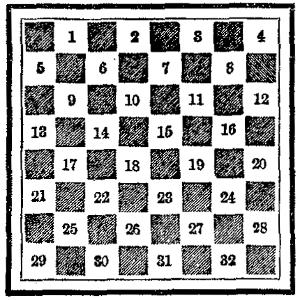
No. 4.
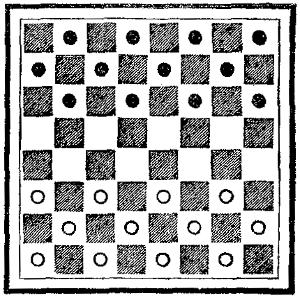
No. 5.
In checker notation the number of the move is never given, as it is in Chess. The moves of the black men are distinguished from those of the white men by being hyphenated, but there are no marks to show when pieces are captured. Letters or figures in the margins are used to refer to possible variations in the play.
Openings. There are a number of standard openings in Checkers which are formed by the preliminary moves on each side. These openings are known by various fanciful names, dear to all checker-players. In the following list they are arranged in alphabetical order for convenience in reference.
ALMA. AYRSHIRE LASSIE. BRISTOL. CENTRE. CROSS. DEFIANCE. DENNY.
11-15 11-15 11-16 11-15 11-15 11-15 10-14
23 19 24 20 24 20 23 19 23 18 23 19
8-11 8-11 16-19 8-11 9-14
22 17 22 17 27 23
3- 8 15-18
DYKE. DOUBLE CORNER. DUNDEE. EDINBURG. FIFE. GLASGOW. KELSO.
11-15 9-14 12-16 9-13 11-15 11-15 10-15
22 17 23 19 23 19
15-19 9-14 8-11
22 17 22 17
5- 9 11-16
LAIRD AND LADY. MAID OF THE MILL. OLD 14TH. PAISLEY. SECOND DOUBLE CORNER. SINGLE CORNER. SOUTER.
11-15 11-15 11-15 11-16 11-15 11-15 11-15
23 19 22 17 23 19 24 19 24 19 22 18 23 19
8-11 8-11 8-11 9-14
22 17 17 13 22 17 22 17
9-13 15-18 4- 8 6- 9
SWITCHER. WHILTER. WILL O’ THE WISP. WHITE DYKE. IRREGULAR OPENINGS.
11-15 11-15 11-15 11-15 11-15 11-15 10-15
21 17 23 19 23 19 22 17 22 17 23 19 22 18
9-14 9-13 8-11 8-11 8-11 15-22
22 17 17 14 25 22 22 17 25 18
7-11
The Middle Game. The best way for the student to learn the manner in which the various openings are followed up, is to play over illustrative games, and in doing so he should be careful always to play with the winning side next him. In selecting openings, take those that show the greatest number of wins for the side you propose to play. In all checker books there are marks at the foot of the column to show which side has an advantage, if any exists, at the end of each variation. The Alma, for instance, shows a great many more winning variations for the black men than for the white, and is consequently one of the best openings for Black.
Any person who plays correctly can always be sure of avoiding defeat; that is, no one can beat him if he makes no slips, and the worst he can get is a draw. It is a common error to suppose that the first move is an advantage. [See Illustrative Game No. 7.]
The strategy of the game consists in so deploying your men that alluring openings are left for your adversary. These openings are always pitfalls of the most dangerous character, and whenever you think a good player has made a mistake and left you a chance, you should examine the position with great care, or you will probably walk into a trap. The first of the example games given in this work is a case in point. White’s move, 27 24, is apparently the best possible, yet it immediately and hopelessly loses the game. Sometimes these traps are set very early in the opening, and sometimes after the pieces have been pretty well developed.
There are many cases in which a good player may take advantage of the weakness of an adversary by making moves which are really losing moves, and which would lead to immediate defeat if he were opposed by an expert. But if he feels that his adversary is not skilful enough to take advantage of these losing moves, a winning position may sometimes be rapidly obtained by departing from the regular development of the opening.
The beginner should be satisfied with learning only one or two forms of the openings, committing to memory as many variations as possible. When he meets with a line of play that beats him, he should study out the variation in his text books, and see at what point he made the losing move. To be perfect in any one opening a person must know at least five hundred variations by heart; but if he finds himself caught in a variation which he does not remember, or has never learned, he should trust to good judgment rather than to defective memory.
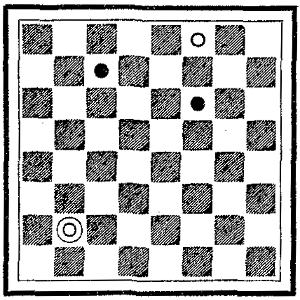
The End Game usually resolves itself into one of four well-known positions. These four positions are those in which there is a win for one side or the other owing to the peculiar position occupied by the opposing forces, although they may be numerically equal. Every checker player must know these four positions thoroughly, or he may abandon many a game as drawn which he could win, and may lose many a game which he could draw. These four positions are here given as they are usually found in the books, but the player must be able to recognize at once any position which resembles them, or can be made to lead up to them. The student will find many games marked as “won” in which he cannot see any winning position unless he is familiar with the four endings. The expert strives to exchange his men so as to bring about one of these positions, after which he knows he has a won game, although his less skilful adversary may be unconscious of his advantage.
First Position.
Black to move and win.
WHITE.
BLACK.
Second Position.
Black to move and win.
WHITE.
BLACK.
Third Position.
Either to move; White to win.
WHITE.
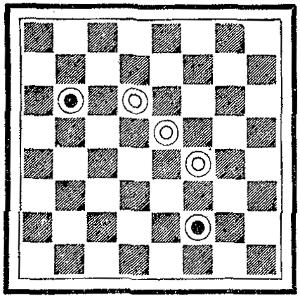
BLACK.
Fourth Position.
Black to play and win. White to play and draw.
WHITE.
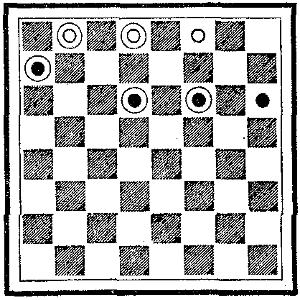
BLACK.
The first position is one of the most common endings on the checker board, and should be very thoroughly understood. The letters in the margin refer to the variations. There are a great many minor variations, for which the student must be referred to Janvier’s Anderson, page 265.
First Position.
27-32
8 11
32-27
11 7
27-23
7 10
22-26
A 10 6
26-31
6 9
31-26
9 6
26-22
6 10
23-18
10 6
18-14
6 1
22-18
1 6
18-15
6 1
15-10
1 5
10- 6
5 1
14-13
1 5
6- 1
5 9
1- 5
9 13
10-14
13 9
14-18
9 6
18-15
30 25
15-18
6 10
5- 1
25 21
1- 5
10 6
18-15
21 17
5- 1
6 9
15-18
17 13
18-15
9 14
1- 5
14 17
15-10
17 22
10-14
22 25
5- 1
25 22
1- 6
22 25
6-10
25 22
10-15
22 25
15-18
25 21
B wins
Var A.
30 25
23-18
10 6
18-14
6 1
26-30
25 21
30-25
1 5
25-22
5 1
22-18
1 5
18-15
5 1
15-10
1 5
10- 6
5 1
14-10
1 5
6- 1
5 9
10-15
B 9 5
15-18
5 9
1- 5
9 6
18-15
21 17
5- 1
6 9
15-18
9 5
18-22
17 14
1- 6
5 1
6- 2
1 5
22-17
14 9
B wins
Var B.
9 14
1- 5
21 17
5- 1
17 13
1- 5
14 17
15-10
B wins
Second Position.
1- 5
8 11
5- 9
11 15
9-14
15 11
14-18
11 16
18-15
16 20
15-11
20 24
3- 7
24 19
7-10
19 23
10-15
23 27
15-19
27 32
19-24
32 28
24-27
28 32
27-31
32 28
31-27
28 32
27-23
32 28
23-18
28 24
18-14
24 19
6-10
19 23
10-15
23 27
15-19
27 32
19-24
32 28
24-27
28 24
27-32
24 28
32-27
28 32
27-24
32 28
24-19
28 32
19-15
32 28
15-10
28 24
10- 6
24 19
14-10
19 24
10-15
24 28
15-19
28 32
19-24
32 28
11-16
28 19
16-23
12 8
23-18
8 4
18-14
4 8
6- 1
8 11
14- 9
13 6
1-10
11 16
10-15
16 20
15-19
B wins
Third Position.
White to move
18 15
A 6- 1
14 9
24-28
23 19
1- 5
9 6
B 28-32
19 24
5- 1
24 19
W wins
Var A.
24-28
23 27
6- 1
14 10
28-32
27 24
1- 5
10 6
W wins
Var B.
5- 1
6 10
W wins
Black to move
6- 1
18 15
C 1- 6
14 10
6- 9
23 19
24-27
15 18
D 27-32
19 24
9- 5
10 14
32-28
24 27
W wins
Var C.
1- 5
14 10
24-28
23 19
28-32
15 18
32-27
10 6
27-32
19 23
5- 1
6 9
W wins
Var D.
9- 5
10 6
27-32
19 23
5- 1
6 9
32-28
23 27
W wins
Fourth Position.
Black to play
28-24
32 28
24-20
28 32
22-18
31 27
23-19
27 31
19-24
32 27
24-28
27 32
18-22
31 27
22-26
30 23
28-24
B wins
White to play
31 27
23-19
27 31
19-24
32 27
24-20
27 32
22-18
31 27
28-24
27 31
18-23
31 26
Drawn
Traps. The beginner should be on his guard against being caught, “two for one,” especially in such positions as those shown in Diagrams Nos. 6 and 7.
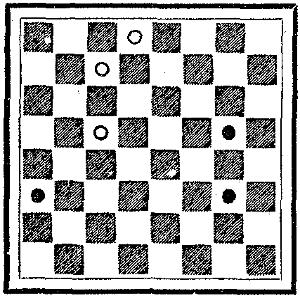
No. 6.
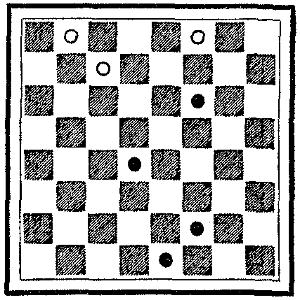
No. 7.
In No. 6, White will play 19 16, forcing you to jump, and will then play 27 23, forcing you to jump again. In No. 7, White will play 30 26, making your man a King. He will then play 32 28, and wait for your newly made King to jump. This will give him three of your men, and he will catch the other before it gets to the king row.
Another common form of trap is to get a player into such a position in the end game, when he has only one or two men, that he cannot get to the king row without being caught; sometimes because he is driven to the side of the board by the man following him, and sometimes because the man meeting him can head him off. The adversary can do this only when he has “the move.”
Theory of the Move. When the position is such that you will be able to force your adversary into a situation from which he cannot escape without sacrificing a piece or losing the game, you are said to have the move; and if he does not change it by capturing one of your men he must lose the game. As the move is often of the greatest importance in the end game, every checker-player should understand its theory, so that he may know when it is necessary to make an exchange of men in order to secure the move, and when he should avoid an exchange which would lose it. The move is only important when the number of men on each side is equal.
In order to calculate the move, the board is supposed to be divided into two systems of squares, sixteen in each. The first system is formed by the four vertical rows running from your own side of the board, as shown by the dotted lines in Diagram No. 8. The second system runs from your adversary’s side of the board, as shown in Diagram No. 9.
FIRST SYSTEM.
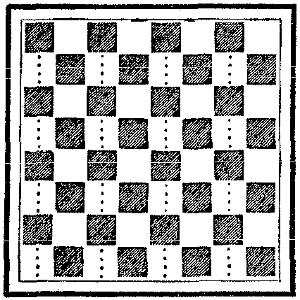
No. 8.
SECOND SYSTEM.
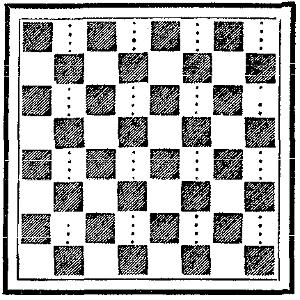
No. 9.
In order to ascertain if you have the move when it is your turn to play, add together all the men, both black and white, in one of the systems, taking no notice of those in the other system, and if the number is odd, you have the move. In Diagram No. 10, for instance, if you have the black men, and it is your turn to play, you will find three men on your own system, and therefore you have the move, and must win by playing 10-15. When White moves, there will again be an odd number of men on your system, and you will still have the move, and he must sacrifice both his men.
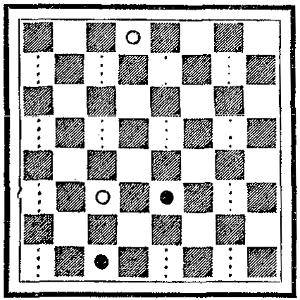
No. 10.
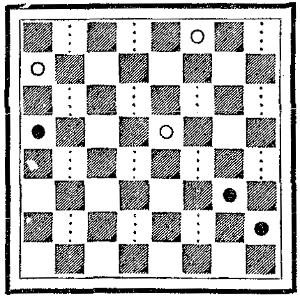
No. 11.
In Diagram No. 11, if you count up the men on either your own or your adversary’s system, you will find that the number is even, and as you have not the move you should force an exchange immediately, which will give it to you, and win the game.
Every single exchange of man for man changes the move when only one of the capturing pieces remains on the board, and the following rule is given for ascertaining how proposed exchanges in complicated positions will affect the move:—The capturing pieces of both black and white in both systems must first be added together, and if the number agrees—in the matter of being odd or even—with that of the number of captured pieces in each system, the move will not be changed; but if one number so found is odd, and the other is even, the move will be changed.
ILLUSTRATIVE GAMES.
The asterisk shows the losing move.
Play with Black Men. Play with White Men.
1 2 3 4 5 6 7
11-15 11-15 10-15 11-15 11-15 11-15 10-15
22 18 23 19 22 18 24 20 22 18 23 19 23 18
15-22 8-11 15-22 8-11 15-22 8-11 12-16
25 18 22 17 25 18 28 24 25 18 26 23 21 17
8-11 3- 8 6-10 4- 8 8-11 4- 8 16-19
29 25 *17 14 29 25 23 19 29 25 30 26 17 14
4- 8 9-18 10-15 * 9-13 4- 8 * 9-13 9-13
24 20 21 17 *25 22 20 16 24 20 19 16 24 20
10-15 18-22 15-19 11-20 10-15 12-19 8-12
25 22 25 18 23 16 22 17 25 22 23 16 25 21
12-16 15-22 12-19 13-22 * 9-13 11-20 12-16
*27 24 26 23 24 15 25 4 20 16 22 17 21 17
15-19 5- 9 9-14 W wins. 12-19 13-22 4- 8
24 15 17 13 18 9 23 16 25 4 29 25
16-19 11-15 11-25 11-20 W wins. 6- 9
23 16 23 18 B wins. 18 4 27 24
9-14 1- 5 W wins. 1- 6
18 9 18 11 32 27
11-25 7-23 6-10
28 24 27 18 27 23
5-14 9-14 8-12
24 19 18 9 25 21
6-10 5-14 2- 6
B wins. B wins. 31 27
3- 8
30 25
W wins.
LOSING GAME. In this variety of Draughts, the object is to give away all your men before your adversary can give away his, or to block yourself so that you cannot move. The secret of success in Losing Game is to get your men on such squares that they cannot be made to jump to the king row. These squares will be the row next you on your own side of the board, and every second row from that, horizontally. Get your men on those squares as soon as possible, and do not be in too great a hurry to capture your adversary’s men.
POLISH DRAUGHTS. Although intended for a special board of 100 squares this game can be played on a common checker board. It differs from ordinary draughts in two particulars:
Although the men can move only forward, they can take backward, and Kings can go any distance at one move.
If in taking a piece, a man arrives at the king row, that does not end the move if he can capture another piece by jumping backward out of the king row again. As this brings him away from the king row before the move is complete, he will not be a king until he can get to the king row at the end of a move.
Kings can go any number of squares in a straight line, and can capture any piece which is on the diagonal, not protected by another piece behind it. Kings can also go on for any number of squares beyond the captured piece, and then turn a corner to capture another piece. In Diagram No. 12, for instance, the black King could capture all six of the white men by going over the first one only, and then turning to the left, and continuing to turn to the left after every capture, as shown by the squares with the numbers on them, which indicate his five successive turning-points.
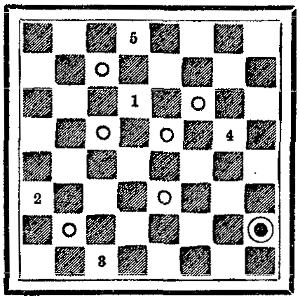
No. 12.
DEVIL AMONG THE TAILORS. This is hardly a variation of the game of Draughts, although it is played on a checker board. Four white men, the tailors, are placed upon 29 30 31 and 32; and one black man, the devil, on 1. The men can move only one square at a time, diagonally; the white men forward only, the black man forward or backward. There is no jumping or capturing, and the object of the tailors is to pin the devil in, so that he cannot move. If the black man can reach the free country behind the white men, he wins the game.
The game is a certainty for the white men if properly played. At the end of four moves they should be lined up on squares 25, 26, 27, 28 and whichever end the devil attacks, the tailors should move in from the other end.
There are two critical positions.
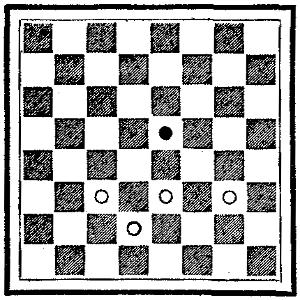
No. 13.
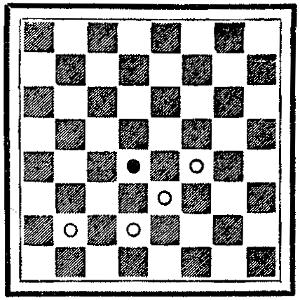
No. 14.
In Diagram No. 13, if White moves 24 19 he loses, because Black goes to 11, and as the tailors advance to head him off, he goes back to 15 and 18, and then gets round by going to 14. White’s proper play is 22 18, after which 26 22 will reform his line.
In Diagram No. 14, if White moves 26 22, or 19 15, he loses immediately. In the first case Black will run to 15 and 11, and either get round or double back to 18. In the second case Black will get round by way of 7, or get through.
CHECKER LAWS.
1. The Standard board must be of light and dark squares, not less than fourteen inches nor more than fifteen inches across said squares.
2. The board shall be so placed that the bottom corner square, on the left hand, shall be black.
3. The Standard men, technically described as White and Black, must be light and dark (say white and red, or yellow and black), turned, and round, not less than one inch, nor more than 1⅛ inches in diameter.
4. The men shall be placed on the black squares.
5. The black men shall invariably be placed upon the real or supposed first twelve squares of the board; the white upon the last twelve squares.
6. Each player shall play alternately with the white and black men, and lots shall be cast for the colour only once, viz., at the beginning of the play—the winner to have his choice of taking black or white.
7. The first play must invariably be made by the person having the black men.
8. At the end of five minutes [if the play has not been previously made], “Time” must be called by the person appointed for that purpose, in a distinct manner; and if the play is not completed in another minute, the game shall be adjudged lost through improper delay.
9. When there is only one way of taking one or more pieces, time shall be called at the end of one minute, and if the play is not completed in another minute, the game shall be adjudged lost through improper delay.
10. Either player is entitled, on giving intimation, to arrange his own or his opponent’s pieces properly on the squares. After the first move has been made, however, if either player touch or arrange any piece without giving intimation to his opponent, he shall be cautioned for the first offence, and shall forfeit the game for any subsequent act of the kind.
11. After the pieces have been arranged, if the person whose turn it is to play touch one, he must either play it or forfeit the game. When the piece is not playable, he forfeits according to the preceding law.
12. If any part of a playable piece is moved over an angle of the square on which it is stationed, the move must be completed in that direction.
13. A capturing play, as well as an ordinary one, is completed whenever the hand has been withdrawn from the piece played, although one or more pieces should have been taken.
14. The Huff or Blow is to remove from the board, before one plays his own piece, any one of the adverse pieces that might or ought to have taken but the Huff or Blow never constitutes a play.
15. The player has the power to huff, compel the capture, or let the piece remain on the board, as he thinks proper.
16. When a man first reaches any of the squares on the opposite extreme line of the board, it becomes a King, and can be moved backward or forward as the limits of the board permit, though not in the same play. The adversary must crown the new King, by placing a captured man on the top of it, before he makes his own move.
17. A player making a false or improper move forfeits the game to his opponent.
18. When taking, if either player removes one of his own pieces, he cannot replace it; but his opponent can either play or insist on the man being replaced.
19. A Draw is when neither of the players can force a Win. When one of the sides appears stronger than the other, the stronger is required to complete the Win, or to show a decided advantage over his opponent within forty of his own moves—to be counted from the point at which notice was given,—failing which, the game must be abandoned at Drawn.
20. Anything which may annoy or distract the attention of the player is strictly forbidden; such as making signs or sounds, pointing or hovering over the board, unnecessarily delaying to move a piece touched, or smoking. Any principal so acting, after having been warned of the consequence and requested to desist, shall forfeit the game.
21. While a game is pending, neither player is permitted to leave the room without giving a sufficient reason, or receiving the other’s consent or company.
22. A player committing a breach of any of these laws must submit to the penalty, which his opponent is equally bound to exact.
23. Any spectator giving warning, either by sign, sound, or remark, on any of the games, whether played or pending, shall be expelled from the room.
24. Should any dispute occur, not satisfactorily determined by the preceding laws, a written statement of facts must be sent to a disinterested arbiter having a knowledge of the game, whose decision shall be final.
TEXT BOOKS.
Spayth’s Checkers for Beginners.
Game of Draughts, John Robertson.
Janvier’s Anderson.
Bowen’s Bristol.
Bowen’s Cross.
Bowen’s Fife.
E.T. Baker’s Alma.
Scattergood’s Game of Draughts.
Lyman’s Selected Problems.
Backgammon and Draughts, by Berkeley.
Anderson’s Checkers.
Dunne’s Draught Proxis.
Kear’s Sturges.
BACKGAMMON. OR TRIC-TRAC.
Backgammon is played by two persons, each of whom is provided with fifteen men, two dice, and a dice-box. The men on each side are of different colours, black and white, and the players are distinguished by the colour of the men with which they play. The board is divided into two tables, inner and outer, and at the beginning of the game the men may be set up in either of the positions shown in the diagram.
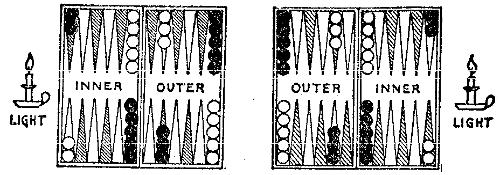
It will be observed that the black men on any point have exactly the same number of white men standing opposite them. In one table there are only two upon one point, and in the other there are only three upon one point. The table with the two men is always the inner table while the one with three is always the outer table. This distinction is important, and may be remembered by observing that the number of letters in the words in and out are two and three respectively.
In setting up the men the inner table is always placed toward the light, whether it be a window or the gas. Each player must always have the majority of his men, five and three, on the side nearer him; and the minority, five and two, on the side farther from him. The side of the inner table which is nearer the player will always be his home table. In all the illustrations in this work you are supposed to be playing with the black side next you, and with your inner or home table on your left hand.
The raised portion or hinge of the board, which divides the inner from the outer tables, is known as the bar, and the points, or flèches, in each player’s home table are numbered from 1 to 6, reckoning from the outer edge toward the bar. These six points are spoken of as the Ace, Deuce, Trey, Four, Five and Six points respectively, and they correspond to the six faces on a single die. The points in the outer tables have no numbers, but the one next the bar on each side is called the bar point. In giving the moves of the men in a game, the names of the six points in the home tables are disregarded, and each player, Black and White, numbers the board from 1 to 24, starting from the square on which he has only two men. The notation for the black moves would be as shown in the margin; that for white being exactly opposite, of course.