THE WHIST FAMILY. (continued 2)
Reading edition
Do not lead trumps from the strong trump hand if it would be to your advantage to put the other hand in the lead with a plain suit, so as to let the trump lead come from the weaker hand to the stronger, as when a finesse in trumps is desirable.
Do not lead trumps if you have no good plain suit, and can make more tricks by playing for a cross-ruff.
Do not lead trumps if the weaker hand can trump some of your losing cards first. It often happens that a losing trump can be used to win a trick before trumps are led.
At No-trump. The declarer’s first care in a no-trumper must be to select the suit that he will play for. Four simple rules cover this choice:—
1. Always lead from the weak hand to the strong if the suit is not already established.
2. Play for the suit in which you have the greatest number of cards between the two hands, because it will probably yield the greatest number of tricks.
3. If two suits are equal in number, play for the one in which you have the greatest number of cards massed in one hand. That is, if you have two suits of eight cards each, select the one that has six of those cards in one hand, in preference to the suit with four in each hand.
4. Everything else being equal, play for the suit which is shown in the Dummy, so as to conceal from the adversaries as long as possible the strength in your own hand.
A suit is said to be established when you can win every remaining trick in it, no matter who leads it. As it is very important that the hand which is longer in the suit should be able to lead it without interruption when it is established, good players make it a rule always to play the high cards from the shorter hand first, so as to get out of the way. With Q 10 and three others in one hand, K J and one other in the other hand, the play is the K and J from the short hand, keeping the Q 10 in the long hand.
If there is any choice, that suit should be selected which contains the longest sequence, or the sequence with the fewest breaks. It should be noticed that the sequence need not be in one hand; for it is almost as valuable if divided, and it is especially advantageous to have the higher cards concealed in the declarer’s hand. Its continuity is the chief point. For instance: Declarer and Dummy hold between them one suit of K J 9 7 5 4 3, and another of Q J 10 9 8 7 5. The latter should be selected, because two leads must establish it.
In establishing a long suit it is very important to note the fall of the missing cards in the sequences. In the first of the two combinations just given, the declarer should be as careful to watch for the fall of the 8 and 6 as for the A Q and 10.
Leading. It is quite unnecessary to follow any system of leads, further than to distinguish between the combinations from which high or low cards are led. But it is important to remember that although a high-card combination may be divided, it should be played as if in one hand. For instance: The declarer holds Q J x x x of a suit; Dummy having A x x. By leading Q or J, Dummy is enabled to finesse, as if he held A Q J. The declarer holds K J x x x; Dummy having Q x x. The play is to force the Ace, as if the combination of K Q J x x were in one hand.
Many opportunities arise for leading the Ace first from a short suit, in order to secure a ruff on the second or third round.
Second Hand Play. If any card is led by the adversaries which the fourth hand cannot win, the second hand should cover it if possible; for unless he does so, his weakness will be exposed, and the suit will be continued. This is especially true of cases in which the second hand holds single honours, such as Jack and others, or Queen and others. Even the King should be played second hand in such cases, unless it is so well guarded that the Ace must fall before the King can be forced out.
If the fourth hand can win the card led, it is seldom necessary to cover second hand. For instance: If the Jack of trumps is led, the dealer holding Q 9 7 4, and Dummy having A 6 3 2; there is no need to play the Queen. If the King is in third hand, such play would establish the Ten. If the King is with the leader, it or the Ten must make. If Dummy were second hand with the same cards, Jack being led, he should not play the Ace, for third hand must play the King to shut out the Queen.
With A Q 9, partner having K and others, it is best to play A on J led.
If the dealer has Ace and several others of a suit led, Dummy having only two small cards, a force may be certainly secured by passing the first round. If Dummy has the Ace, and passes second hand, the dealer failing to win the trick, the adversaries will of course see that the play is made in order to force the dealer on the third round.
If Dummy is weak in trumps, and has only one card of a suit in which the dealer has Ace and others, the Ace should be played, and Dummy forced, unless there is a better game.
It is a disadvantage to play in second hand from suits in which each has a guarded honour. If the dealer has Q x x, and Dummy has J x, they must make a trick in that suit if they play a small card second hand, and avoid leading the suit. The same is true of the adversaries; but they must play on the chance that the partner has the honour, whereas the dealer knows it.
Finessing. This is a very important part of the strategy of the game for the dealer. The adversaries of the dealer never finesse in bridge; but the dealer himself relies upon finessing for any extra tricks he may want.
A finesse is any attempt to win a trick with a card which is not the best you hold, nor in sequence with it. Suppose you have Ace and Queen in the hand which is longer in the suit and lead from the shorter hand a small card. If you play the Queen, that is a finesse, because you hope to take a trick with it, although the King is against you.
It is usually bad play to finesse when there are nine cards of the suit between the two hands, dealer’s and Dummy’s, because there is a good chance that the card you wish to finesse against may fall.
When it will be necessary to take two finesses in the same suit, the lead must come twice from the weaker hand. Suppose the dealer holds A Q J and others. If the first finesse of the Jack wins, he should put Dummy in again, so as to take a second finesse of the Queen. Suppose the dealer holds A J 10, and finesses the ten the first time. If it falls to the Queen, he should get Dummy in again, so as to take the second finesse with the Jack. The idea is to take advantage of the fact that the odds are against both King and Queen being in one hand. If they are both on the right, one of them will be played on the small card led from Dummy, and then the dealer can win it with the Ace and force out the other high card with his Jack, which will have become one of the second and third-best of the suit.
Re-entry Cards. After a suit has been cleared, or established, it will be necessary to get into the lead with it. For this purpose the dealer must be careful to preserve a re-entry card in the hand which is longer in the suit. Suppose that Dummy’s long suit is clubs, but that the Ace is against him, and that his only winning card outside is the Ace of diamonds. If diamonds are led, and the dealer has the Queen, he must let the lead come up to his hand so as to keep Dummy’s Ace of diamonds for a re-entry to bring the clubs into play after the Ace has been forced out and the suit established. Many of the prettiest plays in bridge are in the management of re-entry cards.
Underplay. When the dealer is afraid of a suit which is opened against him, and has only one winning card in it, such as the Ace, he should hold up that card until the third hand has no more of the suit to lead to his partner. The original leader will then have to get in himself, because his partner cannot help him; but if the dealer gave up the Ace on the first trick, it would not matter which partner got into the lead, they would return to the suit first opened.
Ducking. This is a method of play by which the dealer hopes to make his own suit even when the hand that is longer in it has no re-entry card. Suppose Dummy holds six clubs to the Ace King, and not another trick in his hand. The dealer has two small clubs only to lead. If the two winning clubs are led right out, it is impossible to catch the Q J 10, no matter how those cards lie, therefore the dealer leads a club, but makes no attempt to win the first round. No matter what is played by the adversaries he ducks the first round, keeping his Ace and King. Next time the dealer gets in, he leads another club, and now he is able to win the second and third rounds of the suit, and will probably catch all the adverse cards and establish it.
The dealer’s play always requires careful planning of the whole hand in advance.
THE NULLO. Although not yet in the official laws of the game, this bid seems to be a popular one with many players. It is a contract to lose tricks instead of winning them, and is primarily a defence against overwhelmingly strong no-trumpers. A bid of three nullos means that the declarer will force his opponents to win nine tricks, he winning four only, so that each trick under seven counts for the nullo player on his side.
SCORING. There is some difference of opinion as to the proper value for the nullo, but the general verdict seems to be to put it just below the no-trumper at 10 a trick, no honours. Two no-trumps will outbid two nullos. If the adversaries of a nullo revoke, the declarer can give them three of his tricks, or take 100 in honours as penalty. If he revokes, they take 100 penalty as usual.
SUGGESTIONS FOR BIDDING. The dealer should never bid a nullo originally, as it gives his partner no information as to the distribution of the suits. When any player has one long suit good for either no trumps or nullos, such as A K Q 6 4 2, he should “shout,” bidding a trick more than necessary. Singletons and missing suits are valuable parts of a nullo hand, as they afford opportunities for discards. It is always dangerous to bid a nullo without the deuce of the longest suit. If the dealer bids a spade, his partner may safely bid one nullo, because the contract is seldom or never obtained for less than two or three, but he should not persist in the nullo if his partner does not assist it. The greater the opposition from a no-trumper, the more probable that the nullo will succeed, but it is a dangerous declaration in any case. The player with aces and kings is sure to win tricks, regardless of his partner’s hand, but deuces and treys are not sure to lose, as the partner may have all high cards, although not the tops.
SUGGESTIONS FOR THE PLAY. The declarer should count up the tricks he must win, and as a rule win them early, bunching his high cards as much as possible. Suits with two small cards and two high ones must win one trick, but should escape with that. The great point is to lead losing cards from one hand and discard dangerous cards in other suits from the other hand whenever possible.
The opponents of a nullo should lead their shortest suits, so as to get discards later, keeping their eyes on the dummy and forcing it to win tricks whenever possible, but never allowing it to get a discard. The partner’s leads should be returned unless a singleton can be led at once. It is usual to lead the top of two cards, the intermediate of three or more, and to avoid leading suits that are safe, with small cards at the bottom.
ILLUSTRATIVE AUCTION HANDS.
Z is the dealer in both instances, but Y makes the winning declaration, so that B leads for the first trick. The first illustration is straight auction; the second is a nullo. The underlined card wins the trick and the card under it is the next one led.
A Y B Z A Y B Z
Q♠ 2♠ 9♠ ♣2 1 A♢ Q♢ J♢ 9♢
A♠ 6♠ 8♠ ♡3 2 K♢ 6♢ 8♢ 5♢
K♠ 10♠ 4♠ ♡7 3 10♢ 4♢ ♡A 3♢
5♠ J♠ 3♠ ♡J 4 J♠ 3♠ 9♠ A♠
2♢ Q♢ 4♢ 5♢ 5 5♠ Q♠ K♠ 6♠
10♢ 9♢ 7♢ J♢ 6 ♣Q ♣6 ♣J ♣K
♡4 3♢ 8♢ A♢ 7 7♢ ♡J ♡5 ♡10
7♠ ♡5 ♡9 K♢ 8 10♠ ♡7 ♡Q ♡9
♡8 ♣3 ♡2 6♢ 9 ♣5 ♣4 ♣2 ♣3
♣4 ♣Q ♣10 ♣9 10 7♠ 2♠ 4♠ ♡K
♣5 ♣A ♡6 ♣7 11 ♣10 ♡4 ♣A ♡8
♣8 ♣K ♡10 ♡Q 12 ♣8 ♡3 ♣9 ♡6
♣J ♣6 ♡A ♡K 13 ♣7 2♢ 8♠ ♡2
In the first example the dealer, Z, bids a heart. A says one royal and Y two clubs. This bid of Y’s denies any support for his partner’s hearts, but shows a supporting minor suit, in case Z is strong enough to go on with the hearts. B bids two royals as he can stop the hearts twice and ruff the clubs. Z cannot pursue the hearts, but shows his supporting minor suit, bidding three diamonds. This says to Y, “Go no trumps if you can stop the spades.” When A passes, having bid his hand on the first round, Y goes two no trumps and makes game. B leads the top of his partner’s declared suit, and A leads a fourth round, hoping to get in with the club jack. At tricks 8 and 9, B signals control in hearts. A keeps the protection in clubs to the end and saves a trick by it. Y keeps two clubs in dummy, so that if club is led, he will have one to return after he has made his diamonds.
In the second example, they are playing nullos, Y declaring. The points in the play are holding the spade queen, so as to lead a diamond or a spade at trick 6. This B prevents, hoping to force two clubs on Y and Z and set the contract. At trick 7, if the hearts are split, the queen must win the ten. If not, Z must win one heart trick. Y makes his contract, losing four odd.
BRIDGE.
The difference between straight bridge, as it is sometimes called, and auction is in the method of selecting the trump, which must be declared by the dealer or his partner, the opponents having nothing to say except to double the declaration if they think it will not win the odd trick. Another point is that either side can score toward game by getting the odd trick or more, there being no penalties for failure to make the odd except losing the value of the tricks because the dealer never declares to make any given number of tricks on the hand.
There are some irregularities which are peculiar to straight bridge that would not apply to auction. These are fully covered by the following description of the game, all other matters, such as the correct card to lead and the manner of combining the hands, have been fully described in connection with auction.
MAKING THE TRUMP. This is the chief peculiarity in bridge. The trump is not turned up, but the suit is named by the dealer or his partner, after they have examined their cards. In order properly to understand the considerations which guide them in making the trump, one should first be familiar with the values attached to the tricks when certain suits are trumps. The first six tricks taken by one side do not count; but each trick above that number counts toward game according to the following table:—
When Spades are trumps, each trick counts 2 points.
” Clubs ” ” ” ” ” 4 ”
” Diamonds ” ” ” ” ” 6 ”
” Hearts ” ” ” ” ” 8 ”
” there is no trump, ” ” ” 12 ”
Better to understand the importance of this variation in value, it should be noticed that the game is 30 points; so that if two partners won 3 by cards with no trump, or 4 by cards with hearts for trumps, they would win the game in one deal. On the other hand, if either of the black suits were trumps, they could not lose the game, even if a slam were made against them.
It will thus be evident that two considerations influence the player whose privilege it is to make the trump: First, to win as much as possible, if he has the cards to do it. Second, to save himself, if he is weak; or the game, if it is in danger. As a general proposition, it may be said that his decision will be indicated by the colour of the trump he names. If it is red, he is strong, and plays to win; if it is black, he is taking to the woods. A further element may enter into his calculations, the state of the score. If he feels sure of the few points necessary to win the game or the rubber with a black trump, there is no necessity to risk making it red. This is a part of the subject which we shall go into further when we come to the suggestions for good play.
The dealer has the first say in making the trump. If he does not feel himself strong enough to make it no trump, or red, although his hand may be black enough to promise a good score in clubs or spades, he should transfer to his partner the privilege of making the trump by saying: “I leave it to you, partner.” Guided by this indication, his partner must fix on some suit for the trump or go no-trumps, and must announce it.
Either the dealer or his partner may elect to play without a trump, if he has sufficient strength in all the suits to do so.
IRREGULARITIES IN DECLARING. If the dealer’s partner makes a declaration before being asked to do so, either adversary may demand that the declaration shall stand, or that there shall be a new deal. In England, only the eldest hand, A, may exact the penalty. If the dealer’s partner passes the declaration to the dealer, either adversary may claim a new deal or may insist that the player in error shall make the declaration. In England, the eldest hand exacts this penalty.
Should an adversary of the dealer make a declaration, the dealer may, after looking at his own hand, either have a new deal or proceed as if nothing had been said.
SETTLING THE VALUE OF THE TRICKS. The trump suit having been announced, the first hand or leader, A, before he plays a card, has the privilege of doubling the value of the tricks if he thinks the opponents cannot win the odd trick with the trump named. To do this, he simply says: “I double.” If he does not feel justified in doubling, he transfers the opportunity to his partner, by asking him: “Shall I play?” That is to say, “shall we play without doubling?” If his partner will not double, he answers: “Yes.” Either A or B having doubled, it becomes the privilege of the player who made the trump to double him again; making the value of the trick four times greater than that given in the table. If he does not do so, he says: “I pass”; and his partner then has the privilege. If either the dealer or his partner doubles, the adversary who first doubled may repeat it; or if he passes, his partner may double. This doubling may be continued until the value of each trick over the book is 100 points, when it must cease.
IRREGULARITIES IN DOUBLING. If the pone doubles before his partner has asked him “Shall I play?” the maker of the trump shall say whether or not the double shall stand. If he allows it to stand it may be redoubled. Should a player redouble out of turn, the one whom he redoubles shall have the right to say whether or not the redouble shall stand.
Any consultation between partners as to doubling or redoubling will entitle their adversaries to insist on a new deal.
If the eldest hand leads without asking his partner’s permission to play, the pone cannot double without the consent of the maker of the trump. Should the pone ask the eldest hand, “Shall I play?” that does not deprive the eldest hand of the right to double.
METHOD OF PLAYING. The trump suit and the value of the tricks settled, the player on the dealer’s left begins by leading any card he pleases. After he has played, the second player, Y, lays his hand face up on the table, and takes no further part in the play beyond availing himself of the privilege of asking his partner if he has none of a suit to which he renounces. From the moment that Y’s cards are exposed the game becomes Dummy, the dealer, Z, playing Y’s cards for him.
The dealer gathers the tricks for his side; either adversary may gather for the other. The first six tricks taken by one side make a “book” and all over six count toward game. The tricks should be so laid that they can be readily counted by any player at the table.
The Revoke. Should a player fail to follow suit when able to do so, it is a revoke. Dummy cannot revoke under any circumstances; but the penalty for any other player is the loss of three tricks for each revoke made, which are taken from the side in error at the end of the hand. In England, the penalty may be exacted in any of three ways; three tricks, or the value of three tricks in points, or the addition of a like amount to opponent’s score. A slam cannot be scored if the tricks necessary to make it were taken for the revoke penalty. The side making a revoke cannot win the game that hand, no matter what they score; but they may play the hand out, and count all they make to within two points of game, or 28. Players cannot score a slam in a hand in which they have revoked.
Exposed Cards. If the dealer or his partner exposes a card before the declaration has been made, either adversary may claim a new deal. If any player exposes a card before the first card is led, his partner forfeits the right to double or redouble. If the pone exposes a card in this manner, the dealer may call it an exposed card, or he may require the eldest hand not to lead that suit.
If, during the play of the hand, either adversary of the dealer exposes a card, by playing two cards at once, dropping one face up on the table, or holding it so that his partner can see any portion of its face, the card so exposed must be left face upward on the table, and is liable to be called.
Exposed cards can be called by the dealer at any time, but he cannot compel the play of a card which would constitute a revoke.
Leading Out of Turn. If either of the dealer’s adversaries lead out of turn, the dealer may either call the card exposed, or may call a suit when it is the turn of either adversary to lead. If the dealer leads out of turn, there is no penalty, but he cannot correct the error if the second hand has played.
Cards Played in Error. If any player but the Dummy omits to play to a trick and does not correct the error until he has played to the next trick, his adversaries may claim a new deal. If any one, excepting Dummy, plays two cards to a trick and does not discover it, he is responsible for any revokes that he may make in consequence of not having the card in his hand.
OBJECT OF THE GAME. As in all members of the whist family, the object in Bridge is to win tricks, the highest card played of the suit led winning, and trumps, if any, winning against all other suits. At the end of each hand the side that has won any tricks in excess of the book, scores them, after multiplying their number by the unit of value settled upon by the doubling, if any took place. As soon as either side reaches or passes 30, they win the game; but the hand must be played out, and all tricks taken must be counted. The total is written on the score-sheet; the score of the losers standing to their credit until the final accounting at the end of the rubber.
RUBBERS. Three games, of 30 points each, constitute a rubber; but if the first two are won by the same players, the third is not played. The side winning the majority of the games adds 100 (rubber) points to its score.
SUGGESTIONS FOR GOOD PLAY. The points which the beginner may profitably study in Bridge are chiefly in making the trump, and in the methods by which the hands of the partners are combined, so as to work together.
Making the Trump. The bridge player’s first consideration should be the state of the score, which will show how many points he needs to win the game. Let us suppose this number to be 12, he having already scored 18. These 12 points can be made by winning six by cards with spades for trumps; three by cards with clubs; or two by cards with diamonds or hearts. But if the hand can be played without a trump, the odd trick wins the game.
It is hardly necessary to say that a player would be very foolish to engage himself to win six by cards if the odd trick would equally answer his purpose; nor would he undertake to win three by cards with clubs for trumps, if he had as good a chance of making two by cards with diamonds or hearts. In other words, the player should not make the trump which promises the greatest number of tricks, but should select that which will yield the largest number of points.
It is for this reason that every good player first considers the advisability of making it “no-trump,” and if he thinks that injudicious, hearts or diamonds, leaving the black suits as a last resort.
It is the custom invariably to make it no-trump with three Aces, unless the hand is strong enough for a heart make, or holds great honour value in red.
In estimating the probabilities of trick-taking, it is usual to count the partner for three tricks on the average. Conservative players do not depend on him for more than two. Generally speaking, the maker of the trump should have four pretty certain tricks in his own hand.
The dealer should seldom announce a black trump unless he has a certainty of the game in his own hand, without any assistance from his partner, or unless he has such a poor hand that he must make it a “defensive spade.” If he cannot safely make it no-trump or red, he should pass, and allow his partner the chance. With such a hand as seven clubs, including four honours, and absolutely worthless cards otherwise, the dealer should make it clubs, except when the adversaries have won the first game, and are about 20 points in the second. This makes it not unlikely that they will win the rubber on the next hand with their deal. Under such circumstances the dealer must invariably leave it to his partner, in the hope that he can save the rubber by making it no-trump.
The dealer’s partner should be aware that there cannot be any reasonable hope of four tricks in red in the leader’s hand, or a red trump would have been announced; and unless he has at least five probable tricks in his own hand he should not make it red. With three Aces he should make it no-trump. Four Aces is always a no-trumper, no matter what the rest of the hand may be. If he is obliged to make it black, and has three or four probable tricks, he should announce whichever suit he is best in. Attention should be paid to the score; for in many instances the suit must be selected so that the adversaries cannot win the game with the odd trick, even if they double.
Doubling. The dealer or his partner having announced the trump, the adversary should carefully consider the score before doubling or playing. Most players consider themselves justified in doubling when they have six reasonably certain tricks in their own hands, trusting partner for one only. Great caution should be used in doubling no-trumpers, the position of the lead being carefully studied; because the odd trick usually settles the fate of the game when a no-trumper is doubled. While a player with the lead, and seven certain tricks in one suit, should double a no-trumper, his partner would be very foolish to do so, unless he had, in addition to his long suit, the heart ace; for it is a conventionality of the game for A to lead hearts if B doubles a no-trumper.
The original maker of the trump should be very strong to justify him in redoubling the adversary. If he had four probable tricks originally, he may count the adversary who doubles for five, and of the four doubtful tricks remaining, the odds are against partner having the three which would be necessary to win the odd trick.
Opening Leads. The first lead must necessarily be made in the dark, but the selection of the suit will often depend on the trump, and whether it was named by the dealer or by his partner.
If the dealer has made it red, and A has the A K of any plain suit, he should play the King, so as to retain the lead until Dummy’s hand is exposed.
If the dealer passes it to his partner, he is probably weak in red. If Y makes it hearts, A should lead a supporting diamond, unless he has strength in another suit. If Y has made it diamonds, A should lead a supporting heart. But in either case, if A has in his hand such cards as A K, even of a black suit, he should play the King, and wait to see the Dummy’s hand. If Y has made it black, A must be guided by his own cards, but should give a red suit the preference for his opening lead.
Details as to the correct card to lead and the play after the opening lead have been fully covered in connection with auction bridge, which see.
The discard is usually coupled with the system of opening against a doubled no-trumper. If your partner says he is “heart and strong” he means that if you double a no-trumper and he is eldest hand, he will lead you his best heart, and that he will discard his strong suit when playing against a no-trumper. If he says he is “heart and weak,” he will lead the top heart; but he will discard his weak suit. If he says he is “weak and weak,” he means that he will lead the shortest or weakest suit in his hand, if you double no-trumps, that being the almost universal custom in England.
All the situations which have been covered in the play of the second, third and fourth hands at auction can be studied with advantage by the bridge player, as the manner of securing the best results from certain distributions of the cards is the same in both games. The chief difference lies in the value of the tricks, because at bridge the opponents of the declaration can score toward game, and it is therefore frequently advisable to take a finesse or make a play that would be quite unjustifiable at auction, if there is any chance that such a play may win a game that would be otherwise impossible.
Close attention to the score is an important factor in bridge which does not operate in auction, because in that game any previous score toward game is seldom of any use, eighteen out of every twenty deals being game hands or nothing, and the dealer having no more advantage in the selection of the trump than any other player. In bridge, one always calculates that the dealer will go out if he is 18 or 20 up on the score, as almost any suit will do. This prompts the side that has the deal, or a chance to go game, to lose no opportunity to win at once, before the other side gets a chance at it.
ILLUSTRATIVE BRIDGE HANDS.
The dealer is Z in both instances. In the first example, he makes it no-trump. In the second, Dummy, Y, makes it no-trump. A leads in both cases:—
A Y B Z A Y B Z
7♢ 3♢ J♢ K♢ 1 ♡6 ♡A ♡7 ♡3
♣Q ♣2 ♣K ♣J 2 ♣5 ♣K ♣3 ♣2
A♢ 8♢ 6♢ 2♢ 3 ♣8 ♣10 ♣7 ♣J
4♢ Q♢ 2♠ 5♢ 4 5♢ 3♢ ♣A ♣4
♣4 ♣3 ♣A ♣10 5 ♡K ♡2 ♡9 ♡J
♡3 ♡5 ♡J ♡A 6 ♡5 ♡4 6♢ ♡Q
8♠ ♣9 ♡2 ♣8 7 5♠ 3♠ 6♠ ♣Q
9♠ ♣7 3♠ ♡4 8 7♢ 4♠ 8♠ ♣9
♡6 ♣6 4♠ ♡Q 9 9♢ 4♢ 10♠ ♣6
♡9 ♣5 ♡8 7♠ 10 A♠ 9♠ J♠ 7♠
9♢ J♠ 5♠ Q♠ 11 ♡10 Q♠ 8♢ 2♠
10♢ ♡7 6♠ A♠ 12 ♡8 K♠ 10♢ 2♢
♡K ♡10 K♠ 10♠ 13 K♢ A♢ Q♢ J♢
The first of these examples shows the importance of playing for the suit which is longest between the two hands. Observe that the dealer plays the high cards from the hand which is shorter in the suit, and on the second round of clubs is careful to give up the higher of two cards, so as to get out of Dummy’s way and clear, or establish, the suit. B, hoping to get his partner into the lead again, leads a heart up to Dummy’s weakness, and leads a heart which will beat Dummy’s best heart. At the eleventh trick, unless the dealer can make two tricks in spades by the finesse, he cannot win the game.
The second example shows the importance of preserving a re-entry card in the hand which is longer in the suit the dealer intends playing for. If the dealer lets the heart come up to him, it is true that he will make win the first trick with the Jack; but he will never win a trick with the Queen, and therefore he can never get in to make his clubs, even if he establishes them. By putting up the Ace of hearts, and keeping both Q and J in his own hand, he is certain of a re-entry in hearts. On the second round of clubs, the adversary still holding up or underplaying, the dealer must be careful to overtake Dummy’s ten with his own Jack, so as to continue the suit without losing the lead.
VARIETIES OF BRIDGE.
THREE HAND AUCTION. This is a game for three active players only, but four may form a table. Each player is for himself, there being no partnerships except the temporary combination against the declarer for each deal. The player who cuts the lowest card chooses his seat and cards and the player with the next lower cut sits on his left, the other on his right.
The cards are dealt one at a time into four packets, of thirteen each, just as in the ordinary game of auction, the odd hand remaining untouched until the winning declaration is decided. The dealer makes the first bid and then each bids in turn until two pass. The penalty for bidding out of turn is 50 points added to the score of each opponent, for doubling out of turn it is 100. If both pass the irregularity there is no penalty, but if only one passes, the third may call attention to it.
The highest bidder takes up the dummy hand, sorts it and lays it on the table opposite him, face up, as soon as the eldest hand leads a card. If there is a player sitting opposite the highest bidder, he moves to the vacant seat.
The game is 30 points, and the winner of a game adds 125 points to his score at once. The first player to win two games not only adds the 125 for the second game, but 250 more for winning the rubber. Honours are scored by each player separately, every honour being worth as much as a trick in that suit. Four or five in one hand count double. At no trump, the aces count for 10 each to the holders, four in one hand 100. The declarer scores his dummy’s honours.
At the end of the rubber, each wins from or loses to each of the others. The score is usually made up in this way, the final amounts to the credit of each being shown in the top line:
A, 240 B, 980 C, 456
-740 +740 +215
-215 +524 -524
-955 +1264 -309
DUPLICATE AUCTION. This game may be played in any of the ways described for the movement of trays and players under the head of duplicate whist. Tricks and honours are scored as usual, but there are no games or rubbers. Should the declarer make 30 or more points on a single hand he gets 125 points bonus in the honour column. This game is now covered by the official laws for auction, which see.
BRIDGE FOR THREE. Sometimes called Dummy Bridge, or Cut-Throat. The lowest cut deals the first hand and plays the Dummy. If the dealer will not declare on his own cards, he passes, and Dummy must declare according to a fixed schedule. With three or four aces; no-trumps, no matter what the rest of the hand may be. With less than three aces, Dummy cannot make it no-trumps under any circumstances; but must name the longest suit. If two suits are equal, the pips on each are counted, reckoning aces as 11 each, other honours at 10 each, and the larger number of pips is the suit. If this is still equal, the more valuable suit must be declared.
No one but the eldest hand may double, and no one but the dealer may redouble. In order to make this fair for both sides, it is usual to let the pone sort and declare on Dummy’s cards, so that the dealer shall not see them until the first card is led.
No matter what points are made for tricks, the dealer only can score them below the line, to count toward game. If the adversaries make the odd trick, they score above the line, in the honour column, so that no one can go out except on his own deal.
After the deal is finished and scored, the players move, so as to bring about a change of partners. The one on the left of the vacant place moves into it, and the player on his right deals. Three of these movements bring about the original position.
Each player’s score is kept individually, and when one of the three has won two games, the scores are added up and balanced, after giving the winner 100 rubber points. Each then pays the difference to the others. Suppose the winner to be A, with 320; B having 80 and C 64. A wins 240 from B and 256 from C; while B wins 16 from C.
BRIDGE FOR TWO. Sometimes called “Chinese Bridge.” The dealer gives his adversary four cards face down, and then deals four to himself, also face down. He then distributes the remainder of the pack by dealing to his adversary and himself alternately, one card at a time, keeping them separate from the first four. Without lifting or looking at any of these twenty-two cards, each player places eleven of them in two rows, face down, and then the other eleven on the top of the first, but face up. This gives each player eleven cards face up on the table, covering eleven face down under them, and a separate hand of four cards.
The dealer looks at his four cards, without showing them to his adversary, and after due consideration of what he sees on the table, declares. His adversary can double if he likes, or he can simply play a card. Tricks and honours count as in the ordinary rubber.
The declaration made, the non-dealer leads any card he pleases, from the four in his hand or from the eleven face up on the table, and the dealer must follow suit if he can, either from his hand or from the table. The moment a card is played from the table, the card under it must be turned face up, and becomes playable; but no card which is on the top of another card can be shifted, so that the card under it cannot be turned up until its covering card is legitimately played away.
The second player having played to the trick, the original leader must play to it in his turn, and then his adversary plays the fourth card, completing the trick. The winner of the trick takes it in, turns it down, and leads for the next trick, and so on until all thirteen tricks have been played. The winner of the rubber scores 100 points extra.
MISERY BRIDGE. This is a game for two players, who sit opposite each other. Four hands of thirteen cards each are dealt, the dealer beginning on his left. Before declaring, the dealer may discard any number of cards from one to four, laying them on the table at his left, but face up, where they so remain during the play of the hand.
In place of this discard, the dealer takes an equal number of cards from the top of the hand on his left. These are not shown to the adversary. Having discarded and drawn, the dealer declares. There is no doubling; but the dealer himself may undertake to win at least eight of the thirteen tricks, and if he announces “eight tricks,” he can score them at double value if he succeeds. If he fails to get the full eight, his adversary scores ten points penalty, the dealer scoring nothing at all. No matter what the trump suit, the penalty of ten points remains the same.
After discarding, drawing and declaring, the stock hand is laid aside, still face down, and the non-dealer takes up and sorts the hand on his left, turning it face up on the table, like a Dummy. This hand belongs to the non-dealer, who leads first and plays both hands, so that the dealer is practically opposed to two hands of thirteen cards each.
If the dealer does not want to discard and draw, he can play misery, which is a no-trumper, but played to lose tricks, instead of to win them. If the dealer takes more than one trick, his adversary scores five points penalty for each so taken. But if the dealer succeeds in taking only one trick, or none at all, he scores five points for every trick his adversary has taken over the book of six.
PIVOT BRIDGE. This is simply a movement of the players, very popular in social games, which requires that the four originally seated at a table shall remain at that table until the game is ended, and shall not cut for partners after the first rubber, but change in regular order. The usual way is for the first dealer to sit still all the time, the three other players moving round her in a circle at the end of each rubber. This will compel the player on her left to pass behind her and take the seat on her right. At the end of three rubbers, each will have had each of the others for a partner. When there are a number of tables in play, it will be necessary to have a prize for each, giving the first choice to the player who has the highest score in the room.
When this method is adopted, it is not necessary to deduct the lower score from the higher at the end of each rubber, so that each player can keep what she gets, the comparative result being the same if the players remain at the same table. This method is open to the objection that if two strong players are opposed to weak ones all the time, it is a great advantage. It is also liable to abuse, if four players agree to double everything, so that some one at the table shall be high score.
PROGRESSIVE BRIDGE. This is simply a movement of the players from table to table, much as described under the heading of compass whist. The players may either agree that all the N & S pairs shall sit still, all the E & W pairs moving one table; or they may arrange for the winners to move in a certain direction. In all progressive games, sometimes called Drive Bridge, there are no rubbers or games, as one table would keep all the others waiting. An even number of deals, usually four, is the rule for each round before moving.
DUPLICATE BRIDGE. This is bridge with the hands kept separate and put into trays to be carried from table to table. The methods will be found fully described under the titles for duplicate whist. In order to prevent the players from giving too much attention to the honours in declaring, it is sometimes the rule to add a certain number of points to the trick scores, as a bonus. This is called Bridge to the Score. Four deals is a round, before changing adversaries, and fifty points are added to the score of the side having the greater trick score. Another method is to add fifty points to the side winning a game, if a game is won before moving, and then to add a definite number of points for every trick point that one side may be ahead of the other on unfinished games; or as many points as the higher score below the line.
None of these methods have proved attractive enough to be popular, however, although the first is the one commonly adopted for club tournaments, adding fifty points bonus for the higher trick score, regardless of any games or rubbers. All the additions of percentages require special score cards and the services of some alleged expert to run the game, and even then they are not attractive. The problem of duplicate bridge remains as yet unsolved, so far as a popular game is concerned.
SIX-HAND BRIDGE. This is played by six persons, sitting with two card tables pushed together so as to make one. Each dealer sits at the long end of the table, the two dealers being partners. On each side of one sits a pair of adversaries so that the initial arrangement, if pair A had the deal, would be this:—
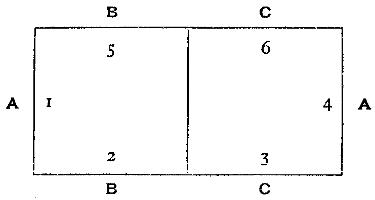
Numbers are placed on the tables to indicate the positions to which the players shall move after each deal. The player at 6 goes to 5; 4 to 3; 3 to 2; 2 to 1, and 1 to 6. Each pair of partners, as they fall into the end seats, have the deal.
If the dealer at either end will not declare on his own cards, he passes it, and the Dummy hand opposite him must be handed to the dealer that sits at the other end of the long table, who must declare for his partner. The usual four hands are dealt and played at each table, and scored as usual.
Three scores must be kept, because there are three separate rubbers going on at once,—that between A and B; between A and C, and between B and C. If one pair wins its rubber against one of the others, three players will be idle at one end of the table for one deal, but then all will come into play again, for the next deal. Some persons think this is better than four playing a rubber while two look on.
DOUBLE DUMMY BRIDGE. In this form of the game, the dealer always deals for himself. His adversary sits next him on the left for the first deal, and leads for the first trick before the Dummies are exposed. There is no doubling. On the next deal, the adversary must sort his Dummy’s hand and must lead from it, before looking at his own. If the declaration is passed, Dummy must make it on the lines laid down for passed makes in Bridge for Three, which has already been described. There is no penalty for a revoke made by either Dummy; but otherwise the laws of bridge govern.
DRAW BRIDGE. This is double Dummy; but instead of laying Dummy’s cards face up on the table, each player is provided with a holder in which he places his partner’s cards in such a manner that his adversary cannot see them. As it comes to Dummy’s turn to play to each trick, a card is drawn from the holder. All four hands are responsible for revokes.
KING’S BRIDGE. This is sometimes called Four Hand Bridge, each player being for himself. The movements of the players are the same as those described in Pivot Bridge, one player sitting still all the time, while each of the others in turn becomes his partner for four deals.
The dealer declares. If he passes, the player sitting opposite him must make it according to the mechanical rules given in Bridge for Three. There is no doubling. The score of each player is kept in a separate column, and the trick and honour score is put down in one lump, plus or minus, the new score being added to or deduced from the previous one. It is simpler, however, to put down nothing but the plus scores, so that when the declaration is defeated, the points are credited to each of the three other players. Suppose the dealer wins 16 and 16. He is put down as 32 plus. If he should lose 12 and 30, his score would not be touched, but each of the others would be put down 42 plus.
There are no games or rubbers. At the end of four deals the players change partners by the pivot system. At the end of twelve deals, each has played four deals with each of the others. The scores are then added up and balanced by the method described in connection with the game of Skat.
REVERSI BRIDGE. This is playing bridge to lose, and the object of the declaration is to pick out the make which is likely to win the least tricks. At the end of the hand, each side scores what the other makes; so that if the dealer declares no-trumps, and loses two by cards, and finds thirty aces against him, he scores 24 and 30 to his own credit. The adversaries can double if they wish to, and all the rules of regular bridge apply, except that if a revoke is made the usual penalty is reversed, the player in error taking three tricks instead of losing them.
SHORT BRIDGE. This is bridge without any doubling or rubbers, and is played for so much a game instead of for so much a point, the winners being the side that has the higher score for tricks and honours combined when either side reaches thirty points below the line. It is a good game for occasions upon which the players may be interrupted at any time, or have not time to finish a full rubber.
THE AMERICAN LAWS OF BRIDGE.
Revised to November, 1913.
Reprinted and Copyrighted, 1913, by permission of The Whist Club of New York.
THE RUBBER.
1. The partners first winning two games win the rubber. When the first two games decide the rubber, a third is not played.
SCORING.
2. Each side has a trick score and a score for all other counts, generally known as the honour score. In the trick score the only entries made are points for tricks won (see Law 3), which count both toward the game and in the total of the rubber.
All other points, including honours, penalties, slam, little slam, and under-tricks, are recorded in the honour score, which counts only in the total of the rubber.
3. When the declarer wins the number of tricks bid or more, each above six counts on the trick score; two points when spades are trumps, six when clubs are trumps, seven when diamonds are trumps, eight when hearts are trumps, nine when royal spades are trumps, and ten when the declaration is no trump.
4. A game consists of thirty points made by tricks alone. Every deal is played out, whether or not during it the game be concluded, and any points made (even if in excess of thirty) are counted.
5. The ace, king, queen, knave, and ten of the trump suit are the honours; when no trump is declared, the aces are the honours.
6. Honours are credited to the original holders; they are valued as follows:
When a Trump is Declared.
3[1] honours held between partners equal value of 2 tricks.
4 ” ” ” ” ” ” 4 ”
5 ” ” ” ” ” ” 5 ”
4 ” ” in 1 hand ” ” 8 ”
4 ” ” ” 1 ” 5th in partner’s ” ” 9 ”
5 ” ” ” 1 ” ” ” 10 ”
When No Trump is Declared.
3 aces held between partners count 30
4 ” ” ” ” ” 40
4 ” ” in one hand ” 100
7. Slam is made when partners take thirteen tricks.[2] It counts 40 points in the honour score.
8. Little slam is made when partners take twelve tricks.[3] It counts 20 points in the honour score.
9. The value of honours, slam, or little slam, is not affected by doubling or redoubling.
10. At the conclusion of a rubber the trick and honour scores of each side are added and 250 additional points added to the score of the winners of the rubber. The size of the rubber is the difference between the completed scores. If the score of the losers of the rubber exceed that of the winners, the losers win the amount of the excess.
11. When a rubber is started with the agreement that the play shall terminate (i.e., no new deal shall commence) at a specified time, and the rubber is unfinished at that hour, the score is made up as it stands, 125 being added to the score of the winners of a game. A deal if started must be finished.
12. A proved error in the honour score may be corrected at any time before the score of the rubber has been made up and agreed upon.
13. A proved error in the trick score may be corrected at any time before a declaration has been made in the following game, or, if it occur in the final game of the rubber, before the score has been made up and agreed upon.
CUTTING.
14. In cutting the ace is the lowest card; between cards of otherwise equal value the heart is the lowest, the diamond next, the club next, and spade the highest.
15. Every player must cut from the same pack.
16. Should a player expose more than one card, the highest is his cut.
FORMING TABLES.
17. Those first in the room have the prior right to play. Candidates of equal standing decide their order by cutting; those who cut lowest play first.
18. Six players constitute a complete table.
19. After the table has been formed, the players cut to decide upon partners, the two lower play against the two higher. The lowest is the dealer, who has choice of cards and seats, and, having made his selection, must abide by it.[4]
20. The right to succeed players as they retire is acquired by announcing the desire to do so, and such announcements, in the order made, entitle candidates to fill vacancies as they occur.
CUTTING OUT.
21. If, at the end of a rubber, admission be claimed by one or two candidates, the player or players who have played the greatest number of consecutive rubbers withdraw; when all have played the same number, they cut to decide upon the outgoers; the highest are out.[5]
RIGHT OF ENTRY.
22. At the end of a rubber a candidate is not entitled to enter a table unless he declare his intention before any player cut, either for partners, for a new rubber, or for cutting out.
23. In the formation of new tables candidates who have not played at an existing table have the prior right of entry. Others decide their right to admission by cutting.
24. When one or more players belonging to an existing table aid in making up a new one, which cannot be formed without him, he or they shall be the last to cut out.
25. A player belonging to one table who enters another, or announces a desire to do so, forfeits his rights at his original table, unless the new table cannot be formed without him in which case he may retain his position at his original table by announcing his intention to return as soon as his place at the new table can be filled.
26. Should a player leave a table during the progress of a rubber, he may, with the consent of the three others, appoint a substitute to play during his absence; but such appointment becomes void upon the conclusion of the rubber, and does not in any way affect the rights of the substitute.
27. If a player break up a table, the others have a prior right of entry elsewhere.
SHUFFLING.
28. The pack must not be shuffled below the table nor so the face of any card be seen.
29. The dealer’s partner must collect the cards from the preceding deal and has the right to shuffle first. Each player has the right to shuffle subsequently. The dealer has the right to shuffle last, but should a card or cards be seen during his shuffling or while giving the pack to be cut, he must reshuffle.
30. After shuffling, the cards, properly collected, must be placed face downward to the left of the next dealer, where they must remain untouched until the end of the current deal.
THE DEAL.
31. Players deal in turn; the order of dealing is to the left.
32. Immediately before the deal, the player on the dealer’s right cuts, so that each packet contains at least four cards. If, in or after cutting and prior to the beginning of the deal, a card be exposed, or if any doubt exist as to the place of the cut, the dealer must reshuffle and the same player must cut again.
33. After the pack has been properly cut, it should not be reshuffled or recut except as provided in Law 32.
34. Should the dealer shuffle after the cut, his adversaries may also shuffle and the pack must be cut again.
35. The fifty-two cards must be dealt face downward. The deal is completed when the last card is dealt.
36. In the event of a misdeal, the same pack must be dealt again by the same player.
A NEW DEAL.
37. There must be a new deal:
(a) If the cards be not dealt, beginning at the dealer’s left into four packets one at a time and in regular rotation.
(b) If, during a deal, or during the play the pack be proved incorrect.
(c) If, during a deal, any card be faced in the pack or exposed, on, above, or below the table.
(d) If more than thirteen cards be dealt to any player.[6]
(e) If the last card does not come in its regular order to the dealer.
(f) If the dealer omit having the pack cut, deal out of turn or with the adversaries’ cards, and either adversary call attention to the fact before the end of the deal and before looking at any of his cards.
38. Should a correction of any offence mentioned in 37 f not be made in time, or should an adversary who has looked at any of his cards be the first to call attention to the error, the deal stands, and the game proceeds as if the deal had been correct, the player to the left dealing the next. When the deal has been with the wrong cards, the next dealer may take whichever pack he prefers.
39. If, prior to the cut for the following deal, a pack be proved incorrect, the deal is void, but all prior scores stand.[7]
The pack is not incorrect when a missing card or cards are found in the other pack, among the quitted tricks, below the table, or in any other place which makes it possible that such card or cards were part of the pack during the deal.
40. Should three players have their proper number of cards, the fourth, less, the missing card or cards, if found, belong to him, and he, unless dummy, is answerable for any established revoke or revokes he may have made just as if the missing card or cards had been continuously in his hand. When a card is missing, any player may search the other pack, the quitted tricks, or elsewhere for it.
If before, during or at the conclusion of play, one player hold more than the proper number of cards, and another less, the deal is void.
41. A player may not cut, shuffle, or deal for his partner if either adversary object.
THE DECLARATION.
42. The dealer, having examined his hand, must declare to win at least one odd trick,[8] either with a specified suit, or at no trump.
43. After the dealer has declared, each player in turn, beginning on the dealer’s left, must pass, make a higher declaration, double the last declaration, or redouble a declaration which has been doubled, subject to the provisions of Law 54.
44. A declaration of a greater number of tricks in a suit of lower value, which equals the last declaration in value of points, is a higher declaration; e.g., a declaration of “three spades” is higher than “one club.”
45. A player in his turn may overbid the previous adverse declaration any number of times, and may also overbid his partner, but he cannot overbid his own declaration which has been passed by the three others.
46. The player who makes the final declaration[9] must play the combined hands, his partner becoming dummy, unless the suit or no trump finally declared was bid by the partner before it was called by the final declarer, in which case the partner, no matter what bids have intervened, must play the combined hands.
47. When the player of the two hands (hereinafter termed “the declarer”) wins at least as many tricks as he declared, he scores the full value of the tricks won (see Law 3).[10]
47a. When the declarer fails to win as many tricks as he declares, neither he nor his adversaries score anything toward the game, but his adversaries score in their honour column 50 points for each under-trick (i.e., each trick short of the number declared). If the declaration be doubled, the adversaries score 100 points; if redoubled, 200 points for each under-trick.
48. The loss on the dealer’s original declaration of “one spade” is limited to 100 points, whether doubled or not, unless redoubled. Honours are scored as held.
49. If a player make a declaration (other than passing) out of turn, either adversary may demand a new deal, or may allow such declaration to stand, in which case the bidding shall continue as if the declaration had been in turn.
If a player pass out of turn, the order of the bidding is not affected, i.e., it is still the turn of the player to the left of the last declarer. The player who has passed out of turn may re-enter the bidding in his proper turn if the declaration he has passed be overbid or doubled.
50. If a player make an insufficient or impossible declaration, either adversary may demand that it be penalized. The penalty for an insufficient declaration is that the bid is made sufficient in the declaration named and the partner of the declarer may not further declare unless an adversary subsequently bid or double. The penalty for an impossible declaration is that the bid is made seven in the suit named and the partner of the declarer may not further declare unless an adversary subsequently bid or double. Either adversary, instead of penalizing an impossible declaration, may demand a new deal, or that the last declaration made on behalf of his partnership become the final declaration.
50a. If a player who has been debarred from bidding under Laws 50 or 65, during the period of such prohibition, make any declaration (other than passing), either adversary may decide whether such declaration stand, and neither the offending player nor his partner may further participate in the bidding even if the adversaries double or declare.
50b. A penalty for a declaration out of turn (see Law 49), an insufficient or impossible declaration (see Law 50), or a bid when prohibited (see Law 50a) may not be enforced if either adversary pass, double, or declare before the penalty be demanded.[11]
50c. Laws which give to either adversary the right to enforce a penalty, do not permit unlimited consultation. Either adversary may call attention to the offence and select the penalty, or may say, “Partner, you determine the penalty,” or words to that effect. Any other consultation is prohibited,[12] and if it take place, the right to demand any penalty is lost. The first decision made by either adversary is final and cannot be altered.
51. At any time during the declaration, a question asked by a player concerning any previous bid must be answered, but, after the final declaration has been accepted, if an adversary of the declarer inform his partner regarding any previous declaration, the declarer may call a lead from the adversary whose next turn it is to lead. If the dummy give such information to the declarer, either adversary of the declarer may call a lead. A player, however, at any time may ask what declaration is being played and the question must be answered.
52. A declaration legitimately made cannot be changed after the next player pass, declare, or double. Prior to such action a declaration inadvertently made may be corrected. If, prior to such correction, an adversary call attention to an insufficient or impossible declaration, it may not thereafter be corrected nor may the penalty be avoided.
DOUBLING AND REDOUBLING.
53. Doubling and redoubling doubles and quadruples the value of each trick over six, but it does not alter the value of a declaration; e.g., a declaration of “three clubs” is higher than “two royal spades” doubled or redoubled.
54. Any declaration may be doubled and redoubled once, but not more; a player may not double his partner’s declaration nor redouble his partner’s double, but he may redouble a declaration of his partner which has been doubled by an adversary.
The penalty for redoubling more than once is 100 points in the adverse honour score or a new deal; for doubling a partner’s declaration, or redoubling a partner’s double it is 50 points in the adverse honour score. Either adversary may demand any penalty enforceable under this law.
55. Doubling or redoubling reopens the bidding. When a declaration has been doubled or redoubled, any one of the three succeeding players, including the player whose declaration has been doubled, may, in his proper turn, make a further declaration of higher value.
56. When a player whose declaration has been doubled wins the declared number of tricks, he scores a bonus of 50 points in his honour score, and a further 50 points for each additional trick. When he or his partner has redoubled, he scores 100 points for making the contract and an additional 100 for each extra trick.
57. A double or redouble is a declaration, and a player who doubles or redoubles out of turn is subject to the penalty provided by Law 49.
58. After the final declaration has been accepted, the play begins; the player on the left of the declarer leads.
DUMMY.
59. As soon as the player on the left of the declarer leads, the declarer’s partner places his cards face upward on the table, and the declarer plays the cards from that hand.
60. The partner of the declarer has all the rights of a player (including the right to call attention to a lead from the wrong hand), until his cards are placed face upward on the table.[13] He then becomes the dummy, and takes no part whatever in the play, except that he has the right:
(a) To call the declarer’s attention to the fact that too many or too few cards have been played to a trick;
(b) to correct an improper claim of either adversary;
(c) to call attention to a trick erroneously taken by either side;
(d) to participate in the discussion of any disputed question of fact after it has arisen between the declarer and either adversary;
(e) to correct any erroneous score;
(f) to consult with and advise the declarer as to which penalty to exact for a revoke;
(g) to ask the declarer whether he have any of a suit he has renounced.
The dummy, if he have not intentionally looked at any card in the hand of a player, has also the following additional rights:
(h) To call the attention of the declarer to an established adverse revoke;
(i) to call the attention of the declarer to a card exposed by an adversary or to an adverse lead out of turn.
61. Should the dummy call attention to any other incident in the play in consequence of which any penalty might have been exacted, the declarer may not exact such penalty. Should the dummy avail himself of rights (h) or (i), after intentionally looking at a card in the hand of a player, the declarer may not exact any penalty for the offence in question.
62. If the dummy, by touching a card or otherwise, suggest the play of one of his cards, either adversary may require the declarer to play or not to play such card.
62a. If the dummy call to the attention of the declarer that he is about to lead from the wrong hand, either adversary may require that the lead be made from that hand.
63. Dummy is not subject to the revoke penalty; if he revoke and the error be not discovered until the trick be turned and quitted, whether by the rightful winners or not, the trick must stand.
64. A card from the declarer’s hand is not played until actually quitted, but should he name or touch a card in the dummy, such card is played unless he say, “I arrange,” or words to that effect. If he simultaneously touch two or more such cards, he may elect which to play.
CARDS EXPOSED BEFORE PLAY.
65. After the deal and before the declaration has been finally determined, if any player lead or expose a card, his partner may not thereafter bid or double during that declaration,[14] and the card is subject to call.[15] When the partner of the offending player is the original leader, the declarer may also prohibit the initial lead of the suit of the exposed card.
66. After the final declaration has been accepted and before the lead, if the partner of the proper leader expose or lead a card, the declarer may treat it as exposed or may call a suit from the proper leader. A card exposed by the leader, after the final declaration and before the lead, is subject to call.
CARDS EXPOSED DURING PLAY.
67. After the original lead, all cards exposed by the declarer’s adversaries are liable to be called and must be left face upward on the table.
68. The following are exposed cards:
(1) Two or more cards played simultaneously;
(2) a card dropped face upward on the table, even though snatched up so quickly that it cannot be named;
(3) a card so held by a player that his partner sees any portion of its face;
(4) a card mentioned by either adversary as being held in his or his partner’s hand.
69. A card dropped on the floor or elsewhere below the table, or so held that it is seen by an adversary but not by the partner, is not an exposed card.
70. Two or more cards played simultaneously by either of the declarer’s adversaries give the declarer the right to call any one of such cards to the current trick and to treat the other card or cards as exposed.
70a. Should an adversary of the declarer expose his last card before his partner play to the twelfth trick, the two cards in his partner’s hand become exposed, must be laid face upward on the table, and are subject to call.
71. If, without waiting for his partner to play, either of the declarer’s adversaries play or lead a winning card, as against the declarer and dummy and continue (without waiting for his partner to play) to lead several such cards, the declarer may demand that the partner of the player in fault win, if he can, the first or any other of these tricks. The other cards thus improperly played are exposed.
72. If either or both of the declarer’s adversaries throw his or their cards face upward on the table, such cards are exposed and liable to be called; but if either adversary retain his hand, he cannot be forced to abandon it. Cards exposed by the declarer are not liable to be called. If the declarer say, “I have the rest,” or any words indicating the remaining tricks or any number thereof are his, he may be required to place his cards face upward on the table. He is not then allowed to call any cards his adversaries may have exposed, nor to take any finesse not previously proved a winner unless he announce it when making his claim.
73. If a player who has rendered himself liable to have the highest or lowest of a suit called (Laws 80, 86, and 92) fail to play as directed, or if, when called on to lead one suit, he lead another, having in his hand one or more cards of the suit demanded (Laws 66, 76, and 93), or if, when called upon to win or lose a trick, he fail to do so when he can (Laws 71, 80, and 92), or if, when called upon not to play a suit, he fail to play as directed (Laws 65 and 66), he is liable to the penalty for revoke (Law 84) unless such play be corrected before the trick be turned and quitted.
74. A player cannot be compelled to play a card which would oblige him to revoke.
75. The call of an exposed card may be repeated until it be played.
LEADS OUT OF TURN.
76. If either adversary of the declarer’s lead out of turn, the declarer may either treat the card so led as exposed or may call a suit as soon as it is the turn of either adversary to lead. Should they lead simultaneously, the lead from the proper hand stands, and the other card is exposed.
77. If the declarer lead out of turn, either from his own hand or dummy, he incurs no penalty, but he may not rectify the error unless directed to do so by an adversary.[16] If the second hand play, the lead is accepted.
78. If an adversary of the declarer lead out of turn, and the declarer follow either from his own hand or dummy, the trick stands. If the declarer before playing refuse to accept the lead, the leader may be penalized as provided in Law 76.
79. If a player called on to lead a suit have none of it, the penalty is paid.
CARDS PLAYED IN ERROR.
80. Should the fourth hand, not being dummy or declarer, play before the second, the latter may be required to play his highest or lowest card of the suit led, or to win or lose the trick. In such case, if the second hand be void of the suit led, the declarer in lieu of any other penalty may call upon the second hand to play the highest card of any designated suit. If he name a suit of which the second hand is void, the penalty is paid.[17]
81. If any one, except dummy, omit playing to a trick, and such error be not corrected until he has played to the next, the adversaries or either of them may claim a new deal; should either decide that the deal stand, the surplus card (at the end of the hand) is considered played to the imperfect trick, but does not constitute a revoke therein.[18]
82. When any one, except dummy, plays two or more cards to the same trick and the mistake is not corrected, he is answerable for any consequent revokes he may make. When the error is detected during the play, the tricks may be counted face downward, to see if any contain more than four cards; should this be the case, the trick which contains a surplus card or cards may be examined and such card or cards restored to the original holder.[19]
THE REVOKE.[20]
83. A revoke occurs when a player, other than dummy, holding one or more cards of the suit led, plays a card of a different suit. It becomes an established revoke when the trick in which it occurs is turned and quitted by the rightful winners (i.e., the hand removed from the trick after it has been turned face downward on the table), or when either the revoking player or his partner, whether in turn or otherwise, leads or plays to the following trick.
84. The penalty for each established revoke is:
(a) When the declarer revokes, he cannot score for tricks and his adversaries add 100 points to their score in the honour column, in addition to any penalty which he may have incurred for not making good his declaration.
(b) When either of the adversaries revokes, the declarer may either add 100 points to his score in the honour column or take three tricks from his opponents and add them to his own.[21] Such tricks may assist the declarer to make good his declaration, but shall not entitle him to score any bonus in the honour column in case the declaration has been doubled or redoubled, nor to a slam or little slam not otherwise obtained.[22]
(c) When, during the play of a deal, more than one revoke is made by the same side, the penalty for each revoke after the first is 100 points.
The value of their honours is the only score that can be made by a revoking side.
85. A player may ask his partner if he have a card of the suit which he has renounced; should the question be asked before the trick be turned and quitted, subsequent turning and quitting does not establish a revoke, and the error may be corrected unless the question be answered in the negative, or unless the revoking player or his partner have led or played to the following trick.
86. If a player correct his mistake in time to save a revoke, any player or players who have followed him may withdraw his or their cards and substitute others, and the cards so withdrawn are not exposed. If the player in fault be one of the declarer’s adversaries, the card played in error is exposed, and the declarer may call it whenever he pleases, or he may require the offender to play his highest or lowest card of the suit to the trick, but this penalty cannot be exacted from the declarer.
87. At the end of the play the claimants of a revoke may search all the tricks. If the cards have been mixed, the claim may be urged and proved if possible; but no proof is necessary and the claim is established if, after it is made, the accused player or his partner mix the cards before they have been sufficiently examined by the adversaries.
88. A revoke cannot be claimed after the cards have been cut for the following deal.
89. Should both sides revoke, the only score permitted is for honours. In such case, if one side revoke more than once, the penalty of 100 points for each extra revoke is scored by the other side.
GENERAL RULES.
90. A trick turned and quitted may not be looked at (except under Law 82) until the end of the play. The penalty for the violation of this law is 25 points in the adverse honour score.
91. Any player during the play of a trick or after the four cards are played, and before the trick is turned and quitted, may demand that the cards be placed before their respective players.
92. When an adversary of the declarer, before his partner plays, calls attention to the trick, either by saying it is his, or, without being requested to do so, by naming his card or drawing it toward him, the declarer may require such partner to play his highest or lowest card of the suit led, or to win or lose the trick.
93. An adversary of the declarer may call his partner’s attention to the fact that he is about to play or lead out of turn; but if, during the play, he make any unauthorized reference to any incident of the play, the declarer may call a suit from the adversary whose next turn it is to lead.
94. In all cases where a penalty has been incurred, the offender is bound to give reasonable time for the decision of his adversaries.
NEW CARDS.
95. Unless a pack be imperfect, no player has the right to call for one new pack. When fresh cards are demanded, two packs must be furnished. When they are produced during a rubber, the adversaries of the player demanding them have the choice of the new cards. If it be the beginning of a new rubber, the dealer, whether he or one of his adversaries call for the new cards, has the choice. New cards cannot be substituted after the pack has been cut for a new deal.
96. A card or cards torn or marked must be replaced by agreement or new cards furnished.
BYSTANDERS.
97. While a bystander, by agreement among the players, may decide any question, he should not say anything unless appealed to; and if he make any remark which calls attention to an oversight affecting the score, or to the exaction of a penalty, he is liable to be called upon by the players to pay the stakes (not extras) lost.
ETIQUETTE OF AUCTION.
In the game of Auction slight intimations convey much information. The code succinctly states laws which fix penalties for an offence. To offend against etiquette is far more serious than to offend against a law; for in the latter case the offender is subject to the prescribed penalties; in the former his adversaries are without redress.
1. Declarations should be made in a simple manner, thus: “one heart,” “one no trump,” “pass,” “double”; they should be made orally and not by gesture.
2. Aside from his legitimate declaration, a player should not show by word or gesture the nature of his hand, or his pleasure or displeasure at a play, bid, or double.
3. If a player demand that the cards be placed, he should do so for his own information and not to call his partner’s attention to any card or play.
4. An opponent of the declarer should not lead until the preceding trick has been turned and quitted; nor, after having led a winning card, should he draw another from his hand before his partner has played to the current trick.
5. A card should not be played with such emphasis as to draw attention to it, nor should a player detach one card from his hand and subsequently play another.
6. A player should not purposely incur a penalty because he is willing to pay it, nor should he make a second revoke to conceal a first.
7. Conversation during the play should be avoided, as it may annoy players at the table or at other tables in the room.
8. The dummy should not leave his seat to watch his partner play. He should not call attention to the score nor to any card or cards that he or the other players hold.
9. If a player say, “I have the rest,” or any words indicating that the remaining tricks, or any number thereof, are his, and one or both of the other players expose his or their cards, or request him to play out the hand, he should not allow any information so obtained to influence his play.
10. If a player concede, in error, one or more tricks, the concession should stand.
11. A player having been cut out of one table should not seek admission in another unless willing to cut for the privilege of entry.
12. A player should not look at any of his cards until the end of the deal.
THE LAWS OF THREE HAND AUCTION.
The Laws of Auction govern the three-hand game except as follows:
(1) Three players take part in a game and four constitute a complete table. Each plays for himself; there are no partners, except as provided in Law 7.
(2) The player who cuts lowest selects his seat and the cards with which he deals first. The player who cuts next lowest sits on the dealer’s left.
(3) The cards are dealt in four packets, one for each of the three players and one for the dummy.[23] The dummy hand is not touched until after the final declaration has been made.
(4) The dealer declares, and the bidding continues as in Auction, except that each player bids exclusively on his own account.
(5) The penalty for a declaration out of turn is that each of the other players receives 50 points in his honour score. A declaration out of turn does not affect the right of the player whose turn it is to declare, unless both he and the other player, either by passing or declaring, accept the improper declaration.
(6) If a player declare out of turn, and the succeeding player either pass or declare, the third player may demand that the mistake be corrected as is provided in Law 5. In such case the player who first declared out of turn is the only one penalized.
(7) The player making the final declaration, i.e., a declaration that has been passed by both of the others, plays his own hand and that of the dummy against the two others, who then, and for that particular hand, assume the relationship of partners.
(8) It is advisable that the game be played at a round table so that the hand of the dummy can be placed in front of the declarer without obliging any player to move; but, in the event of a square table being used, the two players who become the adversaries of the declarer should sit opposite each other, the dummy being opposite the declarer. At the end of the play the original positions should be resumed.
(9) If, after the deal has been completed and before the conclusion of the declaration, any player expose a card, each of his adversaries counts 50 points in his honour score, and the declarer, if he be not the offender, may call upon the player on his left to lead or not to lead the suit of the exposed card. If a card be exposed by the declarer after the final declaration, there is no penalty, but if exposed by an adversary of the declarer, it is subject to the same penalty as in Auction.
(10) If a player double out of turn, each of his adversaries counts 100 points in his respective honour score, and the player whose declaration has been doubled may elect whether the double shall stand. The bidding is then resumed, but if the double shall be disallowed, the declaration may not be doubled by the other player.
(11) The rubber continues until two games have been won by the same player; it may consist of two, three, or four games.
(12) When the declarer fulfils his contract, he scores as in Auction. When he fails to do so, both of his adversaries score as in Auction.
(13) Honours are scored by each player separately, i.e., each player who holds one honour scores the value of a trick; each player who holds two honours scores twice the value of a trick; a player who holds three honours scores three times the value of a trick; a player who holds four honours scores eight times the value of a trick; and a player who holds five honours scores ten times the value of a trick. In a no-trump declaration, each ace counts ten, and four held by one player count 100. The declarer counts separately both his own honours and those held by the dummy.
(14) A player scores 125 points for winning a game, a further 125 points for winning a second game, and 250 points for winning a rubber.
(15) At the end of the rubber, all scores of each player are added and his total obtained. Each one wins from or loses to each other the difference between their respective totals. A player may win from both the others, lose to one and win from the other, or lose to both.
THE LAWS OF DUPLICATE AUCTION.
Duplicate Auction is governed by the Laws of Auction, except in so far as they are modified by the following special laws:
A. Scoring. In Duplicate Auction there are neither games nor rubbers. Each deal is scored just as in Auction, with the addition that whenever a pair makes 30 or more for tricks as the score of one deal, it adds as a premium 125 points in its honour column.
B. Irregularities in the Hands. If a player have either more or less than his correct number of cards, the course to be pursued is determined by the time of the discovery of the irregularity.
(1) When the irregularity is discovered before or during the original play: There must be a new deal.
(2) When the irregularity is discovered at the time the cards are taken up for overplay and before such overplay has begun: It must be sent back to the table from which it came, and the error be there rectified.
(3) When the irregularity is not discovered until after the overplay has begun: In two-table duplicate there must be a new deal; but in a game in which the same deals are played at more than two tables, the hands must be rectified as is provided above and then passed to the next table without overplay at the table at which the error was discovered; in which case, if a player have less than thirteen cards and his adversary the corresponding surplus, each pair takes the average score for that deal; if, however, his partner have the corresponding surplus, his pair is given the lowest score and his opponents the highest score made at any table for that deal.
C. Playing the cards. Each player, when it is his turn to play, must place his card, face upward, before him and toward the centre of the table. He must allow it to remain upon the table in this position until all have played to the trick, when he must turn it over and place it face downward, nearer to himself; if he or his partner have won the trick, the card should point toward his partner and himself; otherwise it should point toward the adversaries.
The declarer may either play dummy’s cards or may call them by name whenever it is dummy’s turn to play and have dummy play them for him.
A trick is turned and quitted when all four players have turned and ceased to touch their respective cards.
The cards must be left in the order in which they were played until the scores of the deal have been recorded.
D. The Revoke. A revoke may be claimed at any time before the last trick of the deal in which it occurs has been turned and quitted and the scores of that deal agreed upon and recorded, but not thereafter.