NATIONAL GAMES. (continued 2)
Reading edition
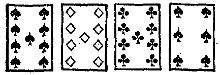
If there are two duplicates of either card, the combination will always be worth 12 points; 6 for the three fifteens, and 6 more for the pair royal.
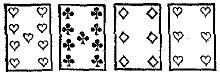
If the duplicates are of two different cards, the combination is still worth 12, because four different fifteens can be formed by combining each Nine with each Six separately, and there are two single pairs.
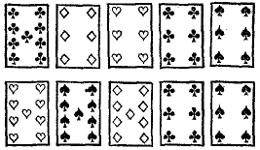
The same is true of any combinations of two-card fifteens in which all five cards are of value; they are both of the same pegging value, 20 points. If there are three duplicates of one card in the original fifteen, the four separate fifteens will be worth 8, and the double pair royal 12. If there are two duplicates of one card, and one of the other, six separate fifteens can be formed by combining each Nine with each Six, pegging 12; and the pair royal of one card with the single pair of the other will add 8 more.
Three-card Fifteens may be formed in fifteen different ways, ranging from 10 4 A, to 5 5 5. If you hold any of these combinations, and have a fourth card which is a duplicate of any of the three forming the fifteen, the value of the combination will depend on how many cards you can replace with the duplicate card.
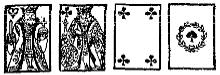
If you have an extra tenth card, you can replace the other tenth card once only, and the total value of the combination is therefore 6 points, which is expressed by the formula; “Fifteen-two, fifteen-four, and a pair.”
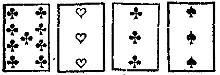
If your combination was 9 3 3, and you had another 9, the same thing would be true; but if your duplicate is a Three, there are two cards which can be replaced, and the combination is therefore worth 12; 6 for the three fifteens, and 6 more for the pair royal.
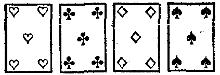
If your combination is one in which all three cards can be replaced with the duplicate, making three extra fifteens, it must be worth 20 altogether; 8 for the four fifteens, and 12 for the double pair royal.
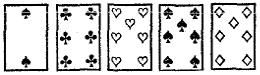
If you have two duplicates of any one card in the original combination, there are only two extra fifteens, and the combination will be worth 12; 6 for the three fifteens, and 6 more for the pair royal.
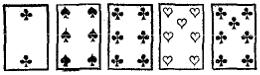
If you have duplicates of two different cards you can form four fifteens; because you can replace the Seven first, and then the Six, and then put the first Seven back again with the new Six. This will make the combination of the same value as if you had three duplicates of one card, 12 points; 8 for the four fifteens, and 4 for the two single pairs.
Combinations. The beginner’s greatest difficulty is in counting hands which contain all three varieties of counts; pairs, sequences, and fifteens. But if he is familiar with the values of the various combinations taken separately, he will have no difficulty in computing them when they are found together. Some regular order should be observed in going over the hands, so that nothing shall be forgotten. The majority of players begin with the fifteens, as they are more liable to be overlooked, and then reckon the value of the runs and pairs together.
Take the following examples:—
No. 1.
No. 2.
No. 3.
No. 4.
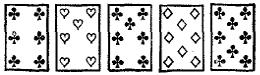
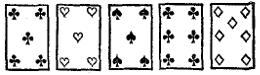
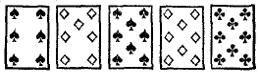
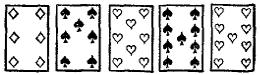
No. 1 contains a fifteen in addition to the three runs of three and the pair royal, and is therefore worth 17 altogether. Nos. 2 and 3 each contain three fifteens; but No. 2 is worth 21 points on account of the three runs of three and the pair royal, while No. 3 is worth only 16; a double run of four and a single pair. No. 4 contains four fifteens in addition to the four runs of three and two single pairs, and is therefore worth 24 points.
The best combination that can be held in hand or crib is three Fives and a Jack, with the Five of the same suit as the Jack for a starter. We have already seen that the four Fives by themselves are worth 20, to which we must add the four extra fifteens made by combining the Jack with each Five separately, and one more point for his nobs, 29 altogether. If the Jack was the starter, the combination would be worth 30 to the dealer, but his heels would have to be counted before a card was played.
Flushes. In addition to the foregoing combinations, if all four cards in the hand are of the same suit the player can peg four points for the flush; if the starter is also the same suit, five points. A flush does not count in the crib unless the starter is the same suit, and then it counts five points. Flushes are never made in play.
Laying Out for the Crib. With this knowledge of the objects of game, and the various counting combinations, it will be seen that each player should keep the cards which count the most for him, or which are most likely to form good combinations with different starters.
Suppose the non-dealer holds these cards:—
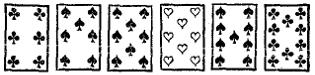
If he puts the two Eights in his adversary’s crib, he not only gives him two very good cards, which go to form a great many valuable combinations, but he leaves himself absolutely nothing but 2 points for a single fifteen, formed by the 9 and 6. It would be a little better, but still very bad play, for him to discard the 8 and 6, leaving himself a sequence of four cards and a fifteen, 6 points altogether. He might do a little better by discarding the 10 and 8, leaving himself a run of four, and two fifteens, 8 points altogether. If he discards either the 10 and 9, or the 10 and 6, he will leave himself a double run of three, a pair, and two fifteens, 12 altogether. Of these two discards, that of the 10 and 6 is better than the 10 and 9, because the 10 and 9 might help to form a sequence in the adversary’s crib, whereas the 10 and 6 are so far apart that they are very unlikely to be of any use.
Cards which are likely to form parts of sequences are called close cards, and those which are too widely separated to do so are called wide cards.
METHOD OF PLAYING. The crib laid out and the starter cut, the pone begins by playing any card he pleases. The card he selects he lays face upward on the table on his own side of the cribbage board, and at the same time announces its pip value; two, five, or ten, whatever it may be. It is then the dealer’s turn to play a card from his hand, which is also laid face upward on the table, but on the dealer’s side of the cribbage board. Instead of announcing the pip value of this second card, the dealer calls out the total value of the two cards taken together. The pone then lays another card on the table face upward and on the top of the first, which is not turned face down, and at the same time announces the total pip value of the three cards so far played; the dealer plays again, and so on.
If at any time the total pip value of the cards played is exactly 15 or 31, the one who plays the card that brings it to that number pegs two points for it at once. If any counting combination, such as a pair, pair royal, or sequence, is formed by the cards played, its value is pegged by the person that plays the card which completes the combination; but neither player is allowed to play a card which will make the total pip value of the cards played pass 31. The method of forming and pegging these various combinations in play will be better understood if they are described separately. A card once played cannot be taken up again, unless it passes 31.
Pairs. If the first card played by the pone should be a 6, and the dealer had a 6 also, the latter would probably play it, announcing: “Twelve, with a pair,” and pegging two holes. If the pone held a third six he would immediately play it, announcing: “Eighteen, with a pair royal,” and would peg six holes for the three pairs which can be formed with the three Sixes, although he did not hold all of them. If the dealer was fortunate enough to hold the fourth Six he might rejoin with: “Twenty-four, with a double-pair-royal.” This would entitle him to peg twelve more holes, although he had already pegged the single pair.
Sequences. Suppose the first card played by the pone was a 4. The dealer plays a 2, announcing: “Six.” The pone plays a 3, announcing: “Nine, with a run of three,” and pegging three holes for the sequence formed in play. The dealer plays an Ace; “Ten, with a run of four,” and pegs four holes for the sequence of four cards made in play, all of which are face upward on the table, although he held only two of them.
Fifteens. The pone then plays a 5, which, added to the 10 just announced by the dealer, makes 15, with a run of five cards; seven holes to peg altogether. (This is quite independent of the sequence previously scored, just as the double pair royal was of the previous single pair.) The dealer now plays a deuce, and announces seventeen. This card does not form any sequence with those that have gone immediately before it, because if the order of play is retraced it will be found that another deuce is encountered before we reach the Four. This illustrates the rule already given, that sequences formed in play must always be single, and cannot be reckoned with substitute cards, like pairs royal. If they could, the last player in this case might claim a double run of five and a pair.
The pone now plays another 4, which forms the sequence afresh if we go back to the third card played. He announces: “Twenty-one, with a run of five,” and pegs five holes more. The dealer plays a 3, also claiming a run of five, which he pegs, and as that is the last card to be played in that hand he also pegs one hole for last card.
The total score of the dealer is now 10 points, and that of the pone is 15. The cards they held, and the order in which they were played is as follows:—
Pone:—
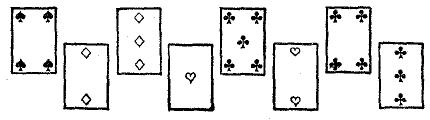
Dealer:—
SHOWING. In order to illustrate the manner of counting the hands, which is called showing, let us suppose the starter to be a Queen, and that the pone discarded an Ace and a Ten for the crib, the dealer laying out two Jacks.
The non-dealer always has the first show, as an offset to the advantage of the dealer’s crib. The pone therefore shows his hand, which, combined with the starter, is as follows:—
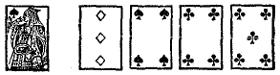
This is worth 10 holes; the run of three with one duplicate is always worth 8, and the fifteen formed by the starter and the Five counts 2 more. This puts the pone’s total score to 25 points.
The dealer then counts, showing his hand first. This, with the starter, is as follows:—
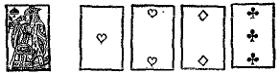
This is worth 14 holes. In addition to the run of three with one duplicate, three fifteens can be formed by combining the starter and a Three with each of the deuces, and then taking the starter and the Ace with both the deuces together. This puts the dealer’s total score to 24, with the crib still to count. This is as follows, with the starter:—
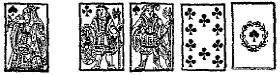
This is worth 9 holes; 8 for the run of three with one duplicate, and 1 for his nobs. There are no fifteens, and the Ace is worthless. This puts the dealer three holes round the corner, and on the homestretch for the game hole.
The deal now passes to the player that was the pone, and the next crib will belong to him.
Beginners often experience difficulty in deciding when a run has been made in play, and when it has not. If there is any dispute about it, the cards should be placed as shown in these diagrams, and if any duplicate is encountered before the run is complete, it cannot be pegged.
Take the following examples:—
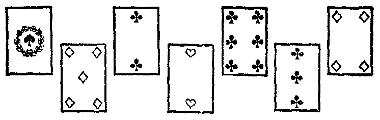
There is no sequence, because we encounter a duplicate deuce before we reach the Five. If the last player had a Five to play now, it would make a run of five cards, stopping at the deuce of hearts. Take the following:—
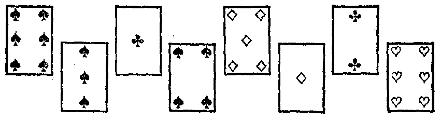
There is no sequence; but if the pone had played his Five for his second card, the dealer would have pegged two runs; one of four, and one of six, besides the last card; the pone making one run of five and a pair, as follows:—
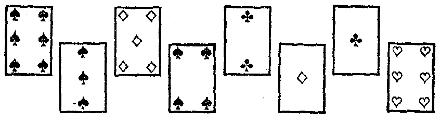
It will be seen that if the dealer had not played his Ace and kept his Six at the last, the pone would have pegged eleven holes on him, instead of seven.
Go, and Thirty-one. When a person has no card which he can play without making the total pip value of all the cards played more than 31, he must say to his adversary: “Go.” That is, “Go on and play, for I cannot.” If his adversary has no cards left, the player must say “go” to himself. When a person is told to go, he must play as many cards as he can without passing 31. If he reaches 31 exactly, he scores two points; if he cannot quite reach it, he scores one point for the go. The principle is that if 31 cannot be made by either player, the one playing the card that brought the count nearest to it shall count one for it, even if he has told himself to go. There is no count for “last card” if it makes 31. But the “last card” counts if it makes 15.
If a player tells another to go when he can still play himself, he forfeits two points, and his adversary may, if he chooses, take back the cards to the point where the error occurred and have them played over again. The same penalty can be enforced against a player who pegs for a go when he can still play.
Suppose the first card played is a Jack. The dealer, holding two Nines, an Eight, and a Five, plays the Five, and pegs 2 for the fifteen. The pone plays a Nine, announcing the total as twenty-four. The dealer cannot pair this Nine, because it would run the count past 31, neither can he play the Eight, so he says, “Go.” The pone pegs the go without playing, which shows that he is also unable to play, having nothing so small as a Seven.
Both then turn down the cards already played, and the one whose turn it is to play begins all over again with his remaining cards or card, announcing its face value, his adversary playing after him until their cards are exhausted or they reach another 31.
To continue the foregoing example, let us suppose the dealer to play one of his Nines. The pone plays a Jack, and announces “Nineteen.” The dealer plays his remaining Nine, and calls “Twenty-eight.” The pone tells him to go, and he pegs one. These three cards are turned down. The pone then plays a Ten, and the dealer marks one for the last card. The hands and crib are then shown.
If either player can reach exactly 31, he scores two points for it, whether he has been told to go or not. Suppose the pone begins with a Nine. The dealer plays a Six and pegs 2 for the fifteen. The pone pairs the Six, calls “Twenty-one,” and pegs 2 for the pair. The dealer with two Fives and a Four in his hand, plays the Four, and calls “Twenty-five,” hoping the pone has no small card, which will allow the dealer to make a run of three with one of his Fives if he is told to go. But the pone plays a Five, calling: “Thirty, with a run of three.” The dealer tells him to go, and he plays an Ace, pegging two holes for the 31. The cards are all turned down, and the pone having no cards, the dealer plays his two Fives, and pegs a pair and the last card. The pair counts in this case because the adversary has no cards to interfere with it. A run of three might be played and scored in the same way, because the score for combinations made in play are determined by the order in which the cards are played, irrespective of who plays them.
Irregularities in Hands. If a player is found to have too many or too few cards, after he has laid out for the crib, his adversary pegs two points, and may also claim a fresh deal. If the deal is allowed to stand, superfluous cards must be drawn at random by the adversary, who may look at the card or cards so drawn before placing them in the pack. If either player is found to have too few cards after having laid out for the crib, he has no remedy. His adversary pegs two points, and the short hand must be played and shown for what it is worth.
Irregular Cribs. If the superfluous card is found in the crib, and the non-dealer had the short hand, the dealer may reckon all the combinations he can make in the six-card crib; but if it was the dealer who had the short hand, the superfluous crib is void. If the crib contains a superfluous card, both the players having their right number, the non-dealer pegs two holes for the evident misdeal, and the crib is void. If both players have their right number, and the crib is short, it must be shown for what it is worth; but the non-dealer pegs two holes for the evident misdeal.
Irregular Announcements. There is no penalty if a player announces a wrong number as the total of the cards played, provided he does not peg an erroneous fifteen or thirty-one. If the following player does not correct the announcement, but plays and adds to it, the error cannot be rectified. If any holes are pegged for an erroneous announcement, the adversary may demand that they be taken down again, and may add the number to his own score.
Miscounting. If a player over-counts his hand, crib, or play, and pegs the points erroneously claimed, his adversary may call attention to the error, demand that the superfluous points be taken down again, and may add them to his own score as penalty. Should a player neglect to peg the full value of his hand, crib, or play, his adversary may add the neglected points to his own score, after pointing out the omission. Should a player be mistaken in exacting either of these penalties, he must not only take down what he pegged, but allow his adversary to peg the same number as penalty.
None of these corrections can be claimed until the player in error has pegged and quitted the score; that is, removed his fingers from the front peg. The claim should always be prefaced by the word Muggins. If the error is one of omission in play, the adversary must play his own card before claiming muggins. If it is in the hand or crib, the adversary must wait until the points claimed are pegged and quitted. If there are no points claimed, he must wait until the cards are turned face down, thus acknowledging that there is apparently nothing to score. A player is not allowed to tell his adversary whether or not he has counted his hand or crib correctly, until it is pegged.
Nineteen. As it is impossible to hold 19 in hand or crib, it is a common practice for a player, when he has nothing at all to score, to announce, “Nineteen.” The numbers twenty-seven, twenty-six and twenty-five are also impossible.
Pegging. Neither player is allowed to touch the other’s pegs. If the score is erroneous, the player in fault must be called upon to remedy it himself. A player whose pegs are touched by his adversary can score two holes for penalty. If a player removes his adversary’s front peg, the latter may immediately claim the game. If a player displaces his own front peg, he must place it behind the other. If both players displace their front pegs, as by accident, they may agree to replace them where they believe them to have stood; but if they cannot agree they must call the game void.
Pegging Out. In pegging during the play, the first man to reach his game hole wins, no matter what either may have in hand or crib. If neither can peg out in play, the non-dealer has the first show. If he cannot show out, the dealer proceeds to count his hand and then his crib. If he cannot show out there must be a new deal.
CHEATING. The greatest advantage at Cribbage is to secure good starters, and for this purpose the greek adopts various methods of trimming and marking the cards so that he may secure a starter exactly suited to his hand. After trimming certain cards a trifle longer or shorter than others, the pack to be cut may be presented to the pone in such a manner that he will unconsciously lift them either by the ends or the sides, according to the wish of the dealer, and so uncover a starter exactly suited to the dealer’s hand or crib. When the sharper has the cut, he can of course uncover any card he pleases. With marked edges, the pone can cut down to a card of any desired denomination. Some audacious gamblers make it a rule to get a starter by simply removing the top card and turning up the next one. It is needless to say that the second card has been carefully pre-arranged. Any person who fingers the pack longer than necessary in cutting starters, or who cuts sometimes by the edge and sometimes by the side, will bear watching. Marked cards and second dealing are great weapons in a game where so much depends on a knowledge of the adversary’s hand, and on securing good counting cards for yourself.
SUGGESTIONS FOR GOOD PLAY. In the six-card game the hand is more valuable than the crib, because you know what it contains, whereas the crib is largely speculative. In the five-card game, in which there are only three cards in the hand and four in the crib, it is usual to sacrifice the hand very largely for the possibilities of the crib, because of the much larger scores that can be made with five cards, the starter and four in the crib.
Baulking. In both games it is the duty of the pone to baulk the dealer’s crib as much as possible, by laying out cards which are very unlikely to be worth anything, either in making fifteens or in filling up sequences. Pairs it is impossible to provide against, and the chance of making a flush is remote, but should be avoided if there is any choice. The best baulk is a King and Nine; tenth cards and Aces are also very good cards to lay out. Cards which are at least two pips apart, called wide cards, are better than close cards, as the latter may form sequences. Fives are very bad discards, and so are any cards that form a five or a fifteen.
The Crib. In laying out for his own crib, the dealer should preserve his own hand as much as possible; but other things being equal, the best cards to lay out are pairs, close cards, and cards that form fives, such as Fours and Aces. If these elements can be combined, so much the better. An Eight and a Seven, for instance, are not only close cards, being only one pip apart, but form a fifteen. The same is true of a trey and deuce.
Keeping. In selecting the hand to keep, much depends on the score. Early in the game you want a counting hand; near the end, especially if you have only four or five points to go, you want a pegging hand; that is, one with every card different, so that you can pair several cards, or make fifteens with almost anything that the pone may lead. In keeping a counting hand, much depends on whether it is good in itself, or needs a starter. In reckoning on the possibilities of the starter, it must never be forgotten that there are sixteen tenth cards in the pack, and that they are therefore the most probable starters of all. It is better to keep sequences open at both ends than those open in the middle. With two Sevens and two Eights, either a Six or a Nine will make your hand worth 24; but with two Eights and two Sixes, nothing but a Seven will improve your hand more than 4 points. Sequences are the best to keep, especially those of three cards with a duplicate. After them pairs royal are valuable, and next to them cards which will make a number of fives in various combinations, such as two Threes and two deuces.
Leading. There are two systems of playing, known as playing off, and playing on, and they are selected according to the player’s position in the score. Long experience has shown that in six-card Cribbage the average expectation of the non-dealer for his hand and play is 12 points; and for the dealer, in hand, crib, and play, is 17. This being so, each player having had a deal, their scores should be about 29. If a player is 29 or more, he is said to be at home; and if he is seven or more points ahead of his adversary on even deals, he is said to be safe at home. When a player is safe at home, he should play off; that is, take no chances of scoring himself that might give his adversary a chance to make a still better score. This is usually found in the method of playing sequences. A player who avoids playing cards that might lead up to a run is said to play off. If he invites the run, hoping to make it longer himself, he is said to play on. When a player is behind, it is better for him to play on, and to seize every chance to score, especially with sequences. As it is considered an advantage to be ahead on the first deal, most players prefer a forward game on the opening hand.
Playing Off. In this it is best to play cards on which it is unlikely that your adversary can score. Lead Aces, Twos and Threes, which cannot be made into fifteens. Do not pair his cards unless you have a card which will make you a double pair royal, (without passing 31,) if he should make a pair royal on you. Do not play close cards which he may turn into sequences.
Never play a card which will allow the adversary to make a double score, such as a pair and a fifteen, or a sequence and a fifteen at the same time. Such as the following are all bad plays: 9 on 3; 7 on A; 6 on 3, 4, or 5; 5 on 5; 4 on 7; 3 on 9; A on 7. All these expose you to the immediate rejoinder of a double count. Of course, if you have the card to make a pair royal in return, that is another matter, and is playing on, not playing off.
Do not play a card which brings the pip count to 5 or 21 if you can help it; because any tenth card will enable your adversary to peg two holes. Be a little wary about pairing the first card played, unless you have a third of the same denomination. If you have a choice between a pair and a sequence, your decision will depend on whether you are playing off or on. If you are playing off, make the pair, and take no chances of long runs.
Playing On. In this you play to give your adversary a count, hoping to make a better yourself. It is always advantageous to play one of a pair, and to begin with one end of a sequence. If he pairs your first card, you can reply with a pair royal. If he plays to make a sequence, you can sometimes hold him off until you get the score, and he will be unable to continue the run without passing 31. Play one of two cards that form a five, such as 3 and 2; 4 and A. If he plays a tenth card to it, you can peg fifteen. In playing on, you should make all the sequences possible, taking chances of your adversary’s being able to continue the run. If you think he is leading you on, you must be guided by the state of the score as to how much you can risk.
Toward the end, you must reckon pretty closely how many points you can afford to risk your adversary’s making without putting him out. If you have enough in your hand to get out on the show, you should not attempt to make a single point in play. Pair nothing, for he might come out with a pair royal; make no runs, for he might extend them. But if you have not enough to show out, you must take every chance to peg the difference, because if you cannot get out in play and first show, the dealer has not only both hand and crib against you, but the first show on the next deal. In six-card Cribbage, the usual pegging for the play is five holes for the dealer, and four or five for the non-dealer. By adding this expectation to your show, you can see how many you can hope to peg yourself, and how many the dealer will probably be on hand, crib and peg altogether. The hands should average 7 points, and the cribs 5.
FIVE-CARD CRIBBAGE.
In this form of the game only five cards are dealt to each player, one at a time. Two of these are laid out for the crib, and the three remaining are used in play, exactly as in the six-card game.
Three for Last. The non-dealer on the first hand of each game is allowed to peg three holes as a compensation for the advantage his adversary derives from having the first deal. Although the rules allow these three to be pegged at any time during the game, they should be put up immediately, in order to avoid disputes.
There is no further play after a go is declared, or either player has reached 31. The score for 31 is two holes; and for the go, one hole. Great importance is attached to the score for the go at five-card Cribbage, because so little is made in play that every point counts.
The Crib. This is the most important thing in the five-card game, and it is much more important to baulk your adversary’s crib than to preserve your own hand. The best baulking cards are a King with a 10, 9, 8, 7, 6 or A. Never lay out a Jack, nor two cards which form a five, nor any pair, nor any two close cards. In laying out for your own crib, Fives, Sevens and Eights are the best. Any pair, any two cards that make five or fifteen, and any close cards are also good. Keep pairs royal and runs in your hand, and do not forget that a flush of three counts in the hand; but the starter must agree to make a flush in the crib.
Playing Off and On. The pegging in play is usually small; 2 for the dealer, and an average of 1½ for the non-dealer, hence the importance of the go. The average hand is a little less than 5, and the crib about 5. The player is at home if he has pegged 17 in two deals, his own and his adversary’s. He is safe at home if he is 7 ahead, or his adversary is 7 behind.
In Five-card Cribbage, more than any other game, it is true that a game is never won until it is lost. Take the following example, in which the pone is 56 up, and the dealer has pegged only 5 holes altogether. The separated cards show those laid out for the crib, and the odd card is the starter.
Pone:—
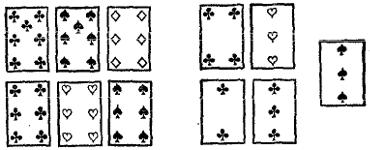
Dealer:—
The pone leads a Seven, and afterwards pairs the dealer’s Six, pegging to 58. The dealer pegs 6 for the pair royal, and is told to go. This enables the dealer to make a double pair royal and 31, pegging fourteen holes more. (The last card does not count when a go or 31 is pegged). On the show the pone has only a pair, which puts him to 60, within one of the game hole. The dealer shows 12 in hand and 17 in crib, making him 54 up. In the next deal the player who wanted one could not peg, his adversary securing a fifteen and a go, and showing out with a pair and a fifteen, 61 up and game.
THREE-HANDED CRIBBAGE.
Five cards are dealt to each player, and then another, face down, for the foundation of the crib. Each player then lays out one card to make the dealer’s crib up to four. The starter is cut by the player on the dealer’s left, and the game proceeds as at six-card Cribbage, the eldest hand having the first show, the dealer the last.
FOUR-HANDED CRIBBAGE.
When four play, they cut for partners, choice of seats, and deal; the two lowest pairing against the two highest, and the lowest taking the first deal and crib. The game is usually 121 points up, or twice round the board, and only one player on each side keeps the score.
Five cards are dealt to each player, one at a time, and one of these is discarded from each hand to form the crib, leaving four cards with which to play. The right-hand adversary of the dealer cuts for deal; the left-hand adversary for the starter. The eldest hand plays first, and all pairs, sequences, and fifteens are scored by the side making them. If a player says “go,” his left-hand neighbour must play, or pass the go to the next player on his left. In this way it may pass entirely round the table to the last player, who will then peg for it.
At this game there is a great deal more in the play than in either hand or crib. The average hand and crib is the same as at six-card Cribbage, 7 for the hand and 5 for the crib, but the play for the partners will run to 8 or 10 holes. Either side should be at home with 48 to 50 on two deals; four individual hands of 7 each, four plays of five each, and one crib of 5.
SEVEN-CARD CRIBBAGE.
This form of the game for two players differs from the others only in the number of cards dealt to each player, which is seven. Two are laid out for the crib, and five kept for playing. There being six cards in each hand, with the starter, the counting combinations sometimes run into high figures, and it is therefore usual to play the game 121 or even 181 points up.
There are no authoritative LAWS for Cribbage, but the foregoing descriptions contain all the regulations in force at the best clubs.
TEXT BOOKS.
The Cribbage Player’s Handbook, by Walker.
Bézique and Cribbage, by Berkeley.
Pocket Guide to Cribbage, by “Cavendish.”
Bohn’s Handbook of Games.
Cribbage, by Rawdon Crawley.
Dick’s Handbook of Cribbage.
PIQUET.
Piquet is supposed to have been introduced during the reign of Charles VII., and was designed as a motif for a ballet of living cards which was given in the palace of Chinon. Of the etymology of the word piquet, little or nothing is known, but the game itself is one of those perennials that have survived much more pretentious rivals, and, thanks to its intrinsic merits, it has never since its invention ceased to be more or less à la mode.
There are several varieties of Piquet, but the straightforward game for two players, sometimes called Piquet au Cent, or 100 points up, is the most common and popular, and will be first described.
CARDS. Piquet is played with a pack of thirty-two cards, all below the Seven being deleted. The cards rank: A K Q J 10 9 8 7, the Ace being the highest both in cutting and in play. There is no trump in Piquet, and all suits are equal in value. Two packs are sometimes used, one by each player in his proper turn to deal.
The cards have a certain pip-counting value, the Ace being reckoned for 11, other court cards for 10 each, and the 7 8 9 10 for their face value.
MARKERS. As the scores are not put down until the end of the hand or play the game is usually kept on a sheet of paper, or it may be marked on a cribbage board.
PLAYERS. Piquet is played by two persons, who sit opposite each other. They are known as the dealer, and the elder hand or pone.
CUTTING. They cut for seats and cards, the lower cut having the choice, and dealing the first hand. If a player exposes more than one card the lowest of those exposed must be taken as his cut. Ties are decided by cutting a second time.
STAKES. Piquet is played for so much a game of 100 points; but if the loser has not reached 50 points he is lurched, and loses a double game.
DEALING. The cards shuffled, they are presented to the pone to be cut, and at least two cards must be left in each packet. Twelve cards are dealt to each player, either two or three at a time; but whichever method is first selected must be maintained throughout the game. In England the cards are always dealt by twos. No trump is turned. The remaining eight cards are placed face downward on the table, the five top cards being laid crosswise on the three at the bottom. These eight cards are called the talon or stock. Each player deals in turn.
Irregularities in Dealing. If the pack is proved to be imperfect the deal is void, but all previous scores or cuts made with that pack stand good. A misdeal does not lose the deal under any circumstances. If a card is found faced in the pack there must be a fresh deal with the same cards. If a player deals out of turn, and detects the error himself before he sees any of his cards, he may insist on his adversary’s dealing, even if the adversary has seen his cards. As the deal is a disadvantage the adversary is not bound to correct the player in error.
If the dealer gives too many or too few cards to either player a new deal is at the option of the adversary. The error will of course be detected when it is found that there are only seven cards in the talon. If the non-dealer elects to have the deal stand, the error in the player’s hand must be remedied in the discard, as will presently be described, and the stock must be divided 4-3 or 5-2, according to which player has too many cards.
Carte Blanche. The cards dealt, each player takes up his twelve cards and sorts them into suits. If the pone finds himself without a K Q or J, he should immediately claim 10 points for carte blanche. If the dealer holds carte blanche, he does not declare it until the pone has discarded.
DISCARDING. The five cards on the top of the talon belong to the pone, and he may discard from his hand any number of cards from one to five, and replace them by an equal number from the top of the stock. He must take at least one card, and he must take from the talon in the natural order of the cards. If he has elected to let a deal stand in which he has been given thirteen cards, he is entitled to four cards only from the talon, and must in all cases leave himself with twelve cards after his discard and draw are completed. If he does not take all five cards, he must announce distinctly how many he leaves, for if he fails to do so the dealer is not liable for having too many cards.
The dealer then discards, first declaring carte blanche if he holds it. In England, he need not draw at all, in France he must draw at least one card. Besides the three cards which belong to him, he is entitled to take as many as he pleases of those left by the pone, and in drawing from the talon he must take the cards in the order in which they come. If two cards are left by the pone, for instance, and the dealer wants three only, he must take the two left by the pone and one of his own three, leaving the two others face down on the table. The number of cards in hand after the discard and draw must be exactly twelve. Only one discard is allowed, and having been made it cannot be changed after the stock has been touched.
If the pone does not take all the cards to which he is entitled, he is allowed to look at those that remain of the first five that were on the talon; but on no account may he look at any of the dealer’s three. If the dealer leaves any cards in the stock, he has a right to look at them, but the pone may not see them until he has led for the first trick, or announced the suit he will lead. If he announces a suit, and after seeing the cards in the stock does not lead that suit, the dealer may call a suit. If the dealer does not look at the remaining cards the pone cannot see them either.
Each player keeps his discards separate from those of his adversary, and is allowed to refer to them at any time during the play of the hand, but on no account can he see his adversary’s discards, unless that adversary has mixed with them one or more of the unseen cards that were left in the stock, and afterward picks up and looks at his discard, including the card which the other is entitled to see. For instance: The dealer leaves a card without looking at it. This he afterward mixes with his discard. Now, if he looks at his discard, of course he sees the card left in the stock, and the pone may demand to see not only the card left, but the entire discard. The same rule applies to the pone if he takes into his discards an unseen card of the stock.
Irregular Discards. If a player discards less cards than he intended, it is too late to remedy the error if he has touched the stock. If he discards too many cards, as the dealer frequently will by laying out five instead of three, he may take them back if he has not touched those in the stock, but if he touches any card in the stock, he must play with the short hand if there are not enough cards left in the stock to make his hand up to twelve.
Irregular Drawing. If the pone draws one of the three cards which properly belong to the dealer, he loses the game; and if the dealer draws any of the first five, before the pone has announced that he leaves them, the dealer loses the game. The dealer has no right to touch any part of the stock until the pone has discarded and drawn; but if the pone draws without making any announcement about leaving cards, the dealer has a right to assume that five cards have been taken, and that only three remain in the stock. For instance: The pone discards five cards, but draws four only, without saying anything. The dealer proceeds to discard and draw. He has of course taken one of the pone’s cards, but it is too late to remedy the error or claim a penalty, and the pone must play with eleven cards. It is evident that the dealer will have too many cards, but as he has been led into the error by his adversary, he must be allowed to discard to reduce his hand to twelve.
If a player takes a card too many from the stock, he may replace it if he has not put it with the other cards in his hand. If he has seen it, he must show it to his adversary. If the superfluous card has been taken into the hand, the player must have too many cards, and can score nothing that deal. This does not prevent the adversary from scoring anything he may have in hand or play, even if it is inferior.
If a player is found to have too few cards after the draw, he may still play and count all he can make, but he cannot win a capot, because he has no card for the last trick, which must be won by his adversary.
The Stock. If a player looks at one of his adversary’s cards in the stock before or during the draw, he can count nothing that hand. If he looks at a card left in the talon after the draw, which he is not entitled to see, his adversary may call a suit from him as many times as he has seen cards. If a card of the talon is accidentally exposed, the player to whom it would naturally belong may demand a fresh deal.
OBJECTS OF THE GAME. In order to understand the principles that guide players in discarding, the objects of the game must first be explained. There are three classes of counting combinations at Piquet, and the player that holds the better of each class, scores it. These combinations are: Point; Sequence; Fours and Triplets.
The Point is the suit having the greatest pip value, reckoning the Ace as 11, court cards as 10 each, and the 10 9 8 7 at their face value. If one player’s best suit contains five cards, worth 48 points, and his adversary has a suit worth 51, the latter would be the only one to count, and it would be called the point for that deal.
The value of the point is the number of cards that go to make it. In England, they count a point containing the 7 8 and 9 as worth one less than the number of cards. This is a modern invention, unknown to the older writers on the game, and not always played.
Sequence. Three or more cards of the same suit, if next in value to one another, form a sequence. The French terms are generally used to designate the number of cards in the sequence: Tierce, Quatrième, Quinte, Sixième, Septième, Huitième. Many English works on cards erroneously spell quinte without the “e,” and give “quart” for a sequence of four. If one is going to use the French language at all, it may as well be used correctly.
Sequences outrank one another according to the best card, if they are of equal length; so that a quinte to a King would be better than a quinte to a Queen; but a longer sequence always outranks a shorter one, regardless of the high cards. The player holding the best sequence is entitled to score it, together with any inferior sequences he may hold in other suits. Should his adversary hold intermediate sequences, they are of no value. For instance: One player holds a quinte to the Jack in spades, a tierce to the Ten in hearts, and a tierce to the Nine in clubs; while the other holds a quatrième majeure (A K Q J) in hearts, diamonds, and clubs. None of the latter are of any value; but all those in the other hand are good. If the best sequence is a tie, no sequences can be scored by either player.
The value of a sequence is ten more than the number of cards that go to form it, provided that number exceeds four. A tierce counts 3 only, and a quatrième 4 only; but a quinte is worth 15, a sixième 16, and so on.
Fours, and Triplets. Any four cards of the same denomination, higher than a Nine, is called a Quatorze; three of any kind higher than the Nine is called a Trio, or sometimes a Brelan. As a trio is seldom mentioned without naming the denomination, it is usual to say; “Three Kings,” or “Three Jacks,” as the case may be. The 7 8 and 9 have no value except in point and sequence. The player holding the quatorze of the highest rank may score any inferior ones that he may hold, and also any trios. Should his adversary hold any intermediate ones, they are of no value. In the absence of any quatorze, the best trio decides which player shall count all the trios he may have in his hand, his adversary counting none. For instance: One player holds four Tens and three Jacks, his adversary holding triplets of Aces, Kings, and Queens. None of the latter would be of any value, as the lowest quatorze is better than the highest trio, and the player with the four Tens could count his three Jacks also. Pairs have no value.
The value of any quatorze is 14, as its name implies. Trios are worth 3 only.
In discarding, the object is to secure the best counting combinations, and also to retain cards which will win tricks in play. The combinations take precedence of one another in scoring, the first being always Carte Blanche, then the Point, then Sequence, and lastly the Quatorze or Trio.
DECLARING. Carte blanche must be announced and shown before a discard is made. Each player having discarded and drawn, the elder hand proceeds to announce any counting combinations he holds, which he must declare in regular order, beginning with the point. In announcing the point, the suit is not mentioned, only its value. The sequences are defined by the number of cards and the highest; “sixième to the King,” for instance. The fours and trios are defined in the same way; “four Kings,” or “three Jacks.”
To each of these declarations, as they are made in regular order, the dealer must reply: “Good,” “Equal,” or, “Not good.” If the point is admitted to be good, the holder scores it; not by putting it down on the score sheet, but simply by beginning his count with the number of points it is worth. If the point is equal, neither player scores it, and secondary points have no value under any circumstances. If the point declared by the elder hand is not good, it is not necessary for the dealer to say how much better his point is; that will come later. To each of the other declarations replies are made in the same manner, except that fours and trios cannot be “equal.” As each combination is admitted to be good, the elder hand adds it to his count. For instance: His point is 51, good; his sequence is five to the Ace, good; and his triplet of Aces is good. These are worth 5, 15, and 3 respectively, and his total count is 23, if he has no minor sequences or trios. This is not put down, but simply announced.
The strict rules of the game require the player whose combination is acknowledged to be good, to show it; but among good players this is quite unnecessary, for each usually knows by his own cards what his adversary should and probably does hold.
The elder hand having finished his declarations, and announced their total value in points, leads any card he pleases. If this card is a Ten or better, he claims one point for leading it, even if he does not win the trick, and he adds this point to his score.
An illustration will probably make the foregoing processes clearer. The elder hand, after the draw, holds these cards:—
♡ A K Q J: ♣ A K Q: ♢ A K Q 7: ♠ A.
He announces: “Forty-one.” “Not good.” “Quatrième to the Ace.” “Not good.” “Quatorze Aces,” which he knows is good; and which admits of his counting his triplets of Kings and Queens. These are worth collectively 20 points, and on leading one of his Aces he announces “Twenty-one.”
The dealer, before playing a card, proceeds to claim the count for the combinations which are good in his own hand, which is as follows:—
♣ J 10 9 8: ♢ J 10 9: ♠ K Q J 10 9.
The point is worth 5; the quinte 15, the quatrième 4, and the tierce 3; 27 altogether. His trios of Jacks and Tens are shut out by the superior combinations in the elder hand.
Having claimed these 27 points, and their correctness having been admitted by the elder hand, the dealer proceeds to play a card. If either player has forgotten to declare anything before he plays, the count is lost.
Sinking. A player is not obliged to declare any combination unless he wishes to do so, and he may sink a card if he thinks it would be to his advantage to conceal his hand. Sinking is calling only part of a combination, as, for instance, calling 51 for his point when he really has 61; calling a quinte when he has a sixième, or a trio when he has a quatorze. Sinking is usually resorted to only when the player knows from his own hand and discards that what he declares is still better than anything his adversary can hold; but it must be remembered that the part of the declaration which is sunk in this manner is lost.
Irregular Declarations. If either player claims a combination which he does not hold, and does not remedy the error before he plays a card, he cannot count anything that deal, losing any other declarations he may have made which are correct. His adversary then counts everything in his hand, whether his combinations were inferior or not. He also counts for what he wins in the tricks.
If the elder hand’s declaration is admitted by the dealer to be good, it is good, even if the dealer afterward proves to have a better point, sequence, quatorze or trio. If any combination named by the elder hand is not actually his best, he cannot amend his declaration after the dealer has replied to it. This is in order to prevent a player from getting information to which he is not entitled. If he holds three Kings and three Tens, for instance, and announces the Tens in order to find out whether or not his adversary has three Queens or Jacks, and the dealer says: “Not good,” the three Kings are lost, and the dealer scores his own trios.
It sometimes happens that in order to keep a good point or sequence, a player will discard one card of a quatorze originally dealt him; or one of a trio, of which he afterward draws the fourth. He can score only the trio, of course; but his adversary, having none of that denomination either in his hand or discards, knows that four were possible, and after playing a card he has a right to ask the suit of the card which was discarded.
METHOD OF PLAYING. The elder hand can lead any card he pleases, announcing the suit at the same time. The dealer is bound to follow suit, if able, but he is not obliged to win the trick. As there are no trumps, the higher card, if of the suit led, wins the trick. If the second player does not follow suit, the leader wins. The winner of one trick leads for the next, and so on until all twelve tricks are played.
Every time a card is played which is better than a Nine, the leader counts one for it, adding the number to the total value of his score as already announced. If the second player wins the trick with any card better than a Nine he also counts one; but if the trick is won by the player who led, there is no extra count for winning it. The winner of the last trick counts one for it, in addition to his count for winning it with a card better than a Nine. If the leader wins it, he gets the one extra.
If each player wins six tricks, there is no further scoring; but if either player wins the odd trick he adds to his score ten points for cards, in addition to all other scores. If either player wins all twelve tricks, which would be the case in the example hand just given as an illustration, he adds to his score forty points for the capot; but this forty points includes the scores for the last trick and for the odd trick.
A card once laid on the table cannot be taken back, unless the player has renounced in error. There is no revoke in Piquet, and if a player has one of the suit led he must play it. If he fails to do so, when the error is discovered the cards must be taken back and replayed.
REPIC. If either player is able to reach 30 by successive declarations, beginning with the point, all of which are admitted by his adversary to be good, he adds 60 to his score, making it 90 instead of 30, and this is irrespective of what his adversary may have in minor or inferior combinations. The important thing to remember in repic is that declarations always count in regular order, carte blanche taking precedence of everything; then the point, sequences, and quatorze or trio. Suppose elder hand to hold the following cards:—
♡ K Q J 10 9; ♣ A K Q; ♢ A Q 9; ♠ Q.
If the quinte to the King is admitted good for the point, it must be good for the sequence also. That is 20. The four Queens must be good, as the adversary cannot have any quatorze. This makes the total 34, and 60 added for repic, 94 altogether, to which he will add one for leading the first card, if it is above a Nine.
Suppose the elder hand had the following cards:—
♡ A K Q J 8; ♣ A K; ♢ A K; ♠ A K 10.
If his point is good, that and his four Aces and Kings will make him 33 altogether; but his sequence is not good, because the dealer holds five diamonds to the Queen, which comes in order before the score for quatorze, and so saves the repic. Suppose that with the foregoing cards the elder hand was told that even his point was not good. He would count 29 for the 14 Aces, 14 Kings, and the card led. If the dealer had a sixième in diamonds, and a quinte in clubs, for instance, he would claim a repic, 96 points, in spite of the 29 announced by the elder hand; because point and sequence score before quatorze.
Equalities do not save the repic. Take the following hands:—
Elder:— ♡ A J 10 9 8; ♣ 10; ♢ 10; ♠ A J 10 9 8.
Dealer:— ♡ K Q; ♣ A K Q; ♢ A K Q J 7; ♠ K Q.
The point is equal. The quatrième to the Jack is not good and the four Tens are not good; so elder hand leads a card, and counts, “One.” The dealer then claims repic, 95 points, which is good, although the elder hand had an equal point.
PIC. If either player can reach 30 in hand and play combined, before his adversary scores anything, 30 are added for the pic. Pic can never be made by the dealer unless the elder hand leads a card smaller than a Nine; he must make repic if anything. To make pic the elder hand must reach 30 in the regular order of scoring. Suppose holds these cards:—
♡ A 9; ♣ A K Q J; ♢ K Q J 10 9; ♠ K.
If the dealer acknowledges the point to be good, everything else in the hand must be good also. This will give the elder hand 27 before playing a card; 5 for the point, 15 and 4 for the sequences, and 3 for the Kings. By leading out the A K and Q, 3 more points are secured, the dealer having nothing to score, and so the elder hand reaches 30 and makes the pic, counting 60, and still having the lead. Equalities do not save pic.
According to the strict rules of the game, a player who is playing for pic is not allowed to count 30 at all, but must jump from his last count, 29, to 60, or he loses the pic; but this is seldom or never insisted on.
SCORING. The last card played, the total number of points made by each player are put down on the score sheet, or marked on a cribbage board, and if neither player has reached 100 points, the deal passes to the one who was elder hand on the last deal.
The order of scoring should be carefully observed, in order to determine which goes out first, and whether or not a player is lurched. Carte blanche, The Point, Sequence, Quatorze or Trio, Repic, Points for Leading or Winning, Pic, the Odd Trick, Capot.
If one player reaches 100 before his adversary has reached 50, it is a lurch, and counts a double game.
Abandoned Hands. If a player throws down his cards, he may still take them up again, unless he or his adversary have mixed their cards with the discards, or with the remainder of the talon.
SUGGESTIONS FOR GOOD PLAY. The chief points for the beginner are good discarding, and taking advantage of tenace positions in the play, so as to secure the count for cards, which is often important.
Elder Hand. In discarding, the pone should consider what there may be against him. If it is unlikely that he will lose a pic or repic, he should try for the point, which very often carries with it the sequence. It must be remembered that there are only eight cards in each suit, and by comparing those that you hold with those that your adversary may hold it is comparatively easy, in the majority of hands, to estimate the possible scores against you. Next to the point, the most important thing is the score for cards. The point will save pic and repic, but the cards will make the greatest difference in the score in the long run. Sequences are always valuable, especially those that are Ace high in the elder hand, because they enable him to win a succession of tricks in play.
The elder hand should risk a good deal if he has a fair chance to make a pic or repic, which will often settle the game. If there is any choice as to what to keep of two nearly equal chances, always preserve the combination that will be most likely to secure the count for cards.
In Leading, it is best to begin with the point, unless you know that you are leading up to tenace, or to high cards that will bring in a long adverse suit. The piquet player soon learns the importance of tenace and fourchette, and can sometimes see how things must be managed for five or six tricks ahead, so as to secure the odd trick. Tenace is the best and third-best of any suit, such as A Q, while a fourchette is any two cards within one of each other, such as K J, or Q 10, and the lead from such combinations should always be avoided. If you have the odd trick in hand, make it at once, before you risk anything else, because the only difference between the odd trick and eleven tricks is the count for each card led in the tricks.
The Dealer. The first thing to guard against is a long run of winning leads from the elder hand, which might make the odd trick, or even capot. As there are no trumps it is very important for the dealer to keep guarded Kings and twice-guarded Queens. The principal thing for the dealer to remember is that if he cannot stop a long suit in the elder hand, he will have to provide in advance for a certain number of discards, and these must be so planned that guards will be preserved in the other suits. He should also get his hand into such condition that when he does get into the lead, he will not have to lead away from tenaces or guarded Kings. Careful attention to his adversary’s declarations, and a comparison of his own hand with his discards will usually guide the dealer to a correct conclusion as to what to keep and what to throw away in playing to tricks.
Mathematicians have exhausted their resources on Piquet, but their conclusions are of little use to the average player. The subject of discards has been very fully illustrated by examples from actual play, especially in the Westminster Papers, but no one has yet given us any simple rules like the jeux de règle at Écarté.
PIQUET NORMAND, FOR THREE PLAYERS.
In this form of the game the players cut for seats and deal. The cards are dealt by twos and threes until each has ten, two cards remaining for the talon. The dealer may lay out any two cards in exchange for these, but no other player is allowed to touch them, nor to see the discards.
The elder hand makes the first declarations. He makes repic and counts 90 if he can reach 20 without playing a card; and he makes pic, 60, if he can reach 20 in hand and play, under the same conditions as in the game for two players. The majority of tricks counts 10; if it is a tie, each counts 5. Capot counts 40 if all the tricks are taken by one player; but if two take them all between them, they count 20 each.
The game may be played for a pool, first man out to take all; or it may be agreed that after one has retired the others shall decide it between them by playing it out at the ordinary two-handed game.
PIQUET VOLEUR, FOR FOUR PLAYERS.
The players cut for partners, the two lowest pairing against the two highest, and the lowest cut taking the first deal. Partners sit opposite each other. All the cards are dealt out, two and three at a time, each receiving eight cards.
The elder hand declares first, but instead of announcing one thing at a time, and awaiting the reply of his adversaries, he declares everything, and then plays a card. Suppose the cards are distributed as follows, Z being the dealer:—
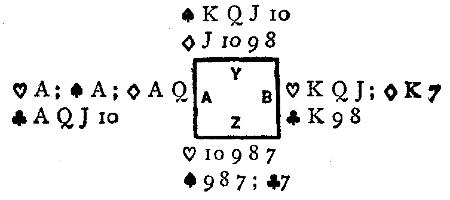
A announces 41 for his point, sequence of three to the Queen, four Aces, and says, “I play a club,” which is his lead for the first trick. If the second player admits all these to be good he says nothing, but plays a card. In this case, Y would announce four to the King, and four to the Jack, and would play a spade, having no club. B would then announce three Kings, which are good on account of his partner’s having four Aces; but both the sequences are shut out by Y’s better declarations. The dealer, Z, then declares four to the Ten and three to the Nine, both those sequences being made good by his partner’s holding the best sequence at the table.
The first trick played, each person at the table shows what he has claimed, in order that his adversaries may verify the count. A would then gather up the first trick, announcing the total score for his side, which would be 22; 4 for the point, 14 Aces, 3 Kings, and 1 for the card led. He would then play another club, announcing 22. This his partner would win but would not count, as he is on the same side that has already counted for the lead. If the play is followed up it will be found that A-B make a capot. The adversaries will then score 15 for their three sequences of four, and one of three.
No point of less than 30 can be announced.
Pic and Repic. If one player, or two partners together, reach 20 in counting, without playing, they count 90 for the repic. If they reach 20 in declarations and play together, they count 60 for the pic. Carte blanche in the hand of one or other partner may count toward pic or repic; and if two partners each held carte blanche, they would be entitled to 90 points for the repic, no matter what the adversaries held, because carte blanche takes precedence of all other scores.
PIQUET A ÉCRIRE.
This game somewhat resembles Skat in the manner of playing and settling. Any number from three to seven persons sit around the table; but only two play, and the losses of each individual are charged to him on a score sheet ruled off for the purpose. The players may take turns, each playing two deals, the first with the person on his left, and the second with the one on his right. Or it may be agreed that the loser in each deal shall give way to a new player, the winner of the majority of points in each deal to continue. The game is generally arranged for a certain number of tours or deals, at the end of which the scores are balanced and settled for.
RUBICON PIQUET, FOR TWO PLAYERS.
The chief difference between this game and the usual form, Piquet au cent, is in the manner of declaring. The usual method in England and America is as follows:—
The Point is scored by the player holding the greatest number of cards in the suit, and the pip value is resorted to only to decide ties. This is done in order to conceal, if possible, the nature of the cards held. When the numerical value is asked, only the last figure is given, “seven,” for instance, if the point is 47.
If the point is good, the elder hand immediately names the suit. If it is not good, the suit is not named, and the elder hand proceeds to call his sequences. It they are good, the suits must be named; the same with quatorze and trio.
Under-calling. If a player holds an inferior sequence, quatorze or trio, which he knows is better than any his adversary can possibly hold, he may call it, and afterward score the better combination, provided he is correct in estimating the inferior one that he called as good against the cards. But if the adversary can demonstrate that the inferior announcement was not actually good against the cards, and that it was possible for him to hold a better, the score for the higher combination is lost. For instance: A player holds four Kings and three Aces, and on glancing over his hand and discards, sees that his adversary cannot hold any quatorze, so he declares the three Kings, instead of the four Aces. Suppose he mistook a Nine for a Ten, and overlooked the fact that his adversary might have had four Tens, the score for the four Kings would be lost, but the three Aces would be good if his adversary had discarded a Ten, and did not actually hold four. In the ordinary game, the higher combination is lost if it is not called.
In play, every card led, whatever its value, counts one, and winning the trick counts one also. The last trick counts two, and the capot forty. Pic and repic are reckoned as in the ordinary game.
Scoring. Instead of playing 100 points up, six deals is a game, each player dealing three times. The lower score is then deducted from the higher, and 100 points added to the difference to determine the value of the game, which is usually played for so much a point.
If the result of the six deals is a tie, two more deals must be played. If they also result in a tie, the game is void.
Rubicons. If either or both players fail to reach 100 points in the six deals, the one having the most is the winner, and adds to his own score all the points made by the loser, with 100 in addition for game. For instance: A has 113 scored, and B 80. A wins 113 + 80 + 100 = 293 altogether. Again; A has 88, B has 84. A wins 88 + 84 + 100 = 272 altogether. Again; A has 180, B has 142. A wins the difference in the scores, 38 + 100 = 138 altogether.
TEXT BOOKS.
Jeux de Cartes, by Jean Boussac.
Académie des Jeux, by Van Tenac.
Académie des Jeux, by Richard.
Règles de tous les Jeux, by Dreyfous.
Bohn’s Handbook of Games.
Piquet, and Rubicon Piquet, by Berkeley.
Laws of Piquet, by “Cavendish.”
Westminster Papers, Vols. II. to IX. inclusive. There are excellent articles on the Laws in Vols. III. and VI., and on discards in Vol. VII.
IMPERIAL, OR PIQUET WITH A TRUMP.
Impérial differs from Piquet in some minor details, although the leading principle is the same. There are no discards; sequences of court cards are the only ones that count; tierces are worthless; and a trump suit is added.
The cards rank K Q J A 10 9 8 7; the K Q J A and 7 of trumps are called honours, and in all sequences the four highest cards in the suit are the only ones that count.
Counters. Each player is supplied with six white and four red counters, which are passed from left to right as the points accrue. Each red is worth six white, and when all six white counters have been passed over, they must be returned, and a red one passed over in their place. When all the counters, four red and six white, have been passed over, the game is won.
Dealing. Twelve cards are given to each player, two or three at a time, and the twenty-fifth is turned up for the trump. If this is an honour, the dealer marks one white counter for it. There are no discards.
Impérials. Certain combinations of cards are known as impérials, and the player marks one red counter for each of them. The best impérial is carte blanche, which is sometimes marked as a double impérial, and worth two reds. A sequence of K Q J A in any suit is an impérial. An impérial de retourne may be formed in the dealer’s hand if the turn-up trump completes his sequence or makes four of a kind. An impérial tombée, or de rencontre, is made when the player who holds the King and Queen of trumps catches the Jack and Ace from his adversary. Four Kings, Queens, Jacks, Aces, or Sevens in one hand is an impérial; but the Eights, Nines and Tens have no value.
Declaring. The elder hand announces his point, as in Piquet, and arrives at its value in the same way, reckoning the Ace for 11, etc. The dealer replies, “Good,” or “Not good,” as the case may be; but there are no equalities. If the point is a tie, the elder hand counts it. The point is worth a white counter. The impérials are then called, each being worth one red counter. The sequences are called first, that in trumps being “good” of course; then the fours are called, the best being four Kings, and the lowest four Aces. In plain-suit sequences there are no “equals,” the elder hand counting ties as an offset to the advantages of the deal.
Playing. The elder hand leads a card, and the dealer then declares and marks any impérials he may have that are good; after which he plays a card. No impérials can be claimed or scored after the holder has played a card. The second player in each trick must win the trick if he can, either with a higher card or with a trump. For each honour in trumps in the tricks won the player marks a white counter at the end of the hand. The winner of the odd trick scores as many white counters as he has tricks in excess of his adversary. If either player makes capot, (all twelve tricks,) he scores two red counters.
Scoring. When one player reaches six white counters and changes them for a red, his adversary must take down any white counters he may have scored. For instance: The pone has 2 reds and 4 whites up; the dealer has 1 red and 5 whites. The pone scores two whites, reaching six, and advancing his score to 3 reds, which are sometimes called impérials. The dealer must take down his white counters, losing that count altogether, and leaving himself 1 red. The only exception to this is that at the beginning of the hand if both have impérials combinations in hand, neither side takes down its white counters.
In Counting out the following order of precedence must be observed: The turn-up trump, (if it is an honour). The Point. Impérial in hand, sequences first. Impérial de retourne. Impérial tombée. Honours in tricks. Odd tricks.
CASSINO.
This is a very old and always popular game, which has lately been much improved by the introduction of the variations known as Royal and Spade Cassino, the latter especially being a very lively game. Like Euchre, Cassino is eminently respectable, and is one of the few games of cards that are unhesitatingly admitted to the domestic circle.
Cards. Cassino is played with a full pack of fifty-two cards, which have no rank in play, their pip or face value being the only element of importance. In cutting for positions at the table, or for partners in the four-handed game, the Ace is the lowest card, the others ranking upward to the King in the order of their sequence.
Markers. When a certain number of points is agreed on as a game, the score may be kept with counters, on a sheet of paper, or on a cribbage board. If each hand is a game in itself, it is settled for immediately, either in counters or in money.
Players. Any number from two to four may play, each for himself, or four may play two against two, partners sitting opposite each other. The players on the dealer’s right and left are known as the pone, and the eldest hand respectively.
Cutting. The players draw from an outspread pack for positions at the table, the lowest card having the choice and dealing the first hand. If the first cut does not decide, those tying must cut again. If a player exposes more than one card he must cut again. The ace is low.
Stakes. Cassino may be played for so much a game, or so much a point; and it may be agreed that the game shall be a certain number of points, or shall be complete in one deal, or that the player making the majority of points on each deal shall score one, and the one first making a certain number in this manner, such as five, shall be the winner. If points are played for, the lower score is usually deducted from the higher, and the difference is the value of the game. It is sometimes agreed that if the winner has twice as many points as his adversary, he shall be paid for a double game.
Dealing. After the cards have been properly shuffled they must be presented to the pone to be cut, and he must leave at least four in each packet. Beginning on his left, the dealer distributes four cards to each player in two rounds of two at a time, giving two to the table just before helping himself in each round. No trump is turned, and the remainder of the pack is left face downward on the dealer’s left. The four cards dealt to the table are then turned face up, and the play begins. After the four cards given to each person have all been played, the dealer takes up the remainder of the pack, and without any further shuffling or cutting, deals four more cards to each player, two at a time, but gives none to the table. These four having been played, four more are dealt in the same manner, and so on, until the pack is exhausted, after which the deal passes to the left in regular rotation.
Irregularities in the Deal. If the pack is proved to be imperfect, or if a card is found faced in the pack there must be a fresh deal by the same dealer. If a player deals out of turn, he must be stopped before the cards on the table are turned face upward.
A misdeal loses the deal. It is a misdeal if the pack has not been cut, or if the cards are shuffled after the pack has been properly cut; or if the dealer deals a card incorrectly, and fails to remedy it before dealing to the next player; or if he deals too many or too few cards to any player or to the table.
If a card is exposed during the deal, an adversary may claim a fresh deal. If, after the cards on the table have been faced, a card is exposed by the dealer, or is found faced in the pack, the player to whom it would be dealt may reject it, and it must then be placed in the middle of the stock, and he must be given the top card. If a card is exposed in the last round, the dealer must take it, and must allow the player to whom it would have been dealt to draw a card from the dealer’s hand, face downward. If he draws the exposed card, he must keep it.
If the dealer gives any player an incorrect number of cards in any round after the first, and does not detect and correct the error before he deals to the next player, the dealer cannot count anything that hand. The number of cards in each hand must be restored to four, either by drawing from them, face down, or adding from the stock. If any player lifts his cards before the dealer has helped all the players, including himself, a misdeal cannot be claimed.
Objects of the Game. The object in Cassino is to secure certain cards and combinations of cards which count toward game. These are as follows:—
Points.
The majority of Cards taken in. 3
The majority of Spades taken in. 1
The Ten of diamonds, Big Cassino. 2
The deuce of spades, Little Cassino. 1
The Ace of any suit. 1
A Sweep of all the cards on the table. 1
The manner in which these points are secured will become apparent from the description of the method of playing the hands.
Method of Playing. Beginning on the dealer’s left, each player in turn plays a card from his hand, placing it face upward on the table. Only one card can be played at a time, and each person must play in his proper turn until all four of his cards are exhausted. After receiving fresh cards, the eldest hand again plays first, and so on for every round. Under certain conditions, each player in his proper turn may take up certain cards from the table, together with the one played from his hand, turning them face downward in front of him. He is entitled to count all the points contained in the cards taken in or won in this manner. These conditions are: that he can match or pair a card or cards on the table; that he can combine two or more cards on the table so as to make their total pip value equal to that of the card he plays; or that he can build a card in his hand upon one on the table, so as to make their total pip value agree with that of a second card, still in his hand.
Pairing. If the person whose turn it is to play, holds in his hand any card of a similar denomination to any of those on the table, he may play the card from his hand, face upward, and then gather it in again, together with all similar cards, turning them face downward in front of him. For instance: He holds an Eight, and there are one or two Eights on the table. He plays the Eight from his hand, and then gathers in all of them.
Combining. If a player holds any card, not a K Q or J, the pip value of which is equal to that of two or more cards on the table, he may play the card from his hand, and then gather it in again, together with the two or three cards that collectively equal it in pip value. For instance: He holds a 9, and a 4, 3 and 2 are upon the table. He may combine these three cards, calling attention to the fact that their collective value is 9, and then play the 9 from his own hand, gathering in and turning down all four cards. An 8 and Ace, or 6 and 3 might be gathered in the same way; or two such combinations might be gathered at the same time, 3, 2, 6, 7, for instance, which would make two nines; all of which might be gathered by a player holding a 9 his hand.
Pairs and combinations may be taken in together. For instance: Among the cards on the table are a 4, 6, and 10, and the player holds a 10. He can gather in not only the pair of Tens, but the combinations which equal a 10.
Building. A player may have in his hand two cards, the lower of which, if added to a card on the table, would build up its value to that of the higher card still in the player’s hand. For instance: A player holds a 9 and 2, and there is a 7 on the table. He may place the 2 on the 7, announcing the total value; “Nine,” which will notify other players that those two cards cannot be separated; but he cannot take them in until it again comes round to his turn to play, because he is allowed to play only one card at a time, and he has played his card in making the build.
Should any other player following him hold a 9, he would be entitled to take in this build, but he could not separate the two cards forming it. A player holding either a 7 or a 2 could not touch either of the cards in the build, because they are no longer a 7 and 2, but a 9, for all practical purposes.
Increasing Builds. If any player held an Ace and a 10 in his hand, he could increase the 9 build to a 10 build, by putting his Ace on the 7 and 2, and announcing the total value, “Ten.” Any following player would then be unable to win the build with anything but a 10, and the player who originally built it a 9 would lose it unless he also held a 10 in his hand. Should the build remain a 9 until it came round again to the player who originally built it, he could then take it in with his 9, or he might himself increase it to 10, if he had an Ace and a 10 in his hand; but in order to do this the player must have in his hand the cards to win both the original and the increased builds. A player holding in his hand a 10, 3 and 2, but no 8, could not build a 5 on the table to an 8, and afterward advance it to 10. He must have the 2 3 8 and 10 all in his own hand to do this.
Some players imagine that a player cannot increase his own build in this manner, even if he has both the cards for the first and last build; but there is no reason why a player should be denied a privilege which is freely granted to his adversary. If any player can legitimately make or increase a build, all may do so, provided they have the proper cards.
Double Builds. When two cards of the same denomination, or two builds of the same value are put together as one, they cannot be increased. For instance: A player holds 7 and 3, and there are upon the table a 5 2 and 4. He places his 3 on the 4, and gathers the 5 and 2 together, announcing the build as “Two Sevens.” This cannot be increased to 8, 9, or 10 under any circumstances, and nothing but a 7 will win it.
Pairs may be doubled in the same manner. If a player has two Nines in his hand, and there is one on the table, he may build on the latter with one of his own, announcing, “Two Nines,” which will prevent any player from building either of them to 10, and will entitle the builder to take in both cards with his third Nine when it comes round to his turn. Should any other player at the table hold the fourth Nine, he could of course take in the build.
It is necessary to distinguish between building and combining. In combining cards, those already on the table are gathered together; in building, or increasing a build, a card must be played from the hand. If one player has made a build of any description, it cannot be interfered with or increased except by other cards from a player’s hand, those from the table not being available. For instance: One player has built a 5 by combining two Aces on the table with a 3 from his hand. On the table are also a 2 and 4 and a following player holds a 9 and 7. He cannot use the deuce on the table to increase the build from 5 to 7, nor the 4 to increase it to 9; because that would not be building from his hand; but if he held the 4 and 9 in his hand, he could build on the 5.
The simple rule to be remembered is that no combination of cards once announced, and left on the table, can be changed, except by the addition of a card from the hand of some player.
Taking In. Any player who has made a build is obliged either to win it, when it is next his turn to play, or to win something else, or to make another build. For instance: He has built a 5 into a 9 with a 4, and holds another 4; if another 5 appears on the table before it comes to his turn to play, he may build that into a 9 also, with his other 4, announcing, “Two Nines.” Or if some player should lay out a 4 he could pair it and take it in, leaving his 9 build until the next round. In the same way a player may increase or win another player’s build instead of taking in his own. An opponent’s build may be increased by cards from the hand only.
In the four-handed game, partners may take in one another’s builds, or may make builds which can be won by the card declared in the partner’s hand. For instance; One player builds an 8, and his partner holds Little Cassino. If there is a 6 on the table, the Cassino can be built on it, and “two Eights,” called, although the player has no 8 in his own hand; the 8 already built by his partner is sufficient. If a player has built a 9 which has been taken in by an adversary, he still holding the 9 he built for, his partner may build for the declared 9 in the same way.
Sweeping. If at any time a player is able to win everything on the table with one card, it is a sweep, and counts a point. For instance: He holds an 8, and there are upon the table four cards only:—5 3 6 and 2. By combining the 6 and 2, and the 5 and 3, two Eights will be formed, and the sweep is made. Sweeps are usually marked by leaving the cards with which they are made face upward at the bottom of the tricks taken in by the player. Sweeps made by opposite sides are sometimes turned down to cancel one another.
Trailing. When a player cannot pair, combine, or build anything, he must play a card. This is called trailing, because he is simply following along waiting for opportunities. In trailing it is usually the best policy to play the smaller cards, except Aces and Little Cassino, because as other players will probably trail small cards also, these may be combined and won with the larger cards kept in the player’s hand.