THE EUCHRE FAMILY. (continued 2)
Reading edition
MARKING THE KING. The discards settled, the first and most important thing before play begins is to mark the King. If the King is turned up, the dealer marks one point for it immediately. If the pone holds it, he must announce and mark it before he plays a card. If he leads the King for the first trick, he must still announce it by saying distinctly: “I mark the King;” and unless this announcement is made before the King touches the table, it cannot be marked. So important is this rule that in some European Casinos it is found printed on the card tables. Having properly announced the King, it may be actually marked with the counters at any time before the trump is turned for the following game.
If the dealer holds the King he must announce it before his adversary leads for the first trick. It is in order that there may be no surprises in this respect that the elder hand is required to say distinctly: “I play,” before he leads a card. The dealer must then reply: “I mark the King,” if he has it; if not, he should say: “Play.” A player is not compelled to announce or mark the King if he does not choose to do so.
If a player announces and marks the King when he does not hold it, his adversary can take down the point erroneously marked, and mark one himself, for penalty. This does not prevent him from marking an additional point for the King if he holds it himself. For instance: The pone announces King, and marks it, at the same time leading a card. Not having notified the dealer that he was about to play, the dealer cannot be deprived of his right to mark the King himself, if he holds it. The dealer marks the King, marks another point for penalty, and takes down the pone’s point, erroneously marked. If the player announcing the King without holding it, discovers his error before a card is played, he simply amends the score and apologizes, and there is no penalty. If any cards have been played after an erroneous announcement of the King, such cards can be taken back by the adversary of the player in error, and the hand played over again.
METHOD OF PLAYING. The elder hand begins by leading any card he pleases, at the same time announcing the suit; “hearts;” “spades;” or whatever it may be. This announcement must be continued at every trick. If a player announces one suit and leads another, his adversary may demand that he take back the card played, and lead the suit announced. If he has none of the announced suit, the adversary may call a suit. If the adversary is satisfied with the card led, but improperly announced, he may demand that it remain as played.
RENOUNCING. When a card is led the adversary must not only follow suit, but must win the trick if he can. If he can neither follow suit nor trump, he may discard any card he pleases. Should a player not follow suit, or should he decline to win the trick, when able to do so, it is a renounce, and if he makes the odd trick he counts nothing; if he makes all five tricks, he counts one point only, instead of two. Should he trump the trick when he can follow suit, he is subject to the same penalty. There is no such thing as a revoke in Ecarté. When it is discovered that a player has not followed suit when able, or has lost a trick that he could have won, the cards are taken back, and the hand played over again, with the foregoing penalty for the renounce.
The highest card played, if of the suit led, wins the trick, and trumps win all other suits.
Leading Out of Turn. Should a player lead out of turn, he may take back the card without penalty. If the adversary has played to the erroneous lead, the trick stands good.
Gathering Tricks. The tricks must be turned down as taken in, and any player looking at a trick once turned and quitted may be called upon to play with the remainder of his hand exposed, but not liable to be called.
Abandoned Hands. If, after taking one or more tricks, a player throws his cards upon the table, he loses the point; if he has not taken a trick, he loses two points. But if the cards are thrown down claiming the point or the game, and the claim is good, there is no penalty. If the cards are abandoned with the admission that the adversary wins the point or the game, and the adversary cannot win more than is admitted, there is no penalty.
SCORING. A game consists of five points, which are made by tricks, by penalties, and by marking the King. A player winning three tricks out of the five possible, counts one point toward game; winning all five tricks, which is called the vole, counts two points. The player holding or turning up the King of trumps may mark one point for it, but he is not compelled to do so.
If the pone plays without proposing, and makes three or four tricks, he counts one point; if he makes the vole he counts two points; but if he fails to make three tricks the dealer counts two.
If the dealer refuses the first proposal, he must make three tricks to count one point; if he makes the vole he counts two points; but if he fails to win three tricks the player who was refused counts two points.
If the dealer accepts the first proposal, and gives cards, subsequent proposals and refusals do not affect the score; the winner of the odd trick scoring one point, and the winner of the vole two points.
In no case can a player make more than two points in one hand by tricks. If the dealer refuses the first proposal, and the pone makes the vole, it counts two points only. If the pone should play without proposing, and the dealer should mark the King and win the vole, it would count him only three points altogether.
The player first reaching five points wins the game. If a player has four scored, and turns the King, that wins the game, provided the King was the eleventh card. Rubbers are seldom played.
CHEATING. The methods of cheating at Écarté would fill a volume. There are many tricks which, while not exactly fraudulent, are certainly questionable. For instance: A player asks the gallery whether or not he should stand, and finally concludes to propose, fully intending all the time to draw five cards. Another will handle his counters as if about to mark the King; will then affect to hesitate, and finally re-adjust them, and ask for cards, probably taking four or five, having absolutely nothing in his hand. The pone will ask the dealer how many points he has marked, knowing perfectly well that the number is three. On being so informed, he concludes to ask for cards, as if he were not quite strong enough to risk the game by standing; when as a matter of fact he wants five cards, and is afraid of the vole being made against him.
There are many simple little tricks practiced by the would-be sharper, such as watching how many cards a player habitually cuts, and then getting the four Kings close together in such a position in the pack that one of them is almost certain to be turned. Telegraphic signals between persons on opposite sides of the gallery who are nevertheless in partnership, are often translated into advice to the player, to his great benefit. Besides these, all the machinery of marked cards, reflectors, shifted cuts, wedges, strippers, and false shuffles are at the command of the philosopher, who can always handle a small pack of cards with greater freedom, and to whom the fashion of dealing in twos and threes is always welcome. The honest card-player has not one chance in a thousand against the professional at Écarté.
SUGGESTIONS FOR GOOD PLAY. The French claim that any person may become an expert at a game like Piquet, simply by dint of long practice; but that the master of Écarté must be a born card-player, as no game requires in such degree the exercise of individual intelligence and finesse. While this may be true, there are many points about the game which may be learned by the novice, and which will greatly improve his play.
There are two things which the beginner should master before sitting down to the table for actual play: the hands on which it is right to stand, or play without proposing, and those with which it is right to refuse, or play without giving cards. These are called stand hands, or jeux de règle, and the player should be able to recognize them on sight.
In the following paragraphs the words dealer and player will be used to distinguish the adversaries at Écarté.
The principle underlying the jeux de règle is the probable distribution of the cards in the trump suit, and the fact that the odds are always against the dealer’s holding two or more. There are thirty-two cards in the Écarté pack, of which eight are trumps, and one of these is always turned up. The turn-up and the player’s hand give us six cards which are known, and leave twenty-six unknown. Of these unknown cards the dealer holds five, and he may get these five in 65,780 different ways. The theory of the jeux de règle is that there are only a certain number of those ways which will give him two or more trumps. If the player holds one trump, the odds against the dealer’s holding two or more are 44,574 to 21,206; or a little more than 2 to 1. If the player holds two trumps, the odds against the dealer’s holding two or more are 50,274 to 15,506; or more than 3 to 1. It is therefore evident that any hand which is certain to win three tricks if the dealer has not two trumps, has odds of two to one in its favour, and all such hands are called jeux de règle. The natural inference from this is that such hands should always be played without proposing, unless they contain the King of trumps.
The exception in case of holding the King is made because there is no danger of the dealer’s getting the King, no matter how many cards he draws, and if the player’s cards are not strong enough to make it probable that he can win the vole, it is better for him to ask for cards, in hope of improving his chances. If he is refused, he stands an excellent chance to make two points by winning the odd trick.
While it is the rule for the player to stand when the odds are two to one in his favour for making the odd trick, and to ask for cards when the odds are less, there are exceptions. The chances of improving by taking in cards must not be forgotten, and it must be remembered that the player who proposes runs no risk of penalty. He has also the advantage of scoring two for the vole if he can get cards enough to win every trick, whereas the dealer gets no more for the vole than for the odd trick if the player does not propose. Some beginners have a bad habit of asking for cards if they are pretty certain of the point. Unless they hold the King this is not wise, for the player cannot discard more than one or two cards, but the dealer may take five, and then stands a fair chance of getting the King, which would not only count a point for him, but would effectually stop the vole for which the player was drawing cards.
The most obvious example of a jeux de règle is one trump, a winning sequence of three cards in one suit, and a small card in another. For instance: Hearts trumps—
1 44,724 to 21,056.
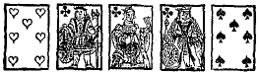
If the dealer does not hold two trumps, it is impossible to prevent the player from winning the point with these cards; because he need only lead his winning sequence until it is trumped, and then trump himself in again. With this hand the player will win 44,724 times out of 65,780.
There are about twenty hands which are generally known as jeux de règle, and every écarté player should be familiar with them. In the following examples the weakest hands are given, and the trumps are always the smallest possible. If the player has more strength in plain suits than is shown in these examples, or higher trumps, there is so much more reason for him to stand. But if he has not the strength indicated in plain suits, he should propose, even if his trumps are higher, because it must be remembered that strong trumps do not compensate for weakness in plain suits. The reason for this is that from stand hands trumps should never be led unless there are three of them; they are to be kept for ruffing, and when you have to ruff it does not matter whether you use a seven or a Queen. The King of trumps is of course led; but a player does not stand on a hand containing the King.
The first suit given is always the trump, and the next suit is always the one that should be led, beginning with the best card of it if there is more than one. The figures on the right show the number of hands in which the player or the dealer will win out of the 65,780 possible distributions of the twenty-six unknown cards. These calculations are taken, by permission of Mr. Charles Mossop, from the eighth volume of the “Westminster Papers,” in which all the variations and their results are given in full.
Player Wins. Dealer Wins.
2 47,768 18,012
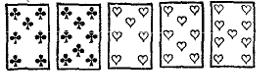
3 46,039 19,741
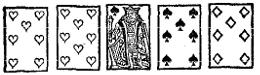
4 43,764 22,016
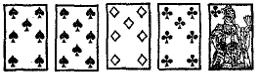
5 45,374 20,406
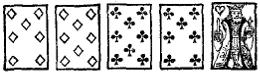
6 44,169 21,611
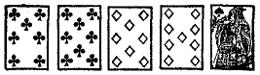
7 43,478 22,302
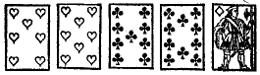
8 44,243 21,537
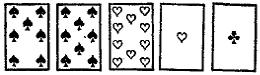
9 44,766 21,014
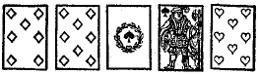
10 44,459 21,321
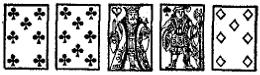
11 44,034 21,746
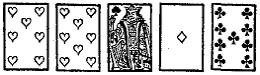
12 43,434 22,346
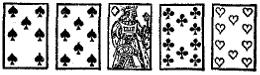
13 44,766 21,014
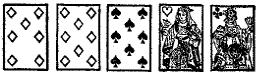
14 46,779 19,001
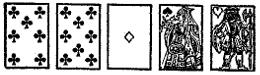
15 45,929 19,851
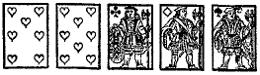
The player should always stand on a hand containing three trumps, not including the King, and should lead the trump:—
16 42,014 to 23,766
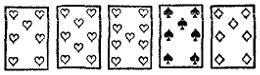
An example of a hand containing only one trump has already been given, and some hands are jeux de règle which contain no trumps. The strongest of these is the King of each plain suit, and any queen. Lead the K Q suit:—
17 48,042 to 17,738
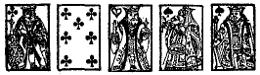
The odds in favour of this hand are greater than in any other jeux de règle. Another which is recommended by Bohn is this, the odds in favour of which have not been calculated; the player to begin with the guarded King:—
18
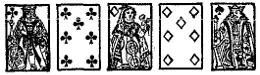
Another is any four court cards, not all Jacks; unless one is the trump Jack guarded. From the example the Queen should be led:—
19
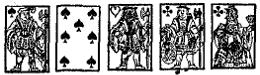
There are two hands which are usually played with only one trump, from both of which the best card of the long suit is led:—
20
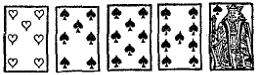
21
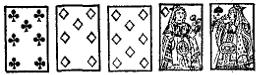
THE LEADER. There are a great many more opportunities to make the vole than most players are aware of; especially with jeux de règle. Where the vole is improbable or impossible, tenace is very important, and all tenace positions should be made the most of. In No. 5, for instance, if the clubs were the Queen and ace, it would be better to begin with the heart King, instead of leading away from the minor tenace in clubs. Observe the lead in No. 4. Many tenace positions cannot be taken advantage of because the player must win the trick if he can. For instance: Several discards have been made, and each player suspects the other holds three trumps, with three tricks to play. The Queen is led, and the adversary holds K A 7. If he could pass this trick, he must lie tenace; but as he has to win it with the King, he gives tenace to his adversary, who evidently has J and another.
When the dealer is four, the player may stand on much weaker hands.
It is usually best to lead from guarded suits, in preference to single cards. Lead the best of a suit if you have it. If the third trick is the first you win, and you have a trump and another card, lead the trump; but if you have won two tricks, lead the plain suit.
THE DEALER. When the player asks for cards, the dealer knows that his adversary probably does not hold a jeux de règle. The dealer must not be too sure of this, however, for proposals are sometimes made on very strong hands in order to try for the vole, or to make two points on the refusal. The dealer should assume that he is opposed by the best play until he finds the contrary to be the case, and it is safest to play on the assumption that a player who proposes has not a jeux de règle.
For all practical purposes it may be said that the dealer can refuse to give cards with hands a trifle less strong than those on which the player would stand. The general rule is for the dealer to give cards unless he is guarded in three suits; or has a trump, and is safe in two suits; or has two trumps, and is safe in one suit. If the dealer has only one suit guarded, and one trump, he must take into account the risk of being forced, and having to lead away from his guarded suit.
There are eight recognized hands on which the dealer should refuse. The full details of the calculations can be found in the ninth volume of the “Westminster Papers.” As in the case of the player, the weakest trumps have been taken for the examples, and the weakest holdings in plain suits. If the dealer has better plain suits, or stronger trumps, he has of course so much more in his favour if he refuses. The first column of figures gives the number of times in 65,780 that there will be no proposal, so that the dealer has no choice but to play. The other columns give the number of times the dealer or the player will win if the player proposes and the dealer refuses.
The first suit given in each instance is the trump.
No Proposal. Dealer Wins. Player Wins.
22 6,034 36,974 22,772
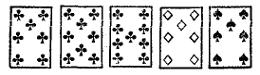
23 9,826 38,469 17,485
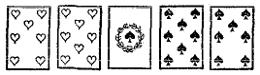
24 8,736 41,699 15,345
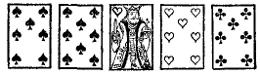
25 9,256 40,524 16,000
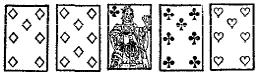
26 10,336 37,484 17,960
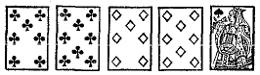
27 9,776 37,439 18,565
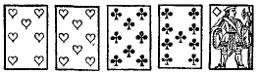
28 9,776 36,909 19,095
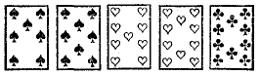
29 9,776 36,733 19,271
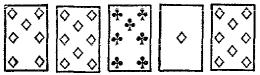
In giving cards, some judgment of human nature is necessary. Some players habitually propose on strong hands, and it is best to give to such pretty freely.
DISCARDING. The general principle of discarding is to keep trumps and Kings, and let everything else go. If you hold the trump King you may discard freely in order to strengthen your hand for a possible vole. If you have proposed once, and hold the King, and feel pretty sure of the point, you may propose again on the chance of getting strength enough to make the vole.
When only two cards can be discarded, it is a safe rule to stand on the hand; either to play without proposing, or to refuse cards; unless you hold the King.
There are no authoritative laws for Écarté, and the various French and English codes do not agree. The code adopted by the English clubs is not in accord with the best usage, and fails to provide for many contingencies. All that is essential in the laws will be found embodied in the foregoing description of the game.
TEXT BOOKS. The best works on the subject of Écarté are usually to be found in conjunction with other games. The student will find the following useful:—
The Westminster Papers, Vols. IV to XI, inclusive.
Bohn’s Handbook of Games; any edition.
Écarté and Euchre, by Berkeley, 1890.
Cavendish on Écarté, 1886.
Jeux de Cartes, (Fr.), by Jean Boussac.
Règles de Tous les Jeux, (Fr.), M. Dreyfous, Edit.
Académie des Jeux, (Fr.), by Van Tenac.
Académie des Jeux, (Fr.), by Richard.
Short Whist, by Major A. (Écarté Laws in appendix.)
POOL ÉCARTÉ.
Pool Écarté is played by three persons, each of whom contributes an agreed sum, which is called a stake, to form a pool. They then cut to decide which shall play the first game, the lowest écarté card going out. The players then cut for the first deal, choice of seats and cards, etc., exactly as in the ordinary game.
The winner of the first game retains his seat; the loser pays into the pool another stake, equal to the first, and retires in favour of the third player, who is called the rentrant. The rentrant takes the loser’s seat and cards, and cuts with the successful player for the first deal. The loser of the second game adds another stake to the pool, and retires in favour of the waiting player.
The pool is won by any player winning two games in succession. If the winner of the first game won the second also, he would take the pool, which would then contain five stakes; the three originally deposited, and the two added by the losers of the two games. A new pool would then be formed by each of the three depositing another stake, and all cutting to decide which should sit out for the first game.
In some places only the two players actually engaged contribute to the pool, the loser retiring without paying anything further, and the rentrant contributing his stake when he takes the loser’s place.
The outsider is not allowed to advise either player during the first game, nor to call attention to the score; but on the second game he is allowed to advise the player who has taken his seat and cards. This is on the principle that he has no right to choose sides on the first game; but that after that he has an interest in preventing his former adversary from winning the second game, so as to preserve the pool until he can play for it again himself.
NAPOLEON, OR NAP.
This is one of the simplest, and at the same time most popular of the euchre family. Few games have become so widely known in such a short time, or have had such a vogue among all classes of society. So far as the mere winning and losing goes, the result depends largely upon luck, and skill is of small importance. Except in a long series of games the average player has little to fear from the most expert.
CARDS. Napoleon is played with a full pack of fifty-two cards, which rank A K Q J 10 9 8 7 6 5 4 3 2; the ace being highest in play; but ranking below the deuce in cutting.
COUNTERS. As each deal is a complete game in itself it must be settled for in counters, to which some value is usually attached. One player is selected for the banker, and before play begins each of the others purchases from him a certain number of counters, usually fifty. When any player’s supply is exhausted, he can purchase more, either from the banker or from another player.
In many places counters are not used, and the value of the game is designated by the coins that take their place. In “penny nap,” English coppers are used in settling; sixpences in “sixpenny nap,” and so on. In America, nickel and quarter nap are the usual forms.
PLAYERS. Any number from two to six can play; but four is the best game. If five or six play it is usual for the dealer to give himself no cards.
CUTTING. The players draw from an outspread pack to form the table, and for choice of seats. A lower cut gives preference over all higher; the lowest cut has the first choice of seats, and deals the first hand. Ties cut again, but the new cut decides nothing but the tie.
In some places the players take their seats at random, and a card is then dealt to each face upward; the lowest card or the first Jack taking the deal.
DEALING. Any player has a right to shuffle the cards, the dealer last. They are then presented to the pone to be cut, and at least four cards must be left in each packet. Beginning at his left, the dealer gives each player in rotation two cards on the first round, and three on the next; or three on the first and two on the next. No trump is turned. In some places the cards are distributed one at a time until each player has five; but the plan is not popular, as the hands run better and the bidding is livelier when the cards are dealt in twos and threes. The deal passes to the left, each player dealing in turn.
MISDEALING. A misdeal does not lose the deal in Napoleon, because the deal is a disadvantage. For this reason, if any player begins to deal out of turn, he must finish, and the deal stands good. If any card is found faced in the pack, or is exposed by the dealer; or if too many or too few cards are given to any player; or if the dealer does not give the same number of cards to each player in the same round; or if he fails to have the pack cut, it is a misdeal, and the misdealer must deal again with the same pack.
BIDDING. Beginning on the dealer’s left, each player in turn bids for the privilege of naming the trump suit, stating the number of tricks he proposes to win, playing single-handed against the three other players, and leading a trump for the first trick. In bidding, the trump suit is not named, only the number of tricks. If a player proposes to win all five tricks he bids nap, which is the highest bid possible, and precludes any further bidding, except in some of the variations which will be described later on. If a player will not make a bid, he says “I pass,” A bid having been made, any following player must either increase it or pass. If all pass until it comes to the dealer, he is bound to bid at least one trick, and either play or pay. The hands are never abandoned except in case of a misdeal.
In some places a misère bid is allowed, which outranks a bid of three tricks, and is beaten by one of four. There is no trump suit in misère, but the bidder, if successful, must lead for the first trick.
Any bid once made can neither be amended nor recalled, and there is no second bid.
METHOD OF PLAYING. The player bidding the highest number of tricks has the first lead, and the first card he plays must be one of the trump suit. The players must follow suit if able, but need not win the trick unless they choose to do so. The highest card played of the suit led wins the trick, and trumps win all other suits. The winner of the trick leads again for the next trick, and so on, until all five tricks have been played. After the first trick any suit may be led.
The bidder gathers all tricks he wins, stacking them so that they may be readily counted by any player at the table. One of the other side should gather all tricks won by the adversaries of the bidder. A trick once turned and quitted cannot again be seen. In some places they have a very bad habit of gathering tricks with the cards face up, turning down one card only. This always results in numerous misdeals, on account of cards being continually found faced in the pack.
The hands are usually abandoned when the bidder succeeds in his undertaking, or shows cards which are good for his bid against any play. If it is impossible for him to succeed, as when he bids four and the adversaries have won two tricks, the hands are thrown up, because nothing is paid for under or over-tricks. Players should show the remainder of their hands to the board, as evidence that no revoke has been made.
IRREGULARITIES IN HANDS. If a player, before he makes a bid or passes, discovers that he holds too many or too few cards, he must immediately claim a misdeal. If he has either made a bid or passed, the deal stands good, and the hand must be played out. If the bidder has his right number of cards and succeeds, he must be paid. If he fails, he neither wins nor loses; because he is playing against a foul hand. If the bidder has more than his right number of cards he must pay if he loses; but wins nothing if he succeeds. If he has less than his right number of cards, he is simply supposed to have lost the trick for which he has no card to play.
PLAYING OUT OF TURN. If any adversary of the bidder leads or plays out of turn, he forfeits three counters to the bidder, independently of the result of the hand, and receives nothing if the bid is defeated. If the bidder leads out of turn, the card must be taken back, unless all have followed the erroneous lead, in which case the trick is good. There is no penalty if he plays out of turn.
REVOKES. When a revoke is detected and claimed, the hands are immediately abandoned, and the individual player in fault must pay all the counters depending on the result. If he is the bidder, he pays each adversary; if he is opposed to the bidder, he pays for himself and for each of his partners. In England it is the rule to take back the cards and play the hand over again, as at Écarté, the revoking player paying all the stakes according to the result. This is often very unfair to the bidder, and leads to endless disputes as to who held certain cards which have been gathered into tricks. Sometimes the difference between a seven and an eight in a certain player’s hand will change the entire result.
PAYMENTS. If the bidder succeeds in winning the specified number of tricks, each adversary pays him a counter for every trick bid. If he bid three tricks, they pay him three counters each; four counters each for four tricks bid; and the value of three tricks for a misère. If he fails to win the specified number of tricks, he pays each adversary; three counters if he bid three tricks, or a misère; four if he bid four. Any player bidding nap, and succeeding in winning all five tricks, receives ten counters from each adversary; but if he fails, he pays only five to each.
When penny nap is played, the settlement being in coin, it is usual to make naps win a shilling or lose sixpence, in order to avoid handling so much copper.
SUGGESTIONS FOR GOOD PLAY. In calculating his chances for success in winning a certain number of tricks, the player will often have to take into consideration the probability of certain cards being out against him. This will vary according to the number of players engaged. For instance: If four are playing, and the bidder holds K Q of a plain suit, the odds against the ace of that suit being out against him are about 2 to 1. As it would be impossible for any person to remember all the jeux de règle for three tricks at Napoleon, each must learn from experience the trick-taking value of certain hands. Trump strength is, of course, the great factor, and the bidder should count on finding at least two trumps in one hand against him. Nap should never be bid on a hand which is not pretty sure of winning two rounds of trumps, with all other cards but one winners. One trick may always be risked in a nap hand, such as A Q of trumps, or a King, or even a Queen or Jack in a plain suit; the odds against the adversaries having a better card being slightly increased by the odds against their knowing enough to keep it for the last trick.
If the bid is for three tricks only, tenaces, or guarded minor honours in plain suits should be preserved. After the first trick it will sometimes be advantageous for the player to get rid of any losing card he may have in plain suits. It is seldom right to continue the trumps if the bidder held only two originally, unless he has winning cards in two plain suits, in which case it may be better to lead even a losing trump to prevent a possibility of adverse trumps making separately.
In playing against the bidder, leave no trick to your partners that you can win yourself, unless a small card is led, and you have the ace. In opening fresh suits do not lead guarded honours, but prefer aces or singletons. If the caller needs only one more trick, it is usually best to lead a trump. If you have three trumps, including the major tenace, pass the first trick if a small trump is led; or if you remain with the tenace after the first trick, be careful to avoid the lead.
Discards should indicate weakness, unless you can show command of such a suit as A K, or K Q, by discarding the best of it. This will direct your partners to let that suit go, and keep the others. It is usually better to keep a guarded King than a single ace. The player on the right of the bidder should get into the lead if possible, especially if he holds one or two winning cards. These will either give his partners discards, or allow them to over-trump the bidder.
In playing misères, it is better to begin with a singleton, or the lowest of a safe suit. An ace or King two or three times guarded is very safe for a misère, as it is very improbable that any player will be able to lead the suit more than twice; and if the bidder’s missing suit is led, the high card can be got rid of at once.
In playing against a misère, discards are important, and the first should be from the shortest suit, and always the highest card of it. A suit in which the bidder is long should be continued, in order to give partners discards. More money is lost at Napoleon by playing imperfect misères than in any other way.
Variations. The foregoing description applies to the regular four-handed game; but there are several variations in common use.
Better bids than “nap” are sometimes allowed, on the understanding that the bidder will pay double or treble stakes if he fails, but will receive only the usual amount if successful. For instance: One player bids Nap, and another holds what he considers a certainty for five tricks. In order not to lose such an opportunity the latter bids Wellington, which binds him to pay ten counters to each player if he fails. Another may outbid this again by bidding Blucher, which binds him to pay twenty to each if he loses, but to receive only ten if he wins. In England, the bidder, if successful, receives double or treble stakes for a Wellington or a Blucher, which is simply another way of allowing any person with a nap hand to increase the stakes at pleasure, for a player with a certain five tricks would of course bid a Blucher at once, trebling his gains and shutting off all competition at the same time. This variation is not to be recommended, and benefits no one but the gambler.
Pools. Napoleon is sometimes played with a pool, each player contributing a certain amount, usually two counters, on the first deal. Each dealer in turn adds two more; revokes pay five, and leads out of turn three. The player who first succeeds in winning five tricks on a nap bid takes the pool, and a fresh one is formed. If a player bids nap and fails, he is usually called upon to double the amount then in the pool, besides paying his adversaries.
Purchase Nap; sometimes called Écarté Nap, is a variation of the pool game. After the cards are dealt, and before any bids are made, each player in turn, beginning on the dealer’s left, may discard as many cards as he pleases, the dealer giving him others in their place. For each card so exchanged, the player pays one counter to the pool. Only one round of exchanges is allowed, and bids are then in order. A player having once refused to buy, or having named the number of cards he wishes to exchange, cannot amend his decision. Any player winning five tricks on a nap bid takes the entire pool. This is a very good game, and increases both the bids and the play against them.
Widows. Another variation is to deal five cards in the centre of the table, face downward, the dealer giving the cards to the widow just before helping himself in each round. Any player in his proper turn to bid may take the widow, and from the total of ten cards so obtained select five on which he must bid nap, discarding the others face downward.
Peep Nap. In this variety of the pool game one card only is dealt to the widow, usually on the first round. Each player in turn, before bidding or passing, has the privilege of taking a private peep at this down card, on paying one counter to the pool. The card is left on the table until the highest bidder is known, and he then takes it into his hand, whether he has paid to peep at it or not. He must then discard to reduce his hand to five cards. If a player bids nap it usually pays those following him to have a peep at the down card in case the bidder should retain it in his hand.
SPOIL FIVE.
Spoil Five is one of the oldest of card games, and is generally conceded to be the national game of Ireland. It is derived from the still older game of Maw, which was the favourite recreation of James the First. The connecting link seems to have been a game called Five Fingers, which is described in the “Compleat Gamester,” first published in 1674. The Five Fingers was the five of trumps, and also the best, the ace of hearts coming next. In Spoil Five, the Jack of trumps comes between these two.
CARDS. Spoil Five is played with a full pack of fifty-two cards. The rank of the cards varies according to the colour of the suit, and the trump suit undergoes still further changes, the heart ace being always the third best trump. In the plain suits, the K Q J retain their usual order, the King being the best. The rank of the spot cards, including the aces of diamonds, clubs, and spades, is generally expressed by the phrase: Highest in red; lowest in black. That is to say, if several cards of a suit, not including a King, Queen or Jack, are played to a trick, the highest card will win if the suit is red; and the lowest if the suit is black. This will give us the following order for the plain suits, beginning with the highest card in each:—
No change. Highest in red.
♡ K Q J 10 9 8 7 6 5 4 3 2
♢ K Q J 10 9 8 7 6 5 4 3 2 A
Lowest in black.
♣ K Q J A 2 3 4 5 6 7 8 9 10
♠ K Q J A 2 3 4 5 6 7 8 9 10
In the trump suit the same order of cards is retained, except that four cards are always the best trumps. These are the Five, Jack, and ace of the suit itself, and the ace of hearts, the latter being always the third best. This gives us the rank of the cards as follows, when the suit is trump:—
No change. Highest in red.
♡ 5 J ♡ A K Q 10 9 8 7 6 5 4 3 2
♢ 5 J ♡ A ♢ A K Q 10 9 8 7 6 5 4 3 2
Lowest in black.
♣ 5 J ♡ A ♣ A K Q 2 3 4 5 6 7 8 9 10
♠ 5 J ♡ A ♠ A K Q 2 3 4 5 6 7 8 9 10
COUNTERS. Spoil Five is played with a pool, for which counters are necessary. One player should act as banker, and the others should purchase from him, each beginning with 20 counters. Coins may take the place of counters, shillings being the usual points.
PLAYERS. Any number from 2 to 10 may play; but 5 or 6 is the usual game.
CUTTING. This is unknown at Spoil Five. The players take their seats at random, and one of them deals a card face up to each in succession. The first Jack takes the first deal. Some note should be made of the player who gets the first deal, as the rules require that when the game is brought to an end the last deal shall be made by the player on the right of the first dealer.
THE POOL. Before play begins each player deposits one counter in the pool, and to this amount each successive dealer adds a counter until the pool is won, when all contribute equally to form a new one. In some places it is the practice for each successive dealer to put up for all the players, whether the pool is won or not. This simply makes larger pools.
DEALING. Any player has the right to shuffle the pack, the dealer last. The cards are then presented to the pone to be cut, and as many cards as there are players must be left in each packet. Beginning on his left, the dealer gives five cards to each player; two on the first round and three on the next, or three and then two. After all are helped, the next card is turned up on the remainder of the pack, and the suit to which it belongs is the trump for that deal.
MISDEALING. If there is any irregularity in the deal which is not the dealer’s fault, such as any card except the trump found faced in the pack, or the pack found imperfect, the same person deals again. But if the dealer neglects to have the pack cut, or deals too many or too few cards to any player, or exposes a card in dealing, or does not give the same number of cards to each player on the same round, or counts the cards on the table or those remaining in the pack, it is a misdeal, and the deal passes to the next player on the misdealer’s left. In some places the misdealer is allowed to deal again if he forfeits two counters to the pool.
ROBBING THE TRUMP CARD. If the trump card is an ace, the dealer may discard any card he pleases in exchange for it. He may take up the ace when he plays to the first trick, or may leave it on the pack until got rid of in the course of play. When an ace is turned, the eldest hand, before leading, should call upon the dealer to discard if he has not already done so. If the dealer does not want the trump, he answers: “I play these.”
If the trump card is not an ace, any player at the table holding the ace of trumps is bound to announce the fact when it comes to his turn to play to the first trick. The usual plan is for him to pass a card to the dealer face downward, and in return the dealer will give him the turn-up trump. If the holder of the ace does not want the turn-up, he must tell the dealer to turn the trump down, which shows that he could rob, but does not wish to. If the holder of the ace of trumps plays without announcing it, he not only loses his right to rob, but his ace of trumps becomes of less value than any other trump for that deal, and even if it is the ace of hearts he loses the privileges attached to that card.
METHOD OF PLAYING. The eldest hand begins by leading any card he pleases. It is not necessary to follow suit except in trumps; but if a player does not follow suit when he is able to do so, he must trump the trick, or it is a revoke. If he cannot follow suit, he may trump or discard at his pleasure. The highest card played of the suit led wins the trick, and trumps win all other suits. The winner of the first trick leads any card he pleases for the next, and so on, until all five tricks have been played. Each player gathers his own tricks, as there are no partnerships.
RENEGING. The three highest trumps have special privileges in the matter of not following suit. Any player holding the Five or Jack of the trump suit; or the ace of hearts, but having no smaller trump with them, may refuse to follow suit if any inferior trump is led; but if he has also a smaller trump, he must play one or the other. If a superior trump is led, the player must follow suit in any case. For instance: If the Five of trumps is led, no one can refuse to follow suit, no matter what trumps he holds; but if the Jack is led, and any player holds the Five alone, he need not play it to the inferior trump lead. If the heart ace is led, and one player holds the Jack alone, and another the Five alone, neither of these cards need be played, because the trump led is inferior to both of them. If a superior trump is played in following suit, such as the Five played on an Eight led, the holder of the lone Jack of trumps or ace of hearts, need not play it, because the lead was inferior. This privilege of reneging is confined to the three highest trumps.
OBJECTS OF THE GAME. In Spoil Five there are three things to play for. If any one person can win three tricks he takes the pool. If he can win all five tricks he not only gets the pool, but receives an extra counter from each of the other players. If he has no chance to win three tricks, he must bend all his energies to scattering the tricks among the other players, so that no one of them shall be able to get the three tricks necessary to win the pool. When this is done, the game is said to be spoiled, and as that is the object of the majority in every deal it gives the game its name. In the older forms of the game the winner of three tricks counted five points, and if he could be prevented from getting three tricks his five points were spoiled.
JINK GAME. When a player has won three tricks, he should immediately abandon his hand and claim the pool, for if he continues playing he must jink it, and get all five tricks or lose what he has already won, the game being spoiled just as if no one had won three tricks. It is sometimes a matter for nice judgment whether or not to go on, and, for the sake of an extra counter from each player, to risk a pool already won. The best trump is often held up for three rounds to coax a player to go on in this manner.
IRREGULARITIES IN THE HANDS. If, during the play of a hand, it is discovered that any one holds too many or too few cards, that hand is foul, and must be abandoned, the holder forfeiting all right to the pool for that deal. Those who have their right number of cards finish the play without the foul hand, but any tricks already won by the holder of the foul hand remain his property.
IRREGULARITIES IN PLAY. If any player robs when he does not hold the ace; leads or plays out of turn; reneges to the lead of a higher trump; renounces in the trump suit; revokes in a plain suit; or exposes a card after any player has won two tricks, he loses all his right and interest in the current pool, which he cannot win, either on that or any subsequent deal, but to which he must continue to contribute when it comes to his turn to deal. After the pool has been won, and a fresh one formed, the penalty is removed.
SUGGESTIONS FOR GOOD PLAY. Observation, quickness, and good judgment of character are the essentials for success at Spoil Five, the last being probably the most important. The peculiar order of the cards; the privilege of renouncing when holding a card of the suit led; and the right of passing inferior trump leads, are very confusing to the beginner; but with practice the routine and strategy of the game soon become familiar.
The player should first make up his mind whether he is going to try to win the pool or to spoil it. Particular attention should be paid to the player who robs, because he must have at least the ace and the turn-up in trumps, and is more likely to need spoiling than any other player. When a player wins a trick, some judgment will be necessary to decide whether he is trying for the pool himself, or simply spoiling it for some one else. When he wins two tricks, every other player at the table must combine against him.
With only one small or medium trump, it is better to use it at the first opportunity. Unless the player has some hopes of winning the pool himself, he should trump all doubtful cards; that is, cards that may win the trick if not trumped. With two good trumps, it is better to wait for developments; even if you cannot win the last three tricks yourself, you may effectually spoil any other player. Do anything you can to prevent the possibility of a third trick being won by a player who has already won two.
FORTY-FIVE, OR FIVE AND TEN.
These names are given to Spoil Five when it is played by two persons only, or by four or six divided into two equal partnerships. There is no pool, as one side or the other must win three tricks every deal. The side winning the odd trick counts five points towards game, or ten points if it wins all five tricks. Forty-five points is game. In another variation, each trick counts five points, and the winners’ score is deducted from the losers’, so that if one side wins four tricks it counts fifteen towards game. When this manner of counting is adopted, the players count out; that is, if each side is 35 up, the first to win two tricks counts out.
Minor variations are sometimes introduced; such as robbing with the King, if the ace is not in play; counting five for the dealer’s side if the ace or King is turned up, etc.
There are no Text Books on Spoil Five; but descriptions and laws of the game are to be found in the “Westminster Papers,” Vol II., and in “Round Games,” by Berkeley.
RAMS, OR RAMMES
This game seems to be the connecting link between the more strongly marked members of the Euchre family and Division Loo.
CARDS. Rams is played with the euchre pack, thirty-two cards, which rank as at Écarté, K Q J A 10 9 8 7. It has lately become the fashion, however, to adopt the rank of the cards in the piquet pack, A K Q J 10 9 8 7.
PLAYERS. Any number from three to six may play; but when six play the dealer takes no cards. The general arrangements for the players, first deal, counters, etc., are exactly the same as at Spoil Five.
THE POOL. Each successive dealer puts up five counters, to form or to augment the pool.
DEALING. The cards having been properly shuffled and cut, five are given to each player; two the first round and three the next, or three the first round and two the next. An extra hand, known as the widow, is dealt face downward in the centre of the table. The dealer gives cards to the widow just before dealing to himself in each round. When all are helped, the next card is turned up for the trump. Irregularities in the deal are governed by the same rules as in Spoil Five.
DECLARING TO PLAY. Each player in turn, beginning with the eldest hand, may either play or pass. If he passes, he lays his cards face downward in front of him, and takes no further part in that deal unless a general rams is announced. If he plays, he engages himself to take at least one trick, or forfeit five counters to the pool. He may play with the hand originally dealt him, or he may risk getting a better by taking the widow in exchange. If he exchanges, his original hand is dead, and must not be seen by any player. If any player takes the widow, those following him must play the hand dealt them or pass out. In some clubs the eldest hand is obliged to play, either with his own hand or with the widow.
If all pass except the pone, he must play against the dealer, either with the cards dealt him, or with the widow. If he declines to play, he must pay the dealer five counters, and the pool remains. The dealer must play if he is opposed by only one player; but if two others have announced to play, the dealer may play or pass as he pleases. If he plays, he may discard and take up the trump card. No other player may rob the trump.
METHOD OF PLAYING. The eldest hand of those who have declared to play begins by leading any card he pleases. Each player in turn must head the trick; that is, play a higher card if he can. If he has two higher, he may play either. If he has none of the suit led, he must trump if he can, even if the trick is already trumped by another player. For instance: Hearts are trumps, and A leads a club. B follows suit, but neither C nor D has a club. Suppose C trumps with the King, and that the only trump D has is the Queen, he must play it on the trick, losing it to C’s King. When a player can neither follow suit nor trump, he may discard any card he pleases. The winner of the trick leads for the next trick, and so on until all five tricks have been played.
PENALTIES. There is only one penalty in Rams; to win nothing on the deal, and to forfeit five counters to the next pool. This is inflicted for playing with more or less than five cards; for exposing any card; for leading or playing out of turn; for renouncing; and for refusing to head or trump a trick when able to do so.
DIVIDING THE POOL. Pools may be simple or double. The usual custom is to compel every one to play when the pool is a simple, containing nothing but the five counters put up by the dealer. When there are more than five counters in the pool they must be some multiple of five, and the pool is called a double. In double pools the players may play or pass as they please. No matter how many counters are already in the pool, the dealer must add five.
Each player gathers in the tricks he wins, and at the end of the hand he is entitled to take one-fifth of the contents of the pool for every trick he has won. If he has played his hand, and failed to get a trick, he is ramsed, and forfeits five counters to form the next pool, in addition to those which will be put up by the next dealer. If two or more players fail to win a trick, they must each pay five counters, and if the player whose turn it will be to deal next is ramsed, he will have to put up ten; five for his deal, and five for the rams.
GENERAL RAMS. If any player thinks he can win all five tricks, with the advantage of the first lead, he may announce a general rams, when it comes to his turn to pass or play. This announcement may be made either before or after taking the widow. When a general rams is announced, all at the table must play, and those who have passed and laid down their hands, must take them up again. If the widow has not been taken, any player who has not already refused it may take it. The player who announced general rams has the first lead. If he succeeds in getting all five tricks, he not only gets the pool but receives five counters in addition from each player. If he fails, he must double the amount then in the pool, and pay five counters to each of his adversaries. Any player taking a trick that spoils a general rams gets nothing from the pool, and it is usual to abandon the hands the moment the announcing player loses a trick.
ROUNCE.
This is an American corruption of Rams. It is played with the full pack of fifty-two cards, which rank as at Whist, and any number of players from three to nine. Six cards are dealt to the widow, one of which must be discarded by the player taking it. All pools are alike, there being no difference between simples and doubles, and there is no such announcement as general rounce. There is no obligation to head the trick, nor to trump or under-trump; but the winner of the first trick must lead a trump if he has one.
BIERSPIEL.
This is a popular form of Rams among German students. Three crosses are chalked on the table in front of each player, representing five points each. When a trick is won, a beer-soaked finger wipes out the centre of a cross, and reduces its value to four. Successive cancellings of the remaining arms of the cross as tricks are taken gradually reduce it to nothing, and the player who is last to wipe out his third cross pays for the beer. No player is allowed to look at his cards until the trump is turned, and the dealer gives the word of command: “Auf.” The seven of diamonds is always the second-best card of the trump suit, ranking next below the ace. If it is turned up, the dealer turns up the next card for a trump, and when it comes to his turn, he can take both cards into his hand, discarding others in their place. If the dealer passes, the eldest hand may take up the trump. If only two declare to play, a trump must be led for the first trick; if three play, trumps must be led twice; if four play, three times. If the leader has no trump, he must lead his smallest card, face downward, which calls for a trump from such of the other players as have one. All penalties are made by adding fresh crosses to the delinquent’s score.
LOO, OR DIVISION LOO.
This was at one time the most popular of all round games at cards; but its cousin Napoleon seems to have usurped its place in England, while Poker has eclipsed it in America. There are several varieties of the game, but the most common form is Three-card Limited Loo, which will be first described.
CARDS. Loo is played with a full pack of fifty-two cards, which rank, A K Q J 10 9 8 7 6 5 4 3 2; the ace being the highest.
COUNTERS. Loo being a pool game, counters are necessary. They should be of two colours, white and red, one red banker, to sell and redeem all counters. Each player should begin with 18 red and 6 white, which is equal to 20 reds.
PLAYERS. Any number of persons from three to seventeen may play, but eight is the usual limit, and five or six makes the best game. The players take their seats at random.
CUTTING. A card is dealt round to each player, face up, and the first Jack takes the first deal.
THE POOL. Each successive dealer places three red counters in the pool. The pool is added to from time to time by penalties for infractions of the rules, and by forfeitures from players who have failed in their undertakings. Such payments are always made in red counters, the number being always three or six. When the pool is divided, it sometimes happens that a player is not allowed to withdraw his share. In such cases the red counters representing it should be changed for their value in white ones, so that the forfeited share may be divided in three parts.
The difference between Limited Loo, and Unlimited Loo, is in the amounts paid into the pool. In Limited Loo the penalty is always three or six red counters. In Unlimited Loo, it is the same for irregularities, and for infraction of the rules; but any player failing in his undertaking must put up for the next pool an amount equal to that in the current pool. When two or more fail on successive deals the pool increases with surprising rapidity. A player at twenty-five cent Loo has been known to lose $320 in three consecutive deals.
DEALING. The pack having been properly shuffled and cut, the dealer gives three cards to each player, one at a time in rotation, beginning on his left. The first deal, and every deal in which the pool contains only the three red counters put up by the dealer, is known as a simple, and no trump card is turned up until one or two tricks have been played to. If there are more than three red counters in the pool, it is known as a double, and an extra hand must be dealt for the widow, and after all have been helped, the next card in the pack is turned up for a trump. The dealer gives cards to the widow just before helping himself in each round.
Irregularities in the Deal. If the pack is found to be imperfect, or any card except the trump is found faced in the pack, the same dealer must deal again without penalty. If the dealer neglects to have the pack cut; reshuffles it after it has been properly cut; deals a card incorrectly and fails to correct the error before dealing another; exposes a card in dealing; gives any player too many or too few cards; or deals a wrong number of hands, it is a misdeal, and he loses his deal, and forfeits three red counters to the current pool. The new dealer adds his three counters as usual, and the pool becomes a double.
METHOD OF PLAYING. A description of the method of playing will be better understood if it is divided into two parts, as it varies in simple and in double pools.
In Simple Pools, no trump is turned, and no widow dealt. Should the dealer inadvertently turn a trump, he forfeits three red counters to the current pool, but it remains a simple. If he deals a card for a widow, and fails to correct himself before dealing another card, it is a misdeal.
The eldest hand leads any card he pleases, and the others must not only follow suit, but must head the trick if they can. This does not necessarily mean that they shall play the best card they hold of the suit led, but that they shall play a better one than any already played. The cards are left in front of the players. If all follow suit the winner of the trick leads any card he pleases for the next trick. If all follow suit to that again, the winner leads for the next, and if all follow suit again, that ends it, and the winners of the several tricks divide the pool. All those who have not won a trick are looed, and must contribute three red counters each for the next pool, which, added to the three to be deposited by the next dealer, will make the ensuing pool a double. But if in any trick any player is unable to follow suit, as soon as the trick is complete the dealer turns up the top card on the remainder of the pack, and the suit to which it belongs is the trump. If any trump has been played, the highest trump wins the trick. In any case, the winner of the trick must lead a trump for the next trick if he has one. When all three tricks have been played, the winner of each is entitled to one-third of the contents of the pool. Those who have not won a trick are looed, and must contribute three red counters each for the next pool. This is called a Bold Stand.
In Double Pools, an extra hand is dealt for the widow, and a trump is turned. No player is allowed to look at his cards until it comes to his turn to declare. The dealer, beginning on his left, asks each in turn to announce his intentions. The player may stand with the cards dealt him; or may take the widow in exchange; or may pass. If he passes or takes the widow, he gives his original hand to the dealer, who places it on the bottom of the pack. If he takes the widow or stands, he must win at least one trick, or he is looed, and will forfeit three red counters to the next pool.
If all pass but the player who has taken the widow, he wins the pool without playing, and the next deal must be a simple. If only one player stands, and he has not taken the widow, the dealer, if he will not play for himself, must take the widow and play to defend the pool. If he fails to take a trick, he is not looed; but the payment for any tricks he wins must be left in the pool, and the red counters for them should be changed for white ones, so that the amount may be easily divided at the end of the next pool.
Flushes. If any player in a double pool holds three trumps, whether dealt him or found in the widow, he must announce it as soon as all have declared whether or not they will play. The usual custom is to wait until the dealer declares, and then to ask him: “How many play?” The dealer replies: “Two in;” “Three in;” or: “Widow and one;” as the case may be. The player with the flush then shows it, and claims the pool without playing, each of those who are “in” being looed three red counters. If two players hold a flush in trumps, the elder hand wins, whether his trumps are better or not; but the younger hand, holding another flush, is not looed.
Leading. In all double pools, the eldest hand of those playing must lead a trump if he has one. If he has the ace of trumps he must lead that; or if he has the King and the ace is turned up. The old rule was that a player must lead the higher of two trumps, but this is obsolete. The winner of a trick must lead a trump if he has one. Each player in turn must head the trick if he can; if he has none of the suit led he must trump or over-trump if he can; but he need not under-trump a trick already trumped.
Irregularities and Penalties. There is only one penalty in Loo, to win nothing from the current pool, and to pay either three or six reds to the next pool. If the offender has won any tricks, the payment for them must be left in the pool in white counters, to be divided among the winners of the next pool.
The offences are divided, some being paid for to the current pool, such as those for errors in the deal, while others are not paid until the current pool has been divided. If any player looks at his hand before his turn to declare, or the dealer does so before asking the others whether or not they will play, or if any player announces his intention out of his proper turn; the offender in each case forfeits three red counters to the current pool, and cannot win anything that deal, but he may play his hand in order to keep counters in the pool. If he plays and is looed, he must pay.
Revokes. If a player, when able to do so, fails to follow suit, or to head the trick, or to lead trumps, or to lead the ace of trumps, (or King when ace is turned,) or to trump a suit of which he is void, the hands are abandoned on discovery of the error, and the pool is divided as equally as possible among those who declared to play, with the exception of the offender. Any odd white counters must be left for the next pool. The player in fault is then held guilty of a revoke, and must pay a forfeit of six red counters to the next pool. The reason for the division of the pool is that there is no satisfactory way to determine how the play would have resulted had the revoke not occurred. It is impossible to take back the cards and replay them, because no one would have a right to judge how much a person’s play was altered by his knowledge of the cards in the other hands.
If a player, having already won a trick, renders himself liable to any penalty, as for exposing a card, leading or following suit out of turn, or abandoning his hand, he is looed for three red counters, payable to the next pool, and the payment for the tricks he has won must be left in the pool in white counters.
IRISH LOO.
In this variation, no widow is dealt, and there is no distinction between simple and double pools. A trump is always turned up, and the dealer asks each in turn, beginning on his left, whether or not he will play, taking up the cards of those who decline to stand. He then announces his own decision, and proceeds to ask those who have declared to play whether or not they wish to exchange any of the cards originally dealt them. The usual question is simply: “How many?” and the player names the number of cards he wishes to exchange, if any; at the same time discarding others in their places. The number first asked for cannot be amended or recalled. The trump is laid aside, and the cards called for are dealt from the remainder of the pack, without further shuffling. In all other respects, the game is Three-card Loo.
FIVE-CARD LOO.
This is Irish Loo with some additional variations. Each red counter should be worth five white ones, and the players will require about fifty red counters each at starting. The dealer puts up five red counters. Any player holding a flush of five cards in any suit may immediately claim the pool, and every person at the table, whether playing or not, is supposed to be looed, and pays five red counters to the next pool. If two players hold flushes, the elder hand wins, even if the younger hand holds a flush in trumps.
Another variation is to make the club Jack, which is known as Pam, always the best trump. Combined with four cards of any suit, this card will make a flush. If any player leads the trump ace, the holder of Pam must pass the trick if he can do so without revoking. The old usage was for the holder of the trump ace to notify any player holding Pam to pass, if he wished him to do so; but that is quite superfluous, as no player wants to lose his ace of trumps, and it goes without saying that he wants Pam to pass it.
Interesting articles on Loo will be found in “Bell’s Life,” the “Field,” the “Sportsman,” and the “Westminster Papers;” Vol. II. of the latter especially.