PART III.
Reading edition
553

THE TURF
Of all the evils connected or associated with games of chance in this country, perhaps the most vicious are those which surround the race-courses of the land—not only those extensive parks which are recognized as having a legitimate existence, but as well the country tracks where racing events are casual and sporadic. The “turf,” as we are popularly accustomed to term the race course with reference to its gambling features, implies not only the element of chance as manipulated by systematic knavery, and which will be found elsewhere fully explained, but also what is termed the legitimate sport of gentlemen, conducted as honestly as it may be and with every disposition on the part of managers and judges to give a fair test of the speed and endurance of the competing horses. Even in the latter case, it is a notorious fact that race tracks that are conducted in their official management under the highest auspices and by the most responsible individuals, are not in their actual surroundings, influences and results, less pernicious nor injurious than those which are openly in the charge of recognized swindlers and scoundrels. Even as to the great “events” which in this country are recognized and patronized, to the great misfortune of public morals, by the press and by society, governed though they may be by honorable men, and with every concerted determination for a fair and proper exhibition of honest results, it is notorious and undisputed, that these exhibitions are the harvest fields of systematized vice, and that while the judge in the stand may be immaculate, the seller of pools, the bookmaker, the touter, the tip-givers, the turf prophets and all the others who camp upon the trail of the credulous and unwary with schemes that, by methods of certainty, enrich the gambler without risk on his part, are one and all dishonest and designing scoundrels to whom the sense of honor is unknown, and whose infamous and insidious influence is one of the gravest dangers to which the morality and uprightness of the youth of our country are exposed.
The origin of horse-racing, as with that of our modern athletic sports, comes from the classic ages; but in the contests of equine speed and in the competition of personal skill or valor in the “brave days of old” there is no record of the thimble-rigging propensities which these latter days have developed. The competitions of those times were for public honor and prizes, for the encouragement of features which were essential to the public welfare and safety. In that period all free men were warriors, 554upon whom depended the security of life, property and national existence. The cultivation of ambition to excel in personal strength and swiftness had, therefore, a patriotic and commendable foundation; and the same as regarded the trials of speed by horses, which were for the improvement of the qualities upon which the warriors had to rely in these their main coadjutors upon the field of battle. All this had nothing in common with the turf as we recognize and realize it to-day. For this we have to look back to our mother, England, from whom it was an inheritance of shame whose evil influence has expanded like the upas tree ever since it first took a root in our land. In England, while it has been customary for turf enthusiasts to trace the history of their trade from about the reign of Charles I., the fact is that it was not really till the reign of George II. that the “turf,” as property understood, became a recognized entity. Prior to that time there had been plenty of horse-racing, in which gentlemen rode their own horses, and which was almost entirely free from the vicious concomitants which have later surrounded, characterized and dominated the race track. The leading meetings in England are the Newmarket, Epsom, Ascot, York, Doncaster and Goodwood. It is at Epsom that “the Derby,” an event of interest to the whole sporting world, is run. This is known as the Cockneys’ Holiday, and has been the subject of many an exemplification of the highest attainments of the art of word painting. Indeed the interest attaching to the vast and heterogeneous throng is to many greater than that which belongs to the race itself, every element between the palace and the poor-house being there represented. Ascot is favored frequently by the presence of royalty, and is on this account always the scene of a brilliant display by the aristocracy. Goodwood is also an aristocratic meeting, representative of the south of England and distinguished by the great value of the prizes offered for competition. The distinguishing feature at Doncaster is the race for the St. Leger stakes, which rivals the Derby in sporting importance; and it has been claimed that upon these two events not less than twenty-five per cent. of the whole English population are bettors, either risking their money on the tracks or at the pool rooms, which in every town throughout the country sell chances upon the results.
It is a somewhat remarkable fact that of late years while, in England, the most energetic efforts have been made, and with good success, to keep the thimble-riggers and blacklegs off the track, this fraternity, outside the track, in the adjacent hotels, and in other outside towns where interest in the result centers, carries on its audacious trade with increasing extent and profit, while to-day, throughout Great Britain, the mania for gambling upon the results of contests upon the turf is more wide-spread and deep-rooted than ever before. The harm resulting to public morals is incalculable, and will possibly more than offset the efforts for good of the 555ministers of religion. There is not a race meeting after which we do not hear of the downfall of some “plunger,” who in “legitimate” betting has risked his all upon the “wrong horse,” bringing ruin and disgrace too often upon the innocent wife and family, and opening up the alternative of crime, dishonor or suicide. Yet these are but the least of the injurious influences of gambling upon these race meetings. They are only heard of by reason of the conspicuous extent of the individual losses, or the prominence of the persons thus involved in the ruinous consequences of the national vice. Far more serious, more deplorable and more demoralizing are the results upon the infinite number of the “smaller fry,” who submit themselves as easy victims to the skillful swindler who runs the “speculation list” or the pool-room, whose specious but delusive allurements send the honest hand of many a youth surreptitiously into his employer’s cash-drawer, to be drawn forth forever tainted with dishonor; and merely in order that the ill-gotten gains of the experienced swindler may be enlarged. Round about all such tracks, too, may be seen the gaming devices of every description, and all the nefarious instrumentalities by means of which the honest man is deluded of his earnings for the benefit of systematic knavery. And yet the race-track is the “national sport” of England; to it, and all its contaminating, crime-producing, society-wrecking and soul-destroying influence, royalty lends its condescension, and princes and peers their active countenance and aid; bishops and churchmen, members of Parliament and professional men, participate and applaud; while even those in charge of the little children afford them special holidays in order that their young minds may be subjected to impressions which, in the years of their older youth will make them the easy prey of the agents of this monster vice. It is in the glitter and glamour of all its brilliant external attributes that England finds the pride with which she claims the turf as her peculiar national institution; it is in the ruined reputation, the blasted life, the broken heart, the wreck of happiness, the loss of honor and the headlong course to crime, which are to be traced by the tears of women and the wails of children, in the blighted homes throughout the land, that we recognize in the turf and all that pertains to it, England’s national curse, that must surely sooner or later invite and evoke a national retribution.
The details of the various rascalities practiced in connection with the “turf” being common to all countries, we shall deal with these features of the English national sport, at the close of this chapter, in a general explanation of the methods which affect the results of all race meetings, and which add strength to the steel meshes of the net in which the innocent and confiding bettor is certain to become involved.
556THE AMERICAN TURF.
It is to be said to the honor and credit of the Puritan and Pilgrim settlers of New England, that they had a strong antipathy to every form of vice, and in their interdict against the evils which they had left England to escape, horse-racing was especially included. On the other hand the early settlements of the Old Dominion, (which originally included Kentucky), and of Carolina, were of aristocratic stock, retired army officers, the younger sons of gentlemen, etc., and as the early conditions that prevailed precluded many of the ordinary sports, horse-racing, generally in the form of the steeple-chase, was encouraged. This was not, however, the “turf,” in America, but it was the means of affording a nursery for the splendid animals which have made the American turf famous for the wonderful achievements in time and speed of its horses. In those early days travel in the South was almost altogether by saddle horses, and hence the necessity for developing those peculiar qualities in the horses used, as made them valuable for racing purposes. The stock was recruited from the best blood, imported from England, and as it was a peculiar mark of social distinction, where all men ride, to be well mounted, great care was taken in cultivating and improving the breeding of horses. Yearly meetings for running races became the custom; but at these affairs there were no bookmakers nor blacklegs, and the betting was generally of that perfunctory character which usually exists where the competing parties are interested rather in the results than in the stakes. As the country developed, the new state of Kentucky, with its splendid climate, its crystal streams and its unequalled grasses, became distinctively the home of fine horses, which up to the present day even, she has continued to supply to the racing world.
The trotting race had its origin in New York and took its peculiarity from the general use of the light wagon for road traveling. In this way the only possible method of testing speed was the “pace” or “trot,” and for many years in the Northeastern States the trotting meeting was the recognized form of sport, the practice becoming general and being the invariable accompaniment of every county fair. The earliest recorded organized trotting meeting of which there is any specific record is of date of 1818. The fastest time for fifty miles was recorded in favor of Spangle at Union Course, Long Island, Oct. 15, 1855. The best time for two miles under saddle was at Fashion Course, Long Island, July 1, 1863, by George M. Patchen. We mention these dates to show that as long as thirty-five years ago there were important meetings of the turf, and also to point out the fact that the public sense of humanity, growing with the increasing refinement of the country, has reduced these trials of speed generally to one-mile contests, and frequently to the half-mile.
557Trotting races began to assume an aspect of national importance shortly after the war, and the first National Trotting Association was organized in February, 1870, under the name of the “National Association for the Promotion of the Interests of the Trotting Turf,” which in 1878, at a congress of members, was changed to that of “National Trotting Association.” It is a curious fact that the origin of the National Association arose in the abuses which invariably follow the practice of racing for money or of betting on unknown results. There had been complaints all over the country of crooked work on the race tracks—of “blind” horses being entered under assumed names to gull unsuspicious victims; of jockeys who “pulled” the winner so as to make him the loser; of improper decisions by judges, and of a thousand and one things in the way of serious and petty crookedness on the leading race tracks. ItIt became generally recognized that the confidence of the public in the integrity of racing contests in America was becoming exhausted and that racing was falling into contempt as well as falling off in its profits. Organization was originally effected in response to a circular sent out by the Narragansett Park Association, of Providence, R. I., in 1869. It proposed the formation of a central body for general control, and the establishment of a code of rules and penalties for the government of all tracks as the most effective means of correcting existing abuses and elevating the standard of honor and fair play, and the character of the American Trotting Turf. The results were gratifying so far as those objects were concerned, though it is a serious question whether the country would not have been greatly the gainer had the race-courses and their attending evils been allowed to extinguish themselves by the very excesses which were at that time making them offensive and contemptible. However, the organization was effected as stated, officers elected and, a code of laws adopted, under which the chief of the evils complained of disappeared from the official protection of the tracks, though they still continue under more insidious and less offensively unscrupulous methods. The membership of this association consists of the representative of a trotting course. In order to show the extraordinary growth of this mania for speculating upon the chances of the horse-race we may state that, commencing with 51 in 1870, in 1886 there were 273 courses represented in the National Association, while now there are 317, and in the American Association 419—in all 736. The government of the National Association is effected through the medium of a Board of Appeals consisting of five District Boards and a Board of Review, each of the former being entitled to three members of the general board, giving it thus fifteen members in addition to the President and Vice-presidents who are ex-officio members. The Board of Review is composed of a chairman appointed by the President from each of the five districts, and this Board has and exercises 558supreme authority and jurisdiction, being a final court of resort which decides all appeals from the decisions of the District Boards. The objects set forth on behalf of the association are the improvement of the breed and the development of horses by promotion of the interests of the American Trotting Turf; the prevention, detection and punishment of frauds thereon, and uniformity in the government and rules of trotting and pacing.
In 1887, a number of Western tracks separated from the original body and formed the “American Trotting Association,” with objects precisely similar, and methods not materially differing. In fact, many parties are represented in both Associations, as a matter of policy, and to ensure the enforcement of rules and penalties upon all courses.
Running races have of late very largely supplanted trotting races in public favor, for the reason that they offer to the public a more vivid and intense excitement, and to bettors a speedier settlement of their concern about the result. Five persons will attend, it is said, a running race, where one will attend a trotting race.
To enumerate the “principal courses” would be a task that would take space with little profit, but we can gather some idea of the extent of opportunities that are open to the sharks that swim the sea of speculation in races throughout the Union, when we say that at the great Suburban race, Sheepshead Bay, N. Y., in 1890, there were present not less than twenty thousand persons according to gate receipts; while at Washington Park, Chicago, thirty-four thousand people have been counted on important occasions. And these, let it be remembered, do not constitute a tithe of the actual number of the eager victims of the gamblers of the turf. In all our leading cities to-day are pool-rooms, where may be seen excited crowds who by the use of the telegraph wire, on the same principle as quotations are announced on the board of trade, follow the races from start to finish with as much accuracy as if they were at the tracks, and in this way the prey of the gambler is increased without limit, and his operations made to permeate near and remotely into society that otherwise would never have sought nor had the opportunity of seeking the contact.
A NATIONAL VICE.
If reckless indulgence in games of chance of every description, in lottery enterprises, in the board of trade, and in the pool-room, can be, as it is, appropriately denominated a “national vice,” that appellation belongs with especial emphasis to the gambling of the race-track. This is true, probably, mainly because of the fatal facility with which contact is there had with the evil influence that draws men and boys, aye, even women and girls, into its deadly toils. The race-track is governed by presumably respectable 559persons. It has the convincing support of the press, universally, to sustain its claims to harmlessness. Church members and people of recognized reputable position, bankers, merchants and professional men, are openly seen “making their bets,” in the face of thousands of their fellow citizens. Women surrender to the glamour of its fascinations, and may be seen in numbers, any day on any grand stand, “backing” their favorite in the race. In the face of such example as this, then, how can we expect that the youth of the land shall escape? Already they are sufficiently imbued in their personal and business ambition with the spirit of speculation that pervades the nation, and in the feverish haste to get rich suddenly are ready to turn to any resort that may seem to offer them the opportunity of making large winnings for a small investment. True, the youth may have been warned by a pious mother or a prudent father that gambling is a vice, and one of the most dangerous and pernicious of all that threaten the interests, the welfare and even the safety of society. But when the young man sees the pillar of the church, or the refined lady leader of polite society, who mayhap occupies the front pew in the church which he attends, openly patronizing gambling, is it any cause for wonder that he concludes the good counsel which he brought from home was merely a mistake, and that there’s “no harm in it” after all? And once in the circle of that treacherous maelstrom of vice, at first imperceptibly to himself and in slow and apparently safe revolutions, he is gradually but irresistibly drawn to the fatal gulf, in which character, integrity, hope, and the best opportunities of life are remorselessly swallowed up.
Every bet that is made upon a race-course is emphatically and indisputably participation in the commonest kind of a lottery—is gambling pure and simple; and if it has been found necessary by Congress, acting upon the advice of the National Executive, to legislate against the existence of the incorporated lotteries that exist by State authority, why is it not equally the duty of Congress to declare all betting unlawful? This is not a new proposition. Under existing law the illegality of gambling by betting is recognized in the refusal of the courts to enforce debts or contracts incurred under a bet. If the principle were logically carried out, it would afford a safeguard to society which, as yet, moral sentiment appears to have been unable to extend. But what moral restraints, the teaching of parents and the exhortations of the clergy, have failed to achieve, may be accomplished by what this book contains: by tearing away the mask of harmless sport from the death’s-head that grins behind it, and exposing, in all its hideous nakedness, not the moral wrong that there is in the vice of gambling by betting, but the personal rascality toward the individual, the plain and evident object of robbery that is involved in all the schemes of the book-maker, the pool-seller, and every 560other person who makes either a profession or a systematic practice of offering bets upon the results of the race-track. While our young men may be eager to get rich by the easiest means, we have much confidence in the hard common sense that is characteristic of every American youth, before the natural acuteness of his intellect and spirit of self-preservation have been insensibly dulled by the insidious and subtle approaches of a danger that draws near him with a smiling countenance. With, however, an ample fore-knowledge of what those advances mean in reality, with pride and apprehension both on the alert, every young man will firmly refuse to allow himself to be deliberately gulled, and will turn his back in contempt upon the pickpockets of the pool-room and the race-track.
THE POOL ROOM.
We have already alluded to the pool room as an accessory to gambling at the track. This is one of the most nefarious of all the modern instruments of evil, and ought to be summarily abolished by specific law in every State in the Union. Its worst feature, perhaps—in addition to the fact that it is a skin game played to catch “suckers,” as the gamblers term their latest dupes—is that it seeks out and offers opportunity to a class of citizens who could never be reached by these machinations in any other way. Clerks, students, apprentices, and such, would in all probability never have the time nor the means to squander in a trip from New York to Sheepshead Bay, to witness a horse race. The pool-room brings the race to him. He can visit them at his noon hour or in the idle hours of his evening rest. Here he is deluded into the belief that a small investment will bring a rich return, and is easily wheedled by a “capper” into investing his small hoard on “tips” that he is assured are certain to win. Of course he loses, and to retrieve his loss will probably go to his employers’ funds to get the means to continue his play. And so from bad to worse till exposure and ruin overtake him.
Pool rooms are conducted upon the science of exactness, not only as to the promptness and accuracy of the reports upon the blackboard, but also with regard to the certainty that the pool seller will be the only one in the room who will be a sure and solid winner each time. The pool board displays the whole course of the race, in its smallest details. It shows when the horses are “off,” which one is “in the lead;” which “second” and which “third;” how they stand at the “quarter,” the “half,” the “three quarter,” and their positions down the “stretch,” and within ten seconds after the “finish,” will display which horse was winner, and which took second and which third place. Previous to the race the board has reliable and definite information of the state of the track, whether “fast” or muddy; gives the name of the jockey who is 561to mount each horse, the weights and all information necessary to the man who governs his bets by what he considers the most reasonable chance to win.
The pool-seller works his gambling racket on what he calls the percentage principle. In all pools sold by auction, he deducts a certain sum, generally 5 to 15 per cent., from the amount in the pool, and pays the balance to the winner. The book maker arranges his book with reference to the “odds” for or against; that is, the individualindividual chances of each horse upon the information which he has available, and which if he be at all expert in the business will enable him to insure his personal success every time, except only in the case where all the patrons buy the same horse and that horse should be the winner a—contingency that is, however, not as one to one hundred, and about as liable to happen as that the sucker who has bought on a “cinch tip” will win the pot.
It may be interesting for many who have no knowledge of pool room practices, and will better illustrate the devices by which the “sucker” is snared, to have a few illustrations of actual proceedings that have transpired. Here, for instance, is what is called a “book” taken from the blackboard at the Imperial pool rooms, Chicago, June 12, 1890:
THE MUTUAL POOL.
PURSE $400—WEST SIDE TRACK, CHICAGO.
First Race, Maidens, Seven Furlongs.
20 Emma McDowell 105 1
10 Dora Morne 105 1
10 Jack Staff 106 1
50 Norwood 107 1
40 Flora McDonald 98 1
10 Jennie Gronnod 105 1
10 John Clarkson 103 1
3 Corticelli 110 1
20 Imogene 105 2
30 Council Platt 100 5
2 Later On 106 1
5 Jack Batcheler 107 1
10 Tall Bull 110 1
20 Arizone 105 5
50 Miss Longford 105 1
10 Jasper 107 1
15 Rock 111 2
315 27
In explanation it is to be observed that the bookmaker never bets in favor of any horse. He invariably offers odds against every flyer on the programme. The first column of figures gives the odds offered; the second the weight carried by each horse, and the last the figure against which odds are offered. For instance, the first line means that the bookmaker offers twenty to one against Emma McDowell. Now, if this horse should win, the bookmaker would pay out $20, and having won all the other 562bets he would still be the winner, because he would receive $26 against the loss of $20. It will be observed that on Later On he only lays odds of two to one, and on Corticelli three to one. These are the favorites—horses which offer tolerably certain chances of being winner, and on which the book maker will take the smallest possible limit of chance. The favorite won the race and the book maker has to pay the winner $2, so that he is the winner by $25, counting out of the pool of $27, $2—$1 of which was his stake and the other that which had to be returned to the winner. If the horse Norwood had won the book maker would have been out $25. But no such contingencies are to be dreaded by the gentleman who presides over the pools. He is kept posted from sources that are always inside and unquestionable, and in offering the heavy odds knows that he runs no risk. This computation of winnings is based on the supposition that only one bet at the figure of $1 named was made, but the probability is that instead of this being the case the actual winnings may be safely estimated at $2,500 instead of $25. In this business an important figure is the “tout,” who, while actually the bookmaker’s agent, assumes the role of a gentleman who, by some means or other, has procured a “cinch tip” (meaning a sure thing), but is unfortunately short of money. “Now,” he will confidentially inform the sucker, “give me $10 to bet on Norwood, and we’ll divide the pot.” The money is produced, and, of course, goes to swell the book maker’s wad. These touts always induce their victim to bet on the “short horses”—that is, the horses against which the heaviest odds are laid, for two reasons. First, because the money more certainly goes where he is employed to steer it, and second, because in the rare and unprecedented event of the tail-ender on the blackboard becoming the winner on the track, the tout’s share of the winning will be so much larger. The tout will ply his vocation so industriously that on a board like the above he will have given a “tip” and got a bet laid on nearly every horse on the board. In this way he is almost certain to have one winner out of the lot and when the latter receives his stake the tout says, “There, didn’t I give you a straight tip!” He gets a liberal share, and his reputation for inside information is spread among the crowd, and his chances of increasing his victims in succeeding races are immensely increased. As for the losers, no one pays any attention to them. Even the tout won’t take the trouble to condole with them, and realizing that the mob of a gambling room do most heartily despise a “kicker,” they will probably sneak away to kick themselves in private. To illustrate the wisdom of the tout in always deluding his dupes to bet on the “short horse,” it may be mentioned that once in a great while, through some influence not comprehended by the book maker and his crowd of sharpers, the “short horse” will be a winner. This generally happens when the horse has been managed by some professional who, having discovered his 563qualities, has played a game on his brother gamblers, kept his pacer’s capacity a careful secret, probably has had him “pulled” by the jockey to make a bad record in a preceding race, so that he can gather in heavy odds in the event in which he intends to show his hand; and so the book maker becomes a victim in the game of “diamond cut diamond,” and the tout is made happy by a liberal share in the chance hit. We say “chance” hit because the tout never gives an honest tip, and if he really had the knowledge of the “short horse’s” prowess he would have informed his patron, the book maker, and the long odds would never have been given. As an instance of this kind of luck it may be stated that recently during a St. Louis meeting, at Roche’s pool-room in that city, a book was made in which the odds against a certain horse were laid at 100 to 1. A tout persuaded a man from North Missouri to let him have $50 to bet on the race. The tout bet 100 to 1 on the horse, and to his own astonishment, the amazement of the book maker, and of everyone else, his horse won the race, the result being that the book maker lost $5,000, while the tout received a bonus of $2,000 of the money.
THE COMBINATION BOARD.
This board enables you to have an opportunity to select a winner in three different races. The board is arranged as by this diagram:
Third Race—6 Furlongs. Handicap. Purse $500. 1. { Wrestler, Prophecy, 108 114 2. Copperfield, 100 3. { Bonnie Annie, Lady Blackburn, 90 96 4. { Gilford, Vatel, 106 106 Fourth Race—5 Furlongs. Purse $400. Selling. 1. Laura Doxey, 110 2. { Ferryman, Katie J. 98 105 3 Irma B., 97 4. { Bert Jordan, James V. 102 105 Fifth Race.—Steeplechase. Purse $400. Full Course. 1. Irish Pat, 138 2. Ascoli, 138 3. Elphin, 178 4. Gov. Hardin, 120
1 111 2 14 142 3 27 233 1 40 324 8 53 421 2
2 112 1 15 143 10 28 234 1 41 331 10 54 422 3
3 113 1 16 144 1 29 241 1 42 332 1 55 423 1
4 114 3 17 211 1 30 242 2 43 333 4 56 424 1
5 121 4 18 212 4 31 243 3 44 334 5 57 431 2
6 122 5 19 213 30 32 244 4 45 341 6 58 432 1
7 123 1 20 214 1 33 311 5 46 342 1 59 433 2
8 124 1 21 221 2 34 312 11 47 343 2 60 434 3
9 131 2 22 222 3 35 313 10 48 344 1 61 441 4
10 132 1 23 223 1 36 314 1 49 411 3 62 442 6
11 133 1 24 224 1 37 321 1 50 412 1 63 443 1
12 134 1 25 231 2 38 322 2 51 413 1 64 444 1
13 141 2 26 232 1 39 323 3 52 414 1 65
25 60 45 44 27
Total, 201
We will assume that in placing the bet you put your money on Gilford or Vatel for third race, Irma B. in the fourth, and Ascoli in the 564fifth. The number of your ticket would be 58, represented by the figures 4, 3, 2, these latter numbers indicating the horses named, as numbered on the score card. If your judgment has been correct, being the only purchaser of ticket number 58, for $1 you would receive the proceeds of the sale of the other tickets, or $201, less the percentage to the bookmaker, who pockets $30.15, or 15 per cent. thereon. But as a matter of fact, Copperfield wins the third, Laura Doxey the fourth, and Elphin the fifth. These horses being “favorites,” thirty tickets were sold on them, and the bookmaker having abstracted his $30.15, each winner receives only $5.69. In this board the bookmaker relies solely upon his percentage, and if the amount set forth be amplified to correspond with the sums usually bet at the race tracks and pool rooms, it will be seen that the profit is not only a handsome one, but it is the only one on the board that has the least “possible, probable shadow” of chance in its favor. The combination on the short horses won’t win once in a thousand times, while the winner on the selling combination gets only a sixth as much as the cosy and certain profits of the book maker.
FRENCH MUTUALS.
In these pools, the board is made up for each race as it transpires, and is set forth in the following manner:
WEST-SIDE TRACK, CHICAGO.
First Race. Purse $400. Six Furlongs.
NO.
50 Tom Karl 109 10
51 Prophecy 100 12
52 Fayette 109 3
53 Hornpipe 100 8
54 Susie B. 109 20
55 Famous 112 5
56 Catherine B. 102 6
57 Donovan 106 4
58 Tall Bull 107 10
59 Only Dare 106 2
80
PLACE.
60 Hornpipe 11
61 Susie B. 19
62 Famous 8
63 Tom Karl 12
64 Fayette 5
65 Prophecy 10
66 Tall Bull 10
67 Donovan 8
68 Only Dare 2
69 Catherine B. 5
90
565In this case, the player selects his horse for first or second place, tickets for first place being called “straight,” and those for second place, “place.” Generally only favorite horses are bought for straight, but on this board there appears to have been a large field of favorites.favorites. The buyer may purchase as many tickets as he pleases for either “straight” or “place” chances. In this event it appears that there were eighty tickets sold as “straights,” and the tickets being sold for $2 each, the amount in the pool book would be $160. The pool-seller deducts 5 per cent. of this amount, or $8, and the balance of $152 is divided between the holders of the ten tickets sold on Tom Karl, the winner. This would give to each ticket $15.20, whether held by one party or in different hands. In awarding the results in the case of the “place” in this event, the pool book exhibited 90 tickets at $2 each, or $180. The seller deducts his 5 per cent., or $9 from this, and after deducting from the remaining $171, the sum of $44, representing the amount paid in by the bettors on the winner of the race, Tom Karl, 12 tickets at $2, and on Prophecy, the winner of “place,” 10 tickets at $2, or $44 in all, he proceeds to divide the balance, $127 equally between these two winners. Thus $63.50 is divided among the ten tickets on Prophecy, giving to each $6.30, and the same amount among the holders of tickets on Tom Karl, or $5.30 to each ticket.
METHODS OF THE “HOUSE.”
Let it not be supposed, however, that the book maker, or his confederates who stand in with him, are to be contented with a fifteen per cent. upon the money that passes through the pool book. On the contrary, he is the most expert and successful of all the gamblers who “play the races.” He is generally the only one of this nefarious outfit who receives a genuine and reliable “tip.” His intimate relations with the jockeys, stablemen and all the habitues of the training stables and racing grounds, are such that he is generally able to pick out a winner, and to discount the results of a race in advance. Thus assured he skillfully sends out his touts to give “tips” that will bring the most grist to his mill, that is to say, to industriously disseminate the belief that that horse will win, which he knows has no chance of success. Under this influence the amateur sport, and the average patron of the racing ground or pool-room, will generally plunge largely on the horse they imagine is to bring them a rich booty, while the pool-seller looks on complacently, knowing that all the money in the strong box belongs to him as surely as if the race had been already run.
The methods employed by these pool-room experts are of the most ingenious and daring order. For instance, at a race in St. Louis recently, the book maker had a secret wire brought into his pool-room, by which he 566received the actual result several seconds sooner than the news sent by the public wire which supplied the official record. In these few brief seconds of opportunity, and in the intense excitement always prevailing at this point, he was enabled to pocket thousands by “betting on a sure thing.” In short there is no device nor subterfuge, nor daring rascality of any description, to which he will not bend the most astute cunning and the greatest energy in order to extend his thieving operations upon the pockets of those innocent pigeons who lend themselves to be plucked under the miserable and baseless delusion that the pool-room is run “on the square” and that he is getting even a gambler’s chance in the unequal contest with the skillful and audacious knavery with which he is led to contend. Indeed, it is remarkable that men of courage, of resources, of acute perception, of tireless energy, of a self poise that never fails, and an activity of intellect equal to any emergency, as most of these successful sharpers are, should not have preferred to bring their talents to bear upon honorable and lawful occupations in which they could not fail to apply those qualities to the greatest advantage.
THE FRIENDLY “TIP.”
In every pool room, amid the conglomeration of representatives of “queer” industries always there to be found, is invariably a liberal sprinkling of “cappers” or “touts.” These are the lowest and most contemptible of all the instrumentalities employed by the turf sharp, and the most dangerous because they always do their work in the guise of pretended friendship, and under the basest kind of betrayal of confidence. The lowest kind of a bunko steerer is a gentleman by comparison with this most contemptible of all the crawling things that infest this footstool. We have given some insight into the character of his operations. Let it be remembered that every tout is in the employ of the book maker; that every man who offers another a “tip” on a race-course or at a pool room is a “tout,” beyond any peradventure, and be certain that his frank and apparently generous and off-handed advances are but in reality the means by which he intends to aid in the operation of picking your pocket. He is a liar by instinct, by choice and by occupation, and no matter how engaging his manners, or however plausible his representations, you may safely set him down as a thief, and deal with him accordingly. His very approach is an insult to the intelligence of every man whom he seeks to “play for a sucker.”
EXTENT OF THE DEPREDATIONS OF TURF GAMBLERS.
The amount of money abstracted from the business industries, and incomes of the people, mainly of the cities, of the United States, is simply something appalling in its magnitude. In all the great centers of population 567in the United States: New York, Chicago, Philadelphia, Boston, St. Louis, Cincinnati, Louisville, Kansas City, Denver, New Orleans and San Francisco, the depredations of the gambler will be found to run into the millions in each case. In Chicago and New York it is impossible to make any estimate. The actual truth, if it could be revealed, would no doubt be deemed incredible. One fact, however, that is definitely ascertained, will give some idea of the magnitude of this crime against society, in the western metropolis. At the Fall meeting at Washington Park, in 1889, forty-two gamblers paid to the track authorities, $100 each per day for the term of twenty-four days, the duration of the meeting. That amounted to $100,800. In addition to that they had to pay for the most expensive kind of living at the highest-priced hotels; and had to pay for “police protection,” touters, cappers and hangers-on, salaries that professional men would envy, and had to make high-rollers’ profits. Altogether, there cannot be a question that these sharpers, for the privilege for which they paid over $100,000, must have taken away out of the city, in the neighborhood of half a million of dollars for this one meeting alone. This would represent at a fair computation $2,000,000 for the year, without taking into account the enormous amount constantly being drained from the community by the other gambling operations.
NEVER A LOCAL AFFAIR.
In addition to these features—which certainly those responsible for the social, moral and material welfare of the community do not seem to realize—it is to be remembered that when the race-meeting has closed, when the principal thieves with their robber retainers have departed for the scene of their next activity, and good people heave a sigh of relief that their boys or their clerks or their students are now no longer in danger of this temptation, their deadly influence still remains. While the races, for instance, are progressing in St. Louis, the pool-rooms, the billiard rooms and saloons, by use of the telegraph, continue to keep alive the taint of turf gambling, to keep the temptation to our youth ever present, and to make easy for all, the deadly descent to Avernus. Here, too, the work of the skin gambler, the jackal of his tribe, is made particularly easy. Fraternities of these fragrant personalities are organized, who between the different cities keep each other “posted” on the true tips on races, and give the very latest and most reliable information as to the probabilities of each race. The dupe bets upon the regular “blackboard” reports; the scoundrel upon a dead certainty. The robber rejoices in his good fortune; the victim curses his “bad luck,” perhaps, but has no suspicion that he has not had an even chance upon the board.
568POOL-ROOM HABITUES.
If any young man, or old man for that matter, who is in the least degree fastidious upon the point of keeping decent company, will but get some one acquainted with the character of pool-room assemblies, or take the trouble to exercise judgment for himself, he will learn or perceive that which will make him take himself speedily away. Here all the proper distinctions of society are violated, and the lawyer or doctor, lost by his infatuation to self-respect, may be observed taking “pointers” from a ragged and ill-smelling stable-boy. The banker, with the cashier of his competitor, are jostling with a frowsy bootblack; the business man discusses the board with the pickpocket; the thief and gambler is everywhere. The odor of state prison associations is upon many. The pimp, the bummer, the thug, the midnight housebreaker and the daylight lawbreaker, all mingle in the throng with the representatives of business probity and youthful innocence—with the prop and stay of one family, and with the hope and pride of another household. If it were not for the fascination that centers upon the betting board and renders decency oblivious to its shameful surroundings, no man of sense, with a spark of manhood or self respect about him, could, for a moment endure the contamination of surroundings so degrading. The scene is one of the most repulsive that any pure mind could conceive. It is the monstrous anomaly presented of the vesture of life with warp of virtue and woof of vice.
FEATURES PECULIAR TO THE TRACK.
While many of the evil influences which are organized in the pool-room to defraud, deceive and destroy, are common to the race-track, yet the latter possesses nefarious peculiarities whose features ought to be well scanned, and therefore carefully avoided. At the race track, while the vile types of character which infest the pool-room are to some extent visible, they have not the same freedom of communication nor familiarity with the visitor to the track as is the case in the pool-room. In the pure outer air they shrink from intrusion upon respectability, and are content to flock by themselves. Here it is, the well-dressed thief, the polite and polished tout, the sanctimonious sharper, and the keen and experienced shark, who carry on the operation of fleecing the victims of turf rapacity are to be found. The scene in itself is far from repulsive, as is the case with the pool-room. On the contrary, it is a kaleidoscopic view of human society of every decent grade seen in its most attractive form. Costly equipages, daintily dressed fair ladies, bright colors, the beauty of flowers and the fragrance of delicate perfume; men, each one dressed, like McGinty, in his best suit of clothes, moving hither and thither in constant bustle, flutter and excitement, the busy hum of multitudes of voices and the general and exhilarating impression of life, movement and animation, 569combine to give the race-course attractions that are apt to obscure its deadly menace to honor, honesty and morality. Looking beneath this fair exterior, however, we find a very charnel house, reeking foul with infamy and fraud.
THE LADY GAMBLER.
Here we may observe the lady of fashion in her costly equipage stopping to despatch her coachman for a card, and to take instructions for a tip. Of course he gets the tip, for he knows where to go for it. He and the tout are pals, and after the lady shall have lost every one of her eager and confident ventures and leaves the ground with pocket-book light but disappointment heavy in her heart, we may get a glimpse at the decorous coachee as he smiles softly to himself, and thinks upon the liberal portion of his mistress’ money he will have to divide with the tout in the evening. Ladies who visit the race-track to bet are carefully “spotted;” their servants are suborned, and they become the very easiest and silliest victims that fall to the lot of the “fancy.”
THE CONFIDENTIAL STAKE-HOLDER.
A common swindle in the crowd at the pool-seller’s stand at the track is the eager and excited young man who is victimized by a brace of sharpers. They have watched him and sized him up; they recognize when he is ripe enough to pick and then dexterously perform the operation of gathering him in. “Bet two to one on Susie G.,” cries Mr. Verdant Green, after a short argument with his elbow neighbor. “I’ll take you,” retorts the other, counting out his bills, “we’ll put the money into the hands of this gentleman here.” Benevolent-looking rascal, who has been abstractedly looking the other way, is appealed to and consents to be the depository of the wagers. The race is on; excitement becomes intense; everybody is straining eyes upon the flying horses. Not so the confidential stake-holder and his friend. They have gone from the gaze of Mr. Verdant Green—“though lost to sight, to memory dear.” If they could be found ten minutes later they might be discovered in the act of dividing an easily earned “swag.” This kind of swindle is as old as the flood. But all do not read the newspapers, and, as the gams say, “there’s a sucker born every minute.” That is a cardinal doctrine with them, and they ought to believe in it firmly, for does not their experience seem to prove it? No one, however, who has read this book, whether he read newspapers or not, will be liable to be deceived by this simple fraud.
SKIN GAMES OUTSIDE THE TRACK.
One of the very worst features that attend race meetings is the unavoidable presence, at every convenient point of proximity to the race track, and lining every approach and avenue to the central scene, of all 570the known skin games of which the reader of this book will have been afforded ample knowledge elsewhere. Here assemble the three-card-monte swindler, the shell-game shark, the wheel of fortune fakir, and in short every conceivable representative of the smaller forms of swindling by means of the practice of gambling. They cannot, it is true, get into the enclosure. Race-track representatives draw the line of its virtue there. True they are not a whit worse than their brethren inside, who play for higher game. Both are merely plundering honest people by means of gambling schemes. It is the case of the pot saying to the kettle, “Keep off; I fear you may besmut me.” But the shell game man and his confreres do not hanker to be within the sacred high fence. They can catch their kind of suckers just as well outside, as they come and go; and many a confiding innocent beside, who has not enough money to buy a seat on the grand stand, nor to make a bet on the race, has yet sufficient to lose by a turn of the wheel. They are not particular, bless you, these smaller knaves. They do not want the earth. So long as they get all the sucker has got, even though it be but a little, they are content.
Again, there are cases where the winning horse actually has become sick; so sick that he has had to be scratched, or been compelled to fail in even getting a “place,” and that even where the stable has been watched night and day by a man with a blunderbuss. Of course everybody knows, including the dupes who have laid their money on him, that the favorite has been “dosed.” Some suspect that the watcher may have been bribed by the enemy, and permitted his care to be drugged for a fee. It might be; but the odds are in favor of his innocence. The experienced mind will look for a larger villain. There was a big sum of money on the race: it would be an easy matter for the owner of the horse winning to scratch him, or allow him to be beaten, and win more than was on the board and in the stakes. Horses have been sold out by their owners, on American and English race courses, and will be again, so long as knavery lasts in the form of gambling on horse racing. And when you observe that said owner is particularly tumultuous and volcanic in the expression of his wrath, and encrimsons the surrounding air with richly embroidered profanity, then you may be tolerably sure that you might reach the secret of the case if you could only get deep down into his trousers pockets.
WAYS THAT ARE DARK AND TRICKS THAT ARE NOT VAIN.
In no other human enterprise is it more frequently demonstrated that “the race is not always to the swift.” It is a not uncommon practice for owners of a horse by confederacy with book makers, and other necessary aids, to groom a horse to win a heavy stake upon a dead certainty. First the horse and his capabilities are discovered. Then he is ridden in one or two races to lose. He becomes regarded as a permanent tail-ender. 571His appearance on the blackboard is greeted with derision. Reports are circulated that the horse is “sick,” particularly just before the event for which he is being held back. He makes his appearance when his time has come. Nobody will bet on him. The wildest sort of odds against him are cheerfully offered, and as quietly gathered in by the confederates of the owner and pool-seller. He takes the field and comes in an easy winner in such a handsome manner that old sports who were not in the combine, recognize, with words not loud but deep, as they go down into their pockets to settle, that they have been “sold again.” In this as in all other ways the average bettor or amateur gambler stands no show. He has no chance, though he may think he has. He is simply food for sharks.
THE JOCKEY.
As the “king maker” to the claimant to the thrones of the days of old, so the jockey to the horse race, and to the high hopes which rest upon the particular animal in his charge. The jockey is generally a kind of person who would be a stable-boy, a boot-black or a street sweeper, if he were not a jockey. Being a jockey, he is clothed in purple and fine linen, and gets his $10,000 or $12,000 per year—which would pay salaries for two ministers of the gospel of the very first water, or of at least four superintendents of schools. Is the jockey paid this magnificent salary for being a jockey? Not at all; nor is he paid for being honest. It is for being honest to his employer in carrying out his wishes in regard to the horse, as it may happen to be more profitable to the owner to win or lose. Do jockeys ever sell a race? Probably: sometimes in obedience to the orders of the owner, and occasionally on his own account. In the latter event it is generally his last race; but he can afford to retire to an opulent private life, for his reward is exceedingly liberal. Who shall tell when the jockey is riding honestly or dishonestly? He alone knows the minutest shade of the temper and capacity of the horse. Half a nose may lose a race when he has seemed to have done his best. And yet he might have won by a neck had he so elected. The plain amateur, everyday sport who is slated to be swindled in any case, as well as the anxious owner, the vendor of pools, and the maker of books, are all at the mercy of the discretion of the jockey. Hence the frills upon his raiment; hence a salary so large that it is concluded that life can offer him no other temptations. In very many instances, indeed, the jockey is the instrument through whom the thousands of dupes are sold, the owner sometimes directing the robbery, and on other occasions being included in the list of goods delivered. The high-salaried jockey is a part of an evil system. Take away the gambling feature from horse racing, and let us have honest sport, and the jockey would be glad indeed to ride “square” for a dollar a 572day and found. And there will be no honest competitions of speed on the race-track until the immoral, rascally and thieving element of betting on the result, or gambling, as you may be pleased to term it, has been abolished, either by legal enactment, by public opinion, or by repudiation on the part of the people who now patronize it—in which latter case, the victims refusing to come to the fold to be sheared as they do now, the evil would die for want of pockets to pick.
THE HANDICAP FRAUD.
In the “handicap” race lies one of the great opportunities for rascality on the race track. There is no doubt that some of the events which offer the largest prizes, in which the public takes the deepest interest, and which seem on the surface to be about the fairest tests of all for a square contest of speed, have become masterpieces of organized scoundrelism. The theory of the handicap is that all the horses are so exactly weighted that they start on a footing of perfect equality in the race, and that if it were possible for them all to cross in an exact line at the starting point, they would come under the wire nose to nose. Of course, to secure such an exact start is an impossibility, and the struggle is presumed to be a supreme effort on the part of each jockey to make up the space lost at the start. It makes a grand and thrilling spectacle to witness a handicap race: but it is generally a delusion. They are just going through the motions, and any gentlemen in the combination can tell you when the “start” is declared which horse is destined to come out first at the finish. In cases of crooked races of this kind, the horse is generally selected a season in advance and a combination between certain leading horsemen is made to allow him to be the winner and divide stakes and betting winnings. The stable from which this “dark horse” comes will have generally two or three others in the field, and the selected winner is ridden falsely for a whole season, and given a bad record, so as to give him so ridiculously light a weight at the handicap race that his winning is a comparative certainty. To be sure, other elements of fitness to win the race have been carefully ascertained, and his exact speed and staying qualities are well known to those interested. When he goes into the field a certain winner, he gets lightest weights and the longest odds to be had, and when he comes under the wire he is worth his weight in gold to his owner or managers. Sometimes it happens that there are two cliques working in the dark in this fashion, and then a division has to be made. A private meeting between the two selected horses is had, and this is a race for keeps and in which the best horse wins. Then both parties form a common syndicate, and labor to double the anticipated profits. Being leaders of the turf, they have ample opportunity to gull the public. The sporting papers, or sporting editors are “tipped” to systematically “bear” 573the winning horse, and to “write up” other horses which appear to give the public a fair chance for winning, or at least an even chance in betting upon the few favorites which have been selected for “stool pigeons,” which are “bulled,” in the estimation of the public without stint. When it comes to the test, the dark horse has a comparative walk-over; the syndicate reaps a golden harvest, and the public can divide the loss between the individual suckers who have been gulled. Sometimes it has happened that a genuine dark horse has honestly won, and these schemers come to grief. But that is as rare as teeth in the mouth of a hen, and the fact remains, generally speaking, that in this as in every other department of betting on the events of the turf, the confiding public is swindled on a deliberate system by which the professional gambler could not lose if he chose, unless he were to conspire actively to attain that end. This, however, there is no fear of, for a more selfish, cold-blooded and rapacious breed of blood-hounds never pursued a defenceless prey.
OFFICIALLY PROTECTED CRIME.
The author of this work has traveled over most of the surface of the United States, and has set up the green tables in towns and cities in nearly every State in the Union, and in each and every instance he has been compelled to purchase official protection for his unlawful trade; making payments in some cases to mayors; sometimes to the chiefs of police or city marshals, and on other occasions to individual policemenpolicemen. In this way the authority that is invested with the duty of protecting society is suborned and prostituted to the vile end of extending official protection to the very crime which it is its sworn duty to exterminate. That this perversion of public authority is almost universal seems to be unquestionable. We have recently been furnished with a forcible example of this in the great city of Chicago, where it has been strikingly illustrated that when rogues fall out honest men sometimes get their own. For months in the western metropolis efforts had been made to compel the public authorities to the enforcement of the law regarding this vice. It was persistently denied by the local authorities that there was any gambling going on in Chicago, and this in the face of a general public knowledge to the contrary. In order to prove the hypocrisy of the position of the officers of the city government in this matter, a daily newspaper entered upon a crusade upon its own account. Private detectives were hired and raids constantly made for some weeks, resulting in many arrests, the seizure of a large quantity of gaming apparatus and its destruction in the court-rooms of the city. Yet, still the authorities refused to act and continued to ignore the prevalence of gambling rooms throughout the city, even after the press had given lists of names and full information upon which to proceed. It was publicly and very directly intimated 574that this alleged ignorance on the part of the city government was a matter of bargain and sale—that specific money payments were made by the criminals for immunity from the proper consequences of their criminal operations; that, in fact, the officials of a great corporation had been suborned to become accessory to the operations of the gamblers. One part of this nefarious understanding was that while the races at Washington Park were in progress the down-town pool-rooms should remain closed in order that the race-track swindlers might be enabled to make the most of their opportunities. With the same scrupulous fidelity which is said to characterize transactions between some other violators of the law, this agreement was carried out. Then followed another race meeting at the track of one Corrigan, a noted horseman on the West Side. Corrigan claimed the same privilege of shutting out the pool-room competition as had been extended to the Washington Park club.
The pool-room keepers refused to recognize any obligation of the kind. They claimed that their agreement with the city administration had been completed; that they could not afford to remain longer closed up, and that by reason of their payment of the assessments which had been regularly levied upon them by the representatives of the city administration, they were entitled to continue their business without molestation. Then Corrigan began a war upon them by the aid of a private detective organization, and the shameful fact that the gamblers had the protection of the police force and its management became apparent beyond dispute. Not only was this the case, but the officials who had hitherto placidly ignored general and widespread gambling in the center of the city, became the active and open allies of the city gamblers, and used their legal powers in an endeavor to punish Corrigan by making arrests at the race-track. Corrigan resorted to the courts for protection against this interference, and secured a bill of injunction restraining the Mayor and Chief of Police from interfering with book making at his track. In the bill filed to secure this injunction the whole disgraceful bargain between the representatives of the city’s police force and the crooks and gamblers was distinctly related, alleging a direct compact of corruption by which crime purchased a stipulated protection at the hands of those sworn to uphold and enforce the laws. There is little reason to doubt that this practice is not confined to Chicago. It exists everywhere. It calls for a remedy, because it is a dangerous and deadly menace to morality, and to the security and safety of society. An aroused public opinion is needed everywhere to offset this great evil, and it is one of the earnest purposes of this work that good people may be awakened to the sense of the danger that threatens the public welfare in this particular. The foundation of justice, the fountain of the law, are thus assailed with an unscrupulous boldness that would be incredible if 575the facts were not beyond dispute. It is impossible to conceive a graver danger to the best interests of the republic than this widespread pollution of the honor of the custodians of law and morality, and the instinct of self-preservation on the part of all the decent elements of society should point the way to a united effort to secure reform and redress.
THE EXTENT OF THE MANIA.
Year by year the fever of gambling on the races increases in intensity and the range of its operations. Thousands upon thousands go to the races who would not be able to distinguish between a Kentucky thoroughbred and a Miami valley towpath mule. They do not go for the “sport” there is in a splendid contest between the noblest of the brute creation. They go to “speculate,” to “buy pools;” in short, to gamble, in the idiotic hope that by some blind chance they may return a “winner,” with a hat full of gold bought for a silver dollar. In fact they go out sheep and they return home shorn. Speaking of the recent universality of this gambling mania, a story goes that lately a St. Louis wholesale merchant’s cashier came to him one day and said:
“I should like to get away this morning sir; my sister is to be married to-day.”
“Certainly, certainly,” said the good-natured merchant.
Presently came the book-keeper, with a rueful countenance, who said:
“I’m feeling very unwell, sir, and if you could spare me, I’d like to be excused for to-day.”
The amiable merchant cheerfully gave the requested permission. Shortly after the errand boy appeared.
“Please, sir; my grandmother died last night, and she’s to be buried this afternoon. Please may I go home?”
“To be sure, my boy,” said the merchant. “Sorry for your mother; here’s a quarter for you.”
“Well,” soliloquized the merchant, “since they’re all gone, I might as well shut up shop. I guess I’ll call and see the doctor to-day.”
At the doctor’s he got word that the physician had just been called away to visit a patient in the country, so he concluded to do some business with his lawyer. At the latter’s office he discovered that the man of law had gone to file a paper in the probate court.
“Well, if I can’t see anybody,” said he to himself, “I might just as well go over to the races awhile.”
As he approached the grand stand he observed astride the roof a small animate object, which closer inspection proved to him was his office boy, who was thus attending his grandmother’s funeral. In front of the stand stood the doctor holding a roll of bills in one hand, and shouting for bets on his favorite horse. Up on the stand he observed the lawyer wildly 576swinging his hat and hallooing like a maniac. Passing around the corner of the stand he came upon his sick clerk and the one who was marrying his sister, each with a schooner of lager in his hand and in an evidently hilarious condition.
“Well,” mused he, “King David was a good judge of human nature when he said, ‘All men are liars.’”
A FALSE GUIDE.
There is one topic more that may appropriately be used to conclude this chapter, and that is the recalcitrancy to the highest welfare of the people, and the best interest of true public morality, of the most powerful instrument for good or evil that to-day exists. The press of the country is not only fully cognizant of the deplorable evils that arise from gambling on the turf, but lends to it countenance, encouragement and aid; and it does so undoubtedly for the money there is in it. The newspapers spread page after page of the turf and its events over their daily issues. The attractions and the interest of the race meetings are set forth with all the skill at their command. They become agents of thieves by publishing “pointers” on the races, and giving advice to bettors which is no more honest nor reliable than that of the sharks of the pool-room. They are thus false to their high mission; false to their lofty responsibilities, which should in all things guide and direct; false to the interests of society, and to the welfare of their readers and patrons. Surely it is time to call a halt in the prostitution of this noble influence to the purposes of race track gambling and systematic knavery. The sordid influence which leads them to become an active party to the debauchery of public morals would no doubt give them the cohesion in action that grows out of a common source of plunder; but newspapers are amenable to one influence—that of a united public opinion. Let the ministers of the gospel, the natural guardians of our morality; the teachers, the parents, and all good men everywhere, bring a united and emphatic protest to bear upon the press, to induce it to desist from encouraging this national crime, and from familiarizing the youth of America with the methods and fascinations of turf gambling, and we may yet hope to see the newspapers of the land stand upon this question on the side of the family hearth, and of God and morality.
577

THE EXCHANGE
The origin of the commercial exchange is coeval with the beginning of commerce. According to that eminent Oriental scholar and historian, Rawlinson, the city of Babylon contained several of these marts, each devoted to the sale of some particular description of merchandise, and Herodotus intimates that one of them was set apart exclusively to the sale of wheat, corn, barley, millet and sesame. Athens and Rome also had their exchanges, and during the middle ages the traders of Venice were wont to assemble in the Rialto. Marseilles boasted of a Chamber of Commerce in the fifteenth century, and as early as 1566 London merchants were accustomed daily to convene in the open air at various localities in Lombard Street, until the erection of the present Royal Exchange, and to-day exchanges or bourses are among the prominent commercial features of every great European city.
The idea of a commercial exchange germinated in the United States before the war of the American Revolution. Here, as in Europe, the basis of every mercantile exchange is a voluntary union of business men, who deem it for their mutual interest regularly to assemble in some convenient locality, for the purpose of effecting the sale of commoditiescommodities or securities, and of profiting by the fluctuations in market prices. Stock exchanges, produce exchanges, chambers of commerce and boards of trade are all essentially identical in character, the principal point of difference being the nature of the commodities bought and sold.
The New York Chamber of Commerce, founded in 1768, is the oldest organization of this kind in this country. Similar institutions were established in Baltimore in 1821, and in Philadelphia in 1833. In 1858 there were ten chambers of commerce and twenty boards of trade between Portland and San Francisco. In 1865 these bodies organized what is known as the “National Board of Trade.” In this association are represented Albany, Baltimore, Boston, Buffalo, Charleston, Chicago, Cincinnati, Cleveland, Denver, Detroit, Dubuque, Louisville, Milwaukee, Newark, New Orleans, New York, Oswego, Peoria, Philadelphia, Pittsburg, Portland, Providence, Richmond, St. Louis, St. Paul, Toledo, Troy and Wilmington.
As an institution, the commercial exchange has been productive of some good, but much harm. If restricted in its scope to the legitimate purposes of commerce, it is unquestionably of the highest benefit to the 578business world. When its operations are diverted into illegitimate channels it becomes a source of incalculable injury to society. As a great market place, it plays an important part in modern civilization; as a gigantic agency for the promotion of gambling in the commodities of the world, it is a snare, a delusion and a curse.
Not all the gaming hells of the country combined afford facilities for gambling equal to those furnished by these organizations. The faro dealer places a limit upon the stakes wagered; upon the floor of ’Change one may bet without limit. Not everyone can obtain admittance to the gilded salon of the tiger; the commission merchant, or broker, who does business upon the Stock Exchange or Board of Trade accepts orders from all comers. The character of the transactions in which his principals engage is to him a matter of indifference, his interest being centered in their frequency and extent.
To one who is not versed in the methods of conducting trading in the mercantile exchange, the jargon of the ordinary journalistic report of a day is unmeaning gibberish. “Longs” and “shorts,” “puts, calls and straddles,” “scalpers” and “plungers,” a “squeal,” a “squeeze,” an “unloading,” are terms as destitute of significance as though they were words from a foreign tongue. Yet the mode of doing business is not so complicated that any man of average intelligence need fail to grasp it. The author—as he has already stated in his autobiography—was once connected with a firm operating on the Chicago Board of Trade, and as such, acquired an intimate acquaintance with the modus operandi of its dealings, and he believes that his work would be incomplete should he ignore the marble palace through whose noiselessly swinging doors so many thousands have entered upon the path of shame which leads to ruin. Not that the Chicago Board of Trade is either worse or better than the score of similar institutions scattered through the country; nor is it intended to select that organization as the object of special animadversion. The methods of all commercial exchanges are, as has been said, substantially identical.
Members of these bodies may be classified on any one of several general principles. One system of classification has relation to the character of their operations; in other words, all members may be divided into two classes, the first comprising those who venture on their own account (popularly known as “speculators”), and the second embracing those who buy or sell only on the receipt of orders from outsiders (i. e., brokers). Under another system, members may be classified as those who wish to enhance the prices of commodities on the one hand, and those who, on the other, seek to depress market quotations. The former are technically known as “bulls,” and the latter as “bears.” These sobriquets are derived from the well-known propensities of the two descriptions of 579animals, the one to hoist and the other to pull down. A “bull” is one who seeks to advance prices; a “bear” one who strives to lower them. The distinction between “longs” and “shorts” is substantially of the same nature. A “long” is a speculator who, believing that the price of a certain commodity is destined to advance, buys freely in anticipation of a rise. It follows that he is naturallynaturally, if not inherently, a “bull.” On the other hand, a “short,” judging that quotations are destined to decline, sells wherever he can find a purchaser. He, naturally, is a “bear.” It must not be forgotten, however, that neither of these parties for a moment actually expects either to receive or deliver the articles which he buys or sells; and the reason for this apparently inconsistent statement will be explained hereafter.
With these few prefatory words of explanation, we will pursue the course of the speculator, after which will be given a definition of the slang terms used, and following this the reader will find a concise description of the adventitious agencies employed in the manipulation of the market.
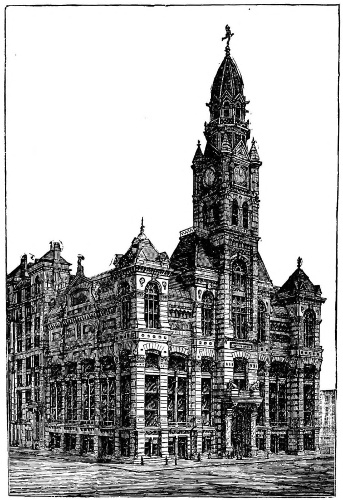
CHICAGO BOARD OF TRADE.
And first, as to the speculator: He may fall within either one of two categories—the professional or the occasional. Yet even under the general caption of professional speculators, operators may be divided into two classes. One embraces men whose large wealth enables them to contrive and engineer what is popularly known as a “corner;” the other includes those who follow in their wake, believing that they can discern their intentions, and laying the flattering delusion to their souls that they can presage the course of prices. The professional speculator, as being the “larger fish,” should first claim our notice. He it is who originates and conducts “corners,” by which term is meant the forcing up of prices for any given commodity to a point far beyond their legitimate value, with a view to enriching the few at the expense of the many. Men of this stamp ordinarily associate with themselves kindred spirits, whose natural bent is the same as their own, and whose capital may prove of value in carrying out their schemes. The combination having been formed, the first objective point is the selection of some commodity or stock to “corner.” The choice having been made, the next step is, quietly and unostentatiously to buy all of it that can be purchased. Let not the unsophisticated reader for a moment suppose, however, that the syndicate thus formed proposes to buy the article in question at current rates. Far otherwise. Prices must be depressed, and there is an obvious way in which to effect this result. Every market in the world is supposed to be governed by the normal relations between supply and demand. It follows that free offerings of any commodity are likely to reduce its quotable value. What, then, are the tactics of the “operator”? Evidently to offer to sell freely. Under the influence of the precipitation of large lots, prices recede, and the speculator is shrewd enough to purchase “at the 581bottom of the market.” Of course he does not expose his policy by buying such enormous quantities in his own name. He has recourse to firms doing a strictly commission business, of whom he employs a multiplicity, and who always refuse to disclose the name of their principal—not from any high sense of honor, but from motives of self-interest, for the simple reason that such exposure would result in a peremptory withdrawal of business. Having secured the desired quantity of the stock or commodity selected, the clique proceeds to advance the price, not abruptly but gradually, selling a little here and buying a little there, the object being the mystification of the miscellaneous dealers. At last comes what is known as the “squeeze.” The cabal having all, or at least the great preponderance, of the article where they can, if they choose, call for its immediate delivery, refuse to entertain any offers at less than the limit fixed. The consequence is that the “shorts”—i. e., the men who have sold to the syndicate—are compelled to settle at the price to which the coalition has forced quotations. The method of operation can be best illustrated by a suppositious case. Let us suppose—simply by way of illustration—that a coterie of dealers in grain resolve to force up the price of wheat, although not to localize the illustration, we might assume the formation of a “corner” on some one of the numerous stock exchanges with which the country is blessed (?), or cursed. But let us take the Chicago Board of Trade, with whose methods the author is most familiar: Let us suppose that the article to be “cornered” is “July wheat,” and that the combination has been formed in March. Resort is had to the tactics above explained. Wheat for July delivery is first depressed, then bought, and in the end sold without regard to its inherent value, but solely with a view to what the “shorts” may be forced to pay. The profits of such “corners,” thus constructed, are sometimes enormous. Yet, as in the game of faro, the most expert dealer is sometimes put to heavy loss by the combination which is playing against the bank; so even the machinations of the strongest and shrewdest operators are brought to naught either by a combination of brighter minds, by a failure carefully to guard every weak spot, or, it may be, by very chance. The same elements are present in both games, faro and stock-jobbing. These corners are conceived in cupidity, carried on in deceit, and consummated in heartlessness; yet there are not wanting those who affirm that the commercial exchange is the very prop and bulwark of American commerce! That the exchange, in its legitimate scope, affords an easy and safe way of doing business, cannot be denied; that its practical operation is to foster speculation and encourage reckless gambling is equally indisputable.
This assertion seems, on its face, perhaps, ill-considered, yet it is abundantly justified by facts. We have, thus far, considered only the tactics of the professional “operator.” Let us, for a moment, consider 582the fortune (or misfortune) that awaits the occasional speculator. The latter closely resembles the man who plunges, headlong, into the Niagara rapids without even a rudimentary knowledge of the art of swimming. Like a chip, he sports upon the crest of the eddying waters of the whirlpool, until, gradually drawn nearer and nearer toward the centre, he is sucked into its very vortex, sinking to reappear no more. Yet this comparison is weak. The outside speculator who fancies that he can buy or sell on “pointers,” (i. e. private information) given him by parties well-posted, very nearly approaches an idiot in the matter of intelligence. Let us take, as a single illustration, a case which fell under the author’s personal observation. The experience of the victim (whom we will call Jones) is by no means exceptional. Mr. “Jones” was advised by a friend (?) that “old Higgenbotham” had bought up all of a certain article and that within sixty days prices were destined materially to appreciate. Naturally “Mr. Jones” found his interest, as well as his cupidity stimulated. What would his friend recommend him to do? “Buy, of course; and buy heavily,” was the answer. “But I don’t know how to buy,” objected Jones. “Why,” replied his advisor, “that’s the easiest thing in the world, Q X & Z, one of the best houses in the street, are particular friends of mine. Take my card and go down and see them. They’ll use you right.” The unfortunate “Jones” listened to the siren song. He interviewed Q X & Z, by whom he was received with distinguished consideration. The firm of brokers explained to him how he could, by depositing with them a “margin” of five per cent. on the par value of his prospective purchase, become the putative owner of twenty times the amount of his deposit. Of course he must buy for future delivery, this not being a “cash” transaction. But there was no doubt that prices would advance. Oh, certainly not.
Mr. “Jones” was naturally a little timorous, being unaccustomed to speculation. He advanced a few hundred dollars, however, by way of “margins,” and at the conclusion of the “deal,” found himself winner by a handsome sum. His experience was a revelation to him. He ventured again and again, with varying success. Finally he found himself heavily interested on the wrong side of the market. He was assured that prices must necessarily take a turn, and he could ill afford to lose the sum already risked.
To understand the nature of the risk which he had incurred, however, some explanation of the method of speculating by means of margins is necessary. To illustrate: let us suppose that a certain article—say, wheat is to-day at $1.00 per bushel, of course 10,000 bushels are nominally worth $10,000. Imagine a legitimate purchase of such a quantity at these figures. Should the price advance one cent per bushel, the 10,000 bushels would be worth $10,100; should it fall off one cent the wheat 583would be worth only $9,900. In the former case the buyer would win $100; in the latter he would lose a like sum. In the case of a bona-fide sale, the whole of the $10,000 is actually paid. In a speculative transaction the purchaser only advances a part of the price, usually a few cents per bushel, which is placed in the hands of his broker, who gives him a receipt therefor. The commission merchant conducts the business in his own name, assuming personal responsibility for the payment of the money. To protect himself against possible loss, which may result from violent fluctuations in the market, he insists upon a marginal deposit as above stated. Should the depreciation in value approach the limit of the margin, the speculator is called upon to advance more money. If he fail to do so, and the decline continues, the broker protects himself by selling out the article bought, charging his customer with the loss sustained, together with his own brokerage charges, and handing over to him whatever small balance may remain to his credit. In the case of a speculative sale, precisely the same methods are employed, except that as the seller’s gain is derived from a depreciation and his loss through an advance, when the “margin” is in danger of being “wiped out,” the broker closes the transaction by buying on the customer’s account instead of selling.
But to return to the experience of Mr. “Jones.” As has been said he had ventured largely, and he found himself confronted with financial ruin. Although engaged in a money-making business, he had plunged so deeply into the maelstrom of speculation that his capital was seriously impaired. What was to be done? To withdraw meant bankruptcy; yet, how could he go on? Only one way presented itself to him. He was the executor of his brother’s will and the guardian of his brother’s minor children. The trust funds placed under his control might be utilized to avert impending disaster. Not that he would wrong the orphans whose patrimony had been committed to his care, but he would temporarily borrow the money of the estate, to be returned with interest, within a few weeks. He succumbed to the temptation and the result need hardly be told. The combination formed for the purpose of controlling prices absorbed these funds as it had the others, with the same relentless rapacity as do the knights of the green cloth the last hard-earned dollar of the day-laborer. The day of settlement arrived, the bubble burst and the unfortunate man found himself buried fathoms deep in dishonor and ruin. Not only was he penniless, but he realized that wherever he went the finger of scorn pointed out his every step. A temperate man before, he plunged headlong into dissipation. His wife found herself compelled to leave him, and to-day, stripped of fortune, bereft of family, deserted by friends, he walks the streets with faltering tread, aimlessly and hopelessly; living God knows how; hanging about bucket-shops and pool-rooms, considering that a fortunate day on which, honestly or dishonestly, he can earn half a dollar.
584Nor is this an isolated case. The speculator who has been alluded to is but a type of a class of men whose name is legion. The ruined reputations of confidential clerks, cashiers and administrators of trust funds mark the path of the reckless operator as milestones mark the causeway. The terrible fascination of gambling, whether through speculation or cards, when once the votary has succumbed to it, can be most fitly compared to that of the opium habit. The victim of this body-debasing, soul-destroying vice is willing to risk his hopes, not only for time but for eternity, on the gratification of his appetite. So does the devotee of the faro table or the man infatuated with the allurements of the exchange stake his life, his honor, his very salvation upon the turn of a die or the rise or fall of a particular stock.
Better, far better, were it for the man who enters a gaming resort that his first wager prove unsuccessful; far happier would he be who determines to “speculate in futures” did his first venture result in heavy loss. In either case the influence of failure would prove a deterrent sufficiently powerful to avert years of future misery, if not ultimate destruction.
The technical nomenclature of the exchange—sometimes termed the “slang of the street”—which, as has been remarked, is incomprehensible to the uninitiateduninitiated, in itself affords some key to the nature of the business transacted. Some of the most common terms are here defined, although to enumerate them all would swell the dimensions of the present chapter beyond the limits assigned it.
A “scalper” is an operator who makes it his practice to close his transactions as soon as he can see a small profit, say a quarter of one cent. His operations are neither more nor less than betting on a rise or fall in prices.
The “guerilla” is a species of the genus “scalper,” few in number, and makes a specialty of dealing in stocks and commodities: So unsavory is the reputation of this class that it has fixed the appellation of “Hell’s Kitchen” and “Robber’s Roost” upon certain localities in the New York Stock Exchange.
Still another class is composed of those who strive to enrich themselves by the fictitious rise and fall of a particular stock in which they constantly deal.
The terms “long” and “short,” when used as adjectives, have been already explained, and their signification when employed as nouns is practically the same. A “long” is a speculator who has bought heavily in anticipation of a rise. A “short” is one who has sold freely in expectation of a decline. The action of the former is called “loading.”
“Forcing quotations” is keeping up prices by any means whatever. When this is accomplished by the dissemination of fictitious news or the 585circulation of unfounded rumors, the operator is said to “balloon” prices.
A speculator is said to “take a flyer” when he engages in some side venture; he “flies kites” when he expands operations injudiciously; he “holds the market” when he prevents a decline in prices by buying heavily; he “milks the street” when he manipulates so skilfully that they rise or fall at his pleasure; he “unloads” when he sells the particular stock or commodity of which he is “long;” he “spills stock” when he offers large quantities with a view to lowering or “breaking” prices; if he is successful in these tactics he is said to “saddle the market.”
A “bear” is said to be “gunning” a stock when he employs all his energy and craft to “break” its price. He “covers,” or “covers his shorts,” when he buys to fulfill his contracts. He “sells out” a man by forcing prices down so that the latter is obliged to relinquish what he is “carrying,” perhaps to fail.
The nature of a “corner” has been already set forth in detail. The operator or clique organizing and managing it is said to “run” it. The day when final settlement must be made between the opposing parties engaged in such a transaction is termed “settling day.” If the “bears” are forced to settle at unusually high prices they are said to be “squeezed.” The “squeeze” which has followed many a corner has precipitated not a few wealthy men into financial ruin. This circumstance, however, is usually a matter of utter indifference to the manipulators. The success of a “corner” is sometimes prevented by what is known as a “squeal,” or revelation of the secrets of the pool or clique by one of its members. Sometimes the plans of the organizers of a “corner” are brought to naught by a “leak” in the pool, that is, by one of the members secretly selling out his holdings. Of course, a “corner” can be formed only on what is known as a “future,” or future delivery, by which is meant the sale and purchase of some stock or commodity to be delivered at some period in the future.
Yet another form of gambling very common upon the floors of stock and commercial exchanges is known as dealing in “puts,” “calls” and “straddles.” When a person buys a “put,” he pays a stipulated sum for the privilege of selling to the party to whom it is paid, a certain quantity of some particular stock or other article, within a fixed time, at a designated price. Thus A might pay to B one hundred dollars for the privilege of selling him one hundred shares of Union Pacific stock at a stipulated price, within ten days. As a matter of course, the price named is always a little below the current quotation ruling at the time the contract is made, i. e., the day upon which the “put” is bought. If, for instance, the “put” is sold at 80 cents on that day, and the market declines to 75, A might tender to B the one hundred shares, and the latter would be compelled to take them at that price. In such a case A would 586have gained five dollars per share, or five hundred dollars in all, provided he had “covered his shorts,” i. e., bought in the stock which he had already put, at the latter figure. As a matter of fact, neither party contemplated an actual delivery. The market having declined, A’s net gain is, of course, only four hundred dollars, he having already paid one hundred dollars to B. This appears an easy method of winning money. As a matter of fact, however, experience has shown that very few men win through the purchase of “puts” and “calls.”
A “call” is similar in its general nature to a “put,” but differs from it in that the buyer of the former has the privilege of calling or buying a certain quantity, under the same conditions. The seller of the “put” contracts to buy, and of the “call” to sell, whenever the demand is made.
A “straddle” is a combination of the “put” and the “call,” and is the option of either buying or selling. The cost of these “puts,” “calls,” and “straddles,” which are known as “privileges,” varies from one to five per cent. of the par value of the stock, or the market value of the commodity involved, and depends upon the time they have to run, the range covered, and the activity and sensitiveness of the market.
It is claimed in behalf of these privileges that they are, in their essence, really contracts of insurance, and as such are entirely legitimate. The general public, however, has always regarded them as a complex system of betting, and believes that they constitute one of the most pernicious features of the exchange. The fallacy of the argument in their favor, above outlined, becomes apparent when it is remembered that the law regards all contracts of insurance as being one form of gambling, and sanctions and enforces them only on grounds of public policy. The burden of proof is upon the defenders of “puts” and “calls” to show that, even if it be conceded that they are contracts of insurance, they can be justified as being necessary to the furtherance of commerce or the welfare of society. That they do not tend to promote commerce is shown by the fact that neither party to the transaction for a moment contemplates the actual delivery of the article bought or sold. It is essentially a wager between two individuals as to the future course of the market, one betting that prices will advance, and the other that they will decline. The absurdity of claiming that they promote the general welfare of society, (were such a claim advanced), may be easily demonstrated by calling attention to the economic consideration that the winner has done nothing to produce the money which he pockets, and by pointing to the pecuniary loss and moral debasement which they entail. They sustain somewhat of the same relation to the dealings of the large operators as does the keno room to the faro bank.