PART II. (continued 3)
Reading edition
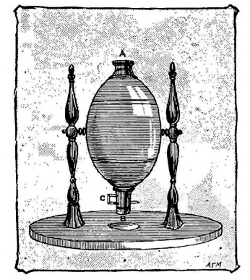
The game very closely resembles the children’s pastime of “lotto.” Any number of persons may play. Each one desiring to participate in the game buys a card on which are three horizontal rows of five numbers each, arranged altogether without regularity. The price paid for a card is commonly twenty-five cents, although sometimes the stakes are considerably higher. None of the cards contain a higher number than ninety-nine. The conductor of the game—who is known as the “roller”—takes his position, usually upon a raised platform, in full view of the players. Before him is placed a globe containing ninety-nine balls, numbered consecutively from one to ninety-nine, to correspond with the figures on the players’ cards. The balls having been thoroughly mixed, the “roller” presses a spring at the bottom of the globe, opening an aperture just large enough to permit one ball to drop at a time. As soon as the first one has fallen, the aperture is closed and the “roller,” in a loud voice, calls out the number inscribed upon it. If a player finds the number in either of the three horizontal rows on his card he places a button over it. When any player has all five, numbers in any one of his rows thus called out, he exclaims “keno,” after which the “roller” takes no more balls from the globe. His card is then inspected by one of the “collectors”—of whom there are usually two—and if his tally is correct he is given the entire amount of money paid by all the players (which is called “the pot”) less a discount of fifteen per cent., which is retained by “the house” as its “percentage.” Thus, if there are a hundred players, each of whom has paid twenty-five cents for a card, the winner receives twenty-one dollars and twenty-five cents, the bank reserving to itself three dollars and seventy-five cents as “percentage.”
252Matters having been thus arranged, fresh stakes are advanced by those wishing to play again, the balls put in the globe and the game is resumed.
It may be readily seen that the “bank” incurs no risk whatever, and its sure percentage on the stakes is large enough to satisfy the cupidity of most gamblers. Fortunes have been won by the proprietors of these games, one concern alone in St. Louis having made $190,000 thereby. Still, the instinct to cheat is strong in the breast of the professional sharper; and sometimes a confederate of the proprietor plays in the game and wins the “pot,” through the co-operation of the “roller.” The latter withholds from the globe several balls, which he substitutes, from time to time, for the ones which he should have taken from the globe. The numbers on these withheld and substituted balls correspond to those necessary to fill out one of the horizontal rows on the confederate’s card and the latter is thus enabled toto win through fraud.
ROLLING FARO.
This game is similar in its general principles to those of the “squeeze spindle,” “needle wheel,” and “corona,” which have already been described. It is a favorite game upon fair-grounds, as are the others, but it is frequently found in resorts which are known as “first-class” gambling houses. There is scarcely a “hell” in the city of Chicago in which this apparatus cannot be found. This circumstance, in itself, affords a striking commentary upon the principles which underlie the management of what the uninitiated are wont to call “square houses.”
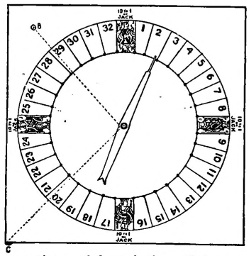
The accompanying cut shows the device used in playing the game, not only as it appears to the outsider, but also with the “fake” element exposed. A circular ring of wood, about three inches broad, is attached to a square board which is placed upon a table. At four points in the ring, equi-distant from each other, are the painted representations of four jacks. Between each pair of jacks are eight blank spaces, each one of which is usually numbered, the numbers running from one to thirty-two, consecutively. Sometimes ordinary playing cards 253are substituted for the numbers. Each of the four blocks of numbers is painted a distinct and separate color. In the centre of the inner circle is placed a metal arrow, having a pointed quill attached to the smaller end, the whole swinging upon a central pivot. Prices are placed at intervals upon the numbered squares. When the game is played at gambling houses, the only prizes offered are sums of money, varying in amount, and between these the numbers are left blank. When the device is operated upon a fair-ground, there are no blanks, articles of jewelry of trifling value being placed between the money prizes.
The mode of play is usually different upon fair-grounds from that which is followed in the regular gaming houses. In the former case, players pay twenty-five cents each for the privilege of swinging the arrow, and take the prize opposite the quill point when it stops revolving. At regular gaming houses players place their stakes upon whatever number or color they may select, and if they win the bank pays them the amount due them. The bets may be made either upon any one of the four jacks or on either of the four colors. If the player stakes his money upon a jack and wins, the proprietor pays him ten times the amount of his stake. If he lays his wager upon any given color,—if he is playing upon a fair-ground,—he receives simply his original stake, together with an equal sum. If, however, he is playing in a house, and names the lucky color, he receives two for one.
The chances having been bought or the bets laid, some one—either one of the players, or the proprietor, or a bystander—sets the arrow in motion. When the pointer comes to rest, if any player has laid his bet upon the number at which it stops, he receives either the prize thereon placed or the amount of his winnings in cash.
The “fake” element, as has been said, is shown in the illustration. There is a wire rod running from points B and C to the central pivot. As in the “squeeze spindle,” they are sunk into the table and concealed by the cloth covering. That which runs to point B is manipulated by pressure with the hand; that which terminates at point C is operated by pressure from the hip. When the operator pushes against either of these rods, he checks the revolution of the arrow by creating friction at the pivot, and brings the pointer to a standstill at any part of the circle which he may desire.
Very little reflection is necessary to show the reader how great is the legitimate percentage in favor of the bank, even were this game played without any resort to trickery. There are four colors and four jacks upon which a player may bet. It follows that the odds are seven to one in favor of the house against any individual player naming the winning color or card. And when to this percentage against the players there is added the absolute certainty of winning which the bank gains 254through the operation of the fraudulent device above explained, it is apparent that no one can possibly win except through the consent of the proprietor of the machine.
A rather striking illustration of the utter lack of good faith which characterizes gamblers in their dealings with one another, and their general moral perversity is furnished in the following narrative, for the truth of which the author vouches. Two itinerantitinerant sharpers, each with a rolling faro outfit were traveling on a Missouri river steamboat. The year was 18—, and the season was autumn, when county fairs were at full blast and men of that ilk were reaping a rich harvest. Both men were destined for the same point, and each had been anxious to secure a monopoly of the “privilege” of running his machine at the fair in question. One of them discovered that his business rival had forestalled him, and that—to use a colloquialismcolloquialism—“his cake was dough.” The gambler who had succeeded in obtaining his license retired early, serenely confident that the following day would witness not only the discomfiture of his rival but also his own success. But he had reckoned without his host. Scarcely had he fallen asleep before the form of his wily antagonist might have been seen prowling among the freight upon the main deck. Stealthily he moved in and out among the piles of stuff until he discovered the wheel of the licensed monopolist. Then followed a dull, grating sound, as of some one drawing a heavy box across a floor; then came a sudden splash, and to this succeeded silence. The gambling machine of the enterprising gamester who had secured the license, had sunk beneath the waters of the Mississippi, to be seen no more by mortal eyes. The next morning there was a brief season of pandemonium. The situation, however, was simple. There was but one fair, one license and one outfit, yet there were two gamblers. One of them had a license, but no paraphernalia; the other had paraphernalia, but no license. There was but one solution; the two found themselves compelled to “pool their issues.” In other words, the man who had thrown his rival’s wheel overboard forced the man who had owned it to divide his profits with him in consideration of being permitted to use the only wheel available.
The author was himself present at the fair where these two men operated the wheel to which reference has been made. On the way back a fearful scene was witnessed. A quarrel over “privileges” had arisen on the grounds and was continued on the boat. A gambler familiarly known as “Curley” the hog driver, a bulldozer, when heated by passion and liquor, was raising a terrible disturbance when another sporting man, Sherman Thirston, interfered to restrain him from mischief. “Curley” drew his revolver and fired three shots at Thirston, one breaking a spittoon which he held in front of him, and one grazing Lone Wolf’s forehead. Thirston advanced upon “Curley” and disarmed him.
255HIGH BALL POKER.
This game derives its name from the fact that balls are used instead of cards, and that bets may be “raised” as in poker. In fact, “bluff” is resorted to in both games in about the same ratio. The method of play is exceedingly simple. All that is necessary is a cloth-covered table (usually about six feet long by three and one-half feet broad), a leather bottle, one hundred wooden or ivory balls, numbered from one to one hundred consecutively, and some “chips.” The latter are sold to the players by the proprietor at five or ten cents each. Those wishing to indulge in the game put down their “ante,” as in straight or draw poker. The “ante” is usually one chip. The person conducting the game then takes the bottle, in which the balls have been placed, in his hand, and throws them from its open mouth, one to each player. The latter then examine the little spheres which they have received and either forfeit the chips which they have already laid down or make their bets in the same manner as in playing poker. Precisely the same tactics are employed in both games. When the “call” is made the player holding the ball on which is inscribed the highest number wins the bet, by which is meant all the stakes which have been placed upon the table.
This is a favorite game in many gambling houses, especially those of an inferior class. The “house” always takes a percentage, or “rake-off,” as it is frequently called. This percentage consists of either one or two chips, as may be agreed upon. It follows that the proprietors run no risk, being absolutely certain of winning something each time that the balls are thrown. In “skin” gambling houses, however, the owners are not content with this percentage of profit. A “capper” is called into the game, who usually sits at the end of the table toward the banker’s left hand. The latter finds it necessary to be very cautious in collecting the balls from the players, lest some one who had received a high number might withhold it in order to bet upon it on the next throw. Accordingly, he examines each ball as it is returned to him. This affords him ample opportunity for holding out some high number in his hand, which he throws to his confederate the next time, thereby enabling him to bet with approximate certainty of winning everything in sight. These cappers are commonly known as “pluggers,” and are paid a stated per diem, being looked upon as regular employes.
256

VARIOUS CARD GAMES.
“SEVEN UP,” OR “OLD SLEDGE.”
The game, sometimes called Old Sledge and Seven-Up, is played with a full pack of fifty-two cards, which take rank as at Whist—the Ace being the highest and the Deuce the lowest.
The players cut for deal. The dealer then gives six cards to each player, three at a time, and turns up the thirteenth, if there be two players, and the twenty-fifth if there be four. The turn-up is the trump.
The non-dealer then looks at his hand, and determines whether he will hold it for play, or beg. If he is satisfied with his hand, he says, “I stand;” but if he is not satisfied with his cards, he says, “I beg,” in which case the dealer must either suffer his adversary to score one point, saying, “Take one,” or give each three more cards from the pack, and then turn up the next card, the seventh, for trumps; if however, the trump turned up be of the same suit as the first, the dealer must go on, giving each three cards more, and turning up the seventh, until a change of suit for turn-up takes place.
After these preliminaries have been settled, if two only are playing, the non-dealer leads a card, and the dealer plays a card to it; these two cards constitute a trick.
The player who plays the highest card of the suit led, or trumps, wins the trick, and has the next lead. The play proceeds in this way until all the tricks are played.
Each player must follow suit, if he can, unless he chooses to trump.
The points that may be scored are herewith given in their order of precedence.
High.—The highest trump out; the holder scores one point.
Low.—The lowest trump out; the original holder scores one point, even if it be taken by his adversary.
Jack.—The Knave of trumps. The winner of the trick containing it scores one point.
When the Jack is turned up for trump, it counts one point for the dealer, and in that case takes precedence of every other point in the score.
257Game.—The greatest number that in the tricks gained, can be shown by either party; reckoning for
Each Ace four towards game.
” King three ” ”
” Queen two ” ”
” Jack one ” ”
” Ten ten ” ”
The other cards do not count towards game; thus it may happen that a deal may be played without either party having any score for game, by reason of holding neither face cards nornor tens.
When the players hold equal numbers, the dealer’s hand scores the point for game.
One card may count all “fours;” for example, the oldest hand holds only the jack of the trump suit, and stands his game, the dealer, having neither trump, ten, ace nor court card, it will follow that the jack will be at once high, low, jack and game.
The game consists of seven points, and the player who first scores that number wins the game. If the non-dealer is dissatisfied with his hand, he may “beg,” i. e., ask the dealer to “give” him one point on his score. If the latter refuse, he must “run the cards,” by which is meant, turn down the trump, deal three cards each to his antagonist and himself, and turn another card. If the latter happen to be of the same suit as that previously turned, it is turned over, and the “running for trumps” is continued until some card of a different suit is turned.
In four-handed Seven-up the parties usually decide who shall be partners by cutting the cards, the two highest and the two lowest playing together. The four players divide themselves into two sets, each player sitting opposite his partner, as at whist. The first deal is decided by cutting the cards, the highest cut having the deal, but afterward it is taken by each player in rotation.
The dealer and the player on his left only are permitted to look at their cards, previous to the latter deciding upon his hand, and in case he begs, the other parties must not raise their cards until the dealer announces whether he will “give one” or “run the cards” for another trump.
There can be little question but that the popular game of seven-up had its origin in the United States, although whether in the East or West is a question, the answer to which is shrouded in obscurity.
Half a century ago the wild frontiersman of Indiana and Illinois were accustomed to while away their nights by playing “High, Low, Jack,” with a greasy pack of cards, upon the head of a whiskey barrel, never quitting the game until they had consumed the contents of the barrel.
258Fully as long ago the stalwart lumbermen of Maine sat down upon improvised seats in the pine woods, and devoted Sunday to the same amusement. In these early days the game was, if anything, more popular than at present, for the reason that fewer games of cards were known to the great masses of players.
Occasionally matches, which might nowadays be euphoniously designated as tournaments, were held. In the simple language of those times they were generally referred to as “bouts a keards.” It is probable that even then more or less fraud was practiced by the players, since deception seems to have been a prominent characteristic of the human family since the days of the “fall,” and when cards are played for money the temptation to cheat seems to be, to a certain class of men, irresistible. “Wet groceries” were the favorite stakes of the rough Western farmers and the Eastern lumbermen, yet play was not confined to these. Money earned by long and patient toil of the hardest sort was piled upon barrel heads or laid upon the ground, and it is doubtful whether the losers bore their losses with any more equanimity than do the same class of players to-day. But it has remained for the blackleg of these latter days to introduce into the game those finer arts such as the “half stock” and the “whole stock,” by means of which the unwary are entrapped and the gullible fleeced. To the untutored minds of the early players to whom reference has been made, the idea of reading the cards by the back would have seemed an utter absurdity; but it is true that the farmers and lumbermen have since grown wiser, through no little bitter experience. The result has been that the gamblers do not as easily find victims to-day as they did twenty-five or thirty years ago. This very circumstance shows the benefit effected by the knowledge, and it is the mission of this work to spread broadcast throughout the land such knowledge that he who may be swindled through such artifices as herein described, has only himself to blame for his folly. Infatuation and ignorance have but a poor show of success in a contest with chicanery and skill.
Some of the most common, and at the same time most effective descriptions of fraud practiced in this game will next be concisely described.
“STRIPPERS.”
In preparing “strippers,” to be used in seven-up, the blacklegs elects either three aces or three jacks, which he leaves in the same condition as that in which they came from the manufacturer. The remainder of the pack he slightly trims down. In using a pack thus prepared the cheat takes advantage of his antagonist’s deal by drawing out these three cards from the pack by their sides, instead of giving the deck a fair, honest cut. Having drawn them out he throws them upon the top, and as a matter of course receives them as his own first three cards. If he has the deal himself 259he “strips” them, that is draws them out of the pack by the sides, places them on top and throws three cards over them. If his adversary has cut the pack, the gambler “shifts” the cut, as described in the chapter relative to poker. Of course his antagonist now receives the three cards which were thrown on top of the pack, while the sharper receives the three aces or jacks.
“BRIEFS.”
The same “brief” is employed in seven-up as in poker. It consists of one wide card which is drawn out and placed on top of the three cards,—usually an ace, deuce or jack—which have been previously arranged together. The object in using this card, as in poker, is to enable their sharper to cut the pack in such a way as to uncover the prepared hand. It may be remarked concerning both “stripper” and “briefs” that their employment is usually more easy of detection than “stocking,” when practiced by an expert, and for this reason they are not favorite devices with most of the profession in playing short games, unless their antagonist be particularly verdant.
HALF STOCK.
In this arrangement of the pack the gambler, having first selected a card of any suit, places above it three others of the same suit. It is a common practice to select the high (ace) the low (deuce) and the jack; above these three others are placed. In shuffling the dealer is careful not to disturb the seven cards thus arranged. Having completed his shuffle, he offers them to be cut. After the cut he deals, as he should do, from the remainder of the pack and leaves the cut lying upon the board. The trump is fairly turned, but as he exposes it the sharper throws it to one side; he then picks up the cut with his right hand and places it on top of the remainder of the pack. His antagonist, being engaged in looking at his hand, naturally fails to observe the order in which the two halves of the pack are put together. The advantage of this maneuver is that if his adversary “begs” the dealer runs off to him the three top cards which he had previously placed together and which, of course, lie on top of the cut, which is now uppermost in the deck. He himself receives the three best cards (perhaps the ace, deuce and jack) of the same suit, which, as we have seen, laid beneath the three upper cards; he then turns a new trump, the seventh card, which, it will be remembered, was also of the same suit. He now holds the high, low and jack of the new trump suit and is naturally in a far better position than his antagonist. Of course the half stock is comparatively valueless unless his opponent begs. But in the course of a rubber the latter is reasonably certain to do this often enough to entail a serious loss upon himself.
260THE WHOLE STOCK.
In a case where the cards have been stocked on the system of the “whole stock,” it makes not the slightestslightest difference to the sharper whether his adversary beg or not.
The blackleg who intends to employ this artifice is careful to attempt it only when there have been but twelve cards dealt from the pack on any particular hand, for example, when he himself has “stood” on his antagonist’s deal. In picking up the twelve cards from the table he selects four cards of some one suit, of course taking care to choose the highest four which have been played during that hand. Over these four cards he places the remaining eight, above these again a thirteenth card of the same suit, which he takes from the pack. Of course, at this moment the faces of the cards are uppermost. By placing the thirteen arranged cards on the bottom and turning the pack over in order to shuffle, the former are brought to the top. In shuffling he takes great care not to disarrange the prepared thirteen. When his antagonist has cut, the sharper “shifts” the cut, as in poker, thus restoring the cards to their original position. The result is, that in dealing, the last three cards of the original twelve will necessarily fall to himself, and they will of course be of the same suit as the trump card turned.
CRIMPING.
Crimping in all games is practiced on substantially the same principle. In seven-up the dishonest gamester “crimps,” or bends down, one or more—even three high cards. Of course it is an artifice which can prove of advantage to the operator only on his adversary’s deal, in which case he cuts down to the “crimped” cards, the location of which is perceived by the bent card slightly raising those above it, from those below. If only a single ace be crimped, the result is a very heavy percentage of odds in favor of the sharper.
MARKING THE EDGES.
The object of marking the edges of the cards is practically the same as that of crimping; that is, to enable the blackleg to cut down to any desired card. The edges of the ace or jacks, or possibly of both, are very carefully marked with India ink. Cards thus prepared are useful to the cheat only on his opponent’s deal; but in the latter case he is invariably able to cut the pack in such a way that he will himself receive one of the cards thus marked.
THE HIGH HAND.
There are two “high hands” in Seven-up, one called the “long hand,” the other the “short hand.” To run up a “long hand” requires more time than can usually be obtained by making a seemingly fair deal 261or turning up a jack or ten-spot. However, thousands of dollars have been won on this game, as the major hand seems to a tyro a perfectly sure hand for four points—the fact being that it is a “sure thing” the other way.
The “long hand” is a device to which professional gamblers frequently resort, and which often proves highly successful. It is introduced at a stage of the game where the pack has been “run off” to an extent sufficient to give each player nine cards. Of course, the perpetration of the trick presupposes that the pack has been carefully “stocked.” The player who is to be victimized is given the four court cards, ten-spot and deuce of some suit, e. g., of spades, together with the kings of the three other suits. The gambler has dealt himself six of the remaining spades, and the aces of hearts, diamonds and clubs. He then turns a spade—let us say the nine spot.
The reader who has mastered the explanation of the game already given, will comprehend that the dupe is certain of winning three points—the high, low and jack, and with six trumps and three kings of outside suits his chances of making “game” are apparently excellent. He is, therefore, easily induced, even if he does not himself offer, to bet that he will score four points. Now, mark the issue. The “sucker” inevitably makes his “high, low and jack,” but when the count is made for game he finds his reckoning to be 20 (ace 4, king 3, queen 2, jack 1, and ten-spot 10), to his adversary’s 21 (three aces 12, three kings 9, making 21), the result being the loss of his stake.
The “short hand” at “Seven-up” is a trick to which gamblers resort at the stage of the game when the score stands 6 to 5 in favor of the “sucker” and the “professional” has the deal. Six cards having been dealt to each player, the cheat turns up, let us say, a heart, although the particular suit is altogether immaterial, provided the pack has been properly “stocked.” When the greenhorn picks up his cards, he finds he has the aces of the three other suits. Of course, if he is an average player he “begs,” i. e., asks his adversary to “give” him one point. Inasmuch as such a “gift” would make his score seven, and decide the game in his favor, the gamester refuses. The only course remaining is to “run for a new trump.” The dupe now feels perfectly sure of winning the game. He knows that the ace is necessarily “high,” which point counts first in determining who wins the game; and inasmuch as he is aware that either hearts, diamonds or clubs must next be the trump, and he holds the ace of each of these three suits, he “bets his pile” in serene confidence that he will win. And now comes in the “fine work” of the sharper. He takes the deck and “runs off” six cards; he then turns up the seventh, which is always a jack of the suit originally turned, thus adding one to his own tally, and making the score stand 6 to 6. As the 262rules forbid the same suit being trump, he has to “run” again. Once more the seventh card is turned; another jack (of course of another suit) is exposed: the gambler scores another point for “turning jack,” thus making his account seven and winning the game, leaving the unlucky “sucker” to lament the cruel fate which so effectually prevented him from scoring “high” on either of his three utterly worthless aces.
HOLDING OUT.
It is unnecessary to enter into any detailed description of this method of fraud as practiced in seven-up, for the reason that it has been already fully explained in treating of poker. The most common means of practicing this cheat is the employment of the “bug.”
It is, however, for two objects; first to secrete an ace, ten, jack or deuce with a view to their further use, and, secondly as a means by which the sharper may deal to himself seven cards. This latter purpose, and the method by which it is achieved may be worth describing.
On the second run of the deal, the blackleg gives himself four cards instead of three. He then takes out some low card of his strongest suit, places it on top of his cards and his hand on the table. If his adversary stands, he discards some one of his seven cards into the “bug,” thus leaving the proper number in his hand. If on the other hand his antagonist begs, he runs off the desired cards and picking up his own, raises the three last received, on the one which he had previously placed upon the top of his original hand, then exclaims that he has dealt himself four cards instead of three and that the bottom card must be the trump. He thereupon turns over the card of his strongest suit and places it on the top of the deck as the trump, leaving his hand with only the proper number of cards.
MARKED CARDS.
Marked cards are often used by professionals in playing seven-up, but the blacklegs do not find them of nearly as great advantage as in many other games. The description of the manner in which they are prepared has already been given in the chapter on poker and need not be here repeated.
TURNING JACK FROM THE BOTTOM.
This is a very common custom with professional gamblers, who, through long practice, have acquired a manual dexterity which virtually defies detection. The first step of the sharper is to place a jack at the bottom of the pack, leaving it in that position while he deals. If his adversary cuts, the cheat “shifts the cut,” in the same manner as at poker, restoring the cards to their original position. Then, after dealing, 263he places his hands over the deck, in such a way as to conceal it from view. Then, grasping the pack by its outer edge with his right hand, he turns it over on the jack, simultaneously drawing the latter toward the inside, with his left hand, so that it may meet the other cards as they turn over. He all the time imparts a slight upward movement to the pack, which he finally drops upon the table.
Of course, as above explained, by “turning up jack” the dealer scores one. If, now, his opponent begs, the gambler takes occasion surreptitiously to observe the suit of the bottom card. If it happens to be the same as the strongest suit in his own hand, he repeats the trick, turning it for trump, thereby practically placing himself in a position where the chances for winning decidedly preponderate in his favor.
The sharper very commonly selects as the moment for using this stratagem, that period of the game when the score stands six to six, thus scoring the single point necessary to enable him to win.
WHIST.
Whist is too tedious a game for the professional gambler; it is peculiarly a game of skill, and therefore less adapted to cheating purposes, than are many others, the issue of which depends more upon chance. At one time both long and short whist were very popular at evening parties, but neither of them was ever a general game for money in this country, and even as a pastime Euchre has far surpassed it in public favor.
Still, trickery may be employed with telling effect, and the professional blackleg brings his ill-directed skill to bear upon it in a variety of ways.
The chief advantage to be obtained by the deal is with a “second,” and the gambler who is sufficiently dexterous to give the aces, kings and queens to himself and his partner can make the “odd trick” every time he deals.
“Signing up” between partners is also an essential element in fraudulent whist playing. For although each confederate has a general knowledge of the contents of his partner’s hand, yet there are critical periods in the game, especially when one of the two holds uncertain cards, when “signing up” is of great value in determining the event with absolute certainty. This secret telegraphy is arranged beforehand between the pair of swindlers, the signals for “suit” and “size” being mutually agreed upon; and where the understanding is perfect the defeat of any honest players with whom they may be contending, is a moral certainty.
“” ‘’ Another favorite device of card sharpers is to “ring in a cold deck,” by which is meant the substitution of a pack of cards having precisely similar backs as those used in the game, but which have been previously so arranged that while the greenhorns shall receive excellent hands, it is a matter of utter impossibility for them to score the odd trick. The substitution 264having been effected, one of the swindlers contrives some excuse for not looking at his hand until after his antagonists shall have examined theirs. Perhaps he lights a cigar, protesting that it will not “draw.” After the dupes have seen their cards, he proposes a wager—“just to make it interesting”—that he and his partner will win the odd trick. He adds that he will bet on his hand “unsight, unseen.” The honest player usually protests that he has looked at his cards already. “O, well,” says the blackleg; “never mind that. I’m in for a ‘spec,’ and if you want a little ‘go,’ I’m your man for twenty or so.”so.” At this point, the moral (?) companion of the sharper interferes with a protest. He doesn’t believe in betting on a friendly game; money is not so easily made that it can be thrown away, etc., etc. But this is so artfully said as to stimulate rather than to check the greenhorn’s desire to bet. A little more conversation almost invariably results in the making of a wager, the limit of which is determined by the purse and the verdancy of the victim. The stakes having been placed the game proceeds. The inevitable result follows: The “suckers” win the first six tricks and the sharpers the last seven and the money. The original pack had been put out of sight and the dupes rarely discover the manner in which they have been swindled, even if they suspect that any fraud whatever has been practised.
To illustrate the manner in which a pack of cards has been prepared for this purpose, let us suppose a party seated at the whist table. A, a sharper, deals to B, his verdant antagonist, the ace, king, queen, knave, ten and nine of hearts, which we will assume to be trumps; the ace, king, queen and knave of clubs; and the ace, king and queen of spades; the hand being, of course, void of diamonds. Every whist player would recognize this as an exceedingly strong, if not an impregnable, hand. But observe what A gives himself and his partner; the eight, seven, six, five, four, three and deuce of trumps, and of the rest of the pack, it is a matter of indifference. Now, mark the result. B leads off with his trumps, of which he has six; A follows suit every time, having seven; next B leads his ace of spades, which A takes with his remaining trump. The lead being now with the latter, he plays his six diamonds, each one of which, of course, takes a trick, the blackleg thus securing the odd trick. In considering a trick of this kind, the average man is at a loss whether to admire its ingenuity or condemn its rascality.
265CASINO.
This is one of the games of cards usually first taught to children and commonly considered too simple to interest matured minds. As a matter of fact, to play it successfully requires an exercise of memory second only to that necessary in playing at Whist.
It is not a favorite with gamblers for the reason that it presents comparatively few opportunities of using the advantages so dear to the heart of the blackleg. At the same time “eminent professionals” have been known to win $1,000 on a single game, and I have myself played for (and won) $50 on the hazard of one hand. It is related of “Canada Bill,” elsewhere referred to as the “king of the monte men,” that he deceived himself into believing that he understood the game. While he was making his headquarters in Kansas City he was wont to make short trips upon the railways centering there, from which he would not infrequently return with $2,000 or $3,000. He was then willing to have a bout at casino (and he would play no other game) for from $100 to $500 with any one who offered. Shrewd rascal as he was, he was the veriest tyro—in fact a “sucker”—at his own favorite pastime, and the blacklegs of the place used to fleece him unmercifully.
The main reliance of the gambler at this game, however, is in the superior skill resulting from careful study and long practice. An expert gamester can always tell the cards remaining in the pack at the commencement of the last deal, even on a perfectly fair game.
Of course “paper,” i.e., marked cards, are invaluable to the cheat at this as at all other games, and this is really the principal scheme of fraud of any importance ever attempted at this game. Occasionally, when a professional is playing with a greenhorn, he will contrive to keep a nine spot on top of his pile of tricks, which he uses in “building” to suit himself. Sometimes also a card of some low denomination (e.g. the three spot of hearts) is substituted for the ace of spades, which the sharper abstracts and conceals, placing it among his tricks and using it in counting his own points for game. This is rather unsafe, however, as the duplicate cards occasionally come together.
Casino is an amusement frequently affected by broken down gamblers, whose depleted resources do not permit them to “sit in” a game of poker, and who seek to rehabilitate their fallen fortunes by playing casino for a stake of five cents on a game of twenty-one points.
266EUCHRE.
Perhaps no game is more universally played in the United States than Euchre. It is pre-eminently a social amusement. While it does not possess the absorbing fascination of whist, it permits free and unrestrained conversation among the players, which circumstance has unquestionably contributed largely to its popularity.
It is probable that it originated in the Western States, but its devotees are to-day confined to no section, and the pastime finds its defenders alike in the saloon, the gaming “hell” and the drawing room.
To be a successful Euchre player calls for the exercise of excellent judgment, considerable finesse and no little boldness. As it is never played with a pack of more than thirty-two cards, this game does not afford so many opportunities for fraud, but the slightest advantage which can be gained, tells with unfailing certainty.
In fleecing victims at euchre, professional gamblers resort to many of the practices which are so successfully employed at “seven-up.” “Marked” or “advantage cards,” are among the most common devices of the sharpers.
“Strippers” are also found extremely useful. These are prepared in the same manner as in all other games, i. e. by removing—either from each side or both ends—a narrow, triangular “strip,” not wider than one-sixteenth of an inch at the widest part. One of the “surest things” is to have the cards cut for two jack “strippers,” which the “professional” can strip on the top of the pack on his opponent’s deal, thus securing two bowers. Sometimes one jack of a red and one of a black suit are selected for this purpose, but it is usually considered better to use two jacks of the same color, for the reason that should a trump of that color be turned, (which is likely to occur at least half the time) the cheat is sure of both bowers. This, as every euchre player knows, gives an immense advantage. Yet this trick is not always certain to win; sometimes “luck” will favor the honest player, and it is recorded that a guileless and unsuspecting neophyte once won sixteen consecutive games from a blackleg who trusted to this expedient. Such instances, however, are almost as rare as ice in the tropics; and any man is utterly devoid of sense who imagines that he is safe in trusting to chance, as against skill combined with chicanery.
“Briefs” may also be advantageouslyadvantageously used at euchre. The gambler places a “brief” above two bowers, or a bower and an ace, and the cut is made down to it on his adversary’s deal, thus insuring at least two high cards.
“Stocking” is far more easily accomplished at this game than at either poker or “seven-up,” and the gamester who is proficient in arranging 267the cards for either of the other two games finds it an easy matter to “put up” a deck for euchre, although it is absolutely essential to his success that he should be an expert at “shifting the cut.”
“Crimping” is practiced precisely as in “seven-up,” the most common device being to “crimp” a jack and then cut to it. The sharper also not infrequently marks the edges of the bowers with India ink, whereby he is always able so to cut the pack as to be certain of securing one of these desirable cards, with the chance of another one should two happen to lie together.
As in poker, the “bug” is sometimes used for “holding out” a valuable card—e. g., a bower or ace, and sometimes two. A card “held out” is occasionally “palmed;” by which is meant that it is concealed by the black-leg in the palm of his hand when the pack is handed him to cut. He then adroitly drops it on top, lightly taps the deck and allows the cards to run. If the gambler wishes to palm a card on his own deal, he places it on top of the pack as described and either makes a false cut or shuffles the pack through once without disturbing the one palmed.
However, although these nefarious artifices are constantly practiced by black-legs upon the unsophisticated player, it is only right to say that the “profession” does not regard euchre with favor as a game at which quick and large returns may be realized. It is mainly employed to fleece victims through a device technically called the “high hand,” which, as thus used, has very generally supplanted “three card monte” on railroad trains and steamboats. These conveyances are most commonly selected by this class of card sharps as the theater of their exploits. In the operation of this scheme of fraud, two confederates act in concert. Usually the game is commenced by “roping in” two greenhorns to make up a euchre party, “just for amusement,” or possibly for stakes, which are merely nominal. As soon as a fairly good hand has been obtained by one of the pair and the next deal is to fall to his confederate, he “plays it alone,” his accomplice gathering in the tricks as they are made. As he does so he can easily arrange the cards so that when dealt they will inevitably fall into “poker hands,” that is, into “single pairs,” “full houses,” “four of a kind,” etc.—for an explanation of which terms the reader is referred to the chapter on “Poker and Poker Players.” One of the sharpers at once offers to bet at poker; his ally accepts the gauntlet thus thrown down, the stakes are put up, and the bet won. As soon as occasion offers these tactics are repeated, until finally one of the “suckers,” who has been given what would be an extraordinarily strong hand at “bluff,” is induced to bet. The stakes are at once “raised,” as at poker, and when the hands are shown, the victim always finds that he has lost, for the reason that the sharper always holds a hand “just a little higher.”higher.”
268WhenWhen a “gudgeon” displays an unusual reluctance to “snap at the bait” sometimes he is given four kings—a hand which only four aces or a “royal flush” can beat. If he still hesitates the confederate who sits next to him shows him an ace in his own hand, thereby convincing him that his adversary, at best, cannot have four aces, and inducing him to believe that he has a “sure thing.” When the “show-down” comes the dupe is amazed to be confronted by four aces in his opponent’s hand! The explanation is simple; the pack had five aces.
CRIBBAGE.
Cribbage is a quicker game than whist, and therefore better adapted to the requirements of the professional blackleg. It is not so popular in this country as in England, although extensively played and constantly gaining in favor.
As five-spots are most valuable cards at cribbage, various devices are employed by professionals to secure them. One of the most common is “palming.” In accomplishing this the sharper conceals two five-spots and any other two cards in the palm of his right hand, alternating the fives with indifferent cards, and playing them so that the five-spots shall be below the others. Having arranged the cards in this manner in his hand, the sharper—with an air of candor—passes the rest of the pack to his antagonist, with the request that the latter shuffle them while he is lighting his cigar. The cards having been shuffled, the blackleg takes them in the hand in which he has “palmed” the four cards, which are thus placed upon the top of the pack, and, of course are dealt first. Sometimes the professional marks all four fives, so that while dealing he may not only avoid giving them to the dupe, but may, as opportunity offers, appropriate them to himself. Another trick sometimes practiced by less dexterous manipulators is to place the fives at the bottom of the pack, and quietly drop them into the dealer’s hand. Cards are also sometimes secreted between the knee and the table, or in the “bug,” as in poker, or in the coat collar, so that the swindler may exchange bad cards received during a deal for good ones previously abstracted from the pack. The coat collar, and the knee-and-table method have generally fallen into disfavor as being too clumsy and liable to detection.
Cards are sometimes prepared for cribbage as follows. The sixes, sevens, eights and nines are cut slightly shorter than the others, while the fives, court cards and tens are cut a trifle narrower. If a sharper wishes a card of one of the former denominations to turn up, he cuts the pack by lifting the ends, and one of the cards which he needs is certain to be uppermost on the cut, for the reason that they are shorter than the others. 269But if a five, ten or court card be desired, he cuts by taking hold of the cards on the sides, and the card which he needs, being narrower than the rest, will be infallibly discovered.
Crimping is also practiced at cribbage. In the course of two or three deals, the sixes, sevens, eights and nines are bent in the middle lengthwise, the sides inclining downwards. By this means it is possible for the sharper to obtain one of the important cards at the start, should he want it, by cutting the pack where he sees the bent card. Sometimes two or three small cards are surreptitiously taken from the pack. The dupe, not knowing this, plays at a great disadvantage, while the knowledge of the fact is proportionately of benefit to the blackleg.
A common method of cheating at cribbage, euchre, and in fact nearly all card games, is the “telegraph.” A confederate gambler looking over the shoulder of an honest player, under pretense of taking an interest in the game, with, perhaps, the excuse of a trifling bet on his success, reads off his hand to the other gambler, who is thereby thoroughly informed as to its nature and value. This information can be conveyed in a hundred ways, without speaking a word or moving a finger. An almost imperceptible movement of the eyebrows, an expansion of the nostrils, a puff of cigar smoke to the right or the left, an opening of the mouth, a turn of the head, biting the lip, chewing a toothpick—these and a thousand other equally simple devices, previously agreed upon and thoroughly understood, may be employed to abstract money from the pocket of an unsuspecting dupe. Of course, under such circumstances the confederate sharpers pretend to be utter strangers to each other, and not infrequently there occurs a slight wrangle between them, which serves still further to instil into the mind of the victim the belief that the sharper who acts as “stool pigeon” is his friend.
Considered on the whole, however, cribbage is not a favorite game with professional blacklegs, for the reasons stated above. There are, however, many persons who are exceedingly fond of it, and who are easily induced to play for stakes in the belief that cheating at it is practically impossible. To such players as these the foregoing remarks are especially commended. There is no game where innocence and ignorance are a match for chicanery. Nor does the expert card-sharper know either pity or remorse. The man who sits down at a table to play for stakes is supremely foolish, and the man who gambles with a stranger is preternaturally idiotic. The only safety for the unsophisticated youth, the only safe rule for every man, young or old, is to abstain from gambling altogether.
270VINGT-UN, OR TWENTY-ONE.
This game of vingt-un, as its name denotes, originated in France, but has achieved wonderful popularity, not only all over the continent of Europe and the kingdom of Great BritainBritain, but also on the shores of the Western Hemisphere.
It is played by any number of persons, seated around a table similar to that used in faro. The banker always deals, and uses one, two, or three packs of cards, according to the number of players.
After the cards are shuffled he draws one from the pack and places it at the bottom, face upward. This is called “burning” a card. The object is to prevent what is known among gamblers as “bottom dealing,” and this practice measurably interferes with one of the favorite practices of card sharpers. First, all bets are made before they deal. Two cards are given to each player, one at a time. When all have been supplied, the players look at their hands. The king, queen, jack and ten spot each count ten; an ace counts one or eleven, at the option of its holder, but he is always guided in his determination by the exigencies of his hand. The remainder of the cards are reckoned according to the number of spots upon their faces. Each player signifies his satisfaction, or dissatisfaction with his hand by “standing” or calling for a card which is dealt to him, face upward. If this does not satisfy him he can call for a second or even a third, as long as it does not count more than twenty-one. If a player, who elects to draw to his hand, finds that the number of spots on the cards drawn, added to the number on those which he first received, exceeds twenty-one, he is said to have “burst,” and throws his hand face downward upon the table, the stake being forfeited to the banker, who is always the dealer.
After all have stood or drawn, the dealer turns his hand face upward on the table, and either stands or draws. If he draws and “bursts,” that is makes his count exceed twenty-one, he pays to each player the stake which he has advanced, provided such player has not already overdrawn. If he stands, or draws so that his hand does not exceed twenty-one, he receives from or pays to each player in rotation; the one whose cards reckon up nearest twenty-one being considered the winner. In the case of a tie between the dealer and any of the players, the former takes the stakes.
Every man who has ever played Vingt-un knows that the foregoing description of the game is palpably incomplete. The author does not aim fully to instruct the ignorant as to the legitimate method of playing all games of cards. Wherever a game, as honestly played, is described in this book, it is his intention to give only such an explanation of the game as may enable the reader thoroughly to comprehend the frauds 271practiced by blacklegs. It is idle folly to say to a man that he is on the edge of a precipice, who does not understand what a precipice is.
There can be no question that the explanation of the tricks of “professionals” in this game will be thoroughly comprehended by those who have ever played it, either for the purposes of amusement or in a gaming “hell.”
In the first place the dealer enjoys an unquestionable advantage, and the sharper always endeavors to obtain the deal if possible. Failing in that, two other resources are open to him. As honestly played, the game is one which calls for the exercise of some little discretion, considerable finesse and extraordinary boldness. If square players possess these qualifications, it is necessary for the “professional” to encounter from some “point of vantage.” The most common agencies employed to effect this result are the use either of marked cards or of the “bug.” If he uses the latter, it is comparatively easy for him to fill in his hand without a draft, standing on two cards and raising from—and at the same time discarding to the “bug.” If he is able to make use of the marked cards, it is, of course, easy for him to tell what he will receive on the draw, and he guides his action accordingly.
The “second” hand, is often found invaluable to gamblers who wish to win at this game. If a sharper has marked cards, or “paper,” he can readily deal from eight, while he draws with absolute certaintycertainty. If, on the other hand, he is using a fair pack, it is not much trouble for him to prick those above the nine. This having been done, on dealing a “second,” it is the simplest thing in the world to pick up twenty-one every time.
It is much easier to deal a “second” at vingt-un than at poker, for the reason that the deal affords far better opportunities for delay and stoppage in the former game than in the latter.
Any reader who is not a preternatural idiot can easily see that a “professional” who uses “paper” has enough percentage to bankrupt a greenhorn with the utmost celerity and dispatch.
Sometimes a partner is found valuable. In such a case, the latter usually sits directly on the right hand of the dealer. A system of signals between the two confederates having been arranged, the “elder” hand is able to tell precisely when it is advisable for him to “draw.” This he does without any regard to his own hand. It is no difficult matter for an accomplice to continue his draft until some card appears on top that will fill the dealer’sdealer’s hand. Marked cards, are of course, an advantage even in the accomplishment of this scheme. When both circumstances are combined—i. e. “paper” and partner—there can be little doubt as to which party will win.
272It is not an uncommon practice among gamblers to “stand” on their first two cards without drawing, even when they have not more than twelve or thirteen. The object is to mislead an unsuspecting player into the belief that they already hold nineteen or twenty.twenty. The result often is that the latter is thus induced to draw until he “bursts.” Just here, is where the advantage of having a partner is most apparent. The dealer either draws according to some previously determined system of signals between himself and his partner, or is guided by the action of his confederate not drawing.
273

DICE AND THE DICE BOX.
The origin of dice is shrouded in obscurity, but it is certain that their use has come down to modern days from a period of remote antiquity. Dice throwing has always been one of the most popular forms of gaming, and in days gone by immense fortunes have been staked and lost upon the throwing of the cubes. Of late years, however, the popularity of this method of gambling has been rather on the wane, as compared with the past. It is by no means so common a recreation of gentlemen gamesters, who delight in playing a fair game of chance for stakes with their friends. It is now chiefly played in gaming houses, and the dice are among the implements of the professional gambler.
Nevertheless dice are among the most time-honored tools of the “professional.” The honor of their invention is ascribed to the Egyptians, and in some of the bas-reliefs that have been disinterred in the land of the PharoahsPharoahs, figures playing with something closely resembling dice are discernible. The Ethiops of three or four thousand years ago were, it is believed, addicted to gaming of this sort, and in this connection it may be remarked that gambling is quite as much a barbaric as a civilized vice. In fact it may be questioned whether the Troglodytes did not gamble in their caves, and swindle one another out of the spoils of the chase before they had learned to construct huts in which to live.
It is not the intention of this chapter to describe all the games of dice which may be played—some of which are yet a favorite amusement among gentlemen—but to explain those most commonly used by card sharpers as a means of defrauding the ignorant. In fact the practices described in this chapter hardly deserve to be ranked with “games” considered as such. They partake rather of the nature of tricks, and, without exception, are illy concealed games of fraud.
The various devices will be treated seriatumseriatum. And first we will begin with one of the best known and most frequently played.
HIERONYMUS.
This is, perhaps, one of the most successful games of dice—considered from the standpoint of the operator—known to the gambling fraternity.
The illustration affords a view of all the paraphernalia employed in conducting it. On a cloth-covered table rests an inverted tambourine, above which stands an implement substantially of the form depicted in the 274cut. The latter may be best described as consisting of two wooden bowls, the smaller ends of which are placed opposite each other and connected by a hollow tube as shown in the diagram. On the cloth which covers the table are painted numbers from one to six. Three dice are used in playing, differing from ordinary dice, only in being larger and in having figures painted on the faces, instead of the small black dots commonly employed.
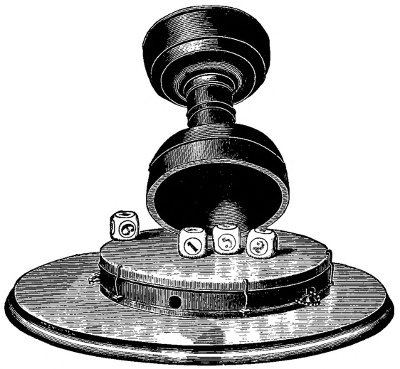
The mode of playing is as follows: Players select the number or numbers on which they wish to bet, and place their wagers on the corresponding squares on the cloth.cloth. The dice are then placed in the upper bowl and permitted to drop through the tube, and fall upon the tambourine, directly under the inverted bowl. The bowl is then raised, and if the bettor happens to have placed his stake on the number appearing on one of the upper faces of the cubes, he wins the amount of his bet. If the number which he selected appears on two of their faces, the proprietor of the bowl pays him double. If the three dice all show the same number and he has happened to place his wager thereon, the operator pays him three to one.
The “percentage” against the players in this game is so large that the proprietors are ordinarily content to play it “on the square.” It sometimes happens, however, that the operation of the reorganized laws of chance seems to be reversed, and a player wins over and over again. Of course, 275this is not to be tolerated. The proprietor of the game is running it for his own pecuniary profit; the idea of conducting a scheme for the benefit of the general public has never occuredoccured to him. Accordingly he has resort to trickery. Sometimes instead of taking all three dice from the tambourine, he removes only two, thus retaining a knowledge of at least one of the winning numbers. I have also known a device of this kind to be resorted to: When a certain number is winning repeatedly, the operator, having (apparently by accident) knocked the dice off of the table, while stooping to pick them up will substitute another set of three cubes, none of which contains the cubes in question.
But the most contemptible form of swindling consists in replacing the tambourine by a thin board, which may be so agitated, by means of a concealed spring, as to overturn the dice after the manipulator has ascertained the numbers shown by looking through the tube.
Sometimes the operator provides himself with dice having all the faces marked with the same number, by substituting one or more of which he is able to cast whatever throw he pleases.
CHUCK-A-LUCK
This is a simple little game of dice, yet one of the most fascinating of all games of chance. It is sometimes designated as “the old army game,”game,” for the reason that soldiers at the front were often wont to beguile the tedium of a bivouac by seeking relief from monotony in its charms.
The outfit requisite to play the game is simple and inexpensive, consisting of three small dice, a dice-box, and a cloth on which are inscribed the numbers one to six, corresponding to the dots, or “pips,” on the six faces of the cubes.
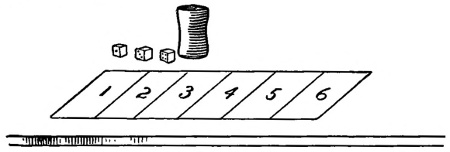
Bets are made by placing the money wagered on the numbers on the cloth. The dice, having been placed in the box, are shaken and thrown upon the table. Bets made upon either of the three numbers which come uppermost are won by the players. Money staked on either of the remaining numbers are won by the bank.
On its face, this game appears to be one of pure chance. As played upon fair and circus-grounds, however, there is very little chance about 276it. The “banker” does not throw the dice fairly. Through long practice, he is able to retain two of them between the fingers of the hand which he holds over the inverted dice-box. The other die he allows to remain in the box, and rattles it against the sides, occasionally knocking the box itself against the button of his coat in order to simulate the sound produced by the shaking of three dice. When he removes his hand from the mouth of the dice cup, he drops upon the table the two dice which he held in his hand and permits the third die to fall by chance. The reader will perceive, that he thus makes himself absolutely certain as to two of the faces which will be exposed when the cup is lifted. When it is remembered, that the box is not agitated until all the bets have been made, it will be readily perceived how great is the unfair advantage thus obtained.
This game is a favorite one with outside sharpers for “ringing in” loaded dice on the manipulators. It is a very simple matter to substitute prepared cubes for those used by the operator, and, after winning his money, to replace those originally employed by him. I have myself successfully practiced this trick many times, very much to the financial loss and mental chagrin of the proprietor of the dice and box.
One of the most artful devices practiced by swindlers in operating this game is that which I will now describe. The proprietor of the game has, as a confederate, a “side partner,” who keeps himself studiously in the back-ground until the opportune moment presents itself for his appearance upon the scene of action. Meanwhile, the chief manipulator of the scheme inveigles a countryman, whose avarice surpasses his sense, to enter into a partnership with him for the purpose of fleecing his own friends and acquaintances. This individual is to develop, later, into the dupe. He is required, before securing an interest in the prospective profits of the game, to advance a sum of money, the amount of which is gauged only by the size of his pocket and credulity. After the proprietor has received the cash, the countryman remains by the table where the game is being operated, serenely confident that he is about to win a large sum through imposing upon the confidence of his towns people. The “side partner” soon makes his appearance, usually in a state apparently bordering on beastly intoxication. The greenhorn regards him in the light of a “soft mark,” and at once approaches him with the suggestion that he “try his luck.” To this the seemingly drunken man assents, substitutes loaded dice or “other ringers” for those previously used by the operator, thus winning the entire amount of his stake. This he continues to do, until he has won a sum sufficient to absorb all the “capital” which the “sucker” had advanced. The result is that the latter’s interest in the concern is speedily wiped out, and the proprietor and his confederate divide the sum thus gained between them.
277CRAPS.
This is a favorite game among steamboat men, and is particularly popular among colored people. I first became acquainted with it on board the steamboat “City of Chester” on the Mississippi river. I was traveling in partnership with a man named Martin, and we had succeeded in fleecing one man out of some $800, at poker in the cabin. I went out on deck, and my attention was arrested by hearing a negro crying in a stentorian voice, “come 7 or 11,” then another man calling out, “chill’en cryin’ fo’ bread.” This was followed by the sound of something rolling on the floor. My curiosity was aroused, and I went below to learn what was going on. Here I first saw the game of “craps” and my introduction to it cost me precisely $15. I went up-stairs and informed my partner that I had discovered a new game. He was anxious to see it, and together we returned to the main deck where the play was in progress. He dropped $10 to the “crap” roller, expressed himself as satisfied, and we returned to the cabin. I did not at the time understand how I was cheated, although I was perfectly well satisfied that the cheating had been done. Since then, I have discovered all about it.
The game is played with dice about half the size of the cubes ordinarily used in other games. Only two are employed and they are held in the hand and thrown forward upon the table or whatever surface may be convenient. The numbers 7 and 11 are called “craps.” After the dice have ceased rolling the spots on both sides are added together, and if the sum is equal to 7 or 11, the “crap” thrower wins all bets which have been made against him. If the same amount to two, three, or twelve, he loses, and is required to pay each player the amount of his stake. Should the sum of all the spots on the two dice amount to four, five, six, eight, nine or ten, he is entitled to continue throwing, until he has either cast the amount thrown again, or throw a seven. In the former case he wins the player’s bets; if, however, the sum of the spots amount to 7 before the number first thrown turns up again, he loses.
The game commences by one player throwing the dice until he loses, when the next player at his left takes the cubes, and so on in rotation.
The favorite method of cheating at this game is by the substitution of unfair dice. For this purpose, loaded dice are sometimes used, and sometimes dice specially prepared, on the faces of one of which, are painted two aces, two twos and two sixes, while the other dice is inscribedinscribed with two threes, two fours and two fives. If the reader will take pains to figure out the combination of numbers which may be made with two dice so prepared, he will see that it is an utter impossibility for the thrower to make either, two, three or twelve, the numbers which will be a loss to him. In addition to this circumstance it is also apparent that the chances of throwing 7 are very greatly increased by the arrangement of two fours on one dice and two threes on the other, as well as two fives on one and 278two twos on the other. The small size of the dice employed in playing this game and the fact that they are thrown from the hand, renders the substitution of unfair dice a comparatively easy matter.
Although the game, as I have said, is an especial favorite among negroes and deck-hands, nevertheless it is frequently played by “high toned” gamblers and for large stakes.
Of course, the dice are usually made of bone, although in a recently raided game in Chicago, the players anticipating interference on the part of the police, had their little cubes made of cut sugar, and when the officers of the law made their appearance, swallowed the dice, and there being no gaming implements found, the case against them was necessarily dismissed.
EIGHT-DIE CASE.
This is a favorite game with traveling sporting men, who introduce it at county fairs, and on circus grounds, and at other places where there is a large crowd. The diagram represents the arrangement of the interior of a glass covered case containing prizes. The divisions in the case are numbered from eight to forty-eight, inclusive, to correspond with the numbers which may be possibly thrown in casting eight dice, which the proprietor carries with him, together with a dice box. For a stipulated consideration, he permits any one who may wish, to throw the dice upon the glass cover of the case. The sum of the spots on the upper faces is taken, and the player is given whatever prize the number may call for.
When the game is introduced upon fair-grounds, the directors of which insist that there shall be no blanks, small articles of cheap jewelry are put inside the case as prizes, although gamblers prefer to use money prizes only, for the reason that it gives the outfit a more attractive appearance.
An examination of the diagram will show that the higher prizes are invariably placed in squares corresponding to a number which it is almost impossible for a player to throw. Thus, a $500 prize is placed in the square numbered eight. To win this, it would be necessary to cast eight aces. Another prize of like amount is numbered forty-eight, and cannot be won unless the player throws eight sixes. Those numbers which may be easily thrown are always attached to squares containing small prizes, or which are inscribed with the abbreviation “rep.” These letters, as in all similar games, stand for “represent,” and when a player has thrown a number corresponding to a square so marked, he is required to double the amount already put up or submit to the loss of his stake.
This game affords a rare opportunity for cheating, although the fraud is not perpetrated by means of loaded dice, as many persons suppose. The proprietor counts the spots on the dice thrown to suit himself, and after hastily calling out the number replaces the cubes in the box. 279Strange as it may appear, it is not one man out of fifty who ever insists upon counting the spots on his own throw. If the owner of the device has reason to believe that the player has money and is a “soft mark,” he calls out the number corresponding to one of the “represent” squares. He then tells the victim that he has neither won nor lost and must double the amount previously advanced and “try his luck” again. This practice is continued until the dupe has been induced to stake all of his money, when the proprietor calls out a number corresponding to the square marked “blank,” of which there is always one in every case. Of course, the operator then informs the “sucker” that he has lost all the money which he had paid.
It sometimes happens that a player grows suspicious, and asks how long this doubling his stake is to continue. In such a case, the operator mentally calculates the amount of money which the man probably has, and tells him that he will be required to double only two or three times more, when, if he again throws a “represent” number, the proprietor will return all of his money except five per cent., which is the percentage belonging to the game. The victim does not throw a “represent” number the last time under such circumstances, but is thrown upon the “blank” square, which means that the proprietor has won the entire stake. “Cappers” are as useful in this game as in any other. Their methods of operation are similar to those elsewhere described and need not be more particularly dwelt upon here.
Eight-Die Case.
Jewelry. Jewelry. Jewelry. $3.00 Jewelry. Jewelry. Rep.
19 38 24 9 37 21 15
25 cts. Jewelry. $1.00 Jewelry. Rep. Rep. $5.00
13 30 43 33 18 29 46
Rep. Jewelry. $5.00 $20.00 Rep. 50 cts. Jewelry.
23 39 8 1215 36 12 34
Rep. Blank. Jewelry. Jewelry. Jewelry. Jewelry. Jewelry.
32 17 35 28 16 41 22
$2.00 $5.00 Rep. Jewelry. Jewelry. $50.00 $10.00
11 48 20 42 31 10 37
$2.00 Jewelry. Jewelry. Jewelry. Jewelry. Blank.
44 27 14 25 04 20
280POKER DICE.
This game is usually played in saloons for drinks or cigars, though sometimes for money, and occasionally even for higher stakes. Five ordinary dice and a dice cup is used. Each player has three throws. The highest score which can possibly be made is five aces, the next, five sixes, then five fives, and so on. Next to five similar spots, the best throw is four of one kind and an odd number, the relative value of such throws being measured by the number of spots upon the top of the four dice, aces ranging highest. The game is called “poker” dice, because of the general resemblance between it and “bluff,” so far as the value of the throws is concerned as compared with that of the hands held at poker.
I have never known but one scheme of fraud to be employed in playing this game, which consisted in so placing the five dice within the box that the thrower was able to turn out whatever number he might see fit. I have known two men, both of whom are at present in Chicago, who can cast any throw which they may wish at their own will. They do not employ loaded dice, but, through long practice have acquired such dexterity in placing the cubes in the box and throwing them upon the table, that they are able to play with absolute certainty.
OVER AND UNDER SEVEN.
This game is most frequently played on fair and circus grounds, at public meetings, barbacues, political rallies, and other places where a large crowd is assembled. The outfit requisite to its operation consists of a dice box with two dice and a cloth, about 2½ feet long, on which are outlined three squares, in each of which is painted the figure 7. One of these squares is in the centre of the cloth, the other two at the respective ends. In one of them is painted the word “over,” and in another the word “under.”
The method of play is as follows: Bets may be placed upon either of the three squares. If laid on the centre square, the proprietor pays the winner two for one. After the wagers have all been laid, the dealer throws the dice. If the sum of the spots on the upper face of the two cubes is equal to 7, and no stake has been laid on that number, he wins. If it is more than 7, bets placed upon the squares containing the word “over” are paid to the bettors. If the total is less than 7, the proprietor pays those who have laid their money upon the other square.
The mode of cheating at this game is substantially the same as that already explained in the description of the game of “chuck-a-luck.” The operator retains one of the two dice in the fingers of the hand which he 281places over the mouth of the cup and rattles the dice about, inside. When he lifts the box, he is absolutely certain as to the number of spots upon the die which he has held in his hand, thereby gaining an immense advantage over the bettors, inasmuch as he has it practically within his power to cause the wager of any particular player to be lost.
TOP AND BOTTOM.
This game of dice—if it may properly be called a game—is a swindling device, pure and simple. It is, in effect, nothing but a scheme of fraud, for the successful operation of which are required two sharpers, who act as confederates, a dice box, three ordinary dice, a “ringer” and a “sucker.” The place commonly selected for working it is a saloon, and the method in which it is operated is as follows:
The victim having been selected and located in a saloon, the first sharper scrapes an acquaintance with him and induces him to throw dice for the drinks or cigars. While the dice are being handled, the gambler calls the attention of the dupe to the fact that the number of spots on the faces of the three dice added to the number on the three reverse sides is always equal to twenty-one. This fact necessarily follows from the construction of all fair dice; on the reverse face from the ace is a 6; opposite to 3 is 4; and directly opposite to 5 is 2. There are, however, many persons, who not having had their attention directed to this circumstance, are ignorant of the fact. The “sucker” usually satisfies himself of the correctness of the statement made by his newly formed acquaintance through throwing the dice several times in succession, until he becomes convinced that the sum of the six numbers is always equal to twenty-one. At this point sharper number two makes his appearance. He strolls up to the pair and offers to join in throwing dice for refreshments. The first swindler proposes that they guess as to the number of spots on the upper and under sides of the three dice. To this sharper number two assents, and guesses, say, 25. As a matter of course, the greenhorn guesses 21 and wins. The second confederate thereupon remarks that he is a “pretty good guesser.” To this the first swindler replies that “the gentlemen can tell the number every time.” The confederate demurs to this statement, saying that it is impossible. He offers to bet the price of a box of cigars that the dupe cannot do it. His accomplice retorts that he would be willing to bet $1,000 that he can, and offers to lend the dupe money to add to whatever sum the latter may wish to bet for the purpose of laying a stake against his confederate. The bet having been made, the attention of the victim is momentarily diverted and the 282“ringer”—either a loaded dice or one prepared after the manner described in the paragraph upon the game of “crap”—is substituted for one of the fair dice. The throw is cast, and when the spots are added together their sum is inevitably found to be either greater or less than 21. Sharper number two thereupon demands and takes the stakes.
Ordinarily the dupe is too bewildered at the moment to understand the precise nature of the game which has been played upon him until after the two confederates have left the house. Should he, however, remonstrate and undertake to raise a disturbance, it is usually found an easy matter to quiet him by summoning the town marshal or some other police officer. In fact, I have known an officer actually summoned, who insisted upon the dupe keeping quiet, for which service he received a bonus from the pair of swindlers.
HIGH AND LOW DICE TOPS.
These little implements are used chiefly for winning drinks or cigars, or small sums of money. They are eight-sided spinning tops made of ivory, the respective sides being numbered one to eight. Sometimes they are made fairly, but dice tops of the latter description are not in favor with the professional gambler, who uses a top having a moveable iron peg which the sharper may so arrange as to cause the high or low numbers to fall uppermost when the top comes to rest, after being spun. If the peg be turned one way a high number will come uppermost; if the other, a low number. Of course the greenhorn, not being aware of this little peculiarity of the top, it is comparatively an easy matter for the confidence man or other cheat to arrange the peg in such a way that when he spins for himself he turns up a high number, and when his opponent takes the same article in hand, however, he invariably turns up a low one. It may be seen that the former has it in his power to win as often as he chooses, but in order that his luck may not appearappear to be positively miraculous, he sometimes permits his dupe to win.
GRAND HAZARD.
Three dice are used in this game. Sometimes they contain spots, as do ordinary dice, sometimes on the faces are painted representations of birds, animals, or reptiles, such as an elephant, an eagle, a rattlesnake, etc. On the table upon which the dice are thrown is spread a cloth on which are depicted numbers or figures corresponding to those upon the faces of the cubes. Bets are made by playing the stakes upon whatever square or squares the player may select. The dice are dropped through a funnel-shaped cup, somewhat similar in form to that used in “hieronymus,” and the gains or losses of the bettors are determined by inspecting the face of the dice which lie uppermost after they have fallen upon the 283table. If any player has wagered his money, for instance, upon the number six, and one of the dice show a six-spot on its upper face, the bettor is paid the amount which he has ventured. In case the three dice should all show the same number or figure when they fall, the proprietor pays to the bettor, who has placed his stake upon the corresponding square on the cloth, 180 for 1.
In this, as in all other fraudulent games with dice, gamblers resort to the substitution of “ringers” for fair dice, and have the poor fools, who risk their money on such schemes, practically at their mercy.
MUSTANG.
This game is substantially identical with “grand hazard,” the only variations being, that differently inscribed dice are employed. The same sort of cloth on which are depicted squares containing the prizes is used, and the dice are dropped through a similar metal funnel. The dice, however, are usually of either one of the two sorts. In those of the first description, the faces of the cubes are painted, respectively, with a club, a heart, a spade, a diamond, an anchor and a star. The faces of the other description of dice employed, are respectively marked with a snake, an elephant, an eagle, a baby and a turtle.
LOADED DICE.
Almost every one has heard of loaded dice, but there are comparatively few among the guild of professional gamblers who are experts in their use. The sharper who does not travel, preferring to wait, at home, such victims as the antipodes of Providence may send him, is satisfied with employing occasionally, a set of high dice. But the peripatetic scoundrel who, like Satan, “wanders to and fro upon the earth,” seeking for victims, usually provides himself with three sets—one “high,” one “low,” and one “square.” The fraudulent dice are loaded with quicksilver, the interior of each dice being hollowed out in such a manner as to cause the weight to fall upon the opposite side to that intended to come up, the weighted side being, of course, always undermost.
The professional, in using these dice against a single adversary, usually works very rapidly, distracting the dupe’s attention, as far as possible, from his operations by story telling or some other interesting conversation. He changes the cubes swiftly and often, “ringing in” the “high” one for himself, and the “square” ones for his opponent; or the latter for himself and the “low” ones for his victim, occasionally, however, using the fair dice for both, in order to disarm suspicion.
284

GAMES AT FAIRS AND CIRCUSES.
There is scarcely a person who has visited a county fair, or patronized a circus, whose attention has not been attracted by the presence upon the grounds of an immense numbernumber of “fakirs,” as peripatetic tricksters are often called. Probably many excellent people have wondered how it happened that men of this class were allowed to introduce gambling devices upon grounds which were supposed to be used for purposes of rational entertainment, even if not of instruction. No gambling device can be operated upon any fair-ground without the consent of the directors of the Fair Association having been first had and obtained. The members of this august body are usually selected on account of their social prominence and their supposedly high moral character. It would be, therefore, charitable to suppose that they are not aware of the precise nature of the schemes the manipulation of which they tolerate.
A county fair, however, is essentially a money making scheme, and the license fees derived from this source constitute no unimportant feature of the managers’ revenue. Sometimes the “fakirs” gain permission to work their various schemes through the ignorance of the directors. More frequently they are well aware of their nature, and exact high fees in consequence of this very knowledge. To illustrate: I myself once made application for a license to operate a hap-hazard upon the grounds of one of these associations. The secretary was a bank cashier, and the moment that he saw my machine, exclaimed: “Why, I know all about that thing. You can stop that whenever want to. Pay me $50, and you can go on the grounds and ‘skin’ all you want to.” Naturally I paid the sum demanded, and I happened to know that some fifteen or twenty other contrivances of a like character were admitted to the same grounds upon the same terms. This is but one instance of many that I could cite, in which the director was equally well convinced that my contrivance was a “fake,” pure and simple.
Such a transaction is a high-handed outrage upon the community. The men who license schemes such as are described in this chapter are licensing scoundrels, in comparison with whom pickpockets are respectable, to prey upon their own towns-people, pocketing the money which they well know has been made by fraud.
Sometimes it is thought necessary to preserve at least the semblance of innocence on the part of the managers. When the application for a 285license of one of these machines is received by the directors, some one of the latter, whose conscience (?) will not permit him to sanction schemes of fraud asks if the device in question is to be operated as a “gift enterprise?” By this, he means, are there to be any blanks? If so, his high moral sense will not permit him to tolerate its introduction upon the grounds over which the Board has control. This objection is easily removed, by introducing into the scheme a number of articles of valueless jewelry, the presence of which among the prizes usually removes all conscientious scruples of the objector. Occasionally, when the moment for taking a vote arrives, “Squire Brown” is conveniently absent, and the majority of the board acts without him. Sometimes the gamblers are told that it will be necessary for them to submit to an arrest and pay a small fine in order that the scruples and prejudices of the public may be appeased. I have myself known this to happen more than once.
After the license has been granted and the various games are in operation, it is not an uncommon occurrence for the town marshal or sheriff to put in an appearance, and extort from $5.00 to $10.00 per day in consideration of there being no molestation offered. This payment is what the “fakirs” call “sugaring,” and I have never known one of these officials for whom the dose could be made too sweet. I have submitted to this extortion of blackmail (for it is nothing else) several times when I was convinced, to a moral certainty, that the directors were receiving a percentage of the money which I paid over to the officers.
Sometimes a different policy is adopted by the managers. The prosecuting attorney and sheriff find it necessary to leave town on urgent business, and are therefore totally unaware of what is going on. In such a case, a purse is usually made up for these officials by contributions from the proprietors of the various “fakes,” which is always understood by the gamblers to be intended for the sheriff and prosecutor. It may be that a portion of the money raised sticks to the fingers of the man to whom its payment is entrusted, but my own impression is that in a majority of cases the greater proportion of it, reaches the parties for whom it was intended.
It is the hope of the author that what is here said may serve to open the eyes of reflecting citizens to the grave character of the evil which is pointed out. Too much cannot be said in reprehension of such conduct on the part of men to whom the community entrusts interests of such a character. And if any member of any Board of Directors of any county fair will carefully read the pages which follow, he will, at least, find it forever impossible hereafter to plead ignorance, by way of extenuation of a vote to tolerate the introduction of any of these devices among his own acquaintances.
286NEEDLE WHEEL.
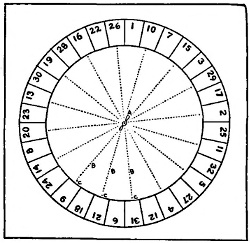
This is an exceedingly ingenious and very delicately constructed piece of mechanism. The accompanying cut affords a view of its appearance, but cannot be understood without some explanation. It consists of three parts. The outer rim, which is stationary, contains thirty-two metal grooves, or pockets, numbered, apparently without special arrangement, from one to thirty-two. Inside this rim, is a circular piece of wood, resembling a wheel, but without spokes, which is covered with cloth. Above this, and of about equal size with it, is a saucer-shaped piece of wood, in which are bored three holes. On the table on which the wheel is placed stands a wooden box, containing thirty-two compartments, numbered consecutively from one to thirty-two. In these compartments are placed sixteen money prizes, which the players believe they have a chance to win. Apparently, the chances are exactly even, the number of prizes and of blanks being equal.
When the game is played upon fair-grounds, and the directors of the fair insist that it shall be operated as a gift enterprise in which there shall be no blanks, articles of cheap jewelry are placed in the compartments, which under other circumstances are left blank.
The mode of playing is as follows: One wishing to win a prize pays fifty cents or $1.00 (in proportion to the size of the crowd) for the privilege of making the attempt. He then places a marble in the upper wheel or saucer, which is given a twirl, either by himself or the proprietor, the lower wheel being usually set in motion at the same time, but in an opposite direction. As the upper wheel revolves, the marble flies around and finally falls through one of the holes on to the lower wheel. The latter slopes gently from centre to circumference and the marble naturally rolls down to one of the compartments in the outer rim, where it stops. If it has fallen into a winning number, the player receives the prize placed in the compartment of the box or case, having the corresponding number. If, on the other hand, it has fallen into a blank number, he receives nothing.