PART II.
Reading edition
185

GAMBLING IN THE NEW WORLD.
It may be questioned whether any other country on the globe affords a more striking illustration of the prevalence and the power of the gambling mania than does the great Republic of the North American Continent. Nor are the reasons far to seek. Hereditary titles of nobility are not recognized by the American constitution. In the general scramble for position and power, wealth counts for more in the United States than in any other land under the blue vaulted dome of Heaven.
At the same time it should not be supposed that an insane desire to accumulate fortunes lies at the root of American gaming. The hard, practical common sense of the average Yankee convinces him that he is not likely to win a competence at the green cloth. A large majority of American gamesters (i. e., local, as distinguished from professional) gamble because their brains are in a constant whirl of excitement. Rest has no charms for them; they seek recreation in the substitution of one form of mental stimulant for another. The “operator” on the exchange, whose days are spent in watching the rise and fall of commodities purely speculative, finds the ordinary paths of life too quiet, too monotonous, to elicit more than a passing thought. From the moment when he leaves “the floor” until he returns to it next day, his brain is in a mad whirl of excitement. What more natural than that he should seek relief for an overtaxed mind through exchanging one avenue of activity for another?
The application of these remarks, however, cannot be confined to “stock-jobbers” and manipulators of “corners.” The same spirit pervades all classes of society. This accursed thirst for gold—sacra auri fames—enters every American home, as the serpent insinuated his wiles into the Garden of Eden, and destroys at once domestic happiness and individual peace. The mechanic stakes and loses his week’s wages; the clerk risks his month’s salary; the husband and father ventures upon the turn of a card the money which should be devoted to the support of wife and children. Yet, as has been said, this reckless improvidence cannot be ascribed solely to a hope of acquiring rapid gains. The feeling of dissatisfaction with his condition which lurks in the breast of the average American, leads him, insensibly to himself, into all sorts of rash excesses, among which is gambling at cards.
American gambling, however, presents some distinctively characteristic features. In the first place it is mainly conducted on the floor of the exchange, rather than in public gaming rooms. The Stock and Produce 186Exchanges are sapping the very vitals of the country’s morality. For “stakes” are substituted “margins;” for “winnings” read “profits;” while the designation of “players” is changed into the more euphonious appellation of “speculators.” With these changes in nomenclature, the game is the same in principle; the same in the method of its manipulation; the same in its demoralizing results. Even “suckers” are known, but they are termed “lambs.”
Professional gamblers have not been slow to recognize this fact, nor have they scrupled to avail themselves of it. From this circumstance has sprung into existence the “bucket shops,” those preparatory schools for the penitentiary in which the young, the poor and the unsophisticated are incited to avarice, duplicity, embezzlement and actual theft. The school boy, the artisan and the bootblack read or hear of colossal fortunes, accumulated on the “floors” of commercial exchanges. To operate a “corner” is beyond their means; but the conviction is not slow in forcing itself upon their minds that they may at least follow humbly in the footsteps of men whose faults the public is willing to condone in view of their success. Herein lies the chief danger—to the perpetuity of the Nation—in those marble halls wherein gambling is conducted upon a scale in comparison with which that at Monaco and Monte Carlo is dwarfed into insignificance, and where one man rides triumphantly into wealth and power upon a sea whose bottom is strewn with wrecks.
Yet another form of gambling which prevails in the United States more than in any other civilized nation on the globe is the mania for lottery speculation and particularly for “policy playing,” by which latter term—as is elsewhere more fully explained—is meant betting on the particular numbers which will win a prize at any given drawing. These forms of gaming are confined to neither sex, nor do they know the limitation of age, occupation or social rank. The official list of drawings is scanned with equal solicitude by the leaders of society and the outcasts of the slums; by the reckless young “blood,” who “takes a flyer” by day and leads the german at night and by the decrepteddecrepted old negro, who risks his last dime upon “4-11-44;” by the veteran and the school-boy, by the philosopher and the proletaire. That the general sentiment of the country as voiced by the exponents of public opinion has uniformly and unhesitatingly condemned the practice is unquestionable. While the vice is peculiarly American, in the number and character of its devotees, it is totally un-American in so far as the moral countenance of the Nation is concerned. Minor principalities of Europe have sought to replenish treasuries drained by the extravagance or debauchery of their rulers through the institution and legal authorization of lottery schemes, whose world-wide advertisement might draw to the country English pounds, French Napoleons and American Eagles. It has remained, however, for 187the State of Louisiana to bring disgrace upon the Republic by accepting, through her law-makers, a direct pecuniary bribe to consummate her public shame. Even the new State of North Dakota with its farmers crying for seed wheat showed the moral courage to resist the fastening into its vitals of the delicate, but deadly tendrils of the octopus which saps the morals of the commonwealth which tolerates its embrace as does its physical prototype the very life blood of the individual victim on which it fastens its fangs. Louisiana prides itself on its cognomen of the “Pelican” State. What a misnomer! While the pelican robs her breast to minister to her young, her mistaken namesake robs her own young to feed the vulture which first whets its appetite on her own offspring and later gorges its distended veins and arteries on the very vital fluid of other States and Territories. Out upon the indifference to public morals which recognizes, in this matter, a mere question of sectional lines. Shame upon the venality which would bring a nation into disrepute before the whole world in order that a purchasable Syndicate of corrupt law-makers might be enriched. The remedy for such a state of public morals is not easy to find. It is idle for any given community to insist that their chosen representatives do not represent the average morals of the district which places the latter in positions of responsibility. And yet the commonwealth of Louisiana would consider its character impugned should the palpable inference be drawn. It remains to be hoped that the legislators of the future may be able to devise some method by which the escutcheon of this great State may be relieved of the shadow which just now dims its brightness. This sort of dissertation, however, is hardly in place in the present connection. Gambling on the exchange and in the bucket-shops is discussed elsewhere. The history of the Louisiana lottery, from its inception, is given in another chapter. Nevertheless in an introduction to the general subject of American gambling, it is impossible to avoid these allusions although they are, perforce, of a somewhat desultory character.
What we are particularly considering in this section of the volume, Part II, is gaming as practiced in the halls, the club room and private houses in the United States. For those who, from poverty or other causes, are unable to gratify their taste for public gambling in rooms devoted to the purpose there is a multiplicity of devices, found upon fair grounds and at various other localities at which large crowds are wont to gather, which offer to the casual gamester an opportunity for gratifying his thirst for excitement at an expense sometimes trifling and sometimes costly.
At the gaming houses proper, the preference is given to what are known as “banking games.” By this term is meant games where the deal never passes from hand to hand, and where all players bet against 188one central fund, known as the “bank,” which is owned and operated by the proprietors of the resort. Of this class of games, faro, roulette and rouge et noir, are by far the most popular, the star of the former being decidedly in the ascendant. Another game of this description which holds a high place in public favor is keno (a full explanation of which may be found in Chapter IV) the popularity of which is due, primarily, to the small capital necessary to play, and, secondarily, to the belief that the legitimate percentage in favor of the bank is so great that the temptation to fraud is reduced to a minimum, if not an infinitesimal quantity.
Next to the banking games in the estimation of the bettors comes poker, both “draw” and “stud.” The former is played according to recognized rules, but the “house” exacts a percentage from the holders of certain winning hands. This percentage is technically known as the “rake-off,” and insures the proprietors of the establishment a handsome royalty on all winnings. In “stud” poker the dealer always represents the “house.” The players are never permitted to handle the cards. To quote Tennyson’s poem of The Brook, the “man in the chair might say—
‘Men may come and men may go,
But I go on forever.’”
In the public gambling rooms, also, many of the gaming devices seen upon fair and circus grounds are to be found, notably the wheel of fortune. These various contrivances are fully explained in subsequent chapters.
Public American gaming resorts are ordinarily classified under two general headings—“square” and “brace.” Under the former caption are included those where the “occasional player” is supposed to enjoy an opportunity of laying a wager with some possible chance of winning. “Brace” games, as the term is understood among the fraternity, are veritable “hells,” into which a victim is enticed for purposes of downright robbery under the pretence of a game of “chance.” The dupe who enters a room of this character, seals his own doom by the mere fact of entrance. The proprietors, from that moment, mark him as their own peculiar prey. If he has but little cash, he is promptly and incontinently relieved of it. If he is a “pigeon” whose future “plucking” promises a rich harvest, his mentors are merciful, and he is encouraged to “call again.” “Luck” appears variable, although, as a matter of fact, in a “brace” house—otherwise yclept a “skin game”—“luck” is dependent solely upon the will of the dealer.
In regard to American gambling houses generally, it may be remarked that there exists a popular misapprehension as to the relative proportion of “square” and “brace” resorts. It is unquestionably of no small value to any resort that it should enjoy the reputation of being “square,” and it cannot be denied that there are those where, under ordinary circumstances, the “bank” contents itself with its legitimate (?) 189percentage. Yet, as a matter of fact, it may be doubted whether there is a “square” hell (what a contradiction in terms!) in the country which has not conveniently at hand and ready for use, all the fraudulent contrivances so dear to the heart of the “brace” dealer. Not always are they brought into requisition, but, like the reserves of an army, are always at hand, and always ready to be brought into action.
The fact that the statutes of nearly every State prohibit gambling, necessitates a sort of sub-rosa activity. At Monaco, Baden-Baden and Monte Carlo gaming is carried on, not only under the very eyes, but even under the sanction and patronage of the government. Not so in the United States. The genius of American institutions has stamped upon gambling the seal of its statutory condemnation. Two elements have combined, incidentally, against any action which would enforce the will of the people.people. The first is the half-heartedness of the war waged against gambling by municipal authorities; the second is the assistance which proprietors receive from outside confederates. The latter “goes without saying.” Every habitue of a gaming house knows that there are “cappers.” Equally thorough is the knowledge enjoyed by every proprietor that some sort of satisfactory arrangement can be made with the municipal authorities. What is the result? Each of the operating causes produces its own effects. Guests at the hotels of every large town are persecuted by solicitations to gamble, while the Mayor and Common Council of the average city indulge in raids at a set time, for the simple reason that the officers of the law exact and receive a percentage on the profits of every game which they tolerate.
Outside of “banking” games, however, there is one which is almost as peculiarly American as is base ball. “Poker” seems to be, for some unexplainable reason, looming up as a National pastime. Some reference has already been made to gambling at the fashionable club house and in the family circle. Under such circumstances poker is the game par excellence. Stakes ordinarily run high, no matter how small the introductory ante may be. As a matter of fact there is scarcely a club house in any prominent commercial center of the Union in which there is not an apartment curtained from the vulgar gaze, where play is not carried on for high stakes. And these very gentlemen who play a friendly game rarely suspect that into their midst there is sometimes introduced a professional, who not only wins a handsome stake for himself, but also assists in recouping losses sustained by the gentlemen who introduced him. This statement may seem incredibly absurd upon its face, yet the author knows whereof he speaks.
There is still another distinctive feature of American gambling which deserves notice. Men who know that they cannot be admitted as members of any recognized club form an association by themselves, also known 190as clubs, which are organized for gambling purposes, pure and simple. Associations of this character are primarily conducted for the convenience of players, yet the keeper of the room rarely fails to “earn a profit” through selling liquid refreshments and the manipulation of the “rake-off,” which is conducted in a manner similar to that followed in public houses.
The interference by the municipal authorities with the “hells” is regarded by the proprietors as a contingency too remote to be worth seriously considering. There are various reasons for the excellent understanding which usually exists between the gamblers and the “powers that be.” Political influence sometimes lies at the bottom of the friendliness. It is also a sad truth that too often the explanation is to be found in actual venality on the one hand and corruption on the other. Yet there is one circumstance which should not be lost sight of. The “fraternity” not infrequently renders valuable assistance to the officers of the law by disclosing the habits, haunts, and sometimes the whereabouts of criminals who are being sought for by the authorities. Not that they are anxious to serve the ends of justice, but that they look upon the rendering of such assistance in the light of a quid pro quo for the “protection,” otherwise immunity, which they enjoy. The reader who will thoughtfully peruse chapter X of this part of the book will gather much interesting information on this point which will afford him food for no little serious reflection.
Another pronounced feature of American gaming is the number of itinerant gamblers who wander about the country, infesting railway trains and steamboats, invading the summer resorts, and coming down upon country towns after the manner of a wolf upon the sheep fold. These peripatetic sporting men are adepts at all card games and thoroughly versed in every fraudulent device. They combine the arts of the card sharp and the confidence man. For them honor is a by-word and virtue a mockery. They are destitute alike of conscience and of pity, and ill fares the luckless wight who falls a victim to their blandishments.
Hitherto, except in a few comparatively isolated localities, legislation has proved powerless to repress gambling in the United States. The “Johnson law,” so called from the name of its author, the Hon. Charles P. Johnson, of Missouri, making gambling a felony, operated to check it in that State and brought about a positive hegira of the men who had been thriving upon the gullibility of a too confiding public. Similar results have followed its adoption and enforcement in other States. But it is idle to encumber the statute book of any commonwealth with laws whose enforcement is not demanded by public sentiment. The vice of gaming, like its twin relic of barbarism, drunkenness, will be suppressed only when an outraged nation rises in its righteous wrath and forever stamps out of existence the viper which has buried its fangs deep in the very vitals of the body politic.
191

FARO GAMBLING AND GAMBLERS.
The general belief that cards were invented in the fourteenth century to amuse the imbecile Charles VI. of France is one of those popular errors which, despite the proofs arrayed against them by modern research, seem destined to be perpetual truth, though booted and spurred, seldom overtakes a plausible historical fable if the latter has the advantage of a start of three or four centuries, and therefore the idea that cards were originated by Gringonneur, a Parisian portrait painter, to tickle the fancy of a royal idiot, will probably continue to exist in the public mind for centuries to come. The public journals, in their answers to correspondents, reiterate the same old stereotyped tale, which seems destined to have an immortal lease of life.
The truth, however, is that cards, like chess, originated in the Orient, and were first introduced into Southern Europe by gypsies toward the close of the thirteenth century. How long they had been in use in the East is a matter of conjecture, pure and simple, but there is ground for the belief that they are as old as the Pyramids. This is a question for archaeologists to settle, and the answer to it does not fall within the scope of the present work. It is certain that they rapidly grew in public favor. During the seventeenth century the passion for card-playing became a veritable mania among the nobility and gentry, royalty itself setting the example. Louis XIV., in whom were united the incongruous characteristics of a gambler and a miser played nearly until the day of his death. During the regency, and throughout the dissolute reign of Louis XV., under the influence of Madame de Pompadour and the infamous Dubarry, the court gambled from morning till night and from night till morning, while the nation followed suit. So in England, substantially the same state of affairs existed, Charles II., with his courtiers and favorites, setting the fashion. In a word, all Europe was card-mad.
America’s turn came later. With prosperity came a taste for sumptous amusements—the legitimate offspring of wealth and leisure—and it may be questioned whether there is any country in the world where card-playing is so universal, or where so much money is staked upon the issues as in the United States.
The origin of the game of faro, like that of most games of cards, is obscure. There is a tradition that it emanated from the shores of the Nile, and that its antiquity is as venerable as that of the pyramids. Perhaps this rather fanciful theory has grown in favor from the fact that its 192name is sometimes spelled “pharo,” the name of the founder of the great Egyptian dynasty, whose head is said, in ancient times, to have been depicted upon one of the cards. Be this as it may, it is certain that centuries ago it was popular among the gamesters of France and other countries of Europe, whence it crossed the channel to the British isles and later was brought across the Atlantic to America. In the United States, it is a game par excellence at every gambling establishment, being at once the most absorbingly fascinating to players and the most profitable to the bank. Across the green cloth which separates the former from the latter, fortunes are hourly lost and won. The monotonous, droning call of the dealer, falling upon the ears of players, whose interest is breathless in its intensity, has proved to thousands the knell of doom to wealth, honor, integrity, and happiness. With its allurement of excitement and its tempting bait of gain, it woos its votaries to shipwreck equally certain and no less terrible than that which befell the mariner of old, whose charmed senses drank in the intoxicating music of the siren’s song. Faro has been happily likened to the “tiger,” which, crafty, treacherous, cruel and relentless, hides under cover waiting, with impatient eagerness, for the moment when it may bury its velvet covered claws within the vitals of its unsuspecting victim and slake its fiery, unquenchable thirst with his life blood.
The principles of the game as fairly played to-day do not materially differ from those laid down by Hoyle a hundred years ago. Be it understood, however, that this remark applies to modern faro, as played in the “hells” of this year of grace, only in the abstract. The principles (sic) upon which it is practically conducted by the dealers of to-day are of a sort calculated to astound that eminent authority on the doctrine of chances. In order, however, that the reader may thoroughly comprehend to how great an extent the player is at the mercy of the banker, it will be necessary to explain first the method of legitimate playing (i. e., if any gambling can be properly called legitimate) and then some of the devices whereby the dealer may transform his naturally overwhelming chances of winning to a practical certainty.
As preparatory to a discussion of the first branch of the subject, it may be remarked that faro is pre-eminently a game of chance. Even when played with absolute fairness, success or failure, fortune or misfortune, depend—not upon the skill of the player, but upon the caprice of blind chance. It is true that mathematical science has attempted to reduce this chance to some sort of law, and has formulated a theory as to the inherent probability or improbability of certain events happening or failing to happen, and there are devotees of faro who play upon what they believe—with a faith which approaches the sublime—to be an infallible “system.” But the doctrine of chance is, after all, but an approximation 193to accuracy, and the only certainty about any system, however cunningly devised, is the certainty that at the supreme moment it will prove a delusion and a snare.
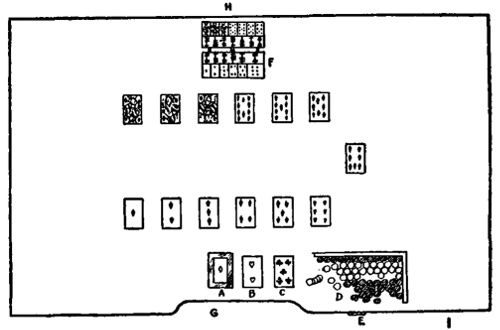
But, to return to the method of playing: Any number of persons may participate in the game, which requires a full pack of fifty-two cards. The dealer acts as “banker,” and may, at his discretion, limit the sums to be played for, according to the amount of his capital. At public games, this functionary, assisted by one or more persons known as “lookers-out,” whose duty it is to watch the table, the players and the bets, with a view to seeing that the bank’s winnings are promptly gathered in, and that the interests of “the house” are properly guarded. In order to facilitate the making of bets, players purchase checks, usually made of ivory or bone or composition, though sometimes of paste-board, from the banker, who redeems them at the option of the holder. Their value is denoted either by their color, or figures stamped upon them. The banker usually limits the sums that may be bet in accordance with his capital, and the limit may be of two kinds, known as the plain and the running limit. The plain limit is usually twice as much for double, treble or quadruple cards as for single cards. That is to say, if a player may bet fifty dollars on either or all of the latter, he may bet $100 on all or any of the double. The running limit is any sum named and its multiple of four. To illustrate, the running limit may be 50 and 200; in that case, the player may bet fifty dollars, and if he wins, may suffer the original stake and its increase (which would amount to $100) to be where it is or move it to another place, where he may win another $100, thus giving him with his first stake $200, which is the limit. This is known as parleeing a bet, and if the first bet is five, the second will be ten, the third twenty, 194the fourth forty, and so on. Almost all bankers will allow a player to “parlee,” as the percentage is largely in favor of the bank.
Each banker is provided with a “board” about three by one and one-half feet in dimensions, which is placed on a table about four by two and one-half feet. This “board” is covered with green cloth, on which one suit of thirteen cards of the ordinary pack are portrayed in the order shown in the foregoing illustration.
In the centre of the cut given above, the arrangement of the cards in the “lay-out” is shown. The outer line of the parallelogram represents the table. Letter “G” indicates the seat of the dealer; “I” that of the “lookout;” “F” that part of the table on which the “case keeper” (the use of which will be explained later) is placed; and “H” shows where sits that important functionary who operates the “case keeper.” The players sit or stand all around the table. “A” represents the dealing box, and “B” and “C” the two piles into which the cards are divided as they issue from the box. “D” shows the “check-rack,” or the apparatus for holding the “checks,” and “E” shows the position of the money drawer.
The ace, deuce, queen and king are called the big square; the deuce, tray, queen and jack the second square, and so on; the six, seven and eight are called the pot. The players select their cards upon which they wish to bet, and lay upon them their checks.
All preliminaries being settled, before any bets are made the dealer shuffles and cuts the cards and places them face upward in a metal box, containing an aperture at the top, sufficiently large to allow the full faces of the cards to be seen. Originally, the cards while being dealt, were held in the dealer’s hands, and in Germany they are nailed to the table and torn off one by one. For many years, however, it has been the practice to deal from an uncovered metal box, a little longer than the pack, in which are placed the “pasteboards” faces upward, so that the top card is always exposed to view. Near the top of one end of this receptacle is a horizontal slit, wide enough to admit the passage of a single card, and at the bottom are four springs, which, pressing upward, automatically force the pack toward the top of the box, thus keeping one card always opposite the slit. The top card, called the “soda,” having been seen, is not used for betting, and is laid aside. The card immediately below is the banker’s card, and it wins for him all stakes placed upon it in the “lay-out,” provided it has not been “coppered,” as explained below. The next is the player’s card and wins for him in the same manner. Each pair of cards taken from the box and exposed constitute what is denominated a “turn.” It may happen, however, that the player may wish to bet that a certain card may lose. In that case he places a copper (which is provided for the purpose) upon the top of his stake. 195This is called “coppering,” because originally old fashioned copper cents were employed for this purpose instead of the wooden checkers.
Whenever two cards of the same denomination appear in the same “turn,” the dealer takes half the money found upon such card. This is called a “split,” and is, in effect, a percentage taken by the bank. If a player wins his bet and allows both stake and winnings to remain on the same card for another “turn,” he is said to play a paroli or parlee. At the end of a “turn” a pause is made, to permit the paying of bets already determined and the making of new ones. And the same routine is followed until the pack is exhausted, when a fresh deal is made and the process repeated. It will be seen that there are twenty-five “turns” in every deal. The dealer may close the game at the end of any deal when he may see fit. The last card remaining in the box at the end of each deal neither wins nor loses, although originally it was claimed by the dealer, who took all the money staked upon that card. The bank thus had the certainty of winning such stakes, with no possibility of loss; hence, that card came to be called “hock” or “hockelty,” which means certainty, and by that name it is known.
A player may avoid risking his stake on any particular turn by saying to the dealer, “I bar this bet for the turn”—pointing to it—in which case it can neither lose nor win, but remains barred until he says “it goes.” Again, he may reduce his stake one-half, by saying to the dealer, “one-half this bet goes,” and this, unless the order is revoked, will be understood to be his intention until the close of the deal.
When there is but one turn left in the box, the player may “call the last turn;” that is, guess the order in which the cards will appear. If he guesses correctly, he receives either two or four times the value of his stake, according to the advantage which he enjoys through the character of the turn. If the three cards are three denominations, they may come out in any one of the six different ways; if, on the other hand, two of the three cards are of the same denomination, only three arrangements are possible. Hence, in the former case, if he guess correctly, the banker pays him four times the amount of his wager; in the latter (which is technically called a “cat hop”) he wins double its value.
As has been shown, there is a multiplicity of methods of betting open to the player, but it remains to explain one of the most common, as well as fascinating, modes in vogue among the patrons of the “green cloth,” a method, too, which more than any other has been prolific of disputes. It consists of placing bets not only upon any card or cards, but upon the margin of the “lay-out.” These are called “string bets,” an explanation of which would tend rather to confuse than to enlighten the inexperienced reader.
196It being of the utmost importance to both dealer and player that the cards remaining on the box should be known, an effort is made to keep an accurate record of the deal in such a way that its every phase may be seen at a glance. For this purpose a printed card, known as a “cue card,” is given to each player if he desires it, with the characters A, 2, 3, 4, 5, 6, 7, 8, 9, 10, J, Q, K, arranged in a perpendicular row, “A” representing the ace, the numbers indicating the spots, and the letters “J, Q, K” standing for the court cards. As each card is dealt the player denotes the denomination on his “cue card” by placing in the proper line a zero (0) if it lose, and a straight perpendicular mark (I) if it wins, the last or “hock” card being indicated by a double dagger ([++]).
The Chances of the Game.
The following statement of the odds against winning any number of times consecutively is applicable to faro or any other game of chance. The computation is that of Mr. Hoyle, who, as an honest man, had not forecast the devices of the modern sharper.
Champions of this game, however, claim that when fairly conducted, the percentage of the bank against the player is less in faro than in any known game; and it is probable that the fact of this belief being wide spread accounts for its wonderful popularity in the United States. In fact, when fairly dealt, the only percentages in favor of the game are the “splits” and “calls.” Mr. Hoyle gives the following computation of the odds at the game.
The chances of doublets vary according to the number of similar cards remaining among those undealt. The odds against the player increase with every “turn” that is dealt.
When only eight cards are remaining, it is five to three in favor of the bank:
When only six cards, it is 2 to 1
When only four cards, 2 to 1
That the player does not win his first stake is an equal bet.
That he does not win twice following, is 3 to 1
Three times following, is 7 to 1
Four ditto, is 15 to 1
Five ditto, is 31 to 1
Six ditto, is 63 to 1
Having briefly outlined the method of playing, and shown how even when fairly played there is a very large percentage of odds in favor of the bank, it remains to point out some of the practices resorted to by those professional gamblers known as “advantage players,” “brace dealers,” 197etc., to take advantage of the gullible and unwary, called among the fraternity “chumps,” or by the still less euphonius term of “suckers.”
These practices may be grouped under three different heads: First, the cards themselves; second, the dealing box; and third, a system of confederates. These will be taken up in the order given.
1st. The cards themselves. The “skin gambler” never deals a game of faro without making use of cards known as “strippers,” or “humps.” These may be bought from dealers in gambling implements, or may be prepared by the gambler himself by using “trimming shears,” a tool devised for this special purpose, and costing from forty to seventy-five dollars per pair. “Strippers” are ordinary playing cards of the same size and form as the “square” ones used in dealing faro, from the edge of which a very little “strip” has been trimmed, thus making them a fraction narrower at one end than at the other. The “strip” cut off does not exceed one thirty-second part of an inch at one end and runs to a point at the other. These are used that certain cards may be reversed and known; that is, the narrow ends of some turned with the wide ends of others. Thus, the dealer may take all the cards under seven, and turn their narrow ends with the wide ends of the rest of the pack, thus greatly increasing the chances for “splits,” on which the banker wins half the stakes; moreover, the cards are used more in bunches, whereby the odds in his favor are still further increased. When the wide ends of such a pack are all together, it is difficult to detect them; but when a part only is reversed they are more easily distinguished, since if the pack be taken by opposite ends all those turned opposite ways will easily come out if pulled by the ends.
The cards just described are known as “side strippers.” Another variety, which has some advantage over these is called “end strippers,” or “rakes.” As their name implies, they are cut on the end instead of the sides, but are arranged, sanded, and used as are the others. Before making a deal, the cards are “pulled” and “run in” endwise, after which they may be shuffled any number of times without changing their relative positions. They will apparently change their positions, but owing to the manner in which they are cut and their being sanded, they adhere in pairs all through the pack. When the cards are trimmed on the side, displacement during shuffling is unavoidable; hence, the advantage of using “rakes.”
Other prepared cards are called “hollows” and “rounds.” These are cut in plates made for the purpose, and a portion of the pack is wider across the middle, and tapers a very little toward the ends. The rest of the pack is hollowed out a little in the middle and broader at the ends. Strippers of this sort are used for the same purpose as those first described, but are used by taking hold of the pack at the middle and one end instead of at both ends.
198The very closest observation is necessary to detect cards prepared in either of these ways, and soft, smooth hands are necessary to use them advantageously. The advantages resulting to the skillful dealer from their use, however, are too palpable to call for further elucidation, except in connection with the explanation of fraudulent, or “fake” dealing boxes, which will be given below. Sometimes the odd spot cards, the jack and king are trimmed differently from the remainder and then reversed. They are then “run in,” an odd against an even, and can be told through the difference in their size. This stratagem insures, at the pleasure of the dealer, the effectual bankruptcy of the man who plays upon a “system.”
“Squares and rounds” are made in much the same way. They are cut to pull from the ends like “rakes.”“rakes.” Like “hollows and rounds” they can be turned around without producing any effect upon them; and, like both, when properly “sanded” (which process is explained below), they can be shuffled without changing their relative positions. They are used in the same way as common “strippers.”
Another process to which the cards of the “skin” faro gambler are subjected is the preparation of them in such a way that they will adhere together. This is accomplished by rubbing them, sometimes with sandpaper, sometimes with rosin and glass, and sometimes with pumice stone. If, however, the surface be too much scratched, the abrasion will become visible when the cards are held up to the light. To accomplish the result desired most effectually, and at the same time with the least possible risk of detection, a powder composed of fish bone and rosin is sprinkled over them. When it is remembered that the dealing cards are extremely thin and smooth, the ease with which this device can be carried into successful operation can be imagined. Sometimes the backs of certain cards are roughened and the faces of others; the adhesion is then rendered very close and the added thickness so slight as absolutely to defy detection. To facilitate the use of cards thus prepared, a special dealing box, known as the “sand tell” box, has been devised, a description of which may be found in its proper place.
Still another resource, however, remains to the dealer of a “fake” game. He marks his cards along the edges on the faces, by which simple but effective plan he can always tell, with approximate accuracy, the denomination of any card below the top. This is accomplished by putting dots on the edges and it is absolutely essential to the successful operation of most of the “faked” boxes described below. Similar dots may be seen along the left hand edge of the card shown in the accompanying cut of the dealing box.
2nd. The Dealing Box.—When the dealing box was first introduced, more than half a century ago, it was claimed in its behalf that it 199insured absolute protection against fraud on the part of either dealer or players. Practically, as years have passed and new features have been engrafted upon it, it has become the most effective agency for unlimited fraud that the most nefarious dealer could desire. Indeed it may be questioned whether the original object of its introduction was not to render more easy the task of completely stripping every man who should venture to play against the bank. Hoyle points out that the odds, even in legitimate play are always in favor of the banker, and it seems hardly probable that he would himself suggest an innovation which might in any degree lessen his chances. The first boxes were made of brass, a very little larger than the pack, and about half an inch wider, with one side left open for the admission of the pack. The side opposite had an opening, close to the top, large enough to allow a single card to slip out, and in the top of the case was another of sufficient size to permit the insertion of the end of the finger to slip off the top card. At the bottom were springs to keep the pack constantly pressed up to the top of the box. That such a contrivance might be used with perfect fairness in dealing faro cannot be disputed. The fact remains, however, that almost every American gambling den to-day has at hand boxes which are cunningly contrived devices to facilitate the fleecing of the ignorant, to convert chance into certainty, to transform the unsuspicious player into the victim and the dealer into the harpy.
In order to have a thorough comprehension of the following description of some of the “fake” boxes now in use, it may be well that the reader understand the object sought to be gained through them. The rules of the game require that but one card shall be dealt at a time. To a dealer determined to win, it is of the utmost importance to know, before the card issues from the box, what that card is going to be. In this, he is greatly aided by the preparation of the cards as described above. Still, he needs some mechanical device through which he may put this knowledge into practical operation, either by failing to deal any certain card at a moment when its issuance from the box means loss to the bank, or by putting out a card which is sure to win for himself. To give him this advantage he uses a box so constructed that he can control its operations at will. It will thus be seen that his cards and his box supplement each other. To know the cards would avail him nothing unless he might use those which he needed; to be able to deal fraudulently would be of no possible advantage, unless he knew precisely which card to deal. Taken together, they form a combination so strong as to be impregnable to the dupe who fancies that he and his crafty opponent meet on a fair field in open, even if not honorable, combat.
At the present time, the “fraternity” generally use one of three varieties of boxes, known respectively as the “lever,” or “end squeeze 200movement,” the “needle movement,” and the “sand tell” box. Of these, the former is the most common, and the second the most expensive, while the third is commonly employed for a special purpose, which will be explained.explained.
The accompanying cut shows the mechanism of the “screw box,” at one time very popular with gamblers, and still used in some houses.
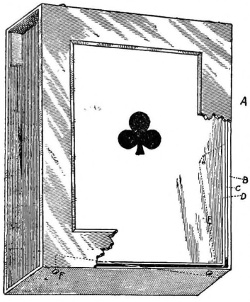
The front side of this box, “A,” is provided with three thin perpendicular plates, of which two are stationary, but all of which seem to be solidly joined together. Between the stationary plates “B” and “D,” whose inner surfaces are so highly polished as to reduce friction to a minimum, slides another and invisible plate, marked “C,” and which is adjustable and highly sensitive to the secret manipulation of the practiced dealer. This centre piece “C,” when properly placed and at rest, presents an upper edge a trifle above the two stationary plates, leaving an aperture so narrow that the dealer can take but one card from the box at a time.
“F” is a screw which operates a secret lever, “E C,” between the two plates “B” and “D.” This lever hangs on a pivot, and by slightly pressing the screw with the thumb the adjustable plate “C” quickly responds, and drops until its edge is even with those of the stationary plates “B” and “D,” thereby enabling the dealer to take two cards from the box at one time without observation.
Upon removing the thumb pressure from the screw “F,” the adjustable plate “C” rises to its original position.
There is a flat metal piece in the inside of the box at the bottom, which, when pushed forward, instantly and securely locks the box, preventing the discovery of its mechanism, should any of the players request permission to examine it. Such permission is always cheerfully, and usually courteously given.
Finally, inside of the box, as in all others, is a thin plate the size of the cards, which is placed in a level or horizontal position, upon which the cards rest, and which is supported by four steel springs, that force the cards up to the top of the box so that they may always be ready for dealing.
201The “lever,” or “end squeeze” box—the one which is perhaps just now most in favor among “skin” gamblers—is operated on the same principle as is the “screw” box. The screw, however, is replaced by a mechanical contrivance which enables the dealer to raise the middle plate (lettered C in the illustration) by means of pressure or “squeezing” applied at the end of the box. The “lever” box also differs from the “screw” in the manner of locking the secret mechanism. In the essential principles of the “fake,” however, the two closely correspond. The underlying fraud in both consists of the manipulation of a concealed middle plate, substantially in the manner already explained.
The “needle” movement box is so called from the fact that at one end, on the inside, is a small spring, lying the thickness of three cards from the top, and having a fine point, like that of a needle, which catches on the edges of the cards. The dealer remembers which cards are round—which, as has been said, may be the odd numbers or may be those having a less number of spots than seven; the remainder of the pack is, of course, cut hollow at the ends. By the aid of the spring, the dealer is enabled to tell whether the first card is round or hollow, and also what the second card is; as when the round card comes in contact with the spring, it pushes it in, and as the latter slips it makes a slight noise, similar to the grating of the finger nails.nails. He can thus tell whether it is for his interest to take the second card or not, and—thanks to his previous preparation of the cards—it is as easy for him to take one as the other. An incidental advantage of this box is, that in case any of the players object to the apparently undue advantage in favor of the bank, it is possible for the dealer to offer to permit any player thus dissatisfied to deal in his stead, while he himself bets against the bank. Should his offer be accepted and a player open a bank, the latter, of course, not being acquainted with the secret spring of the box, will derive no benefit from the grating noise even should he notice it; while by reason of the professional dealer understanding the sound made by the secret spring, the latter is able to tell very nearly, if not absolutely, what card is coming next.
The “sand tell” box is particularly designed for the use of gamblers who desire to induce a player to deal the game. As its name implies, the cards used in it are “sanded,” while the “tell” consists of a small extra perpendicular plate near the front of the box on the inside, a trifle below its mouth, which causes the top card to stand slightly in advance of the deckdeck, so that the gambler can readily distinguish the card underneath.
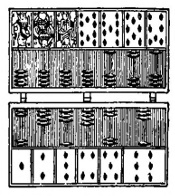
A record of the game is kept by means of an implement known as a “case-keeper,” which is usually placed in care of an employe of the 202establishment. This device is a miniature “lay-out,” with four buttons attached to each wire as shown in the illustration. These buttons run on wires, one of which extends from the end of each card. When the deal begins, all the buttons are shoved up close to the cards; as soon as a “turn” is made, the two buttons opposite the cards dealt are shoved to the opposite ends of their respective wires. This enables anyone around the table to see, at a glance, how many cards of each denomination remain in the dealer’s box. When all four cards of any one denomination have been dealt, that is said to be “dead.” When three cards of any one denomination have been dealt, the one remaining in the box is called the “case,” or “single card.”
It may sometimes happen that the tally of a player will not agree with that of the case keeper, owing to the fact that the dealer has withdrawn two cards where he should have taken one. In such a case, a trick known as the “put back” is employed. A confederate of the dealer attracts the attention of the players while the extra card or cards taken from the box are adroitly returned to it by the dealer. Of course, there must be a perfect understanding between the latter and the case keeper, so that when two cards are dealt at once a signal may be given showing the denomination of the second card.
In case a player making a bet finds that he has been misled by the incorrectness of the record kept by the cue keeper, the invariable rule is that the bet must be determined by the cards remaining in the dealing box, a regulation which is, to say the least, not at all to the disadvantage of the bank.
But the cheating is not all on one side, and a device called a hair “copper” is sometimes employed by players to guard against a possible loss on a certain description of bets. This hair “copper” consists of a piece of shoemaker’s wax, the color of the check, a horse hair, and a string of rubber attached to a band around the wrist, secreted in the sleeve. The wax adheres to the copper at one end of the horse hair, which is invisible, the other end being fastened to the rubber string which is extended in the hand to the tops of the fingers. Placing this copper on a bet, if the turn comes in favor of the dealer the player quickly and without observation loosens the rubber which jerks the “copper” into his sleeve, causing the dealer to pay the bet he may have fairly won.
Another scheme for beating the dealer is not infrequently resorted to by professional gamblers. It is technically known among them as “snaking” the card. This consists of “ringing in” upon the proposed victim of certain prepared cards, which are placed among the other dealing 203cards in some secret manner, and at a time when he is not aware of it. Sometimes, when no other opportunity presents itself, the faro dealer’s room is entered by false keys during his absence, and his cards are so operated upon that the operator can, to a certainty, break the bank at the first opportunity. There are gamblers who travel through the country for the purpose of “snaking” games, seldom engaging in any other species of gaming, and it often happens that many professionals are badly bled through this means without suspecting it. Sometimes the services of some person who is a stranger to the dealer are secured to play against the bank in order to allay suspicion.
The modes of “snaking” are various. One of the earliest consists of placing an extra plate in the dealing-box, in connection with a piece of steel not larger than a cambric needle. The cards are then cut on the edges in such a way that the appearance and disappearance of this piece of steel tells whether the next card will win or lose. This steel point, in the rapidity of its motion, was compared to a snake’s tongue, and it is probable that the origin of the term “snaking” is to be found in this fancied resemblance.
Another method of “snaking” cards is as follows: The deck is prepared. Let us suppose that the “pot” cards—the six, seven and eight—are the ones selected. A pack of cards is taken, and the sixes, sevens, and eights sanded on the backs and the remainder of the pack on the faces. Small dots are then made on the face of each card in the deck, near the edge. The position of these dots is determined by measuring on the card with the plate which belongs to the dealing box. Now, when a sanded deck of cards is placed in a “sand tell” dealing box, every time a card is taken from the box the card next to the one taken moves a little forward in consequence of the card taken from the box pressing on the one underneath it. But, with these “snaked” cards, the case is somewhat different; while dealing with these cards, should a smooth one be next to the one drawn from the box, it would be drawn a little forward, i. e., if there is not one of these “sanded” cards underneath this smooth one. If there should be one of the sanded cards under the smooth one, the card left on the top, after making a turn, will be held back by the sanded card which is underneath it, and it will not be pulled forward at all. Now, when a card which is left on the top, after making a turn, is pulled forward, these dots (above mentioned) are visible on the face of the card, denoting that neither of the pot cards can lose on the first turn; consequently the pot cards are played to win as long as this dot is visible on the face of the top card. But, in case, after a turn is made, the top card should not move forward, then the dot on the face of the card underneath could not be seen, which shows that one of the pot cards (which are the six, seven or eight) will certainly lose on that turn; of course the pot is instantly coppered, that is, betting that these cards will lose.
204Another and simpler plan is to perforate all the cards of a certain description, perhaps of either dark suit, from the two to the ten, with an instrument known as the “card punch,” of which the accompanying illustration will enable the reader to form a fair conception.

It is made of the finest steel, and is employed to puncture cards at the center. A “deck” thus prepared is substituted for that which the banker intends to place in the box. Sometimes, however, in this “diamond cut diamond” game, an entrance is effected to the dealer’s room and the “punch” is employed on his own cards. The substitution of the prepared pack for that of the banker is the fundamental point to be attained, and occasionally resort is had to desperate expedients. A fight is raised, and in the melee which ensues the dealer’s box is thrown upon the floor and the substitution quickly accomplished.
This shameless trick is played by one gambler upon another without the slightest compunction. What a commentary does this afford upon the hollowness of the old adage regarding “honor among thieves.” The author having never been guilty of larceny, as defined by either the common law or the criminal code, cannot speak for “thieves” technically defined as such. As to those greater thieves known as gamblers, however, he does not hesitate to say that among them “honor” is a word as unmeaning as the mirage of the desert is illusory.
But to return to the punctured cards. The holes made by the punch are so small that the player is often “beaten” by it. Whenever a white surface is seen through this small hole, the player is perfectly certain that the card underneath is the deuce, four, six, seven, eight or ten, and may accordingly back these cards to win for himself with absolute certainty. If a colored surface is discerned, he is equally certain that the next card will be of another denomination.
Yet another method is to sandpaper the edges of one-half the cards. Then, as the edge of the under card is seen through the slit in the dealing box, the outside player can tell in which half it belongs by noticing whether it is bright or dull. Of course, to practice this successfully, the player must remember correctly the cards making up each half; but when the division is made upon a system, this is an easy matter.
Besides the methods of cheating already described, which relate more particularly to the preparation of the cards and the construction and operation of the dealing box, there are other methods well known to professionals, which may be employed with comparative immunity and great success against the unsuspecting.
A favorite stratagem is to use a prepared deck containing fifty-three cards, one more than the legitimate pack contains, known among the fraternity 205as the “odd.” The odd card is never seen by the player; and as the cues come out correct, there is nothing of which he can complain. The advantage of its use to the gambler is that it gives him one sure turn during each deal, and he usually prefers to employ it on the last turn. In such a case, it is impossible for the bettor to win on the call, and he is equally certain to lose on any bet which he may make on that turn. The advantage of such a large additional percentage in favor of the game is palpable. A large proportion of players are fond of calling the “last turn,” because of the greater odds given by the bank; they are also more disposed to bet high on single cards at this stage of the deal, for the reason that a “split” is impossible. This is called playing cases. The manner in which a deck of fifty-three cards may be manipulated to the certain loss of such bettors may be best shown by means of an illustration. The denomination of the extra card is a matter of no importance, but we will suppose it to be an ace; its introduction would then make five aces in the pack. All the cards are then sanded except these five aces, which are marked on the edges with one or two dots, so as to be instantly recognized. The deck, having been thus prepared, is played in the following manner: The cards are first shuffled a few times from bottom to top, the dealer not then knowing the position of any card. The latter then commences finding the aces, which is easily accomplished, inasmuch as they are the only cards not sanded and are marked on the edges. While shuffling he places one ace on the top of the deck, over this he places a card of some other denomination, and on this another ace, and over this again yet another card. A false cut (which is accomplished in various ways, and is really no cut at all) is then given to the cards, which are next placed, faces upward, in the dealing box, the arranged cards being of course now at the bottom. Let us suppose that when the last turn is reached it consists of an ace, king and queen. Of course there are really two aces in the box, though only one is shown. If the dealer wishes to make the ace lose, all that he need do is to turn one card and then take two cards instead of one, through the aid of his “faked” box, the bottom one of these two cards being one of the aces, this leaves one card in the box, as there should be. Should he desire to make the ace win, he draws two on the first pull, and only one afterward, which results in one of the aces never being seen, making the cues on the last turn come out correct. Sometimes the cards are cut fairly, and the extra card comes in the middle of the deck; in such a case, when the dealer arrives where the aces are arranged, he is aware of it and acts in the same manner as has been already described when they are placed so as to fall in the last turn. Sometimes two odd cards are added to the deck, making the pack consist of fifty-four cards. When properly manipulated, the dealer has the advantage of being able to manage two turns instead of one.
206Even when both cards and dealing box are perfectly “square,” it is still in the power of the professional gambler to take such advantages of persons not posted as to be morally certain of winning their money. For instance, should a player select certain favorite cards on which to bet (as is often the case), on the next deal the dealer may easily cause such cards to win or lose all the way through as he may desire, the bettor never suspecting that the run was not a matter of pure chance. As these favorite cards come out of the box, the dealer—at a moment when the bettor is not observing—places them at the bottom at the end of the deal, where they are not disturbed while shuffling. The deck is then “run in” endwise, and these cards being separated, will either win or lose throughout the game.
“Faked” dealing boxes are not always the “thing of beauty” and perennial source of joy which their manipulators would like to see them. They occasionally “get out of order;” a little sand works its way between the plates, and even an expert “brace” dealer finds it more or less difficult so to use the device that its employment cannot be detected. At Laredo, Texas, a few years ago, a “professional,” who is now dealer at a famous house in a Western city, encountered a difficulty of this sort. He “pulled” two cards, but so clumsily that the “sucker” observed it. “What’s the matter with your box?” the player asked. “O, it’s a little old, and don’t work just right,” was the answer. “Well, see here,” said the Texan, “that was an almighty short deal, somehow. Reckon I’m going to lose money any way; but hadn’t you better go a little slower and make one of them long deals? I’d like to take a little more time.” The game progressed and the stranger rose from the table a loser to the amount of three hundred dollars. “Look here,” he remarked to the dealer, “I reckon you’d better give me back the money you’ve cheated me out of.” The gambler, with an air of the utmost nonchalance, replied that he would be blanked if he gave back any of it. “Well,” remarked the countryman, as he drew down his slouch hat over his eyes and left the room, “I’ll be back in a few minutes.” No sooner had he left than one of the employes of the establishment took the proprietor aside and advised him either to return the money or close the place at once, if he did not want the victim to return and shoot him “on sight.” The proprietor was a capital “brace” dealer, but physical courage was not his chief characteristic. He lost no time in acting on his subordinate’s suggestion. Hastily raising the window he called out to the victim—whose rapidly vanishing form was still in sight—“I say, you! Come back here a minute; I want to see you.” The “sucker” came back; the gambler greeted him cordially. “You old idiot,” said he, “can’t you take a little joke? Of course I knew that you were ‘capping,’ (i. e. acting as ‘capper’) for the 207game. Here’s your money old man.”man.” He handed him a roll of currency, which the stranger pocketed with a grim smile of satisfaction. But subsequent events proved that the proprietor “had builded better than he knew.” Sitting around the room were other men who had lost money and seen a fellow sufferer receive back his losses, it did not take long for the crowd to extinguish the lights, and in the darkness the unlucky dealer was “held up” for every dollar that he had with him.
3rd. The third adjunct to success in a “brace” faro game is by no means the least important. Confederates on the outside are considered sine qua non in every “skin” gaming hell. They are technically known as “ropers” or “steerers.” This euphonious appellation sufficiently indicates at once their character and the nature of the duties with which they are charged. The man who for a percentage and under the guise of friendship lures a man to loss is, if possible, morally lower than the scoundrel who robs him.
To be a good “steerer,” a man should possess some education and be endowed with a courteous and affable demeanor. The more polished his manners, the greater the value of his services. Men of this stamp hang about the depots, infest the corridors of hotels of every grade, and patrol the streets with far more watchfulness than does the average policeman. Their methods do not vary, in any marked respect, from those employed by “cappers” and “steerers” in other games, which are fully disclosed under other head lines. About the same qualifications are expected of faro and “bunko steerers,” and those required of the latter are plainly indicated in Chapter VIII.
There is, however, a class of “ropers” who do rather more than “dirty” work. These men hang about the entrances to houses which are alleged and believed to be “square,” turn out the gas in the stairway, and when a would-be player presents himself, assure him that “the house is closed for the night, but that they (or he) can ‘show him where a game is running.’” Should the verdant dupe be sufficiently gullible to believe the story, one of these miscreants “steers” him to a “brace” house, sees that he is “plucked,” and then claims and receives his percentage on the amount which the victim has lost.
Among broken-down gamblers who have lost the last vestige of self-respect, another game is popular. Individuals of this sort will hang about the side-walk in front of a “hell.” When a player goes up-stairs into the rooms, they watch him. If they can gain access to the house they watch his play; if they are too disreputable in appearance to be allowed inside the doors, they await his return. In either event, they ascertain whether he has lost or won. If the former, they promptly present themselves before the proprietor and claim the usual percentage paid to a “steerer,” 208and usually receive it. This sort of scamp is known among the fraternity as a “gutter snipe.”
Once in a while one of them proves himself of some service. On a certain evening, two young men had been playing faro at a “skin” house on the Bowery, in New York. They had pooled their resources and one of them had been doing all the betting. Their losses footed up about eighty dollars. After coming down stairs they stood upon the corner, bewailing their hard luck, when they were accosted by an individual who, although decidedly seedy, presented the appearance of being the wreck of what was once a gentleman. He told them that he had overheard their conversation and asked them if they would like to get a part of their money back. Being answered in the affirmative, he went on to say that he himself did not dare to go up into the rooms, but that if the man who had not done the betting would return alone and claim to have been acting as a “steerer,” he would receive from the proprietor a “capper’s” percentage of the house’s winnings. The advice was acted upon; one of the two again mounted the stairs, entered the apartmentapartment, demanded his forty-five per cent. of the money lost and received it without objection. The stranger was made happy by receiving a five dollar bill, and the friends walked away considerably wiser, if somewhat poorer, than when they first entered the den.
While speaking of “steerers” there is one fact which should not be overlooked. Not a few of the proprietors of the so-called “square” houses run “brace” games at other localities, “on the quiet.” These men keep “ropers” at the foot of the stairways leading up to their respectable (?) establishments, whose duty it is to inform any particularly verdant “sucker” that there is “no game being played here to-night,” and then “steer” him to the place where he can be fleeced with more ease and expedition. The same tactics are employed at times when public sentiment compels the closing of the gaming hells. The “reputable” gamblers shut their doors, and open a room either at a hotel or in some out of the way location, whither their “steerers” guide victims, thus partially at least, recouping their losses resulting from the closing of their regular rooms. Where they do not open other places they sometimes “stand in” with the keepers of “skin” rooms, to have their employes “steer” their patrons to the latter resorts, the “square” players, of course, receiving a percentage of the winnings.
The better class of houses of play close at about two o’clock in the morning, when the cards, dealing boxes and other paraphernalia are given a few hours rest. Others are open all night, and at Pueblo, Colorado, there is a resort whose doors are never closed. At all establishments, however, there are at least two sets of employes, known respectively as the “day” and “night-watch.” The day men arrive about nine in the 209morning, the dealer having the combination of the safe. He takes out the money, chips, cards, etc.; the “house is ready for business,” or to state it more accurately, the trap is set and baited for fresh game.
It is generally during the earlier hours of the day-watch that the game is “thrown off,” if at all. This term is a bit of gambler’s slang, and always means that some one is victimized through a gross breach of good faith, in other words, the victim is “thrown” to a confederate as a bone to a dog. The “throwing off a game” is usually worked as follows: Suppose that A, B and C enter into partnership to conduct a gaming house. A and B secretly agree to defraud C of the capital which he has advanced. C closes the house at night and A opens in the morning. B arranges with an outside party to come to the house in the morning while C is absent, and by collusion with the dealer, A, “win out the roll,” as it is technically termed, that is, win the money of the firm so that C’s share may be divided among the two scoundrels. Of all dastardly confidence games this may be probably set down as the meanest, and the fact that it is ever done shows how far the maxim “honor among thieves” applies to professional blacklegs.
A UNIQUE ESTABLISHMENT.
The establishment at Pueblo to which reference has been made above, is probably the largest in the United States. It contains six faro tables, four roulette wheels, four hazard tables, two “stud” poker tables, two “draw” poker tables, one “short faro” table, one vingt-un table, one hieronymus bowl, and one table for playing a game known as “high suit.” They are all in one large room, which opens directly off the street, without any pretense of concealment, and contains, besides, a bar and a lunch counter. Back of this is an apartment in which occur two drawings daily, and yet farther in the rear is a keno room, where a game is run every night. This mammoth hell never closes its doors. Three sets of employes relieve each other, each “shift” (a designation for the alternate “watches,” borrowed from the phraseology of the Colorado miners) being on duty eight hours. As may be imagined, the cost of running such an establishment is enormous, and the fact that the proprietors continue to prosper financially shows that dupes are found in abundance.
There is one feature in the management of this Pueblo resort peculiar to itself. It is a very common thing in all gambling houses for a player who “has lost his roll” to ask a donation—or a “loan,” as he prefers to call it—of a small sum, wherewith to get a drink, procure a meal, or pay for a night’s lodging. Only in the lowest dives is such a request refused. In the Pueblo den, however, a different system is pursued. The proprietors never give money to any man, for the reason that they apprehend 210that the beneficiary might use it in playing against the house. At the same time no sober applicant (unless a chronic “dead beat”), whether player or stranger, is ever refused a drink, a cigar, a square meal, or a night’s lodging. Instead of cash, however, he is given a brass check which, while not receivable at the tables as stakes, is good at the bar, the lunch counter, or at a lodging house owned and run by the establishment, for refreshments of whatever kind he may desire.
SHORT FARO.
This is a vastly simplified modification of the game of faro. The lay-out consists of six cards—ace, king, queen, jack, ten, and nine. The dealer commonly uses two or more packs, which he shuffles and usually deals from his hand, though sometimes from a box. The first three cards run off are for “the house,” and are dealt faces down and not exposed. The second three cards are for the player and are shown. Bettors place their stakes on the card or cards in the lay-out which they may select before the deal begins. The mode of play may be best shown by an illustration: Suppose a player wagers a dollar on the queen. If one of the three cards exposed happens to be a queen he wins one dollar; if two are queens he receives double the amount of his stake; if all three should prove to be queens the dealer returns him his original stake augmented by three times the amount; if no queen is shown the “house” gathers in the stake. It does not require a particularly erudite mathematician to discover that the odds at this game are enormously in favor of the bank. In the first place the player can win only should one of six cards out of fifty-two turn up. Moreover, of the six cards dealt he is allowed to see only three, thus reducing his already insignificant chances by one half. Even when fairly played the game, like roulette, is little short of downright robbery by the dealer, and when to this preponderance of chances one adds the numerous advantages which a professional “brace” dealer has over a greenhorn it is easy to foretell who will have the money at the end of the game.
POLICE PROTECTION TO GAMBLING.
The attentive reader will find, at various parts of this volume, allusions to the tacit understanding which often exists between the fraternity of black-legs and the police. The personal experience of the author is referred to and the chapter devoted to local gambling is replete with recitals of facts which afford food for reflection.
It may not be out of place here, however, to describe briefly the methods adopted for rendering ineffective even a carefully planned and honestly executed raid, if undertaken or managed by inexperienced or incompetent officers. The latter on gaining entrance to a room do not 211find any gambling in progress and are therefore unable to capture any property or make any arrests. The outer doors of the resorts are usually constructed of ponderous oak timbers, from four to ten inches thick, fastened together by means of heavy iron bolts. Of late years steel has been substituted for wood, and it is said that at one of the Chinese gambling hells in San Francisco the doors are made of thick rubber, resembling car springs in texture, the elasticity of which repels the blows of a sledge hammer as a marble pavement gives a rebound to a rubber ball. The object of making such doors is, of course, to prevent forcible intrusion. It is not of the employment of violence, however, that I am about to speak, but of those raids where the officers are given admission. It should be added that not infrequently entrance is granted, after a short delay, because the hospitable proprietors have been privately warned of the intended visit.
A small aperture in the door enables the door-keepers, one of whom is always in attendance, to inspect applicants for admission before undoing the bolts. If the custodian is in doubt as to the character of the callers, the proprietor is summoned. If the visitors are recognized as officers, an electric bell sounds a note of warning, and a parley between the blue-coats and the Cerebus at the portal follows. In the twinkling of an eye the cards, boxes, chips, lay-out, case-keeper, and money disappear into the safe. The table is at once transformed into an ordinary round-topped affair, covered with a crimson cloth. Scattered around the room are well dressed, quiet mannered gentlemen engaged in reading the newspapers, in discussing politics, or in general conversation. The police see nothing, and after apologizing for their intrusion, withdraw. Often the proprietor accompanies them to the stairway, and, cordially shaking hands, leaves in the honest (?) palm of the one in command a substantial token of his readiness to “bury the hatchet.” Scarcely have they reached the sidewalk before the table is placed in position, the safe unlocked, the money and paraphernalia taken out, the players resume their seats, and the game goes on as before. Is it surprising that the man who witnesses such a farce as this should entertain a contempt for the very name of law?
REMINISCENCES AND INCIDENTS.
From what has been said, some unsophisticated reader may be led to suppose that running a faro bank is a short and easy road to fortune. No more fatal mistake could be made. Professional gamblers, almost without exception, die paupers. Nor is the reason far to seek. The gambler “on the inside,” is likely to win, even if the game is fairly played; and the skin dealer never loses, even by accident. But the curse of Heaven seems to attach to money thus accumulated. The winners rarely keep it long. The terrible fascination of the mania for gaming 212is no less potent with professionals than amateurs. The author might multiply illustrations, drawn from his own experience. A successful proprietor of a faro game will often draw from his safe thousands of his nefariously won money to drop it on the table in another house. Even Morrissey, the gambling king of the country, twice a member of the New York State Senate and later of the United States House of Representatives, owner of the most luxuriously appointed gambling house of the American metropolis and of the world famed “club house” at Saratoga, which vied with Monaco and Monte Carlo in its elegance—even Morrissey, the “prince of good fellows,” the idol of his friends, the once millionaire, died insolvent. The history of American gambling abounds in incidents scarcely less striking. Ephemeral success, debauchery, drunkenness, poverty, suicide or death from violence—this is the epitome of the career of the average blackleg. O! young men of America, you who are upon the very threshold of life, you who are in doubt as to “which way” you will direct your steps, you in whom are centered the fondest affections of so many hearts, you before whom so bright a future is opening, you upon whom depends the future of this great country, listen to the advice which comes from a heart that would avert from you the pangs which it has suffered. Believe one who has drained the cup to its very dregs, that at the bottom you will find only a serpent!
William Close,Close, one of the best known and most expert manipulators of a brace box known to American gamblers, who won heavily and bet as freely, died a pauper.
John Timmins, a successful dealer, “went broke” and in a fit of desperation, ended his miserable existence with a bullet.
Sam Cade, a “faro bank fiend” and one of the best poker players known in the “hells” was buried by a fund to which I was myself a subscriber.
These are but a tithe of the many instances that I might adduce in corroboration of the truth of what has been said.
An illustration of the well-nigh irreclaimable depravity of the case-hardened professional happened not many years ago in a St. Louis gambling house. A well dressed young man entered, sat down at the faro table, and in a very short time lost $500. His money gone, he hurriedly rose and left the room without a word. After his departure one of the “profession,” who was sitting in the room, looked toward the door and remarked, “Well, he dropped his little roll rather sudden.” Then he added, with a pensive air, “but it comes easy?” “What is he?” asked the dealer. “Why don’t you know?” was the inquiry of the first speaker. “He’s one of the finest ‘dips’ in the country.” “What’s a dip?” was the next conundrum of the proprietor. “Why, you driveling idiot,” replied his confrere, “a dip’s a pick-pocket.” “Well,” answered the winner, 213with a yawn, “I don’t care. Glad he makes money so easily. Hope he’ll ‘dip’ some more. A dip’s money is just as good to run bank with as any other.” And with this remark he wheeled about in his chair and was soon immersed in the newspaper, awaiting the arrival of another victim.
I cannot close this chapter on faro without a passing reference to an old gambler who at one time was a prominent figure all along the Mississippi valley, and whose face was as familiar to patrons of the river steamers as were the sand-bars which blocked the channel. I refer to “Colonel” Charles Starr. His long yarns were proverbial. According to his own story he owned half the plantations skirting the river. Occasionally some one would “pick him up” by telling him that he (the skeptic) was the owner of those broad acres. No such trifling circumstance as this abashed the “Colonel” in the least. Like Banquo’s ghost, he peremptorily and perennially refused to “down.”
Stories about him were as plentiful as “pickaninnies” about a negro cabin. It is said that once, at an Arkansas watering place, he was approached by an itinerant blackleg who asked for half a dollar with which to get something to eat. The “Colonel” surveyed him leisurely, from head to foot, before either granting or refusing his request. Finally he said: “How long did you say it was, young man, since you had anything to eat?” “Two days, Colonel.” “Well,” drawled Starr, “I reckon I don’t want to give you a half a dollar, but if you go without eating two days longer, I’ll give you a hundred dollars for your appetite.”
Starr was a gourmand, though a dyspeptic, and withal rather selfish. He went into a restaurant in New Orleans one day and ordered a sumptuous repast. A hungry, penniless gambler entered while he was eating, and approaching him, said: “Colonel, I’m awful hungry and I’m dead broke. Can’t you ‘stake’ me with some of that?” “Oh, no,” answered Starr, “you see, I’m a capper for the house, and my play doesn’t go.”
He accumulated a fair competence, but gambling and dissipation reduced him to poverty, and he died a pauper. The evening of the day preceding his death he entered a fashionable restaurant and ordered a dinner costing some seven or eight dollars. The proprietor called him on one side, and told him frankly that he did not feel disposed to “carry” him any longer, that he must pay cash for his order or it would not be filled. Starr said nothing, but went out and borrowed five dollars from a friend; returning, he threw it on a table and ordered the best meal obtainable for that sum. When it was set before him he deliberately turned every dish upside down upon the cloth, and walked out of the place. The following morning he died.
214

POKER AND POKER PLAYERS.
The game of poker is undoubtedly one of the “peculiar institutions”institutions” of the United States and, like base-ball, may be called a “National game.” It finds an abiding place alike among the pineries of the frozen Kennebec and the orange groves of Florida, in the gilded salons of Manhattan Island, the backwoods of Arkansas, and the mining camps of California. It numbers among its devotees men of letters and of the proletariat, the millionaire and the shoe-black, the railway magnate and the tramp. It recognizes no distinction of “age, color, or previous condition of servitude.” It draws not the line at sex, and is equally at home in the fashionable club house and the gambler’s den, the private parlor and the cheap lodging house. Men who avowedly abhor it, play it behind closed doors and drawn curtains, and ladies of culture and high social position are among its most devoted and most skillful patrons. To describe its fascination is as difficult as to account for it, yet the undisputable fact remains that of the vast army of men connected with mercantile pursuits in the United States, comparatively few can be found who have not some knowledge of the game; and were the whole truth disclosed, no insignificant number might reveal a tale of losses of no little magnitude.
Gentlemen, who would not, for worlds, enter a gaming hell, and who are apt to pride themselves upon their ignorance of faro, play poker at their clubs and by their own firesides, without either compunction of conscience or pretence of concealment. Intelligent, thoughtful men, eulogize the game as far removed from vulgarity, as calling into exercise some of the highest faculties of the human mind, and as resulting in healthy, moral effects.
This enthusiastic laudation of the game is all very well, but the naked facts remain, that whatever argument may be advanced against any form of gambling, may be urged with equal force against poker; and that this game sanctioned as it practically is, by the countenance of the reputable men who never set foot within a gaming house, has done more to weaken the moral sense of the country at large as to the general question of gambling than any other single agency. Its growing popularity and increasing prevalence constitute a menace by no means to be ignored to the prosperity, the morals, even the perpetuity of our people. A nation of gamblers is a nation whose course is already turned towards the setting sun.
215As in the chapter devoted to the game of faro, the game will be first described as squarely and fairly played, after which the principal tricks of “card sharpers” will be taken up.
Foul Hand.—A hand composed of more, or less than five cards.
Going Better.—When any player makes a bet, it is the privilege of the next player to the left to raise him, that is, after making good the amount already bet by his adversary, to make a still higher bet. In such a case it is usual to say, “I see you, and go (so much) better,” naming the extra sum bet.
Going In.—After making good the ante of the age and the straddles (if any) for the privilege of drawing cards and playing for the pool.
Limit.—A condition made at the beginning of a game, limiting the amount of any single bet or raise.
Making Good.—Depositing in the pool an amount equal to any bet previously made. This is done previous to raising or calling a playing, and is sometimes called seeing a bet.
Original Hand.—The first five cards dealt to any player.
Pat Hand.—An original hand not likely to be improved by drawing, such as a full, straight, or flush.
Pass.—“I pass,” is a term used in Draw Poker, to signify that a player throws up his hand and retires from the game.
Raising a Bet.—The same as going better.
Say.—When it is the turn of any player to declare what he will do, whether he will bet, or pass his hand.
In the fair game, the deal is of no special value and anybody may begin.
The dealer, beginning with the person at his left, throws around five cards to each player, giving one card at a time.
The dealer shuffles and makes up the pack himself, or it may be done by the player at his left, and the player at his right must cut.
To begin the pool, the player next to the dealer on his left, must put up money, which is called an “ante,” and then in succession, each player, passing around to the left, must after looking at his hand determine if he goes in or not; and each player deciding to play for the pool must put in twice the amount of the ante. Those who decline to play throw up their cards, face downward on the table, and per consequence in front of the next dealer.
When all who wish to play have gone in, the person putting up the ante can either give up all interest in the pool, thus forfeiting the ante which has been put up, or else can play like the others who have gone in, by “making good,” that is, putting, up in addition to the ante as much more as will make him equal in the stake to the rest.
The players must throw away their discarded cards before taking up or looking at those which they draw.
216In poker, as fairly played, every player is for himself and against all others, and to that end will not let any of his cards be seen, nor betray the value of his hand by drawing or playing out of his turn, or by change of countenance, or any other sign. It is a great object to mystify your adversaries, up to the “call,” when hands have to be shown. To this end it is permitted to “chaff,” or talk nonsense, with a view of misleading your adversaries as to the value of your hand, but this must be without unreasonably delaying the game.
When the drawing is all complete, the betting goes around in order, like the drawing, to the left. The ante man is the first to bet unless he has declined to play, and in that case the first bet is made by the player nearest to the dealer on his left. But the player entitled to bet first may withhold his wager until the others have bet round to him, which is called “holding the age,” and this being considered an advantage, is very frequently done.
Each bettor in turn must put into the pool a sum equal at least to the first bet made; but each may in turn increase the bet, or “raise” it, as it comes to him; in which case the bets proceeding round in order must be made by each player in his turn, equal to the highest amount put in by any one; the party who fails being required to go out of the play, forfeiting his interest in the pool.
When a player puts in only as much as has been put in by each player who preceded him, that is called “seeing the bet.”
WhenWhen a player puts in that much, and raises it, that is called seeing the bet and “going better.”
When the bet goes around to the last bettor, or player, who remains in, if he does not wish to see and go better, he simply sees and “calls,” and then all playing must show their hands, and the highest hand wins the pool.
When any one declines to see the bet, or the increase of bet, which has been made, he “lays down” his hand; that is, throws it up with the cards face downwards on the table. If all the other players throw down their hands, the one who remains in to the last wins, and takes the pool without showing his hand.
To “bluff” is to take the risk of betting high enough on a poor hand or a worthless one, to make all the other players lay down their hands without seeing or calling you.
When a hand is complete so that the holder of it can play without drawing to better it, that is called a “pat” hand. A bold player will sometimes decline to draw any cards, and pretend to have a “pat” hand, and play it as such when he has none.
A skillful player will watch and observe when each player draws, the expression of the face, the circumstances and manner of betting, and 217judge, or try to judge, of the value of each hand opposed to him accordingly.
No one is bound to answer the question, how many cards he drew, except the dealer; and the dealer is not bound to tell after the betting has begun.
RELATIVE VALUE OF HANDS IN THEIR ORDER, BEGINNING WITH BEST.
1. A Sequence Flush—Which is a sequence of five cards, and all of the same suit.
2. Fours—Which is four of the five cards of the same denomination.
3. A Full—Which is a hand consisting of three cards of the same denomination and two of likewise equal denomination.
4. A Flush—Which is all five cards of the same suit.
5. A Sequence—Which is all five cards not of the same suit, but all in sequence. [In computing the value of a sequence, an ace counts either as the highest or the lowest card; that is below a deuce or above a king.]
6. Threes—Which is three cards of the same denomination, but the other two of different denominations from each other.
7. Two pairs.
8. One pair.
When a hand has neither of the above the count is by the cards of the highest value or denomination.
When parties opposed each hold a pair, the highest pair wins, and the same when each party holds threes or fours.
When each party holds two pairs, the highest pair of the two determines the relative value of the hands.