PART II. (continued 9)
Reading edition
455GAMBLING IN NEW ORLEANS.
Previous to 1827, there were no large public gambling houses in New Orleans. The old Creoles played extensively, but it was among themselves or at their clubs. The flatboat men, who managed the river business, all gambled; but the establishments in which they wagered their money were small and “tough” affairs, where pistols were constantly needed. These men, the first patrons of public gambling, came from the upper rivers, usually the Ohio and its tributaries, landed at the levee opposite St. Mary’s market, tied their boats, and at once made for the nearest saloon to gamble away their cargoes. On Front Street, where the flat boats lay three deep, was a row of drinking places, the back room in each being given over to gambling. Faro and roulette were the principal games. There was no law against gambling then, nor was any license demanded; and there was no attempt made to conceal the business. In fact, from the sidewalk the passers-by could hear the roulette caller shouting, “twenty-eight on the red,” or “eagle bird by chance,” and the rattling of the chips.
Another favorite location for these flatboat gambling houses was known as the “swamp,” and was back of the town, where the Gerrod Cemetery is to-day. Here the flatboat men and many other wild characters who in those days frequented New Orleans, made their rendezvous. It was beyond the limits and control of the city police, and the “flint-lock” pistol of those days reigned supreme there, just as the revolver does to-day in some of the frontier towns.
The flatboat men were all inveterate gamblers. They would remain in the city until they had gambled away their last cent, when they “whipsawed” at home, traveling across the country, usually on foot, along the government trail through the Choctaw country of Mississippi.
The gambling of that period was rough and dangerous. The dens around St. Mary’s market and in “the swamp” were a constant menace to the authorities. Crimes of violence were more frequent in them than in all the rest of the city; and the flatboat men and gamblers frequently united to defeat the police. As a general thing, however, the municipal authorities refrained from attempting to exercise any jurisdiction over these dangerous sections. The police put forth no effort looking to the regulation of these gambling hells and left the flatboat men and gamblers to shoot and kill each other, as they saw fit. The number of murders resulting from these causes is beyond calculation, for the victims generally left no one to inquire for them or worry over their “taking off.” It was the most lawless community in the country, and the readiest with the knife or pistol. To that element, however, we owe some of our standard American stories. It was here, also, that the expression, “acknowledge 456the corn” and hundreds of others originated, such as “keel-hauling,” “whip-sawing,” “cordelling,” etc.
In 1827 gambling was introduced to the polite element of the city by John Davis, emigre from San Domingo, an impressario of the old opera house and the first impressario of the United States. Davis opened two gambling houses. One of them was on the side of the city known as the Bayou St. John, where those who wished to get away from the noise and bustle of the town and indulge in a “high old time” in a choice, quiet suburban retreat might be accommodated. The other was located on a corner in the very heart of creole New Orleans.
The Bayou St. John club house was intended more especially for Saturday night and Sunday games, Sunday being the favorite day for playing. On that day a magnificent dinner was set out by Davis, free to those who patronized his establishment. This resort soon became the best known spot in the city. Its central location made it convenient for the gentry of Louisiana. Here were to be found representatives of the bench, the bar and the commercial world. The house was opened day and night and was always crowded, the favorite games being faro, roulette and vingt-et-un, and the betting was heavy. At these public games, however, the elite and notabilities of the day did not, as a rule, participate to any great extent, special rooms being set apart for them, at which brag, ecarte, baccarat and bagatelle were played.
Nearly every man in public life in Louisiana gambled and the losses and winnings were immense. Col. Ghrymes, the leading lawyer at the Louisiana bar, and enjoying a very large income, squandered every cent at Davis’ and was always in an impecunious condition. A loss of $50,000 to $100,000 a year, or $25,000 at one sitting, was not considered very extraordinary, and there were many who dropped that amount of money in an hour.
Davis was very successful with his club house and made a large fortune, which he and his son, “Toto” Davis, spent to good purpose in building an opera house and establishing the opera in New Orleans, where it first took root in America. On music, to which both of them were devoted, most of the money won in the gambling business was expended.
The success of Davis with his “club house” produced two results; first, it greatly increased the number of gambling houses, and secondly, it induced the legislature to take a hand in the business for its share of the profits. In 1832, five years after Davis’ venture, there were fourteen large gambling saloons in New Orleans, all well equipped and furnished, and all well backed with capital. They were all making money and the legislature, having determined to get some of the profit, licensed the business, and authorized the opening and running of gambling houses on the payment to the state of an annual license of $7,500.
457All the fourteen gambling saloons or, as they preferred to be called, “club houses,” accepted the conditions. They were owned and operated as follows: Hicks & Hewlett, corner of St. Louis and Chartres; Duval, Chartres between Conti and Bienville; St. Cyr; Chentres, between Conti and St. Louis; Toussaunte, opposite Chentres on Canal, between Camp and St. Charles; Elkin, Canal near St. Charles, and Padet, corner of Canal and Camp. These seven were distributed between the first and second municipalities, about half of the fourteen in the French and the other half in the American quarter of the city.
These houses were public in the fullest sense of the word. They were never closed, running night and day, for when one set of dealers became tired, there was another to take their places. They were resorted to by all classes, but their best business was from the numerous strangers who visited New Orleans, and who always made it a point to see the world-famed gambling houses. They were lively, those “flush times,” and not unlike San Francisco in the gold fever of 1848-50.
In 1836, the gambling business in New Orleans received a double check. The financial crisis brought an end to the “flush times” and the rural or moral element got control of the legislature. Previous to that year the French element had control and it saw nothing wrong in gambling, but the country members protested against it, and, at the instigation of a Mr. Larrimore, who represented the moral as well as the American element, the license for gambling was withdrawn, as improper and immoral, the state surrendering some $120,000 of the money it had been deriving from this source, and prohibiting gambling under a heavy penalty, a fine of $1,000 to $5,000 for the first, and $5,000 to $10,000 and imprisonment for the second offence.
The act of the legislature did not meet with favor in New Orleans, which could see no immorality in gambling, and the third municipality one of those independent cities into which New Orleans was divided by the legislature, in consequence of the race prejudice between Creoles and Americans, set the State at defiance, and licensed gambling by a city ordinance. A conflict between the city and the state followed, in which the latter came out triumphant theoretically—as the Supreme court decided that the city of New Orleans could not license gambling when the State of Louisiana had forbidden it—but the decision accomplished little practically, for the gambling saloons ran on the same as ever, for the reason that public sentiment, especially in the French portion of the town, approved of them. This was particularly true of the third municipalitymunicipality, or Faubourg Maugrey, which actually owes its origin to gambling, as the name of the street indicates.
It was originally the plantation of the Maugreys, one of the first Creole families of Louisiana, and entitled to a marquisate in France, and 458was frittered away at the gaming table by its owner. Whenever old Maugrey wanted more money for gaming he laid off a section of the plantation, cut a new street through it, and sold lots; in a sort of ironical mood naming the streets after the game at which he had lost his money. Thus it is that the streets in that part of the town were named Bagatelle (a favorite Creole game in that day), Craps (played with dice and mostly confined to the negroes to-day), etc., by which names they are called even now, to recall old Maugrey’s gambling, which mainly bankrupted the richest and most famous family in Louisiana.
The act of the legislature of 1836, although it gave half the fine to the informer who pointed out a gambling house, was of no effect. The houses ran on the same as usual, not quite as openly, but bribing the city officials and the gendarmes, who at that time did police duty.
The financial crisis worked far more injury to the gamblers than did the act of the legislature since money became scarce and their business decreased so rapidly that a number of the principal houses were compelled to close.
There was a marked revival of activity in gambling circles in 1846, when New Orleans became the military center of operations against Mexico, and when thousands of soldiers were quartered there. The stimulus thus imparted to gaming was continued, if not increased, throughout the years ’48, ’49, and ’50, when the excitement of the California gold fever filled the city with emigrants moving toward the Pacific. The transient population became very large, and was mainly composed of men, who, by nature and temperament, were bold speculators, ready to stake anything or everything on the cast of a die. Their advent, moreover, caused a plethora of money, so that it is no cause for surprise that the gambling fever broke out in New Orleans in a far more vehement form than it had assumed in the days of old John Davis. Gambling houses were no longer confined to any particular section of the city as they had formerly been, but opened everywhere. Dens abounded in the neighborhood of St. Mary’s market for the accommodation of the flatboat men and river characters, while for those of more fastidious tastes, places of a better grade were opened in the neighborhood of hotels and boarding houses. But this class of resorts was especially numerous in those localities where returning soldiers or emigrants were quartered.
Despite the prohibition of the legislature, certain gambling establishments were licensed by the city to carry on the game of “rondeau” and “lotto” (since styled “keno”), under the pretence that such games were not gambling, and “from dusky eve to dewy morn,” on any frequented thoroughfare, might be heard the sonorous voice of the game-keeper, as he called time and game.
The gambling houses at this period numbered between 400 and 500, giving employment to some three thousand gamblers, dealers, etc. They 459did not resemble the elegantly furnished houses of John Davis’ day, nor were they like those which came later; they were rough, and suited to the tastes of miners, soldiers and emigrants, who mainly patronized them.
With the abatement of the California gold fever, gambling in New Orleans fell away, until it had returned to its normal condition. The number of establishments were materially reduced, but they were of a decidedly better class, being fitted up more for the rich planters than for the rough element which had for several years constituted their main support. Elegantly furnished houses, where sumptuous repasts were served to the patrons, once more began to appear. McGrath, Sherwood and PetittPetitt were the first to take the lead in this new departure.
The trio believed in “square” gambling, had plenty of capital, and were all men of mark. McGrath went North during the war, but finally settled down in his native state, and with the profits of his gambling transactions in New Orleans established the well-known McGrath stock farm. He has since devoted himself to the breeding of racing and other blooded stock, and has become one of the best known turfmen in the United States, owning “Tom Bowling” and many other famous coursers.
Petitt spent a large portion of his winnings in the raising and equipment of troops for the Confederate army during the war. He sent, at his own expense, from New Orleans to the Virginia battle fields one of the first companies recruited in the South, known as Petitt’s Guards.
Sherwood remained in New Orleans during the war, where he contributed liberally to the support of the wives and children of Southern soldiers at the front.
These were the three leading gamblers in New Orleans during the period just before the war, and were good types of their class.
“Supper rooms” were the names commonly given to these establishments in those days, for the reason that choice suppers were always supplied, with wine and cigars in profusion. Sherwood would frequently order all games to cease, and invite all his guests to a magnificent repast, during the course of which he would play the part of the courteous host, entertaining the company with a fund of anecdotes and quaint stories.
These “supper rooms” were a favorite resort, and if one failed to find in the rotunda of the St. Charles or St. Louis hotels any noted personage of whom he might be in quest, he felt reasonably certain of running across him either at McGrath’s club room, or Cassidy’s or Sherwood’s supper room, playing, talking, or at supper.
In those days, these resorts were something more than mere gambling rooms. The club house, as known to-day, did not then exist, and the commercial exchange, as understood in more modern times, was unknown. In consequence, the gaming houses (which, it must be remembered, were not at that time looked upon as the disreputable resorts which they are 460now considered to be) supplied the place of both. The same remark applies measurably to drinking saloons. Business men and gentlemen of that period were wont to make places of this description their rendezvous. These names, by the way, are still used in New Orleans in speaking of saloons and gambling rooms, the term “exchange” and “club room” having a distinct signification in that city, different from the meaning attached to them in any other portion of the United States.
In order to thoroughly comprehend this condition of affairs, it is necessary to glance, for a moment, at the then existing state of society in the Crescent City. Bachelors far outnumbered men of family. The tone of morals was low, and life was generally fast. The idea that there was anything wrong in gambling occurred to no one. Hence it was considered no more surprising to meet one’s friend in a gaming resort than to find him at his home. In fact, the club rooms, with many men at that period, supplied the place of home life.
McGrath’s, in particular, became, like Davis’ of old, a club house and social center for the men of New Orleans. It was the sporting centre also and there all the pools on the races, and particularly on the Mataurie course which, for so long a period stood at the head of American race courses, were sold.
The appointments and fittings of these houses were of such a character that only the higher classes of society were desired as patrons. McGrath, who occupied No. 4, Carondelet street, afterwards known as the Boston club (a social organization founded by private gentlemen for their own diversion) spent $75,000 to $100,000 in furniture for his place; while Lauraine and Cassidy, who had a place opposite the St. Charles Hotel, and who set the finest supper in the city, boasted of a solid silver service, including dishes and plates, unequalled in the South. Other famous gambling houses of that day, though not so well known as some of those already mentioned, were kept by Sam Levy and “Count” Lorenzo Servri (who received his sobriquet because of his polished manners and faultless apparel) and Martino, whose place was located on Canal street, near Carondelet. Besides these were numerous other “club houses,” where the visitor paid fifty cents an hour, and was entitled to refreshments free of cost, which included a well cooked dinner with claret ad libitum, besides being permitted to gamble at poker.
At all the gaming houses play was high, and wherever there was a limit it was generally removed by the proprietor if the patrons requested it. A prominent Greek merchant, representing in New Orleans one of the largest commercial houses in the world, played there night after night, losing $80,000 in a single evening, his total losses footing up a round half million, which caused the suspension of the house whose representative he was.
461In addition to these establishments, nearly all of the many steamboats plying between New Orleans and the various river points, were in themselves gambling houses. A class of gamblers travelled up and down the river on these boats. Their saloons were given up almost wholly to card playing. The principal games were Boston and Poker, the latter being played without limit. Bets from $10,000 to $25,000 were frequently made on a single hand, and one of $50,000 is recorded. When cash ran out lands and slaves were wagered.
The ante-bellum games were nearly all “square” and the gamblers were usually of better social standing than those of later days. Davis, McGrath and PetittPetitt, in particular, were looked upon as gentlemen, and were admitted anywhere, their profession not standing in the way of their social advancement. Augustus Lauraine was excluded from polite circles, not because he was a gambler but for the reason that he had violated one of the principles of the “code,” in other words, he failed to pay a gambler’s debt.
The immediate result of the war was to break up nearly all the New Orleans gaming houses. Most of the gamblers were enthusiastic confederates. The action of Petitt in equipping a company has been already mentioned. Martino went to Richmond, where he opened a house, but there was not much to be made out of confederate currency and he gave so liberally to the sick and destitute soldiers that his venture brought him no profit. It was not until 1862, when the city was in the hands of the United States forces under General Butler, that gaming again revived.
Through the favor of Col. Butler—a brother of the General—Bryant, one of the best known and oldest gamblers in New Orleans, and who had kept one of the “supper rooms” in the days before the war, was permitted to open a gambling house at the corner of Exchange Alley and Bienville street; and Fulton, a new comer, opened one a square lower down the same street. These resorts opened off the street and access was free to all comers except private soldiers, the semi-military control under which they were placed drawing the line here. Officers, however, who were plentifully supplied with money, played freely and, of course, lost heavily. But gross scandals resulted, and in 1864 General Hurlbut, by military order, directed that they be closed. Martial law proved singularly effective in this instance, and until the revocation of the order (which came in a few weeks)weeks), public gaming was at a stand still. This was an era in the city’s history, and, with the exception of a period when the District Attorney arrested and prosecuted all the gamblers in New Orleans, was the only time when gambling was completely suppressed. At all other times it has been either protected or tolerated by the authorities; carried on openly under license from the State or city, or conducted clandestinely, 462through bribery of the officials. In fact, public sentiment has generally either favored it or, at most, been disposed to regard it as a necessary evil.
After the war there was manifest a disposition to return to the old license system, under which the state received a portion of the gamblers’ winnings. One of the arguments in its favor was that the Havana lottery was taking more money out of Louisiana every month than all the gamblers in New Orleans combined, and as a matter of fact that city was as good a market for the sale of these tickets as Havana itself. In addition to regular lottery offices and ticket peddlers, every tobacconist was an agent for their sale. Tradition recorded the names of eleven winners of capital prizes. It is true that the old citizens (all of whom were devout believers in “luck”) were accustomed to wag their beards and sagely declare that riches thus acquired took to themselves wings and flew away, but they nevertheless “played lottery” every month, with the regularity of clock work, and eagerly awaited the receipt of the list of drawings, which in those days was brought from Havana to New Orleans by carrier pigeons.
The legislature of Louisiana determined to enter the field in competition with the Governor General of Cuba, and endeavored to secure at least its fair share of the business. Accordingly, in 1866, a law was passed requiring lottery ticket brokers and peddlers to take out a license, and turn over to the State five per cent. of their gross receipts. This, however, did not produce as large a revenue to the State as had been expected, as the dealers disposed of their tickets surreptitiously, and in 1868, the legislature enacted the Louisiana State Lottery, exacting a bonus of $40,000 a year, and gave it a monopoly of the business, prohibiting the sale of tickets in the Havana, or any other foreign lottery.
This plan proving successful, the legislature went a step further and determined to license gambling also. On March 9, 1869, a law was passed, empowering every one to open a public gaming saloon, who would pay a license fee of $5,000. (It had been $7,500 under the law of 1832). The payment of the money was the sole condition imposed by the law. No restriction was placed upon the games to be played nor was any distinction drawn between “square” and “brace” houses. Protection was guaranteed in the form of a promise to close and keep closed all unlicensed houses.
The new law was in force but a short time. It caused general dissatisfaction, and its repeal has been attributed to the moral sentiment of the community. This, however, is an error. While the great majority of the people of New Orleans were shocked at the result, this mattered little to the legislature, one of the most notoriously corrupt bodies which Louisiana has ever seen; and had not the gamblers themselves appealed 463to it, to repeal the law which recognized and licensed their business, it would have continued for many years.
The immediate result of the law was to make New Orleans an American Monte Carlo, the gambling centre of the United States. All the old local gamblers took advantage of the law and paid their license; but they found that they would not be allowed to occupy the field alone. The statute proved to be an advertisement of New Orleans throughout the Union, and gamblers flocked thither from New York, Baltimore, Cincinnati and St. Louis, to open places of business in a city, where it was not only free from inspection and supervision, but even legitimate.
Within a few weeks, St. Charles Street blossomed into one vast gambling hell. These resorts, some forty in number, and popularly known as “the forty thieves,” did a “land office business.” They were open night and day from the ground floor up. Every kind of gambling was carried on, with open doors, while runners on the outside enticed all passers by to enter. They had “all-round” saloons in which all kinds of games were played. The lower floor was commonly devoted to faro; roulette claimed the second story; while the third floor was set apart for keno. Generally one or two side rooms were fitted up for vingt-et-un and other games. Lunch settees and wine tables were prominent articles in their equipment, and everything was supplied which might make gaming attractive. There were no screens, the saloons opening immediately off the street; no limit was fixed, and boys and octogenarians were alike welcomed.
This state of affairs proved too much, even for the advocates of public gaming. St. Charles Street, the principal thoroughfare, had become a by-word and reproach, a very high-way of vice, if not of crime.
Notwithstanding the indignant protest of an outraged public, however, the law would have probably remained on the statute book had it not been, as has been already intimated, for the gamblers themselves. Not that they complained of the exaction of a license fee; that, they were willing to pay cheerfully. It was the ruinous competition in business which it brought about that constituted the ground of their dissatisfaction. The “old-timers” found themselves injured, not only in pocket but also in reputation, by the horde of confidence men, “steerers”, sharpers and “skin” gamblers, who had swept down upon New Orleans like vultures upon a carcass. The license law had proved a boomerang.
The influx of strangers had been so great that the demand for licences to keep gaming houses had grown to such proportions that New Orleans seemed destined to absorb and monopolize all the gambling of the entire country. A conference of those “to the manor born” was held, which was attended by Bush, Taylor, Harrison and others, at which, after a full interchange of views, it was determined that the wiser policy was to return 464to the old system and get rid of the new comers at any cost. They were strong enough, politically, to get what they wanted from the legislature, and the obnoxious law was repealed, and the auditor directed to return to the gamblers the fees paid for the new year.
The abolition of the license system, however, did not put an end to gambling. Some of the more recent arrivals departed for Texas, Long Branch, Washington, and other promising points, but the “old timers”, to the number of 100 to 110, continued to do business in the same way as usual, paying bribes into the pockets of the police instead of a license fee into the State treasury. As, however, the law prohibited gambling, some sort of a pretence was made at secrecy, although the houses were all well known, and one could hear in the street below the rattle of chips and the droning call of the dealer.
During the next ten years the gamblers did a fair business, notwithstanding the fact that they were freely blackmailed by the police. They recouped themselves, however, for this outlay by taking their revenge upon the police, and particularly upon strangers. Bunko flourished and “steerers” abounded, while some of the best known confidence men now traveling about the country acquired their first knowledge of the business at New Orleans during this period.
In 1880, yet another plan of indirectly regulating gaming was introduced. The new system was neither the imposition of license fees nor the secret extortion of “hush-money”, and was essentially different from that followed in any other city of the world up to that time. While gambling had been unlawful it had also been notorious. Not less than ninety houses spread their nets for victims, and over a thousand persons were employed in the nefarious calling. Bribery and corruption had taken the place of legal license, and through political influence the gambling fraternity had enjoyed comparative immunity.
In the year last mentioned, Mr. ShakspeareShakspeare who had just been elected Mayor, determined to accomplish indirectly what had been forbidden by State law—the license of the houses. He looked upon this as the only available means of controlling and regulating a business which, however, reprehensible, seemed destined to “go on forever.”
He favored the license system as the best practical solution of the problem, inasmuch as under it the city would receive a share of the profits of the business while there might, at the same time, be police supervision of the establishments.
A newspaper reporter was employed to visit the various gambling houses, inspect the games played there, and report to the Mayor on the subject.
After the latter had secured all the information he needed, he laid it before the council, together with his plan for licensing gambling and 465asked for its consideration and discussion. He proposed that a “forced loan” be collected from the gamblers—the city to charge each gaming saloon $150 a month or $1,800 a year for the privilege of carrying on business. They were to conduct only “square” games, to employ no “runners” or “cappers” to drum up business for them, and to content themselves with such profits as they might legitimately (?) derive from the unsolicited visits of occasional players. No minors were to be permitted to play and houses were to be confined within certain prescribed boundaries in the business section of the city, while the proprietors were to agree to preserve peace and order in the establishments, and to be always subject to the inspection and control of the police.
In consideration of the making of this forced loan, the city was to undertake that the houses entering into the arrangement, so long as they complied with the requirements exacted, should not be raided or otherwise molested by the police. Moreover, those saloons which accepted the proposition were to be protected from undue and unlicensed competition, the city promising to close all places which did not “pay up” or were guilty of irregularities.
When these propositions, which had been already submitted to the gamblers and approved by them, were laid before the council, that body authorized the executive to make the experiment, although the city fathers cautiously refused to share the responsibility for any consequences which might ensue. At first, the revenue thus received was paid directly to the city treasurer, but that official, being unwilling to accept it, it was turned over to the mayor’s private secretary, to be expended as the mayor ordered.
At the time of the inauguration of the “Shakespeare system” of exacting this forced loan there were eighty-two gambling resorts running in New Orleans. Half of these closed at once rather than pay the licenses. From the remainder some $6,000 was received as the first month’s instalment, which was set aside as a special fund for the erection of an alms house, or an institution, which was greatly needed in a city which had failed to make any provision for the support of paupers. Later the receipts from this source were turned over to the charity hospital or devoted to alleviating the condition of those confined in the jails. From this source (the gambler’s contributions) enough money was obtained to erect a large brick building named “The Shakespeare Almshouse” in honor of the mayor, and to support and care for two hundred paupers and incurables. A number of prominent citizens consented to act as directors of the institution, accepting the money turned over to them by the mayor for its maintenance, although well knowing the source from which it was derived.
466At first, the anomalous system appeared to be a success. There were some complaints from the religious element of the community, but the general public raised no objection, while the press approved. The fund was exclusively under the control of the mayor, who accounted to no one, and was wholly free from responsibility in the matter and was at liberty to use the money as he saw fit. It occurred to him that the most effectual means of silencing his critics would be to devote it to public charity.
An account of the fund was kept in a book open to all, with each payment received from the gamblers, together with the sums turned over to the directors of the almshouse.
The supporters of the mayor pointed to his administration of the fund and the practical results of the system as a triumphant vindication of his policy. In the course of a year the number of gambling houses had been reduced from eighty-two, running at all seasons, to sixteen in summer and thirty-two in winter. This diminution, too, had been accomplished without police raids, while there had been no public scandals.
The mayor exacted literal compliance with his requirements. One of the leading saloons, run by “Billy Johnson,” a well known gambler about town, was closed early in the day because of some irregularities, and when the old trick was tried of re-opening it at the same place but under a new name, the mayor promptly suppressed it. “Any place,” he said, “once closed for ‘bunkoing’ was closed for ever.”
The loudest complaints about the system came from some of the gamblers themselves, who declared that the city was getting more out of the business than they were, and several attempts were made to persuade the mayor to reduce the amount of tribute. But to all such remonstrances he persistently turned a deaf ear, his stereotyped reply being, “If you can’t make enough from gambling to pay the city $150 a month for the privilege, you had better go into some other and better paying business.”
Mayor Skakspeare was succeeded by Gen. W. H. Bebian, who, so far as gambling was concerned, followed in the footsteps of his predecessor. Following him came Gillette. The latter regularly collected the tax, but instead of devoting it solely to purposes of charity, diverted a portion of it to meeting the exigencies of the political situation. From the fund were defrayed the expenses of entertainments ordered by the council, while it was also used to meet the pay-roll of the mayor’s special police, as well as for other objects of a distinctively political character. This line of action induced scandal, and the circumstance that no account of the disbursement of the fund was rendered, considered in connection with the fact that the almshouse—for which it had been created—was left without income, brought the system into disfavor and disrepute, and a 467revulsion of public sentiment occurred. Several grand juries presented reports condemning the fund as having been exacted in direct violation of the State constitution and the laws framed thereunder. The result of this agitation of the question was that during the incumbency of Mayor Gillette, the system was abandoned.
Since then, gambling in New Orleans has been conducted under the system of semi-toleration, which prevails in most American cities. The law against “banking games,” was enforced for a few weeks during 1888, when, as has been said, the prosecuting attorney arrested the gamblers and for a short time brought public gaming to an abrupt (though temporary) cessation; but although there were several convictions, the spasm of virtue soon passed; raids came to an end; and matters soon drifted back to their former position.
The law against gambling still adorned the pages of the statute book, but for many years no attempt whatever had been made to enforce it. The police knew the location of every gambling saloon in the city, as did also the district attorney, whose duty it was to enforce the law, but not an indictment was found against any of them.
To-day, there are some thirty gaming resorts in New Orleans, half of which, however, are mainly patronized by negroes. They are visited by the police in a supervisory sort of way, from time to time. When anything wrong is reported, the proprietor is arrested, and in the great majority of cases willingly consents to make good the complainant’s losses rather than to face exposure. If he proves recalcitrant, his house is closed. Only one place was closed in 1889, however, on this ground.
Two years ago, “keno” became the favorite game in New Orleans. It proved especially seductive to youths and those of small means, because of the small stakes required to play it. It proved particularly harmful for this very reason, its patrons being largely drawn from the ranks of those who could not afford to lose anything. The better class of gamblers themselves did not favor it, for the reason that it afforded no chances for the “bank,” which had to content itself with its “percentage.” Nevertheless, the “demand” for this sort of amusement resulted in an abundant supply, and for several blocks on two of the principal streets of the city, the ear of the passing pedestrian was saluted with the cries of “forty-eight,” “sixteen” and “keno,” which were wafted down to the street from the open windows of the keno rooms, which occupied the second floors of nearly every building. The majority of the players were clerks, under 25 years of age, mechanics and laborers; and to losses at keno may be attributed the numerous embezzlements which brought such unenviable notoriety upon New Orleans for several years.
The negroes, sunny children of nature, content if their immediate wants are satisfied, and taking no thought for the future, all gamble—certainly 468nine in ten of them gamble at the saloons on Dauphin and Franklin Streets, among themselves at “craps” or “chuck-a-luck,” or at “policy,” the latter being the favorite for women. These colored saloons are probably the worst in the world; rude unfurnished rooms, with nothing but gambling tables and chairs in them, lighted by flickering, ill-smelling lamps. Here congregate the roustabouts, longshoremen and deck hands, who drift into New Orleans during “the season,” or when crops are gathered, and here they and their mistresses play until the last dollar of their earnings is spent, and they once more enter upon their toilsome labor. Here, too, all the negro criminals of New Orleans, the colored ex-convicts, who number several thousand sneak thieves, burglars, etc., resort. The negro gambling saloons often prove of service to the police when prosecuting a search for colored criminals. There is no necessity to hunt for them all over the city. The owners of these gambling dens are anxious to be on good terms with the officers of the law, and act as spies for them. If a murderer or a burglar is needed, they are furnished with a description of him, and within a very short time comes the information that “Dago Dick,” or “Big Sam” is at such-and-such a saloon. These dives frequently stand the police in good stead, saving the officers no little trouble in searching for notorious negro criminals.
It cannot be said that, on the whole, the gamblers of New Orleans have made much out of their business. Very few have accumulated money through their original calling, although some have acquired their first start at the card table and have since achieved a competence in other and legitimate pursuits. Probably the most striking illustration of the truth of this statement has been already mentioned in referring to the case of McGrath, who has made a fortune through his stock farm and on the the turf. Another Crescent City sport invested his winnings at the faro table in the hotel business, at which he succeeded even beyond his expectations. Perhaps ten or a dozen in all, who have renounced the green cloth have honestly earned a competence, although a few have grown rich.
Perhaps one reason why gambling has not proved more remunerativeremunerative since the war is that comparatively few of those engaged in the business at the South, have had the large capital necessary to conduct a thoroughly first-class establishment. Besides this, the gamester is by nature a spendthrift, whose motto is always “easy come, easy go.” His instincts are all arrayed on the side of prodigal expenditure, as against thrift.
At the present time, the houses are under fair control. That is to say, they are not tolerated on the ground floor, minors are not allowed to enter them, and “skin” gambling is perhaps less practiced than in other metropolitan cities. The fraternity complain bitterly of “hard times,” and declare that their business is entirely broken up. Of what are euphoniously 469characterized as “respectable” houses, there are scarcely half a dozen, and even these reap their richest harvest from strangers, during the carnival season. The local patronage is not profitable.
In 1889, the whirligig of time again elevated Mr. Joseph Shakspeare to the Mayor’s chair. He made no secret of his disposition to return to the system of indirect license which he had himself inaugurated. The council, however, proved less complaisant, and refused either to sanction or to disapprove the plan of the executive. Meanwhile, public sentiment in the city was about equally divided in reference to the question. A very large element of the community was bitterly hostile to countenancing the vice, even indirectly. On the other hand, there were not wanting those who regarded gaming as a necessary evil, which would find its votaries under any and all circumstances, and from the practice of which the city would do well to derive some revenue.
Among the latter half of the community were, of course, included those who were themselves fond of patronizing the public tables.
Speculation in stocks, bonds and produce was unknown in New Orleans previous to 1880. To its introduction may, perhaps, be measurably attributed the decline in the volume of gambling in the hells. Once introduced, it rapidly grew in favor with many of those who had been accustomed to look for that excitement which they regarded as their highest recreation in gambling upon the turn of a card. Whether the introduction into the city of the speculative mania and the decadence of the gambling saloons stood to each other in the relation of cause and effect it might be difficult to say; they certainly occurred about the same time. At first, speculation was chiefly confined to cotton, which bore the same relative position to New Orleans that wheat sustains to Chicago. Gradually, however, mining stocks and gold grew in favor of those who were disposed to venture their money upon options, as affording even greater fluctuationsfluctuations in value.
When trading in future deliveries was first suggested upon the floor of the New Orleans Cotton Exchange, it aroused violent opposition. Its opponents pointed out that the city already lacked sufficient capital to handle the cotton crop, of which New Orleans was the distributing centre, even in a legitimate way; they showed that a vicious element would be imparted to values; and called attention to the disastrous effect which such business might have upon the price of cotton. In reply to these arguments, it was urged that New York was already doing a gambling business in cotton futures, amounting to 25,000,000 bales per year, which was four or five times as much as the entire cotton crop of the whole country; that New Orleans was sending a great deal of money to the Atlantic seaboard to be invested in futures; and that unless dealing in speculative deliveries was sanctioned in what ought to be the greatest 470cotton mart of the world, a large proportion of the city business would be diverted to New York, even if the latter point did not absorb a great deal of the “spot” trade.
The result of the discussion was a triumph for the advocates of speculation, and in February, 1880, gambling in cotton futures began upon the floor of the New Orleans Cotton Exchange. At first, it did not seem to commend itself rapidly to public favor. Only 2,083,100 bales were sold during the first year. The rapidity in which it grew in favor is shown by the sudden increase in transactions in futures. In 1881, 10,115,800 bales were sold, which figures increased in 1882 to 16,171,000, which was fully double the amount of cotton the city received. The advocates of stock gambling pointed to this increased volume of business as the triumphant vindication of the position which they had assumed. New Orleans, they said, had in less than three years built up as large a gambling business as that which was carried on in New York. But experience proved that speculation in cotton futures reached its highest point in 1882, from which period it began to decline. At that time, however, it was practically universal. Clerks, samplers and weighers of cotton were among the most numerous patrons of the speculative market. Men of this class appeared to believe that because they have some business relations with cotton, they were thoroughly conversant with the market and that their casual handling, sampling or classifying of bales rendered them competent judges as to the future course of events. New Orleans speculators proved to be but pigmies, as compared with those of New York. In fact, the Southern market was so generally wrong that it became a common saying in the “country” that if one wished to bet right on the course of the cotton market, he should always bet against the combined wisdom of New Orleans. It may have been because the Eastern city had more capital, but the tangible result was thatwas that in the single year, 1882, New York was estimated to have relieved the metropolis of the Southwest of $4,000,000, of her surplus cash. The loss fell chiefly upon those who were less able to bear it. The employes of the warehouses had ventured heavily. Even the janitor or porter bought his little “jag” of a hundred bales.
The withdrawal of such a large quantity of money during a single year resulted in bringing about a financial stringency in New Orleans, and the tightness of money operated as a check upon speculative gambling, which has never since blossomed out in the same magnificent luxuries. Among those who had been particularly pronounced in their advocacy of the sale of futures upon the Cotton Exchange, not less than fifty went to the wall, and for a time the more conservative element managed things in its own way. Some idea of the extent to which this species of gambling mania had pervaded all classes of citizens may be gathered from the statement—which cannot be controverted—that during the crop year of 1881-82, 471fully 15,000 people bought cotton futures at one time or another, and that at least one man in four in New Orleans was accustomed, now and then,then, to “take a little flyer.”
In 1883, the volume of transactions of this character declined to 12,041,900 bales; in 1884, to 9,588,300; in 1885, 8,037,100; and in 1886, to 7,474,900 bales, or less than half what it had been. MoreoverMoreover the business was confined chiefly to the larger dealers, the “small fry” letting the market religiously and severely alone, and since 1886, transactions have fluctuated in quantity. In 1887, sales of future deliveries aggregated some 11,239,000 bales; 1888, 8,947,800; and in 1889, 6,575,000 bales. Since the introduction of this description of gambling in New Orleans, about 92,223,900 bales of future cotton have been sold in that city, upon which margins of $276,671,700 have been put up, allowing a liberal commission to the brokers who managed the business; these figures represent a payment, virtually upon a wager of $73,409,933 by the losers to the winners. But no matter whether the hotly contested battle was decided in favor of the bulls or whether the bears were triumphant, some way or other New York always contrived to come out ahead, and it is a generally conceded that the thrifty manipulators of the latter market succeeded in extracting from the pockets of their New Orleans brethren a sum variously estimated at from $12,000,000 to $20,000,000.
Several attempts were made to prohibit this species of gambling by law, but the dealers in futures proved too strong. Neither did public sentiment condemn this sort of gambling, and many persons who would have scorned to enter a faro bank, bought options in cotton without compunction. Speculative craze during this period reached its maximum, and was not confined to cotton alone. Three or four “bucket shops” were started at which one could buy almost anything—wheat, or railroad and mining stocks. With the general decline of their business, the “bucket shops” also went by the board.
At present, however, the business is confined chiefly to a few operators and brokers. The general public views the situation with little interest, being indifferent as to whether A wins from B to-day and B recovers his losses to-morrow, or vice-versa.
Speculation in stocks has always been far less active than in cotton. Far removed from the commercial centre of the country, New Orleans has gambled but little in the general list of stocks, the greater portion of the business done on the Stock Exchange being confined to transactions in State and City bonds, a few local stocks, and—of late years—in mining shares. Nevertheless of the $160,000,000 worth of bonds and other securities dealt in during the past ten years, it is estimated that fully four-fifths were bought and sold on speculative account. The frequency with which the Louisiana law-makers have legislated in reference to State 472debentures have caused the latter to fluctuate violently. Large fortunes have been rapidly made and quickly lost, the case of the Confederate Commander, Gen. J. B. Hood, affording a striking illustration of the truth of the latter statement.
Legislative action in reference to the State debt in 1879, when the interest was reduced, and again in 1884, regarding what is known as the “interest amendment” gave rise to heavy speculations. Again in 1887, a mania for gambling in land and mining stocks broke out, which continued until 1889. In the latter year, the Mexican Lottery attracted much interest, and winnings and losses were alike numerous.
The amount of money lost on speculation in New Orleans in ten years is estimated at $82,000,000,—almost as much as the property valuation—and some commercial concerns regarded as among the most solvent in the city have been dragged down to bankruptcy.
Perhaps the most seductive and dangerous form of gambling in New Orleans to-day is the mania for buying tickets in the Louisiana lottery, with its attendant evil, “policy playing.” Lottery playing has always prevailed in New Orleans. Lotteries innumerable existed in the old days, and even the churches—notably Christ Church, the first Protestant church in Louisiana, and to this day, the largest and most fashionable—were built by means of lotteries.
The lotteries of the “olden times,” however, were small concerns, yet they stimulated the desire and whetted the appetite for this sort of excitement. They prepared the way for the extraordinary success which, as has been already said, attended the introduction of the sale of Havana lottery tickets into the Crescent City.
After the war, the Kentucky State Lottery Company sold some of its tickets in New Orleans, but that concern never became so popular among the people at large as was the Havana Lottery.
The considerations which induced the State Legislature to incorporate the Louisiana Company have been already set forth. Too much money was going to Cuba, and it was thought that the public treasury might as well be enriched by a portion of the profits, which were known to be numerous. All attempts to enforce the payment of a percentage on the sale of Havana tickets have proved lamentable failures.
The act of incorporation of the Louisiana State Lottery was passed in 1868. Under its terms the company was granted a lease of life for a period of twenty-five years. Under the constitution of 1880, its grip upon the state was confirmed until the expiration of the year 1892. As has been pointed out, in consideration of the payment by the company into the state treasury of $40,000 per annum, the concern was to be secured in a monopoly of the sale of lottery tickets within the state. At first, however, this provision of the law was not enforced, Havana tickets being 473freely sold upon the streets. But gradually the more attractive offers of the home company and its growing popularity attracted more and more business to its coffers, until, little by little it virtually had a field to itself.
Of the $40,000 yearly tax, one-half was set apart for the maintenance of the Charity Hospital—the largest free hospital in America—while the remainder was devoted to the public service fund.
Originally the business of the company was very largely confined to daily drawings and policy playing, and at one time there were not less than 180 places within the corporate limits at which policy might be played. At this time the sale of tickets was confined exclusively to Louisiana and mainly to New Orleans. As time went by, however, the company changed its schedule of drawings and gradually extended its operations until they included the entire country. The result of these various new departures was to enhance the importance of the monthly drawings to such an extent that the daily distributions and the attendant policy playing sunk into comparative insignificance. Little by little, the value of the prizes and the price of tickets have been doubled, until a whole ticket in a monthly drawing costs $20, while a similar chance in the semi-annual distribution of prizes is held at $40. Fully nine-tenths of the tickets are sold outside of Louisiana, the largest buyers being Texas, California, New York, Washington and Chicago.
The existing schedule of drawing is as follows: Two grand semi-annual drawings; ten monthly drawings; three hundred and thirteen daily drawings (with policy playing ad libitum); making a grand total of three hundred and twenty-five drawings during the year.
The following table shows the number of each description of drawings, the number of tickets printed, the price paid for a whole chance, the value of the tickets sold, the amount of cash prizes distributed, and the sum paid out in salary commissions.
NUMBER OF DRAWINGS PER YEAR. NO. TICKETS PRINTED. PRICE PER TICKET. VALUE TICKETS SOLD. PRIZES WON. PAID OUT FOR SALARIES AND COMMISSIONS.
2 Grand Semi-Annual, 200,000 $40.00 $5,600,000 $3,080,000 $600,000
10 Monthly, 1,000,000 20.00 13,000,000 7,150,000 1,200,000
313 Daily, 21,900,000 1.00 1,320,000 892,000 198,000
325 Drawings, 23,100,000 —— $19,920,000 $11,122,000 $1,998,000
Year by year the business of the company has increased and its financial standing has advanced in an equal ratio. Since its incorporation in 1868, it has sold tickets to the value of $168,000,000, paid prizes amounting to $92,400,000, and expended in commissions to dealers in New Orleans and elsewhere $16,000,000.
Its stock has, for some time past, paid an annual dividend of 85 per cent. on its par value, and is quoted on the market at 900.
474
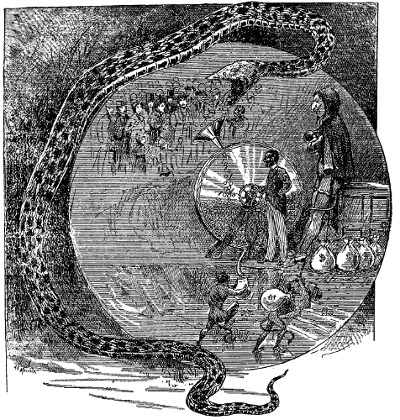
THE HOPPER OF THE SERPENT.
475In New Orleans, lottery playing is universal. It is safe to say that 50,000 fractional parts of tickets are purchased monthly, the smallest fraction of a chance sold in a monthly drawing being one-twentieth, and in the semi annual distribution one-fortieth. Among the purchasers there is no distinction of sex, age, color, social position or occupation. Men, women, whites, blacks, Mongolians, Mexicans, the old, the young, leaders of society and the “bums,” one and all buy, the crowd of these deluded speculators being swelled even by recruits from the ranks of the clergy.
The friends of the lottery adduce many arguments in its support. They claim that it is the least objectionable form of gambling; that it is conducted “on the dead square;” that as the larger drawings take place but once a month, and the price of the ticket is low (the usual ticket one-twentieth or one-fortieth costs $1.00), one can at most lose but $12.00 a year, even if he “plays lottery” every month and invariably loses; that there have been no scandals growing out of the monthly drawings, nor any instance of a man who has sunk his fortune, or resorted to embezzlement to play. As regards the daily drawings, it is pointed out that as that the ordinary purchaser only risks twenty-five cents and the prizes stand to the tickets in the ratio of one to three, it is impossible that much financial harm can be done.
These arguments, of course, utterly failed to take into consideration the powerful incitement and stimulus which this sort of gambling imparts to the vice in general. While the immediate effects of investing in lottery tickets may not be sudden and pronounced financial ruin, the consequences are apt to be far-reaching. Neither do the advocates of the lottery take into account what is essentially the very worst feature of the whole business—policy playing. While the aggregate amount of money lost through this means may be insignificant as compared with that squandered upon the monthly and semi-annual drawings, the ultimate results flowing from this description of gambling are, perhaps, worse than those attendant upon any other. Policy is played by the very poorest classes—and particularly by the negroes—who cannot afford to lose a solitary cent. The amount of suffering entailed upon the families of the poor through this agency is so large as hardly to be susceptible of computation.
At present there are some eighty policy shops in New Orleans, the business of all of which is based upon the daily drawings of the Louisiana Lottery. The keepers of these places sell, on an average eighty slips each day, making the total sale in the city about sixty-four hundred every twenty-four hours, or two million three thousand two hundred per annum. The low prices at which these “slips” (or fractional part of the tickets) are sold—twenty-five and fifty cents, places them within the reach of all. 476There are probably two thousand or three thousand regular policy players who buy tickets every day and who have a system of combinations which they believe is certainly bound to win in the end. In addition, there are about twenty-five thousand others who make a similar venture about once a week. All these have made policy playing a profound study, and understand all its intricacies and know all about “horses”, “saddles”, “gigs”, “all day”, “first place”, etc. They are firm believers in “luck”. In fact, nowhere are so many “fortune telling” and “dream” books sold as in New Orleans, principally for the purpose of interpreting dreams which the buyers believe indicate numbers which they should play. Clairvoyants and fortune tellers abound and prosper; and there are men whose only means of obtaining a fair support is travelling the streets with cages of trained canaries or parroquets, which for the trifling consideration of five cents, will select from a case an envelope containing a number supposed to be a “sure winner.” Blindness is regarded with reverence, for the reason that a blind man is supposed to be invariably lucky. “Age cannot wither nor custom stalestale” the folly of these inveterate policy players. Their infatuation and superstition know no limit. They are constantly looking for “signs”. If you should say to one of them that you expected to be thirty-six years old on the sixth of December, the chances are that he would rush off around the corner to play the combination 6-12-36. They are perpetually looking for numbers by day and dreaming of them by night, and their first act on arising in the morning is to consult their “dream-books”, to ascertain what they shall play that day. The negro house servants are among the best patrons of the policy shops, often squeezing a quarter or half dollar from the market or grocery money, to place it on a “gig” or “saddle”.
The aggregate amount thus squandered is, as has been said, enormous. Yet it is usually spent in small sums and leads to no graver crime than petty pilfering, which, however, is bad enough. Still, occasionally a “plunger” tries this form of gambling, and once in a while a dishonest clerk who has been systematically robbing his employer for years will seek to arouse sympathy by attributing his entire peculation to the insidious fascination of daily drawings.
The following table may prove of interest to the reader, as showing the amount and character of the gambling practiced in New Orleans during the past ten years. It has been carefully prepared from the most authentic sources available and it is believed to be a very close approximation to the exact facts:
477
PROFITS OF BROKERS,
DESCRIPTION OF GAMBLING. AMOUNTS CHANGING GAMBLERS,
HANDS. LOTTERY CO. AND
DEALERS IN T’KS.
Speculation in Stocks, Futures, etc. $82,000,000 $10,145,945
Lottery Tickets, 18,600,000 8,370,000
Policy Playing, 8,000,000 3,200,000
Regular Gambling, 30,000,000 3,400,000
Total, $138,000,000 $25,115,945
Note.—The figures given include only the local business. The total amount received from sales is vastly greater.
From the foregoing sketch of gambling in New Orleans, it will be apparent to the reader that there has never been any determined effort put forth for its suppression. This fact may be ascribed to two operative causes. First, the absence of any pronounced public sentiment against gaming; secondly, the powerful political influence wielded by the gamblers. The latter have always been active ward politicians, and have exercised great influence upon local elections, in fact, they have usually had one or more of their representatives; indeed, at one time, the Chief of Police, the officer on whom devolved the duty of enforcing the law against gambling, was himself an ex-professional. At other times, gamblers who were actively engaged in the business have been members of the city council, tax collectors or supervisors of registration, besides filling numerous other State and City offices. Of the four men who, as ward “bosses,” virtually controlled the politics of the city from 1876 to 1888, one was an active gambler.
The “sports” had become politicianspoliticians, and ten or a dozen of them were recognized as active “workers,” whose support was valuable to the “bosses.” In consequence legislation adverse to gambling was well nigh impossible, and the enforcement of the laws already on the statute book had become dilatory and half-hearted. So weak was the sentiment in the legislature againstagainst gaming that that body, at its last session, had refused to pass a law requiring saloons where private gambling was conducted, to place a screen behind their front doors.
At the present time, gambling in the city is comparatively at a standstill. Many of those who have been prominently identified with the business in the past have sought other pursuits, which, although of a kindred character, have proved more profitable, such as the keeping of “turf exchanges,” “book making,” etc.
The city council having refused to indorse the suggestion of Mayor Shakspeare, that the indirect system of licensing be revived, finally mustered up courage to instruct the executive to close all houses. While the order cannot be said to have been literally and fully obeyed, its passage and the official action following the same have proved a deadly blow to public gambling.
478Two striking instances may be mentioned, which serve to show not only the immediate effect of a sudden reversal of public policy in this regard, but also to illustrate the deep hold which this pernicious vice obtains upon its victims.
On October 3, 1889, Joseph M. Marcus, a young merchant and a partner in a large tobacco concern, lodged a bullet in his brain while standing near the main entrance of one of the parish prisons. Temporary abberationabberation of mind, resulting from insomnia and apprehension of financial loss was supposed to have been the cause of his rash act. Later in the day, Napoleon Bonaparte White, one of the best known of the local gambling fraternity, was found dead in his bed, in a lodging house. A vial, in which remained a few drops of a decoction of morphine was found near him, and its presence was supposed to be a sufficient explanation of the manner of his death. About the time that the executive order was being prepared—the day before his decease—while the Mayor and Chief of Police were conferring upon the subject, White appeared to be much depressed and said that he had provided a method of evading the enforcement of the law; that he had purchased a pistol which he proposed to use in case the order was enforced. White’s career had been an eventful one. An engineer by profession, he had started in life on the Mississippi steamboats. His ambition and temperament soon drew him from the engine room to the saloon of the steamboat, where he blossomed forth as a professional gambler. When Walker planned his famous expedition to Nicaragua in 1856, White was one of the first to enroll himself in the band of volunteers. After the final collapse of the expedition, he drifted back to his old haunts in New Orleans, where for many years he was one of the most familiar figures upon the streets.
Instances are numerous where men have won or lost their daily bread upon the turn of a card. There have been not a few who, having staked their all upon the same contingency and lost, have blown out their brains with the weapon of despair. The sun-kissed hill-tops and low-lying valleys that surround Monte Carlo, contain the graves of not a few devotees of gaming, who in despair have ended their wretched lives. There is no sort of emotion which the fascination of this vice has not awakened in the human breast. There are a few rare instances relative to gamblers who have fallen dead in a superabundance of sudden joy. But never before, so far as is known, have two gamblers killed themselves because they believed that they were about to be deprived of the opportunity of indulging in their favorite pastimes. These instances stand unprecedented and unparalleledunparalleled in history.
479MILWAUKEE.
In some form or other, gambling has been known in Milwaukee ever since the advent of the first white settlers, and even on their arrival they found the IndiansIndians racing ponies on the plains for wagers.
The first regular gambling house in Milwaukee of which there is any record was a faro layout, established by Martin Curtis, in 1843, and operated by him for several years. In those days every one gambled; and as Curtis was gifted with the faculty of saving his winnings, he became quite wealthy. He erected various buildings in that city, among them a row of dwellings which yet stand on Broadway, facing the police station. Some of his grandchildren still reside in the city, and enjoy the inheritance left them by the “old man.”
In 1849, Milwaukee had grown to be a place of sufficient size to maintain two gaming establishments. Thomas Wicks opened a game which he continued to run for thirty years with varying success. He had two brothers, Curtis and Gardner Wicks, who aided him in the business, and ran the bank during the sessions of the legislature and at other times when there was any “game” in the town. All through the war the Wicks Brothers’ game was running in full blast at Milwaukee in an old yellow building which General Lucius Fairchilds had inherited from his father. The fact that General Fairchilds was Secretary of State for two years on leaving the army, and was Governor for six, did not interfere with the “tiger” having its lair in the upper part of his building, within two blocks of the handsome mansion in which his family resided. As showing the “pull” which the Wicks had on politicians and public men it may be of interest to record the fact, that although Governor Fairchilds went through four bitter political campaigns as a candidate, there never was a word said in any paper in reference to the fact that while Governor of Wisconsin he knowingly rented his property for gambling purposes.
From the time when he opened, in 1849, until some timesome time in or about 1872, John Welch was the gambling king of the State. His acquaintance with prominent men gave him immunity, both in Milwaukee and at Madison; and it was seldom that his game was made the subject of police interference. During a long period of his career, William Beck was Milwaukee’s chief of police, and as he was an inveterate gambler himself, and could generally be found in a gaming house when not engaged upon professional business, he naturally refrained from interfering with Wicks.
But the gambler met his fate at last. “Taking a flyer” is what ruined him, and since 1872 he has done very little beyond insisting that modern gamblers are all “crooked.”
On several occasions he has attempted to break up the games in Milwaukee by procuring indictments against the gamblers, but in each instance 480has ignominiouslyignominiously failed, for the reason that the younger men have been shrewd enough to induce the public to believe that the “old sport” was merely trying to extort money. Prior to his unfortunate venture in wheat, “Tom” Wicks enjoyed the friendship of a large number of wealthy and influential men who never gambled. These in a majority he has retained since his misfortune. The charge brought against him by the younger gamblers, however, that he was endeavoring to levy blackmail has caused a coolness between himself and some of his former acquaintances.
In 1876, when Alexander Mitchell took the Wisconsin delegation to St. Louis in his private car, “Tom” Wicks was made chief caterer and attended to the wants of the party; the members of which enjoyed a perpetual banquet from the moment of their departure until the hour of their return.
Just before Wicks lost his money, Mayor O’Neil closed up the gambling houses in Milwaukee and also raided Sunday dances, the result being that next year the “tough” element joined the Republicans and elected Harrison Ludington Mayor. He opened the town for those who had elected him, and, so far as gambling was concerned, it continued to run about as it pleased until a year ago, when Chief Ries, almost as a last official act before being relieved of the care of the police force, closed up the gambling houses. This left Mayor Brown and Chief Jansen the choice of keeping them closed or being abused by the friends of Ries. They chose the former alternative. As a consequence the city has been “closed up tight” for nearly a year, most of the dealers and supernumeriessupernumeries since the last election emigrating to other localities, a considerable proportion finding congenial surroundings in Chicago.
Before this compulsory hegira of the gamblers, Milwaukee was one of the most viciously “wide open” towns in the Northwest, and the business was becoming a nuisance. After the collapse of the iron boom all manner of disreputables flocked thither, and gambling, might have been said, to be running rampant. Six faro banks were constantly open, besides poker games and wheels of fortune in the back rooms of most of the saloons.
During the recent G. A. R. encampment, the authorities seemed to relax their vigilance, and allowed a little faro playing in a quiet way, but there is no guarantee that a raid may not occur at any moment. As a consequence, it is not probable that a game of any magnitude will attempt to exist, or that if it does anybody will run the risk of patronizing it. A raid was made last September and three keepers and sixty players were captured. It was generally supposed that the “haul” would have been larger had not a “tip” been secretly given.
481Last May the Chief of Police, Jansen, drafted a new ordinance relative to gambling, which he asked the council to pass. The ordinance provided that police officers armed with a properly drawn warrant might enter any place where they suspect gambling was being carried on, and that any one refusing them admission should be subject to a severe penalty. The police were empowered to use force and to batter down doors when refused admission. The ordinance also provided that the men found in charge of the gambling house should be deemed the keepers and that all gambling tools and paraphernalia captured by the police should be destroyed as soon as the police proved to the court that the said tools are gambling devices.
There was considerable opposition among the aldermen to the ordinance, on the ground that it would enable the police to break into private houses and arrest a party of gentlemen who might be enjoying a quiet game of poker.
“Any man who pretends to oppose the law on such grounds is either a fool or a knave,” said Chief Jansen. “In the first place, we can enter any man’s house now on a properly drawn warrant. It is all nonsense to suppose that the police would attempt to enter any one’s house to break up a game of cards, even if played for a consideration. Any police official who attempted it would be promptly called to account and the verdict of public opinion alone would cause him to lose his position. What we do want, however, are laws sufficiently stringent to allow us to stamp out public gambling. It costs the city hundreds of dollars to keep the gambling houses closed, and when we get a case against them they slip through with a petty fine and then the police department is subjected to the humiliation of having to return the gambling tools. The ordinances of the city are no more stringent now than when they were first passed, when the city was incorporated, in 1854. They are not up to the times. We want this new ordinance passed so that we can close and keep closed public gambling houses without being compelled to keep a detail of men on watch at all times.”
482GAMBLING IN SARATOGA.
To narrate the history of gambling in Saratoga, would be almost to give an epitome of the history of the town itself from its earliest date. Its celebrity as a watering place has done much to increase the practice of the vice, but even before it obtained fame in this direction its reputation as a gambling resort was well established within the somewhat contracted radius of the circle of which it formed the centre.
The author is indebted to an old resident of the Springs, who took up his residence there, under the parental wing, in 1831, when he was a boy of but ten years of age, for the statement that as early as 1844 there existed a resort on Broadway, opposite the residence of the Chancellor, where a bowling alley and billiard room constituted the chief attractions. The fact that games were played for wagers undoubtedly rendered the resorts more attractive. In a journal published in those early days there is found a communication from a lawyer, in which the writer complains that while arguing a case before the Chancellor he had been much annoyed by the noise of the patrons of the bowling alley, and that at intervals he could hear the click of the billiard pools, and even the rolling of the roulette table. During this period there was another bowling alley, situated in a small grove near a pond in the Southern part of the village, with the then customary adjuncts of billiards and open gambling. The location of the latter resort was practically identical with the site of the Clarendon hotel. Its proprietor was Geo. W. Gale, who also owned the alley opposite the Chancellor. In 1845, Gale retired from business, to accept the position of ticket agent of the Rensselaer and Saratoga railroad, a fact which would seem to indicate that in those early days running a gambling house was not found to be particularly profitable in Saratoga.
Perhaps the explanation may be found in the fact that the resorts of similar character had multiplied to an extent considerably exceeding the demand of the population. About the year 1834 bowling alleys and other places where various games might be played for a wager were numerous in the neighborhood of the railroad depots. The business was carried on so openly that almost the first object which attracted the attention of a passenger alighting from a train was the open door of one of these resorts.
Early in the history of the Springs, and long before the war, Southern planters in great numbers, selected Saratoga as their summer resort every year. It is not too much to say that they gambled with a recklessness in comparison with which the ventures of players of later days sink into comparative insignificance. They prided themselves upon playing a “gentleman’s game,” and the stakes were practically unlimited. The 483rich Southerner of the ante-bellum days was as simple in his pride as any other spoiled child of fortune; he offered an easy prey to the rapacity of professional sharks, and he was not infrequently robbed outright. He was accustomed to associating with those who were wont to flatter his vanity, and who were fond of assuring him that “the king could do no wrong.” The result was that the gamblers found it easy to reap a rich harvest, provided that they succeeded in being permitted to “sit”“sit” in the right kind of games. As most of the gambling was done at the hotel, the chance of detection was reduced to a minimum. From what has been said, it may be inferred that it is a mistake to suppose that gambling at Saratoga had its origin at the time of the introduction of the races, although since the time that the trial of the speed of horses was added to the attractions of this world-famous watering place, the vice has developed to a larger extent than ever before. The races were started in 1863, at what was then regarded as a suburb, and known as “House Haven.” It was about this time that club rooms sprang up and were to be found in all the larger hotels, where, for that matter, they may be found to-day. Faro and other banking games were openly dealt at half a dozen places in the village.
John Morrissey, once famous as a pugilist, and later as the head and front of the sporting fraternity throughout the United States, first appeared in Saratoga in 1863, as a patron of the race course. In 1870 he built and opened, with no little parade, his magnificent club house.
Ladies and gentlemen were alike invited to become his guests, and his object was to establish upon the American continent a gaming resort which should rival Monte Carlo. Notwithstanding the fact that indignant remonstrances were made by the better class of citizens, a local newspaper of that date chronicles that his establishment received the patronage of many of the principal ladies of the village, who were received and attended during their visits by professional blacklegs. Playing at this resort has always run high, although of late years the profits of the managers have not been so large as in former days. In March, 1871, an indignation meeting of citizens was held and resolutions were adopted emphatically denouncing gambling.
Among the best known professionals of early days at Saratoga, was Benjamin C. Scribner, who arrived in the village about 1842 and opened a small place in an alley near the United States Hotel. He was supposed to be a man of considerable wealth at one time, but was ultimately very glad to accept a position from Morrissey, in whose employ he remained until he died. It was a surprise to the public that his estate was found to be worth several thousand dollars, but the surprise was somewhat dissipated when it was learned that the property had been tied up in such a way that he could not use it.
484Morrissey soon found that it was impossible to carry out his original idea of making Saratoga the Baden-Baden of the United States. The disapprobation of the citizens was so openly expressed that he became chary of admitting people into his resort. He professed to discountenance open gambling, although every one in Saratoga knew that his club house was the great head-center of the vice. Albert Spencer and Charles Reed were subsequently associated with him as partners. Reed brought his wife to Saratoga and purchased land on which he erected a handsome residence. His family regularly attended the Episcopal church, and he made some effort to gain a foot-hold in good society, but did not meet with the success which he had expected. Afterwards Mr. Reed abandoned or disposed of his interest in the club house, and is at present a stock raiser, having obtained a by no means unenviable reputation as a breeder of thorough breds. He owns a fine racing stable.
Morrissey’s career is too well known to call for any extended description in this connection. He died a poor man and his wife was left in decidedly straightened circumstances. Probably no gambler in the United States won more money than he, and certainly none enjoyed a higher reputation for fair dealing and integrity. He was liberal to folly; in fact it may be said that during the heyday of his prosperity he was princely in his generosity. While his business was said to be under reprobation, he was yet able to command an immense popularity. It is doubtful whether any professional gambler in America has done more to corrupt the morals of young men than did Morrissey through the indirect influence of his gambling. It is a lamentable commentary upon American politics that a professional gambler, even though reputed to be a “square” player, should have been able to obtain a seat in the United States Congress through the suffrage of a constituency which typified the wealth and culture of the metropolis of the New World.
One word with regard to the influence of legislation upon gambling on horse races. At the period when the Saratoga meetings were inaugurated pool selling was not prohibited and was openly conducted. Not long afterward a law was enacted forbidding this form of gambling, but so far as Saratoga was concerned it proved a dead letter; in other words it was never enforced. Some practical members of the law-making body perceived this fact and attempted to prescribe a remedy. The outcome of their efforts was the celebrated “Ives” bill, which legalizes pool selling on horse races during thirty days in each year. The practical result of the adoption of this measure was to put an end to pool selling in a “hole-and-corner” sort of way, which was brought about measurably through the efforts of those gamblers who were willing to comply with the provisions of the law.
485Not many years ago Anthony Comstock, known all over the country as an uncompromising foe of vice, visited Saratoga upon the invitation of the reputable class of citizens. As a result of his visit several places were raided, but the grand jury refused to indict the proprietors upon the complaint of Comstock and his men.
It is worthy of remark that probably there is no place in the United States in which gambling is conducted on more strictly business principles than in Saratoga. Twenty years ago play was reckless, but was prompted chiefly by a love of excitement. Then everybody gambled simply as a method of killing time. To-day gambling at this famous watering place is chiefly, if not altogether, in the hands of professionals. In other words, nowadays, everybody who gambles does so on keen business principles. In the old times, the Southern gentleman lost his slaves and his plantation upon the turn of a card. At the present time large stakes are the exception, as they were formerly the rule. Occasionally a player who has plenty of money will risk a few hundreds and lose them without a murmur, but the good old days seem to have gone forever. The dealers’ winnings, as a rule, are comparatively small.
To come down to modern times, no history of gambling at Saratoga would be complete which failed to record the inauguration and prosecution of the war against gaming houses, which was commenced by Spencer Trask, of New York, in 1889. Mr. Trask, was well and favorably known upon the New York Stock Exchange, and for some time conducted an office at Saratoga during the season where he bought and sold stocks on margins. He is (or was) a proprietor of a daily newspaper at the Springs, through the columns of which he waged vigorous war upon the gamblers. He is understood to have been one of the victims of Comstock’s first raid, and is said to have paid a fine in consequence of an indictment by the grand jury. The result of his investigations he has made known, and the author, after some pains to contest the correctness of his statements, feels justified in giving to his readers a summary of what he discovered.
At the present time, there are over twenty or thirty gaming resorts in Saratoga. Half of these cannot be said to be open games. Many of them cater for the patronage of the lowest class of society only. In the “Saratoga Union” of August 22, there was printed a list of the public houses, which may be said to have been a substantially correct re-capitulation of those actually running at that time.
To summarize the history of gambling in Saratoga—It may be said that there has been open gambling at the Springs for at least twenty years, and that gaming is still open there to-day. While there was more poker playing at the hotels twenty years ago than there is to-day the vice is more rampant now than then. At the same time, there is a more pronounced 486effort to conduct it in comparative secrecy. At that time, the officers of the law looked upon it as a necessary evil and put forth no effort toward its suppression. To-day, public sentiment compels them to take action, which, however dilatory and half-hearted, is still or more less effective.
A brief allusion has been made in a preceding paragraph to the visit of Anthony Comstock to Saratoga. From what has been said, the reader may perhaps infer that it was comparatively without result. This impression should be removed. The Secretary of the New York Society for the Suppression of Vice visited the place accompanied by several of his own detectives, all being disguised. Their primary object was to obtain evidence against some twenty-nine gamblers. They were threatened with assassination and the best people of the city met in a citizens’ assembly to voice public opinion, and to afford them the moral support which the people alone can furnish. The hells were raided, and most of those arrested waived examination; yet in spite of positive and conclusive evidence not a single indictment was found.
In August, 1879, two raids upon the gaming houses were instituted but no implements were found either time. The explanation commonly accepted by the public was that “private tips” had been given to the houses by the police. Notwithstanding this, detectives obtained sufficient evidence to hold several gamblers to await the action of the grand jury. The net result was a rather deplorable fiasco.
Despite all citizens’ meetings, it is a grave question whether public sentiment in Saratoga does not, at least indirectly, support gambling. A leading daily journal of that city, while fighting for the suppression of the vice, virtually concedes this fact. There can be no question that strong political influence is brought to bear every year upon the District Attorney of Saratoga County, not to press indictments before the grand jury, and upon members of the latter body not to find a true bill. The explanation is to be found in the fact that the gambling interests in the city and county are too strong to be overcome by the moral sentiment of a minority of tax-payers.
Owing to the large number of hotels gamblers and confidence men have found Saratoga a good place at which to locate an alibi. It is a fact no less surprising than sad that clerks at reputable hotels are willing to lend themselves to such a scheme. The modus operandi is simple. A few lines are reserved on the register under a particular date; on that day a confidence game is worked elsewhere (let us say in Boston). The sharpers repair to the hotel where the space on the register has been reserved, and enter their names as of a previous date. Should they be arrested the hotel register is an invaluable adjunct in establishing an alibi. Of course the clerk cannot distinctly remember particular guests, but—for a consideration—he believes that his register is correct.
487GAMBLING IN CINCINNATI.
Cincinnati at present (1890) may be said to be comparatively free from gamblers. The last gaming establishment in the city was shut up in 1886, and since that time there has not been a single place known as a resort of this character within the corporate limits. The proprietor of the last recognized house was Marshall Wooden, who is now somewhere in Arkansas. His place was closed as a result of the last battle in the long struggle between the gamblers and the authorities. Two years previous to that time gambling hells had been numerous, being protected by the existing Board of Police Commissioners, who exacted a weekly amount of blackmail from every gambling house. That board, however, which was a partisan one, was wiped out of existence, and a non-partisan board took charge of the police. A crusade against the gamblers was inaugurated, and little by little they were driven from the town. However, in Covington and Newport, Kentucky towns just across the river from Cincinnati, gamblers are allowed full sway. In Covington alone there are no less than one hundred policy shops, and Newport boasts of a large number. Faro and keno are also played in these towns, while in Newport is a resplendently gorgeous gaming palace, devoted to all kinds of play, which has been running for years. These facilities for gambling, so near at home, are so annoying to Cincinnati authorities that the latter have attempted to induce the officials on the other side of the river to act with them in suppressing the vice. But nothing has been done in the matter. It was only a short time ago that a young man, a clerk in the Bodmann tobacco warehouse in Cincinnati, began to frequent the horse races at Latonia. At first he risked only his own money, but from betting on horse pools he gradually became infatuated with other forms of gambling, and night after night found him in Newport, in the place already referred to. As a result of this love for play, and to pay his “debts of honor,” (?) he forged the name of his employers to checks to the amount of ten thousand dollars, cashed them, fled to England, was arrested, brought back, and is now serving a sentence of seven years in the Ohio penitentiary.
It was not until the beginning of the war that there was any great amount of gambling in Cincinnati. Previous to that time, poker was played regularly on the steam boats plying the Ohio and Mississippi rivers between that city and New Orleans, and occasionally there was a game on shore. But as a rule the gambler kept on the water. During the war, however, Cincinnati was the headquarters of one of the great departments of the army. It was full of officers going and coming; immense amounts of money changed hands constantly; fortunes were made readily, and, of course, adventurers of all kinds flocked to the city.
488Then it was that the first gambling establishments were opened. There was a general laxity in regard to gamblers, and they held uninterrupted sway. Gambling increased until 1877 or 1878, when it reached its height. There were pool rooms in many of the saloons; gambling houses were as open as dry goods stores; policy was openly played, and lottery tickets were apparently legitimate articles of commerce.
About 1878, however, the pool rooms were closed and lottery tickets were banished. Now and then there would be a return of officials who owed their election to the votes of the gamblers, and that element in the community which was in sympathy with them, as during the years of 1884 and 1886, but good and efficient laws and their administration by an honest police force soon succeeded in suppressing open gaming houses.
Probably Cincinnati’s most noted gambler was the late “Bolly” Lewis. He flourished during the palmy days of the war. His establishment was one of the finest in the city. One night an army paymaster dropped into his place, and before morning came the unfortunate officer had lost $40,000. This set “Bolly” to moralizing, and from that time he became a changed man. He gave up gambling, became a member of the church, and was prominent in all charitable works. He proved his penitence by restoring the $40,000 to the officer. He went into the hotel business, became part proprietor of the Gibson house, and when he died enjoyed the respect and confidence of the entire community.
Tom Mead has been one of Cincinnati’s most persistent gamblers. He was a miner and went to California in ’49. He found it, however, more profitable to stop at Panama, where the miners who went by sea were crossing in a steady stream, and opening a gambling house there, he caught them going and coming, greatly to his own profit. He returned very wealthy, shot a man in Boston, then came to Cincinnati and opened places on Vine, Longworth and Fifth streets. Personally, he is a quiet, apparently inoffensive gentleman, dressing modestly, fond of good horses and devoted to his wife. Since gambling has been stopped he has become a law-abiding citizen and lives on the rental of the many houses which he owns.
“Eph” Holland is another noted Cincinnati gambler, who once achieved some notoriety as a politician, and who now has a place in Hot Springs, Arkansas.
“Blackie” Edwards still lives in Cincinnati, where for years he ran a straight faro game. He was honest in his way and had a code of honor which was exact. He apparently has enough to live on without working.
Robert Lynn ran faro games in both Cincinnati and Washington, and when the edict went forth that drove him out of the former city he retired to the latter.
489Those named are men who have lived long in Cincinnati, some of whom have accumulated money, which they have carefully invested; but at all times the city has had homeless, temporary professional gamblers, who have come floating up from Lexington and other southern and western cities. It was from Kentucky that the business men, stock farmers and the like came, who made up the principal customers for Cincinnati’s gambling establishments. It was openly stated by the gamblers when it was proposed to drive them away, that they rarely fleeced any one who lived in the city, their profits being derived altogether from strangers, and that consequently it was really a good thing for the town to draw and keep here money from abroad.
There have never been but three really popular games among Cincinnati gamesters—poker, of the stud-horse type, faro, and keno. Keno, as a rule, has been straight, while faro has been equally crooked.