PART II. (continued 10)
Reading edition
With the exception of Blackie Edwards’ place, the stranger in a gambling room in Cincinnati had nine chances in ten of being cheated. Roulette has been played to some extent, while in the old days rondeau was something of a favorite. It was played with a board furnished with pockets. You played a certain number of balls, rolling them down the board, and if an even number of them went in the pockets you won; if not, you lost. Crap shooting is played only along the levee by the darkies. Three years ago there were at least five hundred policy shops in town, but they have all been driven out. Policy is still played on a small scale, the headquarters being in Kentucky, and men go around to collect the numbers from the “friends,” as they are called.
During the war, gambling was enormously profitable. The instance of $40,000 having been lost in a single night has already been mentioned. The heads of gambling establishments would frequently take a trip to New Orleans, and would return with perhaps $5,000 and it was not unusual for the profits to be $10,000. During the later years, profits have not been so phenomenal, but still the money made has been large, as was clearly shown by the fact that gamblers were able to spend $50,000 and $60,000 a year for police protection. The business being in the hands of a few men, they were able to run pretty much as they pleased, the horde of small-fry professional gamblers being kept on the outside.
During the palmy days of the gamblers, they were an active, aggressive political force. Ephraim Holland, already mentioned, was famous as a political ward worker. He manipulated conventions to suit himself, and saw to it that the police officers were men who were friendly; and when Ephraim saw that an election was going against him, he at one time, so far forgot himself as to stuff the ballot box. This sent him to the penitentiary, and the wave of public indignation that followed his conviction, was disastrous to the gamblers. The gambling houses were kept open all 490night, being run, as a rule, in connection with a saloon, and they were hot-beds fostering criminals. They attracted to the town all sorts of unscrupulous individuals. There were frequent fights and occasionally a murder, while robbery was not uncommon. But since the closing of the gambling houses and at the same time the shutting down of the saloons at midnight, Cincinnati has really been regenerated. The number of prisoners in the jail has been reduced to almost half, while the clearing of the moral atmosphere is noticeable. The chief of detectives of Cincinnati, Col. Larry Hazen, said in speaking of the hegira of the gamblers, “I regard it as the greatest moral reform that Cincinnati has seen in my time. It removed temptation from growing boys and trusted young men, and it keeps away from our town a great number of pickpockets, as well as gamblers, who are ready to be burglars or anything else when occasion may offer.”
The Cincinnati Chamber of Commerce and Board of Trade are for strictly legitimate dealing. There is no selling on margins; all transactions must be with the real article. There are, however, three bucket shops who do business with the Chicago Board of Trade. Ten years ago there were fifteen bucket shops doing business in this way, but for the lack of patronage, they have dwindled to three. The law is exact and plain in forbidding their existence, but thus far, the courts have failed to dispose of the cases brought before them. The police are making a strenuous effort to close them up, and the next legislature promises to pass even more stringent legislation in regard to them. The volume of business done by them is small, their customers being for the most part, young men and listless individuals who have no regular employment, but who lounge around the bucket shops, spending now and then a dollar, and passing their time in watching the blackboards.
Lo! next to my prophetic eye there starts
A beauteous gamestress in the queen of hearts.
The cards are dealt, the fatal pool is lost,
And all her golden hopes forever crossed.
Yet still this card—devoted fair I view—
Whate’er her luck, to “honor” ever true.
So tender there—if debts crowd fast upon her
She’ll pawn her “virtue” to preserve her “honor.”
Thrice happy were my art, could I foretell
Cards would be abjured by every belle!
Yet, I pronounce who cherish still the vice,
And the pale vigils keep of cards and dice—
’Twill on their charms sad havoc make, ye fair!
Which “rouge” in vain shall labor to repair.
Beauties will grow mere hags, toasts wither’d jades,
Frightful and ugly as the—Queen of Spades.
Oxonian in Town, 1767.
491GAMBLING IN CLEVELAND.
With a population estimated at 250,000, Cleveland supports a dozen public gambling houses, half a dozen private poker clubs and two policy shops. In deference to unfavorable public sentiment, which forms the basis of restrictive measures enforced by the police, all forms of gambling are of necessity conducted in an exceedingly quiet manner. As a rule, all public gaming is conducted behind locked doors and applicants for admissionadmission are subjected to close scrutiny. For thirty years but one line of policy has been pursued by the municipal authorities toward gambling houses, and in all that time public opinion has been uniformly hostile to the business. The policy of the authorities has been to restrict, rather than to abolish, gambling. They have endeavored to place the games, as far as possible, beyond the reach of uninitiated and guileless citizens who would probably prove easy victims, and to limit their patronage to those whose experience has made them more familiar with the wiles of the professional gamester.
There is not a gambling house in Cleveland conducted on the ground floor, nor is there one run with open doors. With a solitary exception, the gambling rooms, of which there are about a dozen, are located in the second story of the business blocks. The exception referred to is a Chinese “joint,” operated in connection with a Mongolian laundry in a basement.
In 1866, there were but a half dozen gambling establishments in the city, and nearly all the six opened have commenced operations within the past eight years. There have, however, been several gambling rooms opened and conducted for only a short time, whose doors were closed because of the slender resources of the “bank,” which could not sustain the loss of a few thousand dollars. Within the past few years the police have emphatically insisted that the gambling rooms be kept hidden from public gaze. The object undoubtedly has been, as before intimated, so to arrange matters that only those who were obstinately bent on play, could find a place in which to stake their earnings on the turn of a card.
It has also been a feature of police policy to make a formal raid every year. In the Police Court it has been the custom to assess nominal fines of fifty dollars and costs on the keepers of gambling houses and ten dollars and costs on the visitors. Both classes have always assented to the arrangement, and, after pleading guilty, paid their fines without protest. A great many disinterested citizens insist that such proceedings, besides being inherently farcical, partake very much of the nature of an indirect licensing of the business.
A State statute provides that, when ordered by a court of competent jurisdiction, the mayor and chief of police shall destroy the gambling 492implements captured in a raid. It has become the settled custom, however, for the court not to order the destruction of the paraphernalia, which is accordingly returned to the owners. In consequence there is a great public outcry against the business and the police order all proprietors to close their rooms. They comply for a few weeks, and then gaming is resumed, though at first on a small scale. They gradually grow bolder, until they very nearly reach the point where they conduct business with open doors. There is then another outcry,outcry, they are ordered to close and the whole process is repeated.
In all the gambling houses there is a sentinel, and unless the appearance of the applicant for admission is satisfactory he is not permitted to enter.
Probably another reason for the caution on the part of the gamblers is to be found in the stringent legislation against the vice. The law, of course, does not recognize the business as legitimate, and it is an easy matter for a loser to secure judgment for money lost, either before a petty magistrate or in a higher court. As a rule the gamblers settle before the cases are called for trial, and they have at times submitted to blackmail rather than appear in court.
Concerning the individual characteristics of Cleveland gamblers there is little to be said, few of them enjoying more than a local reputation.
Among the most prominent proprietors of gambling houses, George Randall is, perhaps, the best known, and is the nearest approach to the ideal professional gamester. He has just passed the meridian of life, and has an unusually pleasant countenance. His drooping mustache is barely tinged with gray. He is intelligent, good-natured, and of a quiet disposition. He is thoroughly “game,” and no man can lose with more nonchalance or win with an easier grace. He owns a gambling establishment in Saratoga, but has an interest in two “hells” in Cleveland. His fortune is estimated at $30,000.
As regards the extent of gambling in Cleveland, it may be said that four-fifths of the playing is done in eight establishments, in all of which the principal games are “faro,” “roulette” and “poker.” In each of those places the paraphernalia—that is, the gambling implements and furnishings—cost about $2,500. The total amount invested in the outfit of the gambling rooms is about $25,000. There are in nearly all cases two partners, three dealers, and a porter, who also acts as sentinel. The dealers receive from $20 to $30 per week; the rents range from $60 to $80 per month, and the gas bills average about $6 per week. Under the head of expenses should be included the fines assessed at the time of the annual raids, all of which are paid by the proprietors. The average expenses of the twelve gambling houses in the city may fairly be summarized as follows:
493
Salaries of dealers $3,000
Rents 840
Gas 300
Porter 520
Police-court fines 100
Incidental expenses, including refreshments 500
———
Total $5,260
The amount of capital backing the establishments is about $80,000, of which faro has some $30,000, and roulette and poker the balance. There are about fifty employes. The profits during the past year have been, in the estimation of the best judges in the city, about $35,000. It has, however, been an unfortunate year for the fraternity, for, in addition to the losses already mentioned, one firm lost $6,000 in a month.
There are three semi-public poker clubs, of which the expenses are paid by the “rake off.” Besides these there are several private poker clubs, the members of which contribute all the money needed to maintain the rooms. A great deal of poker playing is also carried on in private rooms at various points throughout the city.
The Chinese laundrymen love to indulge in “fan-tan” and poker, and are inveterate gamesters. Many of them wear jasper rings on their left wrists “for luck.” They are in the habit of assembling in small parties in several localities, the main establishment being located at the corner of Seneca and Chaplain streets. The last mentioned place is also the headquarters of one of their secret societies. A police raid upon it, not many months ago, resulted in the capture of some twenty Celestials.
Policy playing is limited to two establishments. Each is conducted by the proprietor and one assistant, and they do a prosperous business. Their patrons are poor people, who are necessarily ignorant or they would not strive to overcome the heavy odds against their chance of winning. The patrons of the game invest about $1,500 per week in their effort to name the winning combination.
About $5,000 per month is invested in the Louisiana State Lottery. The local agent is the proprietor of a cigar store who maintains little secrecy, and even women and children figure among the patrons. The greater number of tickets are ordered by express or mail directly from New Orleans.
Gambling in stocks and grain is conducted through a few brokers who act as agents of the parties in New York and Chicago. They do a fair business, but it is not nearly so large as it was during the speculative craze a few years ago. They are understood to receive a commission of five per cent. Gamblers in Cleveland have never taken an active part in politics, their interest having been chiefly limited to wagers on the result of elections.
494Police officials all unite in saying that little or no crime has been traced to gambling. One bank cashier embezzled nearly $1,000,000, and another about $80,000 to invest in stocks and wheat, but only one or two trifling defalcations have been traced to ordinary gambling. Recently a young man $200 short in his accounts disappeared, and he probably lost the money at roulette. A trusted employe ruined a prominent book firm, misusing perhaps $20,000; but business mismanagement and possibly other weaknesses combined with his fondness for poker to bring about his downfall.
There have undoubtedly been cases of embezzlement due to cards, however, that never became public. The laws against gambling have also made the proprietors cautious, and they are careful in permitting visitors to stake large sums. The gamblers, aside from a lot of “hangers on,” known as “shoestring” or “tin horn” gamblers, do not figure in the criminal records. Most of the latter exist on the earnings of prostitutes, and steal and gamble as a matter of course.
GAMBLING IN MOBILE.
Before the war, the slave owner with wealth at his command, with his plantations overseered by trustworthy men, with his crops cultivated by his slaves, gradually became more and more indifferent to mercantile pursuits, and indeed, to any vocation involving actual work, of either mind or body, his main anxiety being to solve the question, how should he spend his money and live. Especially was this true before the advent of the railroad, when Mobile was the principal city in the State, the most easy of access on account of its rivers, and the focus of at least two-thirds of the entire wealth of Alabama. Gaming at that time in Mobile was almost universal, the sporting element being by far more gentlemanly, better educated, and in every respect more polished than are the men of that ilk to-day. Among the patrons of the race-course were such men as Wm. R. Johnson, Col. Sprague, “Wagner” Campbell; while the gamblers numbered in their ranks, Capt. Geo. Grant and Jack Delahaunty. As long as money poured into Mobile, that city was specially noted among the gambling fraternity for the high stakes wagered on horse-racing, and the amount risked on the turn of a card. Even when “the late unpleasantness” came on, substantially the same state of affairs existed, and what diminution there was in gaming among the residents, was more than counterbalanced by the prevalence of gambling among the soldiers of both armies during the war.
495At this time a well known figure on the streets of Mobile, was Capt. Wm. H. Williamson. He was a Virginian by birth, of wealthy parents and educated as a gentleman. Early in life he settled in Alabama. He was exceedingly fond of horses, and generally devoted to sporting and was a frequenter of the races in Mobile, even up to a date within the last few years. He was one of the California “Forty-niners” and one of the witnesses of the famous Broderick-Terry duel, the story of which has recently been revived by the shooting of Judge Terry. Capt. Williamson was elected Chief of Police for two terms, holding that office during six years. It is fairness of play and unfailing courtesy rendered him popular, and he was one of the best types of the gamblers who, before the war, made Mobile their headquarters.
During the ante-bellum days “brace” games were either exceptional or not desirable. In fact they may be said to have been comparatively unknown in Mobile until after the occupancy of the city by the federal forces, when an army, estimated at 60,000, occupied the city and its immediate vicinity. With the advent of the camp followers, came sharp practices, and gambling revived in its most pernicious form.
From 1865 to 1872 this state of affairs continued. In the year 1873, Mobile having, like every other city in the Union, undergone the ordeal of a financial panic, which at that time swept over the country at large, was not a particularly favorable spot for the operations of gamblers. The laws of the State enacted about that time, moreover, were decidedly hostile to gambling. However, keno rooms and lotteries began to flourish, at the expense of poker, faro and roulette. Each successive legislature passed more stringent laws against gaming than had its predecessor, and public gambling almost ceased to exist. Simultaneously, however, with the advent of each new administration, some of the sporting fraternity, more venturesome than others, attempted to run keno, faro and poker rooms. Yet the popular demand for the enforcement of the laws was so loud, and the sentences of the court so severe, that at present gambling in Mobile is conducted with the utmost secrecy, and every precaution is taken to avoid police interference.
During the decade between 1870 and 1880 lotteries flourished. A test case was made up against A. J. Moses, and its determination temporarily put a stop to them all. At present lottery tickets are exposed for sale with great caution, the grand jury presenting a true bill against the venders, so far as the latter can be ascertained, two or three times a year, notwithstanding the fact that they usually turn their wheels in some place outside the city limits.
It was during the period between 1875 and 1880 that “Bud” Reneau, who has since figured so prominently in sporting circles, particularly 496as one of the managers of the Sullivan-Kilrain fight, began to attract attention as a member of local sporting clubs. His handsome figure and courtly manners always made him a favorite wherever he went. He has retained for his native place an affection which years of absence have not lessened, and his purse has always been open to the needy of his own city.
The sporting element has repeatedly essayed to influence elections in Mobile, but it cannot be said that their efforts have been rewarded with success, the policy of each municipal administration having been uniformly against gambling.
Among the negroes, “craps” is greatly in vogue, and there are but few terms of the courts in which indictments for “crap shooting” are not more numerous than for almost any other violation of the gambling laws. This description of gaming is almost exclusively confined to the colored population, and the prosecution of the offense is perhaps not retarded by the fact that the solicitor receives $150 for each conviction, as against $37.50 for other classes of misdemeanors.
The court enjoys the discretion in the case of conviction under the gambling laws, of either inflicting a fine, or sentencing the offender to the coal mines or both. As a rule, the sentence in the case of managers of lotteries has been a fine of $100 and solicitors fees $150 and costs of court which has resulted in the collection for the city of nearly ten thousand dollars per year from this source. At present, between the laws against gambling and the perseverance of the solicitor in keeping an eye on all the resorts of the gamblers it may be said that gambling is at the lowest possible ebb in Mobile. The enforcement of the laws by the grand juries has made things so unpleasant for the blacklegs that gradually they have been compelled to leave the city, either to avoid trials by the courts or to seek more profitable fields.
Early in 1877 the “Pool Room” or “Turf Exchange” made its appearance in Mobile. Undoubtedly this has proved the most pernicious of all forms of gambling. It grew rapidly in favor and lured many young men to destruction and dishonor. The evil was so great that a few citizens appealed to the Legislature in the spring of 1889 for the passage of a bill prohibiting pool selling which, up to that time, had not been covered by the State laws against gambling. The new bill had the novel feature in it that it compelled the municipal authorities of the various cities of the State to execute this law, and gave them jurisdiction, for that purpose, for five miles outside the corporate limits. The law was so carefully framed that the “Turf Exchange” men surrendered without a fight, and quit the State in a body.
497GAMBLING IN CHARLESTON.
McMaster, in his “History of the People of the United States” quoting from the historian Ramsay, and several European travelers, says: “Betting and gambling were, with drunkenness and a passion for dueling and running in debt, the chief sins of the Carolina Gentleman.” This was about 1791. Charleston was then and for many years afterwards as much South Carolina as Paris is France. “Already the city was a great commercial centre. At its wharves might have been seen, almost any day, scores of vessels laden with every article of luxury or use Great Britain could supply. In the hands of her subjects was all the trade and all the commerce of the State. To own a ship, to keep a shop, to do any of those things done by merchants and traders, was in the opinion of a Carolina planter, degrading. The master spent his time in the enjoyment of such festivities as Charleston could afford. There he lived in a fine house, gave fine dinners, went to the theatre to see Mrs. Rawson, or to the circus to see Mr. Ricketts; subscribed to the assembly, joined the Hell-fire club or the Ugly club, or the Mount Zion Society, and rode his favorite horse at the races.”
Irving’s history of the turf in South Carolina, shows that the Jockey Club in Charleston was probably the oldest in the Union, and while at its annual meetings betting was not as common or as heavy as elsewhere, and the prizes were more frequently plate than money, yet the early popularity of horse racing indicates of necessity a passion for betting as well as for its alleged object, the improvement of the breeds of horses.
The early narratives give two notes of interest to the student of gambling, one before, and the other after, the Revolution, neither of which is cited by McMaster.
Johnson in his “Traditions of the Revolution” tells of the visit of Lord Anson, the well known British naval commander, to Charleston, about the year 1733. He was hospitably received by the citizens, among them, Thomas Gadsen, the King’s collector for the province. Lord Anson’s passion for gaming was such that he had been censured for even winning money from his humble midshipmen. Mr. Gadsen (who had formerly been a Lieutenant in the British Navy) played with his lordship, lost a large sum of money, and paid the debt of honor by giving him titles for all those lands which to this day (1840) bear the designation of Ansonborough. It was that portion of Charleston between Boundary and Laurens Street, extending eastwardly from Anson street to the channel of Cooper River. These valuable lands which now constitute a large section of the city were afterwards purchased from Lord Anson by General Christopher Gadsen, the distinguished soldier and statesman of the Revolution, and a son of the King’s collector, Thomas Gadsen, the unlucky gamester.
498
DRAWN NUMBERS of the South Carolina Lottery, class No. 15, for 1844.
30 43 55 56 52 73 66 64 5 31 22 36.
RECEIVED AT
J. G. GREGORY & CO., Managers,
Ap 12 26 Broad street.
DRAWING DUE THIS DAY AT 3 p. m.
GREEN and PULASKI MONUMENT LOTTERY,
Class No. 12.
20,000 DOLLS.
30 of 500 DOLLS.
Fifteen Drawn Ballots.
Tickets $5—shares in proportion.
FOR SALE BY
J. G. GREGORY & CO., Managers,
Ap 12 26 Broad street.
DRAWING DUE MONDAY.
VIRGINIA MONONGALIA LOTTERY,
Class No. 15. for 1844.
7,000 DOLLS.
2,034 DOLLS.
12 Drawn Numbers in each package of 22 Tickets.
Tickets $2.50—Shares in proportion.
FOR SALE BY
J. G. GREGORY & CO., Managers,
Ap 10 26 Broad street.
DRAWING DUE TUESDAY.
ALEXANDRIA LOTTERY,
Class No. 14, for 1844.
30,000 DOLLS.
10,000 DOLLS.
25 of $1,000.
Tickets $10—shares in proportion.
J. G. GREGORY & CO., Managers,
Ap 11 26 Broad street.
DRAWING DUE WEDNESDAY.
VIRGINIA (Leesburg) LOTTERY.
Class No. 16, for 1844.
12,000 DOLLS.
10 of $1,000.
78 Numbers—14 Drawn Ballots.
Tickets $5—shares in proportion.
J. G. GREGORY & CO., Managers,
Ap 12 26 Broad street.
DRAWN NUMBERS of Pokomoke River Lottery, Class No. 46.
51 69 71 4 10 72 34 18 82 27 53 31.
Georgia Literature Lottery, Class No. 4.
75 74 37 65 44 38 17 19 59 31 64 25 11.
DRAWING EXPECTED TO-MORROW.
POKOMOKE RIVER LOTTERY. Class No. 48.
7,000 DOLLS.
66 Number Lottery—12 Drawn Ballots.
Tickets $2.50; Halves $1.25; Quarters 62½c.
DRAWING EXPECTED MONDAY
POKOMOKE RIVER LOTTERY, Class No 50.
10,000 DOLLS.
Tickets $4; Halves $2: Quarters $1.
GEORGIA LITERATURE LOTTERY, Class 6.
7,000 DOLLS.
Tickets $2; Halves $1; Quarters 50c.
D. PAINE & CO., Managers, 42 Broad st.,
Successors to James Phalen & Co.
☞ J. Phalen & Co. guarantee the payment of all prizes sold under the management of their successors, D. Paine & Co. 2 Ap 12
The other reference to the gambling habits of the time is that of the Duke de La Rochefaucault Liancourt, who visited Charleston about 1798. He says: “The French planters and commanders of the privateers differ widely in their political opinions, but the love of gaming reconciles them all, and in the French gaming houses, which are very numerous in Charleston, aristocracy and sans culottes mix in friendly intercourse and indiscriminately surround the tables. It is asserted that they play very high.” From which it appears that the gambling table was then, as now, a great leveler.
Newspaper advertisements and a few traditions are all that exist to show the history of the gaming table from the times of La Rochefaucault to the present day. Rich planters still kept up and encouraged horse racing at the courses in Charleston and throughout the state, as the records of the Jockey club show, though, as intimated before, the improvement of horse-flesh rather than betting was the main object. Faro banks undoubtedly existed in Charleston, but they were not so numerous nor as well patronized as they are to-day. Undoubtedly there was considerable private gambling, chiefly poker, and there are stories of large and valuable plantations changing hands over a card table in a single night.
The most widespread and approved gambling was the lottery. We read that in the year 1800 Denmark Vesey, the notorious mulatto 499who planned, organized, and almost brought to a successful condition, the great negro insurrection of 1822, bought his freedom with $600 of a $1,500 prize won in the “East Bay (local) Lottery,” and the newspapers of Charleston about 1814 show three lottery advertisements, one to build a college in Beaufort, another to build a Presbyterian and another to build an Episcopal church in Charleston.
In 1844 the lottery craze was at its height, and as much as thirty thousand dollars was occasionally drawn at the weekly drawings of the South Carolina Lottery which were held at the City Hall. The City and State levied no license and it appears that the community favored the enterprise. J. S. Gregory & Co. of Baltimore, the great lottery managers, employed agents in this city, and their agents, Messrs. Gatewood & Cochran, were highly esteemed citizens, whose reputation and social standing were not in the least affected by their occupations.
The foregoing clipping from the Charleston Courier of April 13, 1844, will give some idea of the “schemes” and of the extent of the business.
The most notorious case of ante-bellum losing, at a sitting, took place at the old Charleston Club House. The parties were Motte A. Pringle of an old aristocratic family, and Mr. Bunch the British Consul at Charleston. Mr. Bunch, who was a good deal of a sharper, professed to know nothing of the game of “grab,” and Pringle offered to teach him the game. When they arose from the table Pringle owed Bunch $10,000. Pringle told his father (who was a prominent business man in the city) the next morning, and the old gentleman recognizing it as a debt of honor, gave him the money, and it was promptly paid over to Bunch the next day. At the Charleston Club, frequented by professional men and cotton merchants, there are two sets of poker players, with limits of $50 and $200 respectively. The proportion of poker playing members is not large and I have never heard of but one man squandering all his means (almost $30,000) there. This was a present member of the Charleston bar, and it took him almost ten years to do it. The other club is the Queen City Club, which is more of a poker club than anything else and where men occasionally lose and win as much as $2,000 in a night. No professional is allowed there, but it is the favorite resort of the non-professional poker player of the city.
The Otranto Club (chiefly lawyers) owns a beautiful villa about sixteen miles from the city, where they have six or eight meetings a year, and I understand play a pretty stiff game of poker. Hunting and good eating are, however, the main delight at Otranto.
DEALING IN FUTURES.
There are in Charleston a Merchants’ Exchange, consisting mainly of wholesale grocers and produce brokers; a Cotton Exchange; a Phosphate Miners’ Exchange and a Chamber of Commerce.
500At the opening of the Cotton Exchange, about twelve years ago, one hundred bales of cotton futures were sold from the floor. This is the only transaction of the kind that has ever taken place in this city. About ninety per cent. of the cotton shippers of Charleston sell futures in New York against their shipments to the United Kingdom and the continent. There are two gentlemen, Lee Howard and E. H. Priolean, who, as agents for New York firms, sell futures in cotton, but their business has decreased very much in late years, and amounts to very little.
There never have been any futures sold at the Merchants’ Exchange, though some of its members occasionally speculate a little in grain and pork futures in the Chicago market. The Phosphate Exchange is little more than a pool among phosphate rock miners, and does no “future” selling or buying.
The Chamber of Commerce, the oldest commercial body in the South, does no business whatever in “futures.”
The Legislature of South Carolina in 1883 passed an act “to declare unlawful contracts for the sale of articles for future delivery made under certain circumstances and to provide the remedy in such cases.” No case has ever come to the State Supreme Court under this act, and it is considered merely as declarative of the common law.
LOTTERY, OR POLICY SHOPS.
There are at present five “policy” offices, with agents or “vendors” scattered throughout the city, the large majority of the vendors being negroes.
The business was first started here about 1871, when Horbach, a gambler and bar-keeper, Willoughby, a corrupt politician, and others obtained a charter, under the title of “The Charleston Charitable Association,” and did a large and lucrative “policy” business until March, 1875, when the act was repealed.
The present five “companies” are modeled after the Charleston Charitable Association, though they do business on a far less scale, as they are prohibited by law. The drawings are conducted squarely, the chances in favor of the gambler being tremendous, and one of the managers is authority for the statement that the net profits amount to 33 per cent. of the gross receipts. The system is probably the same as elsewhere. Seventy-eight numbers are put into a wheel, and twelve are withdrawn by a little negro, blindfolded. Drawings take place at two and six o’clock every day, except Sunday, and are held at the main offices, three of which are in Market Street. Some few negroes are allowed in the room during the drawing, which is always conducted behind a screen, or door ajar, for the noise of a crowd would necessarily attract the attention of the police, who wink at the proceedings. The policy 501shops, like faro banks, are seldom pulled; the only instance in the last three years being the raiding of Syke Thorne’s den on Market Street, two months ago; and this would not have happened had not Thorne run a dance hall, bar-room and “chuck-a-luck” in connection with his policy shop. Negroes compose fully 70 per cent. of the patrons of the policy shops. Their general play is for five or ten cents, and their winnings never exceed $50 on a single ticket, though the limit of all the policy companies is $500. A few white printers, clerks and occasionally a gentleman with a passion for gambling will invest two or three dollars in a single drawing, and buy to the limit. The companies have never had any very great losses since the closing up of the Charleston Charitable Association, which was sometimes ‘struck’ for large amounts. The combinations played are as follows:
COMBINATION TABLE.
SADDLES. GIGS. HORSES.
2 Numbers make 1 0 0
3 ” ” 3 1 0
4 ” ” 6 4 1
5 ” ” 10 10 5
6 ” ” 15 20 15
7 ” ” 21 35 35
8 ” ” 28 56 70
9 ” ” 36 84 126
10 ” ” 45 120 210
11 ” ” 55 165 330
12 ” ” 66 220 495
13 ” ” 78 286 715
14 ” ” 91 364 1001
15 ” ” 105 455 1305
16 ” ” 120 560 1820
17 ” ” 136 680 2380
18 ” ” 153 816 3060
19 ” ” 171 969 3876
20 ” ” 190 1140 4845
21 ” ” 210 1330 5985
22 ” ” 231 1540 7315
23 ” ” 253 1771 8855
24 ” ” 276 2024 10620
25 ” ” 300 2300 12650
[The above is page 64 of a little green pamphlet, “The Wheel of Fortune and Egyptian Dreamer, with numbers for any dream, also tables of lucky numbers.” 12 mo., pp. 73, published by Joseph Noehler, 120 Chatham Street, N. Y. It is very popular and has an extensive sale among the negroes.]
The following are two policy tickets bought a few day ago. The size and form of the other policy tickets in this city are very nearly similar, and these will give an idea of what they are all like. They cost ten cents 502each and were bought of a vendor who has a desk in a large old paper and rag store in the rear of, and about 30 feet from the door of the U. S. Post-office in Charleston.
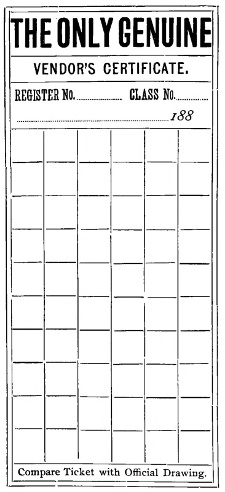
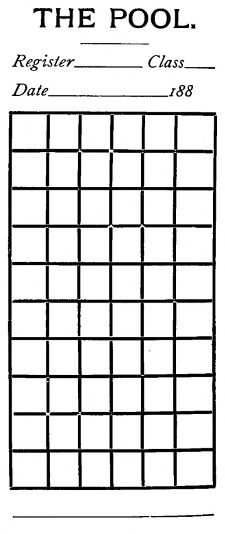
The “policy shops” and their proprietors are as follows:
“Pool,” proprietors Jas. F. Walsh and —— Conner.
“The Only Genuine,” proprietors W. K. Brown and Thomas Finley.
“Little Havana,” proprietor J. C. Jaudon.
“Palmetto,” proprietor Syke Thorne.
James F. Walsh is a wholesale liquor dealer. He has never kept a gambling house; is rated by Dunn or Bradstreet at $40,000 to $75,000; credit high; takes an active but silent part in politics; occasionally goes 503to a political convention, but has never run for office; is on the official bonds of the Probate Judge, Recorder of Mesne Conveyance, County Treasurer and (probably) Coroner of Charleston County. Though apparently of mild manner and address, he has killed two men; one a mulatto, for which murder he was tried and convicted, but soon bought a pardon from Moses, the robber Governor of South Carolina; the other was the killing of a brother Irishman, for which he was tried and acquitted with a verdict of self defense, which verdict created great talk in the city, it being in the opinion of the general public a clear case of manslaughter.
J. C. Jaudon is a bar-keeper near the S. C. Railway depot, worth with his brothers about $5,000; not rated in the commercial agencies—has only started “policy” this year. Syke Thorne is the most notorious mulatto gambler in the State. He has a bar-room, dancing hall patronized by abandoned women, “policy shops,” and several “chuck-a-luck” and small “faro” tables on Market Street, between King and Archdale Streets. He was “pulled” by the police recently, but though “lying low,” is again in the business. He is probably worth $5,000. In person he is good looking, dresses well, and is quiet mannered. He has never taken any prominent part in politics.
FARO BANKS.
The faro banks and bankers of the city are as follows:
Finley and Brown, 78 Meeting Street; faro, roulette and poker; dealers Dowling and Neisz. Elegantly furnished.
Charles F. Levy; faro, roulette, mustang and poker; dealers Conners and Levy. Although the finest rooms in town, they are temporarily closed for want of funds. Powers (M. W.) a well-known young Irish contractor and builder, holds the bank bill roll.
John Munro and Israel; roulette and faro; Munro and Israel, dealers. Neat but not gaudy appointments.
W. J. O’Dell and a partner; two faro tables, roulette and poker. Handsomely furnished.
A. M. Flynn, assisted by a woman who joins in the poker game, and occasionally deals faro.
Syke Thorne, with several negro assistants. Very small game at very mean tables.
As to whether the games are “skin” or “square” it may be said that any one of the Charleston dealers will put up a game on a drunken man with a large bank roll; but there are probably two of those dealers who will try to “skin” any and everybody.
Finley and Brown is probably the strongest backed house in the city, and it is not improbable that F. & B. back O’Dell, as he is not known to have much money of his own, and he deals at Brown’s old stand and in 504his building. Levy and Connor got temporarily to the end of their financial rope some months ago and have not resumed business yet. Munro and Israel do not play a very heavy game and would probably shut down after a loss of $400. They have no backers unless since very recently. Thomas Finley, the king of the gamblers, was a tinner by trade and took to the green cloth and occasional horse racing about 1858. He owns considerable real estate and is generally supposed to be worth between $30,000 and $50,000. He is the ideal gambler as far as liberality goes, and is exceedingly popular. He is generous and open-hearted and for ten years furnished all the coal for the use of the Seamdies Church; is not particularly smart except at his business; and has never been known to have had anything to do with politics, except to contribute to the campaign fund. He very rarely, if ever, deals faro, but plays considerable poker for small stakes. He is said to have won $15,000 betting on a recent Congressional election.
W. K. Brown is a butcher by trade and still continues at the business. He dealt faro for many years while running his stall in the market, but is seldom seen now in a gambling room and is very close and shrewd. His partner in the meat business is a very prominent Republican politicianpolitician and is now U. S. Marshal for South Carolina. Brown has never run for office and is probably too close to spend money for his friends’ political aspirations. He is married and has several very handsome children. Is supposed to be worth $50,000, which he inherited from relatives in England two years ago.
John Munro is the oldest gambler in the city and is about as honest as a gambler can be; is now poor, having been ruined by a reckless partner in Savannah some years ago. Has had several fortunes and spent almost as many years and dollars in ’Frisco as he has in Charleston.
The other dealers whose names are mentioned are all young men and Charlestonians, except Neisz, who is an Alsatian Jew. They have not made much money or reputation as yet. The most notorious of them is Charles F. Levy, the enfant perdu of a very respectable Jewish family. He shot a man in a bar-room brawl some years ago, and Levy’s neck was in considerable danger, but the man eventually recovered. Levy has squandered about $15,000, left him by his grandfather, in about three years. He is utterly without principle and is one of the best rifle shots in Charleston.
In conclusion, it may be said that gambling has been on the decrease for the last thirteen years in Charleston, except, possibly, in the small matter of “policy” buying among the negroes. Plenty of money was in the hands of the very class of men who would spend it over the faro and poker table during the years of misrule—1868 to 1876. One of the 505judges of the State at that time is reported to have been an ex-faro bank dealer and was certainly a great devotee of the game.game.
The only great business defalcation publicly known to have been caused by the passion for gaming was that of Bentham R. Caldwell, of a highly respectable family of the city, who in the year 1879 misappropriated $75,000, and expended it over the faro tables of Finley and Brown. Suit was brought and the case was carried to the Supreme Court qui-tam action brought by the plaintiff as a common informer to recover the penalty under sections 6 and 7 of the 79th chapter of the Revised Statutes of South Carolina, but the gamblers ruled the roast, as may be seen by referring to the case of Augustus S. Trumbo vs. Finley and Brown, as reported in the 18th (or possibly 20th) S. C. Law Reports (Strand’s), which probably can be found in any large law library.
GAMBLING IN AUSTIN, TEXAS.
Gambling is alarmingly prevalent in the capital of Texas. From the foundation of the city (in 1843) until 1870, Austin was a frontier town, where all the vices incident to places of that sort abounded and flourished, gaming being one of the chief. Since the year last named, while gambling may be said to have increased rather than diminished, it has not been so flagrantly open as in the earlier days of the city’s history. The introduction of “modern improvements” would seem to have stimulated rather than repressed the growth of the vice. The electric lights, which have replaced the “dip” candle of more primitive times, have served to render the “hells” more attractive to the young men who are to shape the destiny of Austin in the future. One of the most deplorable features of the existing situation in that city is the constant growth of the damning practice among the youth. The sons of the most influential and respected families are habitual frequenters of the gaming saloons and are rapidly becoming devotees of the soul-destroying habit.
The resorts are numerous enough and of sufficiently varied character to meet the requirements of all players of whatever class. The respectable (?) houses are three, of which two are devoted to “banking” and “short” games, and one to keno. These establishments are located in the center of the business portion of the city and on one of the principal thoroughfares. They are fully equal, in point of equipment and furnishing, to those which may be found in any Southern city of the same size. Besides these there are four or five “dives” in the lower and more 506degraded part of town, where “brace,” as distinguished from so-called “square” games, are at the very zenith of that fleeting success which accrues to the “skin” gambler when unmolested by the authorities. In addition to these public resorts, there are several semi-private poker games, nightly running, which are patronized almost exclusively by the upper classes.
With the exception of the keno game, all these houses are open day and night, from the first day of January until midnight on the thirty-first of December in each year. The keno house opens its doors two or three evenings each week, as the demands of its patrons and the prospects of business seem to justify. Saturday night, however, constitutes the great gala festival of this resort. Then it is that the room is crowded almost to suffocation with a motley throng of clerks, mechanics and day-laborers. It is on Saturday night, also, that the “dives” garner their richest harvest. In these dens of iniquity there gather on Saturday night, at certain seasons, the negroes from the cotton fields, whose earnings for an entire season, accumulated at a cost of toil, privation and suffering, which might well appal stouter hearts than theirs, are swept into the coffers of men in comparison with whom the tiger is merciful. These unreflecting children of nature never perceive that they have been victimized. To the last they believe that they have been given an equal chance of winning, and should the shark who had won their last cent offer them five dollars as a gratuity, they would be first and loudest in singing his praises.
In almost all the houses—whatever their class—faro is the game most in favor. In those which revel in the reputation of being “square,” the “chances” (sic) of success sometimes fluctuate, but the preponderance, in the long run, is always in favor of the bank. The “square” element in each instance is a variable quantity. In other words, if a player is reasonably conversant with “fake-boxes,” “strippers,” and all the other subterfuges which are to the professional dealer as his A, B, C, he may hope to be accorded something like an even chance. If, on the other hand, he is susceptible, verdant and gullible, his chances are correspondingly reduced.
A game somewhat similar to faro, known as “Mexican monte,” also flourishes in Austin. Perhaps its popularity is due to the propinquity of the city to the Mexican frontier. Forty-four cards are employed, the nine and ten spots being discarded. “Chips” are “barred,” and the players stake cash or its negotiable equivalent. The bank, too, is exposed, and is placed in the center of the table, and contains from $250 to $500 in silver, arranged in stacks of $20 each. The game is very fascinating, counting its devotees by scores, and a great deal of money is bet on it. The dealer deals from his hand as in poker, and it is supposed to be exceedingly difficult for him to “put up” a game, a belief that adds not 507a little to its popularity. There are from four to six “monte” games run in the fashionable Austin resorts.
As has been said, the private poker games are patronized almost exclusively by the elite.elite. In the public houses all classes may be found around the table—Americans, of high and low degree, Mexicans, and even Chinese. In fact, poker in Austin may be said to be a “fad,” a “craze.” Even ladies of the highest social standing may be found to whom the terms “ante,” “jack pot” and “bob-tail flush” are as familiar as household words. It is hard to overestimate the deplorable influence which this condition of public morals is exercising upon the young. From playing poker in the parlor to gambling in a “hell” is but a step, and a short one at that; and more than one family in the Texan capital to-day laments the downfall of one of its members through the love of gambling acquired by indulgence in “five-cent ante” under the refined surroundings of the higher circles of social life.
The proprietors of the gambling houses, as well as the dealers therein, are a power at the polls and particularly at municipal elections. In some of the wards they absolutely dictate who shall be councilmen. At every election they use money freely. Sometimes they become candidates themselves, as, for instance, three years ago when one of the proprietors of one of the largest gambling rooms and himself a faro dealer sat among the ten elected law-makers of the city. No policeman or other peace officer dares to enter these haunts without the permission of the proprietors; and even crimes of violence—short of murder—are not regarded as sufficient justification for a raid.
To say that gambling is the city’s curse is to state the situation mildly. Innumerable instances of blighted lives might be mentioned, the fundamental cause for which is to be found in the abandonment of the victims to this vice, pernicious as it is insidious. Within the comparatively short space of four years, five embezzlements by trusted employes have surprised the community. All the culprits were men of previously unblemished reputations. Five young men of the best families, two of them married, have been convicted of forgery and theft during the past two years, and are now serving their time in the penitentiary, all because of the gambling hells in the city. Three of these men held responsible positions. One was clerk of the United States District Court; one was in the postal money order department; another in the money department of the Pacific Express Company; another in the distributing department of the post-office. Young men visiting the city from neighboring towns and from the country are inveigled into the hells by “steerers” and lose large sums. Not long since a young man, a tax collector of an adjoining county, came to the capital to pay taxes due to the State. He was induced to visit one of the first class houses. He was drugged, and in a 508brace game lost not only his own money, but also that of the State. He returned home and blew out his brains.
It is among the working classes that the gambling mania is working irreparable injury and wrong to innocent women and children. Scores of laboring men, many of them of the better class, waste their earnings on Saturday nights in the keno rooms. Wages are gambled away and women and children go in rags and suffer for the want of food while the gamblers adorn their well-fed, well-dressed persons with diamonds.
There is a law against gambling in Texas, the penalty being a fine of $10 to $100. Three or four times a year the gamblers go into court, plead guilty and pay $10 and costs, amounting to about $37.50, and then continue their games. Two years ago the law was amended by adding imprisonment for from 30 to 60 days for exhibiting or dealing games; but only a few convictions have been had under it, and then the guilty parties were permitted to hire substitutes while the principals returned to their rooms and reopened their games.
GAMBLING IN HARTFORD, CONN.
In 1849 there was published in Hartford a book entitled, “The History of the Green Family.” It was an expose of the night side (and the worst side) of Hartford life at that time. Its quaint title page describes it as a work “wherein the citizens of Hartford are raked over from Lord’s Hill to Ferry Street.” Incidents, names, dates and localities are mentioned with an attention to detail as surprising as it is pitiless. A vigorous effort was made by the “good people” of the city whose peccadilloes were thus mercilessly exposed to suppress the volume, and at the present time there are only one or two copies in existence. The writer, however, has been permitted to examine one of these, and accorded the privilege of making notes.
Gambling, as a profession, was not at that time carried on to nearly so great an extent as in later years. But the gamester, the blackleg, the men who lived by their wits and fleeced unsophisticated victims were even then known and described. The “Climax,” a locally celebrated gaming house, then flourished on Ferry Street and was kept by “Nels” Hulburt, is mentioned. A bowling alley and a bar were connected with it. All the ordinary games of cards were played, “old sledge” being an especial favorite. “Nels,” or his partner, Weeks, generally took a hand and the “house” did a prosperous business. This resort divided 509with the Clinton House the patronage of nearly all the players, both professional and occasional, among whom are mentioned Caruthers, a man named Judd, and a confidence operator known as Dan Osburn. “Nels” also had a place on Mulbury Street.
Gambling steadily increased in Hartford, attaining the culmination of its popularity during and just after the war. Names and dates can be obtained only through a long and tedious search through court and police records, but the following general statements are made on the authority of a veteran officer, who for more than a score of years has been connected with the Hartford police. From about 1862 till 1877, gaming ran riot. Houses in which large capital was invested were conducted with scarcely a pretense of secrecy, and the profits of the proprietors were enormous. Almost any one who wanted to “do” the city by night could visit in the course of an evening half a dozen places where roulette was in active operation and twice as many where poker and faro were being played. The famous gambler, Pat Sheedy, was a native of Hartford. A perfect gentleman in manners and dress, yet a most reckless player, he was apparently equally content to win or lose a fortune in an evening. His “management” of John L. Sullivan is fresh in the memory of the public, as is also the story of his large winnings at roulette in a Saratoga resort less than a year ago. He occasionally appears in Hartford, and his goings and comings are duly noted in the local press.
But to return to the history. A single incident will show something of the magnitude of the gaming operations in the sixties and early seventies.
A large fire on Temple Street, almost within a stone’s throw of the Police station, during the winter of 1872, burned out an extensive gamblinggambling establishment. The “lay-outs” for faro and roulette were flung out of the window. All the tables, dice boxes, counters, chips, the roulette wheel, etc., were of the most costly description, The police gathered up the debris, and a conservative estimate affixed the value of the property thus sacrificed at $3,000.
From that time the police were more active. Raids became the rule rather than the exception, especially from 1879 to 1886. Two years ago, one of the last important visits by the officers was made, under supervision of Lieutenant Ryan, on a gaming house on Gold Street, kept by a man named McLean, who originally came from Meriden. He was running an extensive faro bank, with a gambling outfit worth about $600.
Not long afterwards a raid was made by the police upon a Chinese opium joint and gambling house on south Main Street, in the Buckingham block. About a dozen of the celestials were arrested, arraigned and convicted of gambling, and two were found guilty of keeping a gaming house. The game in progress at the time was played with dice and was 510a peculiar one. The player deposited any amount of money with the dealer, who gave him a receipt therefor. The game then went on until the bettor’s money was exhausted, or until he had won a stipulated amount, when he was at liberty to withdraw. Slips of cardboard were substituted for chips. There were found three Fan-Tan tables and six opium layouts in this place.
Poker has always been and still is played in Hartford; but not to nearly so great an extent at present as it was a few years ago. For years a game was running in the Times building. A dark, heavily mustached man who called himself Dr. Longley, kept the room. The police got after him and he was obliged to leave rather hastily. The game is played largely in what are popularly known as “club rooms.” However, even those are not doing a very brisk business just now. One can also easily get into a game in several of the fashionable billiard and bar rooms, such as “Mattie” Hewins’, or Dwight Mitchell’s on Main Street; or Frank Avary’s on State Street. Probably the heaviest poker playing in Hartford, however, is carried on at the Hartford Club House, on Prospect Street. This is where the older, wealthier and more aristocratic men play. The organization is a rather select one, and its roll of members includes some of the richest and best known men in town. It is in no sense a gambling house, yet at the same time there is a great deal of heavy betting across the social card tables.
So far as is known there is no roulette played in Hartford at present. The police have been too watchful for these gentlemen to prosper and they have sought other fields.
“Policy” is played to a large extent in the city, and seemingly with but little fear of the law. The head-quarters for this form of gambling is in a little room, opening off the side walk on Front Street. Anyone passing can see through the open door, the black-board on which are posted the numbers at every drawing. James Waldron, formerly of New York, a short, thick-set man, about 40 years of age, is at the head of the operations in Hartford. Besides the place on Front Street, he has another on Gold Street, and yet a third on Asylum Street. In the Front Street place is kept a large flat book, in which is recorded every drawing for the entire year. This is open to the inspection of all players who are permitted to trace in its pages the history of any number throughout the year—i. e. ascertain how many drawings have occurred since it last come first, etc. The numbers are received twice a day by cypher dispatches. Apparently everything is “square,” but the chances are enormously against the player. This is the most popular of all games with the colored population. It would seem as though every member of that race in Hartford played policy. There is also a considerable class of superstitious 511whites who firmly believe in “lucky” numbers. Once in a while some one “strikes” a lucky number, but no considerable amount is ever made.
Charter Oak Park, just outside the city limits, is the scene of the fall race meetings in the grand circuit. Roulette is played on the grounds on these occasions, without the slightest restraint and in full view of the police. The games do an immense business through “race week,” not less than two wheels and five tables were in full blast at a recent meeting.
There is a stock exchange in the city and some speculative operations are carried on, but not to any great extent. Hartford is too near New York to permit of the business being profitable.
On the whole, it may be said, that as compared with fifteen or even ten years ago, there is very little gambling in the city. Professional gamestersgamesters have to “lie low” and keep extremely quiet in Hartford. At the same time, there is, as has been said, considerable poker playing, while probably there are two or three faro banks still in operation. There are no municipal ordinances against gambling, all actions are brought under the State Statutes.
GAMBLING IN QUEBEC.
Quebec being a city of only some 60,000 souls, the vice of public gambling has never been able to obtain any very firm foothold. A large amount of money changes hands here every year at games of chance, and amongst the most confirmed gamesters are many of the most prominent citizens. Yet so thoroughly does everybody know his neighbor’s business that no attempt has been made of late years to open and maintain a public gambling resort. Much of the playing for stakes in Quebec takes place in private residences, or in rooms secured for the purpose in the principal hotels and restaurants. In the principal club—the Garrison—gambling of every kind is strictly prohibited and nothing but whist is played.
Banking games are not popular, and faro, roulette and hazard are not played at all. Poker is the prevailing game and of late years, and has taken a strong hold upon the French-Canadian population, who evince an unusual aptitude for it. So long as they have in reserve a fair supply of “chips,” French-Canadian poker players excel at the game of “bluff.” They possess in a remarkable degree the effrontryeffrontry and cool “cheek” necessary to successful poker playing for which they manifest a predilection almost from childhood. Professionals and merchants alike gamble at night at their clubs or at each others residences, and students and clerks, imitating the practices of their employers and elders, assemble for the same purpose in each other’s rooms.other’s rooms. A well-known Canadian politician, confided to the writer that at the early age of ten years he had become 512so infatuated with poker that he used to steal money from his father’s pockets with which to play. The ruin of numerous bank clerks and others formerly occupying respectable positions in the city, may be distinctly traced to this cause.
The principal center of gambling in Quebec is undoubtedly the “Quebec Whist Club,” an institution occupying comfortable quarters over Rogers’ drug store,—the Medical Hall on Fabrique Street. It has been in existence for nearly twenty years past, but has several times removed its location. There is nothing “professional,” however, about this organization. Its name is, of course, simply a cloak for the real object of its existence. It is controlled on a sort of mutual plan by the resident frequenters of the place, and strangers and visitors are only admitted after introduction by a member. The game almost universally played is poker, and the stakes may be either unlimited or for a limit varying from two to five dollars. The game played here is usually “straight,” in the ordinary acceptation of the term, but the older habitues of the place, some of whom have no other visible means of support, are such adepts at the game, and, in the particular species of mind and character reading so essential to a successful player, that unless struck by a particularly hard strain of bad luck, they seldom rise from the table losers at the game should such a misfortune by any chance overtake them. They know only too well, by long experience, that the winners of their money will quickly return to lose it again.again. There are not wanting those who claim to believe that the more experienced of these frequenters of the “club” never play against each other except as a “blind,” but combine to “raise” strangers out of the game and divide their profits. Many well-to-do business men frequent the club, including newspaper proprietors, importers, wholesale merchants, hotel men, piano dealers and jewelers. Few of these, however, continue to play at the resort for year after year, unless in a very occasional way, for the amount of loss eventually sustained by them would either seriously impair their business standing or compel them to abandon the game until they can again legitimately afford to risk further means in playing it.
The number of men who have been wholly or partially ruined by poker in Quebec is large. An ex-member of parliament, formerly a resident of that city, but at present of Montreal, has lost a fortune at the game, frequently dropping as much as $1,500 a night. The continual harvest reaped by the habitual frequenters of the club above mentioned is maintained by the infusion of new blood through the introduction of new members, who are generally selected from among those who are known to be possessed of some means, and of speculative, if not gaming proclivities. If such are not known to be poker players they are, perhaps, invited to the rooms in the first instance, by a friend, for the nominal purpose of 513partaking of refreshments, to which may be added the prospect of enjoying a rubber of whist. The excitement, glitter and attraction of the poker tables are counted upon, and generally correctly, to prove a sufficient temptation to green players to risk a few dollars upon a small limit game, “just for amusement.” The downward course of the visitor, like the descent of Avernus, is thenceforward comparatively easy. Half a dozen members of parliament and as many members of the city council have been counted in these apartments at the same time. Quebec does not by any means supply all the victims. A sharp lookout is kept for visitors with money and gambling tendencies, though occasionally the habitues “catch a tartar,” and get “hoist by their own petard,” through occasionally admitting an unknown blackleg. This does not very often happen, however, as may be easily supposed, in view of the long experience of the older members. They are usually careful, moreover, in admitting only men of prominence or of recognized standing in professions, political or commercial circles, or who are personally known to some of the regular members of the club.
Acquaintances of members who may be guests at the hotels are often visited in the evening and invited to the club, and now quite a number of prominent business and professional men and politicians of Montreal and other cities are frequent visitors when in town. Commercial travelers fall an easy prey and have been repeatedly introduced to the rooms by their Quebec customers. From time to time scores of these young men have been ruined here, rendered desperate by their losses, and stranded “high and dry,” after losing all their own available means, and very often a good deal of which was not theirs as well.
One of the worst features of this club is the large amount of drinking that goes on during the games, spirituous liquors being provided in abundance and to be had for the taking.
An immense amount of money has been lost in Quebec on exchange gambling of various kinds. For some few years past, bucket shop gambling has been a popular pastime with people of wealth, and, unfortunately, often many not possessing the necessary means of their own. So far has this business been run into the ground for some time past, however, that many of the bucket shops have been closed in consequence of the small amount of trade offerings, most of their clients having been entirely ruined. Four or five years ago, fully five times as much fictitious and illegitimate business was done on the Quebec Exchange as of real and bona fide transactions. Even now, a good deal of speculation akin to gambling goes on, such as buying and selling,—going long and short on bank and other shares, corn, wheat, pork, oil, etc.,—all on margins. The volume of such business transacted in the city at present is about equal to that of legitimate dealings.
514GAMBLING IN KANSAS CITY, MO.
There have been no public gaming houses in Kansas City since 1882, when the Missouri legislature passed a bill commonly known as the “Johnson Law,” from the fact that ex-Governor Charles P. Johnson was its author. This statute made the keeping of a gaming establishment a felony. The effect of the law was to drive the professional gamblers of Kansas City, Mo., into the adjoining burg of Kansas City, Kas., where they remained unmolested until a comparatively recent date.
The town on the west bank of the river soon became the recognized “haven” for members of the fraternity. The faro banks were clustered together just a few steps across the State line, where they received a liberal patronage from the residents of the Missouri town, who had become as it were, thoroughly saturated with the instincts and habits of the gamester.
The proprietors of the packing houses objected to the location of such establishments within the precincts of their business, because of the convenience of such locations to their employes, who constituted a considerable proportion of the patrons of these “hells.” Among those who remonstrated were the representatives of Armour & Co., who were quick to perceive the disastrous effects which the running of the game was producing upon their business interest. For some years a bitter fight was waged upon this issue. It soon, however, became apparent that the gamblers exercised a controlling influence upon the action of the city and county officers, and the packers abandoned what promised to be a profitless warfare.
The laws of Kansas make the keeping of a gaming house a misdemeanor, and the proprietors were regularly fined—even without the formality of an arrest—a large revenue being thus realized by the city. For many years it was an open secret that the chief of police and prosecuting attorney of Kansas City, Kas., received a regular stipend from the gamblers, the money being paid and accepted in consideration of an uncertain guarantee of immunity.
Public sentiment, however, at length became aroused, and at the municipal election held a few years ago, officers were chosen who were pledged to enforce the laws against gaming.
Before the passage of the Johnson law to which reference has been already made, Kansas City was a veritable Mecca for sporting men. Along in the 70’s—in the palmy days of gambling—when the “wide open,” “everything goes,” policy prevailed there were eleven gaming establishments in the town, all of which were doing a most prosperous business. Stakes were high, and the gain or loss of $10,000 at a single sitting called forth little comment among the sporting fraternity.
515The Johnson law, however, gave the signal for a hegira of gamblers to the western side of the State line, and its enforcement on the Missouri side of the border has been so perfect that openly there has not been a card run from a box, or a turn called since its passage.
In the halcyon days of gambling in Kansas City, the place was filled with men who had rapidly acquired fortunes in the mines of Old and New Mexico, and Colorado, and in the raising and herding of cattle on the plains. Such men flocked here to gamble, and the “professionals” from the far west came and made this town their headquarters in consequence of the number of dupes who had gathered here. The “capitalists” who made Kansas City their headquarters were allured thither by the prospects of “beating” the “banks,” the number of which steadily increased by the constant accession to the ranks of the players.
At the time of the exodus of the gamblers across the State line there were eleven establishments in the city, at three of which “brace” games were played. Faro was the favorite, but “poker,” of the “stud” variety, “roulette,” and “chuck-a-luckchuck-a-luck,” were not neglected. About fifty men were employed in these houses, and each “bank” was supposed to possess a “roll” of about $5,000. At times the game ran high, and $2,000 and $3,000 were often won or lost by a single player.
There are now, just across the State line, seven gambling houses, two of them owned by Clayton L. Maltby, one by Frazier & Baughman, one by Cotton & Kennedy, one by Gus Galbaugh, one by Joe. Bassett, and one by Tom Wallace. These houses are all conducted on the “square” principle, and besides faro, have all the “side” games—roulette, hazard, craps, stud and draw poker. The games open at eight o’clock A. M., and often run until daylight the next morning. They are well patronized, and Saturday and Monday nights the rooms are crowded, Saturday and Monday being pay days at the packing houses, manufactories, and other establishments that pay their men weekly. To give the reader an idea of the amount of money these houses have a chance to win, or rather steal, per month, a statement by C. L. Maltby, the principal “banker” of Kansas City may be mentioned. Mr. Maltby has two houses, and is of a calculating and methodical turn. He desired to know exactly what money was exchanged for checks and played against the faro game at one of his houses within a given time. He employed a man to set at the table, from the time the game opened until it closed for the night, and keep an accurate account of the amount paid in for checks. This was kept up for one month, and the grand total amounted to $63,843.75. This money was mainly “changed in” in small amounts, the purchases ranging from $1 to $50, and one individual, at one time, buying $100 worth of checks. Of course Maltby’s game did not win all this money, 516but the greater part of it found its way into the drawer, and went to swell the bank account of the proprietor.
Among the crowds that throng these rooms you will find the gentleman, the tough, the “Rounder,” and the “Macer.”
The plan pursued by the Kansas City, Kas., authorities to “suppress gambling” is thus described in a daily paper, under date of August 2, 1889:
“Three gambling houses in Kansas City, Kansas, were ‘raided’ by the police last night in the periodical Wyandotte style. The Chief of Police, accompanied by several officers, went to C. Maltby’s place and found thirty or more men gambling. Their names were taken down and the proprietor was required to deposit $10 apiece for his visitors and $100 for himself as security for their appearance in the police court to-day. The police then went away and the gambling was immediately resumed.resumed. At G. F. Frazier’s twenty-six men were playing and the proprietor paid $300 to the officers. This morning Frazier, Galbaugh and Maltby appeared in the police court and were formally fined the amounts they deposited. This is the manner in which gambling houses are, to all intents and purposes, licensed in Kansas City, Kas.”
Although public gaming has been checked in Kansas City, Mo., the amount of private gambling is enormous. At the Midland hotel, the best in the city, where wealthy stock men from the far west make their head-quarters, draw poker is a favorite amusement. It is played, however, with the utmost secrecy, but generally for high stakes. At the rooms of the Kansas City club, and other similar organizations, the same game is indulged in, although the stakes are as a rule comparatively moderate. Perhaps the most deplorable feature of the situation, however, is the alarming extent to which the game of draw poker is played in private houses—even those belonging to the most fashionable and exclusive social circles. It is asserted by those who are competent to speak upon the subject, that the love of play has permeated almost every stratum of society.
Apropos of gambling in Kansas City, the following story of one of the clubs in that place, is told: An Eastern merchant (rumor says that he came from Boston) once found himself a guest at a leading hostelry in that city of dust, hills, and grip cars. Being inclined to play a “little poker,” he inquired of the urbane hotel clerk where he could find a “gentleman’s game.” In due time he was introduced into a private “club room,” where the proclivities of the poker-player might be gratified by a “no limit” game. Of course the frequenters were all “gentlemen;” gentlemen, however, of that peculiarly whole-souled variety who would throw a drowning “sucker” a bar of lead as a life preserver. The man from the “hub” played for several hours, and rose from the table a loser to the amount of about two thousand dollars. He was 517exceedingly wroth, and was fully persuaded that he had been cheated, although he was not able to tell exactly how it had been done. He discharged this Parthian arrow, however, at the crowd, before taking his departure. “Gentlemen,” said he, as he stood before them, hat in hand, “I was assured that I should find this a ‘gentleman’s’ game. You are all gentlemen, and I know it. I appreciate the way in which I have been treated, I appreciate it thoroughly. I’ve got a few dollars left, and if some one of you will be kind enough to tell me where I can sit in a horse-thief’s game, I believe I’ll go around there.”
GAMBLING IN BUFFALO.
Buffalo has not been cursed with such a growth of the gambling mania as have some other cities of similar commercial importance and whose floating population has been so transient and so varied. It has never received the implied sanction of public sentiment, as in New Orleans; the gaming resorts of the city lack the luxurious elegance of some of the gilded hells of New York; nor have the blacklegs ever dominated the municipal government to the same extent as in Chicago. Yet the history of the practice of the vice is not destitute of interest, presenting, as it does, a varied succession of alternating ups and downs.
During the decade between 1850 and 1860, Buffalo was known all over the country as a “tough town.” Situated as it was at the Southern point of the chain of great lakes and being the terminus of the Erie canal, it was the natural rallying point of thousands of men belonging to the “rough and ready” class, from which the dens of those drew a majority of their patrons. In those days it was as little condemned by the easy-going citizens as it was interfered with by the authorities. Along the wharves and at the sailors’sailors’ boarding houses, games of chance constituted the principal pastime, among them “penny-ante” (i. e. poker for small stakes) being a prime favorite. Sometimes higher stakes were wagered, and occasionally a faro “lay-out” was improvised.
At present gambling in Buffalo is trivial when compared with the early days of the city’s history, when the lake traffic was the principal source of its growth and the vast fleet of small craft brought hundreds of sailors from the West to compare experiences with canal boatmen from the East. In those early days, Buffalo was full of sporting men of all classes. It was the chosen rendezvous of prize fighters and its proximity to the Canadian border rendered it attractive to that class which for various causes, did not feel safe on American soil.
Such being the state of affairs it is not surprising that gaming rooms multiplied only too rapidly. To use the expression of an old resident, 518“faro rooms, keno rooms, poker rooms, and general gaming rooms, were as thick as sand flies, and ran in all their glory, in full blast day and night, without the slightest attempt being made to put the least check on this fascinating occupation by the authorities, many of whom were as deeply interested in it as the professionals themselves.” Fortunes were made and lost in a day at that time. Money was plentiful and wages good, and Buffalo soon acquired an unenviable reputation, which brought hundreds of unwelcome visitors to the city. That notorious highway, Canal Street, was then in the zenith of its prosperity and debauchery ran riot.
It was just before the war that gambling received a new impetus and the “palmy days” of which old gamblers are fond of speaking, were from 1859 to 1866, when the sports held high carnival. The public pulse was at fever heat, and the excitement which pervaded all classes of the community found a vent in seeking the alluring fascination of the green cloth. Buffalo might boast of several professional gamblers, who were then or subsequently became celebrities of various degrees. Gambling houses were numerous and open.
But as the number of railroads centering in the city increased and a better class of people became residents, public sentiment gradually became aroused, and the blacklegs soon found that the political influence which had formed their chief reliance was beginning to wane. Gamblers came to be looked upon as social outcasts, and the hells were vigorously denounced by the press and from the pulpit. Nevertheless the laws respecting public gaming remained unenforced, and rascals continued to fatten upon the credulity of their victims.
In 1866 the first effective blow was struck at the vice, and it proved the first of a series which finally brought about almost the total extermination of gambling in Buffalo. The Niagara frontier police was organized that year, under a State law, and the loud cry of the better element of the community that the law be enforced was at last heeded. All gaming rooms were ordered closed, and those resorts whose proprietors refused or neglected to comply were promptly raided and the offenders punished. As the police perceived that their efforts were endorsed by public opinion and commended by the press, they grew more and more severe, and gambling entered upon a period of rapid and steady decline. The most stubborn resistance encountered by the authorities was during the annual races, when the city was filled with men who “lived by their wits.”
While the Frontier Police, however, did excellent service in the cause of law and order, they appeared to lack the knowledge necessary to enable them to achieve entire success. Besides this drawback the municipal ordinances applicable to gaming were carelessly drawn, and many of 519the prominent gamblers, through the aid of superior legal advice and the aid of local politicians, were able to evade the penalties meted out to the “smaller fry.”
In 1870, when the Niagara Frontier Police passed out of existence and the Buffalo City Police was organized to replace the constables who had previously done duty, a rigorous policy toward gambling-houses was adopted. Even pool selling at the races was checked, although it was found impossible to put a stop to it altogether, owing to technical imperfections of the law, which afforded loop-holes for escape.
From 1872 to 1878, the city authorities seemed to be determined in their resolutions to suppress the vice. During these half dozen years, the houses were very few; and the proprietors did not dare to openly solicit patronage. The owners were men who enjoyed—for men of that class—a good reputation; that is to say, that as far as a professional blackleg can be “square,” they enjoyed that reputation.
The immediate cause for this renewal of activity on the part of the authorities was to be found in the fact that the gamblers were not only permitting, but even encouraged, young men, clerks, students and even schoolboys to frequent their rooms. Public sentiment was clamorous in its condemnation, and the city government was, in a measure, forced to take the bull by the horns. The practical results of the agitation may be thus summarized: The number of the houses was reduced, only the more respectable professionals were permitted to carry on business; “steerers,” like Othello, found their “occupation gone;” and only avowed gamblers or men who were popularly supposed to be able to lose were permitted to play. In a certain degree, the rooms were under the supervision of the police.
With each change in the city administration, however, came the inauguration of a new policy. Thus, in 1879, the gamblers’ dens were more liberally treated and their business improved, while from 1880 to 1882 the laws were more stringently enforced. In 1883 gambling again enjoyed a “boom,” and for a time threatened to regain its foothold and flourish as in the days of yore. The local government put forth no effort to prevent gaming, and numerous rooms were re-opened. Faro and poker enjoyed a steady patronage, which, however, during the racing season they had to divide with an occasional keno game. The gamblers were encouraged, and openly predicted that gaming was again about to become popular. Public opinion, however, spurred by the perpetration of several embezzlements and minor crimes which were traceable to gambling, brought about a change. Gradually the sporting element found Buffalo a less and less attractive field of operations, until at the present time there is not a faro game in the city, although faro is occasionally dealt outside the city limits at a road resort in the town of Cheektowaga, while gamblers of the 520“skin” variety are said to hold full sway in the town of Tonawanda, about fourteen miles distant.
Poker is still popular in Buffalo, but the men who were the “shining lights” of the fraternity in former years, have either sought “fresh fields and pastures new,” or retired from business to enjoy life. Of the latter class, however, there are but few.
There is, however, a very considerable amount of gambling yet going on which no effort is made to suppress. In the fashionable club houses into whose sacred precincts no agent of the police would ever think of entering, poker is a favorite pastime, and at times stakes run high. The members of these organizations usually belong to the wealthier classes, merchants and professional men predominating. The presence of unintroduced strangers is not permitted, far less, desired. In consequence, to obtain legal evidence of gambling in these houses is difficult, if not well-nigh impossible.
One case, however, was brought to public notice some years ago, which opened the eyes of the public and confirmed a previous suspicion that all was not known of the inner workings of these club houses. The case referred to was that of a reputed millionaire, a manufacturer and a bank president. So far as could be learned, he did not commence gaming until he had reached mature years, but—as in the case of men who do not commence drinking liquor until after they are 30—the infatuation of the habit seizedseized upon him with irresistible force. He yielded to the allurements and was a nightly visitor at the club rooms. What games were played by which this man was ruined, can be better imagined than described, but his losses were heavy and so frequent that in spite of his almost unlimited wealth, the final crash came which nearly ruined the bank of which he was president, and his clothing business was completely wrecked. He was burdened with an extravagant family; his wife was notorious for her weakness in this respect; his sons and daughters were allowed freedom in money matters which made a terrible drain on his income. He was naturally a generous man, genial in disposition and always ready to excuse the failings of others. His generosity was proverbial, owing perhaps to the general opinion held of his class (Hebrews), who are seldom troubled in this way. He was born in this country and became rich by his own efforts. He was of a nervous disposition, and in conversing with him a close observer would notice quick movements which are peculiar to all gamblers. After his financial ruin he became insane and died a physical and mental wreck.
To mention any other names of men of this class might be to do them an injustice, but there are doubtless fifty or sixty “young bloods” who frequent club-house gaming tables. Who they are, no definite idea 521could be arrived at without long and constant watching of these houses, and even then the innocent might suffer with the guilty.
The experience of gambling with municipal authorities is outlined above. Public opinion as a whole, always has opposed gambling in Buffalo, and that it flourished was mainly due to the fact that public opinion is slow to exert itself here, and consequently, careless officials, in the past, were not held accountable for their neglect to suppress the evil. It is hard to say if the gamblers have ever been protected through the bribery of the police or other officials, but one thing is certain that in thethe history of gambling, money has never been demanded from gamblers by officials, except in two or three alleged instances; proof of which, however, was never forthcoming.
GAMBLERS, PAST AND PRESENT.
The list of Buffalo’s gamblers numbers men who, in the “good old days” of gambling were famous throughout the country and who acquired wide reputations, principally for skill as gamblers or for their character or peculiarities. Among the pioneers of gambling in Buffalo, was William Carney, better known as “Gentleman Bill,” or plain “Bill.” Carney was a Buffalonian of good family, who began his career as a gambler when quite young. At the age of 20 he was known as one of the most expert dealers of faro in the country, and all his life he was noted for his suave manners and nerve under all circumstances. Carney made a fortune and, like many of his fellows, died poor. For 40 years or more he ran the principal gambling den in Buffalo, and his rooms were the resort for the most noted gamblers in America. Faro was the game most played, and among Carney’s customers were men who 30, 20, or 15 years ago, were looked upon as Buffalo’s foremost citizens and prominent business men. Judges, lawyers and city officials are said to have frequented Carney’s rooms and he often related that, when gambling was at its zenith, he threw away the key of the door and “everything went.” Carney was a thorough gentleman in manners, a fascinating story teller and a great lover of prize-fighting and other sports. He was a professional gambler and not until a few years ago did he condescend to play poker to any extent; faro was his game and both the single and double box were used in his rooms. The writer knew Carney intimately for several years, and can testify to his good qualities. He was generous, and no man ever asked him for aid who did not get it, if he was worthy. Carney’s greatest enemy was himself, and of late years, his passion for liquor, coupled with the reckless conduct of his two sons, gradually brought about his ruin. His health failed and rheumatism and dissipation caused his death a few months ago.
522The name of Timothy Glassford stands among the foremost of professional gamblers in the United States. He was, excepting Carney, probably the oldest professional gambler worthy the title in Buffalo. For 40 years or more he maintained an elegantly furnished house and dealt faro to the city’s “best and most prominent citizens,” as they were recognized by the general public. Glassford was the only gambler who was at any time a power in politics and he is credited with having exerted considerable influence not only in local but in State politics. Glassford made a fortune which at one time was estimated at $200,000 (about 1867). He died a few years ago leaving an estate worth $80,000, which includes three stores on Main and Eagle Streets. This estate, or the larger portion of it will go to a son. Glassford was well educated, spoke several languages and is said to have prospered because he was an ardent student of human nature. His reputation is that of an expert at faro dealing, a great bluffer at poker, and his games are said to have been square.
“Oat” Forrester, is another of Buffalo’s old-time gamblers. In his day he was the dude of the fraternity and took great pride in being faultlessly but neatly dressed. At times he wore diamonds worth $30,000, and he seldom paid less than $75 for a suit of clothes. He kept a faro room which was much frequented by young bloods. As a rule his games were square though the brace game was played at intervals, especially during race week. ForresterForrester about 20 years ago was worth probably $25,000. His health failed and he bought a house at Fort Erie, Ontario, where he lived until about four years ago, when he removed to Chicago, and is now said to be living with a daughter, financially ruined and dependent upon others.
“Pige” or “Judge” Darling was another Buffalo faro player of note. He was a distinguished-looking man at middle age, and a brilliant conversationalist. He played at various rooms, was a large winner but a spendthrift.
James McCormick is another who some years ago was one of Buffalo’s notables. Naturally a gambler he was for several years successful in “hitting” faro. Finally with a few hundred dollars he drifted West and then to Chicago and New York. To-day he is known throughout the country as owner of one of the celebrated strings of trotting horses, which yearly win for him considerable money. It is said that McCormick gambles occasionally.
Adam Clark, an English Jew, was a noted gambler. He owned a large tract of land on Main Street, until recently run as a pleasure resort and known as “Spring Abbey.” There is a brick dwelling there, in which he used to preside over faro and poker games. It is said that Clark catered only to the rich and that a “brace” or dishonest game was never played in his rooms. In 1860, Clark probably was worth $100,000, but 523through illness, his affairs were neglected and at his death his estate was so involved that lawyers got the lion’s share. Curiously the property, for years the home of the gambler, is now the “Home for the Friendless.” Clark’s credit among gamblers, bankers and merchants was good and he could borrow thousands, giving only his oral promise to pay. A Buffalo ex-gambler states that Clark never failed to pay a debt and that several times he was loaned $5,000 or $10,000, and on one occasion $15,000 for which his note was not asked—his simple word of honor being sufficient security. Clark was charitable and it is said that he gave to needy institutions, etc., on an average $2,000 a year.