PART I. (continued 2)
Reading edition
The fact that I was contemplating issuing the present volume became known to some members of the “profession” in Chicago a year ago, and on June 27, 1889, about ten o’clock in the forenoon, I was arrested by detectives Kehoe and Flynn, without the shadow of a charge having been preferred against me. For five hours I was deprived of my liberty. What a commentary upon the nature of the relations existing between the “profession” and the custodians of public morals.
In this connection I desire to return thanks to John Cameron Simonds, Esq., and Mr. Matthew W. Pinkerton, of Chicago, for their generous intervention in my behalf. To their kind efforts I owe my speedy release.
64During my lifetime I have thus far been called upon to mourn the loss of father and mother, three brothers—Dick, Robert and Victor—and two sisters—Laura and Roma. Of eight children, but three of us survive, George Sidney, who still lives in Randolph County, Missouri, where he was born and reared; Hatsel Seldon, at present at Hot Springs, Arkansas, and myself.
To the press of Chicago, which so kindly encouraged him in his early ventures in the lecture field, the author desires to express his grateful acknowledgements. Unknown and friendless, he felt the timidity incident to one inexperienced in public speaking, and who carried in his breast the knowledge of his own past wrong-doing. But the journals of the city in which he made his maiden effort, those leaders and exponents of public sentiment, sustained him, and their words of commendation imparted to him fresh courage.
I hardly know how better to close this recital of a part whose shameful recollections might well overcome a stouter heart than mine, than by the following quotation from an old verse-writer, which have long floated through my memory. They present, in homely language, a truth which strikes a responsive chord in the heart of every man who is not panoplied in serene satisfaction with his own virtues. The lines run as follows:
“Thou may’st conceal thy sin by cunning art,
Which will disturb thy peace, thy rest undo;
Yet conscience sits a witness in thy heart;
And she is witness, judge and prison too.”
65
THE THREE STAGES OF A GAMBLER’S LIFE.
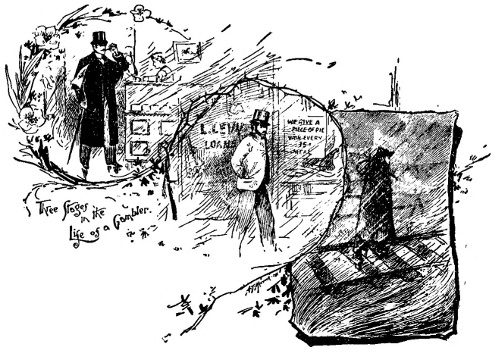
The foregoing illustration presents, in a form calculated to strike the eye and impress the mind, a view of the gradations in the downward career of a gambler.
Starting out, with high hopes of pleasure to be derived and wealth to be gained through a life devoted to the ruin of his fellowmen, he boldly enters upon the way whose end is death and whose steps “take hold on hell.” Costly is his attire and elastic his step as he at first ventures upon the road whose path is a quagmire and whose downward course is beset with thorns.
As he advances, he finds the declivity growing steeper; his feet are sore and his raiment torn. Too late he perceives his error, and realizes that it is far easier to descend than to climb the tortuous, slippery path. The illusion is dispelled; the glamour has gone out in darkness. No longer the jovial, roystering, “hail-fellow-well-met,”—he has become the midnight prowler, dependent for his very subsistence, upon the scanty earnings which he derives from the percentage doled out to him by more prosperous members of the same villainous craft for betraying the confidence of his friends and luring the unwary to their destruction. He realizes his situation, only to curse it; he would retrace his steps if he knew how, but his chosen sin holds him with a grasp as close as the coil of the deadly anaconda.
66In the figure of the forlorn tramp, a destitute, penniless wanderer, a pariah and an outcast, we see him approaching his wretched end. The pitiless storm that beats in his face is but the sighing of the summer wind as compared with that which rages in his breast. The wind that howls in his ears seems to chant the requiem of home, happiness, hope, honor,—all that men hold dear. And yet he must go on; on, into the blinding sleet; on into the unknown future; on, until he reaches the Potter’s Field; on until he stands before the bar of God.
Certainly it can be no mistake to call such an one a “fool of fortune,” a fool enslaved by his own degraded instincts and besotted passions, a fool who, in the words of Scripture, “has said in his heart there is no God.” But professional blacklegs are not the only “fools of fortune.” The young man, just entering upon the path of life; the middle aged man of family, who squanders at the gaming table the money which should go to buy luxuries, comforts, perhaps even necessaries for those dependent upon him, the old man, who, about to sink into the grave, finds it impossible to overcome the fascination of the vice which has reduced him from affluence to penury—these, one and all, are fools. The savings of a lifetime, dissipated in an hour, the cherished hopes of years blighted by the turn of a card—these are every day occurrences in the hells where one class of fools worship “Fortune,” and another class delude themselves by the belief that it is possible for money dishonestly acquired to bring with it anything but a curse.
It is with the hope that those who have not already entered upon this course may be deterred from entering upon it and that those who may have already tasted the false pleasures of an unhealthy excitement may be induced to pause before it is too late, that the author has made his frank confession of his own follies and his revelation of all the secret arts of the gambler’s devil born art.
67

PRELIMINARY REMARKS—FOOD FOR REFLECTION.
Only gamblers defend gambling. Those who play faro, roulette, hazard; those who buy mutual pools or “puts and calls;” and even those whose instinct for gaming is satisfied with a partly legitimate business, go on with their practices without an analysis of their actions. It is the object of this work, not only to trace the history of gaming, so far as is recorded, but to expose to the mind of the most casual reader the sophistries upon which the art of gambling is based. In other words, the author will show that if men seek for happiness in games of chance they find sorrow; if they hope for gain, they fall into penury; if they flee from care, they suffer unending perplexity; if they be honorably ambitious, they forfeit all public regard.
It is a sad fact that ethics—the science of human duty—had reached its summit long before the Roman Empire was founded. The philosophers of Africa and Asia taught to the students of Greece all that this work can teach to English-speaking people. Aristotle classed the gambler with the thief and robber, and so just was the mind of Alexander’s preceptor, that he hated even usury. If man studied ethics, with any other purpose than for mental relaxation, there could be no gambling; there could be none of the gross selfishness and competition which shames our civilization, and in reality gives to the barbaric spirit of conquest that relief which it finds in gambling.
We have, then, only to repeat the warnings of the sages of the world, and to reinforce them with the history of the gaming vice in all ages. Thousands of years have elapsed since man learned that gambling was morally wrong. Why, then, does he gamble? Because he does not know that all wrong is a source of unhappiness. No man wishes to be unhappy. All men are unhappy; they seek peace. In the fact that argument has failed to carry home to the human mind this conviction, that gaming cannot give peace, the author finds his reason for writing. Only by patient iteration of the principles which Aristotle accepted, and only by a persevering recital of the evils which gambling has wrought on men, can it be hoped that the young student will accept as a truth, without personal proof, that doctrine which, to prove, would cost his fortune and his happiness.
68Why, then, is gambling wrong? Why did Aristotle denounce it? Why does the young man of to-day need further proof that gambling is wrong and disappointing—why does he lose years of time, hazard his respectability, acquire dangerous habits and diseases, and regret the experiment he has made? To answer these questions requires this volume.
Blackstone cleverly calls gaming “a kind of tacit confession, that the company engaged therein do in general exceed the bounds of their respective fortunes; and therefore they cast lots to determine upon whom the ruin shall at present fall, that the rest may be saved a little longer.” This statement, which has stood the criticisms of centuries, leaves to the gamester the unhappy knowledge that some one in his company is to be destroyed. Instead of sitting at an entertainment, then, he is a pall-bearer. He carries away the dead because he himself is not dead. To begin, therefore, the gambler who thinks must have throttled pity. He knows it is a funeral; he is so selfish that he cares only for his own welfare. When two or more men gamble, the winners win and the losers lose, but there is no productive labor; therefore, nobody profits except it be the owner of the premises who has put his building to an unproductive business—a business closely allied with other vices that at once rob their agents of honor, health and fortune. Commerce, when flying almost in the face of nature, will, if successful, benefit man and alleviate his needs, but the gambler spends his time and his energies in that which (as this work will carefully show) is of enormous evil. It is more than a waste of time. It is more than a waste of money. It is more than a waste of health. It is more than a waste of thought. For gambling, as Charles Kingsley has said, is almost the only thing in the world in which the honorable man is no match for the dishonorable man. The scrupulous man is weaker, by the very fact of his scruples, than he who has none. When a man begins to play he may have a high feeling of honor, but what right has honor to sit at a gaming-table? There’s the rub. When he wins he will consider it folly not to extend the hours of play, and will begin an expense that he did not indulge before. With greater expense, he will be keener at the game—more zealous to win. But he will lose anon, and further anon his losses and gains will be equal. Then his increased expense—the luxury of late hours, with dinners, carriages, and personal service—must be paid from the income that was deemed insufficient to support a more modest mode of life. As this manifestly cannot be done, recourse in hope must be had to the gaming-table once more, where, with losses and gains so far equal, the increased disbursements must be made good. To win, the tricks of the gambler must be used; friends must be inveigled to their ruin; advantages must be seized; a sight of the opponent’s cards must be used for whatever it will win, and one 69step after another gradually reduces the player to a condition in which he secretly knows he is a rogue. Others about him have long known it. The true philosopher knows it the moment the “high-minded player” sits down to the game.
But ignorance does not depict a scene so deplorable. The gambler in his best days, is lured by a brighter vision. He does not value money, and gathers that reward which comes from a princely generosity and a reckless patronage of all who desire to serve him. But of real humanity he has none, because his business, veil it as you may, is robbery. The man who plays against the gambler is called a “producer,” and what can that mean but fool or victim—a victim whose greed is his ruin. Despising respectable men who play with him as greedy fools, the gambler must oppose honest men (who will not play) as foes. Hating all men, he must hate women; therefore marriage is rare among the “profession.” If he secures a fortune, so that he may “retire” from hazard, it will be seen that he owns and enslaves both men and women, and never aids the emancipation of society. Sensualism and materialism are his characteristics. If he loves power in his community, it is for private aggrandizement. The hand of society has been against him; he cannot forget it. Reform would be forgiveness, and the gambler never forgives. True respectability would be forgetfulness of the past, and the gambler never forgets. Such is the successful gamester—the “retired gamester.” And to secure that much of success how many thousands of victims are in his train? His charities are a sham, like the subscriptions of Monte Carlo on Riviera; like the proffered relief to flood sufferers by the Louisiana lottery. While the wail of the unhappy and the lost is heard at the wheel, the cruel game goes on without mercy. The very existence of these splendid dens of dishonesty and inhumanity, are a menace to men.
But success in this crime is as rare as success in any other. The ordinary gambler does not “retire.” He dresses extravagantly, he lives in ignorance, he pursues the existence of an ape. The mere sensualist sins and repents, but the reformer who toils with the drunkard and the fallen woman despairs of the gambler. He lives his short life, and dies alone in his garret or in prison. His fellow-gamblers are glad he is dead. They say he was unfit to live, and they know.
Of all acts, gambling induces most often to suicide. It is believed that the number of “the profession” is not relatively large considering the total population, yet the suicide of the professional gambler is a matter of the most frequent note. In England eight persons out of 100,000 kill themselves in a year. At Monaco, a solitary gambling establishment, one hundred suicides were reported in one season. The German tables of play have sent thousands out to death. The reason why a gambler should kill himself appears to him in the aspect of lost honor. If he 70joins to this a loss of money—the only thing for which he has striven—he cannot summon fortitude to live. He goes out of the world, impelled by a just nature, that thus removes his life from the earth which he has encumbered.
The strain of gambling is a sharp one. It breaks the nerves and prematurely ages the face. Losses, if they do not paralyze the mind, at least enrage it against circumstances and events, turning the man to a veritable horned beast, or to a poisonous serpent, bent on inflicting a blow though it be on its own body. The natives of India call this passion “hot heart,” or inner rage without vent. The revulsion has been severe to the extent of our conception. Fortune was near, nor is it far. The loser feels that fate is a sentient being—a hag whom he must tear with his nails. Her blow has been twice as harsh as if he had not hoped, and it falls on one ill-prepared to receive it. There lies but one escape, and that is death. Hence the excitement with which professional gamblers behold the loss of their means of livelihood. Where suicide does not follow, the most painful blows are often delivered by the gambler upon his own temples and forehead. He has no pity on himself for losing money that he ought to have kept.
Gambling is closely allied with forces which tend to the subversion of social order; it is directly conducive to various crimes of frequent occurrence. The gambling mania is at war with industry, and therefore, destructive of prosperity and thrift. Devotion to the gaming habit will in time hush the voice of conscience and is a constant menace to honor and happiness. Once possessed of the passion, an individual is lost to every sense of duty as husband, father, citizen, and man of business. His heart becomes the prey of emotions at enmity with affection and sound morality. In this condition, a man is unfitted for any responsibility requisite to the welfare of society. In spirit, if not in fact, he is an Ishmaelite—an outlaw; then, expediency is his only principle, and necessity his only law. In heart, at least, he is a criminal. As a result, the man is false to every confidence, recreant to every trust! Is this not true? Look about you and see! How many bloody tragedies are directly traceable to the gambling “hell?” How has this vice fed the mania for homicide, the tendency to suicide? The business world is rife with forgeries and defalcations, which may be directly ascribed to gambling. Widows and orphans are plundered by their trustees, corporations wrecked by their officers, one partner made the victim of another, the employer betrayed by his employee, all because of this terrible passion. But is this the end? Is it even the worst? In gambling, as in other forms of evil, are not the “sins of the father visited upon the children, even unto the third and fourth generation.” It would seem so, if Dr. Ribot is an authority. Descending from sire to son, from ancestor to posterity, the vice enters into the very 71fiber of the soul. Ribot asserts of gambling, as of avarice, theft and murder, that the propensity is subject to the law of heredity; that the “passion for play often attains such a pitch of madness as to be a form of insanity, and like it transmissible.” And Da Gama Machado says: “A lady of my acquaintance, and who possessed a large fortune, had a passion for gambling, and passed whole nights at play. She died young of pulmonary disease. Her eldest son, who was very like his mother, had the same passion for play. He, too, like his mother, died of consumption, and at about the same age. His daughter, who resembled him, inherited the same taste, and died young.” Justified twice over, then, is society, in protecting itself against a practice so terrible, so deadly, so far reaching in its effects.
In course of time, this seems to have been realized by all nations pretending to civilization, whether ancient or modern. Whatever may have been the private practice of rulers and statesmen, in this respect, their public policy and legislative enactments were against gambling.
Some of the laws of the ancients against gambling are worthy of adoption to-day, and are well calculated to check the destructive evil. Amongst the Jews, for instance, a gambler could not act as a magistrate, or occupy any high or honorable office, nor could he be a witness in any court of justice. Such disqualifications, at the present day, would largely decimate the judicial ranks and deplete the government roll. In ancient Egypt, again, a convicted gambler was condemned to the quarries of Sinai, there to expiate his offense. Would not a kindred punishment, now, be effectual with the “genteel” gambler—with ye “gentleman” gambler of the gilded “hell” and “club house.” Yea, extended, even in a general sense, to all persons, whatever their position in life, convicted of the offense of gambling, would it not go far toward a reduction of this great and growing evil?
No where is the capriciousness and inconstancy of the ancient Greeks more manifest than in their policy toward gambling. Denouncing it in the abstract, they were universally addicted to the practice. At one time the object of legislative prohibition, with them, at another it would be granted a license, or permitted to flourish without “let or hindrance.” To the Romans has been ascribed a talent for political organization; a genius for jurisprudence. Strangely inconsistent, however, was their position on the subject of gambling. By the Roman laws, ædiles were authorized to punish gambling, except during the Saturnalia—a time when every passion was allowed to run riot. In other respects, the Roman law on this subject resembled that now obtaining in England and America. Money lost at play could not be legally recovered by the winner, and the loser could recover the money paid by him to the winner. Under the Justinian Code, according to Paulus, a master or father had a 72remedy against any person inducing the servant or son to play. This must have been a wholesome measure. Why may it not be on every statute book in the United States? The most radical feature of the Roman law, perhaps, was that by virtue of which a gambling house might be forfeited to the State, and this equally so, whether it belonged to the offender, or to another person cognizant of the offense. Had this Roman law of confiscation been some years since ingrafted on the law of each State in the Union, it may be a matter of speculative opinion, of course, how many “club houses” would have passed into the hands of the government.
If wagers did not violate any rule of public decency or morality, or any rule of public policy, they were not invalid by the common law of England. And such was the principle of law inherited by the English colonies in America, and recognized by the courts of the respective States of the Union.
In England, however, dating from the middle of the eighteenth century, a series of statutes has been enacted, aimed not only at gambling in stocks, but at all wagering contracts. In 1834, the well known statute of Sir John Barnard was enacted. This act was intended to prevent what it styled the “Infamous Practice of Stock Jobbing.” This statute was repealed by 23 and 24 Victoria, Ch. 28. By the act of 8 and 9 Victoria, Ch. 109, S. 108, “all contracts or agreements, whether by parol or in writing, by way of gaming or wagering, shall be null and void, and no suit shall be brought in any court of law or equity for recovering any sum of money or valuable thing alleged to be won upon any wager.” This statute is now in force. These enactments aside, the English courts were wont to reprehend such contracts, and frequently expressed regret that they had ever been sanctioned.
The authorities in this country are far from uniform on the common law doctrine; some leaning decidedly against wagering contracts. Others, on the other hand, have countenanced them. Such contracts have been sustained by the United States courts, and the courts of New York, California, Texas, New Jersey, and Delaware. In Maine, Massachusetts, New Hampshire, Vermont, and Pennsylvania, a wager was never a valid contract. Now, by the revised statutes of New York all “wagers, bets, or stakes, made to depend upon any race, or upon any gaming by lot or chance, casualty, or unknown or contingent event whatever, shall be unlawful. All contracts for, or on account of, any money or property, or a thing in action, so wagered, bet or staked, shall be void.” Similar, and even more stringent, legislation of like character, exists in Ohio, Iowa, West Virginia, Virginia, Wisconsin, Missouri, New Hampshire, and Illinois.
In many states gambling is a misdemeanor only. Where this is the case, the gambler is allowed to prey upon the community at his pleasure, 73and compelled to pay only an occasional fine. In not a few of the states, however, the offense is a felony which may be punished by imprisonment in the penitentiary. May it become the law in all the states. More than this, the penalty should not be an alternative between a fine or imprisonment. The prison door should be open to every convicted gambler, without hope of escape.
From all this it will be seen not only that gambling has long been denounced, and with good cause, as a great social evil; but that it has been an important object for legislation. It will clearly appear, also, that all laws, provisions and penalties have been ineffectual to suppress it, prevent its growth, or counteract its demoralizing influence. That gaming is an evil of the most pernicious character in society, no man can have the effrontery to deny; but a doubt may be reasonably entertained whether the propensity be not too strong to be controlled by law, and too human for any legislative enactments.
More than human wisdom and effort is required to master the ruling and inherent passion of universal man. Moreover, if the law is to successfully suppress public gambling, it must be by enactments falling with equal weight, and operating with just severity on all practitioners of the principle which it is the object of the law to discountenance; and not by measures protecting one class of offenders and punishing another; not by exempting those high in social position, while those of lowly estate are made to feel the heavy hand of authority. If at all, it is to be accomplished only by striking at the whole system of gaming, as far as the law can effect the object, upon one great principle, letting law go hand in hand with justice, in the work, so that it err not in the principle of its enactments or in the equity of its administration.
74

HEBREWS, PERSIANS, CHINESE AND JAPANESE.
The Hebrews, in resorting to the casting of lots, believed it was an appeal to the Lord. It was not thought to be gambling. It is useful that the reader should understand this. Thus by lot it was determined which of the goats should be offered by Aaron; by lot the land of Canaan was subdivided; by lot Saul was chosen to wear the crown; by lot Jonah was discovered to be the cause of the storm. It is well to note that herein gambling had its sacred origin. Man cannot easily surrender the idea that Heaven directs the casting of a die. It is possible that man founds his passion for hazard upon his love of the mystic. Yet no laws are so exact as the laws of chance, and none are so sure to seize on those laws as the professional gambler. The priests of Egypt assured Herodotus that one of their kings visited alive the infernal regions, and that he there gambled with a large party. Plutarch recites an Egyptian story to the effect that Mercury having fallen in love with the earth, and wishing to do the earth a favor, gambled with the moon, and won from the moon every seventieth part of the time she illumined the earth. Out of these seventieth parts Mercury made five days, and added them to the earth’s year, which had formerly held but 360 days.
The examples of these gods could not but move the people to gamble. We know that the vice prevailed because we discover the existence of heavy penalties against it. In Egypt, if a person were convicted of the crime of dice-playing, or of being a gamester, he was sent to work in the quarries, to recruit those vast companies which were continually engaged in public enterprises, such as the pyramids, the labyrinth, the artificial lake and the lesser monuments.
Persians.—We gather that gaming with dice was a fashionable diversion at the Persian court 400 years before Christ, from the historical anecdotes recited by Plutarch in his life of Artaxerxes. The younger Cyrus, son of Queen Parysatis, had been killed at the order of Artaxerxes by a favorite slave of the king; and the queen, who was the mother also of Artaxerxes, burned secretly for revenge on the slave, whose name was Mesabetes. But as the slave had merely obeyed the monarch, her son, the Queen laid this snare for him. She excelled at playing a certain 75game of dice. She had apparently forgiven her elder son, the King, for his cruel deed, and joined him continually at play. One day she proposed playing for a stake of $500, to which the King agreed, and she, feigning lack of skill, lost the money, and paid it on the nail. But affecting sorrow and vexation over her ill-luck, she pressed the King to play for a slave, as if her cash were short. The King suspected nothing, and accepted the stake. It was stipulated that the winner should choose the slave. Now the Queen resorted to all the arts of gaming, which easily procured a victory. She chose Mesabetes, the slayer of Cyrus, and this slave, being delivered into her hands, was put to the most cruel tortures, and to death. When the King would have interfered, she only replied with a smile of contempt: “Surely you must be a great loser, to be so much out of temper for giving up a decrepit old slave, when I, who lost $500, and paid on the spot, do not say a word, and am satisfied.”
To properly understand this story, it must be remembered that a slave had no rights whatever, being treated simply as cattle. Should a man express pity for a rat in the teeth of a terrier, he would be on a par with Artaxerxes if he pitied Mesabetes. The grief of the outwitted King was unmanly, from the ancient standpoint, but it is notable that dice ministered to the plot of revenge and murder.
The laws of the modern Persians, who are Mohammedans, prohibit all gambling. The Persians evade the sin by making alms of their winnings—a sorry device, for it is only the robbery of Peter to give larger to Paul. Like all other evasions, even this practice soon degenerates into gambling pure and simple, the excuse being that skill more than chance has to do with the game. The public spirit, however, is happily adverse to the practice, and any gambling-place is called in detestation, a morgue, a carrion-house, a “habitation of corrupted carcasses.”
The Hindoos.—At the “Festival of Lamps,” in honor of the goddess of wealth, the Rajpoots make a religion of gambling. At such a time vice may indeed prosper. Easy was the conquest of a people whose sensuality and superstition could be so well united in the service of the priesthood. The specialties of Hindoo gambling are interesting. The hot climate stimulates the passion, and the greater the Raja, or King, the longer the tale of his fortune at play.
The ancient Hindoo dice, known as coupeen, were similar to modern dice, and were thrown from a box. The practice of “loading” is plainly alluded to, and there was opportunity for skill in handling the box. In the more modern Hindoo games, called pasha, the dice are not cubic but oblong, and they are thrown like printer’s quads in “jeffing”—that is, out of the palm of the hand. The throw may be made either directly upon the ground, or against a post or board, which will break the fall and render the result more a matter of chance.chance.
76A story of a Rajah’s insane love of play forms a striking passage in the great Sanskrit poem of the Veda. The famous gambling-match was the outcome of a conspiracy between two brothers, Duryodhana and Duhsasana, and their uncle Sakuni, of the family of the Kauravas, for the purpose of robbing Yudhisthira of his Raj, or the kingdom of the Pandavas. The poem deals with the conception of a Nemesis. Envy and love of conquest led the conspirators to invite Yudhisthira to a game of coupeen at Hastinapur. The Veda is translated as follows:
“And it came to pass that Duryodhana was very jealous of the pomp of his cousin Yudhisthira, and desired in his heart to destroy the Pandavas and gain the Raj. Now Sakuni was the brother of Gandhari, who was the brother of the Kauravas, and he was very skillful in throwing dice, and in playing with dice that were loaded, insomuch that whenever he played he always won the game. So Duryodhana plotted with his uncle, and then proposed to his father, the Maharaja, or Great Raja, that Yudhisthira should be invited to the Festival, and the Great Raja was secretly glad that his sons should be friendly with their cousins, the sons of his deceased brother, Pandu, and so he sent his younger brother, Vidura, to the city of Indraprastha to invite the Pandavas to the game.
“And Vidura went his way to the city of the Pandavas, and was received by them with every sign of attention and respect. And Yudhisthira inquired whether his kinsfolk and friend at Hastinapur were all well in health, and Vidura replied, ‘They are all well.’
“Then Vidura said to the Pandavas: ‘Your uncle, the Great Raja, is about to give a great feast, and he invites you and your mother and your joint wife to come to his city, and there will be a match at dice-playing.’
“When Yudhisthira heard these words he was troubled in mind, for he knew that gaming was a frequent cause of strife, and he was in no way skillful in throwing the dice, and likewise knew that Sakuni was dwelling at Hastinapur, and that he was a famous gambler. But Yudhisthira remembered that the invitation of the Great Raja was equal to the command of a father, and that no true Kshatriga could refuse a challenge either to war or play. So Yudhisthira accepted the invitation and commanded that on the appointed day his brethren and their mother and their joint wives should accompany him to the city of Hastinapur.
“When the day arrived for the departure of the Pandavas, they took their mother Kunti, and their joint wife Draupadi, and journeyed from Indraprastha to the city of Hastinapur, where they first paid a visit of respect to the Great Raja; and they found him sitting among his chieftains, and the ancient Bhishma, and the preceptor Drona and Karua, who was the friend of Duryodhana, and many others were sitting there also.
“And when the Pandavas had done reverence to the Great Raja, and 77respectfully saluted all present, they paid a visit to their aunt Gandhari, and did her reverence likewise.
And after they had done this, their mother and joint wife entered the presence of Gandhari, and respectfully saluted her; and the wives of the Karauvas came in and were made known to Kunti and Draupadi. And the wives of the Kauravas were much surprised when they beheld the beauty and fine raiment of Draupadi; and they were very jealous of their kinswoman. And when all their visits had been paid, the Pandavas retired with their wife and mother to the quarters which had been prepared for them, and when it was evening they received the visits of all their friends who were dwelling at Hastinapur.
Now, on the morrow the gambling match was to be played; so when the morning had come, the Pandavas bathed and dressed, and left Draupadi in the lodging which had been prepared for her, and went their way to the palace. And the Pandavas again paid their respects to their uncle, the Maharaja, and were then conducted to the pavilion where the play was to be; and Duryodhana went with them, together with all his brethren, and all the chieftains of the royal house. And when the assembly had all taken their seats, Sakuni said to Yudhisthira: “The ground here has all been prepared, and the dice are all ready: Come now, I pray you, and play a game.” But Yudhisthira was disinclined, and replied: “I will not play, excepting upon fair terms; but if you will pledge yourself to throw without artifice or deceit, I will accept your challenge.” Sakuni said: “If you are so fearful of losing you had better not play at all.” At these words Yudhisthira was wroth, and replied: “I have no fear either in play or war; but let me know with whom I am to play, and who is to pay me if I win.” So Duryodhana came forward and said: “I am the man with whom you are to play, and I shall lay any stakes against your stakes; but my uncle Sakuni will throw the dice for me.” Then Yudhisthira said: “What manner of game is this, where one man throws and another lays the stakes.” Nevertheless he accepted the challenge, and he and Sakuni began to play.
At this point in the narrative it may be desirable to pause, and endeavor to obtain a picture of the scene. The so-called pavilion was probably a temporary booth, constructed of bamboos and interlaced with basket work; and very likely it was decorated with flowers and leaves after the Hindoo fashion, and hung with fruits, such as cocoa-nuts, mangoes, plantains, and maize. The chieftains present seem to have sat upon the ground, and watched the game. The stakes may have been pieces of gold and silver, or cattle, or lands; although, according to the legendary account which follows, they included articles of a far more extravagant and imaginative character. With these passing remarks, the tradition of the memorable game may be resumed as follows:
78So Yudhisthira and Sakuni sat down to play, and whatever Yudhisthira laid as stakes, Duryodhana laid something of equal value; but Yudhisthira lost every game. He first lost a very beautiful pearl; next a thousand bags, each containing a thousand pieces of gold; next a piece of gold so pure that it was as soft as wax; next a chariot set with jewels and hung all round with golden bells; next, a thousand war elephants, with golden howdahs set with diamonds; next a lakh of slaves all dressed in good garments; next a lakh of beautiful slave girls, adorned from head to foot with golden ornaments; next all the remainder of his goods; next all his cattle; and then the whole of his Raj, excepting only the lands which had been granted to the Brahmins.
Now when Yudhisthira had lost his Raj, the chieftains present in the pavilion were of the opinion that he should cease to play, but he would not listen to their words, but persisted in the game. And he staked all the jewels belonging to his brothers, and he lost them; and he staked his two younger brothers, one after the other, and he lost them; and he then staked Arjuna, and Bhima, and finally himself, and he lost every game. Then Sakuni said to him: “You have done a bad act, Yudhisthira, in gaming away yourself and becoming a slave. But now, stake your wife, Draupadi, and if you win the game you will again be free.” And Yudhisthira answered and said: “I will stake Draupadi!” And all assembled were greatly troubled and thought evil of Yudhisthira; and his uncle Vidura put his hand to his head and fainted away, whilst Bhishma and Drona turned deadly pale, and many of the company were very sorrowful; but Duryodhana and his brother Duhsasana, and some others of the Karauvas were glad in their hearts, and plainly manifested their joy. Then Sakuni threw the dice, and won Draupadi for Duryodhana.
Then all in that assembly were in great consternation, and the chieftains gazed upon one another without speaking a word. And Duryodhana said to her uncle Vidura. “Go now and bring Draupadi hither, and bid her sweep the rooms.” But Vidura cried out against them with a loud voice, and said: “What wickedness is this? Will you order a woman who is of noble birth, and the wife of your own kinsman, to become a household slave? How can you vex your brethren thus? But Draupadi has not become your slave, for Yudhisthira lost himself before he staked his wife, and having first become a slave, he could no longer have power to stake Draupadi!” Vidura then turned to the assembly and said: “Take no heed to the words of Duryodhana, for he has lost his senses this day.” Duryodhana then said: “A curse be upon this Vidura, who will do nothing that I desire him.”
After this Duryodhana called one of his servants, and desired him to go to the lodgings of the Pandavas, and bring Draupadi into the pavilion. And the man departed out, and went to the lodgings of the Pandavas, and 79entered the presence of Draupadi and said to her: “Raja Yudhisthira has played you away, and you have become the slave of Raja Duryodhana: So come now and do your duty like his other slave girls.” And Draupadi was astonished at these words, and exceedingly wroth, and she replied: “Whose slave was I that I could be gambled away? And who is such a senseless fool as to gamble away his own wife?” The servant said: “Raja Yudhisthira has lost himself, and his four brothers, and you also, to Raja Duryodhana, and you cannot make any objection. Arise, therefore, and go to the house of the Raja.”
Then Draupadi cried out: “Go you now and inquire whether Raja Yudhisthira lost me first, or himself first; for if he played away himself first, he could not stake me.” So the man returned to the assembly, and put the question to Yudhisthira; but Yudhisthira hung down his head with shame, and answered not a word.
Then Duryodhana was filled with wrath, and he cried out to his servant: “What“What waste of words is this? Go you and bring Draupadi hither, that if she has aught to say she may say it in the presence of us all.” And the man essayed to go, but he beheld the wrathful countenance of Bhima and he was sore afraid, and he refused to go, and remained where he was. Then Duryodhana sent his brother Duhsasana; and Duhsasana went his way to the lodgings of Draupadi, and said: “Raja Yudhisthira has lost you in play to Rajah Duryodhana, and he has sent for you. So arise now and wait upon him according to his commands; and if you have anything to say, you can say it in the presence of the assembly.” Draupadi replied: “The death of the Karauvas is not far distant, since they can do such deeds as these.” And she rose up in great trepidation and set out, but when she came near to the palace of the Maharaja, she turned aside from the pavilion where the chieftains were assembled, and ran away with all speed toward the apartments of the women. And Duhsasana hastened after her and seized her by her hair, which was very dark and long, and dragged her by main force into the pavilion before all the chieftains.
And she cried out: “Take your hands from off me.” But Duhsasana heeded not her words, and said: “You are now a slave girl, and slave girls cannot complain of being touched by the hands of men.”
When the chieftains thus beheld Draupadi, they hung down their heads from shame, and Draupadi called upon the elders amongst them, such as Bhishma and Drona to acquaint her whether or no Raja Yudhisthira had gamed away himself before he had staked her; but they likewise held down their heads and answered not a word.
Then she cast her eye upon the Pandavas, and her glance was like the stabbing of a thousand daggers, but they moved not hand or foot to help her; for when Bhima would have stepped forward to deliver her from the hands of Duhsasana, Yudhisthira commanded him to forbear, 80and both he and the younger Pandavas were obliged to obey the command of their elder brother.
And when Duhsasana saw that Draupadi looked towards the Pandavas, he took her by the hand, and drew her another way, saying: “Why, O slave, are you turning your eyes about you?” And when Kama and Sakuni heard Duhsasana calling her a slave, they cried out: “Well said! well said!”
Then Draupadi wept very bitterly, and appealed to all the assembly, saying: “All of you have wives and children of your own, and will you permit me to be treated thus? I ask you one question, and I pray you to answer it.” Duhsasana then broke in and spoke foul language to her, and used her rudely, so that her veil came off in his hands. And Bhima could restrain his wrath no longer, and spoke vehemently to Yudhisthira; and Arjuna reproved him for his anger against his elder brother, but Bhima answered: “I will thrust my hands into the fire before these wretches shall treat my wife in this manner before my eyes.”
Then Duryodhana said to Draupadi: “Come, now, I pray you, and sit upon my thigh;” and Bhima gnashed his teeth and cried out with a loud voice: “Hear my vow this day: If for this deed I do not break the thigh of Duryodhana, and drink the blood of Duhsasana, I am not the son of Kunti.”
Meanwhile the Chieftain Vidura had left the assembly, and told the blind Maharaja, Dhritarashtra, all that had taken place that day, and the Maharaja ordered his servants to lead him into the pavilion where all the chieftains were gathered together. And all present were silent when they saw the Maharaja, and the Maharaja said to Draupadi: “O, daughter, my sons have done evil to you this day. But go now, you and your husbands, to your own Raj, and remember not what has occurred, and let the memory of this day be blotted out forever.” So the Pandavas made haste with their wife Draupadi, and departed out of the city of Hastinapur.
Then Duryodhana was exceeding wroth, and said to his father: “O Maharaja, is it not a saying that when your enemy hath fallen down, he should be annihilated without a war? And now we that had thrown the Pandavas to the earth and had taken possession of all their wealth, you have restored them all their strength, and permitted them to depart with anger in their hearts; and now they will prepare to make war that they may revenge themselves upon us for all that has been done and they will return within a short while and slay us all. Give us leave, then, I pray you, to play another game with these Pandavas, and let the side which loses go into exile for twelve years; for thus, and thus only, can a war be prevented between ourselves and the Pandavas.” And the Maharaja granted the request of his son, and messengers were sent to bring back 81the brethren, and the Pandavas obeyed the command of their uncle, and returned to his presence; and it was agreed upon that Yudhisthira should play one game more with Sakuni, and if Yudhisthira won the Kauravas were to go into exile; and that if Sakuni won, the Pandavas were to go into exile, and the exile was to be for twelve years, and one year more; and during that thirteenth year those who were in exile were to dwell in any city they pleased, but to keep themselves so concealed that the others should never discover them; and if the others did discover them before the thirteenth year was over, then those who were in exile were to continue so for another thirteen years. So they sat down again to play, and Sakuni had a set of cheating dice, as before, and with them he won the game.
When Duhsasana saw that Sakuni had won the game, he danced about for joy; and he cried out: “Now is established the Raj of Duryodhana.” But Bhima said: “Be not elated with joy, but remember my words: The day will come when I will drink your blood, or I am not the son of Kunti.” And the Pandavas, seeing that they had lost, threw off their garments and put on deer-skins, and prepared to depart into the forest with their wife and mother, and their priest Dhaumya; but Vidura said to Yudhisthira: “Your mother is old and unfitted to travel, so leave her under my care;” and the Pandavas did so, and the brethren went out from the assembly hanging down their heads with shame, and covering their faces with their garments; but Bhima threw out his long arms, and looked at the Kuravas furiously, and Draupadi spread her long black hair over her face and wept bitterly. And Draupadi vowed a vow, saying:
“My hair shall remain disheveled from this day, until Bhima shall have slain Duhsasana and drunk his blood; and then he shall tie up my hair again, whilst his hands are dripping with the blood of Duhsasana.”
Such was the great gambling match at Hastinapur in the Heroic age of India. * * *
The avenging battle subsequently ensued. Bhima struck down Duhsasana with a terrible blow of his mace, saying: “This day I fulfil my vow against the man who insulted Draupadi!” Then setting his foot on the breast of Duhsasana, he drew his sword and cut off the head of his enemy; and holding his two hands to catch the blood, he drank it off, crying out: “Ho! ho! Never did I taste anything in this world so sweet as this blood.”
Chinese.—Many gambling games have been invented by the Chinese and gambling houses are numerous in their cities and towns. Into these dens, as is the case in other countries, the inexperienced are enticed by sharpers, there to be plundered of their money. It is the old story; the sharper pretends friendship for the unsophisticated visitor and a desire to 82show him the notable sights. Once in the den, the victim is permitted to win a small sum, several perhaps, but the result is always the same—he is fleeced of his ready money, which may not be all his own, but entrusted to him by neighbors and friends with which to purchase goods for them. With money gone and character ruined the poor Chinaman, in many cases, becomes a vagabond, in process of time, a beggar, or a thief, and finally ends his course in suicide.
A common gambling instrument in China, consists of a circular board, some 18 inches in diameter, which is divided, either into 8 or 16 equal parts, with lines drawn from the center to the division points at the circumference. In the center is a standard, or post, some 8 inches high, upon which two or three inches from the top, is placed a slender wooden stick in such a manner as to revolve easily. At one end of this piece of wood is tied a string, which hangs down nearly to the surface of the board. Being turned by a sudden movement of the hand, the horizontal stick will continue to revolve for sometime. When it stops the string indicates the division of the board which wins. The player places his bet on any division he may favor and whirls the stick himself. If the string stops over any other place than the one upon which he placed his money, he loses. If he wins, the proprietor of the concern pays him in money, or sweetmeats, as he may prefer. This gambling device operates upon the same principle as the modern “wheel of fortune.”
Another method of gambling may be called the “literary” or “poetical.” The “banker,” or gambler proprietor, having provided himself with a table, seats himself behind it, in the street. On the table, for the inspection of those who may wish to gamble, is written a line of poetry of, say, five or seven characters, one word of which is omitted. A list of several words is furnished, anyone of which, if inserted in the blank place, will make good sense. In betting which of these words is the one omitted consists the gambling. He who guesses the right word receives five times his stake. Yet another method of gambling is this: Provided with three slender slips of bamboo, or other wood, eight or ten inches long, the gambler seats himself by the wayside and, grasping the slips at one end, holds them up so that they diverge from each other. A red tassel, or string, hanging from the hand which conceals from sight the lower ends of the slips, is supposed to be attached to one of them. He who wishes to play the game bets that he can guess the slip to which the string is attached. If he fails, he loses his stake; if he succeeds he receives back his stake and twice as much more. The game is often dishonestly operated, and the operator seldom forfeits any money. Frequently, the red string is attached to all three of the slips, but in such a way that when one of them is pulled from the hand which grasps it, it will slip off and remain on the other two. If, then, one of these is pulled, 83it slips again and remains attached to the one still held in the hand. Then the gambler opens his hand to show that everything has been conducted “fairly” and the thread is seen to be attached to the slip that was not drawn, thus everything seems to have been honestly managed. Of course, the man who operates deceitfully and unfairly does not allow the condition of the string on the ends of the sticks in his hand to be seen or examined at the beginning of the game.
In China, gambling is forbidden by law. It is tolerated by the government, nevertheless, and considerable sums of money are realized by it from this source. Indeed, certain magistrates at Canton once actually converted their spare rooms in their respective “yamuns” into gaming houses. But, as a rule, the dens are in back or side streets, for, there as well as here, the more respectable trades people object to such an establishment. In 1861, all the shop-keepers in a particular street in Canton closed their shops and refused to open them, until the Governor-General of the province promised to issue an order directing the district ruler to close a gambling house which he had permitted to be opened in the street. It appeared, however, that these merchants did not object to the gambling establishments on moral grounds, but through fear that their business would be injured.
There are various kinds of gaming houses in China. Some are conducted by joint-stock companies, consisting of ten or twenty partners. In such houses there are usually two apartments. In the front room is a high table, in the center of which is a small square board, the sides of which are numbered one, two, three and four. The game in this room requires the presence of three of the partners. One is called the Tan-koon, or croupier; the second, Tai-N’gan, or shroff, and sets by the side of the former with his tables, scales and money drawers; and the third, the Ho-Koon, who keeps account of the game and pays over the stakes to the rightful winners. The gamblers and their patrons assemble around the high table, on which the Tau-Koon, or croupier, places a handful of “cash,” over which he immediately puts a cover so that the gamblers cannot calculate the amount. The players are then requested to place their stakes on such side of the square as they may choose. When this has been done, the cover is removed by the croupier, who, using a thin ivory rod a foot long, proceeds to diminish the heap of coin by drawing away four pieces at a time. Should one piece remain the gambler who placed his stake on the side of the small square marked one is the winner. If two or three remain he saves his stake; if four, he loses it. This game is called Ching-low and the player has one chance of winning, two of retaining his stake and one of losing it. Another game, called Nim is played at the same table. At this game the player has one chance of winning double the amount of his stake, two of losing it and one of retaining 84it. Should his stake be placed on that side of the board numbered two, and two pieces of money remain of the heap after successive removals of four, his winnings are double the amount of his bet. If three pieces remain he retains his stake, but if either one or four remain he loses it. Yet a third game played at this table is called Fan, in which the player has one chance of winning three times his stake and three chances of losing it. Still another and similar game at this table is known as Kok. In it the stake is placed at a corner of the board, between two of the numbers, and if either of them corresponds to the number of pieces left of the pile of money, the player wins the amount of his stake; if either of the other two numbers corresponds he loses his bet.
In the inner apartment of these establishments, the stakes are all silver coin, and here also three of the partners are required to conduct the game. The stakes are often heavy and the money is not placed on the table for fear the vagabonds or desperate characters in the place should make a rush and seize it. The players and their stakes are therefore distinguished by corresponding cards from different packs. Because of the large sums paid monthly to the mandarins by the proprietors the expenses of the latter are very heavy and they exact from the players seven per cent. of all the winnings. Sometimes gaming establishments are started by prostitutes, but they are generally closed by the authorities as soon as detected.
One peculiar mode of gambling is called Koo-Yan, or “The Ancients,” sometimes known under the name of “Flowery Characters.” This game, it is said, originated in the department of Chun-Chow, and was introduced in the 28th year of the reign of Taou-Kwang. The term “ancients” means a number of names by which thirty-six personages of former times were known. These names are divided into nine different classes as follows:
1. Four men who attained the highest literary distinction. In a former state of existence these men were respectively a fish, a white goose, a white snail, and a peacock.
2. Five distinguished military officers. These men were once respectively a worm, a rabbit, a pig, a tiger, and a cow.
3. Six successful merchants. These were once respectively a flying dragon, a white dog, a white horse, an elephant, a wild cat, and a wasp.
4. Four persons who were conspicuousconspicuous for their uninterrupted happiness on earth. Respectively, in former state, a frog, an eagle, a monkey, and a dragon.
5. Four females. Respectively a butterfly, a precious stone, a white swallow and a pigeon.
856. Five beggars. Respectively a prawn, a snake, a fish, a deer, and a sheep.
7. Four Buddhist priests. Respectively a tortoise, a hen, an elk, and a calf.
8. Two TaouistTaouist priests. Respectively a white egret, and a yellow streaked cat.
9. The name of a Buddhist nun who, in another world, was a fox.
The company selects a person who has an aptitude for composing enigmas, to whom they pay a very large salary. New enigmas are constantly wanted, as the houses where this game is played are open twice daily, at 7 A. M. and 8 P. M. Each enigma is supposed to refer to one of the creatures enumerated. When an enigma is composed, it is printed and sold to the people, the sale of itself bringing in a considerable revenue. When the purchaser of an enigma thinks he has discovered the creature to which it refers, he writes his answer on a sheet of paper, and at the appointed hour hastens to the gambling house and gives it into the keeping of a secretary, together with the sum of money he is prepared to stake upon the correctness of his guess. When all the answers and stakes have been received, the names of those who have answered correctly are recorded by the secretary. Suspended from the roof of the chamber, where the players are assembled, is a folded scroll containing a picture of the creature to which the enigma refers. At the proper time this scroll is unfolded by the secretary, and as soon as the picture is seen it is greeted with a loud shout of exultation by the successful few and with murmurs of discontent from the many who have guessed wrong. “It is hardly necessary to add that the managers take care to provide enigmas of such ambiguous character that the majority are always wrong in their conjectures. The amount staked in these places is limited.”
Much money is lost at such establishments by ladies, but as they are not allowed to appear in public, they are represented by their female servants.
Large sums are daily lost by all classes in a game called ta-pak-up-pu, or “strike the white dove.” A company is formed of fifty partners, having equal shares. One acts as overseer, and, for reasons which will presently appear, is required to live in strict retirement. To him is given a sheet of paper on which are eighty Chinese characters, representing, respectively, heaven, earth, sun, moon, stars, etc. In his private apartment, he makes twenty of the characters with a vermilion pencil. The sheet is then deposited in a box, which is carefully locked. Thousands of sheets of paper, containing eighty similar characters, are then sold to the public. Marking ten of the eighty characters, the purchasers next morning, take their papers to the gambling establishment to have them compared with the one marked by the overseer. Before they give them up, 86they make and retain copies of them. When all the papers have been received, the box containing the overseer’s paper is unlocked, and when taken out, the player’s papers are compared with it. If a player has not marked more than four of the characters marked by the overseer, he receives nothing. If he has marked five, he receives seven “cash;” if six, seventy “cash;” if eight, seven dollars; and if ten, fifteen dollars. A person can buy as many as three hundred copies of the gambling sheet, but he must make them all alike. There are never more than two establishments of this kind in large cities and their winnings must be very great, judging from the number of sheets sold daily.
There are also houses in which cards are played night and day, and in them many persons are brought to ruin. To elude the vigilance of the authorities, these establishments are more or less private, but card players experience little trouble in finding such haunts. Gambling by means of oranges is also practiced at fruit stalls, the wagers being made upon the number of pips or seeds an orange may have. At fruit stalls, also, it is common to gamble for sticks of sugar cane. The cane is placed in a perpendicular position, and he who succeeds in cutting it asunder from top to bottom with a sharp edged knife, wins it from the fruitier. Should the attempt fail, the fruitier retains his cane and wins more than its value in money. Gambling by means of a joint of meat, or pork, or fish, is a very common pastime. The joint or fish is suspended from the top of a long pole and bets are taken as to its weight.
The games prevalent in Japan closely resemble those practiced in China. Cards and dice are strictly prohibited, and, although the law is said to be transgressed by the gambling houses, at home the Japanese respect it.
87

ANCIENT AND MODERN GREEKS AND ROMANS, TURKEY IN EUROPE, AND ASIA MINOR.
It is probable that the fall of Greece was due to the license that prevailed as to gaming, and consequently to all other and lesser forms of dissipation and corruption. Philip of Macedon was planning the battle of Cheronea at the very time when dicing had reached its most shameful height in Athens. Public associations existed, not for the purpose of defending Greece against her foes, but for the encouragement of the basest passions that surge in the human breast. Both Philip and Alexander knew the value to despotism of vice among the people. Alexander put a fine on those of his courtiers who did not play, for he had a jealous fear of subjects who were engaged in more serious pursuits.
But dice alone did not furnish the implements of gambling. The ancient Greeks had the equivalent of Cross and Pile, and gambled at cocking mains. The Athenian orator, Callistratus, notes the desperation of these practices when he says that the games in which the losers go on doubling their stakes “resemble ever-recurring wars, which terminate only with the extinction of the combatants.”
It was a practice of the ancients to put the invention of vicious acts or games upon foreign nations. Thus we have Plutarch’s indignant answers to Herodotus; but no Grecian ever resented the story that dice was first made by Palamedes, at the siege of Troy. Dice were called alsae by the Romans, and there were two kinds, the tali, or four-sided knucklebones, and the tesserarae or six-sided bones. The tali has four sides long-wise, the two ends were not regarded. Up one side there was an ace, or canis; on the opposite side six; on the other two sides four and three. On the tesserarae the numbers were from one to six. But on both sides of alsae or dice the numbers on the upper and lower side would make seven, as now-a-days on dice.
The game was played with three tesserarae and four tali. They were put into a box made into the form of a tower, with a straight neck—wider below than above, called fritillas turris, turricula, orca, etc. This box was shaken, and the dice was thrown upon the gaming board, forus, alvenus, tabulalus oriae. The highest or most fortunate throw was called Venus, or jactus venereus, or basilicas (the King’s throw.) It consisted of three sixes on the tesseraraetesserarae, and differing numbers, as two alike, on the 88tali. The worst throw, the dog throw, was called in Latin jactus pessimus, or jactus canes. In this throw, the three tesserarae must be aces, and the tali all the same number. The other throws were valued according to the numbers. Cocked dice nullified the throw, as now-a-days. While throwing the dice it was customary to name the desires of the player, and this practice still holds with negroes in their game of craps. Old men were specially fond of the game. Jacta alsa, esto! Let the die be cast! was Cæsar’s cry at the Rubicon when he betrayed the Roman republic. The law prohibited dice-playing, except in the month of December, during the Saturnalia, and the character of gamesters was then as infamous as now, although there was much gambling. The works of Horace, Cicero, Suetonius, Juvenal, Tacitus, Plautus, Varro, Ovid, Pliny, and Paulus, show by direct reference and by metaphor, the familiarity of dice in the public mind, and the evils they involved. Persius, in his satires, speaks of the practice of cogging the dice, and cheating the unwary.
Augustus, the first Roman emperor, was an habitual gambler, and, notwithstanding the laws prohibiting the practice, gambling was prevalent at Rome in all ranks of society. Although the emperor was a passionate gambler—as devoted to the vice, at least, as his cold and deliberate nature would permit—yet he was nothing if not a politician, and in frequenting the gaming table, he had motives other than cupidity. For example, he wrote Tiberius: “If I had exacted my winnings during the festival of Minerva; if I had not lavished my money on all sides, instead of losing twenty thousand sestercii (about $5,000) I should have gained 150,000 sestercii (about $37,000). I prefer it thus, however, for my bounty should win me immense ‘glory.’”
If Horace may be credited, they could “cog” a die in the Augustan age, if they could not “secure” it, as in this.
The emperor, Caligula, converted his palace into a gambling house, and while indulging his passion for play, this human monster conceived his most fiendish deeds, and resorted to falsehood and perjury in his efforts to escape the tide of ill-luck that set against him. When frenzied by losses, this wretch would vent his cruel spleen upon those about him, and to make good what he had lost he did not hesitate at murder most foul and confiscation most wanton. On one occasion, it is related, after having condemned to death several Gauls of great opulence and confiscated their wealth, he rejoined his gambling companions and exclaimed, “I pity you when I see you lose a few sestercii, whilst, with the stroke of a pen I have just won six hundred millions” (about $150,000,000). Although the author of a treatise on gambling, yet the emperor Claudius played like an imbecile. In gaming, as in all else, Nero was a veritable madman, and would stake hundreds of thousands on a single cast of the dice. In ghastly 89humor the imbecile, Claudius would play against the estates of his murdered victims. In his caustic description of the hypotheosis of Claudius, the great Seneca brings the emperor finally to hell, and represents him as there condemned to play at dice forever with a bottomless box, always in hope, but ever balked.
“For whenso’er he shook the box to cast,
The rattling dice delude his eager haste;
And when he tried again, the waggish bone
Insensibly was through his fingers gone;
Still he was throwing, yet he ne’er had thrown.”
Cicero is authority for the statement that Cato, the censor, was an inveterate gambler. If so, how inappropriate the appellation which has brought to his memory an ill-deserved fame? With what consistency could a man addicted to gambling censure the conduct of his fellow man? Domitian was blamed for gaming from morning till night and without cessation even on the festival days of the Roman calendar. But this is scarcely notable in a man who was brutal in every instinct, base in every passion. In his satires Juvenal exhibits children playing dice in imitation of their fathers, and in his third satire they are represented cheating in their games. The fighting quails of the Romans are mentioned by Plutarch, and to him we are also indebted for the lament of Marc Antony, that even the very quails of Octavius Caesar were superior to his own. Was this a foreboding of the fate of Cleopatra’s lover at the battle of ActiumActium? Returning to Juvenal we find this graphic picture: “When was the madness of games of chance more furious? Nowadays, not content with carrying his purse to the gaming table, the gamester conveys his iron chest to the play room. It is there that, as soon as the gaming instruments are distributed, you witness the most terrible contests. Is it not mere madness to lose one hundred thousand sestercii, and refuse a garment to a slave perishing with cold?” This inexorable and terrible satirist was the contemporary of eleven Roman Emperors, including Domitian.
Gibbon, quoting from Ammianus Marcellinus, thus describes the situation at Rome at the end of the fourth century: “Another method of introduction into the houses and society of the ‘great’ is derived from the profession of gaming, or, as it is more politely styled, of play. The confederates are united by a strict and indissoluble bond of friendship, or rather of conspiracy. A superior degree of skill in the “tessarian” art is a sure road to wealth and reputation. A master of that sublime science who, in a supper or assembly, is placed below a magistrate, displays in his countenance the surprise and indignation which Cato might be supposed 90to feel when he was refused the prætorship by the votes of a capricious ‘people.’”
All authorities who mention the subject agree that gambling made fearful havoc in society and government under the Emperors, and the conclusion is irresistible, that the “decline and fall” was due in a large measure to the prevalence of this infatuating and demoralizing vice. It is asserted, on good authority, that at the epoch when Constantine abandoned Rome, never to return, every inhabitant of that city, down to the populace, were addicted to gambling.
The Greeks are to-day famous for the number of sharpers that ply their trade, both with dice and cards, but especially with cards. To cheat in this way the Greek relies on shifting the cut, which is done in many ways:
1. As the Greek lays down the pack to be cut, he is ready to seize that part of the deck which his opponent leaves on the table, and lay it on the other so that the upper part projects over the lower and toward him. This offers a niche for the insertion of the little finger of the hand which raises the pack. It is possible for a player having his little finger thus in a pack, to twirl the two parts and restore them to their original or uncut position. All that can be seen is a whirring movement, and even this cannot be seen if the hand falls for an instant beneath the table.
2. To pass the cut, the sharper replaces the top part of the deck himself, but so quickly that it is impossible to see that he puts the top part almost half way back off the deck. With the right hand he raises the misshapen pack to the palm of his left hand. As the back of his left hand obscures the vision, he clutches the forward or lower half of the pack and brings it to the top, the appearance being that he is straightening the pack, in order to deal. He now has the cards as he stocked them in the first place. This trick is called the straddle and other names.
3. A wider card is introduced from another pack, and placed exactly over the stocked portion of the deck. As this card is about half-way down, and as it offers a salient edge for the fingers, the victim usually makes the cut precisely where the sharper designed it.
4. The bridge is formed by bending half the deck convexly and the other concavely. Thus, if the other half be convex at the face of the card, it is difficult for the victim to lift any of the lower half, and he will make the cut in precisely the same place as if there were a wider card to aid him.
91In dealing, the sharper can at any time retain on the top of the pack a card which he does not wish to deliver, and it is impossible to detect the cheat until after a long study of the motions of the player. When gamesters play with each other, they are constantly on the lookout for this trick, which is aided by the crimping or denting of important cards. A gambler examines his aces closely to see if his opponent has crimped them. If not, he crimps them. If two gamblers confront each other in a game where “producers” are present, the two gamblers “take the office” and cheat together, dividing stakes after the play.
The palming of cards is practiced where two of the sharpers sit together in a large game. The dealer holds a “hand” in the palm of his right hand, dealing to himself a hand at his extreme left. As he lays down the deck he lowers his left arm upon his fair “hand” and pushes it along, meanwhile pretending to pick up the “hand” which has been in the palm. The confederate stays out of the play and with his right arm receives the fair “hand” and throws it in the rejected cards along with his own hand.
The roof is a large number of cards which the sharper holds from a deck of thick cards. The decks are changed by consent from very thin faro-cards to very thick cards. At the first deal of the victim the roof is placed on in the act of cutting, and the victim cannot detect the difference in thickness because of the change of decks. Thus the victim deals himself four kings and his dishonest foe four aces. Counting the cards, he finds the deck complete. Vain in the belief of his acuteness, he bets and loses.
The cold deck is a pre-arranged pack, introduced under the tray of a waiter at the call for liquor, or carried in rear pockets called finetles. Pockets called costieres are in front. To mark the cards, the Greek will buy the stock of a tradesman and exchange the goods on some excuse, often preparing and sealing the decks. Then, at some future time, he has the satisfaction of being asked to play with cards bought by his victim, every one of which carries a mark known only to the rogue.
The Greek carries a tin-box under the fore-arm, in his coat sleeve. This is called the bag in English. Projecting from the sleeve is a pair of pincers which will seize and withdraw any card that may be desired.
Basiled cards, or strippers, were one of the most effective methods of cheating in the eighteenth century, when the secret was known only to sharpers. Strippers are made by cutting the cards so that they are wider at one end than at the other. Now, if one of the cards be turned, it will present, at the narrower end of the deck, the feeling of a wide card, and can be stripped out of the deck in a twinkling. In the hands of an expert, the basil may be scarcely perceptible to the touch, and the further advantage of a variety of basils may be obtained. Thus, with a convex 92basil or ax-like edge, the gambler may feel for a court card, while with a convex basil, or razor-like edge, he may detect a low card. Thus he may cut high or low with only a few cards turned, and those by accident in the hands of his victim. Basiled cards cannot be detected without a delicate touch and close scrutiny, implying suspicion and inviting a quarrel if the rogue be vicious, as none is so jealous of his honor as a thief.
The chapelet is an arrangement or stock of cards by the order of certain words. One of the oldest chapelets is found in Latin, and each word means a certain card of the pack of fifty-two.
The poverty, squalor and filth among the Turks and the Greeks is due, in a considerable degree, to gambling. Men gamble away their money, their merchandise, their household, their clothes, and not infrequently they hazard themselves, on the chance of a die.
“One of my sudri, or carriers,” writes a gentleman to us, “when I was going from Jenidscheh up into the Rhodope mountains, had lost himself in this way and had become the property of a wealthy ‘Broussa’ merchant, but on the death of the latter he again became free and resumed his precarious gambling life. That is only one instance out of hundreds to be found in the Turkish Peninsula, of men becoming so degraded by this mad passion for gaming.
“I remember once stopping at a street corner in Zante, the capital of the Island of Currants, the Zacynthus of the ancients, and watching a party of ragged idlers, who had chosen a shady corner of a colonnade as they played ‘comboloio.’ The ‘comboloio’ is a rosary, or bead string, and the game is played with the loose beads and a ‘Kanate’ or earthen jar, with a long, narrow neck, generally used for water. I didn’t understand the rationale of the game, but it seemed to consist of betting on which of the colored beads would come out successively, after being shaken up in the ‘Kanate.’ Presently one of the party went off to fetch some wine and I strolled away down to the harbor. I had occasion to pass the same spot in the evening, about dusk, or rather the short twilight that answers to dusk in those latitudes, and the group was still there, rolling the colored beads out of the water vessel, and passing little copper coins to and fro. They were always good humored and merry. Indeed, amongst the lower classes in Greece, and particularly amongst these loafers of the street, one rarely meets with any strong display of feeling over losses or gains at play. They have become largely imbued with the spirit of the Turk, and take everything that comes with a dull resignation to fate. There are few large gambling houses in Greece, as far as I know, but every town has plenty of little ‘dens’ and ‘joints’ where gaming is openly practiced and allowed.
93“The spirit of hazard is inherent in the Greek, and everywhere one finds the dice box, the wheel, the ‘Koulai,’ or card tables. Cheating is regarded, I will not say as legitimate, but at least as justifiable. If a man is fool enough to allow himself to be cheated, he must suffer the consequences, and his acceptance of these consequences is always graceful and blended with a sort of admiration for the cheater. Speaking of this, I remember seeing in the museum at Athens (I think it was) a number of the Kanatii mentioned above, with false bottoms carefully fitted to them. They are a standing puzzle to the ceramist. If they were used simply as vessels for holding water or wine, the use of these false bottoms seems inexplicable, but I believe this was only a device used by the gamblers in the game of ‘comboloio.’
“The American gentleman, traveling in Greece, had better beware of sitting down at the card table with delicate handed Greeks. He is sure to be invited wherever he goes, and unless he knows his company well, he is sure to lose his money, no matter how skilled he may be in the tricks common to the fraternity in his native land in the west; and if he should take a hand and find that he is being plucked, the only way is to ignore it, and withdraw from the game at an opportune moment. It would never do to treat the Greek in the manner that certain parties once treated Ah Sin when playing ‘The game he did not understand.’ Everywhere, through the Grecian Islands, one will find these dens kept by Levantines and Greeks, and fitted up with all the modern paraphernalia of gambling.
“This is the most beautiful part of Europe. The waves of the glorious Mediterranean wash eternally on the ‘Shores of the old Romance.’ No spot of the land, or the sea, but has a history, a legend, or a poem. Here in old Salonica, the seven-towered citadel, once the Acropolis, still watches o’er the town, its rugged cliff facing Mount Olympus across the gulf. Down below, in the town itself, is many a temple, but little attended since the days when Olympus was the abode of the gods. What a great pity that the people should have become so degraded.
‘We have the Pyrrhic dance as yet;
‘Where is the Pyrrhic-phalanx gone?”
“Sings Byron. Yes, the Pyrrhic-dancer and the Pyrrhic gambler meet one at every step. Some of these old houses that I have mentioned were pointed out to me as noted gambling hells, and they have probably been so for centuries.
“One house that I went into at Corfu, just off the Italian-looking Spianata, or Esplanade, had scratched on the tiled walls of the rooms some jokes and ribaldries, which must have been hundreds of years old. Among other things there was a representative of the old tessara, or 94marble game, a sort of pocket billiards, now to be found only in the lowest dives, and usually played with biased balls.
“At Milon, a suburb of Corinth, is a magnificent gaming house, worthy of Monte Carlo, and it would seem as if a special Providence watched over it. The street in which it stands has been twice almost entirely destroyed by fire, but the house has escaped; earthquake after earthquake has left the place intact; and while I was in the city there was a very severe shock of earthquake, which desolated the entire suburb, but did not even disarrange the mirrors in the ‘Glass Room,’ a chamber where only high play is permitted, and whose very floors and ceilings are of plate glass. By the way, there is an ugly hole through one of these very mirrors, a little round hole, which has not starred the glass, telling that a certain Russian Prince once shot himself with a revolver in that room, and in his death agony pressed the trigger again, firing another shot which pierced the mirror behind him.”him.”
95

GERMANY, RUSSIA, ROUMANIA, BULGARIA AND SERVIA.
“The Huns,” says St. Ambrose, “a fierce and warlike race, are always subject to a set of usurers, who lend them what they want for the purpose of gaming. They live without laws and yet obey the laws of dice.” The Father adds that when a player has lost he sets his liberty and often his life upon a single cast, and is accounted infamous if he does not pay his “debt of honor,” as a debt of dishonor has always been named.
We are told by Tacitus, in his history of the Germans, that the warriors gambled without the excuse of being drunk, which was probably an ironical indictment of the Romans, who did the same thing. The practices noted in a later age, by St. Ambrose, are described by the great Roman scholar, who says that a German who loses his liberty, submits to be chained and exposed to sale. The winner is always anxious to barter away such slaves.
Let us now look into the Germany of to-day. In 1838, the government at Paris abolished the public salons of play, and then arose Baden, Weisbaden, Sissingern, Wilhelmbad, Koethen, Hamburg, Ems, Spa, Geneva and Monaco. The gaming season began in the spring, when the leaves were green and closed in the late autumn. The opening and closing days of the tables were like the saturnalia of the Romans. Rouge-et-noir and roulette were the games.
The Garden at Wiesbaden.
In 1842, Homburg was an obscure village, the capital of the smallest of European countries. Its inhabitants were poor and unassuming. There was one inn, the “Aigle.” To this, a few German families came to drink the waters of a mineral spring. In the year 1842, the famous Blanc brothers arrived from Paris, from whence they had been driven. Frankfort had refused to receive them, and hearing of Homburg, they traveled thither in a diligence, and put up at the “Aigle.” The prime minister, who governed the Landgrafate of Homburg, at a salary of $300 a year, was open to the offers of a visitor so rich as the elder Blanc. Permission was given to set up a roulette-wheel at the inn and an old and skillful croupier of Frascati turned the wheel. No one could beat this wheel. So successful was the summer’s business that Blanc, at its close, obtained from the prime minister an exclusive concession to build a cure-hall, 97lay out a public garden, and pay into the national exchequer 40,000 florins (over $17,000) a year. With this concession Blanc went to Frankfort, and the Jews aided him in forming a company with a capital stock of about $175,000. Of this sum the Jews took half, and the Blancs half. During the winter a small cure-hall was built, and advertisements of the sanitivesanitive properties of the waters filled Europe. Next year visitors poured into Homburg in large numbers, and they were offered fully as much gambling as mineral water. From this beginning arose the great “company.” In 1867, the place was the most noted gaming resort in Europe. Nature and art had conspired to make it attractive. On one side are the mountains; on the other the river plains; the stream being the Main. On the mountain-side is a forest, with walks for the visitors. Gardens, lawns, groves, lakes, fountains, swans, music, and perfume, all united to dull the sense of right, and make a heaven of hell, for hell was what Homburg had come to be in 1867.
Fronting on the main street of the town, built of brown freestone in the fashion of a palace of Florence, was the “Temple of Fortune.” A spacious vestibule, paved with Roman mosaic, led to the great salon, whose walls and ceilings were laden with gilt and sculpture, mirrors and curtains of velvet and satin. Sofas and chairs of damask appeared to invite to rest, but there was no rest in that dread chamber. The rattle of the balls went on. Money sounded and checks clicked. There came regularly the cries of the croupiers, the cappers and the recommenders: “Make your play, gentlemen and ladies;” “The play is made; nothing more goes.”
As he entered, the visitor must remove his hat, as if he were in St. Peter’s. The goddess of fortune was a jealous and very exacting deity.
From a gentleman once connected with the “Levant Herald,” we are indebted for the following glimpses of gambling as it obtains in the Balkan Peninsular to-day:
“In Bulgaria and Servia I have seen the peasants throwing dice, or coins, or even a notched stick, to decide the point as to who should pay for the morning meal of ‘yekmek e’ soot’ (bread and milk.)
“The gamins of the street gamble for ‘LoukouniLoukouni,’ little sticks of what looks like ‘Turkish Delight.’ In all the towns one may see at the street corners, the ‘hakimal,’ or ‘fakirs,’ with their packs of greasy cards, wheels of fortune, and little cunning traps of dingy brass work into which you drop small pieces of money and see whether it will ever reach the bottom. Unfortunately that happy event rarely occurs. The coin almost invariably becomes intercepted in its tortuous path and is claimed by the swarthy proprietor of the “faki.” Very often these men carry jewelry, and will match their wares against some property of your own; then play you ‘double or quits’ at ‘djini,’ which is practically the same as three card monte, only both parties have the privilege of a throw. While in 98Belgrade I came across an Arab, a most intelligent man, who had been a courier in Europe for years. I remarked to him upon this passion for gambling, and denounced its results in very strong terms. ‘Yes,’ he said, ‘but what would you have? These people are happy; they enjoy themselves. Why should they work when they can earn money so easily?’easily?’ ‘Ed djunya djifetun ve talibeha khilab’ (The world is an abomination, and those that work thereon are dogs.) This man had a supreme contempt for manual labor, and would spend days and nights in gaming houses. He was a master of the art of cheating, and told me he never employed any but fair means. ‘I know enough to guard myself from others,’ he said, ‘but why should one waste one’s talents on cattle like these?’ pointing to a long-bearded, venerable ‘hakimal’ near by. I think, however, that he did use his ‘talents’ pretty freely, for I noticed that he never came away from the table empty-handed.
“Now here was an instance of a man with remarkable natural intelligence, a fine linguist, well read, cultivated, a most agreeable traveling companion; but he was a gambler, and all his thoughts and energies were directed to one object—the winning of money by unfair means. He won immense sums, and if he had kept them, would have been a very wealthy man. But ‘light come, light go,’ and every cent was squandered in pleasure, often of the vilest, most revolting kind. I told him how it would probably end in a horrible death from starvation. ‘No,’ he replied quietly, ‘not like that. There is always a way out of life,’ and he pointed significantly to a small Malay creese which he carried in his belt. I went with him one night to the ‘Tag Alek’ in Belgrade, a hell of the worst reputation, and where I would not have ventured alone for a kingdom, but I knew I was safe in the company of ‘Le Brulant,’ as the courier was called. We passed through a dimly lighted court yard and entered by a little arched door-way, which opened into a small stone hall with a little fountain in the middle. My companion spoke a few words to the man in charge (cawass), who supplied us with felt sandals, and also gave me a loose gown to put over my European dress. Then we passed into a long, low room filled with little tables, each occupied by its group of card players, who were waited on by nearly nude negroes.
The Old Castle, and View of Baden-Baden.
“There was almost perfect silence, broken now and then by a muttered oath or exclamation. The players were well, and even richly dressed, and seemed to embrace many nationalities. We went through noiselessly, and into another small room fitted up with divans and lounges. This was a conversation room, and there were two or three men talking in a Slav dialect in one corner. From here one could pass by separate doors, to the rooms where roulette, rouge et noir, and other games were played, but my companion refused to enter these, saying we 100should only disturb the players. We sat down, and an attendant brought us some coffee, black and bitter as gall, then handed us each a ‘tcihbouque’ (pipe), to light while a little boy dressed as an Albanian, brought us a piece of red hot charcoal on a platter. After a few minutes ‘Le Brulant’ proposed that we should see the rest of the house. I agreed, and we arose. ‘Let’s go to the Shades first,’ he said. I asked him what he meant. ‘Well,’ was the reply, ‘the rooms over these,’ pointing to the way by which we had entered, ‘are nothing. The men who play there are quiet, steady people. They are not initiated. Look here,’ and he drew back a heavy gold-embroidered curtain which concealed the end of the passage we had traversed. It was a magnificent room which lay beyond, gorgeous with gold and silver, and all the vivid colors of oriental furnishing. At the different tables were men and women seated, and apparently absorbed in their game. The attendants in this room were young girls dressed in a single fold of a fabric so fine and transparent that the white flesh gleamed through like pearl. My companion dropped the curtain and said: ‘Ah, there’s no one there to-night but the Lurley (mentioning the soubriquet of a woman infamously known all over Europe) and she seems to have a new victim.’ The Arab ground his teeth together savagely, as he hissed: ‘They may well call her the Lurley.’ We looked into a number of other rooms, where the same scene was being enacted, with variations. These were the public rooms, but there were also private dens, some of which were set apart for opium devotees. ‘But,’ I said to ‘Le Brulant,’ ‘I don’t see any danger in coming here. Everything seems quiet and orderly. How is it that the house has such a fiendish reputation?’ ‘Yes, you see the fair side to-night,’ he answered, ‘but if I was to leave you now, you might never get out of this place alive, if you had any money or jewelry about you. One of those sirens yonder would soon lure you to a nice, cool resting place at the bottom of the Danube.’ He said this so fiercely that I shuddered, and the thought struck me that the gambling fever might flash out in his veins at any moment and leave me without a protector in this hell upon earth. He saw my disquietude, and said gently: ‘Come, let’s go; its best not to stay too long.’ We passed out by another door opening on the same dark court yard, and I breathed more freely when we reached the open air, and I could see the stars above my head and feel the fresh breeze blowing down from the mountains, sweeping away the sense of languor and enervation imbued by the heavy scented atmosphere of the Tag’ Alek.”