PART II. (continued 7)
Reading edition
An exciting episode of the raid was the appearance at the calaboose of an attorney, “Charley” (now Colonel) Cameron, who demanded an interview with a client—one of the four Smith brothers, all of whom were in the lock-up. His request was refused, and going outside he attempted to hold a consultation through the grated window. The watchful eye of the mayor espied him. “What are you doing there, you —— rascal?” fairly shrieked His Honor. “Get away, I tell you; get away!” Cameron replied that he was exercising the right of an attorney in consulting a client. Angered beyond endurance, Wentworth rushed at him. “Don’t you dare to touch me,” shouted Cameron. “Oh, no; Oh, no” yelled the mayor; and grasping the attorney with a vise-like grip, he forced him into the city prison, never relaxing his hold until he had seen him safely placed behind the bars.
All these proceedings may have been the very acme of arbitrariness, but they are worth recounting, as showing how raids were conducted under the first administration of “Long John.” Everything found in the rooms was confiscated, and when the tenants returned they found only bare walls and a carpetless floor. The proprietors plead guilty and were fined heavily. The “inmates” appealed to a higher court and were each mulcted in the sum of twenty-five dollars and costs; the total expense of each player, including attorney’s fees, being about sixty dollars. Cameron caused the arrest of the mayor for assault and false imprisonment, but the case never came to trial.
Thus ended the first, and, up to the present time, the only raid upon a Chicago gambling house conducted by the city’s chief executive in person. It proved one of the most effective known to history. Open gambling ceased at once, and the “hole-and-corner” variety of the vice was soon hunted out. Banking games were no longer to be found, and the few poker rooms that were started in out-of-the-way places were speedily discovered, 392raided, and forced to close. Occasionally a game of faro was dealt; Saturday night being the time usually selected and the game lasting until well-nigh into Sunday morning; but when an adjournment was had, it was “sine die,” and no two consecutive games were played at the same place.
It must be remembered that all this occurred before the beginning of the present era of club life, which has done so much to pervert the morals, if not to overturn the foundations of society. It is a notorious fact that the heaviest play in Chicago to-day may be found in the most aristocratic and exclusive clubs. The police, of course, are not aware of it. Every man in Chicago doing business in what is known as the “Board of Trade district” has heard of the existence of a small club, whose membership is chiefly composed of operators on the floor of ’Change, and most men about town know where it is located. The appointments of the rooms while not luxurious, are of simple elegance and the cuisine and buffet are said to be matchless. Stories are current of fabulous sums having been lost and won across the tables in this exclusive resort. It is charitable to suppose that the authorities lack either the knowledge or the legal power to interfere with the gambling here conducted. However this may be, the fact remains that the patrol wagons laden with blue-coated officers of the law rattle over the stones beneath its very windows, intent upon proving at once their watchfulness and their fidelity by arresting a half-score of Mongolians for indulging in “fan tan,” or “running in” a dozen negroes who may be found “throwing craps.”
Still, even before the days when Wentworth reigned autocrat of Chicago, and even during his administration, there existed in the city a club, composed of choice spirits selected from both the professional and commercial walks of life. Among its shining lights were such men as Doctor Egan, Maxwell, Maxmire, Judge Meeker, Justice Lamb, Judge Wilson, Col. Carpenter, “Bob” Blackwell, and a host of other men equally well known in their day. Politics and religious creeds were forgotten. Relaxation, unrestrained social intercourse, and mental improvement were nominally the objects sought. At the same time often a game of brag was played. This was the favorite pastime, although poker had its devotees; whist held its own, while cribbage, and even old sledge, were not too plebian amusements. Games were sometimes played for high stakes, among the most venturesome players being Egan, Maxwell and Carpenter.
At these gatherings hilarity was unbounded. Thomas F. Marshall, of Kentucky, during one summer that he spent in Chicago was wont to charm the members with his oratory, logic, wisdom and wit; John Brougham, E. L. Davenport, and James E. Murdock, famous the world over for their histrionic talent, were frequent and welcomed guests. Of these perhaps the former was somewhat the favorite with the members. 393He wrote a poem addressed to Egan’s daughter, and dedicated a book to the doctor:
[In this connection, it may not be amiss to repeat a well authenticated story of Murdock, which has come down as a tradition from the days when the club flourished. The members took their guest to the race course to see Chicago’s favorite win. So elated was the crowd over the triumphs that champagne flowed like the pent up rivulet bursting through a rocky chasm. That evening Murdock was to play Claude Melnotte. When he undertook to recite the description of the palace by the lake of Como his articulation became thick and indistinct. Recognizing the demands of the situation the great tragedian hurriedly bowed himself off the stage. His place before the foot-lights was promptly taken by Manager McFarland, who, in tones of the severest courtesy, apologized for the “sudden and unaccountable (sic) illness of Mr. Murdock,” in consequence of which he craved the indulgence of the audience during the few moments necessary for him to consume in dressing, when he, himself, would assume the part. Assent having been secured, McFarland finished the role to a crowded if not over-critical house.]
Keno was just beginning to grow into favor with the gaming public at the time when Mayor Wentworth so ruthlessly suppressed the vice. Some of the games were “square;” others “brace.” The latter were at first conducted by “Billy” Buck, and later by “Ed” Simpson. Both men were fond of drink, and the games were run in meanly furnished rooms in localities ill suited to their successful operation.
The gambling fraternity, recognizing in Wentworth a foe who could be neither cajoled, bribed, nor intimidated, began, with practical unanimity, either to look for some other walk of life in which they might exercise their peculiar talents, or to seek localities where the head of the city government was more amenable to “reason.”
“Long John” was succeeded by Mayor Haynes, and the hydra-headed monster once more began to lift its head from the seclusion into which it had been forced. In other words the gamblers determined to see whether the new city administration was to be controlled by the same influences and actuated by the same principles as had been its predecessor. Slowly they felt their way. At first Daniels, Avery, Sears, and Winchester opened their houses in a quiet and unobtrusive manner. Other members of the fraternity, finding that these were not molested, followed suit, and during several successive administrations, down to the time of Medill, everything was smooth sailing. Raids were of infrequent occurrence, and altogether farcical in their character. They appeared to be conducted not so much with a view of suppressing the vice or injuring the business of the houses raided, as for the purpose of raising a sort of indirect tax, or levying an illegal assessment. No one ever thought of destroying the 394personal property found in the resorts, and the fines imposed were usually very light. In fact, so little attention was paid to them that the proprietors were wont to admit the officers with the utmost cheerfulness; and when a hell was “pulled” hacks were at once called into requisition and the dealers and players rode together to the office of the nearest police magistrate, where bail was at once accepted, and the party again entering their carriages, returned to the rooms and resumed play. Of course, under such a regime, gambling houses multiplied rapidly, and to attempt an enumeration of the resorts or of their keepers would occupy too much space. A few of the more prominent, however, may be mentioned. These were the Smiths, Holland, Howland, Scott, Robbins, Lawler, Holt, Jones, Bachelor, McDonald, Martin, Walpole, Cameron, Dowling, Peters, Page, Hynes, Wicks, Blanga, Curtis, Wallace, Buchanan, Kellogg, Bowers, Taylor, Donaldson, Corcoran, Nellis Adams, Daniels, Hugh Dunn, Dutch Charley, Cy Janes, H. Jeff & Co., Hankins, H. Smith, and Beach.
One of the best known houses during this period was that of Theo. Cameron, at the Northeast corner of Clark and Madison Streets. Fred White was employed as dealer. The profits of the establishment were very large, owing to the fact that the proprietor employed competent “steerers,” who found little difficulty in securing dupes, whom he was fond of calling “fat suckers.” But Cameron was a man who, had he made a hundred thousand dollars in a night, would have contrived to get rid of it during the next twenty-four hours, even if he had to burn it up. Among his compeers he was known as “a bad man from Texas and handy with a gun.” One evening several “tough” citizens, among whom was a recent graduate from the State institution at Joliet, dropped into his place and lost all the money which they had. Meeting a friend on the outside, the latter informed them that they had undoubtedly been “skinned.” After holding a council of war they concluded to return to the place and demand that their money be returned to them. Accordingly, the three went up stairs, and while two stationed themselves at the door, the ex-convict entered the apartment, pistol in hand, and demanded the money. While the dealer was endeavoring to placate him, Cameron entered the place and took in the situation at a glance. Stealing, with cat-like step, to the sideboard, he took a revolver from one of the drawers and opened fire on the intruder, wounding him at the first shot. A mutual fusillade followed, which continued until the victim dropped dead. Cameron promptly surrendered himself, but when his trial occurred, found no difficulty in securing abundant evidence that he had acted strictly in self-defense.
Subsequently the same man opened a “brace” game at 68 Randolph Street. The place was expensively furnished, and was conducted on a scale of prodigal extravagance. The “sporting” fraternity knew it as a 395“bird house.” The lodging rooms were fitted up most luxuriously, and were always at the disposal of the guests and employes. The sideboard was stocked with the choicest liquors, and with cigars of the finest brands, while the wines were the best the market afforded. “Dr.” Ladd was Cameron’s partner, owning a half interest in the house, and it was his duty to supervise this part of the business. NotwithstandingNotwithstanding all this lavish outlay, the house made a great deal of money; yet when the hells were again closed and the gamblers forced to seek other fields of action, Cameron was so poor that he left the city with scarcely five hundred dollars in his pocket.
“Colonel Wat” Cameron ran a house at 167 Randolph Street. It enjoyed the reputation of being a “square” game, and was liberally patronized by a good class of players. He finally came to grief, it is said, through the machinations of “Gabey” Foster and “Old Ben” Burnish, who, however, allowed him a percentage of the winnings. They made a great deal of money there and in other parts of the city.
“Gabey” Foster, whose name is mentioned above, was not well liked by the fraternity at large, who regarded him as a decidedly mean specimen of humanity. He became a confirmed victim of the opium habit, and “hitting the pipe” at last brought him to his death. His brain became affected, and while at Little Rock, Arkansas, he wandered away into the woods, where his body was found frozen stiff. His paramour sent for his remains and gave them a decent interment.
Another noted “brace” dealer of those times was a man known as “Jew” Hyman. He possessed a fine physique, and a mind of more than average capacity. He was fond of playing against the bank in other houses, and found no difficulty in scattering his winnings. He was much devoted to all the pleasures of sense; a high liver and fond of women. He married a notorious courtesan some thirty years ago. He died in a West Side Chicago lodging house, broken down in health, and with a disordered brain, and was buried by the woman to whose fortunes he had linked his own, and who had supported him for many years.
In 1863 the city received a new influx of “skin” gamblers, some of whom are still residents of Chicago, but not at present actively engaged in the practice of their “profession.” As tending to illustrate the characteristics of a certain class of “brace” dealers, and as serving to show the depth of degradation to which the gambling vice will sometimes sink its votaries, the following incident may prove not only interesting, but instructive. The story is literally true, only the names of the actors being withheld. The gang of sharpers who came to this city in 1863 was one of the most unscrupulous that has ever cursed any city. They commenced operations as “ropers in” for the most disreputable resorts. It was their custom to gain access to the hallways of gaming houses in 396which players were allowed some little chance of winning, and turn out the gas. As soon as a visitor appeared, some member of the coterie would inform him that the place was closed for the night, and at once “steer” him to some hole where he was certain to be shamelessly plundered. At length, one of them contrived to become proprietor of a small den, which his fellows at once made their headquarters, and where “suckers” were robbed without the slightest regard to even the semblance of decency.
Among the visitors to this place was a man who occupied a position of high trust in a well known private corporation. The keeper of the hell assiduously cultivated his friendship, and easily won his money. He then insinuated into the mind of his dupe the belief that his only hope of recovering his losses was to plunge still deeper into the game. Step by step the unfortunate man fell. Knowing the combination of the company’s vault, it was easy for him to gain an entrance thereto and abstract large amounts of currency. This he did night after night. At length he abstracted $5,000 in one package, carried it with him to the den in question, staked it at the faro table, and lost every cent. The proprietor had always posed as his friend, and the wretched devotee of play took him into his confidence. He told him that he was a defaulter to the extent of $31,000. “Better go and get it all, and see if you can play out,” was the advice of the gambler. He added that if he lost it he would be in no worse condition than he then was. After considerable argument and no little persuasion, the official of the corporation consented, and the two went together to the company’s office. The gambler held a lamp in order that his dupe might be able to see more clearly the combination of the safe. When it was opened he extended his hand for the money, which the victim handed to him. With the money in his possession, the scoundrel’s manner soon changed entirely. He told the unhappy defaulter that it would be far better for him to go to California, where he would keep him well supplied with money, while meanwhile a compromise might be effected with the company. This was not at all satisfactory to the embezzler, who insisted upon taking the money and risking it at play. But the gambler was obdurate, and flatly refused to turn over any more cash than was necessary to enable the miserable man to leave town. They drank and quarreled until morning. The position of the official was a most distressing one. He dared not return to the office; he was absolutely penniless; and to attempt to compel the surrender of the money by the gambler would be to proclaim his own shame. Accordingly, he found himself compelled to accept the terms proposed to him. His pretended friend stuck close to him, escorted him to the train, bought him a ticket and gave him a little money and much advice, bidding him farewell with a profusion of promises. The money which the absconding 397treasurer had taken with him was soon spent, but the man who had been the cause of his ruin refused to take any notice of his appeals for further assistance. At last the unhappy man concluded, like the prodigal in the parable, to “arise and go to his father.” The latter was a man of wealth, and on learning of his son’s whereabouts, at once sent him money with which to come home. As soon as the victim reached Chicago, the gambler was arrested and placed in jail, where he languished for some three months, being unable to secure bail chiefly because of his notoriously bad character. He finally secured his release through a compromise, restoring the $20,000 which he had taken from the defaulter on the night before he left the city. The victim of his knavery died soon afterwards of consumption, supposed to have been aggravated, if not induced, through the dissipation to which he resorted in order to drown his shame.
At the expiration of Mayor Haines’ term of office, Mr. Wentworth was again elevated to the chief magistracy of the city. He found a very different state of affairs from that which he had left. While things had not exactly “gone to the dogs,” the laws were by no means strictly enforced and many of the minor city ordinances had become dead letters. Particularly was this true in the case of those relating to bawdy houses and gaming hells. This circumstance may be accounted for in part by the fact that there did not exist an overwhelming public sentiment in favor of their suppression. Then, as now, there was a large and influential element in the community which openly claimed that while these resorts were to be condemned on principle, their toleration in a large and constantly growing city was a necessary evil. Another class protested loudly against any interference by the legislative or executive departments of the government with what they were pleased to denominate the “personal liberty of the citizens.” Others, still, who never gambled themselves, looked upon the harm done by this class of houses as being no affair of theirs, and regarded the ruin of the occasional players at faro with the utmost indifference.
Wentworth was quick to feel and respond to the public pulse upon this question. During his second term he was by no means the terror to evil-doers that he had been throughout his first. He had already shown what he could do, and the cognomen of a “reform Mayor,” appeared to have for him no further charms. While his enforcement of the laws cannot be said to have been lax, neither was it particularly stringent. Nevertheless, he occasionally made life exceedingly interesting for the gamblers.
The years during which Mayors Rumsey and Sherman held office, were halcyon days for Chicago sporting men. This was the era of the war, when gambling flourished all over the country and raised its serpent head with a brazen effrontery never seen before. Paymasters, 398contractors and army officers gambled with a reckless prodigality which was as surprising as it was reprehensible. These classes constituted, perhaps, the richest prey for the professional gamblers. Next to them, the numerous professional bounty-jumpers, who rapidly scattered at the gaming table the money out of which they had defrauded the government. Those were mad, wild times, when money was abundant and speculation ran riot. It was pre-eminently a period of “brace” games, the reckless players being apparently utterly indifferent as to the character of the game at which they staked their money.
Among the professionals who came prominently into public notice at this time were William Leonard, (sometimes known as “Old Bill”) Otis Randall, George Trussell, and Judd.
The latter was known as a “forty-niner.” He entered upon his career as a gambler in the far west, carrying a roulette wheel on his back from one mining camp to another. He accumulated a considerable amount of money through gaming, and retired from its active pursuit. Going from Chicago to New York he became associated with John Morrissey in the proprietorship of some of the most elegant gaming houses in that city. Rumor has it that he also had an interest in several resorts of an inferior grade. He was what is known among the fraternity as an “all-round sport,” equally adept at all games. His fondness for liquor proved the cause of the loss of his fortune, and compelled him once more to become a wanderer.
George Trussel, who during the time of which we are writing, owned and conducted one of the most popular resorts in Chicago, was a man of fine physique, scrupulous in his dress, and extravagant in his tastes and habits. His establishment was elegantly, if not sumptuously furnished, and the refreshments provided for the guests were noted for their fine quality, no less than for the fastidiousness displayed in the manner of their service. He came to a wretched end. His discarded mistress shot and killed him at the entrance to Rice’s livery stable, as he was returning with a horse and buggy in which he had taken her rival for a drive. The case awakened no little interest at the time, and the trial was fully reported in the daily prints. The woman was acquitted by the jury, whose sympathies were aroused by the deplorable tale of seduction, neglect, abuse and desertion which she revealed.
Another gambler who met a somewhat similar fate was Charley Stiles, who was shot and killed at his room in the Palmer House by a courtesan whom he had outrageously abused. The verdict of the jury in her case was a somewhat anomalous one. They found her mentally irresponsible at the time of the commission of the deed, yet fixed her punishment at one year’s imprisonment in the penitentiary.
399Mayor Rumsey ruled with a by no means iron hand. The blacklegs found comparatively little occasion to find fault with his administration of city affairs. Occasionally, a complaint on the part of some victim or an unusually bitter newspaper attack would compel him to resort to harsh measures. At such times, one or two raids would be made; the gamblers were forced to open their safes, and the tools and furniture taken away, though their destruction was rarely attempted, the owners being usually allowed ample time in which to sue out writs of replevin.
Reference has been made to the prosperous times which the fraternity enjoyed under the rule of Mayor Sherman. Connected with his administration, however, was Chief of Police Washburne. In the latter official the gamblers found a bitter and uncompromising foe. He raided the hells constantly, earnestly and viciously. Furniture and tools costing thousands of dollars were ruthlessly destroyed; and if the owners replevined the property seized and attempted to resume business “at the old stand,” they soon found they had reckoned without their host. Washburne at once paid them a midnight visit, and again removed the paraphernalia of their houses. It was his custom to insist upon heavy fines, and this circumstance, taken in connection with the destruction of property, soon made the business unprofitable. He gave the “sports” no rest, harrassingharrassing them night and day.
His laudable efforts to suppress the gaming houses were materially hampered by the treachery and insubordination of his officers. The sympathy of a very large proportion of the police force was with the proprietors of the hells, and the latter were constantly apprized of intended raids, and were generally kept tolerably well posted as to the intentions and doings of the chief. As a matter of course, for services such as these the “crooks” were willing to pay, and pay well. As a result of this state of affairs, it was no uncommon occurrence for the raiders to find a house empty and securely closed at the time of their nocturnal visit. Sometimes the keepers adopted other tactics. Instead of closing the house, they quietly awaited the arrival of the police, in company with a few pretended players, whom they had hired to submit to an arrest. On such occasions, the only property found consisted of an empty tin box and a few stacks of old and worn out chips.
Notwithstanding all these hindrances, Washburne was vigilant and energetic. His exertions knew no cessation. He not only rendered it unsafe to conduct a gaming house, but made it dangerous and costly to be caught in one. The contest proved to be an unequal one, and the gamblers abandoned the field to their determined antagonist. To their patrons they said that it was their intention to “close up for a little while, until the storm blew over or the authorities were fixed.” For a time, there was no public gambling in the city, but soon some of the more 400venturesome members of the fraternity began to “play a little on the quiet.” They at once discovered that this would not do. The risk of playing was so great, however, that only “brace” or “snap” games were opened. The efforts of the blacklegs in this direction were supplemented by the opening of “bunko” rooms, with occasional ventures at rouge-et-noir, while “top and bottom” joints were scattered about the city.
Gaming, as such—by which is meant the playing of a game of chance—was unknown. The sports were penniless and needed money; they were aware that their operations must be conducted quickly if they were to avoid arrest, and in consequence, they had resort to every sort of device known among professionals as “sure things.” The robbery carried on was of the most outrageous and shameless description, and the harvest, if confined within a brief period, was golden while it lasted. Temporary games were numerous and gamblers thrived. Hotels, lodging houses, the back rooms of saloons, in fact, every available place was utilized. Rooms were rented for a short time only and cheaply furnished, here, there and everywhere. Yet Washburne hounded them from place to place, although embarrassed by lukewarmness, if not positive corruption on the part of his subordinates. Indeed, there was an element in the force which was constantly plotting against him and incessantly scheming for his removal. Many of his descents upon the hells proved futile for the reasons already stated. Despite all these hindrances, however, the strife went on, and Washburne showed no sign of weakening.
When Mayor Rice assumed control of the city’s executive department, the gamblers began to resume operations more openly. They soon found that prosecutions were by no means so numerous as they had been while Washburne filled the position of Chief of Police, while raids were comparatively infrequent. Boldness soon succeeded timidity, and during the latter part of Mayor Rice’s term, as well as throughout the mayoralty of Mason, the list of gaming houses was constantly augmented. In fact, “crooks” found no better territory for their operations throughout the length and breadth of the land than Chicago. Confidence men swarmed upon the public streets and plied their nefarious vocation without let or hindrance. The fame of the city as a safe stamping ground for swindlers soon spread abroad, and there occurred a general hegira of gamblers to a place where they knew that they ran no risk of molestation. As a result, Chicago was soon filled with a set of sharpers drawn from all quarters of the United States, and comprising as motley, disreputable and dishonest a class as ever cursed any city under the face of Heaven. Wealthy “suckers” were found in abundance, and “brace” dealers, “bunko” men and rogues of every description carried off money in bundles.
401Among the most prominent men engaged in gambling in Chicago at this period were Harry Lawrence (afterward a dealer in “Rock and Rye,” and partner of Morris Martin), Mike McDonald, “Bill” Foster, “Big John” Wallace, “Little John” Wallace, “Trailer,” “Appetite Bill,” “Nobby Tom,” Sam Hueston, Harry Monell, “Bill” Close, “Hank” Maguire, Tom Daniels, “White Pine,” “Snapper” Johnny, “Rebel” George, “Long” John, “Billy” Singleton, Grant, “Jake” Lehman, “Johnny” Molloy, Lew Lee, “Jew” Myers, and at least fifty more of the “small fry” class.
The winnings of some of the men named above were a theme of gossip among gamblers all over the continent. The “bunko” men were particularly successful. To rob a man out of $5,000 was a common occurrence; $7,000 was occasionally made; while there were those who repeatedly won $10,000 from a single victim; and one of this class of sharpers succeeded in taking $20,000 from one of his dupes. Meanwhile the profits of the “skin” houses were enormous.
This was the state of affairs existing at the time of the visitation of the city by the holocaust of 1871, when the United States military were called upon to protect the people and the city was placed under martial law. Thugs, thieves, confidence men, “skin” gamblers and rogues of every sort might be found on any street corner. From Harrison Street on the south, to Lincoln Park on the north, roamed a homeless, hungry, penniless mob, whom the prospect of starvation soon drove across the river to the West Side. With the crowd went Martin, Kellogg, Batchelder, McDonald and Dowling. “Watt” Robbins and John Lawler opened a house on State Street, and the games measurably flourished until the election of Joseph Medill in the spring of 1872.
He assumed office with many promises of reform, which he carried out to the best of his ability. One of his first acts was a declaration of war upon the gamblers, and vigorously was it prosecuted. The houses were promptly and permanently closed, and the only gambling done during his term of office was attended with great risk to those who engaged in it. Still, the task of supplying the needs of the destitute and guarding the other interests of the city were so great that some were found who ventured to incur the hazard of playing an occasional game, which was, of course, always of the “brace” variety. Yet, on the whole, Medill fully merited the high encomiums bestowed upon him by the enemies of gambling for his effective, restrictive policy and his manly enforcement of the laws.
He was succeeded by H. D. Colvin, familiarly nicknamed by the sporting men as “Harvey,” just as the same class afterwards spoke of Mayor Harrison as “our Carter.” His was an administration which might be fairly described as one under which “everything went.” Scarcely had 402he taken his seat before the gamblers began to furnish and open many houses in all quarters of the city. Those who had emigrated from the South to the West division, returned to their former haunts. Among the rest was one who located himself at the corner of Clark and Monroe Streets where he conducted the European Hotel, with a saloon and gambling rooms attached. This place continued to run for many years. The worst elements of the community were in the ascendent. Dance halls, concert saloons and disreputable houses of every description abounded and flourished. “Toughs” of every grade walked the streets without fear; and the bunko men, “brace” dealers, monte players and “crooks” of high and low degree openly plied their vocations. The “sucker” who wished to lose his money, had his choice of no less than eight “brace” gaming houses, twelve bunko shops, and an innumerable assortment of joints where rouge-et-noir, wheel of fortune, and “top and bottom” were but a few of the devices employed to fleece greenhorns. The mayor manifested utter indifference to the enforcement of the laws, and it was said that his personal example was not of a kind to instill into the minds of the average citizen a respect for authority. Of all the “free and easy” cities in the Union, Chicago was at this time the worst. The town was literally handed over to the criminal class who held high carnival by day as well as by night.
One of the best known gamblers who flourished at this period, and who has since attained considerable influence in local politics soon forged to the front and became the recognized “boss.” It was commonly stated at the time that he was personally interested in not a few resorts of questionable character, and that he was wont to levy a contribution upon every gambler who came to Chicago. Be that as it may, it is certain that the games no longer lurked in dark corners and out of the way localities, but opened their doors upon the city’s principal streets, their proprietors carrying on their nefarious business with as little concealment as though they had been engaged in legitimate commercial pursuits.
Another professional sport who figured prominently before the public at that time as proprietor of two “dollar stores,” with back-room attachments where “bunko” and “top and bottom” were played, has since become a reputable citizen, the proprietor of a large store in Chicago, and is reputed to be millionaire.
The press scored Colvin roundly, and the indignation of the decent, law-abiding citizens against him knew no bounds. Threats of impeachment were freely made but never enforced. Vice and crime continually stalked brazenly through the streets until the close of his term when he was succeeded by Mayor Hoyne, who gave way, in turn, to Heath.
The rule of the latter was as radically stringent as that of Colvin had been disreputably lax. He at once set about righting many wrongs, 403establishing order, and enforcing the laws. The work which he thus mapped out was an herculean task, for pandemonium reigned and the “gang” was determined not to be driven out without making a severe struggle. One of Heath’s first orders was to the effect that the gambling houses should be closed. The proprietors seemingly acquiesced, but actually carried on business surreptitiously, and raiding was at once begun. When the police endeavored to force an entrance into the gambling rooms at the “Store,” a well known resort on Clark Street, connected with a hotel, they committed the blunder of breaking into the rooms of the caravansary. The wife of the proprietor promptly resented this intrusion upon the premises by firing at the officers, although no one was hit. She was arrested and defended by A. S. Trude, who secured her discharge from Judge McAllister on the plea that her house was her castle and that the law justified her in defending it. The incident caused much excitement in the city at the time, and Mayor Heath became yet more aggressive and was as unremittent in his attentions to the gamblers, whose houses he kept closed.
In 1877 a loud cry was raised against “bunko” and “bunko steerers,” and it was charged that this class of swindlers found victims in alarming numbers, and that the unsophisticated “stranger within the gates” was being guided to his financial ruin with great rapidity. On motion of Alderman Cullerton the mayor was instructed to appoint a special committee to ascertain if public gaming houses were tolerated in the city. His Honor named as such committee Aldermen Cullerton, Phelps and Waldo. The “bunko” men were subsequently thinned out by the police.
Carter H. Harrison succeeded Heath as mayor. The radical policy of his predecessor was not pursued by the new incumbent, and charges were constantly made by the press that gambling was rampant in the city.
Austin Doyle had been chief of police under Mayor Heath, and for a time filled the same position under his successor. The frequency of complaints by victims and the numerous and bitter attacks upon the administration in the public prints stimulated Mr. Doyle to take active measures toward suppressing the vice. Through his energetic tactics the houses were compelled to close their doors, and for a time public gaming came to an end. Doyle, however, was offered a responsible position in the employ of a private corporation, and resigned his public office. His successor did not meet with the same success in suppressing the nuisance.
Harrison served two terms and it is not too much to say that throughout the greater part of the four years during which he was mayor those who wished to encounter the “tiger in his lair” found little difficulty in gratifying their inclination.
Roche followed Harrison, holding the reigns of city government for two years. He owed his elevation to office in a large measure to the support 404which he received from the “law and order” element of the community, and was tacitly if not avowedly pledged to carry out their wishes. He soon began to make things interesting for the gamblers. They were given fair notice of his intentions and instructed to close. Those who failed to comply with his command soon discovered that the city’s executive meant what he had said and had the power to enforceenforce his behest. Public houses were forced to close their doors, and the city for a time enjoyed a comparative rest. Occasionally games were played at the hotels, private club rooms, and over saloons, but generally speaking it was a “hole-and-corner” sort of play, and it was by no means an easy matter to discover where the games were going on. The result was that many of the “sports” who had prospered during the years preceding, found themselves forced to seek “fresh fields and pastures new.”
When Roche’s name was presented to the public as that of a candidate for re-election the hostility of the fraternity toward him quickly found vent. His opponent, Cregier, received the support of the men who had learned to hate the administration which interfered with their business, and he was elected by a very decided majority. At the present time the number of gambling houses in the city may be said to be legion. The proprietors have taken leases of the premises for two years, in some cases giving the previous tenants a bonus to move out; removing partitions, enlarging entrances, building new stairways, and otherwise intimating their belief that, for a time at least, they cherish no apprehension of molestation. Raids are infrequent, although, occasionally, a few Mongolians are captured while playing “bung-loo,” and once in a while a squad of negroes is taken to the station as a punishment for being detected in playing “crap.” The larger houses suffer but little from police interference. When a raid is made on one of these establishments, the officers placidly await the coming of the patrol wagon while the players escape through a convenient window or sky-light. Enough “pluggers” are captured to fill one or two wagons and are driven to the nearest police station with much clatter and display. The proprietors promptly bail out their employes, and the next morning pay the small fines imposed upon them. Within an hour or two after the descent of the police the game is again in full operation.
Some idea of the success which attends public gaming houses in Chicago at the present time may be formed from a consideration of the fact that the largest and best patronized house has, on an average, forty men on its pay-roll; that sometimes twenty games are in full blast at one time; and that the estimated net winnings of its owners amount to $20,000 a month. To this place professionals are not admitted, it being found more remunerative to encourage the patronage of amateur players. 405So notorious is this fact that the habitués of this resort are commonly termed the “dinner pail brigade.”
The following may be accepted as a correct statement of the regular weekly salaries at a Chicago house doing a good business: Two faro dealers at $40 a week; three ditto at $35; two roulette croupiers at $30; two hazard dealers at $30; two stud-poker dealers at $30; one outside watchman at $20;20; one doorkeeper at $25; sixteen “pluggers” and “cappers” at $2.50 per day; total salary list, $690 per week.
It is fair to presume that this is an average outlay for weekly salaries by the numerous gaming houses. The estimate does not, of course, include miscellaneous expenses, such as rent, fuel, lighting, free eating and drinking for the habitués, nor the large percentage on profits paid to “ropers” and “steerers.” It must be plain to the dullest comprehension that a business of such magnitude as to be able to pay nearly $700 in weekly salaries, is in favor of the army of unemployed gamblers who are temporarily “down on their luck.”
However, there are some gaming houses in the city where high rollers can always gain admittance and find congenial company; where the obliging proprietors are always willing to “remove the limit” for a regular patron; and which enjoy the reputation of being comparatively “square.”
One of the peculiar features of Chicago gambling is the reported existence of a “gamblers’ trust.” The use of the word “trust” as applied to establishments which cannot in any sense be called commercial, seems, on its face, to be anomalous, yet, if all reports be true, the term is not a misnomer. It is understood that a combination of sporting men exists, the nature of the tie that binds them being the contribution by the proprietors of each establishment belonging to the pool of either a fixed sum weekly or an agreed percentage of the winnings toward a common purse. Just what is done with the money is known only to those who handle it, but when it is remembered that the contributors enjoy practical immunity from police interference, its disposition is a fair subject of conjecture.
Within the last month (July, 1890), the question of selling pools upon races has loomed up into prominence. One of the chief operators in this line, a man who is reputed to have cleared $190,000 through this means during the racing season of 1889, has invoked the aid of private detective agencies for the suppression of his business rivals. The latter have retaliated by employing the city police to interfere with his operations. The result has been a sort of Kilkenny fight, in which charges seriously reflecting upon the city’s chief executive have been filed in the courts.
406
SELECTIONS FROM A PRICE LIST OF SPORTING GOODS MANUFACTURED AND FOR SALE BY A FIRM IN CHICAGO, ILL.
FARO TOOLS.
Trimming Shears, double bar, brass block $40 00
” ” with attachment for cutting briefs 45 00
Cutter, for cutting round corners on cards 20 00
Trimming Plates, will cut any style of cards 8 00
Trimming Shears repaired and sharpened.
Dealing Boxes, Lever movement $35 00 to $60 00
” ” End, or Needle movement $50 00 to $100 00
” ” Sand Tell $13 00, $15 00 to $18 00
” ” ” ” to lock up square $20 00, $25 00
Dealing Boxes repaired, or changed to end or needle squeeze.
Faro Dealing Cards, unsquared, per doz. $15 00
” ” ” squared, per doz. 15 00
” ” ” ” per pack 1 25
” ” ” Linen, second quality 6 50
” ” ” ” ” ” squared 7 50
☞ Dealing Cards of every kind furnished to order.
Card Punches, best steel 2 00
” Sighters, set of 4 in case 2 00
Glass Paper, better than sand, per doz. sheets 1 00
DEALING GAMES FOR BOX AND CARDS.
Card Hazard, cards, box, layout complete $25 00
” ” Layout 15 00
Red and Black Dealing Boxes, to lock and unlock 25 00
” ” ” ” Skeleton boxes, to lock and unlock 10 00
” ” ” ” Boxes, to work with gaff 25 00
Short Faro, or Card Chuck Luck, Enameled Layout 3 00
Diana Dealing Boxes, for two packs 15 00
ROULETTE, RONDO AND BALL GAMES.
High Ball Poker Balls, ivory, flat face, each $ 25
Patent Bottle, with Keno mouthpiece, bottle only 10 00
(Rubber Tubing for above, per foot, 15c.)
Red, White and Blue Layout, box and balls 12 00
POOL AND SPINDLE GAMES.
Chuck-luck Wheel, complete with layouts $30 00
Spindle Game, red, white, blue and horses 15 00
Jenny Wheel, for high or low, or red or black 10 00
” ” with two centers, and paddles 15 00
Rolling Faro, 28 Aces, and 2 Stars—with fake 60 00
” ” 28 Cards, and 4 Jacks ” 60 00
” ” 1-2-3-4-5-6 and Stars ” 60 00
” ” on table, to work with knee or pressure 125 00
” ” Extra Spreads, with Rings to match 20 00
Jewelry Squeeze Spindle 40 00
Needle Wheel, complete with Layout 80 00
Bee Hive (Hap Hazard), new and sure 50 00
O’Leary Belt, with one box, complete 75 00
407Striking Machines, two fakes, with chart 40 00
Miniature Race Tracks, seven horses, to order 300 00
(Packed in cases for traveling, $50.00 extra.)
“Corona,” or “Mascott” 200 00
Tivoli, or Derby Pool, faked 100 00
$20.00 required with order for faked goods.
DICE GAMES.
Bunko Chart, “Special Drawing,” without tickets $ 5 00
Bunko tickets, per set of 56 2 00
Ivory Dice, for top and bottom, three fair,with ringer 80
” ” double, 3 high, 3 low, 3 fair, with box 2 00
” ” LOADED, ” ” ” ” 5 00
” ” ” ⅝ inch, each 1 25
” ” ” ¾ ” ” 1 50
Craps ” ½ inch, Ivory, per set of 6 1 50
Ball ” Hyronemus, per set of 3, 1 inch 3 00
” ” ” ” ” 1¼ inch. 4 50
” ” ” ” ” 1½ inch. 6 00
” ” ” ” ” 2 inch. 10 50
Measured by the diameter of ball.
Ivory Dice Tops, to throw high or low 1 50
SHORT GAMES.
Monte Tickets, or “Broads,” per doz., by express 5 00
Patent Knives, with lock, new pattern 5 00
Tobacco Boxes, to lock and unlock 1 50
Patent Safes, with two openings, ebony 2 00
Padlocks, per pair 50
Penny Game, complete with dice 60
Bank Note Reporters, by mail 50
Sliding Boxes, for street work, per 100 1 00
Double Boxes, with Soap, per doz., 75c., per 100 5 00
Vest Hold Out, with late improvements 10 00
Table Hold Out, something new, works with knee 10 00
The “Bug,” for holding out an extra card 1 00
SHORT CARD GAMES.
Sleeve Hold Out, arm pressure $25 00
” ” ” ” Keplinger’s patent 0000
Nail Pricks, for finger nails 50
Shiner, for reading cards dealt opponents 1 00
” ” ” ” ” in half dollar 2 00
Poker Table Plates, each 50c. and 75
Floor Telegraph, for Poker Rooms 5 00
Marked Back Cards, per doz., round corners, by express 12 00
” ” ” Flag Backs, per doz. 12 00
Strippers, for any game, cut to order $6 00 to 8 00
Crayon Pencils, case of 12 colors 1 00
Spanish Monte Cards, will wash, per doz. 9 00
Dealing Boxes, for Monte 10 00
☞ Monte cards cut and prepared in any manner.
408GAMBLING IN ST. LOUIS.
With the exception of New Orleans—and possibly of Chicago—it is doubtful whether public gambling ever took deeper root in any Western city than the metropolis of Missouri. This fact may be attributed partly to the mixed character of the early population, in which were blended the elements of the French and Southern natures. Games of chance seem to appeal more strongly to the hot-blooded temperament which is kindled into warmth by a Southern sun, than to the more phlegmatic disposition of those who have been reared in Northern latitudes. Another cause for the popularity and prevalence of gambling in St. Louis is to be found in the fact that for many years that city enjoyed the distinction of being the chief commercial centre of the Mississippi valley. Not only was it the entrepot and point of transfer for vast quantities of freight, the handling of which gave employment to a large number of men, but emigrants on their way to the far West found the city a convenient place in which they might rest and recruit, and at the same time purchase supplies.
The result of this latter circumstance was that professional gamblers from all points of the compass flocked thither, making the city a sort of headquarters from which to make predatory excursions upon the steamboats that plied the lower Mississippi. Scores of the best known sporting men in the United States have, at one time or another, made St. Louis their abiding place.
Among the earliest professionals to locate there were “Jim” Ames, Henry Perritt, Bob O’Blennis, David Foster, William and Rufus Sanders, Pete Manning, Thorwegian, Hewey Gains, George Phegley, Jr., Henry Godfrey, Jim Greely, Alex. Tyler, Capt. Roberts and Ecker.
Of all these, perhaps O’Blennis was the best known; not so much for his skillful dealing as for his pugnacious disposition. He was the terror of all who knew him, and was always ready—as the slang phrase runs—“to fight at the drop of a hat.” He was struck by paralysis, and for several years before his death was unable to do anything for himself without the assistance of a colored servant, who accompanied him wherever he went.
These were succeeded by Ryan—who killed a man in Nebraska City and served a term in the penitentiary therefor—John Dewing, Ed Dowling, Kelley, “Bill” Close, “Dr.” Ladd, “Tonny” Blennerhassett and “Count” Sobieski.
The latter married a woman who had been the plaintiff in a breach of promise suit, which was one of the causes celebres of the city’s judicial history. He occupied gorgeously appointed apartments near Mercantile Library Hall, in which, on Sundays, he was wont to entertain a choice party of congenial spirits with banquets which Epicurus himself might 409have envied. At the conclusion of the feast the “Count” would produce his dealing box and layout, and proceed to entertain his visitors by dealing a quiet game of faro, the result usually being that when the party broke up for the evening the guests found that they had transferred most of their surplus cash from their pockets to those of their courteous but more fortunate (?) host. Liquor, however, proved Sobieski’s ruin. His wife separated from him because of his intemperance, and he wandered about, aimlessly, until death overtook him at Salt Lake City. His widow went after his body, which she buried in St. Louis. She received $10,000 on his policy of life insurance, the payments on which she had kept up during the years of their estrangement.
Other “old timers,” who flourished here before the war, were Dow Catlin, Charley Coulter, Joe Butch, Frank Smith, Dan Ward and “Bill” Williams.
In the early days of public gaming it was popularly supposed that play was conducted “on the square,” and as a matter of fact, “brace” games were not so notoriously common then as in later years. Yet there was never a time in the history of this vice when professional gamesters would hesitate to resort to unfair advantages when their funds were at a low ebb, or they believed that the trick might be safely played. But in the exciting days which marked the beginning of the war, “skin” gambling became more common, and in 1862-63 there were “brace” dealers in abundance.
Of the skilled artists in the manipulation of the pasteboards at that period, whose faces were familiar to all who sought the “tiger” in his lair were George Griffen (a Bostonian, who, coming to St. Louis well-nigh penniless, soon acquired an interest in four gaming establishments), StuartStuart Eddy, George Phegley, August Whitman and Jack Silvia. Of the latter, it is credibly reported, and generally believed by the fraternity, that on one occasion when he had lost all his ready cash, together with all that he could borrow on his watch and jewelry, he actually pawned his artificial teeth (mounted on a gold plate) in order to obtain fresh funds with which to play against the bank. He died in Leadville, a pauper, after having won at gaming many thousands. Money was subscribed to bring his remains to St. Louis for burial.
Besides there were “Gabe” Foster and Ben Burnish, afterward well known in Chicago, who ran a place opposite the Planters House, there being three others in the block. It was about this time that “Dick” Roach made his appearance in St. Louis. He came from Detroit, a beardless youth, but soon found employment as a dealer in a house located at the Southeast corner of Pine and 4th streets. He had not been long so engaged when his peculiar talents in this direction began to develop themselves. As a player against the bank he “made a large 410stake,” and at once secured an interest in a gaming establishment. His fortune is to-day estimated at $500,000, and his career furnishes a striking exception to the general rule applicable to the lives of men of his profession.
The members of the fraternity who have been mentioned may be said to have constituted the first and second “crops” of St Louis gamblers. The craze which followed the discovery of silver ore at Leadville, Colorado, brought a third. Among them were such men as Hank Wider, Johnnie Morgan, Lou Lee, Tom Daniels, Al Masterson, “Jimmy” White and John Hall, the latter being generally better known under his sobriquet of “Coal-oil Johnnie;” Bensby Brothers, Charley King, Pete Manning, Bill Binford, Joe Duke, Charley Durgie, Cave Brothers, Harry Embree, Bill Kirrick, Lightborn Brothers, Cill Howard, Bob Ray, and Sam Cade, who died suddenly.
Of all these perhaps “Coal-oil Johnnie” is the best known. His career was an eventful one, he having contrived to compress, within his comparatively short life, enough adventurous escapades to fill a volume. His end formed a fitting termination to his vicious course. On leaving St. Louis he went to Chicago, where he obtained employment as dealer in a “brace” house. He left the latter city suddenly “between two days,” taking with him the “bank roll” of the parties for whom he was working. His wife followed in quest of him. She found him at Terre Haute, Indiana, dead drunk. In his company was a woman. Enraged beyond endurance at the sight, Mrs. Hall drew from her pocket a revolver, the contents of whose chambers she emptied into her husband’s body. She was, of course, at once arrested and in due time tried, but her counsel experienced no difficulty in securing from the jury an acquittal of his client on the ground of emotional insanity.
At the time of which I am speaking “skin” houses were far more plentiful in St. Louis than “square” ones, and the city at the junction of the Mississippi and Missouri afforded even a better field for the operations of blacklegs than has even her rival by the shores of Lake Michigan in the latter’s palmiest days. There was little effort made to clothe the business with even the flimsiest veil of secrecy. All the resorts were wide open and, in the slang of the fraternity, “everything went.” “Steerers” were almost as numerous as “suckers,” and, when the city detectives announced their intention to arrest these gentry on sight the latter snapped their fingers at the police, openly set the authorities at defiance, and brazenly continued to ply their nefarious calling. Gambling was practically unrestrained, and play ran high. Business men, lawyers, doctors, artisans, actors—men from every walk of life—gambled as a pastime, while those who made the practice of the vice their sole business thrived proportionately.
411“Squeals” from victims were of daily occurrence, and the authorities found themselves compelled to take notice of the complaints. It is not too much to say, however, that the executive department of the city was for many years honeycombed with corruption. One police official, who occupied a position very near the top round of the ladder was understood to have realized $28,000 as the result of his extortion of blackmail from gaming-house keepers. It followed, as a matter of course, that when the officers of the law found themselves compelled to make a raid upon one of these resorts the descent was accomplished in a most perfunctory manner. The common practice was to send notice to the proprietors in advance that they might “expect visitors” at an hour named. The gamblers being thus forewarned, the police rarely found anything to justify stringent measures. The paraphernalia was generally safely stowed away out of sight; and if, by chance, any gambling instruments were captured, their owners were generally privately advised as to where, when and how they might recover their property.
As tending to illustrate how the mania for gaming had taken hold of all classes of society, I cannot forbear to relate the following anecdote of Mr. F——, who, at the time of which I am speaking, was president of one of the St. Louis banks. While the tale may bring a smile to the lips of the man who, even as an amateur, has taken a hand in a “little game of draw,” it is not without its moral. The story runs thus: One morning as the janitor of Mr. F——’s bank was swinging open the heavy doors which guarded the treasure of the institution from the marauding hands of covetous midnight strollers, he discovered sitting on the steps three tired-looking citizens, one of whom clutched tightly in his hands a sealed package. But a short time elapsed before the cashier appeared upon the scene. “Gentlemen,” he suavelysuavely asked, “how can I accommodateaccommodate you? Do you wish to make a deposit?” The man with the package eagerly assured him that he had come to negotiate a loan. “What security do you offer?” asked the cashier; “government bonds?” “Government nothing!” answered the would-be borrower. “I’ve got something that knocks 7-30’s clean out of the ropes.” And producing the bundle which he had so jealously guarded, his two companions gathering close around, he proceeded to explain the situation: “You see,” he went on, “these gentlemen and myself have been playing poker all night. I’ve got a dead sure thing, but they’re trying to ‘raise me’ out. I want $5,000 to ‘see’ them with. See here.” And he unsealed the packet and showed its contents to the astounded bank official. “This,” he explained, “is my hand. I’ll show it to you, but don’t let them (indicating his companions) see it. You see we sealed it up so the cards couldn’t be monkeyed with.” The cashier looked at the cards; they were four kings and an ace. (This was before the days of a “royal flush,” and beat any other hand then recognized.) 412Coldly did the financier regard the precious pasteboards, and austere was his glance as he returned them, saying in freezing tones, “this bank, sir, doesn’t lend on cards.” The disappointed applicant for a loan turned sadly away, dejectedly saying to his comrades, “boys, I’m a chump if he isn’t going to let me be frozed out on this hand.” And he gazed ruefully down the street. At this moment Mr. F—— opportunely came in sight, and was at once recognized. Quick as thought the distressed gamester appealed to him for assistance. The bank president had himself been spending the night at the poker table, and he comprehended the situation at a glance. Rushing behind the bank’s counter he seized several bags of double eagles and accompanied the trio to the room where the game had been in progress. In a brief time he returned to the bank, threw down the amount of the loan, together with $500 interest on the accommodation, and glared at the cashier. “Ever play poker?” he asked. The abashed official meekly confessed his ignorance of the game. “Well, sir,” pursued the president in tones of deep earnestness not unmixed with a touch of sarcasm, “if you had you would know better what good collateral is. You might as well understand, once for all, that four kings, with an ace for a confidence card, is good in this institution for our entire assets.”
One of the best known characters in St. Louis in those days, and who afterward achieved no little notoriety all over the West, was John Lawler. He was a jovial, reckless, devil-may-care fellow, but possessing many traits which rendered him popular among his acquaintances. He first appeared among St. Louis sporting men as a “roper” and venturesome player against the bank. Innumerable anecdotes are told of him illustrating his character and setting forth his experience, both in that city and elsewhere. His ups and downs were numerous and abrupt. One evening, while sitting in a restaurant waiting for his supper, there entered a man from Newark, Ohio, with whom he had a slight acquaintance. He lost no time in engaging him in conversation, and soon succeeded in “steering” him into a “brace” house, where he lost $340. As soon as Lawler could get away from his companion he returned to the room to claim his percentage on the amount won, which was handed to him at once. Repairing to another resort he seated himself at a faro table and began to play. Luck favored him and it was not long before he found himself $1,100 ahead. He “cashed in his checks,” and privately determined to purchase an interest in a small game on the succeeding day. Among the bystanders, however, was George Ross, a faro dealer, a Philadelphian, and a most jovial companion. He suggested to Lawler that it was a pleasant night for a drive. The latter assented, and the two drove to the Mansion House, where they had supper, which they washed down with several bottles of wine. On their return to the city, Lawler said that 413it was his “lucky night,” and announced his intention of winning enough to reimburse him for the expenses of the jaunt. He went to a gaming house and again began to “buck the tiger,” but the fickle goddess deserted him and he arose from the table without a dollar. He was a man of most irascible temper, and when he lost would frequently butt his head against the wall and attempt to pull off his ears. On one occasion when he had dropped his last cent at the faro table, he became so excited that he threw an oyster loaf which he was taking home with him at the ceiling of the room directly over the dealer’s head. The scene that followed was a laughable one. The string broke and the oysters fell in all directions, a fair portion of the loaf bespattering the dealer’s face. From St. Louis he went to Chicago, where, in 1867, he became interested in some of the best houses in that city, being associated with such men as Captain Ash Holland, George Holt, Mat Robbins, and McDonald. At the time of the great fire he was reputed to be worth $40,000. It is said that he sank $20,000 in leasing, altering and refitting the Southern Hotel, at the corner of Wabash avenue and Twenty-second street. He also lost heavily at faro, often walking up to the table and betting $1,000 on a single turn.
While in Chicago he became involved in a shooting scrape, the result of which proved very serious. The party whom he shot was named George Duvall, a “sure thing” player, as they are styled, who had played “monte,” “top and bottom,” and “high hands” at euchre up and down the Arkansas, Red, and Upper Mississippi and Missouri rivers. He had won considerable amounts, of which he lost in playing against faro bank. A few years ago he married at Cincinnati, and since then has published a book on gambling, in which he recites many of his own personal experiences.
At the time of the shooting above mentioned, a woman with whom Duvall was well acquainted complained to him that Lawler had insulted her upon the street. Duvall proceeded to hunt him up, and on meeting him assaulted him, knocking him into a mud puddle, where he left him. As soon as possible Lawler returned to his room, where he changed his clothing, and having armed himself with a revolver sought out Duvall, whom he found on the south-east corner of Clark and Madison streets. He opened fire at once, hitting his adversary in the hand. Duvall took refuge behind a telegraph pole and thus protected himself from the three additional shots which Lawler fired before he was arrested. He was indicted for assault with intent to kill, tried, convicted, and sentenced to the penitentiary. A new trial was granted, and eight months after the shooting he was acquitted. During his incarceration his hair had turned from black to white, and by the time he had liquidated his indebtedness to his counsel he was entirely penniless. Although he afterwards succeeded 414in getting upon his feet again, and owned an interest in several gambling houses, his old-time luck seemed to have deserted him, and he was compelled to commence dealing for stipulated wages. When Mayor Roche closed up the games, he opened an elegant club room on Clark street, with cozily furnished apartments in the rear, in which he kept house with an estimable lady whom he had married. The police raided his place. The mortgage on his chattels was foreclosed, and he succeeded in saving only $100 out of the wreck. With this sum he sent his wife to her relatives, and he himself started for the Pacific Slope. He is at present understood to be at Tacoma, where he is reported to have acquired some real estate and to be doing well.
“Bob” Potee another well-known and exceedingly popular sporting man of St. Louis, met a sad fate. He was sober, gentlemanly, and well bred, and a high roller. He was married and well-to-do. He removed from St. Louis to Kansas City, where fortune so frowned upon him that, becoming despondent and weary of life, he disappeared and his body was afterwards found in the river, into which he had thrown himself.
Another suicide among the gamblers at St. Louis was John Timmons, who killed himself at Leadville, for some unexplained cause. His rash act occasioned much surprise among his numerous friends, to whom he had always seemed the very incarnation of cheerfulness and high animal spirits.
Yet another victim of faro who came to a similar end was Captain Ash Hopkins, one of the most popular river captains who sailed from St. Louis to New Orleans. He was loved and respected by all who knew him, but after a debauch in which he had lost several thousand dollars at one bout with the “tiger,” he was found dead at sunrise of the following day at the Southern Hotel. He found himself unable to meet his responsibilities in this world and had madly appealed to the court of eternal justice.
Far different, however, was the manner in which Charley Teenan met death. Although a professional gambler, he had many of the elements of a hero. He was dealing faro in a resort opposite the Southern Hotel at the time of the burning of that immense caravansary. Seeing the flames, he rushed from his rooms across the street to the blazing building. Up the ladder he went and into the hallway, seeking whom he might rescue. Once, twice, thrice, four times, he brought half suffocated victims to the window and sent them down the ladder. Once more he went back on his errand of mercy, but the flames and smoke repulsed him and he saw that he had no time to lose if he were to save himself. Returning to the window he saw that the ladder had been removed to another casement, in order to rescue others. He climbed upon the sill and sprang toward the ladder, hoping to catch it. Fatal leap! Missing his hold, he fell an inert mass upon the stone flagging below, and was picked up mortally wounded. He was carried to his gambling room and laid out on his faro table.
415John Mackey, another old-time St. Louis gambler, fell from his chair, dead; alcoholism being the cause of his demise. Fisher, a case-keeper at a Fourth street gaming house, was found dead on a lounge in the rooms when the place was opened for business in the morning. He sprang from aa good New England family, and was well educated and well read. He was a natural card player and was an expert at many games, and particularly proficient at boston, cribbage and whist. Professionals had won large sums of money through betting on his play. The original cause of his downfall was his love for liquor, and his downward career was rapid. He was a man of brains who might have made his mark in some one of the learned professions, but who deliberately yielded himself a victim to a strange infatuation, which caused him to end his life as a case-keeper in a common “brace” house.
It surely seems as though Heaven had attached to the vice of gaming a peculiar curse. Money won through this means rarely proves of benefit to its possessor, as is shown by the large number of gamblers who have accumulated considerable sums and yet died paupers. Another circumstance which cannot fail to impress itself on the thoughtful mind is the fact that so many of the profession have, as the slang phrase runs, “died with their boots on,” while their death has remained unavenged by the law. Charley Dalton, a St. Louis sport, was shot in the back in the post-office at Salt Lake City, by one Obie, who charged him with having insulted his wife. Alex. Crick, a protégé of “Old Jew” Abrams, a St. Louis pawnbroker, who served a term in the penitentiary for receiving stolen goods, was shot and killed by a courtesan in a house of ill-fame.
A somewhat similar case of those already described was that of “Star” Davis, a popular sporting man of St. Louis, after whom the celebrated racer, “Star Davis,” was named. He had a large acquaintance, by whom he was well liked. He was a man of intelligence and refined tastes, and an exceedingly venturesome player. While on one of his periodical sprees, being grossly intoxicated, he fell down stairs and broke his neck.
The author well remembers a member of the fraternity who frequented the gaming resorts of St. Louis during the period of his residence in that city. He was familiarly known by the sobriquet of “Sugar Bob.” When I first began to “steer” for faro banks in St. Louis, I found some difficulty in inducing the victims to enter the house for which I was acting. Accordingly, I employed “Sugar Bob” to decoy men whom I selected, dividing my percentage with him. He received this singular cognomen from the oily manner in which he used to sympathize with “suckers” after they had been fleeced. If his honeyed words failed to console them for their losses, it was universally conceded that there was no further use for attempting to employ the influence of kindness.
416
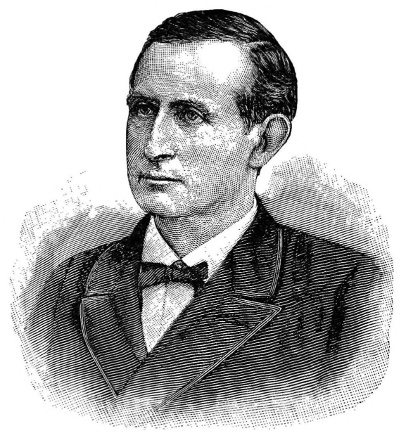
Hon. Charles P. Johnson, Ex-Governor of Missouri, Author of the “Anti-Gambling Law,” which eradicated Gambling from that State.
417EX-GOVERNOR CHARLES P. JOHNSON.
Governor Johnson was born in St. Clair County, Illinois, on the 18th of January, 1836. His natural tastes early inclined him to the study of the law, and he was admitted to the bar at St. Louis in 1857.
His official career forms a part of the history of the State which he has so well served; it does not call for extended narration in a work of this character. But one remark need be made in passing—that as his private character has been without blemish, so is his public record unassailable. It may not be out of place, however, to call attention to the fact that it was through his unshaken firmness and unswerving fidelity to the law which he had sworn to uphold that gambling was finally successfully suppressed in St. Louis. In vain had every agency been employed before to accomplish the same result. The pulpit had thundered denunciation; the press had lifted up its voice against the evil; fleeced victims had complained to the police, who had in turn periodically raided the gambling dens with sledge hammers and batons; yet all efforts had proven futile until the arrival of Governor Johnson upon the scene. In him the gamblers recognized a foe of keen intellect, sterling integrity and iron will, a man to be neither deceived, cajoled, bought nor bullied.
In person Governor Johnson is spare, but well proportioned. His countenance is grave, yet benignant; thoughtful, but unclouded, indicating a mind well stored through deep research and capable of grasping at once the most profound problems, and the most intricate details. Nor does the face belie its promise. To comprehensive sagacity he joins unfailing accuracy, and to a subtle faculty of discrimination he unites a well-nigh inexhaustible fertility of expedient. Add to this rare combination of qualities in their highest form of development an almost incredible power of long-sustainedlong-sustained application, and you have an ideal lawyer, and it is only as a lawyer that he will be considered in these pages.
Either from natural predilection, or through force of circumstances, Governor Johnson’s most pronounced professional successes have been attained as a criminal practitioner. To sway a jury is his forte and his delight, and in the accomplishment of this end he well knows how to employ the keen shafts of polished sarcasm, the scathing denunciation of fiery invective, the cold logic of convincing argument, and the impassioned appeal to tender sympathy. It has been well and truly said of him that jurors enter the box as strangers to him, but leave it with a sentiment of respect akin to regard. He has learned how to reach and touch the secret springs of the human heart, and need acknowledge no master in originality, tact or delicacy of touch, before which tears succeed mirth, and in turn yield to indignation.
418His practice in the criminal courts has pitted him against such brilliant luminaries of the legal firmament as Uriel Wright (deceased), Senator George G. Vest, William Wallace, Judge Henry D. Laughlin, and Joseph G. Lodge (deceased), with a number of others equally as prominent in Missouri; Ex-Governor Palmer and William O’Brien, of Illinois; Ex-GovernorEx-Governor Jenkins, of Colorado; besides a long array of other eminent men. Before all these he has poised his lance like a true knight, nor can it be said of him that any of them have laid him low.
But distinguished as he is as an advocate before a jury, he has attained no less distinction as an examiner of witnesses. No fixedness of feature, no previous drilling in a cunningly-devised tale can hide the truth from his trained and watchful eye, which reads the secrets of the witnesses’ soul as though it were an open page.
Among the multitude of cases whose successful conduct has made him famous, a want of space forbids a mention of but a few.
One of his most noteworthy triumphs was obtained in the trial of the train-wreckers at Paola and Wyandotte in Kansas, when he and associates defeated the array of legal talent opposed to him by the trusted lieutenants of Jay Gould.
Another was his triumphant vindication of Fotheringham, the alleged dishonest messenger of the American Express Co., whose character he exonerated and for whom he secured the substantial damages of $20,000.
Another was in the successful defence at Gallatin, Mo., of the celebrated Frank James.
But what has always seemed to me to have been his crowning professional success was attained in the trial of Michael Horner, charged with murder in the first degree for the killing of Boswell, at Mt. Vernon, Lawrence Co., Mo. Both the accused and his victim had been farmers of Lawrence Co. for about five years before the commencement of the feud between them, which had its origin in a charge brought by Boswell against Horner (and denied by the latter) of seduction of the former’s sister. A succession of personal encounters ensued, but the combatants were always separated by mutual friends. At length, on July 18, 1885, Boswell, while at work in his field, saw Horner riding down the lane. Leaving his reaper and climbing the fence, he began a vigorous bombardment of his old enemy with fragments of rock. Horner, without dismounting, drew his revolver and emptied the contents of three chambers into the body of Boswell, who fell lifeless to the ground. In due time the slayer was arraigned, tried, found guilty of murder, and sentenced to confinement in the penitentiary for ninety-nine years. A second trial was granted, and occupied two weeks, 300 witnesses being summoned. The excitement throughout the country was intense, and the court-room was daily 419crowded by ardent sympathizers with either side. But Charles P. Johnson was for the defence, and so ably did he conduct and plead the cause of his client that the jury, after brief deliberation, returned a verdict of manslaughter in the fourth degree, and the penalty was fixed at a fine of $600. The scene which followed the reading of the verdict would need the pencil of a Hogarth to portray. Horner—who, despite all the efforts of his friends to secure his release on bail, had lain in jail since the killing—remained for a moment motionless through agitation; then jumping three feet into the air and wildly gesticulating, he shouted the Southern warhoop (known in the North as the “rebel yell”), which was taken up and repeated again and again by the vast crowd which packed the chamber to overflowing. In a delirium of joy, his young wife, hastily entrusting her baby to the nearest pair of arms, sprang toward the jury, whom she hugged and kissed by turns. Then both she and her husband mounted to the bench and grasped the judge by either hand, which they shook as vehemently as though they had been veritable pump-handles. In vain did the sheriff seek to restore order, but he was finally compelled to suffer the wild enthusiasm to find its vent. Horner was overwhelmed with congratulations, in which joined both friends and former foes. And in the midst of the wild confusion—in it, but not of it—stood the great advocate, whose genius, labor and eloquence had rendered such a result possible.
It may be that the reader will think that the author has been too lavish in his encomiums of this truly great man. Possibly so; yet the praise proceeds from the love of a grateful heart. Were I to find myself in the antipodes, and involved in difficulties calling for the aid of sound legal advice, the one man of all others to whom I would apply, and whose services, did my means permit, I should certainly retain, is Charles P. Johnson.
The reasons for my preference are easily explained. Governor Johnson, unlike many other lawyers who have attained prominence as practitioners in the criminal courts, does not desert his clients after he has secured their acquittal. To me he has proved a friend in need and in deed at the darkest hours of my life. He knows my character thoroughly; he has defended me more than once; and that I have not fallen into graver crimes than those which I now confess with shame, is due to his wise, fatherly counsels, and to the fact that he first implanted in my breast the desire to reform my life.
Nor is my case a solitary instance. His great brain is no less quick to conceive than is his great heart to execute. His quiet charity is as unostentatious as it is far reaching and comprehensive, and the number of those who owe their reformation to his patient, untiring efforts, will be known only when the secrets of all hearts are revealed.
420THE GAMBLING HOUSES OF NEW YORK.
Despite the fact that there is upon the statute books of New York a stringent law against gaming, the great American metropolis has been called—and not unjustly—the very paradise of gamblers. It is said, by carping critics, that there is scarcely a street without its gambling resort, all private, of course, yet the location of which is well known to those who indulge in that excitement.
The favorite game—as all over the North American continent—is faro, and the stakes vary according to the class to which the house belongs in which the game is played. In some of the lowest hells a stake of five cents is not despised. These houses are frequented by the poorest working men, discharged soldiers, broken down gamblers and street boys. In this connection it may be said, that of all the street boys in the world perhaps those of New York are most precocious. It is no uncommon sight to see a shoe-black, scarcely three feet high, walk up to the table or “bank,” as it is euphoniously termed, and stake a nickel with the air of a young spendthrift to “whom money is no object.”
At any of the later hours of the night, in any one of the cheap eating houses which abound in or near Broadway, from Spring Street north to Tenth Street, can be found one or more shabby-genteel men who bear unmistakable evidence in their speech, manner and appearance, of long continued, and generally disastrous, “fighting with the tiger.” These are the canaille of gamblers, who hang precariously on the edge of a terrible fascination, and manage to supply the necessities of life in a cheap way, from chance success in small bets and by a few dollars picked up by guiding more profitable customers to the houses where they are known. Strictly speaking, there are more “cappers” than gamblers. They are not only at the bottom of the “profession,” but their right to the proud (?) title of “sporting men” is stoutly denied by their more prosperous and reputable brethren of the green cloth. Improvident, uncertain in habits and language, unscrupulous, they are the natural products of sporting life, but which the faro banks nevertheless strive, although in vain, to shake off. Every house has several of these forlorn attaches, who play when they have money, and introduce a desirable stranger when they can; who are constant in their attendance upon the banquets that are daily spread in these houses, but are thus obliged to take the chances as to lodgings, and raiment. When they have worn threadbare the hospitality of the gaming house-keeper (as sometimes happens), they subsist—God and themselves alone know how.
Very different in most respects is another class of gamblers who can be seen any fine afternoon decorating Broadway with the splendor of their apparel, for, as a rule, the sporting fraternity is unexcelled in elegance of 421attire. If you meet in Broadway a man who lounges listlessly onward as though he had no well-defined object in life, and whose garments are cut in the latest style and of the finest material, you may wager he is a gambler in good luck, provided his silk hat is in the highest possible state of polish and his watch chain unusually massive. Very elegant in appearance, very quiet and gentlemanly in their demeanor, are these professional sports of the better class at all times and in all places. Gamblers of this type are usually men of intelligence far above the average, and among the hundreds of men eminent in science, literature and art who flock to the high-toned hells of New York, it is no easy task to find greater brilliancy of wit, higher polish of deportment, or more geniality of manner than are exhibited by the dealers at first-class metropolitan gaming-houses.
In the Bowery and on the side streets, may be met professionals of a very different class; brazen-faced men, with bristly mustaches and hair closely cropped like a convict, with apparel obtrusively gaudy and loaded with jewelry apparently of gold and precious stones. These are men to be avoided as the sharks which their appearance and their every act proclaim them to be. They are proprietors of, or “steerers” for the third-rate dens, where a “square” game is never played, even by accident. Should faro fail to return a profit, these fellows are ready to try anything else, from a game of poker down to outright robbery, as a means of obtaining money. Honest labor they abhor and despise. Any man, they say, can make a living by work, but it requires a smart man to get it without. They cherish a deep and abiding conviction of their own shrewdness; and their egregious conceit sometimes leads them to attempt some one of the confidence games in which “skinners” are adepts, in the perpetration of which they usually ingloriously come to grief through their native clumsiness. When they have no small dens of their own, their chief occupation and main reliance is as “ropers in,” and in view of their uncouth, repulsive appearance and address it is surprising that they are as successful as they are in enticing strangers into the wretched holes where they can be fleeced.
These strangers, thus inveigled, come under the name of “occasional players,” and are the vivification of all gambling, whether guided by the better class of ropers into gilded resorts, or by these vampires into the lower cribs. So long as one sporting man wins from or loses to another, no harm is done to the community at large, but no good is done the gamblers. It is the “occasional players” who furnish the means to replenish the faro banks, without which, they would soon be empty; the strangers who play not more than two or three times in their lives are the meat upon which these harpies fatten. It is not singular, that the novice is so apt to try his luck when he has once been induced to enter 422the gambling house. The universal game is faro; and looks so simple, so safe, so entirely fair, that the chances appear rather in favor of, than against the outside player.
It is made yet more alluring by its surroundings. Nowhere has sumptuous elegance been attained in such perfection as in the first-class gambling saloons of New York. Generally each has a suite of rooms, the largest of which is devoted to faro, with perhaps a roulette wheel in one corner, while others are sacred to short card games, and one is always exclusively used as a banqueting hall. All are furnished without regard to cost, but there is never anything in any of them to offend the most fastidious taste, although there may be sometimes a grim humor in some of the decorations, as is the case in one house where a magnificent oil painting of a tiger is suspended from the wall immediately over the table, so that none of the players can look up without meeting the glaring eye of the beast, which is held to be the presiding deity of the game. But such suggestions as this are very rare, as in general there is nothing anywhere but the faro table to declare the uses of the place. Take that away, and the visitor would imagine himself in the private parlors of a gentleman whose great wealth was fortunately equaled by his refined taste. This delusion would be strengthened by a seat at the banquet, where the viands are of all possible varieties, and the best quality, and are served with a finished elegance in the plate and all table appointments, including the waiters, which are not exceeded even in the most select private houses. At the table and on the sideboard in the saloon are liquors of excellent quality, which, although freely offered, are never pressed upon the visitor, and it is possible for a man to frequent these resorts for years without acquiring a taste for liquor. There is, in fact, very little drinking in them, and none at all of that fast and furious potation which hurries so many thousands of Americans to physical, mental and moral ruin. No sight is rarer in a first-class gaming house than to see a man maudlin drunk. An intoxicated man is never allowed to profane the place. If he appears in the person of a valuable patron, he is quietly led away, to be put to bed in some remote room; but if he comes as an unknown casual he is put into the street with little ceremony but without violence.
These statements, however, apply, of course, only to the first-class and most prosperous establishments. The places next in order ape them in everything, but are far below them in all. A second-class house has sometimes even more of glitter than its rival, but it is easy to see that it is pinchbeck grandeur. There is an absence, too, of the refined taste which presides over the decoration and furnishing of the better house. These rooms are glaringly painted, filled with odds and ends of furniture of all ages and patterns, so that they look not unlike the wards of a hospital for superannuated and diseased household goods turned over in 423their old age to the auctioneer’s hammer. The suppers and liquors, however, most plainly proclaim the lower caste of the place. While the variety of both is abundant, the first are execrably cooked and served, and the quality of the latter would not be strange to the most experienced patron of the ordinary Bowery saloons, which are proverbial for furnishing every kind of beverage except good.
But if the second grade houses are bad in these respects, there are some below them which are much worse. If a man can digest the so called “game suppers,” and survive any considerable drinking of the liquids which are offered as pure whiskey and brandy in the lowest classes of faro houses, he ought to be able to insure his life on the most favorable terms, and the appointments of these houses are in keeping with their entertainment. The chairs, sofas and carpets were of the most tawdry description when new, but are ragged with long and ill usage; the gambling checks, which range in price from twenty-five cents to one dollar, are grimed and dented with much handling; the faro table, elsewhere enticing with its newness and cleanliness, here is old and smeared with grease; the dealing-box, which in first-class houses is of pure and polished silver, here is of pewter, and dingy. So are all the minutiae of these places. They are repulsively suggestive of squalid and unprosperous vice; and if by any chance a gentleman enters, he leaves at once, to lose his money under more elegant, or at least cleaner, auspices.
Faro houses in New York have rarely exceeded one hundred in number, except during the latter part of the war, when speculation, going mad in Wall street, stalked over the land, demoralizing and ruining thousands. In those feverish times faro-playing naturally increased with stock gambling, and the faro houses multiplied until they fluctuated between one hundred and twenty and one hundred and thirty in number. Of late years, however, they have decreased, and a few years ago, when public excitement on the subject had given rise to the sensational statement that the city contained six hundred of them, ninety-two was the largest number that could be found open at any time. The number seems small in comparison to the size of the city, which, beside the large resident reckless population, contains tens of thousands of strangers, anxious not to miss any of the sensations of the metropolis. Yet these faro banks not only are enough to do all the business presented and enticed to them, but some of them have a very precarious life owing to the lack of custom. The first and second-class houses are under very heavy expenses, a principal item of which takes the shape of rent. They must be and are located in the principal thoroughfares near the leading hotels, with the exception of those anomalous institutions known as “day games,” which are found in Ann, Fulton, and Chambers streets, for accommodation of the business men, many of whom have acquired the bad habit of seeking solace for the 424vexations of legitimate transactions in the delights of faro. A seizure was made of these places lately, upon the ground that they are of all the gambling establishments in the city the most dangerous to the public. It is not necessary to endorse this statement in order to justify the attempt to suppress day gambling, but if activity in this direction is intended to excuse the toleration of all other houses, it will result in more of evil than good. The night houses, into which strangers are inveigled and robbed, are the resorts of young men of fortune, who here take the first step on a downward road which leads them and their families to shame and ruin, are worthy of at least equal attention. Beside being more frequented, these night houses have a much greater number of hours for play. The day houses are in full operation four or five hours per day, but in the night houses a game can be had in the afternoon and at any hour at night, while the average of play, take them altogether, is fully eighteen hours of each twenty-four. In the absorption and waste of capital, the half-score of day houses cannot be compared to those where most of the play is at night.
It is well-nigh impossible to get accurate statistics upon this point, and resort must therefore be had to approximate figures, which are, however, very near the exact truth. The faro banks of New York have as capital a little less than one million dollars, which is very unequally divided, as the ninety-two houses vary from $2,000 to $50,000 each, although only three or four have the latter amount, and the average banking capital is about $10,000. It is impossible to say what amount of money changes hands upon this basis. It is asserted that the average yearly winnings of all the banks taken together is about fifty per cent. over and above the expenditure required to keep up the establishments, so that every year these gamblers absorb about $500,000, while the gross profits are more than 100 per cent. These figures are conclusive that the way of the transgressor, if he be an occasional player rather than a dealer, is hard.
“Bunko Land,” on Broadway, of a fair summer evening, extends from Twenty-third to Thirty-third street. Here, meandering softly along in the twilight, or boldly facing the glare of the electric lamps, New York’s gamblers are to be seen in mid-summer and mid-winter alike. They know well enough who their friends in authority are. They are fully convinced that charges against McLaughlin and Carpenter, like charges against Williams—which have been so often and so unsuccessfully made—are not likely to come to anything as long as their friends are on deck. And that means, of course, just as long as the gamblers’ weekly stipend is forthcoming.