PART II. (continued 2)
Reading edition
When each party holds a sequence, the hand commencing with the highest card in the sequence wins; so, also, when two or more parties hold flushes against each other.
That full counts highest of which the three cards of the same denomination are highest. The two cards of same denomination help only to constitute the full, but do not add to the value of the hand. When hands are equal so far that each party holds a pair, or two pairs, of exactly the same value, the next highest card or cards in each hand must be compared with the highest card or cards in the other hand, to determine which wins.
In case of the highest hands, (which very seldom occurs) being exactly equal, the pool is divided.
TECHNICAL TERMS USED IN POKER.
Age.—Same as eldest hand.
Ante.—The stake deposited in the pool by the age at the beginning of the game.
218Blaze.—This hand consists of five court cards, and, when it is played, beats two pairs.
Blind.—The ante deposited by the age previous to the deal. The blind may be doubled by the player to the left of the eldest hand, and the next player to the left may at his option straddle this bet, and so on, including the dealer, each player doubling. The player to the left of the age, alone has the privilege of the first straddle, and if he decline to straddle it debars any other player coming after him from doing so. To make a blind good costs double the amount of the ante, and to make a straddle good costs four times the amount of the blind. Each succeeding straddle costs double the preceding one.
Call.—When the bet goes round to the last bettor, a player who remains in, if he does not wish to see and go better, simply sees and calls, and then all those playing show their hands, and the highest hand wins the pool.
Chips.—Ivory or bone tokens, representing a fixed value in money.
Chipping, or to Chip.—Is synonymous with betting. Thus a player, instead of saying “I bet,”“I bet,” may say “I chip” so much.
Discard.—To take from your hand the number of cards you intend to draw, and place them on the table, near the next dealer, face downwards.
Draw.—After discarding one or more cards, to receive a corresponding number from the dealer.
Eldest Hand, or Age.—The player immediately at the left of the dealer.
Filling.—To match, or strengthen the cards to which you draw.
The following descriptions of what are known as “jack-pots,” a modification of the game of draw-poker, is taken from “Trump’s American Hoyle,” which Blackbridge pronounces the standard authority on this as on all other card games:
When all the players pass up to the blind hand, the latter allows his blind to remain in the pot, and each of the other players deposit a similar amount. The blind now deals, and any player in his regular turn may open or break the pot, provided he holds a pair of jacks or better, but a player is not compelled to do so, this being entirely optional.
Each player in turn, commencing with the one at the left of the dealer, declares whether he can and will open the pot; if he declines to open, he says, “I pass.” If he has the requisite hand, and elects to open, he says, “I open.”
If no player opens the pot, then each player deposits in the pool the same amount that was previously contributed, and the deal passes to the next player. The same performance ensues until some player holds the necessary cards, and is willing to break the pot.
219A player may break the pot for any amount within the limits of the game and each player in turn must make the bet good, raise it, or pass out.
After all the players who determined to go in have made good the bet of the player who opened the jack-pot, and the hands have been filled, then the opener of the pot makes the first bet.
If all pass, up to the player who broke the pot, the latter takes the pool, and can only be compelled to show the jacks, or better, necessary to break the pot.
One of the most vital adjuncts to poker games as played in the many “club-rooms” scattered throughout the United States is technically termed the “take off.” It is an amount taken by the proprietors out of the pots as a percentage due the “house” on every hand “called,” and shown down; a pair of aces and another pair, and you must “go to the hole” with a check. The “hole” is a slot cut in the middle of the table, leading to a locked drawer underneath, and all checks deposited therein are the property of the keeper of the place. At other resorts the house “takes off” for each pair of jacks or any better hand shown on the call, while at others the percentage is exacted for any two pairs shown. It will be readily seen, by any intelligent reader, that it is only a question of time when all the player’s chips will go into the “hole.” The exaction of the “take off” is justified on the score of incidental expenses, lights, etc., but a compound interest note, on which interest is computed quarterly, will not take away your money more surely or more rapidly than this innocent looking “hole.”
In “stud-poker” the dealer attends to the “take off.” He is supposed to take one check for every pair in sight, and for every “call,” but owing to a manual dexterity acquired through long practice he is enabled considerably to exceed the stipulated limit, and it is but a short time before all the money played against the game is in the table drawer.
Having briefly outlined the principles of the fair game of poker, and explained the relative value of the hands of cards which may bebe held by players, it is next in order to explain the various advantages obtained by professional gamblers over those whom they propose to fleece, such as stocking the cards, employing marked cards or cards previously prepared, “crimping,” “ringing in cold decks,” “holding out,” false shuffles and cuts, “convexes” and “reflectors,” &c., &c.
First will be described the simplest of all known methods of stocking the cards, viz.:
STRIPPERS.
Prepared cards are either “Strippers” or “Briefs.” In preparing “Strippers” the professional selects from the pack two hands, which may be either “Fulls,” “Flushes,” or “Fours.” The sides of the remaining 220cards are then prepared so that they shall be a little narrower than the hands selected. The cards withdrawn for stripping are then cut slightly convex on the sides, somewhat after the manner of strippers prepared for faro.
The number of cards taken out varies according to the character of the hand to be made up. If the sharper wishes to deal flushes he will require ten cards of the same suit. If full hands are desired he picks out two sets of three of a certain denomination together with four smaller cards of a kind. The object of this selection is to give variety to the hands to be dealt. The manner of conducting this scheme of fraud is substantially as follows: As the gambler shuffles it is not difficult for him to feel along the sides of the pack with the fingers of his right hand; he then draws out the wider cards, which he places upon the top of the pack. When he has succeeded in getting the wide cards on top he next divides the pack, then taking each portion by the outer ends, he places the two halves evenly together and then, with comparative ease, so shuffles them in that no two cards of the same size shall lie together, but instead shall alternate over and under each other throughout the whole deck.
The reader who will carefully study the foregoing explanation will see that the cards will run off “Four-handed;” that is that they will fall to the hands of opposite players.
In the practice of this trick the professional finds the services of a partner of great value to him. If, however, he have none, when he deals he places one card above the hands which he has set up in order that his antagonist may receive one of the arranged hands while he takes the other. Let us suppose that the hands have been arranged as “Flushes.” If the dealer finds that in his hand he has not an ace, as a matter of course he refrains from betting. If, however, the hands be “Fulls,” the professional’s acquaintance with the arrangement enables him to know which is the better hand, and he bets, or refrains from betting, as he knows is best.
It is also possible to employ strippers in a two-handed game. In the latter case the dealer strips the pre-arranged hands, but does not mix them as in a four-handed game, preferring to “shift” on his own deal and allow the cards to run without cutting on that of his antagonist.
Sometimes in using strippers in a four-handed game the dealer will place a “Jog,” that is a hand, over them and allow his confederate to cut the pack down to the prepared place. At first sight the employment of cards thus prepared may appear rather difficult, yet the professional blackleg finds it comparatively easy after a little practice. “Full” hands and “Fours of a kind” may be set up without difficulty. The swindler knows which the ten strippers are, and in taking up his five cards he is, of course, well informed as to the value of the five cards which his opponent has, and guides himself accordingly. To illustrate: Suppose there are 221ten strippers made up of four fives, three aces and three kings, and that the sharper secures three aces and two kings. Naturally he refuses to bet, being well aware that the four fives and the king must be held by his antagonist.
BRIEFS.
The “Brief,” which is a card used not only in poker, but also in various other games, is a card nicely trimmed on the sides to such a width that it can be readily distinguished by the dealer’s touch.
The advantage of using such a card is that it enables the party knowing of its existence to cut at the point where it lies. Sometimes the “brief” is placed on the top of the prepared hand and the confederate of the dealer uncovers the pre-arranged cards by making precisely the correct cut.
STOCKING.
By far the most common description of frauds employed by professional gamblers in playing poker, however, is that of “stocking” the cards. Four varieties of “stocks” are employed by the fraternity, commonly known as the top stock, the bottom stock, the jog stock and the palm stock.
THE TOP STOCK.
Of all these, perhaps the one most ordinarily employed—possibly because the one most easily accomplished—is the top stock. In preparing the pack for the perpetration of this fraud, the dealer selects a pair and places between the two cards as many others as there are players at the table, less one. Thus, if there are four persons playing he inserts three cards between the two constituting the pair; if five, he places four; and so on, as the number of players is greater or less. His next step is to place above the pair thus arranged, the same number of cards which he has placed between them, the result being that when he deals, the two cards which he desires must necessarily fall to his own hand. A partner is also a desirable adjunct in this case, as he ordinarily sits at the right hand of the dealer, in order that he may either give the cards a false cut, or allow them to run. If, however, the dealer has no partner, he ordinarily has to resort to the device of “shifting the cut” (a trick which will be explained below), in order that the arrangement of the pack may not be disturbed. If the sharper can manage to get hold of the three cards of the hands which are thrown up, he may sometimes find it practicable to arrange “threes of a kind” in this way, as well as a pair.
222BOTTOM STOCK.
In executing the bottom stock the tactics employed are substantially the same as in the top stock, by that the pair are placed on the bottom of the pack instead of on the top. The dealer takes great care in shuffling that he shall not disturb the lower part of the pack. The point at which the deck is cut makes considerable difference in the success of this maneuver. If, after cutting, it is found that all of the pack, except the cut, is necessary to supply the players with the requisite number of cards, then the pair will fall to the hand which has the last card, for the reason that the player who receives the bottom card must necessarily have also received the other; but if the dealer sees that the bottom card is not destined to fall to himself, when he reaches the last two cards he “shifts” them, that is, reverses the order of dealing so that the party who should receive the top one receives the lower, while that uppermost falls to the next player. It may be readily perceived that by this trick the dealer has separated the pair, one falling to one hand, and the other to the player seated immediately upon the dealer’s left. I have already stated that the point at which the deck may be cut plays no unimportant part in the successful accomplishment of this maneuver. In fact, in order to succeed it is essential that the sharper have a partner at his right who will cut so near to the bottom of the deck that the lower cards will have to be run off. It is immaterial to the two scoundrels which of them receives the pre-arranged pair, inasmuch as the winnings are to be divided between them, consequently the bottom stock affords a double chance for the perpetration of fraud.
Occasionally a blackleg who has no partner, but who observes that some particular player is in the habit of cutting the pack very deep, will so arrange matters that he may sit next to him, this renders an innocent party inadvertently an accomplice to his nefarious practices. When two sharpers sit in a game with honest players and have resort to the use of the bottom stock, especially if to this be added “signing up,”—by which is meant “signaling” to one’s confederate the cards which one has—it is, however, a moral impossibility for the unsophisticatedunsophisticated to beat the combination of the sharpers.
Should the trick be suspected the sharp rogues will place the remainder of the pack on top of the cut, suffering a “jog”—which will be explained later—to lie over it, by which means they are enabled to deal from the entire pack, which usually tends to counteract suspicion. Sometimes, after the pair has been placed on the bottom of the pack another card is put underneath, the result being that the player who receives the next to the last card will receive the pair. This very simple trick has been found most efficacious in puzzling a suspicious player, who is ordinarily greatly 223surprised to find that the hand into which falls the last card has not received the prepared pair. Sometimes two, or even three cards are placed on the bottom, the principle being the same, although in this case it is necessary that the dealer should carefully remember the number of cards so placed, in order that he may know precisely when he reaches the lower card of the pair.
THE JOG STOCK.
The “jog” stock is a device which it is absolutely impossible to execute without the aid of a confederate, yet it is regarded by professionals as one of the most effectual means of defrauding an honest player. As in the case of the top and bottom stocks, a pair is arranged by the dealer, who places upon it a sufficient number of cards to make the pair fall to his own hand. He next shuffles the pack once or twice in such a manner as to keep the arranged cards on the top, after which he slides a portion of the deck over the pair, leaving a narrow break or jog along the side, thus separating the hand which he has put up from the remainder of the pack. His confederate, it should be remembered, always sits on his right, then takes that part of the deck which rests upon the top of the stocked hand, with the thumb and finger of his right hand grasping them by the ends. Then with the thumb and middle finger of his left hand he seizes, in the same manner, the pre-arranged cards underneath; he draws out the latter and places them on top of the others, leaving them in precisely the same position as they were before his confederate offered them to him to cut.
An expert sharper, after winning once through these means, on his next deal so arranges the pack that the pair shall fall to his partner, with whom he bets, and to whom he apparently loses money. After this the cards are permitted to run naturally for one or two hands, when the second scoundrel repeats the same tactics.
The reflecting reader will readily perceive that this device is far less likely to arouse suspicion than the employment of either the top or bottom stock, and for this reason is more popular with experts than either of the other two.
In playing this trick many sharpers have resorted to the use of glazed cards. Usually the backs have been previously prepared by slightly roughening them with very fine sand-paper. The object of doing this is to cause the cards to adhere together and prevent them from slipping about during the process of shuffling. This enables the dealer to place the pack to a very fine break, which renders the cutting more easy and attracts less attention. I have known experts who were able to set up “three of a kind” in this way as easily as a single pair, although for the successful accomplishment of this it is necessary that the two confederates should understand each other thoroughly. In such a case the partner sitting on the dealer’s 224right observes what pair the latter has, and, if possible, either by cutting the third card into his own hand or from the hands thrown down, and turns it to his confederate with the proper number of cards beneath. If the dealer allow the hand to pass to his partner, the latter, if he wins and deals, passes the cards on to the bottom, in order that the hand may run out on the bottom stock.
PALM STOCK.
No little dexterity is required to manipulate the “palm stock.” I have seen professionals attempt its execution and come to no small grief through its being detected in consequence of their clumsiness. In order to execute this maneuver effectually, the party intending to employ it must be on the left of the dealer. He obtains possession of a high pair—perhaps kings or aces—and while he is holding one in each hand in such a way that neither can be perceived, he asks that he be allowed, after the shuffling and cutting, to cut the deck again. Permission having been granted, he seizes the pack in his right hand, places one of the cards which he has withheld in his hand on top of the pack, and as he cuts he leaves as many cards on the table as may be necessary to intervene between the pair in order that they may be “Put up.” Then as he grasps these cards with his left hand he places the other card of the pair on the top and throws them on top of the pack. It is not difficult to see that the result of this maneuver is to place the two cards which he has “palmed” in such a position that they will inevitably fall to himself. Of course it is not possible to practice this trick frequently without exciting suspicion, but I have, myself, by employing it judiciously, managed to win no inconsiderable sums. As a rule, after executing the “Palm Stock,” the black-leg “goes a blind,” and the trick is rarely attempted unless there is a large “ante.”
FALSE SHUFFLE.
Another favorite practice among the black-legs is the “False Shuffle.” Almost all sharpers have their own individual methods of shuffling; but perhaps the one which is most approved is that known among the profession as “the intricate shuffle.” It is executed substantially as follows: The cards are “ripped,” that is, the deck is divided into two halves, which are pushed entirely through each other, after which they are drawn out at the ends, and the half which was previously on top is replaced in the same position. Some professionals shuffle only the lower half of the pack, not disturbing the top, but concealing the upper cards by means of keeping three or four fingers over the end of the pack which is towards their antagonist. Sometimes a very quick shuffle is employed which does not disarrange the cards on the top, and after this the pack is 225given a double false cut, by means of which the cards originally uppermost are retained in the same position. The device, which, if rapidly executed, appears to the unsophisticated player a perfectly fair shuffle, only a practical acquaintance with the operation of the trick enables the verdant amateur to detect this trick when executed adroitly.
FALSE CUTS.
Besides false shuffles, professionals also have resort to false cuts. Of these, there are but two varieties in common use, known respectively as the “over hand” and “double” cut. In the former about one-third of the pack is taken with the right hand, while one-half the remainder is concealed in the left. The party cutting brings the left hand towards him, that portion of the deck which is left on the table is then covered by the dropping of the cards held in the right hand, the hand still being kept over them, while those in the left hand are thrown over and beyond the others; the maneuver is completed by placing the cards in the right hand on the top.
In the execution of the “double” cut, the middle of the pack is drawn out at the end with the thumb and middle finger, after they are brought to the top of the deck, the cards originally uppermost are caught by the lower part of the thumb and three fingers, drawn out at the end and once more placed on the top. In either case the pack is left in precisely the same position as it was before the seeming cut had been made. The object is the same in the case of both false shuffles and false cuts; that is, to leave the pre-arranged pack in precisely the condition in which the dealer wished it to be.
Sometimes, when a perfectly fair cut is made by an honest player, the professional finds it desirable to “shift” the cut, or, in other words, to replace the two sections of the pack in the same condition in which they were before they had been offered for cutting. The methods of executing this trick are multiform. Ordinarily, however, the operator finds it desirable to have a partner on his left; in fact, in draw-poker it is difficult to execute the maneuver without some assistance. Three of a kind having been placed on top in the shuffle, the cut is left on the table, and the professional deals from the remainder. The deal being completed, removed from the table with the right hand, the cut “shifted,” and the pack dropped into the left hand ready for his partner’s draft.
This piece of chicancery, if successfully performed, is almost impossible of detection by a greenhorn, and even the professional gamblers are not infrequently deceived by its dexterous manipulation.
226
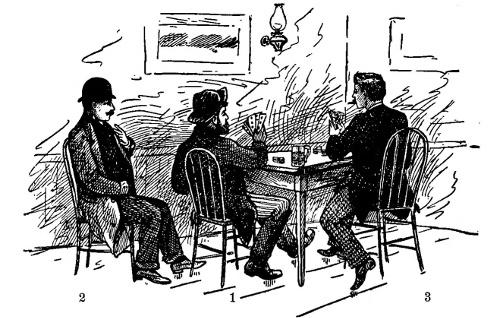
“TIPPING THE HAND.”
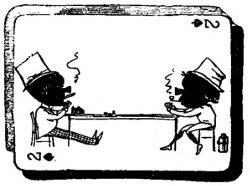
The accompanying illustration affords a view of two “skin” gamblers engaged in victimizing a “sucker” by means of a trick familiarly known among the fraternity as “tipping” or “signing the hand.” Large sums of money have been won through this means, not only from verdant dupes, but even from professionals who prided themselves upon their astuteness. In order to work it successfully, marked cards are indispensable, and at least one of the confederates, who act in unison, must be an expert at the use of “paper,” as marked or “advantage” cards are called among the gamblers.
The cut shows the method in which the trick is carried on. Player number 3 represents the “sucker;” player number 2 the swindler who has induced him to play on the promise of “tipping” the “hand” of number 1, who is in reality the partner of number 2, although, of course, this latter fact is unknown to number 3. The method of playing this nefarious confidence game may be best shown by an illustration. Number 2 always faithfully signals number 3 precisely what cards are in the hands of number 1. The latter being an expert marked card player, of course, knows with absolute certainty what cards are held by number 3. Let us suppose that number 1 holds a pair of sixes and number 3 a pair of fives. Number 2 signals to number 3 that number 1 has in his hand a low pair. Number 3 is naturally in the dark as to whether the pair in question is of a lower denomination than his own, and in the hope that it may prove to be makes his bet. Number 1 immediately “raises” him, and this is continued as long as the victim can be induced to wager, or until number 3 has “staked” his “pile.”“pile.” The hands being “shown down,” of course number 1 takes the stakes.
227RUNNING UP TWO HANDS.
Perhaps one of the most successful feats accomplished by the professional gambler is that known as “running up two hands.” Under such circumstances the game is no longer a contest, but a certainty. It is sometimes played with a partner, sometimes without. If the operator have no partner, he usually selects his seat on the right of the man whom he considers the most verdant of the players. When he observes that his left hand neighbor has a prospect of winning, he immediately “passes,” and taking up the pack prepares the hand as follows:
He selects the individual to whom he proposes to give, let us say, three tens; also, the one upon whom he intends to bestow the larger set of threes, say three kings; in putting up the hands, however, he commences with his own, and while the cards face him for the reason that he knows that when the pack is reversed for the purpose of dealing the uppermost card facing him will be the last one dealt, and as he sits on the right of the dealer, it will of course fall to him. Having selected a king (the face of the pack being uppermost) he places as many cards below as there may be players on his right between himself and the person to whomwhom he wishes to give the three tens. Below these he places another ten, and underneath that as many cards as there are players between himself and the player who is to receive the tens. In the same manner he arranges the other tens together with the kings, so that the three tens may be brought to the bottom. This being done the pack is turned over and as a matter of course the ten placed on the bottom now becomes the top card. His next move is to place as many cards over these as there are players on the left of the dealer, between the latter and the unfortunate individual who is destined to receive the tens.
This explanation may not be as clear to the reader as some of those which have preceded it, yet to go into full details would require more space than can be afforded to a description of the trick. The preparations having all been arranged, the expert very rapidly gathers in the cards as they are thrown down, placing them underneath the pack. He then begs to be permitted to shuffle before the regular dealer. If the request be granted he takes care so to shuffle as to not disturb the hands which he has arranged with so much care. In fact he usually has recourse to the device which has been already described as a “false shuffle.” Sitting on the dealer’s left, of course the cut falls to him, and he either gives the deck a false cut, or says “let them run.”
The consequence of this maneuver is that the blackleg receives the three kings, while one of the other players obtains the three tens. The three tens being considered a safe hand upon which to bet, it is not a difficult matter to induce the verdant player to stake a considerable sum, 228which the expert invariably wins. The sharper, however, finds it far more easy to accomplish his nefarious end if he has a partner. The latter individual, after the cards have been stocked, gives a “false shuffle.” Professional No. 1, who sits at his partner’s right, gives the deck a false cut, and professional No. 2 runs the cards off. It may seem incredible to the average reader that men will sit around a poker table and permit such dallying with the pack.
After long experience, however, I must say that the cases are exceptional in which a smart operator may not manage to arrange three or four such hands in the course of an evening’s play. Sometimes two sharpers, acting as partners, manage to keep the deal between them for two or three consecutive times; meanwhile they arrange the cards on the bottom by degrees, and when everything has been completed the bottom of the pack is transferred to the top. Sometimes hands are arranged in this way and dealt in the same manner as from the bottom stock, which has already been explained, the confederate, as a matter of course, being fully aware which is the best hand.
The ease with which even those hands which at first sight appear most difficult to arrange, may be prepared in this way, is almost inconceivable to the novice. “Flushes” seem an intricate hand to arrange, yet in fact they are among the easiest. A detailed explanation of their arrangement, however, would hardly be either intelligible or interesting to the average reader.
CRIMPING.
A favorite method of cheating at poker is that known as “crimping” the cards, which is effected in one of either two ways: The former is when the player is at the left hand of the professional dealer, in a four-handed game, or his opponent in a two-handed game.
The second method is when the sharper deals himself. In the former case the player so stocks a hand that it shall fall to himself, after which he “crimps” or bends down the sides of the cards of which it is composed. This having been done, after the shuffle has been made the sharper may readily cut to the hand prepared, since there will be a hardly perceptible space between it and the cards above it. If the dealer shuffles “over-handed,” the hand will rarely be broken. If crimping is to be resorted to on one’s own deal, the expert usually waits until he has secured a high hand, when he bends it down, as above described. He then places it on the bottom of the pack, and shuffles in such a way that it shall not be disturbed. After dealing, he lays down his own cards as quietly as possible, close to the deck; then, with his left hand, he draws the “crimped hand” from the bottom, and with his right places the remainder of the pack on the top of the hand which he had originally received. 229He then shoves them aside, and at the same moment lifts from the table the prearranged hand, which is thus substituted for the one which he has secretly discarded. In order to guard against detection, the moment when the other players are engaged in examining their hands is the one usually selected by the blackleg for the execution of this maneuver.
COLD DECKS.
The use of “cold decks” in almost all card games has become so common, among the professionals, that the term, “ringing in a cold deck,” has achieved a recognized place in the vocabulary of American slang. Almost every one knows that the expression refers to a substitution of one thing for another, yet not every one knows whence the phrase has its origin.
A “cold deck” is a pack previously prepared, in which the hands of the dealer and all the other players have been carefully arranged. To “ring in” such a pack, is to substitute it for the one which has been fairly shuffled and cut. There are many ways of accomplishing this substitution. Sometimes a bill is dropped on the floor, and while the dealer is engaged in looking for the greenback the “cold deck” is raised, the original pack being secreted. This method, however, has become ancient, not to say effete. The most approved method now-a-days, is to place the prepared pack in the lap, to raise it nearly to the line of the table with the left hand, and, after the true deck has been cut, draw the latter to the edge of the table with the right hand directly above the “cold deck;” at the same time the latter is raised, the discarded pack is simultaneously dropped into the lap, where it falls into a handkerchief previously spread in order to receive it. The deal having been made, the sharper folds up his handkerchief and places it in his pocket.
MARKED CARDS.
Marked cards are among the favorite and most profitable “tools” of the professional blackleg. Among the fraternity they are technically known as “paper.” When successfully used every element of chance is eliminated from the game, and the play is practically reduced to a cut-throat contest, in which the professional alone carries the knife. In a two-handed game no honest player can ever hope to win against a gambler who employs them. They are usually marked so as to indicate not only the suit, but also the denomination of each card in the pack. As he deals the professional reads and remembers the hand of his opponent, and bets only when he knows that he has the advantage. At the same time it is sometimes deemed expedient to place a wager even upon an inferior hand, lest suspicion be excited by the too pronounced uniformity in winning. It is hardly necessary to point out the tremendous percentage of profit which is bound to accrue to one using cards of this character. Marked cards may be bought, from all dealers in what are known as “gambler’s 230goods,” but some experts prefer to purchase cards which are entirely “straight,” and mark them themselves. The sight of the name of a well-known manufacturer of playing cards, whose reputation is unblemished, will usually prevent or disarm suspicion on the part of a greenhorn.
In a two-handed game the cards thus prepared are usually marked to indicate only the size, the suit being a matter of comparative indifference. The method of using them in a four-handed game differs somewhat from that employed where one party plays against a single antagonist, but the reader may readily imagine that in either case the advantage in favor of the professional is simply enormous. A detailed explanation of the method in which they are employed would hardly prove profitable reading to the general public, and for this reason the subject is passed over somewhat lightly. Some are marked with a representation of the American eagle (what a travesty on the emblem of equality and fraternity!), and during the war thousands of the brave boys who took their lives in their hands in defense of the “old flag” were defrauded of the scanty pittance paid them by the government, through the machinations of unscrupulous scoundrels, who cheated them at poker through marked cards on whose backs was depicted a mimic representation of the standard for which they fought. Satire could not well go farther, inasmuch as the government which they had sworn to defend, tolerated the rascally proceedings even under the very folds of the starry banner itself.
Besides the “stamped” cards—i. e., those on which the secret marks are printed—professional blacklegs use others. An ordinary pack may be prepared by an “artist in coloring” in such a way that he may read the backs as easily as the faces. For this purpose a paint composed of chloroform, alcohol and some pigment is applied with a camel’s hair brush. The pigment may be of any hue—ultramarine, vermillion, etc.—the color selected being always the nearest approximate shade to that of the backs of the cards played with. Card sharpers who are expert marked card players (and it must be remembered that not every professional gambler possesses the necessary qualifications) always travel with a full outfit of packs. On steamboats they will buy out the entire stock of the bar keeper, furnish him with a fresh supply gratuitously, and even pay him a bonus to handle their goods. The result is that when any player on the boat wants a fresh pack, he finds himself compelled to buy the cards whose backs the professionals can read. In towns these manipulators of the pasteboards will either secure the introduction of their cards at the gaming houses through the payment of a percentage, or will see that they are placed on sale at some jewelry, drug, stationery or cigar store near the locality where the game is to be played. The next move is to introduce them at the card table, which is sometimes found to be a very easy matter. In some of the succeedingsucceeding paragraphs of this chapter the 231reader will find related some of my own experiences in this direction which may not prove uninteresting.
A favorite method of “ringing in” these cards—as gamblers term their introduction—is as follows: Two sharpers act in concert. One goes to a town and selects a victim, who is usually a country youth who has money. He tells his dupe that he is “dead broke,” perhaps because of sickness, perhaps for some other reason; that he is a professional gambler and can teach any man how to win at cards. The cupidity of the young man from the rural districts is aroused. The gambler shows him some marked cards and teaches him how to read the backs. Then he sends for his confederate. When the latter arrives the first swindler professes not to know him, and pretends to make his acquaintance for the first time. He then tells the selected victim that he has found a “soft mark,” (which in the vernacular of the profession means a particularly gullible dupe), and offers to introduce him, so that the countryman may win his money through the marked cards. The game is begun; of course the supposed “stranger” is as familiar with the marks as is the greenhorn, besides being master of innumerable other arts of the blackleg, of which the greenhorn knows nothing. The result is a foregone conclusion; the sharper wins all the money which the verdant young man can be induced to bet.
Sometimes it happens that the dupe becomes discouraged at his poor success and declines to play further. In such a case, if the rascals believe that he has any more money, the first confederate will secretly offer to “tip off” the new comer’s hand, a device which rarely fails to prove successful under such circumstances, and an explanation of which has been already given.
PARTNERSHIPS.
As a rule, professional gamblers who travel through the country with a view to defraud the unsophisticated by means of poker-playing, ordinarily work in partnership. Sometimes two—sometimes more—players compose the traveling combination, and divide the proceeds with more or less equality. A thorough understanding among the confederates is, of course, absolutely essential. But this having been once attained, the advantages of the partnership are obviously very great. They convey to each other surreptitious information across the table as to the nature of their respective hands, so that only the one who has the better chance may “go in.” I have already explained how they may co-operate with one another through means of false shuffles and false cuts. They may also prove of material assistance to each other in holding out, and in various other ways, to such a degree that the verdant individual who supposes that he is enjoying a “fair show” for the amount of money he has wagered, is, as a matter of fact, absolutely at their mercy.
232At the same time the members of such a dishonest firm have little confidence in one another, but watch each other as though they were enemies rather than confederates. Yet on one point they are at perfect harmony and act in absolute unison; that is, in the fleecing of greenhorns; and woe betide the unlucky wight who finds himself between the upper and nether mill-stones of such a combination.
DOUBLE DISCARD.
Yet another device of the professional poker-player is known as the “Double discard.” The blackleg does not discard until after he has made a draft. He separates the cards which he wishes to discard from the four which he nominally proposes to retain, holding the former in his left hand and the latter in his right, ready for a fraudulent discard, in case he sees fit. Calling for four cards, he drops those which he has in his right hand immediately in front of him. Next, he lifts the draft with his left hand, the odd card of course coming on top; if now he finds in the draft one or more cards which he perceives will, with the aid of the four cards lying in front of him on the table, improve his chances, he retains that, and again discards the four cards. He then drops the one which he has retained, upon the four originally rejected, raises the hand, and of course is prepared to wager, with an approximate certainty of success.
FLUSHES, FULLS AND FOURS.
These hands are more difficult to arrange than either “pairs” or “threes,” although an expert blackleg is soon able to reduce the art to a science.
The manner of setting up a “flush” differs from that of arranging a “full” or “fours.” In preparing flushes ten cards of any suit are first selected, and being placed face uppermost before the operator, are so arranged that the highest card shall be either the second, fourth, sixth, eighth or tenth in order. The ten cards are then put on the top of the deck, which the sharper takes in his left hand. He uses the fore-finger and thumb of his right hand in shuffling, placing the former on top and the latter underneath, and drawing one card from the top and one from the bottom at each “pull.” These he throws upon the table in pairs. The same tactics are repeated ten times, each two cards, as drawn off, being laid over the preceding pair. The rest of the cards are then similarly treated, but thrown on the table at a short distance from the twenty first drawn. The sharper then places the latter upon the larger half of the pack, and a false shuffle and false cut are made.
If the player sitting on the left of the blackleg happens to be the dealer, (and in no other case can the trick be successfully worked as here 233described), the professional who has arranged the cards will always receive the higher flush, and the player sitting at the dealer’s left, who is of course directly facing the blackleg, is bound to receive the smaller one.
The method of arranging “fulls” is very similar to that described above. The hands, however, are first made up singly, the highest threes being put in alternately as the second, third, fourth and sixth, counting from the top of the pack as it lies face uppermost before the operator. The latter then “strips” one card each from the top and bottom simultaneously, as in the preparation of the flush. The hands fall to the players in the same manner, the larger one falling to the dealer’s right and the smaller on his left.
In stocking the cards for a hand containing “four of a kind,” the hands are put up separately, the higher four being so arranged as to be second, fourth, sixth, and eighth, from the top of the pack as it faces the manipulator. The latter draws a card from the top and bottom at the same time, as in the arrangement of the “flushes” and “fulls,” but instead of drawing ten cards he pulls eight. The result in all three cases is precisely the same, that is, the larger hand will invariably fall to the player on the dealer’s right—(that is, the sharper)—and the smaller one to the individual facing him, who sits at the dealer’s left.
HOLDING OUT.
Of all the practices of a dishonest gambler at poker, “holding out” is perhaps the most frequently resorted to. It consists of abstracting one or more cards from the pack, which are secreted either about the person of the player, or beneath the table. It is most commonly employed upon the blackleg’s own deal. Several cards may be “held out,” provided that the number is not sufficient to attract notice by perceptibly diminishing the size of the pack. The object of course is that the sharper may have desirable cards ready to produce when a favorable opportunity offers. If the person to be deceived is especially verdant the cards withdrawn from the pack are sometimes concealed behind the collar, or under the joint of the knee or may be laid upon a handkerchief in the lap.
Professionals, however, usually prefer either the vest or the sleeve as a place of secreting them. Different sorts of apparatus are also employed to facilitate the operation; now-a-days nearly all professionals employ some one of the four mechanical contrivances which are described below.
234I. THE BUG.
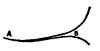
I. The Bug.—This instrument is very simple in its construction, and although sold by dealers in “fake” goods, is often made by gamblers themselves. Its mechanism is shown in the accompanying cut. “B” represents a piece of watch spring which is fastened to the table by means of an awl “A” in such a way that the point may curl over. The awl is pressed into the under side of the table, just far enough from the edge to permit the placing of a card. The watch spring snaps up against the bottom. The method of using it is as follows: Some high card, for example, the king or an ace, is slipped under the bottom of the table, the watch spring holds it firmly in place. As soon as the party receives, in the regular course, a card, or perhaps a pair of the same denomination as the one which he has secreted in the “bug,” he puts his hand over the edge of the table, under which he puts his thumb, he then deftly raises the card which he has concealed, at the same time taking an inferior card from his hand and placing the latter in the “bug” instead of the one which he has taken out. It will be seen that he thus obtains a high pair, or possibly three high cards of the same denomination.
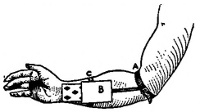
II. The Sleeve Hold Out.—This apparatus consists of a leather band, (lettered A in the illustration) fastened around the right arm, beneath the coat sleeve, near the elbow, to which is attached a spring, pressure upon which works a rod which connects with a plate (lettered B in the cut). The method of using this device is shown in the illustration. The cards which are “held out” are placed beneath the plate B, which holds them in position. When the player wishes to draw them from his sleeve, he presses his arm against his body, thus setting in operation the spring which works the rod and throws forward the concealed cards from behind the plate, as shown in the cut.
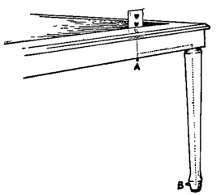
III. The Table Hold Out.—As are the three other contrivances above described, so is this a device for concealing cards abstracted from the pack during the progress of a game of poker. It differs from the others, however, in that it is permanently attached to the table, instead of being carried about by the player himself. The illustration shows the plan of its construction. A card may be seen protruding above the surface of the table, directly where the cloth covering joins the wooden border. This card is forced up through a concealed slit at the will of the gambler, by means of a hidden mechanism. The 235dotted line running from the slit to the foot of the table’s leg represents a wire which operates a spring whereby the card is forced upward, or lowered, through the slit, at the option of the manipulator. “A” is a point at which is inserted a small knob, or button, pressure upon which works the spring. By pressing with his foot at “B,” the player accomplishes the same result. The method of its use is as follows: The abstracted cards are placed in the slit, the player holding his hand of cards in front of it; they are then drawn down and retained beneath the table until the moment arrives when they are to be used. Pressure at either “A” or “B” forces them up, and the sharper takes them in his hand, at the same time discarding an equal number of cards from his hand into the slit.
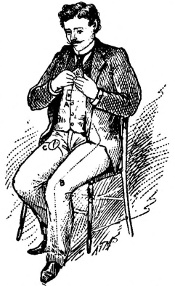
IV. Vest Hold Out.—Some gamblers prefer this contrivance to any other, for the reason that it permits the holding out of an entire hand if the player so desires. The accompanying illustration shows the method in which it is worked. “A” indicates the location of that part of the mechanism which holds the abstracted cards; “B” is a piece of catgut attached to that part of the apparatus concealed beneath the vest, and running underneath the clothing to the heel, where it is fastened either to the shoe or the clothing. The cards selected to be “held out” are placed inside the clamp underneath the vest. When the player stretches out the leg along which runs the catgut, the plate inside the vest comes forward and the cards may be easily withdrawn; when the heel is drawn back beneath the chair the tension on the catgut is increased, and the clamp recedes behind the vest.
CONVEXES, OR SHINERS.
Of all the devices for defrauding at poker, the “shiner,” or “convex” is perhaps the most simple and the most effective. They are of various forms. At first a circular piece of silver highly polished and convex in form, about the size of a five-cent piece, was used. The player employing it places it on the table in front of him, using the utmost pains to conceal it from observation. The advantage resulting from its employment is its power of reflecting whatever is held above it at any angle, thus enabling the dealer who used it to read the face of each card as it was taken, face downward, from the pack. Of late years, however, the makers of these implements have greatly improved the process of manufacture. 236Looking glass has been substituted for silver, the reflection being much more brilliant. Modern convexes are also considerably larger than those of former days. Some players attach them to the knee, some to the thigh—as shown at point “C” in cut illustrating the “Vest Hold Out”—and some fasten them to the coat. In one description of the convexes, a slender bar is attached to the article at its end, a joint containing a spring being fastened to the other extremity of the bar. In using this contrivance the cheat places it on top of a few bank notes, and then with the other bills entirely conceals it from view. In dealing he apparently carelessly rests his hand upon the joint, in doing which he necessarily brings pressure to bear upon the spring; this in turn forces the convex to fly upward toward the dealer, and enables him to see the face of each card as it is dealt. Occasionally magnifying glasses, technically known as “reflectors,” are used. The blackleg places one of these on his lap, or attaches it to the table in such a way that he may cause it to drop by means of a spring. The forms of the “reflectors” are numerous, and no good purpose can be served by describing any further varieties. It may be observed, however, that new shapes are being constantly invented, as well as new contrivances to enable cheats to use them without detection.
I have seen a convex employed upon a Mississippi steamboat with remarkably confusing effect. Two professionals were each trying to take advantage of the other, supposing him to be an amateur. For a time neither gained any advantage. At length, one of the sharpers temporarily excused himself. Going to his state room, he returned with his “shiner.” Meantime his antagonist had arranged a “cold deck,” which he proceeded to “ring in” on his own deal, much to the betterment of his finances. Thus emboldened, he bet wildly on his adversary’sadversary’s deal, the result being that the caller recouped his losses, with interest.
Once at the Mound City Hotel, in St. Louis, I had succeeded in bringing two “skin” gamblers together. I had told each that I intended to “throw off” the other to him, consequently I felt certain of receiving my share of the winnings, no matter which of the pair succeeded in fleecing the other. One of them had prepared a table which he could take apart and carry with him. On the top of it was a box about a foot square, inside of which was a “shiner” made of looking-glass. Half of the side facing the operator was a slide which was raised, when occasion required, by means of a string which passed down the leg of the table to the foot. As the game progressed and the excitement increased, the foot of the operator accidentallyaccidentally slipped from the pedal. The result was that instead of the cover returning quietly to its place, it fell with a sharp click, which attracted the attention of his opponent, who quickly springing to his feet ran around the table and asked, “what’s that?” and then realizing its meaning, laughingly remarked: “Say, the tail piece of your wagon just fell out. What’s that dog-house you’ve got on the table, anyway?”
237THE “NAIL PRICK” OR “SECOND DEALING.”
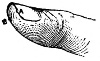
This is a device practiced by professional gamblers with great success. In order to play the “second” effectively, the operator trims the thumb nail on his left hand to a fine point, as shown in the accompanying cut at letter “A.” Sometimes, instead of trimming his nail he attaches to the ball of the thumb, by means of a small piece of kid and a little shoemaker’s wax, a fine needle point, lettered “B” in the illustration. As the game progresses, he gradually pricks the aces and kings on the face in the left hand corner of each, which, when they are turned over, becomes of course, the right hand corner. The cards are dealt from the end, the dealer seizing them by the corner with the thumb of the right hand. When one of the pricked cards is felt, the dealer slips it back and deals from under it until he comes to himself, when he secures it for his own hand, thus gradually obtaining a pair of aces or kings, sometimes two pairs, and occasionally three of a kind. When this trick is successfully performed, the professional is usually able to “clean out” a greenhorn with the utmost ease and dispatch. It is a favorite mode of swindling at poker, inasmuch as it requires no partner, no stocking of cards, and admits of their being fairly shuffled.
THE “TELEGRAPH.”
By the word “telegraph” as employed in gamblers’ parlance, is by no means meant the ordinary electric wire through which are transmitted messages upon which depend not only men’s safety and lives, but even the welfare of nations and the peace of the civilized world. The gamblers‘ “telegraph” is used for entirely different purposes. It consists of a wire running from a poker table to some point of vantage, usually behind a “peep-hole,” by means of which one confederate advises another when to bet. Of course collusion between two is essential. The man at the peep-hole, which is not infrequently in an upper room, sees through the aid of a magnifying glass the hands of all the players. He controls one end of the wire, the other extremity of which is attached to the clothing of his partner. A pre-arranged system of signals conveys to the latter all the information necessary to enable him to place a wager with the absolute certainty of winning. On its face this species of fraud appears so disreputable that the average reader will question whether the device may not have originated in the author’s brain. Alas, for human nature! The telegraph is an actual fact, no less deplorable because its existence is assured. The number of saloons which employ it is “legion,” and it may sometimes be found in places which would be considered most unlikely. The only safe plan to be pursued is never, under any circumstances, to sit down to a game of poker, no matter how trifling the ante.
238A SURE HAND.
Reference is made elsewhere to the advantage taken by professional gamblers and confidence men of the cupidity, venality and dishonesty of a certain class of “suckers.” It is not an uncommon experience with black-legs to be invited by some man of good repute in the community in which he resides, to visit the town with a view to fleecing some moneyed friend of the latter individual, the gain accruing from the execution of the rascally enterprise to be equally divided between the confederate scoundrels. This is known in gambler’s slang as “throwing off a sucker.”
Under the present title will be explained one of the most effective methods by which the scheme is executed. The author can best illustrate it by recounting a bit of his own experience:
In a certain western town once resided a man whom we may call Mr. X—--, who had an intimate friend—a man of some means—who will be referred to in this connection as Mr. Y——. Mr. X—— conceived the idea of winning some money from his friend, and appealed to me to assist him in the enterprise. At that period of my life I was little troubled with qualms of conscience, and I lent a willing ear to the suggestion. I went to the city in question, and in due course was introduced to Mr. Y—— by Mr. X—— as a verdant sort of an individual, almost too green to be attractive to a bovine quadruped, but with plenty of money. Mr. X—— proposed to his friend that they should engage me in a little game of “draw;” that he, Y——, should sit behind me and “tip off” my hand, a knowledge of which was certain to enable X—— to win all my cash. Mr. Y—— was nothing loth, and readily consented to become a party to a transaction which was, on its face, a bold scheme of fraud. Undoubtedly he was a “sucker,” but it is a question whether sympathy would not be wasted upon him.
The plan worked admirably. X—— and myself met at a pre-arranged “trysting-place,” and sat down to play poker. Y—— dropped in and took a seat where he could over-look my hand. A “cold deck” had been prepared—need I say by whom?—and after I had lost a few trifling stakes X—— proceeded to “ring it in” on me, in accordance with his previous understanding. Regarding the operation from a “professional” standpoint, I may say that I never saw a trick more clumsily performed. Had I been, as Y—— supposed, a mere tyro, I could hardly have failed to detect it, so bunglingly was it done. However, I preserved a stolid demeanor, and proceeded to examine my hand. I found a pair of queens with three nines. Mr. X—— had a “full”—three jacks and a pair of tens. Of course this latter was a strong hand. He bet; I promptly “raised” him one thousand dollars, putting the money on the table. Naturally, he professed to regard my “raise” as a mere “bluff,” and asked his friend, 239Y——, to lend him enough money to “see” me. Y—— rose from his chair, and, walking around the table, looked at X——’s hand. Seeing a “full house,” with jacks at the head, as against a smaller one, “nine full,” he willingly loaned the money. With a tolerable simulation of tremulous excitement, Mr. X—— contrived to display his cards. I promptly called for two cards, discarding a like number, and received, as I knew I should, two queens, thus securing “four of a kind,” which always wins against a “full.” The reader who has perused the explanation of the fair game, as given above, will, of course, perceive that in his intense anxiety to win a dishonest $500, Mr. Y—— had overlooked my right to “draw,” although he was satisfied that on the hand which he had seen me hold, I was morally certain to be content with the cards which I had. Yet, cupidity often over-reaches itself in a similar way.
Of course I won and pocketed the stakes, although, in justice to myself, I may add that I divided my winnings fairly with Mr. X——, who received exactly one-half of the money out of which his friend had been cheated.
If the inexperienced, unsophisticated reader will carefully peruse the foregoing paragraphs, he will have but little difficulty in reaching the conclusion that playing poker is about as hazardous as “encountering the tiger in his lair.”
STUD POKER.
Another variety of poker in great favor among the gambling fraternity is called “stud poker,” a stud poker table being now considered a necessary adjunct to every first-class gambling house. The necessary outfit for the game consists of checks, cards and a table large enough to seat 10 or 12 persons. Regular dealers are employed and usually four or five “pluggers” (by which term are designated men who play for the house and with money belonging to the proprietors). The game is very simple, and any one acquainted with the value of draw poker can play, and lose his money as easily and rapidly as he could possibly desire. The game may be illustrated as follows: Suppose four persons, whom we will designate as A, B, C and D, sit down to play. In some games, in fact usually, each player puts up one check as an ante. This having been done, the dealer deals the first card, face downward, to each player, beginning with the one who sits immediately on his (the dealer’s) left; another card is then dealt around with the face exposed, as must also be the other three cards in case a hand of five is dealt. Let us suppose that A’s exposed card is an ace, B’s a queen, C’s a nine spot, and D’s a ten. It is then A’s first bet because he has the highest card in sight. He can wager any amount he chooses, and the others can throw away their cards or “stay in,” by putting up an equal stake to that of A’s. If B, C and D should throw down their cards, the checks in the “pot” belong to A, and the 240dealer shuffling, begins another deal. Should either B, C or D “see” A’s bet or “raise” him, the dealer, deals off another card, face upward, when the player who has the highest cards in sight, has another opportunity to “pass” or bet, while the others have the choice of throwing away their cards or “seeing” the bet, and so on until five cards are dealt, when the players must guess at each other’s buried card, or “hole card” as it is technically called.
Sometimes at stud poker an instrument known as “The Buck” is used. This is employed where all the players do not “ante.” Any article may be used for this purpose. Sometimes an ivory chip with a string running through it; sometimes a circular piece of leather, its material and form are unimportant. It passes in rotation, one to another, the player in front of whom it is placed being required to “ante” a chip and receiving the first card dealt. The game then proceeds as already described. The chances for “crooked work” at this game are legion. In a word nearly every fraudulent device employed in “draw” poker may be utilized in “stud” poker. “Stocking,” “palming,” “holding out,” “false cuts,” “paper,” “partnerships,” etc., etc., are just as useful in one case as in the other.
INCIDENTS AND REMINISCENCES.
The vicissitudes of the life of a professional gambler are numerous and shifting, and perhaps the ups and downs of a poker player’s career are as varying as those which attend the checkered experience of any other description of gambler.
I remember some rather startling experiences of my own in this direction. I was once traveling in partnership with a man named Enyert. At a town in Missouri we fell in with a mule-buyer named Brown. Enyert was cursed with one of the most violent tempers that falls to the lot of man. So also was Brown. Both of them were known as “dangerous” men, i. e., ready with the pistol. I was dealing marked cards and my knowledge of Brown’s character made me extremely nervous. I knew that if he detected any cheating my life would be exacted as a forfeit. An expert marked card player always needs his wits, and my nervousness prevented me from using mine. On the other hand, I knew that if my partner (Enyert) did not win he would accuse me of “throwing him off” to Brown, i. e., of playing in collusion with the latter, in which case I was quite as likely to be shot by him. To use a slang expression, I was too badly “rattled” to be of any use as a dealer and brought the game to a close as soon as possible.
This man Enyert shot the son of the Mayor of Ottumwa, familiarly known as “Billy” Orr, and would, on one occasion, have carved up my anatomy with a bowie knife, had I not dissuaded him by showing him 241the muzzle of a six-chambered navy revolver. Brown’s son inherited his father’s disposition. Having some trouble with his wife’s parents, he emptied both barrels of a shotgun into them, killing Dr. Parish, his father-in-law, and seriously wounding the Doctor’s wife. He was tried, convicted, and sentenced to be hanged. His wife visited him in his cell and contrived to convey to him, secretly, a dose of poison. They mutually agreed to end their lives at an appointed time. The hour fixed fell in the night preceding his execution. When it arrived the woman blew out her brains with a pistol, but Brown lacked the physical courage to carry out his part of the contract, and was publicly hanged on the following day after making an impassioned appeal to the crowd in behalf of his son. He and his devoted wife were buried in the same grave.
I was once playing marked cards with a Boston “drummer,” whose name need not be mentioned. At the time I had a partner. I had instructed the traveling man in the art of reading the cards by their backs and proposed to him that I would “throw off” a “sucker” to him. He assented, and I introduced my partner. We practised the same game which we had worked together many times before. I began to “hold out” cards and did it so clumsily that any one might detect it. My partner waxed furious at the fraud and I was promptly “barred out,” leaving the drummer and my confederate to play single handed, which was precisely what we wanted. The commercial traveler rose from the table a loser to the amount of $400. I condoled with him; and inasmuch as we were supposed to be acting in unison probably I ought to have stood half the loss but I still owe him my share.
One more narrative of my experience with marked cards, and I have done. While traveling in partnership with a man named Sam Martin, whom I have mentioned in my autobiography, we were going down the Mississippi in a steamboat. Martin had placed a number of packs of marked cards with the bar-keeper, with instructions to “ring them in,” that is, to sell them to customers asking for playing cards. We wandered about the boat, separately, looking for victims. At length I formed the acquaintance of a tall, handsome man, who suggested a game of euchre for the cigars. We had not played long when the stranger proposed poker for a small ante. I said that I was not accustomed to playing for money, but that if he would promise not to expose me if I lost I would chance a few dollars. Martin was in the cabin waiting for me to give him a signal to approach. On receiving it he drew near the table and I accosted him with: “Well, stranger, will you join us in a game for a small ante?” He answered that he would if my friend had no objections, although it was near his bed time. We played a few games and quit losers. We knew that our “mark” was going to Memphis, and that we would have an abundance of time in which to win our money back. The 242next morning we resumed play. I lost fifty dollars (which of course was won by Martin), and said that I would have to withdraw from the game unless they would consent to place stakes against a draft. [In those days I always traveled with a liberal supply of worthless checks.checks.] I left the table and Martin and the stranger (who gave his name as Walton) played single-handed, which was precisely what the former wanted. They were using the marked cards which my partner had placed with the bar-keeper. It was not long before Martin had won all the stranger’s money—some $800—besides a valuable gold watch and chain. At the conclusion of the game the winner invited his dupe to take a drink at the bar, which invitation was accepted. As they were drinking Walton looked at Martin and said: “You are a very lucky man. I believe that you might fall overboard without getting wet, and I certainly should expect to see your body floating up stream. You have all my money, and I don’t mind telling you, now, that I was cheating all the time. I was ‘holding out’ and playing the ‘double discard’ from the beginning, and I don’t see how you managed to come out ahead.” “Well,” said Martin, “since you have been so frank I will be equally so. I am an expert marked-card player, and each pack that we played with was one of mine. I knew that you were cheating, but didn’t care. My ‘percentage’ was too strong for you. Here is your watch and chain and fifty dollars for a ‘stake.’ But I can tell you right here that you won’t ever have any show against an artist who can read your hand at sight, and remember it.” And there is no doubt that “Sam” was right. Yet if an accomplished card sharp like Walton can be thus taken in, even while practicing his professional tricks, what possible chance remains to a greenhorn?
243

SHORT GAMES.
The name “short” games is applied among gamblers to those which require comparatively little time in which to determine the issue of the hazard. In the present chapter, those best known and most commonly played in gaming houses will be described and the methods of trickery employed by those who conduct them will be pointed out.
Chief among games of this description are “rouge et noir,” “roulette,” “keno” and “rolling faro.” These will be taken up in the order indicated.
ROUGE ET NOIR.
As played in this country, this game differs materially from the mode of playing in vogue on the continent of Europe. In foreign gaming houses—particularly at the more famous resorts, such as Monte Carlo or Baden-Baden—the game is probably conducted fairly. In other words, the proprietors are satisfied with the revenue which they can derive from the legitimate percentage which accrues in their favor under the operation of the ordinary laws of chance. In this country, however, not only is the method of play vastly simplified, but it has degenerated into a mere scheme of robbery. The players are utterly at the mercy of the manipulators of the machine.
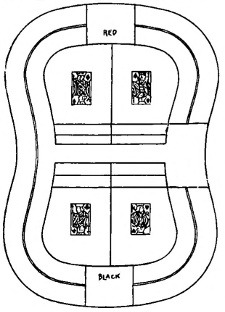
The game is always played with the adjunct of a “lay-out,” which is depicted in the accompanying cut. The outer line, as shown in the illustration, represents the outer edge of the table, which is covered with a green cloth. The middle line serves no special purpose, but adds one more striking feature to the device. The inner line serves to mark off that portion 244of the table on which are depicted the representation of the four jacks found in every pack of cards. At the two ends of the table and on the right hand side are blank spaces. Those at the ends are colored—the one at the top red, the one at the bottom black. The space on the right hand side is for the placing of wagers.
Any number of persons may play.
Bets may be made in either one of the four ways—on the red; on the black; on either jack, or on any one of the four jacks. In the two cases first mentioned the bettor places his wager on the color which he selects. If he wishes to bet on any particular jack (that of hearts, clubs, diamonds or spades), he lays his money on that one which he chooses. If he prefers to bet that some jack (without indicating which) will win, he lays his venture upon the blank space at the right hand side of the table, as shown in the diagram.
If he bets on the winning color, the bank pays him an amount equal to the sum staked, which latter, of course, he receives back. If he selects a particular jack and the one on which he has placed his wager happens to win, his stake is returned to him, together with an increment of ten times the amount. If he places his wager on the blank space to the right he is understood to have bet that some one of the four jacks will win, and if his hazard prove successful, his gains are measured by a sum twice that of his original bet.
The bets having all been made and placed, the play commences. The banker places a full pack (fifty-two cards) in a dealing box, similar to those used in playing “faro,” which have been already described, but with this variation: In “faro” the cards are inserted and dealt face uppermost, the opening being large enough to afford a clear view of the card; in rouge et noir they are inserted and dealt face downward, and the apertureaperture in the box is only large enough to permit the dealer to run them off readily with the index and second fingers of the left hand.
The first two cards, after being withdrawn from the box, are laid upon the table, faces downward, and the third is turned over. This constitutes a “run,” and the gains or losses of the players are determined by the color (and sometimes the denomination) of the third card. If it happens to be red the bank pays all bets placed on the space at the upper end of the table, marked “red,” and gathers in all other wagers placed upon the table. If it chance to be a jack, and any player has placed his money on the representation of that particular jack upon the “lay-out,” the fortunate individual wins ten times the amount which he ventured. If a player has bet upon “jacks,” without naming any particular one—placing his money in the space at the right hand side of the table—and a jack of any suit is turned up, he is given, as his winnings, double the amount of his wager.
245On the other hand, if the bettor has laid his stake either upon “jacks” or on any particular jack, and no jack turns up, he loses.
Even when fairly played, the chances in favor of the bank are large enough to satisfy any banker whose greed for gain is not abnormal. But as in all other games, the rapacious sharks who operate it are not satisfied with even the most extraordinary percentage of chances. What they seek is absolute certainty, and in the game of rouge et noir, as conducted even in so-called “square” houses, they have contrived to secure it.
In dealing the cards, resort is had to many of the same tortuous devices which are employed in “faro,” an explanation of which may be found in the chapter devoted to that game.
“Faked” boxes, similar in construction to those used in “faro,” are employed, and the cards are “stripped” and “sanded” as in that game. The “strippers,” however, are arranged on a somewhat different principle. The red and black cards having been separated so that the pack shall be divided into two lots, one-half being red and the other black, the narrower ends of the two colors are placed opposite each other. The dealer then takes the red cards in one hand and the black in the other. Through long practice he is able to put the two packs of cards together in such a way that a card of one color shall rest directly upon a card of the opposite color all the way through the pack. The cards are then pressed together, so that the entire pack shall lie, one card upon the other. The reader will perceive that, owing to the use of the “strippers,” the end of each card is a trifle narrower than the end of the one directly above it. The manipulation of the pack in the box is practiced in the same way as has been already explained under “faro.” The result of this arrangement of cards is that the dealer knows perfectly well the color of the card under his hand at any given moment. If he considers it worth his while to change the color before exposing the card to the view of the players, the “sanding” and “stripping” of the cards, in connection with the “faked” box, enables him to draw two cards instead of one through the aperture, thus reversing the run of the colors.
The usual method in which bets are made upon this game is as follows:
A player having laid a wager on either the black or red, and having lost, naturally supposes that if he suffers his money to lie upon the table long enough, the color on which he has made his bet must win before the entire pack shall have been run out of the box. Accordingly, if he has a wager of one dollar on the black and the first run shows that he has lost, he doubles his stake and awaits the result of the second run. If he finds he has lost again, he doubles his stake once more, and continues playing in this manner until the entire pack has been run out 246of the box. If he is a loser when all the cards have been dealt, he may, if he choose, continue to double his stake as long as his funds will permit.
The reader can scarcely fail to perceive how soon this sort of play will bankrupt the unsophisticated gamester. Every time he doubles his stake he is offering the bank enormous odds. It requires a very short time, for a bet of one dollar under such circumstances, to run up to a wager of $128, $256, $512, etc. As a matter of fact, the player, under such circumstances, is offering the bank odds amounting, sometimes $4,000 to one. Thus, if a player starts in, with a wager of one dollar, and continues to double it as he loses until he has risked $100,000 or more, he is still actually betting that enormous sum that he will eventually win the trifling sum of one dollar. If he should continue to play for seventy-two consecutive hours on the same principle, and the doubling of his stake run up into the millions, all that he could possibly hope to win at the close of the play would be a dollar.
But there is another device known to the manipulators of this game which is even a more bare-faced robbery than the use of “strippers” and “faked” boxes. When a “soft mark” is playing at the table and has repeatedly doubled his stake, and begins to see the bottom of the pile of money which he has brought with him, he very frequently asks the dealer how long he will be permitted this mode of play. The dealer, after estimating in his own mind the amount of money which the dupe may have in his possession, tells him that the doubling must quit on either the second or third run. As soon as the proprietors are satisfied that the unfortunate victim has staked his all, the dealer turns a jack, and remarks that “this is the only percentage that the bank has,” whereupon he at once gathers in the player’s entire stake without any sign of shame or compunction of conscience. Should the player manifest any unwillingness to continue doubling his wager, the banker informs him that if he loses at the end, his money will be returned to him, less five per cent. Relying upon this assurance, and always hoping that his luck will turn, the poor fool keeps on, only to be confronted at the end by the turning of a jack and to be assured that this entire venture has been incontinently swept away.
“Steerers” or “ropers” are invariably employed by the proprietors of this game. Their duty is to select victims and guide them into the resort where this knavery is carried on. They are paid the usual percentage allowed “cappers;” that is, forty-five per cent, of the bank’s winnings from the dupe whom they may allure.
While a rouge et noirnoir table is considered a necessary adjunct to the outfit of every American gaming house, the game is not so popular in this country as in Europe nor is the method of play precisely the same in both continents. An explanation of the devices used in the old world may be found in Part I.
247ROULETTE.
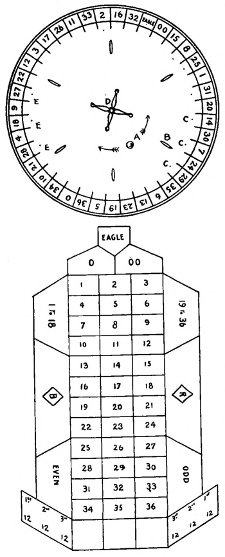
Roulette, as will be seen from the illustration, is played upon a table in the form of an oblong square, covered with green cloth, at one end of which is a round cavity, around the sides of which, equi-distant one from the other, are arranged several metal bands—usually of copper—which, commencing at the top, descend to the extremity of the machine. The cavity is movable, and in its centre is a circular bottom containing thirty-nine holes to which the bands are attached, and upon which are painted, alternately, in black and red, thirty-six numbers, running from 1 to 36, besides (0), a (00), and a picture of an eagle or the word itself printed thereon. In the middle of the cavity, are three or four little metal prongs, centering at “D,” which are used in imparting a rotary motion to the bottom. The revolution of the ball is checked by slender metal plates (indicated on the diagram by the letter “B”) about two inches in length and rising about one-quarter of an inch above the lower surface.
The remainder of the table is laid out as shown in the cut. The figures are arranged in three columns, and above them in two divisions nearest the Roulette wheel, are single and double 00 respectively. The figures are painted black or red, to agree with the corresponding color of the numbers on the wheel. At the head of each column there is a compartment for placing a stake which is made on the column. On each side of the foot of the columns of figures are three spaces, each of which contains the number twelve. These are known, respectively, as the 1st, 2nd and 3rd twelves. Stakes placed on the first 248space are considered to be bets on the numbers 1 to 12; the second space is for bets on numbers 13 to 24; the third space for numbers 25 to 36, all inclusive.
The space on either side of the entire length of the columns is divided into three parts. The upper left hand division is for bets on numbers 1 to 18; the corresponding right hand division is for numbers 19 to 36. The large division in the middle of the left hand side, lettered “B” in the illustration, is for bets on the black; the similar one upon the right, marked “R,”“R,” is for wagers on the red.
The lower division on the left hand is for bets on even numbers; the division opposite on the right is for odd numbers.
There is a banker and several assistants; an unlimited number of persons may play.
One of the assistants sets the machine in motion, at the same instant throwing an ivory ball into the cavity in the opposite direction to the movement which he has given to the movable bottom. The ball makes several revolutions with great rapidity until its momentum being exhausted, it falls into one of the thirty-nine holes formed by the copper bands. It is the hole into which the ball falls that determines the gain or loss of the numerous chances which this game affords to players.
If the reader will examine the cut showing the lay-out, he will perceive that there are numerous chances to be played for: Single and double (0); the “eagle;” black and red; the three columns; the first and last halfhalf of the numbers, respectively, consists of 1 to 18, and 19 to 36 inclusive; the three 12’s, consist of 1 to 12, 13 to 24 and 25 to 36; odds and even; and lastly, the numbers, either single or in small groups.
Stakes bet on black or red; the first or last half of the numbers; also on odd and even, are called single stakes. Stakes on either of the three 12’s, or on either of the three columns, win double the amount. Stakes on any single number, or on either of the (0’s), or the eagle, are paid thirty-five times their amount if they are successful.
Bets may be made on groups of not over six consecutive numbers, and win as many times the amount of the stakes as the grouping is contained in thirty-four, omitting all fractions; so that a bet on any four designated consecutive numbers would win eight times the amount of the stake, provided any one of these numbers comes out.
It has already been stated that the space occupied by thirty-six numbers are all either red or black; and as the numbers are equally divided between the colors eighteen to each, a stake on either color is a single bet. The 0’s and the eagle are painted green, and if a zero or eagle turns up, bets on either black or red are lost by the players.
It is only of late years that the majority of roulette wheels contain a picture of an eagle, a similar picture being painted upon the cloth. Bets on the eagle, if won by the player, are paid in the ratio of 35 to 1.
249The legitimate percentage of chances in favor of the bank in this game is enormous. Out of thirty nine chances, the bank runs eighteen of losing and has twenty-one of winning, or three additional chances in its favor, which is equivalent to fully 5½ per cent. in favor of the bank in all cases, even where a bet is placed upon either of the zeros or the eagle. In the latter case, the bet on either zero or on the eagle is paid 35 to 1, the same as on any single number.
Here the bank has thirty-five chances out of thirty-nine of winning, and only one of losing, or four more chances in its favor than the payments warrant, thus yielding the same 5½ per cent.
It follows that the odds against the players in the various chances may be expressed as follows:
Upon a single number, 37 to 1
Upon any twelve numbers, 13 to 6
Upon two numbers, 18 to 1
Upon three numbers, 11⅔ to 1
Upon four numbers, 17 to 2
Upon six numbers, 16 to 3
Upon odd or even, red or black, 10 to 9
In the case of a bet on the first or last eighteen numbers, the odds are ten to nine, the same as on odd or even, or red or black.
When, however, a stake is laid on all the numbers, and the bank only pays the winner thirty-five times his stake, it clears four; thus, supposing thirty-nine dollars to be a stake, and that the ball is thrown twice in a minute, the gain of the bank, without incurring the slightest risk, would be eight dollars per minute, or $480 per hour. Although, in whatever way a player may bet, the chances are always in favor of the bank, still the latter’s risk varies in proportion to the number of chances which are not filled up. To illustrate, if only ten numbers are filled, and the ball were to enter one of them, the bank would, in that case, lose thirty-four dollars, and only win eight; whereas, when all the numbers are filled, it wins four without risking a cent.
From what has been said, as to the chances in favor of the bank, it would seem to be hardly necessary to use any additional means of swindling, inasmuch as the percentage in its favor is so large that the game is very seldom beaten, even if “played on the square.” An old gambler once remarked in my presence, that the percentage of the game was forty per cent. worse than stealing. However, despite this fact, the gambler is not satisfied, and has succeeded in devising schemes, whereby he may win every bet made against him, if he sees fit.
The first method of cheating which I will describe, is as follows: The roulette is manufactured for the purpose, the machinery being entirely concealed from view. The gambler who manages the game can 250cause the ball (A) to fall in a red or black number, as he may think proper. After throwing the ball he watches it closely, and if it should fall in the red, when he wished it to go into the black, while still revolving, its course can be quickly changed to the desired color. This is accomplished by means of a lever attached to the circular wheel, and connecting with one of the legs of the roulette. This leg has the same appearance as others, but is a trifle shorter, not quite touching the table on which the roulette rests. The gambler has only to touch this leg while the wheel is revolving, and in a second the ball is changed from one color to another, as he may prefer. In fact, so quickly can the ball be changed, that it is difficult to detect the motion after one has been shown how it is managed, unless the wheel is turned slowly. This is one of the most ingenious contrivances in use.
There is yet another kind of roulette, which is made in the following manner: One-half of the small pieces of metal which form the pockets for the ball are made a trifle longer than the others, lettered on the diagram E E E. After the stakes have been placed, if the proprietor wishes the ball to fall in a red color, it is necessary for him merely to throw the ball around to the right hand, and if he wishes it to fall in the black, he casts the ball toward the left. The players may observe that he throws the ball in a different direction on different occasions, but the action appears to be so trivial that it excites no suspicion.
Another fraudulent contrivance used in playing this game consists in the gambler’s having two centers to a wheel, apparently identical, one of which, however, is “square” and the other “faked.” This device is known to the members of “the profession” as the “double center.” The “square” wheel is used at first, and, at an opportune moment, the “fake” is substituted, after which the sharper has everything his own way. This wheel is operated on very much the same principle as the “needle wheel,” for the construction of which the reader is referred to the chapter containing a description of that device. A system of levers radiating from the centre of the apparatus is operated by a rod terminating at the edge of the table. By bringing to bear the requisite pressure, these levers cause fine needle points (lettered C C C on the diagram) to rise through the cloth, one coming up in front of each alternate compartment on the rim, thus obstructing the entry of the ball and causing its course to be so changed that it shall fall into one of the next adjacent divisions, as in the case of the “needle wheel” above referred to.
It is easily perceived that the players can have no possible chance when playing against such roulettes as these, and there is a large number of them in use all over the country.
251KENO.
This game is a favorite one with nearly all non-professional gamblers, not only because the risk of loss involved is not large, but also because of the popular impression that it is always played “on the square.” As a matter of fact, it usually is conducted fairly, although, as will be explained, sometimes bare-faced swindling is resorted to by the proprietors.