Chapter I
Reading edition
The following is a list of some of the inferior local deities of Gujarat and Kathiawar:—
(4) Shitalā is a goddess known for the cure of small-pox.—Persons attacked by this disease observe vows in her honour. Kālāvad and Syādlā are places dedicated to her.40
(5) Ganāgor.—Virgins who are anxious to secure suitable husbands and comfortable establishments worship this goddess and observe vows in her honour.40
(7) Buttāya also is represented by a heap of stones on a hillock in the vicinity of Sānkā. Her worshipper is a Talabdia Koli. A long season of drought leads to her propitiation by feasting Brāhmans, for which purpose four pounds of corn are taken in her name from each threshing floor in the village.42
(8) Surdhan.—This seems to have been some brave Kshatriya warrior who died on a battlefield. A temple is erected to his memory, containing an image of Shiva. The attending priest is an Atit.42
(9) Ghogho.—This is a cobra-god worshipped in the village of Bikhijada having a Bajana (tumbler) for his attending priest.42
(10) Pir.—This is a Musalman saint, in whose honour no tomb is erected, the special site alone being worshipped by a devotee.42
(12) Hanuman.—On a mound of earth there is an old worn-out image of this god. People sometimes light a lamp there, offer cocoanuts and plaster the image with red-lead and oil. A sādhu of the Māragi sect, a Koli by birth, acts as pujari.43
(13) Shaktā (or shakti).—This is a Girasia goddess attended upon by a Chumvāliā Koli. On the Navarātra days, as well as on the following day, Girasias worship this goddess, and if necessary observe vows in her name.43
(15) Hinglaj.—This goddess has a place of worship a hundred and fifty miles from Karachi in Sind, to which her devotees and believers make pilgrimage.44
It is pretty generally believed that vows in honour of the sun are highly efficacious in curing eye-diseases and strengthening the eyesight. Mr. Damodar Karsonji Pandya quotes from the Bhagvadgītā the saying of Krishna:
प्रभास्मि शशिसूर्ययोः
The following are some of the standard books on sun-worship:—
(1) Aditya-hridaya—literally, the Heart of the Sun. It treats of the glory of the sun and the mode of worshipping him.
(2) Brihadāranyakopanishad and Mandula-Brahmans—portions of Yajurveda recited by Vedic Brahmans with a view to tender symbolic as well as mental prayers to the sun.
(3) Bibhrād—the fourth chapter of the Rudri.
(5) Sūrya-Purāna—A treatise relating a number of stories in glorification of the sun.
(7) Sūrya-gīta.


नमस्कारप्रियो भानुर्जलधाराप्रियः शिवः ।
परोपकारप्रियो विष्णुर्ब्राह्मणो भोजनप्रियः ॥
A namaskār or bow is dear to the sun; a stream of water (pouring water in a small stream over Shiva’s idol) is dear to Shiva: benevolence to Vishnu and a good dinner to a Brahman.97
(1) In Kārtika, the first month, the devotee is to take only three leaves of the Tulsi or the holy basil plant.
(2) In Mārgashīrsha, the devotee may only lick a few pieces of candied sugar.
(3) In Pausha, the devotee may chew three stalks of green darbha grass.
(4) In Māgha, a few seeds of sesamum and sugar mixed together may be swallowed.
(5) In Phālguna, a consecrated draught of curds and sugar may be drunk.
(6) In Chaitra, people should break their fasts with a little ghi and molasses.
(7) In Vaishākha, the only satisfaction allowed to those observing the vrat is to lick their own palms three times.
(8) In Jyeshtha, the fast is observed simply on three anjalis or palmfuls of pure water.
(9) In Ashādha, three chillies may be eaten.
(10) In Shrāvana, only cow-urine and molasses are tasted.
(11) In Bhādrapada, cow-dung and sugar are partaken of.
(12) In Āshvina, the application of chandan (sandal wood) either in the form of an ointment or of powder.
Only a few very pious and enthusiastic devotees observe all Sundays in the above manner. In average cases, the devotee allows himself rice, ghi, sugar, milk, i.e., white food, the restriction being only as to colour.98
The special occasions for Sun-worship are the Sankrānti days and the solar eclipses.
If at a wedding the sun happens to be in an unfavourable position according to the bridegroom’s horoscope, an image of the sun is drawn on gold-leaf and given away in charity. Charity in any other form is also common on such an occasion.116
आदित्यो भास्करो भानू रविः सूर्यो दिवाकरः ।
षण्नाम स्मरेन्नित्यं महापातकनाशानम् ॥
It means—one should ever recite the six names of the Sun, Aditya, Bhāskar, Bhānu, Ravi, Surya, Divākar, which destroy sin.
The sun is also worshipped on the thirteenth day after the death of a person, when arghyas are offered, and two earthen pots, containing a handful of raw khichedi—rice and pulse—and covered with yellow pieces of cotton are placed outside the house. This ceremony is called gadāso bharvo.118
पापोऽहं पापकर्माऽहं पापात्मा पापसंभवः ।
त्राहि मां पुण्डरीकाक्ष सर्वपापहरो भव ॥
यानि कानि च पापानि जन्मांतरकृतानि च ।
तानि तानि विनश्यन्तु प्रदक्षिणपदेपदे ॥
‘I am sinful, the doer of sin, a sinful soul and am born of sin. O lotus-eyed One! protect me and take away all sins from me. Whatever sins I may have committed now as well as in my former births, may every one of them perish at each footstep of my pradakshinā.’



The Swastika is used in calculating the number of days taken in pilgrimage by one’s relations, one figure being painted on the wall each day from the date of separation.188

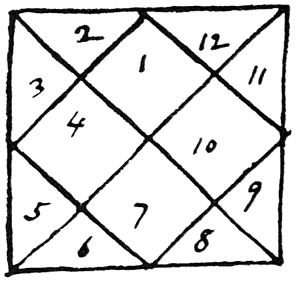
The curse of Gautama and the curse of Daksha are also supposed to be reasons of the waxing and the waning of the moon.
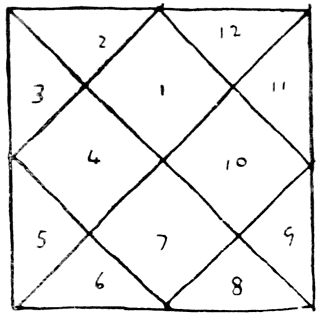
The presence of Mangal (Mars) in the 3rd, the 6th, or the 11th square is auspicious.286
Similarly, in propitiating Rāhu and Ketu the same ceremonies are gone through: only, instead of wheat, mug (Phaseolus mungo) is eaten by the devotee. In the same way Shani (Saturn) is said to favour the diet of adād (or lentils): Guru (Jupiter) inclines to chana (or gram), while Shukra (Venus) favours cholā (dolichos sinensis).288
All the nine grahas and the twenty-seven nakshatras are worshipped on the occasion of the Griha-Shanti ceremony, which is performed before occupying a newly erected building.287
It is considered inauspicious to hold a marriage ceremony while Shukra (Venus) is invisible. In such a case, however, the ceremony may be performed after setting up and worshipping a small golden image of the planet.
Married couples are made to look at the Pole star immediately after the Hymenal knot is tied by the priest, in the hope that they may be as long-lived or as inflexible or unmoved by the ups and downs of life.295
The Musalmāns declare the milky way to be the track formed by the footstep of the horse of the Prophet Muhammad, on the occasion of his night-journey to Heaven.330
Some ambitious Brāhmans dig earth from near the roots of a banyan tree after offering prayer to the earth, and out of it, make an image of Parthishwar—Lord of the Earth—hoping thereby to obtain wealth. The same ceremony, if observed near the roots of a pipal tree (ficus religiosa), is believed to confer wealth and male issue.348
A Brāhman in his brahmacharya (or the period of his life which, according to the Shāstras, should be devoted to the acquirement of learning, and which commences from the date of his being invested with the sacred thread and terminates at the age of twenty-three) and a widow are not allowed by the Shāstras to sleep elsewhere than on beds made on the ground.362
Women, while in menstruation, sleep on the floor for four days.359 Some women, when they are separated from their husbands, also sleep in this fashion.369
The occurrence of thunder and the appearance of lightning on particular days and in particular directions are regarded as signs of the abundance or scarcity of rain during the season.
Some persons expect a Boterun after kadakas or crashing thunder. Others apprehend a famine if they hear thunder on the second day of the bright half of Jyeshtha (the eighth month).391
There is also a belief that deities of some strange species reside in the nether regions, and the earth is shaken whenever these beings fight among themselves.419
The most popular of the holy rivers are the Ganges, the Jumna (or Jamuna), the Narbadā, the Saraswati (near Sidhpur), the Kāveri, the Godāvari, the Gandaki, the Sarayu, the Dāmodari, the Sindhu (or Indus), the Mahānad, the Gomati (near Dwārka), the Brahmaputra, the Sābarmati, the Ghels (near Gaddheda), the Tungabhadra, the Suvarnabhadrā, the Bhadrashitā, the Jambuvati, the Phalaku (or Phalgu), the Kaushiki, the Tāmraparni, the Sita and the Alakanandā. Any point where three rivers meet is also a sacred place. Most of the holy rivers are the subject of many traditions, and books have been written to celebrate their merits.
Of the Gandaki it is said that it contains as many shankars (images of Shiva) as there are sankars (stones). The shāligram stone is found in this river also. The Saryu is sacred as the scene of the childish sports of Rāmachandra, the hero of the Rāmāyana. On the banks of the Phalaku or Phalgu, Rāmachandra performed Shrāddha ceremonies in honour of his father Dasharath.440
The Dāmodar kund is situated near Junāgadh. It is said that if the bones of a deceased person which remain unburnt after his cremation are dipped in this kund, the soul of that person obtains moksha (or final emancipation).445
Kāshīpuri (Benares) contains a vāv called Gyān-vāv, in which there is an image of Vishweshwar (the Lord of the universe, i.e., Shiva). A bath in the water from this vāv is believed to confer upon a person the gift of divine knowledge.445
In Bhadakon near Chudā there is a kund called Garigavo. The place is celebrated as the spot of the hermitage of the sage Bhrigu and a fair is held there annually on the last day of Bhādrapad.458
The goddess Rainadevi resides in water, and is worshipped by virgins on the fifteenth day of the bright half of Āshādh, when they grow javārās (tender wheat-plants) in an earthen vessel and present them to her, remaining awake for the whole of the night to sing songs in her honour.469
Sometimes, for the sake of moksha, a person takes samādhi (i.e., drowns himself with a religious motive) in a holy river, such as the Ganges or the Jumnā. In such a case the relatives and other persons refrain from interference, and do not try to rescue the person.478
The water of the Mrigi kund near Junāgadh remedies leprosy.491
Two kings once agreed that the two children that should first be born to them should marry each other. But it happened that both the kings had daughters. One of them, however, concealed the fact, and gave out that the child born to him was a son. So that when the children attained a marriageable age, they were married to each other according to the agreement.
The god Varuna resides in the waters, and is said to have once carried off Nand (the adoptive father of Krishna) to his watery abode, for having bathed in the Jumnā before dawn.503
Mountains are held to be sacred in a variety of circumstances; thus, some are valued for possessing medicinal drugs: some are revered as the birthplaces of the gods, or as the residences of saints: some for possessing many tīrthas (holy spots): some because they were visited by Rāma or the Pāndavas: some serve as guardians of the four quarters: and some contain the sources of holy rivers.
Both the important ranges of the Presidency, the Sahyādri and the Sātpuda, are subjects of veneration in the popular mind. The Himālayas, the Vindhyā Mountains, and the Nilgiris command special respect. Other sacred mountains are Girnār and Shetrunja in Kāthiāwār, Mount Ābu, Pāvāgad near Baroda, Brahmagiri Ārāsur, Tryambak near Nasik, Koyalo, Govardhan near Mathurā, Revatāchal near Dwārkā, and Hinglaj in Sind.
Pāvāgad is known for the temple of Mahākāli Mātā. It is said that King Patai once propitiated her by austerities, and on being desired to demand a boon, asked the goddess to accompany him to his palace. The goddess was highly incensed at this request, and promptly destroyed him.516
Hanūmān, the monkey-god, once promised to take the Mountain Govardhan to meet Rāma. It is well known how the monkey allies of Rāma constructed a bridge of rocks across the sea to Laṅkā, and how Hanūmān supplied the requisite material by fetching huge mountains. Whilst engaged on this work, he was one day carrying the Govardhan mountain to the site of the bridge, when Rāma issued an order that all monkeys who were fetching mountains should deposit their burdens at the spot where they stood at the moment of the order. Hanūmān could not disobey the order of his lord, and he had accordingly to drop the Govardhan mountain near Mathurā. In order to fulfil Hanūmān’s promise, however, Vishnu held the mountain over his head for seven days, at the time of his Krishna incarnation.516
The temple of Hinglaj stands on a hill, which is situated at a distance of eighteen days’ journey by road from Karachi. The Mātā is ministered to by a Musalman and the place is mostly visited by Atits, Bāvās, Khatris, Chhipās, Mochis, and other low-caste Hindus. On occasions the doors of the temple spontaneously open, and after the devotees have visited the Mātā, they again shut in the same mysterious manner.525
A hill called Swargārohan is believed to be twenty miles to the north of Badrikedārnāth and is said to lead to heaven. In ancient times the Pāndavas had repaired to this place in order to do penance for the sin of having killed their kinsmen in the Great War. But when they tried to ascend to heaven by the Swargārohan Hill, only Yudhishthir and his faithful dog were able to reach their goal: the rest were frozen in the snow.527
Mount Kailāsa, the abode of Shiva, is supposed to be situated in the northern part of the Himālayas. The mountain is described as always covered with verdure and full of beautiful gardens and of palaces made of jewels, with roads paved with golden dust and sphatika-mani (crystal stone).527 It is said that Rāvan, the king of Lankā, once uprooted this mountain and held it on the palm of his hand, in order to display his prowess. The demon Bhasmāsur, who was enamoured of the goddess Pārvati, is said to have performed the same feat in order to frighten Shiva.523
Some believe that when the worship of the village-gods is neglected and when the people grow corrupt, ill-treat the saints and are given to the killing of cows and Brahmans, Yama, the God of Death, directs his colleagues, Indra and Varuna, to threaten the world with a drought. The rainfall returns only when the people revert to righteous ways, and after Indra and Varuna have been conciliated by offerings.
It is the duty of men only to worship the shami tree (prosopis spicegera) on the Dasarā day, and the Hutāshani fire on the day of Holi.579
Women are not allowed to worship the god Kārtikey, who is said to shun women, and to have pronounced a curse against all who visit his image.579
Persons who practise the art of curing men from the effects of serpent-bites by means of incantations, have to sit naked under water in order to gain efficacy for their mantras.592
The hook-shaped instrument, known as ganeshio, which is used by thieves in boring a hole through the walls of a house, is sometimes prepared by a blacksmith and his wife on the night of Kāli-chaudas, both being naked at the time. Instruments prepared in this fashion are believed to secure success for the thief, who scrupulously sets aside the first booty acquired by the help of the ganeshio for the blacksmith as a reward for his services. He does not grudge the reward however large the booty may be.590
In making dice according to the directions of Ramalashāstra, the workers should remain naked.595