← Table of contents
Folk Lore Notes. Vol. I—Gujarat

Chapter III · DISEASE DEITIES.

Reading edition

During the course of the disease no low-caste person and no woman in her monthly course is allowed to cast his or her shadow on the patient.21 The women in the house are prohibited from combing their hair, or churning curdled milk, or indulging in sexual intercourse. Such acts are believed to cause extreme displeasure to the Mātā, who then causes some limb of the patient to be affected. Branches of nimb leaves are suspended over the doors of the house, and also round the patient’s bed. The same leaves are used to fan the patient.21

Women whose relatives have recovered from a dangerous attack of small-pox observe a vow on every sātem, i.e., the 7th day of the dark half of every month. They first bathe with cold water and, after offering an oblation of kulerā, take their meals only once during the day. This food has to be prepared on the previous day.

It is said that the powderlike substance which falls from the scabs of small-pox cures cataract if applied to the eyes.34

The following are some of the remedies adopted in cases of fever:

(i) The recitation of sacred hymns in honour of the gods.

(iii) Rudrābhishek—pouring a stream of water on the image of Shiva with the recitation of verses in his honour.

(iv) Drawing the jantra of Mrityunjaya (lit. Death-conquering, an epithet of Shiva) as shown below.
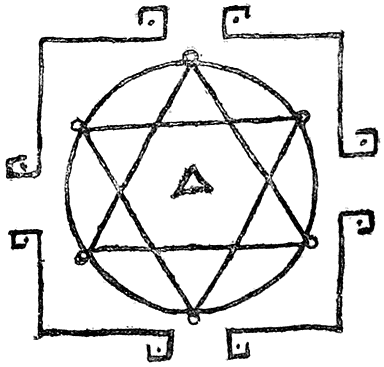
The jantra of Mrityunjaya.

There is a flower garden to the west of Jodia where there is a tree called ghelun (mad) tree. Vows in honour of this tree are believed to be efficacious in curing fever.45

There is also a belief that the sixty-four Joganis, when they are desirous of victims, cause baneful epidemics among mankind, the remedies in such a case being such as offering a goat or a he-buffalo to them, or the observation of an ujāni in their honour.

The following tale is related regarding an occurrence said to have taken place not long ago in the village of Verad. The headman of the village who was a Rajput by birth but who had lost his caste owing to irregular conduct with a woman, died of fever, and as he was an outcaste his body was buried instead of being cremated. Soon after, a number of persons in the same village happened to die of the same fever and the people conjectured that the late patel’s corpse must be lying in its grave with its face downwards chewing the khahan (? perhaps kaphan, i.e. the cloth in which a corpse is wrapped). Many thought that the health of the village would not be restored until the corpse was replaced in the correct position with its face upwards and unless the kaphan was taken out of its mouth. But none ventured to do so, being dissuaded by the fear of meeting with a worse fate.

The following are some of the remedies practised by the village people in the case of certain cattle-diseases.

The following ceremony is sometimes performed in order to ascertain whether a person is under the influence of an evil spirit or not. A bhuvā is invited to the patient’s house in the company of drummers, and there he dances for some time amidst the din produced by the beating of the drums and by the loud recitation of hymns in honour of his favourite goddess. Afterwards a handful of grain is passed round the head of the patient and presented to the bhuvā for inspection. The bhuvā selects a few seeds from the grain and making certain gestures, offers them to the patient with either the words ‘vācho’ or ‘vadhāvo’. In case the bhuvā says ‘vācho’ and the number of seeds happens to be even, what he declared to be the cause of the patient’s trouble is believed to be true. So also if the bhuvā says vadhāvo and the number of seeds proves to be odd. But in case the number of seeds proves to be odd when the bhuvā says ‘vācho’, or even, when he says vadhāvo, then his explanation of the cause of the patient’s trouble is not credited.

The following are other methods of expelling an evil spirit from the body:—

Either lobhān, i.e., incense powder, or chillies or even the excreta of dogs are burnt under the nose of the patient, who, overpowered by the unpleasant odour, is supposed to give out the name of the evil spirit and also what the latter wants.

The eighth day of the bright half of Āshvin is dedicated to the worship of the Mātās and devis (minor goddesses), and on this day, bhuvās have to dance each before his favourite mātā. This they have also to do on the 1st day of the bright half of Āshādh. Bhuvās are also invited to dance on the Diwāsā day i.e., the last day of Āshādh.74

The respect which a bhuvā commands in this way is sometimes increased by the performance of such tricks as his putting lighted torches into his mouth, placing his hand in boiling oil, and similar performances.

But although there may be some bhuvās who profit by imposing upon the credulity of the villagers, there are many bhuvās who do not work with the expectation of any reward, and are only actuated by benevolent motives. Many of them honestly believe that at the time when they are thrown into a state of trance, the mātās or deities actually enter their bodies and speak their wishes through them as a medium.

Once, a child saw its mother offering a rag to such a tree, and asked her the reason of the offering. The mother replied that her brother, that is the child’s maternal uncle, dwelt in the tree. Hence a belief arose that a chithario (ragged) uncle dwells in such trees. Others assert that the chithario pir dwells in such trees, and they propitiate him by offering cocoanuts and burning frankincense before it.89

There is a Khijado tree near Sultānpur which is believed to be the residence of a demon māmo. This demon is propitiated by the offerings of rags.

Some declare that travellers fix rags of worn out clothes to the trees mentioned above in order that they may not be attacked by the evil spirits residing in them. Another belief is that the spirits of deceased ancestors residing in such trees get absolution through this form of devotion. It is also believed that a goddess called chitharia devi resides in such trees, and being pleased with these offerings, blesses childless females with children, and cures persons suffering from itch of their disease. There is a further belief that ragged travellers, by offering pieces of their clothes to the Khijado, Bāval or Kerado trees, are blessed in return with good clothes.

It is related by some people that in deserts trees are rare and the summer heat is oppressive. To the travellers passing through such deserts, the only place of rest is in the shadow of a solitary tree that is to be met occasionally. In order that no harm be done to such trees, some people have given currency to the belief that a spirit called māmo dwells in such trees and expects the offering of a rag and a pice at the hands of every passer by.90

There is also a belief, that the holy trees that receive offerings of rags from travellers, are the abodes of gods or evil spirits, and are distinguished from other trees of the same species by the epithet of chithario. Some people hoist flags on such trees instead of offering rags.

It is stated by some people that the belief in chithario pir has grown during the last four hundred years.

Rags are never offered to wells, but it is common to offer them copper coins and betelnuts. Sometimes flags are hoisted near holy wells in honour of the water-goddess Jaldevki. Travellers hoist flags on certain wells and throw copper coins into them in the course of their journey. The origin of this offering is said to be in the desire of travellers to prevent people from committing a nuisance near wells.

Some wells are noted as being the abode of spirits who have the power of effecting certain cures. It is customary to throw a pice in such wells. When a person is bitten by a rabid dog, he goes to a well inhabited by a vāchharo, the spirit who cures hydrophobia, with two earthen cups filled with milk, with a pice in each, and empties the contents into the water.

It is a belief among Hindus that to give alms in secret confers a great merit on the donor. Some of the orthodox people, therefore, throw pice into wells, considering it to be a kind of secret charity.

The belief in the practices adopted for transferring disease from one person to another obtains mostly among women, who have recourse to such practices for curing their children.

One of such practices is to lay a suffering child in the cradle of a healthy child. This act is believed to result in transferring the disease of the ailing child to the healthy child. Another practice is that the mother of the sickly child should touch the mother of a healthy child with the object of transferring the disease of her child to the child of the latter. Some believe that the mere contact of an ailing child with a healthy child is sufficient to transfer the malady of the former to the person of the latter. Others maintain that this can be brought about by a mother either by touching the cradle of another child or by touching the person of another woman. There are others, who hold that the disease of a sickly child can be transferred to another child by feeding the latter with the leavings of the former. There is a further belief that a mother can transfer the disease of her suffering child to the child of another woman by applying the end of her robe to the end of the robe of the latter. In some places, when a child begins to weaken, its mother makes an idol of cow or buffalo dung, and keeps it fixed to a wall of the house, in the belief that the child will be cured slowly as the idol dries. It is stated that instances are actually known of the recovery of children by this process. These methods of transferring disease are called tuchakās i.e. mystic methods. As a rule superstitious women practise them on Sundays or Tuesdays, as it is believed, that to be efficacious, they must be practised on these days.

In addition to the tuchakās above stated the utārs, dorās, etc., already described, are used for curing diseases.

Some diseases are attributed to vir possession. Virs are male spirits fifty two in number. The bhuvās or exorcists are believed to have control over them, and are supposed to be able to detect an illness caused by possession by a vir. In such cases, the bhuvās drive away the evil spirits from the patients by magic incantations, or transfer them to others by waving a certain number of grain seeds round the head of the patient. By another process the bhuvās can confine the evil spirit in a glass bottle, which is buried underground.

In order to eradicate a dangerous disease, an utār is frequently offered to a dog, in the belief that by eating the utār the disease is transferred to the dog.

When a man is suffering from ānjani (a sore or mole on the eye-lid) he goes to another person’s house and strikes earthen vessels against his door saying “I have shaken the vessels. May the ānjani be with me to-day and with you tomorrow”. It is also stated that such a patient goes to the house of a man who has two wives while the latter are asleep, and taps his door uttering the words “Anjani ghar bhāngani āj mane ane kal tane” i.e., “May ānjani, the breaker of the house, be to-day with me and tomorrow with thee.” This process is believed to transfer the disease from the person of the patient to that of the husband of the two wives.

A common method for transferring disease is to wave water round a sick person and give it to another to drink. Similarly, a goblet filled with water is passed round a patient’s head and offered to a bhuvā, who drinks off the contents.

In some places the patient is supposed to be possessed by a goddess instead of by an evil spirit. A goat, cock or a male buffalo is offered to the goddess in the same way as to an evil spirit.

In some villages, when there is an outbreak of a serious epidemic, it is customary to drive a buffalo beyond the village boundary, with the disease on his back. The back of the buffalo which is chosen for this purpose is marked with a trident in red lead and covered with a piece of black cloth, on which are laid a few grains of adad and an iron nail. Thus decorated, the buffalo is driven beyond the limits of the village. It is believed that an animal driven in this way carries the disease wherever it goes.

Very often, the beast to which a disease is transferred is kept tied to a post all its life, with the belief that by so doing the disease remains enchained. Jain teachers confine a disease in a bottle and bury it underground. Sometimes, a disease is passed on to a crow, whose legs are tied to a pillar, thus making it a life-long prisoner.

A few years ago there lived in Khākhi Jalia, a village in the vicinity of Kolki, a Khākhi (recluse) named Nārandās, who, when laid up with fever, passed on the disease to his blanket, and after a time drew it back to his own person.

Notes in this chapter

Note 1 · Vide Question 19. ↑Note 2 · A small wooden car five or six inches long is covered over with a piece of cotton cloth and the wooden image of a Mātā—Khodiār or Kālkā—besmNote 3 · The Schoolmaster of Luvaria. ↑Note 4 · The Schoolmaster of Jodia. ↑Note 5 · Sometimes the statues of adad flour are besmeared with red lead and afterwards are boiled in dirty water. The whole of this preparation is tNote 6 · The School Master of Dadvi. ↑Note 7 · The School Master of Chhatrasa. ↑Note 8 · The School Master of Jodia. ↑Note 9 · The School Master of Mendarda. ↑Note 10 · The School Master of Movaiya. ↑Note 11 · The School Master of Vanod. ↑Note 12 · The School Masters of Devalia and Vasavad. ↑Note 13 · The Shastri of Jetpur Pathshala. ↑Note 14 · The School Master of Charadwa. ↑Note 15 · These are different sacrifices, the first two in honour of Shiva, the third in honour of the goddess Chandi. ↑Note 16 · The School Master of Ganod. ↑Note 17 · The School Master of Dhānk. ↑Note 18 · The School Master of Dadvi. ↑Note 19 · The School Master of Jodia. ↑Note 20 · The patient is often entirely made over to the Mātā and is again purchased from her at a nominal price of a rupee and a quarter.—Mr. K. D. DNote 21 · A mixture of the flour of bajri, ghi, and molasses. ↑Note 22 · Mr. K. D. Desāi. ↑Note 23 · The School Master of Jodia. ↑Note 24 · The School Master of Sayala. ↑Note 25 · The Deputy Educational Inspector of Hālār. ↑Note 26 · The School Master of Zinzuvāda. ↑Note 27 · The School Masters of Dhānk and Ganod. ↑Note 28 · The School Master of Vanod. ↑Note 29 · The School Master of Ganod. ↑Note 30 · Babhrivāhan was not the son of Bhīma, he was the son of Arjun by Chitrangadā, a princess of Manipur. ↑Note 31 · Mr. K. D. Desāi. ↑Note 32 · The School Master of Jodia. ↑Note 33 · The School Master of Sanka. ↑Note 34 · The Mistress of Rajkot Civil Station Girls’ School. ↑Note 35 · The School Master of Ganod. ↑Note 36 · The Shastri of Jetpur Pathshāla. ↑Note 37 · Names of Vishnu and Shiva respectively. ↑Note 38 · The School Master of Charadwa. ↑Note 39 · The half-man and half-lion incarnation of Vishnu. ↑Note 40 · The School Master of Dhānk. ↑Note 41 · The School Master of Zinzuvāda. ↑Note 42 · Mr. K. D. Desāi. ↑Note 43 · The School Master of Jodia. ↑Note 44 · Mr. K. D. Desāi. ↑Note 45 · The Deputy Educational Inspector of Gohelwad. ↑Note 46 · The School Master of Rajpara. ↑Note 47 · The School Master of Jasdan. ↑Note 48 · The School Master of Rajpara. ↑Note 49 · The School Master of Kotda-Sangani. ↑Note 50 · The School Master of Devalia. ↑Note 51 · The School Master of Devalia. ↑Note 52 · The School Master of Sanka. ↑Note 53 · The School Master of Ganod. ↑Note 54 · The School Master of Dhānk. ↑Note 55 · The School Master of Dhānk and the Shastri of Jetpur Pathshala. ↑Note 56 · The Shastri of Bhayavadur Pathashala. ↑Note 57 · The School Master of Zinzuwāda. ↑Note 58 · The Shastris of Jetpur and Bhayavadur. ↑Note 59 · The School Master of Wala Taluka. ↑Note 60 · The School Master of Anandpur. ↑Note 61 · The School Master of Kotda-Sangani. ↑Note 62 · The School Master of Zinzuwāda. ↑Note 63 · The School Master of Kotda-Sangani. ↑Note 64 · All this of course is addressed to the evil spirit which is supposed to have possessed the patient. ↑Note 65 · Feminine of Vāghri belonging to the Vāghri caste. ↑Note 66 · The School Master of Sānkā. ↑Note 67 · The School Masters of Ganod, Vanod and Kolki. ↑Note 68 · The School Master of Dadvi. ↑Note 69 · The School Master of Limbdi Taluka. ↑Note 70 · Mr. B. K. Desāi. ↑Note 71 · Nilotsava or Nil-parnāvum is a ceremony performed in honour of a young man, who has come to an untimely end. The chief part of the ceremony Note 72 · The School Master of Devaliā. ↑Note 73 · The School Masters of Dhānk and Kotda Sangani. ↑Note 74 · The School Master of Sanka. ↑Note 75 · The School Master of Dadvi. ↑Note 76 · The School Masters of Dadvi and Kolki. ↑Note 77 · The School Masters of Kotdā Sangani and Sanka. ↑Note 78 · The School Master of Zinzuwādā. ↑Note 79 · The School Master of Jodiā. ↑Note 80 · The School Master of Sānka. ↑Note 81 · The School Master of Dadvi. ↑Note 82 · Mr. K. D. Desāi. ↑Note 83 · The Schoolmaster of Pātanvāv. ↑Note 84 · The School Master of Sānkā. ↑Note 85 · The School Master of Kotda Sangani. ↑Note 86 · The School Master of Davaliā. ↑Note 87 · The School Master of Ganod. ↑Note 88 · The School Master of Limbdi Taluka. ↑Note 89 · The School Master of Kolki. ↑Note 90 · The School Master of Dadvi. ↑Note 91 · The School Master of Zinzuwādā. ↑Note 92 · The School Master of Dhānk. ↑Note 93 · The Pathashālā Shastri, Talpur. ↑Note 94 · The School Mistress of Gondal. ↑Note 95 · When a child suffers from the disease, it is often weighed against dates, which are first dedicated to the goddess, and then distributed amoNote 96 · Different things are dedicated to the goddess according as the disease affects one part of the body or another. For instance, flour of bājrāNote 97 · To secure the protection of Shitalā Mātā for their children, women annually observe the vow of shili sātem on the 7th day of the dark half oNote 98 · The following legend is related of shili sātem. A certain woman once forgot to extinguish the fire in her hearth on Rāndhan Chhetha (lit. coNote 99 · Shitalā Mātā is described as riding an ass in a nude state with the half of a supadun (a winnowing fan) for an umbrella and with a swing in Note 100 · There is a tradition that a Kunbi once recovered his eyesight, lost in an attack of small-pox, by worshipping Shitalā Mātā, and by vowing noNote 101 · Daksha Prajāpati once celebrated a great sacrifice, but did not invite his son-in-law Shiva. The latter was extremely enraged at the insult,Note 102 · (ii) The worship of Narsinh.41Note 103 · (v) Tying a magic thread round the arm.42 On a Sunday or a Tuesday a woollen thread or a piece of five-coloured silken thread is taken to a Note 104 · Periodical fevers are believed to be under the control of certain spirits. There is a story connected with almost every sort of fever, and iNote 105 · It has been already said above that such epidemic diseases as cholera or the plague are often supposed to be the result of the sinister pracNote 106 · The Bhangis are also accused of causing an epidemic by means of boiling the ear of a buffalo and the flesh of an ox together in one vessel, Note 107 · Another belief is that the Bhangis charm seeds of adad and cloves by repeating magic incantations over them, and afterwards strew them on a Note 108 · But apart from such beliefs, the appearance of an epidemic is also attributed to other causes. There is the usual belief that it is caused bNote 109 · But although they did not open the grave yet they arranged for certain vows to be taken in honour of the dead man, and that put a stop to thNote 110 · Another story from the same place is that when small-pox once raged furiously in that village, the people of the place celebrated a magnificNote 111 · The remedies adopted for the abatement of epidemic diseases have already been mentioned above, the most common being the winding of a cottonNote 112 · Mention has already been made of the deities which protect the cattle and to whose displeasure diseases among cattle are attributed. It is sNote 113 · In the case of such diseases as movā kharavā or the like, there is a practice of burying a plough near one’s gates, which is afterwards coveNote 114 · For the cure of valo (a disease in which the throat is inflamed), pieces of the stalk of kukad-vel (a kind of creeper) are tied round the neNote 115 · Another remedy for the same disease is to pass a knotted bamboo stick with seven knots seven times over the back of the ailing animal.59Note 116 · Ghi is sometimes used as a medicine in the case of small-pox. In the case of shakario or kālo vā, the animal is branded in the affected limbNote 117 · In the case of kharavā the ailing animal is made to move about in hot sand and is treated with salt, which is first fried on the fire of HolNote 118 · A disease called okarinu (i.e., vomitting) sometimes breaks out among sheep. In this case the shepherds separate all the affected animals frNote 119 · The twin gods Ashvini Kumār are sometimes propitiated by means of an anushthān (the performance of religious austerities in their honour) inNote 120 · It appears that dancing often forms a part of the process of exorcism. Frequently dancing is accompanied by the beating of cymbals and drumsNote 121 · Sometimes the beating of drums and cymbals is alone resorted to for expelling an evil spirit from the person of a patient. It is believed thNote 122 · The patient will then perhaps reply: ‘Don’t you know me? I am chāran’, or I am zāmhādi, (a female spirit guarding the village gates) or VāghNote 123 · Sometimes Brāhmans instead of bhuvās are engaged to exorcise an evil spirit from the body of a sick person. A bell-metal dish, containing adNote 124 · Water is charmed with incantations, and is either dashed against the patient’s eyes or is given to him to drink.70Note 125 · If the evil spirit possessing a patient is a purvaj, i.e., the spirit of a deceased ancestor, either Nārāyan-bali Shrāddha or Nil-Parvani ShNote 126 · If a woman is believed to be possessed by a dākan, she is made to hold a shoe in her teeth and is taken to the village boundary, where the sNote 127 · The following are other occasions for religious dancing, namely during the Nav-rātra holidays (i.e., the festival which commences from the 1Note 128 · At the time when Randal the wife of Surya is installed and worshipped, a party of young women dance in a circle before the goddess to the acNote 129 · The bhuvā occupies a high place in the esteem of the village people, and commands much respect. In the first place, his position is that of Note 130 · In the next place, it is also the office of the bhuvā to treat the sick. In cases when medicine is unavailing and where the malady is supposNote 131 · The bhuvā distributes dorās (magic threads) and anklets among the people. Such things are coveted for their efficacy in warding off the inflNote 132 · In some villages, the office of the bhuvā is hereditary, and lands have been assigned to them in remuneration for their duty80. In addition Note 133 · The bhuvā generally belongs to some low caste and may be a Koli, Bharvād, Rabāri, Vāghri or even a Chamār. The bhuvās are also known as pothNote 134 · A typical bhuvā has a braid of hair on his head, puts one or more iron or copper anklets round his leg or elbow, and makes a mark with red lNote 135 · Generally speaking every bhuvā keeps an image of his favourite mātā in or near his own dwelling. Generally he erects a hut for the purpose aNote 136 · When a new bhuvā is to be initiated into the profession, he is made to sit before an image of the mātā, where he goes into convulsive fits wNote 137 · Every bhuvā is required to propitiate his favourite goddess every third year, the ceremony which is then performed being called Khad-Khadya-Note 138 · It is believed by some people that the spirit of a Muhammadan saint, living or dead, dwells in such trees as the Khijado, i.e., Shami (ProsoNote 139 · According to another belief, travellers, in order to accomplish their journey safely, offer rags to such of the Khijado, Bāval or Limdo (NimNote 140 · Some believe that both male and female spirits reside in the Khijado, Bāval and Kerado trees, and throw rags over them with the object of prNote 141 · Some believe that Hanumān, the lord of spirits, resides in certain trees. They call him chithario or ragged Hanumān. All passers by offer raNote 142 · Some are of opinion that the bhuvās, in order to raise money from the credulous by terrifying them, daub a tree within the limits of each viNote 143 · In some places, the Borādi (jujube), Pipal, Vad (banyan) and the sweet basil receive offerings of a pice and a betelnut from travellers, whiNote 144 · In some places, diseases of long standing due to spirit possession are cured by employing a bhuvā, (exorcist), who, accompanied by others ofNote 145 · A belief prevails all over Gujarāt that a disease can be passed from one species of animals to another, and various practices are adopted toNote 146 · Once upon a time, when there was an outbreak of cholera in a certain village, a bāvā (recluse) happened to arrive on the scene. He caught twNote 147 · It is related that, at Gondal, a case of cholera was cured by a Bhangi (sweeper) by waving a cock round the patient’s head.96Note 148 · The spirits of a deceased father, grand father, great grand father, and of a mother, grand mother, and great grand mother, i.e., all the malNote 149 · The purvajas or spirits of deceased ancestors receive worship on the thirteenth or fourteenth day of the dark half of Shrāvan (the tenth monNote 150 · Purvajas or ancestral spirits descend to the level of ghosts when they are strongly attached to worldly objects. Such spirits often possess
Explore with AITake your curiosity a little further.

Reading settings