NORTH AMERICAN INDIANS (continued 8)
Reading edition
Discovery.
The discovery of enemies, game, or anything else, is announced by riding rapidly to and fro, or in a circle. The idea that there is a difference in the signification of these two directions of riding appears, according to many of the Dakota Indians of the Missouri Valley, to be erroneous. Parties away from their regular encampment are generally in search of some special object, such as game, or of another party, either friendly or hostile, which is generally understood, and when that object is found, the announcement is made to their companions in either of the above ways. The reason that a horseman may ride from side to side is, that the party to whom he desires to communicate may be at a particular locality, and his movement—at right angles to the direction to the party—would be perfectly clear. Should the party be separated into smaller bands, or have flankers or scouts at various points, the only way in which the rider’s signal could be recognized as a motion from side to side, by all the persons to whom the signal was directed, would be for him to ride in a circle, which he naturally does. (Dakota VI, VII, VIII.) Fig. 338.
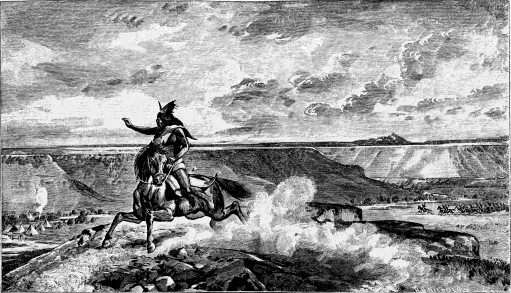
Fig. 338.—Signal of discovery or alarm.
The latter was noticed by Dr. Hoffman in 1873, on the Yellowstone River, while attached to the Stanley Expedition. The Indians had again concentrated after their first repulse by General Custer, and taken possession of the woods and bluffs on the opposite side of the river. As the column came up, one Indian was seen upon a high bluff to ride rapidly round in a circle, occasionally firing off his revolver. The signal announced the discovery of the advancing force, which had been expected, and he could be distinctly seen from the surrounding region. As many of the enemy were still scattered over the neighborhood, some of them would not have been able to recognize this signal had he ridden to and from an observer, but the circle produced a lateral movement visible from any point.
—— Of enemies, or other game than Buffalo. See also Notes on Cheyenne and Arapaho signals.
The discovery of enemies is indicated by riding rapidly around in a circle, so that the signal could be seen by their friends, but out of sight of the discovered enemy. (Dakota I.)
When enemies are discovered, or other game than buffalo, the sentinel waves his blanket over his head up and down, holding an end in each hand. (Omaha I; Ponka I.)
—— Of game, wood, water, &c.
This is communicated by riding rapidly forward and backward on the top of the highest hill. The same would be communicated with a blanket by waving it right and left, and then directly toward the game or whatever the party might be searching for, indicating that it is not to the right or to the left, but directly in front. (Dakota I.)
Drill, Military.
“It is done by signals, devised after a system of the Indian’s own invention, and communicated in various ways.
“Wonderful as the statement may appear, the signaling on a bright day, when the sun is in the proper direction, is done with a piece of looking-glass held in the hollow of the hand. The reflection of the sun’s rays thrown on the ranks communicates in some mysterious way the wishes of the chief. Once standing on a little knoll overlooking the valley of the South Platte, I witnessed almost at my feet a drill of about one hundred warriors by a Sioux chief, who sat on his horse on a knoll opposite me, and about two hundred yards from his command in the plain below. For more than half an hour he commanded a drill, which for variety and promptness of action could not be equaled by any civilized cavalry of the world. All I could see was an occasional movement of the right arm. He himself afterwards told me that he used a looking-glass.” (Dodge’s Plains of the Great West, loc. cit., pp. 307, 308.)
Friendship.
If two Indians [of the plains] are approaching one another on horseback, and they may, for instance, be one mile apart, or as far as they can see each other. At that safe distance one wants to indicate to the other that he wishes to be friendly. He does this by turning his horse around and traveling about fifty paces back and forth, repeating this two or three times; this shows to the other Indian that he is not for hostility, but for friendly relations. If the second Indian accepts this proffered overture of friendship, he indicates the same by locking the fingers of both hands as far as to the first joints, and in that position raises his hands and lets them rest on his forehead with the palms either in or out, indifferently, as if he were trying to shield his eyes from the excessive light of the sun. This implies, “I, too, am for peace,” or “I accept your overture.” (Sac, Fox, and Kickapoo I.) It is interesting in this connection to note the reception of Father Marquette by an Illinois chief who is reported to have raised his hands to his eyes as if to shield them from overpowering splendor. That action was supposed to be made in a combination of humility and admiration, and a pretended inability to gaze on the face of the illustrious guest has been taken to be the conception of the gesture, which in fact was probably only the holding the interlocked hands in the most demonstrative posture. An oriental gesture in which the flat hand is actually interposed as a shield to the eyes before a superior is probably made with the poetical conception erroneously attributed to the Indian.
The display of green branches to signalize friendly or pacific intentions does not appear to have been noticed among the North American Indians by trustworthy observers. Captain Cook makes frequent mention of it as the ceremonial greeting among islands he visited. See his Voyage toward the South Pole. London, 1784, Vol. II, pp. 30 and 35. Green branches were also waved in signal of friendship by the natives of the island of New Britain to the members of the expedition in charge of Mr. Wilfred Powell in 1878. Proceedings of the Royal Geological Society, February, 1881, p. 89.
Halt! —— Stand there! he is coming this way.
Grasp the end of the blanket or robe; wave it downward several times. (Omaha I.)
—— To inquire disposition.
Wave the folded blanket to the right and left in front of the body, then point toward the person or persons approaching, and carry it from a horizontal position in front of the body rapidly downward and upward several times. (Dakota I.)
Many.
Wave the blanket directly in front of the body upward and downward several times. Many of anything. (Dakota I.)
Peace, coupled with invitation.
Motion of spreading a real or imaginary robe or skin on the ground. Noticed by Lewis and Clark on their first meeting with the Shoshoni in 1805. (Lewis and Clark’s Travels, &c., London, 1817, vol. ii, p. 74.) This signal is more particularly described as follows: Grasp the blanket by the two corners with the hands, throw it above the head, allowing it to unfold as it falls to the ground as if in the act of spreading it.
Question.
The ordinary manner of opening communication with parties known or supposed to be hostile is to ride toward them in zigzag manner, or to ride in a circle. (Custer’s My Life on the Plains, loc. cit., p. 58.)
This author mentions (p. 202) a systematic manner of waving a blanket, by which the son of Satana, the Kaiowa chief, conveyed information to him, and a similar performance by Yellow Bear, a chief of the Arapahos (p. 219), neither of which he explains in detail.
—— I do not know you. Who are you?
Point the folded blanket at arm’s length toward the person, and then wave it toward the right and left in front of the face. You—I don’t know. Take an end of the blanket in each hand, and extend the arms to full capacity at the sides of the body, letting the other ends hang down in front of the body to the ground, means, Where do you come from? or who are you? (Dakota I.)
Safety. All quiet. See Notes on Cheyenne and Arapaho signals.
Surrender.
Hold the folded blanket or a piece of cloth high above the head. “This really means ‘I want to die right now.’” (Dakota I.)
Surrounded, We are.
Take an end of the blanket in each hand, extend the arms at the sides of the body, allowing the blanket to hang down in front of the body, and then wave it in a circular manner. (Dakota I.)
SIGNALS MADE WHEN THE PERSON OF THE SIGNALIST IS NOT VISIBLE.
Those noted consist of SMOKE, FIRE, or DUST signals.
SMOKE SIGNALS GENERALLY.
They [the Indians] had abandoned the coast, along which bale-fires were left burning and sending up their columns of smoke to advise the distant bands of the arrival of their old enemy. (Schoolcraft’s History, &c., vol. iii, p. 35, giving a condensed account of De Soto’s expedition.)
“Their systems of telegraphs are very peculiar, and though they might seem impracticable at first, yet so thoroughly are they understood by the savages that it is availed of frequently to immense advantage. The most remarkable is by raising smokes, by which many important facts are communicated to a considerable distance and made intelligible by the manner, size, number, or repetition of the smokes, which are commonly raised by firing spots of dry grass.” (Josiah Gregg’s Commerce of the Prairies. New York, 1844, vol. ii, p. 286.)
The highest elevations of land are selected as stations from which signals with smoke are made. These can be seen at a distance of from twenty to fifty miles. By varying the number of columns of smoke different meanings are conveyed. The most simple as well as the most varied mode, and resembling the telegraphic alphabet, is arranged by building a small fire, which is not allowed to blaze; then by placing an armful of partially green grass or weeds over the fire, as if to smother it, a dense white smoke is created, which ordinarily will ascend in a continuous vertical column for hundreds of feet. Having established a current of smoke, the Indian simply takes his blanket and by spreading it over the small pile of weeds or grass from which the smoke takes its source, and properly controlling the edges and corners of the blanket, he confines the smoke, and is in this way able to retain it for several moments. By rapidly displacing the blanket, the operator is enabled to cause a dense volume of smoke to rise, the length or shortness of which, as well as the number and frequency of the columns, he can regulate perfectly, simply by a proper use of the blanket. (Custer’s My Life on the Plains, loc. cit., p. 187.)
They gathered an armful of dried grass and weeds, which were placed and carried upon the highest point of the peak, where, everything being in readiness, the match was applied close to the ground; but the blaze was no sooner well lighted and about to envelop the entire amount of grass collected than it was smothered with the unlighted portion. A slender column of gray smoke then began to ascend in a perpendicular column. This was not enough, as it might be taken for the smoke rising from a simple camp-fire. The smoldering grass was then covered with a blanket, the corners of which were held so closely to the ground as to almost completely confine and cut off the column of smoke. Waiting a few moments, until the smoke was beginning to escape from beneath, the blanket was suddenly thrown aside, when a beautiful balloon-shaped column puffed upward like the white cloud of smoke which attends the discharge of a field-piece. Again casting the blanket on the pile of grass, the column was interrupted as before, and again in due time released, so that a succession of elongated, egg-shaped puffs of smoke kept ascending toward the sky in the most regular manner. This bead-like column of smoke, considering the height from which it began to ascend, was visible from points on the level plain fifty miles distant. (Ib., p. 217.)
The following extracts are made from Fremont’s First and Second Expeditions, 1842-3-4, Ex. Doc., 28th Cong. 2d Session, Senate, Washington, 1845:
“Columns of smoke rose over the country at scattered intervals—signals by which the Indians here, as elsewhere, communicate to each other that enemies are in the country,” p. 220. This was January 18, 1844, in the vicinity of Pyramid Lake, and perhaps the signalists were Pai-Utes.
“While we were speaking, a smoke rose suddenly from the cottonwood grove below, which plainly told us what had befallen him [Tabeau]; it was raised to inform the surrounding Indians that a blow had been struck, and to tell them to be on their guard,” p. 268, 269. This was on May 5, 1844, near the Rio Virgen, Utah, and was narrated of “Diggers,” probably Chemehuevas.
Arrival of a party at an appointed place, when all is safe.
This is made by sending upward one column of smoke from a fire partially smothered by green grass. This is only used by previous agreement, and if seen by friends of the party, the signal is answered in the same manner. But should either party discover the presence of enemies, no signal would be made, but the fact would be communicated by a runner. (Dakota I.)
Success of a war party.
Whenever a war party, consisting of either Pima, Papago, or Maricopa Indians, returned from an expedition into the Apache country, their success was announced from the first and most distant elevation visible from their settlements. The number of scalps secured was shown by a corresponding number of columns of smoke, arranged in a horizontal line, side by side, so as to be distinguishable by the observers. When the returning party was unsuccessful, no such signals were made. (Pima and Papago I.) Fig. 339. A similar custom appears to have existed among the Ponkas, although the custom has apparently been discontinued by them, as shown in the following proper name: Cú-de gá-xe, Smoke maker: He who made a smoke by burning grass returning from war.
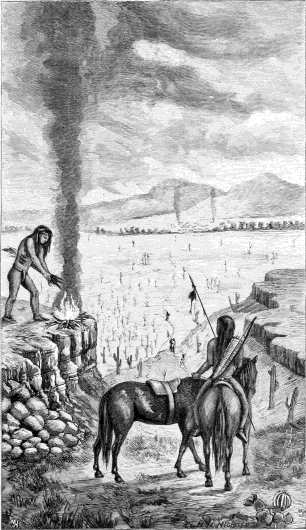
Fig. 339.—Signal of successful war-party.
SMOKE SIGNALS OF THE APACHES.
The following information was obtained by Dr. W. J. Hoffman from the Apache chiefs named on page 407, under the title of Tinnean, (Apache I):
The materials used in making smoke of sufficient density and color consist of pine or cedar boughs, leaves and grass, which can nearly always be obtained in the regions occupied by the Apaches of Northern New Mexico. These Indians state that they employ but three kinds of signals, each of which consists of columns of smoke, numbering from one to three or more.
Alarm.
This signal is made by causing three or more columns of smoke to ascend, and signifies danger or the approach of an enemy, and also requires the concentration of those who see them. These signals are communicated from one camp to another, and the most distant bands are guided by their location. The greater the haste desired the greater the number of columns of smoke. These are often so hastily made that they may resemble puffs of smoke, and are caused by throwing heaps of grass and leaves upon the embers again and again.
Attention.
This signal is generally made by producing one continuous column, and signifies attention for several purposes, viz, when a band had become tired of one locality, or the grass may have been consumed by the ponies, or some other cause necessitated removal, or should an enemy be reported, which would require farther watching before a decision as to future action would be made. The intention or knowledge of anything unusual would be communicated to neighboring bands by causing one column of smoke to ascend.
Establishment of a camp; Quiet; Safety.
When a removal of camp has been made, after the signal for Attention has been given, and the party have selected a place where they propose to remain until there may be a necessity or desire for their removal, two columns of smoke are made, to inform their friends that they propose to remain at that place. Two columns are also made at other times during a long continued residence, to inform the neighboring bands that a camp still exists, and that all is favorable and quiet.
FOREIGN SMOKE SIGNALS.
The following examples of smoke signals in foreign lands are added for comparison.
Miss Haigh, speaking of the Guanches of the Canary Islands at the time of the Spanish conquest, says: “When an enemy approached, they alarmed the country by raising a thick smoke or by whistling, which was repeated from one to another. This latter method is still in use among the people of Teneriffe, and may be heard at an almost incredible distance.” (Trans. Eth. Soc. Lond. vii, 1869, sec. ser., pp. 109, 110.)
“The natives have an easy method of telegraphing news to their distant friends. When Sir Thomas Mitchell was traveling through Eastern Australia he often saw columns of smoke ascending through the trees in the forests, and he soon learned that the natives used the smoke of fires for the purpose of making known his movements to their friends. Near Mount Frazer he observed a dense column of smoke, and subsequently other smokes arose, extending in a telegraphic line far to the south, along the base of the mountains, and thus communicating to the natives who might be upon his route homeward the tidings of his return.
“When Sir Thomas reached Portland Bay he noticed that when a whale appeared in the bay the natives were accustomed to send up a column of smoke, thus giving timely intimation to all the whalers. If the whale should be pursued by one boat’s crew only it might be taken; but if pursued by several, it would probably be run ashore and become food for the blacks.” (Smyth, loc. cit., vol. 1, pp. 152, 153, quoting Maj. T. L. Mitchell’s Eastern Australia, vol. ii, p. 241.)
Jardine, writing of the natives of Cape York, says that a “communication between the islanders and the natives of the mainland is frequent; and the rapid manner in which news is carried from tribe to tribe, to great distances, is astonishing. I was informed of the approach of Her Majesty’s Steamer Salamander, on her last visit, two days before her arrival here. Intelligence is conveyed by means of fires made to throw up smoke in different forms, and by messengers who perform long and rapid journeys.” (Smyth, loc. cit., vol. 1, p. 153, quoting from Overland Expedition, p. 85.)
Messengers in all parts of Australia appear to have used this mode of signaling. In Victoria, when traveling through the forests, they were accustomed to raise smoke by filling the hollow of a tree with green boughs and setting fire to the trunk at its base; and in this way, as they always selected an elevated position for the fire when they could, their movements were made known.
When engaged in hunting, when traveling on secret expeditions, when approaching an encampment, when threatened with danger, or when foes menaced their friends, the natives made signals by raising a smoke. And their fires were lighted in such a way as to give forth signals that would be understood by people of their own tribe and by friendly tribes. They exhibited great ability in managing their system of telegraphy; and in former times it was not seldom used to the injury of the white settlers, who at first had no idea that the thin column of smoke rising through the foliage of the adjacent bush, and raised perhaps by some feeble old woman, was an intimation to the warriors to advance and attack the Europeans. (R. Brough Smyth, F.L.S., F.G.S., The Aborigines of Victoria. Melbourne, 1878, vol. i, pp. 152, 153.)
FIRE ARROWS.
“Travelers on the prairie have often seen the Indians throwing up signal lights at night, and have wondered how it was done. *** They take off the head of the arrow and dip the shaft in gunpowder, mixed with glue. *** The gunpowder adheres to the wood, and coats it three or four inches from its end to the depth of one-fourth of an inch. Chewed bark mixed with dry gunpowder is then fastened to the stick, and the arrow is ready for use. When it is to be fired, a warrior places it on his bowstring and draws his bow ready to let it fly; the point of the arrow is then lowered, another warrior lights the dry bark, and it is shot high in the air. When it has gone up a little distance, it bursts out into a flame, and burns brightly until it falls to the ground. Various meanings are attached to these fire-arrow signals. Thus, one arrow meant, among the Santees, ‘The enemy are about’; two arrows from the same point, ‘Danger’; three, ‘Great danger’; many, ‘They are too strong, or we are falling back’; two arrows sent up at the same moment, ‘We will attack’; three, ‘Soon’; four, ‘Now’; if shot diagonally, ‘In that direction.’ These signals are constantly changed, and are always agreed upon when the party goes out or before it separates. The Indians send their signals very intelligently, and seldom make mistakes in telegraphing each other by these silent monitors. The amount of information they can communicate by fires and burning arrows is perfectly wonderful. Every war party carries with it bundles of signal arrows.” (Belden, The White Chief; or Twelve Years among the Wild Indians of the Plains. Cincinnati and New York, 1871, pp. 106, 107.)
With regard to the above, it is possible that white influence has been felt in the mode of signaling as well as in the use of gunpowder, but it would be interesting to learn if any Indians adopted a similar expedient before gunpowder was known to them. They frequently used arrows, to which flaming material was attached, to set fire to the wooden houses of the early colonists. The Caribs were acquainted with this same mode of destruction as appears by the following quotation:
“Their arrows were commonly poisoned, except when they made their military excursions by night; on these occasions they converted them into instruments of still greater mischief; for, by arming the points with pledgets of cotton dipped in oil, and set on fire, they fired whole villages of their enemies at a distance.” (Alcedo. The Geograph. and Hist. Dict. of America and the West Indies. Thompson’s trans. London, 1812, Vol. I, p. 314.)
DUST SIGNALS.
When an enemy, game, or anything else which was the special object of search is discovered, handfulls of dust are thrown into the air to announce that discovery. This signal has the same general signification as when riding to and fro, or, round in a circle on an elevated portion of ground, or a bluff. (Dakota VII, VII.)
When any game or any enemy is discovered, and should the sentinel be without a blanket, he throws a handful of dust up into the air. When the Brulés attacked the Ponkas, in 1872, they stood on the bluff and threw up dust. (Omaha I; Ponka I.)
There appears to be among the Bushmen a custom of throwing up sand or earth into the air when at a distance from home and in need of help of some kind from those who were there. (Miss L. C. Lloyd, MS. Letter, dated July 10, 1880, from Charlton House, Mowbray, near Cape Town, Africa.)
NOTES ON CHEYENNE AND ARAPAHO SIGNALS.
The following information was obtained from Wa-uⁿ´ (Bobtail), Mo-hi´-nuk´-ma-ha´-it (Big Horse), Cheyennes, and O-qo-his´-sa (The Mare, better known as “Little Raven”), and Na´-watc (Left Hand), Arapahos, chiefs and members of a delegation who visited Washington, D.C., in September, 1880, in the interest of their tribes dwelling in Indian Territory:
A party of Indians going on the war-path leave camp, announcing their project to the remaining individuals and informing neighboring friends by sending runners. A party is not systematically organized until several days away from its headquarters, unless circumstances should require immediate action. The pipe-bearers are appointed, who precede the party while on the march, carrying the pipes, and no one is allowed to cross ahead of these individuals, or to join the party by riding up before the head of the column, as it would endanger the success of the expedition. All new arrivals fall in from either side or the rear. Upon coming in sight of any elevations of land likely to afford a good view of the surrounding country the warriors come to a halt and secrete themselves as much as possible. The scouts who have already been selected, advance just before daybreak to within a moderate distance of the elevation to ascertain if any of the enemy has preceded them. This is only discovered by carefully watching the summit to see if any objects are in motion; if not, the flight of birds is observed, and if any should alight upon the hill or butte it would indicate the absence of anything that might ordinarily scare them away. Should a large bird, as a raven, crow, or eagle, fly toward the hill-top and make a sudden swerve to either side and disappear, it would indicate the presence of something sufficient to require further examination. When it is learned that there is reason to suspect an enemy the scout, who has all the time been closely watched by the party in the rear, makes a signal for them to lie still, signifying danger or caution. It is made by grasping the blanket with the right hand and waving it earthward from a position in front of and as high as the shoulder. This is nearly the same as civilized Americans use the hand for a similar purpose in battle or hunting to direct “lie quiet”!
Should the hill, however, be clear of any one, the Indian will ascend slowly, and under cover as much as possible, and gain a view of the country. If there is no one to be seen, the blanket is grasped and waved horizontally from right to left and back again repeatedly, showing a clear surface. If the enemy is discovered, the scout will give the alarm by running down the hill, upon a side visible to the watchers, in a zigzag manner, which communicates the state of affairs.
Should any expedition or advance be attempted at night, the same signals as are made with the blanket are made with a firebrand, which is constructed of a bunch of grass tied to a short pole.
When a war party encamps for a night or a day or more, a piece of wood is stuck into the ground, pointing in the direction pursued, with a number of cuts, notches, or marks corresponding to the number of days which the party spent after leaving the last camp until leaving the present camp, serving to show to the recruits to the main party the course to be followed, and the distance.
A hunting party in advancing takes the same precautions as a war party, so as not to be surprised by an enemy. If a scout ascends a prominent elevation and discovers no game, the blanket is grasped and waved horizontally from side to side at the height of the shoulders or head; and if game is discovered the Indian rides back and forth (from left to right) a short distance so that the distant observers can view the maneuver. If a large herd of buffalo is found, the extent traveled over in going to and fro increases in proportion to the size of the herd. A quicker gait is traveled when the herd is very large or haste on the part of the hunters is desired.
It is stated that these Indians also use mirrors to signal from one elevation to another, but the system could not be learned, as they say they have no longer use for it, having ceased warfare (?).
SCHEME OF ILLUSTRATION.
In the following pages the scheme of graphic illustration, intended both to save labor and secure accuracy, which was presented in the Introduction to the Study of Sign Language, is reproduced with some improvements. It is given for the use of observers who may not see that publication, the material parts of which being included in the present paper it is not necessary that the former should now be furnished. The Types of Hand Positions were prepared for reference by the corresponding letters of the alphabet to avoid tedious description, should any of them exactly correspond, or by alteration, as suggested in the note following them. These, as well as the Outlines of Arm Positions, giving front and side outlines with arms pendant, were distributed in separate sheets to observers for their convenience in recording, and this will still be cheerfully done when request is made to the present writer. When the sheets are not accessible the Types can be used for graphic changes by tracing the one selected, or by a few words indicating the change, as shown in the Examples. The Outlines of Arm Positions can also be readily traced for the same use as if the sheets had been provided. It is hoped that this scheme, promoting uniformity in description and illustration, will be adopted by all observers who cannot be specially addressed.
Collaborators in the gestures of foreign uncivilized peoples will confer a favor by sending at least one photograph or sketch in native costume of a typical individual of the tribe, the gestures of which are reported upon, in order that it may be reproduced in the complete work. Such photograph or sketch need not be made in the execution of any particular gesture, which can be done by artists engaged on the work, but would be still more acceptable if it could be so made.
OUTLINES FOR ARM POSITIONS IN SIGN LANGUAGE.
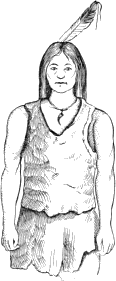
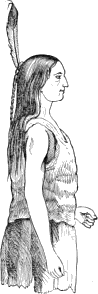
Fig. 340. Fig. 341.
The gestures, to be indicated by corrected positions of arms and by dotted lines showing the motion from the initial to the final positions (which are severally marked by an arrow-head and a cross—see Examples), will always be shown as they appear to an observer facing the gesturer, the front outline, Fig. 340, or side, Fig. 341, or both, being used as most convenient. The special positions of hands and fingers will be designated by reference to the Types of Hand Positions. For brevity in the written description, “hand” may be used for “right hand,” when that one alone is employed in any particular gesture. When more convenient to use the profile figure in which the right arm is exhibited for a gesture actually made by the left hand and arm it can be done, the fact, however, being noted.
In cases where the conception or origin of any sign is ascertained or suggested it should be annexed to the description, and when obtained from the gesturer will be so stated affirmatively, otherwise it will be considered to be presented by the observer. The graphic illustration of associated facial expression or bodily posture which may accentuate or qualify a gesture is necessarily left to the ingenuity of the contributor.
ORDER OF ARRANGEMENT.
The following order of arrangement for written descriptions is suggested. The use of a separate sheet or part sheet of paper for each sign described and illustrated would be convenient in the collation. It should always be affirmatively stated whether the “conception or origin” of the sign was procured from the sign-maker, or is suggested or inferred by the observer.
Word or idea expressed by Sign:
DESCRIPTION:
CONCEPTION OR ORIGIN:
Tribe:
Locality:
Date: 188 .
Observer.
TYPES OF HAND POSITIONS IN SIGN LANGUAGE.


A—Fist, palm outward, horizontal. B—Fist, back outward, oblique upward. C—Clinched, with thumb extended against forefinger, upright, edge outward.


D—Clinched, ball of thumb against middle of forefinger, oblique, upward, palm down. E—Hooked, thumb against end of forefinger, upright, edge outward. F—Hooked, thumb against side of forefinger, oblique, palm outward.


G—Fingers resting against ball of thumb, back upward. H—Arched, thumb horizontal against end of forefinger, back upward. I—Closed, except forefinger crooked against end of thumb, upright, palm outward.
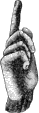
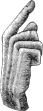

J—Forefinger straight, upright, others closed, edge outward. K—Forefinger obliquely extended upward, others closed, edge outward. L—Thumb vertical, forefinger horizontal, others closed, edge outward.
Fig. 342a.

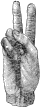
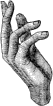
M—Forefinger horizontal, fingers and thumb closed, palm outward. N—First and second fingers straight upward and separated, remaining fingers and thumb closed, palm outward. O—Thumb, first and second fingers separated, straight upward, remaining fingers curved edge outward.
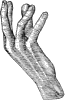

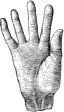
P—Fingers and thumb partially curved upward and separated, knuckles outward. Q—Fingers and thumb, separated, slightly curved, downward. R—Fingers and thumb extended straight, separated, upward.
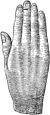
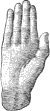

S—Hand and fingers upright, joined, back outward. T—Hand and fingers upright, joined, palm outward. U—Fingers collected to a point, thumb resting in middle.

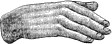
V—Arched, joined, thumb resting near end of forefinger, downward. W—Hand horizontal, flat, palm downward.
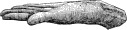
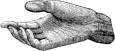
X—Hand horizontal, flat, palm upward. Y—Naturally relaxed, normal; used when hand simply follows arm with no intentional disposition.
Fig. 342b.
NOTE CONCERNING THE FOREGOING TYPES.
The positions are given as they appear to an observer facing the gesturer, and are designed to show the relations of the fingers to the hand rather than the positions of the hand relative to the body, which must be shown by the outlines (see Outlines of Arm Positions) or description. The right and left hands are figured above without discrimination, but in description or reference the right hand will be understood when the left is not specified. The hands as figured can also with proper intimation be applied with changes either upward, downward, or inclined to either side, so long as the relative positions of the fingers are retained, and when in that respect no one of the types exactly corresponds with a sign observed, modifications may be made by pen or pencil on that one of the types, or a tracing of it, found most convenient, as indicated in the Examples, and referred to by the letter of the alphabet under the type changed, with the addition of a numeral—e.g., A 1, and if that type, i.e., A, were changed a second time by the observer (which change would necessarily be drawn on another sheet of types or another tracing of a type selected when there are no sheets provided), it should be referred to as A 2.
EXAMPLES.
Fig. 343. Word or idea expressed by sign: To cut, with an ax. DESCRIPTION. With the right hand flattened (X changed to right instead of left), palm upward, move it downward to the left side repeatedly from different elevations, ending each stroke at the same point. Fig. 343. CONCEPTION OR ORIGIN. From the act of felling a tree.
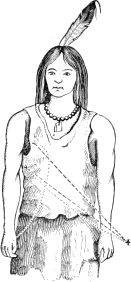
Fig. 344. Word or idea expressed by sign: A lie. DESCRIPTION. Touch the left breast over the heart, and pass the hand forward from the mouth, the two first fingers only being extended and slightly separated (L, 1—with thumb resting on third finger, Fig. 344a). Fig. 344. CONCEPTION OR ORIGIN. Double-tongued. L 1, Fig. 344a.
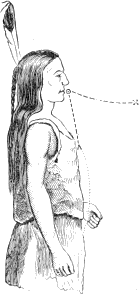

Fig. 345. Word or idea expressed by sign: To ride. DESCRIPTION. Place the first two fingers of the right hand, thumb extended (N 1, Fig. 345a) downward, astraddle the first two joined and straight fingers of the left (T 1, Fig. 345b), sidewise, to the right, then make several short, arched movements forward with hands so joined. Fig. 345. CONCEPTION OR ORIGIN. The horse mounted and in motion. N 1, Fig. 345a. T 1, Fig. 345b.
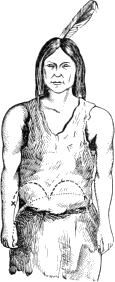
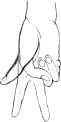
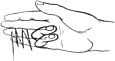
Fig. 346. Word or idea expressed by signs: I am going home. DESCRIPTION. (1) Touch the middle of the breast with the extended index (K), then (2) pass it slowly downward and outward to the right, and when the hand is at arm’s length, at the height of the shoulder, (3) clinch it (A) suddenly and throw it edgewise toward the ground. Fig. 346. CONCEPTION OR ORIGIN. (1) I, personality; (2) motion and direction; (3) locality of my possessions—home.
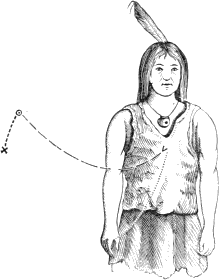
EXPLANATION OF MARKS.
The following indicative marks are used in the above examples:
. . . . . . . . . . . Dotted lines indicate movements to place the hand and arm in position to commence the sign and not forming part of it.
- - - - - - - - - - Short dashes indicate the course of hand employed in the sign, when made rapidly.
– – – – – – – – Longer dashes indicate a less rapid movement.
— — — — — Broken lines represent slow movement.
> Indicates commencement of movement in representing sign, or part of sign.
× Represents the termination of movements.
☉ Indicates the point in the gesture line at which the hand position is changed.