NORTH AMERICAN INDIANS (continued 7)
Reading edition
ANALYSIS.
Wa-śi´-ćuⁿ i-taⁿ-caⁿ ti-el´ ti´-ma-hel unk-i´-pi na
(1) (2) (3) (4)
White man chief lodge in lodge within we were at that place and
na´-pe-uⁿ-za-pi na ki-ci wo-un-gla-ka-pi kiⁿ na-ya-ḣoⁿ- hu-o
(5) (6,7) (8,9)
hand we hold it, take hold of and to each other we talk the thing you hear it ?
It will be observed that the interrogation point is placed under the last syllable, hu-o, the latter implying a question, though the gesture was not made to accompany it, the gestures for hear and you, with a look of inquiry, being deemed sufficient to express the desire on the part of the speaker.
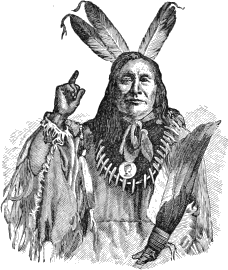
Fig. 316.
Answer. Yes, i heard of it, but did not see it.
(1) Hold the naturally closed hand before the right side of the breast or shoulder, leaving the index and thumb loosely extended, then, as the hand is thrown downward and forward, bring the index against the inner side of the thumb—yes. (2) Repeat gesture No. 8—heard, Fig. 316; (3) pass the extended index forward from the right eye—saw; (4) then in a continuous motion extend all the fingers so as to place the flat hand edgewise, and pointing forward about twelve inches before the right side of the breast, and throw it outward and slightly downward—no, not.
ANALYSIS.
Ha-u na-wa´-ḣoⁿ tka waⁿ-mla´-ke śni
(1) Yes, (2) I heard (but) (3) I saw it. (4) not.
DIALOGUE BETWEEN ALASKAN INDIANS.
The following introductory notes are furnished by Mr. Ivan Petroff, who contributes the Dialogue:
It has been repeatedly stated that among the natives of Alaska no trace of gesture or sign language can be found. The universal spread of the Russian language in former times as a medium of trade and general intercourse has certainly prevented observations of this primitive linguistic feature in all the vast regions visited by the Russians. On the other hand, the homogeneous elements of the Innuit tongue, spoken along the whole seacoast from the Arctic to the Alaskan Peninsula, and the Island of Kadiak, has, to a great extent, abolished all causes for the employment of sign language between tribes in their mutual intercourse. Basing their opinions upon what they saw while touching upon the coast here and there, even the acknowledged authorities on Alaskan matters have declared that sign language did not and could not exist in all that country. Without entering into any lengthened dispute upon this question, I venture to present in the subjoined pages a succinct account of at least one instance where I saw natives of different tribes converse with each other only by means of signs and gestures within the boundaries of Alaska.
In the month of September, 1866, there arrived on the Lower Kinnik River, a stream emptying its waters into Cook’s Inlet, two Indians from a distant region, who did not speak the Kenaitze language. The people of the settlement at which the strangers made their first appearance were equally at a loss to understand the visitors. At last a chief of great age, bearing the name of Chatidoolts (mentioned by Vancouver as a youth), was found to be able to interpret some of the signs made by the strangers, and after a little practice he entered into a continued conversation with them in rather a roundabout way, being himself blind. He informed me that it was the second or third time within his recollection that strangers like those then present had come to Kinnik from the northeast, but that in his youth he had frequently “talked with his hands” to their visitors from the west and east. He also told me that he had acquired this art from his father, who, as the old man expressed himself, had “seen every country, and spoken to all the tribes of the earth.” The conversation was carried on with the help of the old man’s sons, who described to their blind parent the gestures of the strangers, and were instructed in turn by him with what gestures to reply.
This being an entirely new experience to me I at once proceeded to carefully make notes of the desultory talk, extending over several days. My object, primarily, was to make use of the signs for purposes of trade in the future.
The notes thus obtained contain a narrative of the two strangers, interpreted to me at the time by Chatidoolts. I shall present each sign or sentence as I noted it at the time, with only casual reference to that incomplete and frequently erroneous interpretation.
The two Indians wore the pointed hunting shirt of tanned moose-skin, ornamented with beads and fringes which is still common to the Kutchin tribes. They were not tattooed, but ears and noses were encumbered with pendants of dentalium and a small red glass bead. Their feet were clothed in moccasins. One of them had a rifle of English manufacture, and his companion carried two huge knives, one of them of copper evidently of native manufacture.
(1) Kenaitze.—Left hand raised to height of eye, palm outward, moved several times from right to left rapidly; fingers extended and closed; pointing to strangers with left hand. Right hand describes a curve from north to east—Which of the northeastern tribes is yours?
(2) Tennanah.—Right hand, hollowed, lifted to mouth, then extended and describing waving line gradually descending from right to left. Left hand describing mountainous outline, apparently one peak rising above the other, said by Chatidoolts to mean—Tenan-tnu-kohtana, Mountain-river-men.
(3) K.—Left hand raised to height of eye, palm outward, moved from right to left, fingers extended. Left index describes curve from east to west. Outline of mountain and river as in preceding sign.—How many days from Mountain-river?
(4) T.—Right hand raised toward sky, index and thumb forming first crescent and then ring. This repeated three times—moon, new and full three times.
(5) Right hand raised, palm to front, index raised and lowered at regular intervals—walked. Both hands imitating paddling of canoe, alternately right and left—traveled three months on foot and by canoe.
(6) Both arms crossed over breast, simulating shivering—cold, winter.
(7) Right index pointing toward speaker—I. Left hand pointing to the west—traveled westward.
(8) Right hand lifted cup-shaped to mouth—water. Right hand describing waving line from right to left gradually descending, pointing to the west—river running westward.
(9) Right hand gradually pushed forward, palm upward, from height of breast. Left hand shading eyes; looking at great distance—very wide.
(10) Left and right hands put together in shape of sloping shelter—lodge, camp. See Fig. 259, on p. 431.
(11) Both hands lifted, height of eye, palm inward, fingers spread—many times.
(12) Both hands closed, palm outward, height of hips—surprised.
(13) Index pointing from eye forward—see.
(14) Right hand held up, height of shoulder, three fingers extended, left hand pointing to me—three white men.
(15) K.—Right hand pointing to me, left hand held up, three fingers extended—three white men.
(16) Making Russian sign of cross—Russians. Were the three white men Russians?
(17) T.—Left hand raised, palm inward, two fingers extended, sign of cross with right—two Russians.
(18) Right hand extended, height of eye, palm outward, moved outward a little to right—no.
(19) One finger of left hand raised—one.
(20) Sign of cross with right—Russian.
(21) Right hand height of eye, fingers closed and extended, palm outward a little to right—no.
(22) Right hand carried across chest, hand extended, palm upward, fingers and thumb closed as if holding something. Left hand in same position carried across the right, palm downward—trade.
(23) Left hand upholding one finger, right pointing to me—one white man.
(24) Right hand held horizontally, palm downward, about four feet from ground—small.
(25) Forming rings before eyes with index and thumb—eye-glasses.
(26) Right hand clinched, palm upward, in front of chest, thumb pointing inward—gave one.
(27) Forming cup with right hand, simulating drinking—drink.
(28) Right hand grasping chest repeatedly, fingers curved and spread—strong.
(29) Both hands pressed to temple and head moved from side to side—drunk, headache.
(30) Both index fingers placed together, extended, pointing forward—together.
(31) Fingers interlaced repeatedly—build.
(32) Left hand extended, fingers closed, pointing outward (vertically), right hand extended, fingers closed, placed slopingly against left—camp.
(33) Both wrists placed against temples, hands curved upward and outward, fingers spread—horns.
(34) Both hands horizontally lifted to height of shoulder, right arm extended gradually full length to the right, hand drooping a little at the end—long back, moose.
(35) Both hands upright, palm outward, fingers extended and spread, placing one before the other alternately—trees, forest, dense forest.
(36) Sign of cross—Russian.
(37) Motions of shooting a gun—shot.
(38) Sign for moose (Nos. 33, 34), showing two fingers of left hand—two.
(39) Sign for camp as before (No. 10)—camp.
(40) Right hand describing curve from east to west, twice—two days.
(41) Left hand lifted height of mouth, back outward, fingers closed as if holding something; right hand simulating motion of tearing off and placing in mouth—eating moose meat.
(42) Right hand placed horizontally against heart, fingers closed, moved forward a little and raised a little several times—glad at heart.
(43) Fingers of left hand and index of right hand extended and placed together horizontally, pointing forward, height of chest. Hands separated, right pointing eastward and left westward—three men and speaker parted, going west and east.
(44) Pressing both arms against chest and shivering—very cold.
(45) Drawing index of each hand around corresponding legs below the knee—deep snow.
(46) Drawing imaginary line with index of right hand across each foot, just behind the toes—snow shoes.
(47) Head lowered to right side into palm of hand three times—slept three times.
(48) Sign for camp, as before (No. 10)—camp.
(49) Pointing to speaker—I.
(50) Fingers of right hand extended and joined and pointed forward from mouth, left hand lowered horizontally to a foot from the ground—fox.
(51) Left hand raised height of eye, back to the left, fingers closed, with exception of middle finger held upright; then middle finger suddenly closed—trap.
(52) Both hands lifted height of eye, palm inward, fingers spread—many.
(53) Right hand pointing to speaker—I.
(54) Sign for trap (No. 51), as above—trap.
(55) Right hand lowered to within a few inches of the ground and moved from left to right about two feet. Motions of both hands descriptive of playful jumping of marten around a tree or stump—marten.
(56) Holding up the fingers of both hands three times until aggregating thirty—thirty.
(57) Left forearm held up vertically, palm to front, fingers spread—tree.
(58) Motion of chopping with hatchet—cut.
(59) Driving invisible wedge around small circle—peeling birch bark.
(60) Right hand, fingers extended and joined, moved slowly from left to right horizontally while blowing upon it with mouth—pitching seams of canoe.
(61) Motions of using paddle very vigorously—paddle up stream.
(62) Lifting both arms above head on respective sides, hands closed as if grasping something and lifting the body—poling canoe.
(63) Sign for moon (No. 4), (crescent and ring) once—one month.
(64) Right hand vertically, height of chest, palm to left, fingers extended, closed. Left hand horizontally, palm downward, pushed against right—stopped.
(65) Right hand, index extended, drawing outline of mountains, one above other—high mountains.
(66) Left hand lifted to left shoulder, back to front, fingers bent and closed. Right hand, fingers bent and closed, placed over left and then slowly drawn across chest to right shoulder. Motion with both hands as if adjusting pack—pack, knapsack.
(67) Sign for water as before (No. 8). Both hands brought forward, palms down, arms passed outward horizontally to respective sides, palms down—lake. Both hands describing circular line backward until touching collar bone—big and deep.
(68) Left hand raised slightly about height of nipple, three fingers closed; index and thumb holding tip of index of right hand. Both hands moved across chest from left to right—beaver. *
(69) Previous sign for many (No. 52) repeated several times—very plentiful.
(70) Both hands held up with fingers spread, palm forward, twice and left hand once—height of eye—twenty-five.
(71) Pointing to himself—I.
(72) Sign for trap as before (No. 51)—trapped.
(73) Sign for temporary shelter (No. 10)—camped.
(74) Sign for new and full moon (No. 4), once—one month.
(75) Right hand passed slowly over the hair and chin. Left hand touching a pendant of white beads—old man.
(76) Index of right hand held up—one.
(77) Both hands partially closed and placed against breast, back of hands to front, a few inches apart—women.
(78) Index and middle finger of right hand held up, palm forward; eyes directed as if counting—two.
(79) Sign for trap as before (No. 51)—trapping.
(80) Left forearm vertically in front of chest, palm of hand to front, fingers spread, elbow resting upon the back of the right hand—tree.
(81) Arms and hands spanning imaginary tree of some size—big.
(82) Sign for tree as before (No. 57), left forearm suddenly brought down across extended right hand—fell.
(83) Right hand laid on top of head, then passed over the hair and chin, left hand touching white beads—on the head of the old man.
(84) Sign for old man as before (No. 75)—old man.
(85) Closing both eyes with fore and middle finger of right hand; both hands placed side by side, horizontally, palms downward, fingers extended and united, hands separated by slow horizontal movement to right and left—dead.
(86) Sign for women as before (No. 77)—women.
(87) Fingers of both hands interlaced at right angles several times—built.
(88) Sign for lodge as before (No. 10)—lodge. †
(89) Right index describing circle around the head, height of eye (cutting hair). Right hand passed over forehead and face. Left index pointing to black scabbard (blacking faces)—mourning.
(90) Index and middle finger of right hand passed from eyes downward across cheeks—weeping.
(91) Pointing to himself—I.
(92) Make the signs for shoot (Nos. 33, 34), and moose (No. 37)—shot a moose.
(93) Left hand extended horizontally, palm upward, right hand placed across left vertically, about the middle—divided in two.
(94) Right hand closed, palm downward, moved forward from right breast the length of the arm and then opened—I gave.
(95) Sign for women, (No. 77)—to women.
(96) Right hand, palm down, pointing to left, placed horizontally before heart and slightly raised several times—good and glad.
(97) Pointing to his companion—he.
(98) Motion of paddling—in canoe.
(99) Right arm and hand extended in N.E. direction, gradually curved back until index touches speaker—came to me from the northeast.
(100) Sign for together as above (No. 30)—together.
(101) Motion of paddling—paddled.
(102) Pointing to ground—to this place.
(103) K. Motion of drinking water out of hand—water.
(104) Describing circle with right index on palm of left hand extended horizontally—lake.
(105) Left hand raised to height of eye, palm to front, fingers leaning slightly backward. Fingers of left hand closed alternately—how many?
(106) T. Holding up right hand back to front, showing four fingers, eyes looking at them as if counting—four.
(107) Sign for packing with wooden breast-brace as above; three fingers of right hand shown as above—three portages.
(108) K. Right hand pointing to gun of stranger—gun. Left hand raised height of eye, palm to front, and moved rapidly several times to right and left—interrogation.
(109) Sign for trade as before (No. 22)—trade; i.e., where did you buy the gun?
(110) T. Sign for Mountain-river as above (No. 2). Pointing eastward—from the eastward.
(111) Pointing to sun and then raising both hands, backs to front, fingers spread—ten days.
(112) Pointing to me—white man.
(113) Left hand held up vertically, palm outward, fingers joined. Right index placed horizontally across fingers of left hand in front, about the middle joint—pallisaded.
(114) Describing square with right index on flat palm of left hand—building.
(115) Pointing to his gun, powder-horn, blanket, and beads—trading goods.
(116) Both hands horizontal, brought forward and upward from chest and then downward—plenty.
In giving this narrative I have observed the original sequence, but there were frequent interruptions, caused by consultation between Chatidoolts and his sons, and before the strangers departed again they had obtained a knowledge of some words of the Kenaitze language.
OJIBWA DIALOGUE.
[Communicated by the Very Rev. Edward Jacker.]
The following short dialogue forms part of the scanty tradition the civilized Ojibwas possess regarding their ancestors’ sign language:
Two Indians of different tongue meet on a journey. First Indian points to second Indian with the outstretched forefinger of the right hand, bringing it within a few inches of his breast; next he extends both forearms horizontally, clinches all but the forefingers, and bends the hands inward; then he brings them slowly and in a straight line together, until the tips of the outstretched forefingers meet. This gesture is accompanied with a look of inquiry—You met somebody?
Second Indian, facing the south, points to the east, and with the outstretched hand forms a half-circle from east to west (corresponding to the daily course of the sun); then he raises the arm and points to a certain height above the southern horizon. Then the sign for meeting (as above) may be made, or omitted. After this he bends the right hand downward, and repeatedly moves the outstretched forefinger and middle finger in opposite directions (in imitation of the motion of the legs in the act of walking). Finally he raises the right hand and stretches up the forefinger (or several fingers). To-day, when the sun stood at such a height, I met one (or several) persons traveling on foot. If the travelers met were on horseback he makes the sign for horse as described by (Dakota III), see Extracts from Dictionary, or the identical one for going given by (Ojibwa I), which is as follows: To describe a journey on horseback the first two fingers of the right hand are placed astride of the forefinger of the left hand, and both represent the galloping movement of a horse. If it is a foot journey, wave the two fingers several times through the air.
NARRATIVES.
The following, which is presented as a good descriptive model, was obtained by Dr. W. J. Hoffman, of the Bureau of Ethnology, from Natci, a Pai-Ute chief connected with the delegation of that tribe to Washington in January, 1880, and refers to an expedition made by him by direction of his father, Winnimukka, Head Chief of the Pai-Utes, to the northern camp of his tribe, partly for the purpose of preventing the hostile outbreak of the Banaks which occurred in 1878, and more particularly to prevent those Pai-Utes from being drawn into any difficulty with the United States by being leagued with the Banaks.
NÁTCI’S NARRATIVE.
(1) Close the right hand, leaving the index extended, pointed westward at arm’s length a little above the horizon, head thrown back with the eyes partly closed and following the direction—Away to the west, (2) indicate a large circle on the ground with the forefinger of the right hand pointing downward—place (locative), (3) the tips of the spread fingers of both hands placed against one another, pointing upward before the body, leaving a space of four or five inches between the wrists—house (brush tent or wik´-i-up), see Fig. 257, p. 431, (4) with the right hand closed, index extended or slightly bent, tap the breast several times—mine. (5) Draw an imaginary line, with the right index toward the ground, from some distance in front of the body to a position nearer to it—from there I came, (6) indicate a spot on the ground by quickly raising and depressing the right hand with the index pointing downward—to a stopping place, (7) grasp the forelock with the right hand, palm to the forehead, and raise it about six inches, still holding the hair upward—the chief of the tribe (Winnimukka), see Fig. 245, p. 418, (8) touch the breast with the index—me, (9) the right hand held forward from the hip at the level of the elbow, closed, palm downward, with the middle finger extended and quickly moved up and down a short distance—telegraphed, (10) head inclined toward the right, at the same time making movement toward and from the ear with the extended index pointing toward it—I heard, i.e., understood.
(11) An imaginary line indicated with the extended and inverted index from a short distance before the body to a place on the right—I went, (12) repeat gesture No. 6—a stopping place, (13) inclining the head, with eyes closed, toward the right, bring the extended right hand, palm up, to within six inches of the right ear—where I slept. (14) Place the spread and extended index and thumb of the right hand, palm downward, across the right side of the forehead—white man (American), (15) elevating both hands before the breast, palms forward, thumbs touching, the little finger of the right hand closed—nine, (16) touch the breast with the right forefinger suddenly—and myself, (17) lowering the hand, and pointing downward and forward with the index still extended (the remaining fingers and thumb being loosely closed) indicate an imaginary line along the ground toward the extreme right—went, (18) extend the forefinger of the closed left hand, and place the separated fore and second fingers of the right astraddle the forefinger of the left, and make a series of arched or curved movements toward the right—rode horseback, (19) keeping the hands in their relative position, place them a short distance below the right ear, the head being inclined toward that side—sleep, (20) repeat the signs for riding (No. 18) and sleeping (No. 19) three times—four days and nights, (21) make sign No. 18, and stopping suddenly point toward the east with the extended index-finger of the right (others being closed) and follow the course of the sun until it reaches the zenith—arrived at noon of the fifth day.
(22) Indicate a circle as in No. 2—a camp, (23) the hands then placed together as in No. 3, and in this position, both moved in short irregular upward and downward jerks from side to side—many wik´-i-ups, (24) then indicate the chief of the tribe as in No. 7—meaning that it was one of the camps of the chief of the tribe. (25) Make a peculiar whistling sound of “phew” and draw the extended index of the right hand across the throat from left to right—Banak, (26) draw an imaginary line with the same extended index, pointing toward the ground, from the right to the body—came from the north, (27) again make gesture No. 2—camp, (28) and follow it twice by sign given as No. 18 (forward from the body, but a short distance)—two rode. (29) Rub the back of the right hand with the extended index of the left—Indian, i.e., the narrator’s own tribe, Pai-Ute, (30) elevate both hands side by side before the breast, palms forward, thumbs touching, then, after a short pause, close all the fingers and thumbs except the two outer fingers of the right hand—twelve, (31) again place the hands side by side with fingers all spread or separated, and move them in a horizontal curve toward the right—went out of camp, (32) and make the sign given as No. 25—Banak, (33) that of No. 2—camp, (34) then join the hands as in No. 31, from the right toward the front—Pai-Utes returned, (35) close the right hand, leaving the index only extended, move it forward and downward from the mouth three or four times, pointing forward, each time ending the movement at a different point—I talked to them, (36) both hands pointing upward, fingers and thumbs separated, palms facing and about four inches apart, held in front of the body as far as possible in that position—the men in council, (37) point toward the east with the index apparently curving downward over the horizon, then gradually elevate it to an altitude of 45°—talked all night and until nine o’clock next morning, (38) bring the closed hands, with forefingers extended, upward and forward from their respective sides, and place them side by side, palms forward, in front—my brother, Fig. 317, (39) (see also pp. 385, 386) followed by the gesture, No. 18, directed toward the left and front—rode, (40) by No. 7—the head chief, (41) and No. 2—camp.
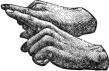
Fig. 317.
(42) Continue by placing the hands, slightly curved, palm to palm, holding them about six inches below the right ear, the head being inclined considerably in that direction—one sleep (night), (43) make sign No. 14—white man, (44) raise the left hand to the level of the elbow forward from the left hip, fingers pointing upward, thumb and forefinger closed—three, (45) and in this position draw them toward the body and slightly to the right—came, (46) then make gesture No. 42—sleep; (47) point with the right index to the eastern horizon—in the morning, (48) make sign No. 14—white man, (49) hold the left hand nearly at arm’s length before the body, back up, thumb and forefinger closed, the remaining fingers pointing downward—three, (50) with the right index finger make gesture No. 35, the movement being directed towards the left hand—talked to them, (51) motion along the ground with the left hand, from the body toward the left and front, retaining the position of the fingers just stated (in No. 49)—they went, (52) tap toward the ground, as in gesture No. 6, with the left hand nearly at arm’s length—to their camp.
(53) Make gesture No. 18 toward the front—I rode, (54) extend the right hand to the left and front, and tap towards the earth several times as in sign No. 6, having the fingers and thumb collected to a point—camp of the white men. (55) Close both hands, with the forefingers of each partly extended and crooked, and place one on either side of the forehead, palms forward—cattle (a steer), (56) hold the left hand loosely extended, back forward, about twenty inches before the breast, and strike the back of the partly extended right hand into the left—shot, (57) make a short upward curved movement with both hands, their position unchanged, over and downward toward the right—fell over, killed, (58) then hold the left hand a short distance before the body at the height of the elbow, palm downward, fingers closed, with the thumb lying over the second joint of the forefinger, extend the flattened right hand, edge down, before the body, just by the knuckles of the left, and draw the hand towards the body, repeating the movement—skinned, (59) make the sign given in No. 25—Banak, (60) place both hands with spread fingers upward and palms forward, thumb to thumb, before the right shoulder, moving them with a tremulous motion toward the left and front—came in, (61) make three short movements toward the ground in front, with the left hand, fingers loosely curved, and pointing downward—camp of the three white men, (62) then with the right hand open and flattened, edge down, cut towards the body as well as to the right and left—cut up the meat, (63) and make the pantomimic gesture of handing it around to the visitors.
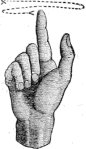
Fig. 318.
(64) Make sign No. 35, the movement being directed to the left hand, as held in No. 49—told the white men, (65) grasping the hair on the right side of the head with the left hand, and drawing the extended right hand with the edge towards and across the side of the head from behind forward—to scalp; (66) close the right hand, leaving the index partly extended, and wave it several times quickly from side to side a short distance before the face, slightly shaking the head at the same time—no, Fig. 318, (67) make gesture No. 4—me, (68) repeat No. 65—scalp, (69) and raising the forelock high with the left hand, straighten the whole frame with a triumphant air—make me a great chief. (70) Close the right hand with the index fully extended, place the tip to the mouth and direct it firmly forward and downward toward the ground—stop, (71) then placing the hands, pointing upward, side by side, thumbs touching, and all the fingers separated, move them from near the breast outward toward the right, palms facing that direction at termination of movement—the Banaks went to one side, (72) with the right hand closed, index curved, palm downward, point toward the western horizon, and at arm’s length dip the finger downward—after sunset, (73) make the gesture given as No. 14—white men, (74) pointing to the heart as in No. 4—and I, (75) conclude by making gesture No. 18 from near body toward the left, four times, at the end of each movement the hands remaining in the same position, thrown slightly upward—we four escaped on horseback.
The above was paraphrased orally by the narrator as follows: “Hearing of the trouble in the north, I started eastward from my camp in Western Nevada, when, upon arriving at Winnemucca Station, I received telegraphic orders from the head chief to go north to induce our bands in that region to escape the approaching difficulties with the Banaks. I started for Camp McDermit, where I remained one night. Leaving next morning in company with nine others, we rode on for four days and a half. Soon after our arrival at the Pai-Ute camp, two Banaks came in, when I sent twelve Pai-Utes to their camp to ask them all to come in to hold council. These messengers soon returned, when I collected all the Pai-Utes ands talked to them all night regarding the dangers of an alliance with the Banaks and of their continuance in that locality. Next morning I sent my brother to the chief, Winnimukka, with a report of proceedings.
“On the following day three white men rode into camp, who had come up to aid in persuading the Pai-Utes to move away from the border. Next morning I consulted with them respecting future operations, after which they went away a short distance to their camp. I then followed them, where I shot and killed a steer, and while skinning it the Banaks came in, when the meat was distributed. The Banaks being disposed to become violent at any moment, the white men became alarmed, when I told them that rather than allow them to be scalped I would be scalped myself in defending them, for which action I would be considered as great a chief as Winnemukka by my people. When I told the Banaks to cease threatening the white men they all moved to one side a short distance to hold a war council, and after the sun went down the white men and I mounted our horses and fled toward the south, whence we came.”
Some of the above signs seem to require explanation. Natci was facing the west during the whole of this narration, and by the right he signified the north; this will explain the significance of his gesture to the right in Nos. 11 and 17, and to the left in No. 75.
No. 2 (repeated in Nos. 22, 27, 33, and 41) designates an Indian brush lodge, and although Natci has not occupied one for some years, the gesture illustrates the original conception in the round form of the foundation of poles, branches, and brush, the interlacing of which in the construction of the wik´-i-up has survived in gestures Nos. 3 and 23 (the latter referring to more than one, i.e., an encampment).
The sign for Banak, No. 25 (also 32 and 59), has its origin from the tradition among the Pai-Utes that the Banaks were in the habit of cutting the throats of their victims. This sign is made with the index instead of the similar gesture with the flat hand, which among several tribes denotes the Sioux, but the Pai-Utes examined had no specific sign for that body of Indians, not having been in sufficient contact with them.
“A stopping place,” referred to in Nos. 6, 12, 52, and 54, represents the temporary station, or camp of white men, and is contradistinguished from a village, or perhaps from any permanent encampment of a number of persons, by merely dotting toward the ground instead of indicating a circle.
It will also be seen that in several instances, after indicating the nationality, the fingers previously used in representing the number were repeated without its previously accompanying specific gesture, as in No. 61, where the three fingers of the left hand represented the men (white), and the three movements toward the ground signified the camp or tents of the three (white) men.
This also occurs in the gesture (Nos. 59, 60, and 71) employed for the Banaks, which, having been once specified, is used subsequently without its specific preceding sign for the tribe represented.
The rapid connection of the signs Nos. 57 and 58 and of Nos. 74 and 75 indicates the conjunction, so that they are severally readily understood as “shot and killed,” and “the white men and I.” The same remark applies to Nos. 15 and 16, “the nine and I.”
PATRICIO’S NARRATIVE.
This narrative was obtained in July, 1880, by Dr. Francis H. Atkins, acting assistant surgeon, United States Army, at South Fork, New Mexico, from Ti-pe-bes-tlel (Sheepskin-leggings), habitually called Patricio, an intelligent young Mescalero Apache. It gives an account of what is locally termed the “April Round-up,” which was the disarming and imprisoning by a cavalry command of the United States Army, of the small Apache subtribe to which the narrator belonged.
(1) Left hand on edge, curved, palm forward, extended backward length of arm toward the West (far westward).
(2) Arm same, turned hand, tips down, and moved it from north to south (river).
(3) Dipped same hand several times above and beyond last line (beyond).
(4) Hand curved (Y, more flexed) and laid on its back on top of his foot (moccasins much curved up at toe); then drew hands up legs to near knee, and cut off with edges of hands (boot tops), (Warm Spring Apaches, who wear booted moccasins with turn-up toes).
(5) Hands held before him, tips near together, fingers gathered (U); then alternately opened and gathered fingers of both hands (P to U, U to P), and thrusting them toward each other a few times (shot or killed many).
(6) Held hands six inches from side of head, thumbs and forefingers widely separated (Mexican, i.e., wears a broad hat).
(7) Held right hand on edge, palm toward him, threw it on its back forward and downward sharply toward earth (T on edge to X), (dead, so many dead).
(8) Put thumbs to temples and indexes forward, meeting in front, other fingers closed (soldiers, i.e., cap-visor).
(9) Repeated No. 5 and No. 7 (were also shot dead).
(10) Placed first and second fingers of right hand, others closed, astride of left index, held horizontally (horses).
(11) Held hands on edge and forward (T on edge forward), pushed them forward, waving vertically (marching, i.e., ran off with soldiers’ horses or others). N.B.—Using both hands indicates double ranks of troops marching also.
(12) Struck right fist across in front of chin from right to left sharply (bad).
(13) Repeated No. 4 (Warm Spring Apache).
(14) Moved fist, thumb to head, from center of forehead to right temple and a little backward (fool).
(15) Repeated No. 8 and No. 11 (soldiers riding in double column).
(16) Thrust right hand down over and beyond left, both palms down (W) (came here).
(17) Repeated No. 8 (soldier).
(18) Touched hair (hair).
(19) Touched tent (quite white).
(20) Touched top of shoulder (commissioned officer, i.e., shoulder-straps).
(21) Thrust both hands up high (high rank).
(22) Right forefinger to forehead; waved it about in front of face and rolled head about (primarily fool, but qualified in this case by the interpreter as no sabe much).
(23) Drew hands up his thighs and body and pointed to himself (Mescalero Indian).
(24) Approximated hands before him, palms down, with thumbs and indexes widely separated, as if inclosing a circle (captured, i.e., corralled, surrounded).
(25) Placed tips of hands together, wrists apart, held them erect (T, both hands inclined), (house; in this case the agency).
(26) Threw both hands, palms back, forward and downward, moving from knuckles (metacarpo-phalangeal joint) only, several times (issuing rations).
(27) Thrust two fingers (N) toward mouth and downward (food).
(28) Repeated No. 25 (house); outlined a hemispherical object (wik-i-up); repeated these several times, bringing the hands with emphasis several times down toward the earth (village permanently here).
(29) Repeated No. 25 several times and pointed to a neighboring hillside (village over there).
(30) Repeated Nos. 17 to 21, inclusive (General X).
(31) Thrust two fingers forward from his eyes (primarily I see; also I saw, or there were).
(32) Repeated No. 11 (toward said hillside), (troops went over there with General X).
(33) Repeated No. 4, adding, swept indexes around head and touched red paper on a tobacco wrapper (San Carlos Apaches, scouts especially distinguished by wearing a red fillet about the head); also added, drew indexes across each cheek from nose outward (were much painted).
(34) Repeated No. 24 and No. 23 (to capture the Mescalero Indians).
(35) Repeated No. 31 (there were).
(36) Repeated No. 33 (San Carlos scouts).
(37) Repeated No. 8 (and soldiers).
(38) Clasped his hands effusively before his breast (so many! i.e., a great many).
(39) Repeated No. 31 (I saw).
(40) Repeated No. 23 (my people).
(41) Brought fists together under chin, and hugged his arms close to his breast, with a shrinking motion of body (afraid).
(42) Struck off half of left index with right index (half, or a portion).
(43) Waved off laterally and upward with both hands briskly (fled).
(44) Projected circled right thumb and index to eastern horizon, thence to zenith (next morning, i.e., sunrise to noon).
(45) Repeated No. 23 (the Mescaleros).
(46) Held hands in position of aiming a gun—left oblique—(shoot).
(47) Waved right index briskly before right shoulder (no, did not; negation).
(48) Swept his hand from behind forward, palm up (Y) (the others came).
(49) Repeated No. 5 (and shot).
(50) Repeated No. 23 (the Mescaleros).
(51) Repeated No. 7 (many dead).
(52) Repeated No. 8 (soldiers).
(53) Repeated No. 10 (horse, mounted).
(54) Hand forward, palm down (W) moved forward and up and down (walking, i.e., infantry).
(55) Beckoned with right hand, two fingers curved (N horizontal and curved) (came).
(56) Repeated No. 11 (marching).
(57) Repeated No. 28 (to this camp, or village).
(58) Repeated No. 23 (with Mescaleros).
(59) Repeated No. 24 (as prisoners, surrounded).
(60) Repeated No. 33 (San Carlos scouts).
(61) Placed hands, spread out (R inverted), tips down, about waist (many cartridges).
(62) Repeated No. 46 (and guns).
(63) Repeated No. 5 (shot many).
(64) Repeated No. 4 (Warm Spring Apaches).
(65) Repeated No. 23 (and Mescaleros).
(66) Moved fist—thumb to head—across his forehead from right to left, and cast it toward earth over left shoulder (brave, i.e., the San Carlos scouts are brave).
CONTINUOUS TRANSLATION OF THE ABOVE.
Far westward beyond the Rio Grande are the Warm Spring Apaches, who killed many Mexicans and soldiers and stole their horses. They (the Warm Spring Apaches) are bad and fools.
Some cavalry came here under an aged officer of high rank, but of inferior intelligence, to capture the Mescalero Indians.
The Mescaleros wished to have their village permanently here by the agency, and to receive their rations, i.e., were peacefully inclined.
Our village was over there. I saw the general come with troops and San Carlos scouts to surround (or capture) the Mescalero Indians. There were a great many San Carlos scouts and soldiers.
I saw that my people were afraid, and half of them fled.
Next morning the Mescaleros did not shoot (were not hostile). The others came and killed many Mescaleros. The cavalry and infantry brought us (the Mescaleros) to this camp as prisoners.
The San Carlos scouts were well supplied with ammunition and guns, and shot many Warm Spring Indians and Mescaleros.
The San Carlos scouts are brave men.
NA-WA-GI-JIG’S STORY.
The following is contributed by Mr. Francis Jacker:
This narrative was related to me by John Na-wa-gi-jig (literally “noon-day sky”), an aged Ojibwa, with whom I have been intimately connected for a long period of years. He delivered his story, referring to one of the many incidents in his perilous life, orally, but with pantomimes so graphic and vivid that it may be presented truly as a specimen of gesture language. Indeed, to any one familiar with Indian mimicry, the story might have been intelligible without the expedient of verbal language, while the oral exposition, incoherent as it was, could hardly be styled anything better than the subordinate part of the delivery. I have endeavored to reproduce these gestures in their original connections from memory, omitting the verbal accompaniment as far as practicable. In order to facilitate a clear understanding it is stated that the gesturer was in a sitting posture before a camp fire by the lake shore, and facing the locality where the event referred to had actually occurred, viz, a portion of Keweenaw Bay, Lake Superior, in the neighborhood of Portage Entry, as seen by the annexed diagram, Fig. 319. The time of the relation (latter part of April) also coincided with the actual time. In speaking of “arm,” “hand,” “finger,” &c., the “right” is understood if not otherwise specified. “Finger” stands for “forefinger.”
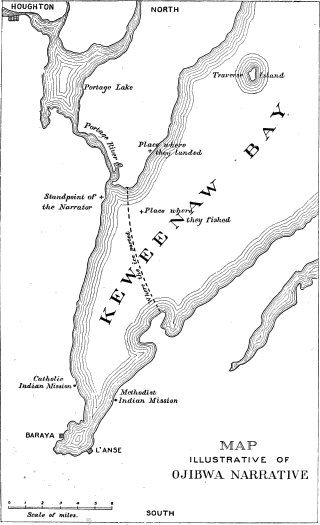
Fig. 319.—Scene of Na-wa-gi-jig’s story.
(1) With the exclamation “me-wi-ja” (a long time ago), uttered in a slow and peculiarly emphatic manner, he elevated the arm above and toward the right at the head, accompanying the motion with an upward wave of the hand and held it thus suspended a moment—a long time ago. (This gesture resembles sign for time, a long, of which it seems to be an abbreviation, and it is not sufficiently clear without the accompanying exclamation.) Withdrawing it slowly, he placed the hand back upon his knee.
(2) He then brought up the left hand toward the temple and tapped his hair, which was gray, with the finger—hair gray.
(3) From thence he carried it down upon the thigh, placing the extended finger perpendicularly upon a fold of his trousers, which the thumb and finger of the right held grasped in such a manner as to advantageously present the smooth black surface of the cloth—of that color, i.e., black.
(4) Next, with a powerful strain of the muscles, he slowly stretched out the right arm and fist and grasping the arm about the elbow with the left, he raised the forearm perpendicularly upward, then brought it down with force, tightening the grasp in doing so (fingers pressing upon knuckle, thumb against pit of elbow)—strength.
(5) Pointing first at me—you.
(6) He next held out the hand horizontally and flat, palm downward, about four feet above the ground, correcting the measure a moment afterward by elevating hand a few inches higher, and estimated the height thus indicated with a telling look, leaning the head toward the side—about that height, i.e., a youth of about that size.
(7) He then rapidly extended the arm about two-thirds of its length forward and toward the right, terminating the motion with a jerk of the hand upward, palm turned outward, and accompanied the motion with a nod of the head, the hand in its downfall closing and dropping upon knee—very well.
(8) Musing a few moments, he next slowly extended the arm and pointed with the fingers toward and along the surface of the frozen bay—out there.
(9) In an easterly direction—eastward.
(10) Thence turning the arm to the right he nodded the finger toward a projection of land southward at a distance of about two miles—following in each case the direction of the finger with the eyes—and immediately after placed the hand again eastward, indicating the spot with the same emphatic nod of the finger as though carrying the visible distance to a spot upon the expanse of the bay, which, bearing no object, could not be marked otherwise—two miles out there.
(11) Carrying the finger toward the body, he touched his breast—I myself.
(12) Thence erected the hand, turning its palm forward, forefinger perpendicularly extended, others slightly closed, and nodded it downward in an explanatory manner, all in an uninterrupted movement—one, meaning in connection with the preceding gesture—I for one.
(13) Again, with an emphatic movement, he turned the hand upward, slightly erecting the index, thumb pointing forward, remaining fingers partially and naturally opened and more or less separated—furthermore.
(14) Then quickly and after a moment’s stop brought down the hand to a horizontal position, first and second fingers joining and fully extending during the movement, and pointing forward—another, i.e., joined by another. Repeating this motion, he at the same time called out the name Ga-bi-wa-bi-ko-ke.
(15) Following the exclamation with a repetition of No. 2—gray hair—repeatedly touching the hair, meaning in this case—an old man.
(16) Pointed with the finger toward the right, directing it obliquely toward the ground—at a short distance toward my right.
(17) Repeated No. 13—furthermore.
(18) Repeated No. 14, adding the third finger to joined fore and middle fingers, thumb resting upon tip of fourth—another, i.e., joined by a third, and pronounced the words “o-gwis-san Sa-ba-dis” (this is a corruption of the French “Jean Baptiste,” a favorite name among Christianized Indians)—John Baptist, his son, while repeating the movement.
(19) Held up the three separated fingers perpendicularly in front of the face, pushing the hand forward a little—three in all.
(20) Presently lowered the hand, fingers relaxing, and carried it a short distance toward the left, thence back to the right, fingers pointing obliquely toward the ground in each case—placed to the right and left of me at a short distance.
(21) He then brought the hand—back toward the right, index horizontally extended, remaining fingers closed, thumb placed against second finger—in front of abdomen, and moved it slowly up and down two or three times, giving it a slight jerk at the upward motion, and raising the arm partially in doing so. At the same time he inclined the body forward a little, eyes looking down—fishing. This refers to fishing on the ice, and, as may be inferred from it, to the use of hook and line. A short stick to which the line is attached serves as a rod and is moved up and down in the manner described.
(22) After a short pause he elevated the hand, directing the index toward that point of the meridian which the sun passes at about the tenth hour of the day, and following the direction with the eye—about ten o’clock.
(23) Turning his face toward the southwest and holding up the flat and extended hand some distance in front of it, back outward, he waved it briskly and several times toward the face—fresh breeze from the southwest.
(24) Repeated No. 21 (fishing), playing the imaginary fish-line up and down regularly for a while, till all at once he changed the movement by raising the hand in an oblique course, which movement he repeated several times, each time increasing the divergence and the length of the motion—the fish-hook don’t sink perpendicularly any longer, i.e., it is moving.
(25) Quickly erecting his body he looked around him with surprise—looking with surprise.
(26) Shading his eyes with the hand, gazed intensively toward the south—fixedly gazing toward the south.
(27) Threw up his arm almost perpendicularly the next moment—greatly astonished.
(28) Extended and slowly moved the arm from southeast to northwest as far as he could reach, at the same time exclaiming “mig-wam” “ice”—the ice from shore to shore.
(29) Approximated the flat and horizontally extended hands, backs upward, with their inner edges touching, whereupon, suddenly turning the edges downward, he withdrew them laterally, backs nearly opposed to each other—parting.
(30) Pushed the left hand, palm outward, fingers joined, edges up and down, forward and toward its side with a full sweep of the arm, head following the movement—pushed in that direction, i.e., northeastward.
(31) Repeated No. 23, but waved the hand only once and with a quick and more powerful movement toward the face—by the force of the wind.
(32) Rotated hands in front of body, rolling them tips over tips very rapidly, fingers with thumbs nearly collected to a point—winding up the hook-line in a hurry.
(33) Quickly passed the hand toward the left breast of his coat—putting it in pocket.
(34) And bending the body forward made motion as if picking up something—picking up.
(35) Raised the hand closed to fist, arm elevated so as to form a right angle with elbow, and made a short stroke downward and toward the left—hatchet.
(36) Thence moved the hand to side of breast and pushed it down the waist—putting it into belt.
(37) Placed the closed hands to each side of the waist (thumbs upward with tips facing each other) and approximated them rapidly and with a jerk in front of navel—tightening the belt.
(38) With both hands lowered to the ground, he described an elongated oval around his foot by placing tips of forefingers together in front of the toes and passing them around each side, meeting the fingers behind the heel and running them jointly backward a few inches to indicate a tail—snow-shoe.
(39) Raised up the heel, resting the foot on the toes and turning it a little toward the right, brought it back in a downward movement with a jerk—putting it on.
(40) Waved the left hand emphatically forward, palm backward, fingers joined and pointing downward, extending them forward at termination of motion, at the same time pushing forward the head—starting.
(41) Directed the finger of the same hand toward the light-house—toward that point.
(42) Pointed with extended first two fingers of the same hand, thumb with remaining fingers partially extended to right and to left—companions.
(43) Repeated No. 40 (starting) less emphatically.
(44) Made several very quick jumping movements forward with the extended left fingers, joined, back upward—going very fast.
(45) Repeated No. 23 (wind), increasing the force of the movement and terminating the sign with the second repetition (wave)—wind increasing.
(46) Raised up the hand in front of head and then arrested it a moment, palm outward, fingers extended, upward and forward—halt.
(47) Partially turning the body toward the north he lowered the extended hand, back forward, fingers joined and pointing downward toward the left of his feet and moved it closely in front of them, and with a cutting motion toward the right, following the movement with the eye—cut off right before feet, i.e., standing on the very edge.
(48) Still facing the north, he carried the hand, back upward, fingers joined and extended, from left side of body outward and toward the right horizontally, indicating the rippled surface of turbulent water by an appropriate motion, and extending the arm to full length, fingers pointing northeastward (toward the right) at termination of motion, and accompanied the movement with a corresponding turn of the head, eyes gazing far into distance—water all along the shore.
(49) Pushed the extended finger, back upward, forward (i.e., northward) in a slightly arched movement—across.
(50) Directing it toward an object (tree) at a distance of about one hundred yards the next moment—a distance of about one hundred yards.
(51) Repeated No. 49 (across) without interrupting the motion—that distance placed across.
(52) Motions as follows: Hands naturally relaxed, edges up and down, backs outward, are with a quick movement and simultaneously carried from the epigastrium forward and toward their sides, arms being extended from elbows only. The hands change their position during the movement and are ultimately placed palms upward, thumbs and fingers extended and widely separated, pointing forward. This is the general sign for doubt. He also turned the face from one side to the other as though interrogating his companions—what are we to do?
(53) Repeated No. 35 (hatchet).
(54) Raised up the finger perpendicularly, other fingers closed, thumb resting against second, and emphatically inclined it forward—only one.
(55) Elevated the arm from the elbow toward the head, hand naturally relaxed, back obliquely upward, inclining the face sideward with a look of consternation, simultaneously, and again mechanically lowered it, dropping palm of hand heavily upon the knee—“bad fix.”
(56) Placed the hand to his hip and raised it up, closed to fist, by a rapid and very energetic movement, ejaculating haw!—quick to the work (referring to the ax or hatchet).
(57) Turning the body downward, he passed the hand, with forefinger directed toward the ground, forward, sideward, and backward, in three movements, each time turning at a right angle—measuring off a square piece on the ground, i.e., on the ice.
(58) Looked and pointed toward an object some twenty feet off, then opposed palms of hands horizontally, and at a short distance from each other, connecting both movements in such a manner as to clearly illustrate their meaning—about twenty feet wide.
(59) Moved the hand—fist, thumb upward—several times quickly up and down a few inches, the arm progressing forward at every stroke—cutting it off.
(60) Repeated No. 55 (bad fix), meaning in this case—bad job.
(61) Opposed the palms of both hands, vertically, at a distance of eight inches, holding them thus steady a moment and estimating the thus indicated measure with the eyes—eight inches thick.
(62) Then struck the palm of left with the back of arched right forcibly—solid ice.
(63) Laid the joined and extended first two fingers, palm up, across side of leg, a foot above heel, accompanying the movement with the eye—one foot deep.
(64) Pushed downward perpendicularly and from same point the flat, extended hand—sinking, or giving in—and turning the hand upward at wrist, back downward, he flirted up the fingers several times quickly—water—slush and water.
(65) Passed one hand over the other as in the act of pulling off mittens—mittens.
(66) Made the motion of wringing out a wet piece of cloth—wringing wet.
(67) Grasped a fold of his trowsers (below the knee) and wrung it—trowsers also wet.
(68) Placed palms of both hands upon legs, near to the ankles, and dragged them up to the knees—up to the knees.
(69) Shivered—feeling cold.
(70) Pointed with thumb backward and toward the right (designating his companion) and repeated No. 2 (hair gray)—my old companion, i.e., Ga-bi-wa-bi-ko-ke.
(71) Repeated No. 69 (feeling cold) more emphatically—more so, i.e., suffering worse from the cold.
(72) Repeated No. 59 (cutting the ice).
(73) Made sign for tired—getting tired, as follows: The left arm is partly extended forward, and is gently struck near the bend of the elbow, usually above it, with the palm of the right hand, at the same time the head is usually inclined to the left side, then in similar manner the right arm is extended and struck by the left hand, and the head in turn inclined to the right.
(74) Repeated No. 35—(hatchet).
(75) Turned the slightly closed left (thumb obliquely upward) over to its side, partially opening it in so doing, fingers pointing to left—passing it over to his companion at the left, i.e., Sabadis.
(76) Flung forefingers of both hands, backs forward, thumbs upward, remaining fingers partially closed, toward their respective sides alternately—by turns.
(77) Repeated No. 59 (cutting the ice).
(78) Elevated the hand above head, thumb and first two fingers extended and directed toward the western meridian, and shook it emphatically and with a tremulous motion up and down while thus suspended—at a late hour.
(79) Followed with the sign for done, finished, as follows: Left hand, with forearm horizontally extended toward the right, is held naturally relaxed, back outward, a few inches in front of body and at a right angle with opposite hand, which is placed on a higher level, slightly arched, edge downward, fingers joined and extended forward. Pass the right quickly and with a cutting motion downward and toward its side, at the same time withdraw the left a few inches toward the opposite direction—finished our work.
(80) Quickly threw up his arm, ejaculating “haw!”—let us start.
(81) Passed both hands approximated in front of body, naturally relaxed, backs outward, forward and toward their respective sides, extending and widely separating the fingers during the movement, and again approximating them with quickly accelerated speed and arresting them, closed to fists, in front of body and with a jerk upward—with united efforts.
(82) Placing the fists, thumbs upward, pointing forward and placed upon side of forefingers, with their wrists against the breast, he pushed them forward and downward a few inches, head slightly participating in the movement—pushing off.
(83) Repeated No. 38 (snow-shoe)—with snow-shoes.
(84) Immediately reassumed the position of “pushing off” as in No. 82, slowly passing forward the fists further and further—pushing and gradually moving off.
(85) Quickly passed and turned the closed left forward, upward, and backward, opening and again closing the fingers in so doing, and executing at almost the same instant a similar, but smaller, revolution with the right—turning over the snow-shoe, tail up.
(86) With both hands closed to fists, left obliquely over the right and on the right side of the body, made motion as if paddling—paddling.
(87) Moved and pointed finger of left towards its side, i.e., northward—toward the shore.
(88) Moved both hands, flat and extended, backs upward, toward the left side, by an even and very slow movement—moving along very slowly toward that direction.
(89) Repeated No. 23—southwest wind.
(90) Repeated No. 30—pushing northeastward.
(91) Turned the thumb of left over to the left—Sabadis.
(92) Repeated No. 32 (winding up), reversing the motion—winding off the hook-line.
(93) Approximated both hands with their tips horizontally in front of body, first two fingers with thumb collected to a point, and moving the fingers as in the act of twisting a cord, gradually receded the hands—twisting.
(94) Thrust forward three fingers of the right—three, i.e., hook-lines.
(95) Repeated No. 93, then rubbed palm of flat and extended right forward over the thigh repeatedly and with a slight pressure—twisting them tightly.
(96) Approximated both hands closed to fists, thumbs upward, in front of body and pulled them asunder repeatedly by short, quick, and sudden jerks—proving strength of line.
(97) Hooked the forefinger, hand turned downward at wrist, remaining fingers closed, thumb resting upon first—fish-hook.
(98) Raised and curved three fingers and thrust them forward a little separated, back to the front—three, i.e., hooks.
(99) Collecting fore and middle fingers of each hand to a point with thumb, he opposed tips of both hands, vertically describing with the upper hand several short circular movements around the tip of the lower—tying together.
(100) Hooked the separated fore and middle fingers of the right, pointing upward, back forward, and placed the hooked finger of the left, palm forward, in front and partially between the fork of the first—in the shape of an anchor.
(101) Thrust both hands, backs upward, fingers extended and separated, forward (i.e., northward), vigorously, left being foremost—throwing toward the shore.
(102) Thence elevating the right toward the head, he thrust it downward in an oblique direction, fore and middle fingers extended and joined with the thumb—sinking.
(103) Placing hands in the position attained last in No. 100 (throwing out toward shore), he closed the fingers, drawing the hands back toward the body and leaning backward simultaneously—hauling in.
(104) Elevated the naturally closed hand to side of head, fingers opening and separating during the movement—at the same time and with a slight jerk of the shoulders inclining the head sideward—and again closed and slowly dropped it upon knee—in vain.
(105) Dropped the finger perpendicularly downward, following the movement with the eye—bottom.
(106) Passed the flat hand, palm down, from side to side in a smooth and horizontal movement—smooth.
(107) Made the sign for stone, rock, as follows: With the back of the arched right hand (H) strike repeatedly in the palm of the left, held horizontal, back outward, at the height of the breast and about a foot in front, the ends of the fingers pointing in opposite directions.
(108) Repeated No. 100—anchor.
(109) Dragged the curved fore and middle fingers over the back of the extended left—dragging.
(110) Waved the left—bent at the wrist, back outward—forward and upward from body, extending the arm to full length, at the same time inclining and pushing forward the head, and repeated the gesture more emphatically—trying again and again.
(111) Waved both hands—backs outward, fingers slightly joined, tips facing each other and closely approximated in front of breast—forward and toward their respective sides a short distance, turning the palms upward during the movement, thumb and fingers being extended and widely separated toward the last. At the same time he inclined the head to one side, face expressing disappointment—all in vain.
(112) Repeated No. 80—Let us start anew!
(113) Repeated No. 86—paddling.
(114) Repeated the preceding gesture, executing the movement only once very emphatically—vigorously.
(115) Waved the finger toward the place of the setting sun, following the direction with the eye—day is near its close.
(116) Repeated No. 69, more emphatically—feeling very cold.
(117) Repeated No. 70—Ga-bi-wa-bi-ko-ke.
(118) Made sign for without, dropping the hands powerless at the sides, with a corresponding movement of head—exhausted.
(119) Pointed with finger toward the light-house and drawing back the finger a little, pushed it forward in the same direction, fully extending the arm—that distance, i.e., one mile beyond light-house.
(120) Elevated both hands to height of shoulder, fingers extended toward the right, backs upward, moving them horizontally forward—left foremost—with an impetuous motion toward the last—drifted out.
(121) Repeated No. 86, executing the movement a series of times without interruption and very energetically—paddling steadily and vigorously.
(122) Pointed with the left forefinger to his breast—I myself.
(123) Waved the thumb of the same hand over to left side without interrupting motion of hand—and Sabadis.
(124) Moved the extended left—back upward, fingers slightly joined—toward left side, and downward a few inches—shore.
(125) Elevated it to level of eyes, fingers joined and extended, palm toward the right, approaching it toward the face by a slow interrupted movement—drawing nearer and nearer.
(126) Drawing a deep breath—relieved.
(127) Repeated No. 86 very emphatically—paddling with increased courage and vigor.
(128) Gazed and pointed northeastward, shading the eyes with the hand, at the same time pushing the left—bent downward at wrist, palm backward—forward in that direction, arm fully extended, fingers separated and pointing ahead at termination of motion—out there at a great distance.
(129) Made a lateral movement with the hand flat and extended over the field of ice in front of him—the ice-field.
(130) Described a series of waves with the flat and extended left, back upward, horizontally outward—sea getting turbulent.
(131) Joyously flourished the hand above head, while pronouncing the word ke-ya-bi—only yet.
(132) Pointed the finger toward the upturned root of a tree a few yards off, thence carrying it forward directed it toward the shore in front—a few yards from shore.
(133) Pointing toward the sun first, he placed palms of both hands in opposition vertically, a space of only an inch or two intervening, with a glance sideways at the height thus indicated—the sun just setting.
(134) Made three vigorous strokes with the imaginary paddle—three more paddle-strokes.
(135) Moved both hands (flat and extended, backs upward) evenly and horizontally toward the left, terminating the movement by turning hands almost perpendicularly upward at wrist, thus arresting them suddenly—the ice-raft runs up against the shore.
(136) Lastly threw up the hand perpendicularly above head, and bringing it down, placed the palm gently over the heart with an air of solemnity—we are saved.
Free translation of the story.
Many years ago—my hair, then black and smooth, has since turned gray; I was then in the prime of life; you, I suppose, were a young lad at that time—the following incident occurred to me:
Yonder on the ice, two miles eastward, I was one day fishing in company with two others, the old Gabiwabikoke and his son John Baptist. It was about ten o’clock in the morning—a fresh breeze from the southwest had previously been getting up—when the hook-line which I was playing up and down began to take an oblique course as though it were moved by a current. Surprised, I looked up and around me. When glancing toward the south I saw a dark streak stretching from shore to shore across the bay; the ice had parted and the wind was carrying it out toward the open lake. In an instant I had wound up my hook-line, picked up my hatchet and snow-shoes, which I put on my feet, and hurried—the others following my example—toward the nearest point of land, yonder where the light-house stands. The wind was increasing and we traveled as fast as we could. There we arrived at the very edge of the ice, a streak of water about one hundred yards in width extending northward along the shore as far as we could see. What to begin with, nothing but a single hatchet? We were in a bad situation. Well, something had to be done. I measured off a square piece on the ice and began cutting it off with the hatchet, a hard and tedious labor. The ice was only eight inches thick, but slush and water covered it to the depth of a foot. I soon had my mittens and trowsers wringing wet and began to feel cold and tired. The old Gabiwabikoke was in a worse state than I. His son next took the hatchet and we all worked by turns. It was about two o’clock in the afternoon when we finished our work. With the help of our snow-shoes (stemming their tail-ends against the edge of the solid ice), we succeeded in pushing off our raft. Turning our snow-shoes the other way (using their tails as handles), we commenced paddling with them toward the shore. It was a very slow progress, as the wind drifted us outward continually. John Baptist managed to twist our three hook-lines into a strong cord, and tying the hooks together in the shape of an anchor, he threw it out toward the shore. Hauling in the line the hooks dragged over the smooth rock bottom and would not catch. Repeated trials were of no avail. We all resumed our former attempt and paddled away with increased energy. The day was drawing near its close, and we began to feel the cold more bitterly. Gabiwabikoke was suffering badly from its effects and was entirely played out. We had already drifted more than a mile beyond the light-house point. John Baptist and I continued paddling steadily and vigorously, and felt relieved and encouraged when we saw the shore draw near and nearer. The ice-field, by this time, was miles away to the northeast, and a sea was getting up. At last, just when the sun was setting, only a few yards separated us from the shore; three more paddle-strokes and our raft ran up against the beach. We were safe.
The oral part of the story in the language of the narrator, with a literal translation into English.
(1) Meⁿ´wija a long time ago
(2) aw ninisis´san this my hair
(3) me´gwa giijina´gwak tibi´shko aw
while it looked like that
(4) me´gwa gimashkaw´isian
while I possessed strength
(5) kin dash you and (i.e., and you)
(6) ga´nabatch kikwiwi´seⁿsiwina´ban perhaps (probably) were a boy
(7) mi´iw very well
(8)-(10) iwe´di there
(11) (12) nin be´jig
I one
(13) mi´nawa again (furthermore)
(14) Gabiwa´bikoke “The Miner”
(15) akiweⁿ´si old man
(16) Expressed by gesture only.
(17) The same as No. 13.
(18) ogwis´san ga´ie, Sabadis
his son too, John Baptist.
(19) mi minik´ so many
(20) (21) Gestures only.
(22) mi wa´pi thus far, i.e., at that time.
(23) we´ai gion´din then the wind blew from
(24) me´gwa nin wewe´banabina´ban
while I was (in the act of) fishing with the hook
nin´goting gonin´gotchi at one time somewhere (out of its course)
oda´bigamo nimigis´skane´ab was drawn my hook line
(25) a´nin ejiwe´bak?
how it happens?
(26) Gesture only.
(27) taai´! ho!
(28) mi´gwam the ice
(29) ma´dja goes
(30) (31) Gestures only.
(32) we´wib quickly
(33) (34) Gestures only.
(35) wagak´wadŏⁿs hatchet
(36) (37) Gestures only.
(38) (39) nin bita´gime I put on snowshoes
(40) win madja´min we go (start)
(41) Gestures only.
(42) (43) mamaw´e together
(44) Gesture only.
(45) esh´kam ki´tchi no´din
more big wind
(46) Gesture only.
(47) mi ja´igwa gima´djishkad (i.e., mi´gwam) already has moved off (i.e., the ice)
(48) (49) Gestures only.
(50) mi´wapi thus far, i.e., at such a distance
(51) Gesture only.
(52) a´nin dash gediji´tehigeiang? how (i.e., what) shall we do?
(53) (54) mi e´ta be´jigwang wagak´wadŏⁿs
only one hatchet
(55) ge´get gisan´agissimin indeed we are badly off.
(56) haw! bak´wewada mi´gwam!
well! (hallo!) let us cut the ice!
(57) (58) (59) Gestures only.
(60) sa´nagad it is bad (hard)
(61) mi epi´tading so it is thick (so thick is it)
(62) Gesture only.
(63) mi dash mi´nawa minik´
that again much (that much again)
(64) nibi´ gon ga´ie
water snow too (water and snow)
(65) nimidjik a´wanag
my mittens
(66) a´pitchi very much
(67) nindas´san gaie
my trowsers two
(68) Gestures only.
(69) nin gi´katch ja´igwa
I feel cold already
(70) aw sa kiweⁿ´si
the old man
(71) nawatch´ win´ more yet he
(72) Gesture only.
(73) nind aie´kos ja´igwa
I am tired already
(74) Gesture only.
(75) Sa´badis John Baptist
(76) memesh´kwat kaki´na
by turns all
(77) Gesture only.
(78) wi´ka ga´ishkwanawo´kweg
late in the afternoon
(79) mi gibakwewangid
now it is cut loose
(80) haw! well! (ho!)
(81) mama´we together
(82) Gesture only.
(83) a´gimag snowshoes
(84) ma´djishka it is moving
(85)-(87) Gestures only.
(88) aga´wa ma´djishkca scarcely it moves (very little)
(89) no´din wind
(90) Gesture only.
(91) Sa´badis John Baptist
(92) migiss´kaneyab hook-line
(93) (94) oginisswa´biginan he twisted three cords together
(95)-(98) Gestures only.
(99) oginisso´bidonan (i.e., migaskanan) he tied together three (i.e., hooks)
(100) Gesture only.
(101) ogiaba´gidonan dash he threw it out
(102) Gesture only.
(103) owikobi´donan he wants to draw it in
(104) kawes´sa in vain (“no go”)
(105)-(108) Gestures only.
(109) ka´win sagakwidis´sinon
(not) it don’t catch on the rock-bottom
(110) mi´nawa—mo´jag again—often (repeatedly)
(111) The same as No. 104.
(112) The same as No. 80.
(113) Gesture only.
(114) e´nigok vigorously
(115) ja´igwa ona´kwishi
already evening
(116) esh´kam kis´sina
more cold (getting colder)
(117) The same as No. 70.
(118) mi ja´igwa gianiji´tang
already he has given up
(119) was´sa ja´igwa
far already
(120) niwebas´himin we have drifted out
(121) Gesture only.
(122) (123) mi´sa e´ta mij´iang (now) only we are two
(124) Gesture only.
(125) ja´igwa tehi´gibig already near to shore
(126) mi ja´igwa anibonen´damang now we catch new spirits
(127) esh´kam nigijijaw´isimin
more we are strong (i.e., our strength and courage increases)
(128) (129) e-eh! was´sa ja´igwa´ mi´gwam!
oh! far already the ice!
(130) ja´igwa already
(131) ke´abi yet
(132) go´mapi so far perhaps
(133) ge´ga bangi´shimo nearly sundown
(134) Gesture only.
(135) mi gibima´jagang we have landed
(136) mi gibima´disiang we have saved our lives.
DISCOURSES.
ADDRESS OF KIN CHĒ-ĔSS.
The following is the farewell address of Kin Chē-ĕss (Spectacles), medicine-man of the Wichitas, to Rev. A. J. Holt, missionary, on his departure from the Wichita Agency, in the words of the latter:
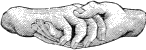
Fig. 320.
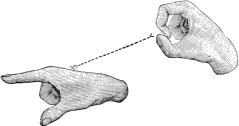
Fig. 321.
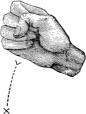
Fig. 322.
He placed one hand on my breast, the other on his own, then clasped his two hands together after the manner of our congratulations—We are friends, Fig. 320. He placed one hand on me, the other on himself, then placed the first two fingers of his right hand between his lips—We are brothers. He placed his right hand over my heart, his left hand over his own heart, then linked the first fingers of his right and left hands—Our hearts are linked together. See Fig. 232, p. 386. He laid his right hand on me lightly, then put it to his mouth, with the knuckles lightly against his lips, and made the motion of flipping water from the right-hand forefinger, each flip casting the hand and arm from the mouth a foot or so, then bringing it back in the same position. (This repeated three or more times, signifying talk or talking.) Fig. 321. He then made a motion with his right hand as if he were fanning his right ear; this repeated. He then extended his right hand with his index finger pointing upward, his eyes also being turned upward—You told me of the Great Father. Pointing to himself, he hugged both hands to his bosom, as if he were affectionately clasping something he loved, and then pointed upward in the way before described—I love him (the Great Father). Laying his right hand on me, he clasped his hands to his bosom as before—I love you. Placing his right hand on my shoulder, he threw it over his own right shoulder as if he were casting behind him a little chip, only when his hand was over his shoulder his index finger was pointing behind him—You go away. Pointing to his breast, he clinched the same hand as if it held a stick, and made a motion as if he were trying to strike something on the ground with the bottom of the stick held in an upright position—I stay, or I stay right here, Fig. 322.
Fig. 323.
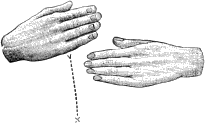
Fig. 324.
Placing his right hand on me, he placed both his hands on his breast and breathed deeply two or three times, then using the index finger and thumb of each hand as if he were holding a small pin, he placed the two hands in this position as if he were holding a thread in each hand and between the thumb and forefinger of each hand close together, and then let his hands recede from each other, still holding his fingers in the same position, as if he were letting a thread slip between them until his hands were two feet apart—You live long time, Fig. 323. Laying his right hand on his breast, then extending his forefinger of the same hand, holding it from him at half-arm’s length, the finger pointing nearly upward, then moving his hand, with the finger thus extended, from side to side about as rapidly as a man steps in walking, each time letting his hand get farther from him for three or four times, then suddenly placing his left hand in a horizontal position with the fingers extended and together so that the palm was sidewise, he used the right-hand palm extended, fingers together, as a hatchet, and brought it down smartly, just missing the ends of the fingers of the left hand, Fig. 324. Then placing his left hand, with the thumb and forefinger closed, to his heart, he brought his right hand, fingers in the same position, to his left, then, as if he were holding something between his thumb and forefinger, he moved his right hand away as if he were slowly casting a hair from him, his left hand remaining at his breast, and his eyes following his right—I go about a little while longer, but will be cut off shortly and my spirit will go away (or will die). Placing the thumbs and forefingers again in such a position as if he held a small thread between the thumb and forefinger of each hand, and the hands touching each other, he drew his hands slowly from each other, as if he were stretching a piece of gum-elastic; then laying his right hand on me, he extended the left hand in a horizontal position, fingers extended and closed, and brought down his right hand with fingers extended and together, so as to just miss the tips of the fingers of his left hand; then placing his left forefinger and thumb against his heart, he acted as if he took a hair from the forefinger and thumb of his left hand with the forefinger and thumb of the right, and slowly cast it from him, only letting his left hand remain at his breast, and let the index finger of the right hand point outward toward the distant horizon—After a long time you die. When placing his left hand upon himself and his right hand upon me, he extended them upward over his head and clasped them there—We then meet in heaven. Pointing upward, then to himself, then to me, he closed the third and little finger of his right hand, laying his thumb over them, then extending his first and second fingers about as far apart as the eyes, he brought his hand to his eyes, fingers pointing outward, and shot his hand outward—I see you up there. Pointing to me, then giving the last above-described sign of look, then pointing to himself, he made the sign as if stretching out a piece of gum-elastic between the fingers of his left and right hands, and then made the sign of cut-off before described, and then extended the palm of the right hand horizontally a foot from his waist, inside downward, then suddenly threw it half over and from him, as if you were to toss a chip from the back of the hand (this is the negative sign everywhere used among these Indians)—I would see him a long time, which should never be cut off, i.e., always.
Pointing upward, then rubbing the back of his left hand lightly with the forefinger of his right, he again gave the negative sign.—No Indian there (in heaven). Pointing upward, then rubbing his forefinger over the back of my hand, he again made the negative sign—No white man there. He made the same sign again, only he felt his hair with the forefinger and thumb of his right hand, rolling the hair several times between the fingers—No black man in heaven. Then rubbing the back of his hand and making the negative sign, rubbing the back of my hand and making the negative sign, feeling of one of his hairs with the thumb and forefinger of his right hand, and making the negative sign, then using both hands as if he were reaching around a hogshead, he brought the forefinger of his right hand to the front in an upright position after their manner of counting, and said thereby—No Indian, no white man, no black man, all one. Making the “hogshead” sign, and that for look, he placed the forefinger of each hand side by side pointing upward—All look the same, or alike. Running his hands over his wild Indian costume and over my clothes, he made the “hogshead” sign, and that for same, and said thereby—All dress alike there. Then making the “hogshead” sign, and that for love, (hugging his hands), he extended both hands outward, palms turned downward, and made a sign exactly similar to the way ladies smooth a bed in making it; this is the sign for happy—All will be happy alike there. He then made the sign for talk and for Father, pointing to himself and to me—You pray for me. He then made the sign for go away, pointing to me, he threw right hand over his right shoulder so his index finger pointed behind him—You go away. Calling his name he made the sign for look and the sign of negation after pointing to me—Kin Chē-ĕss see you no more.
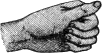
Fig. 325.
Fig. 322, an illustration in the preceding address, also represents a common gesture for sit down, if made to the right of the hip, toward the locality to be occupied by the individual invited. The latter closely corresponds to an Australian gesture described by Smyth (The Aborigines of Victoria, London, 1878, Vol. II, p. 308, Fig. 260), as follows: “Minnie-minnie (wait a little). It is shaken downwards rapidly two or three times. Done more slowly towards the ground, it means ‘Sit down.’” This is reproduced in Fig. 325.
TSO-DI-A´-KO’S REPORT.
The following statement was made to Dr. W. J. Hoffman by Tso-di-a´-ko (Shaved-head Boy), chief of the Wichitas in Indian Territory, while on a visit to Washington, D.C., in June 1880.
The Indian being asked whether there was any timber in his part of the Territory, replied in signs as follows:
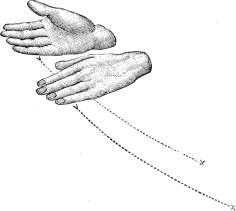
Fig. 326.
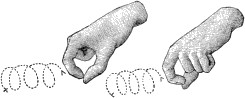
Fig. 327.
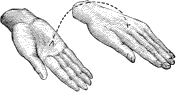
Fig. 328.
(1) Move the right hand, fingers loosely extended, separated and pointing upward, back to the front, upward from the height of the waist to the front of the face—tree (for illustration see Fig. 112, p. 343); repeat this two or three times—trees; (2) then hold the hand, fingers extended and joined, pointing upward, with the back to the front, and push it forward toward different points on a level with the face—standing at various places; (3) both hands, with spread and slightly curved fingers, are held about two feet apart, before the thighs, palms facing, then draw them toward one another horizontally and gradually upward until the wrists cross, as if grasping a bunch of grass and pulling it up—many; (4) point to the southwest with the index, elevating it a little above the horizon—country; (5) then throw the fist edgewise toward the surface, in that direction—my, mine; (6) place both hands, extended, flat, edgewise before the body, the left below the right, and both edges pointing toward the ground a short distance to the left of the body, then make repeated cuts toward that direction from different points, the termination of each cut ending at nearly the same point—cut down, Fig. 326; (7) hold the left hand with the fingers and thumb collected to a point, directed horizontally forward, and make several cutting motions with the edge of the flat right hand transversely by the tips of the left, and upon the wrist—cut off the ends; (8) then cut upon the left hand, still held in the same position, with the right, the cuts being parallel to the longitudinal axis of the palm—split; (9) both hands closed in front of the body, about four inches apart, with forefingers and thumbs approximating half circles, palms toward the ground, move them forward so that the back of the hand comes forward and the half circles imitate the movement of wheels—wagon, Fig. 327; (10) hold the left flat hand before the body, pointing horizontally forward, with the palm down, then bring the right flat hand from the right side and slap the palm upon the back of the left several times—load upon, Fig. 328; (11) partly close the right hand as if grasping a thick rod, palm toward the ground, and push it straight forward nearly to arm’s length—take; (12) hold both hands with fingers naturally extended and slightly separated nearly at arm’s length before the body, palms down, the right lying upon the left, then pass the upper forward and downward from the left quickly, so that the wrist of the right is raised and the fingers point earthward—throw off; (13) cut the left palm repeatedly with the outer edge of the extended right hand—build; (14) hold both hands edgewise before the body, palms facing, spread the fingers and place those of one hand into the spaces between those of the left, so that the tips of one protrude beyond the backs of the fingers of the other—log house, see Fig. 253, p. 428; (15) then place the flat right hand, palm down and fingers pointing to the left, against the breast and move it forward, and slightly upward and to the right—good.
ANALYSIS OF THE FOREGOING.
[There is] much timber [in] my country [of which I] cut down [some],
(3) (1,2) (5) (4) (6)
trimmed, split, loaded it upon a wagon [and] took it away,
(7) (8) (10) (9) (11)
[where I] threw [it] off [and] built [a] good house .
(12) (13) (15) (14)
Notes.—As will be seen, the word timber is composed of signs No. 1 and 2, signifying trees standing. Sign No. 3, for many, in this instance, as in similar other examples, becomes much. The word “in,” in connection with country and my, is expressed by the gesture of pointing (passing the hand less quickly than in ordinary sign language) before making sign No. 5. That sign commonly given for possession, would, without the prefix of indication, imply my country, and with that prefix signifies in my country. Sign No. 7, trimmed, is indicated by chopping off the ends, and facial expression denoting satisfaction. In sign Nos. 11 and 12 the gestures were continuous, but at the termination of the latter the narrator straightened himself somewhat, denoting that he had overcome the greater part of the labor. Sign No. 14 denotes log-house, from the manner of interlacing the finger-ends, thus representing the corner of a log-house, and the arrangement of the ends of the same. Indian lodge would be indicated by another sign, although the latter is often used as an abbreviation for the former, when the subject of conversation is known to all present.
LEAN WOLF’S COMPLAINT
The following remarks were obtained by Dr. W. J. Hoffman from Tce-caq-a-daq-a-qic (Lean Wolf), chief of the Hidatsa Indians of Dakota Territory, who visited Washington in 1880:
Four years ago the American people agreed to be friends with us, but they lied. That is all.
(1) Place the closed hand, with the thumb resting over the middle of the index, on the left side of the forehead, palmar side down, then draw the thumb across the forehead to the right, a short distance beyond the head—white man, American, Fig. 329.
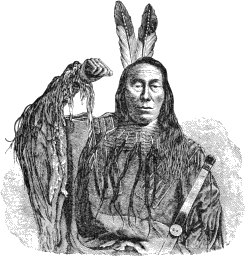
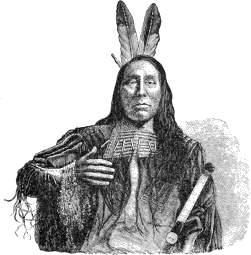
Fig. 329. Fig. 330.
(2) Place the naturally extended hand, fingers and thumb slightly separated and pointing to the left, about fifteen inches before the right side of the body, bringing it to within a short distance—with us, Fig. 330.
(3) Extend the flat right hand to the front and right as if about to grasp the hand of another individual—friend, friends, Fig. 331. For remarks connected with this sign see pp. 384-386.
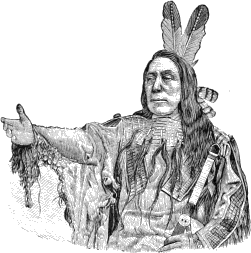
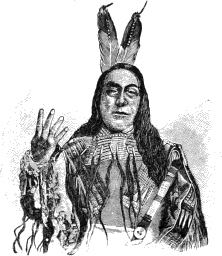
Fig. 331. Fig. 332.
(4) Place the flat right hand, with fingers only extended, back to the front, about eighteen inches before the right shoulder—four [years], Fig. 332.
(5) Close the right hand, leaving the index and second fingers extended and slightly separated, place it, back forward, about eight inches before the right side of the body, and pass it quickly to the left in a slightly downward curve—lie, Fig. 333.
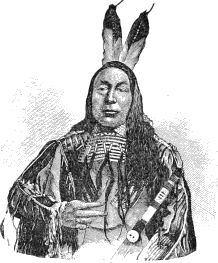
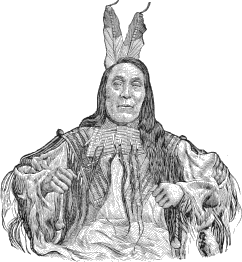
Fig. 333. Fig. 334.
(6) Place the clinched fists together before the breast, palms down, then separate them in a curve outward and downward to their respective sides—done, finished, “that is all”, Fig. 334.
SIGNALS.
The collaborators in the work above explained have not generally responded to the request to communicate material under this head. It is, however, hoped that by now printing some extracts from published works and the few contributions recently procured, the attention of observers will be directed to the prosecution of research in this direction.
The term “signal” is here used in distinction from the signs noted in the Dictionary, extracts from which are given above, as being some action or manifestation intended to be seen at a distance, and not allowing of the minuteness or detail possible in close converse. Signals may be executed, first, exclusively by bodily action; second, by action of the person in connection with objects, such as a blanket, or a lance, or the direction imparted to a horse; third, by various devices, such as smoke, fire or dust, when the person of the signalist is not visible. When not simply intended to attract attention they are generally conventional, and while their study has not the same kind of importance as that of gesture signs, it possesses some peculiar interest.
SIGNALS EXECUTED BY BODILY ACTION.
Some of these are identical, or nearly so, with the gesture signs used by the same people.
Alarm. See Notes on Cheyenne and Arapaho Signals, infra.
Anger.
Close the hand, place it against the forehead, and turn it back and forth while in that position. (Col. R. B. Marcy, U.S.A., Thirty Years of Army Life on the Border, New York, 1866, p. 34.)
Come here.
The right hand is to be advanced about eighteen inches at the height of the navel, horizontal, relaxed, palm downward, thumb in the palm; then draw it near the side and at the same time drop the hand to bring the palm backward. The farther away the person called is, the higher the hand is raised. If very far off, the hand is raised high up over the head and then swung forward, downward, and backward to the side. (Dakota I, IV.)
Danger.
There is something dangerous in that place.—Right-hand index-finger and thumb forming a curve, the other fingers closed; move the right hand forward, pointing in the direction of the dangerous place or animal. (Omaha I.)
Defiance.
Right-hand index and middle fingers open; motion toward the enemy signifies “I do not fear you.” Reverse the motion, bringing the hand toward the subject, means “Do your worst to me.” (Omaha I.)
Direction.
Pass around that object or place near you—she-í-he ti-dhá-ga.—When a man is at a distance, I say to him “Go around that way.” Describe a curve by raising the hand above the head, forefinger open, move to right or left according to direction intended and hand that is used, i.e., move to the left, use right hand; move to the right, use left hand. (Omaha I; Ponka I.)
Halt! —— To inquire disposition.
Raise the right hand with the palm in front and gradually push it forward and back several times; if they are not hostile it will at once be obeyed. (Randolph B. Marcy, The Prairie Traveler. New York, 1859, p. 214.)
—— Stand there! He is coming to you.
Right hand extended, flat, edgewise, moved downward several times. (Omaha I.)
—— Stand there! He is going toward you.
Hold the open right hand, palm to the left, with the tips of the fingers toward the person signaled to; thrust the hand forward in either an upward or downward curve. (Omaha I; Ponka I.)
—— Lie down flat where you are—she-dhu bis-pé zhaⁿ´-ga.
Extend the right arm in the direction of the person signaled to, having the palm down; move downward by degrees to about the knees. (Omaha I; Ponka I.)
Peace; Friendship.
Hold up palm of hand.—Observed as made by an Indian of the Kansas tribe in 1833. (John T. Irving, Indian Sketches. Philadelphia, 1835, vol. ii, p. 253.)
Elevate the extended hands at arm’s length above and on either side of the head. Observed by Dr. W. J. Hoffman, as made in Northern Arizona in 1871 by the Apaches, Mojaves, Hualpais, and Seviches. “No arms”—corresponding with “hands up” of road-agents. Fig. 335.
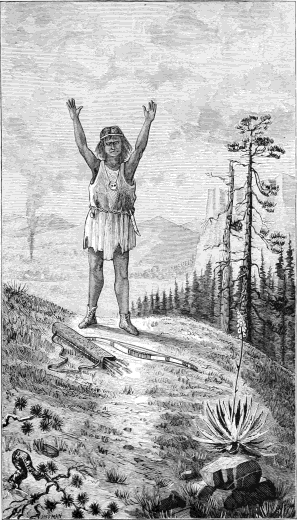
Fig. 335.—A signal of peace.
The right hand held aloft, empty. (General G. A. Custer, My Life on the Plains, New York, 1874, p. 238.) This may be collated with the lines in Walt Whitman’s Salut au Monde—
Toward all I raise high the perpendicular hand,—I make the signal.
The Natchez in 1682 made signals of friendship to La Salle’s party by the joining of the two hands of the signalist, much embarrassing Tonty, La Salle’s lieutenant, in command of the advance in the descent of the Mississippi, who could not return the signal, having but one hand. His men responded in his stead. (Margry, Decouvertes et Établissments des Français dans l’ouest et dans le sud de l’Amérique Septentrionale, &c.)
Question. —— I do not know you. Who are you?
After halting a party coming: Right hand raised, palm in front and slowly moved to the right and left. [Answered by tribal sign.] (Marcy’s Prairie Traveler, loc. cit., 214.) Fig. 336. In this illustration the answer is made by giving the tribal sign for Pani.
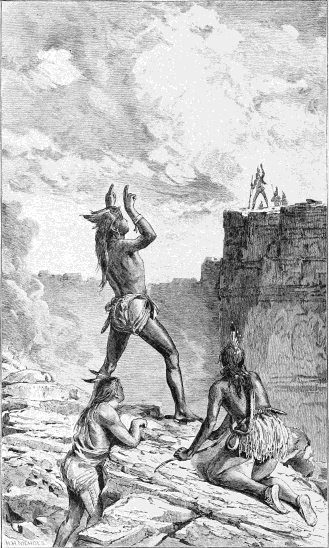
Fig. 336.—Signal, “Who are you?” Answer, “Pani.”
—— To inquire if coming party is peaceful.
Raise both hands, grasped in the manner of shaking hands, or by locking the two forefingers firmly while the hands are held up. If friendly they will respond with the same signal. (Marcy’s Prairie Traveler, loc. cit., 214.)
Submission.
The United States steamer Saranac in 1874, cruising in Alaskan waters, dropped anchor in July, 1874, in Freshwater Harbor, back of Sitka, in latitude 59° north. An armed party landed at a T’linkit village, deserted by all the inhabitants except one old man and two women, the latter seated at the feet of the former. The man was in great fear, turned his back and held up his hands as a sign of utter helplessness. (Extract from notes kindly furnished by Lieutenant-Commander Wm. Bainbridge Hoff, U.S.N., who was senior aid to Rear-Admiral Pennock, on the cruise mentioned.)
Surrender.
The palm of the hand is held toward the person [to whom the surrender is made]. (Long.)
Hold the palm of the hand toward the person as high above the head as the arm can be raised. (Dakota I.)
SIGNALS IN WHICH OBJECTS ARE USED IN CONNECTION WITH PERSONAL ACTION.
Buffalo discovered. See also Notes on Cheyenne and Arapaho signals.
When the Ponkas or Omahas discover buffalo the watcher stands erect on the hill, with his face toward the camp, holding his blanket with an end in each hand, his arms being stretched out (right and left) on a line with shoulders. (Dakota VIII; Omaha I; Ponka I.) See Fig. 337.
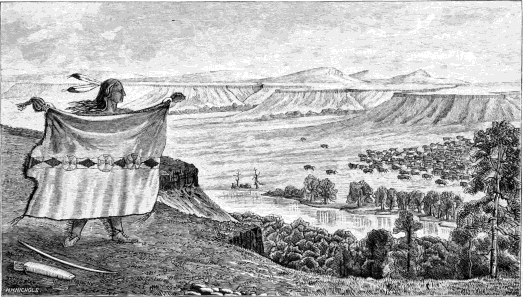
Fig. 337.—Signal for “buffalo discovered.”
Same as (Omaha I), and (Ponka I); with the addition that after the blanket is held out at arm’s length the arms are crossed in front of the body. (Dakota I.)
Camp!
When it is intended to encamp, a blanket is elevated upon a pole so as to be visible to all the individuals of a moving party. (Dakota VIII.)
Come! To beckon to a person.
Hold out the lower edge of the robe or blanket, then wave it in to the legs. This is made when there is a desire to avoid general observation. (Matthews.)
Come back!
Gather or grasp the left side of the unbuttoned coat (or blanket) with the right hand, and, either standing or sitting in position so that the signal can be seen, wave it to the left and right as often as may be necessary for the sign to be recognized. When made standing the person should not move his body. (Dakota I.)
Danger. See also Notes on Cheyenne and Arapaho signals.
—— Horseman at a distance, galloping, passing and repassing, and crossing each other—enemy comes. But for notice of herd of buffalo, they gallop back and forward abreast—do not cross each other. (H. M. Brackenridge’s Views of Louisiana. Pittsburgh, 1814, p. 250.)
—— Riding rapidly round in a circle, “Danger! Get together as quickly as possible.” (Richard Irving Dodge, lieutenant-colonel United States Army, The Plains of the Great West. New York, 1877, p. 368.)
—— Point the right index in the direction of the danger, and then throw the arm over the front of the body diagonally, so that the hand rests near the left shoulder, back outward. If the person to be notified of the danger should be in the rear precede the above signal with that for “Attention.” This signal can also be made with a blanket, properly grasped so as to form a long narrow roll. Perhaps this signal would more properly belong under “Caution,” as it would be used to denote the presence of a dangerous beast or snake, and not that of a human enemy. (Dakota I.)
—— Passing and repassing one another, either on foot or mounted, is used as a war-signal; which is expressed in the Hidatsa—mạkimakă´da-halidié. (Mandan and Hidatsa I.)
Direction. —— Pass around that place.
Point the folded blanket in the direction of the object or place to be avoided, then draw it near the body, and wave it rapidly several times in front of the body only, and then throwing it out toward the side on which you wish the person to approach you, and repeat a sufficient number of times for the signal to be understood. (Dakota I.)