NORTH AMERICAN INDIANS (continued 4)
Reading edition
Time past is not only expressed, but some tribes give a distinct modification to show a short or long time past. The following are examples:
Lately, recently.—Hold the left hand at arm’s length, closed, with forefinger only extended and pointing in the direction of the place where the event occurred; then hold the right hand against the right shoulder, closed, but with index extended and pointing in the direction of the left. The hands may be exchanged, the right extended and the left retained, as the case may require for ease in description. (Absaroka I; Shoshoni and Banak I.)
Long ago.—Both hands closed, forefingers extended and straight; pass one hand slowly at arm’s length, pointing horizontally, the other against the shoulder or near it, pointing in the same direction as the opposite one. Frequently the tips of the forefingers are placed together, and the hands drawn apart, until they reach the positions described. (Absaroka I; Shoshoni and Banak I.)
The Comanche, Wichita, and other Indians designate a short time ago by placing the tips of the forefinger and thumb of the left hand together, the remaining fingers closed, and holding the hand before the body with forefinger and thumb pointing toward the right shoulder; the index and thumb of the right hand are then similarly held and placed against those of the left, when the hands are slowly drawn apart a short distance. For a long time ago the hands are similarly held, but drawn farther apart. Either of these signs may be and frequently is preceded by those for day, month, or year, when it is desired to convey a definite idea of the time past.
A sign is reported with the abstract idea of future, as follows: “The arms are flexed and hands brought together in front of the body as in type-position (W). The hands are made to move in wave-like motions up and down together and from side to side.” (Oto I.) The authority gives the poetical conception of “Floating on the tide of time.”
The ordinary mode of expressing future time is, however, by some figurative reference, as the following: Count off fingers, then shut all the fingers of both hands several times, and touch the hair and tent or other white object. (Apache III.) “Many years; when I am old (whitehaired).”
CONJUNCTIONS.
An interesting instance where the rapid connection of signs has the effect of the conjunction and is shown in Nátci’s Narrative, infra.
PREPOSITIONS.
In the Tendoy-Huerito Dialogue (page 489) the combination of gestures supplies the want of the proposition to.
PUNCTUATION.
While this is generally accompanied by facial expression, manner of action, or pause, instances have been noticed suggesting the device of interrogation points and periods.
Mark of interrogation.
The Shoshoni, Absaroka, Dakota, Comanche, and other Indians, when desiring to ask a question, precede the gestures constituting the information desired by a sign intended to attract attention and “asking for,” viz., by holding the flat right hand, with the palm down, directed to the individual interrogated, with or without lateral oscillating motion; the gestural sentence, when completed, being closed by the same sign and a look of inquiry. This recalls the Spanish use of the interrogation points before and after the question.
Period.
A Hidatsa, after concluding a short statement, indicated its conclusion by placing the inner edges of the clinched hands together before the breast, and passing them outward and downward to their respective sides in an emphatic manner, Fig. 334, page 528. This sign is also used in other connections to express done.
The same mode of indicating the close of a narrative or statement is made by the Wichitas, by holding the extended left hand horizontally before the body, fingers pointing to the right, palm either toward the body or downward, and cutting edgewise downward past the tips of the left with the extended right hand. This is the same sign given in the Address Of Kin Chē-ĕss as cut off, and is illustrated in Fig. 324, page 522. This is more ideographic and convenient than the device of the Abyssinian Galla, reported by M. A. d’Abbadie, who denoted a comma by a slight stroke of a leather whip, a semicolon by a harder one, and a full stop by one still harder.
GESTURES AIDING ARCHÆOLOGIC RESEARCH.
The most interesting light in which the Indians of North America can be regarded is in their present representation of a stage of evolution once passed through by our own ancestors. Their signs, as well as their myths and customs, form a part of the paleontology of humanity to be studied in the history of the latter as the geologist, with similar object, studies all the strata of the physical world. At this time it is only possible to suggest the application of gesture signs to elucidate pictographs, and also their examination to discover religious, sociologic, and historic ideas preserved in them, as has been done with great success in the radicals of oral speech.
SIGNS CONNECTED WITH PICTOGRAPHS.
The picture writing of Indians is the sole form in which they recorded events and ideas that can ever be interpreted without the aid of a traditional key, such as is required for the signification of the wampum belts of the Northeastern tribes and the quippus of Peru. Strips of bark, tablets of wood, dressed skins of animals, and the smooth surfaces of rock have been and still are used for such records, those most ancient, and therefore most interesting, being of course the rock etchings; but they can only be deciphered, if at all, by the ascertained principles on which the more modern and the more obvious are made. Many of the numerous and widespread rock carvings are mere idle sketches of natural objects, mainly animals, and others are as exclusively mnemonic as the wampum above mentioned. Even since the Columbian discovery some tribes have employed devices yet ruder than the rudest pictorial attempt as markers for the memory. An account of one of these is given in E. Winslow’s Relation (A.D. 1624), Col. Mass. Hist. Soc., 2d series, ix, 1822, p. 99, as follows:
“Instead of records and chronicles they take this course: Where any remarkable act is done, in memory of it, either in the place or by some pathway near adjoining, they make a round hole in the ground about a foot deep, and as much over, which, when others passing by behold, they inquire the cause and occasion of the same, which being once known, they are careful to acquaint all men as occasion serveth therewith. And lest such holes should be filled or grown over by any accident, as men pass by they will often renew the same; by which means many things of great antiquity are fresh in memory. So that as a man traveleth, if he can understand his guide, his journey will be the less tedious, by reason of the many historical discourses which will be related unto him.”
Gregg, in Commerce of the Prairies, New York, 1844, II, 286, says of the Plains tribes: “When traveling, they will also pile heaps of stones upon mounds or conspicuous points, so arranged as to be understood by their passing comrades; and sometimes they set up the bleached buffalo heads, which are everywhere scattered over those plains, to indicate the direction of their march, and many other facts which may be communicated by those simple signs.”
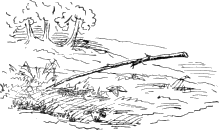
Fig. 151.
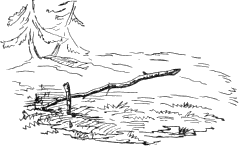
Fig. 152.
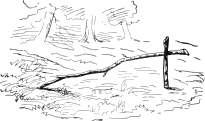
Fig. 153.
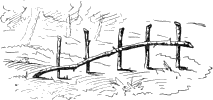
Fig. 154.
A more ingenious but still arbitrary mode of giving intelligence is practiced at this day by the Abnaki, as reported by H. L. Masta, chief of that tribe, now living at Pierreville, Quebec. When they are in the woods, to say “I am going to the east,” a stick is stuck in the ground pointing to that direction, Fig. 151. “Am not gone far,” another stick is stuck across the former, close to the ground, Fig. 152. “Gone far” is the reverse, Fig. 153. The number of days journey of proposed absence is shown by the same number of sticks across the first; thus Fig. 154 signifies five days’ journey. Cutting the bark off from a tree on one, two, three or four sides near the butt means “Have had poor, poorer, poorest luck.” Cutting it off all around the tree means “I am starving.” Smoking a piece of birch bark and hanging it on a tree means “I am sick.”
Where there has existed any form of artistic representation, however rude, and at the same time a system of ideographic gesture signs prevailed, it would be expected that the form of the latter would appear in the former. The sign of river and water mentioned on page 358 being established, when it became necessary or desirable to draw a character or design to convey the same idea, nothing would be more natural than to use the graphic form of delineation which is also above described. It was but one more and an easy step to fasten upon bark, skins, or rocks the evanescent air pictures that still in pigments or carvings preserve their skeleton outline, and in their ideography approach, as has been shown above, the rudiments of the phonetic alphabets that have been constructed by other peoples. A transition stage between gestures and pictographs, in which the left hand is used as a supposed drafting surface upon which the index draws lines, is exhibited in the Dialogue between Alaskan Indians, infra, page 498. This device is common among deaf-mutes, without equal archæologic importance, as it may have been suggested by the art of writing, with which they are generally acquainted, even if not instructed in it.
The reproduction of apparent gesture lines in the pictographs made by our Indians has, for obvious reasons, been most frequent in the attempt to convey those subjective ideas which were beyond the range of an artistic skill limited to the direct representation of objects, so that the part of the pictographs which is still the most difficult of interpretation is precisely the one which the study of sign language is likely to elucidate. The following examples of pictographs of the Indians, in some cases compared with those from foreign sources, have been selected because their interpretation is definitely known and the gestures corresponding with or suggested by them are well determined.


Fig. 156. Fig. 157. Fig. 158. Fig. 159. Fig. 160. Fig. 161.
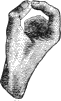
Fig. 155.

Fig. 167.
The common Indian gesture sign for sun is: “Right hand closed, the index and thumb curved, with tips touching, thus approximating a circle, and held toward the sky,” the position of the fingers of the hand forming a circle being shown in Fig. 155. Two of the Egyptian characters for sun, Figs. 156 and 157, are plainly the universal conception of the disk. The latter, together with indications of rays, Fig. 158, and in its linear form, Fig. 159, (Champollion, Dict., 9), constitutes the Egyptian character for light. The rays emanating from the whole disk appear in Figs. 160 and 161, taken from a MS. contributed by Mr. G. K. Gilbert of the United States Geological Survey, from the rock etchings of the Moqui pueblos in Arizona. The same authority gives from the same locality Figs. 162 and 163 for sun, which may be distinguished from several other similar etchings for star also given by him, Figs. 164, 165, 166, 167, by always showing some indication of a face, the latter being absent in the characters denoting star.


Fig. 162. Fig. 163. Fig. 164. Fig. 165. Fig. 166.

Fig. 168.
With the above characters for sun compare Fig. 168, found at Cuzco, Peru, and taken from Wiener’s Pérou et Bolivie, Paris, 1880, p. 706.

Fig. 169.
The Ojibwa pictograph for sun is seen in Fig. 169, taken from Schoolcraft, loc. cit., v. 1, pl. 56, Fig. 67.
A gesture sign for sunrise, morning, is: Forefinger of right hand crooked to represent half of the sun’s disk and pointed or extended to the left, then slightly elevated. (Cheyenne II.) In this connection it may be noted that when the gesture is carefully made in open country the pointing would generally be to the east, and the body turned so that its left would be in that direction. In a room in a city, or under circumstances where the points of the compass are not specially attended to, the left side supposes the east, and the gestures relating to sun, day, &c., are made with such reference. The half only of the disk represented in the above gesture appears in the following Moqui pueblo etchings for morning and sunrise, Figs. 170, 171, and 172. (Gilbert, MS.)
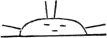


Fig. 170. Fig. 171. Fig. 172.
A common gesture for day is when the index and thumb form a circle (remaining fingers closed) and are passed from east to west.

Fig. 173.
Fig. 173 shows a pictograph found in Owen’s Valley, California, a similar one being reported in the Ann. Rep. Geog. Survey west of the 100th Meridian for 1876, Washington, 1876, pl. opp. p. 326, in which the circle may indicate either day or month (both these gestures having the same execution), the course of the sun or moon being represented perhaps in mere contradistinction to the vertical line, or perhaps the latter signifies one.
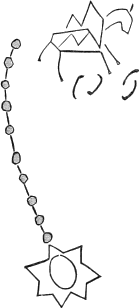
Fig. 174.
Fig. 174 is a pictograph of the Coyotero Apaches, found at Camp Apache, in Arizona, reported in the Tenth Ann. Rep. U.S. Geolog. and Geograph. Survey of the Territories for 1876, Washington, 1878, pl. lxxvii. The sun and the ten spots of approximately the same shape represent the days, eleven, which the party with five pack mules passed in traveling through the country. The separating lines are the nights, and may include the conception of covering over and consequent obscurity above referred to (page 354).

Fig. 175.

Fig. 176.
A common sign for moon, month, is the right hand closed, leaving the thumb and index extended, but curved to form a half circle and the hand held toward the sky, in a position which is illustrated in Fig. 175, to which curve the Moqui etching, Fig. 176, and the identical form in the ancient Chinese has an obvious resemblance.

Fig. 177.
The crescent, as we commonly figure the satellite, appears also in the Ojibwa pictograph, Fig. 177 (Schoolcraft, I, pl. 58), which is the same, with a slight addition, as the Egyptian figurative character.

Fig. 178.

Fig. 179.
The sign for sky, also heaven, is generally made by passing the index from east to west across the zenith. This curve is apparent in the Ojibwa pictograph Fig. 178, reported in Schoolcraft, I, pl. 18, Fig. 21, and is abbreviated in the Egyptian character with the same meaning, Fig. 179 (Champollion, Dict., p. 1).
A sign for cloud is as follows: (1) Both hands partially closed, palms facing and near each other, brought up to level with or slightly above, but in front of the head; (2) suddenly separated sidewise, describing a curve like a scallop; this scallop motion is repeated for “many clouds.” (Cheyenne II.) The same conception is in the Moqui etchings, Figs. 180, 181, and 182 (Gilbert MS.)


Fig. 180. Fig. 181. Fig. 182. Fig. 183.
The Ojibwa pictograph for cloud is more elaborate, Fig. 183, reported in Schoolcraft, I, pl. 58. It is composed of the sign for sky, to which that for clouds is added, the latter being reversed as compared with the Moqui etchings, and picturesquely hanging from the sky.
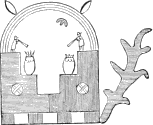
Fig. 184.

Fig. 185.
The gesture sign for rain is described and illustrated on page 344. The pictograph, Fig. 184, reported as found in New Mexico by Lieutenant Simpson (Ex. Doc. No. 64, Thirty-first Congress, first session, 1850, pl. 9) is said to represent Montezuma’s adjutants sounding a blast to him for rain. The small character inside the curve which represents the sky, corresponds with the gesturing hand. The Moqui etching (Gilbert MS.) for rain, i.e., a cloud from which the drops are falling, is given in Fig. 185.

Fig. 186.
The same authority gives two signs for lightning, Figs. 186 and 187. In the latter the sky is shown, the changing direction of the streak, and clouds with rain falling. The part relating specially to the streak is portrayed in a sign as follows: Right hand elevated before and above the head, forefinger pointing upward, brought down with great rapidity with a sinuous, undulating motion; finger still extended diagonally downward toward the right. (Cheyenne II.)
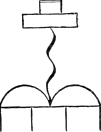
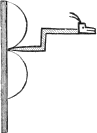
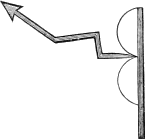
Fig. 187. Fig. 188. Fig. 189.
Figs. 188 and 189 also represent lightning, taken by Mr. W. H. Jackson, photographer of the late U.S. Geolog. and Geog. Survey, from the decorated walls of an estufa in the Pueblo de Jemez, New Mexico. The former is blunt, for harmless, and the latter terminating in an arrow or spear point, for destructive or fatal, lightning.

Fig. 190.
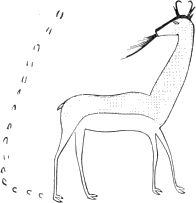
Fig. 191.
A common sign for speech, speak, among the Indians is the repeated motion of the index in a straight line forward from the mouth. This line, indicating the voice, is shown in Fig. 190, taken from the Dakota Calendar, being the expression for the fact that “the-Elk-that-hollows-walking,” a Minneconjou chief, “made medicine.” The ceremony is indicated by the head of an albino buffalo. A more graphic portraiture of the conception of voice is in Fig. 191, representing an antelope and the whistling sound produced by the animal on being surprised or alarmed. This is taken from MS. drawing book of an Indian prisoner at Saint Augustine, Fla., now in the Smithsonian Institution, No. 30664.
Fig. 192 is the exhibition of wrestling for a turkey, the point of interest in the present connection being the lines from the mouth to the objects of conversation. It is taken from the above-mentioned MS. drawing book.
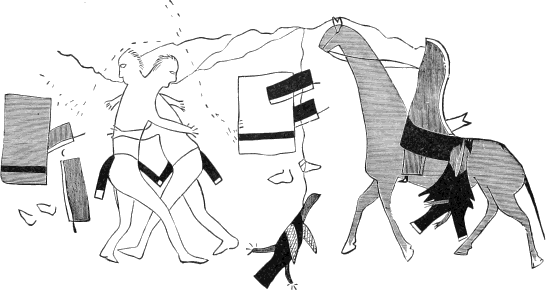
Fig. 192.
The wrestlers, according to the foot prints, had evidently come together, when, meeting the returning hunter, who is wrapped in his blanket with only one foot protruding, they separated and threw off their blankets, leggings, and moccasins, both endeavoring to win the turkey, which lies between them and the donor.
In Fig. 193, taken from the same MS. drawing book, the conversation is about the lassoing, shooting, and final killing of a buffalo which has wandered to a camp. The dotted lines indicate footprints. The Indian drawn under the buffalo having secured the animal by the fore feet, so informs his companions, as indicated by the line drawn from his mouth to the object mentioned; the left-hand figure, having also secured the buffalo by the horns, gives his nearest comrade an opportunity to strike it with an ax, which he no doubt announces that he will do, as the line from his mouth to the head of the animal suggests. The Indian in the upper left-hand corner is told by a squaw to take an arrow and join his companions, when he turns his head to inform her that he has one already, which fact he demonstrates by holding up the weapon.
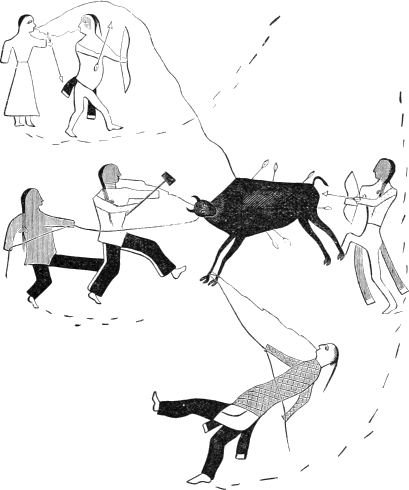
Fig. 193.
The Mexican pictograph, Fig. 194, taken from Kingsborough, II, pt. 1, p. 100, is illustrative of the sign made by the Arikara and Hidatsa for tell and conversation. Tell me is: Place the flat right hand, palm upward, about fifteen inches in front of the right side of the face, fingers pointing to the left and front; then draw the hand inward toward and against the bottom of the chin. For conversation, talking between two persons, both hands are held before the breast, pointing forward, palms up, the edges being moved several times toward one another. Perhaps, however, the picture in fact only means the common poetical image of “flying words.”
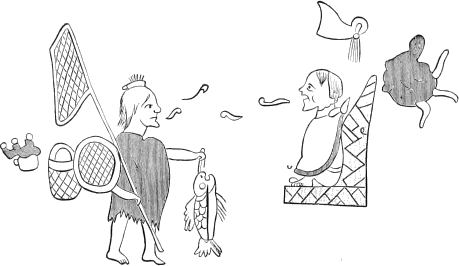
Fig. 194.

Fig. 195.
Fig. 195 is one of Landa’s characters, found in Rel. des choses de Yucatan p. 316, and suggests one of the gestures for talk and more especially that for sing, in which the extended and separated fingers are passed forward and slightly downward from the mouth—“many voices.” Although the last opinion about the bishop is unfavorable to the authenticity of his work, yet even if it were prepared by a Maya, under his supervision, the latter would probably have given him some genuine native conceptions, and among them gestures would be likely to occur.

Fig. 196.
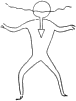

Fig. 197. Fig. 198.
The natural sign for hear, made both by Indians and deaf-mutes, consisting in the motion of the index, or the index and thumb joined, in a straight line to the ear, is illustrated in the Ojibwa pictograph Fig. 196, “hearing ears,” and those of the same people, Figs. 197 and 198, the latter of which is a hearing serpent, and the former means “I hear, but your words are from a bad heart,” the hands being thrown out as in the final part of a gesture for bad heart, which is made by the hand being closed and held near the breast, with the back toward the breast, then as the arm is suddenly extended the hand is opened and the fingers separated from each other. (Mandan and Hidatsa I.) The final part of the gesture, representing the idea of bad, not connected with heart, is illustrated in Fig. 236 on page 411.
The above Ojibwa pictographs are taken from Schoolcraft, loc. cit. I, plates 58, 53, 59.
Fig. 199, a bas-relief taken from Dupaix’s Monuments of New Spain, in Kingsborough, loc. cit. IV, pt. 3, p. 31, has been considered to be a royal edict or command. The gesture to hear is plainly depicted, and the right hand is directed to the persons addressed, so the command appears to be uttered with the preface of Hear Ye! Oyez!
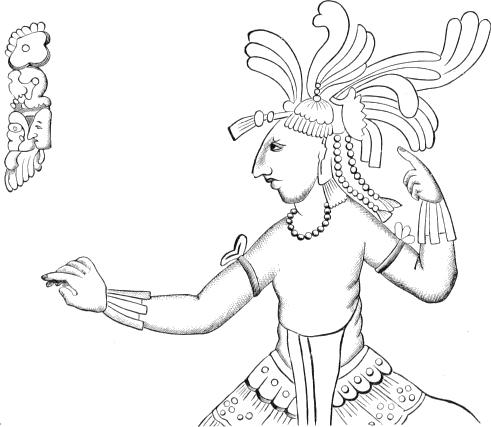
Fig. 199.
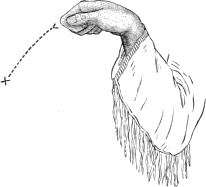
Fig. 200.
The typical sign for kill or killed is: Right hand clinched, thumb lying along finger tips, elevated to near the shoulder, strike downward and outward vaguely in the direction of the object to be killed. The abbreviated sign is simply to clinch the right hand in the manner described and strike it down and out from the right side. (Cheyenne II.) This gesture also appears among the Dakotas and is illustrated in Fig. 200.

Fig. 201.
Fig. 201, taken from the Dakota Calendar, illustrates this gesture. It represents the year in which a Minneconjou chief was stabbed in the shoulder by a Gros Ventre, and afterwards named “Dead Arm” or “Killed Arm.” At first the figure was supposed to show the permanent drawing up of the arm by anchylosis, but that would not be likely to be the result of the wound described, and with knowledge of the gesture the meaning is more clear.
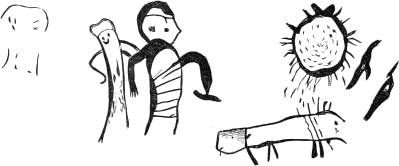
Fig. 202.
Fig. 202, taken from Report upon the Reconnaissance of Northwestern Wyoming, &c., Washington, 1875, p. 207, Fig. 53, found in the Wind River Valley, Wyoming Territory, was interpreted by members of a Shoshoni and Banak delegation to Washington in 1880 as “an Indian killed another.” The latter is very roughly delineated in the horizontal figure, but is also represented by the line under the hand of the upright figure, meaning the same individual. At the right is the scalp taken and the two feathers showing the dead warrior’s rank. The arm nearest the prostrate foe shows the gesture for killed.
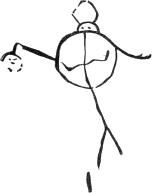
Fig. 203.
The same gesture appears in Fig. 203, from the same authority and locality. The scalp is here held forth, and the numeral one is designated by the stroke at the bottom.
Fig. 204, from the same locality and authority, was also interpreted by the Shoshoni and Banak. It appears from their description that a Blackfoot had attacked the habitation of some of his own people. The right-hand upper figure represents his horse with the lance suspended from the side. The lower figure illustrates the log house built against a stream. The dots are the prints of the horse’s hoofs, while the two lines running outward from the upper inclosure show that two thrusts of the lance were made over the wall of the house, thus killing the occupant and securing two bows and five arrows, as represented in the left-hand group. The right-hand figure of that group shows the hand raised in the attitude of making the gesture for kill.
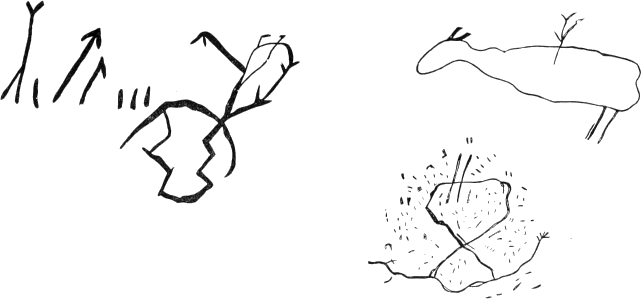
Fig. 204.
As the Blackfeet, according to the interpreters, were the only Indians in the locality mentioned who constructed log houses, the drawing becomes additionally interesting, as an attempt appears to have been made to illustrate the crossing of the logs at the corners, the gesture for which (log-house) will be found on page 428.

Fig. 205.
Fig. 205 is the Egyptian character for veneration, to glorify (Champollion, Dict., 29), the author’s understanding being that the hands are raised in surprise, astonishment.
The Menomoni Indians now begin their prayers by raising their hands in the same manner. They may have been influenced in this respect by the attitudes of their missionaries in prayer and benediction. The Apaches, who have received less civilized tuition, in a religious gesture corresponding with prayer spread their hands opposite the face, palms up and backward, apparently expressing the desire to receive.
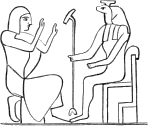
Fig. 206.
Fig. 206 is a copy of an Egyptian tablet reproduced from Cooper’s Serpent Myths, page 28. A priest kneels before the great goddess Ranno, while supplicating her favor. The conception of the author is that the hands are raised by the supplicant to shield his face from the glory of the divinity. It may be compared with signs for asking for mercy and for giving mercy to another, the former being: Extend both forefingers, pointing upward, palms toward the breast, and hold the hands before the chest; then draw them inward toward their respective sides, and pass them upward as high as the sides of the head by either cheek. (Kaiowa I; Comanche III; Apache II; Wichita II.) The latter, to have mercy on another, as made by the same tribes, is: Hold both hands nearly side by side before the chest, palms forward, forefinger only extended and pointing upward; then move them forward and upward, as if passing them by the cheeks of another person from the breast to the sides of the head.
A similar gesture for supplication appears in Fig. 207, taken from Kingsborough, loc. cit., III, pt. I, p. 24.
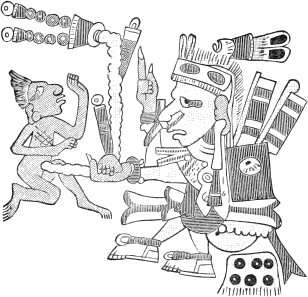
Fig. 207.

Fig. 208.
An Indian gesture sign for smoke, and also one for fire, has been described above, page 344. With the former is connected the Aztec design (Fig. 208) taken from Pipart, loc. cit., II, 352, and the latter appears in Fig. 209, taken from Kingsborough, III, pt. I, p. 21.
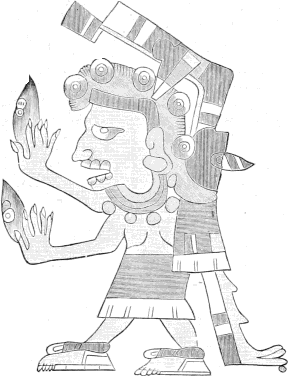
Fig. 209.
A sign for medicine-man, shaman, is thus described: “With its index-finger extended and pointing upward, or all the fingers extended, back of hand outward, move the right hand from just in front of the forehead, spirally upward, nearly to arm’s length, from left to right.” (Dakota IV.)
Fig. 210, from the Dakota Calendar, represents the making of medicine or conjuration. In that case the head and horns of a white buffalo cow were used.


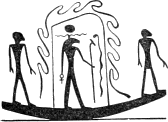

Fig. 210. Fig. 211. Fig. 212. Fig. 213.
Fig. 211 is an Ojibwa pictograph taken from Schoolcraft, loc. cit., representing medicine-man, meda. With these horns and spiral may be collated Fig. 212 which portrays the ram-headed Egyptian god Knuphis, or Chnum, the spirit, in a shrine on the boat of the sun, canopied by the serpent-goddess Ranno, who is also seen facing him inside the shrine. This is reproduced from Cooper’s Serpent Myths, p. 24. The same deity is represented in Champollion, Gram., p. 113, as reproduced in Fig. 213.

Fig. 214.
Fig. 214 is an Ojibwa pictograph found in Schoolcraft, I, pl. 58, and given as power. It corresponds with the sign for doctor, or medicine-man, made by the Absarokas by passing the extended and separated index and second finger of the right hand upward from the forehead, spirally, and is considered to indicate “superior knowledge.” Among the Otos, as part of the sign with the same meaning, both hands are raised to the side of the head, and the extended indices pressing the temples.

Fig. 215.
Fig. 215 is also an Ojibwa pictograph from Schoolcraft I, pl. 59, and is said to signify Meda’s power. It corresponds with another sign made for medicine-man by the Absarokas and Comanches, viz, The hand passed upward before the forehead, with index loosely extended. Combined with the sign for sky, before given, page 372, it means knowledge of superior matters; spiritual power.
The common sign for trade is made by extending the forefingers, holding them obliquely upward, and crossing them at right angles to one another, usually in front of the chest. This is often abbreviated by merely crossing the forefingers, see Fig. 278, page 452. It is illustrated in Fig. 216, taken from the Prince of Wied’s Travels in the Interior of North America, London, 1843, p. 352.
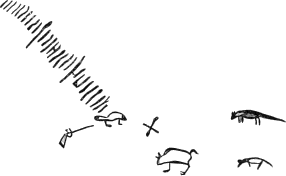
Fig. 216.
To this the following explanation is given: “The cross signifies, ‘I will barter or trade.’ Three animals are drawn on the right hand of the cross; one is a buffalo; the two others, a weasel (Mustela Canadensis) and an otter. The writer offers in exchange for the skins of these animals (probably meaning that of a white buffalo) the articles which he has drawn on the left side of the cross. He has, in the first place, depicted a beaver very plainly, behind which there is a gun; to the left of the beaver are thirty strokes, each ten separated by a longer line; this means, I will give thirty beaver skins and a gun for the skins of the three animals on the right hand of the cross.”
Fig. 217 is from Kingsborough, III, pt. 1, p. 25, and illustrates the sign for to give or to present, made by the Brulé-Dakotas by holding both hands edgewise before the breast, pointing forward and upward, the right above the left, then throwing them quickly downward until the forearms reach a horizontal position.
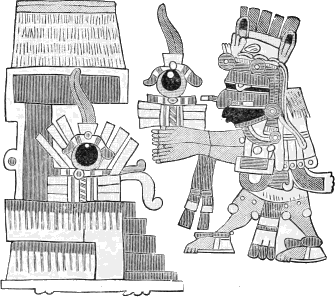
Fig. 217.

Fig. 218.
Fig. 218 is taken from the Dakota Calendar, representing a successful raid of the Absarokas or Crows upon the Brulé-Sioux, in which the village of the latter was surprised and a large number of horses captured. That capture is exhibited by the horse-tracks moving from the village, the gesture sign for which is often made by a circle formed either by the opposed thumbs and forefingers of both hands or by a circular motion of both hands, palms inward, toward each other. In some cases there is a motion of the circle, from above downward, as formed.
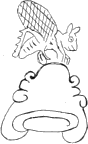
Fig. 219.
Fig. 219, from Kingsborough I, pt. 3, p. 10, represents Chapultepec, “Mountain of the Locust,” by one enormous locust on top of a hill. This shows the mode of augmentation in the same manner as is often done by an exaggerated gesture. The curves at the base of the mountain are intelligible only as being formed in the sign for many, described on pages 359 and 488.

Fig. 220.

Fig. 221.
Fig. 220, taken from Pipart, loc. cit., is the Mexican pictograph for soil cultivated, i.e., tilled and planted. Fig. 221, from the same authority, shows the sprouts coming from the cultivated soil, and may be compared with the signs for grass and grow on page 343.
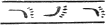
Fig. 222.
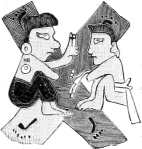
Fig. 223.
The gesture sign for road, path, is sometimes made by indicating two lines forward from the body, then imitating walking with the hands upon the imaginary road. The same natural representation of road is seen in Fig. 222, taken from Pipart, loc. cit., page 352. A place where two roads meet—cross-roads—is shown in Fig. 223, from Kingsborough. Two persons are evidently having a chat in sign language at the cross-roads.

Fig. 224.
If no gesture is actually included in all of the foregoing pictographs, it is seen that a gesture sign is made with the same conception which is obvious in the ideographic pictures. They are selected as specially transparent and clear. Many others less distinct are now the subject of examination for elucidation. The following examples are added to show the ideographic style of pictographs not connected with gestures, lest it may be suspected that an attempt is made to prove that gestures are always included in or connected with them. Fig. 224, from the Dakota Calendar, refers to the small-pox which broke out in the year (1802) which it specifies. Fig. 225 shows in the design at the left, a warning or notice, that though a goat can climb up the rocky trail a horse will tumble—“No Thoroughfare.” This was contributed by Mr. J. K. Hillers, photographer of the United States Geological Survey, as observed by him in Cañon De Chelly, New Mexico, in 1880.
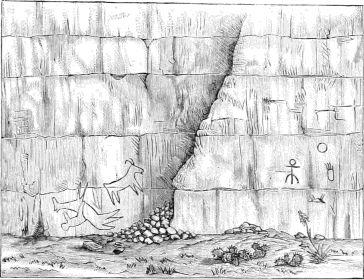
Fig. 225.
SIGNS CONNECTED WITH ETHNOLOGIC FACTS.
The present limits permit only a few examples of the manner in which the signs of Indians refer to sociologic, religious, historic, and other ethnologic facts. They may incite research to elicit further information of the same character.

Fig. 226.
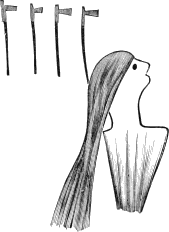
Fig. 227.
The Prince of Wied gives in his list of signs the heading Partisan, a term of the Canadian voyageurs, signifying a leader of an occasional or volunteer war party, the sign being reported as follows: Make first the sign of the pipe, afterwards open the thumb and index-finger of the right hand, back of the hand outward, and move it forward and upward in a curve. This is explained by the author’s account in a different connection, that to become recognized as a leader of such a war party as above mentioned, the first act among the tribes using the sign was the consecration, by fasting succeeded by feasting, of a medicine pipe without ornament, which the leader of the expedition afterward bore before him as his badge of authority, and it therefore naturally became an emblematic sign. This sign with its interpretation supplies a meaning to Fig. 226 from the Dakota Calendar showing “One Feather,” a Sioux chief who raised in that year a large war party against the Crows, which fact is simply denoted by his holding out demonstratively an unornamented pipe. In connection with this subject, Fig. 227, drawn and explained by Two Strike, an Ogalala Dakota, relating to his own achievements, displays four plain pipes to exhibit the fact that he had led four war parties.

Fig. 228.
The sign of the pipe or of smoking is made in a different manner, when used to mean friend, as follows: (1) Tips of the two first fingers of the right hand placed against or at right angles to the mouth; (2) suddenly elevated upward and outward to imitate smoke expelled. (Cheyenne II.) “We two smoke together.” This is illustrated in the Ojibwa pictograph, Fig. 228, taken from Schoolcraft I, pl. 59.

Fig. 229.
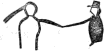
Fig. 230.
A ceremonial sign for peace, friendship, is the extended fingers, separated (R), interlocked in front of the breast, hands horizontal, backs outward. (Dakota I.) Fig. 229 from the Dakota Calendar exhibits the beginning of this gesture. When the idea conveyed is peace or friendship with the whites, the hand shaking of the latter is adopted as in Fig. 230, also taken from the Dakota Calendar, and referring to the peace made in 1855 by General Harney, at Fort Pierre, with a number of the tribes of the Dakotas.
It is noticeable that while the ceremonial gesture of uniting or linking hands is common and ancient in token of peace, the practice of shaking hands on meeting, now the annoying etiquette of the Indians in their intercourse with whites, was not until very recently and is even now seldom used by them between each other, and is clearly a foreign importation. Their fancy for affectionate greeting was in giving a pleasant bodily sensation by rubbing each other on the breast, abdomen, and limbs, or by a hug. The senseless and inconvenient custom of shaking hands is, indeed, by no means general throughout the world, and in the extent to which it prevails in the United States is a subject of ridicule by foreigners. The Chinese, with a higher conception of politeness, shake their own hands. The account of a recent observer of the meeting of two polite Celestials is: “Each placed the fingers of one hand over the fist of the other, so that the thumbs met, and then standing a few feet apart raised his hands gently up and down in front of his breast. For special courtesy, after the foregoing gesture, they place the hand which had been the actor in it on the stomach of its owner, not on that part of the interlocutor, the whole proceeding being subjective, but perhaps a relic of objective performance.” In Miss Bird’s Unbeaten Trades in Japan, London, 1880, the following is given as the salutatory etiquette of that empire: “As acquaintances come in sight of each other they slacken their pace and approach with downcast eyes and averted faces as if neither were worthy of beholding each other; then they bow low, so low as to bring the face, still kept carefully averted, on a level with the knees, on which the palms of the hands are pressed. Afterwards, during the friendly strife of each to give the pas to the other, the palms of the hands are diligently rubbed against each other.”
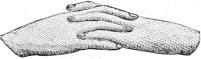
Fig. 231.
The interlocking of the fingers of both hands above given as an Indian sign (other instances being mentioned under the head of Signals, infra) is also reported by R. Brough Smyth, Aborigines of Victoria, loc. cit., Vol. II, p. 308, as made by the natives of Cooper’s Creek, Australia, to express the highest degree of friendship, including a special form of hospitality in which the wives of the entertainer performed a part. Fig. 231 is reproduced from a cut in the work referred to.
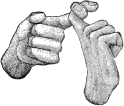
Fig. 232.
But besides this interlocked form of signifying the union of friendship the hands are frequently grasped together. Sometimes the sign is abbreviated by simply extending the hand as if about to grasp that of another, and sometimes the two forefingers are laid side by side, which last sign also means, same, brother and companion. For description and illustration of these three signs, see respectively pages 521, 527, and 317. A different execution of the same conception of union or linking to signify friend is often made as follows: Hook the curved index over the curved forefinger of the left hand, the palm of the latter pointing forward, the palm of the right hand being turned toward the face; remaining fingers and thumbs being closed. (Dakota VIII.) Fig. 232.
Wied’s sign for medicine is “Stir with the right hand into the left, and afterward blow into the latter.” All persons familiar with the Indians will understand that the term “medicine,” foolishly enough adopted by both French and English to express the aboriginal magic arts, has no therapeutic significance. Very few even pretended remedies were administered to the natives and probably never by the professional shaman, who worked by incantation, often pulverizing and mixing the substances mystically used, to prevent their detection. The same mixtures were employed in divination. The author particularly mentions Mandan ceremonies, in which a white “medicine” stone, as hard as pyrites, was produced by rubbing in the hand snow or the white feathers of a bird. The blowing away of the disease, considered to be introduced by a supernatural power foreign to the body, was a common part of the juggling performance.
A sign for stone is as follows: With the back of the arched right hand (H) strike repeatedly in the palm of the left, held horizontal, back outward, at the height of the breast and about a foot in front; the ends of the fingers point in opposite directions. (Dakota I.) From its use when the stone was the only hammer.
A suggestive sign for knife is reported, viz: Cut past the mouth with the raised right hand. (Wied.) This probably refers to the general practice of cutting off food, as much being crammed into the mouth as can be managed and then separated from the remaining mass by a stroke of a knife. This is specially the usage with fat and entrails, the Indian delicacies.
An old sign for tomahawk, ax, is as follows: Cross the arms and slide the edge of the right hand, held vertically, down over the left arm. (Wied.) This is still employed, at least for a small hatchet, or “dress tomahawk,” and would be unintelligible without special knowledge. The essential point is laying the extended right hand in the bend of the left elbow. The sliding down over the left arm is an almost unavoidable but quite unnecessary accompaniment to the sign, which indicates the way in which the hatchet is usually carried. Pipes, whips, bows and arrows, fans, and other dress or emblematic articles of the “buck” are seldom or never carried in the bend of the left elbow as is the ax. The pipe is usually held in the left hand.
The following sign for Indian village is given by Wied: Place the open thumb and forefinger of each hand opposite to each other, as if to make a circle, but leaving between them a small interval; afterward move them from above downward simultaneously. The villages of the tribes with which the author was longest resident, particularly the Mandans and Arikaras, were surrounded by a strong circular stockade, spaces or breaks in the circle being left for entrance or exit.
Signs for dog are made by some of the tribes of the plains essentially the same as the following: Extend and spread the right, fore, and middle fingers, and draw the hand about eighteen inches from left to right across the front of the body at the height of the navel, palm downward, fingers pointing toward the left and a little downward, little and ring fingers to be loosely closed, the thumb against the ring-finger. (Dakota IV.) The sign would not be intelligible without knowledge of the fact that before the introduction of the horse, and even yet, the dog has been used to draw the tent- or lodge-poles in moving camp, and the sign represents the trail. Indians less nomadic, who built more substantial lodges, and to whom the material for poles was less precious than on the plains, would not have comprehended this sign without such explanation as is equivalent to a translation from a foreign language, and the more general one is the palm lowered as if to stroke gently in a line conforming to the animal’s head and neck. It is abbreviated by simply lowering the hand to the usual height of the wolfish aboriginal breed, and suggests the animal par excellence domesticated by the Indians and made a companion.
Several examples connected with this heading may be noticed under the preceding head of gestures connected with pictographs, and others of historic interest will be found among the Tribal Signs, infra.
NOTABLE POINTS FOR FURTHER RESEARCHES.
It is considered desirable to indicate some points to which for special reasons the attention of collaborators for the future publication on the general subject of sign language may be invited. These now follow:
INVENTION OF NEW SIGNS.
It is probable that signs will often be invented by individual Indians who may be pressed for them by collectors to express certain ideas, which signs of course form no part of any current language; but while that fact should, if possible, be ascertained and reported, the signs so invented are not valueless merely because they are original and not traditional, if they are made in good faith and in accordance with the principles of sign formation. Less error will arise in this direction than from the misinterpretation of the idea intended to be conveyed by spontaneous signs. The process resembles the coining of new words to which the higher languages owe their copiousness. It is observed in the signs invented by Indians for each new product of civilization brought to their notice.
An interesting instance is in the sign for steamboat, made at the request of the writer by White Man (who, however, did not like that sobriquet and announced his intention to change his name to Lean Bear), an Apache, in June, 1880, who had a few days before seen a steamboat for the first time. After thinking a moment he gave an original sign, described as follows:
Make the sign for water, by placing the flat right hand before the face, pointing upward and forward, the back forward, with the wrist as high as the nose; then draw it down and inward toward the chin; then with both hands indicate the outlines of a horizontal oval figure from before the body back to near the chest (being the outline of the deck); then place both flat hands, pointing forward, thumbs higher than the outer edges, and push them forward to arms’-length (illustrating the powerful forward motion of the vessel).
An original sign for telegraph is given in Natci’s Narrative, infra.
An Indian skilled in signs, as also a deaf-mute, at the sight of a new object, or at the first experience of some new feeling or mental relation, will devise some mode of expressing it in pantomimic gesture or by a combination of previously understood signs, which will be intelligible to others, similarly skilled, provided that they have seen the same objects or have felt the same emotions. But if a number of such Indians or deaf-mutes were to see an object—for instance an elephant—for the first time, each would perhaps hit upon a different sign, in accordance with the characteristic appearance most striking to him. That animal’s trunk is generally the most attractive lineament to deaf-mutes, who make a sign by pointing to the nose and moving the arm as the trunk is moved. Others regard the long tusks as the most significant feature, while others are struck by the large head and small eyes. This diversity of conception brings to mind the poem of “The Blind Men and the Elephant,” which with true philosophy in an amusing guise explains how the sense of touch led the “six men of Indostan” severally to liken the animal to a wall, spear, snake, tree, fan, and rope. A consideration of invented or original signs, as showing the operation of the mind of an Indian or other uncivilized gesturer, has a psychologic interest, and as connected with the vocal expression, often also invented at the same time, has further value.
DANGER OF SYMBOLIC INTERPRETATION.
In the examination of sign language it is important to form a clear distinction between signs proper and symbols. The terms signs and symbols are often used interchangeably, but with liability to misconstruction, as many persons, whether with right or wrong lexical definition, ascribe to symbols an occult and mystic signification. All characters in Indian picture-writing have been loosely styled symbols, and, as there is no logical distinction between the characters impressed with enduring form and when merely outlined in the ambient air, all Indian gestures, motions, and attitudes might with equal appropriateness be called symbolic. While, however, all symbols come under the generic head of signs, very few signs are in accurate classification symbols. S. T. Coleridge has defined a symbol to be a sign included in the idea it represents. This may be intelligible if it is intended that an ordinary sign is extraneous to the concept and, rather than suggested by it, is invented to express it by some representation or analogy, while a symbol may be evolved by a process of thought from the concept itself; but it is no very exhaustive or practically useful distinction. Symbols are less obvious and more artificial than mere signs, require convention, are not only abstract, but metaphysical, and often need explanation from history, religion, and customs. They do not depict but suggest subjects; do not speak directly through the eye to the intelligence, but presuppose in the mind knowledge of an event or fact which the sign recalls. The symbols of the ark, dove, olive branch, and rainbow would be wholly meaningless to people unfamiliar with the Mosaic or some similar cosmology, as would be the cross and the crescent to those ignorant of history. The last named objects appeared in the class of emblems when used in designating the conflicting powers of Christendom and Islamism. Emblems do not necessarily require any analogy between the objects representing, and the objects or qualities represented, but may arise from pure accident. After a scurrilous jest the beggar’s wallet became the emblem of the confederated nobles, the Gueux of the Netherlands; and a sling, in the early minority of Louis XIV, was adopted from the refrain of a song by the Frondeur opponents of Mazarin. The portraiture of a fish, used, especially by the early Christians, for the name and title of Jesus Christ was still more accidental, being, in the Greek word ἰχθύς, an acrostic composed of the initials of the several Greek words signifying that name and title. This origin being unknown to persons whose religious enthusiasm was as usual in direct proportion to their ignorance, they expended much rhetoric to prove that there was some true symbolic relation between an actual fish and the Saviour of men. Apart from this misapplication, the fish undoubtedly became an emblem of Christ and of Christianity, appearing frequently on the Roman catacombs and at one time it was used hermeneutically.
The several tribal signs for the Sioux, Arapahos, Cheyennes, &c., are their emblems precisely as the star-spangled flag is that of the United States, but there is nothing symbolic in any of them. So the signs for individual chiefs, when not merely translations of their names, are emblematic of their family totems or personal distinctions, and are no more symbols than are the distinctive shoulder-straps of army officers. The crux ansata and the circle formed by a snake biting its tail are symbols, but consensus as well as invention was necessary for their establishment, and the Indians have produced nothing so esoteric, nothing which they intended for hermeneutic as distinct from descriptive or mnemonic purposes. Sign language can undoubtedly be and is employed to express highly metaphysical ideas, but to do that in a symbolic system requires a development of the mode of expression consequent upon a similar development of the mental idiocrasy of the gesturers far beyond any yet found among historic tribes north of Mexico. A very few of their signs may at first appear to be symbolic, yet even those on closer examination will probably be relegated to the class of emblems.
The point urged is that while many signs can be used as emblems and both can be converted by convention into symbols or be explained as such by perverted ingenuity, it is futile to seek for that form of psychologic exuberance in the stage of development attained by the tribes now under consideration. All predetermination to interpret either their signs or their pictographs on the principles of symbolism as understood or pretended to be understood by its admirers, and as are sometimes properly applied to Egyptian hieroglyphs, results in mooning mysticism. This was shown by a correspondent who enthusiastically lauded the Dakota Calendar (edited by the present writer, and which is a mere figuration of successive occurrences in the history of the people), as a numerical exposition of the great doctrines of the Sun religion in the equations of time, and proved to his own satisfaction that our Indians preserved hermeneutically the lost geometric cultus of pre-Cushite scientists.
Another exhibition of this vicious practice was recently made in the interpretation of an inscribed stone alleged to have been unearthed near Zanesville, Ohio. Two of the characters were supposed, in liberal exercise of the imagination, to represent the Α and Ω of the Greek alphabet. At the comparatively late date when the arbitrary arrangement of the letters of that alphabet had become fixed, the initial and concluding letters might readily have been used to represent respectively the beginning and the end of any series or number of things, and this figure of speech was employed in the book of Revelations. In the attempted interpretation of the inscription mentioned, which was hawked about to many scientific bodies, and published over the whole country, the supposed alpha and omega were assumed to constitute a universal as well as sacred symbol for the everlasting Creator. The usual menu of Roman feasts, commencing with eggs and ending with apples, was also commonly known at the time when the book of Revelations was written, and the phrase “ab ovo usque ad mala” was as appropriate as “from alpha to omega” to express “from the beginning to the end.” In deciphering the stone it would, therefore, be as correct in principle to take one of its oval and one of its round figures, call them egg and apple, and make them the symbols of eternity. In fact, not depending wholly for significance upon the order of courses of a feast or the accident of alphabetical position, but having intrinsic characteristics in reference to the origin and fruition of life, the egg and apple translation would be more acceptable to the general judgment, and it is recommended to enthusiasts who insist on finding symbols where none exist.
SIGNS USED BY WOMEN AND CHILDREN.
For reasons before given it is important to ascertain the varying extent of familiarity with sign language among the members of the several tribes, how large a proportion possesses any skill in it, and the average amount of their vocabulary. It is also of special interest to learn the degree to which women become proficient, and the age at which children commence its practice; also whether they receive systematic instruction in it. The statement was made by Titchkemátski that the Kaiowa and Comanche women know nothing of sign language, while the Cheyenne women are versed in it. As he is a Cheyenne, however, he may not have a large circle of feminine acquaintances beyond his own tribe, and his negative testimony is not valuable. Rev. A. J. Holt, from large experience, asserts that the Kaiowa and Comanche women do know and practice sign language, though the Cheyenne either are more familiar with it than the Kaiowa or have a greater degree of expertness. The Comanche women, he says, are the peers of any sign-talkers. Colonel Dodge makes the broad assertion that even among the Plains tribes only the old, or at least middle-aged, men use signs properly, and that he has not seen any women or even young men who were at all reliable in signs. He gives this statement to show the difficulty in acquiring sign language; but it is questionable if the fact is not simply the result of the rapid disuse of signs, in many tribes, by which cause women, not so frequently called upon to employ them, and the younger generation, who have had no necessity to learn them, do not become expert. Disappearing Mist, as before mentioned, remembers a time when the Iroquois women and children used signs more than the men.
It is also asserted, with some evidence, that the signs used by males and females are different, though mutually understood, and some minor points for observation may be indicated, such as whether the commencement of counting upon the fingers is upon those of the right or the left hand, and whether Indians take pains to look toward the south when suggesting the course of the sun, which would give the motion from left to right.
A suggestion has been made by a correspondent that some secret signs of affiliation are known and used by the members of the several associations, religious and totemic, which have been often noticed among several Indian tribes. No evidence of this has been received, but the point is worth attention.
POSITIVE SIGNS RENDERED NEGATIVE.
In many cases positive signs to convey some particular idea are not reported, and in their place a sign with the opposite signification is given, coupled with the sign of negation. In other words, the only mode of expressing the intended meaning is supposed to be by negation of the reverse of what it is desired to describe. In this manner “fool—no,” would be “wise,” and “good—no,” would be “bad.” This mode of expression is very frequent as a matter of option when the positive signs are in fact also used. The reported absence of positive signs for the ideas negatived is therefore often made with as little propriety as if when an ordinary speaker chose to use the negative form “not good,” it should be inferred that he was ignorant of the word “bad.” It will seldom prove, on proper investigation, that where sign language has reached and retained any high degree of development it will show such poverty as to require the expedient of negation of an affirmative to express an idea which is intrinsically positive.
DETAILS OF POSITIONS OF FINGERS.
The signs of the Indians appear to consist of motions more often than of positions—a fact enhancing the difficulty both of their description and illustration—and the motions when not designedly abbreviated are generally large, free, and striking, seldom minute. It seems also to be the general rule among Indians as among deaf-mutes that the point of the finger is used to trace outlines and the palm of the hand to describe surfaces. From an examination of the identical signs made to each other for the same object by Indians of the same tribe and band, they appear to make many gestures with little regard to the position of the fingers and to vary in such arrangement from individual taste. Some of the elaborate descriptions, giving with great detail the attitude of the fingers of any particular gesturer and the inches traced by his motions, are of as little necessity as would be, when quoting a written word, a careful reproduction of the flourishes of tailed letters and the thickness of down-strokes in individual chirography. The fingers must be in some position, but that is frequently accidental, not contributing to the general and essential effect. An example may be given in the sign for white man which Medicine Bull, infra, page 491, made by drawing the palmar surface of the extended index across the forehead, and in Lean Wolf’s Complaint, infra, page 526, the same motion is made by the back of the thumb pressed upon the middle joint of the index, fist closed. The execution as well as the conception in both cases was the indication of the line of the hat on the forehead, and the position of the fingers in forming the line is altogether immaterial. There is often also a custom or “fashion” in which not only different tribes, but different persons in the same tribe, gesture the same sign with different degrees of beauty, for there is calligraphy in sign language, though no recognized orthography. It is nevertheless better to describe and illustrate with unnecessary minuteness than to fail in reporting a real distinction. There are, also, in fact, many signs formed by mere positions of the fingers, some of which are abbreviations, but in others the arrangement of the fingers in itself forms a picture. An instance of the latter is one of the signs given for the bear, viz.: Middle and third finger of right hand clasped down by the thumb, fore and little finger extended crooked downward. See Extracts from Dictionary, infra. This reproduction of the animal’s peculiar claws, with the hand and in any position relative to the body, would suffice without the pantomime of scratching in the air, which is added only if the sign without it should not be at once comprehended.
MOTIONS RELATIVE TO PARTS OF THE BODY.
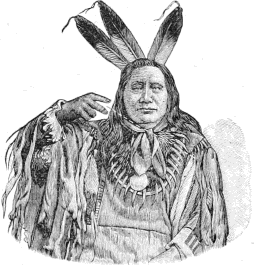
Fig. 233.
The specified relation of the positions and motions of the hands to different parts of the body is essential to the formation and description of many signs. Those for speak, hear, and see, which must be respectively made relative to the mouth, ear and eye, are manifest examples; and there are others less obviously dependent upon parts of the body, such as the heart or head, which would not be intelligible without apposition. There are also some directly connected with height from the ground and other points of reference. In, however, a large proportion of the signs noted the position of the hands with reference to the body can be varied or disregarded. The hands making the motions can be held high or low, as the gesturer is standing or sitting, or the person addressed is distant or near by. These variations have been partly discussed under the head of abbreviations. While descriptions made with great particularity are cumbrous, it is desirable to give the full detail of that gesture which most clearly carries out the generic conception, with, if possible, also the description of such deviations and abbreviations as are most confusing. For instance, it is well to explain that signs for yes and no, described with precise detail as in Extracts from Dictionary, infra, are also often made by an Indian when wrapped in his blanket with only a forefinger protruding, the former by a mere downward and the latter by a simple outward bend of that finger. An example may be also taken from the following sign for lie, falsehood, made by an Arikara, Fig. 233. in which the separated index and second fingers are moved sidewise in a downward line near but below the mouth, which may be compared with other executions of the motion with the same position of the fingers directly forward from the mouth, and with that given in Lean Wolf’s Complaint, illustrated on page 528, in which the motion is made carelessly across the body. The original sign was undoubtedly made directly from the mouth, the conception being “two tongues,” two accounts or opposed statements, one of which must be false, but the finger-position coming to be established for two tongues has relation to the original conception whether or not made near or in reference to the mouth, the latter being understood.
It will thus be seen that sometimes the position of the fingers is material as forming or suggesting a figure without reference to motion, while in other cases the relative position of the hands to each other and to parts of the body are significant without any special arrangement of the fingers. Again, in others, the lines drawn in the air by the hand or hands execute the conception without further detail. In each case only the essential details, when they can be ascertained, should be minutely described.
SUGGESTIONS FOR COLLECTING SIGNS.
The object always should be, not to translate from English into signs, but to ascertain the real signs and their meaning. By far the most satisfactory mode of obtaining this result is to induce Indians or other gesturers observed to tell stories, make speeches, or hold talks in gesture, with one of themselves as interpreter in his own oral language if the latter is understood by the observer, and, if not, the words, not the signs, should be translated by an intermediary linguistic interpreter. It will be easy afterward to dissect and separate the particular signs used. This mode will determine the genuine shade of meaning of each sign, and corresponds with the plan now adopted by the Bureau of Ethnology for the study of the tribal vocal languages, instead of that arising out of exclusively missionary purposes, which was to force a translation of the Bible from a tongue not adapted to its terms and ideas, and then to compile a grammar and dictionary from the artificial result. A little ingenuity will direct the more intelligent or complaisant gesturers to the expression of the thoughts, signs for which are specially sought; and full orderly descriptions of such tales and talks with or even without analysis and illustration are more desired than any other form of contribution.
The original authorities, or the best evidence, for Indian signs—i.e., the Indians themselves—being still accessible, the collaborators in this work should not be content with secondary authority. White sign talkers and interpreters may give some genuine signs, but they are very apt to interpolate their own improvements. Experience has led to the apparently paradoxical judgment that the direct contribution of signs purporting to be those of Indians, made by a habitual practitioner of signs who is not an Indian, is less valuable than that of a discriminating observer who is not himself an actor in gesture speech. The former, being to himself the best authority, unwittingly invents and modifies signs, or describes what he thinks they ought to be, often with a very different conception from that of an Indian. Sign language not being fixed and limited, as is the case with oral languages, expertness in it is not necessarily a proof of accuracy in anyone of its forms. The proper inquiry is not what a sign might, could, would, or should be, or what is the best sign for a particular meaning, but what is any sign actually used for such meaning. If any one sign is honestly invented or adopted by any one man, whether Indian, African, Asiatic, or deaf-mute, it has its value, but it should be identified to be in accordance with the fact and should not be subject to the suspicion that it has been assimilated or garbled in interpretation. Its prevalence and special range present considerations of different interest and requiring further evidence.
The genuine signs alone should be presented to scholars, to give their studies proper direction, while the true article can always be adulterated into a composite jargon by those whose ambition is only to be sign talkers instead of making an honest contribution to ethnologic and philologic science. The few direct contributions of interpreters to the present work are, it is believed, valuable, because they were made without expression of self-conceit or symptom of possession by a pet theory.
MODE IN WHICH RESEARCHES HAVE BEEN MADE.
It is proper to give to all readers interested in the subject, but particularly to those whose collaboration for the more complete work above mentioned is solicited, an account of the mode in which the researches have thus far been conducted and in which it is proposed to continue them. After study of all that could be obtained in printed form, and a considerable amount of personal correspondence, the results were embraced in a pamphlet issued by the Bureau of Ethnology in the early part of 1880, entitled “Introduction to the Study of Sign Language among the North American Indians as Illustrating the Gesture Speech of Mankind.” In this, suggestions were made as to points and manner of observation and report, and forms prepared to secure uniformity and accuracy were explained, many separate sheets of which with the pamphlet were distributed, not only to all applicants, but to all known and accessible persons in this country and abroad who, there was reason to hope, would take sufficient interest in the undertaking to contribute their assistance. Those forms, Types of Hand Positions, Outlines of Arm Positions, and Examples, thus distributed, are reproduced at the end of this paper.
The main object of those forms was to eliminate the source of confusion produced by attempts of different persons at the difficult description of positions and motions. The comprehensive plan required that many persons should be at work in many parts of the world. It will readily be understood that if a number of persons should undertake to describe in words the same motions, whether of pantomimists on the stage or of other gesturers, even if the visual perception of all the observers should be the same in the apprehension of the particular gestures, their language in description might be so varied as to give very diverse impressions to a reader who had never seen the gestures described. But with a set form of expressions for the typical positions, and skeleton outlines to be filled up and, when necessary, altered in a uniform style, this source of confusion is greatly reduced. The graphic lines drawn to represent the positions and motions on the same diagrams will vary but little in comparison with the similar attempt of explanation in writing. Both modes of description were, however, requested, each tending to supplement and correct the other, and provision was also made for the notation of such striking facial changes or emotional postures as might individualize or accentuate the gestures. It was also pointed out that the prepared sheets could be used by cutting and pasting them in the proper order, for successive signs forming a speech or story, so as to exhibit the semiotic syntax. Attention was specially directed to the importance of ascertaining the intrinsic idea or conception of all signs, which it was urged should be obtained directly from the persons using them and not by inference.
In the autumn of 1880 the prompt and industrious co-operation of many observers in this country, and of a few from foreign lands, had supplied a large number of descriptions which were collated and collected into a quarto volume of 329 pages, called “A Collection of Gesture Signs and Signals of the North American Indians, with some comparisons.”
This was printed on sized paper with wide margins to allow of convenient correction and addition. It was not published, but was regarded as proof, a copy being sent to each correspondent with a request for his annotations, not only in revision of his own contribution, but for its comparison with those made by others. Even when it was supposed that mistakes had been made in either description or reported conception, or both, the contribution was printed as received, in order that a number of skilled and disinterested persons might examine it and thus ascertain the amount and character of error. The attention of each contributor was invited to the fact that, in some instances, a sign as described by one of the other contributors might be recognized as intended for the same idea or object as that furnished by himself, and the former might prove to be the better description. Each was also requested to examine if a peculiar abbreviation or fanciful flourish might not have induced a difference in his own description from that of another contributor with no real distinction either in conception or essential formation. All collaborators were therefore urged to be candid in admitting, when such cases occurred, that their own descriptions were mere unessential variants from others printed, otherwise to adhere to their own and explain the true distinction. When the descriptions showed substantial identity, they were united with the reference to all the authorities giving them.
Many of these copies have been returned with valuable annotations, not only of correction but of addition and suggestion, and are now being collated again into one general revision.
The above statement will, it is hoped, give assurance that the work of the Bureau of Ethnology has been careful and thorough. No scheme has been neglected which could be contrived and no labor has been spared to secure the accuracy and completeness of the publication still in preparation. It may also be mentioned that although the writer has made personal observations of signs, no description of any sign has been printed by him which rests on his authority alone. Personal controversy and individual bias were thus avoided. For every sign there is a special reference either to an author or to some one or more of the collaborators. While the latter have received full credit, full responsibility was also imposed, and that course will be continued.
No contribution has been printed which asserted that any described sign is used by “all Indians,” for the reason that such statement is not admissible evidence unless the authority had personally examined all Indians. If any credible person had affirmatively stated that a certain identical, or substantially identical, sign had been found by him, actually used by Abnaki, Absaroka, Arikara, Assiniboins, etc., going through the whole list of tribes, or any definite portion of that list, it would have been so inserted under the several tribal heads. But the expression “all Indians,” besides being insusceptible of methodical classification, involves hearsay, which is not the kind of authority desired in a serious study. Such loose talk long delayed the recognition of Anthropology as a science. It is true that some general statements of this character are made by some old authors quoted in the Dictionary, but their descriptions are reprinted, as being all that can be used of the past, for whatever weight they may have, and they are kept separate from the linguistic classification given below.
Regarding the difficulties met with in the task proposed, the same motto might be adopted as was prefixed to Austin’s Chironomia: “Non sum nescius, quantum susceperim negotii, qui motus corporis exprimere verbis, imitari scriptura conatus sim voces.” Rhet. ad Herenn., l. 3. If the descriptive recital of the signs collected had been absolutely restricted to written or printed words the work would have been still more difficult and the result less intelligible. The facilities enjoyed of presenting pictorial illustrations have been of great value and will give still more assistance in the complete work than in the present paper.
In connection with the subject of illustrations it may be noted that a writer in the Journal of the Military Service Institution of the United States, Vol. II, No. 5, the same who had before invented the mode of describing signs by “means” mentioned on page 330 supra, gives a curious distinction between deaf-mute and Indian signs regarding their respective capability of illustration, as follows: “This French system is taught, I believe, in most of the schools for deaf-mutes in this country, and in Europe; but so great has been the difficulty of fixing the hands in space, either by written description or illustrated cuts, that no text books are used. I must therefore conclude that the Indian sign language is not only the more natural, but the more simple, as the gestures can be described quite accurately in writing, and I think can be illustrated.” The readers of this paper will also, probably, “think” that the signs of Indians can be illustrated, and as the signs of deaf-mutes are often identical with the Indian, whether expressing the same or different ideas, and when not precisely identical are always made on the same principle and with the same members, it is not easy to imagine any greater difficulty either in their graphic illustration or in their written description. The assertion is as incorrect as if it were paraphrased to declare that a portrait of an Indian in a certain attitude could be taken by a pencil or with the camera while by some occult influence the same artistic skill would be paralysed in attempting that of a deaf-mute in the same attitude. In fact, text books on the “French system” are used and one in the writer’s possession published in Paris twenty-five years ago, contains over four hundred illustrated cuts of deaf-mute gesture signs.
The proper arrangement and classification of signs will always be troublesome and unsatisfactory. There can be no accurate translation either of sentences or of words from signs into written English. So far from the signs representing words as logographs, they do not in their presentation of the ideas of actions, objects, and events, under physical forms, even suggest words, which must be skillfully fitted to them by the glossarist and laboriously derived from them by the philologer. The use of words in formulation, still more in terminology, is so wide a departure from primitive conditions as to be incompatible with the only primordial language yet discovered. No vocabulary of signs will be exhaustive for the simple reason that the signs are exhaustless, nor will it be exact because there cannot be a correspondence between signs and words taken individually. Not only do words and signs both change their meaning from the context, but a single word may express a complex idea, to be fully rendered only by a group of signs, and, vice versâ, a single sign may suffice for a number of words. The elementary principles by which the combinations in sign and in the oral languages of civilization are effected are also discrepant. The attempt must therefore be made to collate and compare the signs according to general ideas, conceptions, and, if possible, the ideas and conceptions of the gesturers themselves, instead of in order of words as usually arranged in dictionaries.
The hearty thanks of the writer are rendered to all his collaborators, a list of whom is given below, and will in future be presented in a manner more worthy of them. It remains to give an explanation of the mode in which a large collection of signs has been made directly by the officers of the Bureau of Ethnology. Fortunately for this undertaking, the policy of the government brought to Washington during the year 1880 delegations, sometimes quite large, of most of the important tribes. Thus the most intelligent of the race from many distant and far separated localities were here in considerable numbers for weeks, and indeed, in some cases, months, and, together with their interpreters and agents, were, by the considerate order of the honorable Secretary of the Interior, placed at the disposal of this Bureau for all purposes of gathering ethnologic information. The facilities thus obtained were much greater than could have been enjoyed by a large number of observers traveling for a long time over the continent for the same express purpose. The observations relating to signs were all made here by the same persons, according to a uniform method, in which the gestures were obtained directly from the Indians, and their meaning (often in itself clear from the context of signs before known) was translated sometimes through the medium of English or Spanish, or of a native language known in common by some one or more of the Indians and by some one of the observers. When an interpreter was employed, he translated the words used by an Indian in his oral paraphrase of the signs, and was not relied upon to explain the signs according to his own ideas. Such translations and a description of minute and rapidly-executed signs, dictated at the moment of their exhibition, were sometimes taken down by a phonographer, that there might be no lapse of memory in any particular, and in many cases the signs were made in successive motions before the camera, and prints secured as certain evidence of their accuracy. Not only were more than one hundred Indians thus examined individually, at leisure, but, on occasions, several parties of different tribes, who had never before met each other, and could not communicate by speech, were examined at the same time, both by inquiry of individuals whose answers were consulted upon by all the Indians present, and also by inducing several of the Indians to engage in talk and story-telling in signs between themselves. Thus it was possible to notice the difference in the signs made for the same objects and the degree of mutual comprehension notwithstanding such differences. Similar studies were made by taking Indians to the National Deaf Mute College and bringing them in contact with the pupils.
By far the greater part of the actual work of the observation and record of the signs obtained at Washington has been ably performed by Dr. W. J. Hoffman, the assistant of the present writer. When the latter has made personal observations the former has always been present, taking the necessary notes and sketches and superintending the photographing. To him, therefore, belongs the credit for all those references in the following “List Of Authorities And Collaborators,” in which it is stated that the signs were obtained at Washington from Indian delegations. Dr. Hoffman acquired in the West, through his service as acting assistant surgeon, United States Army, at a large reservation, the indispensable advantage of becoming acquainted with the Indian character so as to conduct skillfully such researches as that in question, and in addition has the eye and pencil of an artist, so that he seizes readily, describes with physiological accuracy, and reproduces in action and in permanent illustration all shades of gesture exhibited. Nearly all of the pictorial illustrations in this paper are from his pencil. For the remainder, and for general superintendence of the artistic department of the work, thanks are due to Mr. W. H. Holmes, whose high reputation needs no indorsement here.
LIST OF AUTHORITIES AND COLLABORATORS.
1. A list prepared by William Dunbar, dated Natchez, June 30, 1800, collected from tribes then “west of the Mississippi,” but probably not from those very far west of that river, published in the Transactions of the American Philosophical Society, vol. vi, pp. 1-8, as read January 16, 1801, and communicated by Thomas Jefferson, president of the society.
2. The one published in An Account of an Expedition from Pittsburgh to the Rocky Mountains, performed in the years 1819-1820, Philadelphia, 1823, vol. i, pp. 378-394. This expedition was made by order of the Hon. J. O. Calhoun, Secretary of War, under the command of Maj. S. H. Long, of the United States Topographical Engineers, and is commonly called James’ Long’s Expedition. This list appears to have been collected chiefly by Mr. T. Say, from the Pani, and the Kansas, Otos, Missouris, Iowas, Omahas, and other southern branches of the great Dakota family.
3. The one collected by Prince Maximilian von Wied-Neuwied in Reise in das Innere Nord-America in den Jahren 1832 bis 1834. Coblenz, 1839 [—1841], vol. ii, pp. 645-653. His statement is, “the Arikaras, Mandans, Minnitarris [Hidatsa], Crows [Absaroka], Cheyennes, Snakes [Shoshoni], and Blackfeet [Satsika] all understand certain signs, which, on the contrary, as we are told, are unintelligible to the Dakotas, Assiniboins, Ojibwas, Krihs [Crees], and other nations. The list gives examples of the sign language of the former.” From the much greater proportion of time spent and information obtained by the author among the Mandans and Hidatsa then and now dwelling near Port Berthold, on the Upper Missouri, it might be safe to consider that all the signs in his list were in fact procured from those tribes. But as the author does not say so, he is not made to say so in this work. If it shall prove that the signs now used by the Mandans and Hidatsa more closely resemble those on his list than do those of other tribes, the internal evidence will be verified. This list is not published in the English edition, London, 1843, but appears in the German, above cited, and in the French, Paris, 1840. Bibliographic reference is often made to this distinguished explorer as “Prince Maximilian,” as if there were but one possessor of that Christian name among princely families. For brevity the reference in this paper will be Wied.
No translation of this list into English appears to have been printed in any shape before that recently published by the present writer in the American Antiquarian, vol. ii, No. 3, while the German and French editions are costly and difficult of access, so the collection cannot readily be compared by readers with the signs now made by the same tribes. The translation now presented is based upon the German original, but in a few cases where the language was so curt as not to give a clear idea, was collated with the French edition of the succeeding year, which, from some internal evidence, appears to have been published with the assistance or supervision of the author. Many of the descriptions are, however, so brief and indefinite in both their German and French forms that they necessarily remain so in the present translation. The princely explorer, with the keen discrimination shown in all his work, doubtless observed what has escaped many recent reporters of Indian signs, that the latter depend much more upon motion than mere position, and are generally large and free, seldom minute. His object was to express the general effect of the motion rather than to describe it with such precision as to allow of its accurate reproduction by a reader who had never seen it. To have presented the signs as now desired for comparison, toilsome elaboration would have been necessary, and even that would not in all cases have sufficed without pictorial illustration.
On account of the manifest importance of determining the prevalence and persistence of the signs as observed half a century ago, an exception is made to the general arrangement hereafter mentioned by introducing after the Wied signs remarks of collaborators who have made special comparisons, and adding to the latter the respective names of those collaborators—as, (Matthews), (Boteler). It is hoped that the work of those gentlemen will be imitated, not only regarding the Wied signs, but many others.
4. The signs given to publication by Capt. R. F. Burton, which, it would be inferred, were collected in 1860-’61, from the tribes met or learned of on the overland stage route, including Southern Dakotas, Utes, Shoshoni, Arapahos, Crows, Pani, and Apaches. They are contained in The City of the Saints, New York, 1862, pp. 123-130.
Information has been recently received to the effect that this collection was not made by the distinguished English explorer from his personal observation, but was obtained by him from one man in Salt Lake City, a Mormon bishop, who, it is feared, gave his own ideas of the formation and use of signs rather than their faithful description.
5. A list read by Dr. D. G. Macgowan, at a meeting of the American Ethnological Society, January 23, 1866, and published in the Historical Magazine, vol. x, 1866, pp. 86, 87, purporting to be the signs of the Caddos, Wichitas, and Comanches.
6. Annotations by Lieut. Heber M. Creel, Seventh United States Cavalry, received in January, 1881. This officer is supposed to be specially familiar with the Cheyennes, among whom he lived for eighteen months; but his recollection is that most of the signs described by him were also observed among the Arapaho, Sioux, and several other tribes.
7. A special contribution from Mr. F. F. Gerard, of Fort A. Lincoln, D. T., of signs obtained chiefly from a deaf-mute Dakota, who has traveled among most of the Indian tribes living between the Missouri River and the Rocky Mountains. Mr. Gerard’s own observations are based upon the experience of thirty-two years’ residence in that country, during which long period he has had almost daily intercourse with Indians. He states that the signs contributed by him are used by the Blackfeet, (Satsika), Absaroka, Dakota, Hidatsa, Mandan, and Arikara Indians, who may in general be considered to be the group of tribes referred to by the Prince of Wied.
In the above noted collections the generality of the statements as to locality of the observation and use of the signs rendered it impossible to arrange them in the manner considered to be the best to study the diversities and agreements of signs. For that purpose it is more convenient that the names of the tribe or tribes among which the described signs have been observed should catch the eye in immediate connection with them than that those of the observers only should follow. Some of the latter indeed have given both similar and different signs for more than one tribe, so that the use of the contributor’s name alone would create confusion. To print in every case the name of the contributor, together with the name of the tribe, would seriously burden the paper and be unnecessary to the student, the reference being readily made to each authority through this LIST which also serves as an index. The seven collections above mentioned will therefore be referred to by the names of the authorities responsible for them. Those which now follow are arranged alphabetically by tribes, under headings of Linguistic Families according to Major J. W. Powell’s classification, which are also given below in alphabetic order. Example: The first authority is under the heading Algonkian, and, concerning only the Abnaki tribe, is referred to as (Abnaki I), Chief Masta being the personal authority.
ALGONKIAN.
Abnaki I. A letter dated December 15, 1879, from H. L. Masta, chief of the Abnaki, residing near Pierreville, Quebec.
Arapaho I. A contribution from Lieut. H. B. Lemly, Third United States Artillery, compiled from notes and observations taken by him in 1877, among the Northern Arapahos.
Arapaho II. A list of signs obtained from O-qo-his´-sa (the Mare, better known as Little Raven) and Na´-watc (Left Hand), members of a delegation of Arapaho and Cheyenne Indians, from Darlington, Ind. T., who visited Washington during the summer of 1880.
Cheyenne I. Extracts from the Report of Lieut. J. W. Abert, of his Examination of New Mexico in the years 1846-’47, in Ex. Doc. No. 41, Thirtieth Congress, first session, Washington, 1848, p. 417, et seq.
Cheyenne II. A list prepared in July, 1879, by Mr. Frank H. Cushing, of the Smithsonian Institution, from continued interviews with Titc-ke-ma´-tski (Cross-Eyes), an intelligent Cheyenne, then employed at that Institution.
Cheyenne III. A special contribution with diagrams from Mr. Ben Clark, scout and interpreter, of signs collected from the Cheyennes during his long residence among that tribe.
Cheyenne IV. Several communications from Col. Richard I. Dodge, A.D.C., United States Army, author of The Plains of the Great West and their Inhabitants, New York, 1877, relating to his large experience with the Indians of the prairies.
Cheyenne V. A list of signs obtained from Wa-uⁿ´ (Bob-tail) and Mo-hi´nuk-ma-ha´-it (Big Horse), members of a delegation of Arapaho and Cheyenne Indians from Darlington, Ind. T., who visited Washington during the summer of 1880.
Ojibwa I. The small collection of J. G. Kohl, made about the middle of the present century, among the Ojibwas around Lake Superior. Published in his Kitchigami. Wanderings Around Lake Superior, London, 1860.
Ojibwa II. Several letters from the Very Rev. Edward Jacker, Pointe St. Ignace, Mich., respecting the Ojibwas.
Ojibwa III. A communication from Rev. James A. Gilfillan, White Earth, Minn., relating to signs observed among the Ojibwas during his long period of missionary duty, still continuing.
Ojibwa IV. A list from Mr. B. O. Williams, Sr., of Owosso, Mich., from recollection of signs observed among the Ojibwas of Michigan sixty years ago.
Ojibwa V. Contributions received in 1880 and 1881 from Mr. F. Jacker, of Portage River, Houghton County, Michigan, who has resided many years among and near the tribe mentioned.
Sac, Fox, and Kickapoo I. A list from Rev. H. F. Buckner, D.D., of Eufaula, Ind. T., consisting chiefly of tribal signs observed by him among the Sac and Fox, Kickapoos, &c., during the early part of the year 1880.
DAKOTAN.
Absaroka I. A list of signs obtained from De-e´-ki-tcis (Pretty Eagle), É-tci-di-ka-hătc´-ki (Long Elk), and Pe-ri´-tci-ka´-di-a (Old Crow), members of a delegation of Absaroka or Crow Indians from Montana Territory, who visited Washington during the months of April and May, 1880.
Dakota I. A comprehensive list, arranged with great care and skill, from Dr. Charles E. McChesney, acting assistant surgeon, United States Army, of signs collected among the Dakotas (Sioux) near Fort Bennett, Dakota, during the year 1880. Dr. McChesney requests that recognition should be made of the valuable assistance rendered to him by Mr. William Fielden, the interpreter at Cheyenne Agency, Dakota Territory.
Dakota II. A short list from Dr. Blair D. Taylor, assistant surgeon, United States Army, from recollection of signs observed among the Sioux during his late service in the region inhabited by that tribe.
Dakota III. A special contribution from Capt. A. W. Corliss, Eighth United States Infantry, of signs observed by him during his late service among the Sioux.
Dakota IV. A copious contribution with diagrams from Dr. William H. Corbusier, assistant surgeon, United States Army, of signs obtained from the Ogalala Sioux at Pine Ridge Agency, Dakota Territory, during 1879-’80.
Dakota V. A report of Dr. W. J. Hoffman, from observations among the Teton Dakotas while acting assistant surgeon, United States Army, and stationed at Grand River Agency, Dakota, during 1872-’73.
Dakota VI. A list of signs obtained from Pe-zhi´ (Grass), chief of the Blackfoot Sioux; Na-zu´-la-taⁿ-ka (Big Head), chief of the Upper Yanktonais; and Ce-taⁿ´-kiⁿ-yaⁿ (Thunder Hawk), chief of the Uncpapas, Teton Dakotas, located at Standing Rock, Dakota Territory, while at Washington in June, 1880.
Dakota VII. A list of signs obtained from Shun´-ka Lu-ta (Red Dog), an Ogalala chief from the Red Cloud Agency, who visited Washington in company with a large delegation of Dakotas in June, 1880.
Dakota VIII. A special list obtained from Ta-taⁿ´ka Wa-kaⁿ (Medicine Bull), and other members of a delegation of Lower Brulé Dakotas, while at Washington during the winter of 1880-’81.
Hidatsa I. A list of signs obtained from Tce-caq´-a-daq-a-qic (Lean Wolf), chief of the Hidatsa, located at Fort Berthold, Dakota Territory, while at Washington with a delegation of Sioux Indians, in June, 1880.
Mandan and Hidatsa I. A valuable and illustrated contribution from Dr. Washington Matthews, assistant surgeon, United States Army, author of Ethnography and Philology of the Hidatsa Indians, Washington, 1877, &c., lately prepared from his notes and recollections of signs observed during his long service among the Mandan and Hidatsa Indians of the Upper Missouri.
Omaha I. A special list from Rev. J. Owen Dorsey, lately missionary at Omaha Agency, Nebraska, from observations made by him at that agency in 1880.
Oto I. An elaborate list, with diagrams, from Dr. W. G. Boteler, United States Indian service, collected from the Otos at the Oto Agency, Nebraska, during 1879-’80.
Oto and Missouri I. A similar contribution by the same authority respecting the signs of the Otos and Missouris, of Nebraska, collected during the winter of 1879-’80, in the description of many of which he was joined by Miss Katie Barnes.
Ponka I. A short list from Rev. J. Owen Dorsey, obtained by him in 1880 from the Ponkas in Nebraska.
Ponka II. A short list obtained at Washington from Khi-dha-skă, (White Eagle), and other chiefs, a delegation from Kansas in January, 1881.
IROQUOIAN.
Iroquois I. A list of signs contributed by the Hon. Horatio Hale, author of “Philology” of the Wilkes Exploring Expedition, &c., now residing at Clinton, Ontario, Canada, obtained in June, 1880, from Sakayenkwaraton (Disappearing Mist), familiarly known as John Smoke Johnson, chief of the Canadian division of the Six Nations, or Iroquois proper, now a very aged man, residing at Brantford, Canada.
Wyandot I. A list of signs from Hen´-to (Gray Eyes), chief of the Wyandots, who visited Washington during the spring of 1880, in the interest of that tribe, now dwelling in Indian Territory.