NORTH AMERICAN INDIANS (continued 3)
Reading edition
The process is precisely the same as that observed among deaf-mutes. One of those unfortunate persons, living with his speaking relatives, may invent signs which the latter are taught to understand, though strangers sometimes will not, because they may be by no means the fittest expressions. Should a dozen or more deaf-mutes, possessed only of such crude signs, come together, they will be able at first to communicate only on a few common subjects, but the number of those and the general scope of expression will be continually enlarged. Each one commences with his own conception and his own presentment of it, but the universality of the medium used makes it sooner or later understood. This independent development, thus creating diversity, often renders the first interchange of thought between strangers slow, for the signs must be self-interpreting. There can be no natural universal language which is absolute and arbitrary. When used without convention, as sign language alone of all modes of utterance can be, it must be tentative, experimental, and flexible. The mutes will also resort to the invention of new signs for new ideas as they arise, which will be made intelligible, if necessary, through the illustration and definition given by signs formerly adopted, so that the fittest signs will be evolved, after rivalry and trial, and will survive. But there may not always be such a preponderance of fitness that all but one of the rival signs shall die out, and some, being equal in value to express the same idea or object, will continue to be used indifferently, or as a matter of individual taste, without confusion. A multiplication of the numbers confined together, either of deaf-mutes or of Indians whose speech is diverse, will not decrease the resulting uniformity, though it will increase both the copiousness and the precision of the vocabulary. The Indian use of signs, though maintained by linguistic diversities, is not coincident with any linguistic boundaries. The tendency is to their uniformity among groups of people who from any cause are brought into contact with each other while still speaking different languages. The longer and closer such contact, while no common tongue is adopted, the greater will be the uniformity of signs.
Colonel Dodge takes a middle ground with regard to the identity of the signs used by our Indians, comparing it with the dialects and provincialisms of the English language, as spoken in England, Ireland, Scotland, and Wales. But those dialects are the remains of actually diverse languages, which to some speakers have not become integrated. In England alone the provincial dialects are traceable as the legacies of Saxons, Angles, Jutes, and Danes, with a varying amount of Norman influence. A thorough scholar in the composite tongue, now called English, will be able to understand all the dialects and provincialisms of English in the British Isles, but the uneducated man of Yorkshire is not able to communicate readily with the equally uneducated man of Somersetshire. This is the true distinction to be made. A thorough sign talker would be able to talk with several Indians who have no signs in common, and who, if their knowledge of signs were only memorized, could not communicate together. So also, as an educated Englishman will understand the attempts of a foreigner to speak in very imperfect and broken English, a good Indian sign expert will apprehend the feeble efforts of a tyro in gestures. But Colonel Dodge’s conclusion that there is but one true Indian sign language, just as there is but one true English language, is not proved unless it can be shown that a much larger proportion of the Indians who use signs at all, than present researches show to be the case, use identically the same signs to express the same ideas. It would also seem necessary to the parallel that the signs so used should be absolute, if not arbitrary, as are the words of an oral language, and not independent of preconcert and self-interpreting at the instant of their invention or first exhibition, as all true signs must originally have been and still measurably remain. All Indians, as all gesturing men, have many natural signs in common and many others which are now conventional. The conventions by which the latter were established occurred during long periods, when the tribes forming them were so separated as to have established altogether diverse customs and mythologies, and when the several tribes were with such different environment as to have formed varying conceptions needing appropriate sign expression. The old error that the North American Indians constitute one homogeneous race is now abandoned. Nearly all the characteristics once alleged as segregating them from the rest of mankind have proved not to belong to the whole of the pre-Columbian population, but only to those portions of it first explored. The practice of scalping is not now universal, even among the tribes least influenced by civilization, if it ever was, and therefore the cultivation of the scalp-lock separated from the rest of the hair of the head, or with the removal of all other hair, is not a general feature of their appearance. The arrangement of the hair is so different among tribes as to be one of the most convenient modes for their pictorial distinction. The war paint, red in some tribes, was black in others; the mystic rites of the calumet were in many regions unknown, and the use of wampum was by no means extensive. The wigwam is not the type of native dwellings, which show as many differing forms as those of Europe. In color there is great variety, and even admitting that the term “race” is properly applied, no competent observer would characterize it as red, still less copper-colored. Some tribes differ from each other in all respects nearly as much as either of them do from the lazzaroni of Naples, and more than either do from certain tribes of Australia. It would therefore be expected, as appears to be the case, that the conventional signs of different stocks and regions differ as do the words of English, French, and German, which, nevertheless, have sprung from the same linguistic roots. No one of those languages is a dialect of any of the others; and although the sign systems of the several tribes have greater generic unity with less specific variety than oral languages, no one of them is necessarily the dialect of any other.
Instead, therefore, of admitting, with present knowledge, that the signs of our Indians are “identical” and “universal,” it is the more accurate statement that the systematic attempt to convey meaning by signs is universal among the Indians of the Plains, and those still comparatively unchanged by civilization. Its successful execution is by an art, which, however it may have commenced as an instinctive mental process, has been cultivated, and consists in actually pointing out objects in sight not only for designation, but for application and predication, and in suggesting others to the mind by action and the airy forms produced by action. To insist that sign language is uniform were to assert that it is perfect—“That faultless monster that the world ne’er saw.”
FORCED AND MISTAKEN SIGNS.
Examination into the identity of signs is complicated by the fact that in the collection and description of Indian signs there is danger lest the civilized understanding of them may be mistaken or forced. The liability to those errors is much increased when the collections are not taken directly from the Indians themselves, but are given as obtained at second-hand from white traders, trappers, and interpreters, who, through misconception in the beginning and their own introduction or modification of gestures, have produced a jargon in the sign, as well as in the oral intercourse. An Indian talking in signs, either to a white man or to another Indian using signs which he never saw before, catches the meaning of that which is presented and adapts himself to it, at least for the occasion. Even when he finds that his interlocutor insists upon understanding and presenting a certain sign in a manner and with a significance widely different from those to which he has been accustomed, it is within the very nature, tentative and elastic, of the gesture art—both performers being on an equality—that he should adopt the one that seems to be recognized or that is pressed upon him, as with much greater difficulty he has learned and adopted many foreign terms used with whites before attempting to acquire their language, but never with his own race. Thus there is now, and perhaps always has been, what may be called a lingua-franca, in the sign vocabulary. It is well known that all the tribes of the Plains having learned by experience that white visitors expect to receive certain signs really originating with the latter, use them in their intercourse just as they sometimes do the words “squaw” and “papoose,” corruptions of the Algonkian, and once as meaningless in the present West as the English terms “woman” and “child,” but which the first pioneers, having learned them on the Atlantic coast, insisted upon treating as generally intelligible.
The perversity in attaching through preconceived views a wrong significance to signs is illustrated by an anecdote found in several versions and in several languages, but repeated as a veritable Scotch legend by Duncan Anderson, esq., Principal of the Glasgow Institution for the Deaf and Dumb, when he visited Washington in 1853.
King James I. of England, desiring to play a trick upon the Spanish ambassador, a man of great erudition, but who had a crotchet in his head upon sign language, informed him that there was a distinguished professor of that science in the university at Aberdeen. The ambassador set out for that place, preceded by a letter from the King with instructions to make the best of him. There was in the town one Geordy, a butcher, blind of one eye, a fellow of much wit and drollery. Geordy is told to play the part of a professor, with the warning not to speak a word; is gowned, wigged, and placed in a chair of state, when the ambassador is shown in and they are left alone together. Presently the nobleman came out greatly pleased with the experiment, claiming that his theory was demonstrated. He said: “When I entered the room I raised one finger to signify there is one God. He replied by raising two fingers to signify that this Being rules over two worlds, the material and the spiritual. Then I raised three fingers, to say there are three persons in the Godhead. He then closed his fingers, evidently to say these three are one.” After this explanation on the part of the nobleman the professors sent for the butcher and asked him what took place in the recitation room. He appeared very angry and said: “When the crazy man entered the room where I was he raised one finger, as much as to say I had but one eye, and I raised two fingers to signify that I could see out of my one eye as well as he could out of both of his. When he raised three fingers, as much as to say there were but three eyes between us, I doubled up my fist, and if he had not gone out of that room in a hurry I would have knocked him down.”
The readiness with which a significance may be found in signs when none whatever exists is also shown in the great contest narrated by Rabelais between Panurge and the English philosopher, Thaumast, commencing as follows:
“Everybody then taking heed in great silence, the Englishman lifted his two hands separately, clinching the ends of his fingers in the form that at Chion they call the fowl’s tail. Then he struck them together by the nails four times. Then he opened them and struck one flat upon the other with a clash once; after which, joining them as above, he struck twice, and four times afterwards, on opening them. Then he placed them, joined and extended the one above the other, seeming to pray God devoutly.
“Panurge suddenly moved his right hand in the air, placed the right-hand thumb at the right-hand nostril, holding the four fingers stretched out and arrayed in parallel lines with the point of the nose; shutting the left eye entirely, and winking with the right, making a profound depression with eyebrow and eyelid. Next he raised aloft the left with a strong clinching and extension of the four fingers and elevation of the thumb, and held it in line directly corresponding with the position of the right, the distance between the two being a cubit and a half. This done, in the like manner he lowered towards the ground both hands, and finally held them in the midst as if aiming straight at the Englishman’s nose.”
And so on at great length. The whole performance of Panurge was to save the credit of Pantagruel by making fantastic and mystic motions in pretended disputation with the signs given by Thaumast in good faith. Yet the latter confessed himself conquered, and declared that he had derived inestimable information from the purposely meaningless gestures. The satire upon the diverse interpretations of the gestures of Naz-de-cabre (Pantagruel, Book III, chap. xx) is to the same effect, showing it to have been a favorite theme with Rabelais.
ABBREVIATIONS.
A lesson was learned by the writer as to the abbreviation of signs, and the possibility of discovering the original meaning of those most obscure, from the attempts of a Cheyenne to convey the idea of old man. He held his right hand forward, bent at elbow, fingers and thumb closed sidewise. This not conveying any sense, he found a long stick, bent his back, and supported his frame in a tottering step by the stick held, as was before only imagined. Here at once was decrepit age dependent on a staff. The principle of abbreviation or reduction may be illustrated by supposing a person, under circumstances forbidding the use of the voice, seeking to call attention to a particular bird on a tree, and failing to do so by mere indication. Descriptive signs are resorted to, perhaps suggesting the bill and wings of the bird, its manner of clinging to the twig with its feet, its size by seeming to hold it between the hands, its color by pointing to objects of the same hue; perhaps by the action of shooting into a tree, picking up the supposed fallen game, and plucking feathers. These are continued until understood, and if one sign or combination of signs proves to be successful it will be repeated on the next occasion by both persons engaged, and after becoming familiar between them and others will be more and more abbreviated. Conventionality in signs largely consists in the form of abbreviation which is agreed upon. When the signs of the Indians have from ideographic form thus become demotic, they may be called conventional, but still not arbitrary. In them, as in all his actions, man had at the first a definite meaning or purpose, together with method in their subsequent changes or modifications.
Colonel Dodge gives a clear account of the manner in which an established sign is abbreviated in practice, as follows: “There are an almost infinite number and variety of abbreviations. For instance, to tell a man to ‘talk,’ the most common formal sign is made thus: Hold the right hand in front of, the back near, the mouth, end of thumb and index-finger joined into an ‘O,’ the outer fingers closed on the palm; throw the hand forward sharply by a quick motion of the wrist, and at the same time flip forward the index-finger. This may be done once or several times.
“The formal sign to ‘cease’ or ‘stop doing’ anything is made by bringing the two hands open and held vertically in front of the body, one behind the other, then quickly pass one upward, the other downward, simulating somewhat the motion of the limbs of a pair of scissors, meaning ‘cut it off.’ The latter sign is made in conversation in a variety of ways, but habitually with one hand only.
“The formal sign to ‘stop talking’ is first to make the formal sign for ‘talk,’ then the formal sign for ‘cut;’ but this is commonly abbreviated by first making the formal sign for ‘talk’ with the right hand, and then immediately passing the same hand, open, fingers extended, downward across and in front of the mouth, ‘talk, cut.’
“But though the Plains Indian, if asked for the sign to ‘stop talking,’ will properly give the sign either in its extended or abbreviated form as above, he in conversation abbreviates it so much further that the sign loses almost all resemblance to its former self. Whatever the position of the hand, a turn of the wrist, a flip of the forefinger, and a turn of the wrist back to its original position is fully equivalent to the elaborate signs.”
It may be added that nearly every sign which to be intelligibly described and as exhibited in full requires the use of both hands, is outlined, with one hand only, by skillful Indians gesturing between themselves, so as to be clearly understood between them. Two Indians, whose blankets are closely held to their bodies by the left hand, which is necessarily rendered unavailable for gesture, will severally thrust the right from beneath the protecting folds and converse freely. The same is true when one hand of each holds the bridle of a horse.
The Italian signs are also made in such abbreviated forms as to be little more than hinted at, requiring a perfect knowledge of the full and original form before the slight and often furtive suggestion of it can be understood. Deaf-mutes continually seek by tacit agreement to shorten their signs more and more. While the original of each may be preserved in root or stem, it is only known to the proficient, as the root or stem of a plant enables botanists, but no others, to distinguish it. Thus the natural character of signs, the universal significance which is their peculiarly distinctive feature, may and often does become lost. From the operation of the principle of independent and individual abbreviation inherent in all sign language, without any other cause, that of the Indians must in one or two generations have become diverse, even if it had in fact originated from one tribe in which all conceptions and executions were absolute.
ARE SIGNS CONVENTIONAL OR INSTINCTIVE?
There has been much discussion on the question whether gesture signs were originally invented, in the strict sense of that term, or whether they result from a natural connection between them and the ideas represented by them, that is whether they are conventional or instinctive. Cardinal Wiseman (Essays, III, 537) thinks that they are of both characters; but referring particularly to the Italian signs and the proper mode of discovering their meaning, observes that they are used primarily with words and from the usual accompaniment of certain phrases. “For these the gestures become substitutes, and then by association express all their meaning, even when used alone.” This would be the process only where systematic gestures had never prevailed or had been so disused as to be forgotten, and were adopted after elaborate oral phrases and traditional oral expressions had become common. In other parts of this paper it is suggested that conventionality chiefly consists in abbreviation, and that signs are originally self-interpreting, independent of words, and therefore in a certain sense instinctive.
Another form of the above query, having the same intent, is whether signs are arbitrary or natural. The answer will depend upon what the observer considers to be natural to himself. A common sign among both deaf-mutes and Indians for woman consists in designating the arrangement of the hair, but such a represented arrangement of hair familiar to the gesturer as had never been seen by the person addressed would not seem “natural” to the latter. It would be classed as arbitrary, and could not be understood without context or explanation, indeed without translation such as is required from foreign oral speech. Signs most naturally, that is, appropriately, expressing a conception of the thing signified, are first adopted and afterwards modified by circumstances of environment, so as to appear, without full understanding, conventional and arbitrary, yet they are as truly “natural” as the signs for hearing, seeing, eating, and drinking, which continue all over the world as they were first formed because there is no change in those operations.
CLASSES OF DIVERSITIES IN SIGNS.
While there is not sufficient evidence that any exhibition of sign language in any tribe is a dialect derived or corrupted from an ascertained language in any other tribe, it still is convenient to consider the different forms appearing in different tribes as several dialects (in the usual mode of using that term) of a common language. Every sign talker necessarily has, to some extent, a dialect of his own. No one can use sign language without original invention and without modification of the inventions of others; and all such new inventions and modifications have a tendency to spread and influence the production of other variations. The diversities thus occasioned are more distinct than that mere individuality of style or expression which may be likened to the differing chirography of men who write, although such individual characteristics also constitute an important element of confusion to the inexperienced observer. In differing handwriting there is always an attempt or desire to represent an alphabet which is essentially determinate, but no such fixedness or limited condition of form restricts gesture speech.
Those variations and diversities of form and connected significance specially calling for notice may be: 1st. In the nature of synonyms. 2d. Substantially the same form with such different signification as not to be synonymous. 3d. Difference in significance produced by such slight variation in form as to be, to a careless observer, symmorphic.
SYNONYMS.
In this division are placed signs of differing forms which are used in senses so nearly the same as to have only a slight shade of distinction, or sometimes to be practically interchangeable. The comprehensive and metaphorical character of signs renders more of them interchangeable than is the case with words; still, like words, some signs with essential resemblance of meaning have partial and subordinate differences made by etymology or usage. Doubtless signs are purposely selected as delineating the most striking outlines of an object, or the most characteristic features of an action; but different individuals, and likewise different bodies of people, would not always agree in the selection of those outlines and features. Taking the illustration of the attempt to invent a sign for bird, before used, any one of a dozen signs might have been agreed upon with equal appropriateness, and, in fact, a number have been so selected by several individuals and tribes, each one, therefore, being a synonym of the other. Another example of this is in the signs for deer, designated by various modes of expressing fleetness, by his gait when not in rapid motion, by the shape of his horns, by the color of his tail, and sometimes by combinations of several of those characteristics. Each of these signs may be indefinitely abbreviated, and therefore create indefinite diversity. Another illustration, in which an association of ideas is apparent, is in the upward raising of the index in front of and above the head, which means above (sometimes containing the religious conception of heaven, great spirit, &c.), and also now, to-day. Not unfrequently these several signs to express the same ideas are used interchangeably by the same people, and some one of the duplicates or triplicates may have been noticed by separate observers to the exclusion of the others. On the other hand, they might all have been noticed, but each one among different bodies. Thus confusing reports would be received, which might either be erroneous in deducing the prevalence of particular signs or the opposite. Sometimes the synonym may be recognized as an imported sign, used with another tribe known to affect it. Sometimes the diverse signs to express the same thing are only different trials at reaching the intelligence of the person addressed. An account is given by Lieut. Heber M. Creel, Seventh Cavalry, U.S.A., of an old Cheyenne squaw, who made about twenty successive and original signs to a recruit of the Fourth Cavalry to let him know that she wanted to obtain out of a wagon a piece of cloth belonging to her, to wipe out an oven preparatory to baking bread. Thus by tradition, importation, recent invention, or from all these causes together, several signs entirely distinct are produced for the same object or action.
THE SAME SIGN WITH DIVERSE MEANINGS.
This class is not intended to embrace the cases common both to sign and oral language where the same sign has several meanings, according to the expression, whether facial or vocal, and the general manner accompanying its delivery. The sign given, for “stop talking” on page 339 may be used in simple acquiescence, “very well,” “all right!” or for comprehension, “I understand;” or in impatience, “you have talked enough!” which may be carried further to express actual anger in the violent “shut up!” But all these grades of thought accompany the idea of a cessation of talk. In like manner an acquaintance of the writer asking the same favor (a permission to go through their camp) of two chiefs, was answered by both with the sign generally used for repletion after eating, viz., the index and thumb turned toward the body, passed up from the abdomen to the throat; but in the one case, being made with a gentle motion and pleasant look, it meant, “I am satisfied,” and granted the request; in the other, made violently, with the accompaniment of a truculent frown, it read, “I have had enough of that!” But these two meanings might also have been expressed by different intonations of the English word “enough.” The class of signs now in view is better exemplified by the French word souris, which is spelled and pronounced precisely the same with the two wholly distinct and independent significations of smile and mouse. From many examples may be selected the Omaha sign for think, guess, which is precisely the same as that of the Absaroka, Shoshoni and Banak for brave, see page 414. The context alone, both of the sign and the word, determines in what one of its senses it is at the time used, but it is not discriminated merely by a difference in expression.
It would have been very remarkable if precisely the same sign were not used by different or even the same persons or bodies of people with wholly distinct significations. The graphic forms for objects and ideas are much more likely to be coincident than sound is for similar expressions, yet in all oral languages the same precise sound is used for utterly diverse meanings. The first conception of many different objects must have been the same. It has been found, indeed, that the homophony of words and the homomorphy of ideographic pictures is noticeable in opposite significations, the conceptions arising from the opposition itself. The differentiation in portraiture or accent is a subsequent and remedial step not taken until after the confusion has been observed and become inconvenient. Such confusion and contradiction would only be eliminated if sign language were absolutely perfect as well as absolutely universal.
SYMMORPHS.
In this class are included those signs conveying different ideas, and really different in form of execution as well as in conception, yet in which the difference in form is so slight as practically to require attention and discrimination. An example from oral speech may be found in the English word “desert,” which, as pronounced “des´-ert” or “desert´,” and in a slightly changed form, “dessert,” has such widely varying significations. These distinctions relating to signs require graphic illustration.

Fig. 112.
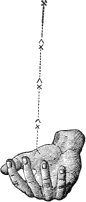
Fig. 113.
The sign made by the Dakota, Hidatsa, and several other tribes, for tree is made by holding the right hand before the body, back forward, fingers and thumb separated, then pushing it slightly upward, Fig. 112. That for grass is the same made near the ground; that for grow is made like grass, though instead of holding the back of the hand near the ground the hand is pushed upward in an interrupted manner, Fig. 113. For smoke, the hand (with the back down, fingers pointing upward as in grow) is thrown upward several times from the same place instead of continuing the whole motion upward. Frequently the fingers are thrown forward from under the thumb with each successive upward motion. For fire, the hand is employed as in the gesture for smoke, but the motion is frequently more waving, and in other cases made higher from the ground.
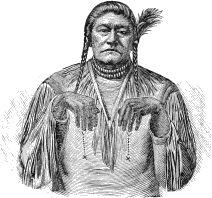
Fig. 114.
The sign for rain, made by the Shoshoni, Apache, and other Indians, is by holding the hand (or hands) at the height of and before the shoulder, fingers pendent, palm down, then pushing it downward a short distance, Fig. 114. That for heat is the same, with the difference that the hand is held above the head and thrust downward toward the forehead; that for to weep is made by holding the hand as in rain, and the gesture made from the eye downward over the cheek, back of the fingers nearly touching the face.

Fig. 115.
The common sign for sun is made by bringing the tips of the thumb and index together so as to form a circle; remaining fingers closed. The hand is then held toward the sky, Fig. 115. The motion with the same circular position of index and thumb is for want, by bringing the hand backward toward the mouth, in a curve forming a short arch between the origin and termination of the gesture.
For drink the gesture by several tribes is the same as for want, with the slight difference in the position of the last three fingers, which are not so tightly clinched, forming somewhat the shape of a cup; and that for money is made by holding out the hand with the same arrangement of fingers in front of the hips, at a distance of about twelve or fifteen inches.
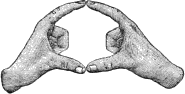
Fig. 116.
Another sign for sun, made by the Cheyennes, is by placing the tips of the partly separated thumb and index of one hand against those of the other, approximating a circle, and holding them toward the sky, Fig. 116, and that for various things, observed among the Brulé Sioux with the same position of the hands, is made by placing the circle horizontal, and moving it interruptedly toward the right side, each movement forming a short arch. Compare also the sign for village, described on page 386.
The Arikara sign for soldier is by placing the clinched hands together before the breast, thumbs touching, then drawing them horizontally outward toward their respective sides, Fig. 117. That for done, made by the Hidatsa, is shown below in this paper, see Fig. 334, page 528. That for much (Cheyenne I, Comanche III), see Fig. 274, page 447, is to be correlated with the above.

Fig. 117.
The sign for to be told or talked to, and for the reception of speech, by the tribes generally, is made by placing the flat right hand, palm upward, about fifteen inches in front of the right side of the face or breast, fingers pointing to the left, then drawing the hand toward the bottom of the chin, and is illustrated in Fig. 71, page 291. The Comanche sign for give or asking is shown in Fig. 301, page 480 (Comanche III), and is made by bringing the hand toward the body but a short distance, and the motion repeated, the tips of the fingers indicating the outline of a circle.
The tribal sign for Kaiowa, illustrated in its place among the Tribal Signs, is made by holding the hand with extended and separated fingers and thumb near the side of the head, back outward, and giving it a rotary motion. This gesture is made in front of the face by many tribes. The generic sign for deer, made by the Dakota and some others, is by holding the hand motionless at the side of the head, with extended and separated thumb and fingers, representing the branched antlers. That for fool, reported from the same Indians, is the same as above described for Kaiowa, which it also signifies, though frequently only one or two fingers are used.
The tribal sign both for the Sahaptin or Nez Percés and for Caddo (see Tribal Signs) is made by passing the extended index, pointing under the nose from right to left. When the second finger is not tightly closed it strongly resembles the sign often made for lie, falsehood, by passing the extended index and second fingers separated toward the left, over the mouth.
The tribal sign for Cheyenne (see Tribal Signs) differs from the sign for spotted only in the finger (or hand) in the latter being alternately passed across the upper and lower sides of the left forearm.
The sign for steal, theft, see Fig. 75, page 293, is but slightly different from that for bear, see Fig. 239, page 413, especially when the latter is made with one hand only. The distinction, however, is that the grasping in the latter sign is not followed by the idea of concealment in the former, which is executed by the right hand, after the motion of grasping, being brought toward and sometimes under the left armpit.
Cold and winter, see Tendoy-Huerito Dialogue, page 486, may be compared with love, see Kin Chē-ĕss’ speech, page 521, and with prisoner. In these the difference consists in that cold and winter are represented by crossing the arms with clinched hands before the breast; love by crossing the arms so as to bring the fists more under the chin, and prisoner by holding the crossed wrists a foot in front of the breast.
Melon, squash, muskmelon, used by the Utes and Apaches, is made by holding the hand arched, fingers separated and pointing forward, and pushing the hand forward over a slight curve near the ground, and the generic sign for animals by the Apaches is made in the same manner at the height intended to represent the object.
The sign for where?, and to search, to seek for, made by the Dakota (IV), is by holding the back of the hand upward, index pointing forward, and carrying it from left to right about eight inches, raising and lowering it several times while so doing, as if quickly pointing at different objects. That for some of them, a part of a number of things or persons, made by the Kaiowa, Comanche, Wichita, and Apache Indians is nearly identical, the gesture being made less rapidly.
RESULTS SOUGHT IN THE STUDY OF SIGN LANGUAGE.
These may be divided into (1) its practical application, (2) its aid to philologic researches in general with (3) particular reference to the grammatic machinery of language, and (4) its archæologic relations.
PRACTICAL APPLICATION.
The most obvious application of Indian sign language will for its practical utility depend, to a large extent, upon the correctness of the view submitted by the present writer that it is not a mere semaphoric repetition of motions to be memorized from a limited traditional list, but is a cultivated art, founded upon principles which can be readily applied by travelers and officials, so as to give them much independence of professional interpreters—as a class dangerously deceitful and tricky. This advantage is not merely theoretical, but has been demonstrated to be practical by a professor in a deaf-mute college who, lately visiting several of the wild tribes of the plains, made himself understood among all of them without knowing a word of any of their languages; nor would it only be experienced in connection with American tribes, being applicable to intercourse with savages in Africa and Asia, though it is not pretended to fulfill by this agency the schoolmen’s dream of an ecumenical mode of communication between all peoples in spite of their dialectic divisions.
It must be admitted that the practical value of signs for intercourse with the American Indians will not long continue, their general progress in the acquisition of English or of Spanish being so rapid that those languages are becoming, to a surprising extent, the common medium, and signs are proportionally disused. Nor is a systematic use of signs of so great assistance in communicating with foreigners, whose speech is not understood, as might at first be supposed, unless indeed both parties agree to cease all attempt at oral language, relying wholly upon gestures. So long as words are used at all, signs will be made only as their accompaniment, and they will not always be ideographic.
An amusing instance in which savages showed their preference to signs instead of even an onomatope may be quoted from Wilfred Powell’s Observations on New Britain and neighboring Islands during Six Years’ Exploration, in Proc. Roy. Geog. Soc., vol. iii, No. 2 (new monthly series), February, 1881, p. 89, 90: “On one occasion, wishing to purchase a pig, and not knowing very well how to set about it, being ignorant of the dialect, which is totally different from that of the natives in the north, I asked Mr. Brown how I should manage, or what he thought would be the best way of making them understand. He said, ‘Why don’t you try grunting?’ whereupon I began to grunt most vociferously. The effect was magical. Some of them jumped back, holding their spears in readiness to throw; others ran away, covering their eyes with their hands, and all exhibited the utmost astonishment and alarm. In fact, it was so evident that they expected me to turn into a pig, and their alarm was so irresistibly comic, that Mr. Brown and I both burst out laughing, on which they gradually became more reassured, and those that had run away came back, and seeing us so heartily amused, and that I had not undergone any metamorphosis, began to laugh too; but when I drew a pig on the sand with a piece of stick, and made motions of eating, it suddenly seemed to strike them what was the matter, for they all burst out laughing, nodding their heads, and several of them ran off, evidently in quest of the pig that was required.”
POWERS OF SIGNS COMPARED WITH SPEECH.
Sign language, being the mother utterance of nature, poetically styled by Lamartine the visible attitudes of the soul, is superior to all others in that it permits every one to find in nature an image to express his thoughts on the most needful matters intelligently to any other person. The direct or substantial natural analogy peculiar to it prevents a confusion of ideas. It is to some extent possible to use words without understanding them which yet may be understood by those addressed, but it is hardly possible to use signs without full comprehension of them. Separate words may also be comprehended by persons hearing them without the whole connected sense of the words taken together being caught, but signs are more intimately connected. Even those most appropriate will not be understood if the subject is beyond the comprehension of their beholders. They would be as unintelligible as the wild clicks of his instrument, in an electric storm, would be to the telegrapher, or as the semaphore, driven by wind, to the signalist. In oral speech even onomatopes are arbitrary, the most strictly natural sounds striking the ear of different individuals and nations in a manner wholly diverse. The instances given by Sayce are in point. Exactly the same sound was intended to be reproduced in the “bilbit amphora” of Nævius, the “glut glut murmurat unda sonans” of the Latin Anthology, and the “puls” of Varro. The Persian “bulbul,” the “jugjug” of Gascoigne, and the “whitwhit” of others are all attempts at imitating the note of the nightingale. Successful signs must have a much closer analogy and establish a consensus between the talkers far beyond that produced by the mere sound of words.
Gestures, in the degree of their pantomimic character, excel in graphic and dramatic effect applied to narrative and to rhetorical exhibition, and beyond any other mode of description give the force of reality. Speech, when highly cultivated, is better adapted to generalization and abstraction; therefore to logic and metaphysics. The latter must ever henceforth be the superior in formulating thoughts. Some of the enthusiasts in signs have contended that this unfavorable distinction is not from any inherent incapability, but because their employment has not been continued unto perfection, and that if they had been elaborated by the secular labor devoted to spoken language they might in resources and distinctiveness have exceeded many forms of the latter. Gallaudet, Peet, and others maybe right in asserting that man could by his arms, hands, and fingers, with facial and bodily accentuation, express any idea that could be conveyed by words.
The combinations which can be made with corporeal signs are infinite. It has been before argued that a high degree of culture might have been attained by man without articulate speech and it is but a further step in the reasoning to conclude that if articulate speech had not been possessed or acquired, necessity would have developed gesture language to a degree far beyond any known exhibition of it. The continually advancing civilization and continually increasing intercourse of countless ages has perfected oral speech, and as both civilization and intercourse were possible with signs alone it is to be supposed that they would have advanced in some corresponding manner. But as sign language has been chiefly used during historic time either as a scaffolding around a more valuable structure to be thrown aside when the latter was completed, or as an occasional substitute, such development was not to be expected.
The process of forming signs to express abstract ideas is only a variant from that of oral speech, in which the words for the most abstract ideas, such as law, virtue, infinitude, and immortality, are shown by Max Müller to have been derived and deduced, that is, abstracted, from sensuous impressions. In the use of signs the countenance and manner as well as the tenor decide whether objects themselves are intended, or the forms, positions, qualities, and motions of other objects which are suggested, and signs for moral and intellectual ideas, founded on analogies, are common all over the world as well as among deaf-mutes. Concepts of the intangible and invisible are only learned through percepts of tangible and visible objects, whether finally expressed to the eye or to the ear, in terms of sight or of sound.
Sign language is so faithful to nature, and so essentially living in its expression, that it is not probable that it will ever die. It may become disused, but will revert. Its elements are ever natural and universal, by recurring to which the less natural signs adopted dialectically or for expedition can always, with some circumlocution, be explained. This power of interpreting itself is a peculiar advantage, for spoken languages, unless explained by gestures or indications, can only be interpreted by means of some other spoken language. When highly cultivated, its rapidity on familiar subjects exceeds that of speech and approaches to that of thought itself. This statement may be startling to those who only notice that a selected spoken word may convey in an instant a meaning for which the motions of even an expert in signs may require a much longer time, but it must be considered that oral speech is now wholly conventional, and that with the similar development of sign language conventional expressions with hands and body could be made more quickly than with the vocal organs, because more organs could be worked at once. Without such supposed development the habitual communication between deaf-mutes and among Indians using signs is perhaps as rapid as between the ignorant class of speakers upon the same subjects, and in many instances the signs would win at a trial of speed. At the same time it must be admitted that great increase in rapidity is chiefly obtained by the system of preconcerted abbreviations, before explained, and by the adoption of arbitrary forms, in which naturalness is sacrificed and conventionality established, as has been the case with all spoken languages in the degree in which they have become copious and convenient.
There is another characteristic of the gesture speech that, though it cannot be resorted to in the dark, nor where the attention of the person addressed has not been otherwise attracted, it has the countervailing benefit of use when the voice could not be employed. This may be an advantage at a distance which the eye can reach, but not the ear, and still more frequently when silence or secrecy is desired. Dalgarno recommends it for use in the presence of great people, who ought not to be disturbed, and curiously enough “Disappearing Mist,” the Iroquois chief, speaks of the former extensive use of signs in his tribe by women and boys as a mark of respect to warriors and elders, their voices, in the good old days, not being uplifted in the presence of the latter. The decay of that wholesome state of discipline, he thinks, accounts partly for the disappearance of the use of signs among the modern impudent youth and the dusky claimants of woman’s rights.
An instance of the additional power gained to a speaker of ordinary language by the use of signs, impressed the writer while dictating to two amanuenses at the same moment, to the one by signs and the other by words, on different subjects, a practice which would have enabled Cæsar to surpass his celebrated feat. It would also be easy to talk to a deaf and blind man at once, the latter being addressed by the voice and the former in signs.
RELATIONS TO PHILOLOGY.
The aid to be derived from the study of sign language in prosecuting researches into the science of language was pointed out by Leibnitz, in his Collectanea Etymologica, without hitherto exciting any thorough or scientific work in that direction, the obstacle to it probably being that scholars competent in other respects had no adequate data of the gesture speech of man to be used in comparison. The latter will, it is hoped, be supplied by the work now undertaken.
In the first part of this paper it was suggested that signs played an important part in giving meaning to spoken words. Philology, comparing the languages of earth in their radicals, must therefore include the graphic or manual presentation of thought, and compare the elements of ideography with those of phonics. Etymology now examines the ultimate roots, not the fanciful resemblances between oral forms, in the different tongues; the internal, not the mere external parts of language. A marked peculiarity of sign language consists in its limited number of radicals and the infinite combinations into which those radicals enter while still remaining distinctive. It is therefore a proper field for etymologic study.
From these and other considerations it is supposed that an analysis of the original conceptions of gestures, studied together with the holophrastic roots in the speech of the gesturers, may aid in the ascertainment of some relation between concrete ideas and words. Meaning does not adhere to the phonic presentation of thought, while it does to signs. The latter are doubtless more flexible and in that sense more mutable than words, but the ideas attached to them are persistent, and therefore there is not much greater metamorphosis in the signs than in the cognitions. The further a language has been developed from its primordial roots, which have been twisted into forms no longer suggesting any reason for their original selection, and the more the primitive significance of its words has disappeared, the fewer points of contact can it retain with signs. The higher languages are more precise because the consciousness of the derivation of most of their words is lost, so that they have become counters, good for any sense agreed upon and for no other.
It is, however, possible to ascertain the included gesture even in many English words. The class represented by the word supercilious will occur to all readers, but one or two examples may be given not so obvious and more immediately connected with the gestures of our Indians. Imbecile, generally applied to the weakness of old age, is derived from the Latin in, in the sense of on, and bacillum, a staff, which at once recalls the Cheyenne sign for old man, mentioned above, page 339. So time appears more nearly connected with τείνω to stretch, when information is given of the sign for long time, in the Speech of Kin Chē-ĕss, in this paper, viz., placing the thumbs and forefingers in such a position as if a small thread was held between the thumb and forefinger of each hand, the hands first touching each other, and then moving slowly from each other, as if stretching a piece of gum-elastic.
In the languages of North America, which have not become arbitrary to the degree exhibited by those of civilized man, the connection between the idea and the word is only less obvious than that still unbroken between the idea and the sign, and they remain strongly affected by the concepts of outline, form, place, position, and feature on which gesture is founded, while they are similar in their fertile combination of radicals.
Indian language consists of a series of words that are but slightly differentiated parts of speech following each other in the order suggested in the mind of the speaker without absolute laws of arrangement, as its sentences are not completely integrated. The sentence necessitates parts of speech, and parts of speech are possible only when a language has reached that stage where sentences are logically constructed. The words of an Indian tongue, being synthetic or undifferentiated parts of speech, are in this respect strictly analogous to the gesture elements which enter into a sign language. The study of the latter is therefore valuable for comparison with the words of the former. The one language throws much light upon the other, and neither can be studied to the best advantage without a knowledge of the other.
Some special resemblances between the language of signs and the character of the oral languages found on this continent may be mentioned. Dr. J. Hammond Trumbull remarks of the composition of their words that they were “so constructed as to be thoroughly self-defining and immediately intelligible to the hearer.” In another connection the remark is further enforced: “Indeed, it is a requirement of the Indian languages that every word shall be so framed as to admit of immediate resolution to its significant elements by the hearer. It must be thoroughly self-defining, for (as Max Müller has expressed it) ‘it requires tradition, society, and literature to maintain words which can no longer be analyzed at once.’ *** In the ever-shifting state of a nomadic society no debased coin can be tolerated in language, no obscure legend accepted on trust. The metal must be pure and the legend distinct.”
Indian languages, like those of higher development, sometimes exhibit changes of form by the permutation of vowels, but often an incorporated particle, whether suffix, affix, or infix, shows the etymology which often, also, exhibits the same objective conception that would be executed in gesture. There are, for instance, different forms for standing, sitting, lying, falling, &c., and for standing, sitting, lying on or falling from the same level or a higher or lower level. This resembles the pictorial conception and execution of signs.
Major J. W. Powell, with particular reference to the disadvantages of the multiplied inflections in Indian languages, alike with the Greek and Latin, when the speaker is compelled, in the choice of a word to express his idea, to think of a great multiplicity of things, gives the following instance:
“A Ponca Indian in saying that a man killed a rabbit, would have to say: the man, he, one, animate, standing, in the nominative case, purposely killed, by shooting an arrow, the rabbit, he, the one, animate, sitting, in the objective case; for the form of a verb to kill would have to be selected, and the verb changes its form by inflection and incorporated particles to denote person, number, and gender as animate or inanimate, and gender as standing, sitting, or lying, and case; and the form of the verb would also express whether the killing was done accidentally or purposely, and whether it was by shooting or by some other process, and, if by shooting, whether by bow and arrow, or with a gun; and the form of the verb would in like manner have to express all of these things relating to the object; that is, the person, number, gender, and case of the object; and from the multiplicity of paradigmatic forms of the verb to kill, this particular one would have to be selected.” This is substantially the mode in which an Indian sign talker would find it necessary to tell the story, as is shown by several examples given below in narratives, speeches, and dialogues.
Indian languages exhibit the same fondness for demonstration which is necessary in sign language. The two forms of utterance are alike in their want of power to express certain words, such as the verb “to be,” and in the criterion of organization, so far as concerns a high degree of synthesis and imperfect differentiation, they bear substantially the same relation to the English language.
It may finally be added that as not only proper names but nouns, generally in Indian languages are connotive, predicating some attribute of the object, they can readily be expressed by gesture signs, and therefore among them, if anywhere, it is to be expected that relations may be established between the words and the signs.
ETYMOLOGY OF WORDS FROM GESTURES.
There can be no attempt in the present limits to trace the etymology of any large number of words in the several Indian languages to a gestural origin, nor, if the space allowed, would it be satisfactory. The signs have scarcely yet been collected, verified, and collated in sufficient numbers for such comparison, even with the few of the Indian languages the radicals of which have been scientifically studied. The signs will, in a future work, be frequently presented in connection with the corresponding words of the gesturers, as is done now in a few instances in another part of this paper. For the present the subject is only indicated by the following examples, introduced to suggest the character of the study in which the students of American linguistics are urgently requested to assist:
The Dakota word Shaⁿte-suta—from shaⁿte, heart, and suta, strong—brave, not cowardly, literally strong-hearted, is made by several tribes of that stock, and particularly by the Brulé Sioux, in gestures by collecting the tips of the fingers and thumb of the right hand to a point, and then placing the radial side of the hand over the heart, finger tips pointing downward—heart; then place the left fist, palm inward, horizontally before the lower portion of the breast, the right fist back of the left, then raise the right and throw it forcibly over and downward in front of the left—brave, strong. See Fig. 242, page 415.
The Arikaras make the sign for brave by striking the clinched fist forcibly toward the ground in front of and near the breast.
Brave, or “strong-hearted,” is made by the Absaroka, Shoshoni, and Banak Indians by merely placing the clinched fist to the breast, the latter having allusion to the heart, the clinching of the hand to strength, vigor, or force.
An Ojibwa sign for death, to die, is as follows:
Place the palm of the hand at a short distance from the side of the head, then withdraw it gently in an oblique downward direction, inclining the head and upper part of the body in the same direction.
The same authority, The Very Rev. E. Jacker, who contributes it, notes that there is an apparent connection between this conception and execution and the etymology of the corresponding terms in Ojibwa. “He dies,” is nibo; “he sleeps,” is niba. The common idea expressed by the gesture is a sinking to rest. The original significance of the root nib seems to be “leaning;” anibeia, “it is leaning”; anibekweni, “he inclines the head sidewards.” The word niba or nibe (only in compounds) conveys the idea of “night,” perhaps as the falling over, the going to rest, or the death of the day.
Ogima, the Ojibwa term for chief, is derived from a root which signifies “above” (Ogidjaii, upon; ogidjina, above; ogidaki, on a hill or mountain, etc.). Ogitchida, a brave, a hero (Otawa, ogida), is probably from the same root.
Sagima, the Ojibwa form of sachem, is from the root sag, which implies a coming forth, or stretching out. These roots are to be considered in connection with several gestures described under the head of Chief, in Extracts from Dictionary, infra.
Onijishin, it is good (Ojibwa), originally signifies “it lies level.” This may be compared with the sign for good, in the Tendoy-Huerito Dialogue, Fig. 309, page 487, and also that for happy, contentment, in the Speech of Kin Chē-ĕss, page 523.
In Klamath the radix lam designates a whirling motion, and appears in the word láma, “to be crazy, mad,” readily correlated with the common gesture for madman and fool, in which the hand is rotated above and near the head.
Evening, in Klamath, is litkhí, from luta, to hang down, meaning the time when the sun hangs down, the gesture for which, described elsewhere in this paper (see Nátci’s Narrative, page 503), is executive of the same conception, which is allied to the etymology usually given for eve, even, “the decline of the day.” These Klamath etymologies have been kindly contributed by Mr. A. S. Gatschet.
The Very Rev. E. Jacker also communicates a suggestive excursus exegeticus upon the probable gestural origin of the Ojibwa word tibishko, “opposite in space; just so; likewise:”
“The adverb tibishko (or dibishko) is an offshoot of the root tib (or dib), which in most cases conveys the idea of measuring or weighing, as appears from the following samples: dibaige, he measures; dibowe, he settles matters by his speech or word, e.g., as a juryman; dibaamage, he pays out; dibakonige, he judges; dibabishkodjige, he weighs; dibamenimo, he restricts himself, e.g., to a certain quantity of food; dibissitchige, he fulfills a promise; dibijigan, a pattern for cutting clothes.
“The original meaning of tib, however, must be supposed to have been more comprehensive, if we would explain other (apparent) derivatives, such as: tibi, ‘I don’t know where, where to, where from,’ &c.; tibik, night; dibendjige, he is master or owner; titibisse, it rolls (as a ball), it turns (as a wheel); dibaboweigan, the cover of a kettle. The notion of measuring does not very naturally enter into the ideas expressed by these terms.
“The difficulty disappears if we assume the root tib or dib to have been originally the phonetic equivalent of a gesture expressive of the notion of covering as well as of that of measuring. This gesture would seem to be the holding of one hand above the other, horizontally, at some distance, palms opposite or both downwards. This, or some similar gesture would most naturally accompany the above terms. As for tibik, night, compare (Dunbar): ‘The two hands open and extended, crossing one another horizontally.’ The idea of covering evidently enters into this conception. The strange adverb tibi (‘I don’t know where,’ &c., or ‘in a place unknown to me’), if derived from the same root, would originally signify ‘covered.’ In titibisse, or didibisse (it rolls, it turns), the reduplication of the radical syllable indicates the repetition of the gesture, by holding the hands alternately above one another, palms downwards, and thus producing a rotary motion.
“In German, the clasping of the hands in a horizontal position, expressive of a promise or the conclusion of a bargain, is frequently accompanied by the interjection top! the same radical consonants as in tib. Compare also the English tap, the French tape, the Greek τύπτω, the Sanscrit tup and tub, &c.”
GESTURES CONNECTED WITH THE ORIGIN OF WRITING.
Though written characters are generally associated with speech, they are shown, by successful employment in hieroglyphs and by educated deaf-mutes to be representative of ideas without the intervention of sounds, and so also are the outlines of signs. This will be more apparent if the motions expressing the most prominent feature, attribute, or function of an object are made, or supposed to be made, so as to leave a luminous track impressible upon the eye separate from the members producing it. The actual result is an immateriate graphic representation of visible objects and qualities which, invested with substance, has become familiar to us as the rebus, and also appears in the form of heraldic blazonry styled punning or “canting.”
Gesture language is, in fact, not only a picture language, but is actual writing, though dissolving and sympathetic, and neither alphabetic nor phonetic.
Dalgarno aptly says: “Qui enim caput nutat, oculo connivet, digitum movet in aëre, &c., (ad mentis cogitata exprimendum); is non minus vere scribit, quam qui Literas pingit in Charta, Marmore, vel ære.”
It is neither necessary nor proper to enter now upon any prolonged account of the origin of alphabetic writing. There is, however, propriety, if not necessity, for the present writer, when making any remarks under this heading and under some others in this paper indicating special lines of research, to disclaim all pretension to being a Sinologue or Egyptologist, or even profoundly versed in Mexican antiquities. His partial and recently commenced studies only enable him to present suggestions for the examination of scholars. These suggestions may safely be introduced by the statement that the common modern alphabetic characters, coming directly from the Romans, were obtained by them from the Greeks, and by the latter from the Phœnicians, whose alphabet was connected with that of the old Hebrew. It has also been of late the general opinion that the whole family of alphabets to which the Greek, Latin, Gothic, Runic, and others belong, appearing earlier in the Phœnician, Moabite, and Hebrew, had its beginning in the ideographic pictures of the Egyptians, afterwards used by them to express sounds. That the Chinese, though in a different manner from the Egyptians, passed from picture writing to phonetic writing, is established by delineations still extant among them, called ku-wăn, or “ancient pictures,” with which some of the modern written characters can be identified. The ancient Mexicans also, to some extent, developed phonetic expressions out of a very elaborate system of ideographic picture writing. Assuming that ideographic pictures made by ancient peoples would be likely to contain representations of gesture signs, which subject is treated of below, it is proper to examine if traces of such gesture signs may not be found in the Egyptian, Chinese, and Aztec characters. Only a few presumptive examples, selected from a considerable number, are now presented in which the signs of the North American Indians appear to be included, with the hope that further investigation by collaborators will establish many more instances not confined to Indian signs.
A typical sign made by the Indians for no, negation, is as follows: The hand extended or slightly curved is held in front of the body, a little to the right of the median line; it is then carried with a rapid sweep a foot or more farther to the right. (Mandan and Hidatsa I.)
One for none, nothing, sometimes used for simple negation, is also given: Throw both hands outward toward their respective sides from the breast. (Wyandot I.)
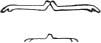
Fig. 118.
With these compare the two forms of the Egyptian character for no, negation, Fig. 118, taken from Champollion, Grammaire Égyptienne, Paris, 1836, p. 519.
No vivid fancy is needed to see the hands indicated at the extremities of arms extended symmetrically from the body on each side.

Fig. 119.
Also compare the Maya character for the same idea of negation, Fig. 119, found in Landa, Relation des Choses de Yucatan, Paris, 1864, 316. The Maya word for negation is “ma,” and the word “mak,” a six-foot measuring rod, given by Brasseur de Bourbourg in his dictionary, apparently having connection with this character, would in use separate the hands as illustrated, giving the same form as the gesture made without the rod.
Another sign for nothing, none, made by the Comanches, is: Flat hand thrown forward, back to the ground, fingers pointing forward and downward. Frequently the right hand is brushed over the left thus thrown out.

Fig. 120.
Compare the Chinese character for the same meaning, Fig. 120. This will not be recognized as a hand without study of similar characters, which generally have a cross-line cutting off the wrist. Here the wrist bones follow under the cross cut, then the metacarpal bones, and last the fingers, pointing forward and downward.

Fig. 121.
The Arapaho sign for child, baby, is the forefinger in the mouth, i.e., a nursing child, and a natural sign of a deaf-mute is the same. The Egyptian figurative character for the same is seen in Fig. 121. Its linear form is Fig. 122, and its hieratic is Fig. 123 (Champollion, Dictionnaire Égyptien, Paris, 1841, p. 31).


Fig. 122. Fig. 123. Fig. 124. Fig. 125. Fig. 126.
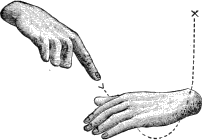
Fig. 127.
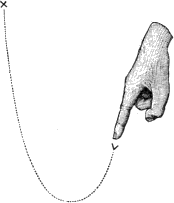
Fig. 128.
These afford an interpretation to the ancient Chinese form for son, Fig. 124, given in Journ. Royal Asiatic Society, I, 1834, p. 219, as belonging to the Shang dynasty, 1756, 1112 B.C., and the modern Chinese form, Fig. 125, which, without the comparison, would not be supposed to have any pictured reference to an infant with hand or finger at or approaching the mouth, denoting the taking of nourishment. Having now suggested this, the Chinese character for birth, Fig. 126, is understood as the expression of a common gesture among the Indians, particularly reported from the Dakota, for born, to be born, viz: Place the left hand in front of the body, a little to the right, the palm downward and slightly arched, then pass the extended right hand downward, forward, and upward, forming a short curve underneath the left, as in Fig. 127 (Dakota V). This is based upon the curve followed by the head of the child during birth, and is used generically. The same curve, when made with one hand, appears in Fig. 128.

Fig. 129.
It may be of interest to compare with the Chinese child the Mexican abbreviated character for man, Fig. 129, found in Pipart in Compte Rendu Cong. Inter. des Américanistes, 2me Session, Luxembourg, 1877, 1878, II, 359. The figure on the right is called the abbreviated form of that by its side, yet its origin may be different.

Fig. 130.
The Chinese character for man is Fig. 130, and may have the same obvious conception as a Dakota sign for the same signification: “Place the extended index, pointing upward and forward before the lower portion of the abdomen.”

Fig. 131.
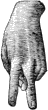
Fig. 132.
The Chinese specific character for woman is Fig. 131, the cross mark denoting the wrist, and if the remainder be considered the hand, the fingers may be imagined in the position made by many tribes, and especially the Utes, as depicting the pudendum muliebre, Fig. 132.
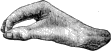
Fig. 133.
The Egyptian generic character for female is (Champollion, Dict.), believed to represent the curve of the mammæ supposed to be cut off or separated from the chest, and the gesture with the same meaning was made by the Cheyenne Titchkematski, and photographed, as in Fig. 133. It forms the same figure as the Egyptian character as well as can be done by a position of the human hand.


Fig. 134.
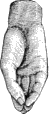
Fig. 135.
The Chinese character for to give water is Fig. 134, which may be compared with the common Indian gesture to drink, to give water, viz: “Hand held with tips of fingers brought together and passed to the mouth, as if scooping up water”, Fig. 135, obviously from the primitive custom, as with Mojaves, who still drink with scooped hands.

Fig. 136.

Fig. 137.
Another common Indian gesture sign for water to drink, I want to drink, is: “Hand brought downward past the mouth with loosely extended fingers, palm toward the face.” This appears in the Mexican character for drink, Fig. 136, taken from Pipart, loc. cit., p. 351. Water, i.e., the pouring out of water with the drops falling or about to fall, is shown in Fig. 137, taken from the same author (p. 349), being the same arrangement of them as in the sign for rain, Fig. 114, p. 344, the hand, however, being inverted. Rain in the Mexican picture writing is shown by small circles inclosing a dot, as in the last two figures, but not connected together, each having a short line upward marking the line of descent.
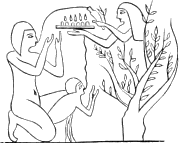
Fig. 138.
With the gesture for drink may be compared Fig. 138, the Egyptian Goddess Nu in the sacred sycamore tree, pouring out the water of life to the Osirian and his soul, represented as a bird, in Amenti (Sharpe, from a funereal stelē in the British Museum, in Cooper’s Serpent Myths, p. 43).
The common Indian gesture for river or stream, water, is made by passing the horizontal flat hand, palm down, forward and to the left from the right side in a serpentine manner.
The Egyptian character for the same is Fig. 139 (Champollion, Dict., p. 429). The broken line is held to represent the movement of the water on the surface of the stream. When made with one line less angular and more waving it means water. It is interesting to compare with this the identical character in the syllabary invented by a West African negro, Mormoru Doalu Bukere, for water, , mentioned by Tylor in his Early History of Mankind, p. 103.

The abbreviated Egyptian sign for water as a stream is Fig. 140 (Champollion, loc. cit.), and the Chinese for the same is as in Fig. 141.
In the picture-writing of the Ojibwa the Egyptian abbreviated character, with two lines instead of three, appears with the same signification.


Fig. 139. Fig. 140. Fig. 141. Fig. 142. Fig. 143.
The Egyptian character for weep, Fig. 142, an eye, with tears falling, is also found in the pictographs of the Ojibwa (Schoolcraft, I, pl. 54, Fig. 27), and is also made by the Indian gesture of drawing lines by the index repeatedly downward from the eye, though perhaps more frequently made by the full sign for rain, described on page 344, made with the back of the hand downward from the eye—“eye rain.”
The Egyptian character for to be strong is Fig. 143 (Champollion, Dict., p. 91), which is sufficiently obvious, but may be compared with the sign for strong, made by some tribes as follows: Hold the clinched fist in front of the right side, a little higher than the elbow, then throw it forcibly about six inches toward the ground.
A typical gesture for night is as follows: Place the flat hands, horizontally, about two feet apart, move them quickly in an upward curve toward one another until the right lies across the left. “Darkness covers all.” See Fig. 312, page 489.

Fig. 144.
The conception of covering executed by delineating the object covered beneath the middle point of an arch or curve, appears also clearly in the Egyptian characters for night, Fig. 144 (Champollion, Dict., p. 3).
The upper part of the character is taken separately to form that for sky (see page 372, infra).

Fig. 145.
The Egyptian figurative and linear characters, Figs. 145 and 146 (Champollion, Dict., p. 28), for calling upon and invocation, also used as an interjection, scarcely require the quotation of an Indian sign, being common all over the world.
The gesture sign made by several tribes for many is as follows: Both hands, with spread and slightly curved fingers, are held pendent about two feet apart before the thighs; then bring them toward one another, horizontally, drawing them upward as they come together. (Absaroka I; Shoshoni and Banak I; Kaiowa I; Comanche III; Apache II; Wichita II.) “An accumulation of objects.” This may be the same motion indicated by the Egyptian character, Fig. 147, meaning to gather together (Champollion, Dict., p. 459).


Fig. 146. Fig. 147. Fig. 148. Fig. 149.
The Egyptian character, Fig. 148, which in its linear form is represented in Fig. 149, and meaning to go, to come, locomotion, is presented to show readers unfamiliar with hieroglyphics how a corporeal action may be included in a linear character without being obvious or at least certain, unless it should be made clear by comparison with the full figurative form or by other means. This linear form might be noticed many times without certainty or perhaps suspicion that it represented the human legs and feet in the act of walking. The same difficulty, of course, as also the same prospect of success by careful research, attends the tracing of other corporeal motions which more properly come under the head of gesture signs.
SIGN LANGUAGE WITH REFERENCE TO GRAMMAR.
Apart from the more material and substantive relations between signs and language, it is to be expected that analogies can by proper research be ascertained between their several developments in the manner of their use, that is, in their grammatic mechanism, and in the genesis of the sentence. The science of language, ever henceforward to be studied historically, must take account of the similar early mental processes in which the phrase or sentence originated, both in sign and oral utterance. In this respect, as in many others, the North American Indians may be considered to be living representatives of prehistoric man.
SYNTAX.
The reader will understand without explanation that there is in the gesture speech no organized sentence such as is integrated in the languages of civilization, and that he must not look for articles or particles or passive voice or case or grammatic gender, or even what appears in those languages as a substantive or a verb, as a subject or a predicate, or as qualifiers or inflexions. The sign radicals, without being specifically any of our parts of speech, may be all of them in turn. There is, however, a grouping and sequence of the ideographic pictures, an arrangement of signs in connected succession, which may be classed under the scholastic head of syntax. This subject, with special reference to the order of deaf-mute signs as compared with oral speech, has been the theme of much discussion, some notes of which, condensed from the speculations of M. Rémi Valade and others, follow in the next paragraph without further comment than may invite attention to the profound remark of Leibnitz.
In mimic construction there are to be considered both the order in which the signs succeed one another and the relative positions in which they are made, the latter remaining longer in the memory than the former, and spoken language may sometimes in its early infancy have reproduced the ideas of a sign picture without commencing from the same point. So the order, as in Greek and Latin, is very variable. In nations among whom the alphabet was introduced without the intermediary to any impressive degree of picture-writing, the order being (1) language of signs, almost superseded by (2) spoken language, and (3) alphabetic writing, men would write in the order in which they had been accustomed to speak. But if at a time when spoken language was still rudimentary, intercourse being mainly carried on by signs, figurative writing had been invented, the order of the figures would be the order of the signs, and the same order would pass into the spoken language. Hence Leibnitz says truly that “the writing of the Chinese might seem to have been invented by a deaf person.” The oral language has not known the phases which have given to the Indo-European tongues their formation and grammatical parts. In the latter, signs were conquered by speech, while in the former, speech received the yoke.
Sign language cannot show by inflection the reciprocal dependence of words and sentences. Degrees of motion corresponding with vocal intonation are only used rhetorically or for degrees of comparison. The relations of ideas and objects are therefore expressed by placement, and their connection is established when necessary by the abstraction of ideas. The sign talker is an artist, grouping persons and things so as to show the relations between them, and the effect is that which is seen in a picture. But though the artist has the advantage in presenting in a permanent connected scene the result of several transient signs, he can only present it as it appears at a single moment. The sign talker has the succession of time at his disposal, and his scenes move and act, are localized and animated, and their arrangement is therefore more varied and significant.
It is not satisfactory to give the order of equivalent words as representative of the order of signs, because the pictorial arrangement is wholly lost; but adopting this expedient as a mere illustration of the sequence in the presentation of signs by deaf-mutes, the following is quoted from an essay by Rev. J. R. Keep, in American Annals of the Deaf and Dumb, vol. xvi, p. 223, as the order in which the parable of the Prodigal Son is translated into signs:
“Once, man one, sons two. Son younger say, Father property your divide: part my, me give. Father so.—Son each, part his give. Days few after, son younger money all take, country far go, money spend, wine drink, food nice eat. Money by and by gone all. Country everywhere food little: son hungry very. Go seek man any, me hire. Gentleman meet. Gentleman son send field swine feed. Son swine husks eat, see—self husks eat want—cannot—husks him give nobody. Son thinks, say, father my, servants many, bread enough, part give away can—I none—starve, die. I decide: Father I go to, say I bad, God disobey, you disobey—name my hereafter son, no—I unworthy. You me work give servant like. So son begin go. Father far look: son see, pity, run, meet, embrace. Son father say, I bad, you disobey, God disobey—name my hereafter son, no—I unworthy. But father servants call, command robe best bring, son put on, ring finger put on, shoes feet put on, calf fat bring, kill. We all eat, merry. Why? Son this my formerly dead, now alive: formerly lost, now found: rejoice.”
It may be remarked, not only from this example, but from general study, that the verb “to be” as a copula or predicant does not have any place in sign language. It is shown, however, among deaf-mutes as an assertion of presence or existence by a sign of stretching the arms and hands forward and then adding the sign of affirmation. Time as referred to in the conjunctions when and then is not gestured. Instead of the form, “When I have had a sleep I will go to the river,” or “After sleeping I will go to the river,” both deaf-mutes and Indians would express the intention by “Sleep done, I river go.” Though time present, past, and future is readily expressed in signs (see page 366), it is done once for all in the connection to which it belongs, and once established is not repeated by any subsequent intimation, as is commonly the case in oral speech. Inversion, by which the object is placed before the action, is a striking feature of the language of deaf-mutes, and it appears to follow the natural method by which objects and actions enter into the mental conception. In striking a rock the natural conception is not first of the abstract idea of striking or of sending a stroke into vacancy, seeing nothing and having no intention of striking anything in particular, when suddenly a rock rises up to the mental vision and receives the blow; the order is that the man sees the rock, has the intention to strike it, and does so; therefore he gestures, “I rock strike.” For further illustration of this subject, a deaf-mute boy, giving in signs the compound action of a man shooting a bird from a tree, first represented the tree, then the bird as alighting upon it, then a hunter coming toward and looking at it, taking aim with a gun, then the report of the latter and the falling and the dying gasps of the bird. These are undoubtedly the successive steps that an artist would have taken in drawing the picture, or rather successive pictures, to illustrate the story. It is, however, urged that this pictorial order natural to deaf-mutes is not natural to the congenitally blind who are not deaf-mute, among whom it is found to be rhythmical. It is asserted that blind persons not carefully educated usually converse in a metrical cadence, the action usually coming first in the structure of the sentence. The deduction is that all the senses when intact enter into the mode of intellectual conception in proportion to their relative sensitiveness and intensity, and hence no one mode of ideation can be insisted on as normal to the exclusion of others.
Whether or not the above statement concerning the blind is true, the conceptions and presentations of deaf-mutes and of Indians using sign language because they cannot communicate by speech, are confined to optic and, therefore, to pictorial arrangement.
The abbé Sicard, dissatisfied with the want of tenses and conjunctions, indeed of most of the modern parts of speech, in the natural signs, and with their inverted order, attempted to construct a new language of signs, in which the words should be given in the order of the French or other spoken language adopted, which of course required him to supply a sign for every word of spoken language. Signs, whatever their character, could not become associated with words, or suggest them, until words had been learned. The first step, therefore, was to explain by means of natural signs, as distinct from the new signs styled methodical, the meaning of a passage of verbal language. Then each word was taken separately and a sign affixed to it, which was to be learned by the pupil. If the word represented a physical object, the sign would be the same as the natural sign, and would be already understood, provided the object had been seen and was familiar; and in all cases the endeavor was to have the sign convey as strong a suggestion of the meaning of the word as was possible. The final step was to gesticulate these signs, thus associated with words, in the exact order in which the words were to stand in a sentence. Then the pupil would write the very words desired in the exact order desired. If the previous explanation in natural signs had not been sufficiently full and careful, he would not understand the passage. The methodical signs did not profess to give him the ideas, except in a very limited degree, but only to show him how to express ideas according to the order and methods of spoken language. As there were no repetitions of time in narratives in the sign language, it became necessary to unite with the word-sign for verbs others, to indicate the different tenses of the verbs, and so by degrees the methodical signs not only were required to comprise signs for every word, but also, with every such sign, a grammatical sign to indicate what part of speech the word was, and, in the case of verbs, still other signs to show their tenses and corresponding inflections. It was, as Dr. Peet remarks, a cumbrous and unwieldly vehicle, ready at every step to break down under the weight of its own machinery. Nevertheless, it was industriously taught in all our schools from the date of the founding of the American Asylum in 1817 down to about the year 1835, when it was abandoned.
The collection of narratives, speeches, and dialogues of our Indians in sign language, first systematically commenced by the present writer, several examples of which are in this paper, has not yet been sufficiently complete and exact to establish conclusions on the subject of the syntactic arrangement of their signs. So far as studied it seems to be similar to that of deaf-mutes and to retain the characteristic of pantomimes in figuring first the principal idea and adding the accessories successively in the order of importance, the ideographic expressions being in the ideologic order. If the examples given are not enough to establish general rules of construction, they at least show the natural order of ideas in the minds of the gesturers and the several modes of inversion by which they pass from the known to the unknown, beginning with the dominant idea or that supposed to be best known. Some special instances of expedients other than strictly syntactic coming under the machinery broadly designated as grammar may be mentioned.
DEGREES OF COMPARISON.
Degrees of comparison are frequently expressed, both by deaf-mutes and by Indians, by adding to the generic or descriptive sign that for “big” or “little.” Damp would be “wet—little”; cool, “cold—little”; hot, “warm—much.” The amount or force of motion also often indicates corresponding diminution or augmentation, but sometimes expresses a different shade of meaning, as is reported by Dr. Matthews with reference to the sign for bad and contempt, see page 411. This change in degree of motion is, however, often used for emphasis only, as is the raising of the voice in speech or italicizing and capitalizing in print. The Prince of Wied gives an instance of a comparison in his sign for excessively hard, first giving that for hard, viz: Open the left hand, and strike against it several times with the right (with the backs of the fingers). Afterwards he gives hard, excessively, as follows: Sign for hard, then place the left index-finger upon the right shoulder, at the same time extend and raise the right arm high, extending the index-finger upward, perpendicularly.
Rev. G. L. Deffenbaugh describes what may perhaps be regarded as an intensive sign among the Sahaptins in connection with the sign for good; i.e., very good. “Place the left hand in position in front of the body with all fingers closed except first, thumb lying on second, then with forefinger of right hand extended in same way point to end of forefinger of left hand, move it up the arm till near the body and then to a point in front of breast to make the sign good.” For the latter see Extracts from Dictionary page 487, infra. The same special motion is prefixed to the sign for bad as an intensive.
Another intensive is reported by Mr. Benjamin Clark, interpreter at the Kaiowa, Comanche, and Wichita agency, Indian Territory, in which after the sign for bad is made, that for strong is used by the Comanches as follows: Place the clinched left fist horizontally in front of the breast, back forward, then pass the palmar side of the right fist downward in front of the knuckles of the left.
Dr. W. H. Corbusier, assistant surgeon U.S.A., writes as follows in response to a special inquiry on the subject: “By carrying the right fist from behind forward over the left, instead of beginning the motion six inches above it, the Arapaho sign for strong is made. For brave, first strike the chest over the heart with the right fist two or three times, and then make the sign for strong.
“The sign for strong expresses the superlative when used with other signs; with coward it denotes a base coward; with hunger, starvation; and with sorrow, bitter sorrow. I have not seen it used with the sign for pleasure or that of hunger, nor can I learn that it is ever used with them.”
OPPOSITION.
The principle of opposition, as between the right and left hands, and between the thumb and forefinger and the little finger, appears among Indians in some expressions for “above,” “below,” “forward,” “back,” but is not so common as among the methodical, distinguished from the natural, signs of deaf-mutes. It is also connected with the attempt to express degrees of comparison. Above is sometimes expressed by holding the left hand horizontal, and in front of the body, fingers open, but joined together, palm upward. The right hand is then placed horizontal, fingers open but joined, palm downward, an inch or more above the left, and raised and lowered a few inches several times, the left hand being perfectly still. If the thing indicated as “above” is only a little above, this concludes the sign, but if it be considerably above, the right hand is raised higher and higher as the height to be expressed is greater, until, if enormously above, the Indian will raise his right hand as high as possible, and, fixing his eyes on the zenith, emit a duplicate grunt, the more prolonged as he desires to express the greater height. All this time the left hand is held perfectly motionless. Below is gestured in a corresponding manner, all movement being made by the left or lower hand, the right being held motionless, palm downward, and the eyes looking down.
The code of the Cistercian monks was based in large part on a system of opposition which seems to have been wrought out by an elaborate process of invention rather than by spontaneous figuration, and is more of mnemonic than suggestive value. They made two fingers at the right side of the nose stand for “friend,” and the same at the left side for “enemy,” by some fanciful connection with right and wrong, and placed the little finger on the tip of the nose for “fool” merely because it had been decided to put the forefinger there for “wise man.”
PROPER NAMES.
It is well known that the names of Indians are almost always connotive, and particularly that they generally refer to some animal, predicating often some attribute or position of that animal. Such names readily admit of being expressed in sign language, but there may be sometimes a confusion between the sign expressing the animal which is taken as a name-totem, and the sign used, not to designate that animal, but as a proper name. A curious device to differentiate proper names was observed as resorted to by a Brulé Dakota. After making the sign of the animal he passed his index forward from the mouth in a direct line, and explained it orally as “that is his name,” i.e., the name of the person referred to. This approach to a grammatic division of substantives maybe correlated with the mode in which many tribes, especially the Dakotas, designate names in their pictographs, i.e., by a line from the mouth of the figure drawn representing a man to the animal, also drawn with proper color or position. Fig. 150 thus shows the name of Shuⁿ-ka Luta, Red Dog, an Ogallalla chief, drawn by himself. The shading of the dog by vertical lines is designed to represent red, or gules, according to the heraldic scheme of colors, which is used in other parts of this paper where it seemed useful to designate particular colors. The writer possesses in painted robes many examples in which lines are drawn from the mouth to a name-totem.
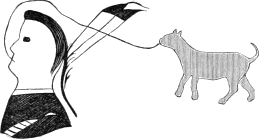
Fig. 150.
It would be interesting to dwell more than is now allowed upon the peculiar objectiveness of Indian proper names with the result, if not the intention, that they can all be signified in gesture, whereas the best sign-talker among deaf-mutes is unable to translate the proper names occurring in his speech or narrative and, necessarily ceasing signs, resorts to the dactylic alphabet. Indians are generally named at first according to a clan or totemic system, but later in life often acquire a new name or perhaps several names in succession from some exploit or adventure. Frequently a sobriquet is given by no means complimentary. All of the subsequently acquired, as well as the original names, are connected with material objects or with substantive actions so as to be expressible in a graphic picture, and, therefore, in a pictorial sign. The determination to use names of this connotive character is shown by the objective translation, whenever possible, of those European names which it became necessary to introduce into their speech. William Penn was called “Onas,” that being the word for feather-quill in the Mohawk dialect. The name of the second French governor of Canada was “Montmagny” which was translated by the Iroquois “Onontio”—“Great Mountain,” and becoming associated with the title, has been applied to all successive Canadian governors, though the origin being generally forgotten, it has been considered as a metaphorical compliment. It is also said that Governor Fletcher was not named by the Iroquois “Cajenquiragoe,” “the great swift arrow,” because of his speedy arrival at a critical time, but because they had somehow been informed of the etymology of his name—“arrow maker” (Fr. fléchier).
GENDER.
This is sometimes expressed by different signs to distinguish the sex of animals, when the difference in appearance allows of such varied portraiture. An example is in the signs for the male and female buffalo, given by the Prince of Wied. The former is, “Place the tightly closed hands on both sides of the head, with the fingers forward;” the latter is, “Curve the two forefingers, place them on the sides of the head and move them several times.” The short stubby horns of the bull appear to be indicated, and the cow’s ears are seen moving, not being covered by the bull’s shock mane. Tribes in which the hair of the women is differently arranged from that of men often denote their females by corresponding gesture. In many cases the sex of animals is indicated by the addition of a generic sign for male or female.
TENSE.
While it has been mentioned that there is no inflection of signs to express tense, yet the conception of present, past, and future is gestured without difficulty. A common mode of indicating the present time is by the use of signs for to-day, one of which is, “(1) both hands extended, palms outward; (2) swept slowly forward and to each side, to convey the idea of openness.” (Cheyenne II.) This may combine the idea of now with openness, the first part of it resembling the general deaf-mute sign for here or now.
Two signs nearly related together are also reported as expressing the meaning now, at once, viz.: “Forefinger of the right hand extended, upright, &c. (J), is carried upward in front of the right side of the body and above the head so that the extended finger points toward the center of the heavens, and then carried downward in front of the right breast, forefinger still pointing upright.” (Dakota I.) “Place the extended index, pointing upward, palm to the left, as high as and before the top of the head; push the hand up and down a slight distance several times, the eyes being directed upward at the time.” (Hidatsa I; Kaiowa I; Arikara I; Comanche III; Apache II; Wichita II.)