NORTH AMERICAN INDIANS (continued 6)
Reading edition
Place both hands flat and extended, thumbs touching, palms downward, in front of and as high as the face; then move them outward and downward a short distance toward their respective sides, thus describing the upper half of a circle. (Wyandot I.) “A heap.”
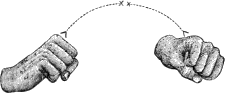
Fig. 274.
Both hands clinched, placed as high as and in front of the hips, palms facing opposite sides and about a foot apart, then bring them upward and inward, describing an arc, until the thumbs touch. (Apache I.) Fig. 274.
Sweep out both hands as if inclosing a large object; wave the hands forward and somewhat upward. (Apache III.) “Suggesting immensity.”
Deaf-mute sign:
The French deaf-mutes place the two hands, with fingers united and extended in a slight curve, nearly together, left above right, in front of the body, and then raise the left in a direct line above the right, thus suggesting the idea of a large and slightly-rounded object being held between the two palms.
—— And heavy.
Hands open, palms turned in, held about three feet apart, and about two feet from the ground, raise them about a foot; close the fists, backs of hands down, as if lifting something heavy; then move a short distance up and down several times. (Omaha I.)
Remarks connected with the signs for quantity appear on pages 291, 359, and 382, supra.
Question; Inquiry; Interrogation.
The palm of the hand upward and carried circularly outward, and depressed. (Dunbar.)
The hand held up with the thumb near the face, and the palm directed toward the person of whom the inquiry is made; then rotated upon the wrist two or three times edgewise, to denote uncertainty. (Long; Comanche I; Wichita I.) The motion might be mistaken for the derisive, vulgar gesture called “taking a sight,” “donner un pied de nez,” descending to our small boys from antiquity. The separate motion of the fingers in the vulgar gesture as used in our eastern cities is, however, more nearly correlated with some of the Indian signs for fool, one of which is the same as that for Kaiowa, see Tribal Signs. It may be noted that the Latin “sagax,” from which is derived “sagacity,” was chiefly used to denote the keen scent of dogs, so there is a relation established between the nasal organ and wisdom or its absence, and that “suspendere naso” was a classic phrase for hoaxing. The Italian expressions “restare con un palmo di naso,” “con tanto di naso,” etc., mentioned by the canon De Jorio, refer to the same vulgar gesture in which the face is supposed to be thrust forward sillily. Further remarks connected with this sign appear on pp. 304, 305, supra.
Extend the open hand perpendicularly with the palm outward, and move it from side to side several times. (Wied.) This sign is still used. For “outward,” however, I would substitute “forward.” The hand is usually, but not always, held before the face. (Matthews.) This is not the sign for question, but is used to attract attention before commencing a conversation or any other time during the talk, when found necessary. (McChesney.) With due deference to Dr. McChesney, this is the sign for question, as used by many tribes, and especially Dakotas. The Prince of Wied probably intended to convey the motion of forward, to the front, when he said outward. In making the sign for attention the hand is held more nearly horizontal, and is directed toward the individual whose attention is desired. (Hoffman.)
Right hand in front of right side of body, forearm horizontal, palm of hand to the left, fingers extended, joined and horizontal, thumb extending upward naturally, turn hand to the left about 60°, then resume first position. Continue this motion for about two to four seconds, depending on earnestness of inquiry. (Creel.)
Right hand, fingers pointing upward, palm outward, elevated to the level of the shoulder, extended toward the person addressed, and slightly shaken from side to side. (Cheyenne II.)
Hold the elbow of the right arm against the side, extending the right hand, palm inward, with all the fingers straight joined, as far as may be, while the elbow remains fixed against the side; then turn the extended hand to the right and left, repeating this movement several times, being performed by the muscles of the arm. (Sac, Fox, and Kickapoo I.)
Place the flat and extended right hand, palm forward, about twelve inches in front of and as high as the shoulder, then shake the hand from side to side as it is moved upward and forward. (Apache I.) See Fig. 304, in Tendoy-Huerito Dialogue, p. 486. This may be compared with the ancient Greek sign, Fig. 67, and with the modern Neapolitan sign, Fig. 70, both of which are discussed on p. 291, supra.
Deaf-mute natural sign:
A quick motion of the lips with an inquiring look. (Ballard.)
Deaf-mute sign:
The French deaf-mutes for inquiry, “qu’est-ce que c’est?” bring the hands to the lower part of the chest, with open palms about a foot separate and diverging outward.
Australian sign:
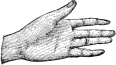
Fig. 275.
One is a sort of note of interrogation. For instance, if I were to meet a native and make the sign: Hand flat, fingers and thumb extended, the two middle fingers touching, the two outer slightly separated from the middle by turning the hand palm upward as I met him, it would mean: “Where are you going?” In other words I should say “Minna?” (what name?). (Smyth.) Fig. 275.
Some comparisons and illustrations connected with the signs for question appear on pages 291, 297, and 303, supra, and under Phrases, infra. Quintilian remarks upon this subject as follows: “In questioning, we do not compose our gesture after any single manner; the position of the hand, for the most part is to be changed, however disposed before.”
Soldier. ——, American.
The upright nearly closed hands, thumbs against the middle of the forefingers, being in front of the body, with their thumbs near together, palms forward, separate them about two feet horizontally on the same line. All in a line in front. (Cheyenne III; Dakota IV.)
Pass each hand down the outer seam of the pants. (Sac, Fox, and Kickapoo I.) “Stripes.”
Sign for White Man as follows: The extended index (M turned inward) is drawn from the left side of the head around in front to the right side, about on a line with the brim of the hat, with the back of the hand outward; and then for Fort, viz, on level of the breasts in front of body, both hands with fingers turned inward, straight, backs joined, backs of hands outward, horizontal, turn outward the hands until the fingers are free, curve them, and bring the wrists together so as to describe a circle with a space left between the ends of the curved fingers. (Dakota I.) “From his fortified place of abode.”
Another: Both hands in front of body, fists, backs outward, hands in contact, draw them apart on a straight line right to right, left to left about two feet, then draw the index, other fingers closed, across the forehead above the eyebrows. This is the sign preferred by the Sioux. (Dakota I.)
Extend the fingers of the right hand; place the thumb on the same plane close beside them, and then bring the thumb side of the hand horizontally against the middle of the forehead, palm downward and little finger to the front. (Dakota II; Ute I.) “Visor of forage cap.”
First make the sign for Soldier substantially the same as (Dakota VI) below, then that for White Man, viz.: Draw the opened right hand horizontally from left to right across the forehead a little above the eyebrows, the back of the hand to be upward and the fingers pointing toward the left; or, close all the fingers except the index and draw it across the forehead in the same manner. (Dakota IV.) For illustrations of other signs for white man see Figs 315 and 329, infra.

Fig. 276.
Place the radial sides of the clinched hands together before the chest, then draw them horizontally apart. (Dakota VI; Arikara I.) “All in a line.” Fig. 276.
Put thumbs to temples, and forefingers forward, meeting in front, other fingers closed. (Apache III.) “Cap-visor.”
——, Arikara.
Make the sign for Arikara (see Tribal Signs) and that for Brave. (Arikara I.)
——, Dakota.
Make the sign for Dakota (see Tribal Signs) and that for Soldier. (Dakota VI.)
——, Indian.
Both fists before the body, palms down, thumbs touching, then draw them horizontally apart to the right and left. (Arapaho II; Cheyenne V; Ponka II; Pani I.) This is the same sign illustrated in Fig. 276, above, as given by tribes there cited for white or American soldier. The tribes now cited use it for a soldier of the same tribe as the gesturer, or perhaps for soldier generically, as they subjoin a tribal sign or the sign for white man, when desiring to refer to any other than their own tribe.
Trade or Barter; Exchange. —— Trade.
First make the sign of Exchange (see below), then pat the left arm with the right finger, with a rapid motion from the hand passing it toward the shoulder. (Long.)
Strike the extended index finger of the right hand several times upon that of the left. (Wied.) I have described the same sign in different terms and at greater length. It is only necessary, however, to place the fingers in contact once. The person whom the prince saw making this sign may have meant to indicate something more than the simple idea of trade, i.e., trade often or habitually. The idea of frequency is often conveyed by the repetition of a sign (as in some Indian languages by repetition of the root). Or the sign-maker may have repeated the sign to demonstrate it more clearly. (Matthews.) Though some difference exists in the motions executed in Wied’s sign and that of (Oto and Missouri I), there is sufficient similarity to justify a probable identity of conception and to make them easily understood. (Boteler.) In the author’s mind exchange was probably intended for one transaction, in which each of two articles took the place before occupied by the other, and trade was intended for a more general and systematic barter, indicated by the repetition of strokes. Such distinction would not perhaps have occurred to most observers, but as the older authorities, such as Long and Wied, give distinct signs under the separate titles of trade and exchange they must be credited with having some reason for so doing. A pictograph connected with this sign is shown on page 381, supra.
Cross the forefingers of both hands before the breast. (Burton.) “Diamond cut diamond.” This conception of one smart trader cutting into the profits of another is a mistake arising from the rough resemblance of the sign to that for cutting. Captain Burton is right, however, in reporting that this sign for trade is also used for white man, American, and that the same Indians using it orally call white men “shwop,” from the English or American word “swap” or “swop.” This is a legacy from the early traders, the first white men met by the Western tribes, and the expression extends even to the Sahaptins on the Yakama River, where it appears incorporated in their language as swiapoin. It must have penetrated to them through the Shoshoni.
Cross the index fingers. (Macgowan.)
Cross the forefingers at right angles. (Arapaho I.)
Both hands, palms facing each other, forefingers extended, crossed right above left before the breast. (Cheyenne II.)
The left hand, with forefinger extended, pointing toward the right (rest of fingers closed), horizontal, back outward, otherwise as (M), is held in front of left breast about a foot; and the right hand, with forefinger extended (J), in front of and near the right breast, is carried outward and struck over the top of the stationary left (+) crosswise, where it remains for a moment. (Dakota I.)
Hold the extended left index about a foot in front of the breast, pointing obliquely forward toward the right, and lay the extended right index at right angles across the left, first raising the right about a foot above the left, palms of both inward, other fingers half closed. This is also an Arapaho sign as well as Dakota. Yours is there and mine is there; take either. (Dakota IV.)
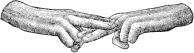
Fig. 277.
Place the first two fingers of the right hand across those of the left, both being slightly spread. The hands are sometimes used, but are placed edgewise. (Dakota V.) Fig. 277.
Another: The index of the right hand is laid across the forefinger of the left when the transaction includes but two persons trading single article for article. (Dakota V.)
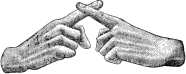
Fig. 278.
Strike the back of the extended index at a right angle against the radial side of the extended forefinger of the left hand. (Dakota VI, VII.) Fig. 278.
The forefingers are extended, held obliquely upward, and crossed at right angles to one another, usually in front of the chest. (Mandan and Hidatsa I.)
Bring each hand as high as the breast, forefinger pointing up, the other fingers closed, then move quickly the right hand to the left, the left to the right, the forefingers making an acute angle as they cross. (Omaha I; Ponka I.)
The palm point of the right index extended touches the chest; it is then turned toward the second individual interested, then touches the object. The arms are now drawn toward the body, semiflexed, with the hands, in type-positions (W W), crossed, the right superposed to the left. The individual then casts an interrogating glance at the second person. (Oto and Missouri I.) “To cross something from one to another.”
Close the hands, except the index fingers and the thumbs; with them open, move the hands several times past one another at the height of the breast; the index fingers pointing upward and the thumbs outward. (Iroquois I.) “The movement indicates ‘exchanging.’”
Hold the left hand horizontally before the body, with the forefinger only extended and pointing to the right, palm downward; then, with the right hand closed, index only extended, palm to the right, place the index at right angles on the forefinger of the left, touching at the second joints. (Kaiowa I; Comanche III; Apache II; Wichita II.)
Pass the hands in front of the body, all the fingers closed except the forefingers. (Sahaptin I.)
Close the fingers of both hands (K); bring them opposite each shoulder; then bring the hands across each other’s pathway, without permitting them to touch. At the close of the sign the left hand will be near and pointing at the right shoulder; right hand will be near and pointing at the left shoulder. (Comanche I.)
Close both hands, leaving the forefingers only extended; place the right before and several inches above the left, then pass the right hand toward the left elbow and the left hand toward the right elbow, each hand following the course made by a flourishing cut with a short sword. This sign, according to the informant, is also employed by the Banak and Umatilla Indians. (Comanche II; Pai-Ute I.)
The forefingers of both hands only extended, pass the left from left to right, and the right at the same time crossing its course from the tip toward the wrist of the left, stopping when the wrists cross. (Ute I.) “Exchange of articles.”
Right hand carried across chest, hand extended, palm upward, fingers and thumb closed as if holding something; left hand, in same position, carried across the right, palm downward. (Kutchin I.)
Hands pronated and forefingers crossed. (Zuñi I.)
Deaf-mute natural sign:
Close the hand slightly, as if taking something, and move it forward and open the hand as if to drop or give away the thing, and again close and withdraw the hand as if to take something else. (Ballard.)
American instructed deaf-mutes use substantially the sign described by (Mandan and Hidatsa I).
—— To buy.
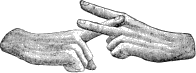
Fig. 279.
Hold the left hand about twelve inches before the breast, the thumb resting on the closed third and fourth fingers; the fore and second fingers separated and extended, palm toward the breast; then pass the extended index into the crotch formed by the separated fingers of the left hand. This is an invented sign, and was given to illustrate the difference between buying and trading. (Ute I.) Fig. 279.
Deaf-mute natural sign:
Make a circle on the palm of the left hand with the forefinger of the right hand, to denote coin, and close the thumb and finger as if to take the money, and put the hand forward to signify giving it to some one, and move the hand a little apart from the place where it left the money, and then close and withdraw the hand, as if to take the thing purchased. (Ballard.)
Italian sign:
To indicate paying, in the language of the fingers, one makes as though he put something, piece after piece, from one hand into the other—a gesture, however, far less expressive than that when a man lacks money, and yet cannot make up a face to beg it; or simply to indicate want of money, which is to rub together the thumb and forefinger, at the same time stretching out the hand. (Butler.) An illustration from De Jorio of the Neapolitan sign for money is given on page 297, supra.
—— Exchange.
The two forefingers are extended perpendicularly, and the hands are then passed by each other transversely in front of the breast so as nearly to exchange positions. (Long.)
Pass both hands, with extended forefingers, across each other before the breast. (Wied.) See remarks on this author’s sign for Trade, supra.
Hands brought up to front of breast, forefingers extended and other fingers slightly closed; hands suddenly drawn toward and past each other until forearms are crossed in front of breast. (Cheyenne II.) “Exchange; right hand exchanging position with the left.”
Left hand, with forefinger extended, others closed (M, except back of hand outward), is brought, arm extended, in front of the left breast, and the extended forefinger of the right hand, obliquely upward, others closed, is placed crosswise over the left and maintained in that position for a moment, when the fingers of the right hand are relaxed (as in Y), brought near the breast with hand horizontal, palm inward, and then carried out again in front of right breast twenty inches, with palm looking toward the left, fingers pointing forward, hand horizontal, and then the left hand performs the same movements on the left side of the body. (Dakota I.) “You give me, I give you.”
The hands, backs forward, are held as index hands, pointing upward, the elbows being fully bent; each hand is then, simultaneously with the other, moved to the opposite shoulder, so that the forearms cross one another almost at right angles. (Mandan and Hidatsa I.)
Yes; Affirmation; It is so. (Compare Good.)
The motion is somewhat like truth, viz: The forefinger in the attitude of pointing, from the mouth forward in a line curving a little upward, the other fingers being carefully closed; but the finger is held rather more upright, and is passed nearly straightforward from opposite the breast, and when at the end of its course it seems gently to strike something, though with rather a slow and not suddenly accelerated motion. (Long.)
Wave the hand straight forward from the face. (Burton.) This may be compared with the forward nod common over most of the world for assent, but that gesture is not universal, as the New Zealanders elevate the head and chin, and the Turks are reported by several travelers to shake the head somewhat like our negative. Rev. H. N. Barnum denies that report, giving below the gesture observed by him. He, however, describes the Turkish gesture sign for truth to be “gently bowing with head inclined to the right.” This sidewise inclination may be what has been called the shake of the head in affirmation.
Another: Wave the hand from the mouth, extending the thumb from the index and closing the other three fingers. (Burton.)
Gesticulate vertically downward and in front of the body with the extended forefinger (right hand usually), the remaining fingers and thumb closed, their nails down. (Creel; Arapaho I.)
Right hand elevated to the level and in front of the shoulder, two first fingers somewhat extended, thumb resting against the middle finger; sudden motion in a curve forward and downward. (Cheyenne II.) It has been suggested that the correspondence between this gesture and the one given by the same gesturer for sitting (made by holding the right hand to one side, fingers and thumb drooping, and striking downward to the ground or object to be sat upon) seemingly indicates that the origin of the former is in connection with the idea of “resting,” or “settling a question.” It is however at least equally probable that the forward and downward curve is an abbreviation of the sign for truth, true, a typical description of which follows given by (Dakota I). The sign for true can often be interchanged with that for yes, in the same manner as the several words.
The index of the horizontal hand (M), other fingers closed, is carried straight outward from the mouth. This is also the sign for truth. (Dakota I.) “But one tongue.”
Extend the right index, the thumb against it, nearly close the other fingers, and holding it about a foot in front of the right breast, bend the hand from the wrist downward until the end of the index has passed about six inches through an arc. Some at the same time move the hand forward a little. (Dakota IV.) “A nod; the hand representing the head and the index the nose.”
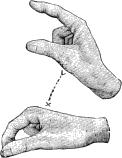
Fig. 280.
Hold the naturally closed hand before the right side of the breast, or shoulder, leaving the index and thumb extended, then throw the hand downward, bring the index against the inner side of the thumb. (Dakota VI, VII, VIII.) Fig. 280. Compare also Fig. 61, p. 286, supra, Quintilian’s sign for approbation.
The right hand, with the forefinger only extended and pointing forward, is held before and near the chest. It is then moved forward one or two feet, usually with a slight curve downward. (Mandan and Hidatsa I.)
Bend the right arm, pointing toward the chest with the index finger; unbend, throwing the hand up and forward. (Omaha I.)
Another: Close the three fingers, close the thumb over them, extend forefinger, and then shake forward and down. This is more emphatic than the preceding, and signifies, Yes, I know. (Omaha I.)
The right arm is raised to head with the index finger in type-position (I 1), modified by being more opened. From aside the head the hands sweep in a curve to the right ear as of something entering or hearing something; the finger is then more open and carried direct to the ground as something emphatic or direct. (Oto and Missouri I.) “‘I hear,’ emphatically symbolized.” It is doubted if this sign is more than an expression of understanding which may or may not imply positive assent. It would not probably be used as a direct affirmative, for instance, in response to a question.
The hand open, palm downward, at the level of the breast, is moved forward with a quick downward motion from the wrist, imitating a bow of the head. (Iroquois I.)
Throw the closed right hand, with the index extended and bent, as high as the face, and let it drop again naturally; but as the hand reaches its greatest elevation the index is fully extended and suddenly drawn into the palm, the gesture resembling a beckoning from above toward the ground. (Kaiowa I; Comanche III; Apache II; Wichita II.)
Quick motion of the right hand forward from the mouth; first position about six inches from the mouth and final as far again away. In first position the index finger is extended, the others closed; in final, the index loosely closed, thrown in that position as the hand is moved forward, as though hooking something with it; palm of hand out. (Sahaptin I.)
Another: Move right hand to a position in front of the body, letting arm hang loosely at the side, the thumb standing alone, all fingers hooked except forefinger, which is partially extended (E 1, palm upward). The sign consists in moving the forefinger from its partially extended position to one similar to the others, as though making a sly motion for some one to come to you. This is done once each time the assent is made. More emphatic than the preceding. (Sahaptin I.) “We are together, think alike.”
Deaf-mute natural sign:
Indicate by nodding the head. (Ballard.)
Deaf-mute sign:
The French mutes unite the extremities of the index and thumb so as to form a circle and move the hand downward with back vertical and turned outward. It has been suggested in explanation that the circle formed and exhibited is merely the letter O, the initial of the word oui.
Fiji sign:
Assent is expressed, not by a downward nod as with ourselves, but by an upward nod; the head is jerked backward. Assent is also expressed by uplifting the eyebrows. (Fison.)
Turkish sign:
One or two nods of the head forward. (Barnum.)
Other remarks and illustrations upon the signs for yes are given on page 286, supra.
TRIBAL SIGNS.
Absaroka or Crow.
The hands held out each side, and striking the air in the manner of flying. (Long.)
Imitate the flapping of the bird’s wings with the two hands, palms downward, brought close to the shoulder. (Burton.)
Imitate the flapping of a bird’s wings with the two hands, palms to the front and brought close to the shoulder. (Creel.)
Place the flat hand as high as and in front or to the side of the right shoulder, move it up and down, the motion occurring at the wrist. For more thorough representation both hands are sometimes employed. (Arapaho II; Cheyenne V; Dakota V, VI, VIII; Ponka II; Kaiowa I; Pani I; Comanche III; Apache II; Wichita II.) “Bird’s wing.”
Both hands extended, with fingers joined (W), held near the shoulders, and flapped to represent the wings of a crow. (Dakota II, III.)
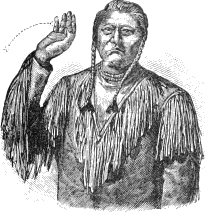
Fig. 281.
At the height of the shoulders and a foot outward from them, move the upright hands forward and backward twice or three times from the wrist, palms forward, fingers and thumbs extended and separated a little; then place the back or the palm of the upright opened right hand against the upper part of the forehead; or half close the fingers, placing the end of the thumb against the ends of the fore and middle fingers, and then place the back of the hand against the forehead. This sign is also made by the Arapahos. (Dakota IV.) “To imitate the flying of a bird, and also indicate the manner in which the Absaroka wear their hair.”
Make with the arms the motion of flapping wings. (Kutine I.)
The flat right hand, palm outward to the front and right, is held in front of the right shoulder, and quickly waved back and forth a few times. When made for the information of one ignorant of the common sign, both hands are used, and the hands are moved outward from the body, though still near the shoulder. (Shoshoni and Banak I.) “Wings, i.e., of a crow.” Fig. 281.
Apache.
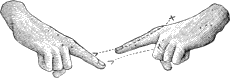
Fig. 282.
Make either of the signs for Poor, in property, by rubbing the index back and forth over the extended left forefinger; or, by passing the extended index alternately along the upper and lower sides of the extended left forefinger from tip to base. (Kaiowa I; Comanche III; Apache II; Wichita II.) Fig. 282. “It is said that when the first Apache came to the region they now occupy he was asked who or what he was, and not understanding the language he merely made the sign for poor, which expressed his condition.”
Rub the back of the extended left forefinger from end to end with the extended index. (Comanche II; Ute I.) “Poor, poverty-stricken.”
——, Coyotero.
Place the back of the right hand near the end of the foot, the fingers curved upward, to represent the turned-up toes of the moccasins. (Pima and Papago I; Apache I.) Fig. 283.
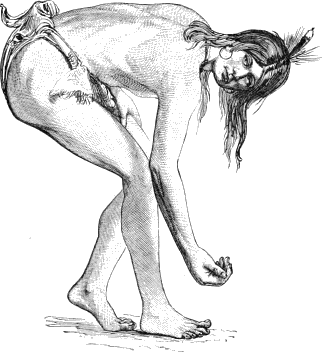
Fig. 283.
——, Mescalero.
Same sign as for Lipan q.v. (Kaiowa I; Comanche III; Apache II; Wichita II.)
——, Warm Spring.
Hand curved (Y, more flexed) and laid on its back on top of the foot (moccasins much curved up at toe); then draw hands up legs to near knee, and cut off with edges of hands (boot tops). (Apache III.) “Those who wear booted moccasins with turn-up toes.”
Arapaho.
The fingers of one hand touch the breast in different parts, to indicate the tattooing of that part in points. (Long.)
Seize the nose with the thumb and forefinger. (Randolph B. Marcy, captain United States Army, in The Prairie Traveler. New York, 1859, p. 215.)
Rub the right side of the nose with the forefinger: some call this tribe the “Smellers,” and make their sign consist of seizing the nose with the thumb and forefinger. (Burton.)
Finger to side of nose. (Macgowan.)
Touch the left breast, thus implying what they call themselves, viz: the “Good Hearts.” (Arapaho I.)
Rub the side of the extended index against the right side of the nose. (Arapaho II; Cheyenne V; Kaiowa I; Comanche III; Apache II; Wichita II.)
Hold the left hand, palm down, and fingers extended; then with the right hand, fingers extended, palm inward and thumb up, make a sudden stroke from left to right across the back of the fingers of the left hand, as if cutting them off. (Sac, Fox, and Kickapoo I.) This is believed to be an error of the authority, and should apply to the Cheyenne tribal sign.
Join the ends of the fingers (the thumb included) of the right hand, and, pointing toward the heart near the chest, throw the hand forward and to the right once, twice, or many times, through an arc of about six inches. (Dakota IV.) “Some say they use this sign because these Indians tattoo their breasts.”
Collect the fingers and thumb of the right hand to a point, and tap the tips upon the left breast briskly. (Comanche II; Ute I.) “Goodhearted.” It was stated by members of the various tribes at Washington, in 1880, that this sign is used to designate the Northern Arapahos, while that in which the index rubs against or passes upward alongside of the nose refers to the Southern Arapahos.
Another: Close the right hand, leaving the index only extended; then rub it up and down, held vertically, against the side of the nose where it joins the cheek. (Comanche II; Ute I.)
The fingers and thumb of the right hand, are brought to a point, and tapped upon the right side of the breast. (Shoshoni and Banak I.)
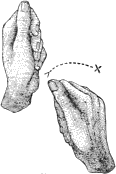
Fig. 284.
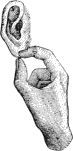
Fig. 285.
Arikara. (Corruptly abbreviated Ree.)
Imitate the manner of shelling corn, holding the left hand stationary, the shelling being done with the right. (Creel.) Fig. 284.
With the right hand closed, curve the thumb and index, join their tips so as to form a circle, and place to the lobe of the ear. (Absaroka I; Hidatsa I.) “Big ear-rings.” Fig. 285.
Both hands, fists, (B, except thumbs) in front of body, backs looking toward the sides of the body, thumbs obliquely upward, left hand stationary, the backs of the fingers of the two hands touching, carry the right thumb forward and backward at the inner side of the left thumb and without moving the hand from the left, in imitation of the act of shelling corn. (Dakota I, VII, VIII.)
Collect the fingers and thumb of the right hand nearly to a point, and make a tattooing or dotting motion toward the upper portion of the cheek. This is the old sign, and was used by them previous to the adoption of the more modern one representing “corn-eaters.” (Arikara I.)
Place the back of the closed right hand transversely before the mouth, and rotate it forward and backward several times. This gesture may be accompanied, as it sometimes is, by a motion of the jaws as if eating, to illustrate more fully the meaning of the rotation of the fist. (Kaiowa I; Comanche III; Wichita II; Apache I.) “Corn-eater; eating corn from the ear.”
Signified by the same motions with the thumbs and forefingers that are used in shelling corn. The dwarf Ree (Arikara) corn is their peculiar possession, which their tradition says was given to them by a superior being, who led them to the Missouri River and instructed them how to plant it. (Rev. C. L. Hall, in The Missionary Herald, April, 1880.) “They are the corn-shellers.” Have seen this sign used by the Arikaras as a tribal designation. (Dakota II.)
Assinaboin.
Hands in front of abdomen, horizontal, backs outward, ends of fingers pointing toward one another, separated and arched (H), then moved up and down and from side to side as though covering a corpulent body. This sign is also used to indicate the Gros Ventres of the Prairie or Atsina. (Dakota I.)
Make the sign of cutting the throat. (Kutine I.) As the Assinaboins belong to the Dakotan stock, the sign generally given for the Sioux may be used for them also.
With the right hand flattened, form a curve by passing it from the top of the chest to the pubis, the fingers pointing to the left, and the back forward. (Shoshoni and Banak I.) “Big bellies.”
Atsina, Lower Gros Ventre.
Both hands closed, the tips of the fingers pointing toward the wrist and resting upon the base of the joint, the thumbs lying upon and extending over the middle joint of the forefingers; hold the left before the chest, pointing forward, palm up, placing the right, with palm down, just back of the left, and move as if picking small objects from the left with the tip of the right thumb. (Absaroka I; Shoshoni and Banak I.) “Corn-shellers.”
Bring the extended and separated fingers and thumb loosely to a point, flexed at the metacarpal joints; point them toward the left clavicle, and imitate a dotting motion as if tattooing the skin. (Kaiowa I; Comanche III; Apache II; Wichita II.) “They used to tattoo themselves, and live in the country south of the Dakotas.”
See also the sign of (Dakota I) under Assinaboin.
Banak.
Make a whistling sound “phew” (beginning at a high note and ending about an octave lower); then draw the extended index across the throat from the left to the right and out to nearly at arm’s length. They used to cut the throats of their prisoners. (Pai-Ute I.)
Major Haworth states that the Banaks make the following sign for themselves: Brush the flat right hand backward over the forehead as if forcing back the hair. This represents the manner of wearing the tuft of hair backward from the forehead. According to this informant, the Shoshoni use the same sign for Banak as for themselves.
Blackfeet. (This title refers to the Algonkian Blackfeet, properly called Satsika. For the Dakota Blackfeet, or Sihasapa, see under head of Dakota.)
The finger and thumb encircle the ankle. (Long.)
Pass the right hand, bent spoon-fashion, from the heel to the little toe of the right foot. (Burton.)
The palmar surfaces of the extended fore and second fingers of the right hand (others closed) are rubbed along the leg just above the ankle. This would not seem to be clear, but these Indians do not make any sign indicating black in connection with the above. The sign does not, however, interfere with any other sign as made by the Sioux. (Creel; Dakota I.) “Black feet.”
Pass the flat hand over the outer edge of the right foot from the heel to beyond the toe, as if brushing off dust. (Dakota V, VII, VIII.) Fig. 286.
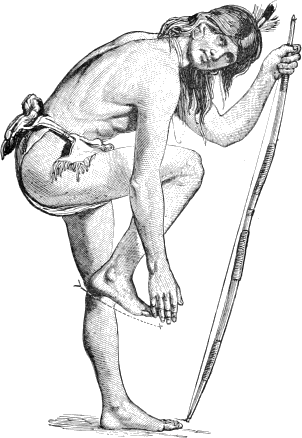
Fig. 286.
Touch the right foot with the right hand. (Kutine I.)
Close the right hand, thumb resting over the second joint of the forefinger, palm toward the face, and rotate over the cheek, though an inch or two from it. (Shoshoni and Banak I.) “From manner of painting the cheeks.” Fig. 287.
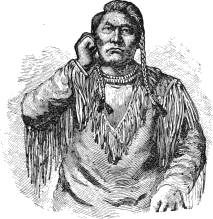
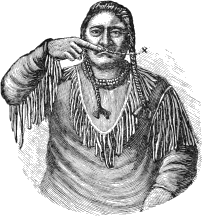
Fig. 287. Fig. 288.
Caddo.
Pass the horizontally extended index from right to left under the nose. (Arapaho II; Cheyenne V; Kaiowa I; Comanche I, II, III; Apache II; Wichita I, II.) “‘Pierced noses,’ from former custom of perforating the septum for the reception of rings.” Fig. 288. This sign is also used for the Sahaptin. For some remarks see page 345.
Calispel. See Pend d’Oreille.
Cheyenne.
Draw the hand across the arm, to imitate cutting it with a knife. (Marcy in Prairie Traveller, loc. cit., p. 215.)
Draw the lower edge of the right hand across the left arm as if gashing it with a knife. (Burton.)
With the index-finger of the right hand proceed as if cutting the left arm in different places with a sawing motion from the wrist upward, to represent the cuts or burns on the arms of that nation. (Long.)
Bridge palm of left hand with index-finger of right. (Macgowan.)
Draw the extended right hand, fingers joined, across the left wrist as if cutting it. (Arapaho I.)
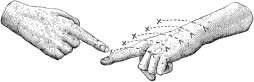
Fig. 289.
Pass the ulnar side of the extended index repeatedly across the extended finger and back of the left hand. Frequently, however, the index is drawn across the wrist or forearm. (Arapaho II; Cheyenne V; Ponka II; Pani I.) Fig. 289. See p. 345 for remarks.
The extended index, palm upward, is drawn across the forefinger of the left hand (palm inward), several times, left hand stationary, right hand is drawn toward the body until the index is drawn clear off; then repeat. Some Cheyennes believe this to have reference to the former custom of cutting the arm as offerings to spirits, while others think it refers to a more ancient custom of cutting off the enemy’s fingers for necklaces. (Cheyenne II.)
Place the extended index at the right side of the nose, where it joins the face, the tip reaching as high as the forehead, and close to the inner corner of the eye. This position makes the thumb of the right hand rest upon the chin, while the index is perpendicular. (Sac, Fox, and Kickapoo I.) It is considered that this sign, though given to the collaborator as expressed, was an error. It applies to the Southern Arapahos. Lieutenant Creel states the last remark to be correct, the gesture having reference to the Southern bands.
As though sawing through the left forearm at its middle with the edge of the right held back outward, thumb upward. Sign made at the left side of the body. (Dakota I.) “Same sign as for a saw. The Cheyenne Indians are known to the Sioux by the name of ‘The Saws.’”
Right-hand fingers and thumb extended and joined (as in S), outer edge downward, and drawn sharply across the other fingers and forearm as if cutting with a knife. (Dakota III.)
Draw the extended right index or the ulnar (inner) edge of the open right hand several times across the base of the extended left index, or across the left forearm at different heights from left to right. This sign is also made by the Arapahos. (Dakota IV.) “Because their arms are marked with scars from cuts which they make as offerings to spirits.”
Draw the extended index several times across the extended forefinger from the tip toward the palm, the latter pointing forward and slightly toward the right. From the custom of striping arms transversely with colors. (Kaiowa I; Comanche II, III; Apache II; Ute I; Wichita II.)
Another: Make the sign for Dog, viz: Close the right hand, leaving the index and second fingers only extended and joined, hold it forward from and lower than the hip and draw it backward, the course following the outline of a dog’s form from head to tail; then add the sign To Eat, as follows: Collect the thumb, index, and second fingers to a point, hold them above and in front of the mouth and make a repeated dotting motion toward the mouth. This sign is generally used, but the other and more common one is also employed, especially so with individuals not fully conversant with the sign language as employed by the Comanches, &c. (Kaiowa I; Comanche III; Apache II; Wichita II.) “Dog-eaters.”
Draw the extended index across the back of the left hand and arm as if cutting it. The index does not touch the arm as in signs given for the same tribe by other Indians, but is held at least four or five inches from it. (Shoshoni and Banak I.)
Chipeway. See Ojibwa.
Comanche.
Imitate, by the waving of the hand or forefinger, the forward crawling motion of a snake. (Burton, also Blackmore in introduction to Dodge’s Plains of the Great West. New York, 1877, p. xxv.) The same sign is used for the Shoshoni, more commonly called “Snake”, Indians, who as well as the Comanches belong to the Shoshonian linguistic family. “The silent stealth of the tribe.” (Dodge; Marcy in Thirty Years of Army Life on the Border. New York, 1866, p. 33.) Rev. A. J. Holt remarks, however, that among the Comanches themselves the conception of this sign is the trailing of a rope, or lariat. This refers probably to their well-known horsemanship.
Motion of a snake. (Macgowan.)
Hold the elbow of the right arm near the right side, but not touching it; extend the forearm and hand, palm inward, fingers joined on a level with the elbow, then with a shoulder movement draw the forearm and hand back until the points of the fingers are behind the body; at the same time that the hand is thus being moved back, turn it right and left several times. (Creel; Sac, Fox, and Kickapoo I.) “Snake in the grass. A snake drawing itself back in the grass instead of crossing the road in front of you.”
Another: The sign by and for the Comanches themselves is made by holding both hands and arms upward from the elbow, both palms inward, and passing both hands with their backs upward along the lower end of the hair to indicate long hair, as they never cut it. (Sac, Fox, and Kickapoo I.)
Right hand horizontal, flat, palm downward (W), advanced to the front by a motion to represent the crawling of a snake. (Dakota III.)
Extend the closed right hand to the front and left; extend the index, palm down, and rotate from side to side while drawing it back to the right hip. (Arapaho II; Cheyenne V; Dakota VI, VII, VIII; Ponka II; Kaiowa I; Pani I; Comanche III; Apache II; Wichita II.) This motion is just the reverse of the sign for Shoshoni, see Fig. 297 infra.
Make the reverse gesture for Shoshoni, i.e., begin away from the body, drawing the hand back to the side of the right hip while rotating it. (Comanche II.)
Cree, Knisteno, Kristeneaux.
Sign for Wagon and then the sign for Man. (Dakota I.) “This indicates the Red River half-breeds, with their carts, as these people are so known from their habit of traveling with carts.”
Place the first and second fingers of the right hand in front of the mouth. (Kutine I.)
Crow. See Absaroka.
Dakota, or Sioux.
The edge of the hand passed across the throat, as in the act of cutting that part. (Long; Marcy in Army Life, p. 33.)
Draw the lower edge of the hand across the throat. (Burton.)
Draw the extended right hand across the throat. (Arapaho I.) “The cut-throats.”
Pass the flat right hand, with palm down, from left to right across the throat. (Arapaho II; Cheyenne V; Dakota VI, VIII; Ponka II; Pani I.)
Draw the forefinger of the left hand from right to left across the throat. (Sac, Fox, and Kickapoo I.) “A cut-throat.”
Forefinger and thumb of right hand extended (others closed) is drawn from left to right across the throat as though cutting it. The Dakotas have been named the “cut-throats” by some of the surrounding tribes. (Dakota I.) “Cut-throats.”
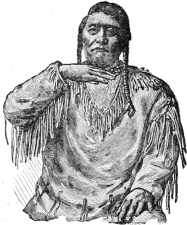
Fig. 290.
Right hand horizontal, flat, palm downward (as in W), and drawn across the throat as if cutting with a knife. (Dakota II, III.)
Draw the open right hand, or the right index, from left to right horizontally across the throat, back of hand upward, fingers pointing toward the left. This sign is also made by the Arapahos. (Dakota IV.) “It is said that after a battle the Utes took many Sioux prisoners and cut their throats; hence the sign ‘cut-throats’.”
Draw the extended right hand, palm downward, across the throat from left to right. (Kaiowa I; Comanche II, III; Shoshoni and Banak I; Ute I; Apache II; Wichita II.) “Cut-throats.” Fig. 290.
——, Blackfoot (Sihasapa).
Pass the flat right hand along the outer edge of the foot from the heel to beyond the toes. (Dakota VIII; Hidatsa I; Ponka II; Arikara I; Pani I.) Same as Fig. 286, above.
Pass the right hand quickly over the right foot from the great toe outward, turn the heel as if brushing something therefrom. (Dakota V.)
Pass the widely separated thumb and index of the right hand over the lower leg, from just below the knee nearly down to the heel. (Kaiowa I; Comanche III; Apache II; Wichita II.)
——, Brulé.
Rub the upper and outer part of the right thigh in a small circle with the open right hand, fingers pointing downward. This sign is also made by the Arapahos. (Dakota IV.) “These Indians were once caught in a prairie fire, many burned to death, and others badly burned about the thighs; hence the name Si-caⁿ-gu ‘burnt thigh’ and the sign. According to the Brulé chronology, this fire occurred in 1763, which they call ‘The-People-were-burned-winter.’”
Pass the flat right hand quickly over the thigh from near the buttock forward, as if brushing dust from that part. (Dakota V, VI, VII, VIII.)
Brush the palm of the right hand over the right thigh, from near the buttock toward the front of the middle third of the thigh. (Kaiowa I; Comanche III; Apache II; Wichita II.)
——, Ogalala.
Fingers and thumb separated, straight (as in R), and dotted about over the face to represent the marks made by the small-pox. (Arapaho II; Cheyenne V; Dakota III, VI, VII, VIII.) “This band suffered from the disease many years ago.”
With the thumb over the ends of the fingers, hold the right hand upright, its back forward, about six inches in front of the face, or on one side of the nose near the face, and suddenly extend and spread all the fingers, thumb included. (Dakota IV.) “The word Ogalala means scattering or throwing at, and the name was given them, it is said, after a row in which they threw ashes into one another’s faces.”
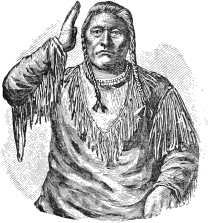
Fig. 291.
Flathead, or Selish.
One hand placed on the top of the head, and the other on the back of the head. (Long.)
Place the right hand to the top of the head. (Kutine I.)
Pat the right side of the head above and back of the ear with the flat right hand. (Shoshoni and Banak I.) From the elongation of the occiput. Fig. 291.
Fox, or Outagami.
Same sign as for Sac. (Sac, Fox, and Kickapoo I.)
Gros Ventre. See Hidatsa.
Hidatsa, Gros Ventre, or Minitari.
Both hands flat and extended, palms toward the body, with the tips of the fingers pointing toward one another; pass from the top of the chest downward, outward, and inward toward the groin. (Absaroka I; Dakota V, VI, VII, VIII; Shoshoni and Banak I.) “Big belly.”
Left and right hands in front of breast, left placed in position first, separated about four or five inches, left hand outside of the right, horizontal, backs outward, fingers extended and pointing left and right; strike the back of the right against the palm of the left several times, and then make the sign for Go, Going, as follows: Both hands (A 1) brought to the median line of body on a level with the breast, some distance apart, then describe a series of half circles or forward arch-like movements with both hands. (Dakota I.) “The Gros Ventre Indians, Minitaris (the Hidatsa Indians of Matthews), are known to the Sioux as the Indians who went to the mountains to kill their enemies; hence the sign.”
Express with the hand the sign of a big belly. (Dakota III.)
Pass the flat right hand, back forward, from the top of the breast, downward, outward, and inward to the pubis. (Dakota VI; Hidatsa I; Arikara I.) “Big belly.”
Indian (generically).
Hand in type-position K, inverted, back forward, is raised above the head with forefinger directed perpendicularly to the crown. Describe with it a short gentle curve upward and backward in such a manner that the finger will point upward and backward, back outward, at the termination of the motion. (Ojibwa V.) “Indicates a feather planted upon the head—the characteristic adornment of the Indian.”
Make the sign for White Man, viz: Draw the open right hand horizontally from left to right across the forehead a little above the eyebrows, the back of the hand to be upward and the fingers pointing toward the left, or close all the fingers except the index, and draw it across the forehead in the same manner; then make the sign for No; then move the upright index about a foot from side to side, in front of right shoulder, at the same time rotating the hand a little. (Dakota IV.)
Rub the back of the extended left hand with the palmar surfaces of the extended fingers of the right. (Comanche II.) “People of the same kind; dark-skinned.”
Rub the back of the left hand with the index of the right. (Pai-Ute I; Wichita I.)
Kaiowa.
Make the signs of the Prairie and of Drinking Water. (Burton; Blackmore in Dodge’s Plains of the Great West. New York, 1877, p. xxiv.)
Cheyennes make the same sign as (Comanche II), and think it was intended to convey the idea of cropping the hair. The men wear one side of the hair of the head full length and done up as among the Cheyennes, the other side being kept cropped off about even with the neck and hanging loose. (Cheyenne II.)
Right-hand fingers and thumb, extended and joined (as in W), placed in front of right shoulder, and revolving loosely at the wrist. (Dakota III.)
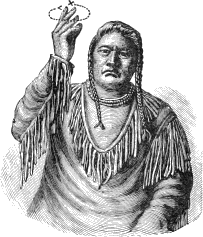
Fig. 292.
Place the flat hand with extended and separated fingers before the face, pointing forward and upward, the wrist near the chin; pass it upward and forward several times. (Kaiowa I; Comanche III; Apache II; Wichita II.)
Place the right hand a short distance above the right side of the head, fingers and thumb separated and extended; shake it rapidly from side to side, giving it a slight rotary motion in doing so. (Comanche II.) “Rattle-brained.” Fig. 292. See p. 345 for remarks upon this sign.
Same sign as (Comanche II), with the exception that both hands are generally used instead of the right one only. (Ute I.)
Make a rotary motion of the right hand, palm extended upward and outward by the side of the head. (Wichita I.) “Crazy heads.”
Kickapoo.
With the thumb and finger go through the motion of clipping the hair over the ear; then with the hand make a sign that the borders of the leggings are wide. (Sac, Fox, and, Kickapoo I.)
Knisteno or Kristeneaux. See Cree.
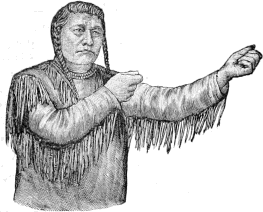
Fig. 293.
Kutine.
Place the index or second finger of the right hand on each side of the left index finger to imitate riding a horse. (Kutine I.)
Hold the left fist, palm upward, at arm’s length before the body, the right as if grasping the bowstring and drawn back. (Shoshoni and Banak I.) “From their peculiar manner of holding the long bow horizontally in shooting.” Fig. 293.
Lipan.
With the index and second fingers only extended and separated, hold the hand at arm’s length to the front of the left side; draw it back in distinct jerks; each time the hand rests draw the fingers back against the inside of the thumb, and when the hand is again started on the next movement backward snap the fingers to full length. This is repeated five or six times during the one movement of the hand. The country which the Lipans at one time occupied contained large ponds or lakes, and along the shores of these the reptile was found which gave them this characteristic appellation. (Kaiowa I; Comanche III; Apache III; Wichita II.) “Frogs.” Fig. 294.
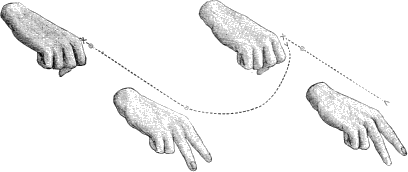
Fig. 294.
Mandan.
The first and second fingers of the right hand extended, separated, backs outward, other fingers and thumb closed, are drawn from the left shoulder obliquely downward in front of the body to the right hip. (Dakota I.) “The Mandan Indians are known to the Sioux as ‘The people who wear a scarlet sash, with a train,’ in the manner above described.”
Minitari. See Hidatsa.
Nez Percés. See Sahaptin.
Ojibwa, or Chippewa.
Right hand horizontal, back outward, fingers separated, arched, tips pointing inward, is moved from right to left breast and generally over the front of the body with a trembling motion and at the same time a slight outward or forward movement of the hand as though drawing something out of the body, and then make the sign for Man, viz: The right-hand is held in front of the right breast with the forefinger extended, straight upright (J), with the back of the hand outward; move the hand upward and downward with finger extended. (Dakota I.) “Perhaps the first Chippewa Indian seen by a Sioux had an eruption on his body, and from that his people were given the name of the ‘People with a breaking out,’ by which name the Chippewas have ever been known by the Sioux.”
Osage, or Wasaji.
Pull at the eyebrows over the left eye with the thumb and forefinger of the left hand. This sign is also used by the Osages themselves. (Sac, Fox, and Kickapoo I.)
Hold the flat right hand, back forward, with the edge pointing backward, against the side of the head, then make repeated cuts, and the hand is moved backward toward the occiput. (Kaiowa I; Comanche III; Apache II; Wichita II.) “Former custom of shaving the hair from the sides of the head, leaving but an occipito-frontal ridge.”
Pass the flat and extended right hand backward over the right side of the head, moving the index against the second finger in imitation of cutting with a pair of scissors. (Comanche II.) “Represents the manner of removing the hair from the sides of the head, leaving a ridge only from the forehead to the occiput.”
Outagami. See Fox.
Pani (Pawnee).
Imitate a wolf’s ears with the two forefingers of the right hand extended together, upright, on the left side of the head. (Burton.)
Place a hand on each side of the forehead, with two fingers pointing to the front to represent the narrow, sharp ears of the wolf. (Marcy in Prairie Traveler, p. 215.)
Extend the index and second fingers of the right hand upward from the right side of the head. (Arapaho II; Cheyenne V; Dakota VII, VIII; Ponka II; Pani I; Comanche II.)
Right hand, as (N), is passed from the back part of the right side of the head, forward seven or eight inches. (Dakota I.) “The Pani Indians are known as the Shaved-heads, i.e., leaving only the scalp locks on the head.”
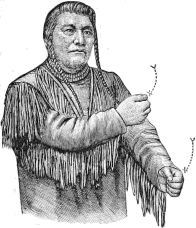
Fig. 295.
First and second fingers of right hand, straight upward and separated, remaining fingers and thumb closed (as in N), like the ears of a small wolf. (Dakota III.)
Place the closed right hand to the side of the temple, palm forward leaving the index and second fingers extended and slightly separated, pointing upward. This is ordinarily used, though, to be more explicit, both hands may be used. (Kaiowa I; Comanche III; Ute I; Apache II; Wichita II.) For illustration see Fig. 336, facing page 531.
Both fists are held as if grasping a paddle vertically downward and working a canoe. Two strokes are made on each side of the body from the side backward. (Shoshoni and Banak I.) Fig. 295.
Pend d’Oreille, or Calispel.
Make the motion of paddling a canoe. (Kutine I.)
Pueblo.
Place the clinched hand back of the occiput as if grasping the queue, then place both fists in front of the right shoulder, rotating them slightly to represent a loose mass of an imaginary substance. Represents the large mass of hair tied back of the head. (Arapaho II; Cheyenne V.)
Ree. See Arikara.
Sac, or Sauki.
Pass the extended palm of the right hand over the right side of the head from front to back, and the palm of the left hand in the same manner over the left side of the head. (Sac, Fox, and Kickapoo I.) “Shaved-headed Indians.”
Sahaptin, or Nez Percés.
The right index, back outward, passed from right to left under the nose. Piercing the nose to receive the ring. (Creel; Dakota I.)
Place the thumb and forefinger to the nostrils. (Kutine I.)
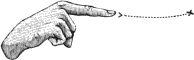
Fig. 296.
Close the right hand, leaving the index straight but flexed at right angles with the palm; pass it horizontally to the left by and under the nose. (Comanche II.) “Pierced nose.” Fig. 296. This sign is made by the Nez Percés for themselves, according to Major Haworth. Information was received from Arapaho and Cheyenne Indians, who visited Washington in 1880, that this sign is also used to designate the Caddos, who practiced the same custom of perforating the nasal septum. The same informants also state that the Shawnees are sometimes indicated by the same sign.
Pass the extended index, pointing toward the left, remaining fingers and thumb closed, in front of and across the upper lip, just below the nose. The second finger is also sometimes extended. (Shoshoni and Banak I.) “From the custom of piercing the noses for the reception of ornaments.”
See p. 345 for remarks upon the signs for Sahaptin.
Satsika. See Blackfeet.
Selish. See Flathead.
Sheepeater. See under Shoshoni.
Shawnee. See remarks under Sahaptin.
Shoshoni, or Snake.
The forefinger is extended horizontally and passed along forward in a serpentine line. (Long.)
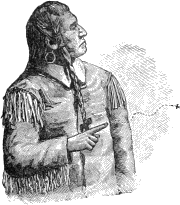
Fig. 297.
Right hand closed, palm down, placed in front of the right hip; extend the index and push it diagonally toward the left front, rotating it quickly from side to side in doing so. (Absaroka I; Shoshoni and Banak I.) “Snake.” Fig. 297.
Right hand, horizontal, flat, palm downward (W), advanced to the front by a motion to represent the crawling of a snake. (Dakota III.)
With the right index pointing forward, the hand is to be moved forward about a foot in a sinuous manner, to imitate the crawling of a snake. Also made by the Arapahos. (Dakota IV.)
Place the closed right hand, palm down, in front of the right hip; extend the index, and move it forward and toward the left, rotating the hand and finger from side to side in doing so. (Kaiowa I; Comanche II, III; Apache II; Wichita II.)
Make the motion of a serpent with the right finger. (Kutine I.)
Close the right hand, leaving the index only extended and pointing forward, palm to the left, then move it forward and to the left. (Pai-Ute I.) The rotary motion of the hand does not occur in this description, which in this respect differs from the other authorities.
——, Sheepeater. Tukuarikai.
Both hands, half closed, pass from the top of the ears backward, downward, and forward, in a curve, to represent a ram’s horns; then, with the index only extended and curved, place the hand above and in front of the mouth, back toward the face, and pass it downward and backward several times. (Shoshoni and Banak I.) “Sheep,” and “to eat.”
Sihasapa. See under Dakota.
Sioux. See Dakota.
Tennanah.
Right hand hollowed, lifted to mouth, and describing waving line gradually descending from right to left; left hand describing mountainous outline, one peak rising above the other. (Kutchin I.) “Mountain-river-men.”
Ute.
“They who live on mountains” have a complicated sign which denotes “living in mountains,” and is composed of the signs Sit and Mountain. (Burton.)
Rub the back of the extended flat left hand with the extended fingers of the right, then touch some black object. Represents black skin. Although the same sign is generally used to signify negro, an addition is sometimes made as follows: place the index and second fingers to the hair on the right side of the head, and rub them against each other to signify curly hair. This addition is only made when the connection would cause a confusion between the “black skin” Indian (Ute) and negro. (Arapaho II; Cheyenne V.)
Left hand horizontal, flat, palm downward, and with the fingers of the right hand brush the other toward the wrist. (Dakota III.)
Place the flat and extended left hand at the height of the elbow before the body, pointing to the front and right, palm toward the ground; then pass the palmar surface of the flat and extended fingers of the right hand over the back of the left from near the wrist toward the tips of the fingers. (Kaiowa I; Comanche III; Apache II; Wichita II.) “Those who use sinew for sewing, and for strengthening the bow.”
Indicate the color black, then separate the thumbs and forefingers of both hands as far as possible, leaving the remaining fingers closed, and pass upward over the lower part of the legs. (Shoshoni and Banak I.) “Black or dark leggings.”
Wasaji. See Osage.
Wichita.
Indicate a circle over the upper portion of the right cheek, with the index or several fingers of the right hand. The statement of the Indian authorities for the above is that years ago the Wichita women painted spiral lines on the breasts, starting at the nipple and extending several inches from it; but after an increase in modesty or a change in the upper garment, by which the breast ceased to be exposed, the cheek has been adopted as the locality for the sign. (Creel; Kaiowa I; Comanche III; Apache II; Wichita II.)
Extend the fingers and thumb of the right hand, semi-closed, and bring the hand toward the face nearly touching it, repeating this several times as if going through the motion of tattooing. The Comanches call the Wichitas “Painted Faces”; Caddos call them “Tattooed Faces,” both tribes using the same sign. (Comanche I.)
Wyandot.
Pass the flat right hand from the top of the forehead backward over the head and downward and backward as far as the length of the arm. (Wyandot I.) “From the manner of wearing the hair.”
PROPER NAMES.
Washington, City of.
The sign for go by closing the hand (as in type position B 1) and bending the arm; the hand is then brought horizontally to the epigastrium, after which both the hand and arm are suddenly extended; the sign for house or lodge; the sign for cars, consisting of the sign for go and wagon, e.g., both arms are flexed at a right angle before the chest; the hands then assume type position (L) modified by the index being hooked and the middle finger partly opened and hooked similarly; the hands are held horizontally and rotated forward side by side to imitate two wheels, palms upward; and the sign for council as follows: The right arm is raised, flexed at elbow, and the hand brought to the mouth (in type position G 1, modified by being inverted), palm up, and the index being more open. The hand then passes from the mouth in jerks, opening and closing successively; then the right hand (in position S 1), horizontal, marks off divisions on the left arm extended. The sign for father is briefly executed by passing the open hand down and from the loins, then bringing it erect before the body; then the sign for cars, making with the mouth the noise of an engine. The hands then raised before the eyes and approximated at points, as in the sign for lodge; then diverge to indicate extensive; this being followed by the sign for council. (Oto and Missouri I.) “The home of our father, where we go on the puffing wagon to council.”
Missouri River.
Make the sign for water by placing the right hand upright six or eight inches in front of the mouth, back outward, index and thumb crooked, and their ends about an inch apart, the other fingers nearly closed; then move it toward the mouth, and then downward nearly to the top of the breast-bone, at the same time turning the hand over toward the mouth until the little finger is uppermost; and the sign for large as follows: The opened right hands, palms facing, fingers relaxed and slightly separated, being at the height of the breast and about two feet apart, separate them nearly to arm’s length; and then rapidly rotate the right hand from right to left several times, its back upward, fingers spread and pointing forward to show that it is stirred up or muddy. (Dakota IV.)
Eagle Bull, a Dakota chief.

Fig. 300.
Place the clinched fists to either side of the head with the forefingers extended and curved, as in Fig. 298; then extend the left hand, flat, palm down, before the left side, fingers pointing forward; the outer edge of the flat and extended right hand is then laid transversely across the back of the left hand, and slid forward over the fingers as in Fig. 299. (Dakota VI; Arikara I.) “Bull and eagle—‘Haliaëtus leucocephalus, (Linn.) Sav.’” In the picture-writing of the Moquis, Fig. 300 represents the eagle’s tail as showing the difference of color which is indicated in the latter part of the above gesture.
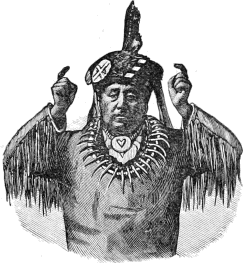
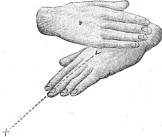
Fig. 298. Fig. 299.
Rushing Bear, an Arikara chief.
Place the right fist in front of the right side of the breast, palm down; extend and curve the thumb and little finger so that their tips point toward one another before the knuckles of the remaining closed fingers, then reach forward a short distance and pull toward the body several times ratter quickly; suddenly push the fist, in this form, forward to arm’s length twice. (Dakota VI; Arikara I.) “Bear, and rushing.”
Spotted Tail, a Dakota chief.
With the index only of the right hand extended, indicate a line of curve from the sacrum (or from the right buttock) downward, backward, and outward toward the right; then extend the left forefinger, pointing forward from the left side, and with the extended index draw imaginary lines transversely across the left forefinger. (Absaroka I; Shoshoni I; Dakota VI, VII; Arikara I.) “Tail, and spotted.”
Stumbling Bear, a Kaiowa chief.
Place the right fist in front of the right side of the breast, palm down; extend and curve the thumb and little finger so that their tips point toward one another before the knuckles of the remaining closed fingers; then place the left flat hand edgewise before the breast, pointing to the right; hold the right hand flat pointing down nearer the body; move it forward toward the left, so that the right-hand fingers strike the left palm and fall downward beyond the left. (Kaiowa I.) “Bear, and stumble or stumbling.”
Swift Runner, a Dakota warrior.
Place the right hand in front of the right side, palm down; close all the fingers excepting the index, which is slightly curved, pointing forward; then push the hand forward to arm’s length twice, very quickly. (Dakota VI; Arikara I.) “Man running rapidly or swiftly.”
Wild Horse, a Comanche chief.
Place the extended and separated index and second fingers of the right hand astraddle the extended forefinger of the left hand. With the right hand loosely extended, held as high as and nearly at arm’s length before the shoulder, make several cuts downward and toward the left. (Comanche III.) “Horse, and prairie or wild.”
PHRASES.
President of the United States; Secretary of the Interior.
Close the right hand, leaving the thumb and index fully extended and separated; place the index over the forehead so that the thumb points to the right, palm toward the face; then draw the index across the forehead toward the right; then elevate the extended index, pointing upward before the shoulder or neck; pass it upward as high as the top of the head; make a short turn toward the front and pass it pointing downward toward the ground, to a point farther to the front and a little lower than at the beginning. (Absaroka I; Dakota VI, VII; Shoshoni and Banak I; Ute I; Apache I.) “White man and chief.”
Make the sign for white man (American), by passing the palmar surface of the extended index and thumb of the right hand across the forehead from left to right, then that for chief, and conclude by making that for parent by collecting the fingers and thumb of the right hand nearly to a point and drawing them forward from the left breast. (Kaiowa I; Comanche III; Apache II; Wichita II.) “White man; chief; father.”
Secretary of the Interior.
Draw the palmar side of the index across the forehead from left to right, resting the thumb upon the right temple, then make the sign for chief—the white chief, “Secretary;” then make the sign for great lodge, council house, by making the sign for lodge, then placing both hands somewhat bent, palms facing, about ten inches apart, and passing them upward from the waist as high as the face. (Arikara I.)
Where is your mother?
After placing the index into the mouth—mother, point the index at the individual addressed—your, then separate and extend the index and second fingers of the right hand; hold them, pointing forward, about twelve or fifteen inches before the face, and move them from side to side, eyes following the same direction—I see, then throw the flat right hand in a short curve outward to the right until the back points toward the ground—not, and look inquiringly at the individual addressed. (Ute I.) “Mother your I see not; where is she?”
Are you brave?
Point to the person and make sign for brave, at same time looking with an inquiring expression. (Absaroka I; Shoshoni and Banak I.)
Bison, I have shot a.
Move the open left hand, palm to the front, toward the left and away from the body slowly (motion of the buffalo when chased). Move right hand on wrist as axis, rapidly (man on pony chasing buffalo); then extend left hand to the left, draw right arm as if drawing a bow, snap the forefinger and middle finger of left hand, and thrust the right forefinger over the left hand. (Omaha I.)
Give me something to eat.
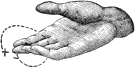
Fig. 301.
Bring the thumb, index and second fingers to a point as if grasping a small object, the remaining fingers naturally extended, then place the hand just above the mouth and a few inches in front of it, and make repeated thrusts quickly toward the mouth several times; then place the naturally extended right hand nearly at arm’s length before the body, palm up, fingers pointing toward the front and left, and make a short circular motion with the hand, as in Fig. 301, bringing the outer edge toward the body as far as the wrist will permit, throwing the hand forward again at a higher elevation. The motion being at the wrist only. (Absaroka I; Dakota VII, VIII; Comanche III.)
I will see you here after next year.
Raise the right hand above the head (J 2), palm to the front, all the fingers closed except the index, hand slanting a little to backward, then move forward and downward toward the person addressed, describing a curve. (Omaha I.)
You gave us many clothes, but we don’t want them.
Lean forward, and, holding the hands concavo-convex, draw them up over the limbs severally, then cross on the chest as wrapping a blanket. The arms are then extended before the body, with the hands in type-position (W), to a height indicating a large pile. The right hand then sweeps outward, showing a negative state of mind. The index of right hand finally touches the chest of the second party and approaches the body, in position (I), horizontal. (Oto and Missouri I.) “Something to put on that I don’t want from you.”
Question. See also this title in Extracts from Dictionary.
Hold the extended and flattened right hand, palm forward, at the height of the shoulder or face, and about fifteen inches from it, shaking the hand from side to side (at the wrist) as the arm is slightly raised, resembling the outline of an interrogation mark (?) made from below upward. (Absaroka I; Dakota V, VI, VII; Hidatsa I; Kaiowa I; Arikara I; Comanche II, III; Pai-Ute I; Shoshoni and Banak I; Ute I; Apache I, II; Wichita II.)
—— What? What is it?
First attract the person’s notice by the sign for attention, viz: The right hand (T) carried directly out in front of the body, with arm fully extended and there moved sidewise with rapid motions; and then the right hand, fingers extended, pointing forward or outward, fingers joined, horizontal, is carried outward, obliquely in front of the right breast, and there turned partially over and under several times. (Dakota I.)
—— What are you doing? What do you want?
Throw the right hand about a foot from right to left several times, describing an arc with its convexity upward, palm inward, fingers slightly bent and separated, and pointing forward. (Dakota IV.)
—— When?
With its index extended and pointing forward, back upward, rotate the right hand several times to the right and left, describing an arc with the index. (Dakota IV.)
—— What are you? i.e., What tribe do you belong to?
Shake the upright open right hand four to eight inches from side to side a few times, from twelve to eighteen inches in front of the chin, the palm forward, fingers relaxed and a little separated. (Dakota IV.)
It must be remarked that in the three preceding signs there is no essential difference, either between themselves or between them and the general sign for Question above given, which can be applied to the several special questions above mentioned. A similar remark may be made regarding several signs given below, which are printed in deference to collaborators.
Pass the right hand from left to right across the face. (Kutine I.)
—— What do you want?
The arm is drawn to front of chest and the hand in position (N 1), modified by palms being downward and hand horizontal. From the chest center the hand is then passed spirally forward toward the one addressed; the hand’s palm begins the spiral motion with a downward and ends in an upward aspect. (Oto I.) “To unwind or open.”
—— Whence come you?
First the sign for you, viz: The hand open, held upward obliquely, and pointing forward; then the hand extended open and drawn to the breast, and lastly the sign for bringing, as follows: The hand half shut, with the thumb pressing against the forefinger, being first moderately extended either to the right or left, is brought with a moderate jerk to the opposite side, as if something was pulled along by the hand. (Dunbar.)
—— Who are you? or what is your name?
The right or left hand approximates close to center of the body; the arm is flexed and hand in position (D), or a little more closed. From inception of sign near center of body the hand slowly describes the arc of a quadrant, and fingers unfold as the hand recedes. We think the proper intention is for the inception of sign to be located at the heart, but it is seldom truly, anatomically thus located. (Oto I.) “To unfold one’s self or make known.”
—— Are you through?
With arms hanging at the side and forearms horizontal, place the fists near each other in front of body; then with a quick motion separate them as though breaking something asunder. (Sahaptin I.)
—— Do you know?
Shake the right hand in front of the face, a little to the right, the whole arm elevated so as to throw the hand even with the face, and the forearm standing almost perpendicular. Principal motion with hand, slight motion of forearm, palm out. (Sahaptin I.)
—— How far is it?
Sign for Do you know? followed with a precise movement throwing right hand (palm toward face) to a position as far from body as convenient, signifying far; then with the same quick, precise motion, bring the hand to a position near the face—near. (Sahaptin I.)
—— How will you go—horseback or in wagon?
First make the sign for Do you know? then throw right hand forward—go or going; then throw fore and middle fingers of right astride the forefinger of the left hand, signifying, will you ride?; then swing the forefingers of each hand around each other, sign of wheel running, signifying, or will you go in wagon? (Sahaptin I.)
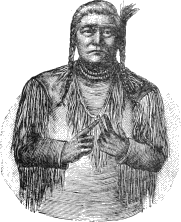
Fig. 302.
—— How many?
After making the sign for question, touch the tips of as many of the extended and separated fingers of the left hand held in front of the body upright, with back outward, with the right index as may be necessary. (Dakota I.) “Count them off to me—how many?”
Place the left hand carelessly before the breast, fingers extended and slightly separated, back to the front, then count off a few with the extended index, by laying down the fingers of the left, beginning at the little finger, as in Fig. 302. In asking the question, the sign for question must precede the sign for many, the latter being also accompanied by a look of interrogation. (Shoshoni and Banak I.)
—— Has he?
Deaf-mute natural sign:
Move to and fro the finger several times toward the person spoken of (Larson.)
—— Have you?
Deaf-mute natural sign:
Move the finger to and fro several times toward the person to whom the one is speaking. (Larson.)
—— Are you?
Deaf-mute natural signs:
Point to the person spoken to and slightly nod the head, with an inquiring look. (Ballard.)
Point with the forefinger, as if to point toward the second person, at the same time nod the head as if to say “yes.” (Ziegler.)
The following was obtained at Washington during the winter of 1880-’81 from Ta-taⁿ-ka Wa-kaⁿ (Medicine Bull), a Brulé Dakota chief, by Dr. W. J. Hoffman.
I am going home in two days.
(1) Place the flat hands in front of and as high as the elbows, palms down, pass each hand across to the opposite side of the body, the right above the left crossing near the wrist at the termination of the gesture (night), repeat in quick succession—nights, (2) elevate the extended index and second finger of the right hand, backs to the front—two, (3) place the tips of the extended and joined fingers of the right hand against the breast—I, (4) after touching the breast as in the preceding, pass the extended index from the breast, pointing downward, forward nearly to arm’s length, and terminating by holding the hand but continuing the motion of the index until it points forward and upward—am going to, (5) throw the clinched right fist about six inches toward the earth at arm’s length after the completion of the preceding gesture—my home.
ANALYSIS.
Haⁿ-he´-pi noⁿ´-pa mi´-ye ti-ya´-ta wa-gle´-kta.
(1) nights (2) two (3) I (5) my home (4) am going to.
It will be noticed that the gesture No. 4, “am going to,” was made before the gesture No. 5, “my home,” although the Dakota words pronounced were in the reverse order, showing a difference in the syntax of the gestures and of the oral speech in this instance. The other gestures, 1, 2, and 3, had been made deliberately, the Dakota word translating each being in obvious connection with the several gestures, but the two final words were pronounced rapidly together as if they could not in the mind of the gesturer be applied separately to the reversed order of the signs for them.
The same authority obtained the above sentence in Ponka and Pani, together with the following signs for it, from individuals of those tribes. Those signs agreed between each other, but differed from the Dakota, as will be observed, in the signs to my house, as signifying to my home.
(1) Touch the breast with the tips of the extended fingers—I. This precedes the signs for Nos. 2, 3, 4, and 5, which correspond to Nos. 1, 2, 3, and 4 of the Dakota; then follows: (6) place the tips of the extended fingers of the flat hands together, leaving the wrists about six inches apart—lodge, (7) and conclude by placing the clinched fists nearly at arm’s length before the body, the right several inches above the left, then throw them toward the ground—about six or eight inches—the fists retaining their relative positions—my, mine.
ANALYSIS.
The following is the Ponka sentence as given by the gesturer in connection with the several gestures as made:
. . . . Naⁿ´-ba jaⁿ ʞi a-g¢e´ ta miñ´-ke ʇi wi´-wi-a tĕ´-ʇa.
(1) (3) (2) (4) (5) (6) (7)
The following is the full sentence as spoken by Ponkas without regard to gesture, and its literal translation:
Naⁿ´-ba jaⁿ ʞĭ a-g¢e´ ta´ miñ´-ke ʇi
Two night, sleep if, when I go homeward will I who lodge
wi´-wi-ʇa tè´-ʇa. . .
my own the, one, standing object, to.
The Pani gestures were given with the accompanying words, viz:
Pit´ ku-rĕt´ ka´-ha wi ta-tukh´-ta a-ka´-ru ru-rĕt´-i-ru.
(1) I (3) (In) two (2) nights (4) I (5) am going (6) house (7) to my.
The orthography in the above sentences, as in others where the original text is given (excepting the Dakota and Ojibwa), is that adopted by Maj. J. W. Powell in the second edition of the Introduction to the Study of Indian Languages. Washington, 1880. The characters more particularly requiring explanation are the following, viz:
¢, as th in then, though.
ñ, as ng in sing, singer; Sp. luengo.
ʞ, an intermediate sound between k and g in gig.
kh, as the German ch, in nacht.
ʇ, an intermediate sound between t and d.
Nasalized vowels are written with a superior n, thus: aⁿ, eⁿ.
The following phrases were obtained by the same authority from Antonito, son of Antonio Azul, chief of the Pimas in Arizona.
I am hungry, give me something to eat.
(1) Touch the breast with the tips of the extended fingers of the right hand—I, (2) place the outer edge of the flat and extended right hand against the pit of the stomach, palm upward, then make a sawing motion from side to side with the hand—hunger, (3) place the right hand before the face, back upward, and fingers pointing toward the mouth, then thrust the fingers rapidly to and from the mouth several times—eat.
ANALYSIS.
Aⁿ-an´-t pi´-hu-ki’um . . . . .
(1) I (have) (2) hunger (3) eat.
The last sign is so intimately connected with that for hunger, that no translation can be made.
Give me a drink of water.
(1) Place the tips of the index and thumb together, the remaining fingers curved, forming a cup, then pass it from a point about six inches before the chin, in a curve upward, backward and downward past the mouth—water, (2) then place the flat right hand at the height of the elbow in front of or slightly to the right of the body, palm up, and in passing it slowly from left to right, give the hand a lateral motion at the wrist—give me.
ANALYSIS.
Shu´-wu-to do´-i’.
(1) water (2) give me.
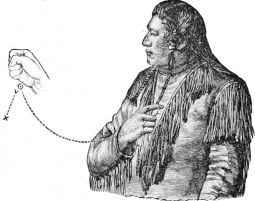
Fig. 303.
The following was also obtained by Dr. W. J. Hoffman from Ta-taⁿ-ka Wa-kaⁿ, before referred to, at the time of his visit to Washington.
I am going home.
(1) Touch the breast with the extended index—I, (2) then pass it in a downward curve, outward and upward toward the right nearly to arm’s length, as high as the shoulder—am going (to), (3) and when at that point suddenly clinch the hand and throw it edgewise a short distance toward the ground—my country, my home. Fig. 303.
ANALYSIS.
Ma-ko´-ce mi-ta´-wa kin e-kta´ wa-gle´ kta.
(3) (2) (1)
Country my own the to I go home will.
DIALOGUES.
TENDOY-HUERITO DIALOGUE.
The following conversation took place at Washington in April, 1880, between Tendoy, chief of the Shoshoni and Banak Indians of Idaho, and Huerito, one of the Apache chiefs from New Mexico, in the presence of Dr. W. J. Hoffman. Neither of these Indians spoke any language known to the other, or had ever met or heard of one another before that occasion:
Huerito.—Who are you?
Place the flat and extended right hand, palm forward, about twelve inches in front of and as high as the shoulder, then shake the hand from side to side as it is moved forward and upward—question, who are you? Fig. 304.
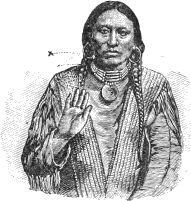
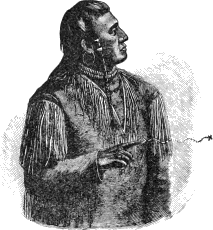
Fig. 304. Fig. 305.
Tendoy.—Shoshoni chief.
Place the closed right hand near the right hip leaving the index only extended, palm down; then pass the hand toward the front and left, rotating it from side to side—Shoshoni, Fig. 305; then place the closed hand, with the index extended and pointing upward, near the right cheek, pass it upward as high as the head, then turn it forward and downward toward the ground, terminating with the movement a little below the initial point—chief. Fig. 306.
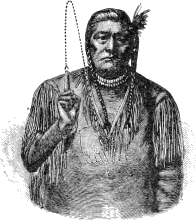
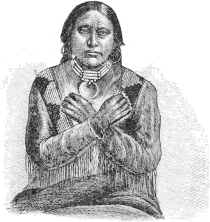
Fig. 306. Fig. 307.
Huerito.—How old are you?
Clinch both hands and cross the forearms before the breast with a trembling motion—cold—winter, year, Fig. 307; then elevate the left hand as high as the neck and about twelve or fifteen inches before it, palm toward the face, with fingers extended and pointing upward; then, with the index, turn down one finger after another slowly, beginning at the little finger, until three or four are folded against the palm, and look inquiringly at the person addressed—how many? See Fig. 302.
Tendoy.—Fifty-six.
Close and extend the fingers and thumbs of both hands, with the palms forward, five times—fifty; then extend the fingers and thumb of the left hand, close the right, and place the extended thumb alongside of and near the left thumb—six. Fig. 308.
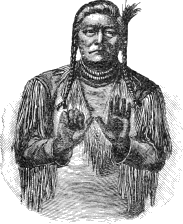
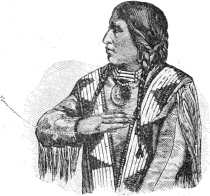
Fig. 308. Fig. 309.
Huerito.—Very well. Are there any buffalo in your country?
Place the flat right hand, pointing to the left, with the palm down, against the breast-bone; then move it forward and slightly to the right and in an upward curve; make the gesture rather slow and nearly to arm’s length (otherwise, i.e., if made hastily and but a short distance, it would only mean good)—very good, Fig. 309; place both closed hands to their respective sides of the head, palms toward the hair, leaving the forefingers curved—buffalo, see Fig. 298, p. 477; then reach out the fist to arm’s length toward the west, and throw it forcibly toward the ground for a distance of about six inches, edge downward—country, away to the west; then point the curved index rather quickly and carelessly toward the person addressed—your.
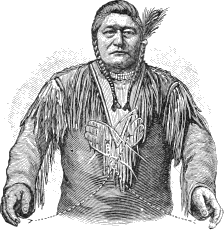
Fig. 310.
Tendoy.—Yes; many black buffalo.
Pass the closed right hand, with the index partly flexed, to a position about eight inches before the right collar-bone, and, as the hand reaches that elevation, quickly close the index—yes; then make the same sign as in the preceding question for buffalo; touch the hair on the right side of the head with the palms of the extended fingers of the right hand—black; spread the curved fingers and thumbs of both hands, place them before either thigh, pointing downward; then draw them toward one another and upward as high as the stomach, so that the fingers will point toward one another, or may be interlaced—many. Fig. 310.
Tendoy.—Did you hear anything from the Secretary? If so, tell me.
Close the right hand, leaving the index and thumb widely separated, pass it by the ear from the back of the ear downward and toward the chin, palm toward the head—hear, see Fig. 316, p. 492; point to the individual addressed—you; close the hand again, leaving the index and thumb separated as in the sign for hear and placing the palmar surface of the finger horizontally across the forehead, pointing to the left, allow the thumb to rest against the right temple; then draw the index across the forehead from left to right, leaving the thumb touching the head—white man; then place the closed hand, with elevated index, before the right side of the neck or in front of the top of the shoulder; pass the index, pointing upward, as high as the top of the head; turn it forward and downward as far as the breast—chief; pass the extended index, pointing up ward and forward, forward from the mouth twice—talk; then open and flatten the hand, palm up, outer edge toward the face, place it about fifteen inches in front of the chin, and draw it horizontally inward until the hand nearly touches the neck—tell me.
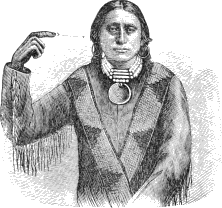
Fig. 311.
Huerito.—He told me that in four days i would go to my country.
Close the right hand, leaving the index curved; place it about six inches from the ear and move it in toward the external meatus—told me, hear, I heard, Fig. 311; with the right hand still closed, form a circle with the index and thumb by allowing their tips to touch; pass the hand from east to west at arm’s length—day; place the left hand before the breast, the fingers extended, and the thumb resting against the palm, back forward, and, with the index, turn down one finger after another, beginning at the little finger—four; touch the breast with the tips of the finger and thumb of the left hand collected to a point—I; drop the hand a short distance and move it forward to arm’s length and slightly upward until it points above the horizon—go to*; then as the arm is extended, throw the fist edgewise toward the ground—my country.
Tendoy.—In two days I go to my country just as you go to yours. I go to mine where there is a great deal of snow, and we shall see each other no more.
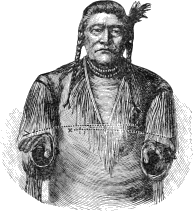
Fig. 312.
Place the flat hands horizontally, about two feet apart, move them quickly in an upward curve toward one another until the right lies across the left—night, Fig. 312, repeat this sign—two nights (literally two sleeps hence); point toward the individual addressed with the right hand—you; and in a continuous movement pass the hand to the right, i.e., toward the south, nearly to arm’s length—go; then throw the fist edgewise toward the ground at that distance—your country; then touch the breast with the tips of the fingers of the left hand—I; move the hand off slowly toward the left, i.e., toward the north to arm’s length—go to*; and throw the clinched hand toward the ground—my country; then hold both hands toward the left as high as the head, palms down, with fingers and thumbs pendent and separated; move them toward the ground two or three times—rain, Fig. 313; then place the flat hands horizontally to the left of the body about two feet from the ground—deep; (literally, deep rain) snow—and raise them until about three feet from the ground—very deep—much; place the hands before the body about twelve inches apart, palms down, with forefingers only extended and pointing toward one another; push them toward and from one another several times—see each other, Fig. 314; then hold the flat right hand in front of the breast, pointing forward, palm to the left, and throw it over on its back toward the right—not, no more.
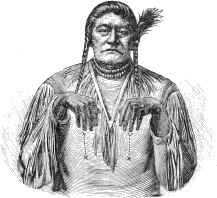
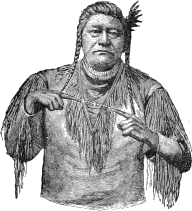
Fig. 313. Fig. 314.
Explanatory Note.—Where the asterisks appear in the above dialogue the preposition to is included in the gesture. After touching the breast for I, the slow movement forward signifies going to, and country is signified by locating it at arm’s length toward the west, to the left of the gesturer, as the stopping-place, also possession by the clinched fist being directed toward the ground. It is the same as for my or mine, though made before the body in the latter signs. The direction of Tendoy’s hands, first to the south and afterwards to the north, was understood not as pointing to the exact locality of the two parts of the country, but to the difference in their respective climates.
OMAHA COLLOQUY.
The following is contributed by Rev. J. Owen Dorsey:
Question. From what quarter is the wind?
Raise the curved right hand, palm in, in front of the left shoulder. Draw in toward the body a little, then from the body several times in different directions.
Answer. From that quarter.
Hand as above; draw in towards the body once, and farther with emphasis, according to the direction of the wind.
BRULÉ DAKOTA COLLOQUY.
The following signs, forming a question and answer, were obtained by Dr. W. J. Hoffman, from Ta-taⁿ-ka Wa-kaⁿ (Medicine Bull), a Brulé Dakota chief who visited Washington during the winter of 1880-’81:
Question. We went to the department [of the interior], shook hands with the secretary and had a conversation with him, did you hear of it?
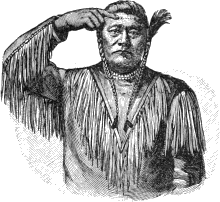
Fig. 315.
(1) Extend and separate the thumb and index, leaving the remaining fingers closed, place the ball of the thumb against the temple above the outer corner of the eye, and the index across the forehead, the tip resting on the left temple, then draw the index across to the right until its tip touches the thumb—white man, Fig. 315; (2) Elevate the extended index before the shoulder, palm forward, pass it upward, as high as the head, and forming a short curve to the front, then downward again slightly to the front to before the breast and about fifteen inches from it—chief; (3) Fingers of both hands extended and separated; then interlace them so that the tips of the fingers of one hand protrude beyond the backs of those of the opposing one; hold the hands in front of the breast, pointing upward, leaving the wrists about six inches apart—lodge; (4) Place the left hand a short distance before the breast, palm down and slightly arched, fingers directed toward the right and front, then pass the flat and extended right hand forward, under and beyond the left, forming a downward curve, the right hand being as high as the left at the commencement and termination of the gesture—enter, entered; (5) Clasp the hands before the body, left uppermost—shook hands, friendly; (6) Place the flat right hand before the chin, palm up with fingers directed to the left, then pass the hand forward several times—talk, talked to him; (7) Reverse this motion, beginning away from the body, drawing the hand edgewise toward the chin several times—talked to me; (8) Separate the extended thumb and index as far as possible, leaving the remaining fingers closed, place the hand about six inches opposite the right ear, palm toward the head, then pass it in a curve forward and downward, terminating at the height of the elbow—hear, heard; (9) then in a continuous movement direct the extended index at the individual addressed, the face expressing a look of inquiry—you.