XXIV. HELLEU.
Reading edition
THE copper on which some master of etching will, sometimes in an hour, engrave in dry-point the latest of his conceptions, the newest impression he has received from the world, is, like the pages of a draughtsma sketch-book, the revelation of just that thing that strikes him the most. The character—in a sense, the temperament—of the artist is betrayed or hinted at by his selection; notwithstanding that the selection, if the man is wise at all, owes something to his knowledge of what are the bounds of his capacity. The work of the great etchers—Rembrandt apart, and he was practically unlimited—shows this. The subtleties of the figure interested Sir Seymour Haden less than the curve of a great stream, the light and shade in an old garden, or the broken surface of a Dorset heath. It is, at least, not emotional incidents that have been the mainspring of the art of Mr. Whistler; for he has been
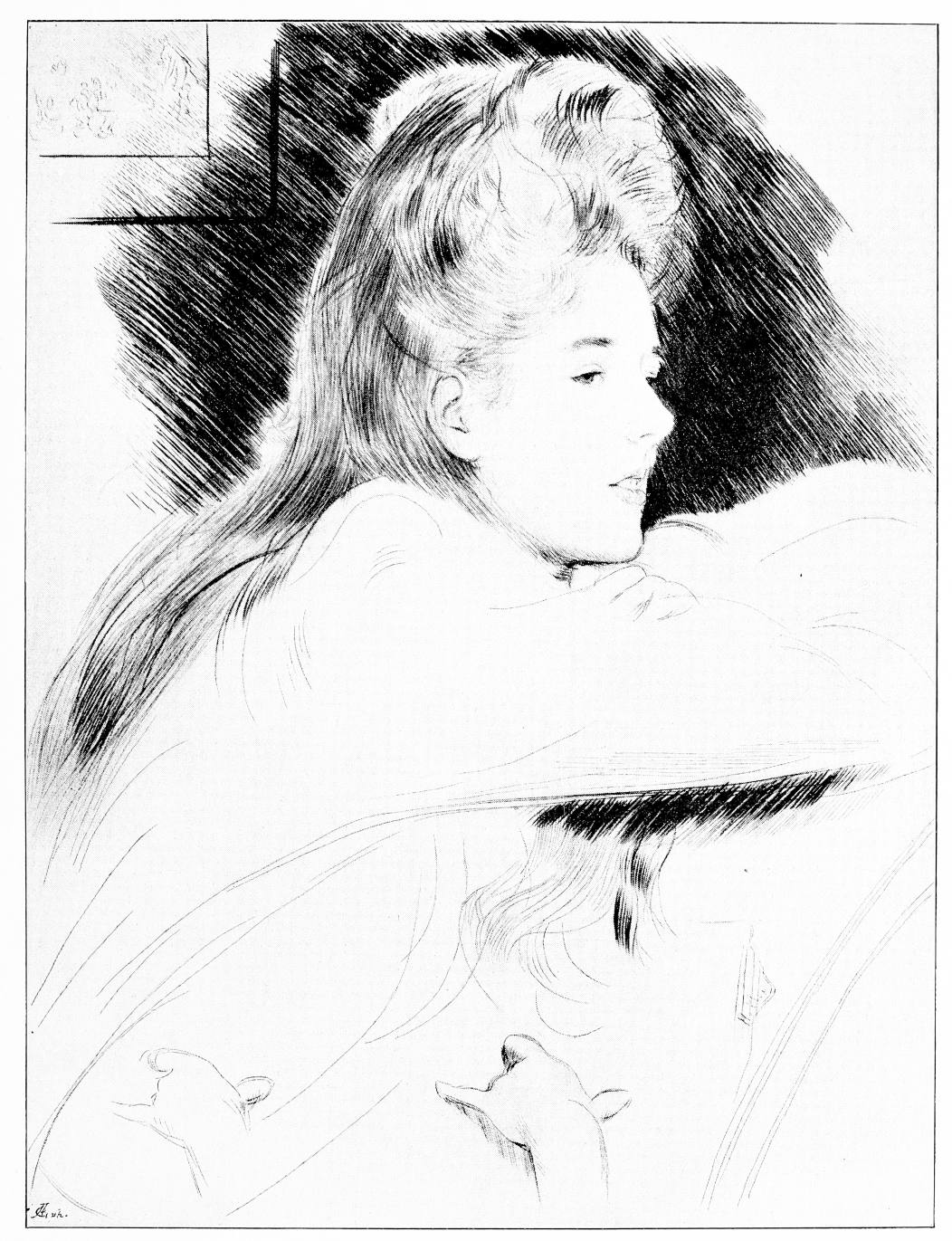
HELLEU. “ÉTUDE DE JEUNE FILLE.”
inspired by the material that he was readiest to receive. And so in the work of that brilliant artist in dry-point to whom I turn last of all, there is evident the sign of his own leanings, the engaging suggestion of those things in his daily life which he most sympathetically notes. And M. Helleu is, above all things, the recorder of the beautiful or the refined interior, with its charm of artistic and harmonious detail—its charm, above all, of feminine life, or of the life of children.
It is as an artist working in pastels that M. Helleu—a man still in young middle age—happens to have been longest known. And his pastels have, not unnaturally, been for the most part portraits. In them he has evinced, and more, it may be, than in his latest portraits in dry-point, the skill of the likeness-taker. But likeness-taker merely he has never aimed to be; the artist has invariably asserted himself, and, if in nothing else, at least by this or that dexterity of craftsmanship—fine jugglery of execution. Only four or five years ago did it occur to M. Helleu to turn to the processes of the engraver, and to sketch rapidly on copper—he turned to dry-point. He has found in England much appreciation; he has worked here to some extent; and his contributions to the Society of Painter-Etchers have been frequent as well as delightful.
In Paris, M. Helleu was much associated with M. James Tissot, an artist whom Englishmen knew as an etcher in almost the last generation. To the association with Tissot—a bold and sometimes graceful recorder of contemporary life with the etching-needle—is due, I have no doubt, M. Helle first practice in dry-point. To some extent he has seen the same world as Tissot, but he has seen it always in his own way, and has pourtrayed it with a singular economy of means that marks him as the brother of the greatest in etching. Tissot, with all his virtues of independence and vigour, has shown little of this economy, nor has he displayed the peculiar refinement which counts for so much in M. Helle charm. Briefly, this is a case in which the pupil—if pupil you can call him—has improved upon the master. It has been given to M. Tissot to have some share in the formation of a craftsman more subtle, a poet far more sensitive, than himself.
Up to the present time, some seventy or eighty plates have been executed by the brilliant and delightful sketcher, M. Tissot to some extent formed. Scarcely one of them, I think, has involved more than a single sitting on the part of model or artist. An hour or two of strenuous, enjoyable, untired labour has sufficed for the production of each dainty, each masterly, work. In
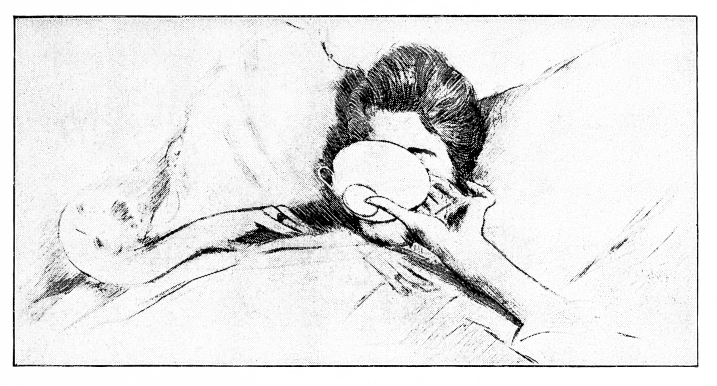
HELLEU. “FEMME À LA TASSE.”
an hour or two the lady or the child of M. Helle choice has found herself recorded on the copper—she and whatever accessories were deemed desirable to indicate her milieu, to place her amidst the surroundings which assist in the telling of her story. There is not, as far as I am aware, a single piece of M. Helle that is not a figure subject, and among his work, so far as it has yet proceeded, I do not recollect a single portrait of a man. Edmond de Goncourt calls his dry-points “les instantanés de la grace de la femme”—“snap-shots,” shall we translate it, at the charm of modern womanhood—the womanhood of the drawing-room—“snap-shots,” not less often, at the charm of refined childhood. In Helle etched work, the connoisseur will welcome what is practically the complement of the etched work of Vandyck, who, in his score or so of plates (wonderful painter though he was of women), undertook only the portraiture of certain distinguished men.
Helle method of dealing with his subjects is not always, or even very often, the method of direct portraiture. His conception has a certain affinity with that of the artist in Genre, in that the model or models, be they women or children, do not only stand for their portraits, but are discovered in poses which suggest an incident this moment happening—be it only the incident of a woman having her hair brushed, of a girl struggling into her jacket, of a woman stooping forward over the drawing-room fireplace, of a child playing with its toys. Helle models are not long stationary, their attitude is never stereotyped; what he pourtrays mainly is movement now making, or movement only just arrested. Hence, perhaps, the sense of spontaneity in all the work—the sense, when you have looked through his plates, that you have been living in the intimacy of charming people who in their daily ways turn this way and that, stoop, stretch themselves, smile, get suddenly grave, dress themselves, lift their eyes inquiringly, or toss the great long hair upon their shoulders. Their movements, whatever they are, are made with the immediate freedom, the complete absence of self-consciousness, of well-bred, natural folk—the folk whose presence, even when they are not actually handsome, or when no personal affection binds them to you, gives a legitimate charm to the passing hour. The spectacle of the world is pleasanter when it is they who are on its stage.
Helle etchings prove him to be in sympathy with the most alert, which is often also the most dignified and distinguished of modern youthful beauty. I know of no plate of his in which he has realised the
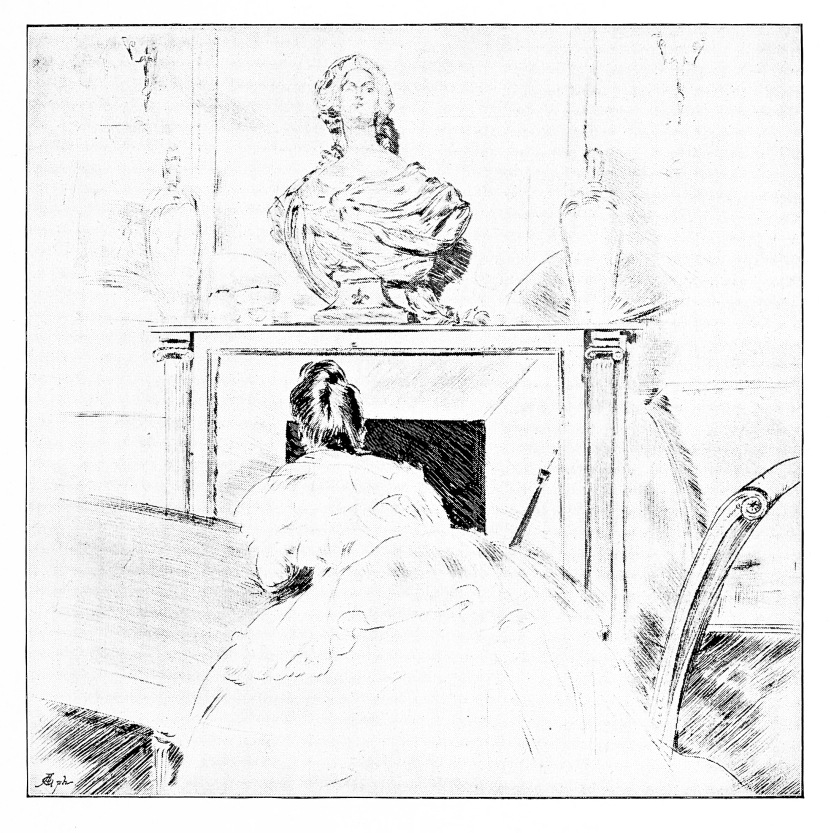
HELLEU. “LE SALON BLANC.
dignity of age as Rembrandt realised it in the etched portrait of his mother smiling, and in that other etched portrait of his mother, with a black veil and folded hands. But several times Helleu has realised what Whistler realised in the dry-point of “Fanny Leyland”—the dignified beauty, the reticent tenderness, the mood, courageous or contemplative, of the better order of young girlhood. Admirable in this way is that “Etude de Jeune Fille,” which shows the quick and earnest, fearless glance—the girl with the lifted elbow and the streaming dark hair. Hardly less admirable, that other study of a child a little younger, the head on a large scale, and the head alone. It may be added, as a detail of both these rare plates, that no others, either by M. Helleu or by any other etcher, show quite so obvious a mastery in the treatment of hair. Dry-point, as M. Helleu handles it, would seem to have been made for the magical suggestion of all that you may notice in hair, except its colour—of its flow and texture, weight and life.
“Femme à la Tasse,” a study of two uplifted hands, holding between them, lightly, in the fingers, a porcelain cup out of which the reclining figure drinks, is a most delicate arrangement of “line,” and of amazing economy of means. And the “Salon Blanc,” or one especially of the several plates which bear that name, is to be noted not for the figure only, not, perhaps, for the figure even chiefly, but for the brief and dainty suggestions of tasteful furniture, the line of a screen, the mouldings of a mantelpiece, the curve of a girandole.
We have etchers amongst us, and clever ones, too, to whom the presence of character in their living models, and in those models’ backgrounds, has been, above all things, precious; to whom the presence of the eccentric has been valuable, and the presence of beauty, superfluous, not to say burdensome. But, with M. Helleu, beauty—beauty of no conventional order, the rapid charm of movement, of expression, of contour—is the inspiring and satisfactory thing. He lives in its intimacy. And he reveals it—much as Watteau did, yet in ways how fearlessly modern!—to the spectator of his work.
CHISWICK PRESS:—CHARLES WHITTINGHAM AND CO. TOOKS COURT, CHANCERY LANE, LONDON.
MR. WEDMOR SHORT STORIES.
Each vol. 3s. 6d. net.
PASTORALS OF FRANCE.
Fourth Edition.
RENUNCIATIONS.
Third Edition, with portrait by J. J. Shannon.
ENGLISH EPISODES.
Second Edition.
FOOTNOTES: