X. SEYMOUR HADEN.
Reading edition
SEVERAL years before Mr. Whistler etched at all—in 1843 and 1844 indeed—a now veteran artist, President “de sa propre Académie,” who has been famous surgeon as well as famous etcher—founder of the Royal Society of Painter-Etchers, energetic advocate, by speech and writing, of the art he loves—drew delicately upon six tiny plates what were meant to be the beginnings of landscapes in mid-Italy. As rare as anything in Mr. Whistle long œuvre—though, as their author knows, in themselves far less desirable—are the impressions of those little plates, which few have seen, but which I beheld, perhaps ten or twelve years ago, strengthened here and there with pencil-work, yet even then only feebly holding their own, among the abundant treasures of an upper chamber in Hertford Street—the almost unknown initial chapter, they, in the sturdy and now celebrated volume of Seymour Hade etched work.
The days when they were executed were about the days of the Etching Club, a body which in its turn was followed by the Junior Etching Club. These clubs left us no legacy we care to inherit; their productions were for the most part fidgety, prim, at best desperately pretty and ridiculously elaborated, so that there was practically nothing in them of visible and expressive line. A little—just a little—of that visible line there was—there actually was, even in an unenlightened period—in those few trifling plates of Seymour Hade on which his first work was accomplished. He wrought nothing for many years afterwards. Then, in 1858, when Whistler, by this time his brother-in-law, was already busy, Seymour Haden—urged thereto by the knowledge of good work executed in France at that moment, and by a fitting reverence for the master etchings of Rembrandt—took up some coppers seriously; and he set down upon them, in this and the few following years, with an appreciation not less certain and immediate than Mr. Whistle of those laws to which etchings should conform, his powerful and personal impressions of English landscape, of the trout stream, and the stately river, of forest trees, a sunset over the Thames, of the yews and cedars of an English country-house (“Mytton Hall”), of the reflections, in some quiet
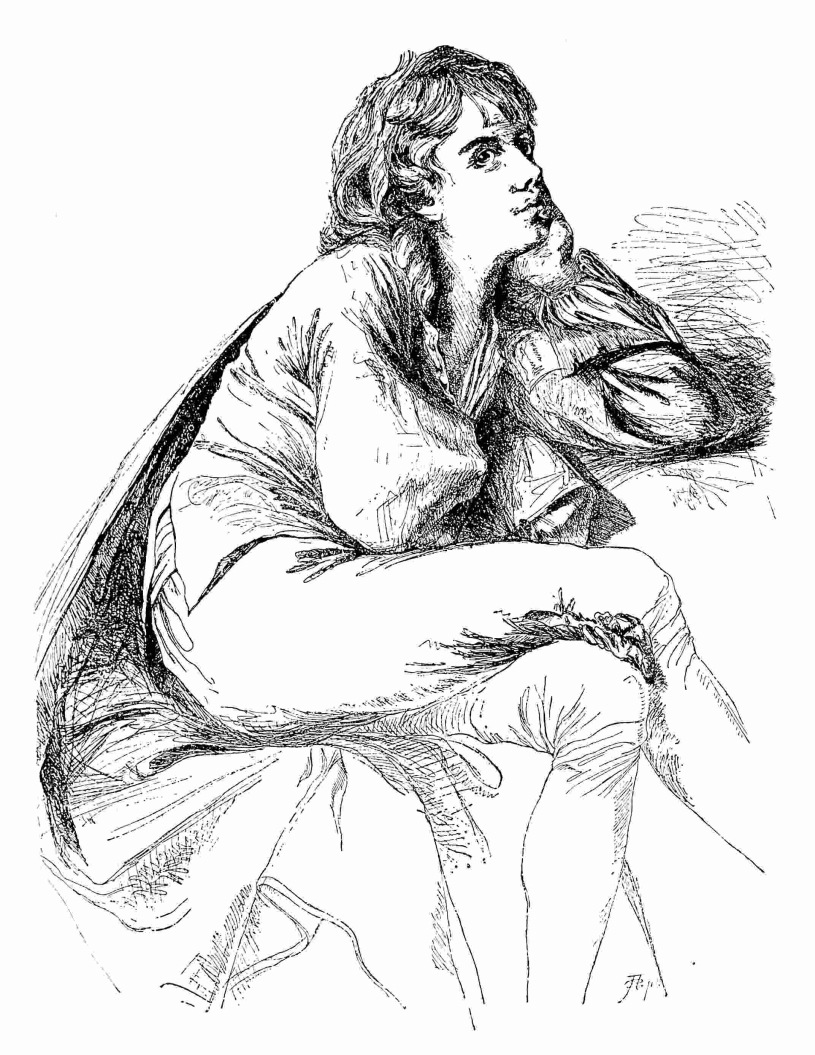
SEYMOUR HADEN. “THOMAS HADEN, AFTER WRIGHT OF DERBY.”
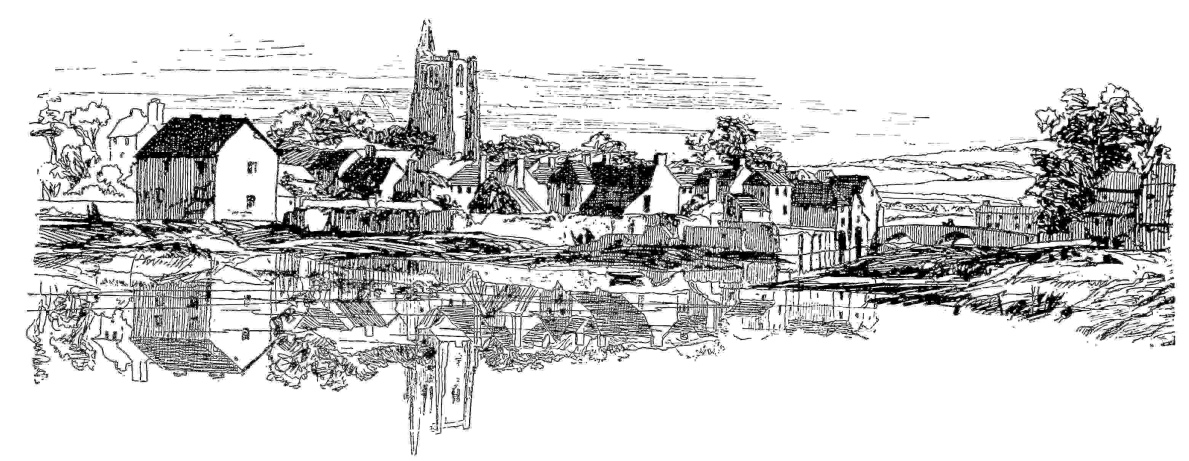
SEYMOUR HADEN. “KIDWELLY TOWN.”
water, of the homely buildings of a little whitewashed town in Wales (“Kidwelly Town”).
A few years later, when the achievements of Haden had grown numerous, the intelligent French critic, Monsieur Philippe Burty (whom the revival of etching greatly interested), praised and chronicled them in the “Gazette des Beaux-Arts.” There were fifty or sixty prints by that time. This was in 1864. And in 1865 and 1866, about thirty of them—including the minor but still attractive plates used as “head” or “tail-pieces”—were formally published in Paris, with a French text which consisted in part of an excellent analytical and didactic letter, written in the foreign tongue, by the artist to Monsieur Burty.
1864 and 1865 were years of great productiveness, and among educated lovers of Art, at home and in France, popularity, hitherto denied to the etcher—for Whistler was little appreciated and Méryon was starving—courted Haden with its blandishments, or threatened him with its dangers. Of the “Shere Mill Pond” Mr. Hamerton spoke in “Etching and Etchers” in terms of what I cannot but think was somewhat exaggerated praise. In 1870, the large and impressive plate of “The Breaking up of the ‘Agamemnon’”—“large” I say; not “huge,” for “the huge plate is an offence”—put the coping-stone upon that edifice of Seymour Hade celebrity to which the writings of Mr. Hamerton (in the now standard volume I have already referred to) had contributed an important storey. Mr. Hamerton, at that period, there can be little question, did not fully appreciate Mr. Whistler. I am not certain that he ever did. He already wrote of him—need I say?—with intelligence and interest, but his enthusiasm was reserved, so far as the moderns are concerned, for Méryon and for Haden.
Save for an exceptional activity in the year 1877—the year of the Dorsetshire dry-points and of the Spanish etchings—the productiveness of Seymour Haden, since 1869, began visibly to slacken. In 1879 it stopped. The 185 etchings chronicled by Sir William Drake in “A Descriptive Catalogue of the Etched Work of Francis Seymour Haden” had all been executed; and soon afterwards—either during Seymour Hade visit to America or during a visit of Mr. Keppe to these shores—the veteran artist said to the New York print-dealer: “I shall etch no more.” I imagine Mr. Keppe countenance of surprise and regret, and Seymour Hade interested observation of it. But the incident was not over. The artist brought out his etching-needle; looked at it; placed it gravely in
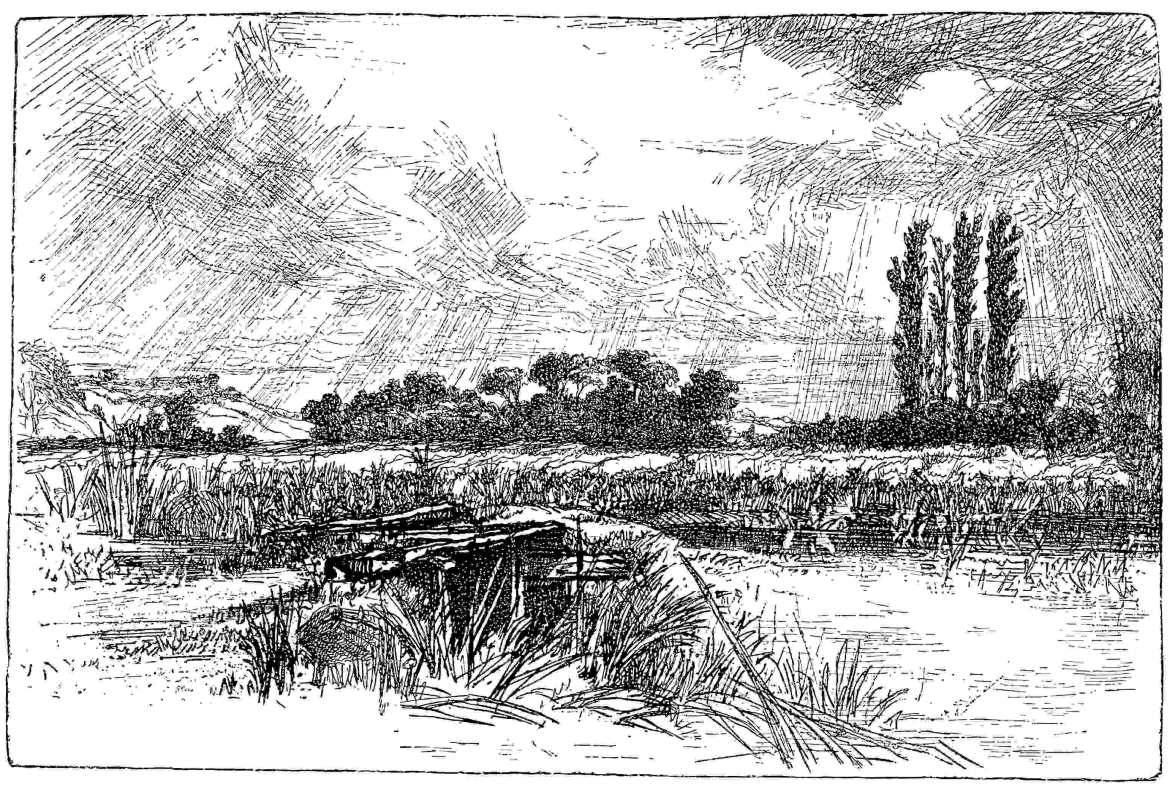
SEYMOUR HADEN. “THE WATER MEADOW.”
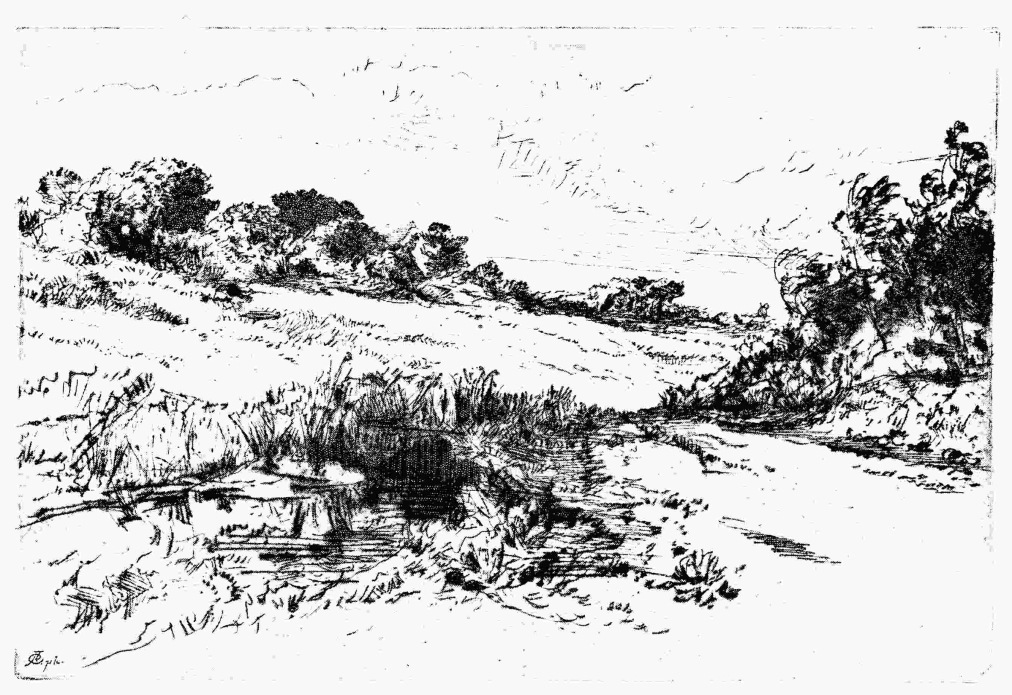
SEYMOUR HADEN. “WINDMILL HILL.”
Mr. Keppe hands. It was presented to him as a sign that that which had been spoken would surely be fulfilled, and the etcher would etch no more. Like Madame Arnould-Plessis, like Macready, too, but like how few of his fellows in any department of public effort, this artist withdrew himself from productiveness before ever the quality of his production had visibly failed.
Perhaps I shall do well, in one or two last paragraphs about him, to name, for convenience sake, a few of Sir Seymour Hade most excellent and most characteristic works—prints in which his vivid impression of the object or the scene before him has been most vividly or, it may be, subtly conveyed—prints, perhaps, which have his most distinguishing qualities of directness and vigour. The etchings of Seymour Haden are deliberately arrested at the stage of the frank sketch; but it is the sketch conceived nobly and executed with impulse. It is not the sketch upon the thumb-nail; it is not the memorandum that may be made upon a ma shirt-cuff at dinner-time, in the interval between the soup and the fish.
The tendency of his work, as time went on, was, as is usual, towards greater breadth; but, unless we are to compare only such a print as “Out of Study-Window,” say (done in 1859), with only the most admirable dry-point, “Windmill Hill” (done in 1877), there is no greatly-marked contrast, no surprise; there is but a steady and slow and apparently inevitable development. This I in part attribute to the fact that when Seymour Haden took up etching seriously in 1858, he was already middle-aged. He had lived for years in frequent intercourse with noble and accomplished Art; his view of Nature, and of the way of rendering her, or letting her inspire you, was large, and likely to be large, almost from the beginning. Yet, as time went on, there came, no doubt, an increasing love of the sense of spaciousness, of breadth, and of potent effect. The work was apt to become more dramatic and more moving. The hand asked the opportunity for the fuller exercise of its freedom.
“Sawley Abbey,” etched in 1873, is an instance of this, and I am glad to mention it, not alone for its merits, but because, like a certain number of its fellows among the later work, it is etched on zinc—a risky substance, which succeeds admirably when it succeeds, and when it fails, as Sir Seymour tells me, fails very much. “Windmill Hill,” “Nine-Barrow Down,” “Wareham Bridge,” and “The Little Boathouse,” and, again, that “Grim Spain” which illustrates my “Four Masters of Etching,” are the prints which I should most choose to possess
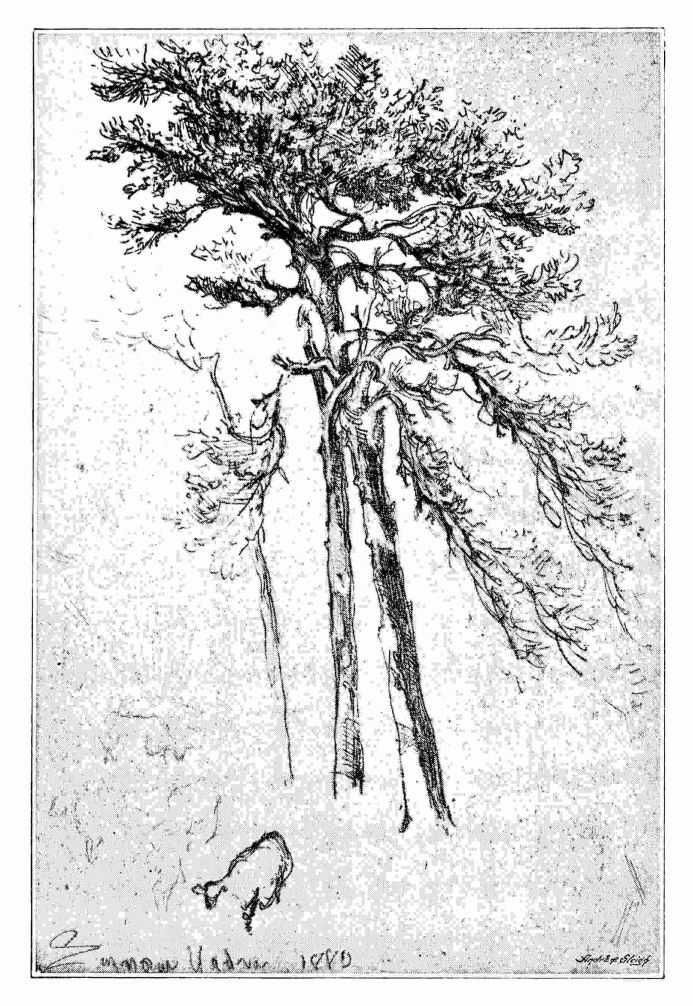
SEYMOUR HADEN. “SCOTCH FIRS.”
(The artis last etching.)
amongst those of Seymour Hade later time; whilst, going back to the period of 1864 and 1865, “Sunset on the Thames” is at the same time popular and strong, and “Penton Hook” remarkable for its draughtsmanship of tree-trunk and stump. Yet earlier—for they belong to 1860 and 1859—“Combe Bottom” is unsurpassed for sweetness and spontaneity, “Mytton Hall” for its full share of that element of Style which is never wholly absent from Seymour Hade work, and “The Water Meadow” is to be studied and enjoyed as an extraordinarily happy transcript of a sudden rain-storm in the Hampshire lowlands, where poplars flourish and grass grows rank.