XII. WILLIAM STRANG.
Reading edition
PROFESSOR, during something like a score of years, at the Slade School in London, Legros had then a dominating influence upon many amiable followers who will hardly hereafter be heard of, and upon two or three clever people with a future in Art. Among these latter—if, for our present purpose, we disregard men who are painters exclusively, like Tuke and Gotch—the most conspicuous are William Strang and Charles Holroyd. Strang is the senior. He has thus far, naturally, been much the most prolific. He is also the most technically accomplished, and, more than any younger etcher of the day—almost as much, indeed, as Monsieur Legros—he has shown himself possessed of the vital gift of imagination. Like Legros, he has looked immensely at Old Masters—at the Italian Primitives and at Rembrandt—and has seen Nature in great measure through their eyes, and this as much when Humanity as when Landscape has been the object of his gaze. In Stran case, too, to these accepted and avowed Old Masters, there has come to be added another Old Master—I mean, Alphonse Legros.
Strang is a Scotsman. That devotion to the weirdness and the uncanny, which is a note of the full Celtic temperament, is shown amazingly in his selection of subject; he is, perhaps, most of all contented with himself when he sets himself to illustrate a ballad of the supernatural, written in a dialect into the last recesses of which I—who love best the English tongue—lack, I confess, the energy to penetrate. His imagination, however, is far from being exercised alone on these themes of the supernatural. It is occupied, not seldom, with as great a power, upon modern incidents treated with quaintness and intensity—the meditations of a jury, the expositions of a preacher, the rescue of the drowned from some dark river, the ill-bred hysteria of the Salvation Army. In portraiture, while it is yet visible, and even valuable, it is controlled sometimes by sense of Style, and then we have, as in the almost Vandyke-like portraits of Mr. Sichel, and of Jan Strang—the nearest approach which Mr. Strang suffers himself to make to the wide domain of beauty. His customary indifference to charm of form, to charm of
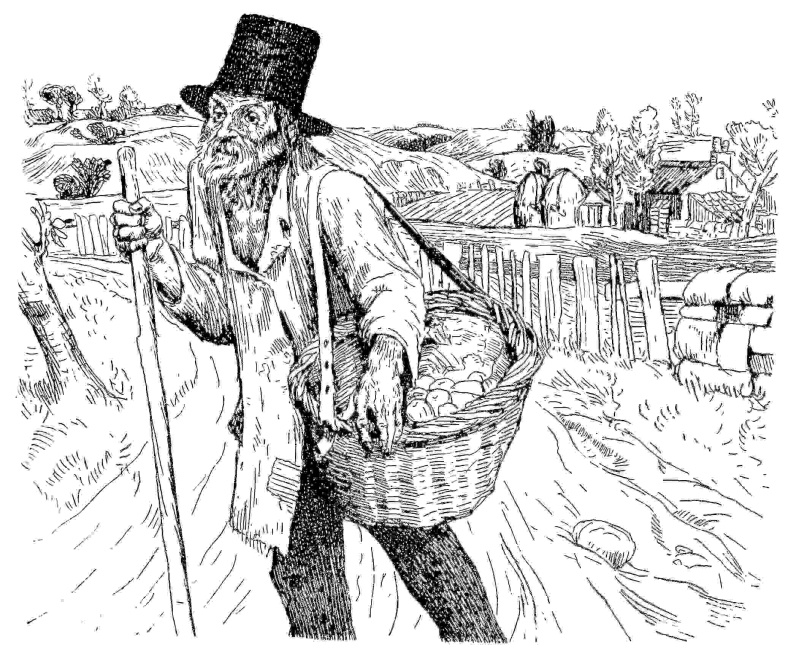
STRANG. “THE POTATO BASKET.”
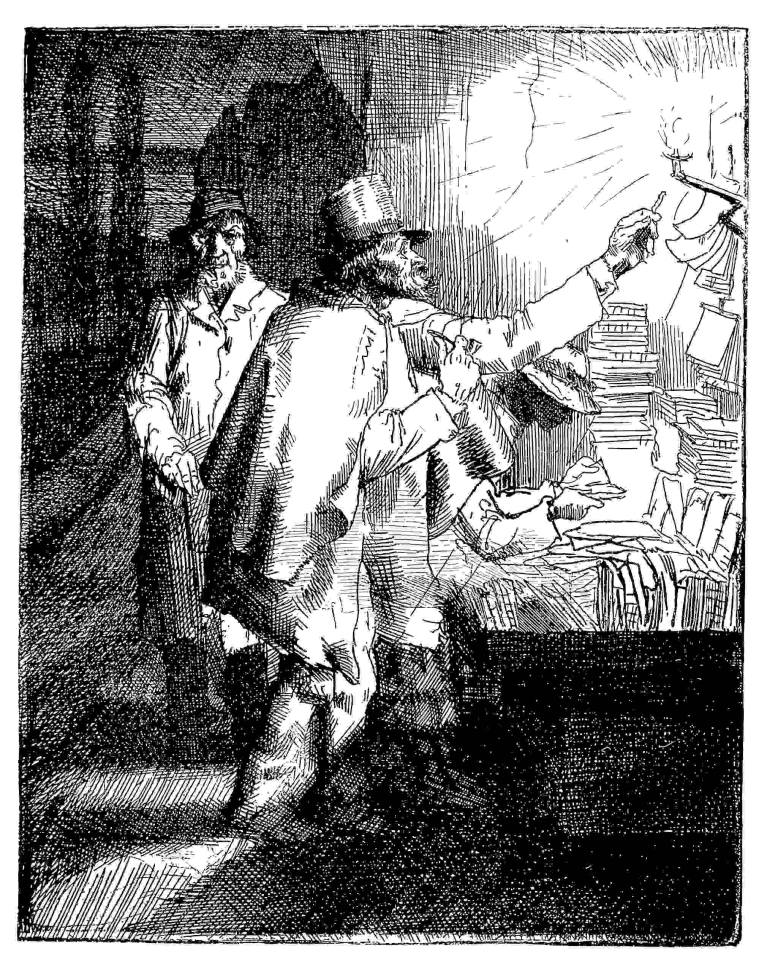
WILLIAM STRANG. “THE BOOKSTALL.”
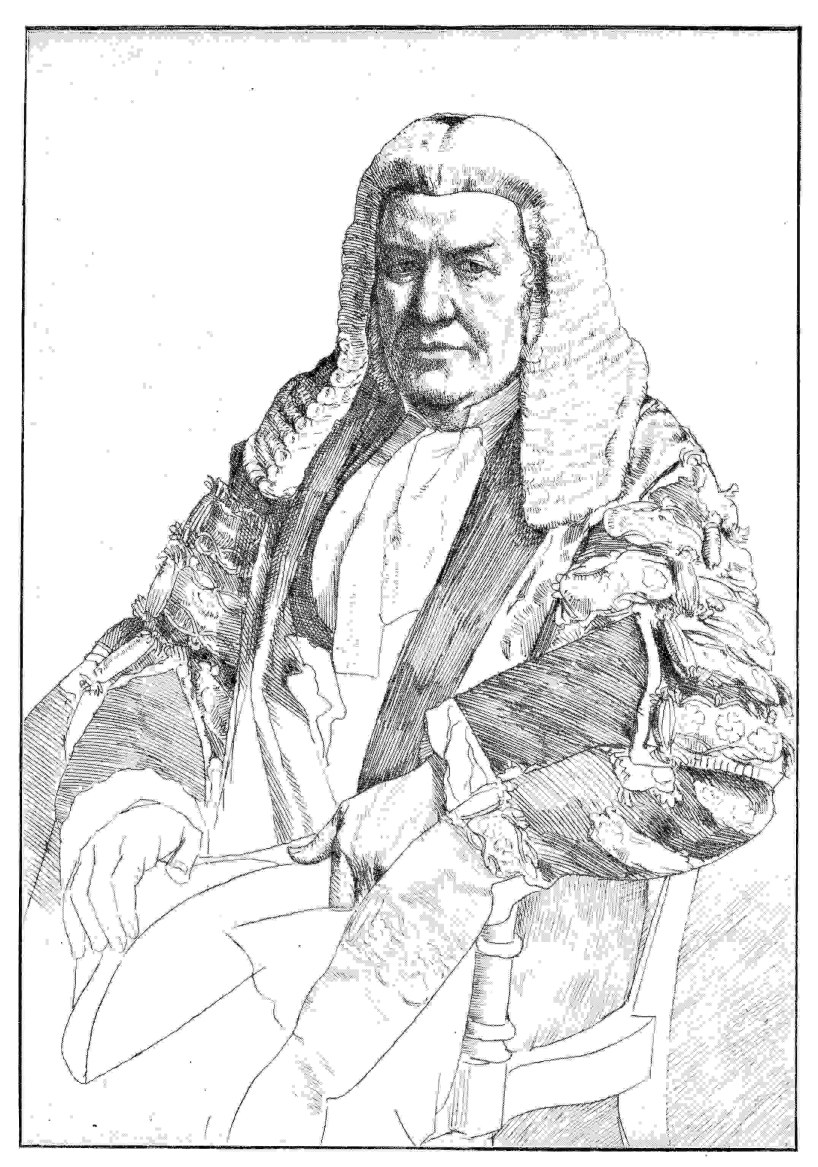
WILLIAM STRANG. “JUSTICE LINDLEY.”
expression, to that which is agreeable and comely, to that which the natural man would voluntarily look upon, is yet more marked—a hundred times more marked—than Mr. Legro. Grace, elegance, personal distinction, the freshness of youth, the winsomeness of girlhood, the acceptability of the English upper classes—these things are far from him: he wots not of them, or but rarely. He likes poor folk, enjoys the well-worn clothes, the story of the poor fol work and poor fol trouble. For that I do not blame him. But, like Ostade and Brouwer, he likes the cottager best when he is stunted, and is most interested in him when he is gnarled.
For all the absence—an absence frequent, not continuous—of local colour, the scenes Mr. Strang depicts arrest you. You remember them because he has himself remembered that which was most important in the making of them. Essentials have not escaped him. The “realism” he has attained has been at least something much deeper than that which prides itself on the correct portrayal of the obvious. In great themes and little themes he has been alike vivid. There may be something that is squalid and something that is ignoble in “The Last Supper” as he can conceive it; but, at all events, a genuine human emotion is not banished from the scene. He is Von Uhde-like in that. And here and there, in brief suggestive studies of contemporary existence, an imaginative light is flashed upon the page, a touch of romance suggested, as where, in the curious little etching of a Bohemian wayfarer—a someone who has lost caste probably, whose pence and whose friends are few—lighting his pipe at a flaring gas-jet over some street bookstall on a Saturday night, you feel that for a moment there has sprung into your vision a fellow-creature with a history, whose mysteriousness you will not solve. Out of the darkness he has emerged for an instant, and into it he returns again.
This very remarkable artist has already executed not less than two hundred and fifty etchings.
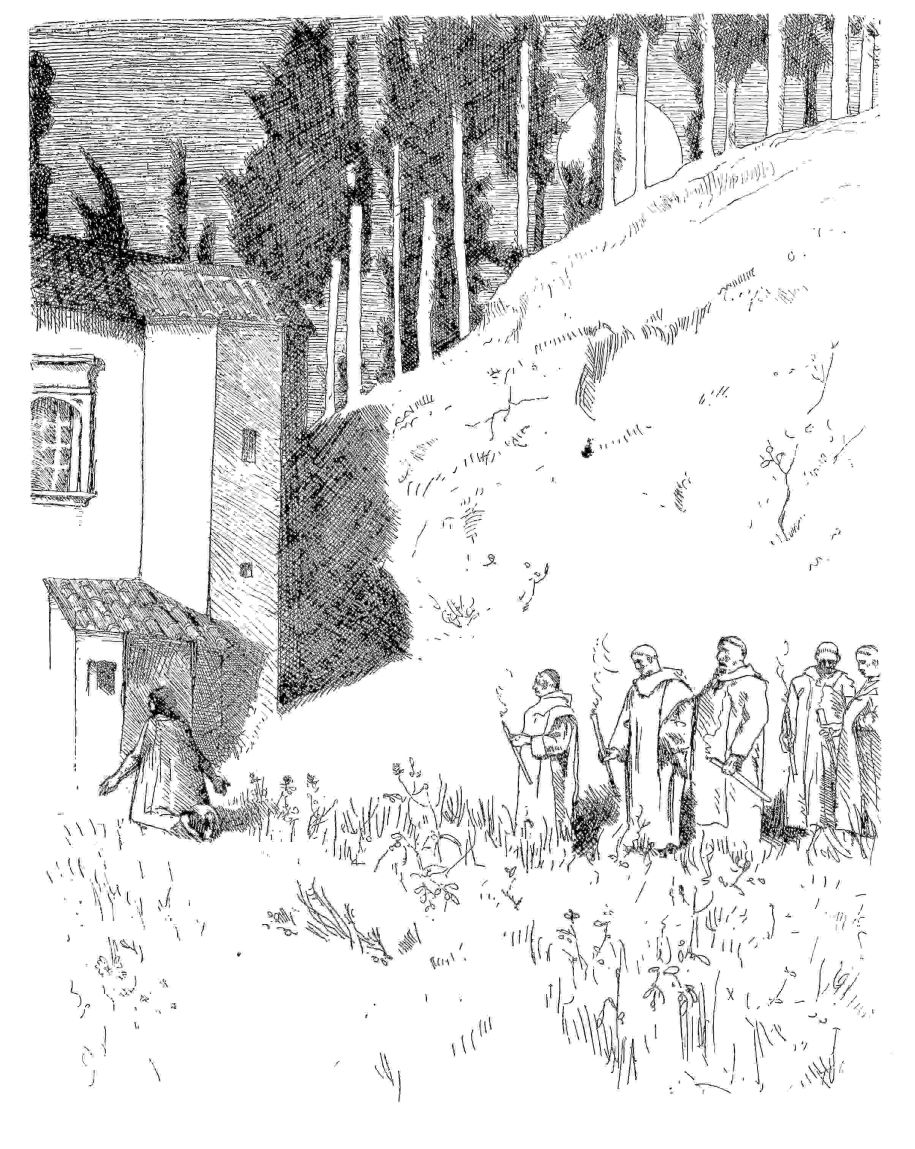
CHARLES HOLROYD. “MIDNIGHT MASS.”
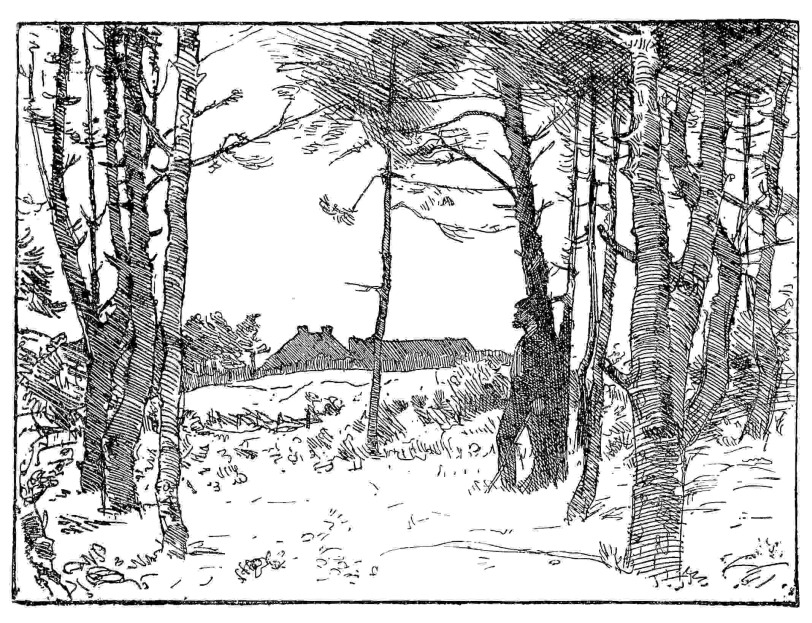
CHARLES HOLROYD. “FARM BEHIND SCARBOROUGH.”
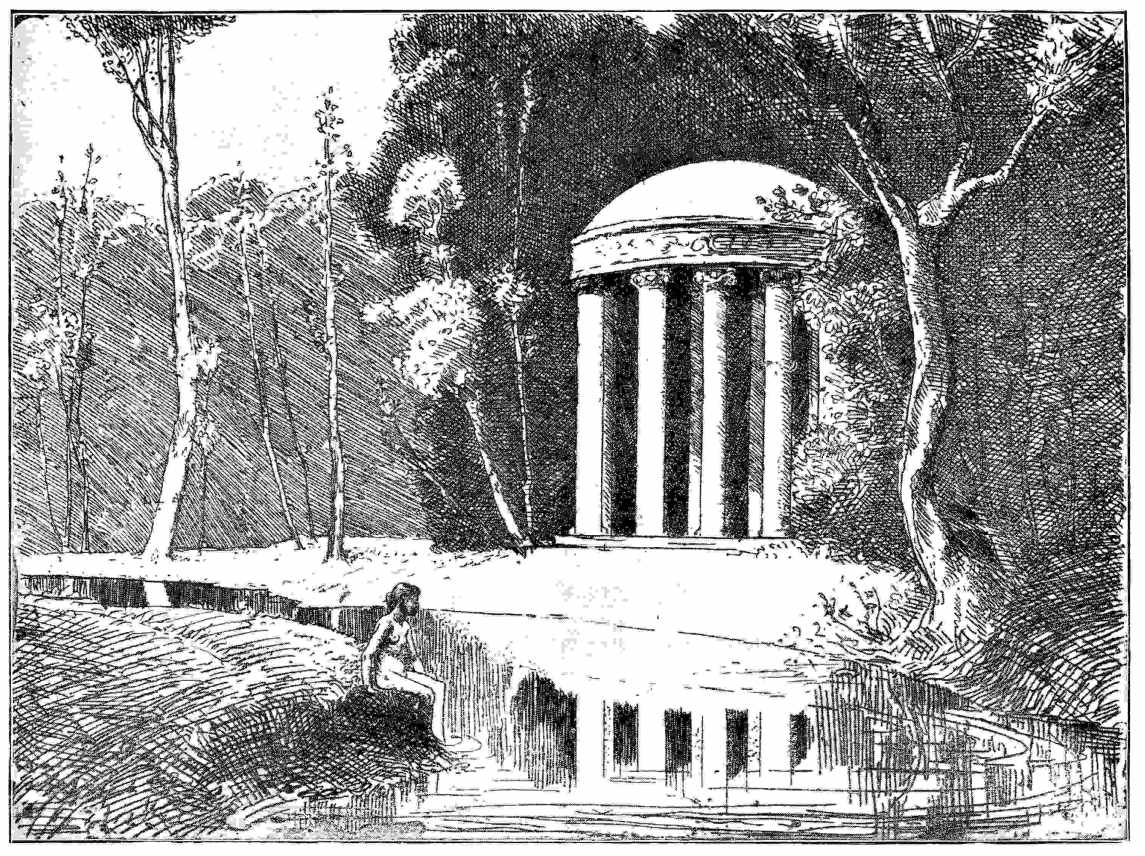
CHARLES HOLROYD. “ROUND TEMPLE.”