III. GIRTIN.
Reading edition
THE limitations which we have marked in Turne aim in Etching, are to be noticed just as clearly in the aim of Girtin. Nay, they are to be noticed yet more. For while Turner not infrequently gave emphasis to his work by the depth and vigour of his bitten line, Girtin, in his few and rare etchings—which, it is worth while to remember, just preceded Turne—sought only to establish the composition and the outline. He did this with a skill of selection scarcely less than Turne own, and admirable, almost as in his water-colour work, is the quiet sobriety of his picturesque record.
But though Girti etchings—many soft-ground, and about twenty—may contain some lessons for the craftsman, some indeed for the artist, they are scarcely for the portfolios of the collector. They were wrought, all of them, towards the end of Girti life, that was cut short in 1802,
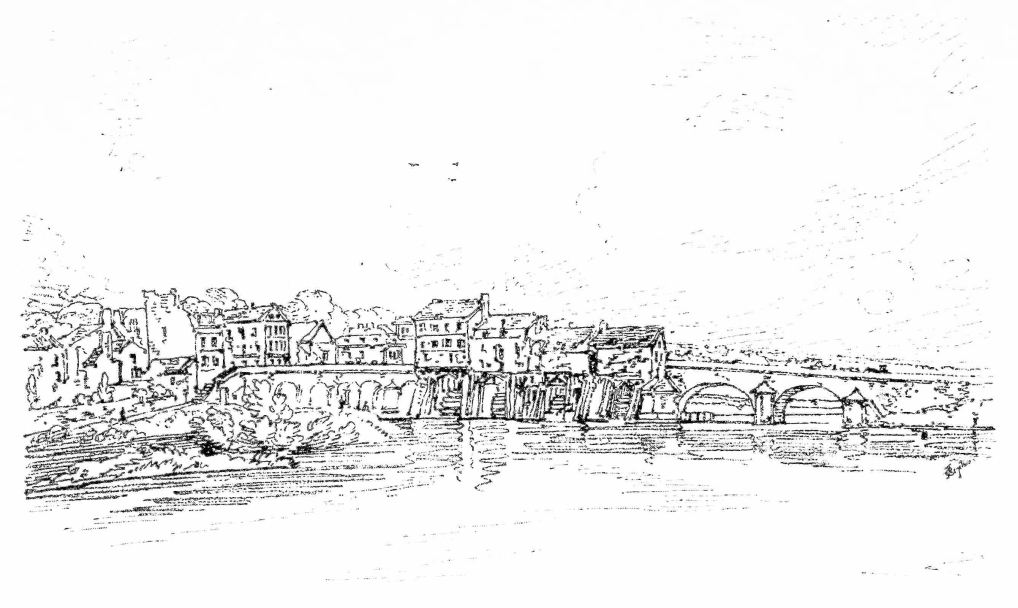
GIRTIN. “A SEINE BRIDGE.”
when he was twenty-nine years old. They were the preparations for his aquatinted plates of Paris, against which in their completed form there is only this to be said—that the avoidance, generally, of any attempt at atmospheric effects, involves a seeming monotony of treatment, though as dignified visions of old Parisian architecture, of Parisian landscape, so to speak, in its habitual setting of wide sky and noble river, they have never been surpassed, and very seldom equalled.
The vision of Girtin, it must always be remembered—whatever be his work—is not emphatically personal. With all his charm and breadth and dignity, something of the pure architectural draughtsman lingered to the end, in his labour. He had no parti pris about the facts: no bias we forgive, no prejudice we welcome. He sought to represent simply the “view,” although no doubt the “view” was generally bettered by his artistry.