XI. ALPHONSE LEGROS.
Reading edition
MORE than one of the great etchers who must in fairness be treated with the British school are of foreign origin. Born at Dijon in 1837, and trained chiefly in Paris—painter, of course, as well as etcher—Alphonse Legros came to London when he was quite a young man. He has been amongst us since 1863. It was in Paris, about 1857, that he did his first etchings, and his surprising originality was declared from the beginning. The trivial, the accidental even, had no attractions for him. Even the quiet humour which one recognizes in his character, has no place in his work. Simple, serious, austere, highly refined, yet with curious tolerance of physical ugliness, and curious indifference to the beauty, at all events, of women, Monsieur Legros has conveyed to us, in his own leisurely and economical fashion, any time these thirty years, his vision of a world not ours, or
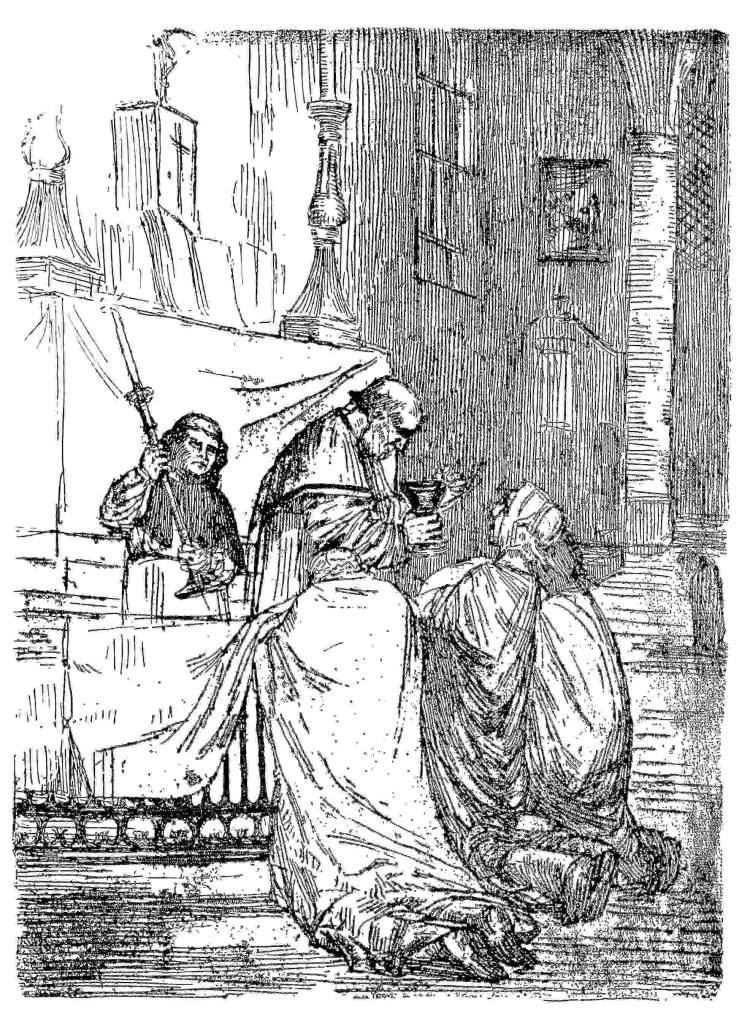
LEGROS. “COMMUNION DANS GLISE ST. MÉDARD.
rather, very often, his vision of the deeper realities which underlie whatever may attract us on the surface.
Legros has been concerned—and best of all concerned in etching—with many departments of Art. Like Mr. G. F. Watts, he has been fascinated, here and again, and very specially, by masculine intellect and character; masculine kindness, goodness, genius, energy. Of Mr. Watts himself—and fortunately in the medium of etching—he has made the happiest of all possible portraits, finding in the theme a gravity of manly beauty, a charm of approaching age, to which he has always been intensely sympathetic. Gambetta, too, and Sir Frederic Leighton, and Cardinal Manning—who, if he appealed to him at all, must have appealed to him on the side of austerity alone—have been the subjects of Legro etched portraiture. To each portrait he has given, though in very different measures, according as the subject wanted it, a nobility and dignity supplied by his own art and temperament, and by a sense of Style nourished upon the study of the Renaissance and of Rembrandt. And, on the other hand, upon each selected model whom he has treated in those other etchings which are not confessedly portraiture, he has bestowed the grave veracity, the verisimilitude of the portrait.
Hardly any of Legro work is dated, and, as time has passed, the changes in his method have not been very marked, though it is hardly to the earliest etching that we must go for his most trained draughtsmanship and most accomplished technique. On the other hand, the early work has about it a sometimes savage earnestness, a rapid and immediate expressiveness, a weirdness also, which are immensely impressive. Poetic and pathetic is it besides, sometimes to the last degree. “Les Chantres Espagnols,” for example, is the creation of a great artist: a most penetrating and pathetic study of physical and mental decay. It represents eight priestly singing men lifting up what hoarse and feeble voices they may be possessed of, in the hushed choir, by the uncertain light of torches, in the nigh most mysterious and most ominous hour.
Several among the more fascinating of these somewhat early etchings and dry-points record the life of the priesthood. In its visible dignity, its true but limited camaraderie, in its monotony and quietude, in its magnificence of service and symbol, the life of the priest, and of those who serve in a great church, has impressed Legros profoundly, and he has etched these men—one now reading a lesson, one waiting now with folded hands, one meditative, one observant, and now one offering up the
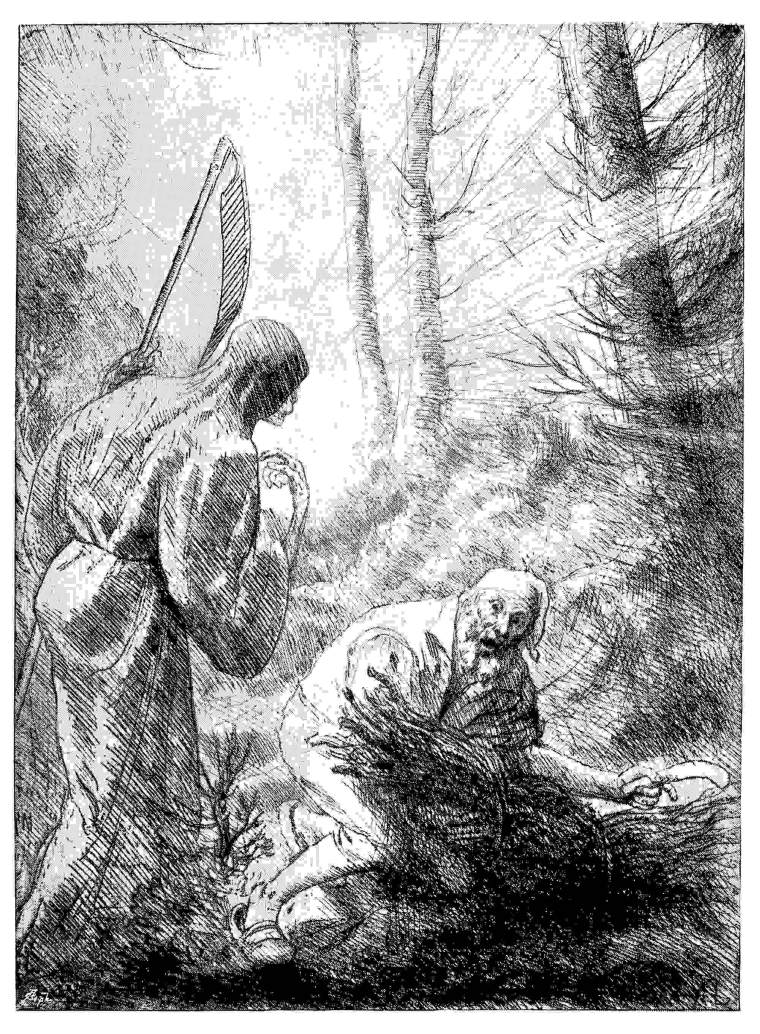
LEGROS. “LA MORT ET LA BÛCHERON.”
Host, and now another bending over the violoncello with slow movement of the hand that holds the bow. Dignity and ignorance, pomp and power, weariness, senility, decay, and almost squalor—nothing has escaped him. In Literature, only a Balzac could have done equal justice to that which attracts, and to that which must needs repel.
Realist, but always poet, in his treatment of these themes—and in the treatment of such a dramatic plate as “ncendie,” such a nobly imaginative plate as “La Mort et le Bûcheron”—Legros, when he betakes himself to landscape, is realist no longer, or, rather, his realism here is shown only in his contentment with the homely scene, the most everyday material. Generally, on impression of his landscape is that it is built to some extent upon the memories of his youth; that, since then, a little observation has gone a long way—that he has cared to dream and fancy rather than to actually notice. Here and there, in his etchings, one maybe reminded of the uplands around Dijon, or of the chalk hills of the Boulognais, with its wide fields and haystacks, its gaunt outhouses—a land which rumours of “high farming” have never reached. As the railway train swept under the hillside, Legros, one thinks, may have profited by a glance from the windows. And out of the glance, and out of the memory, and out of the artis genuine sympathy with humble and monotonous days, there has grown a homely poem.
With Mr. Whistler, on the rare occasions on which he has treated it in his mature art (in the rare “Dam Wood” especially), Landscape becomes Decoration. With Sir Seymour Haden, landscape is a matter that must be energetically observed. Swift, skilful memoranda are taken of it—memoranda which are not the less scientific because they may be dramatic besides. With Legros, the landscape must submit to change, to simplification, to abstraction, generalization even, in the processes of his mind; and the picture which his hand fashions—the hand with reverie behind it—is one which travel will help no one to encounter, and experience help no one to realize. Yet it has its own value.
Before I leave this deeply interesting and so original artist, I will add that in the “Catalogue Raisonné de uvre gravé et lithographié lphonse Legros,” compiled by Messieurs Thibaudeau and Poulet-Malassis in 1877, there are chronicled 168 pieces, but that, writing to me ten years later, M. Thibaudeau was able to tell of nearly ninety additions to the list. Since then the number has been yet further extended, for Legros, to this day, has not ceased to etch.