VOLUME VIII SLICE IV Diameter to Dinarchus
Reading edition
Articles in This Slice
DIAMETER DIEDENHOFEN
DIAMOND DIEKIRCH
DIAMOND NECKLACE, THE AFFAIR OF THE DIELECTRIC
DIANA DIELMANN, FREDERICK
DIANA MONKEY DIEMEN, ANTHONY VAN
DIANE DE FRANCE DIEPENBECK, ABRAHAM VAN
DIANE DE POITIERS DIEPPE
DIAPASON DIERX, LÉON
DIAPER DIES, CHRISTOPH ALBERT
DIAPHORETICS DIEST
DIAPHRAGM DIESTERWEG, FRIEDRICH ADOLF WILHELM
DIARBEKR DIET
DIARRHOEA DIETARY
DIARY DIETETICS
DIASPORE DIETRICH, CHRISTIAN WILHELM ERNST
DIASTYLE DIETRICH OF BERN
DIATOMACEAE DIEZ, FRIEDRICH CHRISTIAN
DIAULOS DIEZ
DIAVOLO, FRA DIFFERENCES, CALCULUS OF
DIAZ, NARCISSE VIRGILIO DIFFERENTIAL EQUATION
DIAZ, PORFIRIO DIFFLUGIA
DIAZ DE NOVAES, BARTHOLOMEU DIFFRACTION OF LIGHT
DIAZO COMPOUNDS DIFFUSION
DIAZOMATA DIGBY, SIR EVERARD
DIBDIN, CHARLES DIGBY, SIR KENELM
DIBDIN, THOMAS FROGNALL DIGBY, KENELM HENRY
DIBDIN, THOMAS JOHN DIGENES ACRITAS, BASILIUS
DIBRA DIGEST
DIBRUGARH DIGESTIVE ORGANS
DICAEARCHUS DIGGES, WEST
DICE DIGIT
DICETO, RALPH DE DIGITALIS
DICEY, EDWARD DIGNE
DICHOTOMY DIGOIN
DICK, ROBERT DIJON
DICK, THOMAS DIKE
DICKENS, CHARLES JOHN HUFFAM DIKKA
DICKINSON, ANNA ELIZABETH DILAPIDATION
DICKINSON, JOHN DILATATION
DICKSON, SIR ALEXANDER DILATORY
DICKSON, SIR JAMES ROBERT DILEMMA
DICOTYLEDONS DILETTANTE
DICTATOR DILIGENCE
DICTIONARY DILKE, SIR CHARLES WENTWORTH
DICTYOGENS DILL
DICTYS CRETENSIS DILLEN, JOHANN JAKOB
DICUIL DILLENBURG
DIDACHĒ, THE DILLENS, JULIEN
DIDACTIC POETRY DILLINGEN
DIDEROT, DENIS DILLMANN, CHRISTIAN FRIEDRICH AUGUST
DIDIUS SALVIUS JULIANUS, MARCUS DILLON, ARTHUR RICHARD
DIDO DILLON, JOHN
DIDON, HENRI DILUVIUM
DIDOT DIME
DIDRON, ADOLPHE NAPOLÉON DIMENSION
DIDYMI DIMITY
DIDYMIUM DINAJPUR
DIDYMUS DINAN
DIDYMUS CHALCENTERUS DINANT
DIE (town of France) DINAPUR
DIE (datum) DINARCHUS
DIEBITSCH, HANS KARL FRIEDRICH ANTON
DIAMETER (from the Gr. διά, through, μέτρον, measure), in geometry, a line passing through the centre of a circle or conic section and terminated by the curve; the “principal diameters” of the ellipse and hyperbola coincide with the “axes” and are at right angles; “conjugate diameters” are such that each bisects chords parallel to the other. The diameter of a quadric surface is a line at the extremities of which the tangent planes are parallel. Newton defined the diameter of a curve of any order as the locus of the centres of the mean distances of the points of intersection of a system of parallel chords with the curve; this locus may be shown to be a straight line. The word is also used as a unit of linear measurement of the magnifying power of a lens or microscope.
In architecture, the term is used to express the measure of the lower part of the shaft of a column. It is employed by Vitruvius (iii. 2) to determine the height of a column, which should vary from eight to ten diameters according to the intercolumniation: and it is generally the custom to fix the lower diameter of the shaft by the height required and the Order employed. Thus the diameter of the Roman Doric should be about one-eighth of the height, that of the Ionic one-ninth, and of the Corinthian one-tenth (see Order).
DIAMOND, a mineral universally recognized as chief among precious stones; it is the hardest, the most imperishable, and also the most brilliant of minerals.1 These qualities alone have made it supreme as a jewel since early times, and yet the real brilliancy of the stone is not displayed until it has been faceted by the art of the lapidary (q.v.); and this was scarcely developed before the year 1746. The consummate hardness of the diamond, in spite of its high price, has made it most useful for purposes of grinding, polishing and drilling. Numerous attempts have been made to manufacture the diamond by artificial means, and these attempts have a high scientific interest on account of the mystery which surrounds the natural origin of this remarkable mineral. Its physical and chemical properties have been the subject of much study, and have a special interest in view of the extraordinary difference between the physical characters of the diamond and those of graphite (blacklead) or charcoal, with which it is chemically identical, and into which it can be converted by the action of heat or electricity. Again, on account of the great value of the diamond, much of the romance of precious stones has centred round this mineral; and the history of some of the great diamonds of historic times has been traced through many extraordinary vicissitudes.
The name Άδάμας, “the invincible,” was probably applied by the Greeks to hard metals, and thence to corundum (emery) and other hard stones. According to Charles William King, the first undoubted application of the name to the diamond is found in Manilius (a.d. 16),—Sic Adamas, punctum lapidis, pretiosior auro,—and Pliny (a.d. 100) speaks of the rarity of the stone, “the most valuable of gems, known only to kings.” Pliny described six varieties, among which the Indian, having six pointed angles, and also resembling two pyramids (turbines, whip-tops) placed base to base, may probably be identified as the ordinary octahedral crystal (fig. 1). The “diamond” (Yahalom) in the breastplate of the high priest (Ex. xxxix. 11) was certainly some other stone, for it bore the name of a tribe, and methods of engraving the true diamond cannot have been known so early. The stone can hardly have become familiar to the Romans until introduced from India, where it was probably mined at a very early period. But one or other of the remaining varieties mentioned by Pliny (the Macedonian, the Arabian, the Cyprian, &c.) may be the true diamond, which was in great request for the tool of the gem-engraver. Later Roman authors mentioned various rivers in India as yielding the Adamas among their sands. The name Adamas became corrupted into the forms adamant, diamaunt, diamant, diamond; but the same word, owing to a medieval misinterpretation which derived it from adamare (compare the French word aimant), was also applied to the lodestone.
Like all the precious stones, the diamond was credited with many marvellous virtues; among others the power of averting insanity, and of rendering poison harmless; and in the middle ages it was known as the “pietra della reconciliazione,” as the peacemaker between husband and wife.
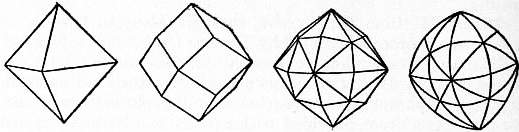
Fig. 1. Fig. 2. Fig. 3. Fig. 4.
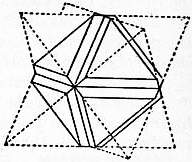
Fig. 5.
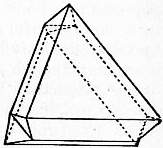
Fig. 6.
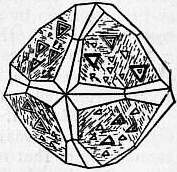
Fig. 7.
Scientific Characters.—The majority of minerals are found most commonly in masses which can with difficulty be recognized as aggregates of crystalline grains, and occur comparatively seldom as distinct crystals; but the diamond is almost always found in single crystals, which show no signs of previous attachment to any matrix; the stones were, until the discovery of the South African mines, almost entirely derived from sands or gravels, but owing to the hardness of the mineral it is rarely, if ever, water-worn, and the crystals are often very perfect. The crystals belong to the cubic system, generally assuming the form of the octahedron (fig. 1), but they may, in accordance with the principles of crystallography, also occur in other forms symmetrically derived from the octahedron,—for example, the cube, the 12-faced figure known as the rhombic dodecahedron (fig. 2), or the 48-faced figure known as the hexakis-octahedron (fig. 3), or in combinations of these. The octahedron faces are usually smooth; most of the other faces are rounded (fig. 4). The cube faces are rough with protruding points. The cube is sometimes found in Brazil, but is very rare among the S. African stones; and the dodecahedron is perhaps more common in Brazil than elsewhere. There is often a furrow running along the edges of the octahedron, or across the edges of the cube, and this indicates that the apparently simple crystal may really consist of eight individuals meeting at the centre; or, what comes to the same thing, of two individuals interpenetrating and projecting through each other. If this be so the form of the diamond is really the tetrahedron (and the various figures derived symmetrically from it) and not the octahedron Fig. 5 shows how the octahedron with furrowed edge may be constructed from two interpenetrating tetrahedra (shown in dotted lines). If the grooves be left out of account, the large faces which have replaced each tetrahedron corner then make up a figure which has the aspect of a simple octahedron. Such regular interpenetrations are known in crystallography as “twins.” There are also twins of diamond in which two octahedra (fig. 6) are united by contact along a surface parallel to an octahedron face without interpenetration. On account of their resemblance to the twins of the mineral spinel (which crystallizes in octahedra) these are known as “spinel twins.” They are generally flattened along the plane of union. The crystals often display triangular markings, either elevations or pits, upon the octahedron faces; the latter are particularly well defined and have the form of equilateral triangles (fig. 7). They are similar to the “etched figures” produced by moistening an octahedron of alum, and have probably been produced, like them, by the action of some solvent. Similar, but somewhat different markings are produced by the combustion of diamond in oxygen, unaccompanied by any rounding of the edges.
Diamond possesses a brilliant “adamantine” lustre, but this tends to be greasy on the surface of the natural stones and gives the rounded crystals somewhat the appearance of drops of gum. Absolutely colourless stones are not so common as cloudy and faintly coloured specimens; the usual tints are grey, brown, yellow or white; and as rarities, red, green, blue and black stones have been found. The colour can sometimes be removed or changed at a high temperature, but generally returns on cooling. It is therefore more probably due to metallic oxides than to hydrocarbons. Sir William Crookes has, however, changed a pale yellow diamond to a bluish-green colour by keeping it embedded in radium bromide for eleven weeks. The black coloration upon the surface produced by this process, as also by the electric bombardment in a vacuum tube, appears to be due to a conversion of the surface film into graphite. Diamond may break with a conchoidal fracture, but the crystals always cleave readily along planes parallel to the octahedron faces: of this property the diamond cutters avail themselves when reducing the stone to the most convenient form for cutting; a sawing process, has, however, now been introduced, which is preferable to that of cleavage. It is the hardest known substance (though tantalum, or an alloy of tantalum now competes with it) and is chosen as 10 in the mineralogist’s scale of hardness; but the difference in hardness between diamond (10) and corundum (9) is really greater than that between corundum (9) and talc (1); there is a difference in the hardness of the different faces; the Borneo stones are also said to be harder than those of Australia, and the Australian harder than the African, but this is by no means certain. The specific gravity ranges from 3.56 to 3.50, generally about 3.52. The coefficient of expansion increases very rapidly above 750°, and diminishes very rapidly at low temperatures; the maximum density is attained about −42° C.
The very high refractive power (index = 2.417 for sodium light) gives the stone its extraordinary brilliancy; for light incident within a diamond at a greater angle than 24½° is reflected back into the stone instead of passing through it; the corresponding angle for glass is 40½°. The very high dispersion (index for red light = 2.402, for blue light = 2.460) gives it the wonderful “fire” or display of spectral colours. Certain absorption bands at the blue end of the spectrum are supposed to be due to rare elements such as samarium. Unlike other cubic crystals, diamond experiences a diminution of refractive index with increase of temperature. It is very transparent for Röntgen rays, whereas paste imitations are opaque. It is a good conductor of heat, and therefore feels colder to the touch than glass and imitation stones. The diamond has also a somewhat greasy feel. The specific heat increases rapidly with rising temperature up to 60° C., and then more slowly. Crystals belonging to the cubic system should not be birefringent unless strained; diamond often displays double refraction particularly in the neighbourhood of inclusions, both liquid and solid; this is probably due to strain, and the spontaneous explosion of diamonds has often been observed. Diamond differs from graphite in being a bad conductor of electricity: it becomes positively electrified by friction. The electrical resistance is about that of ordinary glass, and is diminished by one-half during exposure by Röntgen rays; the dielectric constant (16) is greater than that which should correspond to the specific gravity.
The phosphorescence produced by friction has been known since the time of Robert Boyle (1663); the diamond becomes luminous in a dark room after exposure to sunlight or in the presence of radium; and many stones phosphoresce beautifully (generally with a pale green light) when subjected to the electric discharge in a vacuum tube. Some diamonds are more phosphorescent than others, and different faces of a crystal may display different tints. The combustibility of the diamond was predicted by Sir Isaac Newton on account of its high refractive power; it was first established experimentally by the Florentine Academicians in 1694. In oxygen or air diamond burns at about 850°, and only continues to do so if maintained at a high temperature; but in the absence of oxidising agents it may be raised to a much higher temperature. It is, however, infusible at the temperature of the electric arc, but becomes converted superficially into graphite. Experiments on the combustion of diamond were made by Smithson Tennant (1797) and Sir Humphry Davy (1816), with the object of proving that it is pure carbon; they showed that burnt in oxygen it yields exactly the same amount of carbon dioxide as that produced by burning the same weight of carbon. Still more convincing experiments were made by A. Krause in 1890. Similarly Guyton de Morveau showed that, like charcoal, diamond converts soft iron into steel. Diamond is insoluble in acid and alkalis, but is oxidised on heating with potassium bichromate and sulphuric acid.
Bort (or Boart) is the name given to impure crystals or fragments useless for jewels; it is also applied to the rounded crystalline aggregates, which generally have a grey colour, a rough surface, often a radial structure, and are devoid of good cleavage. They are sometimes spherical (“shot bort”). Carbonado or “black diamond,” found in Bahia (also recently in Minas Geraes), is a black material with a minutely crystalline structure somewhat porous, opaque, resembling charcoal in appearance, devoid of cleavage, rather harder than diamond, but of less specific gravity; it sometimes displays a rude cubic crystalline form. The largest specimen found (1895) weighed 3078 carats. Both bort and carbonado seem to be really aggregates of crystallized diamond, but the carbonado is so nearly structureless that it was till recently regarded as an amorphous modification of carbon.
Uses of the Diamond.—The use of the diamond for other purposes than jewelry depends upon its extreme hardness: it has always been the only material used for cutting or engraving the diamond itself. The employment of powdered bort and the lapidary’s wheel for faceting diamonds was introduced by L. von Berquen of Bruges in 1476. Diamonds are now employed not only for faceting precious stones, but also for cutting and drilling glass, porcelain, &c,; for fine engraving such as scales; in dentistry for drilling; as a turning tool for electric-light carbons, hard rubber, &c.; and occasionally for finishing accurate turning work such as the axle of a transit instrument. For these tools the stone is actually shaped to the best form: it is now electroplated before being set in its metal mount in order to secure a firm fastening. It is also used for bearings in watches and electric meters. The best glaziers’ diamonds are chosen from crystals such that a natural curved edge can be used. For rock drills, and revolving saws for stone cutting, either diamond, bort or carbonado is employed, set in steel tubes, disks or bands. Rock drilling is the most important industrial application; and for this, owing to its freedom from cleavage, the carbonado is more highly prized than diamond; it is broken into fragments about 3 carats in weight; and in 1905 the value of carbonado was no less than from £10 to £14 a carat. It has been found that the “carbons” in drills can safely be subjected to a pressure of over 60 kilograms per square millimetre, and a speed of 25 metres per second. A recent application of the diamond is for wire drawing; a hole tapering towards the centre is drilled through a diamond, and the metal is drawn through this. No other tool is so endurable, or gives such uniform thickness of wire.
Distribution and Mining.—The most important localities for diamonds have been: (1) India, where they were mined from the earliest times till the close of the 19th century; (2) South America, where they have been mined since the middle of the 18th century; and (3) South Africa, to which almost the whole of the diamond-mining industry has been transferred since 1870.
India.—The diamond is here found in ancient sandstones and conglomerates, and in the river gravels and sands derived from them. The sandstones and conglomerates belong to the Vindhyan formation and overlie the old crystalline rocks: the diamantiferous beds are well defined, often not more than 1 ft. in thickness, and contain pebbles of quartzite, jasper, sandstone, slate, &c. The mines fall into five groups situated on the eastern side of the Deccan plateau about the following places (beginning from the south), the first three being in Madras. (1) Chennur near Cuddapah on the river Pennar. (2) Kurnool near Baneganapalle between the rivers Pennar and Kistna. (3) Kollar near Bezwada on the river Kistna. (4) Sambalpur on the river Mahanadi in the Central Provinces. (5) Panna near Allahabad, in Bundelkhand. The mining has always been carried on by natives of low caste, and by primitive methods which do not differ much from those described by the French merchant Jean Baptiste Tavernier (1605-1689), who paid a prolonged visit to most of the mines between 1638 and 1665 as a dealer in precious stones. According to his description shallow pits were sunk, and the gravel excavated was gathered into a walled enclosure where it was crushed and water was poured over it, and it was finally sifted in baskets and sorted by hand. The buying and selling was at that period conducted by young children. In more modern times there has been the same excavation of shallow pits, and sluicing, sifting and sorting, by hand labour, the only machinery used being chain pumps made of earthen bowls to remove the water from the deeper pits.
At some of the Indian localities spasmodic mining has been carried on at different periods for centuries, at some the work which had been long abandoned was revived in recent times, at others it has long been abandoned altogether. Many of the large stones of antiquity were probably found in the Kollar group, where Tavernier found 60,000 workers in 1645 (?), the mines having, according to native accounts, been discovered about 100 years previously. Golconda was the fortress and the market for the diamond industry at this group of mines, and so gave its name to them. The old mines have now been completely abandoned, but in 1891 about 1000 carats were being raised annually in the neighbourhood of Hyderabad. The Sambalpur group appear to have been the most ancient mines of all, but they were not worked later than 1850. The Panna group were the most productive during the 19th century. India was no doubt the source of all the large stones of antiquity; a stone of 673⁄8 carats was found at Wajra Karur in the Chennur group in 1881, and one of 210½ carats at Hira Khund in 1809. Other Indian localities besides those mentioned above are Simla, in the N.W. Provinces, where a few stones have been found, and a district on the Gouel and the Sunk rivers in Bengal, which V. Ball has identified with the Soumelpour mentioned by Tavernier. The mines of Golconda and Kurnool were described as early as 1677 in the twelfth volume of the Philosophical Transactions of the Royal Society. At the present time very few Indian diamonds find their way out of the country, and, so far as the world’s supply is concerned, Indian mining of diamonds may be considered extinct. The first blow to this industry was the discovery of the Brazilian mines in Minas Geraes and Bahia.
Brazil.—-Diamonds were found about 1725 at Tejuco (now Diamantina) in Minas Geraes, and the mining became important about 1740. The chief districts in Minas Geraes are (1) Bagagem on the W. side of the Serra da Mata da Corda; (2) Rio Abaete on the E. side of the same range; these two districts being among the head waters of the Rio de San Francisco and its tributaries; (3) Diamantina, on and about the watershed separating the Rio de San Francisco from the Rio Jequitinhonha; and (4) Grao Mogul, nearly 200 m. to the N.E. of Diamantina on the latter river.
The Rio Abaete district was worked on a considerable scale between 1785 and 1807, but is now abandoned. Diamantina is at present the most important district; it occupies a mountainous plateau, and the diamonds are found both on the plateau and in the river valleys below it. The mountains consist here of an ancient laminated micaceous quartzite, which is in parts a flexible sandstone known as itacolumite, and in parts a conglomerate; it is interbedded with clay-slate, mica-schist, hornblende-schist and haematite-schist, and intersected by veins of quartz. This series is overlain unconformably by a younger quartzite of similar character, and itself rests upon the crystalline schists. The diamond is found under three conditions: (1) in the gravels of the present rivers, embedded in a ferruginous clay-cemented conglomerate known as cascalho; (2) in terraces (gupiarras) in a similar conglomerate occupying higher levels in the present valleys; (3) in plateau deposits in a coarse surface conglomerate known as gurgulho, the diamond and other heavy minerals being embedded in the red clay which cements the larger blocks. Under all these three conditions the diamond is associated with fragments of the rocks of the country and the minerals derived from them, especially quartz, hornstone, jasper, the polymorphous oxide of titanium (rutile, anatase and brookite), oxides and hydrates of iron (magnetite, ilmenite, haematite, limonite), oxide of tin, iron pyrites, tourmaline, garnet, xenotime, monazite, kyanite, diaspore, sphene, topaz, and several phosphates, and also gold. Since the heavy minerals of the cascalho in the river beds are more worn than those of the terraces, it is highly probable that they have been derived by the cutting down of the older river gravels represented by the terraces; and since in both deposits the heavy minerals are more abundant near the heads of the valleys in the plateau, it is also highly probable that both have really been derived from the plateau deposit. In the latter, especially at São João da Chapada, the minerals accompanying the diamond are scarcely worn at all; in the terraces and the river beds they are more worn and more abundant; the terraces, therefore, are to be regarded as a first concentration of the plateau material by the old rivers; and the cascalho as a second concentration by the modern rivers. The mining is carried on by negroes under the supervision of overseers; the cascalho is dug out in the dry season and removed to a higher level, and is afterwards washed out by hand in running water in shallow wooden basins (bateas). The terraces can be worked at all seasons, and the material is partly washed out by leading streams on to it. The washing of the plateau material is effected in reservoirs of rain water.
It is difficult to obtain an estimate of the actual production of the Minas Geraes mines, for no official returns have been published, but in recent years it has certainly been rivalled by the yield in Bahia. The diamond here occurs in river gravels and sands associated with the same minerals as in Minas Geraes; since 1844 the richest mines have been worked in the Serra de Cincora, where the mountains are intersected by the river Paraguassu and its tributaries; it is said that there were as many as 20,000 miners working here in 1845, and it was estimated that 54,000 carats were produced in Bahia in 1858. The earlier workings were in the Serra de Chapada to the N.W. of the mines just mentioned. In 1901 there were about 5000 negroes employed in the Bahia mines; methods were still primitive; the cascalho was dug out from the river beds or tunnelled out from the valley side, and washed once a week in sluices of running water, where it was turned over with the hoe, and finally washed in wooden basins and picked over by hand; sometimes also the diamantiferous material is scooped out of the bed of the shallow rivers by divers, and by men working under water in caissons. It is almost exclusively in the mines of Bahia, and in particular in the Cincora district, that the valuable carbonado is found. The carbonado and the diamond have been traced to an extensive hard conglomerate which occurs in the middle of the sandstone formation. Diamonds are also mined at Salobro on the river Pardo not far inland from the port of Canavieras in the S.E. corner of Bahia. The enormous development of the South African mines, which supplied in 1906, about 90% of the world’s produce, has thrown into the shade the Brazilian production; but the Bulletin for Feb. 1909 of the International Bureau of American Republics gave a very confident account of its future, under improved methods.
South Africa.—-The first discovery was made in 1867 by Dr W. G. Atherstone, who identified as diamond a pebble obtained from a child in a farm on the banks of the Orange river and brought by a trader to Grahamstown; it was bought for £500 and displayed in the Paris Exhibition of that year. In 1869 a stone weighing 83½ carats was found near the Orange river; this was purchased by the earl of Dudley for £25,000 and became famous as the “Star of South Africa.” A rush of prospectors at once took place to the banks of the Orange and Vaal rivers, and resulted in considerable discoveries, so that in 1870 there was a mining camp of no less than 10,000 persons on the “River Diggings.” In the River Diggings the mining was carried on in the coarse river gravels, and by the methods of the Brazilian negroes and of gold placer-miners. A diggers’ committee limited the size of claims to 30 ft. square, with free access to the river bank; the gravel and sand were washed in cradles provided with screens of perforated metal, and the concentrates were sorted by hand on tables by means of an iron scraper.
But towards the close of 1870 stones were found at Jagersfontein and at Dutoitspan, far from the Vaal river, and led to a second great rush of prospectors, especially to Dutoitspan, and in 1871 to what is now the Kimberley mine in the neighbourhood of the latter. At each of these spots the diamantiferous area was a roughly circular patch of considerable size, and in some occupied the position of one of those depressions or “pans” so frequent in S. Africa. These “dry diggings” were therefore at first supposed to be alluvial in origin like the river gravels; but it was soon discovered that, below the red surface soil and the underlying calcareous deposit, diamonds were also found in a layer of yellowish clay about 50 ft. thick known as “yellow ground.” Below this again was a hard bluish-green serpentinous rock which was at first supposed to be barren bed-rock; but this also contained the precious stone, and has become famous, under the name of “blue ground,” as the matrix of the S. African diamonds. The yellow ground is merely decomposed blue ground. In the Kimberley district five of these round patches of blue ground were found within an area little more than 3 m. in diameter; that at Kimberley occupying 10 acres, that at Dutoitspan 23 acres. There were soon 50,000 workers on this field, the canvas camp was replaced by a town of brick and iron surrounded by the wooden huts of the natives, and Kimberley became an important centre.
It was soon found that each mine was in reality a huge vertical funnel or crater descending to an unknown depth, and filled with diamantiferous blue ground. At first each claim was an independent pit 31 ft. square sunk into the blue ground; the diamantiferous rock was hoisted by bucket and windlass, and roadways were left across the pit to provide access to the claims. But the roadways soon fell in, and ultimately haulage from the claims could only be provided by means of a vast system of wire ropes extending from a triple staging of windlasses erected round the entire edge of the mine, which had by this time become a huge open pit; the ropes from the upper windlasses extended to the centre, and those from the lower tier to the sides of the pit; covering the whole mass like a gigantic cobweb. (See Plate II. fig. 12.) The buckets of blue ground were hauled up these ropes by means of horse whims, and in 1875 steam winding engines began to be employed. By this time also improved methods in the treatment of the blue ground were introduced. It was carried off in carts to open spaces, where an exposure of some weeks to the air was found to pulverize the hard rock far more efficiently than the old method of crushing with mallets. The placer-miner’s cradle and rocking-trough were replaced by puddling troughs stirred by a revolving comb worked by horse power; reservoirs were constructed for the scanty water-supply, bucket elevators were introduced to carry away the tailings; and the natives were confined in compounds. For these improvements co-operation was necessary; the better claims, which in 1872 had risen from £100 to more than £4000 in value, began to be consolidated, and a Mining Board was introduced.
Plate I.
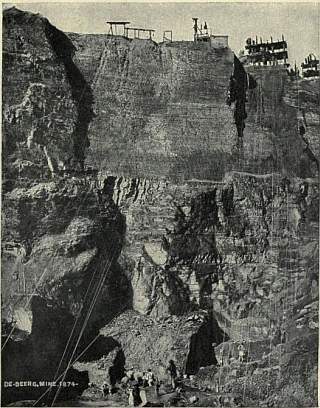
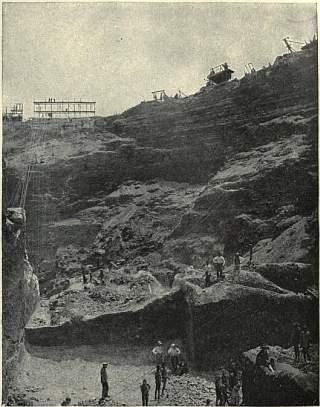
Fig. 9.—DE BEERS MINE, 1874. Fig. 10.—KIMBERLEY MINE, 1874.
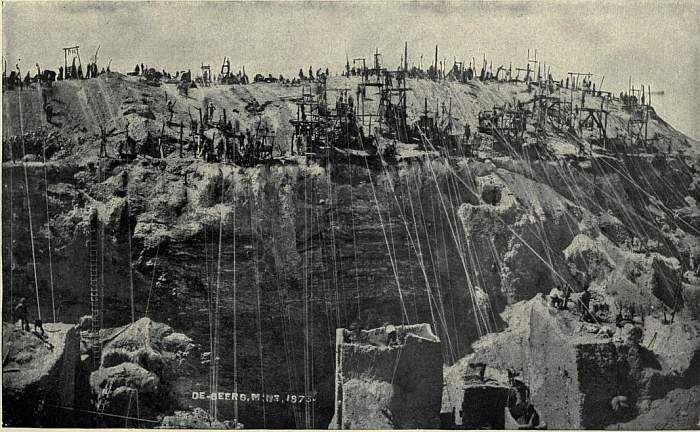
Fig. 11.—DE BEERS MINE, 1873. (From photographs by C. Evans.)
Plate II.
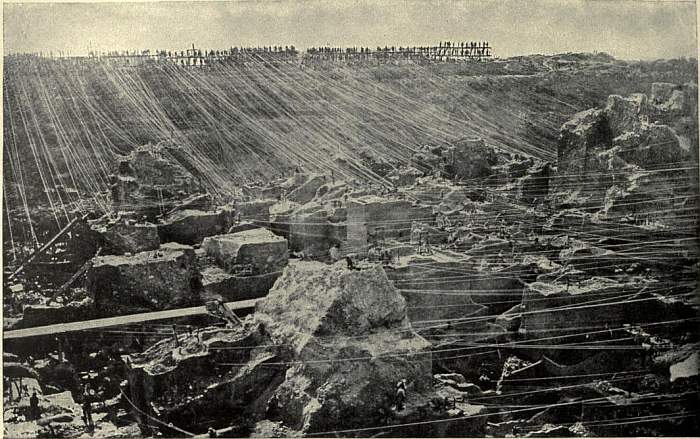
Fig. 12.—KIMBERLEY MINE, 1874.
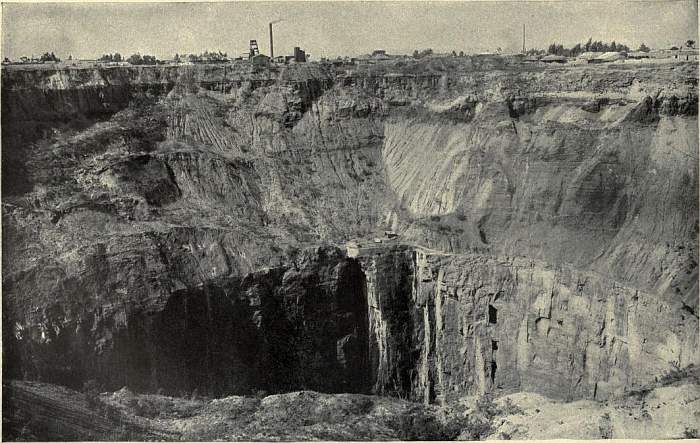
Fig. 13.—KIMBERLEY MINE, 1902. (From photographs by C. Evans.)
In a very few years, however, the open pit mining was rendered impossible by the mud rushes, by the falls of the masses of barren rock known as “reef,” which were left standing in the mine, and by landslips from the sides, so that in 1883, when the pit had reached a depth of about 400 ft., mining in the Kimberley crater had become almost impossible. By 1889, in the whole group of mines, Kimberley, Dutoitspan, De Beers and Bultfontein, open pit working was practically abandoned. Meanwhile mining below the bottom of the pits by means of shafts and underground tunnels had been commenced; but the full development of modern methods dates from the year 1889 when Cecil Rhodes and Alfred Beit, who had already secured control of the De Beers mine, acquired also the control of the Kimberley mine, and shortly afterwards consolidated the entire group in the hands of the De Beers Company. (See Kimberley.)
The scene of native mining was now transferred from the open pit to underground tunnels; the vast network of wire ropes (Plate II. fig. 12) with their ascending and descending buckets disappeared, and with it the cosmopolitan crowd of busy miners working like ants at the bottom of the pit. In place of all this, the visitor to Kimberley encounters at the edge of the town only a huge crater, silent and apparently deserted, with no visible sign of the great mining operations which are conducted nearly half a mile below the surface. The aspect of the Kimberley pit in 1906 is shown in fig. 13 of Plate II., which may be compared with the section of fig. 8.
In fig. 13, Plate II., the sequence of the basalt, shale and melaphyre is clearly visible on the sides of the pit; and fig. 8 shows how the crater or “pipe” of blue ground has penetrated these rocks and also the underlying quartzite. The workings at De Beers had extended into the still more deeply seated granite in 1906. Figure 9, Plate I., shows the top of the De Beers’ crater with basalt overlying the shale. Figure 8 also explains the modern system of mining introduced by Gardner Williams. A vertical shaft is sunk in the vicinity of the mine, and from this horizontal tunnels are driven into the pipe at different levels separated by intervals of 40 ft. Through the blue ground itself on each level a series of parallel tunnels about 120 ft. apart are driven to the opposite side of the pipe, and at right angles to these, and 36 ft. apart, another series of tunnels. When the tunnels reach the side of the mine they are opened upwards and sideways so as to form a large chamber, and the overlying mass of blue ground and débris is allowed to settle down and fill up the gallery. On each level this process is carried somewhat farther back than on the level below (fig. 8); material is thus continually withdrawn from one side of the mine and extracted by means of the rock shaft on the opposite side, while the superincumbent débris is continually sinking, and is allowed to fall deeper on the side farthest from the shaft as the blue ground is withdrawn from beneath it. In 1905 the main shaft had been sunk to a depth of 2600 ft. at the Kimberley mine.
For the extraction and treatment of the blue ground the De Beers Company in its great winding and washing plant employs labour-saving machinery on a gigantic scale. The ground is transferred in trucks to the shaft where it is automatically tipped into skips holding 96 cubic ft. (six truck loads); these are rapidly hoisted to the surface, where their contents are automatically dumped into side-tipping trucks, and these in turn are drawn away in a continual procession by an endless wire rope along the tram lines leading to the vast “distributing floors.” These are open tracts upon which the blue ground is spread out and left exposed to sun and rain until it crumbles and disintegrates, the process being hastened by harrowing with steam ploughs; this may require a period of three or six months, or even a year. The stock of blue ground on the floors at one time in 1905 was nearly 4,500,000 loads. The disintegrated ground is then brought back in the trucks and fed through perforated cylinders into the washing pans; the hard blue which has resisted disintegration on the floors, and the lumps which are too big to pass the cylindrical sieves, are crushed before going to the pans. These are shallow cylindrical troughs containing muddy water in which the diamonds and other heavy minerals (concentrates) are swept to the rim by revolving toothed arms, while the lighter stuff escapes near the centre of the pan. The concentrates are then passed over sloping tables (pulsator) and shaken to and fro under a stream of water which effects a second concentration of the heaviest material.
Until recently the final separation of the diamond from the concentrates was made by hand picking, but even this has now been replaced by machinery, owing to the remarkable discovery that a greased surface will hold a diamond while allowing the other heavy minerals to pass over it. The concentrates are washed down a sloping table of corrugated iron which is smeared with grease, and it is found that practically all the diamonds adhere to the table, and the other minerals are washed away. At the large and important Premier mine in the Transvaal the Elmore process, used in British Columbia and in Wales for the separation of metallic ores, has been also introduced. In the Elmore process oil is employed to float off the materials which adhere to it, while the other materials remain in the water, the oil being separated from the water by centrifugal action. The other minerals found in the concentrates are pebbles and fragments of pyrope, zircon, cyanite, chrome-diopside, enstatite, a green pyroxene, mica, ilmenite, magnetite, chromite, hornblende, olivine, barytes, calcite and pyrites.
In all the S. African mines the diamonds are not only crystals of various weights from fractions of a carat to 150 carats, but also occur as microscopic crystals disseminated through the blue ground. In spite of this, however, the average yield in the profitable mines is only from 0.2 carat to 0.6 carat per load of 1600 lb, or on an average about 1½ grs. per ton. The annual output of diamonds from the De Beers mines was valued in 1906 at nearly £5,000,000; the value per carat ranging from about 35s. to 70s.
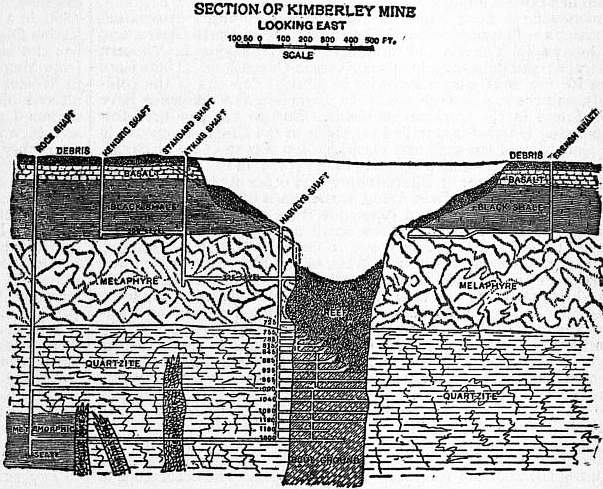
From Gardner Williams’s Diamond Mines of South Africa. Fig. 8.
Pipes similar to those which surround Kimberley have been found in other parts of S. Africa. One of the best known is that of Jagersfontein, which was really the first of the dry diggings (discovered in 1870). This large mine is near Fauresmith and 80 m. to the south of Kimberley. In 1905 the year’s production from the Orange River Colony mines was more than 320,000 carats, valued at £938,000. But by far the largest of all the pipes hitherto discovered is the Premier mine in the Transvaal, about 300 m. to the east of Kimberley. This was discovered in 1902 and occupies an area of about 75 acres. In 1906 it was being worked as a shallow open mine; but the description of the Kimberley methods given above is applicable to the washing plant at that time being introduced into the Premier mine upon a very large scale. Comparatively few of the pipes which have been discovered are at all rich in diamonds, and many are quite barren; some are filled with “hard blue” which even if diamantiferous may be too expensive to work.
The most competent S. African geologists believe all these remarkable pipes to be connected with volcanic outbursts which occurred over the whole of S. Africa during the Cretaceous period (after the deposition of the Stormberg beds), and drilled these enormous craters through all the later formations. With the true pipes are associated dykes and fissures also filled with diamantiferous blue ground. It is only in the more northerly part of the country that the pipes are filled with blue ground (or “kimberlite”), and that they are diamantiferous; but over a great part of Cape Colony have been discovered what are probably similar pipes filled with agglomerates, breccias and tuffs, and some with basic lavas; one, in particular, in the Riversdale Division near the southern coast, being occupied by a melilite-basalt. It is quite clear that the occurrence of the diamond in the S. African pipes is quite different from the occurrences in alluvial deposits which have been described above. The question of the origin of the diamond in S. Africa and elsewhere is discussed below.
The River Diggings on the Vaal river are still worked upon a small scale, but the production from this source is so limited that they are of little account in comparison with the mines in the blue ground. The stones, however, are good; since they differ somewhat from the Kimberley crystals it is probable that they were not derived from the present pipes. Another S. African locality must be mentioned; considerable finds were reported in 1905 and 1906 from gravels at Somabula near Gwelo in Rhodesia where the diamond is associated with chrysoberyl, corundum (both sapphire and ruby), topaz, garnet, ilmenite, staurolite, rutile, with pebbles of quartz, granite, chlorite-schist, &c. Diamond has also been reported from kimberlite “pipes” in Rhodesia.
Other Localities.—In addition to the South American localities mentioned above, small diamonds have also been mined since their discovery in 1890 on the river Mazaruni in British Guiana, and finds have been reported in the gold washings of Dutch Guiana. Borneo has possessed a diamond industry since the island was first settled by the Malays; the references in the works of Garcia de Orta, Linschoten, De Boot, De Laet and others, to Malacca as a locality relate to Borneo. The large Borneo stone, over 360 carats in weight, known as the Matan, is in all probability not a diamond. The chief mines are situated on the river Kapuas in the west and near Bandjarmassin in the south-east of the island, and the alluvial deposits in which they occur are worked by a small number of Chinese and Malays. Australia has yielded diamonds in alluvial deposits near Bathurst (where the first discovery was made in 1851) and Mudgee in New South Wales, and also near Bingara and Inverell in the north of the colony. At Mount Werong a stone weighing 29 carats was found in 1905. At Ruby Hill near Bingara they were found in a breccia filling a volcanic pipe. At Ballina, in New England, diamonds have been found in the sea sand. Other Australian localities are Echunga in South Australia; Beechworth, Arena and Melbourne in Victoria; Freemantle and Nullagine in Western Australia; the Palmer and Gilbert rivers in Queensland. These have been for the most part discoveries in alluvial deposits of the goldfields, and the stones were small. In Tasmania also diamonds have been found in the Corinna goldfields. Europe has produced few diamonds. Humboldt searched for them in the Urals on account of the similarity of the gold and platinum deposits to those of Brazil, and small diamonds were ultimately found (1829) in the gold washings of Bissersk, and later at Ekaterinburg and other spots in the Urals. In Lapland they have been found in the sands of the Pasevig river. Siberia has yielded isolated diamonds from the gold washings of Yenisei. In North America a few small stones have been found in alluvial deposits, mostly auriferous, in Georgia, N. and S. Carolina, Kentucky, Virginia, Tennessee, Wisconsin, California, Oregon and Indiana. A crystal weighing 23¾ carats was found in Virginia in 1855, and one of 21¼ carats in Wisconsin in 1886. In 1906 a number of small diamonds were discovered in an altered peridotite somewhat resembling the S. African blue ground, at Murfreesboro, Pike county, Arkansas. Considerable interest attaches to the diamonds found in Wisconsin, Michigan and Ohio near the Great Lakes, for they are here found in the terminal moraines of the great glacial sheet which is supposed to have spread southwards from the region of Hudson Bay; several of the drift minerals of the diamantiferous region of Indiana have been identified as probably of Canadian origin; no diamonds have however yet been found in the intervening country of Ontario. A rock similar to the blue ground of Kimberley has been found in the states of Kentucky and New York. The occurrence of diamond in meteorites is described below.
Origin of the Diamond in Nature.—It appears from the foregoing account that at most localities the diamond is found in alluvial deposits probably far from the place where it originated. The minerals associated with it do not afford much clue to the original conditions; they are mostly heavy minerals derived from the neighbouring rocks, in which the diamond itself has not been observed. Among the commonest associates of the diamond are quartz, topaz, tourmaline, rutile, zircon, magnetite, garnet, spinel and other minerals which are common accessory constituents of granite, gneiss and the crystalline schists. Gold (also platinum) is a not infrequent associate, but this may only mean that the sands in which the diamond is found have been searched because they were known to be auriferous; also that both gold and diamond are among the most durable of minerals and may have survived from ancient rocks of which other traces have been lost.
The localities at which the diamond has been supposed to occur in its original matrix are the following:—at Wajra Karur, in the Cuddapah district, India, M. Chaper found diamond with corundum in a decomposed red pegmatite vein in gneiss. At Sāo João da Chapada, in Minas Geraes, diamonds occur in a clay interstratified with the itacolumite, and are accompanied by sharp crystals of rutile and haematite in the neighbourhood of decomposed quartz veins which intersect the itacolumite. It has been suggested that these three minerals were originally formed in the quartz veins. In both these occurrences the evidence is certainly not sufficient to establish the presence of an original matrix. At Inverell in New South Wales a diamond (1906) has been found embedded in a hornblende diabase which is described as a dyke intersecting the granite. Finally there is the remarkable occurrence in the blue ground of the African pipes.
There has been much controversy concerning the nature and origin of the blue ground itself; and even granted that (as is generally believed) the blue ground is a much serpentinized volcanic breccia consisting originally of an olivine-bronzite-biotite rock (the so-called kimberlite), it contains so many rounded and angular fragments of various rocks and minerals that it is difficult to say which of them may have belonged to the original rock, and whether any were formed in situ, or were brought up from below as inclusions. Carvill Lewis believed the blue ground to be true eruptive rock, and the carbon to have been derived from the bituminous shales of which it contains fragments. The Kimberley shales, which are penetrated by the De Beers group of pipes, were, however, certainly not the source of the carbon at the Premier (Transvaal) mine, for at this locality the shales do not exist. The view that the diamond may have crystallized out from solution in its present matrix receives some support from the experiments of W. Luzi, who found that it can be corroded by the solvent action of fused blue ground; from the experiments of J. Friedländer, who obtained diamond by dissolving graphite in fused olivine; and still more from the experiments of R. von Hasslinger and J. Wolff, who have obtained it by dissolving graphite in a fused mixture of silicates having approximately the composition of the blue ground. E. Cohen, who regarded the pipes as of the nature of a mud volcano, and the blue ground as a kimberlite breccia altered by hydrothermal action, thought that the diamond and accompanying minerals had been brought up from deep-seated crystalline schists. Other authors have sought the origin of the diamond in the action of the hydrated magnesian silicates on hydrocarbons derived from bituminous schists, or in the decomposition of metallic carbides.
Of great scientific interest in this connexion is the discovery of small diamonds in certain meteorites, both stones and irons; for example, in the stone which fell at Novo-Urei in Penza, Russia, in 1886, in a stone found at Carcote in Chile, and in the iron found at Cañon Diablo in Arizona. Graphitic carbon in cubic form (cliftonite) has also been found in certain meteoric “irons,” for example in those from Magura in Szepes county, Hungary, and Youndegin near York in Western Australia. The latter is now generally believed to be altered diamond. The fact that H. Moissan has produced the diamond artificially, by allowing dissolved carbon to crystallize out at a high temperature and pressure from molten iron, coupled with the occurrence in meteoric iron, has led Sir William Crookes and others to conclude that the mineral may have been derived from deep-seated iron containing carbon in solution (see the article Gem, Artificial). Adolf Knop suggested that this may have first yielded hydrocarbons by contact with water, and that from these the crystalline diamond has been formed. The meteoric occurrence has even suggested the fanciful notion that all diamonds were originally derived from meteorites. The meteoric iron of Arizona, some of which contains diamond, is actually found in and about a huge crater which is supposed by some to have been formed by an immense meteorite penetrating the earth’s crust.
It is, at any rate, established that carbon can crystallize as diamond from solution in iron, and other metals; and it seems that high temperature and pressure and the absence of oxidizing agents are necessary conditions. The presence of sulphur, nickel, &c., in the iron appears to favour the production of the diamond. On the other hand, the occurrence in meteoric stones, and the experiments mentioned above, show that the diamond may also crystallize from a basic magma, capable of yielding some of the metallic oxides and ferro-magnesian silicates; a magma, therefore, which is not devoid of oxygen. This is still more forcibly suggested by the remarkable eclogite boulder found in the blue ground of the Newlands mine, not far from the Vaal river, and described by T. G. Bonney. The boulder is a crystalline rock consisting of pyroxene (chrome-diopside), garnet, and a little olivine, and is studded with diamond crystals; a portion of it is preserved in the British Museum (Natural History). In another eclogite boulder, diamond was found partly embedded in pyrope. Similar boulders have also been found in the blue ground elsewhere. Specimens of pyrope with attached or embedded diamond had previously been found in the blue ground of the De Beers mines. In the Newlands boulder the diamonds have the appearance of being an original constituent of the eclogite. It seems therefore that a holocrystalline pyroxene-garnet rock may be one source of the diamond found in blue ground. On the other hand many tons of the somewhat similar eclogite in the De Beers mine have been crushed and have not yielded diamond. Further, the ilmenite, which is the most characteristic associate of the diamond in blue ground, and other of the accompanying minerals, may have come from basic rocks of a different nature.
The Inverell occurrence may prove to be another example of diamond crystallized from a basic rock.
In both occurrences, however, there is still the possibility that the eclogite or the basalt is not the original matrix, but may have caught up the already formed diamond from some other matrix. Some regard the eclogite boulders as derived from deep-seated crystalline rocks, others as concretions in the blue ground.
None of the inclusions in the diamond gives any clue to its origin; diamond itself has been found as an inclusion, as have also black specks of some carbonaceous materials. Other black specks have been identified as haematite and ilmenite; gold has also been found; other included minerals recorded are rutile, topaz, quartz, pyrites, apophyllite, and green scales of chlorite (?). Some of these are of very doubtful identification; others (e.g. apophyllite and chlorite) may have been introduced along cracks. Some of the fibrous inclusions were identified by H. R. Göppert as vegetable structures and were supposed to point to an organic origin, but this view is no longer held. Liquid inclusions, some of which are certainly carbon dioxide, have also been observed.
Finally, then, both experiment and the natural occurrence in rocks and meteorites suggest that diamond may crystallize not only from iron but also from a basic silicate magma, possibly from various rocks consisting of basic silicates. The blue ground of S. Africa may be the result of the serpentinization of several such rocks, and although now both brecciated and serpentinized some of these may have been the original matrix. A circumstance often mentioned in support of this view is the fact that the diamonds in one pipe generally differ somewhat in character from those of another, even though they be near neighbours.
History.—All the famous diamonds of antiquity must have been Indian stones. The first author who described the Indian mines at all fully was the Portuguese, Garcia de Orta (1565), who was physician to the viceroy of Goa. Before that time there were only legendary accounts like that of Sindbad’s “Valley of the Diamonds,” or the tale of the stones found in the brains of serpents. V. Ball thinks that the former legend originated in the Indian practice of sacrificing cattle to the evil spirits when a new mine is opened; birds of prey would naturally carry off the flesh, and might give rise to the tale of the eagles carrying diamonds adhering to the meat.
The following are some of the most famous diamonds of the world:—
A large stone found in the Golconda mines and said to have weighed 787 carats in the rough, before being cut by a Venetian lapidary, was seen in the treasury of Aurangzeb in 1665 by Tavernier, who estimated its weight after cutting as 280 (?) carats, and described it as a rounded rose-cut-stone, tall on one side. The name Great Mogul has been frequently applied to this stone. Tavernier states that it was the famous stone given to Shah Jahan by the emir Jumla. The Orloff, stolen by a French soldier from the eye of an idol in a Brahmin temple, stolen again from him by a ship’s captain, was bought by Prince Orloff for £90,000, and given to the empress Catharine II. It weighs 194¾ carats, is of a somewhat yellow tinge, and is among the Russian crown jewels. The Koh-i-nor, which was in 1739 in the possession of Nadir Shah, the Persian conqueror, and in 1813 in that of the raja of Lahore, passed into the hands of the East India Company and was by them presented to Queen Victoria in 1850. It then weighed 1861⁄16 carats, but was recut in London by Amsterdam workmen, and now weighs 1061⁄16 carats. There has been much discussion concerning the possibility of this stone and the Orloff being both fragments of the Great Mogul. The Mogul Baber in his memoirs (1526) relates how in his conquest of India he captured at Agra the great stone weighing 8 mishkals, or 320 ratis, which may be equivalent to about 187 carats. The Koh-i-nor has been identified by some authors with this stone and by others with the stone seen by Tavernier. Tavernier, however, subsequently described and sketched the diamond which he saw as shaped like a bisected egg, quite different therefore from the Koh-i-nor. Nevil Story Maskelyne has shown reason for believing that the stone which Tavernier saw was really the Koh-i-nor and that it is identical with the great diamond of Baber; and that the 280 carats of Tavernier is a misinterpretation on his part of the Indian weights. He suggests that the other and larger diamond of antiquity which was given to Shah Jahan may be one which is now in the treasury of Teheran, and that this is the true Great Mogul which was confused by Tavernier with the one he saw. (See Ball, Appendix I. to Tavernier’s Travels (1889); and Maskelyne, Nature, 1891, 44, p. 555.).
The Regent or Pitt diamond is a magnificent stone found in either India or Borneo; it weighed 410 carats and was bought for £20,400 by Pitt, the governor of Madras; it was subsequently, in 1717, bought for £80,000 (or, according to some authorities, £135,000) by the duke of Orleans, regent of France; it was reduced by cutting to 13614⁄16 carats; was stolen with the other crown jewels during the Revolution, but was recovered and is still in France. The Akbar Shah was originally a stone of 116 carats with Arabic inscriptions engraved upon it; after being cut down to 71 carats it was bought by the gaikwar of Baroda for £35,000. The Nizam, now in the possession of the nizam of Hyderabad, is supposed to weigh 277 carats; but it is only a portion of a stone which is said to have weighed 440 carats before it was broken. The Great Table, a rectangular stone seen by Tavernier in 1642 at Golconda, was found by him to weigh 2423⁄16 carats; Maskelyne regards it as identical with the Darya-i-nur, which is also a rectangular stone weighing about 186 carats in the possession of the shah of Persia. Another stone, the Taj-e-mah, belonging to the shah, is a pale rose pear-shaped stone and is said to weigh 146 carats.
Other famous Indian diamonds are the following:—The Sancy, weighing 5312⁄16 carats, which is said to have been successively the property of Charles the Bold, de Sancy, Queen Elizabeth, Henrietta Maria, Cardinal Mazarin, Louis XIV.; to have been stolen with the Pitt during the French Revolution; and subsequently to have been the property of the king of Spain, Prince Demidoff and an Indian prince. The Nassak, 785⁄8 carats, the property of the duke of Westminster. The Empress Eugénie, 51 carats, the property of the gaikwar of Baroda. The Pigott, 49 carats(?), which cannot now be traced. The Pasha, 40 carats. The White Saxon, 48¾ carats. The Star of Este, 2513⁄32 carats.
Coloured Indian diamonds of large size are rare; the most famous are:—a beautiful blue brilliant, 672⁄16 carats, cut from a stone weighing 1123⁄16 carats brought to Europe by Tavernier. It was stolen from the French crown jewels with the Regent and was never recovered. The Hope, 44¼ carats, has the same colour and is probably a portion of the missing stone: it was so-called as forming part of the collection of H. T. Hope (bought for £18,000), and was sold again in 1906 (resold 1909). Two other blue diamonds are known, weighing 13¾ and 1¾ carats, which may also be portions of the French diamond. The Dresden Green, one of the Saxon crown jewels, 40 carats, has a fine apple-green colour. The Florentine, 1331⁄5 carats, one of the Austrian crown jewels, is a very pale yellow.
The most famous Brazilian stones are:—The Star of the South, found in 1853, when it weighed 254½ carats and was sold for £40,000; when cut it weighed 125 carats and was bought by the gaikwar of Baroda for £80,000. Also a diamond belonging to Mr Dresden, 119 carats before, and 76½ carats after cutting.
Many large stones have been found in South Africa; some are yellow but some are as colourless as the best Indian or Brazilian stones. The most famous are the following:—the Star of South Africa, or Dudley, mentioned above, 83½ carats rough, 46½ carats cut. The Stewart, 2883⁄8 carats rough, 120 carats cut. Both these were found in the river diggings. The Porter Rhodes from Kimberley, of the finest water, weighed about 150 carats. The Victoria, 180 carats, was cut from an octahedron weighing 457½ carats, and was sold to the nizam of Hyderabad for £400,000. The Tiffany, a magnificent orange-yellow stone, weighs 125½ carats cut. A yellowish octahedron found at De Beers weighed 428½ carats, and yielded a brilliant of 288½ carats. Some of the finest and largest stones have come from the Jagersfontein mine; one, the Jubilee, found in 1895, weighed 640 carats in the rough and 239 carats when cut. Until 1905 the largest known diamond in the world was the Excelsior, found in 1893 at Jagersfontein by a native while loading a truck. It weighed 971 carats, and was ultimately cut into ten stones weighing from 68 to 13 carats. But all previous records were surpassed in 1905 by a magnificent stone more than three times the size of any known diamond, which was found in the yellow ground at the newly discovered Premier mine in the Transvaal. This extraordinary diamond weighed 3025¾ carats (11⁄3 ℔) and was clear and water white; the largest of its surfaces appeared to be a cleavage plane, so that it might be only a portion of a much larger stone. It was known as the Cullinan Diamond. This stone was purchased by the Transvaal government in 1907 and presented to King Edward VII. It was sent to Amsterdam to be cut, and in 1908 was divided into nine large stones and a number of small brilliants. The four largest stones weigh 516½ carats, 3093⁄16 carats, 92 carats and 62 carats respectively. Of these the first and second are the largest brilliants in existence. All the stones are flawless and of the finest quality.
Bibliography.—Boetius de Boot, Gemmarum et lapidum historia (1609); D. Jeffries, A Treatise on Diamonds and Pearls (1757); J. Mawe, Travels in the Interior of Brazil (1812); Treatise on Diamonds and Precious Stones (1813): Pinder, De adamante (1829); Murray, Memoir on the Nature of the Diamond (1831); C. Zerenner, De adamante dissertatio (1850); H. Emanuel, Diamonds and Precious Stones (1865); A. Schrauf, Edelsteinkunde (1869); N. Jacobs and N. Chatrian, Monographie du diamant (1880); V. Ball, Geology of India (1881); C. W. King, The Natural History of Precious Stones and Precious Metals (1883); M. E. Boutan, Le Diamant (1886); S. M. Burnham, Precious Stones in Nature, Art and Literature (1887); P. Groth, Grundriss der Edelsteinkunde (1887); A. Liversidge, The Minerals of New South Wales (1888); Tavernier’s Travels in India, translated by V. Ball (1889); E. W. Streeter, The Great Diamonds of the World (1896); H. C. Lewis, The Genesis and Matrix of the Diamond (1897); L. de Launay, Les Diamants du Cap (1897); C. Hintze, Handbuch der Mineralogie (1898); E. W. Streeter, Precious Stones and Gems (6th ed., 1898); Dana, System of Mineralogy (1899); Kunz and others, The Production of Precious Stones (in annual, Mineral Resources of the United States); M. Bauer, Precious Stones (trans. L. J. Spencer, 1904); A. W. Rogers, An Introduction to the Geology of Cape Colony (1905); Gardner F. Williams, The Diamond Mines of South Africa (revised edition, 1906); George F. Kunz, “Diamonds, a study of their occurrence in the United States, with descriptions and comparisons of those from all known localities” (U.S. Geol. Survey, 1909); P. A. Wagner, Die Diamantführenden Gesteine Südafrikas (1909).
Among papers in scientific periodicals may be mentioned articles by Adler, Ball, Baumhauer, Beck, Bonney, Brewster, Chaper, Cohen, Crookes, Daubrée, Derby, Des Cloizeaux, Doelter, Dunn, Flight, Friedel, Gorceix, Gürich, Goeppert, Harger, Hudleston, Hussak, Jannettaz, Jeremejew, de Launay, Lewis, Maskelyne, Meunier, Moissan, Molengraaff, Moulle, Rose, Sadebeck, Scheibe, Stelzner, Stow. See generally Hintze’s Handbuch der Mineralogie.
(H. A. Mi.)
1 Diamonds are invariably weighed in carats and in ½, ¼, 1⁄8, 1⁄16, 1⁄32, 1⁄64 of a carat. One (English) carat = 3.17 grains = .2054 gram. One ounce = 151½ carats. (See Carat.)
DIAMOND NECKLACE, THE AFFAIR OF THE, a mysterious incident at the court of Louis XVI. of France, which involved the queen Marie Antoinette. The Parisian jewellers Boehmer and Bassenge had spent some years collecting stones for a necklace which they hoped to sell to Madame Du Barry, the favourite of Louis XV., and after his death to Marie Antoinette. In 1778 Louis XVI. proposed to the queen to make her a present of the necklace, which cost 1,600,000 livres. But the queen is said to have refused it, saying that the money would be better spent equipping a man-of-war. According to others, Louis XVI. himself changed his mind. After having vainly tried to place the necklace outside of France, the jewellers attempted again in 1781 to sell it to Marie Antoinette after the birth of the dauphin. It was again refused, but it was evident that the queen regretted not being able to acquire it.
At that time there was a personage at the court whom Marie Antoinette particularly detested. It was the cardinal Louis de Rohan, formerly ambassador at Vienna, whence he had been recalled in 1774, having incurred the queen’s displeasure by revealing to the empress Maria Theresa the frivolous actions of her daughter, a disclosure which brought a maternal reprimand, and for having spoken lightly of Maria Theresa in a letter of which Marie Antoinette learned the contents. After his return to France the cardinal was anxious to regain the favour of the queen in order to obtain the position of prime minister. In March 1784 he entered into relations with a certain Jeanne de St Remy de Valois, a descendant of a bastard of Henry II., who after many adventures had married a soi-disant comte de Lamotte, and lived on a small pension which the king granted her. This adventuress soon gained the greatest ascendancy over the cardinal, with whom she had intimate relations. She persuaded him that she had been received by the queen and enjoyed her favour; and Rohan resolved to use her to regain the queen’s good will. The comtesse de Lamotte assured the cardinal that she was making efforts on his behalf, and soon announced to him that he might send his justification to Marie Antoinette. This was the beginning of a pretended correspondence between Rohan and the queen, the adventuress duly returning replies to Rohan’s notes, which she affirmed to come from the queen. The tone of the letters became very warm, and the cardinal, convinced that Marie Antoinette was in love with him, became ardently enamoured of her. He begged the countess to obtain a secret interview for him with the queen, and a meeting took place in August 1784 in a grove in the garden at Versailles between him and a lady whom the cardinal believed to be the queen herself. Rohan offered her a rose, and she promised him that she would forget the past. Later a certain Marie Lejay (renamed by the comtesse “Baronne Gay d’Oliva,” the last word being apparently an anagram of Valoi), who resembled Marie Antoinette, stated that she had been engaged to play the role of queen in this comedy. In any case the countess profited by the cardinal’s conviction to borrow from him sums of money destined ostensibly for the queen’s works of charity. Enriched by these, the countess was able to take an honourable place in society, and many persons believed her relations with Marie Antoinette, of which she boasted openly and unreservedly, to be genuine. It is still an unsettled question whether she simply mystified people, or whether she was really employed by the queen for some unknown purpose, perhaps to ruin the cardinal. In any case the jewellers believed in the relations of the countess with the queen, and they resolved to use her to sell their necklace. She at first refused their commission, then accepted it. On the 21st of January 1785 she announced that the queen would buy the necklace, but that not wishing to treat directly, she left the affair to a high personage. A little while later Rohan came to negotiate the purchase of the famous necklace for the 1,600,000 livres, payable in instalments. He said that he was authorized by the queen, and showed the jewellers the conditions of the bargain approved in the handwriting of Marie Antoinette. The necklace was given up. Rohan took it to the countess’s house, where a man, in whom Rohan believed he recognized a valet of the queen, came to fetch it. Madame de Lamotte had told the cardinal that Marie Antoinette would make him a sign to indicate her thanks, and Rohan believed that she did make him a sign. Whether it was so, or merely chance or illusion, no one knows. But it is certain that the cardinal, convinced that he was acting for the queen, had engaged the jewellers to thank her; that Boehmer and Bassenge, before the sale, in order to be doubly sure, had sent word to the queen of the negotiations in her name; that Marie Antoinette had allowed the bargain to be concluded, and that after she had received a letter of thanks from Boehmer, she had burned it. Meanwhile the “comte de Lamotte” appears to have started at once for London, it is said with the necklace, which he broke up in order to sell the stones.
When the time came to pay, the comtesse de Lamotte presented the cardinal’s notes; but these were insufficient, and Boehmer complained to the queen, who told him that she had received no necklace and had never ordered it. She had the story of the negotiations repeated for her. Then followed a coup de théâtre. On the 15th of August 1785, Assumption day, when the whole court was awaiting the king and queen in order to go to the chapel, the cardinal de Rohan, who was preparing to officiate, was arrested and taken to the Bastille. He was able, however, to destroy the correspondence exchanged, as he thought, with the queen, and it is not known whether there was any connivance of the officials, who did not prevent this, or not. The comtesse de Lamotte was not arrested until the 18th of August, after having destroyed her papers. The police set to work to find all her accomplices, and arrested the girl Oliva and a certain Reteaux de Villette, a friend of the countess, who confessed that he had written the letters given to Rohan in the queen’s name, and had imitated her signature on the conditions of the bargain. The famous charlatan Cagliostro was also arrested, but it was recognized that he had taken no part in the affair. The cardinal de Rohan accepted the parlement of Paris as judges. A sensational trial resulted (May 31, 1786) in the acquittal of the cardinal, of the girl Oliva and of Cagliostro. The comtesse de Lamotte was condemned to be whipped, branded and shut up in the Salpetrière. Her husband was condemned, in his absence, to the galleys for life. Villette was banished.
Public opinion was much excited by this trial. It is generally believed that Marie Antoinette was stainless in the matter, that Rohan was an innocent dupe, and that the Lamottes deceived both for their own ends. People, however, persisted in the belief that the queen had used the countess as an instrument to satisfy her hatred of the cardinal de Rohan. Various circumstances fortified this belief, which contributed to render Marie Antoinette very unpopular—her disappointment at Rohan’s acquittal, the fact that he was deprived of his charges and exiled to the abbey of la Chaise-Dieu, and finally the escape of the comtesse de Lamotte from the Salpetrière, with the connivance, as people believed, of the court. The adventuress, having taken refuge abroad, published Mémoires in which she accused the queen. Her husband also wrote Mémoires, and lived until 1831, after having, it is said, received subsidies from Louis XVIII.
See M. Tourneux, Marie Antoinette devant l’histoire: Essai bibliographique (2nd ed., Paris, 1901); Émile Campardon, Marie Antoinette et le procès du collier (Paris, 1863); P. Audebert, L’Affaire du collier de la reine, d’après la correspondance inédite du chevalier de Pujol (Rouen, 1901); F. d’Albini, Marie Antoinette and the Diamond Necklace from another Point of View (London, 1900); Funck-Brentano, L’Affaire du collier (1903); A. Lang, Historical Mysteries (1904). Carlyle’s essay on The Diamond Necklace (first published in 1837 in Fraser’s Magazine) is of historical literary interest.
DIANA, in Roman mythology, an old Italian goddess, in later times identified with the Greek Artemis (q.v.). That she was originally an independent Italian deity is shown by her name, which is the feminine form of Janus (= Dianus). She is essentially the goddess of the moon and light generally, and presides over wood, plain and water, the chase and war. As the goddess of childbirth, she was known, like Juno, by the name of Lucina, the “bringer to light.” As the moon-goddess she was also identified with Hecate, and invoked as “three-formed” in reference to the phases of the moon. Her most celebrated shrine was in a grove at Aricia (whence her title of Nemorensis) near the modern lake of Nemi. Here she was worshipped side by side with a male deity Virbius, a god of the forest and the chase. This Virbius was subsequently identified with Hippolytus, the favourite of Artemis, who was said to have been brought to life by Aesculapius and conducted by Diana to Aricia (Ovid, Fasti, iii. 263, vi. 731, Metam. xv. 497; Virgil, Aeneid, vii. 761). A barbarous custom, perhaps reminiscent of human sacrifice once offered to her, prevailed in connexion with her ritual here; her priest, called Rex Nemorensis, who was a runaway slave, was obliged to qualify for office by slaying his predecessor in single combat (Strabo v. p. 239; Suetonius, Caligula, 35). This led to the identification of Diana with the Tauric Artemis, whose image was said to have been removed by Orestes to the grove of Aricia (see Aricini).
After the destruction of Alba Longa this grove was for a long time the united sanctuary of the neighbouring Latin and Rutulian cities, until at last it was extinguished beneath the supremacy of Rome. The festival of the goddess was on the ides (13th) of August, the full moon of the hot season. She was worshipped with torches, her aid was sought by women seeking a happy deliverance in childbirth, and many votive offerings have been found on the site. The worship of Diana was brought to Rome by Latin plebeians, and hence she was regarded as the protectress of the lower classes, and especially of slaves. In accordance with this, her most important temple was that on the Aventine, the chief seat of the plebeians, founded by Servius Tullius, originally as a sanctuary of the Latin league (Dion. Halic. iv. 26). No man was allowed to enter the temple, and on the day of its dedication (August 13) the slaves kept holiday (Plutarch, Quaest. Rom. 100). This Diana was identified with the sister of Apollo, and at the secular games she was worshipped simply as Artemis. Another celebrated sanctuary of Diana was that on the slopes of Mount Tifata near Capua (where she was worshipped under the name of Tifatina), a sanctuary specially favoured by Sulla and Vespasian. As Noctiluca (“giving light by night”) she had a sanctuary on the Palatine which was kept illuminated throughout the night (Varro, L.L. v. 68). On the Nemi priesthood see J. G. Frazer, Golden Bough.
DIANA MONKEY, a West African representative of the guenon monkeys taking its name, Cercopithecus diana, from the presence of a white crescent on the forehead; another characteristic feature being the pointed white beard. The general colour of the fur is greyish, with a deep tinge of chestnut from the middle of the back to the root of the tail. Together with C. neglectus of East and Central Africa, C. ignitus of Liberia, and C. roloway of the Gold Coast, the diana represents the special subgenus of guenons known as Pogonocebus. Although the diana monkey is commonly seen in menageries, little is known of its habits in the wild state.
DIANE DE FRANCE (1538-1619), duchess of Montmorency and Angoulême, was the natural daughter of Henry II. of France and a young Piedmontese, Filippe Duc. The constable de Montmorency went so far as to assert that of all the children of Henry II. Diane was the only one who resembled him. Catherine de’ Medici was greatly incensed at this affront, and took her revenge by having the constable disgraced on the death of Henry II. Brantôme is loud in praise of Diane. She was a perfect horsewoman and dancer, played several musical instruments, knew Spanish and Italian, and “estoit très belle de visage et de taille.” Legitimated in 1547, she was married in 1553 to Horace Farnese, second son of the duke of Parma, but her husband was killed soon afterwards at the siege of Hesdin. In order to assure his position, the constable de Montmorency wished to marry her to his eldest son, Francis. This was a romantic adventure, for Francis had clandestinely married Mademoiselle de Piennes. The constable dissolved this union, and after lengthy negotiations obtained the dispensation of the pope. On the 3rd of May 1559 Francis married Diane. A wise and moderate woman, Diane undoubtedly helped to make Francis de Montmorency one of the leaders of the party of the politiques. Again a widow in 1579, she had some influence at the court of Henry III., and negotiated his reconciliation with Henry of Navarre (1588). She retained her influence in the reign of Henry IV., conveyed the bodies of Catherine de’ Medici and Henry III. to St Denis, and died in 1619 at her hôtel of Angoulême.
See Brantôme, ed. by Lalanne, in the Coll de la société d’histoire de France, vol. viii. (1875); J. de Thou, Historia sui temporis... (1733); Matthieu de Morgues, Oraison funèbre de Diane de France (Paris, 1619).
DIANE DE POITIERS (1499-1566), duchess of Valentinois, and mistress of Henry II. of France, was the daughter of Jean de Poitiers, seigneur de St Vallier, who came of an old family of Dauphiné. In 1515 she married Louis de Brézé, grand seneschal of Normandy, by whom she had two daughters. She became a widow in 1533, but soon replaced her husband by a more illustrious lover, the king’s second son, Henry, who became dauphin in 1536. Although he was ten years younger than Diane, she inspired the young prince with a profound passion, which lasted until his death. The accession of Henry II. in 1547 was also the accession of Diane: she was virtual queen, while Henry’s lawful wife, Catherine de’ Medici, lived in comparative obscurity. The part Diane played, however, must not be exaggerated. More rapacious than ambitious, she concerned herself little with government, but devoted her energies chiefly to augmenting her income, and providing for her family and friends. Henry was the most prodigal of lovers, and gave her all rights over the duchy of Valentinois. Although she showed great tact in her dealings with the queen, Catherine drove her from the court after Henry’s death, and forced her to restore the crown jewels and to accept Chaumont in exchange for Chenonceaux. Diane retired to her château at Anet, where she died in 1566.
Several historians relate that she had been the mistress of Francis I. before she became the dauphin’s mistress, and that she gave herself to the king in order to obtain the pardon of her father, who had been condemned to death as an accomplice of the constable de Bourbon. This rumour, however, has no serious foundation. Men vied with each other in celebrating Diane’s beauty, which, if we may judge from her portraits, has been slightly exaggerated. She was a healthy, vigorous woman, and, by dint of great pains, succeeded in retaining her beauty late into life. It is said that even on the coldest mornings she would wash her face with well water. Diane was a patroness of the arts. She entrusted to Philibert de l’Orme the building of her château at Anet, and it was for her that Jean Goujon executed his masterpiece, the statue of Diana, now in the Louvre.
See G. Guiffrey, Lettres inédites de Diane de Poytiers (Paris, 1866) and Procès criminel de Jehan de Poytiers (Paris, 1867); Capefigue, Diane de Poitiers (Paris, 1860); Hay, Madame Dianne de Poytiers (London, 1900).
DIAPASON (Gr. διὰ πασῶν, through all), a term in music, originally for an interval of an octave. The Greek is an abbreviation of ἡ διὰ πασῶν χορδῶν συμφωνία, a consonance through all the tones of the scale. In this sense it is only used now, loosely, for the compass of an instrument or voice, or for a harmonious melody. The name is given to the two foundation stops of an organ, the open and the stopped diapason (see Organ), and to a standard of musical pitch, as in the French diapason normal (see Pitch, Musical).
DIAPER (derived through the Fr, from the Gr. διά, through, and ἄσπρος, white; the derivation from the town of Ypres, “d’Ypres,” in Belgium is unhistorical, as diapers were known for centuries before its existence), the name given to a textile fabric, formerly of a rich and costly nature with embroidered ornament, but now of linen or cotton, with a simple woven pattern; and particularly restricted to small napkins. In architecture, the term “diaper” is given to any small pattern of a conventional nature repeated continuously and uniformly over a surface; the designs may be purely geometrical, or based on floral forms, and in early examples were regulated by the process of their textile origin. Subsequently, similar patterns were employed in the middle ages for the surface decoration of stone, as in Westminster Abbey and Bayeux cathedral in the spandrils of the arcades of the choir and nave; also in mural painting, stained glass, incised brasses, encaustic tiles, &c. Probably in most cases the pattern was copied, so far as the general design is concerned, from the tissues and stuffs of Byzantine manufacture, which came over to Europe and were highly prized as ecclesiastical vestments.
In its textile use, the term diaper was originally applied to silk patterns of a geometrical pattern; it is now almost exclusively used for diamond patterns made from linen or cotton yarns. An illustration of two patterns of this nature is shown in the figure. The floats of the warp and the weft are mostly in three; indeed the patterns are made from a base weave which is composed entirely of floats of this number. It will be seen that both designs are formed of what may be termed concentric figures—alternately black and white. Pattern B differs from pattern A only in that more of these concentric figures are used for the complete figure. If pattern B, which shows only one unit, were extended, the effect would be similar to A, except for the size of the unit. In A there are four complete units, and hence the pattern appears more striking. Again, the repeating of B would cause the four corner pieces to join and to form a diamond similar to the one in the centre. The two diamonds in B would then alternate diagonally to left and right. Special names are given to certain kinds of diapers, e.g. “bird’s-eye,” “pheasant’s-eye”; these terms indicate, to a certain extent, the size of the complete diamond in the cloth—the smaller kind taking the name “bird’s-eye.” The size of the pattern on paper has little connexion with the size of the pattern in the cloth, for it is clearly the number of threads and picks per inch which determine the size of the pattern in the cloth from any given design. Although A is larger than what is usually termed the “bird’s-eye” pattern, it is evident that it may be made to appear as such, provided that the cloth is fine enough. These designs, although adapted mostly for cloths such as nursery-diapers, for pinafores, &c., are sometimes used in the production of towels and table-cloths. In the figure, the first pick in A is identical with the first pick in B, and the part C shows how each interweaves with the twenty-four threads.
DIAPHORETICS (from Gr. διαφορεῖν, to carry through), the name given to those remedies which promote perspiration. In health there is constantly taking place an exhalation of watery vapour from the skin, by which not only are many of the effete products of nutrition eliminated, but the body is kept cool. Under exertion or in a heated atmosphere this natural function of the skin is increased, sweating more or less profuse follows, and, evaporation going on rapidly over the whole surface, little or no rise in the temperature of the body takes place. In many forms of disease, such as fevers and inflammatory affections, the action of the skin is arrested, and the surface of the body feels harsh and dry, while the temperature is greatly elevated. The occurrence of perspiration not unfrequently marks a crisis in such diseases, and is in general regarded as a favourable event. In some chronic diseases, such as diabetes and some cases of Bright’s disease, the absence of perspiration is a marked feature; while, on the other hand, in many wasting diseases, such as phthisis, the action of the skin is increased, and copious exhausting sweating occurs. Many means can be used to induce perspiration, among the best known being baths, either in the form of hot vapour or hot water baths, or in that part of the process of the Turkish bath which consists in exposing the body to a dry and hot atmosphere. Such measures, particularly if followed by the drinking of hot liquids and the wrapping of the body in warm clothing, seldom fail to excite copious perspiration. Numerous medicinal substances have the same effect.
DIAPHRAGM (Gr. διάφραγμα, a partition). The diaphragm or midriff (Anglo-Saxon, mid, middle, hrif, belly) in human anatomy is a large fibro-muscular partition between the cavities of the thorax and abdomen; it is convex toward the thorax, concave toward the abdomen, and consists of a central tendon and a muscular margin. The central tendon (q, fig. 1) is trefoil in shape, its leaflets being right, left and anterior; of these the right is the largest and the left the smallest. The fleshy fibres rise, in front from the back of the xiphoid cartilage of the sternum (d), laterally by six serrations, from the inner surfaces of the lower six ribs, interdigitating with the transversalis, posteriorly from the arcuate ligaments, of which there are five, a pair of external, a pair of internal, and a single median one. The external arcuate ligament (h) stretches from the tip of the twelfth rib (b) to the costal process of the first lumbar vertebra in front of the quadratus lumborum muscle (o), the internal and middle are continuations of the crura which rise from the ventro-lateral aspects of the bodies of the lumbar vertebrae, the right (e) coming from three, the left (f) from two. On reaching the level of the twelfth thoracic vertebra each crus spreads out into a fan-shaped mass of fibres, of which the innermost join their fellows from the opposite crus, in front of the aortic opening (k), to form the middle arcuate ligament; the outer ones (g) arch in front of the psoas muscle (n) to the tip of the costal process of the first lumbar vertebra to form the internal arcuate ligament, while the intermediate ones pass to the central tendon. There are three large openings in the diaphragm; the aortic (k) is behind the middle arcuate ligament and transmits the aorta, the vena azygos major, and the thoracic duct. In the right leaflet is an opening (sometimes called the hiatus quadratus) for the inferior vena cava and a branch of the right phrenic nerve (m), while in front and a little to the left of the aortic opening is one for the oesophagus and the two pneumogastric nerves (l), the left being in front and the right behind. The fleshy fibres on each side of this opening act as a sphincter. Passing between the xiphoid and costal origins in front are the superior epigastric arteries, while the other terminal branches of the internal mammaries, the musculo-phrenics, pass through between two costal origins.
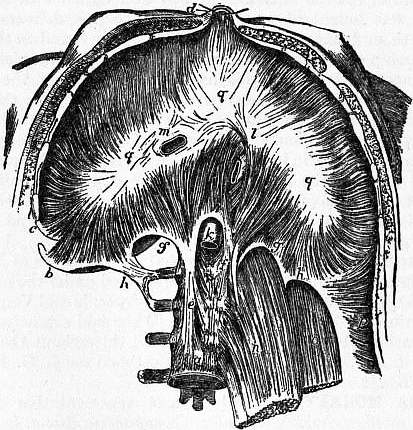
Fig. 1.—Abdominal Surface of the Diaphragm.
Through the crura pass the splanchnic nerves, and in addition to these the left crus is pierced by the vena azygos minor. The sympathetic nerves usually enter the abdomen behind the internal arcuate ligaments. The phrenic nerves, which are the main supply of the diaphragm, divide before reaching the muscle and pierce it in a number of places to enter its abdominal surface, but some of the lower intercostal nerves assist in the supply. The last thoracic or subcostal nerves pass behind the external arcuate ligament.
For the action of the diaphragm see Respiratory System.
Embryology.—The diaphragm is at first developed in the neck region of the embryo, and this accounts for the phrenic nerves, which supply it, rising from the fourth and fifth cervical. From the mesoderm on the caudal side of the pericardium is developed the septum transversum, and in this the central tendon is formed. The fleshy portion is developed on each side in two parts, an anterior or sterno-costal which is derived from the longitudinal neck musculature, probably the same layer from which the sternothyroid comes, and a spinal part which is a derivative of the transversalis sheet of the trunk. Between these two parts is at one time a gap, the spino-costal hiatus, and this is obliterated by the growth of the pleuro-peritoneal membrane, which may occasionally fail to close and so may form the site of a phrenic hernia. With the growth of the body and the development of the lungs the diaphragm shifts its position until it becomes the septum between the thoracic and abdominal cavities. (See A. Keith, “On the Development of the Diaphragm,” Jour. of Anat. and Phys. vol. 39.) A. Paterson has recorded cases in which the left half of the diaphragm is wanting (Proceedings of the Anatomical Society of Gt. Britain, June 1900; Jour. of Anat. and Phys. vol. 34), and occasionally deficiencies are found elsewhere, especially in the sternal portion. For further details see Quain’s Anatomy, vol. i. (London, 1908).
Comparative Anatomy.—A complete diaphragm, separating the thoracic from the abdominal parts of the coelom, is characteristic of the Mammalia; it usually has the human structure and relations except that below the Anthropoids it is separated from the pericardium by the azygous lobe of the lung. In some Mammals, e.g. Echidna and Phocoena, it is entirely muscular. In the Cetacea it is remarkable for its obliquity; its vertebral attachment is much nearer the tail than its sternal or ventral one; this allows a much larger lung space in the dorsal than in the ventral part of the thorax, and may be concerned with the equipoise of the animal. (Otto Müller, “Untersuchungen über die Veränderung, welche die Respirationsorgane der Säugetiere durch die Anpassung an das Leben im Wasser erlitten haben,” Jen. Zeitschr. f. Naturwiss., 1898, p. 93.) In the Ungulata only one crus is found (Windle and Parsons, “Muscles of the Ungulata,” Proc. Zool. Soc., 1903, p. 287). Below the Mammals incomplete partitions between the pleural and peritoneal cavities are found in Chelonians, Crocodiles and Birds, and also in Amphibians (Xenopus and Pipa).
(F. G. P.)
DIARBEKR1 (Kara Amid or Black Amid; the Roman Amida), the chief town of a vilayet of Asiatic Turkey, situated on a basaltic plateau on the right bank of the Tigris, which here flows in a deep open valley. The town is still surrounded by the masonry walls of black basalt which give it the name of Kara or Black Amid; they are well built and imposing on the west facing the open country, but almost in ruins where they overlook the river. A mass of gardens and orchards cover the slope down to the river on the S.W., but there are no suburbs outside the walls. The houses are rather crowded but only partially fill the walled area. The population numbers 38,000, nearly half being Christian, comprising Turks, Kurds, Arabs, Turkomans, Armenians, Chaldeans, Jacobites and a few Greeks. The streets are 10 ft. to 15 ft. wide, badly paved and dirty; the houses and shops are low, mostly of stone, and some of stone and mud. The bazaar is a good one, and gold and silver filigree work is made, peculiar in character and design. The cotton industry is declining, but manufacture of silk is increasing. Fruit is good and abundant as the rich volcanic soil is well watered from the town springs. The size of the melons is specially famous. To the south, the walls are some 40 ft. high, faced with large cut stone blocks of very solid construction, with towers and square bastions rising to 500 ft. There are four gates: on the north the Kharput gate, on the west the Rum, on the south the Mardin, and on the east the Yeni Kapu or new gate. A citadel enclosure stands at the N. E. corner and is now partly in ruins, but the interior space is occupied by the government konak. The summer climate in the confined space within the town is excessively hot and unhealthy. Epidemics of typhus are not unknown, as well as ophthalmia. The Diarbekr boil is like the “Aleppo button,” lasting a long time and leaving a deep scar. Winters are frequently severe but do not last long. Snow sometimes lies, and ice is stored for summer use. Scorpions noted for the virulence of their poison abound as well as horse leeches in the tanks. The town is supplied with water both by springs inside the town and by aqueducts from fountains at Ali Punar and Hamervat. The principal exports are wool, mohair and copper ore, and imports are cotton and woollen goods, indigo, coffee, sugar, petroleum, &c.
The Great Mosque, Ulu Jami, formerly a Christian church, occupies the site of a Sassanian palace and was built with materials from an older palace, probably that of Tigranes II. The remains consist of the façades of two palaces 400 ft. apart, each formed by a row of Corinthian columns surmounted by an equal number of a Byzantine type. Kufic inscriptions run across the fronts under the entablature. The court of the mosque is entered by a gateway on which lions and other animals are sculptured. The churches of greatest interest are those of SS. Cosmas and Damian (Jacobite) and the church of St James (Greek). In the 19th century Diarbekr was one of the largest and most flourishing cities of Asia, and as a commercial centre it now stands at the meeting-point of several important routes. It is at the head of the navigation of the Tigris, which is traversed down stream by keleks or rafts supported by inflated skins. There is a good road to Aleppo and Alexandretta on the Mediterranean, and to Samsun on the Black Sea by Kharput, Malatia and Sivas. There are also routes to Mosul and Bitlis.
Diarbekr became a Roman colony in a.d. 230 under the name of Amida, and received a Christian bishop in a.d. 325. It was enlarged and strengthened by Constantius II., in whose reign it was taken after a long siege by Shapur (Sapor) II., king of Persia. The historian Ammianus Marcellinus, who took part in the defence, gives a detailed account of it. In the later wars between the Persians and Romans it more than once changed hands. Though ceded by Jovian to the Persians it again became annexed to the Roman empire, and in the reign of Anastasius (a.d. 502) was once more taken by the Persians, when 80,000 of its inhabitants were slain. It was taken c. 638 by the Arabs, and afterwards passed into the hands of the Seljuks and Persians, from whom it was finally captured by Selim I. in 1515; and since that date it has remained under Ottoman rule. About 2 m. below the town is a masonry bridge over the Tigris; the older portion being probably Roman, and the western part, which bears a Kufic inscription, being Arab.
The vilayet of Diarbekr extends south from Palu on the Euphrates to Mardin and Nisibin on the edge of the Mesopotamian plain, and is divided into three sanjaks—Arghana, Diarbekr and Mardin. The headwaters of the main arm of the Tigris have their source in the vilayet.
Cereals, cotton, tobacco, rice and silk are produced, but most of the fertile lands have been abandoned to semi-nomads, who raise large quantities of live stock. The richest portion of the vilayet lies east of the capital in the rolling plains watered by tributaries of the Tigris. An exceptionally rich copper mine exists at Arghana Maden, but it is very imperfectly worked; galena mineral oil and silicious sand are also found.
(C. W. W.; F. R. M.)
1 From Diar, land, and Bekr (i.e. Abu Bekr, the caliph).
DIARRHOEA (from Gr. διά, through, ῥέω, flow), an excessive looseness of the bowels, a symptom of irritation which may be due to various causes, or may be associated with some specific disease. The treatment in such latter cases necessarily varies, since the symptom itself may be remedial, but in ordinary cases depends on the removal of the cause of irritation by the use of aperients, various sedatives being also prescribed. In chronic diarrhoea careful attention to the diet is necessary.
DIARY, the Lat. diarium (from dies, a day), the book in which are preserved the daily memoranda regarding events and actions which come under the writer’s personal observation, or are related to him by others. The person who keeps this record is called a diarist. It is not necessary that the entries in a diary should be made each day, since every life, however full, must contain absolutely empty intervals. But it is essential that the entry should be made during the course of the day to which it refers. When this has evidently not been done, as in the case of Evelyn’s diary, there is nevertheless an effort made to give the memoranda the effect of being so recorded, and in point of fact, even in a case like that of Evelyn, it is probable that what we now read is an enlargement of brief notes jotted down on the day cited. When this is not approximately the case, the diary is a fraud, for its whole value depends on its instantaneous transcript of impressions.