VOLUME VIII SLICE IV Diameter to Dinarchus (continued 11)
Reading edition
Before leaving England an attempt was made to draw from him an admission that Laud, with whom he had been intimate, had desired to be made a cardinal, but Digby denied that the archbishop had any leanings towards Rome. On the 1st of November 1643 it was resolved by the Commons to confiscate his property. He published in London the same year Observations on the 22nd stanza in the 9th canto of the 2nd book of Spenser’s “Faërie Queene,” the MS. of which is in the Egerton collection (British Museum, No. 2725 f. 117 b), and Observations on a surreptitious and unauthorized edition of the Religio Medici, by Sir Thomas Browne, from the Roman Catholic point of view, which drew a severe rebuke from the author. After his arrival in Paris he published his chief philosophical works, Of Bodies and Of the Immortality of Man’s Soul (1644), autograph MSS. of which are in the Bibliothèque Ste Geneviève at Paris, and made the acquaintance of Descartes. He was appointed by Queen Henrietta Maria her chancellor, and in the summer of 1645 he was despatched by her to Rome to obtain assistance. Digby promised the conversion of Charles and of his chief supporters. At first his eloquence made a great impression. Pope Innocent X. declared that he spoke not merely as a Catholic but as an ecclesiastic. But the absence of any warrant from Charles himself roused suspicions as to the solidity of his assurances, and he obtained nothing but a grant of 20,000 crowns. A violent quarrel with the pope followed, and he returned in 1646, having consented in the queen’s name to complete religious freedom for the Roman Catholics, both in England and Ireland, to an independent parliament in Ireland, and to the surrender of Dublin and all the Irish fortresses into the hands of the Roman Catholics, the king’s troops to be employed in enforcing the articles and the pope granting about £36,000 with a promise of further payments in obtaining direct assistance. In February 1649 Digby was invited to come to England to arrange a proposed toleration of the Roman Catholics, but on his arrival in May the scheme had already been abandoned. He was again banished on the 31st of August, and it was not till 1654 that he was allowed by the council of state to return. He now entered into close relations with Cromwell, from whom he hoped to obtain toleration for the Roman Catholics, and whose alliance he desired to secure for France rather than for Spain, and was engaged by Cromwell, much to the scandal of both Royalists and Roundheads, in negotiations abroad, of which the aim was probably to prevent a union between those two foreign powers. He visited Germany, in 1660 was in Paris, and at the Restoration returned to England. He was well received in spite of his former relations with Cromwell, and was confirmed in his post as Queen Henrietta Maria’s chancellor. In January 1661 he delivered a lecture, which was published the same month, at Gresham College, on the vegetation of plants, and became an original member of the Royal Society in 1663. In January 1664 he was forbidden to appear at court, the cause assigned being that he had interposed too far in favour of the 2nd earl of Bristol, disgraced by the king on account of the charge of high treason brought by him against Clarendon into the House of Lords. The rest of his life was spent in the enjoyment of literary and scientific society at his house in Covent Garden. He died on the 11th of June 1665. He had five children, of whom two, a son and one daughter, survived him.
Digby, though he possessed for the time a considerable knowledge of natural science, and is said to have been the first to explain the necessity of oxygen to the existence of plants, bears no high place in the history of science. He was a firm believer in astrology and alchemy, and the extraordinary fables which he circulated on the subject of his discoveries are evidence of anything rather than of the scientific spirit. In 1656 he made public a marvellous account of a city in Tripoli, petrified in a few hours, which he printed in the Mercurius Politicus. Malicious reports had been current that his wife had been poisoned by one of his prescriptions, viper wine, taken to preserve her beauty. Evelyn, who visited him in Paris in 1651, describes him as an “errant mountebank.” Henry Stubbes characterizes him as “the very Pliny of our age for lying,” and Lady Fanshawe refers to the same “infirmity.”7 His famous “powder of sympathy,” which seems to have been only powder of “vitriol,” healed without any contact, by being merely applied to a rag or bandage taken from the wound, and Digby records a miraculous cure by this means in a lecture given by him at Montpellier on this subject in 1658, published in French and English the same year, in German in 1660 and in Dutch in 1663; but Digby’s claim to its original discovery is doubtful, Nathaniel Highmore in his History of Generation (1651, p. 113) calling the powder “Talbot’s powder,” and ascribing its invention to Sir Gilbert Talbot. Some of Digby’s pills and preparations, however, described in The Closet of the Eminently Learned Sir Kenelm Digby Knt. Opened (publ. 1677), are said to make less demand upon the faith of patients, and his injunction on the subject of the making of tea, to let the water “remain upon it no longer than you can say the Miserere Psalm very leisurely,” is one by no means to be ridiculed. As a philosopher and an Aristotelian Digby shows little originality and followed the methods of the schoolmen. His Roman Catholic orthodoxy mixed with rationalism, and his political opinions, according to which any existing authority should receive support, were evidently derived from Thomas White (1582-1676), the Roman Catholic philosopher, who lived with him in France. White published in 1651 Institutionum Peripateticorum libri quinque, purporting to expound Digby’s “peripatetic philosophy,” but going far beyond Digby’s published treatises. Digby’s Memoirs are composed in the high-flown fantastic manner then usual when recounting incidents of love and adventure, but the style of his more sober works is excellent. In 1632 he presented to the Bodleian library a collection of 236 MSS., bequeathed to him by his former tutor Thomas Allen, and described in Catalogi codicum manuscriptorum bibliothecae Bodleianae, by W. D. Macray, part ix. Besides the works already mentioned Digby translated A Treatise of adhering to God written by Albert the Great, Bishop of Ratisbon (1653); and he was the author of Private Memoirs, published by Sir N. H. Nicholas from Harleian MS. 6758 with introduction (1827); Journal of the Scanderoon Voyage in 1628, printed by J. Bruce with preface (Camden Society, 1868); Poems from Sir Kenelm Digby’s Papers... with preface and notes (Roxburghe Club, 1877); in the Add. MSS. 34,362 f. 66 is a poem Of the Miserys of Man, probably by Digby; Choice of Experimental Receipts in Physick and Chirurgery ... collected by Sir K. Digby (1668), and Chymical Secrets and Rare Experiments (1683), were published by G. Hartman, who describes himself as Digby’s steward and laboratory assistant.
See the Life of Sir Kenelm Digby by one of his Descendants (T. Longueville), 1896.
(P. C. Y.)
1 Letters by Eminent Persons (Aubrey’s Lives), ii. 324.
2 Life and Continuation.
3 Strafford’s Letters, i. 474.
4 Laud’s Works, vi. 447.
5 Thomason Tracts, Brit. Mus. E 164 (15).
6 Archaeologia Cantiana, ii. 190.
7 Dict. of Nat. Biog. sub “Digby.” See also Robert Boyle’s Works (1744), v. 302.
DIGBY, KENELM HENRY (1800-1880), English writer, youngest son of William Digby, dean of Clonfert, was born at Clonfert, Ireland, in 1800. He was educated at Trinity College, Cambridge, and soon after taking his B.A. degree there in 1819 became a Roman Catholic. He spent most of his life, which was mainly devoted to literary pursuits, in London, where he died on the 22nd of March 1880. Digby’s reputation rests chiefly on his earliest publication, The Broadstone of Honour, or Rules for the Gentlemen of England (1822), which contains an exhaustive survey of medieval customs, full of quotations from varied sources. The work was subsequently enlarged and issued (1826-1827) in four volumes entitled: Godefridus, Tancredus, Morus and Orlandus (numerous re-impressions, the best of which is the edition brought out by B. Quaritch in five volumes, 1876-1877).
Among Digby’s other works are: Mores Catholici, or Ages of Faith (11 vols., London, 1831-1840); Compitum; or the Meeting of the Ways at the Catholic Church (7 vols., London, 1848-1854); The Lovers’ Seat, Kathemérina; or Common Things in relation to Beauty, Virtue and Faith (2 vols., London, 1856). A complete list is given in J. Gillow’s Bibliographical Dictionary of English Catholics, ii. 81-83.
DIGENES ACRITAS, BASILIUS, Byzantine national hero, probably lived in the 10th century. He is named Digenes (of double birth) as the son of a Moslem father and a Christian mother; Acritas (ἄκρα, frontier, boundary), as one of the frontier guards of the empire, corresponding to the Roman milites limitanei. The chief duty of these acritae consisted in repelling Moslem inroads and the raids of the apelatae (cattle-lifters), brigands who may be compared with the more modern Klephts. The original Digenes epic is lost, but four poems are extant, in which the different incidents of the legend have been worked up by different hands. The first of these consists of about 4000 lines, written in the so-called “political” metre, and was discovered in the latter part of the 19th century, in a 16th-century MS., at Trebizond; the other three MSS. were found at Grotta Ferrata, Andros and Oxford. The poem, which has been compared with the Chanson de Roland and the Romance of the Cid, undoubtedly contains a kernel of fact, although it cannot be regarded as in any sense an historical record. The scene of action is laid in Cappadocia and the district of the Euphrates.
Editions of the Trebizond MS. by C. Sathas and E. Legrand in the Collection des monuments pour servir à l’étude de la langue néohellénique, new series, vi. (1875), and by S. Joannides (Constantinople, 1887). See monographs by A. Luber (Salzburg, 1885) and G. Wartenberg (Berlin, 1897). Full information will be found in C. Krumbacher’s Geschichte der byzantinischen Litteratur, p. 827 (2nd ed., 1897); see also G. Schlumberger, L’Épopée Byzantine à la fin du dixième siècle (1897).
DIGEST, a term used generally of any digested or carefully arranged collection or compendium of written matter, but more particularly in law of a compilation in condensed form of a body of law digested in a systematical method; e.g. the Digest (Digesta) or Pandects (Πάνδεκται) of Justinian, a collection of extracts from the earlier jurists compiled by order of the emperor Justinian. The word is also given to the compilations of the main points (marginal or hand-notes) of decided cases, usually arranged in alphabetical and subject order, and published under such titles as “Common Law Digest,” “Annual Digest,” &c.
DIGESTIVE ORGANS (Pathology). Several facts of importance have to be borne in mind for a proper appreciation of the pathology of the organs concerned in digestive processes (for the anatomy see Alimentary Canal and allied articles). In the first place, more than all other systems, the digestive comprises greater range of structure and exhibits wider diversity of function within its domain. Each separate structure and each different function presents special pathological signs and symptoms. Again, the duties imposed upon the system have to be performed notwithstanding constant variations in the work set them. The crude articles of diet offered them vary immensely in nature, bulk and utility, from which they must elaborate simple food-elements for absorption, incorporate them after absorption into complex organic substances properly designed to supply the constant needs of cellular activity, of growth and repair, and fitly harmonized to fulfil the many requirements of very divergent processes and functions. Any form of unphysiological diet, each failure to cater for the wants of any special tissue engaged in, or of any processes of, metabolism, carry with them pathological signs. Perhaps in greater degree than elsewhere are the individual sections of the digestive system dependent upon, and closely correlated with, one another. The lungs can only yield oxygen to the blood when the oxygen is uncombined; no compounds are of use. The digestive organs have to deal with an enormous variety of compound bodies, from which to obtain the elements necessary for protoplasmic upkeep and activity. Morbid lesions of the respiratory and circulatory systems are frequently capable of compensation through increased activity elsewhere, and the symptoms they give rise to follow chiefly along one line; diseases of the digestive organs are more liable to occasion disorders elsewhere than to excite compensatory actions. The digestive system includes every organ, function and process concerned with the utilization of food-stuffs, from the moment of their entrance into the mouth, their preparation in the canal, assimilation with the tissues, their employment therein, up to their excretion or expulsion in the form of waste. Each portion resembles a link of a continuous chain; each link depends upon the integrity of the others, the weakening or breaking of one straining or making impotent the chain as a whole.
The mucous membrane lining the alimentary tract is the part most subject to pathological alterations, and in this connexion it should be remembered that this membrane differs both in structure and functions throughout the tract. Chiefly protective from the mouth to the cardia, it is secretory and absorbent in the stomach and bowel; while the glandular cells forming part of it secrete both acid and alkaline fluids, several ferments or mucus. Over the dorsum of the tongue its modified cells subserve the sense of taste. Without, connected with it by the submucous connective tissue, is placed the muscular coat, and externally over the greater portion of its length the peritoneal serous membrane. All parts are supplied with blood-vessels, lymph-ducts and nerves, the last belonging either to local or to central circuits. Associated with the tract are the salivary glands, the liver and the pancreas; while, in addition, lymphoid tissue is met with diffusely scattered throughout the lining membranes in the tonsils, appendix, solitary glands and Peyer’s patches, and the mesenteric glands. The functions of the various parts of the system in whose lesions we are here interested are many in number, and can only be summarized here. (For the physiology of digestion see Nutrition.) Broadly, they maybe given as: (1) Ingestion and swallowing of food, transmission of it through the tract, and expulsion of the waste material; (2) secretion of acids and alkalis for the performance of digestive processes, aided by (3) elaboration and addition of complex bodies, termed enzymes or ferments; (4) secretion of mucus; (5) protection of the body against organismal infection, and against toxic products; (6) absorption of food elements and reconstitution of them into complex substances fitted for metabolic application; and (7) excretion of the waste products of protoplasmic action. These functions may be altered by disease, singly or in conjunction; it is rare, however, to find but one affected, while an apparently identical disturbance of function may often arise from totally different organic lesions. Another point of importance is seen in the close interdependence which exists between the secretions of acid and those of alkaline reaction. The difference in reaction seems to act mutatis mutandis as a stimulant in each instance.
General Diseases.
In all sections of the alimentary canal actively engaged in the digestion of food, a well-marked local engorgement of the blood-vessels supplying the walls occurs. The hyperaemia abates soon after completion of the special duties of the individual sections. Vascular lesions. This normal condition may be abnormally exaggerated by overstimulation from irritant poisons introduced into the canal; from too rich, too copious or indigestible articles of diet; or from too prolonged an experience of some unvaried kind of food-stuff, especially if large quantities of it are necessary for metabolic needs; entering into the first stage of inflammation, acute hyperaemia. More important, because productive of less tractable lesions, is passive congestion of the digestive organs. Whenever the flow of blood into the right side of the heart is hindered, whether it arise from disease of the heart itself, or of the lungs, or proceed from obstruction in some part of the portal system, the damming-back of the venous circulation speedily produces a more or less pronounced stasis of the blood in the walls of the alimentary canal and in the associated abdominal glands. The lack of a sufficiently vigorous flow of blood is followed by deficient secretion of digestive agents from the glandular elements involved, by decreased motility of the muscular coats of the stomach and bowel, and lessened adaptability throughout for dealing with even slight irregular demands on their powers. The mucous membrane of the stomach and bowel, less able to withstand the effects of irritation, even of a minor character, readily passes into a condition of chronic catarrh, while it frequently is the seat of small abrasions, haemorrhagic erosions, which may cause vomiting of blood and the appearance of blood in the stools. Obstruction to the flow of blood from the liver leads to dilatation of its blood-vessels, consequent pressure upon the hepatic cells adjoining them, and their gradual loss of function, or even atrophy and degeneration. In addition to the results of such passive congestion exhibited by the stomach and bowel as noted above, passive congestion of the liver is often accompanied by varicose enlargement of the abdominal veins, in particular of those which surround the lower end of the oesophagus, the lowest part of the rectum and anus. In the latter position these dilated veins constitute what are known as haemorrhoids or piles, internal or external as their site lies within or outside the anal aperture.
The mucous and serous membranes of the canal and the glandular elements of the associated organs are the parts most subject to inflammatory affections. Among the several sections of the digestive tract itself, the oesophagus and jejunum are singularly exempt from inflammatory processes; the fauces, stomach, caecum and appendix, ileum, mouth and duodenum (including the opening of the common bile-duct), are more commonly involved. Stomatitis, or inflammation of the mouth, Inflammatory lesions. has many predisposing factors, but it has now been definitely determined that its exciting cause is always some form of micro-organism. Any condition favouring oral sepsis, as carious teeth, pyorrhoea alveolaris (a discharge of pus due to inflamed granulations round carious teeth), granulations beneath thick crusts of tartar, or an irritating tooth plate, favours the growth of pyogenic organisms and hence of stomatitis. Many varieties of this disease have been described, but all are forms of “pyogenic” or “septic stomatitis.” This in its mildest form is catarrhal or erythematous, and is attended only by slight swelling tenderness and salivation. In its next stage of acuteness it is known as “membranous,” as a false membrane is produced somewhat resembling that due to diphtheria, though caused by a staphylococcus only. A still more acute form is “ulcerative,” which may go on to the formation of an abscess beneath the tongue. Scarlet fever usually gives rise to a slight inflammation of the mouth followed by desquamation, but more rarely it is accompanied by a most severe oedematous stomatitis with glossitis and tonsillitis. Erysipelas on the face may infect the mouth, and an acute stomatitis due to the diphtheria bacillus, Klebs-Loeffler bacillus, has been described. A distinct and very dangerous form of stomatitis in infants and young children is known as “aphthous stomatitis” or “thrush.” This is caused by the growth of Oidium albicans. It is always preceded by a gastro-enteritis and dry mouth, and if this is not attended to, soon attracts attention by the little white raised patches surrounded by a dusky red zone scattered on tongue and cheeks. Epidemics have occurred in hospitals and orphanages. Mouth breathing is the cause of many ills. As a result of this, the mucous membrane of the tongue, &c., becomes dry, micro-organisms multiply and the mouth becomes foul. Also from disease of the nose, the upper jaw, palate and teeth do not make proper progress in development. There is overgrowth of tonsils, and adenoids, with resulting deafness, and the child’s mental development suffers. An ordinary “sore throat” usually signifies acute catarrh of the fauces, and is of purely organismal origin, “catching cold” being only a secondary and minor cause. In “relaxed throats” there is a chronic catarrhal state of the lining membrane, with some passive congestion. The tonsils are peculiarly liable to catarrhal attacks, as might a priori be expected by reason of their Cerberus-like function with regard to bacterial intruders. Still, acute attacks of tonsillitis appear on good evidence to be more common among individuals predisposed constitutionally to rheumatic manifestations. Cases of acute tonsillitis may or may not go on to suppuration or quinsy; in all there is great congestion of the glands, increased mucus secretion, and often secondary involvement of the lymphatic glands of the neck. Repeated acute attacks often lead to chronic inflammation, in which the glands are enlarged, and often hypertrophied in the true sense of the term. The oesophagus is the seat of inflammation but seldom. In infants and young children thrush due to Oidium albicans may spread from the mouth, and also a diphtheritic inflammation spreads from the fauces into the oesophagus. A catarrhal oesophagitis is rarely seen, but the commonest form is traumatic, due to the swallowing of boiling water, corrosive or irritant substances, &c. A non-malignant ulceration may result which later leads on to an oesophageal stricture. The physical changes presented by the coats of the stomach and the intestine, the subjects of catarrhal attacks, closely resemble one another, but differ symptomatically. Acute catarrh of the stomach is associated with intense hyperaemia of its lining coats, with visible engorgement and swelling of the mucous membrane, and an excessive secretion of mucus. The formation of active gastric juice is arrested, digestion ceases, peristaltic movements are sluggish or absent, unless so over-stimulated that they act in a direction the reverse of the normal, and induce expulsion of the gastric contents by vomiting. The gastric contents, in whatever degree of dilution or concentration they may have been ingested, when ejected are of porridge-thick consistency, and often but slightly digested. Such conditions may succeed a severe alcoholic bout, be caused by irritant substances taken in by the mouth or arise from fermentative processes in the stomach contents themselves. Should the irritating material succeed in passing from the stomach into the bowel, similar physical signs are present; but as the quickest path offered for the expulsion of the offending substances from the body is downwards, peristalsis is increased, the flow of fluid from the intestinal glands is larger in bulk, though of less potency as regards its normal actions, than in health, and diarrhoea, with removal of the irritant, follows. As a general rule, the more marked the involvement of the large bowel, the severer and more fluid is the resultant diarrhoea. Inflammation of the stomach may be due to mechanical injury, thermal or chemical irritants or invasion by micro-organisms. Also all the symptoms of gastric catarrh may be brought on by any acute emotion. The commonest mechanical injury is that due to an excess of food, especially when following on a fast; poisons act as irritants, and also the weevils of cheese and the larvae of insects.
Inflammatory affections of the caecum and its attached appendix vermiformis are very common, and give rise to several special symptoms and signs. Acute inflammatory appendicitis appears to be increasing in frequency, and is associated by many with the modern deterioration in the teeth. Constipation certainly predisposes to it, and it appears to be more prevalent among medical men, commercial travellers, or any engaged in arduous callings, subjected to irregular meals, fatigue and exposure. A foreign body is the exciting cause in many cases, though less commonly so than was formerly imagined. The inflammation in the appendix varies in intensity from a very slight catarrhal or simple form to an ulcerative variety, and much more rarely to the acute fulminating appendicitis in which necrosis of the appendix with abscess formation occurs. It is always accompanied by more or less peritonitis, which is protective in nature, shutting in the inflammatory process. Very similar symptomatically is the condition termed perityphlitis, doubtless in former days frequently due to the appendix, an acute or chronic inflammation of the walls of the caecum often leading to abscess formation outside the gut, with or without direct communication with the canal. The colon is subject to three main forms of inflammation. In simple colitis the mucous membrane of the colon is intensely injected, bright red in colour, and secreting a thick mucus, but there is no accompanying ulceration. It is often found in association with some constitutional disease, as Bright’s disease, and also with cancer of the bowel. But when it has no association with other trouble it is probably bacterial in origin, the Bacillus enteritidis spirogenes having been isolated in many cases. The motions always contain large quantities of mucus and more or less blood. A second very severe form of inflammation of the colon is known as “membranous colitis,” and this may be either dyspeptic, or secondary to other diseases. In this trouble membranes are passed per anum, accompanied by a pain so intense as often to cause fainting. In severe cases complete tubular casts of the intestine have been found. Often the motions contain very little faecal matter, but consist only of membranes, mucus and a little blood. A third form is that known as “ulcerative colitis.” Any part of the large intestine may be affected, and the ulceration shows no special distribution. In severe cases the muscular coat is exposed, and perforation may ensue. The number of ulcers varies from a few to many dozen, and in size from a pea to a five-shilling piece. Like all chronic intestinal ulcers they show a tendency to become transverse.
Chronic catarrhal affections of the stomach are very common, and often follow upon repeated acute attacks. In them the connective tissue increases at the expense of the glandular elements; the mucous membrane becomes thickened and less active in function. Should the muscular coat be involved, the elasticity and contractility of the organ suffer; peristaltic movement is weakened; expulsion of the contents through the pylorus hindered; and, aggravated by these effects, the condition becomes worse, atonic dyspepsia in its most pronounced form results, with or without dilatation. Chronic vascular congestion may occasion in process of time similar signs and symptoms.
Duodenal catarrh is constantly associated with jaundice, indeed is most probably the commonest cause of catarrhal jaundice; often it is accompanied by catarrh of the common bile-duct. Chronic inflammation of the small intestine gives rise to less prominent symptoms than in the stomach. It generally arises from more than one cause; or rather secondary causes rapidly become as important as the primary in its incidence. Chronic congestion and prolonged irritation lead to deficient secretion and sluggish peristalsis; these effects encourage intestinal putrefaction and auto-intoxication; and these latter, in turn, increase the local unrest.
The intestinal mucous membrane, the peritoneum and the mesenteric glands are the chief sites of tubercular infection in the digestive organs. Rarely met with in the gullet and stomach, and comparatively seldom in the mouth and Infective lesions. lips, tubercular inflammation of the small intestine and peritoneum is common. Tubercular enteritis is a frequent accompaniment of phthisis, but may occur apart from tubercle of other organs. Children are especially subject to the primary form. Tubercular peritonitis often is present also. The inflammatory process readily tends towards ulcer formation, with haemorrhage and sometimes perforation. If in the large bowel, the symptoms are usually less acute than those characterizing tubercular inflammation of the small intestine. The appendix has been found to be the seat of tubercular processes; in the rectum they form the general cause of the fistulae and abscesses so commonly met with here. Tubercular peritonitis may be primary or secondary, acute or chronic; occasionally very acute cases are seen running a rapid course; the majority are chronic in type. The tubercles spread over the surface of the serous membrane, and if small and not very numerous may give rise in chronic cases to few symptoms; if larger, and especially when they involve and obstruct the lymph- and blood-vessels, ascites follows. It is hardly possible that tubercular invasion of the mesenteric glands can ever occur unaccompanied by peritoneal infection; but when the infection of the glands constitutes the most prominent sign, the term tabes mesenterica is sometimes employed. Here the glands, enlarged, form a doughy mass in the abdomen, leading to marked protrusion of the abdominal walls, with wasting elsewhere and diarrhoea.
The liver is seldom attacked by tubercle, unless in cases of general miliary tuberculosis. Now and then it contains large caseous tubercular masses in its substance.
An important fact with regard to the tubercular processes in the digestive organs lies in the ready response to treatment shown by many cases of peritoneal or mesenteric invasion, particularly in the young.
The later sequelae of syphilis display a predilection for the rectum and the liver, usually leading to the development of a stricture in the former, to a diffuse hepatitis or the formation of gummata in the second. In inherited syphilis the temporary teeth usually appear early, are discoloured and soon crumble away. The permanent teeth may be sound and healthy, but are often—especially the upper incisors—notched and stunted, when they are known as “Hutchinson’s teeth.” As the result both of syphilis and of tubercle, the tissues of the liver and bowel may present a peculiar alteration; they become amyloid, or lardaceous, a condition in which they appear “waxy,” are coloured dark mahogany brown with dilute iodine solutions, and show degenerative changes in the connective tissue.
The Bacillus typhosus discovered by Eberth is the causal agent of typhoid fever, and has its chief seat of activity in the small intestine, more especially in the lower half of the ileum. Attacking the lymphoid follicles in the mucous membrane, it causes first inflammatory enlargement, then necrosis and ulceration. The adjacent portions of the mucous membrane show acute catarrhal changes. Diarrhoea, of a special “pea-soup” type, may or may not be present; while haemorrhage from the bowel, if ulcers have formed, is common. As the ulcers frequently extend down to the peritoneal coat of the bowel, perforation of this membrane and extravasation into the peritoneal cavity is easily induced by irritants introduced into or elaborated in the bowel, acting physically or by the excitation of hyper-peristalsis.
True Asiatic cholera is due to the comma-bacillus or spirillum of cholera, which is found in the rice-water evacuations, in the contents of the intestine after death, and in the mucous membrane of the intestine just beneath the epithelium. It has not been found in the blood. It produces an intense irritation of the bowel, seldom of the stomach, without giving rise locally to any marked physical change; it causes violent diarrhoea and copious discharges of “rice-water” stools, consisting largely of serum swarming with the organism.
Dysentery gives rise to an inflammation of the large intestine and sometimes of the lower part of the ileum, resulting in extensive ulceration and accompanied by faecal discharges of mucus, muco-pus or blood. In some forms a protozoan, the Amoeba dysenteriae, is found in the stools—this is the amoebic dysentery; in other cases a bacillus, Bacillus dysenteriae, is found—the bacillary dysentery.
Acute parotitis, or mumps, is an infectious disease of the parotid glands, chiefly interesting because of the association between it and the testes in males, inflammation of these glands occasionally following or replacing the affection of the parotids. The causal agent is probably organismal, but has as yet escaped detection.
The relative frequency with which malignant growths occur in the different organs of the digestive system may be gathered from the tabular analysis, on p. 266, of 1768 cases recorded in the books of the Edinburgh Royal Infirmary as having New growths. been treated in the medical and surgical wards between the years 1892 and 1899 inclusive. Of these, 1263, or 71.44%, were males; 505, or 28.56%, females. (See Table I. p. 266.)
If the figures there given be classified upon broader lines, the results are as given in Table II. p. 266, and speak for themselves.
The digestive organs are peculiarly subject to malignant disease, a result of the incessant changes from passive to active conditions, and vice versa, called for by repeated introduction of food; while the comparative frequency with which different parts are attacked depends, in part, upon the degree of irritation or changes of function imposed upon them. Scirrhous, encephaloid and colloid forms of carcinoma occur. In the stomach and oesophagus the scirrhous form is most common, the soft encephaloid form coming next. The most common situation for cancerous growth in the stomach is the pyloric region. Walsh out of 1300 cases found 60.8% near the pylorus, 11.4% over the lesser curvature, and 4.7% more or less over the whole organ. The small intestine is rarely attacked by cancer; the large intestine frequently. The rectum, sigmoid flexure, caecum and colon are affected, and in this order, the cylindrical-celled form being the most common. Carcinoma of the peritoneum is generally colloid in character, and is often secondary to growths in other organs. Cancer of the liver follows cancer of the stomach and rectum in frequency of occurrence, and is relatively more common in females than males. Secondary invasion of the liver is a frequent sequel to gastric cancer. The pancreas occasionally is the seat of cancerous growth.
Sarcomata are not so often met with in the digestive organs. When present, they generally involve the peritoneum or the mesenteric glands. The liver is sometimes attacked, the stomach rarely.
Benign tumours are not of common occurrence in the digestive organs. Simple growths of the salivary glands, cysts of the pancreas and polypoid tumours of the rectum are the most frequent.
The intestinal canal is the habitat of the majority of animal parasites found in man. Frequently their presence leads to no morbid symptoms, local or general; nor are the symptoms, when they do arise, always characteristic of the presence of Animal parasites. parasites alone. Discovery of their bodies, or of their eggs, in the stools is in most instances the only satisfactory proof of their presence. The parasites found in the bowel belong principally to two natural groups, Protozoa and Metazoa. The great class of the Protozoa furnish amoebae, members of Sporozoa and Infusoria. The amoebae are almost invariably found in the large intestine; one species, indeed, is termed Amoeba coli. The frequently observed relation between attacks of dysentery and the presence of amoebae in the stools has led to the proposition that an Amoeba dysenterica exists, causing the disease—a theory supported by the detection of amoebae in the contents of dysenteric abscesses of the liver. No symptoms of injury to health appear to accompany the presence of Sporozoa in the bowel, while the species of Infusoria found in it, the Cercomonas, and Trichomonas intestinalis, and the Balantidium coli, may or may not be guilty of prolonging conditions within the bowel as have previously set up diarrhoea.
The Metazoa supply examples of intestinal parasites from the classes Annuloida and Nematoidea. To the former class belong the various tapeworms found in the small intestine of man. They, like other intestinal parasites, are destitute of any power of active digestion, simply absorbing the nutritious proceeds of the digestive processes of their hosts. Nematode worms infest both the small and large intestine; Ascaris lumbricoides, the common round worm, and the male Oxyuris vermicularis are found in the small bowel, the adult female Oxyuris vermicularis and the Tricocephalus dispar in the large.
The eggs of the Trichina spiralis, when introduced with the food, develop in the bowel into larval forms which invade the tissues of the body, to find in the muscles congenial spots wherein to reach maturity. Similarly, the eggs of the Echinococcus are hatched in the bowel, and the embryos proceed to take up their abode in the tissues of the body, developing into cysts capable of growth into mature worms after their ingestion by dogs.
Numbers of bacterial forms habitually infest the alimentary canal. Many of them are non-pathogenic; some develop pathogenic characters only under provocation or when a suitable environment induces them to act in such a Vegetable parasites. manner; others may form the materies morbi of special lesions, or be casual visitors capable of originating disease if opportunity occurs. Apart from those organisms associated with acute infective diseases, disturbances of function and physical lesions may be the result of abnormal bacterial activity in the canal; and these disturbances may be both local and general. Many of the bacteria commonly present produce putrefactive changes in the contents of the tract by their metabolic processes. They render the medium they grow in alkaline, produce different gases and elaborate more or less virulent toxins. Other species set up an acid fermentation, seldom accompanied by gas or toxin formation. The products of either class are inimical to the free growth of members of the other. The species which produce acids are more resistant to the action of acids. Thus, when the contents of the stomach possess a normal or excessive proportion of free hydrochloric acid, a much larger number of putrefactive and pathogenic organisms in the food are destroyed or inhibited than of the bacteria of acid fermentation. Diminished gastric acidity allows of the entry of a greater number of putrefactive (and pathogenic) types, with, as a consequence, increased facilities for their growth and activity, and the appearance of intestinal derangements.
Table I.
Males. Females. Both Sexes.
Organ or Tissue in Order of Frequency. Per- centage Organ or Tissue in Order of Frequency. Per- centage Organ or Tissue in Order of Frequency. Per- centage
1 Stomach 22.56 1 Stomach 22.37 1 Stomach 22.49
2 Lip 12.94 2 Rectum 17.24 2 Rectum 13.12
3 Rectum 11.57 3 Liver 15.50 3 Liver 10.02
4 Tongue 11.36 4 Peritoneum 7.86 4 Lip 9.89
5 Oesophagus 10.90 5 Oesophagus 5.33 5 Oesophagus 9.29
6 Liver 7.80 6 Sigmoid 4.53 6 Tongue 8.96
7 Jaw 6.38 7 Pancreas 3.52 7 Jaw 5.65
8 Mouth 2.88 8 Tongue 3.12 8 Peritoneum 2.94
9 Tonsils 2.09 9 Omentum 2.98 9 Sigmoid 2.56
10 Sigmoid flexure 1.77 10 Lip 2.57 10 Mouth 2.40
11 Parotid 1.10 11 Jaw 1.97 11 Pancreas 1.80
12 Pancreas ” 12 Colon 1.84 12 Tonsils 1.35
13 Caecum 0.94 13 Abdomen ” 13 Omentum 1.25
14 Peritoneum ” 14 Intestine 1.56 14 Parotid 1.12
15 Colon 0.89 15 Caecum 1.37 15 Colon ”
16 Pharynx 0.79 16 Mouth 1.18 16 Caecum 1.08
17 Intestine (site unknown) ” 17 Parotid ” 17 Intestine 1.00
18 Abdomen 0.71 18 Splenic flexure 0.98 18 Abdomen ”
19 Mesentery 0.55 19 Jejunum and ileum 0.78 19 Pharynx 0.62
20 Omentum ” 20 Tonsils 0.68 20 Mesentery 0.52
21 Hepatic flexure 0.39 21 Pharynx 0.40 21 Jejunum and ileum 0.44
22 Submaxillary gland 0.31 22 Hepatic flexure ” 22 Hepatic flexure ”
23 Jejunum and ileum ” 23 Mesentery ” 23 Splenic flexure ”
24 Duodenum 0.23 24 Submaxillary 0.20 24 Submaxillary 0.28
25 Splenic flexure 0.15 25 Duodenum ” 25 Duodenum 0.22
Note.—The figures where several organs are bracketed apply to each organ separately.
In a healthy new-born infant the mouth is free from micro-organisms, and very few are found in a breast-fed baby, but Bacillus lactis may be found where the child is bottle fed. If there is trouble with the first dentition and food is allowed to collect, staphylococci, streptococci, pneumococci and colon bacilli may be present. Even in healthy babies Oidium albicans may be present, and in older children the pseudo-diphtheria bacillus. From carious teeth may be isolated streptothrix, leptothrix, spirilla and fusiform bacilli. Under conditions of health these micro-organisms live in the mouth as saprophytes, and show no virulence when cultivated and injected into animals. The two common pyogenetic organisms, Staphylococcus albus and brevis, show no virulence. Also the pneumococcus, though often present, must be raised in virulence before it can produce untoward results. The foulness of the mouth is supposed to be due to the colon bacillus and its allies, but those obtained from the mouth are innocuous. Also to enable the Oidium albicans to attack the mucous membrane there must be some slight inflammation or injury. The micro-organisms found in the stomach gain access to that organ in the food or by regurgitation from the small intestine. Most are relatively inert, but some have a special fermentative action on the food (see Nutrition). Abelous isolated sixteen distinct species of organism from a healthy stomach, including Sarcinae, B. lactis, pyocyaneus, subtilis, lactis erythrogenes, amylobacter, megatherium, and Vibrio rugula.
Hare-lip, cleft palate, hernia and imperforate anus are physical abnormalities which are interesting to the surgeon rather than to the pathologist. The oesophagus may be the seat of a diverticulum, or blind pouch, usually situated in its lower half, which in Physical abnormalities most instances is probably partly acquired and partly congenital; a local weakness succumbing to pressure. Hypertrophy of the muscular coat of the pyloric region is an infrequent congenital gastric anomaly in infants, preventing the passage of food into the bowel, and causing death in a short time. Incomplete closure of the vitelline duct results in the presence of a diverticulum—Meckel’s—generally connected with the ileum, mainly important by reason of the readiness with which it occasions intestinal obstruction. Idiopathic congenital dilatation of the colon has been described.
Table II.
Males. Per- centage. Females. Per- centage. Total. Per- centage.
1 Mouth and pharynx 37.85 1 Intestines 28.9 1 Oesophagus and stomach 31.78
2 Oesophagus and stomach 33.46 2 Oesophagus and stomach 27.7 2 Mouth and pharynx 30.27
3 Intestines 17.04 3 Liver 15.5 3 Intestines 20.42
4 Liver 7.8 4 Peritoneum 13.1 4 Liver 10.02
5 Peritoneum 2.75 5 Mouth and pharynx 11.3 5 Peritoneum 5.71
6 Pancreas 1.1 6 Pancreas 3.5 6 Pancreas 1.80
Traction diverticula of the oesophagus not uncommonly occur as sequels to suppurative inflammation of cervical lymphatic glands. More frequently dilatation of a section is met with, due as a rule to the presence of a stricture. The stomach often diverges from the normal in size, shape and position. Normally capable in the adult of containing from fifty to sixty ounces, either by reason of organic disease, or as the result of functional disturbance, its capacity may vary enormously. The writer has seen post mortem a stomach which held a gallon (160 ounces), and again one holding only two ounces. Cancer spread over a large area and cirrhosis of the stomach wall cause diminution in capacity; pyloric obstruction, weakness of the muscular coat, and nervous influences are associated with dilatation. A peculiar distortion of the shape of the stomach follows cicatrization of ulcers of greater or lesser curvature; the gastric cavity becomes “hour-glass” in shape. In addition, the stomach may be displaced downwards as a whole, a condition known as gastroptosis: if the pyloric portion only be displaced, the lesion is termed pyloroptosis. Ptoses of other abdominal organs are described; the liver, transverse colon, spleen and kidneys may be involved. Displacements downwards of the stomach and transverse colon, along with a movable right kidney and associated with dyspepsia and neurasthenia, form the malady termed by Glénard enteroptosis. A general visceroptosis often occurs in those patients who have some tuberculous lesion of the lungs or elsewhere, this disease causing a general weakening and subsequent stretching of all ligaments. Displacements of the abdominal viscera are almost invariably accompanied by symptoms of dyspepsia of a neurotic type. The rectum is liable to prolapse, consequent upon constipation and straining at stool, or following local injuries of the perineal floor.
Every pathological lesion shown by digestive organs is closely associated with the state of the nervous system, general or local; so stoppage of active gastric digestive processes after profound nervous shock, and occurrence of nervous Influence of the nervous system. diarrhoea from the same cause. Gastric dyspepsia of nervous origin presents most varied and contradictory symptoms: diminished acidity of the gastric juice, hyper-acidity, over-production, arrest of secretion, lessened or increased movements, greater sensitiveness to the presence of contents, dilatation or spasm. Often the nervous cause can be traced back farther,—in females, frequently to the pelvic organs; in both sexes, to the condition of the blood, the brain or the bowel. Unhealthy conditions related to evacuation of the bowel-contents commonly induce reflex nervous manifestations of abnormal character referred to the stomach and liver. Gastric disturbances similarly react upon the proper conduct of intestinal functions.
Local Diseases.
The Mouth.—The lining membrane of the cheeks inside the mouth, of the gums and the under-surface and edges of the tongue, is often the seat of small irritable ulcers, usually associated with some digestive derangement. A crop of minute vesicles known as Koplik’s spots over these parts has been lately stated by Koplik to be an early symptom of measles. Xerostomia, or dry mouth, is a rare condition, connected with lack of salivary secretion. Gangrenous stomatitis, cancrum oris, or noma, occasionally attacks debilitated children, or patients convalescing from acute fevers, more especially after measles. It commences in the gums or cheeks, and causes widespread sloughing of the adjacent soft parts—it may be of the bones.
The Stomach.—It were futile to attempt to enumerate all the protean manifestations of disturbance which proceed from a disordered stomach. The possible permutations and combinations of the causes of gastric vagaries almost reach infinity. Idiosyncrasy, past and present gastric education, penury or plethora, actual digestive power, motility, bodily requirements and conditions, environment, mental influences, local or adjacent organic lesions, and, not least, reflex impressions from other organs, all contribute to the variance.
Ulcer of the stomach, however—the perforating gastric ulcer—occupies a unique position among diseases of this organ. Gastric ulcers are circumscribed, punched out, rarely larger than a sixpenny-bit, funnel-shaped, the narrower end towards the peritoneal coat, and distributed in those regions of the stomach wall which are most exposed to the action of the gastric contents. They occur most frequently in females, especially if anaemic, and are usually accompanied by excess of acid, actual or relative to the state of the blood, in the stomach contents. Local pain, dorsal pain, generally to the left of the eighth or ninth dorsal spinous process, and haematernesis and melaena, are symptomatic of it. The amount of blood lost varies with the rapidity of ulcer formation and the size of vessel opened into. Fatal results arise from ulceration into large blood-vessels, followed by copious haemorrhage, or by perforation of the ulcer into the peritoneal cavity. Scars of such ulcers may be found post mortem, although no symptoms of gastric disease have been exhibited during life; gastric ulcers, therefore, may be latent.
Irritation of the sensory nerve-endings in the stomach wall from the presence of an increased proportion of acid, organic or mineral, in the stomach contents is accountable for the well known symptom heartburn. Water-brash is a term applied to eructation of a colourless, almost tasteless fluid, probably saliva, which has collected in the lower part of the oesophagus from failure of the cardiac sphincter of the stomach to relax; reversed oesophageal peristalsis causing regurgitation. A similar reversed action serves in merycism, or rumination, occasionally found in man, to raise part of the food, lately ingested, from the stomach to the mouth. Vomiting also is aided by reversed peristaltic action, both of the stomach and the oesophagus, with the help of the diaphragm and the muscles of the anterior abdominal wall. Emesis may be caused both by local nervous influence, and through the central nervous mechanism either reflexly or from the direct action of substances circulating in the blood. Further, the causal agent acting on the central nervous apparatus may be organic or functional, as well as medicinal. Vomiting without any apparent cause suggests nervous lesions, organic or reflex. The obstinate vomiting of pregnancy is a case in point. Here the primary cause proceeds reflexly from the pelvis. In females the pelvic organs are often the true source of emesis. Haematemesis accompanies gastric ulcer, cancer, chronic congestion with haemorrhagic erosion, congestion of the liver, or may follow violent acts of vomiting. In cases of ulcer the blood is usually bright and in considerable amount; in cancer, darker, like coffee-grounds; and in cases of erosion, in smaller quantity and of bright colour. The reaction of the stomach contents, if the cause be doubtful, yields valuable aid towards a diagnosis. Of increased acidity in gastric ulcer, normal in hepatic congestion, it is diminished in cancer; but as the acid present in cancer is largely lactic, analysis of the gastric contents must often be a sine qua non, because hyperacidity from lactic may obscure hypoacidity of hydrochloric acid.
Flatulence usually results from fermentative processes in the stomach and bowel, as the outcome of bacterial activity. A different form of flatulence is common in neurotic individuals: in such the gas evolved consists simply in carbonic acid liberated from the blood, and its evolution is generally characterized by rapid development and by lack of all fermentative signs.
The Liver.—The liver is an organ frequently libelled for the delinquencies of other organs, and regarded as a common source of ill. In catarrhal jaundice it is in most cases the bowel that is at fault, the liver acting properly, but unable to get rid of all the bile produced. The liver suffers, however, from several diseases of its own. Its fibrous or connective tissue is very apt to increase at the expense of the cellular elements, destroying their functions. This cirrhotic process usually follows long-continued irritation, such as is produced by too much alcohol absorbed from the bowel habitually, the organ gradually becoming harder in texture and smaller in bulk. Hypertrophic cirrhosis of the liver is not uncommonly met with, in which the liver is much increased in size, the “unilobular” form, also of alcoholic origin. In still-born children and in some infants a form of hypertrophic cirrhosis is occasionally seen, probably of hereditary syphilitic origin. Acute congestion of the liver forms an important symptom of malarial fever, and often leads in time to establishment of cirrhotic changes; here the liver is generally enlarged, but not invariably so, and the part played by alcohol in its causation has still to be investigated. Acute yellow atrophy of the liver is a disease sui generis. Of rare occurrence, possibly of toxic origin, it is marked by jaundice, at first of usual type, later becoming most intense; by vomiting; haemorrhages widely distributed; rapid diminution in the size of the liver; the appearance of leucin and tyrosin in the urine, with lessened urea; and in two or three days, death. The liver after death is soft, of a reddish colour dotted with yellow patches, and weighs only about a third part of the normal—about 1½ lb in place of 3¾ lb. A closely analogous affection of the liver, known as Weil’s disease, is of infectious type, and has been noted in epidemic form. In this the spleen and liver are commonly but not always swollen, and the liver is often tender on pressure. As a large proportion of the sufferers from this disease have been butchers, and the epidemics have occurred in the hot season of the year, it probably arises from contact with decomposing animal matter. Hepatic abscess may follow on an attack of amoebic dysentery, and is produced either by infection through the portal vein, or by direct infection from the adjacent colon. In general pyaemia multiple small abscesses may occur in the liver.
The Gall-Bladder.—The formation of biliary calculi in the gall-bladder is the chief point of interest here. At least 75% of such cases occur in women, especially in those who have borne children. Tight-lacing has been stated to act as an exciting cause, owing to the consequent retardation of the flow of bile. Gall-stones may number from one to many thousands. They are largely composed of cholesterin, combined with small amounts of bile-pigments and acids, lime and magnesium salts. Their presence may give rise to no symptoms, or may cause violent biliary colic, and, if the bile-stream be obstructed, to jaundice. Inflammatory processes may be initiated in the gall-bladder or the bile-ducts, catarrhal or suppurative in character.
The Pancreas.—Haemorrhages into the body of the pancreas, acute and chronic inflammation, calculi, cysts and tumours, among which cancer is by far the most common, are recognized as occurring in this organ; the point of greatest interest regarding them lies in the relations established between pancreatic disease and diabetes mellitus, affections of the gland frequently being complicated by, and probably causing, the appearance of sugar in the urine.
The Small Intestine.—Little remains to be added to the account of inflammatory lesions in connexion with the small intestine. It offers but few conditions peculiar to itself, save in typhoid fever, and the ease with which it contrives to become kinked, or intussuscepted, producing obstruction, or to take part in hernial protrusions. The first section, the duodenum, is subject to development of ulcers very similar to those of the gastric mucous membrane. For long duodenal ulceration has been regarded as a complication of extensive burns of the skin, but the relationship between them has not yet been quite satisfactorily explained. The condition of colic in the bowel usually arises from overdistension of some part of the small gut with gas, the frequent sharp turns of the gut facilitating temporary closure of its lumen by pressure of the dilated gut near a curve against the part beyond. In the large bowel accumulations of gas seldom cause such acute symptoms, having a readier exit.
The Large Intestine.—The colon, especially the ascending portion, may become immensely dilated, usually after prolonged constipation and paralysis of the gut; occasionally the condition is congenital. Straining efforts made in defaecation may often account for prolapse of the lower end of the rectum through the anus. Haemorrhage from the bowel is usually a sign of disease situated in the large intestine: if bright in colour, the source is probably low down; if dark, from the caecum or from above the ileo-caecal valve. Blood after a short stay in any section of the alimentary canal darkens, and eventually becomes almost black in colour.
(A. L. G.; M. F.*)
DIGGES, WEST (1720-1786), English actor, made his first stage appearance in Dublin in 1749 as Jaffier in Venice Preserved; and both there and in Edinburgh until 1764 he acted in many tragic rôles with success. He was the original “young Norval” in Home’s Douglas (1756). His first London appearance was as Cato in the Haymarket in 1777, and he afterwards played Lear, Macbeth, Shylock and Wolsey. In 1881 he returned to Dublin and retired in 1784.
DIGIT (Lat. digitus, finger), literally a finger or toe, and so used to mean, from counting on the fingers, a single numeral, or, from measuring, a finger’s breadth. In astronomy a digit is the twelfth part of the diameter of the sun or moon; it is used to express the magnitude of an eclipse.
DIGITALIS. The leaves of the foxglove (q.v.), gathered from wild plants when about two-thirds of their flowers are expanded, deprived usually of the petiole and the thicker part of the midrib, bitter taste; and to preserve their properties they must be kept excluded from light in stoppered bottles. They are occasionally adulterated with the leaves of Inula Conyza, ploughman’s spikenard, which may be distinguished by their greater roughness, their less divided margins, and their odour when rubbed; also with the leaves of Symphytum officinale, comfrey, and of Verbascum Thapsus, great mullein, which unlike those of the foxglove have woolly upper and under surfaces. The earliest known descriptions of the foxglove are those given by Leonhard Fuchs and Tragus about the middle of the 16th century, but its virtues were doubtless known to herbalists at a much remoter period. J. Gerarde, in his Herbal (1597), advocates the use of foxglove for a variety of complaints; and John Parkinson, in the Theatrum Botanicum, or Theater of Plants (1640), and later W. Salmon, in The New London Dispensatory, similarly praised the remedy. Digitalis was first brought prominently under the notice of the medical profession by Dr W. Withering, who, in his Account of the Foxglove (1785), gave details of upwards of 200 cases chiefly dropsical, in which it was used.
Digitalis contains four important glucosides, of which three are cardiac stimulants. The most powerful is digitoxin C34H54O11, an extremely poisonous and cumulative drug, insoluble in water. Digitalin, C35H56O14, is crystalline and is also insoluble in water. Digitalein is amorphous but readily soluble in water. It can therefore be administered subcutaneously, in doses of about one-hundredth of a grain. Digitonin, on the other hand, is a cardiac depressant, and has been found to be identical with saponin, the chief constituent of senega root. There are numerous preparations, patent and pharmacopeial, their composition being extremely varied, so that, unless one has reason to be certain of any particular preparation, it is almost better to use only the dried leaves themselves in the form of a powder (dose ½-2 grains). The pharmacopeial tincture may be given in doses of five to fifteen minims, and the infusion has the unusually small dose of two to four drachms—the dose of other infusions being an ounce or more. The tincture contains a fair proportion of both digitalin and digitoxin.
Digitalis leaves have no definite external action. Taken by the mouth, the drug is apt to cause considerable digestive disturbance, varying in different cases and sometimes so severe as to cause serious difficulty. This action is probably due to the digitonin, which is thus a constituent in every way undesirable. The all-important property of the drug is its action on the circulation. Its first action on any of the body-tissues is upon unstriped muscle, so that the first consequence of its absorption is a contraction of the arteries and arterioles. No other known drug has an equally marked action in contracting the arterioles. As the vaso-motor centre in the medulla oblongata is also stimulated, as well as the contractions of the heart, there is thus trebly caused a very great rise in the blood-pressure.
The clinical influence of digitalis upon the heart is very well defined. After the taking of a moderate dose the pulse is markedly slowed. This is due to a very definite influence upon the different portions of the cardiac cycle. The systole is not altered in length, but the diastole is very much prolonged, and since this is the period not only of cardiac rest but also of cardiac “feeding”—the coronary vessels being compressed and occluded during systole—the result is greatly to benefit the nutrition of the cardiac muscle. So definite is this that, despite a great increase in the force of the contractions and despite experimental proof that the heart does more work in a given time under the influence of digitalis, the organ subsequently displays all the signs of having rested, its improved vigour being really due to its obtaining a larger supply of the nutrient blood. Almost equally striking is the fact that digitalis causes an irregular pulse to become regular. Added to the greater force of cardiac contraction is a permanent tonic contraction of the organ, so that its internal capacity is reduced. The bearing of this fact on cases of cardiac dilatation is evident. In larger doses a remarkable sequel to these actions may be observed. The cardiac contractions become irregular, the ventricle assumes curious shapes—“hour-glass,” &c.—becomes very pale and bloodless, and finally the heart stops in a state of spasm, which shortly afterwards becomes rigor-mortis. Before this final change the heart may be started again by the application of a soluble potassium salt, or by raising the fluid pressure within it. Clinically it is to be observed that the drug is cumulative, being very slowly excreted, and that after it has been taken for some time the pulse may become irregular, the blood-pressure low, and the cardiac pulsations rapid and feeble. These symptoms with more or less gastro-intestinal irritation and decrease in the quantity of urine passed indicate digitalis poisoning. The initial action of digitalis is a stimulation of the cardiac terminals of the vagus nerves, so that the heart’s action is slowed. Thereafter follows the most important effect of the drug, which is a direct stimulation of the cardiac muscle. This can be proved to occur in a heart so embryonic that no nerves can be recognized in it, and in portions of cardiac muscle that contain neither nervecells nor nerve-fibres.
The action of this drug on the kidney is of importance only second to its action on the circulation. In small or moderate doses it is a powerful diuretic. Though Heidenhain asserts that rise in the renal blood-pressure has not a diuretic action per se, it seems probable that this influence of the drug is due to a rise in the general blood-pressure associated with a relatively dilated condition of the renal vessels. In large doses, on the other hand, the renal vessels also are constricted and the amount of urine falls. It is probable that digitalis increases the amount of water rather than that of the urinary solids. In large doses the action of digitalis on the circulation causes various cerebral symptoms, such as seeing all objects blue, and various other disturbances of the special senses. There appears also to be a specific action of lowering the reflex excitability of the spinal cord.
Digitalis is used in therapeutics exclusively for its action on the circulation. In prescribing this drug it must be remembered that fully three days elapse before it gets into the system, and thus it must always be combined with other remedies to tide the patient over this period. It must never be prescribed in large doses to begin with, as some patients are quite unable to take it, intractable vomiting being caused. The three days that must pass before any clinical effect is obtained renders it useless in an emergency. A certain consequence of its use is to cause or increase cardiac hypertrophy—a condition which has its own dangers and ultimately disastrous consequences, and must never be provoked beyond the positive needs of the case. But digitalis is indicated whenever the heart shows itself unequal to the work it has to perform. This formula includes the vast majority of cardiac cases. The drug is contra-indicated in all cases where the heart is already beating too slowly; in aortic incompetence—where the prolongation of diastole increases the amount of the blood that regurgitates through the incompetent valve; in chronic Bright’s disease and in fatty degeneration of the heart—since nothing can cause fat to become contractile.
DIGNE, the chief town of the department of the Basses Alpes, in S.E. France, 14 m. by a branch line from the main railway line between Grenoble and Avignon. Pop. (1906), town, 4628; commune, 7456. The Ville Haute is built on a mountain spur running down to the left bank of the Bléone river, and is composed of a labyrinth of narrow winding streets, above which towers the present cathedral church, dating from the end of the 15th century, but largely reconstructed in modern times, and the former bishop’s palace (now the prison). The fine Boulevard Gassendi separates the Ville Haute from the Ville Basse, which is of modern date. The old cathedral (Notre Dame du Bourg) is a building of the 13th century, but is now disused except for funerals: it stands at the east end of the Ville Basse. The neighbourhood of Digne is rich in orchards, which have long made the town famous in France for its preserved fruits and confections. It is the Dinia of the Romans, and was the capital of the Bodiontii. From the early 6th century at least it has been an episcopal see, which till 1790 was in the ecclesiastical province of Embrun, but since 1802 in that of Aix en Provence. The history of Digne in the middle ages is bound up with that of its bishops, under whom it prospered greatly. But it suffered much during the religious wars of the 16th and 17th centuries, when it was sacked several times. A little way off, above the right bank of the Bléone, is Champtercier, the birthplace of the astronomer Gassendi (1592-1655), whose name has been given to the principal thoroughfare of the little town.
See F. Guichard, Souvenirs historiques sur la ville de Digne et ses environs (Digne, 1847).
(W. A. B. C.)
DIGOIN, a town of east-central France, in the department of Saône-et-Loire, on the right bank of the Loire, 55 m. W.N.W. of Mâcon on the Paris-Lyon railway. Pop. (1906) 5321. It is situated at the meeting places of the Loire, the Lateral canal of the Loire and the Canal du Centre, which here crosses the Loire by a fine aqueduct. The town carries on considerable manufactures of faience, pottery and porcelain. The port on the Canal du Centre has considerable traffic in timber, sand, iron, coal and stone.
DIJON, a town of eastern France, capital of the department of Côte d’Or and formerly capital of the province of Burgundy, 195 m. S.E. of Paris on the Paris-Lyon railway. Pop. (1906) 65,516. It is situated on the western border of the fertile plain of Burgundy, at the foot of Mont Afrique, the north-eastern summit of the Côte d’Or range, and at the confluence of the Ouche and the Suzon; it also has a port on the canal of Burgundy. The great strategic importance of Dijon as a centre of railways and roads, and its position with reference to an invasion of France from the Rhine, have led to the creation of a fortress forming part of the Langres group. There is no enceinte, but on the east side detached forts, 3 to 4 m. distant from the centre, command all the great roads, while the hilly ground to the west is protected by Fort Hauteville to the N.W. and the “groups” of Motte Giron and Mont Afrique to the S.W., these latter being very formidable works. Including a fort near Saussy (about 8 m. to the N.W.) protecting the water-supply of Dijon, there are eight forts, besides the groups above mentioned. The fortifications which partly surrounded the old and central portion of the city have disappeared to make way for tree-lined boulevards with fine squares at intervals. The old churches and historic buildings of Dijon are to be found in the irregular streets of the old town, but industrial and commercial activity has been transferred to the new quarters beyond its limits. A fine park more than 80 acres in extent lies to the south of the city, which is rich in open spaces and promenades, the latter including the botanical garden and the Promenade de l’Arquebuse, in which there is a black poplar famous for its size and age.
The cathedral of St Bénigne, originally an abbey church, was built in the latter half of the 13th century on the site of a Romanesque basilica, of which the crypt remains. The west front is flanked by two towers and the crossing is surmounted by a slender timber spire. The plan consists of three naves, short transepts and a small choir, without ambulatory, terminating in three apses. In the interior there is a fine organ and a quantity of statuary, and the vaults contain the remains of Philip the Bold, duke of Burgundy, and Anne of Burgundy, daughter of John the Fearless. The site of the abbey buildings is occupied by the bishop’s palace and an ecclesiastical seminary. The church of Notre-Dame, typical of the Gothic style of Burgundy, was erected from 1252 to 1334, and is distinguished for the grace of its interior and the beauty of the western façade. The portal consists of three arched openings, above which are two stages of arcades, open to the light and supported on slender columns. A row of gargoyles surmounts each storey of the façade, which is also ornamented by sculptured friezes. A turret to the right of the portal carries a clock called the Jaquemart, on which the hours are struck by two figures. The church of St Michel belongs to the 15th century. The west façade, the most remarkable feature of the church, is, however, of the Renaissance period. The vaulting of the three portals is of exceptional depth owing to the projection of the lower storey of the façade. Above this storey rise two towers of five stages, the fifth stage being formed by an octagonal cupola. The columns decorating the façade represent all the four orders. The design of this façade is wrongly attributed to Hugues Sambin (fl. c. 1540), a native of Dijon, and pupil of Leonardo da Vinci, but the sculpture of the portals, including “The Last Judgment” on the tympanum of the main portal, is probably from his hand. St Jean (15th century) and St Étienne (15th, 16th and 17th centuries), now used as the exchange, are the other chief churches. Of the ancient palace of the dukes of Burgundy there remain two towers, the Tour de la Terrasse and the Tour de Bar, the guard-room and the kitchens; these now form part of the hôtel de ville, the rest of which belongs to the 17th and 18th centuries. This building contains an archaeological museum with a collection of Roman stone monuments; the archives of the town; and the principal museum, which, besides valuable paintings and other works of art, contains the magnificent tombs of Philip the Bold and John the Fearless, dukes of Burgundy. These were transferred from the Chartreuse of Dijon (or of Champmol), built by Philip the Bold as a mausoleum, now replaced by a lunatic asylum. Relics of it survive in the old Gothic entrance, the portal of the church, a tower and the well of Moses, which is adorned with statues of Moses and the prophets by Claux Sluter (fl. end of 14th century), the Dutch sculptor, who also designed the tomb of Philip the Bold. The Palais de Justice, which belongs to the reign of Louis XII., is of interest as the former seat of the parlement of Burgundy. Dijon possesses several houses of the 15th, 16th and 17th centuries, notably the Maison Richard in the Gothic, and the Hôtel Vogüé in the Renaissance style. St Bernard, the composer J. P. Rameau and the sculptor François Rude have statues in the town, of which they were natives. There are also monuments to those inhabitants of Dijon who fell in the engagement before the town in 1870, and to President Carnot and Garibaldi.
The town is important as the seat of a prefecture, a bishopric, a court of appeal and a court of assizes, and as centre of an académie (educational district). There are tribunals of first instance and of commerce, a board of trade-arbitrators, a chamber of commerce, an exchange (occupying the former cathedral of St Étienne), and an important branch of the Bank of France. Its educational establishments include faculties of law, of science and of letters, a preparatory school of medicine and pharmacy, a higher school of commerce, a school of fine art, a conservatoire of music, lycées and training colleges, and there is a public library with about 100,000 volumes.
Dijon is well known for its mustard, and for the black currant liqueur called cassis de Dijon; its industries include the manufacture of machinery, automobiles, bicycles, soap, biscuits, brandy, leather, boots and shoes, candles and hosiery. There are also flour mills, breweries, important printing works, vinegar works and, in the vicinity, nursery gardens. The state has a large tobacco manufactory in the town. Dijon has considerable trade in cereals and wool, and is the second market for the wines of Burgundy.
Under the Romans Dijon (Divonense castrum) was a vicus in the civitas of Langres. In the 2nd century it was the scene of the martyrdom of St Benignus (Bénigne, vulg. Berin, Berain), the apostle of Burgundy. About 274 the emperor Aurelian surrounded it with ramparts. Gregory of Tours, in the 6th century, comments on the strength and pleasant situation of the place, expressing surprise that it does not rank as a civitas. During the middle ages the fortunes of Dijon followed those of Burgundy, the dukes of which acquired it early in the 11th century. The communal privileges, conferred on the town in 1182 by Hugh III., duke of Burgundy, were confirmed by Philip Augustus in 1183, and in the 13th century the dukes took up their residence there. For the decoration of the palace and other monuments built by them, eminent artists were gathered from northern France and Flanders, and during this period the town became one of the great intellectual centres of France. The union of the duchy with the crown in 1477 deprived Dijon of the splendour of the ducal court; but to counterbalance this loss it was made the capital of the province and seat of a parlement. Its fidelity to the monarchy was tested in 1513, when the citizens were besieged by 50,000 Swiss and Germans, and forced to agree to a treaty so disadvantageous that Louis XII. refused to ratify it. In the wars of religion Dijon sided with the League, and only opened its gates to Henry IV. in 1595. The 18th century was a brilliant period for the city; it became the seat of a bishopric, its streets were improved, its commerce developed, and an academy of science and letters founded; while its literary salons were hardly less celebrated than those of Paris. The neighbourhood was the scene of considerable fighting during the Franco-German War, which was, however, indirectly of some advantage to the city owing to the impetus given to its industries by the immigrants from Alsace.
See H. Chabeuf, Dijon à travers les âges (Dijon, 1897), and Dijon, monuments et souvenirs (Dijon, 1894).
DIKE, or Dyke (Old Eng. dic, a word which appears in various forms in many Teutonic languages, cf. Dutch dijk, German Teich, Danish dige, and in French, derived from Teutonic, digue; it is the same word as “ditch” and is ultimately connected with the root of “dig”), properly a trench dug out of the earth for defensive and other purposes. Water naturally collects in such trenches, and hence the word is applied to natural and artificial channels filled with water, as appears in the proverbial expression “February fill-dyke,” and in the names of many narrow waterways in East Anglia. “Dike” also is naturally used of the bank of earth thrown up out of the ditch, and so of any embankment, dam or causeway, particularly the defensive works in Holland, the Fen district of England, and other low-lying districts which are liable to flooding by the sea or rivers (see Holland and Fens). In Scotland any wall, fence or even hedge, used as a boundary is called a dyke. In geology the term is applied to wall-like masses of rock (sometimes projecting beyond the surrounding surface) which fill up vertical or highly inclined fissures in the strata.
DIKKA, a term in Mahommedan architecture for the tribune raised upon columns, from which the Koran is recited and the prayers intoned by the Imam of the mosque.
DILAPIDATION (Lat. for “scattering the stones,” lapides, of a building), a term meaning in general a falling into decay, but more particularly used in the plural in English law for (1) the waste committed by the incumbent of an ecclesiastical living; (2) the disrepair for which a tenant is usually liable when he has agreed to give up his premises in good repair (see Easement; Flat; Landlord and Tenant). By the general law a tenant for life has no power to cut down timber, destroy buildings, &c., (voluntary waste), or to let buildings fall into disrepair (permissive waste). In the eye of the law an incumbent of a living is a tenant for life of his benefice, and any waste, voluntary or permissive, on his part must be made good by his administrators to his successor in office. The principles on which such dilapidations are to be ascertained, and the application of the money payable in respect thereof, depend partly on old ecclesiastical law and partly on acts of parliament. Questions as to ecclesiastical dilapidations usually arise in respect of the residence house and other buildings belonging to the living. Inclosures, hedges, ditches and the like are included in things “of which the beneficed person hath the burden and charge of reparation.” In a leading case (Ross v. Adcock, 1868, L.R. 3 C.P. 657) it was said that the court was acquainted with no precedent or decision extending the liability of the executors of a deceased incumbent to any species of waste beyond dilapidation of the house, chancel or other buildings or fences of the benefice. And it has been held that the mere mismanagement or miscultivation of the ecclesiastical lands will not give rise to an action for dilapidations. To place the law relating to dilapidations on a more satisfactory footing, the Ecclesiastical Dilapidations Act 1871 was passed. The buildings to which the act applies are defined to be such houses of residence, chancels, walls, fences and other buildings and things as the incumbent of the benefice is by law and custom bound to maintain in repair. In each diocese a surveyor is appointed by the archdeacons and rural deans subject to the approval of the bishop; and such surveyor shall by the direction of the bishop examine the buildings on the following occasions—viz. (1) when the benefice is sequestrated; (2) when it is vacant; (3) at the request of the incumbent or on complaint by the archdeacon, rural dean or patron. The surveyor specifies the works required, and gives an estimate of their probable cost. In the case of a vacant benefice, the new incumbent and the old incumbent or his representatives may lodge objections to the surveyor’s report on any grounds of fact or law, and the bishop, after consideration, may make an order for the repairs and their cost, for which the late incumbent or his representatives are liable. The sum so stated becomes a debt due from the late incumbent or his representatives to the new incumbent, who shall pay over the money when recovered to the governors of Queen Anne’s Bounty. The governors pay for the works on execution on receipt of a certificate from the surveyor; and the surveyor, when the works have been completed to his satisfaction, gives a certificate to that effect, the effect of which, so far as regards the incumbent, is to protect him from liability for dilapidations for the next five years. Unnecessary buildings belonging to a residence house may, by the authority of the bishop and with the consent of the patron, be removed. An amending statute of 1872 (Ecclesiastical Dilapidations Act (1871) Amendment) relates chiefly to advances by the governors of Queen Anne’s Bounty for the purposes of the act.
DILATATION (from Lat. dis-, distributive, and latus, wide), a widening or enlarging; a term used in physiology, &c.
DILATORY (from Lat. dilatus, from differre, to put off or delay), delaying, or slow; in law a “dilatory plea” is one made merely for delaying the suit.
DILEMMA (Gr. δίλημμα, a double proposition, from δί- and λαμβάνειν), a term used technically in logic, and popularly in common parlance and rhetoric. (1) The latter use has no exact definition, but in general it describes a situation wherein from either of two (or more) possible alternatives an unsatisfactory conclusion results. The alternatives are called the “horns” of the dilemma. Thus a nation which has to choose between bankruptcy and the repudiation of its debts is on the horns of a dilemma. (2) In logic there is considerable divergence of opinion as to the best definition. Whately defined it as “a conditional syllogism with two or more antecedents in the major and a disjunctive minor.” Aulus Gellius gives an example as follows:—“Women are either fair or ugly; if you marry a fair woman, she will attract other men; if an ugly woman she will not please you; therefore marriage is absurd.” From either alternative, an unpleasant result follows. Four kinds of dilemma are admitted:—(a) Simple Constructive: If A, then C; if B, then C, but either B or A; therefore C. (b) Simple Destructive: If A is true, B is true; if A is true, C is true; B and C are not both true; therefore A is not true. (c) Complex Constructive: If A, then B; if C, then D; but either A or C; therefore either B or D. (d) Complex Destructive: If A is true, B is true; if C is true, D is true; but B and D are not both true; hence A and C are not both true. The soundness of the dilemmatic argument in general depends on the alternative possibilities. Unless the alternatives produced exhaust the possibilities of the case, the conclusion is invalid. The logical form of the argument makes it especially valuable in public speaking, before uncritical audiences. It is, in fact, important rather as a rhetorical subtlety than as a serious argument.
Dilemmist is also a term used to translate Vaibhashikas, the name of a Buddhist school of philosophy.
DILETTANTE, an Italian word for one who delights in the fine arts, especially in music and painting, so a lover of the fine arts in general. The Ital. dilettare is from Lat. delectare, to delight. Properly the word refers to an “amateur” as opposed to a “professional” cultivation of the arts, but like “amateur” it is often used in a depreciatory sense for one who is only a dabbler, or who only has a superficial knowledge or interest in art. The Dilettanti Society founded in 1733-1734 still exists in England. A history of the society, by Lionel Cust, was published in 1898.
DILIGENCE, in law, the care which a person is bound to exercise in his relations with others. The possible degrees of diligence are of course numerous, and the same degree is not required in all cases. Thus a mere depositary would not be held bound to the same degree of diligence as a person borrowing an article for his own use and benefit. Jurists, following the divisions of the civil law, have concurred in fixing three approximate standards of diligence—viz. ordinary (diligentia), less than ordinary (levissima diligentia) and more than ordinary (exactissima diligentia). Ordinary or common diligence is defined by Story (On Bailments) as “that degree of diligence which men in general exert in respect of their own concerns.” So Sir William Jones:—“This care, which every person of common prudence and capable of governing a family takes of his own concerns, is a proper measure of that which would uniformly be required in performing every contract, if there were not strong reasons for exacting in some of them a greater and permitting in others a less degree of attention” (Essay on Bailments). The highest degree of diligence would be that which only very prudent persons bestow on their own concerns; the lowest, that which even careless persons bestow on their own concerns. The want of these various degrees of diligence is negligence in corresponding degrees. These approximations indicate roughly the greater or less severity with which the law will judge the performance of different classes of contracts; but English judges have been inclined to repudiate the distinction as a useless refinement of the jurists. Thus Baron Rolfe could see no difference between negligence and gross negligence; it was the same thing with the addition of a vituperative epithet. See Negligence.
Diligence, in Scots law, is a general term for the process by which persons, lands or effects are attached on execution, or in security for debt.
DILKE, SIR CHARLES WENTWORTH, Bart. (1810-1869), English politician, son of Charles Wentworth Dilke, proprietor and editor of The Athenaeum, was born in London on the 18th of February 1810, and was educated at Westminster school and Trinity Hall, Cambridge. He studied law, and in 1834 took his degree of LL.B., but did not practise. He assisted his father in his literary work, and was for some years chairman of the council of the Society of Arts, besides taking a prominent part in the affairs of the Royal Horticultural Society and other bodies. He was one of the most zealous promoters of the Great Exhibition (1851), and a member of the executive committee. At the close of the exhibition he was honoured by foreign sovereigns, and the queen offered him knighthood, which, however, he did not accept; he also declined a large remuneration offered by the royal commission. In 1853 Dilke was one of the English commissioners at the New York Industrial Exhibition, and prepared a report on it. He again declined to receive any money reward for his services. He was appointed one of the five royal commissioners for the Great Exhibition of 1862; and soon after the death of the prince consort he was created a baronet. In 1865 he entered parliament as member for Wallingford. In 1869 he was sent to Russia as representative of England at the horticultural exhibition held at St Petersburg. His health, however, had been for some time failing, and he died suddenly in that city, on the 10th of May 1869. A selection from his writings, Papers of a Critic (2 vols., 1875), contains a biographical sketch by his son.
His son, Sir Charles Wentworth Dilke, Bart. (1843- ), became a prominent Liberal politician, as M.P. for Chelsea (1868-1886), under-secretary for foreign affairs (1880-1882), and president of the local government board (1882-1885); and he was then marked out as one of the best-informed and ablest of the advanced Radicals. He was chairman of the royal commission on the housing of the working classes in 1884-1885. But his sensational appearance as co-respondent in a divorce case of a peculiarly unpleasant character in 1885 cast a cloud over his career. He was defeated in Chelsea in 1886, and did not return to parliament till 1892, when he was elected for the Forest of Dean; and though his knowledge of foreign affairs and his powers as a critic and writer on military and naval questions were admittedly of the highest order, his official position in public life could not again be recovered. His military writings are The British Army (1888); Army Reform (1898) and, with Mr Spenser Wilkinson, Imperial Defence (1892). On colonial questions he wrote with equal authority. His Greater Britain (2 vols., 1866-1867) reached a fourth edition in 1868, and was followed by Problems of Greater Britain (2 vols., 1890) and The British Empire (1899). He was twice married, his second wife (née Emilia Frances Strong), the widow of Mark Pattison, being an accomplished art critic and collector. She died in 1904. The most important of her books were the studies on French Painters of the Eighteenth Century (1899) and three subsequent volumes on the architects and sculptors, furniture and decoration, engravers and draughtsmen of the same period, the last of which appeared in 1902. A posthumous volume, The Book of the Spiritual Life (1905), contains a memoir of her by Sir Charles Dilke.
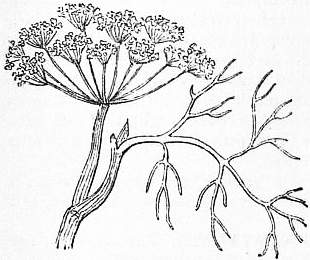
Dill (Anethum or Peucedanum graveolens), leaf and inflorescence.
DILL (Anethum or Peucedanum graveolens), a member of the natural botanical order Umbelliferae, indigenous to the south of Europe, Egypt and the Cape of Good Hope. It resembles fennel in appearance. Its root is long and fusiform; the stem is round, jointed and about a yard high; the leaves have fragrant leaflets; and the fruits are brown, oval and concavo-convex. The plant flowers from June till August in England. The seeds are sown, preferably as soon as ripe, either broadcast or in drills between 6 and 12 in. asunder. The young plants should be thinned when 3 or 4 weeks old, so as to be at distances of about 10 in. A sheltered spot and dry soil are needed for the production of the seed in the climate of England. The leaves of the dill are used in soups and sauces, and, as well as the umbels, for flavouring pickles. The seeds are employed for the preparation of dill-water and oil of dill; they are largely consumed in the manufacture of gin, and, when ground, are eaten in the East as a condiment. The British Pharmacopoeia contains the Aqua Anethi or dill-water (dose 1-2 oz.), and the Oleum Anethi, almost identical in composition with caraway oil, and given in doses of ½-3 minims. Dill-water is largely used as a carminative for children, and as a vehicle for the exhibition of nauseous drugs.
DILLEN [Dillenius], JOHANN JAKOB (1684-1747), English botanist, was born at Darmstadt in 1684, and was educated at the university of Giessen, where he wrote several botanical papers for the Ephemerides naturae curiosorum, and printed, in 1719, his Catalogus plantarum sponte circa Gissam nascentium, illustrated with figures drawn and engraved by his own hand, and containing descriptions of many new species. In 1721, at the instance of the botanist William Sherard (1659-1728), he came to England, and in 1724 he published a new edition of Ray’s Synopsis stirpium Britannicarum. In 1732 he published Hortus Elthamensis, a catalogue of the rare plants growing at Eltham, Kent, in the collection of Sherard’s younger brother, James (1666-1738), who, after making a fortune as an apothecary, devoted himself to gardening and music. For this work Dillen himself executed 324 plates, and it was described by Linnaeus, who spent a month with him at Oxford in 1736, and afterwards dedicated his Critica botanica to him, as “opus botanicum quo absolutius mundus non vidit.” In 1734 he was appointed Sherardian professor of botany at Oxford, in accordance with the will of W. Sherard, who at his death in 1728 left the university £3000 for the endowment of the chair, as well as his library and herbarium. Dillen, who was also the author of an Historia muscorum (1741), died at Oxford, of apoplexy, on the 2nd of April 1747. His manuscripts, books and collections of dried plants, with many drawings, were bought by his successor at Oxford, Dr Humphry Sibthorp (1713-1797), and ultimately passed into the possession of the university.
For an account of his collections preserved at Oxford, see The Dillenian Herbaria, by G. Claridge Druce (Oxford, 1907).
DILLENBURG, a town of Germany, in the Prussian province of Hesse-Nassau, delightfully situated in the midst of a well-wooded country, on the Dill, 25 m. N.W. from. Giessen on the railway to Troisdorf. Pop. 4500. On an eminence above it lie the ruins of the castle of Dillenburg, founded by Count Henry the Rich of Nassau, about the year 1255, and the birthplace of Prince William of Orange (1533). It has an Evangelical church, with the vault of the princes of Nassau-Dillenburg, a Roman Catholic church, a classical school, a teachers’ seminary and a chamber of commerce. Its industries embrace iron-works, tanneries and the manufacture of cigars. Owing to its beautiful surroundings Dillenburg has become a favourite summer resort.
DILLENS, JULIEN (1849-1904), Belgian sculptor, was born at Antwerp on the 8th of June 1849, son of a painter. He studied under Eugène Simonis at the Brussels Academy of Fine Arts. In 1877 he received the prix de Rome for “A Gaulish Chief taken Prisoner by the Romans.” At Brussels, in 1881, he executed the groups entitled “Justice” and “Herkenbald, the Brussels Brutus.” For the pediment of the orphanage at Uccle, “Figure Kneeling” (Brussels Gallery), and the statue of the lawyer Metdepenningen in front of the Palais de Justice at Ghent, he was awarded the medal of honour in 1889 at the Paris Universal Exhibition, where, in 1900, his “Two Statues of the Anspach Monument” gained him a similar distinction. For the town of Brussels he executed “The Four Continents” (Maison du Renard, Grand’ Place), “The Lansquenets” crowning the lucarnes of the Maison de Roi, and the “Monument t’ Serclaes” under the arcades of the Maison de l’Etoile, and, for the Belgian government, “Flemish Art,” “German Art,” “Classic Art” and “Art applied to Industry” (all in the Palais des Beaux Arts, Brussels), “The Laurel” (Botanic Garden, Brussels), and the statue of “Bernard van Orley” (Place du petit Sablon, Brussels). Mention must also be made of “An Enigma” (1876), the bronze busts of “Rogier de la Pasture” and “P. P. Rubens” (1879), “Etruria” (1880), “The Painter Leon Frederic” (1888), “Madame Leon Herbo,” “Hermes,” a scheme of decoration for the ogival façade of the hôtel de ville at Ghent (1893), “The Genius of the Funeral Monument of the Moselli Family,” “The Silence of Death” (for the entrance of the cemetery of St Gilles), two caryatides for the town hall of St Gilles, presentation plaquette to Dr Heger, medals of MM. Godefroid and Vanderkindere and of “The Three Burgomasters of Brussels,” and the ivories “Allegretto,” “Minerva” and the “Jamaer Memorial.” Dillens died at Brussels in November 1904.
DILLINGEN, a town of Germany, in the kingdom of Bavaria, on the left bank of the Danube, 25 m. N.E. from Ulm, on the railway to Ingolstadt. Pop. (1905) 6078. Its principal buildings are an old palace, formerly the residence of the bishops of Augsburg and now government offices, a royal gymnasium, a Latin school with a library of 75,000 volumes, seven churches (six Roman Catholic), two episcopal seminaries, a Capuchin monastery, a Franciscan convent and a deaf and dumb asylum. The university, founded in 1549, was abolished in 1804, being converted into a lyceum. The inhabitants are engaged in cattle-rearing, the cultivation of corn, hops and fruit, shipbuilding and the shipping trade, and the manufacture of cloth, paper and cutlery. In the vicinity is the Karolinen canal, which cuts off a bend in the Danube between Lauingen and Dillingen. In 1488 Dillingen became the residence of the bishops of Augsburg; was taken by the Swedes in 1632 and 1648, by the Austrians in 1702, and on the 17th of June 1800 by the French. In 1803 it passed to Bavaria.
DILLMANN, CHRISTIAN FRIEDRICH AUGUST (1823-1894), German orientalist and biblical scholar, the son of a Württemberg schoolmaster, was born at Illingen on the 25th of April 1823. He was educated at Tübingen, where he became a pupil and friend of Heinrich Ewald, and studied under F. C. Baur, though he did not join the new Tübingen school. For a short time he worked as pastor at Gersheim, near his native place, but he soon came to feel that his studies demanded his whole time. He devoted himself to the study of Ethiopic MSS. in the libraries of Paris, London and Oxford, and this work caused a revival of Ethiopic study in the 19th century. In 1847 and 1848 he prepared catalogues of the Ethiopic MSS. in the British Museum and the Bodleian library at Oxford. He then set to work upon an edition of the Ethiopic bible. Returning to Tübingen in 1848, in 1853 he was appointed professor extraordinarius. Subsequently he became professor of philosophy at Kiel (1854), and of theology at Giessen (1864) and Berlin (1869). He died on the 4th of July 1894.
In 1851 he had published the Book of Enoch in Ethiopian (German, 1853), and at Kiel he completed the first part of the Ethiopic bible, Octateuchus Aethiopicus (1853-1855). In 1857 appeared his Grammatik der äthiopischen Sprache (2nd ed. by C. Bezold, 1899); in 1859 the Book of Jubilees; in 1861 and 1871 another part of the Ethiopic bible, Libri Regum; in 1865 his great Lexicon linguae aethiopicae; in 1866 his Chrestomathia aethiopica. Always a theologian at heart, however, he returned to theology in 1864. His Giessen lectures were published under the titles, Ursprung der alttestamentlichen Religion (1865) and Die Propheten des alten Bundes nach ihrer politischen Wirksamkeit (1868). In 1869 appeared his Commentar zum Hiob (4th ed. 1891) which stamped him as one of the foremost Old Testament exegetes. His renown as a theologian, however, was mainly founded by the series of commentaries, based on those of August Wilhelm Knobels’ Genesis (Leipzig, 1875; 6th ed. 1892; Eng. trans, by W. B. Stevenson, Edinburgh, 1897); Exodus und Leviticus, 1880, revised edition by V. Ryssel, 1897; Numeri, Deuteronomium und Josua, with a dissertation on the origin of the Hexateuch, 1886; Jesaja, 1890 (revised edition by Rudolf Kittel in 1898). In 1877 he published the Ascension of Isaiah in Ethiopian and Latin. He was also a contributor to D. Schenkel’s Bibellexikon, Brockhaus’s Conversationslexikon, and Herzog’s Realencyklopädie. His lectures on Old Testament theology, Vorlesungen über Theologie des Allen Testamentes, were published by Kittel in 1895.