VOLUME VIII SLICE IV Diameter to Dinarchus (continued 6)
Reading edition
DIEST, a small town in the province of Brabant, Belgium, situated on the Demer at its junction with the Bever. Pop. (1904) 8383. It lies about half-way between Hasselt and Louvain, and is still one of the five fortified places in Belgium. It contains many breweries, and is famous for the excellence of its beer.
DIESTERWEG, FRIEDRICH ADOLF WILHELM (1790-1866), German educationist, was born at Siegen on the 29th of October 1790. Educated at Herborn and Tübingen universities, he took to the profession of teaching in 1811. In 1820 he was appointed director of the new school at Mörs, where he put in practice the methods of Pestalozzi. In 1832 he was summoned to Berlin to direct the new state-schools seminary in that city. Here he proved himself a strong supporter of unsectarian religious teaching. In 1846 he established the Pestalozzi institution at Pankow, and the Pestalozzi societies for the support of teachers’ widows and orphans. In 1850 he retired on a pension, but continued vigorously to advocate his educational views. In 1858 he was elected to the chamber of deputies as member for the city of Berlin, and voted with the Liberal opposition. He died in Berlin on the 7th of July 1866. Diesterweg was a voluminous writer on educational subjects, and was the author of various school text-books.
DIET, a term used in two senses, (1) food or the regulation of feeding (see Dietary and Dietetics), (2) an assembly or council (Fr. diète; It. dieta; Low Lat. diaeta; Ger. Tag). We are here concerned only with this second sense. In modern usage, though in Scotland the term is still sometimes applied to any assembly or session, it is practically confined to the sense of an assembly of estates or of national or federal representatives. The origin of the word in this connotation is somewhat complicated. It is undoubtedly ultimately derived from the Greek δίαιτα (Lat. diaeta), which meant “mode of life” and thence “prescribed mode of life,” the English “diet” or “regimen.” This was connected with the verb διαιτᾶν, in the sense of “to rule,” “to regulate”; compare the office of διαιτητής at Athens, and dieteta, “umpire,” in Late Latin. In both Greek and Latin, too, the word meant “a room,” from which the transition to “a place of assembly” and so to “an assembly” would be easy. In the latter sense the word, however, actually occurs only in Low Latin, Du Cange (Glossarium, s.v.) deriving it from the late sense of “meal” or “feast,” the Germans being accustomed to combine their political assemblies with feasting. It is clear, too, that the word diaeta early became confused with Lat. dies, “day” (Ger. Tag), “especially a set day, a day appointed for public business; whence, by extension, meeting for business, an assembly” (Skeat). Instances of this confusion are given by Du Cange, e.g. diaeta for dieta, “a day’s journey” (also an obsolete sense of “diet” in English), and dieta for “the ordinary course of the church,” i.e. “the daily office,” which suggests the original sense of diaeta as “a prescribed mode of life.”
The word “diet” is now used in English for the Reichstag, “imperial diet” of the old Holy Roman Empire; for the Bundestag, “federal diet,” of the former Germanic confederation; sometimes for the Reichstag of the modern German empire; for the Landtage, “territorial diets” of the constituent states of the German and Austrian empires; as well as for the former or existing federal or national assemblies of Switzerland, Hungary, Poland, &c. Although, however, the word is still sometimes used of all the above, the tendency is to confine it, so far as contemporary assemblies are concerned, to those of subordinate importance. Thus “parliament” is often used of the German Reichstag or of the Russian Landtag, while the Landtag, e.g. of Styria, would always be rendered “diet.” In what follows we confine ourselves to the diet of the Holy Roman Empire and its relation to its successors in modern Germany.
The origin of the diet, or deliberative assembly, of the Holy Roman Empire must be sought in the placitum of the Frankish empire. This represented the tribal assembly of the Franks, meeting (originally in March, but after 755 in May, whence it is called the Campus Maii) partly for a military review on the eve of the summer campaign, partly for deliberation on important matters of politics and justice. By the side of this larger assembly, however, which contained in theory, if not in practice, the whole body of Franks available for war, there had developed, even before Carolingian times, a smaller body composed of the magnates of the Empire, both lay and ecclesiastical. The germ of this smaller body is to be found in the episcopal synods, which, afforced by the attendance of lay magnates, came to be used by the king for the settlement of national affairs. Under the Carolingians it was usual to combine the assembly of magnates with the generalis conventus of the “field of May,” and it was in this inner assembly, rather than in the general body (whose approval was merely formal, and confined to matters momentous enough to be referred to a general vote), that the centre of power really lay. It is from the assembly of magnates that the diet of medieval Germany springs. The general assembly became meaningless and unnecessary, as the feudal array gradually superseded the old levy en masse, in which each freeman had been liable to service; and after the close of the 10th century it no longer existed.
The imperial diet (Reichstag) of the middle ages might sometimes contain representatives of Italy, the regnum Italicum; but it was practically always confined to the magnates of Germany, the regnum Teutonicum. Upon occasion a summons to the diet might be sent even to the knights, but the regular members were the princes (Fürsten), both lay and ecclesiastical. In the 13th century the seven electors began to disengage themselves from the prince as a separate element, and the Golden Bull (1356) made their separation complete; from the 14th century onwards the nobles (both counts and other lords) are regarded as regular members; while after 1250 the imperial and episcopal towns often appear through their representatives. By the 14th century, therefore, the originally homogeneous diet of princes is already, at any rate practically if not yet in legal form, divided into three colleges—the electors, the princes and nobles, and the representatives of the towns (though, as we shall see, the latter can hardly be reckoned as regular members until the century of the Reformation). Under the Hohenstaufen it is still the rule that every member of the diet must attend personally, or lose his vote; at a later date the principle of representation by proxy, which eventually made the diet into a mere congress of envoys, was introduced. By the end of the 13th century the vote of the majority had come to be regarded as decisive; but in accordance with the strong sense of social distinctions which marks German history, the quality as well as the quantity of votes was weighed, and if the most powerful of the princes were agreed, the opinion of the lesser magnates was not consulted. The powers of the medieval diet extended to matters like legislation, the decision upon expeditions (especially the expeditio Romana), taxation and changes in the constitution of the principalities or the Empire. The election of the king, which was originally regarded as one of the powers of the diet, had passed to the electors by the middle of the 13th century.
A new era in the history of the diet begins with the Reformation. The division of the diet into three colleges becomes definite and precise; the right of the electors, for instance, to constitute a separate college is explicitly recognized as a matter of established custom in 1544. The representatives of the towns now become regular members. In the 15th century they had only attended when special business, such as imperial reform or taxation, fell under discussion; in 1500, however, they were recognized as a separate and regular estate, though it was not until 1648 that they were recognized as equal to the other estates of the diet. The estate of the towns, or college of municipal representatives, was divided into two benches, the Rhenish and the Swabian. The estate of the princes and counts, which stood midway between the electors and the towns, also attained, in the years that followed the Reformation, its final organization. The vote of the great princes ceased to be personal, and began to be territorial. This had two results. The division of a single territory among the different sons of a family no longer, as of old, multiplied the voting power of the family; while in the opposite case, the union of various territories in the hands of a single person no longer meant the extinction of several votes, since the new owner was now allowed to give a vote for each of his territories. The position of the counts and other lords, who joined with the princes in forming the middle estate, was finally fixed by the middle of the 17th century. While each of the princes enjoyed an individual vote, the counts and other lords were arranged in groups, each of which voted as a whole, though the whole of its vote (Kuriatstimme) only counted as equal to the vote of a single prince (Virilstimme). There were six of these groups; but as the votes of the whole college of princes and counts (at any rate in the 18th century) numbered 100, they could exercise but little weight.
The last era in the history of the diet may be said to open with the treaty of Westphalia (1648). The treaty acknowledged that Germany was no longer a unitary state, but a loose confederation of sovereign princes; and the diet accordingly ceased to bear the character of a national assembly, and became a mere congress of envoys. The “last diet” which issued a regular recess (Reichsabschied—the term applied to the acta of the diet, as formally compiled and enunciated at its dissolution) was that of Regensburg in 1654. The next diet, which met at Regensburg in 1663, never issued a recess, and was never dissolved; it continued in permanent session, as it were, till the dissolution of the Empire in 1806. This result was achieved by the process of turning the diet from an assembly of principals into a congress of envoys. The emperor was represented by two commissarii; the electors, princes and towns were similarly represented by their accredited agents. Some legislation was occasionally done by this body; a conclusum imperii (so called in distinction from the old recessus imperii of the period before 1663) might slowly (very slowly—for the agents, imperfectly instructed, had constantly to refer matters back to their principals) be achieved; but it rested with the various princes to promulgate and enforce the conclusum in their territories, and they were sufficiently occupied in issuing and enforcing their own decrees. In practice the diet had nothing to do; and its members occupied themselves in “wrangling about chairs”—that is to say, in unending disputes about degrees and precedences.
In the Germanic Confederation, which occupies the interval between the death of the Holy Roman Empire and the formation of the North German Confederation (1815-1866), a diet (Bundestag) existed, which was modelled on the old diet of the 18th century. It was a standing congress of envoys at Frankfort-on-Main. Austria presided in the diet, which, in the earlier years of its history, served, under the influence of Metternich, as an organ for the suppression of Liberal opinion. In the North German Confederation (1867-1870) a new departure was made, which has been followed in the constitution of the present German empire. Two bodies were instituted—a Bundesrat, which resembles the old diet in being a congress of envoys sent by the sovereigns of the different states of the confederation, and a Reichstag, which bears the name of the old diet, but differs entirely in composition. The new Reichstag is a popular representative assembly, based on wide suffrage and elected by ballot; and, above all, it is an assembly representing, not the several states, but the whole Empire, which is divided for this purpose into electoral districts. Both as a popular assembly, and as an assembly which represents the whole of a united Germany, the new Reichstag goes back, one may almost say, beyond the diet even of the middle ages, to the days of the old Teutonic folk-moot.
See R. Schröder, Lehrbuch der deutschen Rechtsgeschichte (1902), pp. 149, 508, 820, 880. Schröder gives a bibliography of monographs bearing on the history of the medieval diet.
(E. Br.)
DIETARY, in a general sense, a system or course of diet, in the sense of food; more particularly, such an allowance and regulation of food as that supplied to workhouses, the army and navy, prisons, &c. Lowest in the scale of such dietaries comes what is termed “bare existence” diet, administered to certain classes of the community who have a claim on their fellow-countrymen that their lives and health shall be preserved in statu quo, but nothing further. This applies particularly to the members of a temporarily famine-stricken community. Before the days of prison reform, too, the dietary scale of many prisons was to a certain extent penal, in that the food supplied to prisoners was barely sufficient for existence. Nowadays more humane principles apply; there is no longer the obvious injustice of applying the same scale of quantity and quality to all prisoners under varying circumstances of constitution and surroundings, and whether serving long or short periods of imprisonment.
The system of dietary in force in the local and convict prisons of England and Wales is that recommended by the Home Office on the advice of a departmental committee. As to the local prison dietary, its application is based on (1) the principle of variation of diet with length of sentence; (2) the system of progressive dietary; (3) the distinction between hard labour diets and non-hard labour diets; (4) the differentiation of diet according to age and sex. There are three classes of diet, classes A, B and C. Class A diet is given to prisoners undergoing not more than seven days’ imprisonment. The food is good and wholesome, but sufficiently plain and unattractive, so as not to offer temptation to the loafer or mendicant. It is given in quantity sufficient to maintain health and strength during the single week. Prisoners sentenced to more than seven days and not more than fourteen days are given class A diet for the first seven days and class B for the remainder of the sentence. In most of the local prisons in England and Wales prisoners sentenced to hard labour received hard labour diet, although quite 60% were unable to perform the hardest forms of prison labour either through physical defect, age or infirmity. The departmental committee of 1899 in their report recommended that no distinction should be made between hard labour and non-hard labour diets. Class A diet is as follows:—Breakfast, Bread, 8 oz. daily (6 oz. for women and juveniles) with 1 pint of gruel. Juveniles (males and females under sixteen years of age) get, in addition, ½ pint of milk. Dinner, 8 oz. of bread daily, with 1 pint of porridge on three days of the week, 8 oz. of potatoes (representing the vegetable element) on two other days, and 8 oz. of suet pudding (representing the fatty element) on the other two days. Supper, the breakfast fare repeated.
Class B diet, which is also given to (1) prisoners on remand or awaiting trial, (2) offenders of the 1st division who do not maintain themselves, (3) offenders of the 2nd division and (4) debtors, is as shown in Table I.
Table I.
Men. Women. Juveniles.
Breakfast. Daily:—
Bread 8 oz. 6 oz. 6 oz.
Gruel 1 pt. 1 pt. 1 pt.
Milk · · · · ½ pt.
Dinner. Sunday:—
Bread 6 oz. 6 oz.
Potatoes 8 ” 8 ”
Cooked meat, preserved by heat 4 ” 3 ”
Monday:—
Bread 6 oz. 6 oz.
Potatoes 8 ” 8 ”
Beans 10 ” 8 ”
Fat bacon 2 ” 1 ”
Tuesday:—
Bread 6 oz 6 oz.
Potatoes 8 ” 8 ”
Soup 1 pt. 1 pt.
Wednesday:—
Bread 6 oz. 6 oz.
Potatoes 8 ” 8 ”
Suet pudding 10 ” 8 ”
Thursday:—
Bread 6 oz. 6 oz.
Potatoes 8 ” 8 ”
Cooked beef, without bone 4 ” 3 ”
Friday:—
Bread 6 oz. 6 oz.
Potatoes 8 ” 8 ”
Soup 1 pt. 1 pt.
Saturday:—
Bread 6 oz. 6 oz.
Potatoes 8 ” 8 ”
Suet pudding 10 ” 8 ”
Supper. Daily:—
Bread 8 oz. 6 oz. 6 oz.
Porridge 1 pt.
Gruel 1 pt.
Cocoa 1 pt.
Class C diet is class B amplified, and is given to those prisoners serving sentences of three months and over.
The dietary of convict prisons, in which prisoners are all under long sentence, is divided into a diet for convicts employed at hard labour and a diet for convicts employed at sedentary, indoor and light labour. It will be found set forth in the Blue-book mentioned above. The sparest of all prison diets is called “punishment diet,” and is administered for offences against the internal discipline of the prison. It is limited to a period of three days. It consists of 1 ℔ of bread and as much water as the prisoner chooses to drink.
In French prisons the dietary is nearly two pounds weight of bread, with two meals of thin soup (breakfast and dinner) made from potatoes, beans or other vegetables, and on two days a week made from meat. In France the canteen system is in vogue, additional food, such as sausages, cheese, fruit, &c., may be obtained by the prisoner, according to the wages he receives for his labours. The dietary of Austrian prisons is 1½ ℔ of bread daily, a dinner of soup on four days of the week, and of meat on the other three days, with a supper of soup or vegetable stew. Additional food can be purchased by the prisoner out of his earnings.
These dietaries may be taken as more or less typical of the ordinary prison fare in most civilized countries, though in some countries it may err on the side of severity, as in Sweden, prisoners being given only two meals a day, one at mid-day and one at seven p.m., porridge or gruel being the principal element in both meals. On the other hand, the prison dietaries of many of the United States prisons go to the other extreme, fresh fish, green vegetables, even coffee and fruit, figuring in the dietary.
Another class of dietary is that given to paupers. In England, until 1900, almost every individual workhouse had its own special dietary, with the consequence that many erred on the side of scantiness and unsuitability, while others were too lavish. By an order of the Local Government Board of that year, acting on a report of a committee, all inmates of workhouses, with the exception of the sick, children under three years of age, and certain other special cases, are dieted in accordance with certain dietary tables as framed and settled by the board. The order contained a great number of different rations, it being left to the discretion of the guardians as to the final settlement of the tables. For adult inmates the dietary tables are for each sex respectively, two in number, one termed “plain diet” and the other “infirm diet.” All male inmates certified as healthy able-bodied persons receive plain diet only. All inmates, however, in workhouses are kept employed according to their capacity and ability, and this is taken into consideration in giving allowances of food. For instance, for work with sustained exertion, such as stone-breaking, digging, &c., more food is given than for work without sustained exertion, such as wood-chopping, weeding or sewing. Table II. shows an example of a workhouse dietary.
Table II.
Sun. Mon. Tue. Wed. Thu. Fri. Sat.
Breakfast. Bread. oz. 8 4 4 4 4 4 4
Porridge. pt. * 1½ 1½ 1½ 1½ 1½ 1½
Dinner. Bread. oz. 4 6 .. 4 4 8 6
Beef. oz. 4½ .. .. .. 4½ .. ..
Vegetables. oz. 12 .. .. 12 12 .. ..
Barley Soup. pt. .. 1½ .. .. .. .. ..
Pork. oz. .. .. 4½ .. .. .. ..
Beans. oz. .. .. 12 .. .. .. ..
Fish. oz. .. .. .. 10 .. .. ..
Cheese. oz. .. .. .. .. .. 3 ..
Broth. pt. .. .. .. .. .. 1 ..
Irish Stew. pt. .. .. .. .. .. .. 1
Supper. Bread. oz. 8 6 6 6 8 6 6
Butter. oz. ½ .. .. .. .. .. ..
Tea. pt. 1 .. .. .. .. .. ..
Gruel. pt. .. 1½ 1½ 1½ .. 1½ 1½
Broth. pt. .. .. .. .. 1 .. ..
Cheese. oz. .. .. .. .. 2 .. ..
* On Sundays 1 pint of tea and 2½ oz. of butter are given instead of porridge.
In the casual wards of workhouses the dietary is plainer, consisting of 8 oz. of bread, or 6 oz. of bread and one pint of gruel or broth for breakfast; the same for supper; for dinner 8 oz. of bread and 1½ oz. of cheese or 6 oz. of bread and one pint of soup. The American poor law system is based broadly on that of England, and the methods of relief are much the same. Each state, however, makes its own regulations, and there is considerable diversity in workhouse dietaries in consequence. The German system of poor relief is more methodical than those of England and America. The really deserving are treated with more commiseration, and a larger amount of outdoor relief is given than in England. There is no casual ward, tramps and beggars being liable to penal treatment, but there are “relief stations,” somewhat corresponding to casual wards, where destitute persons tramping from one place to another can obtain food and lodging in return for work done.
In the British navy certain staple articles of diet are supplied to the men to the value approximately of 6d. per diem—the standard government ration—and, in addition, a messing allowance of 4d. per diem, which may either be expended on luxuries in the canteen, or in taking up government provisions on board ship, in addition to the standard ration. The standard ration as recommended in 1907 by a committee appointed to inquire into the question of victualling in the navy is as follows:—
Service Afloat.
1 ℔ bread (or ¾ ℔ bread and ¼ ℔ trade flour). ½ ℔ fresh meat. 1 ℔ fresh vegetables. 1⁄8 pint spirit. 4 oz. sugar. ½ oz. tea (or 1 oz. coffee for every ¼ oz. tea). ½ oz. ordinary or soluble chocolate (or 1 oz. coffee). ¾ oz. condensed milk. 1 oz. jam or marmalade. 4 oz. preserved meat on one day of the week in harbour, or on two days at sea. Mustard, pepper, vinegar, and salt as required.
Substitute for soft bread when the latter is not available—
½ ℔ biscuit (new type) or 1 ℔ flour.
Substitutes for fresh meat when the latter is not available:—
On alternate days. (1) Salt pork day:—
½ ℔ salt pork.
¼ ℔ split peas.
Celery seed, ½ oz. to every 8 ℔ of split peas put into the coppers.
½ ℔ potatoes (or 1 oz. compressed vegetables).
(2) Preserved meat day:—
6 oz. preserved meat.
8 oz. trade flour} or 4 oz. rice.
¾ oz. refined suet
2 oz. raisins
½ ℔ potatoes (or 1 oz. compressed vegetables).
On shore establishments and depot ships ¼ pt. fresh milk is issued in lieu of the ¾ oz. of condensed milk.
In the United States navy there is more liberality and variety of diet, the approximate daily cost of the rations supplied being 1s. 3d. per head. In the American mercantile marine, too, according to the scale sanctioned by act of Congress (December 21, 1898) for American ships, the seaman is better off than in the British merchant service. The scale is shown in Table III.
Table III.
Weekly Scale. Articles. Weekly Scale. Articles.
3½ ℔ Biscuits. 7⁄8 oz. Tea.
3¾ ” Salt beef. 21 ” Sugar.
3 ” “ pork. 1½ ℔ Molasses.
1½ ” Flour. 9 oz. Fruits, dried.
2 ” Meats, preserved. ¾ pt. Pickles.
10½ ” Bread, fresh (8 ℔ flour in lieu). 1 ” Vinegar.
1 ” Fish, dried. 8 oz. Corn Meal.
7 ” Potatoes or yams. 12 ” Onions.
1 ” Tomatoes, preserved. 7 ” Lard.
2⁄3 ” Peas. 7 ” Butter.
2⁄3 ” Calavances. ¼ ” Mustard.
2⁄3 ” Rice. ¼ ” Pepper.
5¼ oz. Coffee, green. ¼ ” Salt.
In the British mercantile marine there is no scale of provisions prescribed by the Board of Trade; there is, however, a traditional scale very generally adopted, having the sanction of custom only and seldom adhered to. The following dietary scale for steerage passengers, laid down in the 12th schedule of the Merchant Shipping Act 1894, is of interest. See Table IV.
Table IV.—Weekly, per Statute Adult.
Scale A. For voyages not exceeding 84 days for sailing ships or 50 days for steamships. Scale B. For voyages exceeding 84 days for sailing ships or 50 days for steamships.
℔ oz. ℔ oz.
Bread or biscuit, not inferior to navy biscuit 3 8 3 8
Wheaten flour 1 0 2 0
Oatmeal 1 8 1 0
Rice 1 8 0 8
Peas 1 8 1 8
Beef 1 4 1 4
Pork 1 0 1 0
Butter · · 0 4
Potatoes 2 0 2 0
Sugar 1 0 1 0
Tea 0 2 0 2
Salt 0 2 0 2
Pepper (white or black), ground 0 0½ 0 0½
Vinegar 1 gill 1 gill
Preserved meat · · 1 0
Suet 0 6
Raisins 0 8
Lime juice 0 6
Certain substitutions may be made in this scale at the option of the master of any emigrant ship, provided that the substituted articles are set forth in the contract tickets of the steerage passengers.
In the British army the soldier is fed partly by a system of co-operation. He gets a free ration from government of 1 ℔ of bread and ¾ ℔ of meat; in addition there is a messing allowance of 3½d. per man per day. He is able to supplement his food by purchases from the canteen. Much depends on the individual management in each regiment as to the satisfactory expenditure of the messing allowance. In some regiments an allowance is made from the canteen funds towards messing in addition to that granted by the government. The ordinary field ration of the British soldier is 1½ ℔ of bread or 1 ℔ of biscuit; 1 ℔ of fresh, salt or preserved meat; ½ oz. of coffee; 1/6 oz. of tea; 2 oz. of sugar; ½ oz. of salt, 1⁄36 oz. of pepper, the whole weighing something over 2 ℔ 3 oz. This cannot be looked on as a fixed ration, as it varies in different campaigns, according to the country into which the troops may be sent. The Prussian soldier during peace gets weekly from his canteen 11 ℔ 1 oz. of rye bread and not quite 2½ ℔ of meat. This is obviously insufficient, but under
the conscription system it is reckoned that he will be able to make up the deficiency out of his own private means, or obtain charitable contributions from his friends. In the French infantry of the line each man during peace gets weekly 15 ℔ of bread, 33⁄10 ℔ of meat, 2½ ℔ of haricot beans or other vegetables, with salt and pepper, and 1¾ oz. of brandy.
An Austrian under the same circumstances receives 13.9 ℔ of bread, ½ ℔ of flour and 3.3 ℔ of meat.
The Russian conscript is allowed weekly:—
Black bread 7 ℔.
Meat 7 ℔.
Kvass (beer) 7.7 quarts.
Sour cabbage 24½ gills = 122½ oz.
Barley 24½ gills = 122½ oz.
Salts 10½ oz.
Horse-radish 28 grains.
Pepper 28 grains.
Vinegar 5½ gills = 26½ oz.
DIETETICS, the science of diet, i.e. the food and nutrition of man in health and disease (see Nutrition). This article deals mainly with that part of the subject which has to do with the composition and nutritive values of foods and their adaptation to the use of people in health. The principal topics considered are: (1) Food and its functions; (2) Metabolism of matter and energy; (3) Composition of food materials; (4) Digestibility of food; (5) Fuel value of food; (6) Food consumption; (7) Quantities of nutrients needed; (8) Hygienic economy of food; (9) Pecuniary economy of food.
1. Food and its Functions.—For practical purposes, food may be defined as that which, when taken into the body, may be utilized for the formation and repair of body tissue, and the production of energy. More specifically, food meets the requirements of the body in several ways. It is used for the formation of the tissues and fluids of the body, and for the restoration of losses of substance due to bodily activity. The potential energy of the food is converted into heat or muscular work or other forms of energy. In being thus utilized, food protects body substance or previously acquired nutritive material from consumption. When the amount of food taken into the body is in excess of immediate needs, the surplus may be stored for future consumption.
Ordinary food materials, such as meat, fish, eggs, vegetables, &c., consist of inedible materials, or refuse, e.g. bone of meat and fish, shell of eggs, rind and seed of vegetables; and edible material, as flesh of meat and fish, white and yolk of eggs, wheat flour, &c. The edible material is by no means a simple substance, but consists of water, and some or all of the compounds variously designated as food stuffs, proximate principles, nutritive ingredients or nutrients, which are classified as protein, fats, carbohydrates and mineral matters. These have various functions in the nourishment of the body.
The refuse commonly contains compounds similar to those in the food from which it is derived, but since it cannot be eaten, it is usually considered as a non-nutrient. It is of importance chiefly in a consideration of the pecuniary economy of food. Water is also considered as a non-nutrient, because although it is a constituent of all the tissues and fluids of the body, the body may obtain the water it needs from that drunk; hence, that contained in the food materials is of no special significance as a nutrient.
Mineral matters, such as sulphates, chlorides, phosphates and carbonates of sodium, potassium, calcium, &c., are found in different combinations and quantities in most food materials. These are used by the body in the formation of the various tissues, especially the skeletal and protective tissues, in digestion, and in metabolic processes within the body. They yield little or no energy, unless perhaps the very small amount involved in their chemical transformation.
Protein1 is a term used to designate the whole group of nitrogenous compounds of food except the nitrogenous fats. It includes the albuminoids, as albumin of egg-white, and of blood serum, myosin of meat (muscle), casein of milk, globulin of blood and of egg yolk, fibrin of blood, gluten of flour; the gelatinoids, as gelatin and allied substances of connective tissue, collagen of tendon, ossein of bone and the so-called extractives (e.g. creatin) of meats; and the amids (e.g. asparagin) and allied compounds of vegetables and fruits.
The albuminoids and gelatinoids, classed together as proteids, are the most important constituents of food, because they alone can supply the nitrogenous material necessary for the formation of the body tissues. For this purpose, the albuminoids are most valuable. Both groups of compounds, however, supply the body with energy, and the gelatinoids in being thus utilized protect the albuminoids from consumption for this purpose. When their supply in the food is in excess of the needs of the body, the surplus proteids may be converted into body fat and stored.
The so-called extractives, which are the principal constituents of meat extract, beef tea and the like, act principally as stimulants and appetizers. It has been believed that they serve neither to build tissue nor to yield energy, but recent investigations2 indicate that creatin may be metabolized in the body.
The fats of food include both the animal fats and the vegetable oils. The carbohydrates include such compounds as starches, sugars and the fibre of plants or cellulose, though the latter has but little value as food for man. The more important function of both these classes of nutrients is to supply energy to the body to meet its requirements above that which it may obtain from the proteids. It is not improbable that the atoms of their molecules as well as those from the proteids are built up into the protoplasmic substance of the tissues. In this sense, these nutrients may be considered as being utilized also for the formation of tissue; but they are rather the accessory ingredients, whereas the proteids are the essential ingredients for this purpose. The fats in the food in excess of the body requirements may be stored as body fat, and the surplus carbohydrates may also be converted into fat and stored.
To a certain extent, then, the nutrients of the food may substitute each other. All may be incorporated into the protoplasmic structure of body tissue, though only the proteids can supply the essential nitrogenous ingredients; and apart from the portion of the proteid material that is indispensable for this purpose, all the nutrients are used as a source of energy. If the supply of energy in the food is not sufficient, the body will use its own proteid and fat for this purpose. The gelatinoids, fats and carbohydrates in being utilized for energy protect the body proteids from consumption. The fat stored in the body from the excess of food is a reserve of energy material, on which the body may draw when the quantity of energy in the food is insufficient for its immediate needs.
What compounds are especially concerned in intellectual activity is not known. The belief that fish is especially rich in phosphorus and valuable as a brain food has no foundation in observed fact.
2. Metabolism of Matter and Energy.—The processes of nutrition thus consist largely of the transformation of food into body material and the conversion of the potential energy of both food and body material into the kinetic energy of heat and muscular work and other forms of energy. These various processes are generally designated by the term metabolism. The metabolism of matter in the body is governed largely by the needs of the body for energy. The science of nutrition, of which the present subject forms a part, is based on the principle that the transformations of matter and energy in the body occur in accordance with the laws of the conservation of matter and of energy. That the body can neither create nor destroy matter has long been universally accepted. It would seem that the transformation of energy must likewise be governed by the law of the conservation of energy; indeed there is every reason a priori to believe that it must; but the experimental difficulties in the way of absolute demonstration of the principle are considerable. For such demonstration it is necessary to prove that the income and expenditure of energy are equal. Apparatus and methods of inquiry devised in recent years, however, afford means for a comparison of the amounts of both matter and energy received and expended by the body, and from the results obtained in a large amount of such research, it seems probable that the law obtains in the living organism in general.
The first attempt at such demonstration was made by M. Rubner3 in 1894, experimenting with dogs doing no external muscular work. The income of energy (as heat) was computed, but the heat eliminated was measured. In the average of eight experiments continuing forty-five days, the two quantities agreed within 0.47%, thus demonstrating what it was desired to prove—that the heat given off by the body came solely from the oxidation of food within it. Results in accordance with these were reported by Studenski4 in 1897, and by Laulanie5 in 1898.
The most extensive and complete data yet available on the subject have been obtained by W. O. Atwater, F. G. Benedict and associates6 in experiments with men in the respiration calorimeter, in which a subject may remain for several consecutive days and nights. These experiments involve actual weighing and analyses of the food and drink, and of the gaseous, liquid and solid excretory products; determinations of potential energy (heat of oxidation) of the oxidizable material received and given off by the body (including estimation of the energy of the material gained or lost by the body); and measurements of the amounts of energy expended as heat and as external muscular work. By October 1906 eighty-eight experiments with fifteen different subjects had been completed. The separate experiments continued from two to thirteen days, making a total of over 270 days. In some cases the subjects were at rest; in others they performed varying amounts of external muscular work on an apparatus by means of which the amount of work done was measured. In some cases they fasted, and in others they received diets generally not far from sufficient to maintain nitrogen, and usually carbon, equilibrium in the body. In these experiments the amount of energy expended by the body as heat and as external muscular work measured in terms of heat agreed on the average very closely with the amount of heat that would be produced by the oxidation of all the matter metabolized in the body. The variations for individual days, and in the average for individual experiments as well, were in some cases appreciable, amounting to as much as 6%, which is not strange in view of the uncertainties in physiological experimenting; but in the average of all the experiments the energy of the expenditure was above 99.9% of the energy of the income,—an agreement within one part in 1000. While these results do not absolutely prove the application of the law of the conservation of energy in the human body, they certainly approximate very closely to such demonstration. It is of course possible that energy may have given off from the body in other forms than heat and external muscular work. It is conceivable, for example, that intellectual activity may involve the transformation of physical energy, and that the energy involved may be eliminated in some form now unknown. But if the body did give off energy which was not measured in these experiments, the quantity must have been extremely small. It seems fair to infer from the results obtained that the metabolism of energy in the body occurred in conformity with the law of the conservation of energy.
3. Composition of Food Materials.—The composition of food is determined by chemical analyses, the results of which are conventionally expressed in terms of the nutritive ingredients previously described. As a result of an enormous amount of such investigation in recent years, the kinds and proportions of nutrients in our common sorts of food are well known. Average values for percentage composition of some ordinary food materials are shown in Table I. (Table I. also includes figures for fuel value.)
Table I.—Percentage Composition of some Common Food Materials.
Food Material. Refuse. Water. Protein. Fat. Carbo- hydrates. Mineral Matter. Fuel Value per ℔
% % % % % % Calories.
Beef, fresh (medium fat)—
Chuck 16.3 52.6 15.5 15.0 · · 0.8 910
Loin 13.3 52.5 16.1 17.5 · · 0.9 1025
Ribs 20.8 43.8 13.9 21.2 · · 0.7 1135
Round 7.2 60.7 19.0 12.8 · · 1.0 890
Shoulder 16.4 56.8 16.4 9.8 · · 0.9 715
Beef, dried and smoked 4.7 53.7 26.4 6.9 · · 8.9 790
Veal—
Leg 14.2 60.1 15.5 7.9 · · 0.9 625
Loin 16.5 57.6 16.6 9.0 · · 0.9 685
Breast 21.3 52.0 15.4 11.0 · · 0.8 745
Mutton—
Leg 18.4 51.2 15.1 14.7 · · 0.8 890
Loin 16.0 42.0 13.5 28.3 · · 0.7 1415
Flank 9.9 39.0 13.8 36.9 · · 0.6 1770
Pork—
Loin 19.7 41.8 13.4 24.2 · · 0.8 1245
Ham, fresh 10.7 48.0 13.5 25.9 · · 0.8 1320
Ham, smoked and salted 13.6 34.8 14.2 33.4 · · 4.2 1635
Fat, salt · · 7.9 1.9 86.2 · · 3.9 3555
Bacon 7.7 17.4 9.1 62.2 · · 4.1 2715
Lard, refined · · · · · · 100.0 · · · · 4100
Chicken 25.9 47.1 13.7 12.3 · · 0.7 765
Turkey 22.7 42.4 16.1 18.4 · · 0.8 1060
Goose 17.6 38.5 13.4 29.8 · · 0.7 1475
Eggs 11.2 65.5 13.1 9.3 · · 0.9 635
Cod, fresh 29.9 58.5 11.1 0.2 · · 0.8 220
Cod, salted 24.9 40.2 16.0 0.4 · · 18.5 325
Mackerel, fresh 44.7 40.4 10.2 4.2 · · 0.7 370
Herring, smoked 44.4 19.2 20.5 8.8 · · 7.4 755
Salmon, tinned · · 63.5 21.8 12.1 · · 2.6 915
Oysters, shelled · · 88.3 6.0 1.3 3.3 1.1 225
Butter · · 11.0 1.0 85.0 · · 3.0 3410
Cheese · · 34.2 25.9 33.7 2.4 3.8 1885
Milk, whole · · 87.0 3.3 4.0 5.0 0.7 310
Milk, skimmed · · 90.5 3.4 0.3 5.1 0.7 165
Oatmeal · · 7.7 16.7 7.3 66.2 2.1 1800
Corn (maize) meal · · 12.5 9.2 1.9 75.4 1.0 1635
Rye flour · · 12.9 6.8 0.9 78.7 0.7 1620
Buckwheat flour · · 13.6 6.4 1.2 77.9 0.9 1605
Rice · · 12.3 8.0 0.3 79.0 0.4 1620
Wheat flour, white · · 12.0 11.4 1.0 75.1 0.5 1635
Wheat flour, graham · · 11.3 13.3 2.2 71.4 1.8 1645
Wheat, breakfast food · · 9.6 12.1 1.8 75.2 1.3 1680
Wheat bread, white · · 35.3 9.2 1.3 53.1 1.1 1200
Wheat bread, graham · · 35.7 8.9 1.8 52.1 1.5 1195
Rye bread · · 35.7 9.0 0.6 53.2 1.5 1170
Biscuit (crackers) · · 6.8 9.7 12.1 69.7 1.7 1925
Macaroni · · 10.3 13.4 0.9 74.1 1.3 1645
Sugar · · · · · · · · 100.0 · · 1750
Starch (corn starch) · · · · · · · · 90.0 · · 1680
Beans, dried · · 12.6 22.5 1.8 59.6 3.5 1520
Peas, dried · · 9.5 24.6 1.0 62.0 2.9 1565
Beets 20.0 70.0 1.3 0.1 7.7 0.9 160
Cabbage 50.0 4.2 0.7 0.2 4.5 0.4 100
Potatoes 20.0 62.6 1.8 0.1 14.7 0.8 295
Sweet potatoes 20.0 55.2 1.4 0.6 21.9 0.9 440
Tomatoes · · 94.3 0.9 0.4 3.9 0.5 100
Apples 25.0 63.3 0.3 0.3 10.8 0.3 190
Bananas 35.0 48.9 0.8 0.4 14.3 0.6 260
Grapes 25.0 58.0 1.0 1.2 14.4 0.4 295
Strawberries 5.0 85.9 0.9 0.6 7.0 0.6 150
Almonds 45.0 2.7 11.5 30.2 9.5 1.1 1515
Brazil nuts 49.6 2.6 8.6 33.7 3.5 2.0 1485
Chestnuts 16.0 37.8 5.2 4.5 35.4 1.1 915
Walnuts 58.1 1.0 6.9 26.6 6.8 0.6 1250
It will be observed that different kinds of food materials vary widely in their proportions of nutrients. In general the animal foods contain the most protein and fats, and vegetable foods are rich in carbohydrates. The chief nutrient of lean meat and fish is protein; but in medium fat meats the proportion of fat is as large as that of protein, and in the fatter meats it is larger. Cheese is rich in both protein and fat. Among the vegetable foods, dried beans and peas are especially rich in protein. The proportion in oatmeal is also fairly large, in wheat it is moderate, and in maize meal and rice it is rather small. Oats contain more oil than any of the common cereals, but in none of them is the proportion especially large. The most abundant nutrient in all the cereals is starch, which comprises from two-thirds to three-fourths or more of their total nutritive substance. Cotton-seed is rich in edible oil, and so are olives. Some of the nuts contain fairly large proportions of both protein and fat. The nutrient of potatoes is starch, present in fair proportion. Fruits contain considerable carbohydrates, chiefly sugar. Green vegetables are not of much account as sources of any of the nutrients or energy.
Similar food materials from different sources may also differ considerably in composition. This is especially true of meats. Thus, the leaner portions from a fat animal may contain nearly as much fat as the fatter portions from a lean animal. The data here presented are largely those for American food products, but the available analyses of English food materials indicate that the latter differ but little from the former in composition. The analyses of meats produced in Europe imply that they commonly contain somewhat less fat and more water, and often more protein, than American meats. The meats of English production compare with the American more than with the European meats. Similar vegetable foods from the different countries do not differ so much in composition.
4. Digestibility or Availability of Food Materials.—The value of any food material for nutriment depends not merely upon the kinds and amounts of nutrients it contains, but also upon the ease and convenience with which the nutrients may be digested, and especially upon the proportion of the nutrients that will be actually digested and absorbed. Thus, two foods may contain equal amounts of the same nutrient, but the one most easily digested will really be of most value to the body, because less effort is necessary to utilize it. Considerable study of this factor is being made, and much valuable information is accumulating, but it is of more especial importance in cases of disordered digestion.
The digestibility of food in the sense of thoroughness of digestion, however, is of particular importance in the present discussion. Only that portion of the food that is digested and absorbed is available to the body for the building of tissue and the production of energy. Not all the food eaten is thus actually digested; undigested material is excreted in the faeces. The thoroughness of digestion is determined experimentally by weighing and analysing the food eaten and the faeces pertaining to it. The difference between the corresponding ingredients of the two is commonly considered to represent the amounts of the ingredients digested. Expressed in percentages, these are called coefficients of digestibility. See Table II.
Table II.—Coefficients of Digestibility (or Availability) of Nutrients in Different Classes of Food Materials.
Kind of Food. Protein. Fat. Carbohydrates.
% % %
Meats 98 98 · ·
Fish 96 97 · ·
Poultry 96 97 · ·
Eggs 97 98 · ·
Dairy products 97 96 98
Total animal food of mixed diet 97 97 98
Potatoes 73 · · 98
Beets, carrots, &c. 72 · · 97
Cabbage, lettuce, &c. · · · · 83
Legumes 78 90 95
Oatmeal 78 90 97
Corn meal 80 · · 99
Wheat meals without bran 83 · · 93
Wheat meals with bran 75 · · 92
White bread 88 · · 98
Entire wheat bread 82 · · 94
Graham bread 76 · · 90
Rice 76 · · 91
Fruits and nuts 80 86 96
Sugars and starches · · · · 98
Total vegetable food of mixed diet 85 90 97
Total food of mixed diet 92 95 97
Such a method is not strictly accurate, because the faeces do not consist entirely of undigested food but contain in addition to this the so-called metabolic products, which include the residuum of digestive juices not resorbed, fragments of intestinal epithelium, &c. Since there is as yet no satisfactory method of separating these constituents of the excreta, the actual digestibility of the food is not determined. It has been suggested that since these materials must originally come from food, they represent, when expressed in terms of food ingredients, the cost of digestion; hence that the values determined as above explained represent the portion of food available to the body for the building of tissue and the yielding of energy, and what is commonly designated as digestibility should be called availability. Other writers retain the term “digestibility,” but express the results as “apparent digestibility,” until more knowledge regarding the metabolic products of the excreta is available and the actual digestibility may be ascertained.
Experimental inquiry of this nature has been very active in recent years, especially in Europe, the United States and Japan; and the results of considerably over 1000 digestion experiments with single foods or combinations of food materials are available. These were mostly with men, but some were with women and with children. The larger part of these have been taken into account in the following estimations of the digestibility of the nutrients in different classes of food materials. The figures here shown are subject to revision as experimental data accumulate. They are not to be taken as exact measures of the digestibility (or availability) of every kind of food in each given class, but they probably represent fairly well the average digestibility of the classes of food materials as ordinarily utilized in the mixed diet.
5. Fuel Value of Food.—The potential energy of food is commonly measured as the amount of heat evolved when the food is completely oxidized. In the laboratory this is determined by burning the food in oxygen in a calorimeter. The results, which are known as the heat of combustion of the food, are expressed in calories, one calory being the amount of heat necessary to raise the temperature of one kilogram of water one degree centigrade. But it is to be observed that this unit is employed simply from convenience, and without implication as to what extent the energy of food is converted into heat in the body. The unit employed in the measurement of some other form of energy might be used instead, as, for example, the foot-ton, which represents the amount of energy necessary to raise one ton through one foot.
Table III.—Estimates of Heats of Combustion and of Fuel Value of Nutrients in Ordinary Mixed Diet.
Nutrients. Heat of Combustion. Fuel Value.
Calories. Calories.
One gram of protein 5.65 4.05
One gram of fats 9.40 8.93
One gram of carbohydrates 4.15 4.03
The amount of energy which a given quantity of food will produce on complete oxidation outside the body, however, is greater than that which the body will actually derive from it. In the first place, as previously shown, part of the food will not be digested and absorbed. In the second place, the nitrogenous compounds absorbed are not completely oxidized in the body, the residuum being excreted in the urine as urea and other bodies that are capable of further oxidation in the calorimeter. The total heat of combustion of the food eaten must therefore be diminished by the heat of combustion of the oxidizable material rejected by the body, to find what amount of energy is actually available to the organism for the production of work and heat. The amount thus determined is commonly known as the fuel value of food.
Rubner’s7 commonly quoted estimates for the fuel value of the nutrients of mixed diet are,—for protein and carbohydrates 4.1, and for fats 9.3 calories per gram. According to the method of deduction, however, these factors were more applicable to digested than to total nutrients. Atwater8 and associates have deduced, from data much more extensive than those available to Rubner, factors for total nutrients somewhat lower than these, as shown in Table III. These estimates seem to represent the best average factors at present available, but are subject to revision as knowledge is extended.
Table IV.—Quantities of Available Nutrients and Energy in Daily Food Consumption of Persons in Different Circumstances.
Number of Studies. Nutrients and Energy per Man per Day.
Protein. Fat. Carbo- hydrates. Fuel Value.
Persons with Active Work. Grams. Grams. Grams. Calories.
English royal engineers 1 132 79 612 3835
Prussian machinists 1 129 107 657 4265
Swedish mechanics 5 174 105 693 4590
Bavarian lumbermen 3 120 277 702 6015
American lumbermen 5 155 327 804 6745
Japanese rice cleaner 1 103 11 917 4415
Japanese jinrikshaw runner 1 137 22 1010 5050
Chinese farm labourers in California 1 132 90 621 3980
American athletes 19 178 192 525 4740
American working-men’s families 13 156 226 694 5650
Persons with Ordinary Work.
Bavarian mechanics 11 112 32 553 3060
Bavarian farm labourers 5 126 52 526 3200
Russian peasants .. 119 31 571 3155
Prussian prisoners 1 117 28 620 3320
Swedish mechanics 6 123 75 507 3325
American working-men’s families 69 105 135 426 3480
Persons with Light Work.
American artisans’ families 21 93 107 358 2880
English tailors (prisoners) 1 121 37 509 2970
German shoemakers 1 99 73 367 2629
Japanese prisoners 1 43 6 444 2110
Professional and Business Men.
Japanese professional men 13 75 15 408 2190
Japanese students 8 85 18 537 2800
Japanese military cadets 11 98 20 611 3185
German physicians 2 121 90 317 2685
Swedish medical students 5 117 108 291 2725
Danish physicians 1 124 133 242 2790
American professional and business men and students 51 98 125 411 3285
Persons with Little or no Exercise.
Prussian prisoners 2 90 27 427 2400
Japanese prisoners 1 36 6 360 1725
Inmates of home for aged—Germany 1 85 43 322 2097
Inmates of hospitals for insane—America 49 80 86 353 2590
Persons in Destitute Circumstances.
Prussian working people 13 63 43 372 2215
Italian mechanics 5 70 36 384 2225
American working-men’s families 11 69 75 263 2085
The heats of combustion of all the fats in an ordinary mixed diet would average about 9.40 calories per gram, but as only 95% of the fat would be available to the body, the fuel value per gram would be (9.40 × 0.95 =) 8.93 calories. Similarly, the average heat of combustion of carbohydrates of the diet would be about 4.15 calories per gram, and as 97% of the total quantity is available to the body, the fuel value per gram would be 4.03. (It is commonly assumed that the resorbed fats and carbohydrates are completely oxidized in the body.) The heats of combustion of all the kinds of protein in the diet would average about 5.65 calories per gram. Since about 92% of the total protein would be available to the body, the potential energy of the available protein would be equivalent to (5.65 × 0.92 =) 5.20 calories; but as the available protein is not completely oxidized allowance must be made for the potential energy of the incompletely oxidized residue. This is estimated as equivalent to 1.15 calories for the 0.92 gram of available protein; hence, the fuel value of the total protein is (5.20 − 1.15 =) 4.05 calories per gram. Nutrients of the same class, but from different food materials, vary both in digestibility and in heat of combustion, and hence in fuel value. These factors are therefore not so applicable to the nutrients of the separate articles in a diet as to those of the diet as a whole.
6. Food Consumption.—Much information regarding the food consumption of people in various circumstances in different parts of the world has accumulated during the past twenty years, as a result of studies of actual dietaries in England, Germany, Italy, Russia, Sweden and elsewhere in Europe, in Japan and other oriental countries, and especially in the United States. These studies commonly consist in ascertaining the kinds, amounts and composition of the different food materials consumed by a group of persons during a given period and the number of meals taken by each member of the group, and computing the quantities of the different nutrients in the food on the basis of one man for one day. When the members of the group are of different age, sex, occupation, &c., account must be taken of the effect of these factors on consumption in estimating the value “per man.” Men as a rule eat more than women under similar conditions, women more than children, and persons at active work more than those at sedentary occupation. The navvy, for example, who is constantly using up more nutritive material or body tissue to supply the energy required for his muscular work needs more protein and energy in his food than a bookkeeper who sits at his desk all day.
In making allowance for these differences, the various individuals are commonly compared with a man at moderately active muscular work, who is taken as unity. A man at hard muscular work is reckoned at 1.2 times such an individual; a man with light muscular work or a boy 15-16 years old, .9; a man at sedentary occupation, woman at moderately active muscular work, boy 13-14 or girl 15-16 years old, .8; woman at light work, boy 12 or girl 13-14 years old, .7; boy 10-11 or girl 10-12 years old, .6; child 6-9 years old, .5; child 2-5 years old, .4; child under 2 years, .3. These factors are by no means absolute or final, but are based in part upon experimental data and in part upon arbitrary assumption.
The total number of dietary studies on record is very large, but not all of them are complete enough to furnish reliable data. Upwards of 1000 are sufficiently accurate to be included in statistical averages of food consumed by people in different circumstances, nearly half of which have been made in the United States in the past decade. The number of persons in the individual studies has ranged from one to several hundred. Some typical results are shown in Table IV.
7. Quantities of Nutrients needed.—For the proper nourishment of the body, the important problem is how much protein, fats and carbohydrates, or more simply, what amounts of protein and potential energy are needed under varying circumstances, to build and repair muscular and other tissues and to supply energy for muscular work, heat and other forms of energy. The answer to the problem is sought in the data obtained in dietary studies with considerable numbers of people, and in metabolism experiments with individuals in which the income and expenditure of the body are measured. From the information thus derived, different investigators have proposed so-called dietary standards, such as are shown in the table below, but unfortunately the experimental data are still insufficient for entirely trustworthy figures of this sort; hence the term “standard” as here used is misleading. The figures given are not to be considered as exact and final as that would suggest; they are merely tentative estimates of the average daily amounts of nutrients and energy required. (It is to be especially noted that these are available nutrients and fuel value rather than total nutrients and energy.) Some of the values proposed by other investigators are slightly larger than these, and others are decidedly smaller, but these are the ones that have hitherto been most commonly accepted in Europe and America.
Table V.—Standards for Dietaries. Available Nutrients and Energy per Man per Day.
Protein. Fat. Carbo- hydrates. Fuel Value.
Voit’s Standards. Grams.9 Grams. Grams. Calories.
Man at hard work 133 95 437 3270
Man at moderate work 109 53 485 2965
Atwater’s Standards.
Man at very hard muscular work 161 · ·10 · ·10 5500
Man at hard muscular work 138 · · · · 4150
Man at moderately active muscular work 115 · · · · 3400
Man at light to moderate muscular work 103 · · · · 3050
Man at “sedentary” or woman at moderately active work 92 · · · · 2700
Woman at light muscular work, or man without muscular exercise 83 · · · · 2450
8. Hygienic Economy of Food.—For people in good health, there are two important rules to be observed in the regulation of the diet. One is to choose the foods that “agree” with them, and to avoid those which they cannot digest and assimilate without harm; and the other is to use such sorts and quantities of foods as will supply the kinds and amounts of nutrients needed by the body and yet to avoid burdening it with superfluous material to be disposed of at the cost of health and strength.
As for the first-mentioned rule, it is practically impossible to give information that may be of more than general application. There are people who, because of some individual peculiarity, cannot use foods which for people in general are wholesome and nutritious. Some persons cannot endure milk, others suffer if they eat eggs, others have to eschew certain kinds of meat, or are made uncomfortable by fruit; but such cases are exceptions. Very little is known regarding the cause of these conditions. It is possible that in the metabolic processes to which the ingredients of the food are subjected in the body, or even during digestion before the substances are actually taken into the body, compounds may be formed that are in one way or another injurious. Whatever the cause may be, it is literally true in this sense that “what is one man’s meat is another man’s poison,” and each must learn for himself what foods “agree” with him and what ones do not. But for the great majority of people in health, suitable combinations of the ordinary sorts of wholesome food materials make a healthful diet. On the other hand, some foods are of particular value at times, aside from their use for nourishment. Fruits and green vegetables often benefit people greatly, not as nutriment merely, for they may have very little actual nutritive material, but because of fruit or vegetable acids or other substances which they contain, and which sometimes serve a most useful purpose.
Table VI.—Amounts of Nutrients and Energy Furnished for One Shilling in Food Materials at Ordinary Prices.
Food Materials as Purchased. Prices per ℔ One Shilling will buy
Total Food materials. Available Nutrients. Fuel Value.
Protein. Fat. Carbo- hydrates.
s. d. ℔ ℔ ℔ ℔ Calories.
Beef, round 0 10 1.20 .22 .14 · · 1,155
0 8½ 1.41 .26 .17 · · 1,235
0 5 2.40 .44 .29 · · 2,105
Beef, sirloin 0 10 1.20 .19 .20 · · 1,225
0 9 1.33 .21 .22 · · 1,360
0 8 1.50 · · · · · · · ·
0 5 2.40 · · · · · · · ·
Beef, rib 0 9 1.33 .19 .19 · · 1,200
0 7½ 1.60 · · · · · · · ·
0 4½ 2.67 · · · · · · · ·
Mutton, leg 0 9 1.33 .20 .20 · · 1,245
0 5 2.40 .37 .35 · · 2,245
Pork, spare-rib 0 9 1.33 .17 .31 · · 1,645
0 7 1.71 .22 .39 · · 2,110
Pork, salt, fat 0 7 1.71 .03 1.40 · · 6,025
0 5 2.40 .04 1.97 · · 8,460
Pork, smoked ham 0 8 1.50 .20 .48 · · 2,435
0 4½ 2.67 .36 .85 · · 4,330
Fresh cod 0 4 3.00 .34 .01 · · 710
0 3 4.00 .45 .01 · · 945
Salt cod 0 3½ 3.43 .54 .07 · · 1,370
0 10 1.20 .07 .01 .04 275
Milk, whole, 4d. a qt. 0 2 6.00 .19 .23 .30 1,915
” 3d. a qt. 0 1½ 8.00 .26 .30 .40 2,550
” 2d. a qt. 0 1 12.00 .38 .46 .60 3,825
Milk, skimmed, 2d. a qt. 0 1 12.00 .40 .03 .61 2,085
Butter 1 6 .67 .01 .54 · · 2,320
1 3 .80 .01 .64 · · 2,770
1 0 1.00 .01 .81 · · 3,460
Margarine 0 4 3.00 · · 2.37 · · 10,080
Eggs, 2s. a dozen 1 4 .75 .10 .07 · · 475
” 1½s. a dozen 1 0 1.00 .13 .09 · · 635
” 1s. a dozen 0 8 1.50 .19 .13 · · 950
Cheese 0 8 1.50 .38 .48 .04 2,865
0 7 1.71 .43 .55 .04 3,265
0 5 2.40 .60 .77 .06 4,585
Wheat bread 0 11⁄8 10.67 .76 .13 5.57 12,421
Wheat flour 0 13⁄5 7.64 .67 .07 5.63 12,110
0 1½ 8.16 .72 .07 6.01 12,935
Oatmeal 0 12⁄5 8.39 1.11 .54 5.54 14,835
0 1½ 8.16 1.08 .53 5.39 14,430
Rice 0 1¾ 6.86 .45 .02 5.27 10,795
Potatoes 0 02⁄3 18.00 .25 .02 2.70 5,605
0 0½ 24.00 .34 .02 3.60 7,470
Beans 0 2 6.00 1.05 .10 3.47 8,960
Sugar 1 ¾ 6.86 · · · · 6.86 12,760
The proper observance of the second rule mentioned requires information regarding the demands of the body for food under different circumstances. To supply this information is one purpose of the effort to determine the so-called dietary standards mentioned above. It should be observed, however, that these are generally more applicable to the proper feeding of a group or class of people as a whole than for particular individuals in this class. The needs of individuals will vary largely from the average in accordance with the activity and individuality. Moreover, it is neither necessary nor desirable for the individual to follow any standard exactly from day to day. It is requisite only that the average supply shall be sufficient to meet the demands of the body during a given period.
The cooking of food and other modes of preparing it for consumption have much to do with its nutritive value. Many materials which, owing to their mechanical condition or to some other cause, are not particularly desirable food materials in their natural state, are quite nutritious when cooked or otherwise prepared for consumption. It is also a matter of common experience that well-cooked food is wholesome and appetizing, whereas the same material poorly prepared is unpalatable. There are three chief purposes of cooking; the first is to change the mechanical condition of the food. Heating changes the structure of many food materials very materially, so that they may be more easily chewed and brought into a condition in which the digestive juices can act upon them more freely, and in this way probably influencing the ease and thoroughness of digestion. The second is to make the food more appetizing by improving the appearance or flavour or both. Food which is attractive to the eye and pleasing to the palate quickens the flow of saliva and other digestive juices and thus aids digestion. The third is to kill, by heat, disease germs, parasites or other dangerous organisms that may be contained in food. This is often a very important matter and applies to both animal and vegetable foods. Scrupulous neatness should always be observed in storing, handling and serving food. If ever cleanliness is desirable it must be in the things we eat, and every care should be taken to ensure it for the sake of health as well as of decency. Cleanliness in this connexion means not only absence of visible dirt, but freedom from undesirable bacteria and other minute organisms and from worms and other parasites. If food, raw or cooked, is kept in dirty places, peddled from dirty carts, prepared in dirty rooms and in dirty dishes, or exposed to foul air, disease germs and other offensive and dangerous substances may easily enter it.
9. Pecuniary Economy of Food.—Statistics of economy and of cost of living in Great Britain, Germany and the United States show that at least half, and commonly more, of the income of wage-earners and other people in moderate circumstances is expended for subsistence. The relatively large cost of food, and the important influence of diet upon health and strength, make a more widespread understanding of the subject of dietetics very desirable. The maxim that “the best is the cheapest” does not apply to food. The “best” food, in the sense of that which is the finest in appearance and flavour and which is sold at the highest price, is not generally the most economical.
The price of food is not regulated largely by its value for nutriment. Its agreeableness to the palate or to the buyer’s fancy is a large factor in determining the current demand and market price. There is no more nutriment in an ounce of protein or fat from the tender-loin of beef than from the round or shoulder. The protein of animal food has, however, some advantage over that of vegetable foods in that it is more thoroughly, and perhaps more easily, digested, for which reason it would be economical to pay somewhat more for the same quantity of nutritive material in the animal food. Furthermore, animal foods such as meats, fish and the like, gratify the palate as most vegetable foods do not. For persons in good health, foods in which the nutrients are the most expensive are like costly articles of adornment. People who can well afford them may be justified in buying them, but they are not economical. The most economical food is that which is at the same time most healthful and cheapest.
The variations in the cost of the actual nutriment in different food materials may be illustrated by comparison of the amounts of nutrients obtained for a given sum in the materials as bought at ordinary market prices. This is done in Table VI., which shows the amounts of available nutrients contained in the quantities of different food materials that may be purchased for one shilling at prices common in England.
When proper attention is given to the needs of the body for food and the relation between cost and nutritive value of food materials, it will be found that with care in the purchase and skill in the preparation of food, considerable control may be had over the expensiveness of a palatable, nutritious and healthful diet.
Authorities.—Composition of Foods:—König, Chemie der menschlichen Nahrungs- und Genussmittel; Atwater and Bryant, “Composition of American Food Materials,” Bul. 28, Office of Experiment Stations, U.S. Department of Agriculture. Nutrition and Dietetics:—Armsby, Principles of Animal Nutrition; Lusk, The Science of Nutrition; Burney Yeo, Food in Health and Disease; Munk and Uffelmann, Die Ernährung des gesunden und kranken Menschen; Von Leyden, Ernährungstherapie und Diätetik; Dujardin-Beaumetz, Hygiène alimentaire; Hutchison, Food and Dietetics; R. H. Chittenden, Physiological Economy in Nutrition (1904), Nutrition of Man (1907); Atwater, “Chemistry and Economy of Food,” Bul. 21, Office of Experiment Stations, U.S. Department of Agriculture. See also other Bulletins of the same office on composition of food, results of dietary studies, metabolism experiments, &c., in the United States. General Metabolism:—Voit, Physiologie des allgemeinen Stoffwechsels und der Ernährung; Hermann, Handbuch der Physiologie, Bd. vi.; Von Noorden, Pathologie des Stoffwechsels; Schäfer, Text-Book of Physiology, vol. i.; Atwater and Langworthy, “Digest of Metabolism Experiments,” Bull. 45, Office of Experiment Stations, U.S. Department of Agriculture.
(W. O. A.; R. D. M.)
1 The terms applied by different writers to these nitrogenous compounds are conflicting. For instance, the term “proteid” is sometimes used as protein is here used, and sometimes to designate the group here called albuminoids. The classification and terminology here followed are those tentatively recommended by the Association of American Agricultural Colleges and Experiment Stations.
2 Folin, Festschrift für Olaf Hammarsten, iii. (Upsala, 1906).
3 Ztschr. Biol. 30, 73.
4 In Russian. Cited in United States Department of Agriculture, Office of Experiment Stations, Bul. No. 45, A Digest of Metabolism Experiments, by W. O. Atwater and C. F. Langworthy.
5 Arch. physiol. norm. et path. (1894) 4.
6 U.S. Department of Agriculture, Office of Experiment Stations, Bulletins Nos. 63, 69, 109, 136, 175. For a description of the respiration calorimeter here mentioned see also publication No. 42 of the Carnegie Institution of Washington.
7 Ztschr. Biol. 21 (1885), p. 377.
8 Connecticut (Storrs) Agricultural Experiment Station Report (1899), 73.
9 One ounce equals 28.35 grams.
10 As the chief function of both fats and carbohydrates is to furnish energy, their exact proportion in the diet is of small account. The amount of either may vary largely according to taste, available supply, or other condition, as long as the total amount of both is sufficient, together with the protein to furnish the required energy.
DIETRICH, CHRISTIAN WILHELM ERNST (1712-1774), German painter, was born at Weimar, where he was brought up early to the profession of art by his father Johann George, then painter of miniatures to the court of the duke. Having been sent to Dresden to perfect himself under the care of Alexander Thiele, he had the good fortune to finish in two hours, at the age of eighteen, a picture which attracted the attention of the king of Saxony. Augustus II. was so pleased with Dietrich’s readiness of hand that he gave him means to study abroad, and visit in succession the chief cities of Italy and the Netherlands. There he learnt to copy and to imitate masters of the previous century with a versatility truly surprising. Winckelmann, to whom he had been recommended, did not hesitate to call him the Raphael of landscape. Yet in this branch of his practice he merely imitated Salvator Rosa and Everdingen. He was more successful in aping the style of Rembrandt, and numerous examples of this habit may be found in the galleries of St Petersburg, Vienna and Dresden. At Dresden, indeed, there are pictures acknowledged to be his, bearing the fictitious dates of 1636 and 1638, and the name of Rembrandt. Among Dietrich’s cleverest reproductions we may account that of Ostade’s manner in the “Itinerant Singers” at the National Gallery. His skill in catching the character of the later masters of Holland is shown in candlelight scenes, such as the “Squirrel and the Peep-Show” at St Petersburg, where we are easily reminded of Godfried Schalcken. Dietrich tried every branch of art except portraits, painting Italian and Dutch views alternately with Scripture scenes and still life. In 1741 he was appointed court painter to Augustus III. at Dresden, with an annual salary of 400 thalers (£60), conditional on the production of four cabinet pictures a year. This condition, no doubt, accounts for the presence of fifty-two of the master’s panels and canvases in one of the rooms at the Dresden museum. Dietrich, though popular and probably the busiest artist of his time, never produced anything of his own; and his imitations are necessarily inferior to the originals which he affected to copy. His best work is certainly that which he gave to engravings. A collection of these at the British Museum, produced on the general lines of earlier men, such as Ostade and Rembrandt, reveal both spirit and skill. Dietrich, after his return from the Peninsula, generally signed himself “Dietericij,” and with this signature most of his extant pictures are inscribed. He died at Dresden, after he had successively filled the important appointments of director of the school of painting at the Meissen porcelain factory and professor of the Dresden academy of arts.
DIETRICH OF BERN, the name given in German popular poetry to Theodoric the Great. The legendary history of Dietrich differs so widely from the life of Theodoric that it has been suggested that the two were originally unconnected. Medieval chroniclers, however, repeatedly asserted the identity of Dietrich and Theodoric, although the more critical noted the anachronisms involved in making Ermanaric (d. 376) and Attila (d. 453) contemporary with Theodoric (b. 455). That the legend is based on vague historical reminiscences is proved by the retention of the names of Theodoric (Thiuda-reiks, Dietrich) and his father Theudemir (Dietmar), by Dietrich’s connexion with Bern (Verona) and Raben (Ravenna). Something of the Gothic king’s character descended to Dietrich, familiarly called the Berner, the favourite of German medieval saga heroes, although his story did not leave the same mark on later German literature as did that of the Nibelungs. The cycle of songs connected with his name in South Germany is partially preserved in the Heldenbuch (q.v.) in Dietrich’s Flucht, the Rabenschlacht and Alpharts Tod; but it was reserved for an Icelandic author, writing in Norway in the 13th century, to compile, with many romantic additions, a consecutive account of Dietrich. In this Norse prose redaction, known as the Vilkina Saga, or more correctly the Thidrekssaga, is incorporated much extraneous matter from the Nibelungen and Wayland legends, in fact practically the whole of south German heroic tradition.
There are traces of a form of the Dietrich legend in which he was represented as starting out from Byzantium, in accordance with historical tradition, for his conquest of Italy. But this early disappeared, and was superseded by the existing legend, in which, perhaps by an “epic fusion” with his father Theudemir, he was associated with Attila, and then by an easy transition with Ermanaric. Dietrich was driven from his kingdom of Bern by his uncle Ermanaric. After years of exile at the court of Attila he returned with a Hunnish army to Italy, and defeated Ermanaric in the Rabenschlacht, or battle of Ravenna. Attila’s two sons, with Dietrich’s brother, fell in the fight, and Dietrich returned to Attila’s court to answer for the death of the young princes. This very improbable renunciation of the advantages of his victory suggests that in the original version of the story the Rabenschlacht was a defeat. In the poem of Ermenrichs Tod he is represented as slaying Ermanaric, as in fact Theodoric slew Odoacer. “Otacher” replaces Ermanaric as his adversary in the Hildebrandslied, which relates how thirty years after the earlier attempt he reconquered his Lombard kingdom. Dietrich’s long residence at Attila’s court represents the youth and early manhood of Theodoric spent at the imperial court and fighting in the Balkan peninsula, and, in accordance with epic custom, the period of exile was adorned with war-like exploits, with fights with dragons and giants, most of which had no essential connexion with the cycle. The romantic poems of König Laurin, Sigenot, Eckenlied and Virginal are based largely on local traditions originally independent of Dietrich. The court of Attila (Etzel) was a ready bridge to the Nibelungen legend. In the final catastrophe he was at length compelled, after steadily holding aloof from the combat, to avenge the slaughter of his Amelungs by the Burgundians, and delivered Hagen bound into the hands of Kriemhild. The flame breath which anger induced from him shows the influence of pure myth, but the tales of his demonic origin and of his being carried off by the devil in the shape of a black horse may safely be put down to the clerical hostility to Theodoric’s Arianism.
Generally speaking, Dietrich of Bern was the wise and just monarch as opposed to Ermanaric, the typical tyrant of Germanic legend. He was invariably represented as slow of provocation and a friend of peace, but once roused to battle not even Siegfried could withstand his onslaught. But probably Dietrich’s fight with Siegfried in Kriemhild’s rose garden at Worms is a late addition to the Rosengarten myth. The chief heroes of the Dietrich cycle are his tutor and companion in arms, Hildebrand (see Hildebrand, Lay of), with his nephews the Wolfings Alphart and Wolfhart; Wittich, who renounced his allegiance to Dietrich and slew the sons of Attila; Heime and Biterolf.
The contents of the poems dealing with the Dietrich cycle are summarized by Uhland in Schriften zur Geschichte der Dichtung und Sage (Stuttgart, 1873). The Thidrekssaga (ed. C. Unger, Christiania, 1853) is translated into German by F. H. v. der Hagen in Altdeutsche und altnordische Heldensagen (vols. i. and ii. 3rd ed., Breslau, 1872). A summary of it forms the concluding chapter of T. Hodgkin’s Theodoric the Goth (1891). The variations in the Dietrich legend in the Latin historians, in Old and Middle High German literature, and in the northern saga, can be studied in W. Grimm’s Deutsche Heldensage (2nd ed., Berlin, 1867). There is a good account in English in F. E. Sandbach’s Heroic Saga-cycle of Dietrich of Bern (1906), forming No. 15 of Alfred Nutt’s Popular Studies in Mythology, and another in M. Bentinck Smith’s translation of Dr O. L. Jiriczek’s Deutsche Heldensage (Northern Legends, London, 1902). For modern German authorities and commentators see B. Symons, “Deutsche Heldensage” in H. Paul’s Grd. d. german. Phil. (Strassburg, new ed., 1905); also Goedeke, Geschichte der deutschen Dichtung (i. 241-246).
DIEZ, FRIEDRICH CHRISTIAN (1794-1876), German philologist, was born at Giessen, in Hesse-Darmstadt, on the 15th of March 1794. He was educated first at the gymnasium and then at the university of his native town. There he studied classics under Friedrich Gottlieb Welcker (1784-1868) who had just returned from a two years’ residence in Italy to fill the chair of archaeology and Greek literature. It was Welcker who kindled in him a love of Italian poetry, and thus gave the first bent to his genius. In 1813 he joined the Hesse corps as a volunteer and served in the French campaign. Next year he returned to his books, and this short taste of military service was the only break in a long and uneventful life of literary labours. By his parents’ desire he applied himself for a short time to law, but a visit to Goethe in 1818 gave a new direction to his studies, and determined his future career. Goethe had been reading Raynouard’s Selections from the Romance Poets, and advised the young scholar to explore the rich mine of Provençal literature which the French savant had opened up. This advice was eagerly followed, and henceforth Diez devoted himself to Romance literature. He thus became the founder of Romance philology. After supporting himself for some years by private teaching, he removed in 1822 to Bonn, where he held the position of privatdocent. In 1823 he published his first work, An Introduction to Romance Poetry; in the following year appeared The Poetry of the Troubadours, and in 1829 The Lives and Works of the Troubadours. In 1830 he was called to the chair of modern literature. The rest of his life was mainly occupied with the composition of the two great works on which his fame rests, the Grammar of the Romance Languages (1836-1844), and the Lexicon of the Romance Languages—Italian, Spanish and French (1853); in these two works Diez did for the Romance group of languages what Jacob Grimm did for the Teutonic family. He died at Bonn on the 29th of May 1876.
The earliest French philologists, such as Perion and Henri Estienne, had sought to discover the origin of French in Greek and even in Hebrew. For more than a century Ménage’s Etymological Dictionary held the field without a rival. Considering the time at which it was written (1650), it was a meritorious work, but philology was then in the empirical stage, and many of Ménage’s derivations (such as that of “rat” from the Latin “mus,” or of “haricot” from “faba”) have since become bywords among philologists. A great advance was made by Raynouard, who by his critical editions of the works of the Troubadours, published in the first years of the 19th century, laid the foundations on which Diez afterwards built. The difference between Diez’s method and that of his predecessors is well stated by him in the preface to his dictionary. In sum it is the difference between science and guess-work. The scientific method is to follow implicitly the discovered principles and rules of phonology, and not to swerve a foot’s breadth from them unless plain, actual exceptions shall justify it; to follow the genius of the language, and by cross-questioning to elicit its secrets; to gauge each letter and estimate the value which attaches to it in each position; and lastly to possess the true philosophic spirit which is prepared to welcome any new fact, though it may modify or upset the most cherished theory. Such is the historical method which Diez pursues in his grammar and dictionary. To collect and arrange facts is, as he tells us, the sole secret of his success, and he adds in other words the famous apophthegm of Newton, “hypotheses non fingo.” The introduction to the grammar consists of two parts:—the first discusses the Latin, Greek and Teutonic elements common to the Romance languages; the second treats of the six dialects separately, their origin and the elements peculiar to each. The grammar itself is divided into four books, on phonology, on flexion, on the formation of words by composition and derivation, and on syntax.
His dictionary is divided into two parts. The first contains words common to two at least of the three principal groups of Romance:—Italian, Spanish and Portuguese, and Provençal and French. The Italian, as nearest the original, is placed at the head of each article. The second part treats of words peculiar to one group. There is no separate glossary of Wallachian.
Of the introduction to the grammar there is an English translation by C. B. Cayley. The dictionary has been published in a remodelled form for English readers by T. C. Donkin.
DIEZ, a town of Germany, in the Prussian province of Hesse-Nassau, romantically situated in the deep valley of the Lahn, here crossed by an old bridge, 30 m. E. from Coblenz on the railway to Wetzlar. Pop. 4500. It is overlooked by a former castle of the counts of Nassau-Dillenburg, now a prison. Close by, on an eminence above the river, lies the castle of Oranienstein, formerly a Benedictine nunnery and now a cadet school, with beautiful gardens. There are a Roman Catholic and two Evangelical churches. The new part of the town is well built and contains numerous pretty villa residences. In addition to extensive iron-works there are sawmills and tanneries. In the vicinity are Fachingen, celebrated for its mineral waters, and the majestic castle of Schaumburg belonging to the prince of Waldeck-Pyrmont.
DIFFERENCES, CALCULUS OF (Theory of Finite Differences), that branch of mathematics which deals with the successive differences of the terms of a series.
1. The most important of the cases to which mathematical methods can be applied are those in which the terms of the series are the values, taken at stated intervals (regular or irregular), of a continuously varying quantity. In these cases the formulae of finite differences enable certain quantities, whose exact value depends on the law of variation (i.e. the law which governs the relative magnitude of these terms) to be calculated, often with great accuracy, from the given terms of the series, without explicit reference to the law of variation itself. The methods used may be extended to cases where the series is a double series (series of double entry), i.e. where the value of each term depends on the values of a pair of other quantities.
2. The first differences of a series are obtained by subtracting from each term the term immediately preceding it. If these are treated as terms of a new series, the first differences of this series are the second differences of the original series; and so on. The successive differences are also called differences of the first, second, ... order. The differences of successive orders are most conveniently arranged in successive columns of a table thus:—
Term. 1st Diff. 2nd Diff. 3rd Diff. 4th Diff.
a
b − a
b c − 2b + a
c − b d − 3c + 3b − a
c d − 2c + b e − 4d + 6c − 4b + a
d − c e − 3d + 3c − b
d e − 2d + c
e − d
e
Algebra of Differences and Sums.
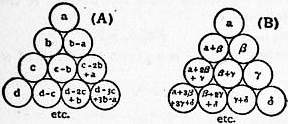
Fig. 1.
3. The formal relations between the terms of the series and the differences may be seen by comparing the arrangements (A) and (B) in fig. 1. In (A) the various terms and differences are the same as in § 2, but placed differently. In (B) we take a new series of terms α, β, γ, δ, commencing with the same term α, and take the successive sums of pairs of terms, instead of the successive differences, but place them to the left instead of to the right. It will be seen, in the first place, that the successive terms in (A), reading downwards to the right, and the successive terms in (B), reading downwards to the left, consist each of a series of terms whose coefficients follow the binomial law; i.e. the coefficients in b − a, c − 2b + a, d − 3c + 3b − a, ... and in α + β, α + 2β + γ, α + 3β + 3γ + δ, ... are respectively the same as in y − x, (y − x)², (y − x)³, ... and in x + y, (x + y)², (x + y)³,.... In the second place, it will be seen that the relations between the various terms in (A) are identical with the relations between the similarly placed terms in (B); e.g. β + γ is the difference of α + 2β + γ and α + β, just as c − b is the difference of c and b: and d − c is the sum of c − b and d − 2c + b, just as β + 2γ + δ is the sum of β + γ and γ + δ. Hence if we take β, γ, δ, ... of (B) as being the same as b − a, c − 2b + a, d − 3c + 3b − a, ... of (A), all corresponding terms in the two diagrams will be the same.
Thus we obtain the two principal formulae connecting terms and differences. If we provisionally describe b − a, c − 2b + a, ... as the first, second, ... differences of the particular term a (§ 7), then (i.) the nth difference of a is
l − nk + ... + (-1)n-2 n·n − 1 c + (-1)n-1 nb + (-1)n a,
1·2
where l, k ... are the (n + 1)th, nth, ... terms of the series a, b, c, ...; the coefficients being those of the terms in the expansion of (y − x)n: and (ii.) the (n + 1)th term of the series, i.e. the nth term after a, is
a + nβ + n·n − 1 γ + ...
1·2
where β, γ, ... are the first, second, ... differences of a; the coefficients being those of the terms in the expansion of (x + y)n.
4. Now suppose we treat the terms a, b, c, ... as being themselves the first differences of another series. Then, if the first term of this series is N, the subsequent terms are N + a, N + a + b, N + a + b + c, ...; i.e. the difference between the (n + 1)th term and the first term is the sum of the first n terms of the original series. The term N, in the diagram (A), will come above and to the left of a; and we see, by (ii.) of § 3, that the sum of the first n terms of the original series is
( N + na + n·n − 1 β + ... ) − N = na + n·n − 1 β + n·n − 1·n − 2 γ + ...
1·2 1·2 1 · 2 · 3
5. As an example, take the arithmetical series
a, a + p, a + 2p, ...
The first differences are p, p, p, ... and the differences of any higher order are zero. Hence, by (ii.) of § 3, the (n + 1)th term is a + np, and, by § 4, the sum of the first n terms is na + ½n(n − 1)p = ½n{2a + (n − 1)p}.
6 As another example, take the series 1, 8, 27, ... the terms of which are the cubes of 1, 2, 3, ... The first, second and third differences of the first term are 7, 12 and 6, and it may be shown (§ 14 (i.)) that all differences of a higher order are zero. Hence the sum of the first n terms is
n + 7 n·n − 1 + 12 n·n − 1·n − 2 + 6 n·n − 1·n − 2·n − 3 = ¼n4 + ½n³ + ¼n² = {½n (n + 1)}².
1·2 1·2·3 1·2·3·4
7. In § 3 we have described b − a, c − 2b + a, ... as the first, second, ... differences of a. This ascription of the differences to particular terms of the series is quite arbitrary. If we read the differences in the table of § 2 upwards to the right instead of downwards to the right, we might describe e − d, e − 2d + c, ... as the first, second, ... differences of e. On the other hand, the term of greatest weight in c − 2b + a, i.e. the term which has the numerically greatest coefficient, is b, and therefore c − 2b + a might properly be regarded as the second difference of b, and similarly e − 4d + 6c − 4b + a might be regarded as the fourth difference of c. These three methods of regarding the differences lead to three different systems of notation, which are described in §§ 9, 10 and 11.
Notation of Differences and Sums.
8. It is convenient to denote the terms a, b, c, ... of the series by u0, u1, u2, u3, ... If we merely have the terms of the series, un may be regarded as meaning the (n + 1)th term. Usually, however, the terms are the values of a quantity u, which is a function of another quantity x, and the values of x, to which a, b, c, ... correspond, proceed by a constant difference h. If x0 and u0 are a pair of corresponding values of x and u, and if any other value x0 + mh of x and the corresponding value of u are denoted by xm and um, then the terms of the series will be ... un-2, un-1, un, un+1, un+2 ..., corresponding to values of x denoted by ... xn-2, xn-1, xn, xn+1, xn+2....
9. In the advancing-difference notation un+1 − un is denoted by Δun. The differences Δu0, Δu1, Δu2 ... may then be regarded as values of a function Δu corresponding to values of x proceeding by constant difference h; and therefore Δun+1 − Δun denoted by ΔΔun, or, more briefly, Δ²un; and so on. Hence the table of differences in § 2, with the corresponding values of x and of u placed opposite each other in the ordinary manner of mathematical tables, becomes
x u 1st Diff. 2nd Diff. 3rd Diff. 4th Diff.
· · · · · ·
· · · · · ·
· · · · · ·
xn-2 un-2 Δ²un-3 Δ4un-4 ...
Δun-2 Δ³un-3
xn-1 un-1 Δ²un-2 Δ4un-3 ...
Δun-1 Δ³un-2
xn un Δ²un-1 Δ4un-2 ...
Δun Δ³un-1
xn+1 un+1 Δ²un Δ4un-1 ...
Δun+1 Δ³un
xn+2 un+2 Δ²un+1 Δ4un ...
· · · · · ·
· · · · · ·
· · · · · ·
The terms of the series of which ... un-1, un, un+1, ... are the first differences are denoted by Σu, with proper suffixes, so that this series is ... Σun-1, Σun, Σun+1.... The suffixes are chosen so that we may have ΔΣun = un, whatever n may be; and therefore (§ 4) Σun may be regarded as being the sum of the terms of the series up to and including un-1. Thus if we write Σun-1 = C + un-2, where C is any constant, we shall have