VOLUME VIII SLICE IV Diameter to Dinarchus (continued 10)
Reading edition
Now
δ = (a + b) s²/2ab (1),
so that, if we write
2πδ= π(a + b)s² = π v² (2),
λ abλ 2
the effect at B is
{ abλ } ½ { cos 2πt ∫ cos ½πv²·dv + sin 2πt ∫ sin ½πv²·dv } (3)
2(a + b) τ τ
the limits of integration depending upon the disposition of the diffracting edges. When a, b, λ are regarded as constant, the first factor may be omitted,—as indeed should be done for consistency’s sake, inasmuch as other factors of the same nature have been omitted already.
The intensity I², the quantity with which we are principally concerned, may thus be expressed
I²= { ∫ cos ½πv²·dv}² + { ∫ sin ½πv²·dv }² (4).
These integrals, taken from v = 0, are known as Fresnel’s integrals; we will denote them by C and S, so that
C = ∫ v cos ½πv²·dv, S = ∫ v sin ½πv²·dv (5).
0 0
When the upper limit is infinity, so that the limits correspond to the inclusion of half the primary wave, C and S are both equal to ½, by a known formula; and on account of the rapid fluctuation of sign the parts of the range beyond very moderate values of v contribute but little to the result.
Ascending series for C and S were given by K. W. Knockenhauer, and are readily investigated. Integrating by parts, we find
C + iS = ∫ v e i·½πv² dv = e i·½πv² · v − 1⁄3 iπ ∫ v e i·½πv² dv³;
0 0
and, by continuing this process,
C + iS = e i·½πv² { v − iπ v³ + iπ iπ v5 − iπ iπ iπ v7 + ... }.
3 3 5 3 5 7
By separation of real and imaginary parts,
C = M cos ½πv² − N sin ½πv² } (6),
S = M sin ½πv² − N cos ½πv²
where
M = v − π²v5 + π4v9 − ... (7),
1 3·5 3·5·7·9
N = πv³ − π3v7 + π5v11 ... (8).
1·3 1·3·5·7 1·3·5·7·9·11
These series are convergent for all values of v, but are practically useful only when v is small.
Expressions suitable for discussion when v is large were obtained by L. P. Gilbert (Mem. cour. de l’Acad. de Bruxelles, 31, p. 1). Taking
½πv² = u (9),
we may write
C + iS = 1 ∫ u eiudu (10).
√(2π) 0 √u
Again, by a known formula,
1 = 1 ∫ ∞ e−uxdx (11).
√ u √π 0 √x
Substituting this in (10), and inverting the order of integration, we get
C + iS = 1 ∫ ∞ dx ∫ u e u(i − x) dx = 1 ∫ ∞ dx eu(i − x) − 1 (12).
π√2 0 √x 0 π√2 √x i − x
Thus, if we take
G = 1 ∫ ∞ e−ux √x · dx , H = 1 ∫ ∞ e−ux dx (13),
π√2 0 1 + x² π√2 0 √x · (1 + x²)
C = ½ − G cos u + H sin u, S = ½ − G sin u − H cos u (14).
The constant parts in (14), viz. ½, may be determined by direct integration of (12), or from the observation that by their constitution G and H vanish when u = ∞, coupled with the fact that C and S then assume the value ½.
Comparing the expressions for C, S in terms of M, N, and in terms of G, H, we find that
G = ½ (cos u + sin u) − M, H = ½ (cos u − sin u) + N (15),
formulae which may be utilized for the calculation of G, H when u (or v) is small. For example, when u = 0, M = 0, N = 0, and consequently G = H = ½.
Descending series of the semi-convergent class, available for numerical calculation when u is moderately large, can be obtained from (12) by writing x = uy, and expanding the denominator in powers of y. The integration of the several terms may then be effected by the formula
∫ ∞ e−y yq−½dy = Γ(q + ½) = (q − ½)(q − 3⁄2) ... ½ √π;
0
and we get in terms of v
G = 1 − 1·3·5 + 1·3·5·9 − ... (16),
π²v³ π4v7 π6v11
H = 1 − 1·3 + 1·3·5·7 − ... (17).
πv π³v5 π5v9
The corresponding values of C and S were originally derived by A. L. Cauchy, without the use of Gilbert’s integrals, by direct integration by parts.
From the series for G and H just obtained it is easy to verify that
dH = − πvG, dG = πvH − 1 (18).
dv dv
We now proceed to consider more particularly the distribution of light upon a screen PBQ near the shadow of a straight edge A. At a point P within the geometrical shadow of the obstacle, the half of the wave to the right of C (fig. 18), the nearest point on the wave-front, is wholly intercepted, and on the left the integration is to be taken from s = CA to s = ∞. If V be the value of v corresponding to CA, viz.
V = √{ 2(a + b) } · CA, (19),
abλ
we may write
I² = ( ∫ ∞ cos ½πv² · dv ) ² + ( ∫ ∞ sin ½πv² · dv ) ² (20),
v v
or, according to our previous notation,
I²=(½ − Cv)² + (½ − Sv)² = G² + H² (21).
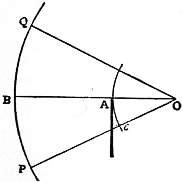
Fig. 18.
Now in the integrals represented by G and H every element diminishes as V increases from zero. Hence, as CA increases, viz. as the point P is more and more deeply immersed in the shadow, the illumination continuously decreases, and that without limit. It has long been known from observation that there are no bands on the interior side of the shadow of the edge.
The law of diminution when V is moderately large is easily expressed with the aid of the series (16), (17) for G, H. We have ultimately G = 0, H = (πV)−1, so that
I² = 1/π²V²,
or the illumination is inversely as the square of the distance from the shadow of the edge.
For a point Q outside the shadow the integration extends over more than half the primary wave. The intensity may be expressed by
I² = (½ + Cv)² + (½ + Sv)² (22);
and the maxima and minima occur when
(½ + Cv) dC + (½ + Sv) dS = 0,
dV dV
whence
sin ½πV² + cos ½πV² = G (23).
When V = 0, viz. at the edge of the shadow, I² = ½; when V = ∞, I² = 2, on the scale adopted. The latter is the intensity due to the uninterrupted wave. The quadrupling of the intensity in passing outwards from the edge of the shadow is, however, accompanied by fluctuations giving rise to bright and dark bands. The position of these bands determined by (23) may be very simply expressed when V is large, for then sensibly G = 0, and
½πV² = ¾π + nπ (24),
n being an integer. In terms of δ, we have from (2)
δ = (3⁄8 + ½n)λ (25).
The first maximum in fact occurs when δ = 3⁄8λ − .0046λ, and the first minimum when δ = 7⁄8λ − .0016λ, the corrections being readily obtainable from a table of G by substitution of the approximate value of V.
The position of Q corresponding to a given value of V, that is, to a band of given order, is by (19)
BQ = a + b AD = V √ { bλ(a + b) } (26).
a 2a
By means of this expression we may trace the locus of a band of given order as b varies. With sufficient approximation we may regard BQ and b as rectangular co-ordinates of Q. Denoting them by x, y, so that AB is axis of y and a perpendicular through A the axis of x, and rationalizing (26), we have
2ax² − V²λy² − V²aλy = 0,
which represents a hyperbola with vertices at O and A.
From (24), (26) we see that the width of the bands is of the order √{bλ(a + b)/a}. From this we may infer the limitation upon the width of the source of light, in order that the bands may be properly formed. If ω be the apparent magnitude of the source seen from A, ωb should be much smaller than the above quantity, or
ω < √{λ(a + b)/ab} (27).
If a be very great in relation to b, the condition becomes
ω < √(λ / b) (28).
so that if b is to be moderately great (1 metre), the apparent magnitude of the sun must be greatly reduced before it can be used as a source. The values of V for the maxima and minima of intensity, and the magnitudes of the latter, were calculated by Fresnel. An extract from his results is given in the accompanying table.
V I²
First maximum 1.2172 2.7413
First minimum 1.8726 1.5570
Second maximum 2.3449 2.3990
Second minimum 2.7392 1.6867
Third maximum. 3.0820 2.3022
Third minimum 3.3913 1.7440
A very thorough investigation of this and other related questions, accompanied by fully worked-out tables of the functions concerned, will be found in a paper by E. Lommel (Abh. bayer. Akad. d. Wiss. II. CI., 15, Bd., iii. Abth., 1886).
When the functions C and S have once been calculated, the discussion of various diffraction problems is much facilitated by the idea, due to M. A. Cornu (Journ. de Phys., 1874, 3, p. 1; a similar suggestion was made independently by G. F. Fitzgerald), of exhibiting as a curve the relationship between C and S, considered as the rectangular co-ordinates (x, y) of a point. Such a curve is shown in fig. 19, where, according to the definition (5) of C, S,
x = ∫ v cos ½πv²·dv, y = ∫ v sin ½πv²·dv (29).
0 0
The origin of co-ordinates O corresponds to v = 0; and the asymptotic points J, J′, round which the curve revolves in an ever-closing spiral, correspond to v = ±∞.
The intrinsic equation, expressing the relation between the arc σ (measured from O) and the inclination φ of the tangent at any points to the axis of x, assumes a very simple form. For
dx = cos ½πv²·dv, dy = sin ½πv²·dv;
so that
σ = ∫ √(dx² + dy²) = v, (30),
φ = tan−1(dy/dx) = ½πv² (31).
Accordingly,
φ = ½πσ² (32);
and for the curvature,
dφ / dσ = πσ (33).
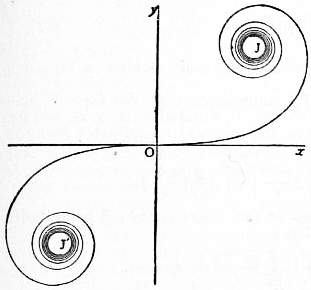
Fig. 19.
Cornu remarks that this equation suffices to determine the general character of the curve. For the osculating circle at any point includes the whole of the curve which lies beyond; and the successive convolutions envelop one another without intersection.
The utility of the curve depends upon the fact that the elements of arc represent, in amplitude and phase, the component vibrations due to the corresponding portions of the primary wave-front. For by (30) dσ = dv, and by (2) dv is proportional to ds. Moreover by (2) and (31) the retardation of phase of the elementary vibration from PQ (fig. 17) is 2πδ/λ, or φ. Hence, in accordance with the rule for compounding vector quantities, the resultant vibration at B, due to any finite part of the primary wave, is represented in amplitude and phase by the chord joining the extremities of the corresponding arc (σ2 − σ1).
In applying the curve in special cases of diffraction to exhibit the effect at any point P (fig. 18) the centre of the curve O is to be considered to correspond to that point C of the primary wave-front which lies nearest to P. The operative part, or parts, of the curve are of course those which represent the unobstructed portions of the primary wave.
Let us reconsider, following Cornu, the diffraction of a screen unlimited on one side, and on the other terminated by a straight edge. On the illuminated side, at a distance from the shadow, the vibration is represented by JJ′. The co-ordinates of J, J′ being (½, ½), (−½, −½), I² is 2; and the phase is 1⁄8 period in arrear of that of the element at O. As the point under contemplation is supposed to approach the shadow, the vibration is represented by the chord drawn from J to a point on the other half of the curve, which travels inwards from J′ towards O. The amplitude is thus subject to fluctuations, which increase as the shadow is approached. At the point O the intensity is one-quarter of that of the entire wave, and after this point is passed, that is, when we have entered the geometrical shadow, the intensity falls off gradually to zero, without fluctuations. The whole progress of the phenomenon is thus exhibited to the eye in a very instructive manner.
We will next suppose that the light is transmitted by a slit, and inquire what is the effect of varying the width of the slit upon the illumination at the projection of its centre. Under these circumstances the arc to be considered is bisected at O, and its length is proportional to the width of the slit. It is easy to see that the length of the chord (which passes in all cases through O) increases to a maximum near the place where the phase-retardation is 3⁄8 of a period, then diminishes to a minimum when the retardation is about 7⁄8 of a period, and so on.
If the slit is of constant width and we require the illumination at various points on the screen behind it, we must regard the arc of the curve as of constant length. The intensity is then, as always, represented by the square of the length of the chord. If the slit be narrow, so that the arc is short, the intensity is constant over a wide range, and does not fall off to an important extent until the discrepancy of the extreme phases reaches about a quarter of a period.
We have hitherto supposed that the shadow of a diffracting obstacle is received upon a diffusing screen, or, which comes to nearly the same thing, is observed with an eye-piece. If the eye, provided if necessary with a perforated plate in order to reduce the aperture, be situated inside the shadow at a place where the illumination is still sensible, and be focused upon the diffracting edge, the light which it receives will appear to come from the neighbourhood of the edge, and will present the effect of a silver lining. This is doubtless the explanation of a “pretty optical phenomenon, seen in Switzerland, when the sun rises from behind distant trees standing on the summit of a mountain.”11
II. Dynamical Theory of Diffraction.—The explanation of diffraction phenomena given by Fresnel and his followers is independent of special views as to the nature of the aether, at least in its main features; for in the absence of a more complete foundation it is impossible to treat rigorously the mode of action of a solid obstacle such as a screen. But, without entering upon matters of this kind, we may inquire in what manner a primary wave may be resolved into elementary secondary waves, and in particular as to the law of intensity and polarization in a secondary wave as dependent upon its direction of propagation, and upon the character as regards polarization of the primary wave. This question was treated by Stokes in his “Dynamical Theory of Diffraction” (Camb. Phil. Trans., 1849) on the basis of the elastic solid theory.
Let x, y, z be the co-ordinates of any particle of the medium in its natural state, and χ, η, ζ the displacements of the same particle at the end of time t, measured in the directions of the three axes respectively. Then the first of the equations of motion may be put under the form
d²ξ = b² ( d²ξ + d²ξ + d²ξ ) + (a² − b²) d² ( d²ξ + d²η + d²ζ ),
dt² dx² dy² dz² dx dx² dy² dz²
where a² and b² denote the two arbitrary constants. Put for shortness
d²ξ + d²η + d²ζ ≈ δ (1),
dx² dy² dz²
and represent by Δ²χ the quantity multiplied by b². According to this notation, the three equations of motion are
d²ξ b²Δ²ξ + (a² − b²) dδ } (2).
dt² dx
d²η b²Δ²η + (a² − b²) dδ
dt² dy
d²ζ b²Δ²ζ + (a² − b²) dδ
dt² dz
It is to be observed that S denotes the dilatation of volume of the element situated at (x, y, z). In the limiting case in which the medium is regarded as absolutely incompressible δ vanishes; but, in order that equations (2) may preserve their generality, we must suppose a at the same time to become infinite, and replace a²δ by a new function of the co-ordinates.
These equations simplify very much in their application to plane waves. If the ray be parallel to OX, and the direction of vibration parallel to OZ, we have ξ = 0, η = 0, while ζ is a function of x and t only. Equation (1) and the first pair of equations (2) are thus satisfied identically. The third equation gives
d²ζ = b² d²ζ (3),
dt² dx²
of which the solution is
ζ = ƒ(bt − x) (4),
where ƒ is an arbitrary function.
The question as to the law of the secondary waves is thus answered by Stokes. “Let ξ = 0, η = 0, ζ = ƒ(bt − x) be the displacements corresponding to the incident light; let O1 be any point in the plane P (of the wave-front), dS an element of that plane adjacent to O1, and consider the disturbance due to that portion only of the incident disturbance which passes continually across dS. Let O be any point in the medium situated at a distance from the point O1 which is large in comparison with the length of a wave; let O1O = r, and let this line make an angle θ with the direction of propagation of the incident light, or the axis of x, and φ with the direction of vibration, or axis of z. Then the displacement at O will take place in a direction perpendicular to O1O, and lying in the plane ZO1O; and, if ζ′ be the displacement at O, reckoned positive in the direction nearest to that in which the incident vibrations are reckoned positive,
ζ′ = dS (1 + cos θ) sin φ ƒ′(bt − r).
4πr
In particular, if
ƒ(bt − x) = c sin 2π (bt − x) (5),
λ
we shall have
ζ′ = cdS (1 + cos θ) sin φcos 2π (bt − r) (6).”
2λr λ
It is then verified that, after integration with respect to dS, (6) gives the same disturbance as if the primary wave had been supposed to pass on unbroken.
The occurrence of sin φ as a factor in (6) shows that the relative intensities of the primary light and of that diffracted in the direction θ depend upon the condition of the former as regards polarization. If the direction of primary vibration be perpendicular to the plane of diffraction (containing both primary and secondary rays), sin φ = 1; but, if the primary vibration be in the plane of diffraction, sin φ = cos θ. This result was employed by Stokes as a criterion of the direction of vibration; and his experiments, conducted with gratings, led him to the conclusion that the vibrations of polarized light are executed in a direction perpendicular to the plane of polarization.
The factor (1 + cos θ) shows in what manner the secondary disturbance depends upon the direction in which it is propagated with respect to the front of the primary wave.
If, as suffices for all practical purposes, we limit the application of the formulae to points in advance of the plane at which the wave is supposed to be broken up, we may use simpler methods of resolution than that above considered. It appears indeed that the purely mathematical question has no definite answer. In illustration of this the analogous problem for sound may be referred to. Imagine a flexible lamina to be introduced so as to coincide with the plane at which resolution is to be effected. The introduction of the lamina (supposed to be devoid of inertia) will make no difference to the propagation of plane parallel sonorous waves through the position which it occupies. At every point the motion of the lamina will be the same as would have occurred in its absence, the pressure of the waves impinging from behind being just what is required to generate the waves in front. Now it is evident that the aerial motion in front of the lamina is determined by what happens at the lamina without regard to the cause of the motion there existing. Whether the necessary forces are due to aerial pressures acting on the rear, or to forces directly impressed from without, is a matter of indifference. The conception of the lamina leads immediately to two schemes, according to which a primary wave may be supposed to be broken up. In the first of these the element dS, the effect of which is to be estimated, is supposed to execute its actual motion, while every other element of the plane lamina is maintained at rest. The resulting aerial motion in front is readily calculated (see Rayleigh, Theory of Sound, § 278); it is symmetrical with respect to the origin, i.e. independent of θ. When the secondary disturbance thus obtained is integrated with respect to dS over the entire plane of the lamina, the result is necessarily the same as would have been obtained had the primary wave been supposed to pass on without resolution, for this is precisely the motion generated when every element of the lamina vibrates with a common motion, equal to that attributed to dS. The only assumption here involved is the evidently legitimate one that, when two systems of variously distributed motion at the lamina are superposed, the corresponding motions in front are superposed also.
The method of resolution just described is the simplest, but it is only one of an indefinite number that might be proposed, and which are all equally legitimate, so long as the question is regarded as a merely mathematical one, without reference to the physical properties of actual screens. If, instead of supposing the motion at dS to be that of the primary wave, and to be zero elsewhere, we suppose the force operative over the element dS of the lamina to be that corresponding to the primary wave, and to vanish elsewhere, we obtain a secondary wave following quite a different law. In this case the motion in different directions varies as cosθ, vanishing at right angles to the direction of propagation of the primary wave. Here again, on integration over the entire lamina, the aggregate effect of the secondary waves is necessarily the same as that of the primary.
In order to apply these ideas to the investigation of the secondary wave of light, we require the solution of a problem, first treated by Stokes, viz. the determination of the motion in an infinitely extended elastic solid due to a locally applied periodic force. If we suppose that the force impressed upon the element of mass D dx dy dz is
DZ dx dy dz,
being everywhere parallel to the axis of Z, the only change required in our equations (1), (2) is the addition of the term Z to the second member of the third equation (2). In the forced vibration, now under consideration, Z, and the quantities ξ, η, ζ, δ expressing the resulting motion, are to be supposed proportional to eint, where i = √(-1), and n = 2π/τ, τ being the periodic time. Under these circumstances the double differentiation with respect to t of any quantity is equivalent to multiplication by the factor -n², and thus our equations take the form
(b²Δ² + n²)ξ + (a² − b²) dδ = 0 } (7).
dx
(b²Δ² + n²)η + (a² − b²) dδ = 0
dy
(b²Δ² + n²)ζ + (a² − b²) dδ = −Z
dz
It will now be convenient to introduce the quantities.ω1, ω2, ω3 which express the rotations of the elements of the medium round axes parallel to those of co-ordinates, in accordance with the equations
ω3 = dξ − dη , ω1 = dη − dζ , ω2 dζ − dξ (8).
dy dx′ dz dy′ dx dz′
In terms of these we obtain from (7), by differentiation and subtraction,
(b²Δ² + n²) ω3 = 0 } (9).
(b²Δ² + n²) ω1 = dZ/dy
(b²Δ² + n²) ω2 = −dZ/dx
The first of equations (9) gives
ω3 = 0 (10).
For ω1, we have
ω1 = 1 ∫∫∫ dZ e−ikr dx dy dz (11),
4πb² dy r
where r is the distance between the element dx dy dz and the point where ω1 is estimated, and
k = n/b = 2π/λ (12),
λ being the wave-length.
(This solution may be verified in the same manner as Poisson’s theorem, in which k = 0.)
We will now introduce the supposition that the force Z acts only within a small space of volume T, situated at (x, y, z), and for simplicity suppose that it is at the origin of co-ordinates that the rotations are to be estimated. Integrating by parts in (11), we get
∫ e−ikr dZ dy = [ Z e−ikr ] − ∫ Z d ( e−ikr ) dy,
r dy r dy r
in which the integrated terms at the limits vanish, Z being finite only within the region T. Thus
ω1 = 1 ∫∫∫ Z d ( e−ikr ) dx dy dz.
4πb² dy r
Since the dimensions of T are supposed to be very small in comparison with λ, the factor d/dy (e−ikr/r) is sensibly constant; so that, if Z stand for the mean value of Z over the volume T, we may write
ω1 = TZ · y · d ( e−ikr ) (13).
4πb² r dr r
In like manner we find
ω2 = − TZ · x · d ( e−ikr ) (14).
4πb² r dr r
From (10), (13), (14) we see that, as might have been expected, the rotation at any point is about an axis perpendicular both to the direction of the force and to the line joining the point to the source of disturbance. If the resultant rotation be ω, we have
ω = TZ · √(x² + y²) · d ( e−ikr ) = TZ sin φ d ( e−ikr ),
4πb² r dr r 4πb² dr r
φ denoting the angle between r and z. In differentiating e−ikr/r with respect to r, we may neglect the term divided by r² as altogether insensible, kr being an exceedingly great quantity at any moderate distance from the origin of disturbance. Thus
ω = −ik · TZ sin φ · e−ikr (15),
4πb² r
which completely determines the rotation at any point. For a disturbing force of given integral magnitude it is seen to be everywhere about an axis perpendicular to r and the direction of the force, and in magnitude dependent only upon the angle (φ) between these two directions and upon the distance (r).
The intensity of light is, however, more usually expressed in terms of the actual displacement in the plane of the wave. This displacement, which we may denote by ζ′, is in the plane containing z and r, and perpendicular to the latter. Its connexion with ωis expressed by ω = dζ′/dr; so that
ζ′ = TZ sin φ · e′ (at−kr) (16),
4πb² r
where the factor eint is restored.
Retaining only the real part of (16), we find, as the result of a local application of force equal to
DTZ cos nt (17),
the disturbance expressed by
ζ′ = TZ sin φ · cos (nt − kr) (18).
4πb² r
The occurrence of sin φ shows that there is no disturbance radiated in the direction of the force, a feature which might have been anticipated from considerations of symmetry.
We will now apply (18) to the investigation of a law of secondary disturbance, when a primary wave
ζ = sin(nt − kx) (19)
is supposed to be broken up in passing the plane x = 0. The first step is to calculate the force which represents the reaction between the parts of the medium separated by x = 0. The force operative upon the positive half is parallel to OZ, and of amount per unit of area equal to
−b²D dζ/dx = b²kD cos nt;
and to this force acting over the whole of the plane the actual motion on the positive side may be conceived to be due. The secondary disturbance corresponding to the element dS of the plane may be supposed to be that caused by a force of the above magnitude acting over dS and vanishing elsewhere; and it only remains to examine what the result of such a force would be.
Now it is evident that the force in question, supposed to act upon the positive half only of the medium, produces just double of the effect that would be caused by the same force if the medium were undivided, and on the latter supposition (being also localized at a point) it comes under the head already considered. According to (18), the effect of the force acting at dS parallel to OZ, and of amount equal to
2b²kD dS cos nt,
will be a disturbance
ζ′ = dS sin φ cos (nt − kr) (20),
λr
regard being had to (12). This therefore expresses the secondary disturbance at a distance r and in a direction making an angle φ with OZ (the direction of primary vibration) due to the element dS of the wave-front.
The proportionality of the secondary disturbance to sin φ is common to the present law and to that given by Stokes, but here there is no dependence upon the angle θ between the primary and secondary rays. The occurrence of the factor λr−1, and the necessity of supposing the phase of the secondary wave accelerated by a quarter of an undulation, were first established by Archibald Smith, as the result of a comparison between the primary wave, supposed to pass on without resolution, and the integrated effect of all the secondary waves (§ 2). The occurrence of factors such as sin φ, or ½(1 + cos θ), in the expression of the secondary wave has no influence upon the result of the integration, the effects of all the elements for which the factors differ appreciably from unity being destroyed by mutual interference.
The choice between various methods of resolution, all mathematically admissible, would be guided by physical considerations respecting the mode of action of obstacles. Thus, to refer again to the acoustical analogue in which plane waves are incident upon a perforated rigid screen, the circumstances of the case are best represented by the first method of resolution, leading to symmetrical secondary waves, in which the normal motion is supposed to be zero over the unperforated parts. Indeed, if the aperture is very small, this method gives the correct result, save as to a constant factor. In like manner our present law (20) would apply to the kind of obstruction that would be caused by an actual physical division of the elastic medium, extending over the whole of the area supposed to be occupied by the intercepting screen, but of course not extending to the parts supposed to be perforated.
On the electromagnetic theory, the problem of diffraction becomes definite when the properties of the obstacle are laid down. The simplest supposition is that the material composing the obstacle is perfectly conducting, i.e. perfectly reflecting. On this basis A. J. W. Sommerfeld (Math. Ann., 1895, 47, p. 317), with great mathematical skill, has solved the problem of the shadow thrown by a semi-infinite plane screen. A simplified exposition has been given by Horace Lamb (Proc. Lond. Math. Soc., 1906, 4, p. 190). It appears that Fresnel’s results, although based on an imperfect theory, require only insignificant corrections. Problems not limited to two dimensions, such for example as the shadow of a circular disk, present great difficulties, and have not hitherto been treated by a rigorous method; but there is no reason to suppose that Fresnel’s results would be departed from materially.
(R.)
1 The descending series for J0(z) appears to have been first given by Sir W. Hamilton in a memoir on “Fluctuating Functions,” Roy. Irish Trans., 1840.
2 Airy, loc. cit. “Thus the magnitude of the central spot is diminished, and the brightness of the rings increased, by covering the central parts of the object-glass.”
3 ”Man kann daraus schliessen, was moglicher Weise durch Mikroskope noch zu sehen ist. Ein mikroskopischer Gegenstand z. B, dessen Durchmesser = (λ) ist, und der aus zwei Theilen besteht, kann nicht mehr als aus zwei Theilen bestehend erkannt werden. Dieses zeigt uns eine Grenze des Sehvermogens durch Mikroskope” (Gilbert’s Ann. 74, 337). Lord Rayleigh has recorded that he was himself convinced by Fraunhofer’s reasoning at a date antecedent to the writings of Helmholtz and Abbe.
4 The last sentence is repeated from the writer’s article “Wave Theory” in the 9th edition of this work, but A. A. Michelson’s ingenious échelon grating constitutes a realization in an unexpected manner of what was thought to be impracticable.—[R.]
5 Compare also F. F. Lippich, Pogg. Ann. cxxxix. p. 465, 1870; Rayleigh, Nature (October 2, 1873).
6 The power of a grating to construct light of nearly definite wave-length is well illustrated by Young’s comparison with the production of a musical note by reflection of a sudden sound from a row of palings. The objection raised by Herschel (Light, § 703) to this comparison depends on a misconception.
7 It must not be supposed that errors of this order of magnitude are unobjectionable in all cases. The position of the middle of the bright band representative of a mathematical line can be fixed with a spider-line micrometer within a small fraction of the width of the band, just as the accuracy of astronomical observations far transcends the separating power of the instrument.
8 “In the same way we may conclude that in flat gratings any departure from a straight line has the effect of causing the dust in the slit and the spectrum to have different foci—a fact sometimes observed.” (Rowland, “On Concave Gratings for Optical Purposes,” Phil. Mag., September 1883).
9 On account of inequalities in the atmosphere giving a variable refraction, the light from a star would be irregularly distributed over a screen. The experiment is easily made on a laboratory scale, with a small source of light, the rays from which, in their course towards a rather distant screen, are disturbed by the neighbourhood of a heated body. At a moment when the eye, or object-glass of a telescope, occupies a dark position, the star vanishes. A fraction of a second later the aperture occupies a bright place, and the star reappears. According to this view the chromatic effects depend entirely upon atmospheric dispersion.
10 In experiment a line of light is sometimes substituted for a point in order to increase the illumination. The various parts of the line are here independent sources, and should be treated accordingly. To assume a cylindrical form of primary wave would be justifiable only when there is synchronism among the secondary waves issuing from the various centres.
11 H. Necker (Phil. Mag., November 1832); Fox Talbot (Phil. Mag., June 1833). “When the sun is about to emerge ... every branch and leaf is lighted up with a silvery lustre of indescribable beauty.... The birds, as Mr Necker very truly describes, appear like flying brilliant sparks.” Talbot ascribes the appearance to diffraction; and he recommends the use of a telescope.
DIFFUSION (from the Lat. diffundere; dis-, asunder, and fundere, to pour out), in general, a spreading out, scattering or circulation; in physics the term is applied to a special phenomenon, treated below.
1. General Description.—When two different substances are placed in contact with each other they sometimes remain separate, but in many cases a gradual mixing takes place. In the case where both the substances are gases the process of mixing continues until the result is a uniform mixture. In other cases the proportions in which two different substances can mix lie between certain fixed limits, but the mixture is distinguished from a chemical compound by the fact that between these limits the composition of the mixture is capable of continuous variation, while in chemical compounds, the proportions of the different constituents can only have a discrete series of numerical values, each different ratio representing a different compound. If we take, for example, air and water in the presence of each other, air will become dissolved in the water, and water will evaporate into the air, and the proportions of either constituent absorbed by the other will vary continuously. But a limit will come when the air will absorb no more water, and the water will absorb no more air, and throughout the change a definite surface of separation will exist between the liquid and the gaseous parts. When no surface of separation ever exists between two substances they must necessarily be capable of mixing in all proportions. If they are not capable of mixing in all proportions a discontinuous change must occur somewhere between the regions where the substances are still unmixed, thus giving rise to a surface of separation.
The phenomena of mixing thus involves the following processes:—(1) A motion of the substances relative to one another throughout a definite region of space in which mixing is taking place. This relative motion is called “diffusion.” (2) The passage of portions of the mixing substances across the surface of separation when such a surface exists. These surface actions are described under various terms such as solution, evaporation, condensation and so forth. For example, when a soluble salt is placed in a liquid, the process which occurs at the surface of the salt is called “solution,” but the salt which enters the liquid by solution is transported from the surface into the interior of the liquid by “diffusion.”
Diffusion may take place in solids, that is, in regions occupied by matter which continues to exhibit the properties of the solid state. Thus if two liquids which can mix are separated by a membrane or partition, the mixing may take place through the membrane. If a solution of salt is separated from pure water by a sheet of parchment, part of the salt will pass through the parchment into the water. If water and glycerin are separated in this way most of the water will pass into the glycerin and a little glycerin will pass through in the opposite direction, a property frequently used by microscopists for the purpose of gradually transferring minute algae from water into glycerin. A still more interesting series of examples is afforded by the passage of gases through partitions of metal, notably the passage of hydrogen through platinum and palladium at high temperatures. When the process is considered with reference to a membrane or partition taken as a whole, the passage of a substance from one side to the other is commonly known as “osmosis” or “transpiration” (see Solution), but what occurs in the material of the membrane itself is correctly described as diffusion.
Simple cases of diffusion are easily observed qualitatively. If a solution of a coloured salt is carefully introduced by a funnel into the bottom of a jar containing water, the two portions will at first be fairly well defined, but if the mixture can exist in all proportions, the surface of separation will gradually disappear; and the rise of the colour into the upper part and its gradual weakening in the lower part, may be watched for days, weeks or even longer intervals. The diffusion of a strong aniline colouring matter into the interior of gelatine is easily observed, and is commonly seen in copying apparatus. Diffusion of gases may be shown to exist by taking glass jars containing vapours of hydrochloric acid and ammonia, and placing them in communication with the heavier gas downmost. The precipitation of ammonium chloride shows that diffusion exists, though the chemical action prevents this example from forming a typical case of diffusion. Again, when a film of Canada balsam is enclosed between glass plates, the disappearance during a few weeks of small air bubbles enclosed in the balsam can be watched under the microscope.
In fluid media, whether liquids or gases, the process of mixing is greatly accelerated by stirring or agitating the fluids, and liquids which might take years to mix if left to themselves can thus be mixed in a few seconds. It is necessary to carefully distinguish the effects of agitation from those of diffusion proper. By shaking up two liquids which do not mix we split them up into a large number of different portions, and so greatly increase the area of the surface of separation, besides decreasing the thicknesses of the various portions. But even when we produce the appearance of a uniform turbid mixture, the small portions remain quite distinct. If however the fluids can really mix, the final process must in every case depend on diffusion, and all we do by shaking is to increase the sectional area, and decrease the thickness of the diffusing portions, thus rendering the completion of the operation more rapid. If a gas is shaken up in a liquid the process of absorption of the bubbles is also accelerated by capillary action, as occurs in an ordinary sparklet bottle. To state the matter precisely, however finely two fluids have been subdivided by agitation, the molecular constitution of the different portions remains unchanged. The ultimate process by which the individual molecules of two different substances become mixed, producing finally a homogeneous mixture, is in every case diffusion. In other words, diffusion is that relative motion of the molecules of two different substances by which the proportions of the molecules in any region containing a finite number of molecules are changed.
In order, therefore, to make accurate observations of diffusion in fluids it is necessary to guard against any cause which may set up currents; and in some cases this is exceedingly difficult. Thus, if gas is absorbed at the upper surface of a liquid, and if the gaseous solution is heavier than the pure liquid, currents may be set up, and a steady state of diffusion may cease to exist. This has been tested experimentally by C. G. von Hüfner and W. E. Adney. The same thing may happen when a gas is evolved into a liquid at the surface of a solid even if no bubbles are formed; thus if pieces of aluminium are placed in caustic soda, the currents set up by the evolution of hydrogen are sufficient to set the aluminium pieces in motion, and it is probable that the motions of the Diatomaceae are similarly caused by the evolution of oxygen. In some pairs of substances diffusion may take place more rapidly than in others. Of course the progress of events in any experiment necessarily depends on various causes, such as the size of the containing vessels, but it is easy to see that when experiments with different substances are carried out under similar conditions, however these “similar conditions” be defined, the rates of diffusion must be capable of numerical comparison, and the results must be expressible in terms of at least one physical quantity, which for any two substances can be called their coefficient of diffusion. How to select this quantity we shall see later.
2 Quantitative Methods of observing Diffusion.—The simplest plan of determining the progress of diffusion between two liquids would be to draw off and examine portions from different strata at some stage in the process; the disturbance produced would, however, interfere with the subsequent process of diffusion, and the observations could not be continued. By placing in the liquid column hollow glass beads of different average densities, and observing at what height they remain suspended, it is possible to trace the variations of density of the liquid column at different depths, and different times. In this method, which was originally introduced by Lord Kelvin, difficulties were caused by the adherence of small air bubbles to the beads.
In general, optical methods are the most capable of giving exact results, and the following may be distinguished, (a) By refraction in a horizontal plane. If the containing vessel is in the form of a prism, the deviation of a horizontal ray of light in passing through the prism determines the index of refraction, and consequently the density of the stratum through which the ray passes, (b) By refraction in a vertical plane. Owing to the density varying with the depth, a horizontal ray entering the liquid also undergoes a small vertical deviation, being bent downwards towards the layers of greater density. The observation of this vertical deviation determines not the actual density, but its rate of variation with the depth, i.e. the “density gradient” at any point, (c) By the saccharimeter. In the cases of solutions of sugar, which cause rotation of the plane of polarized light, the density of the sugar at any depth may be determined by observing the corresponding angle of rotation, this was done originally by W. Voigt.
3. Elementary Definitions of Coefficient of Diffusion.—The simplest case of diffusion is that of a substance, say a gas, diffusing in the interior of a homogeneous solid medium, which remains at rest, when no external forces act on the system. We may regard it as the result of experience that: (1) if the density of the diffusing substance is everywhere the same no diffusion takes place, and (2) if the density of the diffusing substance is different at different points, diffusion will take place from places of greater to those of lesser density, and will not cease until the density is everywhere the same. It follows that the rate of flow of the diffusing substance at any point in any direction must depend on the density gradient at that point in that direction, i.e. on the rate at which the density of the diffusing substance decreases as we move in that direction. We may define the coefficient of diffusion as the ratio of the total mass per unit area which flows across any small section, to the rate of decrease of the density per unit distance in a direction perpendicular to that section.
In the case of steady diffusion parallel to the axis of x, if ρ be the density of the diffusing substance, and q the mass which flows across a unit of area in a plane perpendicular to the axis of x, then the density gradient is -dρ/dx and the ratio of q to this is called the “coefficient of diffusion.” By what has been said this ratio remains finite, however small the actual gradient and flow may be., and it is natural to assume, at any rate as a first approximation, that it is constant as far as the quantities in question are concerned. Thus if the coefficient of diffusion be denoted by K we have q= -K(dρ/dx).
Further, the rate at which the quantity of substance is increasing in an element between the distances x and x+dx is equal to the difference of the rates of flow in and out of the two faces, whence as in hydrodynamics, we have dρ/dt =-dq/dx.
It follows that the equation of diffusion in this case assumes the form
dρ = d ( K dρ ),
dt dx dx
which is identical with the equations representing conduction of heat, flow of electricity and other physical phenomena. For motion in three dimensions we have in like manner
dρ = d ( K dρ ) + d ( K dρ ) + d ( K dρ );
dt dx dx dy dy dz dz
and the corresponding equations in electricity and heat for anisotropic substances would be available to account for any parallel phenomena, which may arise, or might be conceived, to exist in connexion with diffusion through a crystalline solid.
In the case of a very dilute solution, the coefficient of diffusion of the dissolved substance can be defined in the same way as when the diffusion takes place in a solid, because the effects of diffusion will not have any perceptible influence on the solvent, and the latter may therefore be regarded as remaining practically at rest. But in most cases of diffusion between two fluids, both of the fluids are in motion, and hence there is far greater difficulty in determining the motion, and even in defining the coefficient of diffusion. It is important to notice in the first instance, that it is only the relative motion of the two substances which constitutes diffusion. Thus when a current of air is blowing, under ordinary circumstances the changes which take place are purely mechanical, and do not depend on the separate diffusions of the oxygen and nitrogen of which the air is mainly composed. It is only when two gases are flowing with unequal velocity, that is, when they have a relative motion, that these changes of relative distribution, which are called diffusion, take place. The best way out of the difficulty is to investigate the separate motions of the two fluids, taking account of the mechanical actions exerted on them, and supposing that the mutual action of the fluids causes either fluid to resist the relative motion of the other.
4. The Coefficient of Resistance.—Let us call the two diffusing fluids A and B. If B were absent, the motion of the fluid A would be determined entirely by the variations of pressure of the fluid A, and by the external forces, such as that due to gravity acting on A. Similarly if A were absent, the motion of B would be determined entirely by the variations of pressure due to the fluid B, and by the external forces acting on B. When both fluids are mixed together, each fluid tends to resist the relative motion of the other, and by the law of equality of action and reaction, the resistance which A experiences from B is everywhere equal and opposite to the resistance which B experiences from A. If the amount of this resistance per unit volume be divided by the relative velocity of the two fluids, and also by the product of their densities, the quotient is called the “coefficient of resistance.” If then ρ1, ρ2 are the densities cf the two fluids, u1, u2 their velocities, C the coefficient of resistance, then the portion of the fluid A contained in a small element of volume v will experience from the fluid B a resistance Cρ1ρ2v(u1 − u2), and the fluid B contained in the same volume element will experience from the fluid A an equal and opposite resistance, Cρ1ρ2v(u2 − u1).
This definition implies the following laws of resistance to diffusion, which must be regarded as based on experience, and not as self-evident truths: (1) each fluid tends to assume, so far as diffusion is concerned, the same equüibrium distribution that it would assume if its motion were unresisted by the presence of the other fluid. (Of course, the mutual attraction of gravitation of the two fluids might affect the final distribution, but this is practically negligible. Leaving such actions as this out of account the following statement is correct.) In a state of equilibrium, the density of each fluid at any point thus depends only on the partial pressure of that fluid alone, and is the same as if the other fluids were absent. It does not depend on the partial pressures of the other fluids. If this were not the case, the resistance to diffusion would be analogous to friction, and would contain terms which were independent of the relative velocity u2 − u1. (2) For slow motions the resistance to diffusion is (approximately at any rate) proportional to the relative velocity. (3) The coefficient of resistance C is not necessarily always constant; it may, for example, and, in general, does, depend on the temperature.
If we form the equations of hydrodynamics for the different fluids occurring in any mixture, taking account of diffusion, but neglecting viscosity, and using suffixes 1, 2 to denote the separate fluids, these assume the form given by James Clerk Maxwell (“Diffusion,” in Ency. Brit., 9th ed.):—
ρ1 Du1 + dp1 − X1ρ1 + C12ρ1ρ2(u1 − u2) + &c. = 0,
Dt dx
where
Du1 = du1 + u1 du1 + v1 du1 + w1 du1 ,
Dt dt dx dy dz
and these equations imply that when diffusion and other motions cease, the fluids satisfy the separate conditions of equilibrium dp1/dx − X1ρ1 = 0. The assumption made in the following account is that terms such as Du1/Dt may be neglected in the cases considered.
A further property based on experience is that the motions set up in a mixture by diffusion are very slow compared with those set up by mechanical actions, such as differences of pressure. Thus, if two gases at equal temperature and pressure be allowed to mix by diffusion, the heavier gas being below the lighter, the process will take a long time; on the other hand, if two gases, or parts of the same gas, at different pressures be connected, equalization of pressure will take place almost immediately. It follows from this property that the forces required to overcome the “inertia” of the fluids in the motions due to diffusion are quite imperceptible. At any stage of the process, therefore, any one of the diffusing fluids may be regarded as in equilibrium under the action of its own partial pressure, the external forces to which it is subjected and the resistance to diffusion of the other fluids.
5. Slow Diffusion of two Gases. Relation between the Coefficients of Resistance and of Diffusion.—We now suppose the diffusing substances to be two gases which obey Boyle’s law, and that diffusion takes place in a closed cylinder or tube of unit sectional area at constant temperature, the surfaces of equal density being perpendicular to the axis of the cylinder, so that the direction of diffusion is along the length of the cylinder, and we suppose no external forces, such as gravity, to act on the system.
The densities of the gases are denoted by ρ1, ρ2, their velocities of diffusion by u1, u2, and if their partial pressures are p1, p2, we have by Boyle’s law p1 = k1ρ1, p2 = k2ρ2, where k1,k2 are constants for the two gases, the temperature being constant. The axis of the cylinder is taken as the axis of x.
From the considerations of the preceding section, the effects of inertia of the diffusing gases may be neglected, and at any instant of the process either of the gases is to be treated as kept in equilibrium by its partial pressure and the resistance to diffusion produced by the other gas. Calling this resistance per unit volume R, and putting R = Cρ1ρ2(u1 − u2), where C is the coefficient of resistance, the equations of equilibrium give
dp1 + Cρ1ρ2(u1 − u2) = 0, and dp2 + Cρ1ρ2(u2 − u1) = 0 (1)
dx dx
These involve
dp1 + dp2 = 0 or p1 + p2 = P (2)
dx dx
where P is the total pressure of the mixture, and is everywhere constant, consistently with the conditions of mechanical equilibrium.
Now dp1/dx is the pressure-gradient of the first gas, and is, by Boyle’s law, equal to k1 times the corresponding density-gradient. Again ρ1u1 is the mass of gas flowing across any section per unit time, and k1ρ1u1 or p1u1 can be regarded as representing the flux of partial pressure produced by the motion of the gas. Since the total pressure is everywhere constant, and the ends of the cylinder are supposed fixed, the fluxes of partial pressure due to the two gases are equal and opposite, so that
p1u1 + p2u2 = 0 or k1ρ1u1 + k2ρ2u2 = 0 (3).
From (2) (3) we find by elementary algebra
u1/p2 = −u2/p1 = (u1 − u2)/(p1 + p2) = (u1 − u2)/P,
and therefore
p2u1 = −p2u2 = p1p2(u1 − u2)/P = k1k2ρ1ρ2(u1 − u2)/P
Hence equations (1) (2) gives
dp1 + CP (p1u1) = 0, and dp2 + CP (p2u2) = 0;
dx k1k2 dx k1k2
whence also substituting p1 = k1ρ1, p2 = k2ρ2, and by transposing
ρ1u1 = − k1k2 dρ1 , and ρ2u2 = − k1k2 dρ2 .
CP dx CP dx
We may now define the “coefficient of diffusion” of either gas as the ratio of the rate of flow of that gas to its density-gradient. With this definition, the coefficients of diffusion of both the gases in a mixture are equal, each being equal to k1k2/CP. The ratios of the fluxes of partial pressure to the corresponding pressure-gradients are also equal to the same coefficient. Calling this coefficient K, we also observe that the equations of continuity for the two gases are
dρ1 + d(ρ1u1) = 0, and dρ2 + d(ρ2u2) = 0,
dt dx dt dx
leading to the equations of diffusion
dρ1 = d (K dρ1 ), and dρ2 = d (K dρ2 ),
dt dx dx dt dx dx
exactly as in the case of diffusion through a solid.
If we attempt to treat diffusion in liquids by a similar method, it is, in the first place, necessary to define the “partial pressure” of the components occurring in a liquid mixture. This leads to the conception of “osmotic pressure,” which is dealt with in the article Solution. For dilute solutions at constant temperature, the assumption that the osmotic pressure is proportional to the density, leads to results agreeing fairly closely with experience, and this fact may be represented by the statement that a substance occurring in a dilute solution behaves like a perfect gas.
6. Relation of the Coefficient of Diffusion to the Units of Length and Time.—We may write the equation defining K in the form
−K × I dρ .
ρ dx
Here −dρ/ρdx represents the “percentage rate” at which the density decreases with the distance x; and we thus see that the coefficient of diffusion represents the ratio of the velocity of flow to the percentage rate at which the density decreases with the distance measured in the direction of flow. This percentage rate being of the nature of a number divided by a length, and the velocity being of the nature of a length divided by a time, we may state that K is of two dimensions in length and −1 in time, i.e. dimensions L²/T.
Example 1. Taking K = 0.1423 for carbon dioxide and air (at temperature 0° C. and pressure 76 cm. of mercury) referred to a centimetre and a second as units, we may interpret the result as follows:—Supposing in a mixture of carbon dioxide and air, the density of the carbon dioxide decreases by, say, 1, 2 or 3% of itself in a distance of 1 cm., then the corresponding velocities of the diffusing carbon dioxide will be respectively 0.01, 0.02 and 0.03 times 0.1423, that is, 0.001423, 0.002846 and 0.004269 cm. per second in the three cases.
Example 2. If we wished to take a foot and a second as our units, we should have to divide the value of the coefficient of diffusion in Example 1 by the square of the number of centimetres in 1 ft., that is, roughly speaking, by 900, giving the new value of K = 0.00016 roughly.
7. Numerical Values of the Coefficient of Diffusion.—The table on p. 258 gives the values of the coefficient of diffusion of several of the principal pairs of gases at a pressure of 76 cm. of mercury, and also of a number of other substances. In the gases the centimetre and second are taken as fundamental units, in other cases the centimetre and day.
8. Irreversible Changes accompanying Diffusion.—The diffusion of two gases at constant pressure and temperature is a good example of an “irreversible process.” The gases always tend to mix, never to separate. In order to separate the gases a change must be effected in the external conditions to which the mixture is subjected, either by liquefying one of the gases, or by separating them by diffusion through a membrane, or by bringing other outside influences to bear on them. In the case of liquids, electrolysis affords a means of separating the constituents of a mixture. Every such method involves some change taking place outside the mixture, and this change may be regarded as a “compensating transformation.” We thus have an instance of the property that every irreversible change leaves an indelible imprint somewhere or other on the progress of events in the universe. That the process of diffusion obeys the laws of irreversible thermodynamics (if these laws are properly stated) is proved by the fact that the compensating transformations required to separate mixed gases do not essentially involve anything but transformation of energy. The process of allowing gases to mix by diffusion, and then separating them by a compensating transformation, thus constitutes an irreversible cycle, the outside effects of which are that energy somewhere or other must be less capable of transformation than it was before the change. We express this fact by stating that an irreversible process essentially implies a loss of availability. To measure this loss we make use of the laws of thermodynamics, and in particular of Lord Kelvin’s statement that “It is impossible by means of inanimate material agency to derive mechanical effect from any portion of matter by cooling it below the temperature of the coldest of the surrounding objects.”
Substances. Temp. K. Author.
Carbon dioxide and air 0°C. 0.1423 cm²/sec. J. Loschmidt.
” ” hydrogen 0°C. 0.5558 ” ”
” ” oxygen 0°C. 0.1409 ” ”
” ” carbon monoxide 0°C. 0.1406 ” ”
” ” marsh gas (methane) 0°C. 0.1586 ” ”
” ” nitrous oxide 0°C. 0.0983 ” ”
Hydrogen and oxygen 0°C. 0.7214 ” ”
” ” carbon monoxide 0°C. 0.6422 ” ”
” ” sulphur dioxide 0°C. 0.4800 ” ”
Oxygen and carbon monoxide 0°C. 0.1802 ” ”
Water and ammonia 20°C. 1.250 ” G. Hüfner.
” ” 5°C. 0.822 ” ”
” common salt (density 1.0269) 0.355 ” J. Graham.
” ” ” 14.33°C. 1.020, 0.996, 0.972, 0.932 cm²/day. F. Heimbrodt.
” zinc sulphate (0.312 gm/cm³) 0.1162 cm²/day. W. Seitz.
” zinc sulphate (normal) 0.2355 ” ”
” zinc acetate (double normal) 0.1195 ” ”
” zinc formate (half normal) 0.4654 ” ”
” cadmium sulphate (double normal) · · 0.2456 ” ”
” glycerin (1⁄8n, ½n, 7⁄8n, 1.5n) 10.14°C. 0.356, 0.350, 0.342, 0.315 cm²/day. F. Heimbrodt.
” urea ” ” 14.83°C. 0.973, 0.946, 0.926, 0.883 cm²/day. ”
” hydrochloric acid 14.30°C. 2.208, 2.331, 2.480 cm²/day. ”
Gelatin 20% and ammonia 17°C. 127.1 cm²/day. A. Hagenbach.
” ” carbon dioxide · · 0.845 ” ”
” ” nitrous oxide · · 0.509 ” ”
” ” oxygen · · 0.230 ” ”
” ” hydrogen · · 0.0565 ” ”
Let us now assume that we have any syste m such as the gases above considered, and that it is in the presence of an indefinitely extended medium which we shall call the “auxiliary medium.” If heat be taken from any part of the system, only part of this heat can be converted into work by means of thermodynamic engines; and the rest will be given to the auxiliary medium, and will constitute unavailable energy or waste. To understand what this means, we may consider the case of a condensing steam engine. Only part of the energy liberated by the combustion of the coal is available for driving the engine, the rest takes the form of heat imparted to the condenser. The colder the condenser the more efficient is the engine, and the smaller is the quantity of waste.
The amount of unavailable energy associated with any given transformation is proportional to the absolute temperature of the auxiliary medium. When divided by that temperature the quotient is called the change of “entropy” associated with the given change (see Thermodynamics). Thus if a body at temperature T receives a quantity of heat Q, and if T0 is the temperature of the auxiliary medium, the quantity of work which could be obtained from Q by means of ideal thermodynamic engines would be Q(1 − T0/T), and the balance, which is QT0/T, would take the form of unavailable or waste energy given to the medium. The quotient of this, when divided by T0, is Q/T, and this represents the quantity of entropy associated with Q units of heat at temperature T.
Any irreversible change for which a compensating transformation of energy exists represents, therefore, an increase of unavailable energy, which is measurable in terms of entropy. The increase of entropy is independent of the temperature of the auxiliary medium. It thus affords a measure of the extent to which energy has run to waste during the change. Moreover, when a body is heated, the increase of entropy is the factor which determines how much of the energy imparted to the body is unavailable for conversion into work under given conditions. In all cases we have
increase of unavailable energy = increase of entropy.
temperature of auxiliary medium
When diffusion takes place between two gases inside a closed vessel at uniform pressure and temperature no energy in the form of heat or work is received from without, and hence the entropy gained by the gases from without is zero. But the irreversible processes inside the vessel may involve a gain of entropy, and this can only be estimated by examining by what means mixed gases can be separated, and, in particular, under what conditions the process of mixing and separating the gases could (theoretically) be made reversible.
9. Evidence derived from Liquefaction of one or both of the Gases.—The gases in a mixture can often be separated by liquefying, or even solidifying, one or both of the components. In connexion with this property we have the important law according to which “The pressure of a vapour in equilibrium with its liquid depends only on the temperature and is independent of the pressures of any other gases or vapours which may be mixed with it.” Thus if two closed vessels be taken containing some water and one be exhausted, the other containing air, and if the temperatures be equal, evaporation will go on until the pressure of the vapour in the exhausted vessel is equal to its partial pressure in the other vessel, notwithstanding the fact that the total pressure in the latter vessel is greater by the pressure of the air.
To separate mixed gases by liquefaction, they must be compressed and cooled till one separates in the form of a liquid. If no changes are to take place outside the system, the separate components must be allowed to expand until the work of expansion is equal to the work of compression, and the heat given out in compression is reabsorbed in expansion. The process may be made as nearly reversible as we like by performing the operations so slowly that the substances are practically in a state of equilibrium at every stage. This is a consequence of an important axiom in thermodynamics according to which “any small change in the neighbourhood of a state of equilibrium is to a first approximation reversible.”
Suppose now that at any stage of the compression the partial pressures of the two gases are p1 and p2, and that the volume is changed from V to V − dV. The work of compression is (p1 + p2)dV, and this work will be restored at the corresponding stage if each of the separated gases increases in volume from V − dV to V. The ultimate state of the separated gases will thus be one in which each gas occupies the volume V originally occupied by the mixture.
We may now obtain an estimate of the amount of energy rendered unavailable by diffusion. We suppose two gases occupying volumes V1 and V2 at equal pressure p to mix by diffusion, so that the final volume is V1 + V2. Then if before mixing each gas had been allowed to expand till its volume was V1 + V2, work would have been done in the expansion, and the gases could still have been mixed by a reversal of the process above described. In the actual diffusion this work of expansion is lost, and represents energy rendered unavailable at the temperature at which diffusion takes place. When divided by that temperature the quotient gives the increase of entropy. Thus the irreversible processes, and, in particular, the entropy changes associated with diffusion of two gases at uniform pressure, are the same as would take place if each of the gases in turn were to expand by rushing into a vacuum, till it occupied the whole volume of the mixture. A more rigorous proof involves considerations of the thermodynamic potentials, following the methods of J. Willard Gibbs (see Energetics).
Another way in which two or more mixed gases can be separated is by placing them in the presence of a liquid which can freely absorb one of the gases, but in which the other gas or gases are insoluble. Here again it is found by experience that when equilibrium exists at a given temperature between the dissolved and undissolved portions of the first gas, the partial pressure of that gas in the mixture depends on the temperature alone, and is independent of the partial pressures of the insoluble gases with which it is mixed, so that the conclusions are the same as before.
10. Diffusion through a Membrane or Partition. Theory of the semi-permeable Membrane.—It has been pointed out that diffusion of gases frequently takes place in the interior of solids; moreover, different gases behave differently with respect to the same solid at the same temperature. A membrane or partition formed of such a solid can therefore be used to effect a more or less complete separation of gases from a mixture. This method is employed commercially for extracting oxygen from the atmosphere, in particular for use in projection lanterns where a high degree of purity is not required. A similar method is often applied to liquids and solutions and is known as “dialysis.”
In such cases as can be tested experimentally it has been found that a gas always tends to pass through a membrane from the side where its density, and therefore its partial pressure, is greater to the side where it is less; so that for equilibrium the partial pressures on the two sides must be equal. This result is unaffected by the presence of other gases on one or both sides of the membrane. For example, if different gases at the same pressure are separated by a partition through which one gas can pass more rapidly than the other, the diffusion will give rise to a difference of pressure on the two sides, which is capable of doing mechanical work in moving the partition. In evidence of this conclusion Max Planck quotes a test experiment made by him in the Physical Institute of the university of Munich in 1883, depending on the fact that platinum foil at white heat is permeable to hydrogen but impermeable to air, so that if a platinum tube filled with hydrogen be heated the hydrogen will diffuse out, leaving a vacuum.
The details of the experiment may be quoted here:—“A glass tube of about 5 mm. internal diameter, blown out to a bulb at the middle, was provided with a stop-cock at one end. To the other a platinum tube 10 cm. long was fastened, and closed at the end. The whole tube was exhausted by a mercury pump, filled with hydrogen at ordinary atmospheric pressure, and then closed. The closed end of the platinum portion was then heated in a horizontal position by a Bunsen burner. The connexion between the glass and platinum tubes, having been made by means of sealing-wax, had to be kept cool by a continuous current of water to prevent the softening of the wax. After four hours the tube was taken from the flame, cooled to the temperature of the room, and the stop-cock opened under mercury. The mercury rose rapidly, almost completely filling the tube, proving that the tube had been very nearly exhausted.”
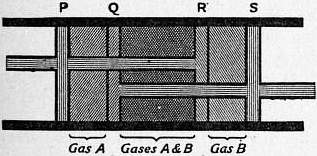
In order that diffusion through a membrane may be reversible so far as a particular gas is concerned, the process must take place so slowly that equilibrium is set up at every stage (see § 9 above). In order to separate one gas from another consistently with this condition it is necessary that no diffusion of the latter gas should accompany the process. The name “semi-permeable” is applied to an ideal membrane or partition through which one gas can pass, and which offers an insuperable barrier to any diffusion whatever of a second gas. By means of two semi-permeable partitions acting oppositely with respect to two different gases A and B these gases could be mixed or separated by reversible methods. The annexed figure shows a diagrammatic representation of the process.
We suppose the gases contained in a cylindrical tube; P, Q, R, S are four pistons, of which P and R are joined to one connecting rod, Q and S to another. P, S are impermeable to both gases; Q is semi-permeable, allowing the gas A to pass through but not B, similarly R allows the gas B to pass through but not A. The distance PR is equal to the distance QS, so that if the rods are pushed towards each other as far as they will go, P and Q will be in contact, as also R and S. Imagine the space RQ filled with a mixture of the two gases under these conditions. Then by slowly drawing the connecting rods apart until R, Q touch, the gas A will pass into the space PQ, and B will pass into the space RS, and the gases will finally be completely separated; similarly, by pushing the connecting rods together, the two gases will be remixed in the space RQ. By performing the operations slowly enough we may make the processes as nearly reversible as we please, so that no available energy is lost in either change. The gas A being at every instant in equilibrium on the two sides of the piston Q, its density, and therefore its partial pressure, is the same on both sides, and the same is true regarding the gas B on the two sides of R. Also no work is done in moving the pistons, for the partial pressures of B on the two sides of R balance each other, consequently, the resultant thrust on R is due to the gas A alone, and is equal and opposite to its resultant thrust on P, so that the connecting rods are at every instant in a state of mechanical equilibrium so far as the pressures of the gases A and B are concerned. We conclude that in the reversible separation of the gases by this method at constant temperature without the production or absorption of mechanical work, the densities and the partial pressures of the two separated gases are the same as they were in the mixture. These conclusions are in entire agreement with those of the preceding section. If this agreement did not exist it would be possible, theoretically, to obtain perpetual motion from the gases in a way that would be inconsistent with the second law of thermodynamics.
Most physicists admit, as Planck does, that it is impossible to obtain an ideal semi-permeable substance; indeed such a substance would necessarily have to possess an infinitely great resistance to diffusion for such gases as could not penetrate it. But in an experiment performed under actual conditions the losses of available energy arising from this cause would be attributable to the imperfect efficiency of the partitions and not to the gases themselves; moreover, these losses are, in every case, found to be completely in accordance with the laws of irreversible thermodynamics. The reasoning in this article being somewhat condensed the reader must necessarily be referred to treatises on thermodynamics for further information on points of detail connected with the argument. Even when he consults these treatises he may find some points omitted which have been examined in full detail at some time or other, but are not sufficiently often raised to require mention in print.
II. Kinetic Models of Diffusion.—Imagine in the first instance that a very large number of red balls are distributed over one half of a billiard table, and an equal number of white balls over the other half. If the balls are set in motion with different velocities in various directions, diffusion will take place, the red balls finding their way among the white ones, and vice versa; and the process will be retarded by collisions between the balls. The simplest model of a perfect gas studied in the kinetic theory of gases (see Molecule) differs from the above illustration in that the bodies representing the molecules move in space instead of in a plane, and, unlike billiard balls, their motion is unresisted, and they are perfectly elastic, so that no kinetic energy is lost either during their free motions, or at a collision.
The mathematical analysis connected with the application of the kinetic theory to diffusion is very long and cumbersome. We shall therefore confine our attention to regarding a medium formed of elastic spheres as a mechanical model, by which the most important features of diffusion can be illustrated. We shall assume the results of the kinetic theory, according to which:—(1) In a dynamical model of a perfect gas the mean kinetic energy of translation of the molecules represents the absolute temperature of the gas. (2) The pressure at any point is proportional to the product of the number of molecules in unit volume about that point into the mean square of the velocity. (The mean square of the velocity is different from but proportional to the square of the mean velocity, and in the subsequent arguments either of these two quantities can generally be taken.) (3) In a gas mixture represented by a mixture of molecules of unequal masses, the mean kinetic energies of the different kinds are equal.
Consider now the problem of diffusion in a region containing two kinds of molecules A and B of unequal mass. The molecules of A in the neighbourhood of any point will, by their motion, spread out in every direction until they come into collision with other molecules of either kind, and this spreading out from every point of the medium will give rise to diffusion. If we imagine the velocities of the A molecules to be equally distributed in all directions, as they would be in a homogeneous mixture, it is obvious that the process of diffusion will be greater, ceteris paribus, the greater the velocity of the molecules, and the greater the length of the free path before a collision takes place. If we assume consistently with this, that the coefficient of diffusion of the gas A is proportional to the mean value of W{a}l{a}, where w{a} is the velocity and l{a} is the length of the path of a molecule of A, this expression for the coefficient of diffusion is of the right dimensions in length and time. If, moreover, we observe that when diffusion takes place in a fixed direction, say that of the axis of x, it depends only on the resolved part of the velocity and length of path in that direction: this hypothesis readily leads to our taking the mean value of 1⁄3wala as the coefficient of diffusion for the gas A. This value was obtained by O. E. Meyer and others.
Unfortunately, however, it makes the coefficients of diffusion unequal for the two gases, a result inconsistent with that obtained above from considerations of the coefficient of resistance, and leading to the consequence that differences of pressure would be set up in different parts of the gas. To equalize these differences of pressure, Meyer assumed that a counter current is set up, this current being, of course, very slow in practice; and J. Stefan assumed that the diffusion of one gas was not affected by collisions between molecules of the same gas. When the molecules are mixed in equal proportions both hypotheses lead to the value 1⁄6([wala] + [wblb]), (square brackets denoting mean values). When one gas preponderates largely over the other, the phenomena of diffusion are too difficult of observation to allow of accurate experimental tests being made. Moreover, in this case no difference exists unless the molecules are different in size or mass.
Instead of supposing a velocity of translation added after the mathematical calculations have been performed, a better plan is to assume from the outset that the molecules of the two gases have small velocities of translation in opposite directions, superposed on the distribution of velocity, which would occur in a medium representing a gas at rest. When a collision occurs between molecules of different gases a transference of momentum takes place between them, and the quantity of momentum so transferred in one second in a unit of volume gives a dynamical measure of the resistance to diffusion. It is to be observed that, however small the relative velocity of the gases A and B, it plays an all-important part in determining the coefficient of resistance; for without such relative motion, and with the velocities evenly distributed in all directions, no transference of momentum could take place. The coefficient of resistance being found, the motion of each of the two gases may be discussed separately.
One of the most important consequences of the kinetic theory is that if the volume be kept constant the coefficient of diffusion varies as the square root of the absolute temperature. To prove this, we merely have to imagine the velocity of each molecule to be suddenly increased n fold; the subsequent processes, including diffusion, will then go on n times as fast; and the temperature T, being proportional to the kinetic energy, and therefore to the square of the velocity, will be increased n² fold. Thus K, the coefficient of diffusion, varies as √T.
The relation of K to the density when the temperature remains constant is more difficult to discuss, but it may be sufficient to notice that if the number of molecules is increased n fold, the chances of a collision are n times as great, and the distance traversed between collisions is (not therefore but as the result of more detailed reasoning) on the average 1/n of what it was before. Thus the free path, and therefore the coefficient of diffusion, varies inversely as the density, or directly as the volume. If the pressure p and temperature T be taken as variables, K varies inversely as p and directly as √T³.
Now according to the experiments first made by J. C. Maxwell and J. Loschmidt, it appeared that with constant density K was proportional to T more nearly than to √T. The inference is that in this respect a medium formed of colliding spheres fails to give a correct mechanical model of gases. It has been found by L. Boltzmann, Maxwell and others that a system of particles whose mutual actions vary according to the inverse fifth power of the distance between them represents more correctly the relation between the coefficient of diffusion and temperature in actual gases. Other recent theories of diffusion have been advanced by M. Thiesen, P. Langevin and W. Sutherland. On the other hand, J. Thovert finds experimental evidence that the coefficient of diffusion is proportional to molecular velocity in the cases examined of non-electrolytes dissolved in water at 18° at 2.5 grams per litre.
Bibliography.—The best introduction to the study of theories of diffusion is afforded by O. E. Meyer’s Kinetic Theory of Gases, translated by Robert E. Baynes (London, 1899). The mathematical portion, though sufficient for ordinary purposes, is mostly of the simplest possible character. Another useful treatise is R. Ruhlmann’s Handbuch der mechanischen Wärmetheorie (Brunswick, 1885). For a shorter sketch the reader may refer to J. C. Maxwell’s Theory of Heat, chaps, xix. and xxii., or numerous other treatises on physics. The theory of the semi-permeable membrane is discussed by M. Planck in his Treatise on Thermodynamics, English translation by A. Ogg (1903), also in treatises on thermodynamics by W. Voigt and other writers. For a more detailed study of diffusion in general the following papers may be consulted:—L. Boltzmann, “Zur Integration der Diffusionsgleichung,” Sitzung. der k. bayer. Akad math.-phys. Klasse (May 1894); T. des Coudres, “Diffusionsvorgänge in einem Zylinder,” Wied. Ann. lv. (1895), p. 213; J. Loschmidt, “Experimentaluntersuchungen über Diffusion,” Wien. Sitz. lxi., lxii. (1870); J. Stefan, “Gleichgewicht und ... Diffusion von Gasmengen,” Wien. Sitz. lxiii., “Dynamische Theorie der Diffusion,” Wien. Sitz. lxv. (April 1872); M. Toepler, “Gas-diffusion,” Wied. Ann. lviii. (1896), p. 599; A. Wretschko, “Experimentaluntersuchungen über die Diffusion von Gasmengen,” Wien. Sitz. lxii. The mathematical theory of diffusion, according to the kinetic theory of gases, has been treated by a number of different methods, and for the study of these the reader may consult L. Boltzmann, Vorlesungen über Gastheorie (Leipzig, 1896-1898); S. H. Burbury, Kinetic Theory of Gases (Cambridge, 1899), and papers by L. Boltzmann in Wien. Sitz. lxxxvi. (1882), lxxxvii. (1883); P. G. Tait, “Foundations of the Kinetic Theory of Gases,” Trans. R.S.E. xxxiii., xxxv., xxvi., or Scientific Papers, ii. (Cambridge, 1900). For recent work reference should be made to the current issues of Science Abstracts (London), and entries under the heading “Diffusion” will be found in the general index at the end of each volume.
(G. H. Br.)
DIGBY, SIR EVERARD (1578-1606), English conspirator, son of Everard Digby of Stoke Dry, Rutland, was born on the 16th of May 1578. He inherited a large estate at his father’s death in 1592, and acquired a considerable increase by his marriage in 1596 to Mary, daughter and heir of William Mulsho of Gothurst (now Gayhurst), in Buckinghamshire. He obtained a place in Queen Elizabeth’s household and as a ward of the crown was brought up a Protestant; but about 1599 he came under the influence of the Jesuit, John Gerard, and soon afterwards joined the Roman Catholics. He supported James’s accession and was knighted by the latter on the 23rd of April 1603. In a letter to Salisbury, the date of which has been ascribed to May 1605, Digby offered to go on a mission to the pope to obtain from the latter a promise to prevent Romanist attempts against the government in return for concessions to the Roman Catholics; adding that if severe measures were again taken against them “within brief there will be massacres, rebellions and desperate attempts against the king and state.” Digby had suffered no personal injury or persecution on account of his religion, but he sympathized with his co-religionists; and when at Michaelmas, 1605, the government had fully decided to return to the policy of repression, the authors of the Gunpowder Plot (q.v.) sought his financial support, and he joined eagerly in the conspiracy. His particular share in the plan was the organization of a rising in the Midlands; and on the pretence of a hunting party he assembled a body of gentlemen together at Danchurch in Warwickshire on the 5th of November, who were to take action immediately the news arrived from London of the successful destruction of the king and the House of Lords, and to seize the person of the princess Elizabeth, who was residing in the neighbourhood. The conspirators arrived late on the evening of the 6th to tell their story of failure and disaster, and Digby, who possibly might have escaped the more serious charge of high treason, was persuaded by Catesby, with a false tale that the king and Salisbury were dead, to further implicate himself in the plot and join the small band of conspirators in their hopeless endeavour to raise the country. He accompanied them, the same day, to Huddington in Worcestershire and on the 7th to Holbeche in Staffordshire. The following morning, however, he abandoned his companions, dismissed his servants except two, who declared “they would never leave him but against their will,” and attempted with these to conceal himself in a pit. He was, however, soon discovered and surrounded. He made a last effort to break through his captors on horseback, but was taken and conveyed a prisoner to the Tower. His trial took place in Westminster Hall, on the 27th of January 1606, and alone among the conspirators he pleaded guilty, declaring that the motives of his crime had been his friendship for Catesby and his devotion to his religion. He was condemned to death, and his execution, which took place on the 31st, in St Paul’s Churchyard, was accompanied by all the brutalities exacted by the law.
Digby was a handsome man, of fine presence. Father Gerard extols his skill in sport, his “riding of great horses,” as well as his skill in music, his gifts of mind and his religious devotion, and concludes “he was as complete a man in all things, that deserved estimation or might win affection as one should see in a kingdom.” Some of Digby’s letters and papers, which include a poem before his execution, a last letter to his infant sons and correspondence with his wife from the Tower, were published in The Gunpowder Treason by Thomas Barlow, bishop of Lincoln, in 1679. He left two sons, of whom the elder, Sir Kenelm Digby, was the well-known author and diplomatist.
See works on the Gunpowder Plot; Narrative of Father Gerard, in Condition of the Catholics under James I. by J. Morris (1872), &c. A life of Digby under the title of A Life of a Conspirator, by a Romish Recusant (Thomas Longueville), was published in 1895.
(P. C. Y.)
DIGBY, SIR KENELM (1603-1665), English author, diplomatist and naval commander, son of Sir Everard Digby (q.v.), was born on the 11th of July 1603, and after his father’s execution in 1606 resided with his mother at Gayhurst, being brought up apparently as a Roman Catholic. In 1617 he accompanied his cousin, Sir John Digby, afterwards 1st earl of Bristol, and then ambassador in Spain, to Madrid. On his return in April 1618 he entered Gloucester Hall (now Worcester College), Oxford, and studied under Thomas Allen (1542-1632), the celebrated mathematician, who was much impressed with his abilities and called him the Mirandula, i.e. the infant prodigy, of his age.1 He left the university without taking a degree in 1620, and travelled in France, where, according to his own account, he inspired an uncontrollable passion in the queen-mother, Marie de’ Medici, now a lady of more than mature age and charms; he visited Florence, and in March 1623 joined Sir John Digby again at Madrid, at the time when Prince Charles and Buckingham arrived on their adventurous expedition. He joined the prince’s household and returned with him to England on the 5th of October 1623, being knighted by James I. on the 23rd of October and receiving the appointment of gentleman of the privy chamber to Prince Charles. In 1625 he married secretly Venetia, daughter of Sir Edward Hanley of Tonge Castle, Shropshire, a lady of extraordinary beauty and intellectual attainments, but of doubtful virtue. Digby was a man of great stature and bodily strength. Edward Hyde, afterwards earl of Clarendon, who with Ben Jonson was included among his most intimate friends, describes him as “a man of very extraordinary person and presence which drew the eyes of all men upon him, a wonderful graceful behaviour, a flowing courtesy and civility, and such a volubility of language as surprised and delighted.”2 Digby for some time was excluded from public employment by Buckingham’s jealousy of his cousin, Lord Bristol. At length in 1627, on the latter’s advice, Digby determined to attempt “some generous action,” and on the 22nd of December, with the approval of the king, embarked as a privateer with two ships, with the object of attacking the French ships in the Venetian harbour of Scanderoon. On the 18th of January he arrived off Gibraltar and captured several Spanish and Flemish vessels. From the 15th of February to the 27th of March he remained at anchor off Algiers on account of the sickness of his men, and extracted a promise from the authorities of better treatment of the English ships. He seized a rich Dutch vessel near Majorca, and after other adventures gained a complete victory over the French and Venetian ships in the harbour of Scanderoon on the 11th of June. His successes, however, brought upon the English merchants the risk of reprisals, and he was urged to depart. He returned home in triumph in February 1629, and was well received by the king, and was made a commissioner of the navy in October 1630, but his proceedings were disavowed on account of the complaints of the Venetian ambassador. In 1633 Lady Digby died, and her memory was celebrated by Ben Jonson in a series of poems entitled Eupheme, and by other poets of the day. Digby retired to Gresham College, and exhibited extravagant grief, maintaining a seclusion for two years. About this time Digby professed himself a Protestant, but by October 1635, while in France, he had already returned to the Roman Catholic faith.3 In a letter dated the 27th of March 1636 Laud remonstrates with him, but assures him of the continuance of his friendship.4 In 1638 he published A Conference with a Lady about choice of a Religion, in which he argues that the Roman Church, possessing alone the qualifications of universality, unity of doctrine and uninterrupted apostolic succession, is the only true church, and that the intrusion of error into it is impossible. The same subject is treated in letters to George Digby, afterwards 2nd earl of Bristol, dated the 2nd of November 1638 and the 29th of November 1639, which were published in 1651, as well as in a further Discourse concerning Infallibility in Religion in 1652. Returning to England he associated himself with the queen and her Roman Catholic friends, and joined in the appeal to the English Romanists for money to support the king’s Scottish expedition.5 In consequence he was summoned to the bar of the House of Commons on the 27th of January 1641, and the king was petitioned to remove him with other recusants from his councils. He left England, and while at Paris killed in a duel a French lord who had insulted Charles I. in his presence. Louis XIII. took his part, and furnished him with a military escort into Flanders. Returning home he was imprisoned, by order of the House of Commons, early in 1642, successively in the “Three Tobacco Pipes nigh Charing Cross,” where his delightful conversation is said to have transformed the prison into “a place of delight,”6 and at Winchester House. He was finally released and allowed to go to France on the 30th of July 1643, through the intervention of the queen of France, Anne of Austria, on condition that he would neither promote nor conceal any plots abroad against the English government.