VOLUME VIII SLICE IV Diameter to Dinarchus (continued 5)
Reading edition
2 An excellent dictionary of quotations, perhaps the first of the kind; a large folio volume printed in Strassburg about 1475 is entitled “Pharetra auctoritates et dicta doctorum, philosophorum, et poetarum continens.”
3 This volume was issued with a new title-page as Glossaire du moyen âge, Paris, 1872.
DICTYOGENS (Gr. δίκτυον, a net, and the termination -γενης, produced), a botanical name proposed by John Lindley for a class including certain families of Monocotyledons which have net-veined leaves. The class was not generally recognized.
DICTYS CRETENSIS, of Cnossus in Crete, the supposed companion of Idomeneus during the Trojan War, and author of a diary of its events. The MS. of this work, written in Phoenician characters, was said to have been found in his tomb (enclosed in a leaden box) at the time of an earthquake during the reign of Nero, by whose order it was translated into Greek. In the 4th century a.d. a certain Lucius Septimius brought out Dictys Cretensis Ephemeris belli Trojani, which professed to be a Latin translation of the Greek version. Scholars were not agreed whether any Greek original really existed; but all doubt on the point was removed by the discovery of a fragment in Greek amongst the papyri found by B. P. Grenfell and A. S. Hunt in 1905-1906. Possibly the Latin Ephemeris was the work of Septimius himself. Its chief interest lies in the fact that (together with Dares Phrygius’s De excidio Trojae) it was the source from which the Homeric legends were introduced into the romantic literature of the middle ages.
Best edition by F. Meister (1873), with short but useful introduction and index of Latinity; see also G. Körting, Diktys und Dares (1874), with concise bibliography; H. Dunger, Die Sage vom trojanischen Kriege in den Bearbeitungen des Mittelalters und ihren antiken Quellen (1869, with a literary genealogical table); E. Collilieux, Étude sur Dictys de Crète et Darès de Phrygie (1887), with bibliography; W. Greif, “Die mittelalterlichen Bearbeitungen der Trojanersage,” in E. M. Stengel’s Ausgaben und Abhandlungen aus dem Gebiete der romanischen Philologie, No. 61 (1886, esp. sections 82, 83, 168-172); F. Colagrosso, “Ditte Cretese” in Atti della r. Accademia di Archeologia (Naples, 1897, vol. 18, pt. ii. 2); F. Noack, “Der griechische Dictys,” in Philologus, supp. vi. 403 ff.; N. E. Griffin, Dares and Dictys, Introduction to the Study of the Medieval Versions of the Story of Troy (1907).
DICUIL (fl. 825), Irish monastic scholar, grammarian and geographer. He was the author of the De mensura orbis terrae, finished in 825, which contains the earliest clear notice of a European discovery of and settlement in Iceland and the most definite Western reference to the old freshwater canal between the Nile and the Red Sea, finally blocked up in 767. In 795 (February 1-August 1) Irish hermits had visited Iceland; on their return they reported the marvel of the perpetual day at midsummer in “Thule,” where there was then “no darkness to hinder one from doing what one would.” These eremites also navigated the sea north of Iceland on their first arrival, and found it ice-free for one day’s sail, after which they came to the ice-wall. Relics of this, and perhaps of other Irish religious settlements, were found by the permanent Scandinavian colonists of Iceland in the 9th century. Of the old Egyptian freshwater canal Dicuil learnt from one “brother Fidelis,” probably another Irish monk, who, on his way to Jerusalem, sailed along the “Nile” into the Red Sea—passing on his way the “Barns of Joseph” or Pyramids of Giza, which are well described. Dicuil’s knowledge of the islands north and west of Britain is evidently intimate; his references to Irish exploration and colonization, and to (more recent) Scandinavian devastation of the same, as far as the Faeroes, are noteworthy, like his notice of the elephant sent by Harun al-Rashid (in 801) to Charles the Great, the most curious item in a political and diplomatic intercourse of high importance. Dicuil’s reading was wide; he quotes from, or refers to, thirty Greek and Latin writers, including the classical Homer, Hecataeus, Herodotus, Thucydides, Virgil, Pliny and King Juba, the sub-classical Solinus, the patristic St Isidore and Orosius, and his contemporary the Irish poet Sedulius;—in particular, he professes to utilize the alleged surveys of the Roman world executed by order of Julius Caesar, Augustus and Theodosius (whether Theodosius the Great or Theodosius II. is uncertain). He probably did not know Greek; his references to Greek authors do not imply this. Though certainly Irish by birth, it has been conjectured (from his references to Sedulius and the caliph’s elephant) that he was in later life in an Irish monastery in the Frankish empire. Letronne inclines to identify him with Dicuil or Dichull, abbot of Pahlacht, born about 760.
There are seven chief MSS. of the De mensura (Dicuil’s tract on grammar is lost); of these the earliest and best are (1) Paris, National Library, Lat. 4806; (2) Dresden, Regius D. 182; both are of the 10th century. Three editions exist: (1) C. A. Walckenaer’s, Paris, 1807; (2) A. Letronne’s, Paris, 1814, best as to commentary; (3) G. Parthey’s, Berlin, 1870, best as to text. See also C. R. Beazley, Dawn of Modern Geography (London, 1897), i. 317-327, 522-523, 529; T. Wright, Biographia Britannica literaria, Anglo-Saxon Period (London, 1842), pp. 372-376.
(C. R. B.)
DIDACHĒ, THE, or Teaching of the (twelve) Apostles,—the most important of the recent recoveries in the region of early Christian literature (see Apocryphal Literature). It was previously known by name from lists of canonical and extra-canonical books compiled by Eusebius and other writers. Moreover, it had come to be suspected by several scholars that a lost book, variously entitled The Two Ways or The Judgment of Peter, had been freely used in a number of works, of which mention must presently be made. In 1882 a critical reconstruction of this book was made by Adam Krawutzcky with marvellous accuracy, as was shown when in the very next year the Greek bishop and metropolitan, Philotheus Bryennius, published The Teaching of the Twelve Apostles from the same manuscript from which he had previously published the complete form of the Epistle of Clement.1
The Didachē, as we now have it in the Greek, falls into two marked divisions: (a) a book of moral precepts, opening with the words, “There are two ways”; (b) a manual of church ordinances, linked on to the foregoing by the words, “Having first said all these things, baptize, &c.” Each of these must be considered separately before we approach the question of the locality and date of the whole book in its present form.
1. The Two Ways.—The author of the complete work, as we now have it, has modified the original Two Ways by inserting near the beginning a considerable section containing, among other matter, passages from the Sermon on the Mount, in which the language of St Matthew’s Gospel is blended with that of St Luke’s. He has also added at the close a few sentences, beginning, “If thou canst not bear (the whole yoke of the Lord), bear what thou canst” (vi. 2); and among minor changes he has introduced, in dealing with confession, reference to “the church” (iv. 14). No part of this matter is to be found in the following documents, which present us in varying degrees of accuracy with The Two Ways: (i.) the Epistle of Barnabas, chaps. xix., xx. (in which the order of the book has been much broken up, and a good deal has been omitted); (ii.) the Ecclesiastical Canons of the Holy Apostles, usually called the Apostolic Church Order, a book which presents a parallel to the Teaching, in so far as it consists first of a form of The Two Ways, and secondly of a number of church ordinances (here, however, as in the Syriac Didascalia, which gives about the same amount of The Two Ways, various sections are ascribed to individual apostles, e.g. “John said, There are two ways,” &c.); (iii.) a discourse of the Egyptian monk Schnudi (d. 451), preserved in Arabic (see Iselin, Texte u. Unters., 1895); (iv.) a Latin version, of which a fragment was published by O. von Gebhardt in 1884, and the whole by J. Schlecht in 1900. When by the aid of this evidence The Two Ways is restored to us free of glosses, it has the appearance of being a Jewish manual which has been carried over into the use of the Christian church. This is of course only a probable inference; there is no prototype extant in Jewish literature, and, comparing the moral (non-doctrinal) instruction for Christian catechumens in Hermas, Shepherd (Mand. i.-ix.), no real need to assume one. There was a danger of admitting Gentile converts to the church on too easy moral terms; hence the need of such insistence on the ideal as in The Two Ways and the Mandates. The recent recovery of the Latin version is of singular interest, as showing that, even without the distinctively Christian additions and interpolations which our full form of the Teaching presents, it was circulating under the title Doctrina apostolorum.2
2. The second part of our Teaching might be called a church directory. It consists of precepts relating to church life, which are couched in the second person plural; whereas The Two Ways uses throughout the second person singular. It appears to be a composite work. First (vii. 1-xi. 2) is a short sacramental manual intended for the use of local elders or presbyters, though such are not named, for they were not yet a distinctive order or clergy. This section was probably added to The Two Ways before the addition of the remainder. It orders baptism in the threefold name, making a distinction as to waters which has Jewish parallels, and permitting a threefold pouring on the head, if sufficient water for immersion cannot be had. It prescribes a fast before baptism for the baptizer as well as the candidate. Fasts are to be kept on Wednesday and Friday, not Monday and Thursday, which are the fast days of “the hypocrites,” i.e. by a perversion of the Lord’s words, the Jews. “Neither pray ye as the hypocrites; but as the Lord commanded in His Gospel.” Then follows the Lord’s Prayer, almost exactly as in St Matthew, with a brief doxology—“for Thine is the power and the glory forever.” This is to be said three times a day. Next come three eucharistic prayers, the language of which is clearly marked off from that of the rest of the book, and shows parallels with the diction of St John’s Gospel. They are probably founded on Jewish thanksgivings, and it is of interest to note that a portion of them is prescribed as a grace before meat in (pseudo-) Athanasius’ De virginitate. A trace of them is found in one of the liturgical prayers of Serapion, bishop of Thmui, in Egypt, but they have left little mark on the liturgies of the church. As in Ignatius and other early writers, the eucharist, a real meal (x. 1) of a family character, is regarded as producing immortality (cf. “spiritual food and drink and eternal life”). None are to partake of it save those who have been “baptized in the name of the Lord” (an expression which is of interest in a document which prescribes the threefold formula). The prophets are not to be confined to these forms, but may “give thanks as much as they will.” This appears to show that a prophet, if present, would naturally preside over the eucharist. The next section (xi. 3-xiii.) deals with the ministry of spiritual gifts as exercised by apostles, prophets and teachers. An apostle is to be “received as the Lord”; but he must follow the Gospel precepts, stay but one or two days, and take no money, but only bread enough for a day’s journey. Here we have that wider use of the term “apostle” to which Lightfoot had already drawn attention. A prophet, on the contrary, may settle if he chooses, and in that case he is to receive tithes and first-fruits; “for they are your high priests.” If he be once approved as a true prophet, his words and acts are not to be criticized; for this is the sin that shall not be forgiven. Next comes a section (xiv., xv.) reflecting a somewhat later development concerning fixed services and ministry; the desire for a stated service, and the need of regular provision for it, is leading to a new order of things. The eucharist is to be celebrated every Lord’s Day, and preceded by confession of sins, “that your sacrifice may be pure ... for this is that sacrifice which was spoken of by the Lord, In every place and time to offer unto Me a pure sacrifice. Appoint therefore unto yourselves bishops and deacons, worthy of the Lord, men meek and uncovetous, and true and approved; for they also minister unto you the ministration of the prophets and teachers. Therefore despise them not; for they are your honoured ones, together with the prophets and teachers.” This is an arrangement recommended by one who has tried it, and he reassures the old-fashioned believer who clings to the less formal régime (and whose protest was voiced in the Montanist movement), that there will be no spiritual loss under the new system. The book closes (chap. xvi.) with exhortations to steadfastness in the last days, and to the coming of the “world-deceiver” or Antichrist, which will precede the coming of the Lord. This section is perhaps the actual utterance of a Christian prophet, and may be of earlier origin than the two preceding sections.
3. It will now be clear that indications of the locality and date of our present Teaching must be sought for only in the second part, and in the Christian interpolations in the first part. We have no ground for thinking that the second part ever existed independently as a separate book. The whole work was in the hands of the writer of the seventh book of the Apostolic Constitutions, who embodies almost every sentence of it, interspersing it with passages of Scripture, and modifying the precepts of the second part to suit a later (4th-century) stage of church development; this writer was also the interpolator of the Epistles of Ignatius, and belonged to the Syrian Church. Whether the second part was known to the writer of the Apostolic Church Order is not clear, as his only quotation of it comes from one of the eucharistic prayers. The allusions of early writers seem to point to Egypt, but their references are mostly to the first part, so that we must be careful how we argue from them as to the provenance of the book as a whole. Against Egypt has been urged the allusion in one of the eucharistic prayers to “corn upon the mountains.” This is found in the Prayer-book of Serapion (c. 350) but omitted in a later Egyptian prayer; the form as we have it in The Didachē may have passed into Egypt with the authority of tradition which was afterwards weakened. The anti-Jewish tone of the second part suggests the neighbourhood of Jews, from whom the Christians were to be sharply distinguished. Either Egypt or Syria would satisfy this condition, and in favour of Syria is the fact that the presbyterate there was to a late date regarded as a rank rather than an office. If we can connect the injunctions (vi. 3) concerning (abstinence from certain) food and that which is offered to idols with the old trouble that arose at Antioch (Acts xv. 1) and was legislated for by the Jerusalem council, we have additional support for the Syrian claim. But all that we can safely say as to locality is that the community here represented seems to have been isolated, and out of touch with the larger centres of Christian life.
This last consideration helps us in discussing the question of date. For such an isolated community may have preserved primitive customs for some time after they had generally disappeared. Certainly the stage of development is an early one, as is shown, e.g., by the prominence of prophets, and the need that was felt for the vindication of the position of the bishops and deacons (there is no mention at all of presbyters); moreover, there is no reference to a canon of Scripture (though the written Gospel is expressly mentioned) or to a creed. On the other hand the “apostles” of the second part are obviously not “the twelve apostles” of the title; and the prophets seem in some instances to have proved unworthy of their high position. The ministry of enthusiasm which they represent is about to give way to the ministry of office, a transition which is reflected in the New Testament in the 3rd Epistle of John. Three of the Gospels have clearly been for some time in circulation; St Matthew’s is used several times, and there are phrases which occur only in St Luke’s, while St John’s Gospel lies behind the eucharistic prayers which the writer has embodied in his work. There are no indications of any form of doctrinal heresy as needing rebuke; the warnings against false teaching are quite general. While the first part must be dated before the Epistle of Barnabas, i.e. before a.d. 90, it seems wisest not to place the complete work much earlier than a.d. 120, and there are passages which may well be later.
A large literature has sprung up round The Didachē since 1884. Harnack’s edition in Texte u. Unters. vol. ii. (1884) is indispensable to the student; and his discussions in Altchristl. Litteratur and Chronologie give clear summaries of his work. Other editions of the text are those of F. X. Funk, Patres Apostolici, vol. i. (Tübingen, 1901); H. Lietzmann (Bonn, 1903; with Latin version). Dr J. E. Odgers has published an English translation with introduction and notes (London, 1906). Dr C. Taylor in 1886 drew attention to some important parallels in Jewish literature; his edition contains an English translation. Dr Rendel Harris published in 1887 a complete facsimile, and gathered a great store of patristic illustration. Text and translation will also be found in Lightfoot’s Apostolic Fathers (ed. min.) The fullest critical treatment in English is by Dr Vernon Bartlet in the extra volume of Hastings’s Dictionary of the Bible; the most complete commentary on the text is by P. Drews in Hennecke’s Handbuch zu den N.T. Apocryphen (1904). Other references to the literature may be found by consulting Harnack’s Altchristl. Litteratur.
1 The MS. was found in the Library of the Jerusalem Monastery of the Most Holy Sepulchre, in Phanar, the Greek quarter of Constantinople. It is a small octavo volume of 120 parchment leaves, written throughout by Leo, “notary and sinner,” who finished his task on the 11th of June 1156. Besides The Didachē and the Epistles of Clement it contains several spurious Ignatian epistles.
2 The word twelve had no place in the original title and was inserted when the original Didachē or Teaching (e.g. The Two Ways) was combined with the church manual which mentions apostles outside of the twelve. It may be noted that the division of the Didachē into chapters is due to Bryennius, that into verses to A. Harnack.
DIDACTIC POETRY, that form of verse the aim of which is, less to excite the hearer by passion or move him by pathos, than to instruct his mind and improve his morals. The Greek word διδακτικός signifies a teacher, from the verb διδάσκειν, and poetry of the class under discussion approaches us with the arts and graces of a schoolmaster. At no time was it found convenient to combine lyrical verse with instruction, and therefore from the beginning of literature the didactic poets have chosen a form approaching the epical. Modern criticism, which discourages the epic, and is increasingly anxious to limit the word “poetry” to lyric, is inclined to exclude the term “didactic poetry” from our nomenclature, as a phrase absurd in itself. It is indeed more than probable that didactic verse is hopelessly obsolete. Definite information is now to be found in a thousand shapes, directly and boldly presented in clear and technical prose. No farmer, however elegant, will, any longer choose to study agriculture in hexameters, or even in Tusser’s shambling metre. The sciences and the professions will not waste their time on methods of instruction which must, from their very nature, be artless, inexact and vague. But in the morning of the world, those who taught with authority might well believe that verse was the proper, nay, the only serious vehicle of their instruction. What they knew was extremely limited, and in its nature it was simple and straightforward; it had little technical subtlety; it constantly lapsed into the fabulous and the conjectural. Not only could what early sages knew, or guessed, about astronomy and medicine and geography be conveniently put into rolling verse, but, in the absence of all written books, this was the easiest way in which information could be made attractive to the ear and be retained by the memory.
In the prehistoric dawn of Greek civilization there appear to have been three classes of poetry, to which the literature of Europe looks back as to its triple fountain-head. There were romantic epics, dealing with the adventures of gods and heroes; these Homer represents. There were mystic chants and religious odes, purely lyrical in character, of which the best Orphic Hymns must have been the type. And lastly there was a great body of verse occupied entirely with increasing the knowledge of citizens in useful branches of art and observation; these were the beginnings of didactic poetry, and we class them together under the dim name of Hesiod. It is impossible to date these earliest didactic poems, which nevertheless set the fashion of form which has been preserved ever since. The Works and Days, which passes as the direct masterpiece of Hesiod (q.v.), is the type of all the poetry which has had education as its aim. Hesiod is supposed to have been a tiller of the ground in a Boeotian village, who determined to enrich his neighbours’ minds by putting his own ripe stores of useful information into sonorous metre. Historically examined, the legend of Hesiod becomes a shadow, but the substance of the poems attributed to him remains. The genuine parts of the Works and Days, which Professor Gilbert Murray has called “a slow, lowly, simple poem,” deal with rules for agriculture. The Theogony is an annotated catalogue of the gods. Other poems attributed to Hesiod, but now lost, were on astronomy, on auguries by birds, on the character of the physical world; still others seem to have been genealogies of famous women. All this mass of Boeotian verse was composed for educational purposes, in an age when even preposterous information was better than no knowledge at all. In slightly later times, as the Greek nation became better supplied with intellectual appliances, the stream of didactic poetry flowed more and more closely in one, and that a theological, channel. The great poem of Parmenides On Nature and those of Empedocles exist only in fragments, but enough remains to show that these poets carried on the didactic method in mythology. Cleostratus of Tenedos wrote an astronomical poem in the 6th century, and Periander a medical one in the 4th, but didactic poetry did not flourish again in Greece until the 3rd century, when Aratus, in the Alexandrian age, wrote his famous Phenomena, a poem about things seen in the heavens. Other later Greek didactic poets were Nicander, and perhaps Euphorion.
It was from the hands of these Alexandrian writers that the genius of didactic poetry passed over to Rome, since, although it is possible that some of the lost works of the early republic, and in particular those of Ennius, may have possessed an educational character, the first and by far the greatest didactic Latin poet known to us is Lucretius. A highly finished translation by Cicero into Latin hexameters of the principal works of Aratus is believed to have drawn the attention of Lucretius to this school of Greek poetry, and it was not without reference to the Greeks, although in a more archaic and far purer taste, that he composed, in the 1st century before Christ, his magnificent De rerum natura. By universal consent, this is the noblest didactic poem in the literature of the world. It was intended to instruct mankind in the interpretation and in the working of the system of philosophy revealed by Epicurus, which at that time was exciting the sympathetic attention of all classes of Roman society. What gave the poem of Lucretius its extraordinary interest, and what has prolonged and even increased its vitality, was the imaginative and illustrative insight of the author, piercing and lighting up the recesses of human experience. On a lower intellectual level, but of a still greater technical excellence, was the Georgics of Virgil, a poem on the processes of agriculture, published about 30 b.c. The brilliant execution of this famous work has justly made it the type and unapproachable standard of all poetry which desires to impart useful information in the guise of exquisite literature. Himself once a farmer on the banks of the Mincio, Virgil, at the apex of his genius, set himself in his Campanian villa to recall whatever had been essential in the agricultural life of his boyish home, and the result, in spite of the ardours of the subject, was what J. W. Mackail has called “the most splendid literary production of the Empire.” In the rest of surviving Latin didactic poetry, the influence and the imitation of Virgil and Lucretius are manifest. Manilius, turning again to Alexandria, produced a fine Astronomica towards the close of the reign of Augustus. Columella, regretting that Virgil had omitted to sing of gardens, composed a smooth poem on horticulture. Natural philosophy inspired Lucilius junior, of whom a didactic poem on Etna survives. Long afterwards, under Diocletian, a poet of Carthage, Nemesianus, wrote in the manner of Virgil the Cynegetica, a poem on hunting with dogs, which has had numerous imitations in later European literatures. These are the most important specimens of didactic poetry which ancient Rome has handed down to us.
In Anglo-Saxon and early English poetic literature, and especially in the religious part of it, an element of didacticism is not to be overlooked. But it would be difficult to say that anything of importance was written in verse with the sole purpose of imparting information, until we reach the 16th century. Some of the later medieval allegories are didactic or nothing. The first poem, however, which we can in any reasonable way compare with the classic works of which we have been speaking is the Hundreth Pointes of Good Husbandrie, published in 1557 by Thomas Tusser; these humble Georgics aimed at a practical description of the whole art of English farming. Throughout the early part of the 17th century, when our national poetry was in its most vivid and brilliant condition, the last thing a poet thought of doing was the setting down of scientific facts in rhyme. We come across, however, one or two writers who were as didactic as the age would permit them to be, Samuel Daniel with his philosophy, Fulke Greville, Lord Brooke with his “treatises” of war and monarchy. After the Restoration, as the lyrical element rapidly died out of English poetry, there was more and more room left for educational rhetoric in verse. The poems about prosody, founded upon Horace, and signed by John Sheffield, 3rd earl of Mulgrave (1648-1721), and Lord Roscommon, were among the earliest purely didactic verse-studies in English. John Philips deserves a certain pre-eminence, as his poem called Cyder, in 1706, set the fashion which lasted all down the 18th century, of writing precisely in verse about definite branches of industry or employment. None of the greater poets of the age of Anne quite succumbed to the practice, but there is a very distinct flavour of the purely didactic about a great deal of the verse of Pope and Gay. In such productions as Gilbert West’s (1703-1756) Education, Dyer’s Fleece, and Somerville’s Chase, we see technical information put forward as the central aim of the poet. Instead of a passionate pleasure, or at least an uplifted enthusiasm, being the poet’s object, he frankly admits that, first and foremost, he has some facts about wool or dogs or schoolmasters which he wishes to bring home to his readers, and that, secondly, he consents to use verse, as brilliantly as he can, for the purpose of gilding the pill and attracting an unwilling attention. As we descend the 18th century, these works become more and more numerous, and more dry, especially when opposed by the descriptive and rural poets of the school of Thomson, the poet of The Seasons. But Thomson himself wrote a huge poem of Liberty (1732), for which we have no name if we must not call it didactic. Even Gray began, though he failed to finish, a work of this class, on The Alliance of Education and Government. These poems were discredited by the publication of The Sugar-Cane (1764), a long verse-treatise about the cultivation of sugar by negroes in the West Indies, by James Grainger (1721-1766), but, though liable to ridicule, such versified treatises continued to appear. Whether so great a writer as Cowper is to be counted among the didactic poets is a question on which readers of The Task may be divided; this poem belongs rather to the class of descriptive poetry, but a strong didactic tendency is visible in parts of it. Perhaps the latest frankly educational poem which enjoyed a great popularity was The Course of Time by Robert Pollok (1798-1827), in which a system of Calvinistic divinity is laid down with severity and in the pomp of blank verse. This kind of literature had already been exposed, and discouraged, by the teaching of Wordsworth, who had insisted on the imperative necessity of charging all poetry with imagination and passion. Oddly enough, The Excursion of Wordsworth himself is perhaps the most didactic poem of the 19th century, but it must be acknowledged that his influence, in this direction, was saner than his practice. Since the days of Coleridge and Shelley it has been almost impossible to conceive a poet of any value composing in verse a work written with the purpose of inculcating useful information.
The history of didactic poetry in France repeats, in great measure, but in drearier language, that of England. Boileau, like Pope, but with a more definite purpose as a teacher, offered instruction in his Art poétique and in his Epistles. But his doctrine was always literary, not purely educational. At the beginning of the 18th century, the younger Racine (1692-1763) wrote sermons in verse, and at the close of it the Abbé Delille (1738-1813) tried to imitate Virgil in poems about horticulture. Between these two there lies a vast mass of verse written for the indulgence of intellect rather than at the dictates of the heart; wherever this aims at increasing knowledge, it at once becomes basely and flatly didactic. There is nothing in French literature of the transitional class that deserves mention beside The Task or The Excursion.
During the century which preceded the Romantic revival of poetry in Germany, didactic verse was cultivated in that country on the lines of imitation of the French, but with a greater dryness and on a lower level of utility. Modern German literature began with Martin Opitz (1597-1639) and the Silesian School, who were in their essence rhetorical and educational, and who gave their tone to German verse. Albrecht von Haller (1708-1777) brought a very considerable intellectual force to bear on his huge poems, The Origin of Evil, which was theological, and The Alps (1729), botanical and topographical. Johann Peter Uz (1720-1796) wrote a Theodicée, which was very popular, and not without dignity. Johann Jacob Dusch (1725-1787) undertook to put The Sciences into the eight books of a great didactic poem. Tiedge (1752-1840) was the last of the school; in a once-famous Urania, he sang of God and Immortality and Liberty. These German pieces were the most unswervingly didactic that any modern European literature has produced. There was hardly the pretence of introducing into them descriptions of natural beauty, as the English poets did, or of grace and wit like the French. The German poets simply poured into a lumbering mould of verse as much solid information and direct instruction as the form would hold.
Didactic poetry has, in modern times, been antipathetic to the spirit of the Latin peoples, and neither Italian nor Spanish literature has produced a really notable work in this class. An examination of the poems, ancient and modern, which have been mentioned above, will show that from primitive times there have been two classes of poetic work to which the epithet didactic has been given. It is desirable to distinguish these a little more exactly. One is the pure instrument of teaching, the poetry which desires to impart all that it knows about the growing of cabbages or the prevention of disasters at sea, the revolution of the planets or the blessings of inoculation. This is didactic poetry proper, and this, it is almost certain, became irrevocably obsolete at the close of the 18th century. No future Virgil will give the world a second Georgics. But there is another species which it is very improbable that criticism has entirely dislodged; that is the poetry which combines, with philosophical instruction, an impetus of imaginative movement, and a certain definite cultivation of fire and beauty. In hands so noble as those of Lucretius and Goethe this species of didactic poetry has enriched the world with durable masterpieces, and, although the circle of readers which will endure scientific disquisition in the bonds of verse grows narrower and narrower, it is probable that the great poet who is also a great thinker will now and again insist on being heard. In Sully-Prudhomme France has possessed an eminent writer whose methods are directly instructive, and both La Justice (1878) and Le Bonheur (1888) are typically didactic poems. Perhaps future historians may name these as the latest of their class.
(E. G.)
DIDEROT, DENIS (1713-1784), French man of letters and encyclopaedist, was born at Langres on the 5th of October 1713. He was educated by the Jesuits, like most of those who afterwards became the bitterest enemies of Catholicism; and, when his education was at an end, he vexed his brave and worthy father’s heart by turning away from respectable callings, like law or medicine, and throwing himself into the vagabond life of a bookseller’s hack in Paris. An imprudent marriage (1743) did not better his position. His wife, Anne Toinette Champion, was a devout Catholic, but her piety did not restrain a narrow and fretful temper, and Diderot’s domestic life was irregular and unhappy. He sought consolation for chagrins at home in attachments abroad, first with a Madame Puisieux, a fifth-rate female scribbler, and then with Sophie Voland, to whom he was constant for the rest of her life. His letters to her are among the most graphic of all the pictures that we have of the daily life of the philosophic circle in Paris. An interesting contrast may be made between the Bohemianism of the famous English literary set who supped at the Turk’s Head with the Tory Johnson and the Conservative Burke for their oracles, and the Bohemianism of the French set who about the same time dined once a week at the baron D’Holbach’s, to listen to the wild sallies and the inspiring declamations of Diderot. For Diderot was not a great writer; he stands out as a fertile, suggestive and daring thinker, and a prodigious and most eloquent talker.
Diderot’s earliest writings were of as little importance as Goldsmith’s Enquiry into the State of Polite Learning or Burke’s Abridgement of English History. He earned 100 crowns by translating Stanyan’s History of Greece (1743); with two colleagues he produced a translation of James’s Dictionary of Medicine (1746-1748) and about the same date he published a free rendering of Shaftesbury’s Inquiry Concerning Virtue and Merit (1745), with some original notes of his own. With strange and characteristic versatility, he turned from ethical speculation to the composition of a volume of stories, the Bijoux indiscrets (1748), gross without liveliness, and impure without wit. In later years he repented of this shameless work, just as Boccaccio is said in the day of his grey hairs to have thought of the sprightliness of the Decameron with strong remorse. From tales Diderot went back to the more congenial region of philosophy. Between the morning of Good Friday and the evening of Easter Monday he wrote the Pensées philosophiques (1746), and he presently added to this a short complementary essay on the sufficiency of natural religion. The gist of these performances is to press the ordinary rationalistic objections to a supernatural revelation; but though Diderot did not at this time pass out into the wilderness beyond natural religion, yet there are signs that he accepted that less as a positive doctrine, resting on grounds of its own, than as a convenient point of attack against Christianity. In 1747 he wrote the Promenade du sceptique, a rather poor allegory—pointing first to the extravagances of Catholicism; second, to the vanity of the pleasures of that world which is the rival of the church; and third, to the desperate and unfathomable uncertainty of the philosophy which professes to be so high above both church and world.
Diderot’s next piece was what first introduced him to the world as an original thinker, his famous Lettre sur les aveugles (1749). The immediate object of this short but pithy writing was to show the dependence of men’s ideas on their five senses. It considers the case of the intellect deprived of the aid of one of the senses; and in a second piece, published afterwards, Diderot considered the case of a similar deprivation in the deaf and dumb. The Lettre sur les sourds et muets, however, is substantially a digressive examination of some points in aesthetics. The philosophic significance of the two essays is in the advance they make towards the principle of Relativity. But what interested the militant philosophers of that day was an episodic application of the principle of relativity to the master-conception of God. What makes the Lettre sur les aveugles interesting is its presentation, in a distinct though undigested form, of the modern theory of variability, and of survival by superior adaptation. It is worth noticing, too, as an illustration of the comprehensive freedom with which Diderot felt his way round any subject that he approached, that in this theoretic essay he suggests the possibility of teaching the blind to read through the sense of touch. If the Lettre sur les aveugles introduced Diderot into the worshipful company of the philosophers, it also introduced him to the penalties of philosophy. His speculation was too hardy for the authorities, and he was thrown into the prison of Vincennes. Here he remained for three months; then he was released, to enter upon the gigantic undertaking of his life.
The bookseller Lebreton had applied to him with a project for the publication of a translation into French of Ephraim Chambers’s Cyclopaedia, undertaken in the first instance by an Englishman, John Mills, and a German, Gottfried Sellius (for particulars see Encyclopaedia). Diderot accepted the proposal, but in his busy and pregnant intelligence the scheme became transformed. Instead of a mere reproduction of Chambers, he persuaded the bookseller to enter upon a new work, which should collect under one roof all the active writers, all the new ideas, all the new knowledge, that were then moving the cultivated class to its depths, but still were comparatively ineffectual by reason of their dispersion. His enthusiasm infected the publishers; they collected a sufficient capital for a vaster enterprise than they had at first planned; D’Alembert was persuaded to become Diderot’s colleague; the requisite permission was procured from the government; in 1750 an elaborate prospectus announced the project to a delighted public; and in 1751 the first volume was given to the world. The last of the letterpress was issued in 1765, but it was 1772 before the subscribers received the final volumes of the plates. These twenty years were to Diderot years not merely of incessant drudgery, but of harassing persecution, of sufferings from the cabals of enemies, and of injury from the desertion of friends. The ecclesiastical party detested the Encyclopaedia, in which they saw a rising stronghold for their philosophic enemies. By 1757 they could endure the sight no longer. The subscribers had grown from 2000 to 4000, and this was a right measure of the growth of the work in popular influence and power. To any one who turns over the pages of these redoubtable volumes now, it seems surprising that their doctrines should have stirred such portentous alarm. There is no atheism, no overt attack on any of the cardinal mysteries of the faith, no direct denunciation even of the notorious abuses of the church. Yet we feel that the atmosphere of the book may well have been displeasing to authorities who had not yet learnt to encounter the modern spirit on equal terms. The Encyclopaedia takes for granted the justice of religious tolerance and speculative freedom. It asserts in distinct tones the democratic doctrine that it is the common people in a nation whose lot ought to be the main concern of the nation’s government. From beginning to end it is one unbroken process of exaltation of scientific knowledge on the one hand, and pacific industry on the other. All these things were odious to the old governing classes of France; their spirit was absolutist, ecclesiastical and military. Perhaps the most alarming thought of all was the current belief that the Encyclopaedia was the work of an organized band of conspirators against society, and that a pestilent doctrine was now made truly formidable by the confederation of its preachers into an open league. When the seventh volume appeared, it contained an article on “Geneva,” written by D’Alembert. The writer contrived a panegyric on the pastors of Geneva, of which every word was a stinging reproach to the abbés and prelates of Versailles. At the same moment Helvétius’s book, L’Esprit, appeared, and gave a still more profound and, let us add, a more reasonable shock to the ecclesiastical party. Authority could brook no more, and in 1759 the Encyclopaedia was formally suppressed.
The decree, however, did not arrest the continuance of the work. The connivance of the authorities at the breach of their own official orders was common in those times of distracted government. The work went on, but with its difficulties increased by the necessity of being clandestine. And a worse thing than troublesome interference by the police now befell Diderot. D’Alembert, wearied of shifts and indignities, withdrew from the enterprise. Other powerful colleagues, Turgot among them, declined to contribute further to a book which had acquired an evil fame. Diderot was left to bring the task to an end as he best could. For seven years he laboured like a slave at the oar. He wrote several hundred articles, some of them very slight, but many of them most laborious, comprehensive and ample. He wore out his eyesight in correcting proofs, and he wearied his soul in bringing the manuscript of less competent contributors into decent shape. He spent his days in the workshops, mastering the processes of manufactures, and his nights in reproducing on paper what he had learnt during the day. And he was incessantly harassed all the time by alarms of a descent from the police. At the last moment, when his immense work was just drawing to an end, he encountered one last and crowning mortification: he discovered that the bookseller, fearing the displeasure of the government, had struck out from the proof sheets, after they had left Diderot’s hands, all passages that he chose to think too hardy. The monument to which Diderot had given the labour of twenty long and oppressive years was irreparably mutilated and defaced. It is calculated that the average annual salary received by Diderot for his share in the Encyclopaedia was about £120 sterling. “And then to think,” said Voltaire, “that an army contractor makes £800 in a day!”
Although the Encyclopaedia was Diderot’s monumental work, he is the author of a shower of dispersed pieces that sowed nearly every field of intellectual interest with new and fruitful ideas. We find no masterpiece, but only thoughts for masterpieces; no creation, but a criticism with the quality to inspire and direct creation. He wrote plays—Le Fils naturel (1757) and Le Père de famille (1758)—and they are very insipid performances in the sentimental vein. But he accompanied them by essays on dramatic poetry, including especially the Paradoxe sur le comédien, in which he announced the principles of a new drama,—the serious, domestic, bourgeois drama of real life, in opposition to the stilted conventions of the classic French stage. It was Diderot’s lessons and example that gave a decisive bias to the dramatic taste of Lessing, whose plays, and his Hamburgische Dramaturgie (1768), mark so important an epoch in the history of the modern theatre. In the pictorial art, Diderot’s criticisms are no less rich, fertile and wide in their ideas. His article on “Beauty” in the Encyclopaedia shows that he had mastered and passed beyond the metaphysical theories on the subject, and the Essai sur la peinture was justly described by Goethe, who thought it worth translating, as “a magnificent work, which speaks even more helpfully to the poet than to the painter, though to the painter too it is as a blazing torch.” Diderot’s most intimate friend was Grimm, one of the conspicuous figures of the philosophic body. Grimm wrote news-letters to various high personages in Germany, reporting what was going on in the world of art and literature in Paris, then without a rival as the capital of the intellectual activity of Europe. Diderot helped his friend at one time and another between 1759 and 1779, by writing for him an account of the annual exhibitions of paintings. These Salons are among the most readable of all pieces of art criticism. They have a freshness, a reality, a life, which take their readers into a different world from the dry and conceited pedantries of the ordinary virtuoso. As has been said by Sainte-Beuve, they initiated the French into a new sentiment, and introduced people to the mystery and purport of colour by ideas. “Before Diderot,” Madame Necker said, “I had never seen anything in pictures except dull and lifeless colours; it was his imagination that gave them relief and life, and it is almost a new sense for which I am indebted to his genius.”
Greuze was Diderot’s favourite among contemporary artists, and it is easy to see why. Greuze’s most characteristic pictures were the rendering in colour of the same sentiment of domestic virtue and the pathos of common life, which Diderot attempted with inferior success to represent upon the stage. For Diderot was above all things interested in the life of men,—not the abstract life of the race, but the incidents of individual character, the fortunes of a particular family, the relations of real and concrete motives in this or that special case. He delighted with the enthusiasm of a born casuist in curious puzzles of right and wrong, and in devising a conflict between the generalities of ethics and the conditions of an ingeniously contrived practical dilemma. Mostly his interest expressed itself in didactic and sympathetic form; in two, however, of the most remarkable of all his pieces, it is not sympathetic, but ironical. Jacques le fataliste (written in 1773, but not published until 1796) is in manner an imitation of Tristram Shandy and The Sentimental Journey. Few modern readers will find in it any true diversion. In spite of some excellent criticisms dispersed here and there, and in spite of one or two stories that are not without a certain effective realism, it must as a whole be pronounced savourless, forced, and as leaving unmoved those springs of laughter and of tears which are the common fountain of humour. Le Neveu de Rameau is a far superior performance. If there were any inevitable compulsion to name a masterpiece for Diderot, one must select this singular “farce-tragedy.” Its intention has been matter of dispute; whether it was designed to be merely a satire on contemporary manners, or a reduction of the theory of self-interest to an absurdity, or the application of an ironical clincher to the ethics of ordinary convention, or a mere setting for a discussion about music, or a vigorous dramatic sketch of a parasite and a human original. There is no dispute as to its curious literary flavour, its mixed qualities of pungency, bitterness, pity and, in places, unflinching shamelessness. Goethe’s translation (1805) was the first introduction of Le Neveu de Rameau to the European public. After executing it, he gave back the original French manuscript to Schiller, from whom he had it. No authentic French copy of it appeared until the writer had been nearly forty years in his grave (1823).
It would take several pages merely to contain the list of Diderot’s miscellaneous pieces, from an infinitely graceful trifle like the Regrets sur ma vieille robe de chambre up to Le Rêve de D’Alembert, where he plunges into the depths of the controversy as to the ultimate constitution of matter and the meaning of life. It is a mistake to set down Diderot for a coherent and systematic materialist. We ought to look upon him “as a philosopher in whom all the contradictions of the time struggle with one another” (Rosenkranz). That is to say, he is critical and not dogmatic. There is no unity in Diderot, as there was in Voltaire or in Rousseau. Just as in cases of conduct he loves to make new ethical assumptions and argue them out as a professional sophist might have done, so in the speculative problems as to the organization of matter, the origin of life, the compatibility between physiological machinery and free will, he takes a certain standpoint, and follows it out more or less digressively to its consequences. He seizes a hypothesis and works it to its end, and this made him the inspirer in others of materialist doctrines which they held more definitely than he did. Just as Diderot could not attain to the concentration, the positiveness, the finality of aim needed for a masterpiece of literature, so he could not attain to those qualities in the way of dogma and system. Yet he drew at last to the conclusions of materialism, and contributed many of its most declamatory pages to the Système de la nature of his friend D’Holbach,—the very Bible of atheism, as some one styled it. All that he saw, if we reduce his opinions to formulae, was motion in space: “attraction and repulsion, the only truth.” If matter produces life by spontaneous generation, and if man has no alternative but to obey the compulsion of nature, what remains for God to do?
In proportion as these conclusions deepened in him, the more did Diderot turn for the hope of the race to virtue; in other words, to such a regulation of conduct and motive as shall make us tender, pitiful, simple, contented. Hence his one great literary passion, his enthusiasm for Richardson, the English novelist. Hence, also, his deepening aversion for the political system of France, which makes the realization of a natural and contented domestic life so hard. Diderot had almost as much to say against society as even Rousseau himself. The difference between them was that Rousseau was a fervent theist. The atheism of the Holbachians, as he called Diderot’s group, was intolerable to him; and this feeling, aided by certain private perversities of humour, led to a breach of what had once been an intimate friendship between Rousseau and Diderot (1757). Diderot was still alive when Rousseau’s Confessions appeared, and he was so exasperated by Rousseau’s stories about Grimm, then and always Diderot’s intimate, that in 1782 he transformed a life of Seneca, that he had written four years earlier, into an Essai sur les règnes de Claude et de Néron (1778-1782), which is much less an account of Seneca than a vindication of Diderot and Grimm, and is one of the most rambling and inept productions in literature. As for the merits of the old quarrel between Rousseau and Diderot, we may agree with the latter, that too many sensible people would be in the wrong if Jean Jacques was in the right.
Varied and incessant as was Diderot’s mental activity, it was not of a kind to bring him riches. He secured none of the posts that were occasionally given to needy men of letters; he could not even obtain that bare official recognition of merit which was implied by being chosen a member of the Academy. The time came for him to provide a dower for his daughter, and he saw no other alternative than to sell his library. When the empress Catherine of Russia heard of his straits, she commissioned an agent in Paris to buy the library at a price equal to about £1000 of English money, and then handsomely requested the philosopher to retain the books in Paris until she required them, and to constitute himself her librarian, with a yearly salary. In 1773 Diderot started on an expedition to thank his imperial benefactress in person, and he passed some months at St Petersburg. The empress received him cordially. The strange pair passed their afternoons in disputes on a thousand points of high philosophy, and they debated with a vivacity and freedom not usual in courts. “Fi, donc,” said Catherine one day, when Diderot hinted that he argued with her at a disadvantage, “is there any difference among men?” Diderot returned home in 1774. Ten years remained to him, and he spent them in the industrious acquisition of new knowledge, in the composition of a host of fragmentary pieces, some of them mentioned above, and in luminous declamations with his friends. All accounts agree that Diderot was seen at his best in conversation. “He who only knows Diderot in his writings,” says Marmontel, “does not know him at all. When he grew animated in talk, and allowed his thoughts to flow in all their abundance, then he became truly ravishing. In his writings he had not the art of ensemble; the first operation which orders and places everything was too slow and too painful to him.” Diderot himself was conscious of the want of literary merit in his pieces. In truth he set no high value on what he had done. It is doubtful whether he was ever alive to the waste that circumstance and temperament together made of an intelligence from which, if it had been free to work systematically, the world of thought had so much to hope. He was one of those simple, disinterested and intellectually sterling workers to whom their own personality is as nothing in presence of the vast subjects that engage the thoughts of their lives. He wrote what he found to write, and left the piece, as Carlyle has said, “on the waste of accident, with an ostrich-like indifference.” When he heard one day that a collected edition of his works was in the press at Amsterdam, he greeted the news with “peals of laughter,” so well did he know the haste and the little heed with which those works had been dashed off.
Diderot died on the 30th of July 1784, six years after Voltaire and Rousseau, one year after his old colleague D’Alembert, and five years before D’Holbach, his host and intimate for a lifetime. Notwithstanding Diderot’s peals of laughter at the thought, an elaborate and exhaustive collection of his writings in twenty stout volumes, edited by MM. Assézat and Tourneux, was completed in 1875-1877.
Authorities.—Studies on Diderot by Scherer (1880); by E. Faguet (1890); by Sainte-Beuve in the Causeries du lundi; by F. Brunetière in the Études critiques, 2nd series, may be consulted. In English, Diderot has been the subject of a biography by John Morley [Viscount Morley of Blackburn] (1878). See also Karl Rosenkranz, Diderots Leben und Werke (1866). For a discussion of the authenticity of the posthumous works of Diderot see R. Dominic in the Revue des deux mondes (October 15, 1902).
(J. Mo.)
DIDIUS SALVIUS JULIANUS, MARCUS, Roman emperor for two months (March 28-June 2) during the year a.d. 193. He was the grandson of the famous jurist Salvius Julianus (under Hadrian and the Antonines), and the son of a distinguished general, who might have ascended the throne after the death of Antoninus Pius, had not his loyalty to the ruling house prevented him. Didius filled several civil and military offices with distinguished success, but subsequently abandoned himself to dissipation. On the death of Pertinax, the praetorian guards offered the throne to the highest bidder. Flavius Sulpicianus, the father-in-law of Pertinax and praefect of the city, had already made an offer; Didius, urged on by the members of his family, his freedmen and parasites, hurried to the praetorian camp to contend for the prize. He and Sulpicianus bid against each other, and finally the throne was knocked down to Didius. The senate and nobles professed their loyalty; but the people made no attempt to conceal their indignation at this insult to the state, and the armies of Britain, Syria and Illyricum broke out into open revolt. Septimius Severus, the commander of the Pannonian legions, was declared emperor and hastened by forced marches to Italy. Didius, abandoned by the praetorians, was condemned and executed by order of the senate, which at once acknowledged Severus.
Authorities.—Dio Cassius lxxiii. 11-17, who was actually in Rome at the time; Aelius Spartianus, Didius Julianus; Julius Capitolinus, Pertinax; Herodian ii.; Aurelius Victor, De Caesaribus, 19; Zosimus i. 7; Gibbon, Decline and Fall, chap. 5.
DIDO, or Elissa, the reputed founder of Carthage (q.v.), in Africa, daughter of the Tyrian king Metten (Mutto, Methres, Belus), wife of Acerbas (more correctly Sicharbas; Sychaeus in Virgil), a priest of Hercules. Her husband having been slain by her brother Pygmalion, Dido fled to Cyprus, and thence to the coast of Africa, where she purchased from a local chieftain Iarbas a piece of land on which she built Carthage. The city soon began to prosper and Iarbas sought Dido’s hand in marriage, threatening her with war in case of refusal. To escape from him, Dido constructed a funeral pile, on which she stabbed herself before the people (Justin xviii. 4-7). Virgil, in defiance of the usually accepted chronology, makes Dido a contemporary of Aeneas, with whom she fell in love after his landing in Africa, and attributes her suicide to her abandonment by him at the command of Jupiter (Aeneid, iv.). Dido was worshipped at Carthage as a divinity under the name of Caelestis, the Roman counterpart of Tanit, the tutelary goddess of Carthage. According to Timaeus, the oldest authority for the story, her name was Theiosso, in Phoenician Helissa, and she was called Dido from her wanderings, Dido being the Phoenician equivalent of πλανῆτις (Etymologicum Magnum, s.v.); some modern scholars, however, translate the name by “beloved.” Timaeus makes no mention of Aeneas, who seems to have been introduced by Naevius in his Bellum Poenicum, followed by Ennius in his Annales.
For the variations of the legend in earlier and later Latin authors, see O. Rossbach in Pauly-Wissowa’s Realencyclopädie, v. pt. 1 (1905); O. Meltzer’s Geschichte der Karthager, i. (1879), and his article in Roscher’s Lexikon der Mythologie.
DIDON, HENRI (1840-1900), French Dominican, was born at Trouvet, Isère, on the 17th of March 1840. He joined the Dominicans, under the influence of Lacordaire, in 1858, and completed his theological studies at the Minerva convent at Rome. The influence of Lacordaire was shown in the zeal displayed by Didon in favour of a reconciliation between philosophy and science. In 1871 his fame had so much grown that he was chosen to deliver the funeral oration over the murdered archbishop of Paris, Monseigneur G. Darboy. He also delivered some discourses at the church of St Jean de Beauvais in Paris on the relations between science and religion; but his utterances, especially on the question of divorce, were deemed suspicious by his superiors, and his intimacy with Claude Bernard the physiologist was disapproved. He was interdicted from preaching and sent into retirement at the convent of Corbara in Corsica. After eighteen months he emerged, and travelled in Germany, publishing an interesting work upon that country, entitled Les Allemands (English translation by R. Ledos de Beaufort, London, 1884). On his return to France in 1890 he produced his best known work, Jésus-Christ (2 vols., Paris), for which he had qualified himself by travel in the Holy Land. In the same year he became director of the Collège Albert-le-Grand at Arcueil, and founded three auxiliary institutions, École Lacordaire, École Laplace and École St Dominique. He wrote, in addition, several works on educational questions, and augmented his fame as an eloquent preacher by discourses preached during Lent and Advent. He died at Toulouse on the 13th of March 1900.
See the biographies by J. de Romano (1891), and A. de Coulanges (Paris, 1900); and especially the work of Stanislas Reynaud, entitled Le Père Didon, sa vie et son œuvre (Paris, 1904).
DIDOT, the name of a family of learned French printers and publishers. François Didot (1689-1757), founder of the family, was born at Paris. He began business as a bookseller and printer in 1713, and among his undertakings was a collection of the travels of his friend the Abbé Prévost, in twenty volumes (1747). It was remarkable for its typographical perfection, and was adorned with many engravings and maps. François Ambroise Didot (1730-1804), son of François, made important improvements in type-founding, and was the first to attempt printing on vellum paper. Among the works which he published was the famous collection of French classics prepared by order of Louis XVI. for the education of the Dauphin, and the folio edition of L’Art de vérifier les dates. Pierre François Didot (1732-1795), his brother, devoted much attention to the art of type-founding and to paper-making. Among the works which issued from his press was an edition in folio of the Imitatio Christi (1788). Henri Didot (1765-1852), son of Pierre François, is celebrated for his “microscopic” editions of various standard works, for which he engraved the type when nearly seventy years of age. He was also the engraver of the assignats issued by the Constituent and Legislative Assemblies and the Convention. Didot Saint-Léger, second son of Pierre François, was the inventor of the paper-making machine known in England as the Didot machine. Pierre Didot (1760-1853), eldest son of François Ambroise, is celebrated as the publisher of the beautiful “Louvre” editions of Virgil, Horace and Racine. The Racine, in three volumes folio, was pronounced in 1801 to be “the most perfect typographical production of all ages.” Firmin Didot (1764-1836), his brother, second son of François Ambroise, sustained the reputation of the family both as printer and type-founder. He revived (if he did not invent—a distinction which in order of time belongs to William Ged) the process of stereotyping, and coined its name, and he first used the process in his edition of Callet’s Tables of Logarithms (1795), in which he secured an accuracy till then unattainable. He published stereotyped editions of French, English and Italian classics at a very low price. He was the author of two tragedies—La Reine de Portugal and La Mort d’Annibal; and he wrote metrical translations from Virgil, Tyrtaeus and Theocritus. Ambroise Firmin Didot (1790-1876) was his eldest son. After receiving a classical education, he spent three years in Greece and in the East; and on the retirement of his father in 1827 he undertook, in conjunction with his brother Hyacinthe, the direction of the publishing business. Their greatest undertaking was a new edition of the Thesaurus Graecae linguae of Henri Estienne, under the editorial care of the brothers Dindorf and M. Hase (9 vols., 1855-1859). Among the numerous important works published by the brothers, the 200 volumes forming the Bibliothèque des auteurs grecs, Bibliothèque latine, and Bibliothèque française deserve special mention. Ambroise Firmin Didot was the first to propose (1823) a subscription in favour of the Greeks, then in insurrection against Turkish tyranny. Besides a translation of Thucydides (1833), he wrote the articles “Estienne” in the Nouvelle Biographie générale, and “Typographie” in the Ency. mod., as well as Observations sur l’orthographie française (1867), &c. In 1875 he published a very learned and elaborate monograph on Aldus Manutius. His collection of MSS., the richest in France, was said to have been worth, at the time of his death, not less than 2,000,000 francs.
DIDRON, ADOLPHE NAPOLÉON (1806-1867), French archaeologist, was born at Hautvillers, in the department of Marne, on the 13th of March 1806. At first a student of law, he began in 1830, by the advice of Victor Hugo, a study of the Christian archaeology of the middle ages. After visiting and examining the principal churches, first of Normandy, then of central and southern France, he was on his return appointed by Guizot secretary to the Historical Committee of Arts and Monuments (1835); and in the following years he delivered several courses of lectures on Christian iconography at the Bibliothèque Royale. In 1839 he visited Greece for the purpose of examining the art of the Eastern Church, both in its buildings and its manuscripts. In 1844 he originated the Annales archéologiques, a periodical devoted to his favourite subject, which he edited until his death. In 1845 he established at Paris a special archaeological library, and at the same time a manufactory of painted glass. In the same year he was admitted to the Legion of Honour. His most important work is the Iconographie chrétienne, of which, however, the first portion only, Histoire de Dieu (1843), was published. It was translated into English by E. J. Millington. Among his other works may be mentioned the Manuel d’iconographie chrétienne grecque et latine (1845), the Iconographie des chapiteaux du palais ducal de Venise (1857), and the Manuel des objets de bronze et d’orfèvrerie (1859). He died on the 13th of November 1867.
DIDYMI, or Didyma (mod. Hieronta), an ancient sanctuary of Apollo in Asia Minor situated in the territory of Miletus, from which it was distant about 10 m. S. and on the promontory Poseideion. It was sometimes called Branchidae from the name of its priestly caste which claimed descent from Branchus, a youth beloved by Apollo. As the seat of a famous oracle, the original temple attracted offerings from Pharaoh Necho (in whose army there was a contingent of Milesian mercenaries), and the Lydian Croesus, and was plundered by Darius of Persia. Xerxes finally sacked and burnt it (481 b.c.) and exiled the Branchidae to the far north-east of his empire. This exile was believed to be voluntary, the priests having betrayed their treasures to the Persian; and on this belief Alexander the Great acted 150 years later, when, finding the descendants of the Branchidae established in a city beyond the Oxus, he ordered them to be exterminated for the sin of their fathers (328). The celebrated cult-statue of Apollo by Canachus, familiar to us from reproductions on Milesian coins, was also carried to Persia, there to remain till restored by Seleucus I. in 295, and the oracle ceased to speak for a century and a half. The Milesians were not able to undertake the rebuilding till about 332 b.c., when the oracle revived at the bidding of Alexander. The work proved too costly, and despite a special effort made by the Asian province nearly 400 years later, at the bidding of the emperor Caligula, the structure was never quite finished: but even as it was, Strabo ranked the Didymeum the greatest of Greek temples and Pliny placed it among the four most splendid and second only to the Artemisium at Ephesus. In point of fact it was a little smaller than the Samian Heraeum and the temple of Cybele at Sardis, and almost exactly the same size as the Artemisium. The area covered by the platform measures roughly 360 × 160 ft.
When Cyriac of Ancona visited the spot in 1446, it seems that the temple was still standing in great part, although the cella had been converted into a fortress by the Byzantines: but when the next European visitor, the Englishman Dr Pickering, arrived in 1673, it had collapsed. It is conjectured that the cause was the great earthquake of 1493. The Society of Dilettanti sent two expeditions to explore the ruins, the first in 1764 under Richard Chandler, the second in 1812 under Sir Wm. Gell; and the French “Rothschild Expedition” of 1873 under MM. O. Rayet and A. Thomas sent a certain amount of architectural sculpture to the Louvre. But no excavation was attempted till MM. E. Pontremoli and B. Haussoullier were sent out by the French Schools of Rome and Athens in 1895. They cleared the western façade and the prodomos, and discovered inscriptions giving information about other parts which they left still buried. Finally the site was purchased by, and the French rights were ceded to, Dr Th. Wiegand, the German explorer of Miletus, who in 1905 began a thorough clearance of what is incomparably the finest temple ruin in Asia Minor.
The temple was a decastyle peripteral structure of the Ionic order, standing on seven steps and possessing double rows of outer columns 60 ft. high, twenty-one in each row on the flanks. It is remarkable not only for its great size, but (inter alia) for (1) the rich ornament of its column bases, which show great variety of design; (2) its various developments of the Ionic capital, e.g. heads of gods, probably of Pergamene art, spring from the “eyes” of the volutes with bulls’ heads between them; (3) the massive building two storeys high at least, which served below for prodomos, and above for a dispensary of oracles (χρησμογράφια mentioned in the inscriptions) and a treasury; two flights of stairs called “labyrinths” in the inscriptions, led up to these chambers; (4) the pylon and staircase at the west; (5) the frieze of Medusa heads and foliage. Two outer columns are still erect on the north-east flank, carrying their entablature, and one of the inner order stands on the south-west. The fact that the temple was never finished is evident from the state in which some bases still remain at the west. There were probably no pedimental sculptures. A sacred way led from the temple to the sea at Panormus, which was flanked with rows of archaic statues, ten of which were excavated and sent to the British Museum in 1858 by C. T. Newton. Fragments of architectural monuments, which once adorned this road, have also been found. Modern Hieronta is a large and growing Greek village, the only settlement within a radius of several miles. Its harbour is Kovella, distant about 2½ m., and on the N. of the promontory.
See Dilettanti Society, Ionian Antiquities, ii. (1821); C. T. Newton, Hist. of Discoveries, &c. (1862) and Travels in the Levant, ii. (1865); O. Rayet and A. Thomas, Milet et le Golfe Latmique (1877); E. Pontremoli and B. Haussoullier, Didymes (1904).
(D. G. H.)
DIDYMIUM (from the Gr. διδυμος, twin), the name given to the supposed element isolated by C. G. Mosander from cerite (1839-1841). In 1879, however, Lecoq de Boisbaudran showed that Mosander’s “didymium” contained samarium; while the residual “didymium,” after removal of samarium, was split by Auer v. Welsbach (Monats. f. Chemie, 1885, 6, 477) into two components (known respectively as neodymium and praseodymium) by repeated fractional crystallization of the double nitrate of ammonium and didymium in nitric acid. Neodymium (Nd) forms the chief portion of the old “didymium.” Its salts are reddish violet in colour, and give a characteristic absorption spectrum. It forms oxides of composition Nd2O3 and Nd2O5, the latter being obtained by ignition of the nitrate (B. Brauner). The atomic weight of neodymium is 143.6 (B. Brauner, Proc. Chem. Soc., 1897-1898, p. 70). Praseodymium (Pr) forms oxides of composition Pr2O3, Pr2O5 ,xH2O (B. Brauner), and Pr4O7. The peroxide, Pr4O7, forms a dark brown powder, and is obtained by ignition of the oxalate or nitrate. The sesquioxide, Pr2O3, is obtained as a greenish white mass by the reduction of the peroxide. The salts of praseodymium are green in colour, and give a characteristic spark spectrum. The atomic weight of praseodymium is 140.5.
DIDYMUS (?309-?394), surnamed “the Blind,” ecclesiastical writer of Alexandria, was born about the year 309. Although he became blind at the age of four, before he had learned to read; he succeeded in mastering the whole circle of the sciences then known; and on entering the service of the Church he was placed at the head of the Catechetical school in Alexandria, where he lived and worked till almost the close of the century. Among his pupils were Jerome and Rufinus. He was a loyal follower of Origen, though stoutly opposed to Arian and Macedonian teaching. Such of his writings as survive show a remarkable knowledge of scripture, and have distinct value as theological literature. Among them are the De Trinitate, De Spiritu Sancto (Jerome’s Latin translation), Adversus Manichaeos, and notes and expositions of various books, especially the Psalms and the Catholic Epistles.
See Migne, Patrol. Graec. xxxix.; O. Bardenhewer, Patrologie, pp. 290-293 (Freiburg, 1894).
DIDYMUS CHALCENTERUS (c. 63 b.c.-a.d. 10), Greek scholar and grammarian, flourished in the time of Cicero and Augustus. His surname (Gr. Χαλκέντερος, brazen-bowelled) came from his indefatigable industry; he was said to have written so many books (more than 3500) that he was unable to recollect their names (βιβλιολάθας). He lived and taught in Alexandria and Rome, where he became the friend of Varro. He is chiefly important as having introduced Alexandrian learning to the Romans. He was a follower of the school of Aristarchus, upon whose recension of Homer he wrote a treatise, fragments of which have been preserved in the Venetian Scholia. He also wrote commentaries on many other Greek poets and prose authors. In his work on the lyric poets he treated of the various classes of poetry and their chief representatives, and his lists of words and phrases (used in tragedy and comedy and by orators and historians), of words of doubtful meaning, and of corrupt expressions, furnished the later grammarians with valuable material. His activity extended to all kinds of subjects: grammar (orthography, inflexions), proverbs, wonderful stories, the law-tablets (ἄξονες) of Solon, stones, and different kinds of wood. His polemic against Cicero’s De republica (Ammianus Marcellinus xxii. 16) provoked a reply from Suetonius. In spite of his stupendous industry, Didymus was little more than a compiler, of little critical judgment and doubtful accuracy, but he deserves recognition for having incorporated in his numerous writings the works of earlier critics and commentators.
See M. W. Schmidt, De Didymo Chalcentero (1853) and Didymi Chalcenteri fragmenta (1854); also F. Susemihl, Geschichte der griech. Literatur in der Alexandrinerzeit, ii. (1891); J. E. Sandys, History of Classical Scholarship, i. (1906).
DIE, a town of south-eastern France, capital of an arrondissement in the department of Drôme, 43 m. E.S.E. of Valence on the Paris-Lyon railway. Pop. (1906) 3090. The town is situated in a plain enclosed by mountains on the right bank of the Drôme below its confluence with the Meyrosse, which supplies power to some of the industries. The most interesting structures of Die are the old cathedral, with a porch of the 11th century supported on granite columns from an ancient temple of Cybele; and the Porte St Marcel, a Roman gateway flanked by massive towers. The Roman remains also include the ruins of aqueducts and altars. Die is the seat of a sub-prefect, and of a tribunal of first instance. The manufactures are silk, furniture, cloth, lime and cement, and there are flour and saw mills. Trade is in timber, especially walnut, and in white wine known as clairette de Die. The mulberry is largely grown for the rearing of silkworms. Under the Romans, Die (Dea Augusta Vocontiorum) was an important colony. It was formerly the seat of a bishopric, united to that of Valence from 1276 to 1687 and suppressed in 1790. Previous to the revocation of the edict of Nantes in 1685 it had a Calvinistic university.
DIE (Fr. dé, from Lat. datum, given), a word used in various senses, for a small cube of ivory, &c. (see Dice), for the engraved stamps used in coining money, &c., and various mechanical appliances in engineering. In architecture a “die” is the term used for the square base of a column, and it is applied also to the vertical face of a pedestal or podium.
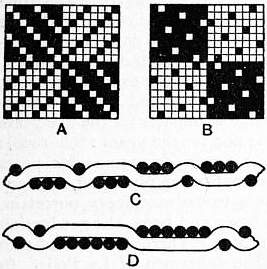
The fabrics known as “dice” take their name from the rectangular form of the figure. The original figures would probably be perfectly square, but to-day the same principle of weaving is applied, and the name dice is given to all figures of rectangular form. The different effects in the adjacent squares or rectangles are due to precisely the same reasons as those explained in connexion with the ground and the figure of damasks. The same weaves are used in both damasks and dices, but simpler weaves are generally employed for the commoner classes of the latter. The effect is, in every case, obtained by what are technically called warp and weft float weaves. The illustration B shows the two double damask weaves arranged to form a dice pattern, while A shows a similar pattern made from two four-thread twill weaves. C and D represent respectively the disposition of the threads in A and B with the first pick, and the solid marks represent the floats of warp. The four squares, which are almost as pronounced in the cloth as those of a chess-board, may be made of any size by repeating each weave for the amount of surface required. It is only in the finest cloths that the double damask weaves B are used for dice patterns, the single damask weaves and the twill weaves being employed to a greater extent. This class of pattern is largely employed for the production of table-cloths of lower and medium qualities. The term damask is also often applied to cloths of this character, and especially so when the figure is formed by rectangles of different sizes.
DIEBITSCH, HANS KARL FRIEDRICH ANTON, count von Diebitsch and Narden, called by the Russians Ivan Ivanovich, Count Diebich-Zabalkansky (1785-1831), Russian field-marshal, was born in Silesia on the 13th of May 1785. He was educated at the Berlin cadet school, but by the desire of his father, a Prussian officer who had passed into the service of Russia, he also did the same in 1801. He served in the campaign of 1805, and was wounded at Austerlitz, fought at Eylau and Friedland, and after Friedland was promoted captain. During the next five years of peace he devoted himself to the study of military science, engaging once more in active service in the War of 1812. He distinguished himself very greatly in Wittgenstein’s campaign, and in particular at Polotzk (October 18 and 19), after which combat he was raised to the rank of major-general. In the latter part of the campaign he served against the Prussian contingent of General Yorck (von Wartenburg), with whom, through Clausewitz, he negotiated the celebrated convention of Tauroggen, serving thereafter with Yorck in the early part of the War of Liberation. After the battle of Lützen he served in Silesia and took part in negotiating the secret treaty of Reichenbach. Having distinguished himself at the battles of Dresden and Leipzig he was promoted lieutenant-general. At the crisis of the campaign of 1814 he strongly urged the march of the allies on Paris; and after their entry the emperor Alexander conferred on him the order of St Alexander Nevsky. In 1815 he attended the congress of Vienna, and was afterwards made adjutant-general to the emperor, with whom, as also with his successor Nicholas, he had great influence. By Nicholas he was created baron, and later count. In 1820 he had become chief of the general staff, and in 1825 he assisted in suppressing the St Petersburg émeute. His greatest exploits were in the Russo-Turkish War of 1828-1829, which, after a period of doubtful contest, was decided by Diebitsch’s brilliant campaign of Adrianople; this won him the rank of field-marshal and the honorary title of Zabalkanski to commemorate his crossing of the Balkans. In 1830 he was appointed to command the great army destined to suppress the insurrection in Poland. He won the terrible battle of Gróchow on the 25th of February, and was again victorious at Ostrolenka on the 26th of May, but soon afterwards he died of cholera (or by his own hand) at Klecksewo near Pultusk, on the 10th of June 1831.
See Belmont (Schümberg), Graf Diebitsch (Dresden, 1830); Stürmer, Der Tod des Grafen Diebitsch (Berlin, 1832); Bantych-Kamenski, Biographies of Russian Field-Marshals (in Russian, St Petersburg, 1841).
DIEDENHOFEN (Fr. Thionville), a fortified town of Germany, in Alsace-Lorraine, dist. Lorraine, on the Mosel, 22 m. N. from Metz by rail. Pop. (1905) 6047. It is a railway junction of some consequence, with cultivation of vines, fruit and vegetables, brewing, tanning, &c. Diedenhofen is an ancient Frank town (Theudonevilla, Totonisvilla), in which imperial diets were held in the 8th century; was captured by Condé in 1643 and fortified by Vauban; capitulated to the Prussians, after a severe bombardment, on the 25th of November 1870.
DIEKIRCH, a small town in the grand duchy of Luxemburg, charmingly situated on the banks of the Sûre. Pop. (1905) 3705. Its name is said to be derived from Dide or Dido, granddaughter of Odin and niece of Thor. The mountain at the foot of which the town lies, now called Herrenberg, was formerly known as Thorenberg, or Thor’s mountain. On the summit of this rock rises a perennial stream which flows down into the town under the name of Bellenflesschen. Diekirch was an important Roman station, and in the 14th century John of Luxemburg, the blind king of Bohemia, fortified it, surrounding the place with a castellated wall and a ditch supplied by the stream mentioned. It remained more or less fortified until the beginning of the 19th century when the French during their occupation levelled the old walls, and substituted the avenues of trees that now encircle the town. Diekirch is the administrative centre of one of the three provincial divisions of the grand duchy. It is visited during the summer by many thousand tourists and travellers from Holland, Belgium and Germany.
DIELECTRIC, in electricity, a non-conductor of electricity; it is the same as insulator. The “dielectric constant” of a medium is its specific inductive capacity, and on the electromagnetic theory of light it equals the square of its refractive index for light of infinite wave length (see Electrostatics; Magneto-Optics).
DIELMANN, FREDERICK (1847- ), American portrait and figure painter, was born at Hanover, Germany, on the 25th of December 1847. He was taken to the United States in early childhood; studied under Diez at the Royal Academy at Munich; was first an illustrator, and became a distinguished draughtsman and painter of genre pictures. His mural decorations and mosaic panels for the Congressional library, Washington, are notable. He was elected in 1899 president of the National Academy of Design.
DIEMEN, ANTHONY VAN (1593-1645), Dutch admiral and governor-general of the East Indian settlements, was born at Kuilenburg in 1593. He was educated in commerce, and on entering the service of the East India Company speedily attained high rank. In 1631 he led a Dutch fleet from the Indies to Holland, and in 1636 he was raised to the governor-generalship. He came into conflict with the Portuguese, and took their possessions in Ceylon and Malacca from them. He greatly extended the commercial relationships of the Dutch, opening up trade with Tong-king, China and Japan. As an administrator also he showed ability, and the foundation of a Latin school and several churches in Batavia is to be ascribed to him. Exploring expeditions were sent to Australia under his auspices in 1636 and 1642, and Abel Tasman named after him (Van Diemen’s Land) the island now called Tasmania. Van Diemen died at Batavia on the 19th of April 1645.
DIEPENBECK, ABRAHAM VAN (1599-1675), Flemish painter, was born at Herzogenbusch, and studied painting at Antwerp, where he became one of Rubens’s “hundred pupils.” But he was not one of the cleverest of Rubens’s followers, and he succeeded, at the best, in imitating the style and aping the peculiarities of his master. We see this in his earliest pictures—a portrait dated 1629 in the Munich Pinakothek, and a “Distribution of Alms” of the same period in the same collection. Yet even at this time there were moments when Diepenbeck probably fancied that he might take another path. A solitary copperplate executed with his own hand in 1630 represents a peasant sitting under a tree holding the bridle of an ass, and this is a minute and finished specimen of the engraver’s art which shows that the master might at one time have hoped to rival the animal draughtsmen who flourished in the schools of Holland. However, large commissions now poured in upon him; he was asked for altarpieces, subject-pieces and pagan allegories. He was tempted to try the profession of a glass-painter, and at last he gave up every other occupation for the lucrative business of a draughtsman and designer for engravings. Most of Diepenbeck’s important canvases are in continental galleries. The best are the “Marriage of St Catherine” at Berlin and “Mary with Angels Wailing over the Dead Body of Christ” in the Belvedere at Vienna, the first a very fair specimen of the artist’s skill, the second a picture of more energy and feeling than might be expected from one who knew more of the outer form than of the spirit of Rubens. Then we have the fine “Entombment” at Brunswick, and “St Francis Adoring the Sacrament” at the museum at Brussels, “Clelia and her Nymphs Flying from the Presence and Pursuit of Porsenna” in two examples at Berlin and Paris, and “Neptune and Amphitrite” at Dresden. In all these compositions the drawing and execution are after the fashion of Rubens, though inferior to Rubens in harmony of tone and force of contrasted light and shade. Occasionally a tendency may be observed to imitate the style of Vandyck, for whom, in respect of pictures, Diepenbeck in his lifetime was frequently taken. But Diepenbeck spent much less of his leisure on canvases than on glass-painting. Though he failed to master the secrets of gorgeous tinting, which were lost, apparently for ever in the 16th century, he was constantly employed during the best years of his life in that branch of his profession. In 1635 he finished forty scenes from the life of St Francis of Paula in the church of the Minimes at Antwerp. In 1644 he received payment for four windows in St Jacques of Antwerp, two of which are still preserved, and represent Virgins to whom Christ appears after the Resurrection. The windows ascribed to him at St Gudule of Brussels were executed from the cartoons of Theodore van Thulden. On the occasion of his matriculation at Antwerp in 1638-1639, Diepenbeck was registered in the guild of St Luke as a glass-painter. He resigned his membership in the Artist Club of the Violette in 1542, apparently because he felt hurt by a valuation then made of drawings furnished for copperplates to the engraver Pieter de Jode. The earliest record of his residence at Antwerp is that of his election to the brotherhood (Sodalität) “of the Bachelors” in 1634. It is probable that before this time he had visited Rome and London, as noted in the work of Houbraken. In 1636 he was made a burgess of Antwerp. He married twice, in 1637 and 1652. He died in December 1675, and was buried at St Jacques of Antwerp.
DIEPPE, a seaport of northern France, capital of an arrondissement in the department of Seine-Inférieure, on the English Channel, 38 m. N. of Rouen, and 105 m. N.W. of Paris by the Western railway. Pop. (1906) 22,120. It is situated at the mouth of the river Arques in a valley bordered on each side by steep white cliffs. The main part of the town lies to the west, and the fishing suburb of Le Pollet to the east of the river and harbour. The sea-front of Dieppe, which in summer attracts large numbers of visitors, consists of a pebbly beach backed by a handsome marine promenade. Dieppe has a modern aspect; its streets are wide and its houses, in most cases, are built of brick. Two squares side by side and immediately to the west of the outer harbour form the nucleus of the town, the Place Nationale, overlooked by the statue of Admiral A. Duquesne, and the Place St Jacques, named after the beautiful Gothic church which stands in its centre. The Grande Rue, the busiest and handsomest street, leads westward from the Place Nationale. The church of St Jacques was founded in the 13th century, but consists in large measure of later workmanship and was in some portions restored in the 19th century. The castle, overlooking the beach from the summit of the western cliff, was erected in 1435. The church of Notre-Dame de Bon Secours on the opposite cliff, and the church of St Remy, of the 16th and 17th centuries, are other noteworthy buildings. A well-equipped casino stands at the west end of the sea-front. The public institutions include the subprefecture, tribunals of first instance and commerce, a chamber of commerce, a communal college and a school of navigation.
Dieppe has one of the safest and deepest harbours on the English Channel. A curved passage cut in the bed of the Arques and protected by an eastern and a western jetty gives access to the outer harbour, which communicates at the east end by a lockgate with the Bassin Duquesne and the Bassin Bérigny, and at the west end by the New Channel, with an inner tidal harbour and two other basins. Vessels drawing 20 ft. can enter the new docks at neap tide. A dry-dock and a gridiron are included among the repairing facilities of the port. The harbour railway station is on the north-west quay of the outer harbour alongside which the steamers from Newhaven lie. The distance of Dieppe from Newhaven, with which there has long been daily communication, is 64 m. The imports include silk and cotton goods, thread, oil-seeds, timber, coal and mineral oil; leading exports are wine, silk, woollen and cotton fabrics, vegetables and fruit and flint-pebbles. The average annual value of imports for the five years 1901-1905 was £4,916,000 (£4,301,000 for the years 1896-1900); the exports were valued at £9,206,000 (£7,023,000 for years 1896-1900). The industries comprise shipbuilding, cotton-spinning, steam-sawing, the manufacture of machinery, porcelain, briquettes, lace, and articles in ivory and bone, the production of which dates from the 15th century. There is also a tobacco factory of some importance. The fishermen of Le Pollet, to whom tradition ascribes a Venetian origin, are among the main providers of the Parisian market. The sea-bathing attracts many visitors in the summer. Two miles to the north-east of the town is the ancient camp known as the Cité de Limes, which perhaps furnished the nucleus of the population of Dieppe.
It is suggested on the authority of its name, that Dieppe owed its origin to a band of Norman adventurers, who found its “diep” or inlet suitable for their ships, but it was unimportant till the latter half of the 12th century. Its first castle was probably built in 1188 by Henry II. of England, and it was counted a place of some consideration when Philip Augustus attacked it in 1195. By Richard I. of England it was bestowed in 1197 on the archbishop of Rouen in return for certain territory in the neighbourhood of the episcopal city. In 1339 it was plundered by the English, but it soon recovered from the blow, and in spite of the opposition of the lords of Hantot managed to surround itself with fortifications. Its commercial activity was already great, and it is believed that its seamen visited the coast of Guinea in 1339, and founded there a Petit Dieppe in 1365. The town was occupied by the English from 1420 to 1435. A siege undertaken in 1442 by John Talbot, first earl of Shrewsbury, was raised by the dauphin, afterwards Louis XI., and the day of the deliverance continued for centuries to be celebrated by a great procession and miracle plays. In the beginning of the 16th century Jean Parmentier, a native of the town, made voyages to Brazil and Sumatra; and a little later its merchant prince, Jacques Ango, was able to blockade the Portuguese fleet in the Tagus. Francis I. began improvements which were continued under his successor. Its inhabitants in great number embraced the reformed religion; and they were among the first to acknowledge Henry IV., who fought one of his great battles at the neighbouring village of Arques. Few of the cities of France suffered more from the revocation of the edict of Nantes in 1685; and this blow was followed in 1694 by a terrible bombardment on the part of the English and Dutch. The town was rebuilt after the peace of Ryswick, but the decrease of its population and the deterioration of its port prevented the restoration of its commercial prosperity. During the 19th century it made rapid advances, partly owing to Marie Caroline, duchess of Berry, who brought it into fashion as a watering-place; and also because the establishment of railway communication with Paris gave an impetus to its trade. During the Franco-German War the town was occupied by the Germans from December 1870 till July 1871.
See L. Vitet, Histoire de Dieppe (Paris, 1844); D. Asseline, Les Antiquités et chroniques de la ville de Dieppe, a 17th-century account published at Paris in 1874.
DIERX, LÉON (1838- ), French poet, was born in the island of Réunion in 1838. He came to Paris to study at the Central School of Arts and Manufactures, and subsequently settled there, taking up a post in the education office. He became a disciple of Leconte de Lisle and one of the most distinguished of the Parnassians. In the death of Stéphane Mallarmé in 1898 he was acclaimed “prince of poets” by “les jeunes.” His works include: Poèmes et poésies (1864); Lèvres closes (1867); Paroles d’un vaincu (1871); La Rencontre, a dramatic scene (1875) and Les Amants (1879). His Poésies complètes (1872) were crowned by the French Academy. A complete edition of his works was published in 2 vols., 1894-1896.
DIES, CHRISTOPH ALBERT (1755-1822), German painter, was born at Hanover, and learned the rudiments of art in his native place. For one year he studied in the academy of Dusseldorf, and then he started at the age of twenty with thirty ducats in his pocket for Rome. There he lived a frugal life till 1796. Copying pictures, chiefly by Salvator Rosa, for a livelihood, his taste led him to draw and paint from nature in Tivoli, Albano and other picturesque places in the vicinity of Rome. Naples, the birthplace of his favourite master, he visited more than once for the same reasons. In this way he became a bold executant in water-colours and in oil, though he failed to acquire any originality of his own. Lord Bristol, who encouraged him as a copyist, predicted that he would be a second Salvator Rosa. But Dies was not of the wood which makes original artists. Besides other disqualifications, he had necessities which forced him to give up the great career of an independent painter. David, then composing his Horatii at Rome, wished to take him to Paris. But Dies had reasons for not accepting the offer. He was courting a young Roman whom he subsequently married. Meanwhile he had made the acquaintance of Volpato, for whom he executed numerous drawings, and this no doubt suggested the plan, which he afterwards carried out, of publishing, in partnership with Méchan, Reinhardt and Frauenholz, the series of plates known as the Collection de vues pittoresques de l’Italie, published in seventy-two sheets at Nuremberg in 1799. With so many irons in the fire Dies naturally lost the power of concentration. Other causes combined to affect his talent. In 1787 he swallowed by mistake three-quarters of an ounce of sugar of lead. His recovery from this poison was slow and incomplete. He settled at Vienna, and lived there on the produce of his brush as a landscape painter, and on that of his pencil or graver as a draughtsman and etcher. But instead of getting better, his condition became worse, and he even lost the use of one of his hands. In this condition he turned from painting to music, and spent his leisure hours in the pleasures of authorship. He did not long survive, dying at Vienna in 1822, after long years of chronic suffering. From two pictures now in the Belvedere gallery, and from numerous engraved drawings from the neighbourhood of Tivoli, we gather that Dies was never destined to rise above a respectable mediocrity. He followed Salvator Rosa’s example in imitating the manner of Claude Lorraine. But Salvator adapted the style of Claude, whilst Dies did no more than copy it.