VOLUME VIII SLICE IV Diameter to Dinarchus (continued 2)
Reading edition
In its primitive form, the diary must always have existed; as soon as writing was invented, men and women must have wished to note down, in some almanac or journal, memoranda respecting their business, their engagements or their adventures. But the literary value of these would be extremely insignificant until the spirit of individualism had crept in, and human beings began to be interesting to other human beings for their own sake. It is not, therefore, until the close of the Renaissance that we find diaries beginning to have literary value, although, as the study of sociology extends, every scrap of genuine and unaffected record of early history possesses an ethical interest. In the 17th century, diaries began to be largely written in England, although in most cases without any idea of even eventual publication. Sir William Dugdale (1605-1686) had certainly no expectation that his slight diary would ever see the light. There is no surviving record of a journal kept by Clarendon, Richard Baxter, Lucy Hutchinson and other autobiographical writers of the middle of the century, but we may take it for granted that they possessed some such record, kept from day to day. Bulstrode Whitelocke (1605-1675), whose Memorials of the English Affairs covers the ground from 1625 to 1660, was a genuine diarist. So was the elder George Fox (1624-1690), who kept not merely “a great journal,” but “the little journal books,” and whose work was published in 1694. The famous diary of John Evelyn (1620-1706) professes to be the record of seventy years, and, although large tracts of it are covered in a very perfunctory manner, while in others many of the entries have the air of having been written in long after the event, this is a very interesting and amusing work; it was not published until 1818. In spite of all its imperfections there is a great charm about the diary of Evelyn, and it would hold a still higher position in the history of literature than it does if it were not overshadowed by what is unquestionably the most illustrious of the diaries of the world, that of Samuel Pepys (1633-1703). This was begun on the 1st of January 1660 and was carried on until the 29th of May 1669. The extraordinary value of Pepys’ diary consists in its fidelity to the portraiture of its author’s character. He feigns nothing, conceals nothing, sets nothing down in malice or insincerity. He wrote in a form of shorthand intelligible to no one but himself, and not a phrase betrays the smallest expectation that any eye but his own would ever investigate the pages of his confession. The importance of this wonderful document, in fact, lay unsuspected until 1819, when the Rev. John Smith of Baldock began to decipher the MS. in Magdalene College, Cambridge. It was not until 1825 that Lord Braybrooke published part of what was only fully edited, under the care of Mr Wheatley, in 1893-1896. In the age which succeeded that of Pepys, a diary of extraordinary emotional interest was kept by Swift from 1710 to 1713, and was sent to Ireland in the form of a “Journal to Stella”; it is a surprising amalgam of ambition, affection, wit and freakishness. John Byrom (1692-1763), the Manchester poet, kept a journal, which was published in 1854. The diary of the celebrated dissenting divine, Philip Doddridge (1702-1751), was printed in 1829. Of far greater interest are the admirably composed and vigorously written journals of John Wesley (1703-1791). But the most celebrated work of this kind produced in the latter half of the 18th century was the diary of Fanny Burney (Madame D’Arblay), published in 1842-1846. It will be perceived that, without exception, these works were posthumously published, and the whole conception of the diary has been that it should be written for the writer alone, or, if for the public, for the public when all prejudice shall have passed away and all passion cooled down. Thus, and thus only, can the diary be written so as to impress upon its eventual readers a sense of its author’s perfect sincerity and courage.
Many of the diaries described above were first published in the opening years of the 19th century, and it is unquestionable that the interest which they awakened in the public led to their imitation. Diaries ceased to be rare, but as a rule the specimens which have hitherto appeared have not presented much literary interest. Exception must be made in favour of the journals of two minor politicians, Charles Greville (1794-1865) and Thomas Creevey (1768-1838), whose indiscretions have added much to the gaiety of nations; the papers of the former appeared in 1874-1887, those of the latter in 1903. The diary of Henry Crabb Robinson (1775-1867), printed in 1869, contains excellent biographical material. Tom Moore’s journal, published in 1856 by Lord John Russell, disappointed its readers. But it is probable, if we reason by the analogy of the past, that the most curious and original diaries of the 19th century are still unknown to us, and lie jealously guarded under lock and key by the descendants of those who compiled them.
It was natural that the form of the diary should appeal to a people so sensitive to social peculiarities and so keen in the observation of them as the French. A medieval document of immense value is the diary kept by an anonymous curé during the reigns of Charles VI. and Charles VII. This Journal d’un bourgeois de Paris was kept from 1409 to 1431, and was continued by another hand down to 1449. The marquis de Dangeau (1638-1720) kept a diary from 1684 till the year of his death; this although dull, and as Saint-Simon said “of an insipidity to make you sick,” is an inexhaustible storehouse of facts about the reign of Louis XIV. Saint-Simon’s own brilliant memoirs, written from 1691 to 1723, may be considered as a sort of diary. The lawyer, Edmond Barbier (1689-1771), wrote a journal of the anecdotes and little facts which came to his knowledge from 1718 to 1762. The studious care which he took to be correct, and his manifest candour, give a singular value to Barbier’s record; his diary was not printed at all until 1847, nor, in its entirety, until 1857. The song-writer, Charles Collé (1709-1783), kept a journal historique from 1758 to 1782; it is full of vivacity, but very scandalous and spiteful. It saw the light in 1805, and surprised those to whom Collé, in his lifetime, had seemed the most placid and good-natured of men. Petit de Bachaumont (1690-1770) had access to remarkable sources of information, and his Mémoires secrets (a diary the publication of which began in 1762 and was continued after Bachaumont’s death, until 1787, by other persons) contains a valuable mass of documents. The marquis d’Argenson (1694-1757) kept a diary, of which a comparatively full text was first published in 1859. In recent times the posthumous publication of the diaries of the Russian artist, Marie Bashkirtseff (1860-1884), produced a great sensation in 1887, and revealed a most remarkable temperament. The brothers Jules and Edmond de Goncourt kept a very minute diary of all that occurred around them in artistic and literary Paris; after the death of Jules, in 1870, this was continued by Edmond, who published the three first volumes in 1888. The publication of this work was continued, and it produced no little scandal. It is excessively ill-natured in parts, but of its vivid picturesqueness, and of its general accuracy as a transcript of conversation, there can be no two opinions.
(E. G.)
DIASPORE, a native aluminium hydroxide, AlO(OH), crystallizing in the orthorhombic system and isomorphous with göthite and manganite. It occurs sometimes as flattened crystals, but usually as lamellar or scaly masses, the flattened surface being a direction of perfect cleavage on which the lustre is markedly pearly in character. It is colourless or greyish-white, yellowish, sometimes violet in colour, and varies from translucent to transparent. It may be readily distinguished from other colourless transparent minerals, with a perfect cleavage and pearly lustre—mica, talc, brucite, gypsum—by its greater hardness of 6½-7. The specific gravity is 3.4. When heated before the blowpipe it decrepitates violently, breaking up into white pearly scales; it was because of this property that the mineral was named diaspore by R. J. Hauy in 1801, from διασπείρειν, “to scatter.” The mineral occurs as an alteration product of corundum or emery, and is found in granular limestone and other crystalline rocks. Well-developed crystals are found in the emery deposits of the Urals and at Chester, Massachusetts, and in kaolin at Schemnitz in Hungary. If obtainable in large quantity it would be of economic importance as a source of alumina.
(L. J. S)
DIASTYLE (from Gr. διά, through, and στῦλος, column), in architecture, a term used to designate an intercolumniation of three or four diameters.
DIATOMACEAE. For the knowledge we possess of these beautiful plants, so minute as to be undiscernible by our unaided vision, we are indebted to the assistance of the microscope. It was not till towards the close of the 18th century that the first known forms of this group were discovered by O. F. Muller. And so slow was the process of discovery in this field of scientific research that in the course of half a century, when Agardh published his Systema algarum in 1824, only forty-nine species included under eight genera had been described. Since that time, however, with modern microscopes and microscopic methods, eminent botanists in all parts of the civilized world have studied these minute plants, with the result that the number of known genera and species has been greatly increased. Over 10,000 species of diatoms have been described, and about 1200 species and numerous varieties occur in the fresh waters and on the coasts of Great Britain and Ireland. Rabenhorst, in the index to his Flora Europaea algarum (1864) enumerated about 4000 forms which had up to that time been discovered throughout the continent of Europe.
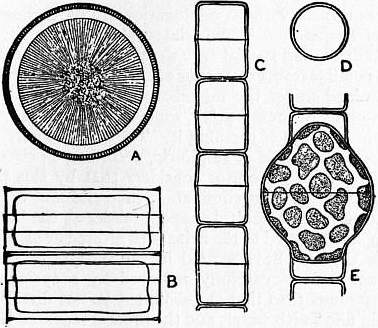
Fig. 1.
A and B, Melosira arenaria. C-E, Melosira varians.
E, showing formation of auxospore.

Fig. 2.
The diatoms are more commonly known among systematic botanists as the Bacillarieae, particularly on the continent of Europe, and although such an immense number of very diverse forms are included in it, the group as a whole exhibits a remarkable uniformity of structure. The Bacillarieae is one of the large groups of Algae, placed by some in close proximity to the Conjugatae and by others as an order of the Brown Algae (or Phaeophyceae), but their characters are so distinctive and their structure is so uniform as to warrant the separation of the diatoms as a distinct class. The affinities of the group are doubtful.
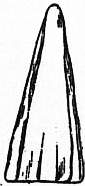
Fig. 3.—Podosphenia Lyngbyii.
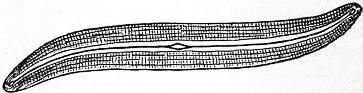
Fig. 4.—Pleurosigma balticum.
The diatoms exhibit great variety of form. While some species are circular and more or less disk-shaped, others are oval in outline. Some are linear, as Synedra Ulna (fig. 2), others more or less crescentic; others again are cuneate, as Podosphenia Lyngbyii (fig. 3); some few have a sigmoid outline, as Pleurosigma balticum (fig. 4); but the prevailing forms are naviculoid, as in the large family Naviculaceae, of which the genus Navicula embraces upwards of 1000 species. They vary also in their modes of growth,—some being free-floating, others attached to foreign bodies by simple or branched gelatinous stalks, which in some species are short and thick, while in others they are long and slender. In some genera the forms are simple, while in others the frustules are connected together in ribbon-like filaments, or form, as in other cases, zigzag chains. In some genera the individuals are naked, while in many others they are enclosed in a more or less definite gelatinous investment. The conditions necessary to their growth are moisture and light. Wherever these circumstances coexist, diatomaceous forms will almost invariably be found. They occur mixed with other organisms on the surface of moist rocks; in streamlets and pools, they form a brownish stratum on the surface of the mud, or cover the stems and leaves of water plants or floating twigs with a furry investment. Marine forms are usually attached to various sea-weeds, and many are found in the stomachs of molluscs, holothurians, ascidians and other denizens of the ocean. The fresh-water forms are specifically distinct from those incidental to salt or brackish water,—fresh-water species, however, are sometimes carried some distance into the sea by the force of the current, and in tidal rivers marine forms are carried up by the force of the tide. Some notion may be formed of the extreme minuteness of these forms from the fact that one the length of which is 1⁄200th of an inch may be considered as beyond the medium size. Some few, indeed, are much larger, but by far the greater proportion are of very much smaller dimensions.
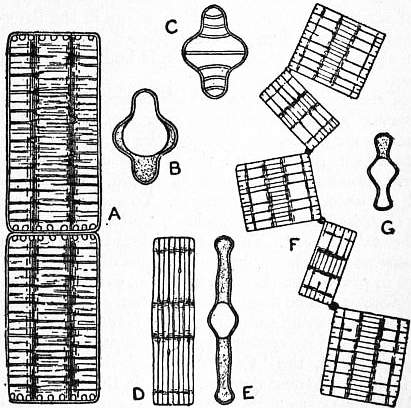
Fig. 5.
A-C, Tetracyclus lacustris. D and E, Tabellaria fenestrata.
F and G, Tabellaria flocculosa.
Diatoms are unicellular plants distinguished from kindred forms by the fact of having their soft vegetative part covered by a siliceous case. Each individual is known as a frustule, and the cell-wall consists of two similar valves nearly parallel to each other, each valve being furnished with a rim (or connecting-band) projecting from it at a right angle.
One of these valves with its rim is slightly smaller than the other, the smaller fitting into the larger pretty much as a pill-box fits into its cover. This peculiarity of structure affords ample scope for the growth of the protoplasmic cell-contents, for as the latter increase in volume the siliceous valves are pushed out, and their corresponding siliceous rims become broader. The connecting-bands although closely fitting their respective valves are distinct from them, and together the two bands form the girdle.
An individual diatom is usually described from two aspects, one in which the surface of the valve is exposed to view—the valve view, and one in which the girdle side is exposed—the girdle view. The valves are thin and transparent, convex on the outside, and generally ornamented with a variety of sculptured markings. These sculptures often present the aspect of striae across the face of the valve, and the best lenses have shown them to consist of a series of small cavities within the siliceous wall of the cell. The valves of some of the marine genera exhibit a beautiful areolated structure due to the presence of larger chambers within the siliceous cell-wall. Many diatoms possess thickenings of the cell-wall, visible in the valve view, in the centre of the valve and at each extremity. These thickenings are known as the nodules, and they are generally connected by a long median line, the raphe, which is a cleft in the siliceous valve, extending at least some part of its length.
The protoplasmic contents of this siliceous box-like unicell are very similar to the contents of many other algal cells. There is a living protoplasmic layer or primordial utricle, connected either by two broad bands or by a number of anastomosing threads with a central mass of protoplasm in which the nucleus is embedded. The greater part of the cavity of the cell is occupied by one or several fluid vacuoles. The characteristic brown colour of diatoms is due to the presence of chromatophores embedded in the lining layer of protoplasm. In number and form these chromatophores are variable. They contain chlorophyll, but the green colour is masked by the presence of diatomin, a brown pigment which resembles that which occurs in the Brown Algae or Phaeophyceae. The chromatophores contain a variable number of pyrenoids, colourless proteid bodies of a crystalloidal character.
One of the first phenomena which comes under the notice of the observer is the extraordinary power of motion with which the frustules are endowed. Some species move slowly backwards and forwards in pretty much the same line, but in the case of Bacillaria paradoxa the motion is very rapid, the frustules darting through the water in a zigzag course. To account for this motion various theories have been suggested, none of which appear to be altogether satisfactory. There is little doubt that the movements are connected with the raphe, and in some diatoms there is much evidence to prove that they are due to an exudation of mucilage.
Classification.—The most natural system of classification of the Bacillarieae is the one put forward by Schütt (1896), and since generally followed by systematists. He separates them into two primary divisions, the ‘Centricae’ and the ‘Pennatae.’ The former includes all those diatoms which in the valve view possess a radial symmetry around a central point, and which are destitute of a raphe (or a pseudoraphe). The latter includes those which are zygomorphic or otherwise irregular, and in which the valve view is generally boat-shaped or needle-shaped, with the markings arranged in a sagittal manner on each side of a raphe or pseudoraphe.
Reproduction.—In the Diatomaceae, as well as in the Desmidieae, the ordinary mode of increase is by simple cell-division. The cell-contents within the enclosure of the siliceous case separate into two distinct masses. As these two daughter-masses become more and more developed, the valves of the mother-cell are pushed more and more widely apart. A new siliceous valve is secreted by each of the two masses on the side opposite to the original valve, the new valves being situated within the girdle of the original frustule. When this process has been completed the girdle of the mother frustule gives way, and two distinct frustules are formed, the siliceous valves in each of these new frustules being one of the valves of the mother-cell, and a newly formed valve similar and more or less parallel to it.
During the life of the plant this process of self-division is continued with an almost incredible rapidity. On this subject the observation of Professor William Smith, writing in 1853, is worthy of special notice:—“I have been unable to ascertain the time occupied in a single act of self-division, but supposing it to be completed in twenty-four hours we should have, as the progeny of a single frustule, the amazing number of 1,000,000,000 in a single month, a circumstance which will in some degree explain the sudden, or at least rapid, appearance of these organisms in localities where they were a short time previously either unrecognized or sparingly diffused” (British Diatomaceae, vol. i. p. 25).
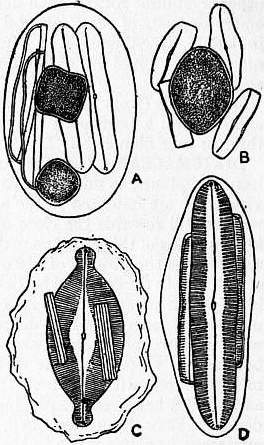
Fig. 6.—Formation of Auxospores. A. Navicula limosa. B. Achnanthes flexella. C. Navicula Amphisbaena. D. Navicula viridis.
Individual diatoms when once produced by cell-division are incapable of any increase in size owing to the rigidity of their siliceous cell-walls, and since the new valves are always formed within the girdle of the old ones, it would follow that every succeeding generation is reduced in size by the thickness of the girdle. In some diatoms, however, this is not strictly true as daughter-cells are sometimes produced of larger size than the parent-cells. Thus, the reduction in size of the individuals is not always proportionate to the number of cell-divisions.
On the diminution in size having reached a limit in any species, the maximum size is regained by the formation of an auxospore. There are five known methods of reproduction by auxospores, but it is unnecessary here to enter into details of these methods. Suffice it to say that a normal auxospore is produced by the conjugation of two parent-cells, its distinguishing feature being a rejuvenescence accompanied by a marked increase in size. These auxospores formed without conjugation are parthenogenetic.
Mode of Preparation.—The Diatomaceae are usually gathered in small bottles, and special care should be taken to collect them as free as possible from extraneous matter. A small portion having been examined under the microscope, should the gathering be thought worthy of preservation, some of the material is boiled in acid for the purpose of cleaning it. The acids usually employed are hydrochloric, nitric or sulphuric, according as circumstances require. When the operator considers that by this process all foreign matter has been eliminated, the residuum is put into a precipitating jar of a conical shape, broader at the bottom than at the top, and covered to the brim with filtered or distilled water. When the diatoms have settled in the bottom of the jar, the supernatant fluid is carefully removed by a syringe or some similar instrument, so that the sediment be not disturbed. The jar is again filled with water, and the process repeated till the acid has been completely removed. It is desirable afterwards to boil the sediment for a short time with supercarbonate of soda, the alkali being removed in the same manner as the acid. A small portion may then be placed with a pipette upon a slip of glass, and, when the moisture has been thoroughly evaporated, the film that remains should be covered with dilute Canada balsam, and, a thin glass cover having been gently laid over the balsam, the preparation should be laid aside for a short time to harden, and then is ready for observation.
General Remarks.—Diatoms are most abundant in cold latitudes, having a general preference for cold water. In the pelagic waters of lakes and of the oceans they are often very abundant, and in the cold waters of the Arctic and Antarctic Oceans they exist in prodigious numbers. They thus form a large proportion of both the marine and the fresh-water plankton.
Large numbers of fossil diatoms are known. Not only are these minute plants assisting at the present time in the accumulation of oceanic and lake deposits, but in former ages they have been sufficiently active to give rise to considerable deposits of diatomaceous earths. When the plant has fulfilled its natural course the siliceous covering sinks to the bottom of the water in which it had lived, and there forms part of the sediment. When in the process of ages, as it has often happened, the accumulated sediment has been hardened into solid rock, the siliceous frustules of the diatoms remain unaltered, and, if the rock be disintegrated by natural or artificial means, may be removed from the enveloping matrix and subjected to examination under the microscope. The forms found may from their character help in some degree to illustrate the conditions under which the stratum of rock had been originally deposited. These earths are generally of a white or grey colour. Some of them are hard, but most are soft and friable. Many of them are of economic importance, being used as polishing powders (“Tripoli”), as absorbents for nitroglycerin in the manufacture of dynamite (“Kieselguhr”), as a dentifrice, and more recently they have been used to a large extent in the manufacture of non-conducting and sound-proof materials. Most of these diatomaceous earths are associated with rocks of Tertiary formations, although it is generally regarded that the earliest appearance of diatoms is in the Upper Cretaceous (chalk).
Vast deposits of Diatomaceous earths have been discovered in various parts of the world,—some the deposit of fresh, others of salt water. Of these deposits the most remarkable for extent, as well as for the number and beauty of the species contained in it, is that of Richmond, in Virginia, one of the United States of America. It extends for many miles, and is in some places at least 40 ft. deep. It is a remarkable fact that though the generations of a diatom in the space of a few months far exceed in number the generation of man during the period usually assigned to the existence of the race, the fossil genera and species are in most respects to the most minute details identical with the numerous living representatives of their class.
(E. O’M.; G. S. W.*)
DIAULOS (from Gr. δι-, double, and αὐλός, pipe), in architecture, the peristyle round the great court of the palaestra, described by Vitruvius (v. II), which measured two stadia (1200 ft.) in length; on the south side this peristyle had two rows of columns, so that in stormy weather the rain might not be driven into the inner part. The word was also used in ancient Greece for a foot-race of twice the usual length.
DIAVOLO, FRA (1771-1806), the popular name given to a famous Italian brigand associated with the political revolutions of southern Italy at the time of the French invasion. His real name was Michele Pezza, and he was born of low parentage at Itri; he had committed many murders and robberies in the Terra di Lavoro, but by good luck combined with audacity he always escaped capture, whence his name of Fra Diavolo, popular superstition having invested him with the characters of a monk and a demon, and it seems that at one time he actually was a monk. When the kingdom of Naples was overrun by the French and the Parthenopaean Republic established (1799), Cardinal Ruffo, acting on behalf of the Bourbon king Ferdinand IV., who had fled to Sicily, undertook the reconquest of the country, and for this purpose he raised bands of peasants, gaol-birds, brigands, &c., under the name of Sanfedisti or bande della Santa Fede (“bands of the Holy Faith”). Fra Diavolo was made leader of one of them, and waged untiring war against the French troops, cutting off isolated detachments and murdering stragglers and couriers. Owing to his unrivalled knowledge of the country, he succeeded in interrupting the enemy’s communications between Rome and Naples. But although, like his fellow-brigands under Ruffo, he styled himself “the faithful servant and subject of His Sicilian Majesty,” wore a military uniform and held military rank, and was even created duke of Cassano, his atrocities were worthy of a bandit chief. On one occasion he threw some of his prisoners, men, women and children, over a precipice, and on another he had a party of seventy shot. His excesses while at Albano were such that the Neapolitan general Naselli had him arrested and imprisoned in the castle of St Angelo, but he was liberated soon after. When Joseph Bonaparte was made king of Naples, extraordinary tribunals were established to suppress brigandage, and a price was put on Fra Diavolo’s head. After spreading terror through Calabria, he crossed over to Sicily, where he concerted further attacks on the French. He returned to the mainland at the head of 200 convicts, and committed further excesses in the Terra di Lavoro; but the French troops were everywhere on the alert to capture him and he had to take refuge in the woods of Lenola. For two months he evaded his pursuers, but at length, hungry and ill, he went in disguise to the village of Baronissi, where he was recognized and arrested, tried by an extraordinary tribunal, condemned to death and shot. In his last moments he cursed both the Bourbons and Admiral Sir Sidney Smith for having induced him to engage in this reckless adventure (1806). Although his cruelty was abominable, he was not altogether without generosity, and by his courage and audacity he acquired a certain romantic popularity. His name has gained a world-wide celebrity as the title of a famous opera by Auber.
The best known account of Fra Diavolo is in Pietro Colletta’s Storia del reame di Napoli (2nd ed., Florence, 1848); B. Amante’s Fra Diavolo e il suo tempo (Florence, 1904) is an attempted rehabilitation; but A. Luzio, whose account in Profili e bozzetti storici (Milan, 1906) gives the latest information on the subject, has demolished Amante’s arguments.
(L. V.*)
DIAZ, NARCISSE VIRGILIO (1808-1876), French painter, was born in Bordeaux of Spanish parents, on the 25th of August 1808. At first a figure-painter who indulged in strong colour, in his later life Diaz became a painter of the forest and a “tone artist” of the first order. He spent much time at Barbizon; and although he is the least exalted of the half-dozen great artists who are usually grouped round that name, he sometimes produced works of the highest quality. At the age of ten Diaz became an orphan, and misfortune dogged his earlier years. His foot was bitten by a reptile in Meudon wood, near Sèvres, where he had been taken to live with some friends of his mother. The bite was badly dressed, and ultimately it cost him his leg. Afterwards his wooden stump became famous. At fifteen he entered the studios at Sèvres, where the decoration of porcelain occupied him; but tiring of the restraint of fixed hours, he took to painting Eastern figures dressed in richly coloured garments. Turks and Oriental scenes attracted him, and many brilliant gems remain of this period. About 1831 Diaz encountered Théodore Rousseau, for whom he entertained a great veneration, although Rousseau was four years his junior; but it was not until ten years later that the remarkable incident took place of Rousseau teaching Diaz to paint trees. At Fontainebleau Diaz found Rousseau painting his wonderful forest pictures, and determined to paint in the same way if possible. Rousseau, then in poor health, worried at home, and embittered against the world, was difficult to approach. Diaz followed him surreptitiously to the forest,—wooden leg not hindering,—and he dodged round after the painter, trying to observe his method of work. After a time Diaz found a way to become friendly with Rousseau, and revealed his anxiety to understand his painting. Rousseau was touched with the passionate words of admiration, and finally taught Diaz all he knew. Diaz exhibited many pictures at the Paris Salon, and was decorated in 1851. During the Franco-German War he went to Brussels. After 1871 he became fashionable, his works gradually rose in the estimation of collectors, and he worked constantly and successfully. In 1876 he caught cold at his son’s grave, and on the 18th of November of that year he died at Mentone, whither he had gone to recruit his health. Diaz’s finest pictures are his forest scenes and storms, and it is on these, and not on his pretty figures, that his fame is likely to rest. There are several fairly good examples of the master in the Louvre, and three small figure pictures in the Wallace collection, Hertford House. Perhaps the most notable of Diaz’s works are “La Fée aux Perles” (1857), in the Louvre; “Sunset in the Forest” (1868); “The Storm,” and “The Forest of Fontainebleau” (1870) at Leeds. Diaz had no well-known pupils, but Léon Richet followed markedly his methods of tree-painting, and J. F. Millet at one period painted small figures in avowed imitation of Diaz’s then popular subjects.
See A. Hustin, Les Artistes célèbres: Diaz (Paris); D. Croal Thomson, The Barbizon School of Painters (London, 1890); J. W. Mollett, Diaz (London, 1890); J. Claretie, Peintres et sculpteurs contemporains: Diaz (Paris, 1882); Albert Wolff, La Capitale de l’art: Narcisse Diaz (Paris, 1886); Ph. Burty, Maîtres et petit-maîtres: N. Diaz (Paris, 1877).
(D. C. T.)
DIAZ, PORFIRIO (1830- ), president of the republic of Mexico (q.v.), was born in the southern state of Oaxaca, on the 15th of September 1830. His father was an innkeeper in the little capital of that province, and died three years after the birth of Porfirio, leaving a family of seven children. The boy, who had Indian blood in his veins, was educated for the Catholic Church, a body having immense influence in the country at that time and ordering and controlling revolutions by the strength of their filled coffers. Arrived at the age of sixteen Porfirio Diaz threw off the authority of the priests. Fired with enthusiasm by stories told by the revolutionary soldiers continually passing through Oaxaca, and hearing about the war with the United States, a year later he determined to set out for Mexico city and join the National Guard. There being no trains, and he being too poor to ride, he walked the greater part of the 250 m., but arrived there too late, as the treaty of Guadalupe-Hidalgo (1848) had been already signed, and Texas finally ceded to the United States. Thus his entering the army was for the time defeated. Thereupon he returned to his native town and began studying law. He took pupils in order to pay his own fees at the Law Institute, and help his mother. At this time he came under the notice and influence of Don Marcos Pérez and Benito Juárez, the first a judge, the second a governor of the state of Oaxaca, and soon to become famous as the deliverer of Mexico from the priesthood (War of Reform). Diaz continued in his native town until 1854, when, refusing to vote for the dictator, Santa Anna, he was stung by a taunt of cowardice, and hastily pushing his way to the voting place, he recorded his vote in favour of Alvarez and the revolutionists. Orders were given for his arrest, but seizing a rifle and mounting a horse he placed himself at the head of a few revolting peasants, and from that moment became one of the leading spirits in that long struggle for reform, known as the War of Reform, which, under the leadership of Juárez, followed the overthrow of Santa Anna. Promotion succeeded promotion, as Diaz led his troops from victory to victory, amid great privations and difficulties. He was made captain (1856), lieutenant-colonel and colonel (1859), brigadier-general (1861), and general of division for the army (1863). Closely following on civil war, political strife, open rebellion and the great War of Reform, came the French invasion of 1862, and the landing of the emperor Maximilian in 1864. From the moment the French disclosed their intentions of settling in Mexico in 1862, Diaz took a prominent part against the foreign invasion. He was twice seriously wounded, imprisoned on three different occasions, had two hairbreadth escapes, and took part in many daring engagements. So important a personage did he become that both Marshal Bazaine and the emperor Maximilian made overtures to him. At the time of Maximilian’s death (with which Diaz personally had nothing to do) he was carrying on the siege of Mexico city, which ended in the surrender of the town two days after the emperor was shot at Quérétaro between his two leading generals. Diaz at once set to work to pay up arrears due to his soldiers, proclaimed death as the penalty of plunder and theft, and in the few weeks that followed showed his great administrative powers, the officers as well as the rank and file receiving arrears of pay. On the very day that he occupied Mexico city, the great commander of the army of the east, to everyone’s surprise, sent in his resignation. He was, indeed, appointed to the command of the second division of the army by President Juárez in his military reorganization, but Diaz, seeing men who had given great and loyal service to the state dismissed from their positions in the government, and disgusted at this course, retired to the little city of Oaxaca; there he lived, helping in the reorganization of the army but taking no active part in the government until 1871.
On Juárez’ death Lerdo succeeded as president, in 1872. His term of office again brought discord, and when it was known that he was attempting to be re-elected in 1876, the storm broke. Diaz came from retirement, took up the leadership against Lerdo, and after desperate struggles and a daring escape finally made a triumphal entry into Mexico city on the 24th of November 1876, as provisional president, quickly followed by the full presidentship. His term of office marks a prominent change in the history of Mexico; from that date he at once forged ahead with financial and political reform, the scrupulous settlement of all national debts, the welding together of the peoples and tribes (there are 150 different Indian tribes) of his country, the establishment of railroads and telegraphs, and all this in a land which had been upheaved for a century with revolutions and bloodshed, and which had had fifty-two dictators, presidents and rulers in fifty-nine years. In 1880 Diaz was succeeded by Gonzalez, the former minister of war, for four years (owing to the limit of the presidential office), but in 1884 he was unanimously re-elected. The government having set aside the above-mentioned limitation, Diaz was continually re-elected to the presidency. He married twice and had a son and two daughters. His gifted second wife (Carmelita), very popular in Mexico, was many years younger than himself. King Edward VII. made him an honorary grand commander of the Bath in June 1906, in recognition of his wonderful administration as perpetual president for over a quarter of a century.
See also Mrs Alec Tweedie, Porfirio Diaz, Seven Times President of Mexico (1906), and Mexico as I saw it (1901); Dr Noll, From Empire to Republic (1890); Lieut. Seaton Schroeder, Fall of Maximilian’s Empire (New York, 1887); R. de Z. Enriquez, P. Diaz (1908); and an article by Percy Martin in Quarterly Review for October 1909.
(E. A. T.)
DIAZ DE NOVAES, BARTHOLOMEU (fl. 1481-1500), Portuguese explorer, discoverer of the Cape of Good Hope, was probably a kinsman of João Diaz, one of the first Portuguese to round Cape Bojador (1434), and of Diniz Diaz, the discoverer of Cape Verde (1445). In 1478 a Bartholomeu Diaz, probably identical with the discoverer, was exempted from certain customary payments on ivory brought from the Guinea coast. In 1481 he commanded one of the vessels sent by King John II. under Diogo d’Azambuja to the Gold Coast. In 1486 he seems to have been a cavalier of the king’s household, and superintendent of the royal warehouses; on the 10th of October in this year he received an annuity of 6000 reis from King John for “services to come”; and some time after this (probably about July or August 1487, rather than July 1486, the traditional date) he left Lisbon with three ships to carry on the work of African exploration so greatly advanced by Diogo Cão (1482-1486). Passing Cão’s farthest point near Cape Cross (in the modern German South-west Africa and) in 21° 50′ S., he erected a pillar on what is now known as Diaz Point, south of Angra Pequena or Lüderitz Bay, in 26° 38′ S.; of this fragments still exist. From this point (according to De Barros) Diaz ran thirteen days southwards before strong winds, which freshened to dangerous stormy weather, in a comparatively high southern latitude, considerably south of the Cape. When the storm subsided the Portuguese stood east; and failing, after several days’ search, to find land, turned north, and so struck the south coast of Cape Colony at Mossel Bay (Diaz’ Bahia dos Vaqueiros), half way between the Cape of Good Hope and Port Elizabeth (February 3, 1488). Thence they coasted eastward, passing Algoa Bay (Diaz’ Bahia da Roca), erecting pillars (or perhaps wooden crosses), it is said, on one of the islands in this bay and at or near Cape Padrone farther east; of these no traces remain. The officers and men now began to insist on return, and Diaz could only persuade them to go as far as the estuary of the Great Fish River (Diaz’ Rio do Iffante, so named from his colleague, Captain João Iffante). Here, however, half way between Port Elizabeth and East London (and indeed from Cape Padrone), the north-easterly trend of the coast became unmistakable; the way round Africa had been laid open. On his return Diaz perhaps named Cape Agulhas after St Brandan; while on the southernmost projection of the modern Cape peninsula, whose remarkable highlands (Table Mountain, &c.) doubtless impressed him as the practical termination of the continent, he bestowed, says De Barros, the name of Cape of Storms (Cabo Tormentoso) in memory of the storms he had experienced in these far southern waters; this name (in the ordinary tradition) was changed by King John to that of Good Hope (Cabo da Boa Esperança). Some excellent authorities, however, make Diaz himself give the Cape its present name. Hard by this “so many ages unknown promontory” the explorer probably erected his last pillar. After touching at the Ilha do Principe (Prince’s Island, south-west of the Cameroons) as well as at the Gold Coast, he appeared at Lisbon in December 1488. He had discovered 1260 m. of hitherto unknown coast; and his voyage, taken with the letters soon afterwards received from Pero de Covilhão (who by way of Cairo and Aden had reached Malabar on one side and the “Zanzibar coast” on the other as far south as Sofala, in 1487-1488) was rightly considered to have solved the question of an ocean route round Africa to the Indies and other lands of South and East Asia.
No record has yet been found of any adequate reward for Diaz: on the contrary, when the great Indian expedition was being prepared (for Vasco da Gama’s future leadership) Bartolomeu only superintended the building and outfit of the ships; when the fleet sailed in 1497, he only accompanied da Gama to the Cape Verde Islands, and after this was ordered to El Mina on the Gold Coast. On Cabral’s voyage of 1500 he was indeed permitted to take part in the discovery of Brazil (April 22), and thence should have helped to guide the fleet to India; but he perished in a great storm off his own Cabo Tormentoso. Like Moses, as Galvano says, he was allowed to see the Promised Land, but not to enter in.
See João de Barros, Asia, Dec. I. bk. iii. ch. 4; Duarte Pacheco Pereira, Esmeraldo de situ orbis, esp. pp. 15, 90, 92, 94 and Raphael Bastos’s introduction to the edition of 1892 (Pacheco met Diaz, returning from his great voyage, at the Ilha do Principe); a marginal note, probably by Christopher Columbus himself, on fol. 13 of a copy of Pierre d’Ailly’s Imago mundi, now in the Colombina at Seville (the writer of this note fixes Diaz’s return to Lisbon, December 1488, and says he was present at Diaz’s interview with the king of Portugal, when the explorer described his voyage and showed his route upon the chart he had kept); a similar but briefer note in a copy of Pope Pius II.’s Historia rerum ubique gestarum, from the same hand; the Roteiro of Vasco da Gama’s First Voyage (Journal of the First Voyage of ... Da Gama, Hakluyt Soc., ed. E. G. Ravenstein (1898), pp. 9, 14); Ramusio, Navigationi (3rd ed.), vol. i. fol. 144; Castanheda, Historia, bk. i. ch. 1; Galvano, Descobrimentos (Discoveries of the World), Hakluyt Soc. (1862), p. 77; E. G. Ravenstein, “Voyages of ... Cão and ... Dias,” in Geog. Journ. (London, December 1900), vol. xvi. pp. 638-655), an excellent critical summary in the light of the most recent investigations of all the material. The fragments of Diaz’s only remaining pillar (from Diaz Point) are now partly at the Cape Museum, partly at Lisbon: the latter are photographed in Ravenstein’s paper in Geog. Journ. (December 1900, p. 642).
(C. R. B.)
DIAZO COMPOUNDS, in organic chemistry, compounds of the type R·N·2·X (where R = a hydrocarbon radical, and X = an acid radical or a hydroxyl group). These compounds may be divided into two classes, namely, the true diazo compounds, characterized by the grouping −N = N−, and the diazonium compounds, characterized by the grouping N ∶ N <.
The diazonium compounds were first discovered by P. Griess (Ann., 1858, 106, pp. 123 et seq.), and may be prepared by the action of nitrous fumes on a well-cooled solution of a salt of a primary amine,
C6H5NH2·HNO3 + HNO2 = C6H5N2·NO3 + 2H2O,
or, as is more usually the case (since the diazonium salts themselves are generally used only in aqueous solution) by the addition of a well-cooled solution of potassium or sodium nitrite to a well-cooled dilute acid solution of the primary amine. In order to isolate the anhydrous diazonium salts, the method of E. Knoevenagel (Ber., 1890, 23, p. 2094) may be employed. In this process the amine salt is dissolved in absolute alcohol and diazotized by the addition of amyl nitrite; a crystalline precipitate of the diazonium salt is formed on standing, or on the addition of a small quantity of ether. The diazonium salts are also formed by the action of zinc-dust and acids on the nitrates of primary amines (R. Mohlau, Ber., 1883, 16, p. 3080), and by the action of hydroxylamine on nitrosobenzenes. They are colourless crystalline solids which turn brown on exposure. They dissolve easily in water, but only to a slight extent in alcohol and ether. They are very unstable, exploding violently when heated or rubbed. Benzene diazonium nitrate, C6H5N(NO3)∶N, crystallizes in long silky needles. The sulphate and chloride are similar, but they are not quite so unstable as the nitrate. The bromide may be prepared by the addition of bromine to an ethereal solution of diazo-amino-benzene (tribromaniline remaining in solution). By the addition of potassium bromide and bromine water to diazonium salts they are converted into a perbromide, e.g. C6H5N2Br3, which crystallizes in yellow plates.
The diazonium salts are characterized by their great reactivity and consequently are important reagents in synthetical processes, since by their agency the amino group in a primary amine may be exchanged for other elements or radicals. The chief reactions are as follows:—
1. Replacement of -NH2 by -OH:—The amine is diazotized and the aqueous solution of the diazonium salt is heated, nitrogen being eliminated and a phenol formed.
2. Replacement of -NH2 by halogens and by the -CN and -CNO groups:—The diazonium salt is warmed with an acid solution of the corresponding cuprous salt (T. Sandmeyer, Ber., 1884, 17, p. 2650), or with copper powder (L. Gattermann, Ber., 1890, 23, p. 1218; 1892, 25, p. 1074). In the case of iodine, the substitution is effected by adding a warm solution of potassium iodide to the diazonium solution, no copper or cuprous salt being necessary; whilst for the production of nitriles a solution of potassium cuprous cyanide is used. This reaction (the so-called “Sandmeyer” reaction) has been investigated by A. Hantzsch and J. W. Blagden (Ber., 1900, 33, p. 2544), who consider that three simultaneous reactions occur, namely, the formation of labile double salts which decompose in such a fashion that the radical attached to the copper atom wanders to the aromatic nucleus; a catalytic action, in which nitrogen is eliminated and the acid radical attaches itself to the aromatic nucleus; and finally, the formation of azo compounds.
3. Replacement of -NH2 by -NO2:—A well-cooled concentrated solution of potassium mercuric nitrate is added to a cooled solution of benzene diazonium nitrate, when the crystalline salt 2C6H5N2·NO3, Hg(NO2)2 is precipitated. On warming this with copper powder, it gives a quantitative yield of nitrobenzene (A. Hantzsch, Ber., 1900, 33, p. 2551).
4. Replacement of -NH2 by hydrogen:—This exchange is brought about, in some cases, by boiling the diazonium salt with alcohol; but I. Remsen and his pupils (Amer. Chem. Journ., 1888, 9, pp. 389 et seq.) have shown that the main product of this reaction is usually a phenolic ether. This reaction has also been investigated by A. Hantzsch and E. Jochem (Ber., 1901, 34, p. 3337), who arrived at the conclusion that the normal decomposition of diazonium salts by alcohols results in the formation of phenolic ethers, but that an increase in the molecular weight of the alcohol, or the accumulation of negative groups in the aromatic nucleus, diminishes the yield of the ether and increases the amount of the hydrocarbon formed. The replacement is more readily brought about by the use of sodium stannite (P. Friedlander, Ber., 1889, 22, p. 587), or by the use of a concentrated solution of hypophosphorous acid (J. Mai, Ber., 1902, 35, p. 162). A. Hantzsch (Ber., 1896, 29, p. 947; 1898, 31, p. 1253) has shown that the chlor- and brom- diazoniumthiocyanates, when dissolved in alcohol containing a trace of hydrochloric acid, become converted into the isomeric thiocyanbenzene diazonium chlorides and bromides. This change only occurs when the halogen atom is in the ortho- or para- position to the -N2- group.
Metallic Diazo Derivatives.—Benzene diazonium chloride is decomposed by silver oxide in aqueous solution, with the formation of benzene diazonium hydroxide, C6H5·N(OH)∶N. This hydroxide, although possessing powerful basic properties, is unstable in the presence of alkalis and neutralizes them, being converted first into the isomeric benzene-diazotic acid, the potassium salt of which is obtained when the diazonium chloride is added to an excess of cold concentrated potash (A. Hantzsch and W. B. Davidson, Ber., 1898, 31, p. 1612). Potassium benzene diazotate, C6H5N2·OK, crystallizes in colourless silky needles. The free acid is not known; by the addition of the potassium salt to 50% acetic acid at -20° C., the acid anhydride, benzene diazo oxide, (C6H5N2)2O, is obtained as a very unstable, yellow, insoluble compound, exploding spontaneously at 0° C. Strong acids convert it into a diazonium salt, and potash converts it into the diazotate. On the constitution, of these anhydrides see E. Bamberger, Ber., 1896, 29, p. 446, and A. Hantzsch, Ber., 1896, 29, p. 1067; 1898, 31, p. 636. By the addition of the diazonium salts to a hot concentrated solution of a caustic alkali, C. Schraube and C. Schmidt (Ber., 1894, 27, p. 520) obtained an isomer of potassium benzene diazotate. These iso-diazotates are formed much more readily when the aromatic nucleus in the diazonium salt contains negative radicals. Potassium benzene iso-diazotate resembles the normal salt, but is more stable, and is more highly ionized. Carbon dioxide converts it into phenyl nitrosamine, C6H5NH·NO (A. Hantzsch). The potassium salt of the iso-diazo hydroxide yields on methylation a nitrogen ether, R·N(CH3)·NO, whilst the silver salt yields an oxygen ether, R·N:N·OCH3. These results point to the conclusion that the iso-diazo hydroxide is a tautomeric substance. The same oxygen ether is formed by the methylation of the silver salt of the normal diazo hydroxide; this points to the conclusion that the isomeric hydroxides, corresponding with the silver derivatives, have the same structural formulae, namely, R·N:N·OH. These oxygen ethers contain the grouping -N:N-, since they couple very readily with the phenols in alkaline solution to form azo compounds (q.v.) (E. Bamberger, Ber., 1895, 28, p. 225); they are also explosive.
By oxidizing potassium benzene iso-diazotate with alkaline potassium ferricyanide, E. Bamberger (Ber., 1894, 27, p. 914) obtained the diazoic acids, R·NH·NO2, substances which he had previously prepared by similarly oxidizing the diazonium salts, by dehydrating the nitrates of primary amines with acetic anhydride, and by the action of nitric anhydride on the primary amines. Concentrated acids convert them into the isomeric nitro-amines, the -NO2 group going into the nucleus in the ortho- or para- position to the amine nitrogen; this appears to indicate that the compounds are nitramines. They behave, however, as tautomeric substances, since their alkali salts on methylation give nitrogen ethers, whilst their silver salts yield oxygen ethers:

Phenyl nitramine, C6H5NH·NO2, is a colourless crystalline solid, which melts at 46° C. Sodium amalgam in alkaline solution reduces it to phenylhydrazine.
Constitution of the Diazo Compounds.—P. Griess (Ann., 1866, 137, p. 39) considered that the diazo compounds were formed by the addition of complex groupings of the type C6H4N2- to the inorganic acids; whilst A. Kekulé (Zeit. f. Chemie, 1866, 2, p. 308), on account of their ready condensation to form azo compounds and their easy reduction to hydrazines, assumed that they were substances of the type R·N:N·Cl. The constitution of the diazonium group -N2·X, may be inferred from the following facts:—The group C6H5N2- behaves in many respects similarly to an alkali metal, and even more so to the ammonium group, since it is capable of forming colourless neutral salts with mineral acids, which in dilute aqueous solution are strongly ionized, but do not show any trace of hydrolytic dissociation (A. Hantzsch, Ber., 1895, 28, p. 1734). Again, the diazonium chlorides combine with platinic chloride to form difficultly soluble double platinum salts, such as (C6H5N2Cl)2·PtCl4; similar gold salts, C6H5N2Cl·AuCl3, are known. Determinations of the electrical conductivity of the diazonium chloride and nitrate also show that the diazonium radical is strictly comparable with other quaternary ammonium ions. For these reasons, one must assume the existence of pentavalent nitrogen in the diazonium salts, in order to account for their basic properties.
The constitution of the isomeric diazo hydroxides has given rise to much discussion. E. Bamberger (Ber., 1895, 28, pp. 444 et seq.) and C. W. Blomstrand (Journ. prakt. Chem., 1896, 53, pp. 169 et seq.) hold that the compounds are structurally different, the normal diazo-hydroxide being a diazonium derivative of the type R·N(∶N)·OH. The recent work of A. Hantzsch and his pupils seems to invalidate this view (Ber., 1894, 27, pp. 1702 et seq.; see also A. Hantzsch, Die Diazoverbindungen). According to Hantzsch the isomeric diazo hydroxides are structurally identical, and the differences in behaviour are due to stereo-chemical relations, the isomerism being comparable with that of the oximes (q.v.). On such a hypothesis, the relatively unstable normal diazo hydroxides would be the syn-compounds, since here the nitrogen atoms would be more easily eliminated, whilst the stable iso-diazo derivatives would be the anti-compounds, thus:

Normal hydroxide (Syn-compound) Iso hydroxide (Anti-compound)
In support of this theory, Hantzsch has succeeded in isolating a series of syn- and anti-diazo-cyanides and -sulphonates (Ber., 1895, 28, p. 666; 1900, 33, p. 2161; 1901, 34, p. 4166). By diazotizing para-chloraniline and adding a cold solution of potassium cyanide, a salt (melting at 29° C.) is obtained, which readily loses nitrogen, and forms para-chlorbenzonitrile on the addition of copper powder. By dissolving this diazocyanide in alcohol and reprecipitating it by water, it is converted into the isomeric diazocyanide (melting at 105-106° C.), which does not yield para-chlorbenzonitrile when treated with copper powder. Similar results have been obtained by using diazotized para-anisidine, a syn- and an anti- compound being formed, as well as a third isomeric cyanide, obtained by evaporating para-methoxy-benzenediazonium hydroxide in the presence of an excess of hydrocyanic acid at ordinary temperatures. This salt is a colourless crystalline substance of composition CH3O·C6H4·N2·CN·HCN·2H2O, and has the properties of a metallic salt; it is very soluble in water and its solution is an electrolyte, whereas the solutions of the syn- and anti- compounds are not electrolytes. The isolation of these compounds is a powerful argument in favour of the Hantzsch hypothesis which requires the existence of these three different types, whilst the Bamberger-Blomstrand view only accounts for the formation of two isomeric cyanides, namely, one of the normal diazonium type and one of the iso-diazocyanide type.
Benzene diazonium hydroxide, although a strong base, reacts with the alkaline hydroxides to form salts with the evolution of heat, and generally behaves as a weak acid. On mixing dilute solutions of the diazonium hydroxide and the alkali together, it is found that the molecular conductivity of the mixture is much less than the sum of the two electrical conductivities of the solutions separately, from which it follows that a portion of the ions present have changed to the non-ionized condition. This behaviour is explained by considering the non-ionized part of the diazonium hydroxide to exist in solution in a hydrated form, the equation of equilibrium being:

On adding the alkaline hydroxide to the solution, this hydrate is supposed to lose water, yielding the syn-diazo hydroxide, which then gives rise to a certain amount of the sodium salt (A. Hantzsch, Ber., 1898, 31, p. 1612),

This assumption also shows the relationship of the diazonium hydroxides to other quaternary ammonium compounds, for most of the quaternary ammonium hydroxides (except such as have the nitrogen atom attached to four saturated hydrocarbon radicals) are unstable, and readily pass over into compounds in which the hydroxyl group is no longer attached to the amine nitrogen; thus the syn-diazo hydroxides are to be regarded as pseudo-diazonium derivatives. (A. Hantzsch, Ber., 1899, 32, p. 3109; 1900, 33, p. 278.) It is generally accepted that the iso-diazo hydroxides possess the oxime structure R·N:N·OH.
Hantzsch explains the characteristic reactions of the diazonium compounds by the assumption that an addition compound is first formed, which breaks down with the elimination of the hydride of the acid radical, and the formation of an unstable syn-diazo compound, which, in its turn, decomposes with evolution of nitrogen (Ber., 1897, 30, p. 2548; 1898, 31, p. 2053).

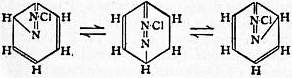
J. Cain (Jour. Chem. Soc., 1907, 91, p. 1049) suggested a quinonoid formula for diazonium salts, which has been combated by Hantzsch (Ber., 1908, 41, pp. 3532 et seq.). G. T. Morgan and F. M. G. Micklethwaite (Jour. Chem. Soc., 1908, 93, p. 617; 1909, 95, p. 1319) have pointed out that the salts may possess a dynamic formula, Cain’s representing the middle stage, thus:
Diazoamines.—The diazoamines, R·N2·NHR, may be prepared by the action of the primary and secondary amines on the diazonium salts, or by the action of nitrous acid on the free primary amine. In the latter reaction it is assumed that the isodiazohydroxide first formed is immediately attacked by a second molecule of the amine. They are yellow crystalline solids, which do not unite with acids. Nitrous acid converts them, in acid solution, into diazonium salts.
C6H5N2·NHC6H5 + 2HCl + HNO2 = 2C6H5N2Cl + 2H2O.
They are readily converted into the isomeric aminoazo compounds, either by standing in alcoholic solution, or by warming with a mixture of the parent base and its hydrochloride; the diazo group preferably going into the para-position to the amino group. When the para-position is occupied, the diazo group takes the ortho-position. H. Goldschmidt and R. U. Reinders (Ber., 1896, 29, p. 1369, 1899) have shown that the transformation is a monomolecular reaction, the velocity of transformation in moderately dilute solution being independent of the concentration, but proportional to the amount of the catalyst present (amine hydrochloride) and to the temperature. It has also been shown that when different salts of the amine are used, their catalytic influence varies in amount and is almost proportional to their degree of ionization in aqueous solution. Diazoaminobenzene, C6H5N2·NHC6H5, crystallizes in golden yellow laminae, which melt at 96° C. and explode at a slightly higher temperature. It is readily soluble in alcohol, ether and benzene. Concentrated hydrochloric acid converts it into chlorbenzene, aniline and nitrogen. Zinc dust and alcoholic acetic acid reduce it to aniline and phenylhydrazine.
Diazoimino compounds, R·N3, may be regarded as derivatives of azoimide (q.v.); they are formed by the action of ammonia on the diazoperbromides, or by the action of hydroxylamine on the diazonium sulphates (J. Mai, Ber., 1892, 25, p. 372; T. Curtius, Ber., 1893, 26, p. 1271). Diazobenzeneimide, C6H5N3, is a yellowish oil of stupefying odour. It boils at 59° C. (12 mm.), and explodes when heated. Concentrated hydrochloric acid decomposes it with formation of chloranilines and elimination of nitrogen, whilst on boiling with sulphuric acid it is converted into aminophenols.
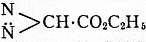
Aliphatic Diazo Compounds.—The esters of the aliphatic amino acids may be diazotized in a manner similar to the primary aromatic amines, a fact discovered by T. Curtius (Ber., 1833, 16, p. 2230). The first aliphatic diazo compound to be isolated was diazoacetic ester, CH·N2·CO2C2H5, which is prepared by the action of potassium nitrite on the ethyl ester of glycocoll hydrochloride, HCl·NH2·CH2·CO2C2H5 + KNO2 = CHN2·CO2C2H5 + KCl + 2H2O. It is a yellowish oil which melts at -24° C.; it boils at 143-144° C., but cannot be distilled safely as it decomposes violently, giving nitrogen and ethyl fumarate. It explodes in contact with concentrated sulphuric acid. On reduction it yields ammonia and glycocoll (aminoacetic acid). When heated with water it forms ethyl hydroxy-acetate; with alcohol it yields ethyl ethoxyacetate. Halogen acids convert it into monohalogen fatty acids, and the halogens themselves convert it into dihalogen fatty acids. It unites with aldehydes to form esters of ketonic acids, and with aniline yields anilido-acetic acid. It forms an addition product with acrylic ester, which on heating loses nitrogen and leaves trimethylene dicarboxylic ester. Concentrated ammonia converts it into diazoacetamide, CHN2·CONH2, which crystallizes in golden yellow plates which melt at 114° C. For other reactions see Hydrazine. The constitution of the diazo fatty esters is inferred from the fact that the two nitrogen atoms, when split off, are replaced by two monovalent elements or groups, thus leading to the formula for diazoacetic ester.
Diazosuccinic ester, N2·C(CO2C2H5)2, is similarly prepared by the action of nitrous acid on the hydrochloride of aspartic ester. It is decomposed by boiling water and yields fumaric ester.
Diazomethane, CH2N2, was first obtained in 1894 by H. v. Pechmann (Ber., 1894, 27, p. 1888; 1895, 28, p. 855). It is prepared by the action of aqueous or alcoholic solutions of the caustic alkalis on the nitroso-acidyl derivatives of methylamine (such, for example, as nitrosomethyl urethane, NO·N(CH3)·CO2C2H5, which is formed on passing nitrous fumes into an ethereal solution of methyl urethane). E. Bamberger (Ber., 1895, 28, p. 1682) regards it as the anhydride of iso-diazomethane, CH3·N:N·OH, and has prepared it by a method similar to that used for the preparation of iso-diazobenzene. By the action of bleaching powder on methylamine hydrochloride, there is obtained a volatile liquid (methyldichloramine, CH3·N·Cl2), boiling at 58-60° C., which explodes violently when heated with water, yielding hydrocyanic acid (CH3NCl2 = HCN + 2HCl). Well-dried hydroxylamine hydrochloride is dissolved in methyl alcohol and mixed with sodium methylate; a solution of methyldichloramine in absolute ether is then added and an ethereal solution of diazomethane distils over. Diazomethane is a yellow inodorous gas, very poisonous and corrosive. It may be condensed to a liquid, which boils at about 0° C. It is a powerful methylating agent, reacting with water to form methyl alcohol, and converting acetic acid into methylacetate, hydrochloric acid into methyl chloride, hydrocyanic acid into acetonitrile, and phenol into anisol, nitrogen being eliminated in each case. It is reduced by sodium amalgam (in alcoholic solution) to methylhydrazine, CH3·NH·NH2. It unites directly with acetylene to form pyrazole (H. v. Pechmann, Ber., 1898, 31, p. 2950) and with fumaric methyl ester it forms pyrazolin dicarboxylic ester.
(F. G. P.*)
See G. T. Morgan, B.A. Rep., 1902; J. Cain, Diazo Compounds, 1908.
DIAZOMATA (Gr. διάζωμα, a girdle), in architecture, the landing places and passages which were carried round the semicircle and separated the upper and lower tiers in a Greek theatre.
DIBDIN, CHARLES (1745-1814), British musician, dramatist, novelist, actor and song-writer, the son of a parish clerk, was born at Southampton on or before the 4th of March 1745, and was the youngest of a family of eighteen. His parents designing him for the church, he was sent to Winchester; but his love of music early diverted his thoughts from the clerical profession. After receiving some instruction from the organist of Winchester cathedral, where he was a chorister from 1756 to 1759, he went to London at the age of fifteen. Here he was placed in a music warehouse in Cheapside, but he soon abandoned this employment to become a singing actor at Covent Garden. On the 21st of May 1762 his first work, an operetta entitled The Shepherd’s Artifice, with words and music by himself, was produced at this theatre. Other works followed, his reputation being firmly established by the music to the play of The Padlock, produced at Drury Lane under Garrick’s management in 1768, the composer himself taking the part of Mungo with conspicuous success. He continued for some years to be connected with Drury Lane, both as composer and as actor, and produced during this period two of his best known works, The Waterman (1774) and The Quaker (1775). A quarrel with Garrick led to the termination of his engagement. In The Comic Mirror he ridiculed prominent contemporary figures through the medium of a puppet show. In 1782 he became joint manager of the Royal circus, afterwards known as the Surrey theatre. In three years he lost this position owing to a quarrel with his partner. His opera Liberty Hall, containing the successful songs “Jock Ratlin,” “The Highmettled Racer,” and “The Bells of Aberdovey,” was produced at Drury Lane theatre on the 8th of February 1785. In 1788 he sailed for the East Indies, but the vessel having put in to Torbay in stress of weather, he changed his mind and returned to London. In a musical variety entertainment called The Oddities, he succeeded in winning marked popularity with a number of songs that included “’Twas in the good ship ‘Rover’,” “Saturday Night at Sea,” “I sailed from the Downs in the ‘Nancy,’” and the immortal “Tom Bowling,” written on the death of his eldest brother, Captain Thomas Dibdin, at whose invitation he had planned his visit to India. A series of monodramatic entertainments which he gave at his theatre, Sans Souci, in Leicester Square, brought his songs, music and recitations more prominently into notice, and permanently established his fame as a lyric poet. It was at these entertainments that he first introduced many of those sea-songs which so powerfully influenced the national spirit. The words breathe the simple loyalty and dauntless courage that are the cardinal virtues of the British sailor, and the music was appropriate and naturally melodious. Their effect in stimulating and ennobling the spirit of the navy during the war with France was so marked as to call for special acknowledgment. In 1803 Dibdin was rewarded by government with a pension of £200 a year, of which he was only for a time deprived under the administration of Lord Grenville. During this period he opened a music shop in the Strand, but the venture was a failure. Dibdin died of paralysis in London on the 25th of July 1814. Besides his Musical Tour through England (1788), his Professional Life, an autobiography published in 1803, a History of the Stage (1795), and several smaller works, he wrote upwards of 1400 songs and about thirty dramatic pieces. He also wrote the following novels:—The Devil (1785); Hannah Hewitt (1792); The Younger Brother (1793). An edition of his songs by G. Hogarth (1843) contains a memoir of his life. His two sons, Charles and Thomas John Dibdin (q.v.), whose works are often confused with those of their father, were also popular dramatists in their day.
DIBDIN, THOMAS FROGNALL (1776-1847), English bibliographer, born at Calcutta in 1776, was the son of Thomas Dibdin, the sailor brother of Charles Dibdin. His father and mother both died on the way home to England in 1780, and Thomas was brought up by a maternal uncle. He was educated at St John’s College, Oxford, and studied for a time at Lincoln’s Inn. After an unsuccessful attempt to obtain practice as a provincial counsel at Worcester, he was ordained a clergyman at the close of 1804, being appointed to a curacy at Kensington. It was not until 1823 that he received the living of Exning in Sussex. Soon afterwards he was appointed by Lord Liverpool to the rectory of St Mary’s, Bryanston Square, which he held until his death on the 18th of November 1847. The first of his numerous bibliographical works was his Introduction to the Knowledge of Editions of the Classics (1802), which brought him under the notice of the third Earl Spencer, to whom he owed much important aid in his bibliographical pursuits. The rich library at Althorp was thrown open to him; he spent much of his time in it, and in 1814-1815 published his Bibliotheca Spenceriana. As the library was not open to the general public, the information given in the Bibliotheca was found very useful, but since its author was unable even to read the characters in which the books he described were written, the work was marred by the errors which more or less characterize all his productions. This fault of inaccuracy however was less obtrusive in his series of playful, discursive works in the form of dialogues on his favourite subject, the first of which, Bibliomania (1809), was republished with large additions in 1811, and was very popular, passing through numerous editions. To the same class belonged the Bibliographical Decameron, a larger work, which appeared in 1817. In 1810 he began the publication of a new and much extended edition of Ames’s Typographical Antiquities. The first volume was a great success, but the publication was checked by the failure of the fourth volume, and was never completed. In 1818 Dibdin was commissioned by Earl Spencer to purchase books for him on the continent, an expedition described in his sumptuous Bibliographical, Antiquarian and Picturesque Tour in France and Germany (1821). In 1824 he made an ambitious venture in his Library Companion, or the Young Man’s Guide and Old Man’s Comfort in the Choice of a Library, intended to point out the best works in all departments of literature. His culture was not broad enough, however, to render him competent for the task, and the work was severely criticized. For some years Dibdin gave himself up chiefly to religious literature. He returned to bibliography in his Bibliophobia, or Remarks on the Present Depression in the State of Literature and the Book Trade (1832), and the same subject furnishes the main interest of his Reminiscences of a Literary Life (1836), and his Bibliographical, Antiquarian and Picturesque Tour in the Northern Counties of England and Scotland (1838). Dibdin was the originator and vice-president, Lord Spencer being the president, of the Roxburghe Club, founded in 1812,—the first of the numerous book clubs which have done such service to literature.
DIBDIN, THOMAS JOHN (1771-1841), English dramatist and song-writer, son of Charles Dibdin, the song-writer, and of Mrs Davenet, an actress whose real name was Harriet Pitt, was born on the 21st of March 1771. He was apprenticed to his maternal uncle, a London upholsterer, and later to William Rawlins, afterwards sheriff of London. He summoned his second master unsuccessfully for rough treatment; and after a few years of service he ran away to join a company of country players. From 1789 to 1795 he played in all sorts of parts; he acted as scene painter at Liverpool in 1791; and during this period he composed more than 1000 songs. He made his first attempt as a dramatic writer in Something New, followed by The Mad Guardian in 1795. He returned to London in 1795, having married two years before; and in the winter of 1798-1799 his Jew and the Doctor was produced at Covent Garden. From this time he contributed a very large number of comedies, operas, farces, &c., to the public entertainment. Some of these brought immense popularity to the writer and immense profits to the theatres. It is stated that the pantomime of Mother Goose (1807) produced more than £20,000 for the management at Covent Garden theatre, and the High-mettled Racer, adapted as a pantomime from his father’s play, £18,000 at Astley’s. Dibdin was prompter and pantomime writer at Drury Lane until 1816, when he took the Surrey theatre. This venture proved disastrous and he became bankrupt. After this he was manager of the Haymarket, but without his old success, and his last years were passed in comparative poverty. In 1827 he published two volumes of Reminiscences; and at the time of his death he was preparing an edition of his father’s sea songs, for which a small sum was allowed him weekly by the lords of the admiralty. Of his own songs “The Oak Table” and “The Snug Little Island” are well-known examples. He died in London on the 16th of September 1841.
DIBRA (Slav. Debra), the capital of a sanjak bearing the same name, in the vilayet of Monastir, eastern Albania, Turkey. Pop. (1900) about 15,000. Dibra occupies a valley enclosed by mountains, and watered by the Tsrni Drin and Radika rivers, which meet 3 m. S. It is a fortified city, and the only episcopal see of the Bulgarian exarchate in Albania; most of the inhabitants are Albanians, but there is a strong Bulgarian colony. The local trade is almost entirely agricultural.
DIBRUGARH, a town of British India, in the Lakhimpur district of eastern Bengal and Assam, of which it is the headquarters, situated on the Dibru river about 4 m. above its confluence with the Brahmaputra. Pop. (1901) 11,227. It is the terminus of steamer navigation on the Brahmaputra, and also of a railway running to important coal-mines and petroleum wells, which connects with the Assam-Bengal system. Large quantities of coal and tea are exported. There are a military cantonment, the headquarters of the volunteer corps known as the Assam Valley Light Horse; a government high school, a training school for masters; and an aided school for girls. In 1900 a medical school for the province was established, out of a bequest left by Brigade-Surgeon J. Berry-White, which is maintained by the government, to train hospital assistants for the tea gardens. The Williamson artisan school is entirely supported by an endowment.
DICAEARCHUS, of Messene in Sicily, Peripatetic philosopher and pupil of Aristotle, historian, and geographer, flourished about 320 b.c. He was a friend of Theophrastus, to whom he dedicated the majority of his works. Of his writings, which comprised treatises on a great variety of subjects, only the titles and a few fragments survive. The most important of them was his βίος τῆς Έλλάδος (Life in Greece), in which the moral, political and social condition of the people was very fully discussed. In his Tripoliticos he described the best form of government as a mixture of monarchy, aristocracy and democracy, and illustrated it by the example of Sparta. Among the philosophical works of Dicaearchus may be mentioned the Lesbiaci, a dialogue in three books, in which the author endeavours to prove that the soul is mortal, to which he added a supplement called Corinthiaci. He also wrote a Description of the World illustrated by maps, in which was probably included his Measurements of Mountains. A description of Greece (150 iambics, in C. Müller, Frag. hist. Graec. i. 238-243) was formerly attributed to him, but, as the initial letters of the first twenty-three lines show, was really the work of Dionysius, son of Calliphon. Three considerable fragments of a prose description of Greece (Müller, i. 97-110) are now assigned to an unknown author named Heracleides. The De re publica of Cicero is supposed to be founded on one of Dicaearchus’s works.
The best edition of the fragments is by M. Fuhr (1841), a work of great learning; see also a dissertation by F. G. Osann, Beiträge zur röm. und griech. Litteratur, ii. pp. 1-117 (1839); Pauly-Wissowa, Realencyclopädie der klass. Altertumswiss. v. pt. 1 (1905).
DICE (plural of die, O. Fr. de, derived from Lat. dare, to give), small cubes of ivory, bone, wood or metal, used in gaming. The six sides of a die are each marked with a different number of incised dots in such a manner that the sum of the dots on any two opposite sides shall be 7. Dice seem always to have been employed, as is the case to-day, for gambling purposes, and they are also used in such games as backgammon. There are many methods of playing, from one to five dice being used, although two or three are the ordinary numbers employed in Great Britain and America. The dice are thrown upon a table or other smooth surface either from the hand or from a receptacle called a dice-box, the latter method having been in common use in Greece, Rome and the Orient in ancient times. Dice-boxes have been made in many shapes and of various materials, such as wood, leather, agate, crystal, metal or paper. Many contain bars within to ensure a proper agitation of the dice, and thus defeat trickery. Some, formerly used in England, were employed with unmarked dice, and allowed the cubes to fall through a kind of funnel upon a board marked off into six equal parts numbered from 1 to 6. It is a remarkable fact, that, wherever dice have been found, whether in the tombs of ancient Egypt, of classic Greece, or of the far East, they differ in no material respect from those in use to-day, the elongated ones with rounded ends found in Roman graves having been, not dice but tali, or knucklebones. Eight-sided dice have comparatively lately been introduced in France as aids to children in learning the multiplication table. The teetotum, or spinning die, used in many modern games, was known in ancient times in China and Japan. The increased popularity of the more elaborate forms of gaming has resulted in the decline of dicing. The usual method is to throw three times with three dice. If one or more sixes or fives are thrown the first time they may be reserved, the other throws being made with the dice that are left. The object is to throw three sixes = 18 or as near that number as possible, the highest throw winning, or, when drinks are to be paid for, the lowest throw losing. (For other methods of throwing consult the Encyclopaedia of Indoor Games, by R. F. Foster, 1903.) The most popular form of pure gambling with dice at the present day, particularly with the lower classes in America, is Craps, or Crap-Shooting, a simple form of Hazard, of French origin. Two dice are used. Each player puts up a stake and the first caster may cover any or all of the bets. He then shoots, i.e. throws the dice from his open hand upon the table. If the sum of the dice is 7 or 11 the throw is a nick, or natural, and the caster wins all stakes. If the throw is either 2, 3 or 12 it is a crap, and the caster loses all. If any other number is thrown it is a point, and the caster continues until he throws the same number again, in which case he wins, or a 7, in which case he loses. The now practically obsolete game of Hazard was much more complicated than Craps. (Consult The Game of Hazard Investigated, by George Lowbut.) Poker dice are marked with ace, king, queen, jack and ten-spot. Five are used and the object is, in three throws, to make pairs, triplets, full hands or fours and fives of a kind, five aces being the highest hand. Straights do not count. In throwing to decide the payment of drinks the usual method is called horse and horse, in which the highest throws retire, leaving the two lowest to decide the loser by the best two in three throws. Should each player win one throw both are said to be horse and horse, and the next throw determines the loser. The two last casters may also agree to sudden death, i.e. a single throw. Loaded dice, i.e. dice weighted slightly on the side of the lowest number, have been used by swindlers from the very earliest times to the present day, a fact proved by countless literary allusions. Modern dice are often rounded at the corners, which are otherwise apt to wear off irregularly.
History.—Dice were probably evolved from knucklebones. The antiquary Thomas Hyde, in his Syntagma, records his opinion that the game of “odd or even,” played with pebbles, is nearly coeval with the creation of man. It is almost impossible to trace clearly the development of dice as distinguished from knucklebones, on account of the confusing of the two games by the ancient writers. It is certain, however, that both were played in times antecedent to those of which we possess any written records. Sophocles, in a fragment, ascribed their invention to Palamedes, a Greek, who taught them to his countrymen during the siege of Troy, and who, according to Pausanias (on Corinth, xx.), made an offering of them on the altar of the temple of Fortune. Herodotus (Clio) relates that the Lydians, during a period of famine in the days of King Atys, invented dice, knucklebones and indeed all other games except chess. The fact that dice have been used throughout the Orient from time immemorial, as has been proved by excavations from ancient tombs, seems to point clearly to an Asiatic origin. Dicing is mentioned as an Indian game in the Rig-veda. In its primitive form knucklebones was essentially a game of skill, played by women and children, while dice were used for gambling, and it was doubtless the gambling spirit of the age which was responsible for the derivative form of knucklebones, in which four sides of the bones received different values, which were then counted, like dice. Gambling with three, sometimes two, dice (κύβοι) was a very popular form of amusement in Greece, especially with the upper classes, and was an almost invariable accompaniment to the symposium, or drinking banquet. The dice were cast from conical beakers, and the highest throw was three sixes, called Aphrodite, while the lowest, three aces, was called the dog. Both in Greece and Rome different modes of counting were in vogue. Roman dice were called tesserae from the Greek word for four, indicative of the four sides. The Romans were passionate gamblers, especially in the luxurious days of the Empire, and dicing was a favourite form, though it was forbidden except during the Saturnalia. The emperor Augustus wrote in a letter to Suetonius concerning a game that he had played with his friends: “Whoever threw a dog or a six paid a denarius to the bank for every die, and whoever threw a Venus (the highest) won everything.” In the houses of the rich the dice-beakers were of carved ivory and the dice of crystal inlaid with gold. Mark Antony wasted his time at Alexandria with dicing, while, according to Suetonius, the emperors Augustus, Nero and Claudius were passionately fond of it, the last named having written a book on the game. Caligula notoriously cheated at the game; Domitian played it, and Commodus set apart special rooms in his palace for it. The emperor Verus, adopted son of Antonine, is known to have thrown dice whole nights together. Fashionable society followed the lead of its emperors, and, in spite of the severity of the laws, fortunes were squandered at the dicing table. Horace derided the youth of the period, who wasted his time amid the dangers of dicing instead of taming his charger and giving himself up to the hardships of the chase. Throwing dice for money was the cause of many special laws in Rome, according to one of which no suit could be brought by a person who allowed gambling in his house, even if he had been cheated or assaulted. Professional gamblers were common, and some of their loaded dice are preserved in museums. The common public-houses were the resorts of gamblers, and a fresco is extant showing two quarrelling dicers being ejected by the indignant host. Virgil, in the Copa generally ascribed to him, characterizes the spirit of that age in verse, which has been Englished as follows:—
“What ho! Bring dice and good wine! Who cares for the morrow? Live—so calls grinning Death— Live, for I come to you soon!”
That the barbarians were also given to gaming, whether or not they learned it from their Roman conquerors, is proved by Tacitus, who states that the Germans were passionately fond of dicing, so much so, indeed, that, having lost everything, they would even stake their personal liberty. Centuries later, during the middle ages, dicing became the favourite pastime of the knights, and both dicing schools (scholae deciorum) and gilds of dicers existed. After the downfall of feudalism the famous German mercenaries called landsknechts established a reputation as the most notorious dicing gamblers of their time. Many of the dice of the period were curiously carved in the images of men and beasts. In France both knights and ladies were given to dicing, which repeated legislation, including interdictions on the part of St Louis in 1254 and 1256, did not abolish. In Japan, China, Korea, India and other Asiatic countries dice have always been popular and are so still.
See Foster’s Encyclopaedia of Indoor Games (1903); Raymond’s Illustriertes Knobelbrevier (Oranienburg, 1888); Les Jeux des Anciens, by L. Becq de Fouquières (Paris, 1869); Das Knöchelspiel der Alten, by Bolle (Wismar, 1886); Die Spiele der Griechen und Römer, by W. Richter (Leipzig, 1887); Raymond’s Alte und neue Würfelspiele; Chinese Games with Dice, by Stewart Culin (Philadelphia, 1889); Korean Games, by Stewart Culin (Philadelphia, 1895).
DICETO, RALPH DE (d. c. 1202), dean of St Paul’s, London, and chronicler, is first mentioned in 1152, when he received the archdeaconry of Middlesex. He was probably born between 1120 and 1130; of his parentage and nationality we know nothing. The common statement that he derived his surname from Diss in Norfolk is a mere conjecture; Dicetum may equally well be a Latinized form of Dissai, or Dicy, or Dizy, place names which are found in Maine, Picardy, Burgundy and Champagne. In 1152 Diceto was already a master of arts; presumably he had studied at Paris. His reputation for learning and integrity stood high; he was regarded with respect and favour by Arnulf of Lisieux and Gilbert Foliot of Hereford (afterwards of London), two of the most eminent bishops of their time. Quite naturally, the archdeacon took in the Becket question the same side as his friends. Although his narrative is colourless, and although he was one of those who showed some sympathy for Becket at the council of Northampton (1164), the correspondence of Diceto shows that he regarded the archbishop’s conduct as ill-considered, and that he gave advice to those whom Becket regarded as his chief enemies. Diceto was selected, in 1166, as the envoy of the English bishops when they protested against the excommunications launched by Becket. But, apart from this episode, which he characteristically omits to record, he remained in the background. The natural impartiality of his intellect was accentuated by a certain timidity, which is apparent in his writings no less than in his life. About 1180 he became dean of St Paul’s. In this office he distinguished himself by careful management of the estates, by restoring the discipline of the chapter, and by building at his own expense a deanery-house. A scholar and a man of considerable erudition, he showed a strong preference for historical studies; and about the time when he was preferred to the deanery he began to collect materials for the history of his own times. His friendships with Richard Fitz Nigel, who succeeded Foliot in the see of London, with William Longchamp, the chancellor of Richard I., and with Walter of Coutances, the archbishop of Rouen, gave him excellent opportunities of collecting information. His two chief works, the Abbreviationes Chronicorum and the Ymagines Historiarum, cover the history of the world from the birth of Christ to the year 1202. The former, which ends in 1147, is a work of learning and industry, but almost entirely based upon extant sources. The latter, beginning as a compilation from Robert de Monte and the letters of Foliot, becomes an original authority about 1172, and a contemporary record about 1181. In precision and fulness of detail the Ymagines are inferior to the chronicles of the so-called Benedict and of Hoveden. Though an annalist, Diceto is careless in his chronology; and the documents which he incorporates, while often important, are selected on no principle. He has little sense of style; but displays considerable insight when he ventures to discuss a political situation. For this reason, and on account of the details with which they supplement the more important chronicles of the period, the Ymagines are a valuable though a secondary source.
See W. Stubbs’ edition of the Historical Works of Diceto (Rolls ed. 1876, 2 vols.), and especially the introduction. The second volume contains minor works which are the barest compendia of facts taken from well-known sources. Diceto’s fragmentary Domesday of the capitular estates has been edited by Archdeacon Hale in The Domesday of St Paul’s, pp. 109 ff. (Camden Society, 1858).
DICEY, EDWARD (1832- ), English writer, son of T. E. Dicey of Claybrook Hall, Leicestershire, was born in 1832. Educated at Trinity College, Cambridge, where he took mathematical and classical honours, he became an active journalist, contributing largely to the principal reviews. He was called to the bar in 1875, became a bencher of Gray’s Inn in 1896, and was treasurer in 1903-1904. He was connected with the Daily Telegraph as leader writer and then as special correspondent, and after a short spell in 1870 as editor of the Daily News he became editor of the Observer, a position which he held until 1889. Of his many books on foreign affairs perhaps the most important are his England and Egypt (1884), Bulgaria, the Peasant State (1895), The Story of the Khedivate (1902), and The Egypt of the Future (1907). He was created C.B. in 1886.
His brother Albert Venn Dicey (b. 1835), English jurist, was educated at Balliol College, Oxford, where he took a first class in the classical schools in 1858. He was called to the bar at the Inner Temple in 1863. He held fellowships successively at Balliol, Trinity and All Souls’, and from 1882 to 1909 was Vinerian professor of law. He became Q.C. in 1890. His chief works are the Introduction to the Study of the Law of the Constitution (1885, 6th ed. 1902), which ranks as a standard work on the subject; England’s Case against Home Rule (1886); A Digest of the Law of England with Reference to the Conflict of Laws (1896), and Lectures on the Relation between Law and Public Opinion in England during the 19th century (1905).
DICHOTOMY (Gr. δίχα, apart, τέμνειν, to cut), literally a cutting asunder, the technical term for a form of logical division, consisting in the separation of a genus into two species, one of which has and the other has not, a certain quality or attribute. Thus men may be thus divided into white men, and men who are not white; each of these may be subdivided similarly. On the principle of contradiction this division is both exhaustive and exclusive; there can be no overlapping, and no members of the original genus or the lower groups are omitted. This method of classification, though formally accurate, has slight value in the exact sciences, partly because at every step one of the two groups is merely negatively characterized and therefore incapable of real subdivision; it is useful, however, in setting forth clearly the gradual descent from the most inclusive genus (summum genus) through species to the lowest class (infima species), which is divisible only into individual persons or things. (See further Division.) In astronomy the term is used for the aspect of the moon or of a planet when apparently half illuminated, so that its disk has the form of a semicircle.
DICK, ROBERT (1811-1866), Scottish geologist and botanist, was born at Tullibody, in Clackmannanshire, in January 1811. His father was an officer of excise. At the age of thirteen, after receiving a good elementary education at the parish school, Robert Dick was apprenticed to a baker, and served for three years. In these early days he became interested in wild flowers—he made a collection of plants and gradually acquired some knowledge of their names from an old encyclopaedia. When his time was out he left Tullibody and gained employment as a journeyman baker at Leith, Glasgow and Greenock. Meanwhile his father, who in 1826 had been removed to Thurso, as supervisor of excise, advised his son to set up a baker’s shop in that town. Thither Robert Dick went in 1830, he started in business as a baker and worked laboriously until he died on the 24th of December 1866. Throughout this period he zealously devoted himself to studying and collecting the plants, mollusca and insects of a wide area of Caithness, and his attention was directed soon after he settled in Thurso to the rocks and fossils. In 1835 he first found remains of fossil fishes; but it was not till some years later that his interest became greatly stirred. Then he obtained a copy of Hugh Miller’s Old Red Sandstone (published in 1841), and he began systematically to collect with hammer and chisel the fossils from the Caithness flags. In 1845 he found remains of Holoptychius and forwarded specimens to Hugh Miller, and he continued to send the best of his fossil fishes to that geologist, and to others after the death of Miller. In this way he largely contributed to the progress of geological knowledge, although he himself published nothing and was ever averse from publicity. His herbarium, which consisted of about 200 folios of mosses, ferns and flowering plants “almost unique in its completeness,” is now stored, with many of his fossils, in the museum at Thurso. Dick had a hard struggle for existence, especially through competition during his late years, when he was reduced almost to beggary: but of this few, if any, of his friends were aware until it was too late. A monument erected in the new cemetery at Thurso testifies to the respect which his life-work created, when the merits of this enthusiastic naturalist came to be appreciated.
See Robert Dick, Baker of Thurso, Geologist and Botanist, by Samuel Smiles (1878).
DICK, THOMAS (1774-1857), Scottish writer on astronomy, was born at Dundee on the 24th of November 1774. The appearance of a brilliant meteor inspired him, when in his ninth year, with a passion for astronomy; and at the age of sixteen he forsook the loom, and supported himself by teaching. In 1794 he entered the university of Edinburgh, and set up a school on the termination of his course; then, in 1801, took out a licence to preach, and officiated for some years as probationer in the United Presbyterian church. From about 1807 to 1817 he taught in the secession school at Methven in Perthshire, and during the ensuing decade in that of Perth, where he composed his first substantive book, The Christian Philosopher (1823, 8th ed. 1842). Its success determined his vocation as an author; he built himself, in 1827, a cottage at Broughty Ferry, near Dundee, and devoted himself wholly to literary and scientific pursuits. They proved, however, owing to his unpractical turn of mind, but slightly remunerative, and he was in 1847 relieved from actual poverty by a crown pension of £50 a year, eked out by a local subscription. He died on the 29th of July 1857. His best-known works are: Celestial Scenery (1837), The Sidereal Heavens (1840), and The Practical Astronomer (1845), in which is contained (p. 204) a remarkable forecast of the powers and uses of celestial photography. Written with competent knowledge, and in an agreeable style, they obtained deserved and widespread popularity.
See R. Chambers’s Eminent Scotsmen (ed. 1868); Monthly Notices Roy. Astr. Society, xviii. 98; Athenaeum (1857), p. 1008.
(A. M. C.)
DICKENS, CHARLES JOHN HUFFAM (1812-1870), English novelist, was born on the 7th of February 1812 at a house in the Mile End Terrace, Commercial Road, Landport (Portsea)—a house which was opened as a Dickens Museum on 22nd July 1904. His father John Dickens (d. 1851), a clerk in the navy-pay office on a salary of £80 a year, and stationed for the time being at Portsmouth, had married in 1809 Elizabeth, daughter of Thomas Barrow, and she bore him a family of eight children, Charles being the second. In the winter of 1814 the family moved from Portsea in the snow, as he remembered, to London, and lodged for a time near the Middlesex hospital. The country of the novelist’s childhood, however, was the kingdom of Kent, where the family was established in proximity to the dockyard at Chatham from 1816 to 1821. He looked upon himself in later years as a man of Kent, and his capital abode as that in Ordnance Terrace, or 18 St Mary’s Place, Chatham, amid surroundings classified in Mr Pickwick’s notes as “appearing” to be soldiers, sailors, Jews, chalk, shrimps, officers and dockyard men. He fell into a family the general tendency of which was to go down in the world, during one of its easier periods (John Dickens was now fifth clerk on £250 a year), and he always regarded himself as belonging by right to a comfortable, genteel, lower middle-class stratum of society. His mother taught him to read; to his father he appeared very early in the light of a young prodigy, and by him Charles was made to sit on a tall chair and warble popular ballads, or even to tell stories and anecdotes for the benefit of fellow-clerks in the office. John Dickens, however, had a small collection of books which were kept in a little room upstairs that led out of Charles’s own, and in this attic the boy found his true literary instructors in Roderick Random, Peregrine Pickle, Humphry Clinker, Tom Jones, The Vicar of Wakefield, Don Quixote, Gil Blas and Robinson Crusoe. The story of how he played at the characters in these books and sustained his idea of Roderick Random for a month at a stretch is picturesquely told in David Copperfield. Here as well as in his first and last books and in what many regard as his best, Great Expectations, Dickens returns with unabated fondness and mastery to the surroundings of his childhood. From seven to nine years he was at a school kept in Clover Lane, Chatham, by a Baptist minister named William Giles, who gave him Goldsmith’s Bee as a keepsake when the call to Somerset House necessitated the removal of the family from Rochester to a shabby house in Bayham Street, Camden Town. At the very moment when a consciousness of capacity was beginning to plump his youthful ambitions, the whole flattering dream vanished and left not a rack behind. Happiness and Chatham had been left behind together, and Charles was about to enter a school far sterner and also far more instructive than that in Clover Lane. The family income had been first decreased and then mortgaged; the creditors of the “prodigal father” would not give him time; John Dickens was consigned to the Marshalsea; Mrs Dickens started an “Educational Establishment” as a forlorn hope in Upper Gower Street; and Charles, who had helped his mother with the children, blacked the boots, carried things to the pawnshop and done other menial work, was now sent out to earn his own living as a young hand in a blacking warehouse, at Old Hungerford Stairs, on a salary of six shillings a week. He tied, trimmed and labelled blacking pots for over a year, dining off a saveloy and a slice of pudding, consorting with two very rough boys, Bob Fagin and Pol Green, and sleeping in an attic in Little College Street, Camden Town, in the house of Mrs Roylance (Pipchin), while on Sunday he spent the day with his parents in their comfortable prison, where they had the services of a “marchioness” imported from the Chatham workhouse.