VOLUME VII SLICE VI Coucy-le-Château to Crocodile (continued 8)
Reading edition
See Lord Lindsay (25th earl of Crawford), Lives of the Lindsays (1849); A. Jervise, History and Traditions of the Land of the Lindsays (1882); G. E. C(okayne), Complete Peerage (1887-1898); H. T. Folkard, A Lindsay Record (1899); and Sir J. B. Paul’s edition of the Scots Peerage of Sir R. Douglas, vol. iii. (1906).
CRAWFORD, FRANCIS MARION (1854-1909), American author, was born at Bagni di Lucca, Italy, on the 2nd of August 1854, being the son of the American sculptor Thomas Crawford (q.v.), and the nephew of Julia Ward Howe, the American poet. He studied successively at St Paul’s school, Concord, New Hampshire; Cambridge University; Heidelberg; and Rome. In 1879 he went to India, where he studied Sanskrit and edited the Allahabad Indian Herald. Returning to America he continued to study Sanskrit at Harvard University for a year, contributed to various periodicals, and in 1882 produced his first novel, Mr Isaacs, a brilliant sketch of modern Anglo-Indian life mingled with a touch of Oriental mystery. This book had an immediate success, and its author’s promise was confirmed by the publication of Dr Claudius (1883). After a brief residence in New York and Boston, in 1883 he returned to Italy, where he made his permanent home. This accounts perhaps for the fact that, in spite of his nationality, Marion Crawford’s books stand apart from any distinctively American current in literature. Year by year he published a number of successful novels: A Roman Singer (1884), An American Politician (1884), To Leeward (1884), Zoroaster (1885), A Tale of a Lonely Parish (1886), Marzio’s Crucifix (1887), Saracinesca (1887), Paul Patoff (1887), With the Immortals (1888), Greifenstein (1889), Sant’ Ilario (1889), A Cigarette-maker’s Romance (1890), Khaled (1891), The Witch of Prague (1891), The Three Fates (1892), The Children of the King (1892), Don Orsino (1892), Marion Darche (1893), Pietro Ghisleri (1893), Katharine Lauderdale (1894), Love in Idleness (1894), The Ralstons, (1894), Casa Braccio (1895), Adam Johnston’s Son (1895), Taquisara (1896), A Rose of Yesterday (1897), Corleone (1897), Via Crucis (1899), In the Palace of the King (1900), Marietta (1901), Cecilia (1902), Whosoever Shall Offend (1904), Soprano (1905), A Lady of Rome (1906). He also published the historical works, Ave Roma Immortalis (1898), Rulers of the South (1900)—renamed Sicily, Calabria and Malta in 1904,—and Gleanings from Venetian History (1905). In these his intimate knowledge of local Italian history combines with the romancist’s imaginative faculty to excellent effect. But his place in contemporary literature depends on his novels. He was a gifted narrator, and his books of fiction, full of historic vitality and dramatic characterization, became widely popular among readers to whom the realism of “problems” or the eccentricities of subjective analysis were repellent, for he could unfold a romantic story in an attractive way, setting his plot amid picturesque surroundings, and gratifying the reader’s intelligence by a style at once straightforward and accomplished. The Saracinesca series shows him perhaps at his best. A Cigarette-maker’s Romance was dramatized, and had considerable popularity on the stage as well as in its novel form; and in 1902 an original play from his pen, Francesco da Rimini, was produced in Paris by Sarah Bernhardt. He died at Sorrento on the 9th of April 1909.
CRAWFORD, THOMAS (1814-1857), American sculptor, was born of Irish parents in New York on the 22nd of March 1814. He showed at an early age great taste for art, and learnt to draw and to carve in wood. In his nineteenth year he entered the studio of a firm of monumental sculptors in his native city; and in the summer of 1835 he went to Rome and became a pupil of Thorwaldsen. The first work which made him generally known as a man of genius was his group of “Orpheus entering Hades in Search of Eurydice,” executed in 1839. This was followed by other poetical sculptures, among which were the “Babes in the Wood,” “Flora,” “Hebe and Ganymede,” “Sappho,” “Vesta,” the “Dancers,” and the “Hunter.” Among his statues and busts are especially noteworthy the bust of Josiah Quincy, executed for Harvard University (now in the Boston Athenaeum), the equestrian statue of Washington at Richmond, Virginia, the statue of Beethoven in the Boston music hall, statues of Channing and Henry Clay, and the colossal figure of “Armed Liberty” for the Capitol at Washington. For this building he executed also the figures for the pediment and began the bas-reliefs for the bronze doors, which were afterwards completed by W. H. Rinehart. The groups of the pediment symbolize the progress of civilization in America. Crawford’s works include a large number of bas-reliefs of Scriptural subjects taken from both the Old and the New Testaments. He made Rome his home, but he visited several times his native land—first in 1844 (in which year he married Louisa Ward), next in 1849, and lastly in 1856. He died in London on the 10th of October 1857.
See Das Lincoln Monument, eine Rede des Senator Charles Sumner, to which are appended the biographies of several sculptors, including that of Thomas Crawford (Frankfort a. M., 1868); Thomas Hicks, Eulogy on Thomas Crawford (New York, 1865).
CRAWFORD, WILLIAM HARRIS (1772-1834), American statesman, was born in Amherst county, Virginia, on the 24th of February 1772. When he was seven his parents moved into Edgefield district, South Carolina, and four years later into Columbus county, Georgia. The death of his father in 1788 left the family in reduced circumstances, and William made what he could by teaching school for six years. He then studied at Carmel Academy for two years, was principal, for a time, of one of the largest schools in Augusta, and in 1798 was admitted to the bar. From 1800 to 1802, with Horatio Marbury, he prepared a digest of the laws of Georgia from 1755 to 1800. From 1803 to 1807 he was a member of the State House of Representatives, becoming during this period the leader of one of two personal-political factions in the state that long continued in bitter strife, occasioning his fighting two duels, in one of which he killed his antagonist, and in the other was wounded in his wrist. From 1807 to 1813 he was a member of the United States Senate, of which he was president pro tempore from March 1812 to March 1813. In 1813 he declined the offer of the post of secretary of war, but from that year until 1815 was minister to the court of France. He was then secretary of war in 1815-1816, and secretary of the treasury from 1816 to 1825. In 1816 in the congressional caucus which nominated James Monroe for the presidency Crawford was a strong opposing candidate, a majority being at first in his favour, but when the vote was finally cast 65 were for Monroe and 54 for Crawford. In 1824, when the congressional caucus was fast becoming extinct, Crawford, being prepared to control it, insisted that it should be held, but of 216 Republicans only 66 attended; of these, 64 voted for Crawford. Three other candidates, however, Andrew Jackson, John Quincy Adams, and Henry Clay, were otherwise put in the field. During the campaign Crawford was stricken with paralysis, and when the electoral vote was cast Jackson received 99, Adams 84, Crawford 41, and Clay 37. It remained for the house of representatives to choose from Jackson, Adams and Crawford, and through Clay’s influence Adams became president. Crawford was invited by Adams to continue as secretary of the treasury, but declined. He recovered his health sufficiently to become (in 1827) a circuit judge in his own state, but died while on circuit, in Elberton, Georgia, on the 15th of September 1834. In his day he was undoubtedly one of the foremost political leaders of the country, but his reputation has not stood the test of time. He was of imposing presence and had great conversational powers; but his inflexible integrity was not sufficiently tempered by tact and civility to admit of his winning general popularity. Consequently, although a skilful political organizer, he incurred the bitter enmity of other leaders of his time—Jackson, Adams and Calhoun. He won the admiration of Albert Gallatin and others by his powerful support of the movement in 1811 to recharter the Bank of the United States; he earned the condemnation of posterity by his authorship in 1820 of the four-years-term law, which limited the term of service of thousands of public officials to four years, and did much to develop the “spoils system.” He was a Liberal Democrat, and advised the calling of a constitutional convention as preferable to nullification or secession.
CRAWFORDSVILLE, a city and the county-seat of Montgomery county, Indiana, U.S.A., situated about 40 m. N.W. of Indianapolis. Pop. (1890) 6089; (1900) 6649, including 230 negroes and 221 foreign-born; (1910) 9371. It is served by the Chicago, Indianapolis & Louisville, the Cleveland, Cincinnati, Chicago & St Louis, and the Vandalia railways, and by interurban electric lines. Wabash College, founded here in 1832 by Presbyterian missionaries but now non-sectarian, had in 1908 27 instructors, 345 students, and a library of 43,000 volumes. Among manufactures are flour, iron, wagons and carriages, acetylene lights, wire and nails, matches, brick paving blocks, and electrical machinery. North-east of the city there are valuable mineral springs, from which the city obtains its water-supply. Crawfordsville, named in honour of W. H. Crawford, was first settled about 1820, was laid out as a town in 1823, and was chartered as a city in 1863. It was for many years the home of Gen. Lew Wallace.
CRAWFURD, JOHN (1783-1868), Scottish orientalist, was born in the island of Islay, Scotland, on the 13th of August 1783. After studying at Edinburgh he became surgeon in the East India Company’s service. He afterwards resided for some time at Penang, and during the British occupation of Java from 1811 to 1817 his local knowledge made him invaluable to the government. In 1821 he served as envoy to Siam and Cochin-China, and in 1823 became governor of Singapore. His last political service in the East was a difficult mission to Burma in 1827. In 1861 he was elected president of the Ethnological Society. He died at South Kensington on the 11th of May 1868.
Crawfurd wrote a History of the Indian Archipelago (1820), Descriptive Dictionary of the Indian Islands and Adjacent Countries (1856), Journal of an Embassy to the Court of Ava in 1827 (1829), Journal of an Embassy to the Courts of Siam and Cochin-China, exhibiting a view of the actual State of these Kingdoms (1830), Inquiry into the System of Taxation in India, Letters on the Interior of India, an attack on the newspaper stamp-tax and the duty on paper entitled Taxes on Knowledge (1836), and a valuable Malay grammar and dictionary (1852).
CRAYER, GASPARD DE (1582-1669), Flemish painter, was born at Antwerp, and learnt the art of painting from Raphael Coxcie. He matriculated in the guild of St Luke at Brussels in 1607, resided in the capital of Brabant till after 1660, and finally settled at Ghent. Amongst the numerous pictures which he painted in Ghent, one in the town museum represents the martyrdom of St Blaise, and bears the inscription A° 1668 aet. 86. Crayer was one of the most productive yet one of the most conscientious artists of the later Flemish school, second to Rubens in vigour and below Vandyck in refinement, but nearly equalling both in most of the essentials of painting. He was well known and always well treated by Albert and Isabella, governors of the Netherlands. The cardinal-infant Ferdinand made him a court-painter. His pictures abound in the churches and museums of Brussels and Ghent; and there is scarcely a country chapel in Flanders or Brabant that cannot boast of one or more of his canvases. But he was equally respected beyond his native country; and some important pictures of his composition are to be found as far south as Aix in Provence and as far east as Amberg in the Upper Palatinate. His skill as a decorative artist is shown in the panels executed for a triumphal arch at the entry of Cardinal Ferdinand into the Flemish capital, some of which are publicly exhibited in the museum of Ghent. Crayer died at Ghent. His best works are the “Miraculous Draught of Fishes” in the gallery of Brussels, the “Judgment of Solomon” in the gallery of Ghent, and “Madonnas with Saints” in the Louvre, the Munich Pinakothek, and the Belvedere at Vienna. His portrait by Vandyck was engraved by P. Pontius.
CRAYFISH (Fr. écrevisse), the name of freshwater crustaceans closely allied to and resembling the lobsters, and, like them, belonging to the order Macrura. They are divided into two families, the Astacidae and Parastacidae, inhabiting respectively the northern and the southern hemispheres.
The crayfishes of England and Ireland (Astacus, or Potamobius, pallipes) are generally about 3 or 4 in. long, of a dull green or brownish colour above and paler brown or yellowish below. They are abundant in some rivers, especially where the rocks are of a calcareous nature, sheltering under stones or in burrows which they dig for themselves in the banks and coming out at night in search of food. They are omnivorous feeders, killing and eating insects, snails, frogs and other animals, and devouring any carrion that comes in their way. It is stated that they sometimes come on land in search of vegetable food.
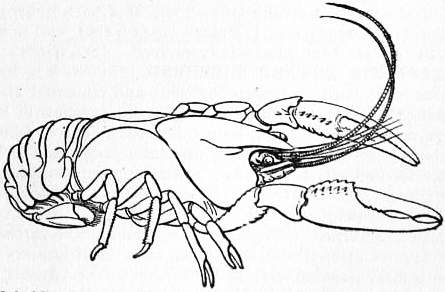
Crayfish (Cambarus sp.) from the Mississippi River. (After Morse.)
On the continent of Europe, Astacus pallipes occurs chiefly in the west and south, being found in France, Spain, Italy and the Balkan Peninsula. It is known in France as écrevisse à pattes blanches and in Germany as Steinkrebs, and is little used as food. The larger Astacus fluviatilis (écrevisse à pattes rouges, Edelkrebs) is not found in Britain, but occurs in France and Germany, southern Sweden, Russia, &c. It is distinguished, among other characters, by the red colour of the under side of the large claws. It is the species most highly esteemed for the table. Other species of the genus are found in central and eastern Europe and as far east as Turkestan. Farther east a gap occurs in the distribution and no crayfishes are met with till the basin of the Amur is reached, where a group of species occurs, extending into northern Japan. In North America, west of the Rocky Mountains, the genus Astacus again appears, but east of the watershed it is replaced by the genus Cambarus, which is represented by very numerous species, ranging from the Great Lakes to Mexico. Several blind species inhabit the subterranean waters of caves. The best known is Cambarus pellucidus, found in the Mammoth Cave of Kentucky.
The area of distribution occupied by the southern crayfishes or Parastacidae is separated by a broad equatorial zone from that of the northern group, unless, as has been asserted, the two come into contact or overlap in Central America. None is found in any part of Africa, though a species occurs in Madagascar. They are absent also from the oriental region of zoologists, but reappear in Australia and New Zealand. Some of the Australian species, such as the “Murray River lobster” (Astacopsis spinifer), are of large size and are used for food. In South America crayfishes are found in southern Brazil, Argentina and Chile.
(W. T. Ca.)
CRAYON (Fr. craie, chalk, from Lat. creta), a coloured material for drawing, employed generally in the form of pencils, but sometimes also as a powder, and consisting of native earthy and stony friable substances, or of artificially prepared mixtures of a base of pipe or china clay with Prussian blue, orpiment, vermilion, umber and other pigments. Calcined gypsum, talc and compounds of magnesium, bismuth and lead are occasionally used as bases. The required shades of tints are obtained by adding varying amounts of colouring matter to equal quantities of the base. Crayons are used by the artist to make groupings of colours and to secure landscape and other effects with ease and rapidity. The outline as well as the rest of the picture is drawn in crayon. The colours are softened off and blended by the finger, with the assistance of a stump of leather or paper; and shading is produced by cross-hatching and stippling. The art of painting in crayon or pastel is supposed to have originated in Germany in the 17th century. By Johann Alexander Thiele (1685-1752) it was carried to great perfection, and in France it was early practised with much success. Amongst the earlier pastellists may be mentioned Rosalba Carriera (1675-1757), W. Hoare (1707-1792), F. Cotes (1726-1770), and J. Russell (1744-1806); and in recent years the art has been successfully revived. (See Pastel.)
CREASY, SIR EDWARD SHEPHERD (1812-1878), English historian, was born at Bexley in Kent, and educated at Eton and King’s College, Cambridge. He became a fellow of King’s College in 1834, and having been called to the bar at Lincoln’s Inn three years later, was made assistant judge at the Westminster sessions court. In 1840 he was appointed professor of modern and ancient history in the university of London, and in 1860 became chief justice of Ceylon and a knight. Broken down in health he returned to England in 1870, and after a further but short stay in Ceylon died in London on the 27th of January 1878. Creasy’s most popular work is his Fifteen decisive Battles of the World, which, first published in 1851, has passed through many editions. He also wrote The History of the Ottoman Turks (London, 1854-1856); History of England (London, 1869-1870); Rise and Progress of the English Constitution (London, 1853, and other editions); Historical and Critical Account of the several Invasions of England (London, 1852); a novel entitled Old Love and the New (London, 1870); and various other works.
CREATIANISM AND TRADUCIANISM. Traducianism is the doctrine about the origin of the soul which was taught by Tertullian in his De anima—that souls are generated from souls in the same way and at the same time as bodies from bodies: creatianism is the doctrine that God creates a soul for each body that is generated. The Pelagians taunted the upholders of original sin with holding Tertullian’s opinion, and called them Traduciani (from tradux: vid. Du Cange s. vv.), a name which was perhaps suggested by a metaphor in De an. 19, where the soul is described “velut surculus quidam ex matrice Adam in propaginem deducta.” Hence we have formed “traducianist,” “traducianism,” and by analogy “creatianist,” “creatianism.” Augustine denied that traducianism was necessarily connected with the doctrine of original sin, and to the end of his life was unable to decide for or against it. His letter to Jerome (Epist. Clas. iii. 166) is a most valuable statement of his difficulties. Jerome condemned it, and said that creatianism was the opinion of the Church, though he admitted that most of the Western Christians held traducianism. The question has never been authoritatively determined, but creatianism, which had always prevailed in the East, became the general opinion of the medieval theologians, and Peter Lombard’s creando infundit animas Deus et infundendo creat was an accepted formula. Luther, like Augustine, was undecided, but Lutherans have as a rule been traducianists. Calvin favoured creatianism.
Peter Lombard’s phrase perhaps shows that even in his time it was felt that some union of the two opinions was needed, and Augustine’s toleration pointed in the same direction, for the traducianism he thought possible was one in which God operatur institutas administrando non novas instituendo naturas (Ep. 166. 5. 11). Modern psychologists teach that while “personality” can be discerned in its “becoming,” nothing is known of its origin. Lotze, however, who may be taken as representing the believers in the immanence of the divine Being, puts forth—but as a “dim conjecture”—something very like creatianism (Microcosmus, bk. iii. chap. v. ad fin.). It is still, as in the days of Augustine, a question whether a more exact division of man into body, soul and spirit may help to throw light on this subject.
See indices to Augustine, vol. xi., and Jerome, vol. xi. in Migne’s Patrologia, s.v. “Anima”; Franz Delitzsch, Biblical Psychology, ii. § 7; G. P. Fisher, History of Chr. Doct. pp. 187 ff.; A. Harnack, History of Dogma (passim; see Index); Liddon, Elements of Religion, Lect. iii.; Mason, Faith of the Gospel, iv. §§ 3, 4, 9, 10.
(A. N.*)
CRÉBILLON, PROSPER JOLYOT DE (1674-1762), French tragic poet, was born on the 13th of January 1674 at Dijon, where his father, Melchior Jolyot, was notary-royal. Having been educated at the Jesuits’ school of the town, and at the Collège Mazarin, he became an advocate, and was placed in the office of a lawyer named Prieur at Paris. With the encouragement of his master, son of an old friend of Scarron’s, he produced a Mort des enfants de Brutus, which, however, he failed to bring upon the stage. But in 1705 he succeeded with Idoménée; in 1707 his Atrée et Thyeste was repeatedly acted at court; Électre appeared in 1709; and in 1711 he produced his finest play, the Rhadamiste et Zénobie, which is his masterpiece and held the stage for a long period, although the plot is so complicated as to be almost incomprehensible. But his Xerxes (1714) was only once played, and his Sémiramis (1717) was an absolute failure. In 1707 Crébillon had married a girl without fortune, who had since died, leaving him two young children. His father also had died, insolvent. His three years’ attendance at court had been fruitless. Envy had circulated innumerable slanders against him. Oppressed with melancholy, he removed to a garret, where he surrounded himself with a number of dogs, cats and ravens, which he had befriended; he became utterly careless of cleanliness or food, and solaced himself with constant smoking. But in 1731, in spite of his long seclusion, he was elected member of the French Academy; in 1735 he was appointed royal censor; and in 1745 Mme de Pompadour presented him with a pension of 1000 francs and a post in the royal library. He returned to the stage in 1726 with a successful play, Pyrrhus; in 1748 his Catilina was played with great success before the court; and in 1754, when he was eighty years old, appeared his last tragedy, Le Triumvirat. Crébillon died on the 17th of June 1754. The enemies of Voltaire maintained that Crébillon was his superior as a tragic poet. The spirit of rivalry thus provoked induced Voltaire to take the subjects of no less than five of Crébillon’s tragedies—Sémiramis, Électre, Catilina, Le Triumvirat, Atrée—as subjects for tragedies of his own. The so-called Éloge de Crébillon (1762), really a depreciation, which appeared in the year of the poet’s death, is generally attributed to Voltaire, though he strenuously denied the authorship. Crébillon’s drama is marked by a force too often gained at the expense of scenes of unnatural horror; his pieces show lack of culture and a want of care which displays itself even in the mechanism of his verse, though fine isolated passages are not infrequent.
There are numerous editions of his works, among which may be noticed: Œuvres (1772), with preface and “éloge,” by Joseph de la Porte; Œuvres (1828), containing D’Alembert’s Éloge de Crébillon (1775); and Théâtre complet (1885) with a notice by Auguste Vitu. A complete bibliography is given by Maurice Dutrait, in his Étude sur la vie et le théâtre de Crébillon (1895).
His only son, Claude Prosper Jolyot Crébillon (1707-1777), French novelist, was born at Paris on the 14th of February 1707. His life was spent almost entirely in Paris, but the publication of L’Écumoire, ou Tanzaï et Neadarné, histoire japonaise (1734), which contained veiled attacks on the bull Unigenitus, the cardinal de Rohan and the duchesse du Maine, brought Crébillon into disgrace. He was first imprisoned and afterwards forced to live in exile for five years at Sens and elsewhere. With Alexis Piron and Charles Collé he founded in 1752 the gay society which met regularly to dine at the famous “Caveau,” where many good stories were elaborated. From 1759 onwards he was to be found at the Wednesday dinners of the Pelletier, at which Garrick, Sterne and Wilkes were sometimes guests. He married in 1748 an English lady of noble family, Lady Henrietta Maria Stafford, who had been his mistress from 1744. Their life is said to have been passed in much affection and mutual fidelity; and there could be no greater contrast than that between Crébillon’s private life and the tone of his novels, the immorality of which lent irony to the author’s tenure of the office of censor, bestowed on him in 1759 through the favour of Mme de Pompadour. He died in Paris on the 12th of April 1777. The most famous of his numerous novels are: Les Amours de Zéokinizul, roi des Kofirans (1740), in which “Zéokinizul” and “Kofirans” may be translated Louis XIV. and the French respectively; and Le Sopha, conte moral (1740), where the moral is supplied in the title only. This last novel is given by some authorities as the reason for his imprisonment.
His Œuvres were collected and printed in 1772. See a notice of Crébillon prefixed to O. Uzanne’s edition of his Contes dialogués in the series of Conteurs du XVIIIe siècle. Crébillon’s novels might be pronounced immoral to the last degree if it were not that two writers slightly later in date surpassed even his achievements in this particular. André Robert de Nerciat (1739-1800) produced under a false name a number of licentious tales, and was followed by Donatien, marquis de Sade.
CRÈCHE (Fr. for a “crib” or cradle), the name given to a day-nursery, a public institution for the feeding and care of infants while the mothers are engaged in work outside their homes, or are otherwise prevented from giving them proper attention. Infants are usually admitted when over a month old, and are kept till they are capable of looking after themselves. The advantages of such institutions are that the attention of skilled and trained nurses is given to the children, the food is better and more adapted to their needs than that given in their homes, the surroundings are cleaner and healthier, and habits of discipline and cleanliness are instilled, which, in many cases, react on the mothers. The nurseries are usually under medical supervision, and the small fees charged, which average in London from 3d. to 4d. a day, and on the continent of Europe about 2d., are much less than the cost to the mother who places her young children under the care of neighbours when at work or away from home. Institutions of this kind were started in France in 1844, and have been established in the majority of the large towns on the continent of Europe. In the industrial centres of France and Germany they have helped to check infantile mortality. The state or municipality in nearly every case grants subsidies, but few are maintained entirely by public authorities; voluntary contributions are depended upon for the main support, and the organization and management are left in the hands of private societies and charitable institutions, although some outside official supervision with regard to the number of infants admitted to each institution, air-space, and ventilation and general hygienic conditions is considered useful. In Great Britain the establishment of such institutions has been left almost entirely to private initiative; and in comparison with the continent the provision is inadequate and unsatisfactory, Paris having nearly double the proportion of accommodation for infants to the population that is provided in London. The National Society of Day Nurseries was founded in 1901 for the purpose of providing a bureau where information may be found of good methods of founding and managing a crèche.
See the Report of the Consultative Committee upon the School Attendance of Children below the Age of Five, issued by the Board of Education (1908).
CRÉCY (Cressy), a town of northern France, in the department of Somme, on the Maye, 12 m. N. by E. of Abbeville by road. It is famous in history for the great victory gained here on the 26th of August 1346 by the English under Edward III. over the French of King Philip of Valois. After its campaign in northern France, the English army retired into Ponthieu, and encamped on the 25th of August at Crécy, the French king in the meantime marching from Abbeville on Braye. Early on the 26th Edward’s army took up its position for battle, and Philip’s, hearing of this, moved to attack him, though the French army marched in much disorder, and on arrival formed only an imperfect line of battle. The English lay on the forward slope of a hillside, with their right in front of the village of Crécy, their left resting on Wadicourt. Two of the three divisions or “battles” were in first line, that of the young prince of Wales (the Black Prince) on the right, that of the earls of Northampton and Arundel on the left; the third, under the king’s own command, in reserve, and the baggage was packed to the rear. Each battle consisted of a centre of dismounted knights and men-at-arms, and two wings of archers. The total force was 3900 men-at-arms, 11,000 English archers, and 5000 Welsh light troops (Froissart, first edition, the second gives a different estimate). The French were far stronger, having at least 12,000 men-at-arms, 6000 mercenary crossbowmen (Genoese), perhaps 20,000 of the milice des communes, besides a certain number of foot of the feudal levy. Along with these served a Luxemburg contingent of horse under John, king of Bohemia, and other feudatories of the Holy Roman Empire, and the whole force was probably about 60,000 strong.
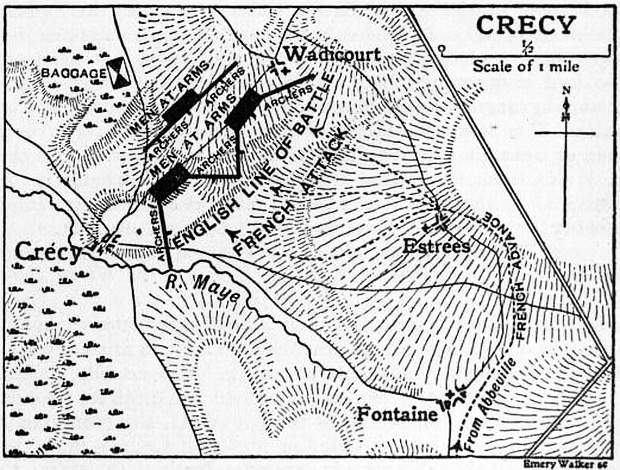
The day was far advanced when the French came upon the English position. Philip, near Estrées, decided to halt and bivouac, deferring the battle until the army was better closed up, but the indiscipline of his army committed him to an immediate action, and he ordered forward the Genoese crossbowmen, while a line of men-at-arms deployed for battle behind them; the rest of the army was still marching in an irregular column of route along the road from Abbeville. A sudden thunderstorm caused a short delay, then the archers and the crossbowmen opened the battle. Here, for the first time in continental warfare, the English long-bow proved its worth. After a brief contest the crossbowmen, completely outmatched, were driven back with enormous loss. Thereupon the first line of French knights behind them charged down upon the “faint-hearted rabble” of their own fugitives, and soon the first two lines of the French were a mere mob of horse and foot struggling with each other. The archers did not neglect the opportunity, and shot coolly and rapidly into the helpless target in front of them. The second attack was made by another large body of knights which had arrived, and served but to increase the number of the casualties, though here and there a few charged up to the English line and fell near it, among them the blind king of Bohemia, who with a party of devoted knights penetrated, and was killed amongst, the ranks of the prince of Wales’s men-at-arms. The battle was now one long series of desperate but ill-conducted charges, a fresh onslaught being made as each new corps of troops appeared on the scene. The English archers on the flanks of the two first line battles had been wheeled up, the centres of dismounted men-at-arms held back, so that the whole line resembled a “herse” or harrow with three points formed by the archers (see sketch). Each successive body of the French sought to come to close quarters with the men-at-arms, and exposed themselves therefore at short range to the arrows on either flank. Under these circumstances there could be but one issue of the battle. Though sixteen distinct attacks were made, and the fighting lasted until long after dark, no impression was made on the English line. At one moment the prince was so far in danger that his barons sent to the king for aid. Even then Edward was not disquieted and he sent a mere handful of knights to the prince’s battle, saying, “Let the boy win his spurs.” The left battle of the English, hitherto somewhat to the rear, moved up into line with the prince, and the French attack slackened. By midnight the army of France was practically annihilated; 1542 men of gentle blood were left dead on the field and counted by Edward’s heralds, the losses of the remainder are unknown. Some fifty of the victors fell in the battle. The story that the Black Prince adopted from the fallen king of Bohemia the crest and motto now borne by the princes of Wales lacks foundation (see John, King of Bohemia). A memorial to the French and their allies was erected, by public subscription in France, Luxemburg and Bohemia, in 1905.
See H. B. George, Battles of English History (London, 1895), and C. W. C. Oman, A History of the Art of War; The Middle Ages (London, 1898).
CREDENCE, or Credence Table, a small side-table, originally an article of furniture placed near the high table in royal or noble houses, at which the ceremony of the praegustatio, Italian credenziare, the “assay” or tasting of food and drink for poisons was performed by an official of the household, the praegustator or credentiarius as he was called in Medieval Latin. Both the ceremony and the table were known as credentia (Lat. credere, to believe, trust), Ital. credenza, Fr. crédence. After the need for the ceremony had disappeared the name still survived, and the table developed a back and several shelves for the display of plate, and gradually merged into the buffet (q.v.). It is, however, as an article of ecclesiastical furniture that the credence table is most familiar. It takes the form of a small table of wood or stone, sometimes fixed and sometimes merely a shelf above or near the piscina. It usually stands on the south or Epistle side of the altar, and on it are placed, in the Roman Catholic Church, the cruets containing the wine and water, the chalice, the candlesticks to be carried by the acolytes, and other objects to be used in the ceremony of the Mass. The use of such a table, to which earlier the name of paratorium or oblationarium was given, appears to have come into use when the personal presentation of the oblations at the Mass became obsolete. When the pope celebrates Mass a special credence table on the Gospel side of the altar is used, and the ceremony of tasting for poison in the unconsecrated elements is still observed. In some churches in England the old credence tables still exist, as at the church of St Cross near Winchester, where there is a fine stone 15th-century example; more frequent are examples of the stone shelf near the piscina. There are some carved wooden ones surviving, one type being with a semicircular top and three legs placed in a triangle with a lower shelf. The formal use of the credence table for the unconsecrated elements and the holy vessels before the celebration has been revived in the English Church.
CREDENTIALS (lettres de créance), a document which ambassadors, ministers plenipotentiary, and chargés d’affaires hand to the government to which they are accredited, for the purpose, chiefly, of communicating to the latter the envoy’s diplomatic rank. It also contains a request that full credence be accorded to his official statements. Until his credentials have been presented and found in proper order, an envoy receives no official recognition. The credentials of an ambassador or minister plenipotentiary are signed by the chief of the state, those of a chargé d’affaires by the foreign minister.
CREDI, LORENZO DI (1459-1537), Italian artist, whose surname was Barducci, was born at Florence. He was the least gifted of three artists who began life as journeymen with Andrea del Verrocchio. Though he was the companion and friend of Leonardo da Vinci and Perugino, and closely allied in style to both, he had neither the genius of the one nor the facility of the other. We admire in Da Vinci’s heads a heavenly contentment and smile, in his technical execution great gloss and smoothness of finish. Credi’s faces disclose a smiling beatitude; his pigments have the polish of enamel. But Da Vinci imparted life to his creations and modulation to his colours, and these are qualities which hardly existed in Credi. Perugino displayed a well-known form of tenderness in heads, moulded on the models of the old Umbrian school. Peculiarities of movement and attitude become stereotyped in his compositions; but when put on his mettle, he could still exhibit power, passion, pathos. Credi often repeated himself in Perugino’s way; but being of a pious and resigned spirit, he generally embodied in his pictures a feeling which is yielding and gentle to the verge of coldness. Credi had a respectable local practice at Florence. He was consulted on most occasions when the opinion of his profession was required on public grounds, e.g. in 1491 as to the fronting, and in 1498 as to the lantern of the Florentine cathedral, in 1504 as to the place due to Michelangelo’s “David.” He never painted frescoes; at rare intervals only he produced large ecclesiastical pictures. The greater part of his time was spent on easel pieces, upon which he expended minute and patient labour. But he worked with such industry that numbers of his Madonnas exist in European galleries. The best of his altar-pieces is that which represents the Virgin and Child with Saints in the cathedral of Pistoia. A fine example of his easel rounds is in the gallery of Mainz. Credi rivalled Fra Bartolommeo in his attachment to Savonarola; but he felt no inclination for the retirement of a monastery. Still, in his old age, and after he had outlived the perils of the siege of Florence (1527), he withdrew on an annuity into the hospital of Santa Maria Nuova, where he died. The National Gallery, London, has two pictures of the Virgin and Child by him.
CREDIT (Lat. credere, to believe), in a general sense, belief or trust. The word is used also to express the repute which a person has, or the estimation in which he is held. In a commercial sense credit is the promise to pay at a future time for valuable consideration in the present: hence, a reputation of solvency and ability to make such payments is also termed credit. In bookkeeping credit is the side of the account on which payments are entered; hence, sometimes, the payments themselves.
The part which credit plays in the production and exchange of wealth is discussed in all economic text-books, but special reference may be made to K. Knies, Geld und Kredit (1873-1879), and H. D. Macleod, Theory of Credit (1889-1891). See also Hartley Withers, The Meaning of Money (1909).
CRÉDIT FONCIER, in France, an institution for advancing money on mortgage of real securities. Due to a great extent to the initiative of the economist L. Wolowski, it was created by virtue of a governmental decree of the 28th of February 1852. This decree empowered the issue of loans at a low rate of interest, secured by mortgage bonds, extending over a long period, and repayable by annuities, including instalments of capital. On its inception it had a capital of 25,000,000 francs and took the title of Banque Foncière de Paris. The parent institution in Paris was followed by similar institutions in Nevers and Marseilles. These two were afterwards amalgamated with the first under the title of Crédit Foncier de France. The capital was increased to 60,000,000 francs, the government giving a subvention of 10,000,000 francs, and exercising control over the bank by directly appointing the governor and two deputy-governors. The administration was vested in a council chosen by the shareholders, but its decisions have no validity without the approval of the governor. The Crédit Foncier has the right to issue bonds, repayable in fifty or sixty years, and bearing a fixed rate of interest. A certain number of the bonds carry prizes. The loans must not exceed half the estimated value of the property mortgaged, upon which the bank has the first mortgage. The bank also makes advances to local bodies, departmental and communal, for short or long periods, and with or without mortgage. Its capital amounts to £13,500,000. Its charter was renewed in 1881 for a period of ninety-nine years.
In 1860 the Crédit Foncier lent its support to the foundation of an organization for supplying capital and credit for agricultural and allied industries. This Crédit Agricole rendered but trifling services to agriculture, however, and soon threw itself into speculation. Between 1873 and 1876 it lent enormous sums to the Egyptian government, obtaining the money by opening credit with the Crédit Foncier and depositing with it the securities of the Egyptian government. On the failure of the Egyptian government to meet its payments the Crédit Agricole went into liquidation, and the Crédit Foncier suffered severely in consequence. The impracticability of the credit system to aid agriculture as worked by the Crédit Agricole was very marked, and, as a consequence, the financing of agricultural associations is now entirely in the hands of the Banque de France.
The Crédit Mobilier is an institution for advancing loans on personal or movable estate. It was constituted in 1871, on the liquidation of the Société Générale de Crédit Mobilier, founded in 1852, which it absorbed.
CRÉDIT MOBILIER OF AMERICA, a construction company whose operations in connexion with the building of the Union Pacific Railroad gave rise to the most serious political scandal in the history of the United States Congress. The company was originally chartered as the Pennsylvania Fiscal Agency in 1859. In March 1864 a controlling interest in the stock was secured by Thomas Durant, vice-president of the Union Pacific Railroad Company, and the Pennsylvania legislature authorized the adoption of the name Crédit Mobilier of America. Durant proposed to utilize it as a construction company, pay it an extravagant sum for the work, and thus secure for the stockholders of the Union Pacific, who now controlled the Crédit Mobilier, the bonds loaned by the United States government. The net proceeds from the government and the first mortgage bonds issued to the construction company were $50,863,172.05, slightly more than enough to pay the entire cost of construction. According to the report of the Wilson Congressional Committee, the Crédit Mobilier received in addition, in the form of stock, income bonds, and land grant bonds, $23,000,000—a profit of about 48%. The defenders of the company assert that several items of expense were not included in this report, and that the real net profit was considerably smaller, although they admit that it was still unusually large. The work extended over the years 1865-1867. During the winter of 1867-1868, when adverse legislation by Congress was feared, it is alleged that Oakes Ames (q.v.), a representative from Massachusetts and principal promoter of the Crédit Mobilier, distributed a number of shares among congressmen and senators to influence their attitude. Shares were sold at par when a few dividends repaid a purchaser at this price. Some in fact received dividends without any initial outlay at all. As the result of a lawsuit between Ames and H. S. McComb, some private letters were brought out in September 1872 which gave publicity to the entire proceedings. The House appointed two investigating committees, the Poland and the Wilson committees, and on the report of the former (1873) Ames and James Brooks of New York were formally censured by the House, the former for disposing of the stock and the latter for improperly using his official position to secure part of it. Charges were also made against Schuyler Colfax, then vice-president but Speaker of the House at the time of the transaction, James A. Garfield, William D. Kelley (1814-1880), John A. Logan, and several other members either of the House or of the Senate. The Senate later appointed a special committee to investigate the charges against its members. This committee, on the 27th of February 1873, recommended the expulsion from the Senate of James W. Patterson, of New Hampshire; but as his term expired within five days no action was taken. The evidence was exaggerated by the Democrats for partisan purposes, but the investigation showed clearly that many of those accused were at least indiscreet if not dishonest. The company itself was merely a type of the construction companies by which it was the custom to build railways between 1860 and about 1880.
See J. B. Crawford, The Crédit Mobilier of America (Boston, 1880), and R. Hazard, The Crédit Mobilier of America (Providence, 1881), both of which defend Ames; also the histories of the Union Pacific Railroad Company by J. P. Davis (Chicago, 1894) and H. K. White (Chicago, 1895); and for a succinct and impartial account, James Ford Rhodes, History of the United States, vol. vii. (New York, 1906). The Poland and Wilson reports are to be found in House of Representatives Reports, 42nd Congress, 3rd session, Nos. 77 and 78, and the report of the Senate Committee in Senate Reports, 42nd Congress, 3rd session, No. 519.
CREDITON, a market town in the South Molton parliamentary division of Devonshire, England, 8 m. N.W. of Exeter by the London & South-Western railway. Pop. of urban district (1901) 3974. It is situated in the narrow vale of the river Creedy near its junction with the Exe, between two steep hills, and is divided into two parts, the east or old town and the west or new town. The church of Holy Cross, formerly collegiate, is a noble Perpendicular building with Early English and other early portions, and a fine central tower. The grammar school, founded by Edward VI. and refounded by Elizabeth, has exhibitions to Oxford and Cambridge universities. Shoe-making, tanning, agricultural trade, tin-plating, and the manufacture of confectionery and cider have superseded the former large woollen and serge industries. In 1897 Crediton was made the seat of a suffragan bishopric in the diocese of Exeter.
The first indication of settlement at Crediton (Credington, Cryditon, Kirton) is the tradition that Winfrith or Boniface was born there in 680. Perhaps in his memory (for the great extent of the parish shows that it was thinly populated) it became in 909 the seat of the first bishopric in Devonshire. It was probably only a village in 1049, when Leofric, bishop of Crediton, requested Leo IX. to transfer the see to Exeter, as Crediton was “an open town and much exposed to the incursions of pirates.” At the Domesday Survey much of the land was still uncultivated, but its prosperity increased, and in 1269 each of the twelve prebends of the collegiate church had a house and farmland within the parish. The bishops, to whom the manor belonged until the Reformation, had difficulty in enforcing their warren and other rights; in 1351 Bishop Grandison obtained an exemplification of judgments of 1282 declaring that he had pleas of withernam, view of frank pledge, the gallows and assize of bread and ale. Two years later there was a serious riot against the increase of copyhold. Perhaps it was at this time that the prescriptive borough of Crediton arose. The jury of the borough are mentioned in 1275, and Crediton returned two members to parliament in 1306-1307, though never afterwards represented. A borough seal dated 1469 is extant, but the corporation is not mentioned in the grant made by Edward VI. of the church to twelve principal inhabitants. The borough and manor were granted by Elizabeth to William Killigrew in 1595, but there is no indication of town organization then or in 1630, and in the 18th century Crediton was governed by commissioners. In 1231 the bishop obtained a fair, still held, on the vigil, feast and morrow of St Lawrence. This was important as the wool trade was established by 1249 and certainly continued until 1630, when the market for kersies is mentioned in conjunction with a saying “as fine as Kirton spinning.”
See Rev. Preb. Smith, “Early History of Credition,” in Devonshire Association for the Advancement of Science, Literature and Art, Transactions, vol. xiv. (Plymouth, 1882); Richard J. King, “The Church of St Mary and of the Holy Cross, Credition,” in Exeter Diocesan Architectural Society, Transactions, vol. iv. (Exeter, 1878).
CREDNER, CARL FRIEDRICH HEINRICH (1809-1876), German geologist, was born at Waltershausen near Gotha, on the 13th of March 1809. He investigated the geology of the Thüringer Waldes, of which he published a map in 1846. He was author of a work entitled Über die Gliederung der oberen Juraformation und der Wealden-Bildung im nordwestlichen Deutschland (Prague, 1863), also of a geological map of Hanover (1865). He died at Halle on the 28th of September 1876.
His son, Carl Hermann Credner (1841- ), was born at Gotha on the 1st of October 1841, educated at Breslau and Göttingen, and took the degree of Ph.D. at Breslau in 1864. In 1870 he was appointed professor of geology in the university of Leipzig, and in 1872 director of the Geological Survey of Saxony. He is author of numerous publications on the geology of Saxony, and of an important work, Elemente der Geologie (2 vols., 1872; 7th ed., 1891), regarded as the standard manual in Germany. He has also written memoirs on Saurians and Labyrinthodonts.
CREE, a tribe of North American Indians of Algonquian stock. They are still a considerable tribe, numbering some 15,000, and living chiefly in Manitoba and Assiniboia, about Lake Winnipeg and the Saskatchewan river. They gave trouble by their constant attacks upon the Sioux and Blackfeet, but are now peaceable and orderly.
See Handbook of American Indians (Washington, 1907).
CREECH, THOMAS (1659-1700), English classical scholar, was born at Blandford, Dorsetshire, in 1659. He received his early education from Thomas Curgenven, master of Sherborne school. In 1675 he entered Wadham College, Oxford, and obtained a fellowship in 1683 at All Souls’. He was headmaster of Sherborne school from 1694 to 1696, and in 1699 he received a college living, but in June 1700 he hanged himself. The immediate cause of the act was said to be a money difficulty, though according to some it was a love disappointment; both of these circumstances no doubt had their share in a catastrophe primarily due to an already pronounced melancholia. Creech’s fame rests on his translation of Lucretius (1682) in rhymed heroic couplets, in which, according to Otway, the pure ore of the original “somewhat seems refined.” He also published a version of Horace (1684), and translated the Idylls of Theocritus (1684), the Thirteenth Satire of Juvenal (1693), the Astronomicon of Manilius (1697), and parts of Plutarch, Virgil and Ovid.
CREEDS (Lat. credo, I believe), or Confessions of Faith. We are accustomed to regard the whole conception of creeds, i.e. reasoned statements of religious belief, as inseparably connected with the history of Christianity. But the new study of comparative religion has something to teach us even here. The saying lex orandi lex credendi is true of all times and of all peoples. And since we must reckon praise as the highest form of prayer, such an early Christian hymn as is found in 1 Tim. iii. 16 must be acknowledged to be of the nature of a creed: “He who was manifested in the flesh, justified in the spirit, seen of angels, preached among the nations, believed on in the world, received up in glory.” It justifies the expansion of the second article of the developed Christian creed from the standpoint of the earliest Christian tradition. It also supplies a reason for including in our survey of creeds some reference to pre-Christian hymns and beliefs. The pendulum has swung back. Rather than despise the faulty presentation of truth which we find in heathen religions and their more or less degraded rites, we follow the apostle Paul in his endeavour to trace in them attempts “to feel after God” (Acts vii. 27). Augustine, the great teacher of the West, was true to the spirit of the great Alexandrians, when he wrote (Ep. 166): “Let every good and true Christian understand that truth, wherever he finds it, belongs to his Lord.”
We are not concerned with the question whether the earliest forms of recorded religious consciousness such as animism, or totemism, or fetishism, were themselves degradations of a primitive revelation or not.1 We are only concerned with the fact of experience that the human soul yearns to express its belief. The hymn to the rising and setting sun in the Book of the Dead (ch. 15), which is said by Egyptologists to be the oldest poem in the world, carries us back at once to the dawn of history.
“Hail to thee, Ra, the self-existent.... Glorious is thine uprising from the horizon. Both worlds are illumined by thy rays.... Hail to thee, Ra, when thou returnest home in renewed beauty, crowned and almighty.”
In a later hymn Amen-Ra is confessed as “the good god beloved, maker of men, creator of beasts, maker of things below and above, lord of mercy most loving.” A similar note is struck in the Indian Vedas. In the more ethical religion of the Avesta the creator is more clearly distinguished from the creature: “I desire to approach Ahura and Mithra with my praise, the lofty eternal, and the holy two.”2 The Persian poet is not far from the kingdom into which Hebrew psalmists and prophets entered.
The whole history of the Jewish religion is centred in the gradual purification of the idea of God. The morality of the Jews did not outgrow their religion, but their interest was always ethical and not speculative. The highest strains of the psalmists and the most fervent appeals of the prophets were progressively directed to the great end of praising and preaching the One true God, everlasting, with sincere and pure devotion. The creed of the Jew, to this day, is summed up in the well-remembered words, which have been ever on his lips, living or dying: “Hear, O Israel, the Lord our God is one Lord” (Deut. vi. 4).
The definiteness and persistence of this creed, which of course is the strength also of Mahommedanism, presents a contrast to the fluid character of the statements in the Vedas, and to the chaos of conflicting opinions of philosophers among the Greeks and Romans. As Dr J. R. Illingworth has said very concisely: “The physical speculations of the Ionians and Atomists rendered a God superfluous, and the metaphysical and logical reasoning of the Eleatics declared Him to be unknowable.”3 Plato regarding the world as an embodiment of eternal, archetypal ideas, which he groups under the central idea of Good, identified with the divine reason, at the same time uses the ordinary language of the day, and speaks of God and the gods, feeling his way towards the conception of a personal God, which, to quote Dr Illingworth again, neither he nor Aristotle could reach because they had not “a clear conception of human personality.” They were followed by an age of philosophizing which did little to advance speculation. The Stoics, for example, were more successful in criticizing the current creed than in explaining the underlying truth which they recognized in polytheism. The final goal of Greek philosophy was only reached when the great thinkers of the early Christian Church, who had been trained in the schools of Alexandria and Athens, used its modes of thought in their analysis of the Christian idea of God. “In this sense the doctrine of the Trinity was the synthesis, and summary, of all that was highest in the Hebrew and Hellenic conceptions of God, fused into union by the electric touch of the Incarnation.”4
Space does not permit enlargement on this theme, but enough has been said to introduce the direct study of the ancient creeds of Christendom.
I. The Ancient Creeds of Christendom.—The three creeds which may be called oecumenical, although the measure of their acceptance by the universal church has not been uniform, represent three distinct types provided for the use of the catechumen, the communicant, and the church teacher respectively. The Apostles’ Creed is the ancient baptismal creed, held in common both by East and West, in its final western form. The Nicene Creed is the baptismal creed of an eastern church enlarged in order to combine theological interpretation with the facts of the historic faith. Its use in the Eucharist of the undivided Church has been continued since the great schism, although the Eastern Church protests against the interpolation of the words “And the Son” in clause 9. The Athanasian Creed is an instruction designed to confute heresies which were current in the 5th century.
1. The Apostles’ Creed.—The increased interest which has been shown in the history of all creed-forms since the latter part of the 19th century is due in a great measure to the work of the veteran pioneer, Professor P. Caspari of Christiania, Apostles’ Creed. who began the herculean task of classifying the enormous number of creed-forms which have been recovered from obscure pages of early Christian literature. In England we owe much to Professors C. A. Heurtley and Swainson. In Germany the monumental work of Professor Kattenbusch has overshadowed all other books on the subject, providing even his most ardent critics with an indispensable record of the literature of the subject.
The majority of critics agree that the only trace of a formal creed in the New Testament is the simple confession of Jesus as the Lord, or the Son of God (Rom. x. 9; 1 Cor. xii. 3). While the apostles were agreed on an outline of teaching (Rom. vi. 17) which included the doctrine of God, the person and work of Christ, and the person and work of the Holy Spirit, it does not appear that they provided any summary, which would cover this ground, as an authoritative statement of their belief. The tradition which St Paul received included, so to speak, the germ of the central prayer in the Eucharist (1 Cor. xi. 23 ff.), and no doubt included also teaching on conduct, “the way of a Christian life” (1 Thess. iv. 1; Gal. v. 21). The creed in all its forms lies behind worship, which it preserves from idolatry, and behind ethics, to which it supplies a motive power which the pre-Christian system so manifestly lacked. Whether the first creed of the primitive Church was of the simple Christological character which confession of Jesus as the Lord expresses, or of an enlarged type based on the baptismal formula (Matt. xxviii. 19), makes no difference to the statement that the faith which overcame the world derived its energy from convictions which strove for utterance. “With the heart man believeth unto righteousness, and with the mouth confession is made unto salvation” (Rom. x. 10).
When St Paul reminds Timothy (1 Tim. vi. 13) of his confession before many witnesses he does not seem to imply more than confession of Christ as king. He calls it “the beautiful confession” to which Christ Jesus had borne witness before Pontius Pilate, and charges Timothy before God, who quickeneth all things, to keep this commandment. Some writers, notably Professor Zahn,5 piecing together this text with 2 Tim. i. 13, ii. 8, iv. 1, 2, reconstructs a primitive Apostles’ Creed of Antioch, the city from which St Paul started on his missionary journeys. But there is no mention of a third article in the creed, beyond a reference to the Holy Ghost in the context of 2 Tim. i. 14, which would prove the apostolic use of a Trinitarian confession imaginable as the parent of the later Eastern and Western forms. The eunuch’s creed interpolated in Acts viii. 57, “I believe that Jesus is the Son of God,” since the reading was known to Irenaeus, probably represents the form of baptismal confession used in some church of Asia Minor, and supplies us with the type of a primitive creed. This theory is confirmed by the evidence of the Johannine epistles (1 John iv. 15, v. 5; cf. Heb. iv. 14).
From this point of view it is easy to explain the occurrence of creed-like phrases in the New Testament as fragments of early hymns (1 Tim. iii. 16) or reminiscences of oral teaching (1 Cor. xv. 1 ff.). The following form which Seeberg gives as the creed of St Paul is an artificial combination of fragments of oral teaching, which naturally reappear in the teaching of St Peter, but finds no attestation in the later creeds of particular churches which would prove its claim to be their parent form:
“The living God who created all things sent His Son Jesus Christ, born of the seed of David, who died for our sins according to the scriptures, and was buried, who was raised on the third day according to the scriptures, and appeared to Cephas and the XII., who sat at the right hand of God in the heavens, all rule and authority and power being made subject unto Him, and is coming on the clouds of heaven with power and great glory.”
The evidence of the apostolic fathers is disappointing. Clement (Cor. lviii. 2) supplies only parallels to the baptismal formula (Matt. xxviii. 19). Polycarp (Ep. 7) echoes St John. But Ignatius might seem to offer in the following passage some confirmation of Zahn’s theory of a primitive creed of Antioch (Trall. 9): “Be ye deaf, therefore, when any man speaketh to you apart from Jesus Christ, who was of the race of David, who was the Son of Mary, who was truly born and ate and drank, was truly persecuted under Pontius Pilate, was truly crucified and died in the sight of those in heaven and those on earth and those under the earth; who, moreover, was truly raised from the dead, His Father having raised Him, who in the like fashion will so raise us also who believe on Him—His Father, I say, will raise us—in Christ Jesus, apart from whom we have not true life.”
The differences, however, which divide this from the later creed forms are scarcely less noticeable than their agreement, and the evidence of the Ignatian epistles generally (Eph. xviii.; Smyrn. i.), while it confirms the conclusion that instruction was given in Antioch on all points characteristic of the developed creed, e.g. the Miraculous Birth, Crucifixion, Resurrection, the Catholic Church, forgiveness of sins, the hope of resurrection, does not prove that this teaching was as yet combined in a Trinitarian form which classified the latter clauses under the work of the Holy Ghost.
At this point a word must be said on the important question of interpretation. While we may hope for eventual agreement on the history of the different types of creed forms, there can be no hope of agreement on the interpretation of the words Holy Spirit between Unitarian and Trinitarian critics. Writers who follow Harnack explain “holy spirit” as the gift of impersonal influence, and between wide limits of difference agree in regarding Christ as Son of God by adoption and not by nature. Amid the chaos of conflicting opinions as to the original teaching of Jesus, the Gospel within the Gospel, the central question “What think ye of Christ?” emerges as the test of all theories. “No man can say that Jesus is the Lord save in the Holy Ghost” (1 Cor. xii. 3). Belief in the fact of the Incarnation of the eternal Word, as it is stated in the words of Ignatius quoted above, or in any of the later creeds, stands or falls with belief in the Holy Ghost as the guide alike of their convictions and destinies, no mere impersonal influence, but a living voice.
If the essence of Christianity is winnowed down to a bare imitation of the Man Jesus, and his religion is accepted as Buddhists accept the religion of Buddha, still it cannot be denied that the early Christians put their trust in Christ rather than his religion. “I am the life,” not “I teach the life,” “I am the truth,” not merely “I teach the truth,” are not additions of Johannine theology but the central aspect of the presentation of Christ as the good physician, healer of souls and bodies, which the most rigid scrutiny of the Synoptic Gospels leaves as the residuum of accepted fact about Jesus of Nazareth. To say more would be out of place in this article, but enough has been said to introduce the exhaustive discussion by Kattenbusch (ii. 471-728) of the meaning of the theological teaching both of the New Testament and of the earliest creeds.
To return within our proper limits. Kattenbusch, with whom Harnack is in general agreement, regards the Old Roman Creed, which comes to light in the 4th century, as the parent of all developed forms, whether Eastern or Western. Marcellus, the exiled bishop of Ancyra, is quoted by Epiphanius as presenting it to Bishop Julius of Rome c. A.D. 340. Ussher’s recognition of the fact that this profession of faith by Marcellus was the creed of Rome, not of Ancyra, is the starting-point of modern discussions of the history of the creeds. Some sixty years later Rufinus, a priest of Aquileia, wrote a commentary on the creed of his native city and compared it with the Roman Creed. His Latin text is probably as ancient as the Greek text of Marcellus, because the Roman Church must always have been bilingual in its early days. It was as follows:
I. 1. I believe in God (the) Father almighty;
II. 2. And in Christ Jesus His only Son our Lord,
3. who was born of the Holy Spirit and the Virgin Mary,
4. crucified under Pontius Pilate and buried
5. the third day He rose from the dead,
6. He ascended into heaven,
7. sitteth at the right hand of the Father,
8. thence He shall come to judge living and dead.
III. 9. And in the Holy Ghost,
10. (the) holy Church,
11. (the) remission of sins,
12. (the) resurrection of the flesh.
This Old Roman Creed may be traced back in the writings of Bishops Felix and Dionysus (3rd century), and in the writings of Tertullian in the 2nd century.
Tertullian calls the creed the “token” which the African Church shares with the Roman (de Praescr. 36): “The Roman Church has made a common token with the African Churches, has recognized one God, creator of the universe, and Christ Jesus, of the Virgin Mary, Son of God the Creator, and the resurrection of the flesh.” The reference is to the earthenware token which two friends broke in order that they might commend a stranger for hospitality by sending with him the broken half. Their creed became the passport by which Christians in strange cities could obtain admission to assemblies for worship and to common meals. The passage quoted is obviously a condensed quotation of the Roman Creed, which reappears also in the following (de Virg. vel. i.):
“The rule of faith is one altogether ... of believing in one God Almighty, maker of the world, and in His Son Jesus Christ, born of Mary the Virgin, crucified under Pontius Pilate; the third day raised from the dead, received in the heavens, sitting now at the right hand of the Father, about to come and judge quick and dead through the resurrection also of the flesh.”
There are many references in Tertullian to the teaching of the Gnostic Marcion, whose breach with the Roman Church may be dated A.D. 145. He seems to have still held to the Roman creed interpreted in his own way. An ingenious conjecture by Zahn enables us to add the words “holy Church” to our reconstruction of the creed from the writings of Tertullian. In his revised New Testament Marcion speaks of “the covenant which is the mother of us all, which begets us in the holy Church, to which we have vowed allegiance.” He uses a word used by Ignatius of the oath taken on confession of the Christian faith. It follows that the words “holy Church” were contained in the Roman Creed.6
While all critics agree in tracing back this form to the earliest years of the 2nd century, and regard it as the archetype of all similar Western creeds, there is great diversity of opinion on its relation to Eastern forms. Kattenbusch maintains that the Roman Creed reached Gaul and Africa in the course of the 2nd century, and perhaps all districts of the West that possessed Christian congregations, also the western end of Asia Minor possibly in connexion with Polycarp’s visit to Rome A.D. 154. He finds that materials fail for Pontus, Galatia, Cappadocia, Syria, Palestine, Egypt. Further, he holds that all the Eastern creeds which are known to us as existing in the 4th century, or may be traced back to the 3rd, lead to Antioch as their starting-point. He concludes that the Roman Creed was accepted at Antioch after the fall of Paul of Samosata in A.D. 272, and was adapted to the dogmatic requirements of the time, all the later creeds of Palestine, Asia Minor and Egypt being dependent on it.
On the other hand, Kunze, Loofs, Sanday, and Zahn find evidence of the existence of an Eastern type of creed of equal or greater antiquity and distinguished from the Roman by such phrases as “One” (God), “Maker of heaven and earth,” “suffered,” “shall come again in glory.” Thus Kunze reconstructs a creed of Antioch for the 3rd century, and argues that it is independent of the Roman Creed.
Creed of Antioch.
I. 1. I believe in one and one only true God, Father Almighty, maker of all things, visible and invisible.
II. 2. And in our Lord Jesus Christ, His Son, the only-begotten and first born of all creation, begotten of Him before all the ages, through whom also the ages were established, and all things came into existence;
3. Who for our sakes, came down, and was born of Mary the Virgin.
4. And crucified under Pontius Pilate, and buried,
5. And the third day rose according to the scriptures,
6. and ascended into heaven.
7.
8. And is coming again to judge quick and dead.
9. [The beginning of the third article has not been recorded.]
10.
11. Remission of sins.
12. Resurrection of the dead, life everlasting.
Along similar lines Loofs selects phrases as typical of creeds which go back to a date preceding the Nicene Council.
A. Creed of Eusebius of Caesarea, presented to the Nicene Council.
B. Revised Creed of Cyril of Jerusalem.
C. Creed of Antioch quoted by Cassian.
D. Creed of Antioch quoted in the Apostolic Constitutions.
E. Creed of Lucian the Martyr (Antioch).
F. Creed of Arius (Alexandria).
1. One (God), A, B, C, D, E, F.
Maker of heaven and earth and of all things visible and invisible (or a like phrase), A, B, C, D, E.
2. Lord Jesus Christ, His Son, the only begotten (or a like phrase), A, B, C, D, E, F.
3. Crucified under Pontius Pilate, B, C, D (A, E, F omit because they are theological creeds. Loofs thinks that the baptismal creeds on which they are based may have contained the words).
5. Rose the third day, A, B, D, E (F omits “the third day” being a theological creed; the translation of C is uncertain).
6. Went up, A, B, D, E, F.
+ and ... and ... and, A, B, C, D, E, F.
8. And is coming, B, C, D, E, F; and is about to come, A;
+ again, A, C, D, E, F(B?); + in glory, A, B; with glory, D, E.
10. + Catholic, B, D, F (A, C, E?)
12. + life eternal, B, C; + life of the age to come, D, F.
Sanday (Journal Theol. Studies, iii. 1) does not attempt a reconstruction on this elaborate scale, but contents himself with pointing out evidence, which Kattenbusch seems to him to have missed, for the existence of creeds of Egypt, Cappadocia and Palestine before the time of Aurelian. He criticizes Harnack’s theory that there existed in the East, that is, in Asia Minor, or in Asia Minor and Syria as far back as the beginning of the 2nd century, a Christological instruction (μάθημα) organically related to the second article of the Roman Creed, and formulas which taught that the “One God” was “Creator of heaven and earth,” and referred to the holy prophetic spirit, and lasted on till they influenced the course of creed-development in the 4th century. He asks, is it not simpler to believe that there was a definite type in the background?
Another English student, the Rev. T. Barns, engaged specially in work upon the history of the creed of Cappadocia, points out the importance of the extraordinary influence of Firmilian of Caesarea in the affairs of the church of Antioch in the early part of the 3rd century. He is led to argue that the creed of Antioch came rather from Cappadocia than Rome. Whether his conclusion is justified or not, it helps to show how strongly the trend of contemporary research is setting against the theory of Kattenbusch that the Roman Creed when adopted at Antioch became the parent of all Eastern forms. It does not, however, militate against the possibility that the Roman Creed was carried from Rome to Asia Minor and to Palestine in the 2nd century. It is evidently impossible to arrive at a final decision until much more spade work has been done in the investigation of early Eastern creeds. Connolly’s study of the early Syrian creed (Zeitschrift für die neutestamentliche Wissenschaft, 1906, p. 202) deserves careful consideration. His reconstruction of the creed of Aphraates is interesting in relation to the other traces of a Syriac creed form existing prior to the 4th century.
[I believe] in God the Lord of all, that made the heavens and the earth and the seas and all that in them is; [And in our Lord Jesus Christ] [the Son of God,] God, Son of God, King, Son of the King, Light from Light, (Son and Counsellor, and Guide, and Way, and Saviour, and Shepherd, and Gatherer, and Door, and Pearl, and Lamb,) and first-born of all creatures, who came and put on a body from Mary the Virgin (of the seed of the house of David, from the Holy Spirit), and put on our manhood, and suffered, or and was crucified, went down to the place of the dead, or to Sheol, and lived again, and rose the third day, and ascended to the height, or to heaven, and sat on the right hand of His Father, and He is the Judge of the dead and of the living, who sitteth on the throne; [And in the Holy Spirit;] [And I believe] in the coming to life of the dead; [and] in the mystery of Baptism (of the remission of sins).
The probable battle-ground of the future between the opposing theories lies in the writings of Irenaeus. He has most of the characteristic expressions of the Eastern creeds. He inserts “one” in clause 1 and 2. He has the phrases “Maker of heaven and earth,” “suffered,” and “crucified,” with “under Pontius Pilate” after instead of before it. Probably also he had “in glory” in clause 8. But there is always the possibility to be faced that Irenaeus drew his creed from Rome rather than Asia Minor. Kattenbusch does not shrink from suggesting that he shows acquaintance with the Roman Creed, and that Justin Martyr also knew it, in which case all the so-called Eastern characteristics have been imprinted on the original Roman form, and are not derived from an Eastern archetype. But the ordinary reader need not feel concern about the future victory of either theory. The plain fact is that the same facts were taught in Palestine, Asia Minor and Gaul, whether gathered up in a parallel creed form or not. The contrast which Rufinus draws between the Roman Creed and others, both of the East and the West, is justified. In comparison with them it was guarded more carefully from change.7 We have yet to inquire how it received the additions which distinguish the derived form now in use as the baptismal creed of all Western Christendom. Some had already found an entrance into Western creeds. We find “suffered” in the creed of Milan, “descended into hell” in the creed of Aquileia, the Danubian lands and Syria; the words “God” and “almighty” were shortly added to clause 7 in the Spanish creed; “life everlasting” had stood from an early date in the African creed. The creed of Caesarius of Arles (d. 543) proves that these variations had all been united in one Gallican creed together with “catholic” and “communion of saints,” but this Gallican form still lacked “Maker of heaven and earth” and the additions in clause 7.
Two newly-discovered creeds help us greatly to narrow down the limits of the problem. The creed of Niceta of Remesiana in Dacia proves that c. A.D. 400 the Dacian church had added to the Roman Creed “maker of heaven and earth,” “suffered,” “dead,” “Catholic,” “communion of saints” and “life everlasting.” Parallel to it is the Faith of St Jerome discovered in 1903 by Dom. Morin.8
The Faith of St Jerome.
“I believe in one God the Father almighty, maker of things visible and invisible. I believe in one Lord Jesus Christ, the Son of God, born of God, God of God, Light of Light, almighty of almighty, true God of true God, born before the ages, not made, by whom all things were made in heaven and in earth. Who for our salvation descended from heaven, was conceived of the Holy Ghost, born of the Virgin Mary, suffered by suffering under Pontius Pilate, under Herod the King, crucified, buried, descended into hell, trod down the sting of death, rose again the third day, appeared to the apostles. After this He ascended into heaven, sitteth at the right of God the Father, thence shall come to judge the quick and the dead. And I believe in the Holy Ghost, God not unbegotten nor begotten, not created nor made, but co-eternal with the Father and the Son. I believe (that there is) remission of sins in the holy catholic church, communion of saints, resurrection of the flesh unto eternal life. Amen.”
This creed may be the form which Jerome mentions in one of his letters (Ep. 17, n. 4) as sent to Cyril of Jerusalem. It is important as connecting the creeds of East and West. Since Jerome was born in Pannonia we may conjecture that he is inserting Nicene phrases from the Jerusalem creed into his baptismal creed, and that this form added to Niceta’s creed proves that the creed of the Danube lands possessed the clauses “maker of heaven and earth” and “communion of saints.”
The first occurrence of the completed form is in a treatise (Scarapsus) of the Benedictine missionary Pirminius, abbot of Reichenau (c. A.D. 730). The difficulty hitherto has been to trace the source from which the clause “maker of heaven and earth” has come into it. It has been known that the forms in use in the south of France approximated to it but without those words. In the 6th century we find creed forms in use in Gaul which include them, but include also other variations distinguishing them from the form which we seek. The missing link which has hitherto been lacking in the evidence has been found by Barns in the influence of Celtic missionaries who streamed across from Europe until they came in touch with the remnants of the Old Latin Christianity of the Danube. The chief documents of the date A.D. 700, which contain forms almost identical with the received text, are connected with monasteries founded by Columban and his friends: Bobbio, Luxeuil, S. Gallen, Reichenau. From one of these monasteries the received text seems to have been taken to Rome. Certainly it was from Rome that it was spread. We can trace the use of the received text along the line of the journeys both of Pirminius and Boniface, and there is little doubt that they received it from the Roman Church, with which Boniface was in frequent communication. Pope Gregory II. sent him instructions to use what seems to have been an official Roman order of Baptism, which would doubtless include a Roman form of creed. Pirminius, who was far from being an original writer, made great use of a treatise by Martin of Braga, but substituted a Roman form of Renunciation, and refers to the Roman rite of Unction in a way which leads us to suppose that the form of creed which he substituted for Martin’s form was also Roman. It seems clear, therefore, that the received text was either made or accepted in Rome, c. A.D. 700, and disseminated through the Benedictine missionaries. At the end of the 8th century Charlemagne inquired of the bishops of his empire as to current forms. The reply of Amalarius of Trier is important because it shows that he not only used the received text, but also connected it with the Roman order of Baptism. The emperor’s wish for uniformity doubtless led in a measure to its eventual triumph over all other forms.
2. The Nicene Creed of the liturgies, often called the Constantinopolitan creed, is the old baptismal creed of Jerusalem revised by the insertion of Nicene terms. The idea that the council merely added to the last section has been Nicene Creed. disproved by Hort’s famous dissertation in 1876.9 The text of the creed of the Nicene Council was based on the creed of Eusebius of Caesarea, and a comparison of the four creeds side by side proves to demonstration their distinctness, in spite of the tendency of copyists to confuse and assimilate the forms.10
Creed of Eusebius, A.D. 325 (Caesarea). Revision by the Council of Nicaea, A.D. 325.
We believe We believe
I. 1. In one God the Father Almighty, the maker of all things visible and invisible. I. 1. In one God the Father Almighty the maker of all things visible and invisible.
II. 2. And in one Lord Jesus Christ,the Word of God. God of God, Light of Light, (Life of Life,) only begotten Son (first-born of all creation, before all worlds begotten of God the Father), by whom all things were made; II. 2. And in one Lord Jesus Christ, the Son of God, begotten of the Father, only begotten, that is of the substance of the Father, God of God, Light of Light, very God of very God, begotten not made, of one substance with the Father, by whom all things were made, both those in heaven and those on earth.
3. Who for our Salvation was incarnate (and lived as a citizen amongst men), 3. Who for us men and for our salvation came down and was incarnate, was made man,
4. And Suffered, 4. And suffered,
5. And rose the third day, 5. And rose the third day,
6. And ascended (to the Father), 6. Ascended into Heaven,
7. And shall come again (in glory) to judge quick and dead. 7. Is coming to judge quick and dead.
III. 8. And (we believe) in (one) Holy Ghost. III. 8. And in the Holy Ghost.
Creed of Jerusalem, A.D. 348. Revision by Cyril, A.D. 362. Council of Constantinople, A.D. 381. Council of Chalcedon, A.D. 451.
I (or We) believe We believe
I. 1. In one God the Father, Almighty, maker of heaven and earth, and of all things visible and invisible. I. 1. In one God the Father Almighty, maker of heaven and earth, and of all things visible and invisible.
II. 2. And in one Lord Jesus Christ, the only begotten Son of God, begotten of His Father, very God before all worlds, by whom all things were made; II. 2. And in one Lord Jesus Christ, the only begotten Son of God, begotten of His Father before all worlds, [God of God,] Light of Light, very God of very God, begotten, not made, being of one substance with the Father, by whom all things were made;
3. was incarnate, and was made Man, 3. Who for us men and for our salvation came down from heaven and incarnate of the Holy Ghost and the Virgin Mary, and was made Man.
4. Crucified and buried. 4. And was crucified also for us under Pontius Pilate, and suffered and
5. Rose again the third day, 5. He rose again the third day, according to the Scriptures,
6. And ascended into heaven and sat on the right hand of the Father, 6. And ascended into heaven and sitteth on the right hand of the Father,
7. And shall come in glory to judge the quick and the dead, whose kingdom shall have no end. 7. And He shall come again to judge the quick and the dead, whose kingdom shall have no end.
III. 8. And in One Holy Ghost, the Paraclete, who spake in the Prophets, III. 8. And in the Holy Ghost, the Lord and Giver of Life. who proceedeth from the Father [and the Son], who with the Father and the Son together is worshipped and glorified, who spake by the Prophets,
9. And in one baptism of repentance for remission of sins, 9. In the Catholic and Apostolic Church.
10. And in one holy Catholic Church, 10. We acknowledge one baptism for remission of sins.
11. And in resurrection of the flesh, 11. We look for the resurrection of the dead,
12. And in life eternal. 12. And in the life of the world to come.
The revised Jerusalem Creed was quoted by Epiphanius in his treatise The Anchored One, c. A.D. 374, some years before the council of Constantinople (A.D. 381). We gather that it had already been introduced into Cyprus as a baptismal creed. Hort’s identification of it as the work of Cyril of Jerusalem is now generally accepted. On his return from exile in A.D. 362 Cyril would find “a natural occasion for the revision of the public creed by the skilful insertion of some of the conciliar language, including the term which proclaimed the restoration of full communion with the champions of Nicaea, and other phrases and clauses adapted for impressing on the people positive truth.” Some of Cyril’s personal preferences expressed in his catechetical lectures find expression, e.g. “resurrection of the dead” for “flesh.”
The weak point in Hort’s theory was the suggestion that the creed was brought before the council by Cyril in self justification. The election of Meletius of Antioch as the first president of the council carried with it the vindication of his old ally Cyril. Kunze’s suggestion is far more probable that it was used at the baptism of Nektarius, praetor of the city, who was elected third president of the council while yet unbaptized. Unfortunately the acts of the council have been lost, but they were quoted at the council of Chalcedon in A.D. 451, and the revised Jerusalem Creed was quoted as “the faith of the 150 Fathers,” that is, as confirmed in some way by the council of Constantinople, while at the time it was distinguished from “the faith of the 318 Fathers” of Nicaea. One of the signatories of the Definition of Faith made at Chalcedon, in which both creeds were quoted in full, Kalemikus, bishop of Apamea in Bithynia, refers to the council of Constantinople as having been held at the ordination of the most pious Nektarius the bishop. Obviously there was some connexion in his mind between the creed and the ordination.
The reasons which brought the revised creed into prominence at Chalcedon are still obscure. It is possible that Leo’s letter to Flavian gave the impulse to put it forward because it contained a parallel to words which Leo quoted from the Old Roman Creed, “born of the Holy Ghost and the Virgin Mary,” “crucified and buried,” which do not occur in the first Nicene Creed. If, as is probable, it was from the election of Nektarius the baptismal creed of Constantinople, we may even ask whether the pope did not refer to it when he wrote emphatically of the “common and indistinguishable confession” of all the faithful. Kattenbusch supposes that Anatolius, bishop of Constantinople, or his archdeacon Aetius, who read the creed at the 2nd session of the council, took up the idea that through its likeness to the Roman Creed it would be a useful weapon against Eutyches and others who were held to interpret the Nicene Creed in an Apollinarian sense. But Kunze thinks that it was not used as a base of operations against Eutyches because there is some evidence that Monophysites were willing to accept it. Certainly it won its way to general acceptance in the East as the creed of the church of the imperial city; regarded as an improved recension of the Nicene Faith. The history of the introduction of the creed into liturgies is still obscure. Peter Fullo, bishop of Antioch, was the first to use it in the East, and in the West a council held by King Reccared at Toledo in 589. The theory of Probst that it had been used in Rome before this time has not been confirmed. King Reccared’s council is usually credited with the introduction of the words “And the Son” into clause 9 of the creed. But some MSS.11 omit them in the creed-text while inserting them in a canon of the faith drawn up at the time. Probably they were interpolated in the creed by mistake of copyists. When attention was called to the interpolation in the 9th century it became one cause of the schism between East and West. Charlemagne was unable to persuade Pope Leo III. to alter the text used in Rome by including the words. But it was so altered by the pope’s successor.
The interpolation really witnessed to a deep-lying difference between Eastern and Western theology. Eastern theologians expressed the mysterious relationship of the Holy Spirit to the Father and the Son in such phrases as “Who proceedeth from the Father and receiveth from the Son,” rightly making the Godhead of the Father the foundation and primary source of the eternally derived Godhead of the Son and the Spirit. Western theologians approached the problem from another point of view. Hilary, starting from the thought of Divine self-consciousness as the explanation of the coinherence of the Father in the Son and the Son in the Father, says that the Spirit receives of both. Augustine teaches that the Father and the Son are the one principle of the Being of the Spirit. From this it is a short step to say with the Quicumque vult that the Spirit proceeds from the Son, while guarding the idea that the Father is the one fountain of Deity. Since Eastern theologians would be willing to say “proceeds from the Father through the Son,” it is clear that the two views are not irreconcilable.
3. The Athanasian Creed, so called because in many MSS. it bears the title “The Faith of S. Athanasius,” is more accurately designated by its first words Quicumque vult.12 Its history has been the subject of much controversy for Athanasian Creed. years past, but no longer presents an insoluble problem. Critics indeed agree on the main outline. Until 1870 the standard work on the subject was Waterland’s Critical History of the Athanasian Creed, first published in 1723. Having traced “the opinions of the learned moderns” from Gerard Vossius, A.D. 1642, “who led the way to a more strict and critical inquiry,” Waterland passed in review all the known MSS. and commentaries, and after a searching investigation concluded that the creed was written in Gaul between 420 and 430, probably by Hilary of Arles.
In 1870 the controversy on the use of the creed in the Book of Common Prayer led to fresh investigation of the MSS., and a theory known as the “Two-portion theory” was started by C. A. Swainson, developed by J. R. Lumby, and adopted by Harnack. Swainson thought that the Quicumque was brought into its present shape in the 9th century. The so-called profession of Denebert, bishop-elect of Worcester, in A.D. 798 presented to the archbishop of Canterbury (which includes clauses 1, 3-6, 20-22, 24, 25), and the Trèves fragment (a portion of a sermon in Paris bibl. nat. Lat. 3836, saec. viii., which quoted clauses 27-34, 36-40), seemed to him to represent the component parts of the creed as they existed separately. He conjectured that they were brought together in the province of Rheims c. 860.
This theory, however, depended upon unverified assumptions, such as the supposed silence of theologians about the creed at the beginning of the 9th century; the suggestion that the completed creed would have been useful to them if they had known it as a weapon against the heresy of Adoptianism; the assertion that no MS. containing the complete text was of earlier date than c. 813. This was Lumby’s revised date, but the progress of palaeographical studies has made it possible to demonstrate that MSS. of the 8th century do exist which contain the complete creed.
The two-portion theory was vigorously attacked by G. D. W. Ommanney, who was successful in the discovery of new documents, notably early commentaries, which contained the text of the creed embedded in them, and thus supplied independent testimony to the fact that the creed was becoming fairly widely known at the end of the 8th century. Other new MSS. and commentaries were found and collated by the Rev. A. E. Burn and Dom Morin. In 1897 Loofs, summing up the researches of 25 years in his article Athanasianum (Realencyclopädie f. prot. Theol. u. Kirche, 3rd ed. ii. p. 177), declared that the two-portion theory was dead.
This conclusion has never been seriously challenged. It has been greatly strengthened by the discovery of a MS. which was presented by Bishop Leidrad of Lyons with an autograph inscription to the altar of St Stephen in that town, some time before 814. As M. Delisle at once pointed out (Notices et extraits des manuscrits, 1898), this MS. supplies a fixed date from which palaeographers can work in dating MSS. The Quicumque occurs in a collection of materials forming an introduction to the psalter. The suggestion has been made that Leidrad intended to use the Quicumque in his campaign against the Adoptianists in 798. But the phrases of the creed seem to have needed sharpening against the Nestorian tendency of the Adoptianists. It is more probable that Leidrad was interested in the growing use of the creed as a canticle, and was consulted in the preparation of the famous Golden Psalter, now at Vienna, which contains the same collection of documents as an introduction. This MS. may now without hesitation be assigned to the date 772-788. The earliest known MS. is at Milan (Cod. Ambros. O, 212, sup.), and is dated by Traube as early as c. 700.
There is a reference to the Quicumque in the first canon of the fourth council of Toledo of the year 633, which quotes part or the whole of clauses 4, 20-22, 28 f., 31, 33, 35 f., 40. The council also quoted phrases from the so-called Creed of Damasus, a document of the 4th century, which in some cases they preferred to the phrases of the Quicumque. Their quotations form a connecting link in the chain of evidence by which the use of the creed may be traced back to the writings of Caesarius, bishop of Arles (503-543). Dom Morin has now demonstrated (“Le Symbole d’Athanase et son premier témoin S. Césaire d’Arles,” Rev. Bénédictine, Oct. 1901) that Caesarius used the creed continually as a sort of elementary catechism. The fact that it exactly reproduces both the qualities and the literary defects of Caesarius is a strong argument in favour of Morin’s suggestion that he may have been the author. Further, Caesarius was in the habit of putting some words of a distinguished writer at the head of his compositions, which would account for the fact that the name of Athanasius was subsequently attached to the creed.