VOLUME VII SLICE VI Coucy-le-Château to Crocodile (continued 11)
Reading edition
Revenue. Expenditure.
Drachmae (gold). Drachmae (gold).
Direct taxes 1,494,000 High Commissioner 200,000
Indirect taxes 1,715,000 Financial administration 694,670
Stamp dues 351,700 Interior (including gendarmerie) 1,678,566
Other sources 780,967 Education and Justice 1,453,500
———— ————
4,341,667 4,026,736
———— ————
The salary of the high commissioner was reduced in 1907 to 100,000 drachmae.
Improved communications are much needed for the transport of agricultural produce, but the state of the treasury does not admit of more than a nominal expenditure on road-making and other public works. On these the average yearly expenditure between 1898 and 1905 was £13,404. The prosperity of the island depends on the development of agriculture, the acquirement of industrious habits by the people, and the abandonment of political agitation. The Cretans were in 1906 more lightly taxed than any other people in Europe. The tithe had been replaced by an export tax on exported agricultural produce levied at the custom-houses, and the smaller peasant proprietors and shepherds of the mountainous districts were practically exempt from any contribution to the state. The communal tax did not exceed on the average two francs annually for each family. The poorer communes are aided by a state subvention.
(J. D. B.)
Archaeology.
The recent exploration and excavation of early sites in Crete have entirely revolutionized our knowledge of its remote past, and afforded the most astonishing evidence of the existence of a highly advanced Early, Middle and Late “Minoan” periods. civilization going far back behind the historic period. Great “Minoan” palaces have been brought to light at Cnossus and Phaestus, together with a minor but highly interesting royal abode at Hagia Triada near Phaestus. “Minoan” towns, some of considerable extent, have been discovered at Cnossus itself, at Gournia, Palaikastro, and at Zakro. The cave sanctuary of the Dictaean Zeus has been explored, and throughout the whole length and breadth of the island a mass of early materials has now been collected. The comparative evidence afforded by the discovery of Egyptian relics shows that the Great Age of the Cretan palaces covers the close of the third and the first half of the second millennium before our era. But the contents of early tombs and dwellings and indications supplied by such objects as stone vases and seal-stones show that the Cretans had already attained to a considerable degree of culture, and had opened out communication with the Nile valley in the time of the earliest Egyptian dynasties. This more primitive phase of the indigenous culture, of which several distinct stages are traceable, is known as the Early Minoan, and roughly corresponds with the first half of the third millennium B.C. The succeeding period, to which the first palaces are due and to which the name of Middle Minoan is appropriately given, roughly coincides with the Middle Empire of Egypt. An extraordinary perfection was at this time attained in many branches of art, notably in the painted pottery, often with polychrome decoration, of a class known as “Kamares” from its first discovery in a cave of that name on Mount Ida. Imported specimens of this ware were found by Flinders Petrie among XIIth Dynasty remains at Kahun. The beginnings of a school of wall painting also go back to the Middle Minoan period, and metal technique and such arts as gem engraving show great advance. By the close of this period a manufactory of fine faience was attached to the palace of Cnossus. The succeeding Late Minoan period, best illustrated by the later palace at Cnossus and that at Hagia Triada, corresponds in Egypt with the Hyksos period and the earlier part of the New Empire. In the first phase of this the Minoan civilization attains its acme, and the succeeding style already shows much that may be described as rococo. The later phase, which follows on the destruction of the Cnossian palace, and corresponds with the diffused Mycenaean style of mainland Greece and elsewhere, is already partly decadent. Late Minoan art in its finest aspect is best illustrated by the animated ivory figures, wall paintings, and gesso duro reliefs at Cnossus, by the painted stucco designs at Hagia Triada, and the steatite vases found on the same site with zones in reliefs exhibiting life-like scenes of warriors, toreadors, gladiators, wrestlers and pugilists, and of a festal throng perhaps representing a kind of “harvest home.” Of the more conventional side of Late Minoan life a graphic illustration is supplied by the remains of miniature wall paintings found in the palace of Cnossus, showing groups of court ladies in curiously modern costumes, seated on the terraces and balustrades of a sanctuary. A grand “palace style” of vase painting was at the same time evolved, in harmony with the general decoration of the royal halls.
It had been held till lately that the great civilization of prehistoric Greece, as first revealed to us by Schliemann’s discoveries at Mycenae, was not possessed of the art of writing. In 1893, however, Arthur Evans observed some signs on Minoan script. seal-stones from Crete which led him to believe that a hieroglyphic system of writing had existed in Minoan times. Explorations carried out by him in Crete from 1894 onwards, for the purpose of investigating the prehistoric civilization of the island, fully corroborated this belief, and showed that a linear as well as a semi-pictorial form of writing was diffused in the island at a very early period (“Cretan Pictographs and Prae-Phoenician Script,” Journ. of Hellenic Studies, xiv. pt. 11). In 1895 he obtained a libation-table from the Dictaean cave with a linear dedication in the prehistoric writing (“Further Discoveries,” &c., J.H.S. xvii.). Finally in 1900 all scepticism in the learned world was set at rest by his discovery in the palace of Cnossus of whole archives consisting of clay tablets inscribed both in the pictographic (hieroglyphic) and linear forms of the Minoan script (Evans, “Palace of Knossos,” Reports of Excavation, 1900-1905; Scripta Minoa, vol. i., 1909). Supplementary finds of inscribed tablets have since been found at Hagia Triada (F. Halbherr, Rapporto, &c., Monumenti antichi, 1903) and elsewhere (Palaikastro, Zakro and Gournia). It thus appears that a highly developed system of writing existed in Minoan Crete some two thousand years earlier than the first introduction under Phoenician influence of Greek letters. In this, as in so many other respects, the old Cretan tradition receives striking confirmation. According to the Cretan version preserved by Diodorus (v. 74), the Phoenicians did not invent letters but simply altered their forms.
There is evidence that the use in Crete of both linear and pictorial signs existed in the Early Minoan period, contemporary with the first Egyptian dynasties. It is, however, during the Middle Minoan age, the centre point of which Earlier pictographic script. corresponds with the XIIth Egyptian dynasty, according to the Sothic system of dating, c. 2000-1850 B.C., that a systematized pictographic or hieroglyphic script makes its appearance which is common both to signets and clay tablets. During the Third Middle Minoan period, the lower limits of which approach 1600 B.C., this pictographic script finally gives way to a still more developed linear system—which is itself divided into an earlier and a later class. The earlier class (A) is already found in the temple repositories of Cnossus belonging to the age immediately preceding the great remodelling of the palace, and this class is specially well represented in the tablets of Hagia Triada (M.M. iii. and L.M. i.). The later class (B) of the linear script is that used on the great bulk of the clay tablets of the Cnossian palace, amounting in number to nearly 2000.
These clay archives are almost exclusively inventories and business documents. Their general purport is shown in many cases by pictorial figures relating to various objects which appear on them—such as chariots and horses, ingots and metal vases, arms and implements, stores of corn, &c., flocks and herds. Many showing human figures apparently contain lists of personal names. A decimal system of numeration was used, with numbers going up to 10,000. But the script itself is as yet undeciphered, though it is clear that certain words have changing suffixes, and that there were many compound words. The script also recurs on walls in the shape of graffiti, and on vases, sometimes ink-written; and from the number of seals originally attached to perishable documents it is probable that parchment or some similar material was also used. In the easternmost district of Crete, where the aboriginal “Eteocretan” element survived to historic times (Praesus, Palaikastro), later inscriptions have been discovered belonging to the 5th and succeeding centuries B.C., written in Greek letters but in the indigenous language (Comparetti, Mon. Ant. iii. 451 sqq.; R. S. Conway, British School Annual, viii. 125 sqq. and ib. xl.). In 1908 a remarkable discovery was made by the Italian Mission at Phaestus of a clay disk with imprinted hieroglyphic characters belonging to a non-Cretan system and probably from W. Anatolia.
The remains of several shrines within the building, and the religious element perceptible in the frescoes, show that a considerable part of the Palace of Cnossus was devoted to purposes of cult. It is clear that the rulers, as so Character of Minoan religion. commonly in ancient states, fulfilled priestly as well as royal functions. The evidence supplied by this and other Cretan sites shows that the principal Minoan divinity was a kind of Magna Mater, a Great Mother or nature goddess, with whom was associated a male satellite. The cult in fact corresponds in its main outlines with the early religious conceptions of Syria and a large part of Anatolia—a correspondence probably explained by a considerable amount of ethnic affinity existing between a large section of the primitive Cretan population and that of southern Asia Minor. The Minoan goddess is sometimes seen in her chthonic form with serpents, sometimes in a more celestial aspect with doves, at times with lions. One part of her religious being survives in that of the later Rhea, another in that of Aphrodite, one of whose epithets, Ariadne ( = the exceeding holy), takes us back to the earliest Cnossian tradition. Under her native name, Britomartis ( = the sweet maiden) or Dictynna, she approaches Artemis and Leto, again associated with an infant god, and this Cretan virgin goddess was worshipped in Aegina under the name of Aphaea. It is noteworthy that whereas, in Greece proper, Zeus attains a supreme position, the old superiority of the Mother Goddess is still visible in the Cretan traditions of Rhea and Dictynna and the infant Zeus.
Although images of the divinities were certainly known, the principal objects of cult in the Minoan age were of the aniconic class; in many cases these were natural objects, such as rocks and mountain peaks, with their cave sanctuaries, like those of Ida or of Dicte. Trees and curiously shaped stones were also worshipped, and artificial pillars of wood or stone. These latter, as in the well-known case of the Lion’s Gate at Mycenae, often appear with guardian animals as their supporters. The essential feature of this cult is the bringing down of the celestial spirit by proper incantations and ritual into these fetish objects, the dove perched on a column sometimes indicating its descent. It is a primitive cult similar to that of Early Canaan, illustrated by the pillow stone set up by Jacob, which was literally “Bethel” or the “House of God.” The story of the baetylus, or stone swallowed by Saturn under the belief that it was his son, the Cretan Zeus, seems to cover the same idea and has been derived from the same Semitic word.
A special form of this “baetylic” cult in Minoan Crete was the representation of the two principal divinities in their fetish form by double axes. Shrines of the Double Axes have been found in the palace of Cnossus itself, at Hagia Triada, and in a small palace at Gournia, and many specimens of the sacred emblem occurred in the Cave Sanctuary of Dicte, the mythical birthplace of the Cretan Zeus. Complete scenes of worship in which libations are poured before the Sacred Axes are, moreover, given on a fine painted sarcophagus found at Hagia Triada.
The same cult survived to later times in Caria in the case of Zeus Labrandeus, whose name is derived from labrys, the native name for the double axe, and it had already been suggested on philological grounds that the Cretan Labyrinth and Minotaur. “labyrinthos” was formed from a kindred form of the same word. The discovery that the great Minoan foundation at Cnossus was at once a palace and a sanctuary of the Double Axe and its associated divinities has now supplied a striking and it may well be thought an overwhelming confirmation of this view. We can hardly any longer hesitate to recognize in this vast building, with its winding corridors and subterranean ducts, the Labyrinth of later tradition; and as a matter of fact a maze pattern recalling the conventional representation of the Labyrinth in Greek art actually formed the decoration of one of the corridors of the palace. It is difficult, moreover, not to connect the repeated wall-paintings and reliefs of the palace illustrating the cruel bull sports of the Minoan arena, in which girls as well as youths took part, with the legend of the Minotaur, or bull of Minos, for whose grisly meals Athens was forced to pay annual tribute of her sons and daughters. It appears certain from the associations in which they are found at Cnossus, that these Minoan bull sports formed part of a religious ceremony. Actual figures of a monster with a bull’s head and man’s body occurred on seals of Minoan fabric found on this and other Cretan sites.
It is abundantly evident that whatever mythic element may have been interwoven with the old traditions of the spot, they have a solid substratum of reality. With such remains before us it is no longer sufficient to relegate Minos to Historic substratum of Cretan myths. the regions of sun-myths. His legendary presentation as the “Friend of God,” like Abraham, to whom as to Moses the law was revealed on the holy mountain, calls up indeed just such a priest-king of antiquity as the palace-sanctuary of Cnossus itself presupposes. It seems possible even that the ancient tradition which recorded an earlier or later king of the name of Minos may, as suggested above, cover a dynastic title. The earlier and later palaces at Cnossus and Phaestus, and the interrupted phases of each, seem to point to a succession of dynasties, to which, as to its civilization as a whole, it is certainly convenient to apply the name “Minoan.” It is interesting, as bringing out the personal element in the traditional royal seat, that an inscribed sealing belonging to the earliest period of the later palace of Cnossus bears on it the impression of two official signets with portrait heads of a man and of a boy, recalling the “associations” on the coinage of imperial Rome. It is clear that the later traditions in many respects accurately summed up the performances of the “Minoan” dynast who carried out the great buildings now brought to light. The palace, with its wonderful works of art, executed for Minos by the craftsman Daedalus, has ceased to belong to the realms of fancy. The extraordinary architectural skill, the sanitary and hydraulic science revealed in details of the building, bring us at the same time face to face with the power of mechanical invention with which Daedalus was credited. The elaborate method and bureaucratic control visible in the clay documents of the palace point to a highly developed legal organization. The powerful fleet and maritime empire which Minos was said to have established will no doubt receive fuller illustration when the sea-town of Cnossus comes to be explored. The appearance of ships on some of the most important seal-impressions is not needed, however, to show how widely Minoan influence made itself felt in the neighbouring Mediterranean regions.
The Nilotic influence visible in the vases, seals and other fabrics of the Early Minoan age, seems to imply a maritime activity on the part of the islanders going back to the days of the Early relations with Egypt. first Egyptian dynasties. In a deposit at Kahun, belonging to the XIIth Dynasty, c. 2000 B.C., were already found imported polychrome vases of “Middle Minoan” fabric. In the same way the important part played by Cretan enterprise in the days of the New Egyptian empire is illustrated by repeated finds of Late Minoan pottery on Egyptian sites. A series of monuments, moreover, belonging to the early part of the XVIIIth Dynasty show the representatives The Kefts and Philistines. of the Kefts or peoples of “The Ring” and of the “Lands to the West” in the fashionable costume of the Cnossian court, bearing precious vessels and other objects of typical Minoan forms. Farther to the east the recent excavations on the old Philistine sites like Gezer have brought to light swords and vases of Cretan manufacture in the later palace style. The principal Philistine tribe is indeed known in the biblical records as the Cherethims or Cretans, and the Minoan name and the cult of the Cretan Zeus were preserved at Early relations with Cyprus and N. Aegean. Gaza to the latest classical days. Similar evidence of Minoan contact, and indeed of wholesale colonization from the Aegean side, recurs in Cyprus. The culture of the more northerly Aegean islands, best revealed to us by the excavations of the British School at Phylakopi in Melos, also attest a growing influence from the Cretan side, which, about the time of the later palace at Cnossus, becomes finally predominant.
Turning to the mainland of Greece we see that the astonishing remains of a highly developed prehistoric civilization, which Schliemann first brought to light in 1876 at Mycenae, and which from those discoveries received the general Minoan influence on mainland of Greece. name of “Mycenaean,” in the main represent a transmarine offshoot from the Minoan stock. The earlier remains both at Mycenae and Tiryns, still imperfectly investigated, show that this Cretan influence goes back to the Middle Minoan age, with its characteristic style of polychrome vase decoration. The contents of the royal tombs, on the other hand, reveal a wholesale correspondence with the fabrics of the first, and, to a less degree, the second Late Minoan age, as illustrated by the relics belonging to the Middle Period of the later palace at Cnossus and by those of the royal villa at Hagia Triada. The chronological centre of the great beehive tombs seems to be slightly lower. The ceiling of that of Orchomenos, and the painted vases and gold cups from the Vaphio tomb by Sparta, with their marvellous reliefs showing scenes of bull-hunting, represent the late palace style at Cnossus in its final development.
The leading characteristics of this mainland civilization are thus indistinguishable from the Minoan. The funeral rites are similar, and the religious representations show an identical form of worship. At the same time the local traditions and conditions differentiate the continental from the insular branch. In Crete, in the later period, when the rulers could trust to the “wooden walls” of the Minoan navy, there is no parallel for the massive fortifications that we see at Tiryns or Mycenae. The colder winter climate of mainland Greece dictated the use of fixed hearths, whereas in the Cretan palaces these seem to have been of a portable kind, and the different usage in this respect again reacted on the respective forms of the principal hall or “Megaron.”
Minoan culture under its mainland aspect left its traces on the Acropolis at Athens,—a corroboration of the tradition which made the Athenians send their tribute children to Minos. Similar traces extend through a large part of Minoan influences in N. Greece. northern Greece from Cephallenia and Leucadia to Thessaly, and are specially well marked at Iolcus (near mod. Volo), the legendary embarking place of the Argonauts. This circumstance deserves attention owing to the special connexion traditionally existing between the Minyans of Iolcus and those of Orchomenus, the point of all others on this side where the early Cretan influence seems most to have taken root. The Minoan remains at Orchomenus which are traceable to the latest period go far to substantiate the philological comparison between the name of Minyas, the traditional ancestor of this ancient race, and that of Minos.
Still farther to the north-west a distinct Minoan influence is perceptible in the old Illyrian lands east of the Adriatic, and its traces reappear in the neighbourhood of Venice. It is well marked throughout southern Italy from Taranto Adriatic and Italian extension. to Naples. It was with Sicily, however, that the later history of Minos and his great craftsman Daedalus was in a special way connected by ancient tradition. Here, as in Crete, Daedalus executed great works like the temple of Eryx, and it was on Sicilian soil that Minos, engaged in a western campaign, was said to have met with a violent death at the hands of the native king Kokalos (Cocalus) and his daughters. His name is preserved in the Sicilian Minoa, and his tomb was pointed out in the neighbourhood of Agrigentum, with a shrine above dedicated to his native Aphrodite, the lady of the dove; and in this connexion it must be observed that the cult of Eryx perpetuates to much later times the characteristic features of the worship of the Cretan Nature goddess, as now revealed to us in the palace of Cnossus and elsewhere. These ancient indications of a Minoan connexion with Sicily have now received interesting confirmation in the numerous discoveries, principally due to the recent excavations of P. Orsi, of arms and painted vases of Late Minoan fabric in Bronze Age tombs of the provinces of Syracuse and Girgenti (Agrigentum) belonging to the late Bronze Age. Some of these objects, such as certain forms of swords and vases, seem to be of local fabric, but derived from originals going back to the beginning of the Late Minoan age.
The abiding tradition of the Cretan aborigines, as preserved by Herodotus (vii. 171), ascribes the eventual settlement of the Greeks in Crete to a widespread desolation that had fallen on the central regions. It is certain that by Minoan crisis: c. 1400 B.C. the beginning of the 14th century B.C., when the signs of already decadent Minoan art are perceptible in the imported pottery found in the palace of Akhenaton at Tell el-Amarna, some heavy blows had fallen on the island power. Shortly before this date the palaces both of Cnossus and Phaestus had undergone a great destruction, and though during the ensuing period both these royal residences were partially reoccupied it was for the most part at any rate by poorer denizens, and their great days as palaces were over for ever. Elsewhere at Cnossus, in the smaller palace to the west, the royal villa and the town houses, we find the evidence of a similar catastrophe followed by an imperfect recovery, and the phenomenon meets us again at Palaikastro and other early settlements in the east of Crete. At the same time, to whatever cause this serious setback of Minoan civilization was owing, it would be very unsafe to infer as yet any large displacement of the original inhabitants by the invading swarms from the mainland or elsewhere. The evidence of a partial restoration of the domestic quarter of the palace of Cnossus tends to show a certain measure of dynastic continuity. There is evidence, moreover, that the script and with it the indigenous language did not die out during this period, and that therefore the days of Hellenic settlement at Cnossus were not yet. The recent exploration of a cemetery belonging to the close of the great palace period, and in a greater degree to the age succeeding the catastrophe, has now conclusively shown that there was no real break in the continuity of Minoan culture. This third Late Minoan period—the beginning of which may be fixed about 1400—is an age of stagnation and decline, but the point of departure continued to be the models supplied by the age that had preceded it. Art was still by no means extinct, and its forms and decorative elements are simply later derivatives of the great palace style. Not only the native form of writing, but the household arrangements, sepulchral usages, and religious rites remain substantially the same. The third Late Minoan age corresponds generally with the Late Mycenaean stage in the Aegean world (see Aegean Civilization). It is an age indeed in which the culture as a whole, though following a lower level, attains the greatest amount of uniformity. From Sicily and even the Spanish coast to the Troad, southern Asia Minor, Cyprus and Palestine,—from the Nile valley to the mouth of the Po, very similar forms were now diffused. Here and there, as in Cyprus, we watch the development of some local schools. How far Crete itself continued to preserve the hegemony which may reasonably be ascribed to it at an earlier age must remain doubtful. It is certain that towards the close of this third and concluding Late Minoan period in the island certain mainland types of swords and safety-pins make their appearance, which are symptomatic of the great invasion from that side that was now impending or had already begun.
Principal Minoan Sites.
It will be convenient here to give a general view of the more important Minoan remains recently excavated on various Cretan sites.
Cnossus.—The palace of Cnossus is on the hill of Kephala about 4 m. inland from Candia. As a scene of human settlement this site is of immense antiquity. The successive “Minoan” strata, which go well back into the fourth millennium B.C., reach down to a depth of about 17 ft. But below this again is a human deposit, from 20 to 26 ft. in thickness, representing a long and gradual course of Neolithic or Later Stone-Age development. Assuming that the lower strata were formed at approximately the same rate as the upper, we have an antiquity of from 12,000 to 14,000 years indicated for the first Neolithic settlement on this spot. The hill itself, like a Tell of Babylonia, is mainly formed of the debris of human settlements. The palace was approached from the west by a paved Minoan Way communicating with a considerable building on the opposite hill. This road was flanked by magazines, some belonging to the royal armoury, and abutted on a paved area with stepped seats on two sides (theatral area). The palace itself approximately formed a square with a large paved court in the centre. It had a N.S. orientation. The principal entrance was to the north, but what appears to have been the royal entrance opened on a paved court on the west side. This entrance communicated with a corridor showing frescoes of a processional character. The west side of the palace contained a series of 18 magazines with great store jars and cists and large hoards of clay documents. A remarkable feature of this quarter is a small council chamber with a gypsum throne of curiously Gothic aspect and lower stone benches round. The walls of the throne room show frescoes with sacred griffins confronting each other in a Nile landscape, and a small bath chamber—perhaps of ritual use—is attached. This quarter of the palace shows the double axe sign constantly repeated on its walls and pillars, and remains of miniature wall-paintings showing pillar shrines, in some cases with double axes stuck into the wooden columns. Here too were found the repositories of an early shrine containing exquisite faience figures and reliefs, including a snake goddess—another aspect of the native divinity—and her votaries. The central object of cult in this shrine was apparently a marble cross. Near the north-west angle of the palace was a larger bath chamber, and by the N. entrance were remains of great reliefs of bull-hunting scenes in painted gesso duro. South of the central court were found parts of a relief in the same material, showing a personage with a fleur-de-lis crown and collar. The east wing of the palace was the really residential part. Here was what seems to have been the basement of a very large hall or “Megaron,” approached directly from the central court, and near this were found further reliefs, fresco representations of scenes of the bull-ring with female as well as male toreadors, and remains of a magnificent gaming-board of gold-plated ivory with intarsia work of crystal plaques set on silver plates and blue enamel (cyanus). The true domestic quarter lay to the south of the great hall, and was approached from the central court by a descending staircase, of which three flights and traces of a fourth are preserved. This gives access to a whole series of halls and private rooms (halls “of the Colonnades,” “of the Double Axes,” “Queen’s Megaron” with bath-room attached and remains of the fish fresco, “Treasury” with ivory figures and other objects of art), together with extensive remains of an upper storey. The drainage system here, including a water-closet, is of the most complete and modern kind. Near this domestic quarter was found a small shrine of the Double Axes, with cult objects and offertory vessels in their places. The traces of an earlier “Middle Minoan” palace beneath the later floor-levels are most visible on the east side, with splendid ceramic remains. Here also are early magazines with huge store jars. At the foot of the slope on this side, forming the eastern boundary of the palace, are massive supporting walls and a bastion with descending flights of steps, and a water-channel devised with extraordinary hydraulic science (Evans, “Palace of Knossos,” “Reports of Excavations 1900-1905,” in Annual of British School at Athens, vi. sqq.; Journ. R.I.B.A. (1902), pt. iv. For the palace pottery see D. Mackenzie, Journ. of Hellenic Studies, xxiii.). The palace site occupies nearly six acres. To the N.E. of it came to light a “royal villa” with staircase, and a basilica-like hall (Evans, B.S. Annual, ix. 130 seq.). To the N.W. was a dependency containing an important hoard of bronze vessels (ib. p. 112 sqq.). The building on the hill to the W. approached by the Minoan paved way has the appearance of a smaller palace (B.S. Annual, xii., 1906). Many remains of private houses belonging to the prehistoric town have also come to light (Hogarth, B.S.A. vi. [1900], p. 70 sqq.). A little N. of the town, at a spot called Zafer Papoura, an extensive Late Minoan cemetery was excavated in 1904 (Evans, The Prehistoric Tombs of Knossus, 1906), and on a height about 2 m. N. of this, a royal tomb consisting of a square chamber, which originally had a pointed vault of “Cyclopaean” structure approached by a forehall or rock-cut passage. This monumental work seems to date from the close of the Middle Minoan age, but has been re-used for interments at successive periods (Evans, Archaeologia, 1906, p. 136 sqq.). It is possibly the traditional tomb of Idomeneus. (For later discoveries see further Cnossus.)
Phaestus.—The acropolis of this historic city looks on the Libyan Sea and commands the extensive plain of Messara. On the eastern hill of the acropolis, excavations initiated by F. Halbherr on behalf of the Italian Archaeological Mission and subsequently carried out by L. Pernier have brought to light another Minoan palace, much resembling on a somewhat smaller scale that of Cnossus. The plan here too was roughly quadrangular with a central court, but owing to the erosion of the hillside a good deal of the eastern quarter has disappeared. The Phaestian palace belongs to two distinct periods, and the earlier or “Middle Minoan” part is better preserved than at Cnossus. The west court and entrance belonging to the earlier building show many analogies with those of Cnossus, and the court was commanded to the north by tiers of stone benches like those of the “theatral area” at Cnossus on a larger scale. Magazines with fine painted store jars came to light beneath the floor of the later “propylaeum.” The most imposing block of the later building is formed by a group of structures rising from the terrace formed by the old west wall. A fine paved corridor running east from this gives access to a line of the later magazines, and through a columnar hall to the central court beyond, while to the left of this a broad and stately flight of steps leads up to a kind of entrance hall on an upper terrace. North of the central court is a domestic quarter presenting analogies with that of Cnossus, but throughout the later building there was a great dearth of the frescoes and other remains such as invest the Cnossian palace with so much interest. There are also few remaining traces here of upper storeys. It is evident that in this case also the palace was overtaken by a great catastrophe, followed by a partial reoccupation towards the close of the Late Minoan age (L. Pernier, Scavi della missione italiana a Phaestos; Monumenti antichi, xii. and xiv.).
About a kilometre distant from the palace of Phaestus near the village of Kalyvia a Late Minoan cemetery was brought to light in 1901, belonging to the same period as that of Cnossus (Savignoni, Necropoli di Phaestos, 1905).
Hagia Triada.—On a low hill crowned by a small church of the above name, about 3 m. nearer the Libyan Sea than Phaestus, a small palace or royal villa was discovered by Halbherr and excavated by the Italian Mission. In its structure and general arrangements it bears a general resemblance to the palace of Phaestus and Cnossus on a smaller scale. The buildings themselves, with the usual halls, bath-rooms and magazines, together with a shrine of the Mother Goddess, occupy two sides of a rectangle, enclosing a court at a higher level approached by flights of stairs. Repositories also came to light containing treasure in the shape of bronze ingots. In contrast to the palace of Phaestus, the contents of the royal villa proved exceptionally rich, and derive a special interest from the fact that the catastrophe which overwhelmed the building belongs to a somewhat earlier part of the Late Minoan age than that which overwhelmed Cnossus and Phaestus. Clay tablets were here found belonging to the earlier type of the linear script (Class A), together with a great number of clay sealings with religious and other devices and incised countermarks. Both the signet types and the other objects of art here discovered display the fresh naturalism that characterizes in a special way the first Late Minoan period. A remarkable wall-painting depicts a cat creeping over ivy-covered rocks and about to spring on a pheasant. The steatite vases with reliefs are of great importance. One of these shows a ritual procession, apparently of reapers singing and dancing to the sound of a sistrum. On another a Minoan warrior prince appears before his retainers. A tall funnel-shaped vase of this class, of which a considerable part has been preserved, is divided into zones showing bull-hunting scenes, wrestlers and pugilists in gladiatorial costume, the whole executed in a most masterly manner. The small palace was reconstructed at a later period, and at a somewhat higher level. To a period contemporary with the concluding age of the Cnossian palace must be referred a remarkable sarcophagus belonging to a neighbouring cemetery. The chest is of limestone coated with stucco, adorned with life-like paintings of offertory scenes in connexion with the sacred Double Axes of Minoan cult. There have also come to light remains of a great domed mortuary chamber of primitive construction containing relics of the Early Minoan period (Halbherr, Monumenti Antichi, xiii. (1903), p. 6 sqq., and Memorie del instituto lombardo, 1905; Paribeni, Lavori eseguiti della missione italiana nel Palazzo e nella necropoli di Haghia Triada; Rendiconti, &c., xi. and xii.; Savignoni, Il Vaso di Haghia Triada).
Palaikastro.—Near this village, lying on the easternmost coast of Crete, the British School at Athens has excavated a section of a considerable Minoan town. The buildings here show a stratification analogous to that of the palace of Cnossus. The town was traversed by a well-paved street with a stone sewer, and contained several important private houses and a larger one which seems to have been a small palace. Among the more interesting relics found were ivory figures of Egyptian or strongly Egyptianizing fabric. On an adjacent hill were the remains of what seems to have been in later times a temple of the Dictaean Zeus, and from the occurrence of rich deposits of Minoan vases and sacrificial remains at a lower level, the religious tradition represented by the later temple seems to go back to prehistoric times. On the neighbouring height of Petsofà, by a rock-shelter, remains of another interesting shrine were brought to light dating from the Middle Minoan period, and containing interesting votive offerings of terra-cotta, many of them apparently relating to cures or to the warding off of diseases (R. C. Bosanquet, British School Annual, viii. 286 sqq., ix. 274 sqq.; R. M. Dawkins, ibid. ix. 290 sqq., x.; J. L. Myres, ibid. ix. 356 sqq.).
Plate I.
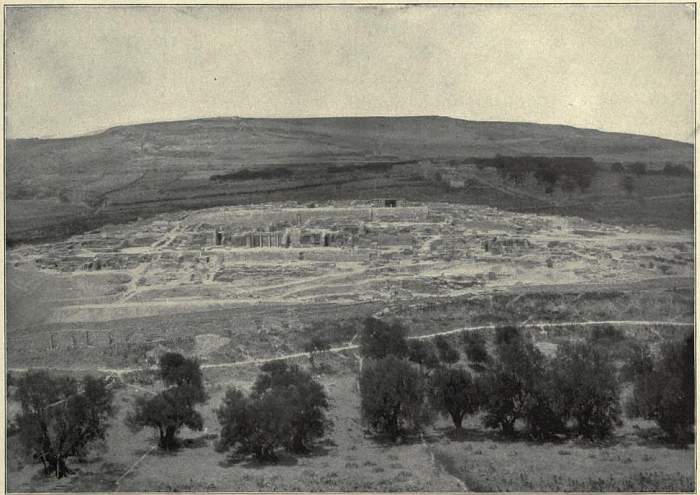
Fig. 1.—PALACE OF CNOSSUS. GENERAL VIEW OF THE SITE FROM THE EAST.
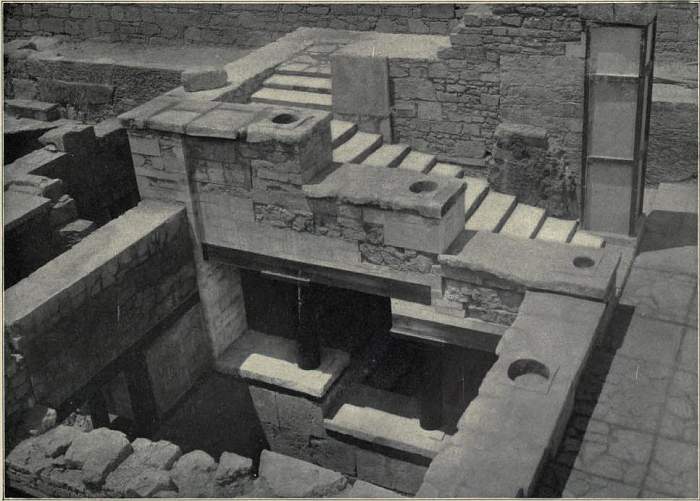
Fig. 2.—VIEW OF PART OF GRAND STAIRCASE AND HALL OF COLONNADES (WOODEN COLUMNS RESTORED) (CNOSSUS). (By permission of Dr A. J. Evans.)
Plate II.
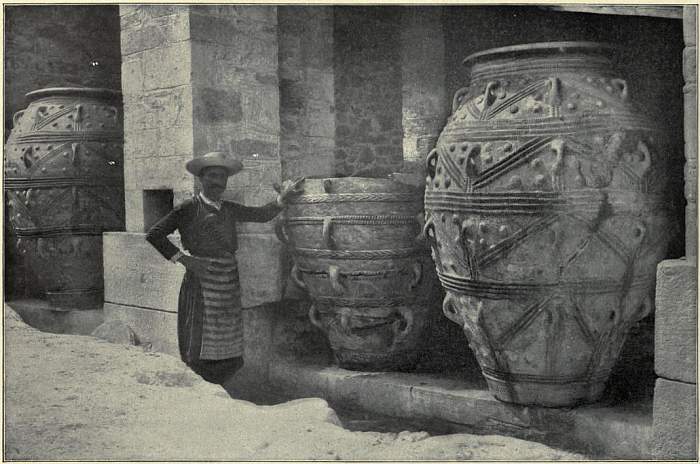
Fig. 3.—LARGE OIL-JARS IN EAST MAGAZINES (CNOSSUS).
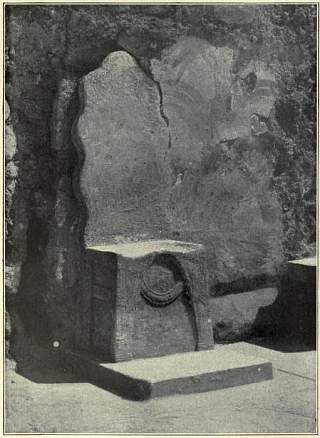
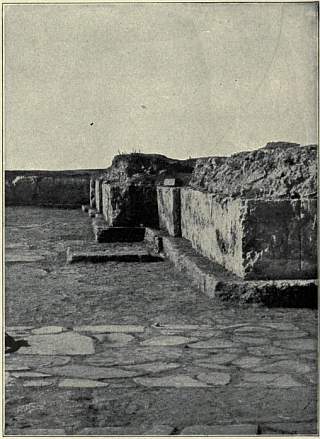
Fig. 4.—GYPSUM THRONE (FRESCO PAINTING VISIBLE ON WALL) (CNOSSUS). Fig. 5.—BASE OF WEST WALL NEAR ROYAL ENTRANCE (CNOSSUS).
(By permission of Dr A. J. Evans.)
Gournia.—Near this hamlet on the coast of the Gulf of Mirabello in east Crete, the American archaeologist Miss Harriet Boyd has excavated a great part of another Minoan town. It covers the sides of a long hill, its main avenue being a winding roadway leading to a small palace. It contained a shrine of the Cretan snake goddess, and was rich in minor relics, chiefly in the shape of bronze implements and pottery for household use. The bulk of the remains belong here, as at Hagia Triada, to the beginning of the Late Minoan period, but there are signs of reoccupation in the decadent Minoan age. The remains supply detailed information as to the everyday life of a Cretan country town about the middle of the second millennium B.C. (H. Boyd, Excavations at Gournia).
Zakro.—Near the lower hamlet of that name on the S.E. coast important remains of a settlement contemporary with that of Gournia were explored by D. G. Hogarth, consisting of houses and pits containing painted pottery of exceptional beauty and a great variety of seal impressions. The deep bay in which Zakro lies is a well-known port of call for the fishing fleets on their way to the sponge grounds of the Libyan coast, and doubtless stood in the same stead to the Minoan shipping (D. G. Hogarth, Annual of the British School, vii. 121 sqq., and Journ. of Hellenic Studies, xxii. 76 sqq. and 333 sqq.).
Dictaean Cave.—Near the village of Psychro on the Lassithi range, answering to the western Dicte, opens a large cave, identified with the legendary birthplace of the Cretan Zeus. This cavern also shared with that of Ida the claim to have been that in which Minos, Moses-like, received the law from Zeus. The exploration begun by the Italian Mission under Halbherr and continued by Evans, who found here the inscribed libation table (see above), was completed by Hogarth in 1900. Besides the great entrance hall of the cavern, which served as the upper shrine, were descending vaults forming a lower sanctuary going down deep into the bowels of the earth. Great quantities of votive figures and objects of cult, such as the fetish double axes and stone tables of offering, were found both above and below. In the lower sanctuary the natural pillars of stalagmite had been used as objects of worship, and bronze votive objects thrust into their crevices (Halbherr, Museo di antichità classica, ii. pp. 906-910; Evans, Further Discoveries, &c., p. 350 sqq., Myc. Tree and Pillar Cult, p. 14 sqq.; Hogarth, “The Dictaean Cave,” Annual of British School at Athens, vi. 94 sqq.).
Pseira and Mochlos.—On these two islets on the northern coast of E. Crete, R. Seager, an American explorer, has found striking remains of flourishing Minoan settlements. The contents of a series of tombs at Mochlos throw an entirely new light on the civilization of the Early Minoan age.
The above summary gives, indeed, a very imperfect idea of the extent to which the remains of the great Minoan civilization are spread throughout the island. The “hundred cities” ascribed to Crete by Homer are in a fair way Third Late Minoan period. of becoming an ascertained reality. The great days of Crete lie thus beyond the historic period. The period of decline referred to above (Late Minoan III.), which begins about the beginning of the 14th century before our era, must, from the abundance of its remains, have been of considerable duration. As to the character of the invading elements that hastened its close, and the date of their incursions, contemporary Egyptian monuments afford the best clue. The Keftiu who represented Minoan culture in Egypt in the concluding period of the Cnossian palace (Late Minoan II.) cease to appear on Egyptian monuments towards the end of the XVIIIth Dynasty (c. 1350 B.C.), and their place is taken by the “Peoples of the Sea.” The Achaeans, under the name Akaiusha, already appear among the piratical invaders of Egypt in the time of Rameses III. (c. 1200 B.C.) of the XXth Dynasty (see H. R. Hall, “Keftiu and the Peoples of the Sea,” Annual of British School at Athens, viii. 157 sqq.).
About the same time the evidences of imports of Late Minoan or “Mycenaean” fabrics in Egypt definitely cease. In the Odyssey we already find the Greek settlementsin Crete. Achaeans together with Dorians settled in central Crete. In the extreme east and west of the island the aboriginal “Eteocretan” element, however, as represented respectively by the Praesians or Cydonians, still held its own, and inscriptions written in Greek characters show that the old language survived to the centuries immediately preceding the Christian era.
The mainland invasions which produced these great ethnic changes in Crete are marked archaeologically by signs of widespread destruction and by a considerable break in the continuity of the insular civilization. New burial The dark ages. customs, notably the rite of cremation in place of the older corpse-burial, are introduced, and in many cases the earlier tombs were pillaged and re-used by new comers. The use of iron for arms and implements now finally triumphed over bronze. Northern forms of swords and safety-pins are now found in general use. A new geometrical style of decoration like that of contemporary Greece largely supplants the Minoan models. The civic foundations which belong to this period, and which include the greater part of the massive ruins of Goulas and Anavlachos in the province of Mirabello and of Hyrtakina in the west, affect more or less precipitous sites and show a greater tendency to fortification. The old system of writing now dies out, and it is not till some three centuries later that the new alphabetic forms are introduced from a Semitic source. The whole course of the older Cretan civilization is awhile interrupted, and is separated from the new by the true dark ages of Greece.
It is nevertheless certain that some of the old traditions were preserved by the remnants of the old population now reduced to a subject condition, and that these finally leavened the whole lump, so that once more—this time under a Hellenic guise—Crete was enabled to anticipate mainland Greece in nascent civilization. Already in 1883 A. Milchhöfer (Anfänge der Kunst) had called attention to certain remarkable examples of archaic Greek bronze-work, and the subsequent discovery of the votive bronzes in the cave of Zeus on Mount Ida, and notably the shields with their fine embossed designs, shows that by the 8th century B.C. Cretan technique in metal not only held its own beside imported Cypro-Phoenician work, but was distinctly ahead of that of the rest of Greece (Halbherr, Bronzi del antro di Zeus Ideo). The recent excavations by the British School on the site of the Dictaean temple at Palaikastro bear out this conclusion, and an archaic marble head of Apollo found at Eleutherna shows that classical tradition was not at fault in recording the existence of a very early school of Greek sculpture in the island, illustrated by the names of Dipoenos and Scyllis.
The Dorian dynasts in Crete seem in some sort to have claimed descent from Minos, and the Dorian legislators sought their sanction in the laws which Minos was said to have received from the hands of the Cretan Zeus. The great monument of Gortyna discovered by Halbherr and Fabricius (Monumenti antichi, iii.) is the most important monument of early law hitherto brought to light in any part of the Greek world.
Among other Greek remains in the island may be mentioned, besides the great inscription, the archaic temple of the Pythian Apollo at Gortyna, a plain square building with a pronaos added in later times, excavated by Halbherr, Greek remains. 1885 and 1887 (Mon. Ant. iii. 2 seqq.), the Hellenic bridge and the vast rock-cut reservoirs of Eleutherna, the city walls of Itanos, Aptera and Polyrrhenia, and at Phalasarna, the rock-cut throne of a divinity, the port, and the remains of a temple. The most interesting record, however, that has been preserved of later Hellenic civilization in the island is the coinage of the Cretan cities (J. N. Svoronos, Numismatique de la Crete ancienne; W. Wroth, B. M. Coin Catalogue, Crete, &c.; P. Gardner, The Types of Greek Coins), which during the good period display a peculiarly picturesque artistic style distinct from that of the rest of the Greek world, and sometimes indicative of a revival of Minoan types. But in every case these artistic efforts were followed at short intervals by gross relapses into barbarism which reflect the anarchy of the political conditions.
Under the Pax Romana, the Cretan cities again enjoyed a large measure of prosperity, illustrated by numerous edifices still existing at the time of the Venetian occupation. A good account of these is preserved in a MS. description of the island Roman remains. drawn up under the Venetians about 1538, and existing in the library of St Mark (published by Falkener, Museum of Classical Antiquities, ii. pp. 263-303). Very little of all this, however, has escaped the Turkish conquest and the ravages caused by the incessant insurrections of the last two centuries. The ruin-field of Gortyna still evokes something of the importance that it possessed in Imperial days, and at Lebena on the south coast are remains of a temple of Aesculapius and its dependencies which stood in connexion with this city. At Cnossus, save some blocks of the amphitheatre, the Roman monuments visible in Venetian times have almost wholly disappeared. Among the early Christian remains of the island far and away the most important is the church of St Titus at Gortyna, which perhaps dates from the Constantinian age.
Literature.—See the authorities already quoted, for further details. Previous to the extensive excavations referred to above, Crete had been carefully examined and explored by Tournefort, Pococke, Olivier and other travellers, e.g. Pashley (Travels in Crete, 2 vols., London, 1837) and Captain Spratt (Travels and Researches in Crete, 2 vols., London, 1865). A survey sufficiently accurate as regards the maritime parts was also executed, under the orders of the British admiralty, by Captain Graves and Captain (afterwards Admiral) Spratt. Most that can be gathered from ancient authors concerning the mythology and early history of the island is brought together by Meursius (Creta, &c., in the 3rd vol. of his works) and Hoeck (Kreta, 3 vols., Göttingen, 1823-1829), but the latter work was published before the researches which have thrown so much light on the topography and antiquities of the island. Much new material, especially as to the western provinces of Crete, has been recently collected by members of the Italian Archaeological Mission (Monumenti Antichi, vol. vi. 154 seqq., ix. 286, 1899; xi. 286 seqq.).
(A. J. E.)
History.
Ancient.—Lying midway between three continents, Crete was from the earliest period a natural stepping-stone for the passage of early culture from Egypt and the East to mainland Greece. On all this the recent archaeological discoveries (see the section on Archaeology) have thrown great light, but the earliest written history of Crete, like that of most parts of continental Greece, is mixed up with mythology and fable to so great an extent as to render it difficult to arrive at any clear conclusions concerning it. The Cretans themselves claimed for their island to be the birthplace of Zeus, as well as the parent of all the other divinities usually worshipped in Greece as the Olympian deities. But passing from this region of pure mythology to the semi-mythic or heroic age, we find almost all the early legends and traditions of the island grouped around the name of Minos. According to the received tradition, Minos was a king of Cnossus in Crete; he was a son of Zeus, and enjoyed through life the privilege of habitual intercourse with his divine father. It was from this source that he derived the wisdom which enabled him to give to the Cretans the excellent system of laws and governments that earned for him the reputation of being the greatest legislator of antiquity. At the same time he was reported to have been the first monarch who established a naval power, and acquired what was termed by the Greeks the Thalassocracy, or dominion of the sea.
This last tradition, which was received as an undoubted fact both by Thucydides and Aristotle, has during the last few years received striking confirmation. The remarkable remains recently brought to light on Cretan soil tend to show that already some 2000 years before the Dorian conquest the island was exercising a dominant influence in the Aegean world. The great palaces now excavated at Cnossus and Phaestus, as well as the royal villa of Hagia Triada, exhibit the successive phases of a brilliant primitive civilization which had already attained mature development by the date of the XIIth Egyptian dynasty. To this civilization as a whole it is convenient to give the name “Minoan,” and the name of Minos itself may be reasonably thought to cover a dynastic even more than a personal significance in much the same way as such historic terms as “Pharaoh” or “Caesar.”
The archaeological evidence outside Crete points to the actual existence of Minoan plantations as far afield on one side as Sicily and on the other as the coast of Canaan. The historic tradition which identifies with the Cretans the principal element of the Philistine confederation, and places the tomb of Minos himself in western Sicily, thus receives remarkable confirmation. Industrial relations with Egypt are also marked by the occurrence of a series of finds of pottery and other objects of Minoan fabric among the remains of the XVIIIth, XIIth and even earlier dynasties, while the same seafaring enterprise brought Egyptian fabrics to Crete from the times of the first Pharaohs. Even in the Homeric poems, which belong to an age when the great Minoan civilization was already decadent, the Cretans appear as the only Greek people who attempted to compete with the Phoenicians as bold and adventurous navigators. In the Homeric age the population of Crete was of a very mixed character, and we are told in the Odyssey (xix. 175) that besides the Eteocretes, who, as their name imports, must have been the original inhabitants, the island contained Achaeans, Pelasgians and Dorians. Subsequently the Dorian element became greatly strengthened by fresh immigrations from the Peloponnesus, and during the historical period all the principal cities of the island were either Dorian colonies, or had adopted the Dorian dialect and institutions. It is certain that at a very early period the Cretan cities were celebrated for their laws and system of government, and the most extensive monument of early Greek law is the great Gortyna inscription, discovered in 1884. The origin of the Cretan laws was of course attributed to Minos, but they had much in common with those of the other Dorian states, as well as with those of Lycurgus at Sparta, which were, indeed, according to one tradition, copied in great measure from those already existing in Crete.2
It is certain that whatever merits the Cretan laws may have possessed for the internal regulation of the different cities, they had the one glaring defect, that they made no provision for any federal bond or union among them, or for the government of the island as a whole. It was owing to the want of this that the Cretans scarcely figure in Greek history as a people, though the island, as observed by Aristotle, would seem from its natural position calculated to exercise a preponderating influence over Greek affairs. Thus they took no part either in the Persian or in the Peloponnesian War, or in any of the subsequent civil contests in which so many of the cities and islands of Greece were engaged. At the same time they were so far from enjoying tranquillity on this account that the few notices we find of them in history always represent them as engaged in local wars among one another; and Polybius tells us that the history of Crete was one continued series of civil wars, which were carried on with a bitter animosity exceeding all that was known in the rest of Greece.
In these domestic contests the three cities that generally took the lead, and claimed to exercise a kind of hegemony or supremacy over the whole island, were Cnossus, Gortyna and Cydonia. But besides these three, there were many other independent cities, which, though they generally followed the lead of one or other of these more powerful rivals, enjoyed complete autonomy, and were able to shift at will from one alliance to another. Among the most important of these were—Lyttus or Lyctus, in the interior, south-east of Cnossus; Rhaucus, between Cnossus and Gortyna; Phaestus, in the plain of Messara, between Gortyna and the sea; Polyrrhenia, near the north-west angle of the island; Aptera, a few miles inland from the Bay of Suda; Eleutherna and Axus, on the northern slopes of Mount Ida; and Lappa, between the White Mountains and the sea. Phalasarna on the west coast, and Chersonesus on the north, seem to have been dependencies, and served as the ports of Polyrrhenia and Lyttus. Elyrus stood at the foot of the White Mountains just above the south coast. In the eastern portion of the island were Praesus in the interior, and Itanus on the coast, facing the east, while Hierapytna on the south coast was the only place of importance on the side facing Africa, and on this account rose under the Romans to be one of the principal cities of the island.
(A. J. E.)
Medieval to 19th Century.—Though it was continually torn by civil dissensions, the island maintained its independence of the various Macedonian monarchs by whom it was surrounded; but having incurred the enmity of Rome, first by an alliance with the great Mithradates, and afterwards by taking active part with their neighbours, the pirates of Cilicia, the Cretans were at length attacked by the Roman arms, and, after a resistance protracted for more than three years, were finally subdued by Q. Metellus, who earned by this success the surname of Creticus (67 B.C.). The island was now reduced to a Roman province, and subsequently united for administrative purposes with the district of Cyrenaica or the Pentapolis, on the opposite coast of Africa. This arrangement lasted till the time of Constantine, by whom Crete was incorporated in the prefecture of Illyria. It continued to form part of the Byzantine empire till the 9th century, when it fell into the hands of the Saracens (823). It then became a formidable nest of pirates and a great slave mart; it defied all the efforts of the Byzantine sovereigns to recover it till the year 960, when it was reconquered by Nicephorus Phocas. In the partition of the Greek empire after the capture of Constantinople by the Latins in 1204, Crete fell to the lot of Boniface, marquis of Montferrat, but was sold by him to the Venetians, and thus passed under the dominion of that great republic, to which it continued subject for more than four centuries.
Under the Venetian government Candia, a fortress originally built by the Saracens, and called by them “Khandax,” became the seat of government, and not only rose to be the capital and chief city of the island, but actually gave name to it, so that it was called in the official language of Venice “the island of Candia,” a designation which from thence passed into modern maps. The ancient name of Krete or Kriti was, however, always retained in use among the Greeks, and is gradually resuming its place in the usage of literary Europe. The government of Crete by the Venetian aristocracy was, like that of their other dependencies, very arbitrary and oppressive, and numerous insurrections were the consequence. Daru, in his history of Venice, mentions fourteen between the years 1207 and 1365, the most important being that of 1361-1364,—a revolt not of the natives against the rule of their Venetian masters, but of the Venetian colonists against the republic. But with all its defects their administration did much to promote the material prosperity of the country, and to encourage commerce and industry; and it is probable that the island was more prosperous than at any subsequent time. Their Venetian masters at least secured to the islanders external tranquillity, and it is singular that the Turks were content to leave them in undisturbed possession of this opulent and important island for nearly two centuries after the fall of Constantinople. The Cretans themselves, however, were eager for a change, and, disappointed in the hope of a Genoese occupation, were ready, as is stated in the report of a Venetian commissioner, to exchange the rule of the Venetians for that of the Turks, whom they fondly expected to find more lenient, or at any rate less energetic, masters. It was not till 1645 that the Turks made any serious attempt to effect the conquest of the island; but in that year they landed with an army of 50,000 men, and speedily reduced the important city of Canea. Retimo fell the following year, and in 1648 they laid siege to the capital city of Candia. This was the longest siege on record, having been protracted for more than twenty years; but in 1667 it was pressed with renewed vigour by the Turks under the grand vizier Ahmed Kuprili, and the city was at length compelled to surrender (September 1669). Its fall was followed by the submission of the whole island. Venice was allowed to retain possession of Grabusa, Suda and Spinalonga on the north, but in 1718 these three strongholds reverted to the Turks, and the island was finally lost to Venice.
From this time Crete continued subject to Ottoman rule without interruption till the outbreak of the Greek revolution. After the conquest a large part of the inhabitants embraced Mahommedanism, and thus secured to themselves the chief share in the administration of the island. But far from this having a favourable effect upon the condition of the population, the result was just the contrary, and according to R. Pashley (Travels in Crete, 1837) Crete was the worst governed province of the Turkish empire. In 1770 an abortive attempt at revolt, the hero of which was “Master” John, a Sphakiot chief, was repressed with great cruelty. The regular authorities sent from Constantinople were wholly unable to control the excesses of the janissaries, who exercised without restraint every kind of violence and oppression. In 1813 the ruthless severity of the governor-general, Haji Osman, who obtained the co-operation of the Christians, broke the power of the janissaries; but after Osman had fallen a victim to the suspicions of the sultan, Crete again came under their control. When in 1821 the revolution broke out in continental Greece, the Cretans, headed by the Sphakiots, after a massacre at Canea at once raised the standard of insurrection. They carried on hostilities with such success that they soon made themselves masters of the whole of the open country, and drove the Turks and Mussulman population to take refuge in the fortified cities. The sultan then invoked the assistance of Mehemet Ali, pasha of Egypt, who despatched 7000 Albanians to the island. Hostilities continued with no decisive result till 1824, when the arrival of further reinforcements enabled the Turkish commander to reduce the island to submission. In 1827 the battle of Navarino took place, and in 1830 (3rd of February) Greece was declared independent. The allied powers (France, England and Russia) decided, however, that Crete should not be included amongst the islands annexed to the newly-formed kingdom of Greece; but recognizing that some change was necessary, they obtained from the sultan Mahmud II. its cession to Egypt, which was confirmed by a firman of the 20th of December 1832. This change of masters brought some relief to the unfortunate Cretans, who at least exchanged the licence of local misrule for the oppression of an organized despotism; and the government of Mustafa Pasha, an Albanian like Mehemet Ali, the ruler of the island for a considerable period (1832-1852), was more enlightened and intelligent than that of most Turkish governors. He encouraged agriculture, improved the roads, introduced an Albanian police, and put down brigandage. The period of his administration has been called the “golden age” of Crete.
In 1840 Crete was again taken from Mehemet Ali, and replaced under the dominion of the Turks, but fortunately Mustafa still retained his governorship until he left for Constantinople to become grand vizier in 1852. Four years later an insurrection broke out, owing to the violation of the provisions of an imperial decree (February 1856), whereby liberty of conscience and equal rights and privileges with Mussulmans had been conferred upon Christians. The latter refused to lay down their arms until a firman was issued (July 1858), confirming the promised concessions. These promises being again repudiated, in 1864 the inhabitants held an assembly and a petition was drawn up for presentation at Constantinople by the governor. The sultan’s reply was couched in the vaguest terms, and the Cretans were ordered to render unquestioning obedience to the authorities. After a period of great distress and cruel oppression, in 1866, on the demand for reforms being again refused, a general insurrection took place, which was only put down by great exertions on the part of the Porte. It was followed by the concession of additional privileges to the Christians of the island and of a kind of constitutional government and other reforms embodied in what is known as the “Organic Statute” of 1868.
(J. H. F.)
Modern Constitutional.—Cretan constitutional history may be said to date from 1868, when, after the suppression of an insurrection which had extended over three years, the Turkish government consented to grant a certain measure of autonomy to the island. The privileges now accorded were embodied in what is known as the Organic Statute, an instrument which eventually obtained a somewhat wider importance, being proposed by Article XXIII. of the Berlin Treaty as a basis of reforms to be introduced in other parts of the Ottoman empire. Various privileges already acquired by the Christian population were confirmed; a general council, or representative body, was brought into existence, composed of deputies from every district in the island; mixed tribunals were introduced, together with a highly elaborate administrative system, under which all the more important functionaries, Christian and Mussulman, were provided with an assessor of the opposite creed. The new constitution, however, proved costly and unworkable, and failed to satisfy either section of the population. The Christians were ready for another outbreak, when, in 1878, the Greek government, finding Hellenic aspirations ignored by the treaty of San Stefano, gave the signal for agitation in the island. During the insurrection which followed, the usual barbarities were committed on both sides; the Christians betook themselves to the mountains, and the Mussulman peasants crowded into the fortified towns. Eventually the Cretan chiefs invoked the mediation of England, which Turkey, exhausted by her struggle with Russia, was Pact of Halepa. ready to accept, and the convention known as the Pact of Halepa was drawn up in 1878 under the auspices of Mr Sandwith, the British consul, and Adossides Pasha, both of whom enjoyed the confidence of the Cretan population. The privileges conferred by the Organic Statute were confirmed; the cumbersome and extravagant judicial and administrative systems were maintained; the judges were declared independent of the executive, and an Assembly composed of forty-nine Christian and thirty-one Mussulman deputies took the place of the former general council. A parliamentary régime was thus inaugurated, and party warfare for a time took the place of the old religious antagonism, the Moslems attaching themselves to one or other of the political factions which now made their appearance among the Christians. The material interests of the island were neglected in the scramble for place and power; the finances fell into disorder, and the party which came off worst in the struggle systematically intrigued against the governor-general of the day and conspired with his enemies at Constantinople. A crisis came about in 1889, when the “Conservative” leaders, finding themselves in a minority in the chamber, took up arms and withdrew to the mountains. Though the outbreak was unconnected with the religious feud, the latent fanaticism of both creeds was soon aroused, and the island once more became a scene of pillage and devastation. Unlike the two preceding movements, the insurrection of 1889 resulted unfavourably for the Christians. The Porte, having induced the Greek government to persuade the insurgents not to oppose the occupation of several strategic posts, despatched a military governor to the island, proclaimed martial law, and issued a firman abrogating many important provisions of the Halepa Pact. The mode of election to the assembly was altered, the number of its members reduced, and the customs revenue, which had hitherto been shared with the island, was appropriated by the Turkish treasury. The firman was undoubtedly illegal, as it violated a convention possessing a quasi-international sanction, but the Christians were unable to resist, and the powers abstained from intervention. The elections held under the new system proved a failure, the Christians refusing to go to the polls, and for the next five years Crete was governed absolutely by a succession of Mahommedan Valis. The situation went from bad to worse, the deficit in the budget increased, the gendarmery, which received no pay, became insubordinate, and crime multiplied. In 1894 the Porte, at the instance of the powers, nominated a Christian, Karatheodory Pasha, to the governorship, and the Christians, mollified by the concession, agreed to take part in the assembly which soon afterwards was convoked; no steps, however, were taken to remedy the financial situation, which became the immediate cause of the disorders that followed. The refusal of the Porte to refund considerable sums which had been illegally diverted from the Cretan treasury or even to sanction a loan to meet immediate requirements caused no little exasperation in the island, which was increased by the recall of Karatheodory (March 1895). Before that event an Epitropé, or “Committee of Reform,” had appeared in the mountains—the harbinger of the prolonged struggle which ended in the emancipation Insurrection of 1896-97. of Crete. The Epitropé was at first nothing more than a handful of discontented politicians who had failed to find places in the administration, but some slight reverses which it succeeded in inflicting on the Turkish troops brought thousands of armed Christians to its side, and in April 1896 it found itself strong enough to invest the important garrison town of Vamos. The Moslem peasantry now flocked to the fortified towns and civil war began. Serious disturbances broke out at Canea on the 24th of May, and were only quelled by the arrival of foreign warships. The foreign consuls intervened in the hope of bringing about a peaceful settlement, but the Sultan resolved on the employment of force, and an expedition despatched to Vamos effected the relief of that town with a loss of 200 men. The advance of a Turkish detachment through the western districts, where other garrisons were besieged, was marked by pillage and devastation, and 5000 Christian peasants took refuge on the desolate promontory of Spada, where they suffered extreme privations. These events, which produced much excitement in Greece, quickened the energies of the powers. An international blockade of the island was proposed by Austria but rejected by England. The ambassadors at Constantinople urged peaceful counsels on the Porte, and the Sultan, alarmed at this juncture by an Armenian outbreak, began to display a conciliatory disposition. The Pact of Halepa was restored, the troops were withdrawn from the interior, financial aid was promised to the island, a Christian governor-general was appointed, the assembly was summoned, and an imperial commissioner was despatched to negotiate an arrangement. The Christian leaders prepared a moderate scheme of reforms, based on the Halepa Pact, which, with a few exceptions, were approved by the powers and eventually sanctioned by the sultan.
On the 4th of September 1896 the assembly formally accepted the new constitution and declared its gratitude to the powers for their intervention. The Moslem leaders acquiesced in the arrangement, which the powers undertook to guarantee, and, notwithstanding some symptoms of discontent at Candia, there was every reason to hope that the island was now entering upon a period of tranquillity. It soon became evident, however, that the Porte was endeavouring to obstruct the execution of the new reforms. Several months passed without any step being taken towards this realization; difficulties were raised with regard to the composition of the international commissions charged with the reorganization of the gendarmery and judicial system; intrigues were set on foot against the Christian governor-general; and the presence of a special imperial commissioner, who had no place under the constitution, proved so injurious to the restoration of tranquillity that the powers demanded his immediate recall. The indignation of the Christians increased, a state of insecurity prevailed, and the Moslem peasants refused to return to their homes. A new factor now became apparent in Cretan politics. Since the outbreak in May 1896 the Greek government had loyally co-operated with the powers in their efforts for the pacification of the island, but towards the close of the year a secret society known as the Ethniké Hetaeria began to arrogate to itself the direction of Greek foreign policy. The aim of the society was a war with Turkey with a view to the acquisition of Macedonia, and it found a ready instrument for its designs in the growing discontent of the Cretan Christians. Emissaries of the society now appeared in Crete, large consignments of arms were landed, and at the beginning of 1897 the Greek Intervention. island was practically in a state of insurrection. On the 21st of January the Greek fleet was mobilized. Affairs were brought to a climax by a series of conflicts which took place at Canea on the 4th of February; the Turkish troops fired on the Christians, a conflagration broke out in the town, and many thousands of Christians took refuge on the foreign warships in the bay. The Greek government now despatched an ironclad and a cruiser to Canea, which were followed a few days later by a torpedo flotilla commanded by Prince George. The prince soon retired to Melos, but on the night of the 14th of February a Greek expeditionary force under Colonel Vassos landed at Kolymbari, near Canea, and its commander issued a proclamation announcing the occupation of the island in the name of King George. On the same day Georgi Pasha, the Christian governor-general, took refuge on board a Russian ironclad, and, on the next, naval detachments from the warships of the powers occupied Canea. This step paralysed the movements of Colonel Vassos, who after a few slight engagements with the Turks remained practically inactive in the interior. The insurgents, however, continued to threaten the town, and their position was bombarded by the international fleet (21st February). The intervention of Greece caused immense excitement among the Christian population, and terrible massacres of Moslem peasants took place in the eastern and western districts. The forces of the powers shortly afterwards occupied Candia and the other maritime towns, while the international fleet blockaded the Cretan coast. These measures were followed by the presentation of collective notes to the Greek and Decision of the powers. Turkish governments (2nd March), announcing the decision of the powers that (1) Crete could in no case in present circumstances be annexed to Greece; (2) in view of the delays caused by Turkey in the application of the reforms Crete should now be endowed with an effective autonomous administration, intended to secure to it a separate government, under the suzerainty of the sultan. Greece was at the same time summoned to remove its army and fleet from the island, while the Turkish troops were to be concentrated in the fortresses and eventually withdrawn. The cabinet of Athens, however, declined to recall the expeditionary force, which remained in the interior till the 9th of May, when, after the Greek reverses in Thessaly and Epirus, an order was given for its return. Meantime Cretan autonomy had been proclaimed (20th March). After the departure of the Greek troops the Cretan leaders, who had hitherto demanded annexation to Greece, readily acquiesced in the decision of the powers, and the insurgent Assembly, under its president Dr Sphakianakis, a man of good sense and moderation, co-operated with the international commanders in the maintenance of order. The pacification of the island, however, was delayed by the presence of the Turkish troops and the inability of the powers to agree in the choice of a new governor-general. The prospect of a final settlement was improved by the withdrawal of Germany and Austria, which had favoured Turkish pretensions, from the European concert (April 1898); the remaining powers divided the island into four departments, which they severally undertook to administer. An attack made by the Moslems of Candia on the British garrison of that town, with the connivance of the Turkish authorities, brought home to the powers the necessity of removing the Ottoman troops, and the last Turkish soldiers quitted the island on the 14th of November 1898.
On the 26th of that month the nomination of Prince George of Greece as high commissioner of the powers in Crete for a period of three years (renewed in 1901) was formally announced, and on the 21st of December the prince Prince George’s administration. landed at Suda and made his public entry into Canea amid enthusiastic demonstrations. For some time after his arrival complete tranquillity prevailed in the island, but the Moslem population, reduced to great distress by the prolonged insurrection, emigrated in large numbers. On the 27th of April 1899 a new autonomous constitution was voted by a constituent assembly, and in the following June the local administration was handed over to Cretan officials by the international authorities. The extensive powers conferred by the constitution upon Prince George were increased by subsequent enactments. In 1901 M. Venezelo, who had played a noteworthy part in the last insurrection, was dismissed from the post of councillor by the prince, and soon afterwards became leader of a strong opposition party, which denounced the arbitrary methods of the government. During the next four years party spirit ran high; in the spring of 1904 a deputation of chiefs and politicians addressed a protest to the prince, and early in the following year a band of armed malcontents under M. Venezelo raised the standard of revolt at Theriso in the White Mountains. The insurgents, who received moral support from Dr Sphakianakis, proclaimed the union of the island with Greece (March 1905), and their example was speedily followed by the assembly at Canea. The powers, however, reiterated their decision to maintain the status quo, and increased their military and naval forces; the Greek flag was hauled down at Canea and Candia, and some desultory engagements with the insurgents took place, the international troops co-operating with the native gendarmerie. In the autumn M. Venezelo and his followers, having obtained an amnesty, laid down their arms. A commission appointed by the powers to report on the administrative and financial situation drew up a series of recommendations in January 1906, and a constituent assembly for the revision of the constitution met at Canea in the following June. On the 25th of July the powers announced a series of reforms, including the reorganization of the gendarmerie and militia under Greek officers, as a preliminary to the eventual withdrawal of the international troops, and the extension to Crete of the system of financial control established in Greece. On the 14th of September, under an agreement dated the 14th of August, they invited King George of Greece, in the event of the high commissionership becoming vacant, to propose a candidate for that post, to be nominated by the powers for a period of five years, and on the 25th of September Prince George left the island. He had done much for the welfare of Crete, but his participation in party struggles and his attitude towards the representatives of the powers had rendered his position untenable. His successor, M. Alexander Zaimis, a former prime minister of Greece, arrived in Crete on the 1st of October.
(J. D. B.)
On the 22nd of February 1907 M. Zaimis, as high commissioner, took the oath to the new constitution elaborated after much debate by the Cretan national assembly. His position was one of singular difficulty. Apart from the rivalry of the factions within the Assembly, there was the question of the Mussulman minority, dwindling it is true,3 but still a force to be reckoned with. The high commissioner, true to his reputation as a prudent statesman and astute politician, showed great skill in dealing with the situation. From the first he had taken up an attitude of great reserve, appearing little in public and careful not to identify himself with any faction. In such matters as appointments to the judicial bench, indeed, his studied impartiality offended both parties; but on the whole his administration was a marked success, and the cessation of the chronic state of disturbance in the island justified the powers in preparing for the withdrawal of their troops. In spite of the admission of their co-religionists to high office in the government, the Mussulmans, it is true, still complained of continuous ill-treatment having for its object their expatriation; but these complaints were declared by Sir Edward Grey, in answer to a question in parliament, to be exaggerated. The protecting powers had fixed the conditions preliminary to evacuation—(1) the organization of a native gendarmerie, (2) the maintenance of the tranquillity of the island, (3) the complete security of the Mussulman population. On the 20th of March 1908 M. Zaimis called the attention of the powers to the fact that these conditions had been fulfilled, and on the 11th of May the powers announced to the high commissioner their intention of beginning the evacuation at once and completing it within a year. The first withdrawal of the troops (July 27), hailed with enthusiasm by the Cretan Christians, led to rioting by the Mussulmans, who believed themselves abandoned to their fate.
Meanwhile M. Zaimis had made a further advance towards the annexation of the island to Greece by a visit to Athens, where he arranged for a loan with the Greek National Bank and engaged Greek officers for the new gendarmerie. The issue was precipitated by the news of the revolution in Turkey. On the 12th of October the Cretan Assembly once more voted the union with Greece, and in the absence of M. Zaimis—who had gone for a holiday to Santa Maura—elected a committee of six to govern the island in the name of the king of Greece.
Against this the Mussulman deputies protested, in a memorandum addressed to the British secretary of state for foreign affairs. His reply, while stating that his government would safeguard the interests of the Mussulmans, left open the question of the attitude of the powers, complicated now by sympathy with reformed Turkey. The efforts of diplomacy were directed to allaying the resentment of the “Young Turks” on the one hand and the ardour of the Greek unionists on the other; and meanwhile the Cretan administration was carried on peaceably in the name of King George. At last (July 13, 1909) the powers announced to the Porte, in answer to a formal remonstrance, their decision to withdraw their remaining troops from Crete by July 26 and to station four war-ships off the island to protect the Moslems and to safeguard “the supreme rights” of the Ottoman Empire. This arrangement, which was duly carried out, was avowedly “provisional” and satisfied neither party, leading in Greece especially to the military and constitutional crises of 1909 and 1910.
(W. A. P.)
Authorities.—Pashley, Travels in Crete (2 vols., Cambridge and London, 1837); Spratt, Travels and Researches in Crete (2 vols., London, 1867); Raulin, Description physique de l’île de Crète (3 vols, and Atlas, Paris, 1869); W. J. Stillman, The Cretan Insurrection of 1866-68 (New York, 1874); Edwardes, Letters from Crete (London, 1887); Stavrakis, Στατιστικὴ τοῦ πληθυσμοῦ τῆς Κρήτης (Athens, 1890); J. H. Freese, A Short Popular History of Crete (London, 1897); Bickford-Smith, Cretan Sketches (London, 1897); Laroche, La Crète ancienne et moderne (Paris, 1898); Victor Berard, Les Affaires de Crète (Paris, 1898); Monumenti Veneti dell’ isola de Creta (published by the Venetian Institute), vol. i. (1906), vol. ii. (1908). See also Mrs Walker, Eastern Life and Scenery (London, 1886), and Old Tracks and New Landmarks (London, 1897); H. F. Tozer, The Islands of the Aegean (Oxford, 1890); J. D. Bourchier, “The Stronghold of the Sphakiotes,” Fortnightly Review (August 1890); E. J. Dillon, “Crete and the Cretans,” Fortnightly Review (May 1897).
CRETINISM, the term given to a chronic disease, either sporadic or endemic, arising in early childhood, and due to absence or deficiency of the normal secretion of the thyroid gland. It is characterized by imperfect development both of mind and body. The thyroid gland is either congenitally absent, imperfectly developed, or there is definite goitre. The origin of the word is doubtful. Its southern French form Chrestiaa suggested to Michel a derivation from cresta (crête), the goose foot of red cloth worn by the Cagots of the Pyrenees. The Cagots, however, were not cretins. The word is usually explained as derived from chrétien (Christian) in the sense of “innocent.” But Christianus (which appears in the Lombard cristanei; compare the Savoyard innocents and gens du bon dieu) is probably a translation of the older cretin, and the latter is probably connected with creta (craie)—a sallow or yellow-earthy complexion being a common mark of cretinism.
The endemic form of cretinism prevails in certain districts, as in the valleys of central Switzerland, Tirol and the Pyrenees. In the United Kingdom cretins have been found in England at Oldham, Sholver Moor, Crompton, Duffield, Cromford (near Matlock), and other points in Derbyshire; endemic goitre has been seen near Nottingham, Chesterfield, Pontefract, Ripon, and the mountainous parts of Staffordshire and Yorkshire, the east of Cumberland, certain parts of Worcester, Warwick, Cheshire, Monmouth, and Leicester, near Horsham in Hampshire, near Haslemere in Surrey, and near Beaconsfield in Buckingham. There are cretins at Chiselborough in Somerset. In Scotland cretins and cases of goitre have been seen in Perthshire, on the east coast of Fife, in Roxburgh, the upper portions of Peebles and Selkirk, near Lanark and Dumfries, in the east of Ayrshire, in the west of Berwick, the east of Wigtown, and in Kirkcudbright. The disease is not confined to Europe, but occurs in North and South America, Australia, Africa and Asia. Wherever endemic goitre is present, endemic cretinism is present also, and it has been constantly observed that when a new family moves into a goitrous district, goitre appears in the first generation, cretinism in the second. The causation of goitre has now been shown to be due to drinking certain waters, though the particular impurity in the water which gives rise to this condition has not been determined (see Goitre). The causation of the sporadic form of cretinism is, however, obscure.
Cretinism usually remains unrecognized until the child reaches some eighteen months or two years, when its lack of mental development and uncouth bodily form begin to attract attention. Occasionally the child appears to be normal in infancy, but the cretinoid condition develops later, any time up to puberty. The essential point in the morbid anatomy of these cases is the absence or abnormal condition of the thyroid gland (see Metabolic Diseases). It may be congenitally absent, atrophied, or the seat of a goitre, though this last condition is very rare in cases of sporadic cretinism. The skeleton shows arrested growth, most marked in the case of the long bones. The skull in the endemic form of cretinism is usually brachycephalic, but in the sporadic cases it is more commonly dolichocephalic. The pathology of cretinism and its allied condition myxoedema (q.v.) has now been conclusively worked out, and its essential cause has been shown to be loss of function of the thyroid gland.
The condition has existed and been described in far back ages, but mingled with so many other entirely different deformities and degenerations that it is now often almost impossible to classify them satisfactorily. The following is a vivid picture by Beaupré (Dissertation sur les crétins, translated in Blackie on Cretinism, Edin., 1855):—
“I see a head of unusual form and size, a squat and bloated figure, a stupid look, bleared hollow and heavy eyes, thick projecting eyelids, and a flat nose. His face is of a leaden hue, his skin dirty, flabby, covered with tetters, and his thick tongue hangs down over his moist livid lips. His mouth, always open and full of saliva, shows teeth going to decay. His chest is narrow, his back curved, his breath asthmatic, his limbs short, misshapen, without power. The knees are thick and inclined inward, the feet flat. The large head drops listlessly on the breast; the abdomen is like a bag.”
When fully grown the height rarely exceeds 4 ft., and is often less than 3 ft. The skin feels doughy from thickening of the subcutaneous tissues, and it hangs in folds over the abdomen and the bends of the joints. Very frequently there is an umbilical hernia. The hair has a far greater resemblance to horse-hair than to that of a human being, and is usually absent on the body of an adult cretin. The temperature is subnormal, and the exposed parts tend to become blue in cold weather. The blood is usually deficient in haemoglobin, which is often only 40-50% of the normal. The mental capacity varies within narrow limits; an intelligent adult cretin may reach the intellectual development of a child 3-4 years of age, though more often the standard attained is even below this. The child cretin learns neither to walk nor talk at the usual time. Often it is unable even to sit without support. Some years later a certain power of movement is acquired, but the gait is waddling and clumsy. Speech is long delayed, or in bad cases may be almost entirely lacking. The voice is usually harsh and unpleasant. Of the senses smell and taste are but slightly developed, more or less deafness is generally present, and only the sight is fairly normal. In the adult the genital organs remain undeveloped. If the cretin is untreated he rarely has a long life, thirty years being an exceptional age. Death results from some intercurrent disease.
Cretinism has to be distinguished from the state of a Mongolian idiot, in whom there is no thickening of the subcutaneous tissues, and much greater alertness of mind; from achondroplasia, in which condition there is usually no mental impairment; and from infantilism, which covers a group of symptoms whose only common point is that the primary and secondary sexual characteristics fail to appear at the proper time.
Before 1891 there was no treatment for this disease. The patients lived in hopeless imbecility until their death. But in that year Dr George Murray published his discovery of the effect of hypodermic injections of thyroid gland extract in cases of myxoedema. In the following year Drs Hector Mackenzie, E. L. Fox of Plymouth, and Howitz of Copenhagen, each working independently, showed the equally potent effect of the gland administered by the mouth. The remedy was soon after applied to cretinism and its effects were found to be even more wonderful. It has to be used, however, with the greatest care and discrimination, since personal idiosyncrasy seems to be a very variable factor. Even small doses, if beyond the patient’s power, may produce fever, excitement, headache, insomnia and vomiting. The administration must be persisted in throughout life, otherwise myxoedematous symptoms appear. The first most apparent results are those of growth, and this may supervene even in patients up to 25-30 years of age. Once started, 4 to 6 in. may be gained in stature in the first year’s treatment, though this is usually in inverse ratio to the age of the patient, and also diminishes in later stages of treatment. In young adolescents it may be so rapid that the patient has to be kept lying down to prevent permanent bending of the long bones of the leg, softened by their rapid growth. A very typical case under Dr Hector Mackenzie, showing what can be expected from early treatment, is that of a cretin aged 11 years in 1893, when thyroid treatment was started. He grew very rapidly and became a normal child, passed through school, and in 1908 was at one of the universities.
Bibliography.—Sardinian Commission, “Relazione della commissione di Sardegna per studiare il cretinismo” (Torino, 1848); C. Hilton Fagge, “On Sporadic Cretinism occurring in England,” Med. Chir. Trans. (London, 1870); Vincenzo Allara, “Sulla causa del cretinesimo,” studio (Milano, 1892); Victor Horsley, “Remarks on the Function of the Thyroid Gland,” Brit. Med. Journ. (1892); “The Treatment of Myxoedema and Cretinism, being a Review of the Treatment of those Diseases by Thyroid Gland,” Journ. Ment. Sc. (London, 1893); W. Osler, “On Sporadic Cretinism in America,” Am. Journ. of Med. Sc. (1893); C. A. Ewald, Die Erkrankungen der Schilddrüse, Myxödeme und Cretinismus (Wien, 1896); G. R. Murray, Diseases of the Thyroid Gland, part i. (1900); R. Virchow, “Über Cretinismus,” Würzburger Verhand.; Hector Mackenzie, “Organotherapy,” Textbook of Pharmacology and Therapeutics (1901); Weygandt, Der heutige Stand der Lehre vom Kretinismus (Halle, 1903); Hector Mackenzie, “Cretinism,” Allbutt & Rolleston’s System of Medicine, part iv. (1908).
CRETONNE, originally a strong, white fabric with a hempen warp and linen weft. The word is said to be derived from Creton, a village in Normandy where the manufacture of linen was carried on. It is now applied to a strong, printed cotton cloth, stouter than chintz but used for very much the same purposes. It is usually unglazed and may be printed on both sides and even with different patterns. Frequently the cretonne has a woven fancy pattern of some kind which is modified by the printed design. It is sometimes made with a weft of cotton waste.
CREUSE, a department of central France, comprising the greater portion of the old province of Marche, together with portions of Berry, Bourbonnais, Auvergne, Limousin and Poitou. Area, 2164 sq. m. Pop. (1906) 274,094. It lies on the north-western border of the central plateau and is bounded N. by the departments of Indre and Cher, E. by Allier and Puy-de-Dôme, S. by Corrèze and W. by Haute-Vienne. The surface is hilly, with a general inclination north-westward in the direction of the valley of the Creuse, sloping from the mountains of Auvergne and Limousin, branches of which project into the south of the department. The chief of these starts from the Plateau de Gentioux, and under the name of the Mountains of Marche extends along the left bank of the Creuse. The highest point is in the forest of Châteauvert (3050 ft.) in the extreme south-east of the department. Rivers, streams and lakes are numerous, but none are navigable; the principal is the Creuse, which rises on the north side of the mass of Mount Odouze on the border of the department of Corrèze, and passes through the department, dividing it into two nearly equal portions, receiving the Petite Creuse from the right, and afterwards flowing on to join the Vienne. The valleys of the head-streams of the Cher and of its tributary the Tardes, which near Évaux passes under a fine viaduct 300 ft. in height, occupy the eastern side; those of the heads of the Vienne and its tributary the Thaurion, and of the Gartempe joining the Creuse, are in the west of the department. The climate is in general cold, moist and variable; the rigorous winter covers the higher cantons with snow; rain is abundant in spring, and storms are frequent in summer, but the autumn is fine. Except in the valleys the soil is poor and infertile, and agriculture is also handicapped by the dearness of labour, due to the annual emigration of from 15,000 to 20,000 of the inhabitants to other parts of France, where they serve as stonemasons, &c. The produce of cereals, chiefly rye, wheat, oats and buckwheat, is not sufficient for home consumption. The chestnut abounds in the north and west; hemp and potatoes are also grown. Cattle-rearing and sheep-breeding are the chief industries of the department, which supplies Poitou and Vendée with draught oxen. Coal is mined to some extent, chiefly in the basin of Ahun. There are thermal springs at Évaux in the east of the department, where remains of Roman baths are preserved. The chief industrial establishments are the manufactories of carpets and hangings and the dyeworks of Aubusson and Felletin. Saw-mills and the manufacture of wooden shoes and hats have some importance. Exports include carpets, coal, live-stock and hats; imports comprise raw materials for the manufactures and food-supplies. The department is served by the Orléans railway company, whose line from Montluçon to Périgueux traverses it from east to west. It is divided into the four arrondissements of Guéret, the capital Aubusson, Bourganeuf, and Boussac, and further into 25 cantons and 266 communes. With Haute-Vienne, Creuse forms the diocese of Limoges, where also is its court of appeal. It forms part of the académie (educational division) of Clermont and of the region of the XII. army corps. The principal towns are Guéret and Aubusson. La Souterraine, Chambon-sur-Voueize and Bénévent-l’Abbaye possess fine churches of the 12th century. At Moutier-d’Ahun there is a church, which has survived from a Benedictine abbey. The nave of the 15th century with a fine portal, and the choir with its carved stalls of the 17th century, are of considerable interest. The small industrial town of Bourganeuf has remains of a priory, including a tower (15th century) in which Zizim, brother of the sultan Bajazet II., is said to have been imprisoned.
CREUTZ, GUSTAF FILIP, Count (1729-1785), Swedish poet, was born in Finland in 1729. After concluding his studies in Åbo he received a post in the court of chancery at Stockholm in 1751. Here he met Count Gyllenborg, with whom his name is indissolubly connected. They were closely allied with Fru Nordenflycht, and their works were published in common; to their own generation they seemed equal in fame, but posterity has given the palm of genius to Creutz. His greatest work is contained in the 1762 volume, the idyll of Atis och Camilla; the exquisite little pastoral entitled “Daphne” was published at the same time, and Gyllenborg was the first to proclaim the supremacy of his friend. In 1763 Creutz practically closed his poetical career; he went to Spain as ambassador, and after three years to Paris in the same capacity. In 1783 Gustavus III. recalled him and heaped honours upon him, but he died soon after, on the 30th of October 1785. Atis och Camilla was long the most admired poem in the Swedish language; it is written in a spirit of pastoral which is now to some degree faded, but in comparison with most of the other productions of the time it is freshness itself. Creutz introduced a melody and grace into the Swedish tongue which it lacked before, and he has been styled “the last artificer of the language.”