VOLUME VII SLICE VI Coucy-le-Château to Crocodile (continued 5)
Reading edition
This obscure step, not one of promotion at the time, was really the most important incident in the uneventful career of Cox. The boy, who had inherited a rather weakly body, and had been trained with care by a pious mother, while intellectually negative and unable to cope with any kind of learning whatever, had endless perseverance, great strength of application, and all through life remained genial, gentle, simple-minded and modest, his penetration and self-reliance being wholly professional, inspired by his love of nature and his knowledge of his subject. Not very quick, and with little versatility, he went step by step in one line of study from the time he began to get the smallest remuneration for his pictures to the age of seventy-five, when he painted large in oil very much the same class of subjects he had of old produced small in water-colours, with the same impressive and unaffectedly noble sentiment, only increased by the mastery of almost infinite practice. He was never led astray by fictitious splendour of any kind, except once indeed in 1825, when he imitated Turner, and produced a classic subject he called “Carthage, Aeneas, and Achates.” He never visited Venice or Egypt, or crossed the Channel except for a week or two in Belgium and Paris, and never even went to Scotland for painting purposes. Bettws-y-Coed and its neighbourhood was everything to him, and characteristics most truly English were beloved by him with a sort of filial instinct. So completely did he love the country, that even London, where it was his interest to live, had few attractions, and did not retain him long.
This residence in the metropolis which began in 1804 was, however, of the most essential educational advantage to him. The Water-Colour Society was established the year after he arrived, and was mainly supported by landscape-painters. He was not, of course, admitted at first into membership, not till 1813, before which time an attempt to establish a rival exhibition had been made. In this Cox joined, the result being very serious to him, an entire failure entailing the seizure and forced sale of all the pictures. At that time the tightest economy was the rule with him, and to save the trifling cost of new strainers or stretching boards, he covered up one picture by another. When these works were prepared for re-sale, fifty years afterwards, some of them yielded picture after picture, peeled off the boards like the waistcoats from the body of the gravedigger in Hamlet!
While lodging near Astley’s Circus he married his landlady’s daughter, and then took a modest cottage at Dulwich, where he gradually left off scene-painting and became teacher, giving lessons at ten shillings a lesson. This entailed walking to the pupils’ homes, and the gift of the paintings done before the pupils. These have since been frequently sold for large sums, but his own price, when lucky enough to sell his best works, was never over a few pounds, and more frequently about fifteen shillings. Sometimes, indeed, he sold them in quantities at two pounds a dozen to be resold to country teachers. By and by he resisted the leaving of the work done to the pupil, but with little advantage to himself, as he saw no end to the accumulation of his own productions, and actually tore them up, and threw them into areas, or pushed them into drains during his trudge homeward. A number of years after he pointed out a particular drain to a friend, and said, “Many a work of mine has gone down that way to the Thames!”
Shortly after he had turned thirty, his stay in London suddenly ended. He was offered the enormous sum of £100 per annum, by a ladies’ college in Hereford, and thither he went. This sum he supplemented by teaching in the Hereford grammar school for many years, at six guineas a year, and in other schools at better pay, but still, and up to his fortieth year, we find his prices for pictures from eight to twenty-five shillings. Cox has no history apart from his productions, and these particulars as to his remuneration possess an interest almost dramatic when we contrast them with the enormous sums realized by his later works, and with the “honours and observance, troops of friends,” that accompanied old age with him, when settled down in his own home at Harborne, near his native town, where he died on the 7th of June 1859.
Cox’s second short residence in London, dating from 1835 to 1840, marks the period of his highest powers. During those years, and for twelve years after, his productiveness kept pace with his mastery, and it would be difficult to overrate the impressiveness of effect, and high feeling, within the narrow range of subject displayed by many of these works. He was now surrounded by dealers, and wealth flowed in upon him. Still he remained the same, a man with few wants and scarcely any enjoyments except those furnished by his brush and his colours. The home at Harborne was a pleasant one, but the approach to the front was useless as the door was kept fastened up, the only entrance being through the garden at the back, and the principal room appropriated as his studio he was content to reach by a narrow stair from the kitchen. Neither in it nor elsewhere was there any luxury or even taste visible:—no bric-à-brac, no objects of interest, few or no books, no pictures except landscapes by his friends. When in winter, after his wife’s death, the fire went out, and the cold at last surprised him, he lifted his easel into the little dining-room and began again. A union of his friends was formed in 1855 to procure a portrait of him, which was painted by Sir J. Watson Gordon; and an exhibition of his works was opened in London in 1858 and again another in 1859. This was actually open when the news of his death arrived.
The number of David Cox’s works, great and small, is enormous. He produced hundreds annually for perhaps forty-five years. Before his death and for ten years thereafter, their prices were remarkable, as witness the following obtained at auction—“Going to the Mill,” £1575; “Old Mill at Bettws-y-Coed,” £1575; “Outskirts of a Wood, with Gipsies,” £2305; “Peace and War,” £3430.
See Hall, Biography of David Cox (1881).
(W. B. Sc.)
COX, SIR GEORGE WILLIAM (1827-1902), English divine and scholar, was born on the 10th of January 1827, at Benares, India, and was educated at Rugby and Trinity College, Oxford. In 1850 he was ordained, and in 1860 took a mastership at Cheltenham College, which he held for only a year. He had already contributed to the Edinburgh Review, and had published in 1850 Poems, Legendary and Historical (with E. A. Freeman), and in 1853 a Life of St Boniface. From 1861 he devoted himself entirely to literary work, chiefly in connexion with history and comparative mythology. Many of his works were avowedly popular in character, and the most important, the History of Greece, has been superseded and is now of little value. His studies in mythology were inspired by Max Müller, but his treatment of the subjects was his own. He was an extreme supporter of the solar and nebular theory as the explanation of myths. He also edited (with W. T. Brande) A Dictionary of Science, Literature and Art (1875). Sir George Cox (who succeeded to the baronetcy in 1877) was a Broad Churchman, and a prominent supporter of Bishop Colenso in 1863-1865; and five years after Colenso’s death he published (1888) his Life of the bishop. He was himself nominated to the see of Natal, but was refused consecration. In 1881 he was made vicar of Scrayingham, York, but resigned the living in 1897. In 1896 he was given a civil list pension. He died at Walmer on the 9th of February 1902.
Works.—Tales from Greek Mythology (1861); A Manual of Mythology (1867); Latin and Teutonic Christendom (1870); The Mythology of the Aryan Nations (1870, new ed., 1882); History of Greece (1874); General History of Greece (1876); History of the Establishment of British Rule in India, and An Introduction to the Science of Comparative Mythology (1881); Lives of Greek Statesmen (1885); Concise History of England (1887).
COX, JACOB DOLSON (1828-1900), American general, political leader and educationalist, was born on the 27th of October 1828 in Montreal, Canada. His father, a shipbuilder of German descent (Koch), and his mother, a descendant of William Brewster, were natives of New York City, where the boy grew up, studying law in an office in 1842-1844, and working in a broker’s office in 1844-1846, and where, under the influence of Charles G. Finney (1792-1875), whose daughter he afterwards married, he prepared himself for the ministry. He graduated at Oberlin College in 1851, having in the meantime given up his theological studies in rebellion at Finney’s dogmatism. In 1851-1853 he was superintendent of schools at Warren, Ohio; in 1853 was admitted to the Ohio bar, being at that time an anti-slavery Whig; and in 1859 was elected to the state senate, in which with Garfield and James Monroe (1821-1898) he formed the “Radical Triumvirate,” Cox himself presenting a petition for a personal liberty law and urging woman’s rights, especially larger property rights to married women. Appointed by Governor Dennison one of three brigadiers-general of militia in 1860, he eagerly undertook the study of tactics, strategy and military history. He rendered great assistance in raising troops for the Union service in 1861, enlisted himself in spite of poor health and a family of six small children, and in April was commissioned a brigadier-general, U.S.V. He took part in the West Virginia campaign of 1861, served in the Kanawha region, in supreme command after Rosecrans’s relief in the spring, until August 1862, when his troops were ordered to join Burnside’s 9th Corps in Virginia. After the death at his side of General Reno in the battle of South Mountain, and during Antietam, Cox commanded the corps, and at the close of the campaign (6th Oct. 1862) he was appointed major-general, U.S.V., but the appointment was not confirmed. In April-December 1863 he was head of the department of Ohio. In 1864 he took part in the Atlanta campaign under Sherman, as a divisional and subsequently corps-commander: at the battle of Franklin he commanded the 23rd Corps, and he served at Nashville also. He led an expedition following Sherman into the Carolinas and fought two successful actions with Bragg at Kinston, N.C. He was governor of Ohio in 1866-1867, and as such advocated the colonization of the freedmen in a restricted area, and sympathized with President Johnson’s programme of Reconstruction and worked for a compromise between Johnson and his opponents, although he finally deserted Johnson. In 1868 he was chairman of the Republican national convention which nominated Grant. He was secretary of the interior in 1869-1870; opposed the confirmation of the treaty for the annexation of Santo Domingo, negotiated by O. E. Babcock and urged by President Grant; introduced the merit system in his department, and resigned in October 1870 because of pressure put on him by politicians piqued at his prohibition of campaign levies on his clerks, and because of the interference of Grant in favour of William McGarrahan’s attempt by legal proceedings to obtain from Cox a patent to certain California mining lands. He took up legal practice in Cincinnati, became president in 1873, and until 1877 was receiver, of the Toledo & Wabash & Western. In 1877-1879 he was a representative in Congress. From 1881 to 1897 he was dean of the Cincinnati law school, and from 1885 to 1889 president of the University of Cincinnati. He died at Magnolia, Massachusetts, on the 4th of August 1900. A successful lawyer, and in his later years a prominent microscopist, who won a gold medal of honour for microphotography at the Antwerp Exposition of 1891, he is best known as one of the greatest “civilian” generals of the Civil War, and, with the possible exception of J. C. Ropes, the highest American authority of his time on military history, particularly the history of the American Civil War. He wrote Atlanta (New York, 1882) and The March to the Sea, Franklin and Nashville (New York, 1882), both in the series Campaigns of the Civil War; The Second Battle of Bull Run, as Connected with the Fitz-John Porter Case (Cincinnati, 1882); and the valuable Military Reminiscences of the Civil War (2 vols., New York, 1900) published posthumously.
See J. R. Ewing, Public Services of Jacob Dolson Cox (Washington, 1902), a Johns Hopkins University dissertation; and W. C. Cochran, “Early Life and Military Services of General Jacob Dolson Cox,” in Bibliotheca Sacra, vol. 58 (Oberlin, Ohio, 1901).
COX, KENYON (1856- ), American painter, was born at Warren, Ohio, on the 27th of October 1856, being the son of Gen. Jacob Dolson Cox. He was a pupil of Carolus-Duran and of J. L. Gérôme in Paris from 1877 to 1882, when he opened a studio in New York, subsequently teaching with much success in the Art Students’ League. His earlier work was mainly of the nude drawn with great academic correctness in somewhat conventional colour. Receiving little encouragement for such pictures, he turned to mural decorative work, in which he achieved prominence. Among his better-known examples are the frieze for the court room of the Appellate Court, New York, and decorations for the Walker Art Gallery, Bowdoin College; for the Capitol at Saint Paul, Minnesota, and for other public and private buildings. He wrote with much authority on art topics, and is the author of the critical reviews, Old Masters and New (1905) and Painters and Sculptors (1907), besides some poems. He became a National Academician in 1903. His wife, née Louise H. King (b. 1865), whom he married in 1892, also became a figure and portrait-painter of note.
COX, RICHARD (1500?-1581), dean of Westminster and bishop of Ely, was born of obscure parentage at Whaddon, Buckinghamshire, in 1499 or 1500. He was educated at the Benedictine priory of St Leonard Snelshall near Whaddon, at Eton, and at King’s College, Cambridge, where he graduated B.A. in 1524. At Wolsey’s invitation he became a member of the cardinal’s new foundation at Oxford, was incorporated B.A. in 1525, and created M.A. in 1526. In 1530 he was engaged in persuading the more unruly members of the university to approve of the king’s divorce. A premature expression of Lutheran views is said to have caused his departure from Oxford and even his imprisonment, but the records are silent on these sufferings which do not harmonize with his appointment as master of the royal foundation at Eton. In 1533 he appears as author of an ode on the coronation of Anne Boleyn, in 1535 he graduated B.D. at Cambridge, proceeding D.D. in 1537, and in the same year subscribing the Institution of a Christian Man. In 1540 he was one of the fifteen divines to whom were referred crucial questions on the sacraments and the seat of authority in the Church; his answers (printed in Pocock’s Burnet, iii. 443-496) indicate a mind tending away from Catholicism, but susceptible to “the king’s doctrine”; and, indeed, Cox was one of the divines by whom Henry said the “King’s Book” had been drawn up when he wished to impress upon the Regent Arran that it was not exclusively his own doing. Moreover, he was present at the examination of Barnes, subscribed the divorce of Anne of Cleves, and in that year of reaction became archdeacon and prebendary of Ely and canon of Westminster. He was employed on other royal business in 1541, was nominated to the projected bishopric of Southwell, and was made king’s chaplain in 1542. In 1543 he was employed to ferret out the “Prebendaries’ Plot” against Cranmer, and became the archbishop’s chancellor. In December he was appointed dean of Oseney (afterwards Christ Church) Oxford, and in July was made almoner to Prince Edward, in whose education he took an active part. He was present at Dr Crome’s recantation in 1546, denounced it as insincere and insufficient, and severely handled him before the privy council.
After Edward’s accession, Cox’s opinions took a more Protestant turn, and he became one of the most active agents of the Reformation. He was consulted on the compilation of the Communion office in 1548, and the first and second books of Common Prayer, and sat on the commission for the reform of the canon law. As chancellor of the university of Oxford (1547-1552) he promoted foreign divines such as Peter Martyr, and was a moving spirit of the two commissions which sought with some success to eradicate everything savouring of popery from the books, MSS., ornaments and endowments of the university, and earned Cox the sobriquet of its cancellor rather than its chancellor. He received other rewards, a canonry of Windsor (1548), the rectory of Harrow (1547) and the deanery of Westminster (1549). He lost these preferments on Mary’s accession, and was for a fortnight in August 1553 confined to the Marshalsea. He was not of the stuff of which martyrs are made; he remained in obscurity until after the failure of Wyatt’s rebellion, and then in May 1554 escaped in the same ship as the future archbishop Sandys, to Antwerp. Thence in March 1555 he made his way to Frankfort, where he played an important part in the first struggle between Anglicanism and Puritanism. The exiles had, under the influence of Knox and Whittingham, adopted Calvinistic doctrine and a form of service far more Puritanical than the Prayer-Book of 1552. Cox stood up for that service, and the exiles were divided into Knoxians and Coxians. Knox attacked Cox as a pluralist, Cox accused Knox of treason to the emperor Charles V. This proved the more dangerous charge: Knox and his followers were expelled, and the Prayer-Book of 1552 was restored.
In 1559 Cox returned to England, and was elected bishop of Norwich, but the queen changed her mind and Cox’s destination to Ely, where he remained twenty-one years. He was an honest, but narrow-minded ecclesiastic, who held what views he did hold intolerantly, and was always wanting more power to constrain those who differed from him (see his letter in Hatfield MSS. i. 308). While he refused to minister in the queen’s chapel because of the crucifix and lights there, and was a bitter enemy to the Roman Catholics, he had little more patience with the Puritans. He was grasping, or at least tenacious of his rights in money matters, and was often brought into conflict with courtiers who coveted episcopal lands. The queen herself intervened, when he refused to grant Ely House to her favourite, Sir Christopher Hatton; but the well-known letter beginning “Proud Prelate” and threatening to unfrock him seems to be an impudent forgery which first saw the light in the Annual Register for 1761. It hardly, however, misrepresents the queen’s meaning, and Cox was forced to give way. These and other trials led him to resign his see in 1580, and it is significant that it remained vacant for nineteen years. Cox died on the 22nd of July 1581: a monument erected to his memory twenty years later in Ely cathedral was defaced, owing, it was said, to his evil repute. Strype (Whitgift, i. 2) gives Cox’s hot temper and marriage as reasons why he was not made archbishop in 1583 in preference to Whitgift, who had been his chaplain; but Cox had been dead two years in 1583. His first wife’s name is unknown; she was the mother of his five children, of whom Joanna married the eldest son of Archbishop Parker. His second wife was the widow of William Turner (d. 1568), the botanist and dean of Wells.
Voluminous details about Cox’s life are given in Strype’s Works, Parker Soc. Publ., and Cooper’s Athenae Cantab. i. 437-445. See also Letters and Papers of Henry VIII.; Acts of the Privy Council; Cal. Dom. State Papers; Cal. Hatfield MSS.; Lit. Rem. of Edward VI.; Whittingham’s Troubles at Frankfort; Machyn’s Diary; Pocock’s Burnet; Bentham’s Ely; Willis’s Cathedrals; Le Neve’s Fasti; R. W. Dixon’s Church History.
(A. F. P.)
COX, SAMUEL (1826-1893), English nonconformist divine, was born in London on the 19th of April 1826. For some years he worked as an apprentice in the London docks, and then entered the Baptist College at Stepney. In 1851 he became pastor of a Baptist church at Southsea, removing in 1855 to Ryde, and in 1863 to Nottingham. He was president of the Baptist Association in 1873 and received the degree of D.D. from St Andrews in 1882. Cox had distinct gifts as a biblical expositor and was the founder and first editor of a monthly journal The Expositor (1875-1884). Among the best known of his numerous theological publications are Salvator Mundi (1877), A Commentary on the Book of Job (1880), The Larger Hope (1883).
COX, SAMUEL HANSON (1793-1880), American Presbyterian divine, was born at Rahway, N.J., on the 25th of August 1793, of Quaker stock. He was pastor of the Presbyterian church at Mendham, N.J., in 1817-1821, and of two churches in New York from 1821 to 1834. He helped to found the University of the City of New York, and from 1834 to 1837 was professor of pastoral theology at Auburn. The next seventeen years were passed in active ministry at Brooklyn, whence in 1854, owing to a throat affection, he removed to Owego, N.Y. He died at Bronxville, N.Y., on the 2nd of October 1880. Cox was a fine orator, and a speech made in Exeter Hall in 1833, in which he put the responsibility for slavery in America on the British government, made a great impression. It was he who described the appellation D.D. as a couple of “semi-lunar fardels.”
His son, Arthur Cleveland Coxe (1818-1896), who changed the spelling of the family name, graduated at the University of the City of New York in 1838 and at the General Theological Seminary in 1841. He was rector of St John’s Church, Hartford, in 1843-1854, of Grace Church, Baltimore, in 1854-1863, and of Calvary Church, New York City, in 1863. In 1863 he became assistant bishop and in 1865 bishop of western New York. He was strongly influenced by the Oxford Movement. Bishop Coxe wrote spirited defences of Anglican orders and published several volumes of verse, notably Christian Ballads (1845).
COXCIE, MICHAEL (1499-1592), Flemish painter, was born at Malines, and studied under Bernard van Orley, who probably induced him to visit Italy. At Rome in 1532 he painted the chapel of Cardinal Enckenvoort in the church of Santa Maria dell’ Anima; and Vasari, who knew him, says with truth “that he fairly acquired the manner of an Italian.” But Coxcie’s principal occupation was designing for engravers; and the fable of Psyche in thirty-two sheets by Agostino Veneziano and the Master of the Die are favourable specimens of his skill. During a subsequent residence in the Netherlands Coxcie greatly extended his practice in this branch of art. But his productions were till lately concealed under an interlaced monogram M.C.O.K.X.I.N. Coxcie returned in 1539 to Malines, where he matriculated, and painted for the chapel of the gild of St Luke the wings of an altarpiece now in Sanct Veit of Prague. The centre of this altarpiece, by Mabuse, represents St Luke portraying the Virgin; the side pieces contain the Martyrdom of St Vitus and the Vision of St John in Patmos. At van Orley’s death in 1541 Coxcie succeeded to the office of court painter to the regent Mary of Hungary, for whom he decorated the castle of Binche. He was subsequently patronized by Charles V., who often coupled his works with those of Titian; by Philip II., who paid him royally for a copy of van Eyck’s “Agnus Dei”; and by the duke of Alva, who once protected him from the insults of Spanish soldiery at Malines. There are large and capital works of his (1587-1588) in St Rombaud of Malines, in Ste Gudule of Brussels, and in the museums of Brussels and Antwerp. His style is Raphaelesque grafted on the Flemish, but his imitation of Raphael, whilst it distantly recalls Giulio Romano, is never free from affectation and stiffness. He died at Malines on the 5th of March 1592.
COXE, HENRY OCTAVIUS (1811-1881), English librarian and scholar, was born at Bucklebury, in Berkshire, on the 20th of September 1811. He was educated at Westminster school and Worcester College, Oxford. Immediately on taking his degree in 1833, he began work in the manuscript department of the British Museum, became in 1838 sub-librarian of the Bodleian, at Oxford, and in 1860 succeeded Dr Bandinel as head librarian, an office he held until his death in 1881. Having proved himself an able palaeographer, he was sent out by the British government in 1857 to inspect the libraries in the monasteries of the Levant. He discovered some valuable manuscripts, but the monks were too wise to part with their treasures. One valuable result of his travels was the detection of the forgery attempted by Constantine Simonides. He was the author of various catalogues, and under his direction that of the Bodleian, in more than 720 volumes, was completed. He published Rogeri de Wendover Chronica, 5 vols. (1841-1844); the Black Prince, an historical poem written in French by Chandos Herald (1842); and Report on the Greek Manuscripts yet remaining in the Libraries of the Levant (1858). He was not only an accurate librarian but an active and hardworking clergyman, and was for the last twenty-five years of his life in charge of the parish of Wytham, near Oxford. He was likewise honorary fellow of Worcester and Corpus Christi Colleges. He died on the 8th of July 1881.
COXE, WILLIAM (1747-1828), English historian, son of Dr William Coxe, physician to the royal household, was born in London on the 7th of March 1747. Educated at Marylebone grammar school and at Eton College, he proceeded to King’s College, Cambridge, and was elected a fellow of this society in 1768. In 1771 he took holy orders, and afterwards visited many parts of Europe as tutor and travelling companion to various noblemen and gentlemen. In 1786 he was appointed vicar of Kingston-on-Thames, and in 1788 rector of Bemerton, Wiltshire. He also held the rectory of Stourton from 1801 to 1811 and that of Fovant from 1811 until his death. In 1791 he was made prebendary of Salisbury, and in 1804 archdeacon of Wiltshire. He married in 1803 Eleanora, daughter of William Shairp, consul-general for Russia, and widow of Thomas Yeldham of St Petersburg. He died on the 8th of June 1828.
During a long residence at Bemerton Coxe was mainly occupied in literary work. His Memoirs of Sir Robert Walpole (London, 1798), Memoirs of Horatio, Lord Walpole (London, 1802), Memoirs of John, duke of Marlborough (London, 1818-1819), Private and Original Correspondence of Charles Talbot, duke of Shrewsbury (London, 1821), Memoirs of the Administrations of Henry Pelham (London, 1829), are very valuable for the history of the 18th century. His History of the House of Austria (London, 1807, new ed. 1853 and 1873), and Memoirs of the Bourbon Kings of Spain (London, 1813), give evidence of careful and painstaking work on the part of the author. The style, however, as in all his works, is remarkably dull. His other works are mainly accounts of his travels: Sketches of the Natural, Political and Civil State of Switzerland (London, 1779), Account of the Russian Discoveries between Asia and America (London, 1780), Account of Prisons and Hospitals in Russia, Sweden and Denmark (London, 1781), Travels into Poland, Russia, Sweden and Denmark (London, 1784), Travels in Switzerland (London, 1789), Letter on Secret Tribunals of Westphalia (London, 1796), Historical Tour in Monmouthshire (London, 1801). He also edited Gay’s Fables, and wrote a Life of John Gay (Salisbury, 1797), Anecdotes of G. F. Handel and J. C. Smith (London, 1798), and a few other works of minor importance. Some of his books have been translated into French, and several have gone through two or more editions.
COXSWAIN (properly “cockswain,” and pronounced cox’n, usually shortened to “cox”; from “cock,” a small boat, and swain, a servant), in the navy, a petty officer in charge of a ship’s boat and its crew, who steers; the coxswain of the captain’s gig takes a special rank among petty officers. In the National Lifeboat Institution of Great Britain the “coxswain” is a paid permanent official on each station, who has charge of the lifeboat and house, is responsible for its care, and steers and takes command when afloat. The word is also used, generally, of any one who steers a boat.
COXWELL, HENRY TRACEY (1819-1900), English aeronaut, was born at Wouldham, Kent, on the 2nd of March 1819, the son of a naval officer. He was educated for the army, but became a dentist. From a boy he had been greatly interested in ballooning, then in its infancy, but his own first ascent was not made until 1844. In 1848 he became a professional aeronaut, making numerous public ascents in the chief continental cities. Returning to London, he gave exhibitions from the Cremorne and subsequently from the Surrey Gardens. By 1861 he had made over 400 ascents. In 1862 in company with Dr James Glaisher, he attained the greatest height on record, about 7 m. His companion became insensible, and he himself, unable to use his frost-bitten hands, opened the gas-valve with his teeth, and made an extremely rapid but safe descent. The result of this and other aerial voyages by Coxwell and Glaisher was the making of some important contributions to the science of meteorology. Coxwell was most pertinacious in urging the practical utility of employing balloons in time of war. He says: “I had hammered away in The Times for little less than a decade before there was a real military trial of ballooning for military purposes at Aldershot.” His last ascent was made in 1885, and he died on the 5th of January 1900.
See his My Life and Balloon Experiences (1887).
COYOTE, the Indian name for a North American member of the dog family, also known as the prairie-wolf, and scientifically as Canis latrans. Ranging from Canada in the north to Guatemala in the south, and chiefly frequenting the open plains on both sides of the chain of the Rocky Mountains, the coyote, under all its various local phases, is a smaller animal than the true wolf, and may apparently be regarded as the New World representative of the jackals, or perhaps, like the Indian wolf (C. pallipes), as a type intermediate between wolves and jackals. In addition to its inferior size, the coyote is also shorter in the leg than the wolf, and carries a more luxuriant coat of hair. The average length is about 40 in., and the general tone of colour tawny mingled with black and white above and whitish below, the tail having a black tip and likewise a dark gland-patch near the root of the upper surface. There is, however, considerable local variation both in the matter of size and of colour from the typical coyote of Iowa, which measures about 50 in. in total length and is of a full rich tint. The coyote of the deserts of eastern California, Nevada and Utah is, for instance, a smaller and paler-coloured animal, whose length is usually about 42 in. On this and other local variations a number of nominal species have been founded; but it is preferable to regard them in the light of geographical phases or races, such as the above-mentioned C. latrans estor of Nevada and Utah, C. l. mearnsi of Arizona and Sonora, and C. l. frustor of Oklahoma and the Arkansas River district.
It is to distinguish them from the grey, or timber, wolves that coyotes have received the name of “prairie-wolves”; the two titles indicating the nature of the respective habitats of the two species. Coyotes are creatures of slinking and stealthy habits, living in burrows in the plains, and hunting in packs at night, when they utter yapping cries and blood-curdling yells as they gallop. Hares (“jack-rabbits”), chipmunks or ground-squirrels, and mice form a large portion of their food; but coyotes also kill the fawns of deer and prongbuck, as well as sage-hens and other kinds of game-birds. “In the flat lands,” write Messrs Witmer Stone and W. E. Cram, in their American Animals (1902), “they dig burrows for themselves or else take possession of those already made by badgers and prairie-dogs. Here in the spring the half-dozen or more coyote pups are brought forth; and it is said that at this season the old ones systematically drive any large game they may be chasing as near to their burrow, where the young coyotes are waiting to be fed, as possible before killing it, in order to save the labour of dragging it any great distance. When out after jack-rabbits two coyotes usually work together. When a jack-rabbit starts up before them, one of the coyotes bounds away in pursuit while the other squats on his haunches and waits his turn, knowing full well that the hare prefers to run in a circle, and will soon come round again, when the second wolf takes up the chase and the other rests in his turn.... When hunting antelope (prongbuck) and deer the coyotes spread out their pack into a wide circle, endeavouring to surround their game and keep it running inside their ring until exhausted. Sage-hens, grouse and small birds the coyote hunts successfully alone, quartering over the ground like a trained pointer until he succeeds in locating his bird, when he drops flat in the grass and creeps forward like a cat until close enough for the final spring.”
When hard put to it for food, coyotes will, it is reported, eat hips, juniper-berries and other wild fruits.
(R. L.*)
COYPEL, the name of a French family of painters. Noel Coypel (1628-1707), also called, from the fact that he was much influenced by Poussin, Coypel le Poussin, was the son of an unsuccessful artist. Having been employed by Charles Errard to paint some of the pictures required for the Louvre, and having afterwards gained considerable fame by other pictures produced at the command of the king, in 1672 he was appointed director of the French Academy at Rome. After four years he returned to France; and not long after he became director of the Academy of Painting. The Martyrdom of St James in Notre Dame is perhaps his finest work.
His son, Antoine Coypel (1661-1772), was still more celebrated than his father. Antoine studied under his father, with whom he spent four years at Rome. At the age of eighteen he was admitted into the Academy of Painting, of which he became professor and rector in 1707, and director in 1714. In 1716 he was appointed king’s painter, and he was ennobled in the following year. Antoine Coypel received a careful literary education, the effects of which appear in his works; but the graceful imagination displayed by his pictures is marred by the fact that he was not superior to the artificial taste of his age. He was a clever etcher, and engraved several of his own works. His Discours prononcés dans les conférences de l’ Académie royale de Peinture, &c.; appeared in 1741.
Antoine’s half-brother, Noel Nicholas Coypel (1692-1734), was also an exceedingly popular artist; and his son, Charles Antoine (1694-1752), was painter to the king and director of the Academy of Painting. The latter published interesting academical lectures in Le Mercure and wrote several plays which were acted at court, but were never published.
COYPU, the native name of a large South American aquatic rodent mammal, known very generally among European residents in the country as nutria (the Spanish word for otter) and scientifically as Myocastor (or Myopotamus) coypu. Its large size, aquatic habits, partially webbed hind-toes, and the smooth, broad, orange-coloured incisors, are sufficient to distinguish this rodent from the other members of the family Capromyidae. Coypu are abundant in the fresh waters of South America, even small ponds being often tenanted by one or more pairs. Should the water dry up, the coypu seek fresh homes. Although subsisting to a considerable extent on aquatic plants, these rodents frequently come ashore to feed, especially in the evening. Several young are produced at a birth, which are carried on their mother’s back when swimming. The fur is of some commercial value, although rather stiff and harsh; its colour being reddish-brown. (See Rodentia.)
COYSEVOX, CHARLES ANTOINE (1640-1720), French sculptor, was born at Lyons on the 29th of September 1640, and belonged to a family which had emigrated from Spain. The name should be pronounced Coëzevo. He was only seventeen when he produced a statue of the Madonna of considerable merit; and having studied under Lerambert and trained himself by taking copies in marble from the Greek masterpieces (among others from the Venus de Medici and the Castor and Pollux), he was engaged by the bishop of Strassburg, Cardinal Fürstenberg, to adorn with statuary his château at Saverne (Zabern). In 1666 he married Marguerite Quillerier, Lerambert’s niece, who died a year after the marriage. In 1671, after four years spent on Saverne, which was subsequently destroyed by fire in 1780, he returned to Paris. In 1676 his bust of the painter Le Brun obtained admission for him to the Académie Royale. A year later he married Claude Bourdict.
In consequence of the influence exercised by Le Brun between the years 1677 and 1685, he was employed by Louis XIV. in producing much of the decoration and a large number of statues for Versailles; and he afterwards worked, between 1701 and 1709, with no less facility and success, for the palace at Marly, subsequently destroyed in the Revolution.
Among his works are the “Mercury and Fame,” first at Marly and afterwards in the gardens of the Tuileries; “Neptune and Amphitrite,” in the gardens at Marly; “Justice and Force,” at Versailles; and statues, in which the likenesses are said to have been remarkably successful, of most of the celebrated men of his age, including Louis XIV. and Louis XV. at Versailles, Colbert (at Saint-Eustache), Mazarin (in the church des Quatre-Nations), Condé the Great (in the Louvre), Maria Theresa of Austria, Turenne, Vauban, Cardinals de Bouillon and de Polignac, Fénelon, Racine, Bossuet (in the Louvre), the comte d’Harcourt, Cardinal Fürstenberg and Charles Le Brun (in the Louvre). Coysevox died in Paris on the 10th of October 1720.
Besides the works given above he carved about a dozen memorials, including those to Colbert (at Saint-Eustache), to Cardinal Mazarin (in the Louvre), and to the painter Le Brun (in the church of Saint Nicholas-du-Chardon).
Among the pupils of Coysevox were Nicolas and Guillaume Coustou.
See Henry Jouin, A. Coysevox, sa vie, son œuvre (1883); Jean du Seigneur, Revue universelle des arts, vol. i. (1855), pp. 32 et seq.
CRAB (Ger. Krabbe, Krebs), a name applied to the Crustacea of the order Brachyura, and to other forms, especially of the order Anomura, which resemble them more or less closely in appearance and habits.
The Brachyura, or true crabs, are distinguished from the long-tailed lobsters and shrimps which form the order Macrura, by the fact that the abdomen or tail is of small size and is carried folded up under the body. In most of them the body is transversely oval or triangular in outline and more or less flattened, and is covered by a hard shell, the carapace. There are five pairs of legs. The first pair end in nippers or chelae and are usually much more massive than the others which are used in walking or swimming. The eyes are set on movable stalks and can be withdrawn into sockets in the front part of the carapace. There are six pairs of jaws and foot-jaws (maxillipeds) enclosed within a “buccal cavern,” the opening of which is covered by the broad and flattened third pair of foot-jaws. The abdomen is usually narrow and triangular in the males, but in the females it is broad and rounded and bears appendages to which the eggs are attached after spawning (fig. 1).
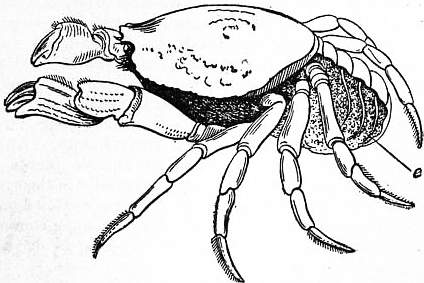
Fig. 1.—Side view of Crab (Morse), the abdomen extended and carrying a mass of eggs beneath it; e, eggs.
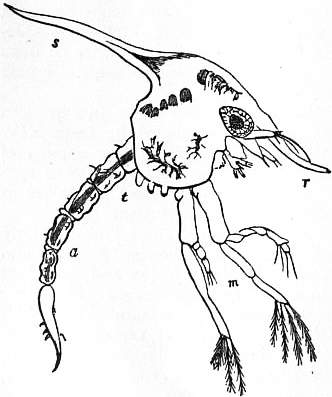
Fig. 2.—Zoëa of Common Shore-Crab in its second stage. r, Rostral spine; s, Dorsal spine; m, Maxillipeds; t, Buds of thoracic feet; a, Abdomen. (Spence Bate.)
As in most Crustacea, the young of nearly all crabs, when newly hatched, are very different from their parents. The first larval stage is known as a Zoëa, this name having been given to it when it was believed by naturalists to be a distinct and independent species of animal. The Zoëa is a minute transparent organism, swimming at the surface of the sea. It has a rounded body, armed with long spines, and a long segmented tail. The eyes are large but not set on stalks, the legs are not yet developed, and the foot-jaws form swimming paddles. After casting its skin several times as it grows in size, the young crab passes into a stage known as the Megalopa (fig. 2), also formerly regarded as an independent animal, in which the body and limbs are more crab-like, but the abdomen is large and not filled up. After a further moult the animal assumes a form very similar to that of the adult. There are a few crabs, living on land or in fresh water, which do not pass through a metamorphosis but leave the egg as miniature adults.
Most crabs live in the sea, and even the land-crabs, which are abundant in tropical countries, nearly all visit the sea occasionally and pass through their early stages in it. Many shore-crabs living between tide-marks are more or less amphibious, and the river-crab of southern Europe or Lenten crab (Potamon edule, better known as Thelphusa fluviatilis) is an example of the freshwater crabs which are abundant in most of the warmer regions of the world. As a rule, crabs breathe by gills, which are lodged in a pair of cavities at the sides of the carapace, but in the true land-crabs the cavities become enlarged and modified so as to act as lungs for breathing air.
Walking or crawling is the usual mode of locomotion, and the peculiar sidelong gait familiar to most people in the common shore-crab, is characteristic of most members of the group. The crabs of the family Portunidae, and some others, swim with great dexterity by means of their flattened paddle-shaped feet.
Like many other Crustacea, crabs are often omnivorous and act as the scavengers of the sea, but many are predatory in their habits and some are content with a vegetable diet.
Though no crab, perhaps, is truly parasitic, some live in relations of “commensalism” with other animals. The best known examples of this are the little “mussel-crabs” (Pinnotheridae) which live within the shells of mussels and other bivalve mollusca and probably share the food of their hosts. Some crabs live among corals, and one species at least gives rise to hollow swellings on the branches of a coral like the “galls” which are formed on plants by certain insects. Another crab (Melia tesselata) carries in each of its claws a living sea-anemone which it uses as an animated weapon of defence and an implement for the capture of prey. Many of the sluggish spider-crabs (Maiidae) have their shells covered by a forest of growing sea-weeds, zoophytes and sponges, which are “planted” there by the crab itself, and which afford it a very effective disguise.
Many of the larger crabs are sought for as food by man. The most important and valuable are the edible crab of British and European coasts (Cancer pagurus) and the blue crab of the Atlantic coast of the United States (Callinectes sapidus).
Among the Anomura, the best known are the hermit-crabs, which live in the empty shells of Gasteropod Mollusca, which they carry about with them as portable dwellings. In these, the abdomen is soft-skinned and spirally twisted so as to fit into the shells which they inhabit. The common hermit-crab of the British coasts (Pagurus or Eupagurus Bernhardus) is sometimes called the soldier-crab from its pugnacity. Small specimens are found between tide-marks inhabiting the shells of periwinkles and other small molluscs, but the full-grown specimens live in deeper water and are usually found in the shell of the whelk (Buccinum). As the crab grows it changes its dwelling from time to time, often having to fight with its fellows for the possession of an empty shell. Sometimes an annelid worm lives inside the shell along with the hermit and often the outside is covered with zoophytes. In some species, as in the British Eupagurus prideauxi, a sea-anemone is constantly found attached to the shell, profiting by the active locomotion of the crab and probably sharing the crumbs of its food, while it affords its host protection by its stinging powers.
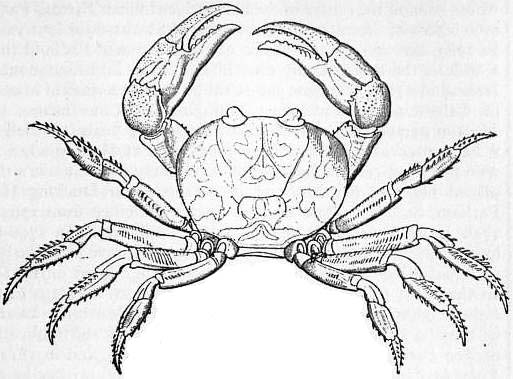
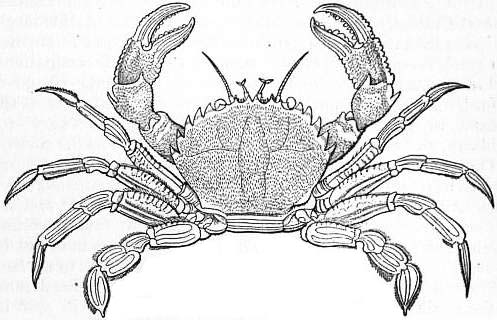
Fig. 3.—Gecarcinus ruricola (Violet Land Crab). Fig. 4.—Portunus puber (Velvet Swimming Crab).
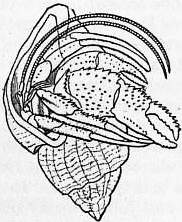
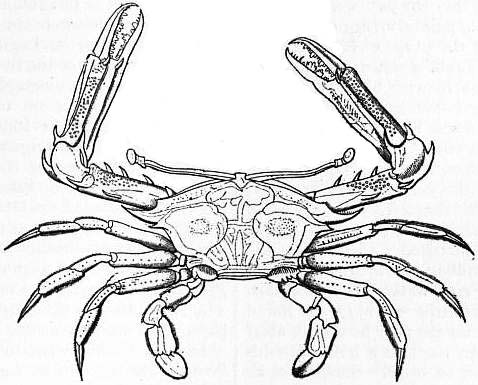
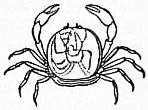
Fig. 6.—Eupagurus Bernhardus (Soldier Crab). Fig. 5. Podophthalmus vigil (Sentinel Spinous Crab). Fig. 7.—Pinnotheres pisum (Pea Crab).
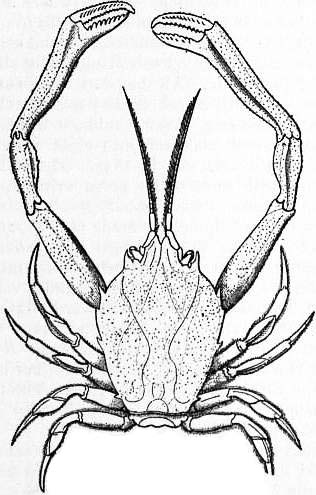
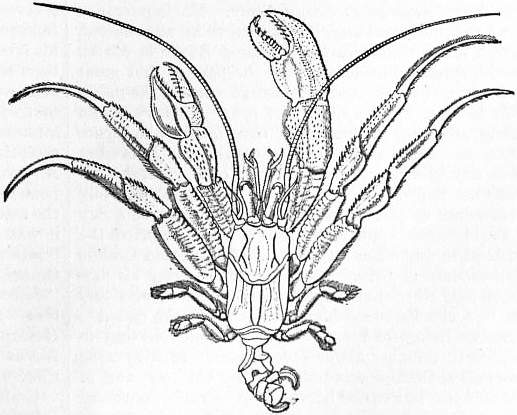
Fig. 8.—Corystes Cassivelaunus (Masked Crab). Fig. 9.—Eupagurus angulatus (a Hermit Crab).
In tropical countries the hermit-crabs of the family Coenobitidae live on land, often at considerable distances from the sea, to which, however, they return for the purpose of hatching out their spawn. The large robber-crab or cocoa-nut crab of the Indo-Pacific islands (Birgus latro), which belongs to this family, has given up the habit of carrying a portable dwelling, and the upper surface of its abdomen has become covered by shelly plates. The stories of its climbing palm-trees to get the fruit were long doubted, but it has been seen, and even photographed in the act.
(W. T. Ca.)
CRABBE, GEORGE (1754-1832), English poet, was born at Aldeburgh in Suffolk on the 24th of December 1754. His family was partly of Norfolk, partly of Suffolk origin, and the name was doubtless originally derived from “crab.” His grandfather, Robert Crabbe, was the first of the family to settle at Aldeburgh, where he held the appointment of collector of customs. He died in 1734, leaving one son, George, who practised many occupations, including that of a schoolmaster, in the adjoining village of Orford. Finally the poet’s father obtained a small post in the customs of Aldeburgh, married Mary Lodwick, the widow of a publican, and had six children, of whom George was the eldest.
The sea has swept away the small cottage that was George Crabbe’s birthplace, but one may still visit the quay at Slaughden, some half-mile from the town, where the father worked and the son was at a later date to work with him. At first attending a dame’s school in Aldeburgh, when nine or ten years of age he was sent to a boarding-school at Bungay, and at twelve to a school at Stowmarket, where he remained two years. His father dreamt of the medical profession for his clever boy, and so in 1768 he went to Wickham Brook near Newmarket as an apothecary’s assistant. In 1771 we find him assisting a surgeon at Woodbridge, and it was while here that he met Sarah Elmy. Crabbe was now only eighteen years of age, but he became “engaged” to this lady in 1772. It was not until 1783 that the pair were married. The intervening years were made up of painful struggle, in which, however, not only the affection but the purse of his betrothed assisted him. About the time of Crabbe’s return from Woodbridge to Aldeburgh he published at Ipswich his first work, a poem entitled Inebriety (1775). He found his father fallen on evil days. There was no money to assist him to a partnership, and surgery for the moment seemed out of the question. For a few weeks Crabbe worked as a common labourer, rolling butter casks on Slaughden quay. Before the year was out, however, the young man bought on credit “the shattered furniture of an apothecary’s shop and the drugs that stocked it.” This was at Aldeburgh. A year later Crabbe installed a deputy in the surgery and paid his first visit to London. He lodged in Whitechapel, took lessons in midwifery and walked the hospitals. Returning to Aldeburgh after nine months—in 1777—he found his practice gone. Even as a doctor for the poor he was an utter failure, poetry having probably taken too firm a hold upon his mind. At times he suffered hunger, so utterly unable was he to earn a livelihood. After three years of this, in 1780 Crabbe paid his second visit to London, enabled thereto by the loan of five pounds from Dudley Lang, a local magnate. This visit to London, which was undertaken by sea on board the “Unity” smack, made for Crabbe a successful career. His poem The Candidate, issued soon after his arrival, helped not at all. For a time he almost starved, and was only saved, it is clear, by gifts of money from his sweetheart Sarah Elmy. He importuned the great, and the publishers also. Everywhere he was refused, but at length a letter which reached Edmund Burke in March 1781 led to the careful consideration on the part of that great man of Crabbe’s many manuscripts. Burke advised the publication of The Library, which appeared in 1781. He invited him to Beaconsfield, and made interest in the right quarters to secure Crabbe’s entry into the church. He was ordained in December 1781 and was appointed curate to the rector of Aldeburgh.
Crabbe was not happy in his new post. The Aldeburgh folk could not reverence as priest a man they had known as a day labourer. Crabbe again appealed to Burke, who persuaded the duke of Rutland to make him his chaplain (1782), and Crabbe took up his residence in Belvoir Castle, accompanying his new patron to London, when Lord Chancellor Thurlow (who told him he was “as like Parson Adams as twelve to the dozen”) gave him the two livings of Frome St Quentin and Evershot in Dorsetshire, worth together about £200 a year. In May 1783 Crabbe’s poem The Village was published by Dodsley, and in December of this year he married Sarah Elmy. Crabbe continued his duties as ducal chaplain, being in the main a non-resident priest so far as his Dorsetshire parishes were concerned. In 1785 he published The Newspaper. Shortly after this he moved with his wife from Belvoir Castle to the parsonage of Stathern, where he took the duties of the non-resident vicar Thomas Parke, archdeacon of Stamford. Crabbe was at Stathern for four years. In 1789, through the persuasion of the duchess of Rutland (now a widow, the duke having died in Dublin as lord-lieutenant of Ireland in 1787), Thurlow gave Crabbe the two livings of Muston in Leicestershire and West Allington in Lincolnshire. At Muston parsonage Crabbe resided for twelve years, divided by a long interval. He had been four years at Muston when his wife inherited certain interests in a property of her uncle’s that placed her and her husband in possession of Ducking Hall, Parham, Suffolk. Here he took up his residence from 1793 to 1796, leaving curates in charge of his two livings. In 1796 the loss of their son Edmund led the Crabbes to remove from Parham to Great Glemham Hall, Suffolk, where they lived until 1801. In that year Crabbe went to live at Rendham, a village in the same neighbourhood. In 1805 he returned to Muston. In 1807 he broke a silence of more than twenty years by the publication of The Parish Register, in 1810 of The Borough, and in 1812 of Tales in Verse. In 1813 Crabbe’s wife died, and in 1814 he was given the living of Trowbridge, Wiltshire, by the duke of Rutland, a son of his early patron, who, it is interesting to recall, wanted the living of Muston for a cousin of Lord Byron. From 1814 to his death in 1832 Crabbe resided at Trowbridge.
These last years were the most prosperous of his life. He was a constant visitor to London, and in friendship with all the literary celebrities of the time. “Crabbe seemed to grow young again,” remarks his biographer, M. René Huchon. He certainly carried on a succession of mild flirtations, and one of his parishioners, Charlotte Ridout, would have married him. The elderly widower had proposed to her and had been accepted in 1814, but he drew out of the engagement in 1816. He proposed to yet another friend, Elizabeth Charter, somewhat later. In his visits to London Crabbe was the guest of Samuel Rogers, in St James’s Place, and was a frequent visitor to Holland House, where he met his brother poets Moore and Campbell. In 1817 his Tales of the Hall were completed, and John Murray offered £3000 for the copyright, Crabbe’s previous works being included. The offer after much negotiation was accepted, but Crabbe’s popularity was now on the wane.
In 1822 Crabbe went to Edinburgh on a visit to Sir Walter Scott. The adventure, complicated as it was by the visit of George IV. about the same time, is most amusingly described in Lockhart’s biography of Scott, although one episode—that of the broken wine-glass—is discredited by Crabbe’s biographer, M. Huchon. Crabbe died at Trowbridge on the 3rd of February 1832, and was buried in Trowbridge church, where an ornate monument was placed over his tomb in August 1833.
Never was any poet at the same time so great and continuous a favourite with the critics, and yet so conspicuously allowed to fall into oblivion by the public. All the poets of his earlier and his later years, Cowper, Scott, Byron, Shelley in particular, have been reprinted again and again. With Crabbe it was long quite otherwise. His works were collected into eight volumes, the first containing his life by his son, in 1832. The edition was intended to continue with some of his prose writings, but the reception of the eight volumes was not sufficiently encouraging. A reprint, however, in one volume was made in 1847, and it has been reproduced since in 1854, 1867 and 1901. The exhaustion of the copyright, however, did no good for Crabbe’s reputation, and it was not until the end of the century that sundry volumes of “selections” from his poems appeared; Edward FitzGerald, of Omar Khayyám fame, always a loyal admirer, made a “Selection,” privately printed by Quaritch, in 1879. A “Selection” by Bernard Holland appeared in 1899, another by C. H. Herford in 1902 and a third by Deane in 1903. The Complete Works were published by the Cambridge University Press in three volumes, edited by A. W. Ward, in 1906.
Crabbe’s poems have been praised by many competent pens, by Edward FitzGerald in his Letters, by Cardinal Newman in his Apologia, and by Sir Leslie Stephen in his Hours in a Library, most notably. His verses comforted the last hours of Charles James Fox and of Sir Walter Scott, while Thomas Hardy has acknowledged their influence on the realism of his novels. But his works have ceased to command a wide public interest. He just failed of being the artist in words who is able to make the same appeal in all ages. Yet to-day his poems will well repay perusal. His stories are profoundly poignant and when once read are never forgotten. He is one of the great realists of English fiction, for even considered as a novelist he makes fascinating reading. He is more than this: for there is true poetry in Crabbe, although his most distinctively lyric note was attained when he wrote under the influence of opium, to which he became much addicted in his later years.
Bibliography.—The Works of Crabbe (8 vols., Murray, 1834; 1 vol., Murray, 1901), and the Works in the Cambridge Press Classics, edited by A. W. Ward (1906), have already been referred to. The life by Crabbe’s son in one volume, The Life of the Rev. George Crabbe, LL.B., by his son the Rev. George Crabbe, A.M. (1834), has not been separately reprinted as it deserves to be. A recent biography is George Crabbe and His Times, 1754-1832; A Critical and Biographical Study, by René Huchon, translated from the French by Frederick Clarke (1907). Brief biographies by T. H. Kebbel (“Great Writers” series) and by Canon Ainger (“English Men of Letters” series) also deserve attention.
(C. K. S.)
CRACKER (from “crack,” a common Teutonic word, cf. Ger. krachen, Dutch kraken, meaning to break with a sharp sound), that which “cracks”; it is, therefore, applied (1) to a firework so constructed that it explodes with several reports and jumps at each explosion, when placed on the ground (see Fireworks); (2) to a roll of coloured and ornamented paper containing sweets, small articles of cheap jewelry, paper caps and other trifles, together with a strip of card with a fulminant which explodes with a “crack” on being pulled; (3) to a thin crisp biscuit (q.v.); in America the general name for a biscuit. In the southern states of America, “cracker” is a term of contempt for the “poor” or “mean whites,” particularly of Georgia and Florida; the term is an old one and dates back to the Revolution, and is supposed to be derived from the “cracked corn” which formed the staple food of the class to whom the term refers.
CRACOW (Pol. Krakov; Ger. Krakau), a town and episcopal see of Austria, in Galicia, 212 m. W. by N. of Lemberg by rail. Pop. (1900) 91,310, of which 21,000 were Jews, 5000 Germans and the remainder Poles. Although in regard to its population it is only the second place in Galicia, Cracow is the most interesting town in the whole of Poland. No other Polish town possesses so many old and historic buildings, none of them contains so many national relics, or has been so closely associated with the development and destinies of Poland as Cracow. And the ancient capital is still the intellectual centre of the Polish nation.
Cracow is situated in a fertile plain on the left bank of the Vistula (which becomes navigable here) and occupies a position of great strategical importance. It consists of the old inner town and seven suburbs. The only relics of the fortifications of the old town, whose place is now occupied by shady promenades, is the Florian’s Gate and the Rondell, a circular structure, built in 1498. Cracow has 39 churches—about half the number it formerly had—and 25 convents for monks and nuns. Of these the most important is the Stanislaus cathedral, in Gothic style, consecrated in 1359, and built on the Wawel, the rocky eminence to the S.W. of the old town. Here the kings of Poland were crowned, and this church is also the Pantheon of the Polish nation, the burial place of its kings and its great men. Here lie the remains of John Sobieski, of Thaddaeus Kosciuszko, of Joseph Poniatowski and of Adam Mickiewicz. Here also are conserved the remains of St Stanislaus, the patron saint of the Poles, who, as bishop of Cracow, was slain before the altar by King Boleslaus in 1079. The cathedral is adorned with many valuable objects of art, paintings and sculptures, by such artists as Veit Stoss, Guido Reni, Peter Vischer, Thorwaldsen, &c. Part of the ancient Polish regalia is also kept here. The Gothic church of St Mary, founded in 1223, rebuilt in the 14th century with several chapels added in the 15th and 16th centuries, was restored in 1889-1893, and decorated with paintings from the designs by Matejko. It contains a huge high altar, the masterpiece of Veit Stoss, who was a native of Cracow, executed in 1477-1489; a colossal stone crucifix, dating from the end of the 15th century, and several sumptuous tombs of noble families from the 16th and 17th centuries. The Dominican church, a Gothic building of the 13th century, but practically rebuilt after a fire in 1850; the Franciscan church, also of the 13th century, also much modernized; the church of St Florian of the 12th century, rebuilt in 1768, which contains the late-Gothic altar by Veit Stoss, executed in 1518, during his last sojourn in Cracow; the church of St Peter, with a colossal dome, built in 1597, after the model of that of St Peter at Rome, and the beautiful Augustinian church in the suburb of Kazimierz, are all worth mentioning. Of the principal secular buildings, the royal castle (Zamek Królowsk), a huge building, begun in the 13th century, and successively enlarged by Casimir the Great and by Sigismund I. Jagiello (1510-1533), is situated on the Wawel, and was until 1610 the residence of the Polish kings. It suffered much from fires and other disasters, and from 1846 onward was used as a barracks and a military hospital; it has now, however, been cleared out and restored. The Jagellonian university, now housed in a magnificent Gothic building erected in 1881-1887, was attended in 1901 by 1255 students, and had 175 professors and lecturers. The language of instruction is Polish. It is the second oldest university in Europe—the oldest being that of Prague—and was famous during the 15th and 16th centuries. It was founded by Casimir the Great in 1364, and completed by Ladislaus Jagiello in 1400. Its rich library is now housed in the old university buildings, erected in the 15th century, in the beautiful Gothic court of which a bronze statue of Copernicus was placed in 1900. The Polish Academy of Science, founded in 1872, is housed in the new university buildings. In the Ring-Platz, or the principal square, opposite the church of St Mary, is the Tuchhaus (cloth-hall, Pol. Sukiennice), a building erected in 1257, several times renovated and enlarged, most recently in 1879, which contains the Polish national museum of art. Behind it is a Gothic tower, the only relic of the old town hall, demolished in 1820. The Czartoryski museum contains a large collection of objects of art, a rich library and a precious collection of manuscripts, relating to the history of Poland.
Among the manufactures of the town are machinery, agricultural implements, chemicals, soap, tobacco, &c. But Cracow is more important as a trading than as an industrial centre. Its position on the Vistula and at the junction of several railways makes it the natural mart for the exchange of the products of Silesia, Hungary and Russian and Austrian Poland. Its trade in timber, salt, textiles, cattle, wine and agricultural produce of all kinds is very considerable. In the neighbourhood of Cracow there are mines of coal and zinc, and not far away lies the village of Krzeszowice with sulphur baths. About 2½ m. N.W. lies the Kosciuszko Hill, a mound of earth 100 ft. high, thrown up in 1820-1823 on the Borislava hill (1093 ft.), in honour of Thaddaeus Kosciuszko, the hero of Poland. On the opposite bank of the Vistula, united to Cracow by a bridge, lies the town of Podgorze (pop. 18,142); near it is the Krakus Hill, smaller than the Kosciuszko Hill, and a thousand years older than it, erected in honour of Krakus, the founder of Cracow. About 8 m. S.E. of Cracow is situated Wieliczka (q.v.), with its famous salt mines.
History.—Tradition assigns the foundation of Cracow to the mythical Krak, a Polish prince who is said to have built a stronghold here about A.D. 700. Its early history is, however, entirely obscure. In the latter part of the 10th century it was annexed to the Bohemian principality, but was recaptured by Boleslaus Chrobry, who made it the seat of a bishopric, and it became the capital of one of the most important of the principalities into which Poland was divided from the 12th century onwards. The city was practically ruined during the first Tatar invasion in 1241, but the introduction of German colonists restored its prosperity, and in 1257 it received “Magdeburg rights,” i.e. a civic constitution modelled on that of Magdeburg. In this year the Tuchhalle was built. The town, however, had yet to pass through many vicissitudes. It suffered again from Tatar invasions; in 1290 it was captured by Wenceslaus II. of Bohemia and was held by the Bohemians until, in 1305, the Polish king Ladislaus Lokietek recovered it from Wenceslaus III. Ladislaus made it his capital, and from this time until 1764 it remained the coronation and burial place of the Polish kings, even after the royal residence had been removed by Siegmund III. (1587-1632) to Warsaw. On the third partition of Poland in 1795 Austria took possession of Cracow; but in 1809 Napoleon wrested it from that power, and incorporated it with the duchy of Warsaw, which was placed under the rule of the king of Saxony. In the campaign of 1812 the emperor Alexander made himself master of this and the other territory which formed the duchy of Warsaw. At the general settlement of the affairs of Europe by the great powers in 1815, it was agreed that Cracow and the adjoining territory should be formed into a free state; and, by the Final Act of the congress signed at Vienna in 1815, “the town of Cracow, with its territory, is declared to be for ever a free, independent and strictly neutral city, under the protection of Russia, Austria and Prussia.” In February 1846, however, an insurrection broke out in Cracow, apparently a ramification of a widely spread conspiracy throughout Poland. The senate and the other authorities of Cracow were unable to subdue the rebels or to maintain order, and, at their request, the city was occupied by a corps of Austrian troops for the protection of the inhabitants. The three powers, Russia, Austria and Prussia, made this a pretext for extinguishing this independent state; and as the outcome of a conference at Vienna (November 1846) the three courts, contrary to the assurance previously given, and in opposition to the expressed views of the British and French governments, decided to extinguish the state of Cracow and to incorporate it with the dominions of Austria.
CRADDOCK, CHARLES EGBERT (1850- ), the pen-name of Mary Noailles Murfree, American author, who was born near Murfreesboro, Tennessee, on the 24th of January 1850, the great-granddaughter of Col. Hardy Murfree. She was crippled in childhood by paralysis. She attended school in Nashville and Philadelphia. Spending her summers in the mountains of eastern Tennessee, she came to know the primitive people there with whose life her writings deal. She contributed to Appleton’s Journal, and, first in 1878, to The Atlantic Monthly. No one, apparently, suspected that the author of these stories was a woman, and her identity was not disclosed until 1885, a year after the publication of her first volume of short stories, In the Tennessee Mountains. She deals mainly with the narrow, stern life of the Tennessee mountaineers, who, left behind in the advance of civilization, live amid traditions and customs, and speak a dialect, peculiarly their own; and her work abounds in exquisite descriptions of scenery. Among her other books are: Where the Battle was Fought (1884), a novel dealing with the old aristocratic southern life; Down the Ravine (1885) and The Story of Keedon Bluffs (1887) for young people; The Prophet of the Great Smoky Mountains (1885), a novel; In the Clouds (1886), a novel; The Despot of Broomsedge Cove (1888), a novel; In the “Stranger-People’s” Country (1891); His Vanished Star (1894), a novel; The Mystery of Witch-Face Mountain and Other Stories (1895); The Phantoms of the Footbridge and Other Stories (1895); The Young Mountaineers (1897), short stories; The Juggler (1897); The Story of Old Fort Loudon (1899); The Bushwhackers and Other Stories (1899); The Champion (1902); A Spectre of Power (1903); The Frontiersman (1904); The Storm Centre (1905); The Amulet (1906); The Windfall (1907); and Fair Mississippian (1908).
CRADLE (of uncertain etymology, possibly connected with “crate” and “creel,” i.e. basket; the derivation from a Celtic word, with a sense of rocking, is scouted by the New English Dictionary), a child’s bed of wood, wicker or iron, with enclosed sides, slung upon pivots or mounted on rockers. It is a very ancient piece of furniture, but the date when it first assumed its characteristic swinging or rocking form is by no means clear. A miniature in an illuminated Histoire de la belle Hélaine in the Bibliothèque Nationale in Paris (end of the 14th or beginning of the 15th century) shows an infant sleeping in a tiny four-post bed slung upon rockers. In its oldest forms the cradle is an oblong oak box without a lid—originally the rockers appear to have been detachable—but, like all other household appliances, it has been subject to changes of fashion alike in shape and adornment. It has been panelled and carved, supported on Renaissance pillars, inlaid with marqueterie or mounted in gilded bronze. The original simple shape persisted for two or three centuries—even the hood made its appearance very early. In the 18th century, however, cradles were often very elaborate—indeed in France they had begun to be so much earlier, but the richly carved and upholstered examples were used chiefly for purposes of state, being in fact miniature lits de parade. In modern times they have become lighter and simpler, the old hood being very often replaced by a draped curtain dependent from a carved or shaped upright. About the middle of the 19th century iron cradles were introduced, along with iron bedsteads. A number of undoubted historic cradles have been preserved, together with many others with doubtful attributions. Two alleged cradles of Henry V. exist; one which claims to have been used by the unhappy earl of Derwentwater is in the Victoria and Albert Museum in London; the other is at Windsor Castle. That of Henry IV. of France, now in the Château de Pau, is mounted upon a large tortoiseshell. That of the king of Rome (“Napoleon II.”) was designed by Prud’hon, and along with that of the comte de Chambord is preserved in the Garde Meuble. In England a cradle is now often called a “bassinet” (i.e. little basket), and the “cot” has to some extent taken its place. By analogy, the word “cradle” is also applied to various sorts of framework in engineering, and to a rocking-tool used in engraving.
CRADOCK, a town of South Africa, capital of a division of the Cape province, in the upper valley of the Great Fish river, 181 m. by rail N. by E. of Port Elizabeth. Pop. (1904) 7762. It is one of the chief centres of the wool industry of the Cape, and does also a large trade in ostrich feathers, mohair, &c. The town enjoys a reputation as one of the best health resorts in the province. It stands at an altitude of 2856 ft.; the climate is very dry, the average annual rainfall being 14.50 in. The mean maximum temperature is 77.6° F. Three miles N. of the town are sulphur baths (temp. 100° F.) used for the treatment of rheumatism. In the neighbouring district survive a few herds of zebras, now protected by the game laws. The town dates from the beginning of the 19th century and is named after Sir John Cradock, governor of the Cape 1811-1813. The division has an area of 3048 sq. m. and a pop. (1904) of 18,803, of whom 41% are white.
CRAFT (a word common to Teutonic languages for strength, or power; cf. Ger. Kraft), a word confined in English only, of the Teutonic languages in which it occurs, to intellectual power, and used as a synonym of “art.” It then means skill or ingenuity, especially in the manual arts, hence its use in the expression “Arts and Crafts” (q.v.), and it is thus applied to the trade or profession in which such skill is displayed, to an association of workmen of a particular trade, a trade gild, and in particular to Freemasons, “the craft”; the word appears also in words such as “handicraft” or “craftsman.” Skill applied to outwit or deceive gives the common sense of cunning or trickery, and it is this meaning which is implied in such combined words as “priestcraft,” “witchcraft” and the like. A more particular use of the word is in the nautical sense of vessels of transport by water; this is probably a colloquially shortened form either of “vessels of a fisherman’s, lighterman’s &c., craft,” i.e. “art,” or of “vessels of a heavier or lighter craft,” i.e. burden or capacity; in both cases the qualifying words are dropped and the word comes to be used of vessels in general.
CRAG (a Celtic word, cf. Gael. creag, Manx creg, and Welsh and modern Scots craig), a steep rock. The word appears in many place-names in the north of England and in Scotland, and is also connected with “carrick,” a word of similar meaning, also found in place-names. In geology, the term is applied to the strata in which a shelly sand deposit is found, and, in the expression “crag and tail,” to a formation of hills, in which one side is precipitous and lofty and the other slopes or “tails” gradually away, as in the Castle Rock in Edinburgh.
CRAGGS, JAMES (1657-1721), English politician, was a son of Anthony Craggs of Holbeck, Durham, and was baptized on the 10th of June 1657. After following various callings in London, Craggs, who was a person of considerable financial ability, entered the service of the duchess of Marlborough, and through her influence became in 1702 member of parliament for Grampound, retaining his seat until 1713. He was in business as an army clothier and held several official positions, becoming joint postmaster-general in 1715; and, making the most of his opportunities in all these capacities, he amassed a great deal of money. Craggs also increased his wealth by mixing in the affairs of the South Sea Company, but after his death an act of parliament confiscated all the property which he had acquired since December 1719. He left an enormous fortune when he died on the 16th of March 1721. It is possible that Craggs committed suicide.
His son, James Craggs the younger (1686-1721), was born at Westminster on the 9th of April 1686. Part of his early life was spent abroad, where he made the acquaintance of George Louis, elector of Hanover, afterwards King George I. In 1713 he became member of parliament for Tregoney, in 1717 secretary-at-war, and in the following year one of the principal secretaries of state. Craggs was implicated in the South Sea Bubble, but not so deeply as his father, whom he predeceased, dying on the 16th of February 1721. Among Craggs’s friends were Pope, who wrote the epitaph on his monument in Westminster Abbey, Addison and Gay.
CRAIG, JOHN (1512?-1600), Scottish reformer, born about 1512, was the son of Craig of Craigston, Aberdeenshire, who was killed at Flodden in 1513. After an education at St Andrews, and acting as tutor to the children of Lord Darcy, the English warden of the North, he became a Dominican, but was soon in trouble as a heretic. In 1536 he made his way to England, but failing to obtain the preferment he desired at Cambridge, he went on to Italy, where the influence of Cardinal Pole, who was himself accused of heresy, secured him the post of master of the novices in the Dominican convent at Bologna. For some years he was busy travelling in the Levant in the interests of his order, but a perusal of Calvin’s Institutes revived his heretical tendencies, and he was condemned to be burnt. Like the English scholar and statesman, Thomas Wilson, he owed his escape to the riot which broke out on the death of Paul IV. on the 18th of August 1559, when the mob burst open the prison of the Inquisition. After various adventures he reached Vienna, where he preached, and was protected by the semi-Lutheran archduke (afterwards the emperor) Maximilian II.
In 1560 he returned to Scotland, where in 1561 he was ordained minister of Holyrood, and in 1562 Knox’s colleague in the High Church. His defence of church property and privilege against the predatory instincts of the nobles and the pretensions of the state brought him into conflict with Lethington and others; but he seems to have condoned, if he was not privy to, Riccio’s murder. At first he refused to publish the banns of marriage between Mary and Bothwell, though in the end he yielded with a protest that he “abhorred and detested the marriage.” He had been associated with Knox in various commissions for the organization of the church, but he wished to compromise between the two extreme parties. From 1571-1579 Craig was in the north, whither he had been sent to “illuminate those dark places in Mar, Buchan and Aberdeen.” In 1579 he was appointed chaplain to the young James VI., and returned to Edinburgh. In 1581 episcopacy was abolished as a result of the report of a commission on which Craig had sat; he also assisted at the composition of the Second Book of Discipline and the National Covenant of 1580, and in 1581 compiled “Ane Shorte and Generale Confession” called the “King’s Confession,” which was imposed on all parish ministers and graduates and became the basis of the Covenant of 1638. He approved of the Ruthven raid, and admonished James in terms which made him weep, but produced no alteration in his conduct, and before long Craig was denouncing the supremacy of Arran. But he was averse from the violence of Melville, and was willing to admit the royal supremacy “as far as the word of God allows.” James VI., like Henry VIII., accepted this compromise, and the oath in this form was taken by Craig, the royal chaplains and some others. In 1592 was published Craig’s Catechism. He died on the 12th of December 1600.
See T. G. Law’s Pref. to Craig’s Catechism (1885); Bain’s Cal. Scottish State Papers; Reg. P. C. Scotl.; Hew Scott’s Fasti Eccles. Scot.; Knox’s, Calderwood’s and Grub’s Eccles. Histories; McCrie’s Life of Melville; Hay Fleming’s Mary, Queen of Scots; Bannatyne’s Memorials.
(A. F. P.)
CRAIG, SIR THOMAS (c. 1538-1608), Scottish jurist and poet, was born about 1538. It is probable that he was the eldest son of William Craig of Craigfintray, or Craigston, in Aberdeenshire, but beyond the fact that he was in some way related to the Craigfintray family nothing regarding his birth is known with certainty. He was educated at St Andrews, where he took the B.A. degree in 1555. From St Andrews he went to France, to study the canon and the civil law. He returned to Scotland about 1561, and was admitted advocate in February 1563. In 1564 he was appointed justice-depute by the justice-general, Archibald, earl of Argyll; and in this capacity he presided at many of the criminal trials of the period. In 1573 he was appointed sheriff-depute of Edinburgh, and in 1606 procurator for the church. He never became a lord of session, a circumstance that was unquestionably due to his own choice. It is said that he refused the honour of knighthood which the king wished to confer on him in 1604, when he came to London as one of the Scottish commissioners regarding the union between the kingdoms—the only political object he seems to have cared about; but in accordance with James’s commands he has always been styled and reputed a knight. Craig was married to Helen, daughter of Heriot of Lumphoy in Midlothian, by whom he had four sons and three daughters. His eldest son, Sir Lewis Craig (1569-1622), was raised to the bench in 1604, and among his other descendants are several well-known names in the list of Scottish lawyers. He died on the 26th of February 1608.
Except his poems, the only one of Craig’s works which appeared during his lifetime was his Jus feudale (1603; ed. R. Burnet, 1655; Leipzig, 1716; ed. J. Baillie 1732). The object of this treatise was to assimilate the laws of England and Scotland, but, instead of this, it was an important factor in building up and solidifying the law of Scotland into a separate system. Other works were De unione regnorum Britanniae tractatus, De jure successionis regni Angliae and De hominio disputatio. Translations of the last two have been published, and in 1910 an edition of the De Unione appeared, with translation and notes by C. S. Terry. Craig’s first poem, an Epithalamium in honour of the marriage of Mary queen of Scots and Darnley, appeared in 1565. Most of his poems have been reprinted in the Delitiae poëtarum Scotorum.
See P. F. Tytler, Life of Craig (1823); Life prefixed to Baillie’s edition of the Jus feudale.
CRAIGIE, PEARL MARY TERESA (1867-1906), Anglo-American novelist and dramatist, who wrote under the pen-name of “John Oliver Hobbes,” was born at Boston, U.S.A., on the 3rd of November 1867. She was the elder daughter of John Morgan Richards, and was educated in London and Paris. When she was nineteen she married Reginald Walpole Craigie, by whom she had one son, John Churchill Craigie: but the marriage proved an unhappy one, and was dissolved on her petition in July 1895. She was brought up as a Nonconformist, but in 1892 was received into the Roman Catholic Church, of which she remained a devout and serious member. Her first little book, the brilliant and epigrammatic Some Emotions and a Moral, was published in 1891 in Mr Fisher Unwin’s “Pseudonym Library,” and was followed by The Sinner’s Comedy (1892), A Study in Temptations (1893), A Bundle of Life (1894), The Gods, Some Mortals, and Lord Wickenham. The Herb Moon (1896), a country love story, was followed by The School for Saints (1897), with a sequel, Robert Orange (1900). Mrs Craigie had already written a one-act “proverb,” Journeys end in Lovers Meeting, produced by Ellen Terry in 1894, and a three-act tragedy, “Osbern and Ursyne,” printed in the Anglo-Saxon Review (1899), when her successful piece, The Ambassador, was produced at the St James’s Theatre in 1898. A Repentance (one act, 1899) and The Wisdom of the Wise (1900) were produced at the same theatre, and The Flute of Pan (1904) first at Manchester and then at the Shaftesbury theatre; she was also part author of The Bishop’s Move (Garrick Theatre, 1902). Later books are The Serious Wooing (1901), Love and the Soul Hunters (1902), Tales about Temperament (1902), The Vineyard (1904). Mrs Craigie died suddenly of heart failure in London on the 13th of August 1906.
CRAIK, DINAH MARIA (1826-1887), English novelist, better known by her maiden name of Mulock, and still better as “the author of John Halifax, Gentleman,” was the daughter of Thomas Mulock, an eccentric religious enthusiast of Irish extraction, and was born on the 20th of April 1826 at Stoke-upon-Trent, in Staffordshire, where her father was the minister of a small congregation. She settled in London about 1846, determined to obtain a livelihood by her pen, and, beginning with fiction for children, advanced steadily until John Halifax, Gentleman (1857), placed her in the front rank of the women novelists of her day. A Life for a Life (1859), though inferior, maintained a high position, but she afterwards wrote little of importance except some very charming tales for children. Her most remarkable novels, after those mentioned above, were The Ogilvies (1849), Olive (1850), The Head of the Family (1851), Agatha’s Husband (1853). There is much passion and power in these early works, and all that Mrs Craik wrote was characterized by high principle and deep feeling. Some of the short stories in Avillion and other Tales also exhibit a fine imagination. She published some poems distinguished by genuine lyrical spirit, narratives of tours in Ireland and Cornwall, and A Woman’s Thoughts about Women. She married Mr G. L. Craik, a partner in the house of Macmillan & Company, in 1864, and died at Shortlands, near Bromley, Kent, on the 12th of October 1887.
CRAIK, GEORGE LILLIE (1798-1866), English man of letters, the son of a schoolmaster, was born at Kennoway, Fifeshire, in 1798. He studied at the university of St Andrews with the intention of entering the church, but, altering his plans, became the editor of a local newspaper, and went to London in 1824 to devote himself to literature. He became connected with a short-lived literary paper called the Verulam; in 1831 he published his Pursuit of Knowledge under Difficulties among the works of the Society for the Diffusion of Useful Knowledge; he contributed a considerable number of biographical and historical articles to the Penny Cyclopaedia; and he edited the Pictorial History of England, himself writing much of the work. In 1844 he published his History of Literature and Learning in England from the Norman Conquest to the Present Time, illustrated by extracts. Craik is best known for his abridged version of this work, The History of English Literature and the English Language (1861), which passed through several editions. In the next year appeared his Spenser and his Poetry, an abstract of Spenser’s poems, with historical and biographical notes and frequent quotations; and in 1847 his Bacon, his Writings and his Philosophy, a work of a similar kind. The two last-mentioned works appeared among Knight’s Weekly Volumes. Two years later Craik obtained the chair of history and English literature at Queen’s College, Belfast, a position which he held till his death, which took place on the 25th of June 1866. He had married Miss Jeannette Dempster (d. 1856) in 1826, and his daughter, Georgiana Marion Craik (Mrs A. W. May), wrote over thirty novels, of which Lost and Won (1859) was the best. Besides the works already noticed, Craik published the History of British Commerce from the Earliest Times (1844), Romance of the Peerage (1848-1850) and The English of Shakespeare (1856).
CRAIL (formerly Karel), a royal and police burgh of Fifeshire, Scotland, 2 m. from Fife Ness, the most easterly point of the county, and 11 m. S.E. of St Andrews by the North British railway, but 2 m. nearer by road. Pop. (1901) 1077. It is said to have been a town of some note as early as the 9th century; and its castle, of which there are hardly any remains, was the residence of David I. and other Scottish kings. It was constituted a royal burgh by a charter of Robert Bruce in 1306, and had its privileges confirmed by Robert II. in 1371, by Mary in 1553, and by Charles I. in 1635. Of its priory, dedicated to St Rufus, a few ruins still exist. The church of Maelrubha, the patron saint of Crail, is an edifice of great antiquity. Many of the ordinary houses are massive and quaint. The public buildings include a library and reading-room and town hall. The chief industries comprise fisheries, especially for crabs, shipping and brewing. It is growing in favour as a summer resort. It unites with St Andrews, the two Anstruthers, Kilrenny, Pittenweem and Cupar in returning one member to parliament.
Balcomie Castle, about 2 m. to the N.E., dates from the 14th century. Here Mary of Guise landed in 1538, a few days before her marriage to James V. in St Andrews cathedral. In the 18th century it passed through the hands of various proprietors and was ultimately shorn of much of its original size and grandeur. The East Neuk is a term applied more particularly to the country round Fife Ness, and more generally to all of the peninsula east of an imaginary line drawn from St Andrews to Elie. For fully half the year the cottages of its villages are damp with the haar, or dense mist, borne on the east wind from the North Sea.
CRAILSHEIM, or Krailsheim, a town of Germany, in the kingdom of Württemberg, on the Jagst, a tributary of the Neckar, at the junction of railways to Heilbronn and Fürth. Pop. (1900) 5251. There are two Evangelical churches and a Roman Catholic church, and a handsome town hall, with a tower 225 ft. high. The industrial establishments include extensive tanneries and machine workshops, and there is a brisk trade in cattle and agricultural produce.
Crailsheim was incorporated as a town in 1338, successfully withstood a siege by the forces of several Swabian imperial cities (1379-1380), a feat which is annually celebrated, passed later into the possession of the burgraves of Nuremberg, and came in 1791 to Prussia, in 1806 to Bavaria and 1810 to Württemberg.
CRAIOVA, or Krajova, the capital of the department of Doljiu, Rumania, situated near the left bank of the river Jiu, and on the main Walachian railway from Verciorova to Bucharest. Pop. (1900) 45,438. A branch railway to Calafat facilitates the export trade with Bulgaria. Craiova is the chief commercial town west of Bucharest; the surrounding uplands are very rich in grain, pasturage and vegetable products, and contain extensive forests. The town has rope and carriage factories, and close by is a large tannery, worked by convict labour, and supplying the army. The principal trade is in cattle, cereals, fish, linen, pottery, glue and leather. In the town, which is the headquarters of the First Army Corps, there are military and commercial academies, an appeal court and a chamber of commerce, besides many churches, Greek Orthodox, Roman Catholic, and Protestant, with synagogues for the Jews.
Craiova, which occupied the site of the Roman Castra Nova, was formerly the capital of Little Walachia. Its ancient bans or military governors were, next to the princes, the chief dignitaries of Walachia, and the district is still styled the banat of Craiova. Among the holders of this office were Michael the Brave (1593-1601), and several members of the celebrated Bassarab family (q.v.). The bans had the right of coining money stamped with their own effigies, and hence arose the name of bani (centimes). The Rumanian franc, or leu (“lion”), so called from the image it bore, came likewise from Craiova. In 1397 Craiova was the scene of a victory won by Prince Mircea over Bayezid I. sultan of the Turks; and in October 1853, of an engagement between Turks and Russians.
CRAMBO, an old rhyming game which, according to Strutt (Sports and Pastimes), was played as early as the 14th century under the name of the ABC of Aristotle. In the days of the Stuarts it was very popular, and is frequently mentioned in the writings of the time. Thus Congreve’s Love for Love, i. 1, contains the passage, “Get the Maids to Crambo in an Evening, and learn the knack of Rhiming.” Crambo, or capping the rhyme, is now played by one player thinking of a word and telling the others what it rhymes with, the others not naming the actual word they guess but its meaning. Thus one says “I know a word that rhymes with bird.” A second asks “Is it ridiculous?” “No, it is not absurd.” “Is it a part of speech?” “No, it is not a word.” This proceeds until the right word is guessed.
In Dumb Crambo the guessers, instead of naming the word, express its meaning by dumb show, a rhyme being given them as a clue.
CRAMER, JOHANN BAPTIST (1771-1858), English musician, of German extraction, was born in Mannheim, on the 24th of February 1771. He was the son of Wilhelm Cramer (1743-1799). a famous London violinist and musical conductor, one of a numerous family who were identified with the progress of music during the 18th and 19th centuries. Johann Baptist was brought to London as a child, and it was in London that the greater part of his musical efforts was exercised. From 1782 to 1784 he studied the pianoforte under Muzio Clementi, and soon became known as a professional pianist both in London and on the continent; he enjoyed a world-wide reputation, and was particularly appreciated by Beethoven. He died in London on the 16th of April 1858. Apart from his pianoforte-playing Cramer is important as a composer, and as principal founder in 1824 of the London music-publishing house of Cramer & Co. He wrote a number of sonatas, &c., for pianoforte, and other compositions; but his Études is the work by which he lives as a composer. These “studies” have appeared in numerous editions, from 1810 onwards, and became the staple pieces in the training of pianists.
CRAMER, JOHN ANTONY (1793-1848), English classical scholar and geographer, was born at Mitlödi in Switzerland. He was educated at Westminster and Christ Church, Oxford. He resided in Oxford till 1844, during which time he held many important offices, being public orator, principal of New Inn Hall (which he rebuilt at his own expense), and professor of modern history. In 1844 he was appointed to the deanery of Carlisle, which he held until his death at Scarborough on the 24th of August 1848. His works are of considerable importance: A Dissertation on the Passage of Hannibal over the Alps, published anonymously with H. L. Wickham (2nd ed., 1828), “a scholar-like work of first-rate ability”; geographical and historical descriptions of Ancient Italy (1826), Ancient Greece (1828), Asia Minor (1832); Travels of Nicander Nucius of Corcyra [Greek traveller of the 16th century] in England (1841); Catenae Graecorum Patrum in Novum Testamentum (1838-1844); Anecdota Graeca (from the MSS. of the royal library in Paris, 1839-1841).
CRÄMER, KARL VON (1818-1902), Bavarian politician, had a very remarkable career, rising gradually from a mere workman in a factory at Doos near Nuremberg to the post of manager, and finally becoming part proprietor of the establishment. Leaving business in 1870 he devoted his time entirely to politics. From 1848 he had been a member of the Bavarian second chamber, at first representing the district of Erlangen-Fürth, and afterwards Nuremberg, which city also sent him after the war of 1866 as its deputy to the German customs parliament, and from 1871 to 1874 to the first German Reichstag. He sat in these bodies as a member of the Progressive party (Fortschrittspartei), and in Bavaria was one of the leaders of the Liberal (Freisinnige) party. His eloquence had a great hold upon the masses. As a parliamentarian he was very clear-headed, and thoroughly understood how to lead a party. For many years he was the reporter of the finance committee of the chamber. In 1882, on account of his great services in connexion with the Bavarian National Exhibition of Nuremberg, the order of the crown of Bavaria was conferred upon him, carrying with it the honour of nobility. He died at Nuremberg on the 31st of December 1902.
CRAMP, CHARLES HENRY (1828- ), American shipbuilder, was born in Philadelphia, Pennsylvania, on the 9th of May 1828, of German descent, his family name having been Krampf. He was the eldest of eleven children of William Cramp (1807-1869), a pioneer American shipbuilder, who in 1830 established shipyards on the Delaware river near Philadelphia. The son was educated at the Philadelphia Central high school, after which he was employed in his father’s shipyards and made himself master of every detail of ship construction. He showed especial aptitude as a naval architect and designer, and after becoming his father’s partner in 1849 it was to that branch of the work that he devoted himself. His inventive capacity and resourcefulness, together with the complete success of his innovations in naval construction, soon gave him high rank as an authority on shipbuilding, and made his influence in that industry widely felt. In the Mexican War he designed surf boats for the landing of troops at Vera Cruz; during the Civil War he designed and built several ironclads for the United States navy, notably the “New Ironsides” in 1862, and the light-draught monitors used in the Carolina sounds; and after 1887 constructed wholly or in part from his own designs many of the most powerful ships in the “new” navy, including the cruisers “Columbia,” “Minneapolis” and “Brooklyn,” and the battleships “Indiana,” “Iowa,” “Massachusetts,” “Alabama” and “Maine.” In every progressive step in ocean shipbuilding, in the transformation from sail to steam, and from wood to iron and steel, Cramp had a prominent part. His fame as a shipbuilder extended to Europe, and he built warships for several foreign navies, among others the “Retvizan” and the “Variag” for the Russian government. He also constructed a number of freight and passenger steamships for several trans-Atlantic lines.