VOLUME VII SLICE VI Coucy-le-Château to Crocodile (continued 7)
Reading edition
At their first interview Cranmer was commanded by the king to lay aside all other pursuits and to devote himself to the question of the divorce. He was to draw up a written treatise, stating the course he proposed, and defending it by arguments from scripture, the fathers and the decrees of general councils. His material interests certainly did not suffer by compliance. He was commended to the hospitality of Anne Boleyn’s father, the earl of Wiltshire, in whose house at Durham Place he resided for some time; the king appointed him archdeacon of Taunton and one of his chaplains; and he also held a parochial benefice, the name of which is unknown. When the treatise was finished Cranmer was called upon to defend its argument before the universities of Oxford and Cambridge, which he visited, accompanied by Fox and Gardiner. Immediately afterwards he was sent to plead the cause before a more powerful if not a higher tribunal. An embassy, with the earl of Wiltshire at its head, was despatched to Rome in 1530, that “the matter of the divorce should be disputed and ventilated,” and Cranmer was an important member of it. He was received by the Pope with marked courtesy, and was appointed “Grand Penitentiary of England,” but his argument, if he ever had the opportunity of stating it, did not lead to any practical decision of the question.
Cranmer returned in September 1530, but in January 1531 he received a second commission from the king appointing him “Conciliarius Regius et ad Caesarem Orator.” In the summer of 1531 he accordingly proceeded to Germany as sole ambassador to the emperor. He was also to sound the Lutheran princes with a view to an alliance, and to obtain the removal of some restrictions on English trade. At Nuremberg he became acquainted with Osiander, whose somewhat isolated theological position he probably found to be in many points analogous to his own. Both were convinced that the old order must change; neither saw clearly what the new order should be to which it was to give place. They had frequent interviews, which had doubtless an important influence on Cranmer’s opinions. But Osiander’s house had another attraction of a different kind from theological sympathy. His niece Margaret won the heart of Cranmer, and in 1532 they were married. Hook finds in the fact of the marriage corroboration of Cranmer’s statement that he never expected or desired the primacy; and it seems probable enough that, if he had foreseen how soon the primacy was to be forced upon him, he would have avoided a disqualification which it was difficult to conceal and dangerous to disclose.
Expected or not, the primacy was forced upon him within a very few months of his marriage. In August 1532 Archbishop Warham died, and the king almost immediately afterwards intimated to Cranmer, who had accompanied the emperor in his campaign against the Turks, his nomination to the vacant see. Cranmer’s conduct was certainly consistent with his profession that he did not desire, as he had not expected, the dangerous promotion. He sent his wife to England, but delayed his own return in the vain hope that another appointment might be made. The papal bulls of confirmation were dated February and March 1533, and the consecration took place on the 30th March. One peculiarity of the ceremony had occasioned considerable discussion. It was the custom for the archbishop elect to take two oaths, the first of episcopal allegiance to the pope, and the second in recognition of the royal supremacy. The latter was so wide in its scope that it might fairly be held to supersede the former in so far as the two were inconsistent. Cranmer, however, was not satisfied with this. He had a special protest recorded, in which he formally declared that he swore allegiance to the pope only in so far as that was consistent with his supreme duty to the king. The morality of this course has been much canvassed, though it seems really to involve nothing more than an express declaration of what the two oaths implied. It was the course that would readily suggest itself to a man of timid nature who wished to secure himself against such a fate as Wolsey’s. It showed weakness, but it added nothing to whatever immorality there might be in successively taking two incompatible oaths.
In the last as in the first step of Cranmer’s promotion Henry had been actuated by one and the same motive. The business of the divorce—or rather, of the legitimation of Anne Boleyn’s expected issue—had now become very urgent, and in the new archbishop he had an agent who might be expected to forward it with the needful haste. The celerity and skill with which Cranmer did the work intrusted to him must have fully satisfied his master. During the first week of April Convocation sat almost from day to day to determine questions of fact and law in relation to Catherine’s marriage with Henry as affected by her previous marriage with his brother Arthur. Decisions favourable to the object of the king were given on these questions, though even the despotism of the most despotic of the Tudors failed to secure absolute unanimity. The next step was taken by Cranmer, who wrote a letter to the king, praying to be allowed to remove the anxiety of loyal subjects as to a possible case of disputed succession, by finally determining the validity of the marriage in his archiepiscopal court. There is evidence that the request was prompted by the king, and his consent was given as a matter of course. Queen Catherine was residing at Ampthill in Bedfordshire, and to suit her convenience the court was held at the priory of Dunstable in the immediate neighbourhood. Declining to appear, she was declared contumacious, and on the 23rd of May the archbishop gave judgment declaring the marriage null and void from the first, and so leaving the king free to marry whom he pleased. The Act of Appeals had already prohibited any appeal from the archbishop’s court. Five days later he pronounced the marriage between Henry and Anne—which had been secretly celebrated about the 25th of January 1533—to be valid. On the 1st of June he crowned Anne as queen, and on the 10th of September stood godfather to her child, the future Queen Elizabeth.
The breach with Rome and the subjection of the church in England to the royal supremacy had been practically achieved before Cranmer’s appointment as archbishop: and he had little to do with the other constitutional changes of Henry’s reign. But his position as chief minister of Henry’s ecclesiastical jurisdiction forced him into unpleasant prominence in connexion with the king’s matrimonial experiences. In 1536 he was required to revise his own sentence in favour of the validity of Henry’s marriage with Anne Boleyn; and on the 17th of May the marriage was declared invalid. The ground on which this sentence is pronounced is fairly clear. Anne’s sister, Mary Boleyn, had been Henry VIII.’s mistress; this by canon law was a bar to his marriage with Anne—a bar which had been removed by papal dispensation in 1527, but now the papal power to dispense in such cases had been repudiated, and the original objection revived. The sentence was grotesquely legal and unjust. With Anne’s condemnation by the House of Lords Cranmer had nothing to do. He interceded for her in vain with the king, as he had done in the cases of Fisher, More and the monks of Christchurch. His share in the divorce of Anne of Cleves was less prominent than that of Gardiner, though he did preside over the Convocation in which nearly all the dignitaries of the church signified their approval of that measure. To his next and last interposition in the matrimonial affairs of the king no discredit attaches itself. When he was made cognizant of the charges against Catherine Howard, his duty to communicate them to the king was obvious, though painful.
Meanwhile Cranmer was actively carrying out the policy which has associated his name more closely, perhaps, than that of any other ecclesiastic with the Reformation in England. Its most important feature on the theological as distinct from the political side was the endeavour to promote the circulation of the Bible in the vernacular, by encouraging translation and procuring an order in 1538 that a copy of the Bible in English should be set up in every church in a convenient place for reading. Only second in importance to this was the re-adjustment of the creed and liturgy of the church, which formed Cranmer’s principal work during the latter half of his life. The progress of the archbishop’s opinion towards that middle Protestantism, if it may be so called, which he did so much to impress on the formularies of the Church of England, was gradual, as a brief enumeration of the successive steps in that progress will show. In 1538 an embassy of German divines visited England with the design, among other things, of forming a common confession for the two countries. This proved impracticable, but the frequent conferences Cranmer had with the theologians composing the embassy had doubtless a great influence in modifying his views. Both in parliament and in Convocation he opposed the Six Articles of 1539, but he stood almost alone. During the period between 1540 and 1543 the archbishop was engaged at the head of a commission in the revision of the “Bishop’s Book” (1537) or Institutions of a Christian Man, and the preparation of the Necessary Erudition (1543) known as the “King’s Book,” which was a modification of the former work in the direction of Roman Catholic doctrine. In June 1545 was issued his Litany, which was substantially the same as that now in use, and shows his mastery of a rhythmical English style.
The course taken by Cranmer in promoting the Reformation exposed him to the bitter hostility of the reactionary party or “men of the old learning,” of whom Gardiner and Bonner were leaders, and on various occasions—notably in 1543 and 1545—conspiracies were formed in the council or elsewhere to effect his overthrow. The king, however, remained true to him, and all the conspiracies signally failed. It illustrates a favourable trait in the archbishop’s character that he forgave all the conspirators. He was, as his secretary Morice testifies, “a man that delighted not in revenging.”
Cranmer was present with Henry VIII. when he died (1547). By the will of the king he was nominated one of a council of regency composed of sixteen persons, but he acquiesced in the arrangement by which Somerset became lord protector. He officiated at the coronation of the boy king Edward VI., and is supposed to have instituted a sinister change in the order of the ceremony, by which the right of the monarch to reign was made to appear to depend upon inheritance alone, without the concurrent consent of the people. But Edward’s title had been expressly sanctioned by act of parliament, so that there was no more room for election in his case than in that of George I., and the real motive of the changes was to shorten the weary ceremony for the frail child.
During this reign the work of the Reformation made rapid progress, the sympathies both of the Protector and of the young king being decidedly Protestant. Cranmer was therefore enabled without let or hindrance to complete the preparation of the church formularies, on which he had been for some time engaged. In 1547 appeared the Homilies prepared under his direction. Four of them are attributed to the archbishop himself—those on Salvation, Faith, Good Works and the Reading of Scripture. His translation of the German Catechism of Justus Jonas, known as Cranmer’s Catechism, appeared in the following year. Important, as showing his views on a cardinal doctrine, was the Defence of the True and Catholic Doctrine of the Sacrament, which he published in 1550. It was immediately answered from the side of the “old learning” by Gardiner. The first prayer-book of Edward VI. was finished in November 1548, and received legal sanction in March 1549; the second was completed and sanctioned in April 1552. The archbishop did much of the work of compilation personally. The forty-two articles of Edward VI. published in 1553 owe their form and style almost entirely to the hand of Cranmer. The last great undertaking in which he was employed was the revision of his codification of the canon law, which had been all but completed before the death of Henry. The task was one eminently well suited to his powers, and the execution of it was marked by great skill in definition and arrangement. It never received any authoritative sanction, Edward VI. dying before the proclamation establishing it could be made, and it remained unpublished until 1571, when a Latin translation by Dr Walter Haddon and Sir John Cheke appeared under the title Reformatio legum ecclesiasticarum. It laid down the lawfulness and necessity of persecution to the death for heresy in the most absolute terms; and Cranmer himself condemned Joan Bocher to the flames. But he naturally loathed persecution, and was as tolerant as any in that age.
Cranmer stood by the dying bed of Edward as he had stood by that of his father, and he there suffered himself to be persuaded to take a step against his own convictions. He had pledged himself to respect the testamentary disposition of Henry VIII. by which the succession devolved upon Mary, and now he violated his oath by signing Edward’s “device” of the crown to Lady Jane Grey. On grounds of policy and morality alike the act was quite indefensible; but it is perhaps some palliation of his perjury that it was committed to satisfy the last urgent wish of a dying man, and that he alone remained true to the nine days’ queen when the others who had with him signed Edward’s device deserted her. On the accession of Mary he was summoned to the council—most of whom had signed the same device—reprimanded for his conduct, and ordered to confine himself to his palace at Lambeth until the queen’s pleasure was known. He refused to follow the advice of his friends and avoid the fate that was clearly impending over him by flight to the continent. Any chance of safety that lay in the friendliness of a strong party in the council was more than nullified by the bitter personal enmity of the queen, who could not forgive his share in her mother’s divorce and her own disgrace. On the 14th of September 1553 he was sent to the Tower, where Ridley and Latimer were also confined. The immediate occasion of his imprisonment was a strongly worded declaration he had written a few days previously against the mass, the celebration of which, he heard, had been re-established at Canterbury. He had not taken steps to publish this, but by some unknown channel a copy reached the council, and it could not be ignored. In November, with Lady Jane Grey, her husband, and two other Dudleys, Cranmer was condemned for treason. Renard thought he would be executed, but so true a Romanist as Mary could scarcely have an ecclesiastic put to death in consequence of a sentence by a secular court, and Cranmer was reserved for treatment as a heretic by the highest of clerical tribunals, which could not act until parliament had restored the papal jurisdiction. Accordingly in March 1554 he and his two illustrious fellow-prisoners, Ridley and Latimer, were removed to Oxford, where they were confined in the Bocardo or common prison. Ridley and Latimer were unflinching, and suffered bravely at the stake on the 16th of October 1555. Cranmer had been tried by a papal commission, over which Bishop Brooks of Gloucester presided, in September 1555. Brooks had no power to give sentence, but reported to Rome, where Cranmer was summoned, but not permitted, to attend. On the 25th of November he was pronounced contumacious by the pope and excommunicated, and a commission was sent to England to degrade him from his office of archbishop. This was done with the usual humiliating ceremonies in Christ Church, Oxford, on the 14th of February 1556, and he was then handed over to the secular power. About the same time Cranmer subscribed the first two of his “recantations.” His difficulty consisted in the fact that, like all Anglicans of the 16th century, he recognized no right of private judgment, but believed that the state, as represented by monarchy, parliament and Convocation, had an absolute right to determine the national faith and to impose it on every Englishman. All these authorities had now legally established Roman Catholicism as the national faith, and Cranmer had no logical ground on which to resist. His early “recantations” are merely recognitions of his lifelong conviction of this right of the state. But his dilemma on this point led him into further doubts, and he was eventually induced to revile his whole career and the Reformation. This is what the government wanted. Northumberland’s recantation had done much to discredit the Reformation, Cranmer’s, it was hoped, would complete the work. Hence the enormous effect of Cranmer’s recovery at the final scene. On the 21st of March he was taken to St Mary’s church, and asked to repeat his recantation in the hearing of the people as he had promised. To the surprise of all he declared with dignity and emphasis that what he had recently done troubled him more than anything he ever did or said in his whole life; that he renounced and refused all his recantations as things written with his hand, contrary to the truth which he thought in his heart; and that as his hand had offended, his hand should be first burned when he came to the fire. As he had said, his right hand was steadfastly exposed to the flames. The calm cheerfulness and resolution with which he met his fate show that he felt that he had cleared his conscience, and that his recantation of his recantations was a repentance that needed not to be repented of.
It was a noble end to what, in spite of its besetting sin of infirmity of moral purpose, was a not ignoble life. The key to his character is well given in what Hooper said of him in a letter to Bullinger, that he was “too fearful about what might happen to him.” This weakness was the worst blot on Cranmer’s character, but it was due in some measure to his painful capacity for seeing both sides of a question at the same time, a temperament fatal to martyrdom. As a theologian it is difficult to class him. As early as 1538 he had repudiated the doctrine of Transubstantiation; by 1550 he had rejected also the Real Presence (Pref. to his Answer to Dr Richard Smith). But here he used the term “real” somewhat unguardedly, for in his Defence he asserts a real presence, but defines it as exclusively a spiritual presence; and he repudiates the idea that the bread and wine were “bare tokens.” His views on church polity were dominated by his implicit belief in the divine right of kings (not of course the divine hereditary right of kings) which the Anglicans felt it necessary to set up against the divine right of popes. He set practically no limits to the ecclesiastical authority of kings; they were as fully the representatives of the church as the state, and Cranmer hardly distinguished between the two. Church and state to him were one.
Authorities.—Letters and Papers of Henry VIII. vols. iv.-xx.: Acts of the Privy Council, 1542-1556; Cal. of State Papers, Dom. and Foreign; Foxe’s Acts and Monuments; Strype’s Memorials of Cranmer (1694); Anecdotes and Character of Archbishop Cranmer, by Ralph Morice, and two contemporary biographies (Camden Society’s publications); Remains of Thomas Cranmer, by Jenkyns (1833); Lives of Cranmer, by Gilpin (1784), Todd (1831), Le Bas, in Hook’s Lives of the Archbishops of Canterbury, vols. vi. and vii. (1868), by Canon Mason (1897), A. D. Innes (1900) and A. F. Pollard (1904); Froude’s History; R. W. Dixon’s History; J. Gairdner’s History of the Church, 1485-1558; Bishop Cranmer’s Recantacyons, ed. Gairdner (1885). R. E. Chester Waters’s Chesters of Chicheley (1877) contains a vast amount of genealogical information about Cranmer which has only been used by one of his biographers.
(A. F. P.)
CRANNOG (Celt. crann, a tree), the term applied in Scotland and Ireland to the stockaded islands so numerous in ancient times in the lochs of both countries. The existence of these lake-dwellings in Scotland was first made known by John Mackinlay, a fellow of the Society of Antiquaries of Scotland, in a letter sent to George Chalmers, the author of Caledonia, in 1813, describing two crannogs, or fortified islands in Bute. The crannog of Lagore, the first discovered in Ireland, was examined and described by Sir William Wilde in 1840. But it was not until after the discovery of the pile-villages of the Swiss lakes, in 1853, had drawn public attention to the subject of lake-dwellings, that the crannogs of Scotland and Ireland were systematically investigated.
The results of these investigations show that they have little in common with the Swiss lake-dwellings, except that they are placed in lakes. Few examples are known in England, although over a hundred and fifty have been examined in Ireland, and more than half that number in Scotland. As a rule they have been constructed on islets or shallows in the lochs, which have been adapted for occupation, and fortified by single or double lines of stockaded defences drawn round the margin. To enlarge the area, or raise the surface-level where that was necessary, layers of logs, brushwood, heather and ferns were piled on the shallow, and consolidated with gravel and stones. Over all there was laid a layer of earth, a floor of logs or a pavement of flagstones. In rare instances the body of the work is entirely of stones, the stockaded defence and the huts within its enclosure being the only parts constructed of timber. Occasionally a bridge of logs, or a causeway of stones, formed a communication with the shore, but often the only means of getting to and from the island was by canoes hollowed out of a single tree. Remains of huts of logs, or of wattled work, are often found within the enclosure. Three crannogs in Dowalton Loch, Wigtownshire, examined by Lord Lovaine in 1863, were found to be constructed of layers of fern and birch and hazel branches, mixed with boulders and penetrated by oak piles, while above all there was a surface layer of stones and soil. The remains of the stockade round the margin were of vertical piles mortised into horizontal bars, and secured by pegs in the mortised holes. The crannog of Lochlee, near Tarbolton, Ayrshire, explored by Dr R. Munro in 1878, was 100 ft. in diameter, and had a double row of piles, bound by horizontal stretchers with square mortise-holes, enclosing an area 60 ft. in diameter. In the centre was a space 40 ft. square, bounded by the remains of a wooden wall and paved inside with split logs. A partition divided it into two equal parts, one of which had a doorway opening to the south, and close by it an extensive refuse-heap. In the middle of the other part was a stone-paved hearth, with remains of three former hearths underneath. The substructure was built up from the bottom of the loch, partly of brushwood but chiefly of logs and trunks of trees with the branches lopped off, placed in layers, each disposed transversely or obliquely across the one below it. A crannog in Loch-an-Dhugael, Balinakill, Argyllshire, described by the same explorer in 1893, revealed a substructure similar to that at Lochlee, with a double row of piles enclosing an area 45 to 50 ft. in diameter, within which was a circular construction 32 ft. in diameter, which had been supported by a large central post and about twenty uprights ranged round the circumference.
From their common feature of a substructure of brushwood and logs built up from the bottom, the crannogs have been classed as fascine-dwellings, to distinguish them from the typical pile-dwellings of the earlier periods in Switzerland, whose platforms are supported by piles driven into the bed of the lake. The crannog of Cloonfinlough in Connaught had a triple stockade of oak piles, connected by horizontal stretchers and enclosing an area 130 ft. in diameter, laid with trunks of oak trees. In the crannog of Lagore, county Meath, there were about 150 cartloads of bones, chiefly of oxen, deer, sheep and swine, the refuse of the food of the occupants. In the crannog of Lisnacroghera, county Antrim, iron swords, with sheaths of thin bronze ornamented with scrolls characteristic of the Late Celtic style, iron daggers, an iron spear-head 16½ in. in length, and pieces of what are called large caldrons of iron, were found. Among the few remains of lacustrine settlements in England and Wales, some are suggestive of the typical crannog structure. The most important of these is the Glastonbury lake village, excavated by Mr A. Bulleid and Mr St George Gray. It consists of more than sixty separate dwellings, grouped within a triangular palisaded defence, formed in the midst of a marsh now partially reclaimed. The dwellings were circular, from 18 to 35 ft. in diameter, the substructure formed of logs and brushwood mingled with stones and clay, and outlined by piles driven into the bottom of the shallow lake. The walls of the houses seem to have been made of wattle-work, supported by posts sometimes not more than a single foot apart. The floors are of clay, with a hearth of stones in the centre, often showing several renewals over the original. The relics recovered show unmistakably that the occupation must be dated within the Iron Age, but probably pre-Roman, as no evidence of contact with Roman civilization has been discovered. The stage of civilization indicated is nevertheless not a low one. Besides the implements and weapons of iron there are fibulae and brooches of bronze, weaving combs and spindle-whorls, a bronze mirror and tweezers, wheel-made pottery as well as hand-made, ornamented with Late Celtic patterns, a bowl of thin bronze decorated with bosses, the nave of a wooden wheel with holes for twelve spokes, and a dug-out canoe. Another site in Holderness, Yorkshire, examined by Mr Boynton in 1881, yielded evidence of fascine construction, with suggestions of occupation in the latter part of the Bronze Age. Similar indications are adduced by Professor Boyd Dawkins from the site on Barton Mere. On the other hand, the implements and weapons found in the Scottish and Irish crannogs are usually of iron, or, if objects of bronze and stone are found, they are commonly such as were in use in the Iron Age. Crannogs are frequently referred to in the Irish annals. Under the year 848 the Annals of the Four Masters record the burning of the island of Lough Gabhor (the crannog of Lagore), and the same stronghold is noticed as again destroyed by the Danes in 933. Under the year 1246 it is recorded that Turlough O’Connor made his escape from the crannog of Lough Leisi, and drowned his keepers. Many other entries occur in the succeeding centuries. In the register of the privy council of Scotland, April 14, 1608, it is ordered that “the haill houssis of defence, strongholds, and crannokis in the Yllis (the western isles) pertaining to Angus M’Conneill of Dunnyvaig and Hector M’Cloyne of Dowart sal be delyverit to His Majestie.” Judging from the historical evidence of their late continuance, and from the character of the relics found in them, the crannogs may be included among the latest prehistoric strongholds, reaching their greatest development in early historic times, and surviving through the middle ages. In Ireland, Sir William Wilde has assigned their range approximately to the period between the 9th and 16th centuries; while Dr Munro holds that the vast majority of them, both in Ireland and in Scotland, were not only inhabited, but constructed during the Iron Age, and that their period of greatest development was as far posterior to Roman civilization as that of the Swiss Pfahlbauten was anterior to it. (See Lake Dwellings.)
Authorities.—Dr R. Munro, The Lake Dwellings of Europe: being the Rhind Lectures in Archaeology for 1888 (with a bibliography of the subject) (London, 1890); Ancient Scottish Lake-Dwellings or Crannogs (Edinburgh, 1882); Col. W. G. Wood-Martin, The Lake-Dwellings of Ireland, or Ancient Lacustrine Habitations of Erin, commonly called Crannogs (Dublin, 1886); Sir W. Wilde, Descriptive Catalogue of the Antiquities in the Museum of the Royal Irish Academy, article “Crannogs,” pp. 220-233 (Dublin, 1857); John Stuart, “Scottish Artificial Islands or Crannogs,” in the Proceedings of the Society of Antiquaries of Scotland, vol. vi. (Edinburgh, 1865); A. Bulleid, “The Lake Village near Glastonbury,” in Proceedings of the Somersetshire Archaeological Society, vol. xl. (1894).
(J. An.)
CRANSAC, a town of southern France, in the department of Aveyron, 28m. N.W. of Rodez by rail. Pop. (1906) town, 4988; commune, 6953. The town is a coal-mining centre and has cold mineral springs, known in the middle ages. There are iron-mines in the neighbourhood. Hills to the north of the town contain disused coal-mines which have been on fire for centuries. About 5 m. to the south is the fine Renaissance château of Bournazel, built for the most part by Jean de Buisson, baron of Bournazel, about 1545. The barony of Bournazel became a marquisate in 1624.
CRANSTON, a city of Providence county, Rhode Island, U.S.A., adjoining the city of Providence on the S. Pop. (1890) 8099; (1900) 13,343; (1910) 21,107; area, 30 sq. m. It is served by the New York, New Haven & Hartford railway. The surface of the E. part is level, that of the W. part is somewhat rolling. Within the city are several villages, including Arlington, Auburn, Edgewood, Fiskeville and Oaklawn. The inhabitants of the country districts are engaged largely in the growing of hay, Indian corn, rye, oats and market-garden produce; in the several villages cotton and print goods, fuses for electrical machinery, and automatic fire-protection sprinklers are manufactured. The value of Cranston’s factory product increased from $1,402,359 in 1900 to $2,130,969 in 1905, or 52%. The state has a farm of 667 acres in the S. part of the city; on this are the state prison, the Providence county jail, the state workhouse and the house of correction, the state almshouse, the state hospital for the insane, the Sockanosset school for boys, and the Oaklawn school for girls—the last two being departments of the state reform school. The post-office address of all these state institutions is Howard. Cranston was settled as a part of Providence about 1640 by associates of Roger Williams, and in 1754 was incorporated as a separate township, but in 1868, in 1873 and in 1892 portions of it were reannexed to Providence. The township is said to have been named in honour of Samuel Cranston (1659-1727), governor of Rhode Island from 1698 until his death. It was incorporated as a city in 1910.
CRANTOR, a Greek philosopher of the Old Academy, was born, probably about the middle of the 4th century B.C., at Soli in Cilicia. He was a fellow-pupil of Polemo in the school of Xenocrates at Athens, and was the first commentator on Plato. He is said to have written some poems which he sealed up and deposited in the temple of Athens at Soli (Diog. Laërtius iv. 5. 25). Of his celebrated work On Grief (Περὶ πένθους), a letter of condolence to his friend Hippocles on the death of his children, numerous extracts have been preserved in Plutarch’s Consolatio ad Apollonium and in the De consolatione of Cicero, who speaks of it (Acad. ii. 44. 135) in the highest terms (aureolus et ad verbum ediscendus). Crantor paid especial attention to ethics, and arranged “good” things in the following order—virtue, health, pleasure, riches.
See F. Kayser, De Crantore Academico (1841); M. H. E. Meier, Opuscula academica, ii. (1863); F. Susemihl, Geschichte der griechischen Litteratur in der Alexandrinerzeit, i. (1891), p. 118.
CRANWORTH, ROBERT MONSEY ROLFE, Baron (1790-1868), lord chancellor of England, elder son of the Rev. E. Rolfe, was born at Cranworth, Norfolk, on the 18th of December 1790. Educated at Bury St Edmunds, Winchester, and Trinity College, Cambridge, he was called to the bar at Lincoln’s Inn in 1816, and attached himself to the chancery courts. He represented Penryn and Falmouth in parliament from 1832 till his promotion to the bench as baron of the exchequer in 1839. In 1850 he was appointed a vice-chancellor and created Baron Cranworth, and in 1852 he became lord chancellor in Aberdeen’s ministry. He continued to hold the chancellorship in the administration of Palmerston until the latter’s resignation in 1857. He was not reappointed when Palmerston returned to office in 1859, but on the retirement of Lord Westbury in 1865 he accepted the great seal for a second time, and held it till the fall of the Russell administration in 1866. Cranworth died in London on the 26th of July 1868. Never a very zealous law reformer, Cranworth’s name is associated in the statute book with only one small measure on conveyancing. But as a judge he will continue to hold first rank. His judgments were marked by sound common sense, while he himself was remarkably free from the prejudices of his profession. Few men of his day enjoyed greater personal popularity than Cranworth. He left no issue and the title became extinct on his death.
See The Times, 27th of July 1868; E. Manson, The Builders of our Law (1904); E. Foss, The Judges of England (1848-1864); J. B. Atlay, Lives of the Chancellors, vol. ii. (1908).
CRAPE (an anglicized version of the Fr. crêpe), a silk fabric of a gauzy texture, having a peculiar crisp or crimpy appearance. It is woven of hard spun silk yarn “in the gum” or natural condition. There are two distinct varieties of the textile—soft, Canton or Oriental crape, and hard or crisped crape. The wavy appearance of Canton crape results from the peculiar manner in which the weft is prepared, the yarn from two bobbins being twisted together in the reverse way. The fabric when woven is smooth and even, having no crêpé appearance, but when the gum is subsequently extracted by boiling it at once becomes soft, and the weft, losing its twist, gives the fabric the waved structure which constitutes its distinguishing feature. Canton crapes are used, either white or coloured, for ladies’ scarves and shawls, bonnet trimmings, &c. The Chinese and Japanese excel in the manufacture of soft crapes. The crisp and elastic structure of hard crape is not produced either in the spinning or in the weaving, but is due to processes through which the gauze passes after it is woven. What the details of these processes are is known to only a few manufacturers, who so jealously guard their secret that, in some cases, the different stages in the manufacture are conducted in towns far removed from each other. Commercially they are distinguished as single, double, three-ply and four-ply crapes, according to the nature of the yarn used in their manufacture. They are almost exclusively dyed black and used in mourning dress, and among Roman Catholic communities for nuns’ veils, &c. In Great Britain hard crapes are made at Braintree in Essex, Norwich, Yarmouth, Manchester and Glasgow. The crape formerly made at Norwich was made with a silk warp and worsted weft, and is said to have afterwards degenerated into bombazine. A very successful imitation of real crape is made in Manchester of cotton yarn, and sold under the name of Victoria crape.
CRASH, a technical textile term applied to a species of narrow towels, from 14 to 20 in. wide. The name is probably of Russian origin, the simplest and coarsest type of the cloth being known as “Russia crash.” The latter is made from grey flax or tow yarns, and sometimes from boiled yarns. The simple term “crash” is given to all these narrow cloths, but the above distinction is very convenient, as also are the following: grey, boiled, bleached, plain, twilled and fancy crash. A large variety obtains with and without fancy borders, while of late years cotton has been introduced as warp, as well as mixed and jute yarns for weft. After the cloth has passed through all the finishing operations, it is cut up into lengths of about 3 yds., the two ends sewn together and it is then ready to be placed over a suspended roller; for this reason it is often termed “roller towelling.”
CRASHAW, RICHARD (1613-1650), English poet, styled “the divine,” was born in London about 1613. He was the son of a strongly anti-papistical divine, Dr William Crashaw (1572-1626), who distinguished himself, even in those times, by the excessive acerbity of his writings against the Catholics. In spite of these opinions, however, he was attracted by Catholic devotion, for he translated several Latin hymns of the Jesuits. Richard Crashaw was originally put to school at Charterhouse, but in July 1631 he was admitted to Pembroke College, Cambridge, where he took the degree of B.A. in 1634. The publication of Herbert’s Temple in 1633 seems to have finally determined the bias of his genius in favour of religious poetry, and next year he published his first book, Epigrammatum sacrorum liber, a volume of Latin verses. In March 1636 he removed to Peterhouse, was made a fellow of that college in 1637, and proceeded M.A. in 1638. It was about this time that he made the acquaintance and secured the lasting friendship of Abraham Cowley. He was also on terms of intimacy with the Anglican monk Nicholas Ferrar, and frequently visited him at his religious house at Little Gidding. In 1641 he is said to have gone to Oxford, but only for a short time; for when in 1643 Cowley left Cambridge to seek a refuge at Oxford, Crashaw remained behind, and was forcibly ejected from his fellowship in 1644. In the confusion of the civil wars he escaped to France, where he finally embraced the Catholic religion, towards which he had long been tending.
During his exile his religious and secular poems were collected by an anonymous friend, and published under the title of Steps to the Temple and The Delights of the Muses, in one volume, in 1646. The first part includes the hymn to St Teresa and the version of Marini’s Sospetto d’ Herode. This same year Cowley found him in great destitution at Paris, and induced Queen Henrietta Maria to extend towards him what influence she still possessed. At her introduction he proceeded to Italy, where he became attendant to Cardinal Palotta at Rome. In 1648 he published two Latin hymns at Paris. He remained until 1649 in the service of the cardinal, to whom he had a great personal attachment; but his retinue contained persons whose violent and licentious behaviour was a source of ceaseless vexation to the sensitive English mystic. At last his denunciation of their excesses became so public that the animosity of those persons was excited against him, and in order to shield him from their revenge he was sent by the cardinal in 1650 to Loretto, where he was made a canon of the Holy House. In less than three weeks, however, he sickened of fever, and died on the 25th of August, not without grave suspicion of having been poisoned. He was buried in the Lady chapel at Loretto. A collection of his religious poems, entitled Carmen Deo nostro, was brought out in Paris in 1652, dedicated at the dead poet’s desire to the faithful friend of his sufferings, the countess of Denbigh. The book is illustrated by thirteen engravings after Crashaw’s own designs.
Crashaw excelled in all manner of graceful accomplishments; besides being an excellent Latinist and Hellenist, he had an intimate knowledge of Italian and Spanish; and his skill in music, painting and engraving was no less admired in his lifetime than his skill in poetry. Cowley embalmed his memory in an elegy that ranks among the very finest in our language, in which he, a Protestant, well expressed the feeling left on the minds of contemporaries by the character of the young Catholic poet:—
“His faith, perhaps, in some nice tenets might Be wrong; his life, I’m sure, was in the right: And I, myself, a Catholic will be, So far at least, dear saint, to pray to thee!”
The poetry of Crashaw will be best appreciated by those who can with most success free themselves from the bondage of a traditional sense of the dignity of language. The custom of his age permitted the use of images and phrases which we now justly condemn as incongruous and unseemly, and the fervent fancy of Crashaw carried this licence to excess. At the same time his verse is studded with fiery beauties and sudden felicities of language, unsurpassed by any lyrist between his own time and Shelley’s. There is no religious poetry in English so full at once of gross and awkward images and imaginative touches of the most ethereal beauty. The temper of his intellect seems to have been delicate and weak, fiery and uncertain; he has a morbid, almost hysterical, passion about him, even when his ardour is most exquisitely expressed, and his adoring addresses to the saints have an effeminate falsetto that makes their ecstasy almost repulsive. The faults and beauties of his very peculiar style can be studied nowhere to more advantage than in the Hymn to Saint Teresa. Among the secular poems of Crashaw the best are Music’s Duel, which deals with that strife between the musician and the nightingale which has inspired so many poets, and Wishes to his supposed Mistress. In his latest sacred poems, included in the Carmen Deo nostro, sudden and eminent beauties are not wanting, but the mysticism has become more pronounced, and the ecclesiastical mannerism more harsh and repellent. The themes of Crashaw’s verses are as distinct as possible from those of Shelley’s, but it may, on the whole, be said that at his best moments he reminds the reader more closely of the author of Epipsychidion than of any earlier or later poet.
Crashaw’s works were first collected, in one volume, in 1858 by W. B. Turnbull. In 1872 an edition, in 2 volumes, was printed for private subscription by the Rev. A. B. Grosart. A complete edition was edited (1904) for the Cambridge University Press by Mr A. R. Waller.
(E. G.)
CRASSULACEAE, in botany, a natural order of dicotyledons, containing 13 genera and nearly 500 species; of cosmopolitan distribution, but most strongly developed in South Africa. The plants are herbs or small shrubs, generally with thick fleshy stems and leaves, adapted for life in dry, especially rocky places. The fleshy leaves are often reduced to a more or less cylindrical structure, as in the stonecrops (Sedum), or form closely crowded rosettes as in the house-leek (Sempervivum). Correlated with their life in dry situations, the bulk of the tissue is succulent, forming a water-store, which is protected from loss by evaporation by a thickly cuticularized epidermis covered with a waxy secretion which gives a glaucous appearance to the plant. The flowers are generally arranged in terminal or axillary clusters, and are markedly regular with the same number of parts in each series. This number is, however, very variable, and often not constant in one and the same species. The sepals and petals are free or more or less united, the stamens as many or twice as many as the petals; the carpels, usually free, are equal to the petals in number, and form in the fruit follicles with two or more seeds. Opposite each carpel is a small scale which functions as a nectary. Means of vegetative propagation are general. Many species spread by means of a creeping much-branched rootstock, or as in house-leek, by runners which perish after producing a terminal leaf-rosette. In other cases small portions of the stem or leaves give rise to new plants by budding, as in Bryophyllum, where buds develop at the edges of the leaf and form new plants.
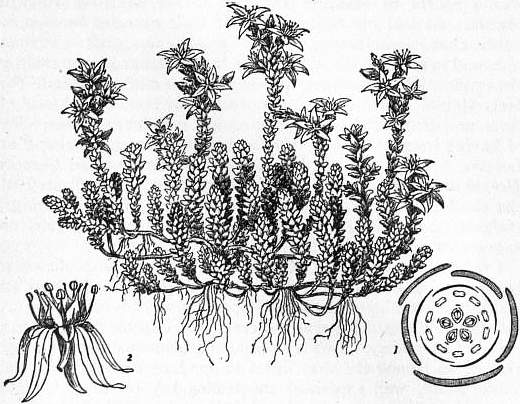
Stonecrop (Sedum acre) slightly reduced. 1, Horizontal plan of arrangement of flower of stonecrop; 2, flower of Sedum rubens.
The order is almost absent from Australia and Polynesia, and has but few representatives in South America; it is otherwise very generally distributed. The largest genus, Sedum, contains about 140 species in the temperate and colder parts of the northern hemisphere; eight occur wild in Britain, including S. Telephium (orpine) and S. acre (common stonecrop) (see fig.). The species are easily cultivated and will thrive in almost any soil. They are readily propagated by seeds, cuttings or divisions. Crassula has about 100 species, chiefly at the Cape. Cotyledon, a widely distributed genus with about 90 species, is represented in the British Isles by C. Umbilicus, pennywort, or navelwort, which takes its name from the succulent peltate leaves. It grows profusely on dry rocks and walls, especially on the western coasts, and bears a spike of drooping greenish cup-shaped flowers. The Echeveria of gardens is now included in this genus. Sempervivum has about 50 species in the mountains of central and southern Europe, in the Himalayas, Abyssinia, and the Canaries and Madeira; S. tectorum, common house-leek, is seen often growing on tops of walls and house-roofs. The hardy species will grow well in dry sandy soil, and are suitable for rockeries, old walls or edgings. They are readily propagated by offsets or by seed.
The order is closely allied to Saxifragaceae, from which it is distinguished by its fleshy habit and the larger number of carpels.
CRASSUS (literally “dense,” “thick,” “fat”), a family name in the Roman gens Licinia (plebeian). The most important of the name are the following:
1. Publius Licinius Crassus, surnamed Dives Mucianus, Roman statesman, orator and jurist, consul, 131 B.C. He was the son of P. Mucius Scaevola (consul 175) and was adopted by a P. Licinius Crassus Dives. An intimate friend of Tiberius Gracchus, he was chosen after his death to take his place on the agrarian commission (see Gracchus). In 131 when Crassus was consul with L. Valerius Flaccus, Aristonicus, an illegitimate son of Eumenes II. of Pergamum, laid claim to the kingdom, which had been bequeathed by Attalus III. to Rome. Both consuls were anxious to obtain the command against him; Crassus was pontifex maximus, and Flaccus a flamen of Mars. Crassus declared that Flaccus could not neglect his sacred office, and imposed a conditional fine on him in the event of his leaving Rome. The popular assembly remitted the fine, but Flaccus was ordered to obey the pontifex maximus. Crassus accordingly proceeded to Asia, although in doing so he violated the rule which forbade the pontifex maximus to leave Italy. Nothing is known of his military operations. But in the following year, when he was making preparations to return, he was surprised near Leucae. He was himself taken prisoner by a Thracian band, and provoked his captors, who were ignorant of his identity, to put him to death. Crassus does not seem to have possessed much military ability, but he was greatly distinguished for his knowledge of law and his accomplished oratory. He had acquired such a mastery of the Greek language that, when he presided over the courts in Asia, he was able to answer each suitor in ordinary Greek or any of the dialects in use.
Cicero, De oratore, i. 50; Philippics, xi. 8; Plutarch, Tib. Gracchus, 21; Livy, Epit. 59; Val. Max. iii. 2. 12, viii. 7. 6; Vell. Pat. ii. 4; Justin xxxvi. 4; Orosius v. 10.
2. Lucius Licinius Crassus (140-91 B.C.), the orator, of unknown parentage. At the age of nineteen (or twenty-one) he made his reputation by a speech against C. Papirius Carbo, the friend of the Gracchi. The law passed by him and his colleague Q. Mucius Scaevola during their consulship (95), to prevent those passing as Roman citizens who had no right to the title, was one of the prime causes of the Social War (Cicero, Pro Balbo, xxi., De officiis, iii. 11). During his censorship Crassus suppressed the newly founded schools of Latin rhetoricians (Aulus Gellius xv. 11). He died from excitement caused by his passionate speech against the consul L. Marcius Philippus, who had insulted the Senate. Crassus is one of the chief speakers in the De oratore of Cicero, who has also preserved a few fragments of his speeches.
3. Publius Licinius Crassus, called Dives, father of the triumvir. Little is known of him before he became consul in 97, except that he proposed a law regulating the expenses of the table, which met with general approval. During his consulship the practice of magic arts was condemned by a decree of the senate, and human sacrifice was abolished. He was subsequently governor of Spain for some years, during which he gained several successes over the Lusitanians, and on his return in 93 was honoured with a triumph. After the Social War, as censor with L. Julius Caesar, he had the task of enrolling in new tribes certain of the Latins and Italians as a reward for their loyalty to the Romans, but the proceedings seem to have been interrupted by certain irregularities. They also forbade the introduction of foreign wines and unguents. Crassus committed suicide in 87, to avoid falling into the hands of the Marian party.
Plutarch, Crassus, 4; Aulus Gellius ii. 24; Macrobius, Saturnalia, ii. 13; Livy, Epit. 80; Pliny, Nat. Hist. xxx. 3; Appian, Bell. Civ. i. 72; Festus, under Referri.
4. Marcus Licinius Crassus (c. 115-53 B.C.), the Triumvir, surnamed Dives (rich) on account of his great wealth. His wealth was acquired by traffic in slaves, the working of silver mines, and judicious purchases of lands and houses, especially those of proscribed citizens. The proscription of Cinna obliged him to flee to Spain; but after Cinna’s death he passed into Africa, and thence to Italy, where he ingratiated himself with Sulla. Having been sent against Spartacus, he gained a decisive victory, and was honoured with a minor triumph. Soon afterwards he was elected consul with Pompey, and (70) displayed his wealth by entertaining the populace at 10,000 tables, and distributing sufficient corn to last each family three months. In 65 he was censor, and in 60 he joined Pompey and Caesar in the coalition known as the first triumvirate. In 55 he was again consul with Pompey, and a law was passed, assigning the provinces of the two Spains and Syria to the two consuls for five years. Crassus was satisfied with Syria, which promised to be an inexhaustible source of wealth. Having crossed the Euphrates he hastened to make himself master of Parthia; but he was defeated at Carrhae (53 B.C.) and taken prisoner by Surenas, the Parthian general, who put him to death by pouring molten gold down his throat. His head was cut off and sent to Orodes, the Parthian king. Crassus was a man of only moderate abilities, and owed his importance to his great wealth.
See Plutarch’s Life; also Caesar, Gaius Julius; Pompey; Rome: History, II. “The Republic.”
CRATER, the cavity at the mouth of a volcanic duct, usually funnel-shaped or presenting the form of a bowl, whence the name, from the Gr. κρατήρ, a bowl. A volcanic hill may have a single crater at, or near, its summit, or it may have several minor craters on its flanks: the latter are sometimes called “adventitious craters” or “craterlets.” Much of the loose ejected material, falling in the neighbourhood of the vent, rolls down the inner wall of the crater, and thus produces a stratification with an inward dip. The crater in an active volcano is kept open by intermittent explosions, but in a volcano which has become dormant or extinct the vent may become plugged, and the bowl-shaped cavity may subsequently be filled with water, forming a crater-lake, or as it is called in the Eifel a Maar. In some basaltic cones, like those of the Sandwich Islands, the crater may be a broad shallow pit, having almost perpendicular walls, with horizontal stratification. Such hollows are consequently called pit-craters. The name caldera (Sp. for cauldron) was suggested for such pits by Capt. C. E. Dutton, who regarded them as having been formed by subsidence of the walls. The term caldera is often applied to bowl-shaped craters in Spanish-speaking countries. (See Volcano.)
CRATES, Athenian actor and author of comedies, flourished about 470 B.C. He was regarded as the founder of Greek comedy proper, since he abandoned political lampoons on individuals, and introduced more general subjects and a well-developed plot (Aristotle, Poëtica, 5). He is stated to have been the first to represent the drunkard on the stage (Aristophanes, Knights, 37 ff.).
Fragments in Meineke, Poëtarum Comicorum Graecorum fragmenta, i.
CRATES, the name of two Greek philosophers.
1. Crates, of Athens, successor of Polemo as leader of the Old Academy.
2. Crates, of Thebes, a Cynic philosopher of the latter half of the 4th century. He was the famous pupil of Diogenes, and the last great representative of Cynicism. It is said that he lost his ample fortune owing to the Macedonian invasion, but a more probable story is that he sacrificed it in accordance with his principles, directing the banker, to whom he entrusted it, to give it to his sons if they should prove fools, but to the poor if his sons should prove philosophers. He gave up his life to the attainment of virtue and the propagation of ascetic self-control. His habit of entering houses for this purpose, uninvited, earned him the nickname Θυρεπανοίκτης (“Door-opener”). His marriage with Hipparchia, daughter of a wealthy Thracian family, was in curious contrast to the prosaic character of his life. Attracted by the nobility of his character and undeterred by his poverty and ugliness, she insisted on becoming his wife in defiance of her father’s commands. The date of his death is unknown, though he seems to have lived into the 3rd century. His writings were few. According to Diogenes Laërtius, he was the author of a number of letters on philosophical subjects; but those extant under the name of Crates (R. Hercher, Epistolographi Graeci, 1873) are, spurious, the work of later rhetoricians. Diogenes Laërtius credits him with a short poem, Παίγνια, and several philosophic tragedies. Plutarch’s life of Crates is lost. The great importance of Crates’ work is that he formed the link between Cynicism and the Stoics, Zeno of Citium being his pupil.
See N. Postumus, De Cratete Cynico (1823); F. Mullach, Frag. Philosophorum Graecorum, ii. (1867); E. Wellmann in Ersch and Gruber’s Allgemeine Encyklopädie; Diog. Laërt. vi. 85-93, 96-98.
CRATES, of Mallus in Cilicia, a Greek grammarian and Stoic philosopher of the 2nd century B.C., leader of the literary school and head of the library of Pergamum. His principles were opposed to those of Aristarchus, the leader of the Alexandrian school. He was the chief representative of the allegorical theory of exegesis, and maintained that Homer intended to express scientific or philosophical truths in the form of poetry. About 170 B.C. he visited Rome as ambassador of Attalus II., king of Pergamum; and having broken his leg and been compelled to stay there for some time, he delivered lectures which gave the first impulse to the study of grammar and criticism among the Romans (Suetonius, De grammaticis, 2). His chief work was a critical and exegetical commentary on Homer.
See C. Wachsmuth, De Cratete Mallota (1860), containing an account of the life, pupils and writings of Crates; J. E. Sandys, Hist. of Class. Schol. i. 156 (ed. 2, 1906).
CRATINUS (c. 520-423 B.C.), Athenian comic poet, chief representative of the old, and founder of political, comedy. Hardly anything is known of his life, and only fragments of his works have been preserved. But a good idea of their character can be gained from the opinions of his contemporaries, especially Aristophanes. His comedies were chiefly distinguished by their direct and vigorous political satire, a marked exception being the burlesque Ὀδυσσεῖς, dealing with the story of Odysseus in the cave of Polyphemus, probably written while a law was in force forbidding all political references on the stage. They were also remarkable for the absence of the parabasis and chorus. Persius calls the author “the bold,” and even Pericles at the height of his power did not escape his vehement attacks, as in the Nemesis and Archilochi, the last-named a lament for the loss of the recently deceased Cimon, with whose conservative sentiments Cratinus was in sympathy. The Panoptae was a satire on the sophists and omniscient speculative philosophers of the day. Of his last comedy the plot has come down to us. It was occasioned by the sneers of Aristophanes and others, who declared that he was no better than a doting drunkard. Roused by the taunt, Cratinus put forth all his strength, and in 423 B.C. produced the Πυτίνη, or Bottle, which gained the first prize over the Clouds of Aristophanes. In this comedy, good-humouredly making fun of his own weakness, Cratinus represents the comic muse as the faithful wife of his youth. His guilty fondness for a rival—the bottle—has aroused her jealousy. She demands a divorce from the archon; but her husband’s love is not dead and he returns penitent to her side. In Grenfell and Hunt’s Oxyrhynchus Papyri, iv. (1904), containing a further instalment of their edition of the Behnesa papyri discovered by them in 1896-1897, one of the greatest curiosities is a scrap of paper bearing the argument of a play by Cratinus,—the Dionysalexandros (i.e. Dionysus in the part of Paris), aimed against Pericles; and the epitome reveals something of its wit and point. The style of Cratinus has been likened to that of Aeschylus; and Aristophanes, in the Knights, compares him to a rushing torrent. He appears to have been fond of lofty diction and bold figures, and was most successful in the lyrical parts of his dramas, his choruses being the popular festal songs of his day. According to the statement of a doubtful authority, which is not borne out by Aristotle, Cratinus increased the number of actors in comedy to three. He wrote 21 comedies and gained the prize nine times.
Fragments in Meineke, Fragmenta Comicorum Graecorum, or Kock, Comicorum Atticorum fragmenta. A younger Cratinus flourished in the time of Alexander the Great. It is considered that some of the comedies ascribed to the elder Cratinus were really the work of the younger.
CRATIPPUS (fl. c. 375 B.C.), Greek historian. There are only three or four references to him in ancient literature, and his importance is due to the fact that he has been identified by several scholars (e.g. Blass) with the author of the historical fragment discovered by Grenfell and Hunt, and published by them in Oxyrhynchus Papyri, vol. v. It may be regarded as a fairly certain inference from a passage in Plutarch (De Gloria Atheniensium, p. 345 E, ed. Bernardakis, ii. p. 455) that he was an Athenian writer, intermediate in date between Thucydides and Xenophon, and that his work continued the narrative of Thucydides, from the point at which the latter historian stopped (410 B.C.) down to the battle of Cnidus (394 B.C.).
The fragments are published in C. Müller’s Fragmenta Historicorum Graecorum. For authorities see under Theopompus.
CRATIPPUS, of Mitylene (1st century B.C.), Peripatetic philosopher, contemporary with Cicero, whose son he taught at Athens, and by whom he is praised in the De officiis as the greatest of his school. He was the friend of Pompey also and shared his flight after the battle of Pharsalia, for the purpose, it is said, of convincing him of the justice of providence. Brutus, while at Athens after the assassination of Caesar, attended his lectures. The freedom of Rome was conferred upon him by Caesar, at the request of Cicero. The only work attributed to him is a treatise on divination, but his reputation may be gauged by the fact that in 44 B.C. the Areopagus invited him to succeed Andronicus of Rhodes as scholarch. He seems to have held that, while motion, sense and appetite cannot exist apart from the body, thought reaches its greatest power when most free from bodily influence, and that divination is due to the direct action of the divine mind on that faculty of the human soul which is not dependent on the body.
Cicero, De divinatione, i. 3, 32, 50, ii. 48, 52; De officiis, i. 1, iii. 2; Plutarch, Cicero, 24.
CRAU (from a Celtic root meaning “stone”), a region of southern France, comprised in the department of Bouches-du-Rhone, and bounded W. by the canal from Arles to Port du Bouc and the Rhone, N. by the chain of the Alpines separating it from an analogous region, the Petite Crau, E. by the hills around Salon and Istres, S. by the gulf of Fos, an inlet of the Mediterranean Sea. Covering an area of about 200 sq. m., the Crau is a low-lying, waterless plain, owing its formation to a sudden inundation, according to some authorities, of the Rhone and the Durance, according to others of the Durance alone. Its surface is formed chiefly of stones varying in size from an egg to a man’s head; these, mixed with a proportion of fine soil, overlie a subsoil formed of stones cemented into a hard mass by deposits of calcareous mud, beneath which lies a bed of loose stones, once the sea-bed. Naturally sterile and poor in lime, the Crau is adapted for agriculture by the process of warping, carried out by means of the Canal de Craponne, which dates from the middle of the 16th century; about one-quarter of the region in the north and east has thus been covered by the rich deposits of the waters of the Durance. The soil also responds in places to deep cultivation and the application of artificial manures. By these aids, uncultivated land, which before supplied only rough and scanty pasture for a few sheep, has been fitted for the growth of the vine, olive and other fruits; where irrigation is practicable, water-meadows have been formed. The dryness of the climate is unfavourable to the production of cereals.
CRAUCK, GUSTAVE (1827-1905), French sculptor, was born and died at Valenciennes, where a special museum for his works was erected in his honour. Though little known to the world at large during his long life, he ranks among the best modern sculptors of France. At Paris his “Coligny” monument is in the rue de Rivoli; his “Victory” in the Place des Arts et Métiers; and “Twilight” in the Avenue de l’Observatoire. Among his finest works is his “Combat du Centaure,” on which he was engaged for thirty years, the figure of the Lapith having been modelled after the athlete, Eugene Sandow. In 1907 an exhibition of his works was held in the École des Beaux-Arts.
CRAUFURD, QUINTIN (1743-1819), British author, was born at Kilwinnock on the 22nd of September 1743. In early life he went to India, where he entered the service of the East India Company. Returning to Europe before the age of forty with a handsome fortune, he settled in Paris, where he gave himself to the cultivation of literature and art, and formed a good library and collection of paintings, coins and other objects of antiquarian interest. Craufurd was on intimate terms with the French court, especially with Marie Antoinette, and was one of those who arranged the flight to Varennes. He escaped to Brussels, but in 1792 he returned to Paris in the hope of rescuing the royal prisoners. He lived among the French émigrés until the peace of Amiens made it possible to return to Paris. Through Talleyrand’s influence he was able to remain in Paris after the war was renewed, and he died there on the 23rd of November 1819.
He wrote, among other works, The History, Religion, Learning and Manners of the Hindus (1790), Secret History of the King of France and his Escape from Paris (first published in 1885), Researches concerning the Laws, Theology, Learning and Commerce of Ancient and Modern India (1817), History of the Bastille (1798), On Pericles and the Arts in Greece (1815), Essay on Swift and his Influence on the British Government (1808), Notice sur Marie Antoinette (1809), Mémoires de Mme du Hausset (1808).
CRAUFURD, ROBERT (1764-1812), British major-general, was born at Newark, Ayrshire, on the 5th of May 1764, and entered the 25th Foot in 1779. As captain in the 75th regiment he first saw active service against Tippoo Sahib in 1790-92. The next year he was employed, under his brother Charles, with the Austrian armies operating against the French. Returning to England in 1797, he soon saw further service, as a lieutenant-colonel, on Lake’s staff in the Irish rebellion. A year later he was British commissioner on Suvarov’s staff when the Russians invaded Switzerland, and at the end of 1799 was in the Helder expedition. From 1801 to 1805 Lieutenant-Colonel Craufurd sat in parliament for East Retford, but in 1807 he resumed active service with Whitelock in the unfortunate Buenos Aires expedition. He was almost the only one of the senior officers who added to his reputation in this affair, and in 1808 he received a brigade command under Sir John Moore. His regiments were heavily engaged in the earlier part of the famous retreat, but were not present at Corunna, having been detached to Vigo, whence they returned to England. Later in 1809, once more in the Peninsula, Brigadier-General Craufurd was three marches or more in rear of Wellesley’s army when a report came in that a great battle was in progress. The march which followed is one almost unparalleled in military annals. The three battalions of the “Light Brigade” (43rd, 52nd and 95th) started in full marching order, and arrived at the front on the day after the battle of Talavera, having covered 62 m. in twenty-six hours. Beginning their career with this famous march, these regiments and their chief, under whom served such men as Charles and William Napier, Shaw and Colborne, soon became celebrated as one of the best corps of troops in Europe, and every engagement added to their laurels. Craufurd’s operations on the Coa and Agueda in 1810 were daring to the point of rashness, but he knew the quality of the men he led better than his critics did, and though Wellington censured him for his conduct, he at the same time increased his force to a division by the addition of two picked regiments of Portuguese Caçadores. The conduct of the renowned “Light Division” at Busaco is described by Napier in one of his most vivid passages. The winter of 1810-1811 Craufurd spent in England, and his division was commanded in the interim by another officer, who did not display much ability. He reappeared on the field of the battle of Fuentes d’Onoro amidst the cheers of his men, and nothing could show his genius for war better than his conduct on this day, in covering the strange readjustment of his line which Wellington was compelled to make in the face of the enemy. A little later he obtained major-general’s rank; and on the 19th of January 1812, as he stood on the glacis of Ciudad Rodrigo, directing the stormers of the Light Division, he fell mortally wounded. His body was carried out of action by his staff officer, Lieutenant Shaw of the 43rd (see Shaw Kennedy), and, after lingering four days, he died. He was buried in the breach of the fortress where he had met his death, and a monument in St Paul’s cathedral commemorates Craufurd and Mackinnon, the two generals killed at the storming of Ciudad Rodrigo. The exploits of Craufurd and the Light Division are amongst the most cherished traditions of the British and Portuguese armies. One of the quickest and most brilliant, if not the very first, of Wellington’s generals, he had a fiery temper, which rendered him a difficult man to deal with, but to the day of his death he possessed the confidence and affection of his men in an extraordinary degree.
His elder brother, Lieutenant-General Sir Charles Craufurd (1761-1821), entered the 1st Dragoon Guards in 1778. Made captain in the Queen’s Bays in 1785, he became the equerry and intimate friend of the duke of York. He studied in Germany for some time, and, with his brother Robert’s assistance, translated Tielcke’s book on the Seven Years’ War (The Remarkable Events of the War between Prussia, Austria and Russia from 1756 to 1763). As aide-de-camp he accompanied the duke of York to the French War in 1793, and was at once sent as commissioner to the Austrian headquarters, with which he was present at Neerwinden, Caesar’s Camp, Famars, Landrecies, &c. Major in 1793, and lieutenant-colonel in 1794, he returned to the English army in the latter year, and on one occasion distinguished himself at the head of two squadrons, taking 3 guns and 1000 prisoners. When the British army left the continent Craufurd was again attached to the Austrian army, and was present at the actions on the Lahn, the combat of Neumarkt, and the battle of Amberg. At the last battle a severe wound rendered him incapable of further service, and cut short a promising career. He succeeded his brother Robert as member of parliament for East Retford (1806-1812). He died in 1821, having become a lieutenant-general and a G.C.B.
CRAVAT (from the Fr. cravate, a corruption of “Croat”), the name given by the French in the reign of Louis XIV. to the scarf worn by the Croatian soldiers enlisted in the royal Croatian regiment. Made of linen or muslin with broad edges of lace, it became fashionable, and the name was applied both in England and France to various forms of neckerchief worn at different times, from the loosely tied lace cravat with long flowing ends, called a “Steinkirk” from the battle of 1692 of that name, to the elaborately folded and lightly starched linen or cambric neckcloth worn during the period of Beau Brummell.
CRAVEN, PAULINE MARIE ARMANDE AGLAÉ (1808-1891), French author, the daughter of an émigré Breton nobleman, was born in London on the 12th of April 1808. Her father, the comte Auguste de la Ferronays, was a close friend of the duc de Berri, whom he accompanied on his return to France in 1814. He and his wife were attached to the court of Charles X. at the Tuileries, but a momentary quarrel with the duc de Berri made retirement imperative to the count’s sense of honour. He was appointed ambassador at St Petersburg, and in 1827 became foreign minister in Paris. Pauline was thus brought up in brilliant surroundings, but her strongest impressions were those which she derived from the group of Catholic thinkers gathered round Lamennais, and her ardent piety furnishes the key of her life. In 1828 her father was sent to Rome, and Pauline, at the suggestion of Alexis Rio, the art critic, made her first literary essay with a description of the emotions she experienced on a visit to the catacombs. At the revolution of July, M. de la Ferronays resigned his position, and retired with his family to Naples. Here Pauline met her future husband, Augustus Craven, who was then attaché to the British embassy. His father, Keppel Richard Craven, the well-known supporter of Queen Caroline, objected to his son’s marriage with a Catholic; but his scruples were overcome, and immediately after the marriage (1834) Augustus Craven was received into the Roman Catholic Church. Mrs Craven, whose family life as revealed in the Récit d’une sœur was especially tender and intimate, suffered several severe bereavements in the years following on her marriage. The Cravens lived abroad until 1851, when the death of Keppel Craven made his son practically independent of his diplomatic career, in which he had not been conspicuously successful. He stood unsuccessfully for election to parliament for Dublin in 1852, and from that time retired into private life. They went to live at Naples in 1853, and Mrs Craven began to write the history of the family life of the la Ferronays between 1830 and 1836, its incidents being grouped round the love story of her brother Albert and his wife Alexandrine. This book, the Récit d’une sœur (1866, Eng. trans. 1868), was enthusiastically received and was awarded a prize by the French Academy. Straitened circumstances made it desirable for Mrs Craven to earn money by her pen. Anne Sévérin appeared in 1868, Fleurange in 1871, Le Mot d’énigme in 1874, Le Valbriant (Eng. trans., Lucia) in 1886. Among her miscellaneous works may be mentioned La Sœur Natalie Narischkin (1876), Deux Incidents de la question catholique en Angleterre (1875), Lady Georgiana Fullerton, sa vie et ses œuvres (1888). Mrs Craven’s charming personality won her many friends. She was a frequent guest with Lord Palmerston, Lord Ellesmere and Lord Granville. She died in Paris on the 1st of April 1891. Her husband, who died in 1884, translated the correspondence of Lord Palmerston and of the Prince Consort into French.
See Memoir of Mrs Augustus Craven (1894), by her friend Mrs Mary Catherine Bishop; also Paolina Craven, by T. F. Ravaschieri Fieschi (1892). There is a biography of Mrs Craven’s father, “En Emigration,” in Étienne Lamy’s Témoins des jours passés (1907).
CRAVEN, WILLIAM CRAVEN, Earl of (1608-1697), eldest son of Sir William Craven, lord mayor of London, and of Elizabeth, daughter of Alderman William Whitmore, was born in June 1608, matriculated at Trinity College, Oxford, in 1623, and joined the society of the Middle Temple in 1624. He had already inherited his father’s vast fortune by the latter’s death in 1618, and before he came of age he had distinguished himself in the military service of the princes of Orange. Returning home he was knighted and created Baron Craven of Hampstead Marshall in Berkshire in 1627. He early showed enthusiasm for the cause of the unfortunate king and queen of Bohemia, driven from their dominions, and in 1632 joined Frederick in a military expedition to recover the Palatinate, meeting Gustavus Adolphus at Höchst, whose praise he gained by being the first, though wounded, to mount the breach at the capture of Kreuznach on the 22nd of February. The Swedish king, however, refused to allow the elector an independent command for the defence of the Palatinate, and Craven returned to England. In May 1633 he was placed on the council of Wales. In 1637 he took part in a second expedition in aid of the palatine family on the Lower Rhine, with the young elector Charles Louis and his brother Rupert, and offered as a contribution the sum of £30,000, but their forces were defeated near Wessel and Craven wounded and taken prisoner together with Rupert. He purchased his freedom in 1639, and then joined the small court of the exiled queen Elizabeth at the Hague and at Rhenen, supplying her generously with funds on the cessation of her English pension owing to the outbreak of the Civil War. He contributed also large sums in aid of Charles I., and, after his execution, of Charles II., the amount bestowed upon the latter being alone computed at £50,000,1 notwithstanding that since 1651 the greater part of his estates had been confiscated by the parliament and his house at Caversham reduced to ruins.2 At the Restoration he accompanied Charles to England, regained his estates, and was rewarded with offices and honours. He was made colonel of several regiments including the Coldstream, and in 1667 lieutenant-general and also high steward of Cambridge University. In 1666 he became a privy councillor, but was not included later in 1679 in Sir William Temple’s remodelled council.3 In 1668 he became a governor of the Charterhouse, was appointed lord-lieutenant of Middlesex, and master of the Trinity House in 1670; and in 1673 a commissioner for Tangier. He was one of the lords proprietors of Carolina and a member of the Fishery Committee.
In March 1664 he was created viscount and earl of Craven. Meanwhile his devotion to the interests of the queen of Bohemia was unceasing, and on her return to England he offered her hospitality at his house in Drury Lane, where she remained till February 1662. At her death, within a fortnight afterwards, she bequeathed to Craven her papers and her valuable collection of portraits, but there is no foundation for the belief entertained later that she had married him. In 1682 he became the guardian of Ruperta, the natural daughter of his old comrade in arms, Prince Rupert. He was again made a privy councillor and lieutenant-general of the forces by James on his accession, and at the age of eighty was in command of the Coldstreams at Whitehall on the 17th of December 1688 when the Dutch troops arrived. He refused to withdraw them at the bidding of Count Solms, the Dutch commander, but obeyed later James’s own orders to retire. His public career now closed and he filled no office after the revolution. Although his claims upon the gratitude of the Stuart royal family were immense, Craven had never been considered a possible candidate for high political place. His ability was probably small, and he is spoken of with little respect in the Verney Papers and by the electress Sophia in her Memoirs. The latter retails some foolish observations made by Craven, and Pepys was disgusted at his coarse and stupid jests at the Fishery Board, where his “very confused and very ridiculous proceedings” are also censured.4 His military prowess, however, his generosity and his public spirit are undoubted. He showed great activity during the plague and fire of London. He was a patron of letters and a member of the Royal Society. He inherited Combe Abbey near Coventry from his father, and purchased Hampstead Marshall in Berkshire, where he built a house on the model of Heidelberg Castle.
He died unmarried on the 9th of April 1697, when the earldom became extinct, the barony passing by special remainder to his cousin William, 2nd Baron Craven; the present earl of Craven (the earldom being revived in 1801) is descended from John, a younger brother of the latter. The first Lord Craven’s brother John, who was created Baron Craven of Ryton in Shropshire and who died in 1648, was the founder of the Craven scholarships at Oxford and Cambridge universities, of which the first was awarded in 1649.
Bibliography.—See the article in the Dict. of Nat. Biography (and Errata); Lives of the Princesses of England (Elizabeth, eldest daughter of James I.), vol. vi., by M. A. E. Green (1854); Memoirs of Elizabeth Stuart, by Miss Benger (1825); Memoiren der Herzogin Sophie, ed. by A. Köcher in Publ. aus den k. preussischen Staatsarchiven, Bd. iv. (1879); “Briefe der Elisabeth Stuart” in Bibliothek des litterarischen Vereins (Stuttgart, 1903), 155, 157; G. E. C.’s Complete Peerage (1889), ii. 404; Lives and Characters of the Most Illustrious Persons (1713), p. 546; Macaulay’s Hist. of England, ii. 584 (1858); Verney Papers (Camden Soc., 1853); Cal. of St. Pap. Dom.; Tracts relating to the confiscation of his estate in Cat. of the British Museum. Much information also doubtless exists in the Craven MSS. at Combe Abbey.
(P. C. Y.)
CRAWFORD, EARLS OF. The house of Lindsay, of which the earl of Crawford is the head, traces its descent back to the barons of Crawford who flourished in the 12th century, and has included a number of men who have played leading parts in the history of Scotland. It is said that “though other families in Scotland may have been of more historic, none can in genealogical importance equal that of Lindsay,” and the Lindsays claim that “the predecessors of the 1st earl of Crawford were barons at the period of the earliest parliamentary records, and that, in fact, they were never enrolled in the modern sense of the term, but were among the pares, of which kings are primi, from the commencement of recorded history.” Again we are told, “the earldom of Crawford, therefore, like those of Douglas, of Moray, Ross, March and others of the earlier times of feudalism, formed a petty principality, an imperium in imperio.” Moreover, the earls “had also a concilium, or petty parliament, consisting of the great vassals of the earldom, with whose advice they acted on great and important occasions.”
Sir James Lindsay (d. 1396), 9th lord of Crawford in Lanarkshire, was the only son of Sir James Lindsay, the 8th lord (d. c. 1357), and was related to King Robert II.; he was descended from Sir Alexander Lindsay of Luffness (d. 1309), who obtained Crawford and other estates in 1297 and who was high chamberlain of Scotland. The 9th lord fought at Otterburn, and Froissart tells of his wanderings after the fight. He was succeeded by his cousin, Sir David Lindsay (c. 1360-1407), son of Sir Alexander Lindsay of Glenesk (d. 1382), and in 1398 Sir David, who married a daughter of Robert II., was made earl of Crawford.
The most important of the early earls of Crawford are the 4th and the 5th earls. Alexander Lindsay, the 4th earl (d. 1454), called the “tiger earl,” was, like his father David the 3rd earl, who was killed in 1446, one of the most powerful of the Scottish nobles; for some time he was in arms against King James II., but he submitted in 1452. His son David, the 5th earl (c. 1440-1495), was lord high admiral and lord chamberlain; he went frequently as an ambassador to England and was created duke of Montrose in 1488, but the title did not descend to his son. Montrose fought for James III. at the battle of Sauchieburn, and his son John, the 6th earl (d. 1513), was slain at Flodden.
David Lindsay, 8th earl of Crawford (d. 1542), son of Alexander, the 7th earl (d. 1517), had a son Alexander, master of Crawford (d. 1542), called the “wicked master,” who quarrelled with his father and tried to kill him. Consequently he was sentenced to death, and the 8th earl conveyed the earldom to his kinsman, David Lindsay of Edzell (d. 1558), a descendant of the 3rd earl of Crawford, thus excluding Alexander and his descendants, and in 1542 David became 9th earl of Crawford. But the 9th earl, although he had at least two sons, named the wicked master’s son David as his heir, and consequently in 1558 the earldom came back to the elder line of the Lindsays, the 9th earl being called the “interpolated earl.”
David Lindsay, 10th earl of Crawford (d. 1574), was a supporter of Mary Queen of Scots; he was succeeded by his son David (c. 1547-1607) as 11th earl. This David, a grandson of Cardinal Beaton, was concerned in some of the risings under James VI.; he was converted to Roman Catholicism and was in communication with the Spaniards about an invasion of England. After his death the earldom passed to his son David (d. 1621), a lawless ruffian, and then to his brother, Sir Henry Lindsay or Charteris (d. 1623), who became 13th earl of Crawford. Sir Henry’s three sons became in turn earls of Crawford, the youngest, Ludovic, succeeding in 1639.
Ludovic Lindsay, 16th earl of Crawford (1600-1652), took part in the strange plot of 1641 called the “incident.” Having joined Charles I. at Nottingham in 1642, he fought at Edgehill, at Newbury and elsewhere during the Civil War; in 1644, just after Marston Moor, the Scottish parliament declared he had forfeited his earldom, and, following the lines laid down when this was regranted in 1642, it was given to John Lindsay, 1st earl of Lindsay. Ludovic was taken prisoner at Newcastle in 1644 and was condemned to death, but the sentence was not carried out, and in 1645 he was released by Montrose, under whom he served until the surrender of the king at Newark. Later he was in Ireland and in Spain and he died probably in France in 1652. He left no issue.
The earl of Lindsay, who thus supplanted his kinsman, belonged to the family of Lindsay of the Byres, a branch of the Lindsays descended from Sir David Lindsay of Crawford (d. c. 1355), the grandfather of the 1st earl of Crawford. Sir David’s descendant, Sir John Lindsay of the Byres (d. 1482), was created a lord of parliament as Lord Lindsay of the Byres in 1445, and his son David, the 2nd lord (d. 1490), fought for James III. at the battle of Sauchieburn. The most prominent member of this line was Patrick, 6th Lord Lindsay of the Byres (d. 1589), a son of John the 5th lord (d. 1563), who was a temperate member of the reforming party. Patrick was one of the first of the Scottish nobles to join the reformers, and he was also one of the most violent. He fought against the regent, Mary of Lorraine, and the French; then during a temporary reconciliation he assisted Mary, queen of Scots, to crush the northern rebels at Corrichie in 1562, but again among the enemies of the queen he took part in the murder of David Rizzio and signed the bond against Bothwell, whom he wished to meet in single combat after the affair at Carberry Hill in 1565. Lindsay, who was a brother-in-law and ally of the regent Murray, carried Mary to Lochleven castle and obtained her signature to the deed of abdication; he fought against her at Langside, and after Murray’s murder he was one of the chiefs of the party which supported the throne of James VI. In 1578, however, he was among those who tried to drive Morton from power, and in 1582 he helped to seize the person of the king in the plot called the “raid of Ruthven,” afterwards escaping to England. Lindsay had returned to Scotland when he died on the 11th of December 1589. His successor was his son, James the 7th lord (d. 1601).
Patrick’s great-grandson, John Lindsay, 17th earl of Crawford and 1st earl of Lindsay (c. 1598-1678), was the son of Robert Lindsay, 9th Lord Lindsay of the Byres, whom he succeeded as 10th lord in 1616. In 1633 he was created earl of Lindsay, and having become a leader of the Covenanters he marched with the Scottish army into England in 1644 and was present at Marston Moor; in 1644 also he obtained the earldom of Crawford in the manner already mentioned. In the same year he became lord high treasurer of Scotland, and in 1645 president of the parliament. Having fought against Montrose at Kilsyth, the earl of Crawford-Lindsay, as he was called, changed sides, and in 1647 he signed the “engagement” for the release of Charles I., losing all his offices by the act of classes when his enemy, the marquess of Argyll, obtained the upper hand. After the defeat of the Scots at Dunbar, however, Crawford regained his influence in Scottish politics, but from 1651 to 1660 he was a prisoner in England. In 1661 he was restored to his former dignities, but his refusal to abjure the covenant compelled him to resign them two years later. His son, William, 18th earl of Crawford and 2nd earl of Lindsay (1644-1698), was, like his father, an ardent covenanter; in 1690 he was president of the Convention parliament. Mr Andrew Lang says this earl was “very poor, very presbyterian, and his letters, almost alone among those of the statesmen of the period, are rich in the texts and unctuous style of an older generation.”
William’s grandson, John Lindsay, 20th earl of Crawford and 4th earl of Lindsay (1702-1749), won a high reputation as a soldier. He held a command in the Russian army, seeing service against the Turk, and he also served against the same foe under Prince Eugene. Having returned to the English army he led the life-guards at Dettingen and distinguished himself at Fontenoy; later he served against France in the Netherlands. He left no sons when he died in December 1749, and his kinsman, George Crawford-Lindsay, 4th Viscount Garnock (c. 1723-1781), a descendant of the 17th earl, became 21st earl of Crawford and 5th earl of Lindsay. When George’s son, George, the 22nd earl (1758-1808), died unmarried in January 1808, the earldoms of Crawford and Lindsay were separated, George’s kinsman, David Lindsay (d. 1809), a descendant of the 4th Lord Lindsay of the Byres, becoming 7th earl of Lindsay. Both David and his successor Patrick (d. 1839) died without sons, and in 1878 the House of Lords decided that Sir John Trotter Bethune, Bart. (1827-1894), also a descendant of the 4th Lord Lindsay of the Byres, was entitled to the earldom. In 1894 John’s cousin, David Clark Bethune (b. 1832), became 11th earl of Lindsay.
The earldom of Crawford remained dormant from 1808, when this separation took place, until 1848, when the House of Lords adjudged it to James Lindsay, 7th earl of Balcarres.
The earls of Balcarres are descended from John Lindsay, Lord Menmuir (1552-1598), a younger son of David Lindsay, 9th earl of Crawford. John, who bought the estate of Balcarres in Fifeshire, became a lord of session as Lord Menmuir in 1581; he was a member of the Scottish privy council and one of the commissioners of the treasury called the Octavians. He had great influence with James VI., helping the king to restore episcopacy after he had become, in 1595, keeper of the privy seal and a secretary of state. Menmuir, a man of great intellectual attainments, left two sons, the younger, David, succeeding to the family estates on his brother’s death in 1601. David (c. 1586-1641), a notable alchemist, was created Lord Lindsay of Balcarres in 1633, and in 1651 his son Alexander was made earl of Balcarres.
Alexander Lindsay, 1st earl of Balcarres (1618-1659), the “Rupert of the Covenant,” fought against Charles I. at Marston Moor, at Alford and at Kilsyth, but later he joined the royalists, signing the “engagement” for the release of the king in 1647, and having been created earl of Balcarres took part in Glencairn’s rising in 1653. Richard Baxter speaks very highly of the earl, who died at Breda in August 1659. His son Charles (d. 1662) became 2nd earl of Balcarres, and another son, Colin (c. 1654-1722), became 3rd earl. Colin, who was perhaps the most trusted of the advisers of James II., wrote some valuable Memoirs touching the Revolution in Scotland, 1688-1690; these were first published in 1714, and were edited for the Bannatyne Club by the 25th earl of Crawford in 1841. Having been allowed to return to Scotland after an exile in France, the earl joined the Jacobite rising in 1715. His successor was his son Alexander, the 4th earl (d. 1736), who was followed by another son, James, the 5th earl (1691-1768), who fought for the Stuarts at Sheriffmuir. Afterwards James was pardoned and entered the English army, serving under George II. at Dettingen. This earl wrote some Memoirs of the Lindsays, which were completed by his son Alexander, the 6th earl (1752-1825). Alexander was with the English troops in America during the struggle for independence, and was governor of Jamaica from 1794 to 1801, filling a difficult position with great credit to himself. He became a general in 1803, and died at Haigh Hall, near Wigan, which he had received through his wife, Elizabeth Dalrymple (1759-1816), on the 27th of May 1825. This earl did not claim the earldom of Crawford, although he became earl de jure in 1808, but in 1843 his son James Lindsay (1783-1869) did so, and in 1848 the claim was allowed by the House of Lords. James was thus 24th earl of Crawford and 7th earl of Balcarres; in 1826 he had been created a peer of the United Kingdom as Baron Wigan of Haigh Hall.
His son, Alexander William Crawford Lindsay, 25th earl of Crawford (1812-1880), was born at Muncaster Castle, Cumberland, on the 16th of October 1812, and educated at Eton and Cambridge. He travelled much in Europe and the East, and was most learned in genealogy and history. His more important works include Lives of the Lindsays (3 vols., 1849), Letters on Egypt, Edom and the Holy Land (1838), Sketches of the History of Christian Art (1847 and 1882), Etruscan Inscriptions Analysed (1872), and The Earldom of Mar during 500 years (1882). He succeeded to the title in September 1869, and died at Florence on the 13th of December 1880. A year later it was discovered that the family vault at Dunecht had been broken into and the body stolen. It was not until the 18th of July 1882 that the police, acting on the confession of an eye-witness of the desecration, found the remains, which were then reinterred at Haigh Hall, Wigan.
His only son, James Ludovic Lindsay, 26th earl of Crawford (1847- ), British astronomer and orientalist, was born at St Germain-en-Laye, France, on the 28th of July 1847. Educated at Eton and Trinity College, Cambridge, he devoted himself to astronomy, in which he early achieved distinction. In 1870 he went to Cadiz to observe the eclipse of the sun, and, in 1874, to Mauritius to observe the transit of Venus. In the interval, with the assistance of his father, he had built an observatory at Dunecht, Aberdeenshire, which in 1888 he presented, together with his unique library of astronomical and mathematical works, to the New Royal Observatory on Blackford Hill, Edinburgh, where they were installed in 1895. His services to science were recognized by his election to the presidentship of the Royal Astronomical Society in 1878 and 1879 in succession to Sir William Huggins, and to the fellowship of the Royal Society in 1878. He also received the degree of LL.D. from Edinburgh University in 1882, and in the following year was nominated honorary associate of the Royal Prussian Academy of Sciences. An enthusiastic bibliophile, he became a trustee of the British Museum, and acted for a term as president of the Library Association. To the free library of Wigan, Lancashire, he gave a series of oriental and English MSS. of the 9th to the 19th centuries in illustration of the progress of handwriting, while for the use of specialists and students he issued the invaluable Bibliotheca Lindesiana. He represented Wigan in the House of Commons from 1874 till his succession to the title in 1880.
Another title held by the Lindsays was that of Spynie, Sir Alexander Lindsay (c. 1555-1607), created Baron Spynie in 1590, being a younger son of the 10th earl of Crawford. The 2nd Lord Spynie was Alexander’s son, Alexander (d. 1646), who served in Germany under Gustavus Adolphus and assisted Charles I. in Scotland during the Civil War; and the 3rd lord was the latter’s son, George. When George, a royalist who was taken prisoner at the battle of Worcester, died in 1671 this title became extinct.
The dukedom of Montrose, which had lapsed on the death of the 5th earl of Crawford in 1495 and had been revived in 1707 in the Graham family, was claimed in 1848 by the 24th earl of Crawford, but in 1853 the House of Lords gave judgment against the earl.
The Lindsays have furnished the Scottish church with several prelates. John Lindsay (d. 1335) was bishop of Glasgow; Alexander Lindsay (d. 1639) was bishop of Dunkeld until he was deposed in 1638; David Lindsay (d. c. 1641) was bishop of Brechin and then of Edinburgh until he, too, was deposed in 1638; and a similar fate attended Patrick Lindsay (1566-1644), bishop of Ross from 1613 to 1633 and archbishop of Glasgow from 1633 to 1638. Perhaps the most famous of the Lindsay prelates was David Lindsay (c. 1531-1613), a nephew of the 9th earl of Crawford. David, who married James VI. to Anne of Denmark at Upsala, was one of the leaders of the Kirk party; he became bishop of Ross under the new scheme for establishing episcopacy in 1600.