VOLUME VII SLICE VI Coucy-le-Château to Crocodile (continued 4)
Reading edition
The texts of the National Covenant and the Solemn League and Covenant are printed in S. R. Gardiner’s Constitutional Documents of the Puritan Revolution (Oxford, 1899). See also J. H. Burton, History of Scotland (Edinburgh, 1905); A. Lang, History of Scotland (Edinburgh, 1900); S. R. Gardiner, History of England (London, 1883-1884); G. Grub, Ecclesiastical History of Scotland (Edinburgh, 1861); J. Macpherson, History of the Church in Scotland (Paisley, 1901); and J. K. Hewison, The Covenanters (1908).
COVENT GARDEN, formerly an open space north of the Strand, London, England, now occupied by the principal flower, fruit and vegetable market in the metropolis. This was originally the so-called “convent garden” belonging to the abbey of St Peter, Westminster. In the first half of the 17th century the site of the garden was laid out as a square by Inigo Jones, with a piazza on two sides; and as early as 1656 it was becoming a market place for the same commodities as are now sold in it. Covent Garden Theatre (1858) is the chief seat of grand opera in London. The site has carried a theatre since 1733, but earlier buildings were burnt in 1809 and 1856.
COVENTRY, SIR JOHN (d. 1682), son of John Coventry, the second son of Thomas, Lord Keeper Coventry, was returned to the Long Parliament in 1640 as member for Evesham. During the Civil War he served for the king, and at the Restoration was created a knight. In 1667, and in the following parliaments of 1678, 1679 and 1681, he was elected for Weymouth, and opposed the government. On the 21st of December 1670, owing to a jest made by Coventry in the House of Commons on the subject of the king’s amours, Sir Thomas Sandys, an officer of the guards, with other accomplices, by the order of Monmouth, and (it was said) with the approval of the king himself, waylaid him as he was returning home to Suffolk Street and slit his nose to the bone. The outrage created an extraordinary sensation, and in consequence a measure known as the “Coventry Act” was passed, declaring assaults accompanied by personal mutilation a felony without benefit of clergy. Sir John died in 1682. Sir William Coventry, his uncle, speaks slightingly of him, ridicules his vanity and wishes him out of the House of Commons to be “out of harm’s way.”
COVENTRY, THOMAS COVENTRY, 1st Baron (1578-1640), lord keeper of England, eldest son of Sir Thomas Coventry, judge of the common pleas (a descendant of John Coventry, lord mayor of London in the reign of Henry VI.), and of Margaret Jeffreys of Earls Croome, or Croome D’Abitot, in Worcestershire, was born in 1578. He entered Balliol College, Oxford, in 1592, and the Inner Temple in 1594, becoming bencher of the society in 1614, reader in 1616, and holding the office of treasurer from 1617 till 1621. His exceptional legal abilities were rewarded early with official promotion. On the 16th of November 1616 he was made recorder of London in spite of Bacon’s opposition, who, although allowing him to be “a well trained and an honest man,” objected that he was “bred by my Lord Coke and seasoned in his ways.”1 On the 14th of March 1617 he was appointed solicitor-general and was knighted; was returned for Droitwich to the parliament of 1621; and on the 11th of January in that year was made attorney-general. He took part in the proceedings against Bacon for corruption, and was manager for the Commons in the impeachment of Edward Floyd for insulting the elector and electress palatine.
On the 1st of November 1625 he was made lord keeper of the great seal; in this capacity he delivered the king’s reprimand to the Commons on the 29th of March 1626, when he declared that “liberty of counsel” alone belonged to them and not “liberty of control.” On the 10th of April 1628 he received the title of Baron Coventry of Aylesborough in Worcestershire. At the opening of parliament in 1628 he threatened that the king would use his prerogative if further thwarted in the matter of supplies. In the subsequent debates, however, while strongly supporting the king’s prerogative against the claims of the parliament to executive power, he favoured a policy of moderation and compromise. He defended the right of the council to commit to prison without showing cause, and to issue “general” warrants; though he allowed it should only be employed in special circumstances, disapproved of the king’s sudden dissolution of parliament, and agreed to the liberation on bail of the seven imprisoned members on condition of their giving security for their good behaviour. He showed less subservience than Bacon to Buckingham, and his resistance to the latter’s pretensions to the office of lord high constable greatly incensed the duke. Buckingham taunted Coventry with having gained his place by his favour; to which the lord keeper replied, “Did I conceive I had my place by your favour, I would presently unmake myself by returning the seal to his Majesty.”2 After this defiance Buckingham’s sudden death alone probably prevented Coventry’s displacement. He passed sentence of death on Lord Audley in 1631, drafted and enforced the proclamation of the 20th of June 1632 ordering the country gentlemen to leave London, and in 1634 joined in Laud’s attack on the earl of Portland for peculation. The same year, in an address to the judges, he supported the proposed levy of ship-money on the inland as well as the maritime counties on the plea of the necessity of effectually arming, “so that they might not be enforced to fight,” “the wooden walls” being in his opinion “the best walls of this kingdom.”3 In the Star Chamber Coventry was one of Lilburne’s judges in 1637, but he generally showed conspicuous moderation, inclining to leniency in the cases of Richard Chambers in 1629 for seditious speeches, and of Henry Sherfield in 1632 for breaking painted glass in a church. He prevented also the hanging of men for resistance to impressment, and pointed out its illegality, since the men were not subject to martial law. While contributing thirty horse to the Scottish expedition in 1638, and lending the king £10,000 in 1639, he gave no support to the forced loan levied upon the city in the latter year. He died on the 14th of January 1640.
Lord Coventry held the great seal for nearly fifteen years, and was enabled to collect a large fortune. He was an able judge, and he issued some important orders in chancery, probably alluded to by Wood, who ascribes to him a tract on “The Fees of all law Officers.”4 Whitelocke accuses him of mediocrity,5 but his contemporaries in general have united in extolling his judicial ability, his quick despatch of business and his sound and sterling character. Clarendon in particular praises his statesmanship, and compares his capacity with Lord Strafford’s, adding, however, that he seldom spoke in the council except on legal business and had little influence in political affairs; to the latter circumstance he owed his exceptional popularity. He describes him as having “in the plain way of speaking and delivery a strange power of making himself believed,” as a man of “not only firm gravity but a severity and even some morosity,” as “rather exceedingly liked than passionately loved.”
Lord Coventry married (1) Sarah, daughter of Sir Edward Sebright of Besford in Worcestershire, by whom besides a daughter he had one son, Thomas, who succeeded him as 2nd baron, and (2) Elizabeth, daughter of John Aldersley of Spurstow, Cheshire, and widow of William Pitchford, by whom he had four sons, John, Francis, Henry and Sir William Coventry, the statesman.
Thomas Coventry, 5th baron (d. 1699), was created an earl in 1697 with a special limitation, on failure of his own male issue, to that of Walter, youngest brother of the lord keeper, from whom the present earl of Coventry is descended.
COVENTRY, SIR WILLIAM (c. 1628-1686), English statesman, son of the lord keeper, Thomas, Lord Coventry, by his second wife Elizabeth Aldersley, was born about 1628. He matriculated at Queen’s College, Oxford, at the age of fourteen. Owing to the outbreak of the Civil War he was obliged to quit his studies, but according to Sir John Bramston “he had a good tutor who made him a scholar, and he travelled and got the French language in good perfection.” “He was young whilst the war continued,” wrote Clarendon, “yet he had put himself before the end of it into the army and had the command of a foot company and shortly after travelled into France.” Here he remained till all hopes of obtaining foreign assistance and of raising a new army had to be laid aside, when he returned to England and kept aloof from the various royalist intrigues. When, however, a new prospect of a restoration appeared in 1660, Coventry hastened to Breda, was appointed secretary to James, duke of York, lord high admiral of England, and headed the royal procession when Charles entered London in triumph.
He was returned to the Restoration parliament of 1661 for Great Yarmouth, became commissioner for the navy in May 1662 and in 1663 was made D.C.L. at Oxford. His great talents were very soon recognized in parliament, and his influence as an official was considerable. His appointment was rather that of secretary to the admiralty than of personal assistant to the duke of York,1 and was one of large gains. Wood states that he collected a fortune of £60,000. Accusations of corruption in his naval administration, and especially during the Dutch war, were brought against him, but there is nothing to show that he ever transgressed the limits sanctioned by usage and custom in obtaining his emoluments. Pepys in his diary invariably testifies to the excellence of his administration and to his zeal for reform and economy. His ability and energy, however, did little to avert the naval collapse, owing chiefly to financial mismanagement and to the ill-advised appointments to command. Coventry denied all responsibility for the Dutch War in 1665, which Clarendon sought to place upon his shoulders, and his repudiation is supported by Pepys; it was, moreover, contrary to his well-known political opinion. The war greatly increased his influence, and shortly after the victory off Lowestoft, on the 3rd of June 1665, he was knighted and made a privy councillor (26th of June) and was subsequently admitted to the committee on foreign affairs. In 1667 he was appointed to the board of treasury to effect financial reforms. “I perceive,” writes Pepys on the 23rd of August 1667, “Sir William Coventry is the man and nothing done till he comes,” and on his removal in 1669 the duke of Albemarle, no friendly or partial critic, declares that “nothing now would be well done.” His appointment, however, came too late to ward off the naval disaster at Chatham the same year and the national bankruptcy in 1672.
Meanwhile Coventry’s rising influence had been from the first the cause of increasing jealousy to the old chancellor Clarendon, who especially disliked and discouraged the younger generation. Coventry resented this repression and thought ill of the conduct of the administration. He became the chief mover in the successful attack made upon Clarendon, but refused to take any part in his impeachment. Two days after Clarendon’s resignation (on the 31st of August), Coventry announced his intention of leaving the duke’s service and of terminating his connexion with the navy.2 As the principal agent in effecting Clarendon’s fall he naturally acquired new power and influence, and the general opinion pointed to him as his successor as first minister of the crown. Personal merit, patriotism and conspicuous ability, however, were poor passports to place and power in Charles II.’s reign. Coventry retained merely his appointment at the treasury, and the brilliant but unscrupulous and incapable duke of Buckingham, a favourite of the king, succeeded to Lord Clarendon. The relations between the two men soon became unfriendly. Buckingham ridiculed Sir William’s steady attention to business, and was annoyed at his opposition to Clarendon’s impeachment. Coventry rapidly lost influence, was excluded from the cabinet council, and six months after Clarendon’s fall complains he has scarcely a friend at court. Finally, in March 1669, Buckingham having written a play in which Sir William was ridiculed, the latter sent him a challenge. Notice of the challenge reached the authorities through the duke’s second, and Sir William was imprisoned in the Tower on the 3rd of March and subsequently expelled from the privy council. He was superseded in the treasury on the 11th of March by Buckingham’s favourite, Sir Thomas Osborne, afterwards earl of Danby and duke of Leeds, and was at last released from the Tower on the 21st in disgrace. The real cause of his dismissal was clearly the final adoption by Charles of the policy of subservience to France and desertion of Holland and Protestant interests. Six weeks before Coventry’s fall, the conference between Charles, James, Arlington, Clifford and Arundel had taken place, which resulted a year and a half later in the disgraceful treaty of Dover. To such schemes Sir William, with his steady hostility to France and active devotion to Protestantism, was doubtless a formidable opponent. He now withdrew definitely from official life, still retaining, however, his ascendancy in the House of Commons, and leading the party which condemned and criticized the reactionary and fatal policy of the government, his credit and reputation being rather enhanced than diminished by his dismissal.3
In 1673 was published a pamphlet which went through five editions the same year, entitled England’s appeal from the Private Cabal at Whitehall to the Great Council of the Nation ... by a true Lover of his Country, an anonymous work universally ascribed to Sir William, which forcibly reflects his opinions on the French entanglement. In the great matter of the Indulgence, while refusing to discuss the limits of prerogative and liberty, he argued that the dispensing power of the crown could not be valid during the session of parliament, and criticized the manner of the declaration while approving its ostensible object. He supported the Test Act, but maintained a statesmanlike moderation amidst the tide of indignation rising against the government, and refused to take part in the personal attacks upon ministers, drawing upon himself the same unpopularity as his nephew Halifax incurred later. In the same year he warmly denounced the alliance with France. During the summer of 1674 he was again received at court. In 1675 he supported the bill to exclude Roman Catholics from both Houses, and also the measure to close the House of Commons to placemen; and he showed great activity in his opposition to the French connexion, especially stigmatizing the encouragement given by the government to the levying of troops for the French service. In May 1677 he voted for the Dutch alliance. Like most of his contemporaries he accepted the story of the popish plot in 1678. Coventry several times refused the highest court appointments, and he was not included in Sir W. Temple’s new-modelled council in April 1679. In the exclusion question he favoured at first a policy of limitations, and on his nephew Halifax, who on his retirement became the leader of the moderate party, he enjoined prudence and patience, and greatly regretted the violence of the opposition which eventually excited a reaction and ruined everything. He refused to stand for the new parliament, and retired to his country residence at Minster Lovell near Witney, in Oxfordshire. He died unmarried on the 23rd of June 1686, at Somerhill near Tunbridge Wells, where he had gone to take the waters, and was buried at Penshurst, where a monument was erected to his memory. In his will he ordered his funeral to be at small expense, and left £2000 to the French Protestant refugees in England, besides £3000 for the liberation of captives in Algiers. He had shortly before his death already paid for the liberation of sixty slaves. He was much beloved and respected in his family circle, his nephew, Henry Savile, alluding to him in affectionate terms as “our dearest uncle” and “incomparable friend.”
Though Sir William Coventry never filled that place in the national administration to which his merit and exceptional ability clearly entitled him, his public life together with his correspondence are sufficient to distinguish him from amongst his contemporaries as a statesman of the first rank. Lord Halifax obviously derived from his honoured mentor those principles of government which, by means of his own brilliant intellectual gifts, originality and imaginative insight, gained further force and influence. Halifax owed to him his interest in the navy and his grasp of the necessity to a country of a powerful maritime force. He drew his antagonism to France, his religious tolerance, wide religious views but firm Protestantism doubtless from the same source. Sir William was the original “Trimmer.” Writing to his nephew Viscount Weymouth, while denying the authorship of The Character of a Trimmer, he says:—“I have not been ashamed to own myself to be a trimmer ... one who would sit upright and not overturn the boat by swaying too much to either side.” He shared the Trimmer’s dislike of party, urging Halifax in the exclusion contest “not to be thrust by the opposition of his enemies into another party, but that he keep upon a national bottom which at length will prevail.” His prudence is expressed in his “perpetual unwillingness to do things which I cannot undo.” “A singular independence of spirit, a breadth of mind which refused to be contracted by party formulas, a sanity which was proof against the contagion of national delirium, were equally characteristic of uncle and nephew.”4 Sir William Coventry’s conceptions of statesmanship, under the guiding hand of his nephew, largely inspired the future revolution settlement, and continued to be an essential condition of English political growth and progress.
Besides the tract already mentioned Coventry was the author of A Letter to Dr Burnet giving an Account of Cardinal Pool’s Secret Powers ... (1685). The Character of a Trimmer, often ascribed to him, is now known to have been written by Lord Halifax. “Notes concerning the Poor,” and an essay “concerning the decay of rents and the remedy,” are among the Malet Papers (Hist. MSS. Comm. Ser. 5th Rep. app. 320 (a)) and Add. MSS. Brit. Mus. (cal. 1882-1887); an “Essay concerning France” (4th Rep. app. 229 (b)) and a “Discourse on the Management of the Navy” (230b) are among the MSS. of the marquess of Bath, also a catalogue of his library (233(a)).
Bibliography.—No adequate life of Sir William Coventry has been written; the most satisfactory appreciation of his character and abilities is to be found in the several passages relating to him in the Life of George Savile, Marquis of Halifax, by Miss A. C. Foxcroft (1898); see also Hist. MSS. Comm. 3 and 4 Rep. (Longleat Collection), 5 Rep. (Malet Collection and see Index) now in the Brit. Mus. add. Cal. (1882-1887), Some of his papers being also at Devonshire House; MSS. of Marquis of Ormond, iii. of J. M. Heathcote and Miscellaneous Collections; Clarendon’s Life and Continuation (Oxford, 1857); Calendar of Clarendon Papers; Burnet’s Hist, of His Own Times (Oxford, 1823); Hallam’s Constitutional Hist. (1854), chap. xi.; John Evelyn’s Memoirs; Pepys’s Diary and Pepysiana (ed. H. B. Wheatley, 1903); Calendar of State Papers, Domestic; Savile Correspondence (Camden Society, 1858, vol. lxxi.); A. Grey’s Debates; Sir John Bramston’s Autobiography (Camden Soc., 1845); Wood’s Athenae Oxonienses, iv. 190; Saturday Review (Oct. 11, 1873).
(P. C. Y.)
COVENTRY, a municipal, county and parliamentary borough of Warwickshire, England; 94 m. N.W. from London by the London & North Western railway. Pop. (1901) 69,978. The Coventry canal communicates with the Trent and Mersey and Birmingham canals, and the midland system generally. Coventry stands on a gentle eminence, with higher ground lying to the west, and is watered by the Sherbourne and the Radford Brook, feeders of the Avon, which unite within the town. Of its ancient fortifications two gates and some portions of the wall are still extant, and several of the older streets are picturesque from the number of half-timbered houses projecting over the footways.
The most remarkable buildings are the churches; of these the oldest are St Michael’s, one of the finest specimens of Perpendicular architecture in England, with a beautiful steeple rising to a height of 303 ft.; Holy Trinity church, a cruciform structure with a lofty steeple at the intersection; and St John’s, or Bablake church, which is nearly a parallelogram on the ground plan, but cruciform in the clerestory with a central tower. Christ church dates only from 1832, but it is attached to the ancient spire of the Grey Friars’ church. Of secular buildings the most interesting is St Mary’s hall, erected by the united gilds in the early part of the 15th century. The principal chamber, situated above a fine crypt, is 76 ft. long, 30 ft. wide and 34 ft. high; its roof is of carved oak, and in the north end there is a large window of old stained glass, with a curious piece of tapestry beneath nearly as old as the building. In the treasury is preserved a valuable collection of ancient muniments. A statue of Sir Thomas White, lord mayor of London (1532-1533), founder of St John’s College, Oxford, was erected in 1883. The cemetery, laid out by Sir Joseph Paxton, the architect and landscape gardener, and enlarged in 1887, is particularly beautiful. The educational institutions include a well-endowed free grammar school, founded in the reign of Elizabeth, in modern buildings (1885), a technical school, school of art, endowed charity schools, and a county reformatory for girls; and among the charitable foundations, which are numerous and valuable, Bond’s hospital for old men and Ford’s hospital for old women are remarkable as fine specimens of ancient timber work. Swanswell and Spenser Parks were opened in 1883, and a recreation ground in 1880.
Coventry was formerly noted for its woollens, and subsequently acquired such a reputation for its dyeing that the expression “as true as Coventry blue” became proverbial. Existing industries are the making of motor cars, cycles and their accessories, for which Coventry is one of the chief centres in Great Britain; sewing machines are also produced; and carpet-weaving and dyeing, art metal working and watch making are carried on. An ancient fair is held in Whit-week. A county of itself till 1843, the town became a county borough in 1888. The corporation consists of a mayor, 10 aldermen and 30 councillors. The parliamentary borough returns one member. In 1894 a suffragan bishopric of Coventry was established under the see of Worcester, but no longer exists. Area, 4149 acres.
The village which afterwards became important as Coventry (Coventreu, Coventre) owed its existence to the foundation of a Benedictine monastery by Earl Leofric and his wife Godgyfu, the famous Lady Godiva (q.v.), in 1043. The manor, which in 1066 belonged to the latter, descended to the earls of Chester and to Robert de Montalt, and from him passed to Isabella queen of Edward II. and the crown. Ranulf, earl of Chester, granted the earliest extant charter to the town in 1153, by which his burgesses were to hold of him in free burgage as they held of his father, and to have their portmote. This, with further privileges, was confirmed by Henry II. in 1177, and by nearly every succeeding sovereign until the 17th century. In 1345 Edward III. gave Coventry a corporation, mayor and bailiffs empowered to hold pleas and keep the town prison. Edward the Black Prince granted the mayor and bailiffs the right to hold the town in fee farm of £50 and to build a wall. In 1452 Henry VI. formed the city and surrounding hamlets into a county, and James I. incorporated Coventry in 1622. It first sent two representatives to parliament in 1295, but the returns were irregular. The prior’s market on Fridays was probably of Saxon origin; a second market was granted in 1348, while fairs, still held, were obtained in 1217 for the octave of Holy Trinity, and in 1348 and in 1442 for eight days from the Friday after Corpus Christi. As early as 1216 Coventry was important for its trade in wool, cloth and caps, its gilds later being particularly numerous and wealthy. In 1568 Flemish weavers introduced new methods, but the trade was destroyed in the wars of the 17th century. During the middle of the 16th century there was a flourishing manufacture of blue thread, but this decayed before 1581; in the 18th century the manufacture of ribbon was introduced.
The popular phrase “to send to Coventry” (i.e. to refuse to associate with a person) is of uncertain derivation. The New English Dictionary selects the period of the Civil War of the 17th century as that in which the origin of the phrase is probably to be found. Clarendon (History of the Great Rebellion, 1647) states that the citizens of Birmingham rose against certain small parties of the king’s supporters, and sent the prisoners they captured to Coventry, which was then strongly parliamentarian.
See Victoria County History, Warwick; William Dugdale, The Antiquities of Coventre, illustrated from records (Coventry, 1765).
COVER (from the Fr. couvert, from couvrir, to cover, Lat. cooperire), that which hides, shuts in or conceals, a lid to a box or vessel, &c., the binding of a book or wrapper of a parcel; as a hunting term, the wood or undergrowth which shelters game. As a commercial term, the word means in its widest sense a security against loss, but is employed more particularly in connexion with stock exchange transactions to signify a “deposit made with a broker to secure him from being out of pocket in the event of the stocks falling against his client and the client not paying the difference” (In re Cronmire, 1898, 2 Q.B. 383). It is a mode of speculation engaged in almost entirely by persons who wish to limit their risk to a small amount, and, as a rule, the transactions are largely carried out in England with “outside” brokers, i.e. those dealers in securities who are not members of the Stock Exchange. The deposit is so much per cent or per share, usually 1% on the market value of the securities up to about twice the amount of the turn of the market; the client being able to close the transaction at any time during the currency of the cover, but the broker only when the cover is exhausted or has “run off.” Cover is not money deposited to abide the event of a wager, but as security against a debt which may arise from a gaming contract, and it may be recovered back, if unappropriated.
COVERDALE, MILES (1488?-1569), English translator of the Bible and bishop of Exeter, was born of Yorkshire parents about 1488, studied philosophy and theology at Cambridge, was ordained priest at Norwich in 1514, and then entered the convent of Austin friars at Cambridge. Here he came under the influence of the prior, Robert Barnes, made the acquaintance of Sir Thomas More and of Thomas Cromwell, and began a thorough study of the Scriptures. He was one of those who met at the White Horse tavern to discuss theological questions, and when Barnes was arrested on a charge of heresy, Coverdale went up to London to assist him in drawing up his defence. Soon afterwards he left the convent, assumed the habit of a secular priest, and began to preach against confession and the worship of images. In 1531 he graduated bachelor of canon law at Cambridge, but from 1528 to 1534 he prudently spent most of his time abroad. No corroboration has, however, been found for Foxe’s statement that in 1529 he was at Hamburg assisting Tyndale in his translation of the Pentateuch. In 1534 he published two translations of his own, the first Dulichius’s Vom alten und newen Gott, and the second a Paraphrase upon the Psalms, and in 1535 he completed his translation of the Bible. The venture seems to have been projected by Jacob van Meteren, who apparently employed Coverdale to do the translation, and Froschover of Zürich to do the printing. No perfect copy is known to exist, and the five or six which alone have title-pages give no name of publisher or place of publication. The volume is dedicated to the king of England, where Convocation at Cranmer’s instance had, in December 1534, petitioned for an authorized English version of the Scriptures. As a work of scholarship it does not rank particularly high. Some of the title-pages state that it had been translated out of “Douche” (i.e. German) “and Latyn”: and Coverdale mentions that he used five interpreters, which are supposed to have been the Vulgate, the Latin version of Pagninus, Luther’s translation, the Zürich version, and Tyndale’s Pentateuch and New Testament. There is no definite mention of the original Greek and Hebrew texts; but it has considerable literary merit, many of Coverdale’s phrases are retained in the authorized version, and it was the first complete Bible to be printed in English. Two fresh editions were issued in 1537, but none of them received official sanction. Coverdale was, however, employed by Cromwell to assist in the production of the Great Bible of 1539, which was ordered to be placed in all English churches. The work was done at Paris until the French government stopped it, when Coverdale and his colleagues returned to England early in 1539 to complete it. He was also employed in the same year in assisting at the suppression of superstitious usages, but the reaction of 1540 drove him once more abroad. His Bible was prohibited by proclamation in 1542, while Coverdale himself defied the Six Articles by marrying Elizabeth Macheson, sister-in-law to Dr John MacAlpine.
For a time Coverdale lived at Tübingen, where he was created D.D. In 1545 he was pastor and schoolmaster at Bergzabern in the duchy of Pfalz-Zweibrücken. In March 1548 he was at Frankfort, when the new English Order of Communion reached him; he at once translated it into German and Latin and sent a copy to Calvin, whose wife had befriended Coverdale at Strassburg. Calvin, however, does not seem to have approved of it so highly as Coverdale.
Coverdale was already on his way back to England, and in October 1548 he was staying at Windsor Castle, where Cranmer and some other divines, inaccurately called the Windsor Commission, were preparing the First Book of Common Prayer. His first appointment had been as almoner to Queen Catherine Parr, then wife of Lord Seymour; and he preached her funeral sermon in September 1548. He was also chaplain to the young king and took an active part in the reforming measures of his reign. He was one of the most effective preachers of the time. A sermon by him at St Paul’s on the second Sunday in Lent, 1549, was immediately followed by the pulling down of “the sacrament at the high altar.” A few weeks later he preached at the penance of some Anabaptists, and in January 1550 he was put on a commission to prosecute Anabaptists and all who infringed the Book of Common Prayer. In 1549 he wrote a dedication to Edward for a translation of the second volume of Erasmus’s Paraphrases; and in 1550 he translated Otto Wermueller’s Precious Pearl, for which Protector Somerset, who had derived spiritual comfort from the book while in the Tower, wrote a preface. He was much in request at funerals: he preached at Sir James Wilford’s in November 1550, and at Lord Wentworth’s before a great concourse in Westminster Abbey in March 1551.
Perhaps it was his gift of oratory which suggested his appointment as bishop of the refractory men of Devon and Cornwall. He had already, in August 1549, at some risk, gone down with Lord Russell to turn the hearts of the rebels by preaching and persuasion, and two years later he was appointed bishop of Exeter by letters patent, on the compulsory retirement of his predecessor, Veysey, who had reached an almost mythical age. He was an active prelate, and perhaps the vigorous Protestantism of the West in Elizabeth’s reign was partly due to his persuasive powers. He sat on the commission for the reform of the canon law, and was in constant attendance during the parliaments of 1552 and 1553. On Mary’s accession he was at once deprived on the score of his marriage, and Veysey in spite of his age was restored. Coverdale was called before the privy council on the 1st of September, and required to find sureties; but he was not further molested, and when Christian III. of Denmark at the instance of Coverdale’s brother-in-law, MacAlpine, interceded in his favour, he was in February 1555 permitted to leave for Denmark with two servants, and his baggage unsearched; one of these “servants” is said to have been his wife. He declined Christian’s offer of a living in Denmark, and preferred to preach at Wesel to the numerous English refugees there, until he was invited by Duke Wolfgang to resume his labours at Bergzabern. He was at Geneva in December 1558, and is said to have participated in the preparation of the Geneva version of the Bible.
In 1559 Coverdale returned to England and resumed his preaching at St Paul’s and elsewhere. Clothed in a plain black gown, he assisted at Parker’s consecration, in spite of the facts that he had himself been deprived, and did not resume his bishopric, and that his original appointment had been by the uncanonical method of letters patent. Conscientious objections were probably responsible for his non-restoration to the see of Exeter, and his refusal of that of Llandaff in 1563. He objected to vestments, and in his living of St Magnus close to London Bridge, which he received in 1563, he took other liberties with the Act of Uniformity. His bishop, Grindal, was his friend, and his vagaries were overlooked until 1566, when he resigned his living rather than conform. He still preached occasionally, and always drew large audiences. He died in February 1568, and was buried on the 19th in St Bartholomew’s behind the Exchange. When this church was pulled down in 1840 to make room for the new Exchange, his remains were removed to St Magnus.
Coverdale’s works, most of them translations, number twenty-six in all; nearly all, with his letters, were published in a collected edition by the Parker Soc., 2 vols., 1846. An excellent account is given in the Dict. Nat. Biog. of his life, with authorities, to which may be added R. W. Dixon’s Church History, Bishop and Gasquet’s Edward VI. and the Book of Common Prayer; Acts of the Privy Council; Letters and Papers of Henry VIII.; Lit. Rem. of Edward VI. (Roxburghe Club); Whittingham’s Brief Discourse of Troubles at Frankfort; Pocock’s Troubles connected with the Prayer-Book (Camden Soc.).
(A. F. P.)
COVERTURE (a covering, an old French form of the modern couverture), a term in English law applied to the condition of a woman during marriage, when she is supposed to be under the cover, influence and protection of her husband, and so immune in certain cases from punishment for crime committed in the presence and on the presumed coercion of her husband. (See further Husband and Wife.)
COVILHÃ, a town of Portugal, in the district of Castello Branco, formerly included in the province of Beira; on the eastern slope of the Serra da Estrella, and on the Abrantes-Guarda railway. Pop. (1900) 15,469. Covilhã, which has been often compared with a collection of swallows’ nests clinging to the rugged granitic mountain side, is shaped like an amphitheatre of closely crowded houses, overlooking the river Zezere and its wild valley from a height of 2180 ft. Over 4000 operatives are employed in the manufacture of saragoça, a coarse brown cloth worn by the peasantry throughout Portugal. The village of Unhaes da Serra (1507), 6 m. W.S.W., is noted for its sulphurous springs and baths.
COVILHAM (Covilhão, Covilhã), PERO or Pedro de, Portuguese explorer and diplomatist (fl. 1487-1525), was a native of Covilhã in Beira. In early life he had gone to Castile and entered the service of Alphonso, duke of Seville; later, when war broke out between Castile and Portugal, he returned to his own country, and attached himself, first as a “groom,” then as a “squire,” to King Alphonso V. and his successor John II. On the 7th of May 1487, he was despatched, in company with Alphonso de Payva, on a mission of exploration in the Levant and adjoining regions of Asia and Africa, with the special object of learning where “cinnamon and other spices could be found,” as well as of discovering the land of Prester John, by “overland” routes. Bartholomeu Diaz, at this very time, went out to find the Prester’s country, as well as the termination of the African continent and the ocean route to India, by sea. Covilham and Payva were provided with a “letter of credence for all the countries of the world” and with a “map for navigating, taken from the map of the world” and compiled by Bishop Calcadilha, and doctors Rodrigo and Moyses. The first two of these were prominent members of the commission which advised the Portuguese government to reject the proposals of Columbus. The explorers started from Santarem and travelled by Barcelona to Naples, where their bills of exchange were paid by the sons of Cosimo de’ Medici; thence they passed to Rhodes, where they lodged with two other Portuguese, and so to Alexandria and Cairo, where they posed as merchants. In company with certain Moors from Fez and Tlemçen they now went by way of Tor to Suakin and Aden, where (as it was now monsoon time) they parted, Covilham proceeding to India and Payva to Ethiopia—the two companions agreeing to meet again in Cairo. Covilham thus arrived at Cannanore and Calicut, whence he retraced his course to Goa and Ormuz, the Red Sea and Cairo, making an excursion on his way down the East African coast to Sofala, which he was probably the first European to visit. At Cairo he heard of Payva’s death, and met with two Portuguese Jews—Rabbi Abraham of Beja, and Joseph, a shoe-maker of Lamego—who had been sent by King John with letters for Covilham and Payva. By Joseph of Lamego Covilham replied with an account of his Indian and African journeys, and of his observations on the cinnamon, pepper and clove trade at Calicut, together with advice as to the ocean way to India. This he truly represented as quite practicable: “to this they (of Portugal) could navigate by their coast and the seas of Guinea.” The first objective in the eastern ocean, he added, was Sofala or the Island of the Moon, our Madagascar—“from each of these lands one can fetch the coast of Calicut.” With this information Joseph returned to Portugal, while Covilham, with Abraham of Beja, again visited Aden and Ormuz. At the latter he left the rabbi; and himself came back to Jidda, the port of the Arabian holy land, and penetrated (as he told Alvarez many years later) even to Mecca and Medina. Finally, by Mount Sinai, Tor and the Red Sea, he reached Zeila, whence he struck inland to the court of Prester John (i.e. Abyssinia). Here he was honourably received; lands and lordships were bestowed upon him; but he was not permitted to leave. When the Portuguese embassy under Rodrigo de Lima, including Father Francisco Alvarez, entered Abyssinia in 1520, Covilham wept with joy at the sight of his fellow-countrymen. It was then forty years since he had left Portugal, and over thirty since he had been a prisoner of state in “Ethiopia.” Alvarez, who professed to know him well, and to have heard the story of his life, both “in confession and out of it,” praises his power of vivid description “as if things were present before him,” and his extraordinary knowledge of “all spoken languages of Christians, Moors and Gentiles.” His services as an interpreter were valuable to Rodrigo de Lima’s embassy; but he never succeeded in escaping from Abyssinia.
See Francisco Alvarez, Verdadera Informaçam das terras do Preste Joam, esp. chs. 73, 89, 98, 102-103, 105 (pp. 177, 224, 254, 264, 265-270, 275, of the Hakluyt Society’s English edition, The Portuguese Embassy to Abyssinia ... 1520-1727, London, 1881); an abstract of this, with some inaccuracies, is given in Major’s Prince Henry the Navigator (London, 1868), pp. 339-340.
COVIN (from the Fr. covine, or couvine, from Lat. convenire, to come together), an association of persons, so used in the Statute of Labourers of 1360, which, inter alia, declared void “all alliances and covins of masons and carpenters.” The more common use of the term in English law was for a secret agreement between persons to cheat and defraud, but the word is now obsolete, and has been superseded by “collusion” or “conspiracy to cheat and defraud.”
COVINGTON, a city and one of the two county-seats of Kenton county, Kentucky, U.S.A., on the Ohio river opposite Cincinnati, with which it is connected by bridges; and at the mouth of the Licking river (also spanned by bridges), opposite Newport, Ky. Pop. (1890) 37,371; (1900) 42,938, of whom 5223 were foreign-born and 2478 were negroes; (1910) 53,270. In 1900 it ranked second in population among the cities of Kentucky. The city is served by the Chesapeake & Ohio, and the Louisville & Nashville railways, by interurban electric railways, and by steamboat lines to the Ohio river ports. It is built on a plain commanding good views and partly shut in by neighbouring hills. Its streets, mostly named from eminent Kentuckians, are paved chiefly with asphalt, macadam and brick. There are numerous fine residences and several attractive public buildings, including that of the United States government—modern Gothic in style—the court-house and city hall combined, and the public library. Covington is the seat of a Roman Catholic bishopric, and its cathedral, in the flamboyant Gothic style, is one of the finest church buildings in the state. In the city are the Academy of Notre Dame and St Joseph’s high school for boys, both Roman Catholic. The principal charitable institutions are the hospital of Saint Elizabeth, a German orphan asylum, a Protestant children’s home, a home for aged women and a Wayfarers’ Rest. Covington is the trade centre of an extensive district engaged in agriculture and stock raising, and as a manufacturing centre it ranked second in the state in 1905 (value of factory products $6,099,715), its products including tobacco, cotton goods, structural iron and steel, foundry and machine shop products, liquors and cordage. A settlement was established here in 1812, and three years later a town was laid out and named in honour of Gen. Leonard Covington (1768-1813), who was mortally wounded at Chrystler’s Field during the War of 1812. In 1834 Covington was chartered as a city; and in 1908 it annexed Central Covington (pop. in 1900, 2155).
COWARD, a term of contempt for one who, before danger, pain or trouble, shows fear, whether physical or moral. The derivation of the word has been obscured by a connexion in sense with the verb “cow,” to instil fear into, which is derived from old Norse kuga, a word of similar meaning, and with the verb “cower,” to crouch, which is also Scandinavian in origin.1 The true derivation is from the French coe, an old form of queue, a tail, from Lat. cauda, hence couart or couard. The reference to “tail” is either to the expression “turn tail” in flight, or to the habit of animals dropping the tail between the legs when frightened; in heraldry, a lion in this position is a “lion coward.” In the fable of Reynard the Fox the name of the hare is Coart, Kywart, Cuwaert or other variants.
COWBRIDGE, a market town and a municipal and contributory parliamentary borough of Glamorganshire, Wales, with a station on the Taff Vale railway branch from Llantrisant to Aberthaw on the coast, distant by rail 162½ m. from London, 12 m. W. of Cardiff, 7 m. S.E. of Bridgend, and 6 m. S. of Llantrisant station. The population in 1901 was 1202, a decrease of over 12% since 1891. Less than one-third of the number was Welsh-speaking. The town mainly consists of one long street running east and west, and is in a wide valley through which runs the river Thaw (Welsh, Ddawan), here crossed by a stone bridge.
Cowbridge is probably situated on the Roman road from Cardiff westwards, which seems to have kept nearly the course of the present main road. Roman coins have been discovered here. It has in fact been suggested, mainly on etymological grounds, that the town occupies the site of the Roman Bovium: the modern Welsh name, y Bontfaen (“stone bridge”) is probably a corruption of the medieval, Pont y fôn, the precise equivalent of “Cowbridge,” which is first found in documents of the second half of the 13th century as Covbruge and Cubrigg. Others place Bovium on a vicinal road, at Boverton near Llantwit Major, about 6 m. to the south near the coast, though the most likely site is near Ewenny, 5 m. to the west of Cowbridge. After the Norman conquest of Glamorgan, the town grew up as an appanage of the castle of St Quentin, which occupies a commanding position half a mile south-west of the town. It was walled round before the 13th century. A tower is mentioned in 1487 when it was granted away by the burgesses. Leland in his itinerary (c. 1535) describes the town wall as three-quarters of a mile round and as having three gates. There was even then a considerable suburb on the west bank of the river and outside the walls. The south wall and gateway are still standing.
The town was a borough by prescription until 1682, when it received a charter of incorporation from Charles II. confirming its previous privileges. Under the Unreformed Corporations Act of 1883 the corporation was dissolved, but on the petition of the inhabitants a new charter was granted in March 1887. During the Tudor and Stuart periods Cowbridge was almost if not quite the chief town of Glamorgan, its importance being largely due to its central and accessible position in a rich agricultural district where a large number of the county gentry lived. The great sessions were held here alternately with Cardiff and Swansea from 1542 till their abolition in 1830, and the quarter sessions were held here once a year down to 1850. From 1536 to 1832 it was one of the eight contributory boroughs within the county which returned a member to parliament, but since 1832 it has been contributory with Cardiff and Llantrisant in returning a member. It has a separate commission of the peace. Sir Edward Stradling (1529-1609) established a grammar school here, but died before endowing it; it was refounded in 1685 by Sir Leoline Jenkins, who provided that it should be administered by Jesus College, Oxford, which body erected the present buildings in 1847. It has throughout its existence been one of the leading schools in Wales. An intermediate school for girls was established here by the county in 1896. The church of St Mary (formerly chapelry to Llanblethian) is of early English style and has a fine embattled tower, of the same military type as the towers of Llamblethian and Ewenny. There are three Nonconformist chapels. There are a town hall and market place. The town is now wholly dependent on agriculture, and has good markets and cattle fairs, that on the 4th of May being a charter fair.
COWDENBEATH, a police burgh, Fifeshire, Scotland, 5¾ m. N.E. of Dunfermline by the North British railway. Pop. (1891) 4249; (1901) 7908. The principal industry is coal-mining, and the public buildings include churches, schools and a hall. Meetings in connexion with the adoption and promulgation of the Covenant were held in the old parish church of Beath.
COWELL, JOHN (1554-1611), English jurist, was born at Ernsborough, Devonshire. He was educated at Eton, and King’s College, Cambridge, ultimately becoming professor of civil law in that university, and master of Trinity Hall. In 1607 he compiled a law dictionary, The Interpreter, in which he exalted the king’s prerogative so much that he was prosecuted before the House of Commons by Sir Edward Coke, and saved from imprisonment only by the interposition of James I. His book was burnt by order of the House of Commons. Dr Cowell also wrote a work entitled Institutiones Juris Anglicani. He died at Oxford on the 11th of October 1611.
COWEN, FREDERIC HYMEN (1852- ), English musical composer, was born at Kingston, Jamaica, on the 29th of January 1852. At four years old he was brought to England, where his father became treasurer to the opera at Her Majesty’s theatre, and private secretary to the earl of Dudley. His first teacher was Henry Russell, and his first published composition appeared when he was but six years old. He studied the piano with Benedict, and composition with Goss; in 1865 he was at Leipzig under Hauptmann, Moscheles, Reinecke and Plaidy. Returning home on the outbreak of the Austro-Prussian War, he appeared as a composer for the orchestra in an overture played at the Promenade Concerts at Covent Garden in September 1866. In the following autumn he went to Berlin, where he was under Kiel, at Stern’s conservatorium. A symphony and a piano concerto were given in St James’s Hall in 1869, and from that time Cowen has been recognized as primarily a composer, his talents as a pianist being subordinate, although his public appearances were numerous for some time afterwards. His cantata, The Rose Maiden, was given in London in 1870, his second symphony by the Liverpool Philharmonic Society in 1872, and his first festival work, The Corsair, in 1876 at Birmingham. In that year his opera, Pauline, was given by the Carl Rosa Company with moderate success. In 1884 he conducted five concerts of the Philharmonic Society, and in 1888, on the resignation of Arthur Sullivan, became the regular conductor of the society, resigning the post in 1892. In the year of his appointment, 1888, he went to Melbourne as the conductor of the daily concerts given in connexion with the Exhibition there. In 1896 Cowen was appointed conductor of the Liverpool Philharmonic Society and of the Manchester orchestra, in succession to Sir Charles Hallé. In 1899 he was reappointed conductor of the Philharmonic Society. His works include:—Operettas: Garibaldi (1860) and One Too Many (1874); operas: Pauline (1876), Thorgrim (1890), Signa (Milan, 1893), and Harold (1895); oratorios: The Deluge (1878), St Ursula (1881), Ruth (1887), Song of Thanksgiving (1888), The Transfiguration (1895); cantatas: The Rose Maiden (1870), The Corsair (1876), The Sleeping Beauty (1885), St John’s Eve (1889), The Water Lily (1893), Ode to the Passions (1898), besides short cantatas for female voices; a large number of songs, ranging from the popular “ballad” to more artistic lyrics, anthems, part-songs, duets, &c.; six symphonies, among which No 3, the “Scandinavian,” has had the greatest success; four overtures; suites, The Language of Flowers (1880), In the Olden Times (1883), In Fairyland (1896); four English dances (1896); a concerto for piano and orchestra, and a fantasia for the same played by M. Paderewski (1900); a quartet in C minor, and a trio in A minor, both early works; pianoforte pieces, &c. Cowen is never so happy as when treating of fantastic or fairy subjects; and whether in his cantatas for female voices, his charming Sleeping Beauty, his Water Lily or his pretty overture, The Butterfly’s Ball (1901), he succeeds wonderfully in finding graceful expression for the poetical idea. His dance music, such as is to be found in various orchestral suites, is refined, original and admirably instrumented; and if he is seldom as successful in portraying the graver aspects of emotion, the vogue of his semi-sacred songs has been widespread.
COWEN, JOSEPH (1831-1900), English politician and journalist, son of Sir Joseph Cowen, a prominent citizen and mine-owner of Newcastle-on-Tyne, was born in 1831, and was educated at Edinburgh University. In 1874 he was elected member of parliament for the borough on the death of his father, who had held the seat as a Liberal since 1865. Joseph Cowen was at that time a strong Radical on domestic questions, an advocate of co-operation, an admirer of Garibaldi, Mazzini and Kossuth, a sympathizer with Irish Nationalism, and one who in speech, dress and manner identified himself with the North-country mining class. Short in stature and uncouth in appearance, his individuality first shocked and then by its earnestness impressed the House of Commons; and his sturdy independence of party ties, combined with a gift of rough but genuine eloquence (of which his speech on the Royal Title Bill of 1876 was an example), rapidly made him one of the best-known public men in the country. He was, moreover, an Imperialist and a Colonial Federationist at a time when Liberalism was tied and bound to the Manchester traditions; and, to the consternation of the official wire-pullers, he vigorously supported Disraeli’s foreign policy, and in 1881 opposed the Gladstonian settlement with the Boers. His independence (which his detractors attributed in some degree to his alleged susceptibility to Tory compliments) brought him into collision both with the Liberal caucus and with the party organization in Newcastle itself, but Cowen’s personal popularity and his remarkable powers as an orator triumphed in his own birthplace, and he was again elected in 1885 in spite of Liberal opposition. Shortly afterwards, however, he retired both from parliament and from public life, professing his disgust at the party intrigues of politics, and devoted himself to conducting his newspaper, the Newcastle Daily Chronicle, and to his private business as a mine-owner. In this capacity he exercised a wide influence on local opinion, and the revolt of the Newcastle electorate in later years against doctrinaire Radicalism was largely due to his constant preaching of a broader outlook on national affairs. He continued behind the scenes to play a powerful part in forming North-country opinion until his death on the 18th of February 1900.
His letters were published by his daughter in 1909.
COWES, a seaport and watering-place in the Isle of Wight, England, 12 m. S.S.E. of Southampton. West Cowes is separated from East Cowes by the picturesque estuary of the river Medina, the two towns (each of which is an urban district) lying on opposite sides of its mouth at the apex of the northern coast of the island. Pop. (1901) West Cowes, 8652; East Cowes, 3196. The port between them is the chief on the island, and is the headquarters of the Royal Yacht Squadron (founded in 1812); it is in regular steamship communication with Southampton and Portsmouth. West Cowes is served by the Isle of Wight Central railway. A steam ferry and a floating bridge across the Medina, here 600 yds. broad, unite the towns. Behind the harbour the houses rise picturesquely on gentle wooded slopes, and numerous villas adorn the vicinity. The towns owe their origin to two forts or castles, built on each side of the mouth of the Medina by Henry VIII. in 1540, for the defence of the coast; the eastern one has disappeared, but the west castle remains and is used as the club-house of the Yacht Squadron. The marine parade of West Cowes, and the public promenade called the Green, are close to the castle. The industrial population is chiefly employed in the shipbuilding yards, in the manufacture of ships’ fittings, and in engineering works. The harbour is under an elective body of commissioners. On the opposite side of the Medina a broad carriageway leads to East Cowes Castle, a handsome edifice built by John Nash, the favourite architect of George IV., in 1798, and immediately beyond it are the grounds surrounding Osborne House (see Osborne), built in 1845 after the property had been purchased by Queen Victoria, the church of St Mildred, Whippingham, lying a mile to the south.
COWL (through Fr. coule, from Lat. cucullus or cuculla, a covering; the word is found in various forms in most European languages, cf. Ger. Kugel or Kigel, Dutch kovel, Irish cochal or cochull; the ultimate origin may be the root kal, found in Lat. clam, secretly, and Gr. καλύπτειν, to hide, cover up), an outer garment worn by both sexes in the middle ages; a part of the monastic dress, hence the phrase “to take the cowl,” signifying entry upon the religious life. The cucullus worn by the early Egyptian anchorites was a hood covering the head and neck. Later generations lengthened the garment until it reached to the heels, and St Benedict issued a rule restricting its length to two cubits. Chapter 55 of his Institute prescribes the following dress in temperate climates: a cowl and tunic, thick in winter and thin in summer, with a scapular for working hours and shoes and stockings, all of simple material and make. In the 14th century the cowl and the frock were frequently confounded, but the council of Vienne defined the former as “a habit long and full without sleeves,” and the latter as “a long habit with long and wide sleeves.” While the term thus seems strictly to imply a hooded gown it is often applied to the hood alone. It is also used to describe a loose vestment worn over the frock in the winter season and during the night office.
The word “cowl” is also applied to a hood-shaped covering to a chimney or ventilating shaft, to help down-draught, and to clear the up-current of foul air (see Ventilation).
COWLEY, ABRAHAM (1618-1667), English poet, was born in the city of London late in 1618. His father, a wealthy citizen, who died shortly before his birth, was a stationer. His mother was wholly given to works of devotion, but it happened that there lay in her parlour a copy of The Faery Queen. This became the favourite reading of her son, and he had twice devoured it all before he was sent to school. As early as 1628, that is, in his tenth year, he composed his Tragicall History of Piramus and Thisbe, an epical romance written in a six-line stanza, of his own invention. It is not too much to say that this work is the most astonishing feat of imaginative precocity on record; it is marked by no great faults of immaturity, and possesses constructive merits of a very high order. Two years later the child wrote another and still more ambitious poem, Constantia and Philetus, being sent about the same time to Westminster school. Here he displayed the most extraordinary mental precocity and versatility, and wrote in his thirteenth year yet another poem, the Elegy on the Death of Dudley, Lord Carlton. These three poems of considerable size, and some smaller ones, were collected in 1633, and published in a volume entitled Poetical Blossoms, dedicated to the head master of the school, and prefaced by many laudatory verses by schoolfellows. The author at once became famous, although he had not, even yet, completed his fifteenth year. His next composition was a pastoral comedy, entitled Love’s Riddle, a marvellous production for a boy of sixteen, airy, correct and harmonious in language, and rapid in movement. The style is not without resemblance to that of Randolph, whose earliest works, however, were at that time only just printed. In 1637 Cowley was elected into Trinity College, Cambridge, where he betook himself with enthusiasm to the study of all kinds of learning, and early distinguished himself as a ripe scholar. It was about this time that he composed his scriptural epic on the history of King David, one book of which still exists in the Latin original, the rest being superseded in favour of an English version in four books, called the Davideis, which he published a long time after. This his most grave and important work is remarkable as having suggested to Milton several points which he afterwards made use of. The epic, written in a very dreary and turgid manner, but in good rhymed heroic verse, deals with the adventures of King David from his boyhood to the smiting of Amalek by Saul, where it abruptly closes. In 1638 Love’s Riddle and a Latin comedy, the Naufragium Joculare, were printed, and in 1641 the passage of Prince Charles through Cambridge gave occasion to the production of another dramatic work, The Guardian, which was acted before the royal visitor with much success. During the civil war this play was privately performed at Dublin, but it was not printed till 1650. It is bright and amusing, in the style common to the “sons” of Ben Jonson, the university wits who wrote more for the closet than the public stage.
The learned quiet of the young poet’s life was broken up by the Civil War; he warmly espoused the royalist side. He became a fellow of Trinity College, Cambridge, but was ejected by the Parliamentarians in 1643. He made his way to Oxford, where he enjoyed the friendship of Lord Falkland, and was tossed, in the tumult of affairs, into the personal confidence of the royal family itself. After the battle of Marston Moor he followed the queen to Paris, and the exile so commenced lasted twelve years. This period was spent almost entirely in the royal service, “bearing a share in the distresses of the royal family, or labouring in their affairs. To this purpose he performed several dangerous journeys into Jersey, Scotland, Flanders, Holland, or wherever else the king’s troubles required his attendance. But the chief testimony of his fidelity was the laborious service he underwent in maintaining the constant correspondence between the late king and the queen his wife. In that weighty trust he behaved himself with indefatigable integrity and unsuspected secrecy; for he ciphered and deciphered with his own hand the greatest part of all the letters that passed between their majesties, and managed a vast intelligence in many other parts, which for some years together took up all his days, and two or three nights every week.” In spite of these labours he did not refrain from literary industry. During his exile he met with the works of Pindar, and determined to reproduce their lofty lyric passion in English. At the same time he occupied himself in writing a history of the Civil War, which he completed as far as the battle of Newbury, but unfortunately afterwards destroyed. In 1647 a collection of his love verses, entitled The Mistress, was published, and in the next year a volume of wretched satires, The Four Ages of England, was brought out under his name, with the composition of which he had nothing to do. In spite of the troubles of the times, so fatal to poetic fame, his reputation steadily increased, and when, on his return to England in 1656, he published a volume of his collected poetical works, he found himself without a rival in public esteem. This volume included the later works already mentioned, the Pindarique Odes, the Davideis, the Mistress and some Miscellanies. Among the latter are to be found Cowley’s most vital pieces. This section of his works opens with the famous aspiration—
“What shall I do to be for ever known, And make the coming age my own?”
It contains elegies on Wotton, Vandyck, Falkland, William Hervey and Crashaw, the last two being among Cowley’s finest poems, brilliant, sonorous and original; the amusing ballad of The Chronicle, giving a fictitious catalogue of his supposed amours; various gnomic pieces; and some charming paraphrases from Anacreon. The Pindarique Odes contain weighty lines and passages, buried in irregular and inharmonious masses of moral verbiage. Not more than one or two are good throughout, but a full posy of beauties may easily be culled from them. The long cadences of the Alexandrines with which most of the strophes close, continued to echo in English poetry from Dryden down to Gray, but the Odes themselves, which were found to be obscure by the poet’s contemporaries, immediately fell into disesteem. The Mistress was the most popular poetic reading of the age, and is now the least read of all Cowley’s works. It was the last and most violent expression of the amatory affectation of the 17th century, an affectation which had been endurable in Donne and other early writers because it had been the vehicle of sincere emotion, but was unendurable in Cowley because in him it represented nothing but a perfunctory exercise, a mere exhibition of literary calisthenics. He appears to have been of a cold, or at least of a timid, disposition; in the face of these elaborately erotic volumes, we are told that to the end of his days he never summoned up courage to speak of love to a single woman in real life. The “Leonora” of The Chronicle is said to have been the only woman he ever loved, and she married the brother of his biographer, Sprat.
Soon after his return to England he was seized in mistake for another person, and only obtained his liberty on a bail of £1000. In 1658 he revised and altered his play of The Guardian, and prepared it for the press under the title of The Cutter of Coleman Street, but it did not appear until 1663. Late in 1658 Oliver Cromwell died, and Cowley took advantage of the confusion of affairs to escape to Paris, where he remained until the Restoration brought him back in Charles’s train. He published in 1663 Verses upon several occasions, in which The Complaint is included.
Wearied with the broils and fatigues of a political life, Cowley obtained permission to retire into the country; through his friend, Lord St Albans, he obtained a property near Chertsey, and here, devoting himself to the study of botany, and buried in his books, he lived in comparative solitude until his death. He took a great and practical interest in experimental science, and he was one of those who were most prominent in advocating the foundation of an academy for the protection of scientific enterprise. Cowley’s pamphlet on The Advancement of Experimental Philosophy, 1661, led directly to the foundation of the Royal Society, to which body Cowley, in March 1667, at the suggestion of Evelyn, addressed an ode which is the latest and one of the strongest of his poems. He died in the Porch House, in Chertsey, on the 28th of July 1667, in consequence of having caught a cold while superintending his farm-labourers in the meadows late on a summer evening. On the 3rd of August Cowley was buried in Westminster Abbey beside the ashes of Chaucer and Spenser, where in 1675 the duke of Buckingham erected a monument to his memory. His Poëmata Latina, including six books “Plantarum,” were printed in 1668.
Throughout their parallel lives the fame of Cowley completely eclipsed that of Milton, but posterity instantly and finally reversed the judgment of their contemporaries. The poetry of Cowley rapidly fell into a neglect as unjust as the earlier popularity had been. As a prose writer, especially as an essayist, he holds, and will not lose, a high position in literature; as a poet it is hardly possible that he can enjoy more than a very partial revival. The want of nature, the obvious and awkward art, the defective melody of his poems, destroy the interest that their ingenuity and occasional majesty would otherwise excite. He had lofty views of the mission of a poet and an insatiable ambition, but his chief claim to poetic life is the dowry of sonorous lyric style which he passed down to Dryden and his successors of the 18th century.
The works of Cowley were collected in 1668, when Thomas Sprat, afterwards bishop of Rochester, brought out a splendid edition in folio, to which he prefixed a graceful and elegant life of the poet. There were many reprints of this collection, which formed the standard edition till 1881, when it was superseded by A. B. Grosart’s privately printed edition in two volumes, for the Chertsey Worthies library. The Essays have frequently been revived with approval.
(E. G.)
COWLEY, HANNAH (1743-1809), English dramatist and poet, daughter of Philip Parkhouse, a bookseller at Tiverton, Devonshire, was born in 1743. When about twenty-five years old she married Mr Cowley, of the East India Company’s service, who died in 1797. Some years after her marriage, being at the theatre with her husband, she expressed the opinion that she could write as good a piece as the one being performed, and within a fortnight she had written her first play, The Runaway. She sent it to Garrick, who produced it at Drury Lane in 1776. Between then and 1795 she wrote twelve more plays, all of which (with one exception) were produced at Drury Lane or Covent Garden; and The Belle’s Stratagem (1782), with one or two others, still survives in the list of acting plays. Among other, pieces were Albina, Countess Raimond, A Bold Stroke for a Husband, More Ways than One, and A School for Greybeards, or The Mourning Bride. Mrs Cowley was the author of a number of indifferent poems, mainly historical, and under the name of “Anna Matilda,” which has since become proverbial, she carried on a sentimental correspondence in the World with Robert Merry. She died at Tiverton on the 11th of March 1809.
COWLEY, HENRY RICHARD CHARLES WELLESLEY, 1st Earl (1804-1884), British diplomatist, was the eldest son of Henry Wellesley, 1st Baron Cowley (1773-1847), and Charlotte, daughter of Charles, 1st Earl Cadogan, and was consequently a nephew of the duke of Wellington and of the marquess Wellesley. Born on the 17th of June 1804, he entered the diplomatic service in 1824, receiving his first important appointment in 1848, when he became minister plenipotentiary to the Swiss cantons; and in the same year he was sent to Frankfort to watch the proceedings of the German parliament. This was followed by his appointment as envoy extraordinary to the new Germanic confederation, a position which he only held for a short time, as he was chosen in 1852 to succeed the 1st marquess of Normanby as the British ambassador in Paris. Baron Cowley, as Wellesley had been since his father’s death in 1847, held this important post for fifteen years, and the story of his diplomatic life in Paris cannot be separated from the general history of England and France. As minister during the greater part of the reign of Napoleon III., he conducted the delicate negotiations between the two countries during the time of those eastern complications which preceded and followed the Crimean War, and also during the excitement and unrest produced by the attempt made in 1858 by Felice Orsini to assassinate the emperor of the French; while his diplomatic skill was no less in evidence during the war between France and Austria and the subsequent course of events in Italy. In 1857 he had been created Earl Cowley and Viscount Dangan; in 1866 he was made a knight of the Garter; and having assisted Richard Cobden to conclude the commercial treaty between Great Britain and France in 1860, he retired in 1867 from a position which he had filled with distinction to himself and with benefit to his country. In 1863 Cowley had inherited the estate of Draycot in Wiltshire from his kinsman the 5th earl of Mornington, and he lived in retirement until his death on the 15th of July 1884. He had married in 1833 Olivia Cecilia (d. 1885), daughter of Charlotte, baroness de Ros and Lord Henry Fitzgerald, by whom he had three sons and two daughters, and was succeeded in his titles by his eldest son, William Henry, 2nd Earl Cowley (1834-1895), father of Henry Arthur Mornington, 3rd earl (b. 1866).
COWLEY FATHERS, the name commonly given to the members of the Society of Mission Priests of St John the Evangelist, an Anglican religious community, the headquarters of which are in England, at Cowley St John, close to Oxford. The society was founded in 1865 by the Rev. R. M. Benson “for the cultivation of a life dedicated to God according to the principles of poverty, chastity and obedience.” The society, which is occupied both with educational and missionary work, has a house in London and branch houses at Bombay and Poona in India, at Cape Town and at St Cuthbert’s, Kaffraria, in South Africa; and at Boston in the United States of America. The costume of the Cowley Fathers consists of a black frock or cassock confined by a black cord and a long black cloak.
COWPENS, a town of Spartanburg county, South Carolina, U.S.A., in the N. part of the state. Pop. (1900) 692; (1910) 1101. It is served by the Southern railway. In colonial days cattle were rounded up and branded here—whence the name. Seven miles N. of the town is the field of the battle of Cowpens, fought on the 17th of January 1781, during the War of American Independence, between the Americans under Gen. Daniel Morgan and the British under Gen. Banastre Tarleton, the British being defeated. A monument was erected on the battlefield in 1859, but was much defaced during the Civil War. The town of Cowpens was founded in 1876, and was incorporated in 1880.
COWPER, WILLIAM COWPER, 1st Earl (c. 1665-1723), lord chancellor of England, was the son of Sir William Cowper, Bart., of Ratling Court, Kent, a Whig member of parliament of some mark in the two last Stuart reigns. Educated at St Albans school, Cowper was called to the bar in 1688; having promptly given his allegiance to the prince of Orange on his landing in England, he was made recorder of Colchester in 1694, and in 1695 entered parliament as member for Hertford. He enjoyed a large practice at the bar, and had the reputation of being one of the most effective parliamentary orators of his generation. He lost his seat in parliament in 1702 owing to the unpopularity caused by the trial of his brother Spencer on a charge of murder. In 1705 he was appointed lord keeper of the great seal, and took his seat on the woolsack without a peerage. In the following year he conducted the negotiations between the English and Scottish commissioners for arranging the union with Scotland. In November of the same year (1706) he succeeded to his father’s baronetcy; and on the 14th of December he was raised to the peerage as Baron Cowper of Wingham, Kent.
When the union with Scotland came into operation in May 1707 the queen in council named Cowper lord high chancellor of Great Britain, he being the first to hold this office. He presided at the trial of Dr Sacheverell in 1710, but resigned the seal when Harley and Bolingbroke took office in the same year. On the death of Queen Anne, George I. appointed Cowper one of the lords justices for governing the country during the king’s absence, and a few weeks later he again became lord chancellor. A paper which he drew up for the guidance of the new king on constitutional matters, entitled An Impartial History of Parties, marks the advance of English opinion towards party government in the modern sense. It was published by Lord Campbell in his Lives of the Lord Chancellors. Cowper supported the impeachment of Lord Oxford for high treason in 1715, and in 1716 presided as lord high steward at the trials of the peers charged with complicity in the Jacobite rising, his sentences on whom have been censured as unnecessarily severe. He warmly supported the septennial bill in the same year. On the 18th of March 1718 he was created Viscount Fordwich and Earl Cowper, and a month later he resigned office on the plea of ill-health, but probably in reality because George I. accused him of espousing the prince of Wales’s side in his quarrel with the king. Taking the lead against his former colleagues, Cowper opposed the proposal brought forward in 1719 to limit the number of peers, and also the bill of pains and penalties against Atterbury in 1723. In his last years he was accused, but probably without reason, of active sympathy with the Jacobites. He died at his residence, Colne Green, built by himself on the site of the present mansion of Panshanger on the 10th of October 1723.
Cowper was not a great lawyer, but Burnet says that “he managed the court of chancery with impartial justice and great despatch”; the most eminent of his contemporaries agreed in extolling his oratory and his virtues. He was twice married—first, about 1686, to Judith, daughter and heiress of Sir Robert Booth, a London merchant; and secondly, in 1706, to Mary, daughter of John Clavering, of Chopwell, Durham. Swift (Examiner, xvii., xxii.) alludes to an allegation that Cowper had been guilty of bigamy, a slander for which there appears to have been no solid foundation. His younger brother, Spencer Cowper (1669-1728), was tried for the murder of Sarah Stout in 1699, but was acquitted; the lady, who had fallen in love with Cowper, having in fact committed suicide on account of his inattention. He was one of the managers of the impeachment of Sacheverell; was attorney-general to the prince of Wales (1714), chief justice of Chester (1717), and judge of the common pleas (1727). He was grandfather of William Cowper, the poet.
The 1st earl left two sons and two daughters by his second wife. The eldest son, William (1709-1764), who succeeded to the title, assumed the name of Clavering in addition to that of Cowper on the death of his maternal uncle. His wife was a daughter of the earl of Grantham, and grand-daughter of the earl of Ossory. The son of this marriage, George Nassau, 3rd Earl Cowper (1738-1789), inherited the estates of the earl of Grantham; and in 1778 he was created by the emperor Joseph II. a prince of the Holy Roman Empire. The 5th earl (1778-1837) married a daughter of Lord Melbourne, the prime minister, by whom he had two sons; and his widow married as her second husband Lord Palmerston, who devised his property of Broadlands to her second son, William Francis Cowper-Temple (1811-1888), who was created Baron Mount Temple in 1880. The elder son, George Augustus Frederick (1806-1856), 6th Earl Cowper, married Anne Florence, daughter of Thomas Philip, earl de Grey; and this lady at her father’s death became suo jure baroness Lucas of Cradwell. Francis Thomas de Grey, 7th Earl Cowper (1834-1905), in addition to the other family titles, became in 1871 10th Baron Dingwall in the peerage of Scotland, and 8th Baron Butler of Moore Park in the peerage of Ireland as heir-general of Thomas, earl of Ossory, son of the 1st duke of Ormonde; the attainder of 1715 affecting those titles having been reversed in July 1871. On the death of his mother he also inherited the barony of Lucas of Cradwell. On the death without issue in 1905 of the 7th earl, who was lord lieutenant of Ireland 1880-1882, the earldom and barony of Cowper, together with the viscountcy of Fordwich, became extinct; the barony of Butler fell into abeyance among his sisters and their heirs, and the baronies of Lucas and Dingwall devolved on his nephew, Auberon Thomas Herbert (b. 1876).
See Private Diary of Earl Cowper, edited by E. C. Hawtrey for the Roxburghe Club (Eton, 1833); The Diary of Mary, Countess Cowper, edited by the Hon. Spencer Cowper (London, 1864); Lord Campbell, Lives of the Lord Chancellors and Keepers of the Great Seal (8 vols., London, 1845-1869); Edward Foss, The Judges of England (9 vols., London, 1848-1864); Gilbert Burnet, History of his Own Time (6 vols., Oxford, 1833); T. B. Howell, State Trials, vol. xii.-xv. (33 vols., London, 1809-1828); G. E. C., Complete Peerage (London, 1889).
(R. J. M.)
COWPER, WILLIAM (1731-1800), English poet, was born in the rectory (now rebuilt) of Great Berkhampstead, Hertfordshire, on the 26th of November (O.S. 15th) 1731, his father the Rev. John Cowper being rector of the parish as well as a chaplain to George II. On both the father’s and the mother’s side he was of ancient lineage. The father could trace his family back to the time of Edward IV. when the Cowpers were Sussex landowners, while his mother, Ann, daughter of Roger Donne of Ludham Hall, Norfolk, was of the same race as the poet Donne, and the family claimed to have Plantagenet blood in its veins. Of more human interest were Cowper’s immediate predecessors. His grandfather was that Spencer Cowper who, after being tried for his life on a charge of murder, lived to be a judge of the court of common pleas, while his elder brother became lord chancellor and Earl Cowper, a title which became extinct in 1905. Here is the poet’s genealogical tree.
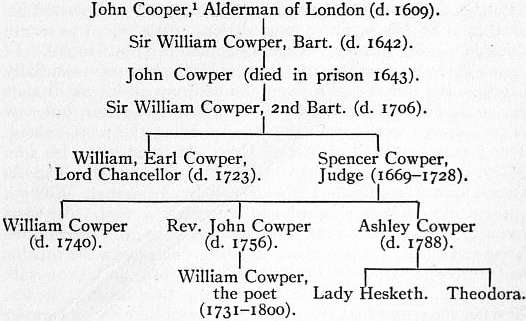
The Rev. John Cowper was twice married. Cowper’s mother, to whom the memorable lines were written beginning “Oh that these lips had language,” was his first wife. She died in 1737 at the age of thirty-four, when the poet was but six years old, and she is buried in Berkhampstead church. Cowper’s stepmother is buried in Bath, and a tablet on the walls of the cathedral commemorates her memory. The father, who appears to have been a conscientious clergyman with no special interest in his sons, died in 1756 and was buried in the Cowper tomb at Panshanger. Only one other of his seven children grew to manhood—John, who was born in 1737.
The poet appears to have attended a dame’s school in earliest infancy, but on his mother’s death, when he was six years old, he was sent to boarding-school, to a Dr Pitman at Markyate, a village 6 m. from Berkhampstead. From 1738 to 1741 he was placed in the care of an oculist, as he suffered from inflammation of the eyes. In the latter year he was sent to Westminster school, where he had Warren Hastings, Impey, Lloyd, Churchill and Colman for schoolfellows. It was at the Markyate school that he suffered the tyranny that he commemorated in Tirocinium. His days at Westminster, Southey thinks, were “probably the happiest in his life,” but a boy of nervous temperament is always unhappy at school. At the age of eighteen Cowper entered a solicitor’s office in Ely Place, Holborn. Here he had Thurlow, the future lord chancellor, as a fellow-clerk, and it is stated that Thurlow promised to help his less pushful comrade in the days of realized ambition. Three years in Ely Place were rendered happy by frequent visits to his uncle Ashley’s house in Southampton Row, where he fell deeply in love with his cousin Theodora Cowper. At twenty-one years of age he took chambers in the Middle Temple, where we first hear of the dejection of spirits that accompanied him periodically through manhood. He was called to the bar in 1754. In 1759 he removed to the Inner Temple and was made a commissioner of bankrupts. His devotion to his cousin, however, was a source of unhappiness. Her father, possibly influenced by Cowper’s melancholy tendencies, perhaps possessed by prejudices against the marriage of cousins, interposed, and the lovers were separated—as it turned out for ever. During three years he was a member of the Nonsense Club with his two schoolfellows from Westminster, Churchill and Lloyd, and he wrote sundry verses in magazines and translated two books of Voltaire’s Henriade. A crisis occurred in Cowper’s life when his cousin Major Cowper nominated him to a clerkship in the House of Lords. It involved a preliminary appearance at the bar of the house. The prospect drove him insane, and he attempted suicide; he purchased poison, he placed a penknife at his heart, but hesitated to apply either measure of self-destruction. He has told, in dramatic manner, of his more desperate endeavour to hang himself with a garter. Here he all but succeeded. His friends were informed, and he was sent to a private lunatic asylum at St Albans, where he remained for eighteen months under the charge of Dr Nathaniel Cotton, the author of Visions. Upon his recovery he removed to Huntingdon in order to be near his brother John, who was a fellow of St Benet’s College, Cambridge. John had visited his brother at St Albans and arranged this. An attempt to secure suitable lodgings nearer to Cambridge had been ineffectual. In June 1765 he reached Huntingdon, and his life here was essentially happy. His illness had broken him off from all his old friends save only his cousin Lady Hesketh, Theodora’s sister, but new acquaintances were made, the Unwins being the most valued. This family consisted of Morley Unwin (a clergyman), his wife Mary, and his son (William) and daughter (Susannah). The son struck up a warm friendship which his family shared. Cowper entered the circle as a boarder in November (1765). All went serenely until in July 1767 Morley Unwin was thrown from his horse and killed. A very short time before this event the Unwins had received a visit from the Rev. John Newton (q.v.), the curate of Olney in Buckinghamshire, with whom they became friends. Newton suggested that the widow and her children with Cowper should take up their abode in Olney. This was achieved in the closing months of 1767. Here Cowper was to reside for nineteen years, and he was to render the town and its neighbourhood memorable by his presence and by his poetry. His residence in the Market Place was converted into a Cowper Museum a hundred years after his death, in 1900. Here his life went on its placid course, interrupted only by the death of his brother in 1770, until 1773, when he became again deranged. It can scarcely be doubted that this second attack interrupted the contemplated marriage of Cowper with Mary Unwin, although Southey could find no evidence of the circumstance and Newton was not informed of it. J. C. Bailey brings final evidence of this (The Poems of Cowper, page 15). The fact was kept secret in later years in order to spare the feelings of Theodora Cowper, who thought that her cousin had remained as faithful as she had done to their early love.
It was not until 1776 that the poet’s mind cleared again. In 1779 he made his first appearance as an author by the Olney Hymns, written in conjunction with Newton, Cowper’s verses being indicated by a “C.” Mrs Unwin suggested secular verse, and Cowper wrote much, and in 1782 when he was fifty-one years old there appeared Poems of William Cowper of the Inner Temple, Esq.: London, Printed for J. Johnson, No. 72 St Paul’s Churchyard. The volume contained “Table Talk,” “The Progress of Error,” “Truth,” “Expostulation” and much else that survives to be read in our day by virtue of the poet’s finer work. This finer work was the outcome of his friendship with Lady Austen, a widow who, on a visit to her sister, the wife of the vicar of the neighbouring village of Clifton, made the acquaintance of Cowper and Mrs Unwin. The three became great friends. Lady Austen determined to give up her house in London and to settle in Olney. She suggested The Task and inspired John Gilpin and The Royal George. But in 1784 the friendship was at an end, doubtless through Mrs Unwin’s jealousy of Lady Austen. Cowper’s second volume appeared in 1785;—The Task: A Poem in Six Books. By William Cowper of the Inner Temple, Esq.; To which are added by the same author An Epistle to Joseph Hill, Esq., Tirocinium or a Review of Schools, and the History of John Gilpin: London, Printed for J. Johnson, No. 72 St Paul’s Church Yard; 1785. His first book had been a failure, one critic even declaring that “Mr Cowper was certainly a good, pious man, but without one spark of poetic fire.” This second book was an instantaneous success, and indeed marks an epoch in literary history. But before its publication—in 1784—the poet had commenced the translation of Homer. In 1786 his life at Olney was cheered by Lady Hesketh taking up a temporary residence there. The cousins met after an interval of twenty-three years, and Lady Hesketh was to be Cowper’s good angel to the end, even though her letters disclose a considerable impatience with Mrs Unwin. At the end of 1786 a removal was made to Weston Underwood, the neighbouring village which Cowper had frequently visited as the guest of his Roman Catholic friends the Throckmortons. This was to be his home for yet another ten years. Here he completed his translation of Homer, materially assisted by Mr Throckmorton’s chaplain Dr Gregson. There are six more months of insanity to record in 1787. In 1790, a year before the Homer was published, commenced his friendship with his cousin John Johnson, known to all biographers of the poet as “Johnny of Norfolk.” Johnson also aspired to be a poet, and visited his cousin armed with a manuscript. Cowper discouraged the poetry, but loved the writer, and the two became great friends. New friends were wanted, for in 1792 Mrs Unwin had a paralytic stroke, and henceforth she was a hopeless invalid. A new and valued friend of this period was Hayley, famous in his own day as a poet and in history for his association with Romney and Cowper. He was drawn to Cowper by the fact that both were contemplating an edition of “Milton,” Cowper having received a commission to edit, writing notes and translating the Latin and Italian poems. The work was never completed. In 1794 Cowper was again insane and his lifework was over. In the following year a removal took place into Norfolk under the loving care of John Johnson. Johnson took Cowper and Mary Unwin to North Tuddenham, thence to Mundesley, then to Dunham Lodge, near Swaffham, and finally in October 1796 they moved to East Dereham. In December of that year Mrs Unwin died. Cowper lingered on, dying on the 25th of April 1800. The poet is buried near Mrs Unwin in East Dereham church.
Cowper is among the poets who are epoch-makers. He brought a new spirit into English verse, and redeemed it from the artificiality and the rhetoric of many of his predecessors. With him began the “enthusiasm of humanity” that was afterwards to become so marked in the poetry of Burns and Shelley, Wordsworth and Byron. With him began the deep sympathy with nature, and love of animal life, which was to characterize so much of later poetry.
Although Cowper cannot rank among the world’s greatest poets or even among the most distinguished of poets of his own country, his place is a very high one. He had what is a rare quality among English poets, the gift of humour, which was very singularly absent from others who possessed many other of the higher qualities of the intellect. Certain of his poems, moreover,—for example, “To Mary,” “The Receipt of my Mother’s Portrait,” and the ballad “On the Loss of the Royal George,”—will, it may safely be affirmed, continue to be familiar to each successive generation in a way that pertains to few things in literature. Added to this, one may note Cowper’s distinction as a letter-writer. He ranks among the half-dozen greatest letter-writers in the English language, and he was perhaps the only great letter-writer with whom the felicity was due to the power of what he has seen rather than what he has read.
Bibliography.—The first important life of Cowper was by Hayley in 1803. In its complete form it appeared in 4 volumes in 1806 and was reprinted in 1809 and 1812. It was reprinted again by the Rev. T. S. Grimshawe with the Correspondence in 8 volumes in 1835. Robert Southey’s much more valuable Life and Letters appeared also in 15 volumes in 1834-1837. The Private Correspondence, edited by John Johnson, appeared in 2 volumes in 1824 and again in 1835. The Complete Correspondence, edited by Thomas Wright, was published in 1904, but more correspondence appeared in Notes and Queries, July, August and September 1904, and in The Poems of William Cowper, edited by J. C. Bailey (1905). Edward Dowden unearthed new correspondence with William Hayley in The Atlantic Monthly (1907). Short lives of Cowper have appeared in many quarters, from Thomas Taylor’s (1833) to Goldwin Smith’s in the “English Men of Letters” series (1880). Another brief biography of great merit is attached to the Globe edition of Cowper’s Works. Essays by Leslie Stephen, Stopford Brooke, Whitwell Elwin, George Eliot and Walter Bagehot deserve attention. See also St Beuve’s Causeries du Lundi (1868), vol. xi.; Letters of Lady Hesketh to John Johnson (1901); John Newton, by the Rev. Josiah Bull (1868); Cowper and Mary Unwin, by Caroline Gearey (1900); and A Concordance to the Poetic Works of William Cowper, by John Neave (1887).
(C. K. S.)
1 Alderman Cooper thus spelt his name and all the family from that day to this, including the poet, have so pronounced it.
COWRY, the popular name of the shells of the Cypraeida, a family of mollusks. Upwards of 100 species are recognized, and they are widely distributed over the world—their habitat being the shallow water along the sea-shore. The best known is the money cowry or Cypraea moneta, a small shell about half an inch in length, white and straw-coloured without and blue within, which derives its distinctive name from the fact that in various countries it has been employed as a kind of currency. (See Shell-money.) In Africa among those tribes, such as the Niam-Niam, who do not recognize their monetary value, the shells are in demand as fashionable decorations, just as in Germany they were in use as an ornament for horses’ harness, and were popular enough to acquire several native names, such as Brustharnisch or breastplates, and Otterköpfchen or little adders’ heads. Besides the Cypraea moneta various species are employed in this decorative use. The Cypraea aurora is a mark of chieftainship among the natives of the Friendly Islands; the Cypraea annulus is a favourite with the Asiatic islanders; and several of the larger kinds have been used in Europe for the carving of cameos. The tiger cowry, Cypraea tigris, so well known as a mantelpiece ornament in England and America, is commonly used by the natives of the Sandwich Islands to sink their nets; and they have also an ingenious plan of cementing portions of several shells into a smooth oval ball which they then employ as a bait to catch the cuttle-fish. While the species already mentioned occur in myriads in their respective habitats, the Cypraea princeps and the Cypraea umbilicata are extremely rare.
COW-TREE, or Milk-tree, Brosimum Galactodendron (natural order Moraceae), a native of Venezuela. As in other members of the order, the stem contains a milky latex, which flows out in considerable quantities when a notch is cut in it. The “milk” is sweet and pleasant tasting. Another species, B. Alicastrum, the bread-nut tree, a native of central America and Jamaica, bears a fruit which is cooked and eaten. The bread-fruit (Artocarpus) is an allied genus of the same natural order.
COX, DAVID (1783-1859), English painter, was born on the 29th of April 1783, in a small house attached to the forge of his father, a hardworking master smith, in a mean suburb of Birmingham. Turning his hand to what he could get to do, Joseph Cox, the father, was both blacksmith and whitesmith, and when the war with France began took to the making of bayonets and horse shoes, on wholesale commission, and immediately the boy David was thought able to assist he was taken from the poor elementary school in the neighbourhood, and set to the anvil. The attempt to turn the boy to this kind of labour had, however, been made too early; it was too heavy for his strength, and he was sent to what was called by the cyclops of Birmingham a “toy trade,” making lacquered buckles, painted lockets, tin snuff-boxes and other “fancy” articles. Here David very soon acquired some power of painting miniatures, and his talents might have been misdirected had his master, Fieldler by name, not released him from his apprenticeship by dying by his own hand; and David found an opening as colour-grinder and scene-painter’s fag in the theatre then leased, with several others, by the father of Macready, the tragedian.