VOLUME VII SLICE VI Coucy-le-Château to Crocodile (continued 13)
Reading edition
A glance at the table given above shows the high place occupied by Surrey in the past. Surrey county cricket can be traced as far back as 1730. Pycroft observes that “the name of Surrey as one united county club is quite lost in the annals of Surrey. cricket from 1817 to 1845.” But before that date two of the most celebrated cricketers, William Lillywhite and Fuller Pilch, had occasionally played for the county, and so also had James Broadbridge (1796-1843) and W. Lambert (1779-1851). Kennington Oval became the Surrey county ground in 1845, the property being leased from the duchy of Cornwall; and in the years immediately following the county team included H. H. Stephenson (1833-1896), Caffyn (b. 1828), N. Felix, and Lockyer (1826-1869); among a later generation appeared such well-remembered names as Jupp, Southerton, Pooley and R. Humphrey. After being champion county in 1873, Surrey did not again attain the same position for fourteen years, but for the next ten years maintained an almost uninterrupted supremacy. The greatest credit was due to the energetic direction of J. Shuter (b. 1855), who kept together a remarkable combination of cricketers, such as W. W. Read (1855-1906), Maurice Read (b. 1859), George Lohmann (1865-1901), and Robert Abel (b. 1859), all of whom were among the greatest players of their period. Lohmann in 1885-1890 would alone have made any side famous; and in the same years when he was heading the bowling averages and proving himself the most deadly bowler in the country, W. W. Read was performing prodigies of batting. No sooner did the latter begin to decline in power than Abel took his place at the head of the batting averages, scoring with astonishing consistency in 1897-1900. In 1899 he made 357 not out in an innings against Somersetshire, and in 1901 his aggregate of 3309 was the largest then compiled. The Oxonian K. J. Key was another famous batsman whose services as captain were also exceedingly valuable to the county. An almost inexhaustible supply of professionals of the very highest class has been at Surrey’s service. W. Lockwood (b. 1868) became almost as deadly a bowler as Lohmann, and Tom Richardson (b. 1870) was the terror of all Surrey’s opponents for several seasons after 1893. Richardson took in all no less than 1340 wickets at the cost of 20,000 runs. Tom Hayward (b. 1867), nephew of the renowned Cambridge professional of the same name, succeeded Abel as the leading Surrey batsman, his play in the test matches of 1899, when he averaged 65, being superb. During the following years his reputation was fully maintained, and in 1906 he had a particularly successful season. Key was followed in the captaincy by D. L. A. Jephson, but the county did not in the opening years of the 20th century maintain the high place it occupied during the last quarter of the 19th. It possessed some excellent professionals, however, in Hayes, Hobbs and Lees, and the season of 1906, under the captaincy of Lord Dalmeny, showed a revival, a new fast bowler being found in N. A. Knox, and a fine batsman and bowler in J. N. Crawford.
Several of the celebrated cricketers of early times already mentioned as having played for the Surrey club were more closely associated with the adjoining county of Sussex, whose records go back as far as 1734, in which year a match was Sussex. played against Kent, the chief promoters of which were the duke of Richmond and Sir William Gage. One of the earliest famous cricketers, Richard Newland (d. 1791), was a Sussex man; and James Broadbridge, W. Lambert, Tom Box, and the great Lillywhite family were all members of the Sussex county team. Lambert, in a match against Epsom, played at Lord’s in 1817, made a “century” (one hundred runs) in each innings, a feat not repeated in first-class cricket for fifty years; and the occasion was the first when the aggregate of a thousand runs was scored in a match. Broadbridge played for Sussex in five reigns, while Box (1808-1876) kept wicket for the county for twenty-four years without missing a match. Notwithstanding this distinguished history, Sussex never attained the highest place in the county rivalry, and for a number of years towards the end of the 19th century the left-handed batting of F. M. Lucas (1860-1887) alone saved the county from complete insignificance. A revival came when W. L. Murdoch (b. 1855), of Australian celebrity, qualified for Sussex; and at a still later date the fortunes of the county were raised by the inclusion in its eleven of Kumar Shri Ranjitsinhji, afterwards H.H. the Jam of Nawanagar (b. 1872), the Indian prince, who had played for Cambridge University. Ranjitsinhji’s dexterity, grace and style were unrivalled. He scored 2780 runs in 1896, averaging 57, while in county matches in 1899 his aggregate was 2555, with an average of 75. Even this performance was beaten in 1900 when he scored a total of 2563 runs, giving an average for the season of 83. In all matches his aggregates were 3159 in 1899, and 3065 in 1900. Not less remarkable was the cricket of C. B. Fry (b. 1872), who came from Oxford University to become a mainstay of Sussex cricket, and who in 1901 performed the unparalleled feat of scoring in successive innings 106, 209, 149, 105, 140 and 105, his aggregate for the season being 3147 with an average of 78. In 1905 his average for Sussex was 86, but in the following year an accident kept him out of the cricket field throughout the season; and in 1909 he transferred his services to Hampshire.
If Kent and Middlesex may be described as the counties of amateurs, Yorkshire and Nottinghamshire should be called the counties of famous professionals. Between 1864 and 1889 Nottinghamshire was champion county twelve times Notts. and the county eleven was as a rule composed almost entirely of professional players, among whom have been many of the greatest names in the history of the game. Richard Daft (1835-1900), after playing as an amateur, became a professional in preference to abandoning the game, scorning to resort to any of the pretexts by which cricketers have been known to accept payment for their services while continuing to cling to the status of the amateur. William Oscroft (1843-1905) was one of Nottinghamshire’s early batting heroes, and in Alfred Shaw (b. 1842) and F. Morley (1850-1884) the county possessed an invaluable pair of bowlers. William Gunn (b. 1858), besides being a magnificent fielder “in the country,” was an exceptionally able batsman; but his performances did not equal those of his greater contemporary, Arthur Shrewsbury, who in six years between 1885 and 1892 headed the English batting averages. Shrewsbury’s perfect style combined with inexhaustible patience placed him in the front rank of the “classical” batsmen of English cricket. Of the batsmen nicknamed “stonewallers,” who at one time endangered the popularity of first-class cricket, was W. Scotton (1856-1893); and among the other numerous professionals whose cricket contributed to the renown of Nottinghamshire were Barnes (1852-1899), at times a most formidable bat; Flowers (b. 1856), always useful both with the bat and the ball; W. Attewell (b. 1861), a remarkably steady bowler who bowled an abnormal number of maiden overs; Mordecai Sherwin (b. 1851), an excellent successor to T. Plumb (b. 1833) and F. Wild (1847-1893) as wicket-keeper for the county; and among more recent players, J. Iremonger (b. 1877) and John Gunn, both of whom proved themselves cricketers worthy of the Notts traditions. J. A. Dixon (b. 1861), one of the few amateurs of the Nottinghamshire records, was for some time captain of the county team; and he was succeeded by A. O. Jones (b. 1873), a dashing batsman, who in 1899 was partner with Shrewsbury when the pair scored 391 for the first wicket in a match against Gloucestershire.
The history of Yorkshire cricket is modern in comparison with that of Surrey, Sussex or Kent. The county club only dates from 1861, and for some years the team was composed entirely of professionals. But though Yorkshire attained the Yorkshire. championship three times during the first ten years of the county club’s existence, thirteen years elapsed after 1870 before it again occupied the place of honour. In the ten years 1896-1906 Yorkshire was no less than six times at the head of the list, this position of supremacy being in no small measure due to the captaincy of Lord Hawke (b. 1860), who played continuously for the county from his university days for more than twenty years, and whose influence on Yorkshire cricket was unique. But before his time Yorkshire had already produced some notable cricketers, such as George Ulyett (1857-1898), who headed the batting averages in 1878, and who was also a fine fast bowler; Louis Hall (b. 1852), a patient bat; and another excellent scorer, Ephraim Lockwood (b. 1845). William Bates (1855-1900), too, was effective both as batsman and bowler; and Tom Emmett (1841-1904), long proverbial for bowling “a wide and a wicket,” was deservedly popular. To the earlier period belonged two fast bowlers, George Freeman (1844-1895) and Allan Hill (b. 1845), and the eminent wicket-keeper Pincher (1841-1903), who was succeeded by J. Hunter (1857-1891), and later by his brother Daniel Hunter (b. 1862). The full effect of Lord Hawke’s energetic captaincy was seen in 1900, when Yorkshire played through a programme of twenty-eight fixtures without sustaining a defeat; and the county’s record was but little inferior in both the following years and again in 1905, in each of which years it retained the championship. It was during this period that as notable a group of cricketers wore the Yorkshire colours as ever appeared in county matches. Edmund Peate (1856-1900), one of the finest bowlers in his day, did not survive to take part in the later triumphs of his county; but the period beginning in 1890 saw J. T. Brown, J. Tunnicliffe, R. Peel, W. Rhodes, George Hirst and the Hon. F. S. Jackson in the field. The two first named became famous for their first wicket partnerships. In 1896 in a match against Middlesex at Lord’s these two batsmen scored 139 before being separated in the first innings, and in the second knocked off the 147 required to win the match. In the following year they made 378 for the first wicket against Surrey, and during their careers they scored over a hundred for the first wicket on no less than fifteen occasions, the greatest feat of all being in 1898, when they beat the world’s record by staying together till 554 runs had been compiled. Peel was for many years an untiring bowler, and Yorkshire was fortunate in discovering a successor of even superior skill in Wilfrid Rhodes, who in 1900 took over 200 wickets at a cost of 12 runs each in county matches alone, and was also an excellent bat. Hirst and Jackson were the two finest all-round cricketers in England about 1905. The Hon. F. S. Jackson (b. 1870), like his fellow-Harrovian A. C. MacLaren, had a wonderful record in test matches against Australia; he captained the England eleven in 1905, and his wonderful nerve enabled him to extricate his side when in a difficulty, and to render his best service at an emergency. Hirst (b. 1871) in 1904 and in 1905 scored over 2000 runs and took more than 100 wickets; and in 1906 he surpassed all previous records by scoring over 2000 runs and taking over 200 wickets during the season. A concourse of 78,000 people watched his “benefit” match (Yorkshire against Lancashire) in August 1904. Besides cricketers like these, such fine players were included in the team as Wainwright (b. 1865), Haigh (b. 1871), Denton (b. 1874), and E. Smith (b. 1869); with such material the Yorkshire eleven had no “tail,” and was able to win the championship six times in a decade.
Somersetshire hardly fulfilled the promise held out by the success achieved in the closing decade of the 19th century; this had been largely owing to the captaincy and brilliant batting of H. T. Hewett (b. 1864), who in partnership with L. C. H. Somersetshire. Palairet (b. 1870), famous for his polished style, scored 346 for the first wicket in a match against Yorkshire in 1892. Hewett was succeeded in the command of the county eleven by the Cambridge fast bowler, S. M. J. Woods (b. 1868); and among other members of the eleven the most valuable was L. C. Braund (b. 1876), a professional who excelled as an all-round cricketer.
The counties above referred to are those which have figured most prominently in the history of county cricket. Individual players of the highest excellence are, however, to be found from time to time in all parts of the country. Warwickshire, for Minor counties. example, can boast of having had in A. A. Lilley (b. 1867) the best wicket-keeper of his day, who represented England against Australia in the test matches; while Worcestershire produced one of the best all-round professionals in the country for a number of years in Arnold (b. 1877), and a batsman of extreme brilliancy in R. E. Foster, a member of a cricketing family to whom belongs the credit of raising Worcestershire into a cricketing county of the first class. Derbyshire, similarly, can claim some well-known cricket names, the bowler W. Mycroft (1841-1894), W. Chatterton (b. 1863), and W. Storer (b. 1868), a first-class wicket-keeper. Essex possesses at Leyton one of the best county grounds in the country, and the club was helped over financial difficulties by the munificent support of an old Uppingham and Cambridge cricketer, C. E. Green. It has produced a fair number of excellent players, notably the batsmen P. Perrin, C. MacGahey, and the fast bowler C. J. Kortright; and A. P. Lucas, afterwards a member of the county club, was a famous cricketer who played for England in 1880 in the first Australian test match. Hampshire had a fine batsman in Captain E. G. Wynyard, and its annals are conspicuous for the phenomenal scores made during the single season of 1899 by Major R. M. Poore; these two put together 411 against Somersetshire in that year before being separated. Among the later Hants professionals, Llewellyn was most prominent.
The distribution of cricketing ability in England might be the subject of some interesting speculation. In the first forty years of the annual competition for the championship six counties alone gained the coveted distinction, and three of these, Surrey, Notts and Yorkshire, won it thirty-four times between them. Why, it may be asked, is it that one county excels in the game while another has no place whatever in the history of cricket? How comes it that great names recur continually in the annals of Surrey and Yorkshire, for example, while those of Berkshire and Lincolnshire are entirely barren? No doubt proximity to great centres of population favours the cultivation of the game, but in this respect Kent and Sussex are no better situated than Hertfordshire, nor does it account for Nottinghamshire having so illustrious a record while Staffordshire has none at all, nor for Somersetshire having outclassed Devon. It is strange, moreover, that while the universities are the chief training-grounds for amateur cricketers, neither Oxfordshire nor Cambridgeshire has made any mark among the counties. The influence of individuals and families, such as the Graces in Gloucestershire, the Walkers in Middlesex, and in recent times the Fosters in Worcestershire, has of course been of inestimable benefit to cricket in those counties; but Buckinghamshire and Norfolk and Cheshire send their sons to the public schools and universities no less than Lancashire or Kent. It is difficult, therefore, to understand why county cricket should so persistently confine itself to a small number of counties; but such is the fact.
Cricket has never flourished vigorously in Scotland, Ireland or Wales, a fact that may partly be accounted for by the comparative difficulty of obtaining good grounds in those parts of the kingdom, and by the inferiority, for the purpose of cricket, of their climate. In the south of Scotland, and especially in the neighbourhood of Edinburgh, there are clubs which keep the game alive; and Scotland, though it has produced no great cricketers, either amateur or professional, has sent a few players to the English university elevens who have found places in English county teams. In Ireland cricket is fairly popular, especially in those parts of the island where local sides can obtain assistance from soldiers quartered in the neighbourhood. One or two counties play annual matches, that between Kildare and Cork in particular exciting keen rivalry. Trinity College, Dublin, has turned out some excellent players; and the Phoenix and Leinster clubs in Dublin, and the North of Ireland club in Belfast, play a full programme of matches every season. D. N. Trotter, who played for county Meath for many years towards the close of the 19th century, was a batsman who would have found a place in any English county eleven; so also would William Hone, one of several brothers all of whom were keen and skilful cricketers. About the same period Lieutenant Dunn scored so many centuries in Irish cricket that he was played, though without any great success, for his native county of Surrey. More recently L. H. Gwynn (1873-1902) batted in a style and with a success that proved him capable of great things. Sir T. C. O’Brien, though an Irishman, belongs as a cricketer to Middlesex; but T. C. Ross, who was chosen to play for Gentlemen v. Players at Lord’s in 1902, was a bowler who played regularly for county Kildare.
Gentlemen v. Players.—The most important match of the year as far as purely English cricket is concerned is the match between the gentlemen and players (amateurs and professionals) played at Lord’s. For many years a match played between sides similarly composed at the Oval excited equal interest, but latterly county cricket has rather starved this particular game, though it still continues as a popular fixture. Other matches with the same title have been played in London on Prince’s Ground (now built over), and at Brighton, Hastings and Scarborough and elsewhere, but those games in no way rank with the London matches.
The Lord’s fixture was first established in 1806, in which year two matches were played; it became annual in 1819, but in those days the amateurs, being no match for their opponents, generally received odds, while in 1832 they defended wickets 22 in. by 6, and in 1837 the professionals stood in front of wickets of four stumps, measuring in all 36 in. by 12 in. This match was known as “The Barndoor Match” or “Ward’s Folly,” and the professionals won by an innings and 10 runs. Odds were not given after 1838, the gentlemen having then won eight matches and lost thirteen. From 1839 to 1866 the gentlemen only won 7 matches as compared with 21 losses. In 1867 the tide turned, for the brothers Grace, especially Dr W. G. Grace, became a power in the cricket-field, and from 1867 to 1884 the gentlemen, winning fifteen matches, only lost one. From 1885 the balance swung round, and by 1903 the professionals had won eleven matches and lost but four. The gentlemen won on nine successive occasions between 1874 and 1884, a draw intervening; while beginning with 1854 the professionals won eleven matches “off the reel.” The professionals won in 1860 by an innings and no less than 181 runs; in 1900 they only won by two wickets, but to do so had to make, and did make, 501 runs in the last innings of the match. In 1903 the gentlemen, heavily in arrears after each side had played an innings, actually scored 500 in their second innings with only two men out. In 1904 the gentlemen won by two wickets after being 156 runs behind on the first innings, thanks to fine play by K. S. Ranjitsinhji and A. O. Jones. J. H. King had scored a century in each innings, a feat previously only performed by R. E. Foster in 1900. C. B. Fry’s 232 not out in 1903 was the largest innings scored in the match. Dr W. G. Grace, who is credited with eight centuries, is the only cricketer who exceeded the hundred more than twice at Lord’s in the fixture, 164 by J. T. Brown being the highest innings by a professional. There were seven instances before 1864 of two bowlers being unchanged in the match, and the Hon. F. S. Jackson and S. M. J. Woods repeated this in 1894. The Oval match was first played in 1857. The amateurs effected their first win in 1866, and though several games were drawn the professionals did not win again till 1880. As at Lord’s, it was the era of Grace, but from this point the amateurs could only win two matches, and by the narrowest of margins, till 1903, this making their sum of victories up to then thirteen, as opposed to twenty-three. In 1879 the gentlemen won in one innings by 126 runs, the heaviest beating that one side had inflicted on the other. The highest individual score was Robert Abel’s 247, and the next Dr W. G. Grace’s 215. Hayward scored 203 in 1904; A. G. Steel and A. H. Evans bowled unchanged in 1879.
School and Club Cricket.—Cricket is the standing summer game at every English private and public school, where it is taught as carefully and systematically as either classics or mathematics. There are also numbers of amateur clubs which possess no grounds of their own and are connected with no particular locality, but which are in fact mere associations of cricketers who play matches against the universities, schools or local teams, or against each other. Of these the best known, perhaps, is I Zingari (The Wanderers), popularly known as I.Z., whose well-known colours, red, yellow and black stripes, are prized rather as a social than as a cricketing distinction. This club was founded in 1845 by Lorraine Baldwin and Sir Spencer Ponsonby-Fane. The first rule of the club humorously declares that “the entrance fee shall be nothing, and the annual subscription shall not exceed the entrance fee.” It is a rule of the club that no member shall play on the opposing side. I.Z. has long been connected with the social festivities forming a feature of the “Canterbury Week,” a cricket festival held at Canterbury during the first week in August, of the Scarborough week, and of the Dublin horse-show. Dr W. G. Grace, who almost invariably appeared in the cricket field wearing the red and yellow stripes of the M.C.C., and some other notable amateurs, never belonged to I.Z. or any similar club; but Dr Grace was instrumental in the formation of the London county club, whose ground was at the Crystal Palace at Sydenham. Other amateur clubs, similar to I Zingari, are the Free Foresters, Incogniti, Etceteras, and in Ireland Na Shuler; while the Eton Ramblers, Harrow Wanderers, Old Wykehamists, and others are clubs whose membership is restricted to “old boys.”
The Oxford and Cambridge universities match was first played in 1827, but was not an annual fixture till 1838. Five matches, those of 1829, 1843, 1846, 1848 and 1850, were played at Oxford, the rest at Lord’s. The “’Varsity match,” and that between the two great public schools, Eton and Harrow, are great “society” events at Lord’s every summer. Up to 1909 Eton won thirty times, and Harrow on thirty-five occasions. D. C. Boles by scoring 183 in 1904 set up a new record for this match, beating the 152 obtained in 1841 by Emilius Bayley (afterwards the Rev. Sir John Robert Laurie); and in 1907 the Harrow captain, M. C. Bird, established a further record by scoring over a hundred runs in each innings. Of the contests between Oxford and Cambridge, the latter (up to 1909) had lost thirty-one and won thirty-five. Oxford’s 503 in 1900 and Cambridge’s 392 in the same match furnished the highest aggregates. The largest individual innings was 172 not out by J. F. Marsh in 1904; but as a feat of batting it was intrinsically inferior to the 171 by R. E. Foster in 1900. Of the thirty centuries scored up to 1909, Oxford was credited with sixteen. Eustace Crawley (b. 1868) made a hundred both in the Eton v. Harrow and Oxford v. Cambridge matches. In the match of 1870 F. C. Cobden (b. 1849) took the last three Oxford wickets with consecutive balls, winning the match for Cambridge by 2 runs.
Australian Cricket.—Naturally popular in a British colony, cricket made but little progress in Australia before the arrival of an English professional eleven in 1861-1862, which carried all before it. Subsequent visits, and the coaching of imported professionals, so promoted the game that in 1878 a representative eleven of Australians visited England. The visits were repeated biennially till 1890, and then triennially. The visits of the Australian teams to England aroused unparalleled interest and acted as an immense incentive to the game. A great sensation was caused when the first team, captained by D. W. Gregory, on the 27th of May 1878, defeated a powerful M.C.C. eleven in a single day, disposing of them for 33 and 19, the fast bowler F. R. Spofforth (b. 1853) taking 6 wickets for 4 runs, and H. F. Boyle (b. 1847) 5 for 3. Their prowess was well maintained when in September 1880 Australia for the first time met the whole strength of England, such matches between representatives of Australia and England being known as “test matches,” a term that was applied later to matches between England and South Africans also. Although in 1880 the old country won by 5 wickets, the honours were fairly divided, especially as Spofforth could not play. Dr W. G. Grace with a score of 152 headed the total of 420, but even finer was the Australian captain W. L. Murdoch’s imperturbable display, when he carried his bat for 153. From 1882 onwards the Colonials, with two exceptions, at Blackpool and Skegness, only played eleven-a-side matches. Such bowlers as Spofforth, Boyle, G. E. Palmer (b. 1861), T. W. Garrett (b. 1858), and G. Giffen (1859) became household names. Nor was the batting less admirable, for Murdoch was supported by H. H. Massie (b. 1854), P. S. McDonnell (1860-1896), A. C. Bannerman (b. 1859), T. Horan (b. 1855), C. J. Bonnor (b. 1855), and S. P. Jones (b. 1861), whilst the wicket-keeper was McCarthy Blackham (b. 1855). This visiting side in 1882 was the greatest team of all; 23 matches were won, only 4 lost, and England was defeated at the Oval by 7 runs. In 1884 English cricket had improved, and the visiting record was hardly so good. The match against England at the Oval will not soon be forgotten. The Colonials scored 551 (Murdoch 211, McDonnell 103, Scott 102), and England responded with 346, Scotton and W. W. Read adding 151 for the ninth wicket.
The team of H. J. H. Scott (b. 1858) in 1886 proved less successful, for all three test matches were lost, and eight defeats had to be set against nine victories, but Giffen covered himself with distinction. This was the first tour under the auspices of the Melbourne Club. McDonnell’s team in 1888 marked the appearance of the bowlers C. T. B. Turner (b. 1862) and J. J. Ferris (1867-1900). The former took 314 wickets for 11 runs each, and the latter 220 for 14 apiece. To all appearance they redeemed a poor tour, 19 matches being won and 14 lost. The 1890 tour, though Murdoch reappeared as captain, proved disappointing, both the test matches being lost and defeats for the first time exceeding victories, though the two bowlers again performed marvellously well. After an interval of three years, M. Blackham captained the seventh team, which was moderately fortunate. H. Graham (b. 1870) and S. E. Gregory (b. 1870) batted admirably, and the 149 of J. J. Lyons (b. 1863) in the match against M.C.C. was an extraordinary display of punishing cricket. In 1896, though they did not win the rubber of test matches, the colonials were most successful, 19 matches being victories and only 6 lost. S. E. Gregory, J. Darling (b. 1870), F. A. Iredale (b. 1867), G. Giffen, C. Hill (b. 1877), and G. H. S. Trott (1866-1905) were the best bats, and the last-named made an admirable captain. H. Trumble (1867) kept an excellent length, and E. Jones (1869) was deadly with his fast bowling.
The Australian representatives in 1899 demonstrated that they were the best since 1882, 16 successes and only 3 defeats (v. Essex, Surrey and Kent) being emphasized by a victory over England at Lord’s by 10 wickets, the only one of the five test matches brought to a conclusion. M. A. Noble (b. 1873) and Victor Trumper (b. 1877), both newcomers, batted superbly. The latter, v. Sussex, made 300, the largest individual score hitherto made by an Australian in England, the previous best having been 286 by Murdoch in the corresponding match in 1882. H. Trumble scored 1183 runs and took 142 wickets for 18 runs apiece, and Darling not only made a judicious captain, but scored the biggest aggregate, 1941, up to then obtained by any batsman touring with a colonial eleven in England. On the home side, Hayward did sound service with the bat, and his stand with F. S. Jackson in the fifth test match yielded 185 runs for the first wicket.
In 1902 another fine Australian eleven, captained by Darling, won 23 and lost only 2 matches. They won the rubber of test matches at Manchester by 3 runs, but lost the final at the Oval by one wicket after an even more remarkable struggle, G. L. Jessop having scored 104 in an hour and a quarter. The other defeat was by Yorkshire by 5 wickets, when they were dismissed for 23 by Hirst and Jackson. The rest of the tour was characterized by brilliant batting. The performance of Trumper in making 2570 runs (with an average of 48) surpassed anything previously seen; R. A. Duff (b. 1878) also proved a brilliant run-getter. W. W. Armstrong (b. 1879) was useful in all departments, and J. V. Saunders (b. 1876) proved a successful left-handed bowler.
In 1905 there was a marked falling-off, as England won two and drew the other three test matches; but only one other defeat, by Essex by 19 runs, had to be set against 16 Australian victories. The persistent bowling off the wicket by Armstrong, and the inability to finish games within three days, were the chief drawbacks. Armstrong eclipsed all previous colonial records in England by heading both tables of averages, scoring 2002 (average 48) and taking 130 wickets at a cost of 17 runs each. He also compiled the largest individual score (303 not out v. Somerset) ever made on an Australian tour. M. A. Noble also exceeded 2000 runs. For a long time the fast bowler, A. Cotter (b. 1882, N.S.W.), failed, but eventually “came off,” just as F. Laver (b. 1869), who had taken many wickets in the earlier part of the tour, was becoming less formidable. Duff saved the colonials by a great innings in the fifth test match; Trumper was less certain than formerly, and Clement Hill more reckless; whilst J. J. Kelly (b. 1867) on his fifth tour was better than ever before with the gloves.
The Australians who visited England under the leadership of M. A. Noble in 1909 were generally held to be a weaker team than most of their predecessors, but they greatly improved as the season advanced, proving that the side included several cricketers of the highest merit, and as a captain Noble has seldom been surpassed in consummate generalship. Their record of thirteen wins to four defeats offered little evidence of inferiority, while the large number of twenty-one drawn matches was accounted for by the cold wet weather that largely prevailed throughout the summer. Two out of the five test matches were unfinished, and Australia won the rubber by two matches to one. In all the test matches England was under the command of A. C. MacLaren, but the great Harrovian was no longer the batsman he had been some years earlier; Jackson had abandoned first-class cricket; Hirst and Hayward were becoming veterans; and, speaking generally, the English batting was decidedly inferior, and it collapsed feebly in three of the test matches. England’s failure, for which poor fielding and missed catches were also responsible, was the more disappointing since they began well by winning the first test match at Birmingham by ten wickets. C. B. Fry and Hobbs knocking off the 105 runs required to win in the second innings without the loss of a wicket. In the third test match, at Leeds, England was deprived of the services of Hayward and Blythe through illness, and an accident to Jessop during the match compelled the side to play a man short. It was in bowling that the Australians were thought to be least strong; but Laver’s analysis in the Manchester test match, when he took 8 wickets for 31 runs in England’s first innings, was the most notable feature of the match; and although his record at the head of the bowling averages for the tour, 70 wickets at an average cost of 14.9 runs, had frequently been beaten in earlier Australian tours in England, it proved him a worthy successor of Spofforth, Boyle and Turner. Armstrong, although he did not equal his record of 1905, again scored over 1000 runs and took over 100 wickets, his exact figures being 1439 runs and 120 wickets. The most remarkable Australian batting was that of two young left-handed players who on this occasion visited England for the first time, W. Bardsley (b. 1884) and Vernon Ransford (b. 1885), the latter of whom headed the averages both for test matches (58.8) and for the whole tour (45.5), his principal achievement being an innings of 143 not out in the test match at Lord’s. Bardsley, who was second in the test matches averages (39.6), fell into the third place slightly below Armstrong in the averages for the tour; but he alone scored over 200 in an innings, which he accomplished twice, and over 2000 in aggregate for the tour, and he established a test match “record” by scoring 136 and 130 in the match at the Oval. Of the twenty-two “centuries” scored by Australians during the season Bardsley and Ransford each made six. Trumper and Noble each scored over a thousand runs, and Macartney was an invaluable member of the side both in batting and bowling. As a wicket-keeper Carter worthily filled the place of Kelly, and the fielding of the Colonials fully maintained the brilliant Australian standard of former years.
The following “records” of Australian cricket in England up to 1909 are of interest:—Highest total by an Australian team: 843 v. Past and Present of Oxford and Cambridge Universities in 1893. Highest total against an Australian team: 576 by England at the Oval in 1899. Lowest total by an Australian team: 18 v. M.C.C. in 1896. Lowest total against an Australian team: 17 by Gloucestershire in 1896. Highest individual Australian score in one innings: 303 not out by W. W. Armstrong v. Somersetshire in 1905. Highest individual Australian aggregate in a tour: 2570 by V. T. Trumper in 1902. Two centuries in a match: V. T. Trumper 109 and 119 v. Essex in 1902; W. Bardsley 136 and 130 v. England in 1909 (test match record).
The following table shows the Australians who headed the batting and bowling averages respectively in tours in England up to 1909.
Batting.
Year. Inn. Not out. Runs. Most. Aver.
1878 C. Bannerman, N.S.W. 31 1 723 133 24.10
1880 W. L. Murdoch, N.S.W. 19 1 465 *153 25.80
1882 W. L. Murdoch, N.S.W. 61 5 1711 *286 30.50
1884 W. L. Murdoch, N.S.W. 50 5 1378 211 30.60
1886 G. Giffen, S.A. 63 9 1453 119 26.90
1888 P. M‘Donnell, V. 62 1 1393 105 22.50
1890 W. L. Murdoch, N.S.W. 64 2 1459 *158 23.33
1893 H. Graham, V. 55 3 1492 219 28.36
1896 S. E. Gregory, N.S.W. 48 2 1464 154 31.38
1899 J. Darling, S.A. 56 9 1941 167 41.29
1902 V. T. Trumper, N.S.W. 53 0 2570 128 48.49
1905 W. W. Armstrong, V. 48 7 2002 *303 48.82
1909 V. S. Ransford 43 4 1778 190 45.58
* Not out.
Bowling.
Year. O. M. R. W. Aver.
1878 T. W. Garrett, N.S.W. 296.2 144 394 38 10.30
1880 F. R. Spofforth, N.S.W. 240.8 82 396 46 8.60
1882 H. F. Boyle, V. 1200.14 525 1680 144 11.60
1884 F. R. Spofforth, N.S.W. 1544.32 649 2642 216 12.20
1886 G. Giffen, S.A. 1693.26 722 2711 159 17.05
1888 C. T. B. Turner, N.S.W. 2589.3 1222 3492 314 11.38
1890 C. T. B. Turner, N.S.W. 1651.1 724 2725 215 12.45
1893 C. T. B. Turner, N.S.W. 1148 450 2202 160 13.12
1896 T. R. M‘Kibbin, N.S.W. 647.1 198 1441 101 14.27
1899 H. Trumble, V. 1249.1 431 2618 142 18.43
1902 H. Trumble, V. 948 305 1998 140 14.27
1905 W. W. Armstrong, V. 1027 308 2288 130 17.60
1909 F. Laver 495.5 161 1048 70 14.97
The first English team to visit Australia was organized in 1862, and was captained by H. H. Stephenson. George Parr (1826-1891) took out the next in 1864, Dr E. M. Grace being the only amateur. In 1873 the Melbourne Club invited Dr W. G. Grace to take out an eleven, and three years later James Lillywhite conducted a team of professionals. On this tour for the first time colonials contended on equal terms, one match v. Australia being won by 4 wickets and the other lost by 45 runs. Lord Harris in the autumn of 1878 took a team of amateurs assisted by Ulyett and Emmett, winning 2 and losing 3 eleven-a-side encounters, Emmett’s 137 wickets averaging 8 runs each. Shaw, Shrewsbury and Lillywhite jointly organized the expedition of 1881, when Australia won the second test match by 5 wickets. The Hon. Ivo Bligh (afterwards Lord Darnley) in 1882 took a fine team, which was crippled owing to an injury sustained by the bowler F. Morley. Four victories could be set against three defeats; Australia winning the only test match, owing to the batting of Blackham. Shaw’s second tour in 1884 showed Barnes heading both batting and bowling averages, while six victories counterbalanced two defeats. In the third tour Shrewsbury became captain, but the English for the first time encountered the bowling of C. T. B. Turner, who took 27 wickets for 113 runs in two matches. Australia was twice defeated, the English captain batting in fine form. On this tour was played the Smokers v. Non-Smokers, when the latter scored 803 for 9 wickets (Shrewsbury 236, W. Bruce 131, Gunn 150), against the bowling of Briggs, Boyle, Lohmann, Palmer and Flowers. The winter of 1887 saw two English teams in Australia, one under Lord Hawke and G. F. Vernon, the other under Shrewsbury and Lillywhite. Both teams played well, the batting being headed by W. W. Read with an average of 65, and Shrewsbury with 58. The ill-success of Lord Sheffield’s team in two out of three test matches did not disprove the great merits of his eleven. Dr W. G. Grace headed the averages with 44, and received the best support from Abel and A. E. Stoddart, whilst Attewell, Briggs and Lohmann all possessed fine bowling figures. A. E. Stoddart’s first team (in 1894) achieved immense success and was the best of all. In the first test match they went in against 586 runs and ultimately won by 10 runs, Ward making 75 and 117. Stoddart himself averaged 51, scoring 173 in the second test match, and A. C. MacLaren (who made 228 v. Victoria), Brown and Ward all averaged over 40. The last tour conducted by Stoddart proved less satisfactory, four of the five test matches being lost, and some friction being caused by various incidents. K. S. Ranjitsinhji, who averaged 60 and made 175 in a test match and 189 v. South Australia, and A. C. MacLaren, who scored five hundreds and averaged 54, were prominent, Hayward also doing good work; but the bowling broke down. Weakness in bowling was the cause of the ill success of A. C. MacLaren’s side in 1901. After a brilliant victory by an innings and 124 runs at Sydney, the other four test matches were all lost. MacLaren himself batted magnificently, and so did Hayward and Tyldesley. Braund stood alone as an all-round man. The M.C.C. in 1903 officially despatched a powerful side led by P. F. Warner, and in every sense except the financial the success was complete. Three test matches were won and two lost, while two new records were set up, one by Rhodes obtaining 15 wickets at Melbourne, the other by R. E. Foster, who in seven hours of brilliant batting compiled 287. Tyldesley and Hayward both did good work as batsmen; Rhodes and Braund both bowled consistently. The catch-phrase about “bringing back the ashes” became almost proverbial; its origin is to be found in the Sporting Times in 1882 after Australia had defeated England at the Oval.
New Zealand.—Although cricket has not attained a degree of perfection in New Zealand commensurate with that in Australia, it is keenly played. Lord Hawke sent out from England a team in 1902-1903 which won all the eighteen matches arranged.
Cricket in India.—Not only the English who live in India, but the natives also—Parsees, Hindus and Mahommedans alike—play cricket. A Parsee eleven visited England in 1884 and 1888.
South Africa.—South African cricketers visiting England are handicapped by playing on turf instead of on the matting wickets used in South Africa. The side which came over during the Boer War in 1901 won 13, lost 9, and drew 2 matches, playing a tie with Worcestershire, and showing marked improvement on the team which had visited England in 1894. E. A. Halliwell (b. 1864) proved a fine wicket-keeper, J. H. Sinclair (b. 1876) a good all-round cricketer, J. J. Kotze (b. 1879) a very fast bowler, and G. A. Rowe (b. 1872) clever with the ball. In 1904 more decided success was achieved, for on a more ambitious programme ten victories could be set against two defeats by Worcestershire and Kent, with a tie with Middlesex. The most important success was a victory by 189 runs over a powerful England eleven at Lord’s, when R. O. Schwarz (b. 1875) scored 102 and 26, and took 8 wickets for 106, dismissing Ranjitsinhji twice. Kotze and Sinclair again bore the brunt of the attack. Of the English teams visiting South Africa, that taken by Lord Hawke in 1894 did not meet with such important opposition as the one he led in 1900, yet the side came back undefeated, having won all three test matches. P. F. Warner and F. Mitchell, with Tyldesley, were the chief run-getters, Haigh, Trott and Cuttell bowling finely. In the winter of 1905 the M.C.C. sent out a side under P. F. Warner, but it lost four out of the five test matches, F. L. Fane and J. N. Crawford being the most successful of the Englishmen, and G. C. White (1882) and A. D. Nourse proving themselves great colonial batsmen. In 1907 a representative South African team came to England, and their improved status in the cricketing world was shown by the arrangement of test matches. In the winter of 1909-1910 an English team under Mr Leveson Gower went to South Africa, and played test matches.
West Indies.—West Indian cricketers toured in England in 1900, winning 5 matches and losing 8. The best batsman was C. A. Olivierre (b. 1876), who subsequently qualified for Derbyshire. The brunt of the bowling devolved on S. Woods and T. Burton (b. 1878). In 1897 teams under Lord Hawke and A. Priestly (b. 1865) both visited West Indies, Trinidad defeating both powerful combinations. R. S. Lucas (b. 1867) had in 1895 taken out a successful side. A much weaker combination in 1902 suffered five defeats but won 13 matches. B. J. T. Bosanquet, E. R. Wilson (b. 1879) and E. M. Dowson (b. 1880) were the chief performers. In 1906 another West Indian side visited England, but were not particularly successful.
America.—In the United States cricket has always had to contend with the popularity of baseball, and in Canada with the rival attractions of lacrosse. Nevertheless it has grown in popularity, Philadelphia being the headquarters of the game in the New World.
The Germantown, Belmont, Merion and Philadelphia Clubs play annually for the Halifax Cup, and the game is controlled by the Associated Cricket clubs of Philadelphia. In the neighbourhood of New York matches are arranged by the Metropolitan District Cricket League and the New York Cricket Association; similar organizations are the Northwestern, the California and the Massachusetts associations, while the Intercollegiate Cricket League consists of college teams representing Harvard, Pennsylvania and Haverford. R. S. Newhall (b. 1852) and D. S. Newhall (b. 1849) may almost claim to be the fathers of cricket in the United States; while D. W. Saunders (b. 1862) did much for the game in Canada. Other eminent names in American cricket are A. M. Wood; H. Livingston, of the Pittsburg Club, who scored three centuries in one week in 1907; H. V. Hordern, University of Pennsylvania, a very successful bowler; J. B. King, who in 1906 made 344 not out for Belmont v. Merion, and who as a fast bowler proved most effective during two tours in England. At San Francisco in 1894 W. Robertson and A. G. Sheath compiled a total of 340 without the loss of a wicket, the former scoring 206 not out, and the latter 118 not out. A large number of English cricket teams have visited the United States and Canada. The first county to do so was Kent in 1904, in which year the Philadelphians also made a tour in England, in the course of which J. B. King (b. 1873) took 93 wickets at an average cost of 14 runs, and proved himself the best all-round man on the side. P. H. Clark (b. 1873), a clever fast bowler, and J. A. Lester (b. 1872), the captain of the team, also showed themselves to be cricketers of merit, while N. Z. Graves (b. 1880) and F. H. Bohlen (b. 1868) were quite up to English county form. The team did not, however, include G. S. Patterson (b. 1868), one of the best batsmen in America. The Philadelphians again visited Great Britain in 1908, when they won 7 out of 14 matches, one being drawn. On this tour King surpassed his former English record by taking 115 wickets, and Wood, who played one fine innings of 132, was the most successful of the American batsmen.
Other Countries.—The English residents of Portugal support the game, but were no match for a moderate English team that visited them in 1898. In Holland, chiefly at the Hague and Haarlem, cricket is played to a limited extent on matting wickets. Dutch elevens have visited England, and English elevens have crossed to Holland, the most important visit being that of the gentlemen of the M.C.C. in 1902, the Englishmen winning all the matches.
Professionalism.—The remuneration of the first-class English professionals is £6 per match, out of which expenses have to be paid; a man engaged on a ground to bowl receives from £2, 10s. to £3, 10s. a week when not away playing matches. A professional player generally receives extra reward for good batting or bowling, the amount being sometimes a fixed sum of £1 for every fifty runs, more frequently a sum awarded by the committee on the recommendation of the captain. Some counties give their men winter pay, others try to provide them with suitable work when cricket is over. A few get cricket in other countries during the English winter. For international matches professional players and “reserves” receive £20 each, though before 1896 the fee was only £10; players (and reserves) in Gentlemen v. Players at Lord’s are paid £10. A good county professional generally receives a “benefit” after about ten years’ service; but the amount of the proceeds varies capriciously with the weather, the duration of the match, and the attendance. In the populous northern counties of England benefits are far more lucrative than in the south, but £800 to £1000 may be regarded as a good average result. County clubs generally exercise some control over the sums received. Umpires are paid £6 a match; in minor games they receive about £1 a day.
Records.—Records other than those already cited may be added for reference. A schoolboy named A. E. J. Collins, at Clifton College in 1899, excited some interest by scoring 628 not out in a boy’s match, being about seven hours at the wicket. C. J. Eady (b. 1870) scored 566 for Break o’ Day v. Wellington in eight hours in 1902, the total being 911. A. E. Stoddart made 485 for Hampstead v. Stoics in 1886. In first-class cricket the highest individual score for a batsman is A. C. MacLaren’s 424 for Lancashire v. Somerset at Taunton in 1895. Melbourne University scored 1094 against Essendon in March 1898, this being the highest authenticated total on record. M.C.C. and Ground made 735 v. Wiltshire in 1888, the highest total at Lord’s. In the match between A. E. Stoddart’s team and New South Wales at Sydney in 1898, 1739 runs were scored, an aggregate unparalleled in first-class cricket. The highest total for an innings in a first-class match is 918 for N.S.W. v. South Australia in January 1901. Yorkshire scored 887 v. Warwickshire at Birmingham in May 1896. The lowest total in a first-class match is 12 by Northamptonshire v. Gloucestershire in June 1907. The record for first wicket is 472 by S. Colman and P. Coles at Eastbourne in 1892. The longest partnership on record is 623 by Captain Oates and Fitzgerald at the Curragh in 1895. The best stand that has been made for the last wicket in a first-class match is 230 runs, which was run up by R. W. Nicholls and Roche playing for Middlesex v. Kent at Lord’s in 1899.
The “averages” of individual players for batting and bowling annually excite a good deal of interest, and there is a danger that some players may think too much of their averages and too little of the sporting side of the game. Any comparison of the highest averages during a series of years would be misleading, owing to improvements in grounds, difference of weather, and the variations in the number of innings.
The following table of aggregates, compiled from the figures to the end of 1905, affords a summary of the records of a select list of historic cricketers; it will serve to supplement some details already given above about them and others.
Batting.
Innings. Not Out. Runs. Most. Aver.
K. S. Ranjitsinhji 448 57 22,277 285 56.3
C. B. Fry 481 29 22,865 244 50.4
T. Hayward 667 61 25,225 315 41.3
J. T. Tyldesley 491 38 18,683 250 41.1
Dr W. G. Grace 1463 103 54,073 344 39.1
A. Shrewsbury 784 88 25,819 267 37.6
R. Abel 964 69 32,810 357 36.5
A. C. MacLaren 526 37 17,364 424 35.2
G. H. Hirst 626 92 18,615 341 34.4
Hon. F. S. Jackson 490 35 15,498 160 34.2
W. Gunn 821 66 25,286 273 33.3
W. W. Read 739 53 22,919 328 33.2
A. E. Stoddart 513 16 16,081 221 32.2
Bowling.
Overs. Maid. Runs. Wkts. Aver.
A. Shaw 22,830 12,803 21,887 1916 11.8
F. R. Spofforth 5,342 2,168 8,773 682 12.5
C. T. B. Turner 5,388 2,396 8,419 649 12.6
T. Emmett 14,672 6,870 20,811 1523 13.1
G. Lohmann 15,196 6,508 23,958 1734 13.1
F. Morley 12,610 6,239 15,938 1213 13.1
E. Peate 11,669 5,593 14,299 1061 13.5
W. Rhodes 11,014 3,476 23,336 1564 14.1
W. Attewell 22,461 11,408 28,671 1874 15.5
J. Briggs 20,300 8,275 34,411 2161 15.2
R. Peel 18,255 7,856 27,795 1733 16.6
S. Haigh 7,749 2,279 18,516 1102 16.8
J. T. Hearne 19,895 7,395 40,532 2350 17.5
W. H. Lockwood 8,733 2,241 22,981 1273 18.6
T. Richardson (1904) 14,474 3,835 38,126 2081 18.6
Dr W. G. Grace (1904) 28,502 10,892 50,441 2730 18.1
G. H. Hirst 11,586 3,525 27,028 1377 19.8
Bibliography.—The chief works on cricket are, apart from well-known annuals:—H. Bentley’s Scores from 1786 to 1822 (published in 1823); John Nyren’s Young Cricketer’s Tutor (1833); N. Wanostrocht’s Felix on the Bat (various editions, 1845-1855); F. Lillywhite’s Cricket Scores and Biographies, 1746 to 1840 (1862); Rev. J. Pycroft’s Cricket Field (various editions, 1862-1873); C. Box’s Theory and Practice of Cricket (1868); F. Gale’s Echoes from Old Cricket Fields (1871, new ed. 1896); Marylebone Cricket Club Scores and Biographies (1876), a continuation of Lillywhite’s Scores and Biographies; C. Box’s English Game of Cricket (1877); History of a Hundred Centuries, by W. G. Grace (1895); History of the Middlesex County Cricket Club, by W. J. Ford (1900); History of the Cambridge University Cricket Club, by W. J. Ford (1902); History of Yorkshire County Cricket, by R. S. Holmes (1904); History of Kent County Cricket, ed. by Lord Harris, (1907); Annals of Lord’s, by A. D. Taylor (1903); Curiosities of Cricket, by F. S. Ashley Cooper (1901); “Cricket,” by Lord Hawke, in English Sport, by A. E. T. Watson (1903); Cricket, edited by H. G. Hutchinson (1903); Cricket Form at a Glance, by Home Gordon (1903); Cricket (Badminton Library), by A. G. Steel and Hon. R. H. Lyttleton (1904); Old English Cricketers, by Old Ebor (1900); Cricket in Many Climes, by P. F. Warner (1903); How We Recovered the Ashes, by P. F. Warner (1904); England v. Australia, by J. N. Pentelow (records from 1877 to 1904) (1904); The Jubilee Book of Cricket, by K. S. Ranjitsinhji (1897).
CRICKHOWELL, a market town of Brecknockshire, Wales, 14 m. E. of Brecon, beautifully situated on the left bank of the Usk, which divides it from Llangattock. Pop. (1901) 1150. The nearest railway stations are Govilon (5 m.) and Gilwern (4 m.) on the London & North-Western railway, but a mail and passenger motor service running between Abergavenny and Brecon passes through the town. It is also served by the Brecon & Newport Canal, which passes through Llangattock about a mile distant. Agriculture is almost the sole industry of the district. The town derives its name from a British fortress, Crûg Hywel, commonly called Table Mountain, about 2 m. N.N.E. of the town. Crickhowell Castle, of which only a tower remains, probably dated from the Norman conquest of the country. The manor of Crickhowell used to be regarded as a borough by prescription, but there is no record of its ever having possessed any municipal institutions. The church is in transitional Decorated style.
CRICKLADE, a market town in the Cricklade parliamentary division of Wiltshire, England, 9 m. N.W. of Swindon, on the Midland & South-Western Junction railway. Pop. (1901) 1517. It is pleasantly situated in the plain which borders the south bank of the Thames, not far from the Thames & Severn Canal. The cruciform church of St Sampson is mainly Perpendicular, with a fine ornate tower, and an old rood-stone in its churchyard. The small church of St Mary has an Early English tower, Perpendicular aisles and a Norman chancel-arch. There is some agricultural trade.
Legend makes Cricklade the abode of a school of Greek philosophers before the Roman conquest, and the name is given as “Greeklade” in Drayton’s Polyolbion. It owed its importance in Saxon times to its position at the passage of the Thames. During the revolt of Æthelwald the Ætheling in 905 he and his army “harried all the Mercian’s land until they came to Cricklade and there they went over the Thames” (Anglo-Sax. Chron. sub anno), and in 1016 Canute came with his army over the Thames into Mercia at Cricklade (ibid.). There was a mint at Cricklade in the time of Edward the Confessor and William I., and William of Dover fortified a castle here in the reign of Stephen. In the reign of Henry III. a hospital dedicated to St John the Baptist was founded at Cricklade, and placed under the government of a warden or prior. Cricklade was a borough by prescription at least as early as the Domesday Survey, and returned two members to parliament from 1295 until disfranchised by the Redistribution Act of 1885. The borough was never incorporated, but certain liberties, including exemption from toll and passage, were granted to the townsmen by Henry III. and confirmed by successive sovereigns. In 1257 Baldwin de Insula obtained a grant of a Thursday market, and an annual three days’ fair at the feast of St Peter ad Vincula. The market was subsequently changed to Saturday, and was much frequented by dealers in corn and cattle, but is now inconsiderable. During the 14th century Cricklade formed part of the dowry of the queens of England. In the reign of Henry VI. the lordship was acquired by the Hungerford family, and in 1427 Sir Walter Hungerford granted the reversion of the manor to the dean and chapter of Salisbury cathedral to aid towards the repair of their belfry.
CRIEFF, a police burgh of Perthshire, Scotland, capital of Strathearn, 17¾ m. W. of Perth by the Caledonian railway. Pop. (1901) 5208. Occupying the southern slopes of a hill on the left bank of the Earn, here crossed by a bridge, it practically consists of a main street, with narrower streets branching off at right angles. Its climate is the healthiest in mid-Scotland, the air being pure and dry. Its charter is said to date from 1218, and it was the seat of the courts of the earls of Strathearn till 1747, when heritable jurisdictions were abolished. A Runic sculptured stone, believed to be of the 8th century, and the old town cross stand in High Street, but the great cattle fair, for which Crieff was once famous, was removed to Falkirk in 1770. It was probably in connexion with this market that the “kind gallows of Crieff” acquired their notoriety, for they were mostly used for the execution of Highland cattle-stealers. The principal buildings are the town hall, tolbooth, public library, assembly rooms, mechanics’ institute, Morison’s academy (founded in 1859), and Strathearn House, a hydropathic establishment built on an eminence at the back of the town, and itself sheltered by the Knock of Crieff (911 ft. high). The industries consist of manufactures of cotton, linen, woollens and worsteds, and leather. Drummond Castle, about 3 m. S., is celebrated for its gardens. They cover an area of 10 acres, are laid out in terraces, and illustrate Italian, Dutch and French styles. They were planned by the 2nd earl of Perth (d. 1662), and take rank with the most magnificent in the United Kingdom. The keep of the castle dates from 1490, and much of the original building was demolished in 1689, a few years after its siege by Cromwell. The present structure was erected subsequent to the extinction of the Jacobite rebellion.
CRIME (Lat. crimen, accusation), the general term for offences against the Criminal Law (q.v.). Crime has been defined as “a failure or refusal to live up to the standard of conduct deemed binding by the rest of the community.” Sir James Stephen describes it as “some act or omission in respect of which legal punishment may be inflicted on the person who is in default whether by acting or omitting to act.” Such action or neglect of action may be injurious or hurtful to society. It is a wrong or tort, to be prevented and corrected by the strong arm of the law.
Crimes vary in character with times and countries. Under different circumstances of place and custom, that which at one time is denounced as a crime, at another passes as a meritorious act. It was once an imperative duty for the family to avenge the death of a kinsman, and the blood feud had a sanction that made killing no murder. Again, among primitive tribes to make away with parents at an advanced age or suffering from an incurable disease was a filial duty. Polyandry was sometimes encouraged, and cannibalism practised with general approval; religious sentiment elevated into heinous crimes, blasphemy, heresy, sacrilege, sorcery and even science when it ran counter to accepted dogmas of the church. Offences multiplied when people gathered into communities and the rights of property and of personal security were understood and established. The law of the strongest might still interfere with individual ownership; the weakest went to the wall; authority, whether exercised by one master or by the combined government of the many, was resisted, and this resistance constituted crime. As civilization spread and the bulk of the population settled into orderliness, society, for its own comfort, convenience and protection, would not tolerate the infraction of its rules, and rising against all law-breakers decreed reprisals against them as the common enemy. Then began that constant warfare between criminals and the forces of law and order which has been continuously waged through the centuries with varying degrees of bitterness.
The combat with crime was long waged with great cruelty. Extreme penalties were thought to constitute the best deterrent, and the principle of vengeance chiefly inspired the penal law. The harshness of ancient codes makes a more humane age shudder. It was the custom to hang or decapitate, or otherwise take life in some more or less barbarous fashion, on the smallest excuse. The final act was preceded by hideous torture. It was performed with the utmost barbarity. Victims were put to death by breaking on the wheel, burning at the stake, by dismemberment and flaying or boiling alive. These were the aggravations of the original idea of riddance, of checking crime by the absolute removal of the offender. Only slowly and gradually milder methods came into force. Revenge and retaliation were no longer the chief aims, the law had a larger mission than to coerce the criminal and force him by severity to mend his ways. To withdraw him for a lengthened period from the sphere of his baneful activity was something; to subject him to more or less irksome processes, to solitary confinement upon short diet, deprived of all the solaces of life, with severe labour, were sharp lessons limited in effect to those actually subjected to them, but too remote to deter the outside crowd of potential wrongdoers. The higher duty of the administrator is to utilize the period of detention by labouring to reform the criminal subjects and send them out from gaol reformed characters. If no very remarkable success has been achieved in this direction, it is obviously the right aim, and it is being more and more steadfastly pursued. But it is generally accepted in principle that to eradicate criminal proclivities and cut off recruits from the permanent army of crime the work must be undertaken when the subject is of an age susceptible of reform; hence the extreme value attaching to the more enlightened treatment of crime in embryo, a principle becoming more and more largely accepted in practice among civilized nations.
It may safely be asserted that the germ of crime is universally present in mankind, ever ready to show under conditions favourable to its growth. Children show criminal tendencies in their earliest years. They exhibit evil traits, anger, resentment, mendacity; they are often intensely selfish, are strongly acquisitive, greedy of gain, ready to steal and secrete things at the first opportunity. Happily the fatal consequences that would otherwise be inevitable are checked by the gradual growth of inhibitory processes, such as prudence, reflection, a sense of moral duty, and in many cases the absence of temptation. From this Dr Nicholson deduces that “in proportion as this development is prevented or stifled, either owing to an original brain defect or by lack of proper education or training, so there is the risk of the individual lapsing into criminal-mindedness or into actual crime.” In the lowest strata of society this risk is largely increased from the conditions of life. The growth of criminals is greatly stimulated where people are badly fed, morally and physically unhealthy, infected with any forms of disease and vice. In such circumstances, moreover, there is too often the evil influence of heredity and example. The offspring of criminals are constantly impelled to follow in their parents’ footsteps by the secret springs of nature and pressure of childish imitativeness. The seed is thrown, so to speak, into a hot-bed where it finds congenial soil in which to take root and flourish.
Wherever crime shows itself it follows certain well-defined lines and has its genesis in three dominant mental processes, the result of marked propensities. These are malice, acquisitiveness and lust. Malicious crimes may be amplified into offences against the person originating in hatred, resentment, violent temper, and rising from mere assaults into manslaughter and murder. Crimes of greed and acquisitiveness cover the whole range of thefts, frauds and misappropriation; of larcenies of all sorts; obtaining by false pretences; receiving stolen goods; robberies; house-breaking, burglary, forgery and coining. Crimes of lust embrace the whole range of illicit sexual relations, the result of ungovernable passion and criminal depravity. The proportions in which these three categories are manifested have been worked out in England and Wales to give the following figures. The percentage in any 100,000 of the population is:—
Crimes of malice 15%
Crimes of greed 75%
Crimes of lust 10%
The members of these categories do not form distinct classes; their crimes are interdependent and constantly overlap. Crime in many is progressive and passes through all the stages from minor offences to the worst crimes. Murder—the culminating point of malice—is constantly preceded by petty larceny; theft by forcible entry; and robbery is associated with violence and armed resistance to capture. Criminality rising into its highest development shows itself under many forms. It is instinctive, passionate, accidental, deliberate and habitual, the outcome of abnormal appetite, of weak and disordered moral sense. The causation of crime varies, but a predominating motive is idleness, leading to the predatory instincts of gain easily acquired without the labour of continuous effort. To deprive the more industrious or more happily placed of their hard-won earnings or possessions, inspires the bulk of modern serious crime. It no doubt has produced one peculiar feature in modern crime: the extensive scale on which it is carried out. The greatest frauds are now commonly perpetrated; great robberies are planned in one capital and executed in another. The whole is worked by wide associations of cosmopolitan criminals.
Other features of modern crime are especially interesting. It is extraordinarily precocious. Children of quite tender years commit murders, and boys and girls are frequently to be met with as professional thieves. Again, the comparative proportions of crime in the two sexes may be considered. Everywhere women are less criminal than men. Naturally they have fewer facilities for committing crimes of violence, although they have offences peculiar to their sex, such as infanticide, and are more frequently guilty of poisoning than men by 70% against 30%. Statistics presented to the Prison Congress at Stockholm fix the percentage of female criminals at 3% in Japan, the East generally, South America and some parts of North America. In some states of the American Union it is 10%; in China, 20%; in Europe generally it varies between 10% and 21%. In France the proportion of accused women is fifteen to eighty-five men. In Great Britain it is now one in four, but has been less. The total sentenced in 1905-1906 to penal servitude and imprisonment was 139,389 men and 44,294 women, the balance being made up by summary convictions. The curious fact in female crime is that one-seventh of the women committed to prison had already been convicted from eleven to twenty times. It has been well said from the above proportions that women are less criminal according to the figures, because when a woman wants a crime committed she can generally find a man to do it for her.
It has often been debated whether or not prison methods react upon the criminality of the country; whether, in other words, severity of treatment deters, while milder methods encourage the wrongdoers to despise the penalties imposed by the law. Evidence for and against the verdict may be drawn from the whole civilized world. In England, as judged by the increase or decrease of the prison population, it might be supposed that the prison system was at one time effective in diminishing crime. Between 1878 and 1891 there was a steady decrease in numbers because of it. More recently there has been an appreciable increase in the number of crimes and proportionately of those imprisoned. The figures for 1906 showed a distinct increase in criminality for that year as compared with the years immediately preceding. The proportion of indictable offences had increased in 1906 from 59,079 as against 50,494 in 1899, or in the proportion of 171.01 per 100,000 of the population as against 158.97, a very marked increase over earlier years. Nevertheless the figures for 1906, although high, are by no means the highest, as on eight occasions during the fifty odd years for which statistics were available in 1909 the total crimes exceeded 60,000, and in the quinquennial period 1860-1864 the annual average was 280 per 100,000 as compared with 171.01 for 1906 and 175 for the quinquennial period 1902-1906. The quality of the crime varied, and while offences against property have increased, those against the person have constantly fallen. Quite half the whole number of crimes were committed by old offenders (see Recidivism).
Statistics have not been kept with the same care in all other countries, but some authentic figures may be quoted for France, where the number of thefts increased while offences against the person diminished. In Belgium there has been a satisfactory decrease in recent years. In Prussia the prison population has on the whole increased, but there has been a slight diminution in more serious crime. Some very noticeable figures are forthcoming from the United States, and comparison is possible of the relative amount of crime in the two countries, America and England. Here the want of statistics covering a large period is much to be regretted. On the general question serious crime in the ten years between 1880 and 1890 slightly increased, while petty crime was very considerably less during the period. Charges for homicide have been much more numerous. There were in 1880, 4608, or a ratio of 9.1 to 100,000 of the population; but in 1890 these offences rose to 7351, or a ratio of 11.7. Comparing America with England, it has been calculated in round numbers that the proportion of prisoners to the general population was in the United States as 1 to every 759, and in England 1 to every 1764 persons. As regards the more serious crimes the number in English convict prisons was as 1 to 10,000, and in the American state prisons (the corresponding institutions) the ratio was 1 to every 1358. In the lesser prisons, i.e. the English local prisons and the American city or county gaols, the numbers more nearly approximate, being in England 1 to 2143 and in America 1 to 1721. It has been argued that much of the crime in America is attributable to the preponderance of foreign immigrants, but the ratio of native born prisoners is that of 1237 to the million, of foreign born prisoners 1777 to the million.
Authorities.—A. MacDonald, Criminology (New York, 1893); A. Drähms, The Criminal (New York, 1900); E. Ferri, La Sociologie criminelle, trans. Ferrier (Paris, 1905); all these contain extensive bibliographies. See also under Criminology.
(A. G.)
CRIMEA (ancient Tauris or Tauric Chersonese, called by the Russians by the Tatar name Krym or Crim), a peninsula on the north side of the Black Sea, forming part of the Russian government of Taurida, with the mainland of which it is connected by the Isthmus of Perekop (3-4 m. across). It is rudely rhomboid in shape, the angles being directed towards the cardinal points, and measures 200 m. between 44° 23′ and 46° 10′ N., and 110 m. between 32° 30′ and 36° 40′ E. Its area is 9700 sq. m.
Its coasts are washed by the Black Sea, except on the north-east, where is the Sivash or Putrid Sea, a shallow lagoon separated from the Sea of Azov by the Arabat spit of sand. The shores are broken by several bays and harbours—on the west side of the Isthmus of Perekop by the Bay of Karkinit; on the south-west by the open Bay of Kalamita, on the shores of which the allies landed in 1854, with the ports of Eupatoria, Sevastopol and Balaklava; by the Bay of Arabat on the north side of the Isthmus of Yenikale or Kerch; and by the Bay of Kaffa or Feodosiya (Theodosia), with the port of that name, on the south side of the same. The south-east coast is flanked at a distance of 5 to 8 m. from the sea by a parallel range of mountains, the Yaila-dagh, or Alpine Meadow mountains, and these are backed, inland, by secondary parallel ranges; but 75% of the remaining area consists of high arid prairie lands, a southward continuation of the Pontic steppes, which slope gently north-westwards from the foot of the Yaila-dagh. The main range of these mountains shoots up with extraordinary abruptness from the deep floor of the Black Sea to an altitude of 2000 to 2500 ft., beginning at the south-west extremity of the peninsula, Cape Fiolente (anc. Parthenium), supposed to have been crowned by the temple of Artemis in which Iphigeneia officiated as priestess. On the higher parts of this range are numerous flat mountain pastures (Turk, yailas), which, except for their scantier vegetation, are analogous to the almen of the Swiss Alps, and are crossed by various passes (bogaz), of which only six are available as carriage roads. The most conspicuous summits in this range are the Demir-kapu or Kemal-egherek (5040 ft.), Roman-kosh (5060 ft.), Chatyr-dagh (5000 ft.), and Karabi-yaila (3975 ft.). The second parallel range, which reaches altitudes of 1500 to 1900 ft., likewise presents steep crags to the south-east and a gentle slope towards the north-west. In the former slope are thousands of small caverns, probably inhabited in prehistoric times; and several rivers pierce the range in picturesque gorges. A valley, 10 to 12 m. wide, separates this range from the main range, while another valley 2 to 3 m. across separates it from the third parallel range, which reaches altitudes of only 500 to 850 ft. Evidences of a fourth and still lower ridge can be traced towards the south-west.
A number of short streams, none of them anywhere navigable, leap down the flanks of the mountains by cascades in spring, e.g. the Chernaya, Belbek, Kacha and Alma, to the Black Sea, and the Salghir, with its affluent, the Kara-su, to the Sivash lagoon.
In point of climate and vegetation there exist marked differences between the open steppes and the south-eastern littoral, with the slopes of the Yaila-dagh behind it. The former, although grasses and Liliaceae grow on them in great variety and luxuriance in the early spring, become completely parched up by July and August, while the air is then filled with clouds of dust. There also high winds prevail, and snowstorms, hailstorms and frost are of common occurrence. Nevertheless this region produces wheat and barley, rye and oats, and supports numbers of cattle, sheep and horses. Parts of the steppes are, however, impregnated with salt, or studded with saline lakes; there nothing grows except the usual species of Artemisia and Salsola. As a rule water can only be obtained from wells sunk 200 to 300 ft. deep, and artesian wells are now being bored in considerable numbers. All over the steppes are scattered numerous kurgans or burial-mounds of the ancient Scythians. The picture which lies behind the sheltering screen of the Yaila-dagh is of an altogether different character. Here the narrow strip of coast and the slopes of the mountains are smothered with greenery. This Russian Riviera stretches all along the south-east coast from Cape Sarych (extreme S.) to Feodosiya (Theodosia), and is studded with summer sea-bathing resorts—Alupka, Yalta, Gursuv, Alushta, Sudak, Theodosia. Numerous Tatar villages, mosques, monasteries, palaces of the Russian imperial family and Russian nobles, and picturesque ruins of ancient Greek and medieval fortresses and other buildings cling to the acclivities and nestle amongst the underwoods of hazel and other nuts, the groves of bays, cypresses, mulberries, figs, olives and pomegranates, amongst the vineyards, the tobacco plantations, and gardens gay with all sorts of flowers; while the higher slopes of the mountains are thickly clothed with forests of oak, beech, elm, pines, firs and other Coniferae. Here have become acclimatized, and grow in the open air, such plants as magnolias, oleanders, tulip trees, bignonias, myrtles, camellias, mimosas and many tender fruit-trees. Vineyards cover over 19,000 acres, and the wine they yield (3½ million gallons annually) enjoys a high reputation. Fruits of all kinds are produced in abundance. In some winters the tops of the mountains are covered with snow, but snow seldom falls to the south of them, and ice, too, is rarely seen in the same districts. The heat of summer is moderated by breezes off the sea, and the nights are cool and serene; the winters are mild and healthy. Fever and ague prevail in the lower-lying districts for a few weeks in autumn. Dense fogs occur sometimes in March, April and May, but seldom penetrate inland. The difference of climate between the different parts of the Crimea is illustrated by the following data: annual mean, at Melitopol, on the steppe N. of Perekop, 48° Fahr.; at Simferopol, just within the mountains, 50°; at Yalta, on the south-east coast, 56.5°; the respective January means being 20°, 31° and 39.5°, and the July means 74°, 70° and 75.5°. The rainfall is small all over the peninsula, the annual average on the steppes being 13.8 in., at Simferopol 17.5, and at Yalta 18 in. It varies greatly, however, from year to year; thus at Simferopol it ranges between the extremes of 7.5 and 26.4 in.
Other products of the Crimea, besides those already mentioned, are salt, porphyry and limestone, and ironstone has recently been brought to light at Kerch. Fish abound all round the coast, such as red and grey mullet, herring, mackerel, turbot, soles, plaice, whiting, bream, haddock, pilchard, a species of pike, whitebait, eels, salmon and sturgeon. Manufacturing industries are represented by shipbuilding, flour-mills, ironworks, jam and pickle factories, soap-works and tanneries. The Tatars excel in a great variety of domestic industries, especially in the working of leather, wool and metal. A railway, coming from Kharkov, crosses the peninsula from north to south, terminating at Sevastopol and sending off branch lines to Theodosia and Kerch.
The bulk of the population consist of Tatars, who, however, are racially modified by intermarriage with Greeks and other ethnic elements. The remainder of the population is made up of Russians, Germans, Karaite Jews, Greeks and a few Albanians. The total in 1897 was 853,900, of whom only 150,000 lived in the towns. Simferopol is the chief town; others of note, in addition to those already named, are Eupatoria and Bakhchisarai, the old Tatar capital.
History.—The earliest inhabitants of whom we have any authentic traces were the Celtic Cimmerians, who were expelled by the Scythians during the 7th century B.C. A remnant, who took refuge in the mountains, became known subsequently as the Tauri. In that same century Greek colonists began to settle on the coasts, e.g. Dorians from Heraclea at Chersonesus, and Ionians from Miletus at Theodosia and Panticapaeum (also called Bosporus). Two centuries later (438 B.C.) the archon or ruler of the last-named assumed the title of king of Bosporus, a state which maintained close relations with Athens, supplying that city with wheat and other commodities. The last of these kings, Paerisades V., being hard pressed by the Scythians, put himself under the protection of Mithradates VI., king of Pontus, in 114 B.C. After the death of this latter sovereign his son Pharnaces, as a reward for assistance rendered to the Romans in their war against his father, was (63 B.C.) invested by Pompey with the kingdom of Bosporus. In 15 B.C. it was once more restored to the king of Pontus, but henceforward ranked as a tributary state of Rome. During the succeeding centuries the Crimea was overrun or occupied successively by the Goths (A.D. 250), the Huns (376), the Khazars (8th century), the Byzantine Greeks (1016), the Kipchaks (1050), and the Mongols (1237). In the 13th century the Genoese destroyed or seized the settlements which their rivals the Venetians had made on the Crimean coasts, and established themselves at Eupatoria, Cembalo (Balaklava), Soldaia (Sudak), and Kaffa (Theodosia), flourishing trading towns, which existed down to the conquest of the peninsula by the Ottoman Turks in 1475. Meanwhile the Tatars had got a firm footing in the northern and central parts of the peninsula as early as the 13th century, and after the destruction of the Golden Horde by Tamerlane they founded an independent khanate under a descendant of Jenghiz Khan, who is known as Hadji Ghirai. He and his successors reigned first at Solkhat (Eski-krym), and from the beginning of the 15th century at Bakhchi-sarai. But from 1478 they ruled as tributary princes of the Ottoman empire down to 1777, when having been defeated by Suvarov they became dependent upon Russia, and finally in 1783 the whole of the Crimea was annexed to the Russian empire. Since that date the only important phase of its history has been the Crimean War of 1854-56, which is treated of under a separate article. At various times, e.g. after the acquisition by Russia, after the Crimean War of 1854-56, and in the first years of the 20th century, the Tatars emigrated in large numbers to the Ottoman empire.
See Antiquités du Bosphore cimmérien (3 vols., St Petersburg, 1854); C. Bossoll, The Beautiful Scenery of the Crimea (52 large drawings, London, 1855-1856); P. Brunn, Notices hist. et topogr. concernant les colonies italiennes en Gazarie (St Petersburg, 1866); J. B. Telfer, The Crimea and Transcaucasia (2 vols., London, 2nd ed., 1877); F. Remy, Die Krim in ethnographischer, landschaftlicher und hygienischer Beziehung (Leipzig, 1872); Joseph, Baron von Hammer-Purgstall, Geschichte der Chane der Krim unter osmanischer Herrschaft (Vienna, 1856); M. G. Canale, Della Crimea e dei suoi dominatori dalle sue origini fino al trattato di Parigi (3 vols., Genoa, 1855-1856); and Sir Evelyn Wood, The Crimea in 1854 and 1894 (London, 1895). (See also Bosporus Cimmerius.)
(P. A. K.; J. T. Be.)
CRIMEAN WAR. The war of 1853-56, usually known by this name, arose from causes the discussion of which will be found under the heading Turkey: History. When Turkey, after a period of irregular fighting, declared war on Russia in October 1853, Great Britain and France (subsequently assisted by Sardinia) intervened in the quarrel. At first this intervention was represented merely by the presence of an allied squadron in the Bosporus, but the storm of indignation aroused in Great Britain and France by the destruction of the Turkish fleet at Sinope (30th November) soon impelled these powers to more active measures. On the 27th of January 1854 they declared war on the tsar, and prepared to carry their armaments to the Danube. In this, the main, theatre of war, the Turks had hitherto proved quite capable of holding their own. The Russian commander, Prince Michael Gorchakov, had crossed the Pruth with two corps early in July 1853, and had overrun Moldavia and Wallachia without difficulty. Omar Pasha, however, disposing of superior forces, was able to check any further advance. During October, November and December the Turks won a succession of actions, of which that at Oltenitza (Nov. 4th) may be particularly mentioned, and a little later Gorchakov found himself compelled to fight at Cetatea (Tchetati) before reinforcements could come up. The defeat he sustained was for the time being decisive (6th Jan. 1854). Three months later, the Russians, now under command of the veteran Prince Paskievich, took the offensive in great force. Crossing the Danube near its mouth at Galatz and Braila, they advanced through the Dobrudja and closed upon the fortress of Silistria, which offered a strong and steady resistance, with an effect all the greater as the Turks from the side of Shumla, now supported by the leading British and French brigades at Varna, prevented a close investment. The Turks, however, avoided a decisive encounter, and the stormers stood ready in the trenches before Silistria, when the siege was suddenly raised. The decision had passed into other hands. The tsar had learned that the Austrian army of observation in Transylvania, 50,000 strong under Feldzeugmeister Hess, was about to enforce the wishes of the “Four Powers.” The Russian offensive was at an end, the army hastily fell back, and on the 2nd of August 1854 the last man recrossed the Pruth. The principalities were at once occupied by Hess.
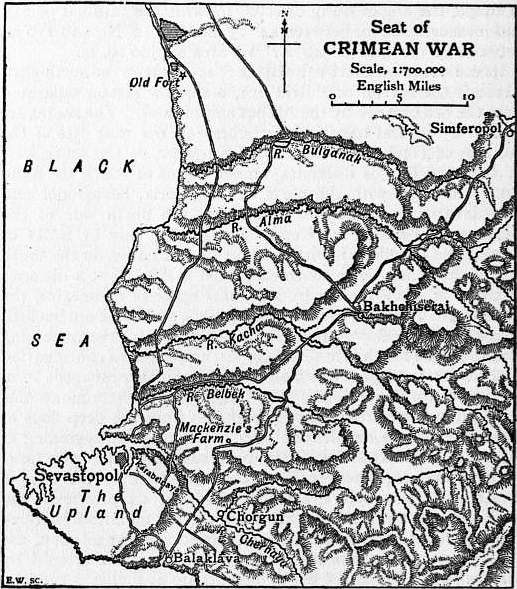
The Invasion of the Crimea.—The primary object of the war had thus easily been obtained. But Great Britain and France were by no means content with a triumph that left untouched the vast resources of an enemy who was certain to employ them at the next opportunity. The two nations felt that Sevastopol, the home of the Black Sea fleet, the port whence Admiral Nachimov had sailed for Sinope, must be crippled for some years at least, and as early as June 29th Lord Raglan and Marshal Saint Arnaud, the allied commanders of England and France, had received instructions to “concert measures for the siege of Sevastopol.” Dynastic considerations reinforced the arguments of policy and popular opinion in the case of France; in Great Britain soldier and civilian alike saw the menace of a Russian Mediterranean fleet in the unfinished forts and busy dockyards. The popular strategy for once coincided with the views of the responsible leaders. Yet there is no sign that either the commanders on the spot or their governments realized the magnitude of the undertaking. Few but the most urgently necessary preparations were made, and cholera, breaking out virulently amongst the French at this time, reduced the army at Varna, and even the fleet at sea, to impotence. The troops were so weakened that, even in September, the five-mile march from camp to transport exhausted most of the men. Heavy weather still further delayed the start, and it was not until the 7th of September that the expedition began to cross the Black Sea. One hundred and fifty war-vessels and transports conveyed the army, which, guarded on all sides by the fighting fleet, crossed without incident and drew up on the Crimean coast on September 13th. Tactical considerations prevailed in the choice of place. The landlocked harbours south of Sevastopol were for the time being neglected, and a spot known as Old Fort preferred, because the long beach, the heavy metal of the ships’ broadsides, and a line of lagoons covering the front offered singularly favourable conditions for the delicate operation of disembarkation. Still, on this side of Sevastopol there was no good harbour, and it is quite open to question whether in this case the strategic necessities of the situation were not neglected in favour of purely tactical and temporary advantages. As a matter of fact no opposition was offered to the landing, but the weather prevented the disembarkation being completed until the 18th. St Arnaud and Raglan had at this time under their orders 51,000 British, French and Turkish infantry, 1000 British cavalry, and 128 guns, and on the 19th this force (less some detachments) began the southward march in order of battle, the British (who alone had their cavalry present) on the exposed left flank, the French next the sea, the fleet moving in the same direction parallel to the troops.
The Alma.—Old Fort was beyond the reach of Menshikov, the Russian commander, but, as the fortress communicated with the interior of Russia via Kerch and Simferopol, it was to be expected that he would either accept battle on the Sevastopol road, or cover Simferopol by a flank attack on Lord Raglan. Both these contingencies were provided for by the order of march, and in due course it was ascertained that the Russians adopted the former alternative, and barred the Sevastopol road on the heights of the river Alma. Menaced by the guns of the fleet, Menshikov had wheeled back his left, and at the same time he strengthened his right in order to cover the Simferopol road. From this it followed naturally that the brunt of the attack fell upon the British divisions, whilst the French, nearer the sea, struck to some extent dans le vide. The two commanders, after a reconnaissance, decided upon their plan. The French divisions in echelon from the right were to cross the river and force Menshikov inwards, whilst the British were to move straight to their front against the strongest part of the Russian line. Substantially this plan was carried out on the 20th of September. Owing to want of men (he had but 36,400 against over 50,000) Menshikov was unable to hold his left wing very strongly, and the French were scarcely checked save by physical obstacles; but opposite the British force the ground sloped glacis-wise up to the Russian line, and nothing but their iron discipline, the best heritage of the Peninsular War, brought them victorious to the crest of Kurghane hill. The Russians had no option but to retreat, which they did without molestation. The allies lost about 3000 men, mostly British (though Prince Napoleon’s men also suffered heavily); the Russians reported 5709 casualties.
The March on Sevastopol.—On the 23rd of September the advance was resumed, and by the 25th Sevastopol was in full view of the allied outposts. It was now that the necessary consequences of the choice of Old Fort as the landing-place presented themselves as a problem for instant solution. Whatever chance there had been of assaulting the north side of Sevastopol was now gone. Menshikov had sacrificed some ships in order to seal up the harbour mouth, and naval co-operation in attack was now impossible, while the other Russian ships could in safety aid the defenders with their heavy guns. A siege, based on the beach of Old Fort or the open roads of Kacha, was out of the question, as was re-embarkation for a fresh landing. There remained only a flank march by Mackenzie’s farm and the river Chernaya. Once established on the south side, the allies could use the excellent harbours of Kamiesh and Balaklava; this could almost certainly be effected without fighting, while in besieging Sevastopol itself and not merely the north side, the allies would be striking at the heart. But a flank march is almost always in itself a hazardous undertaking, and in this case the invaders were required further to abandon their line of retreat on Old Fort. In point of fact, the army, covered by a division opposite the Russian works, successfully accomplished the task. At the same moment Menshikov, after providing for the defence of Sevastopol, had marched out with a field army towards Bakhchiserai, and on the 25th of September each army, without knowing it, actually crossed the other’s front. On arrival at Balaklava the allies regained contact with the fleet, and the detachment left on the north side, its mission being at an end, followed the same route and rejoined the main body. The French now took possession of Kamiesh, the British of Balaklava.
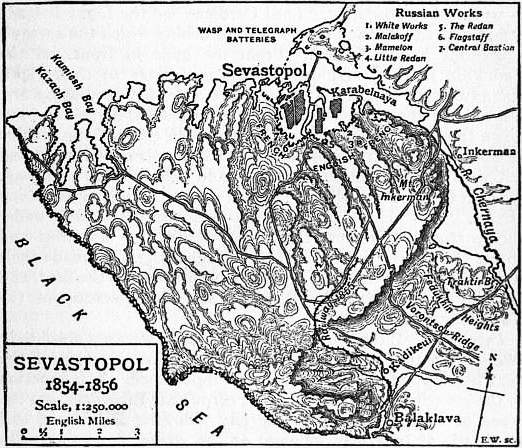
Beginning of the Siege.—Thus secured, the allies closed upon the south side of the fortress. A siege corps was formed, and the British army and General Bosquet’s French corps covered its operations against interruption from the Russian field army. The harbour of Sevastopol, formed by the estuary of the Chernaya, was protected against attack by sea not only by the Russian war-vessels, afloat and sunken, but also by heavy granite forts on the south side and by the works which had defied the allies on the north. For the town itself and the Karabelnaya suburb the trace of the works had been laid down for years. The Malakoff, a great tower of stone, covered the suburb, flanked on either side by the Redan and the Little Redan. The town was covered by a line of works marked by the Flagstaff and central bastions, and separated from the Redan by the inner harbour. Lieut.-Col. Todleben, the Russian chief engineer, had very early begun work on these sites, and daily re-creating, rearming and improving the fortifications, finally connected them by a continuous enceinte. Yet Sevastopol was not, early in October 1854, the towering fortress it afterwards became, and Todleben himself maintained that, had the allies immediately assaulted, they would have succeeded in taking the place. There were, however, many reasons against so decided a course, and it was not until the 17th of October that the first attack took place. All that day a tremendous artillery duel raged. The French siege corps lost heavily and its guns were overpowered. The fleet engaged the harbour batteries close inshore, and suffered a loss of 500 men, besides severe damage to the ships. On the other hand the British siege batteries silenced the Malakoff and its annexes, and, if failure had not occurred at the other points of attack, an assault might have succeeded. As it was, Todleben, by daybreak, had repaired and improved the damaged works. Meanwhile General Canrobert had succeeded St Arnaud (who died on the 29th of September) in the joint leadership of the allies. It was not long before Menshikov and the now augmented field army from Bakhchiserai appeared on the Chernaya and moved towards the Balaklava lines and the British base.
Balaklava.—A long line of works on the upland secured the siege corps from interference, and the Balaklava lines themselves were strong, but the low Vorontsov ridge between the two was weakly held, and here the Russian commander hoped to sever the line of communications. On the 25th of October Liprandi’s corps carried its slight redoubts at the first rush. But the British cavalry stationed at the foot of the upland was situated on their flank, and as the Russian cavalry moved towards Kadikoï, the “Heavy Brigade” under General Scarlett charged home with such effect that Menshikov’s troopers only rallied behind their field batteries near Traktir bridge. At the same time some of the Russian squadrons, coming upon the British 93rd regiment outside the Balaklava lines, were completely broken by the steady volleys of the “thin red line.” The “Light Brigade” of British cavalry, farther north, had hitherto remained inactive, even when the Russians, broken by the “Heavies,” fled across their front. The cavalry commander, Lord Lucan, now received orders to prevent the withdrawal of the guns taken by Liprandi. The aide-de-camp who carried the order was killed by the first shell, and the whole question of responsibility for what followed is wrapped in obscurity. Lord Cardigan led the Light Brigade straight at the Russian field batteries, behind which the enemy’s squadrons had re-formed. From the guns in front, on the Fedukhin heights, and on the captured ridge to their right, the advancing squadrons at once met a deadly converging fire, but the gallant troopers nevertheless reached the guns and cut down the artillerymen. Small parties even charged the cavalry behind, and at least two unbroken squadrons struck out right and left with success, but the combat could only end in one way. The 4th Chasseurs d’Afrique relieved the British left by a dashing charge. The “Heavies” made as if to advance, but came under such a storm of fire that they were withdrawn. By twos and threes the gallant survivors of the “Light Brigade” made their way back. Two-thirds of its numbers were left on the field, and the day closed with the Russians still in possession of the Vorontsov ridge.